Var(X̄) = σ²/n is given; the theorem itself is not.
Since 2018
9 question parts, 43 marks, 2 with a difficulty rating from the examiner's report
Notes, worked examples and practice for this topic are being written by our tutors. The past-paper questions below are ready now: work each one on paper, then open the mark scheme and the examiner's comment.
Tap a question to zoom it. Mark scheme and examiner's comment open under each question.
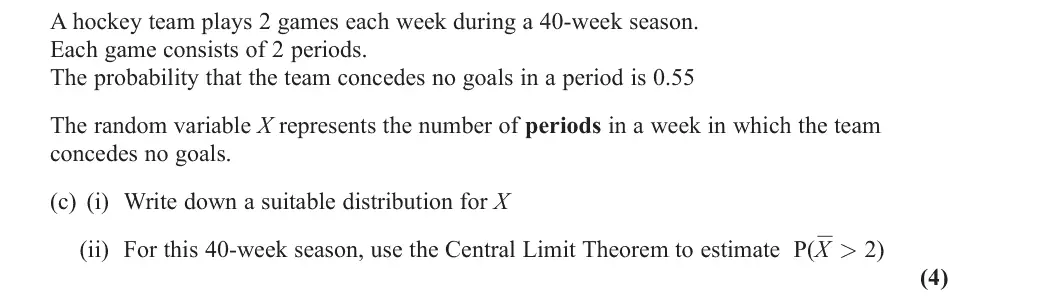
June 2025 · Paper 3B (Further Statistics 1) · Q5(c)4 marks
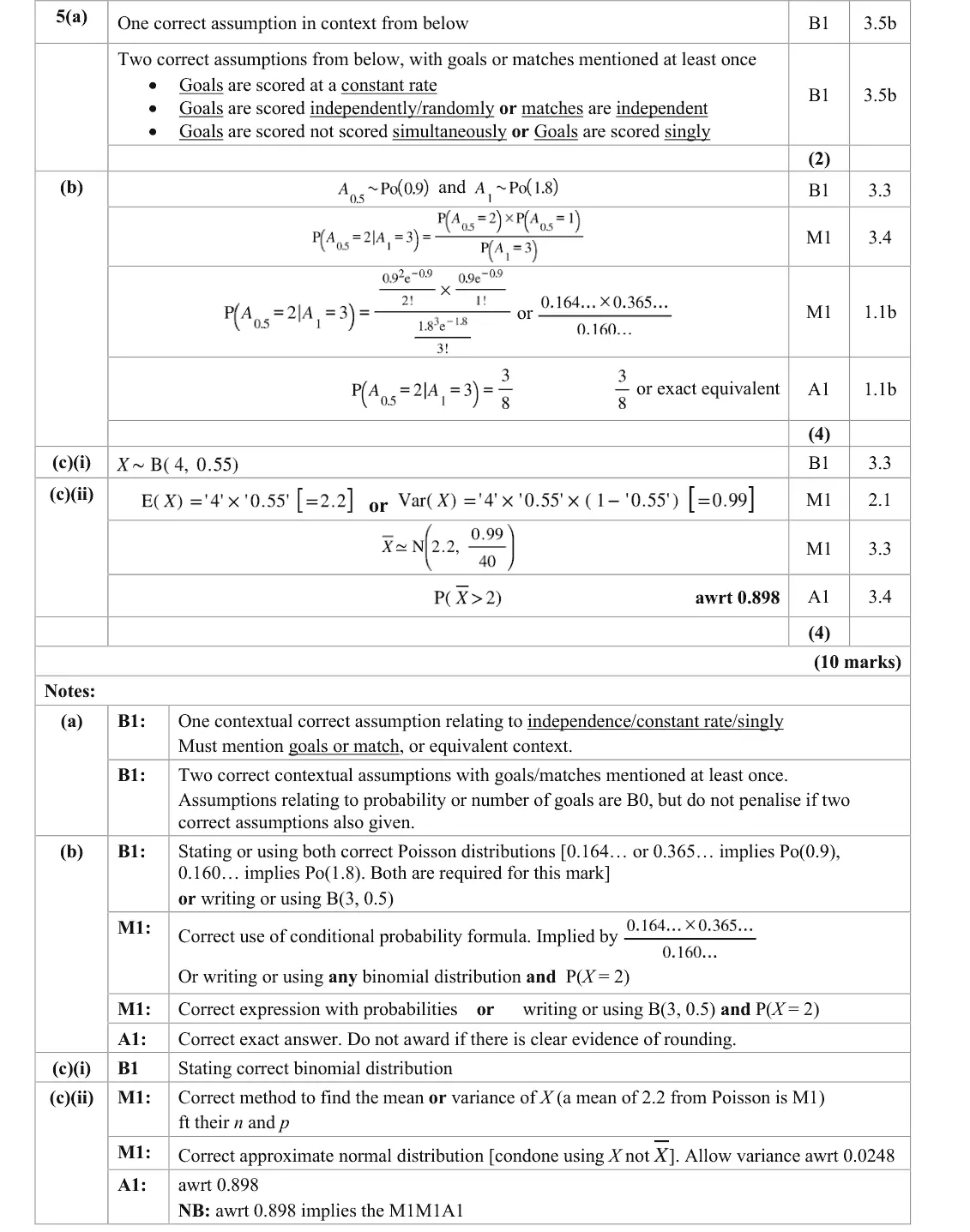
Mark scheme (whole question; this part is marked with the orange bar)
Examiner's comment
Part (c) saw most of the candidates back on track and scoring highly, serving as a nice reset after a challenging part (b). The question was well-scaffolded, and most candidates scored the first mark for stating the correct distribution, and even those that made a mistake on this, went on to score the following mark for finding the mean. Although most candidates knew the method for finding the variance, some forgot to divide by n when using the CLT.
Key points from the mark scheme and examiner's report
(i) X ~ B(4, 0.55)
(ii) mean 2.2, variance 0.99
CLT X̄ ≈ N(2.2, 0.99/40)
P(X̄ > 2) = 0.898
forgetting to divide by n
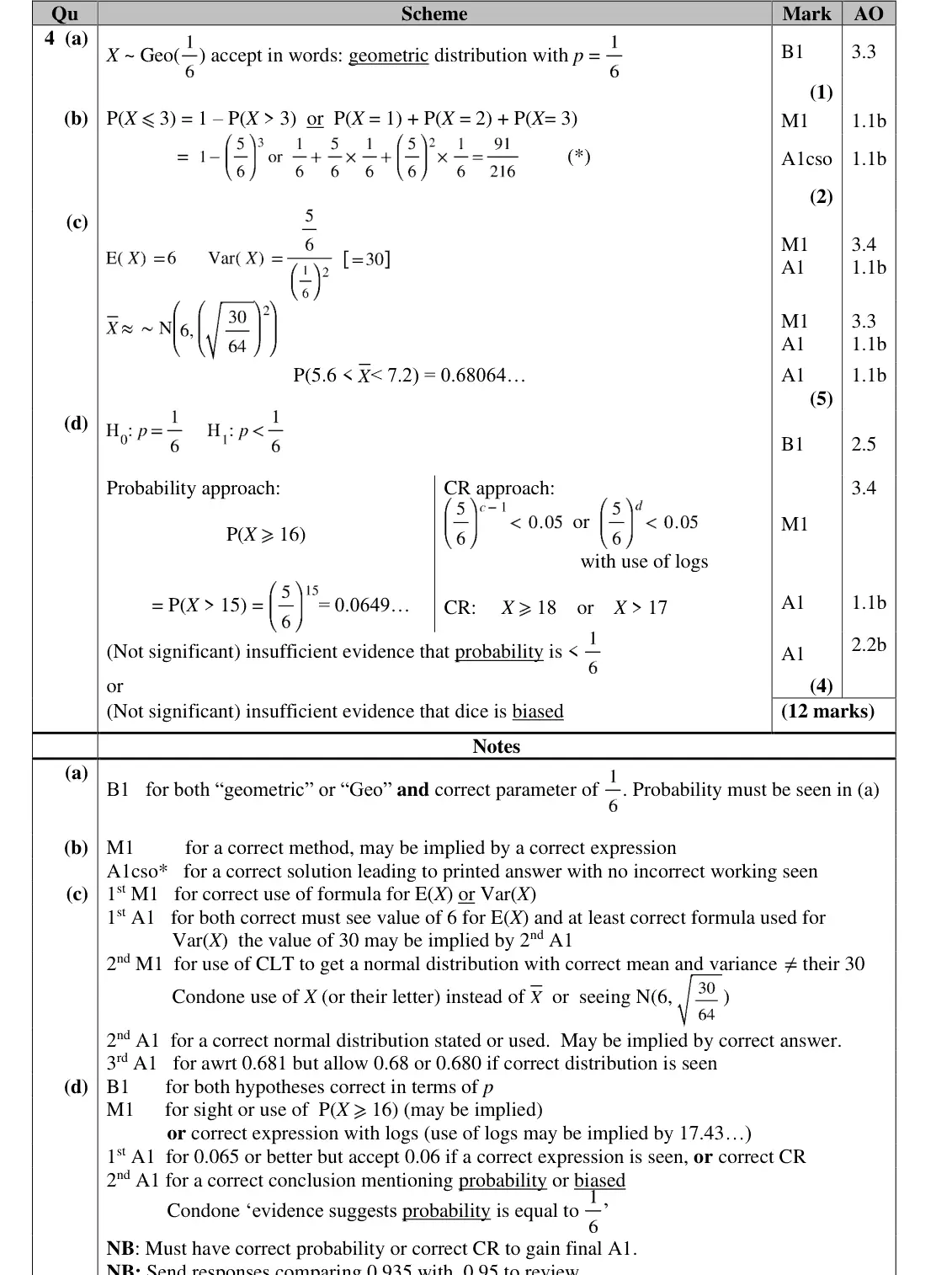
June 2024 · Paper 3B (Further Statistics 1) · Q4(c)5 marks
Mark scheme (whole question; this part is marked with the orange bar)
Examiner's comment
The high level of success the candidates had with part (c) was most encouraging. Again, most candidates realised that the central limit theorem was required and were able to correctly reach the required answer. On the whole the candidates’ working was clear, showed good notation, and was concise.
Key points from the mark scheme and examiner's report
E(X) = 6, Var(X) = (5/6)/(1/6)² = 30
CLT X̄ ≈ N(6, 30/64)
P(5.6 < X̄ < 7.2) = 0.681
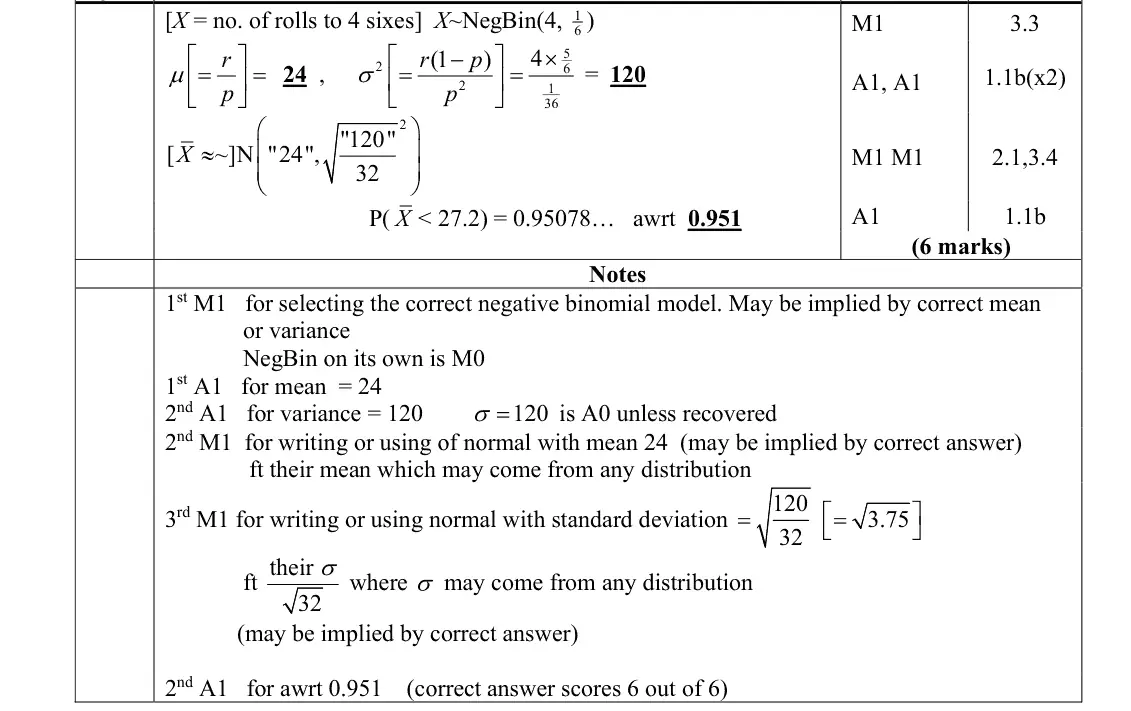
June 2023 · Paper 3B (Further Statistics 1) · Q46 marks
Mark scheme (whole question; this part is marked with the orange bar)
Examiner's comment
This proved to be the most accessible question on the paper and it was quite common to see students earning full marks. Most correctly identified the Negative Binomial distribution and correctly calculated its mean and variance. The vast majority went on to identify the correct normal distribution for the mean and obtain the required probability.
Key points from the mark scheme and examiner's report
rolls to 4 sixes ~ NB(4, 1/6): μ = 24, σ² = 120
CLT X̄ ≈ N(24, 120/32)
P(X̄ < 27.2) = 0.951
June 2022 · Paper 3B (Further Statistics 1) · Q55 marksEasy
Mark scheme (whole question; this part is marked with the orange bar)
Examiner's comment
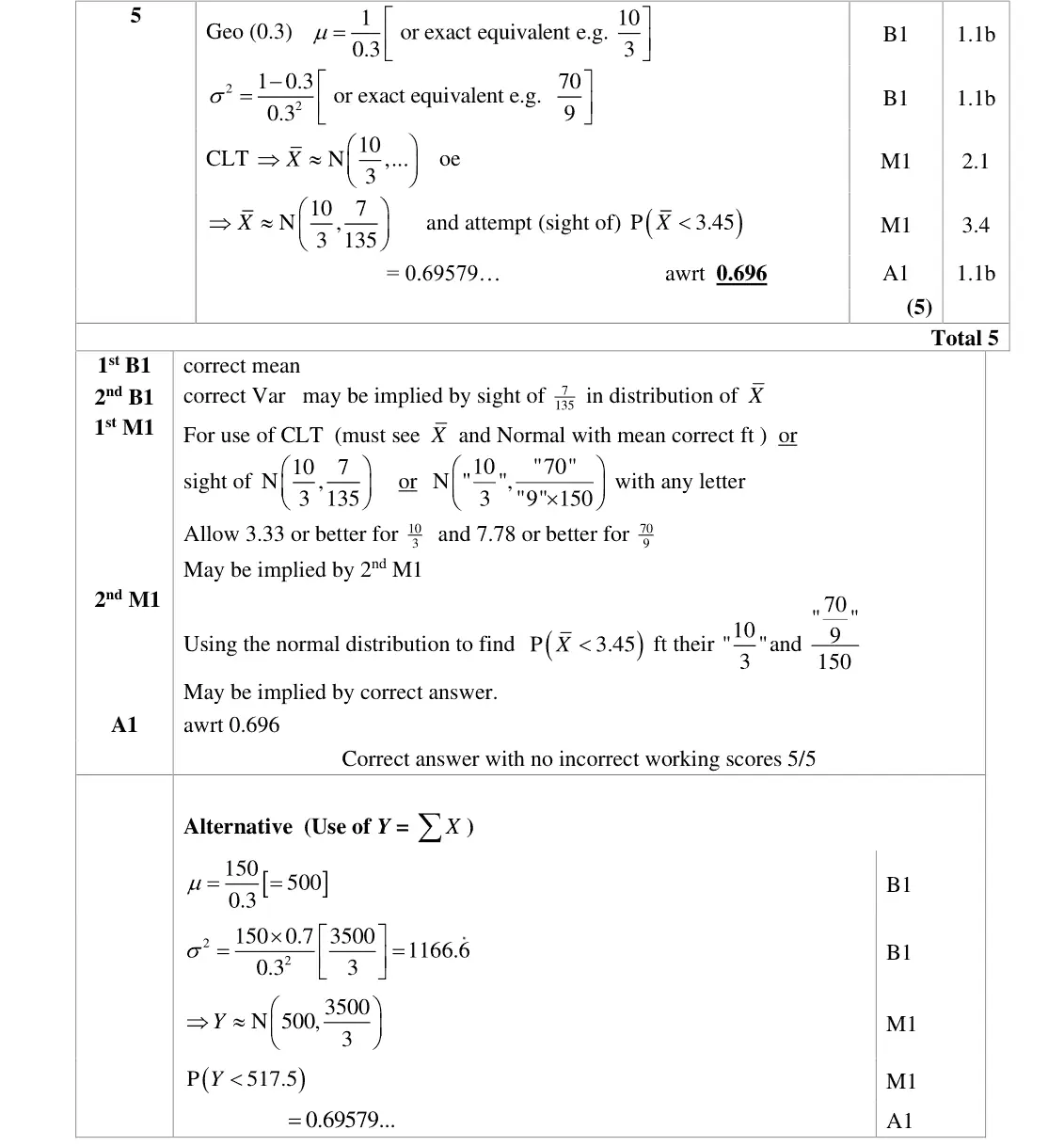
The Advanced Information may well have helped students as they should have been expecting a question involving the Central Limit Theorem and over 75% scored full marks here. The correct mean and variance of the given geometric distribution were nearly always found but a few failed to divide the variance by 150 when forming the distribution for the mean. There was some confusion over the correct notation: we expected to see X and 10 7 N , 3 135 but often X was used for both Geo(0.3) and this normal distribution and occasionally the normal distribution was stated as 10 7 N , 3 135 but if this was used correctly we condoned the incorrect notation.
Key points from the mark scheme and examiner's report
Geo(0.3): μ = 10/3, σ² = 70/9
CLT X̄ ≈ N(10/3, 7/135)
P(X̄ < 3.45) = 0.696
failing to divide the variance by 150
same letter for X and X̄
Nov 2021 · Paper 3B (Further Statistics 1) · Q34 marks
Mark scheme (whole question; this part is marked with the orange bar)
Examiner's comment
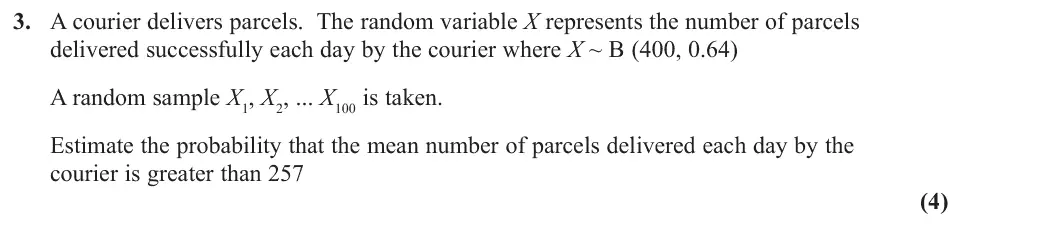
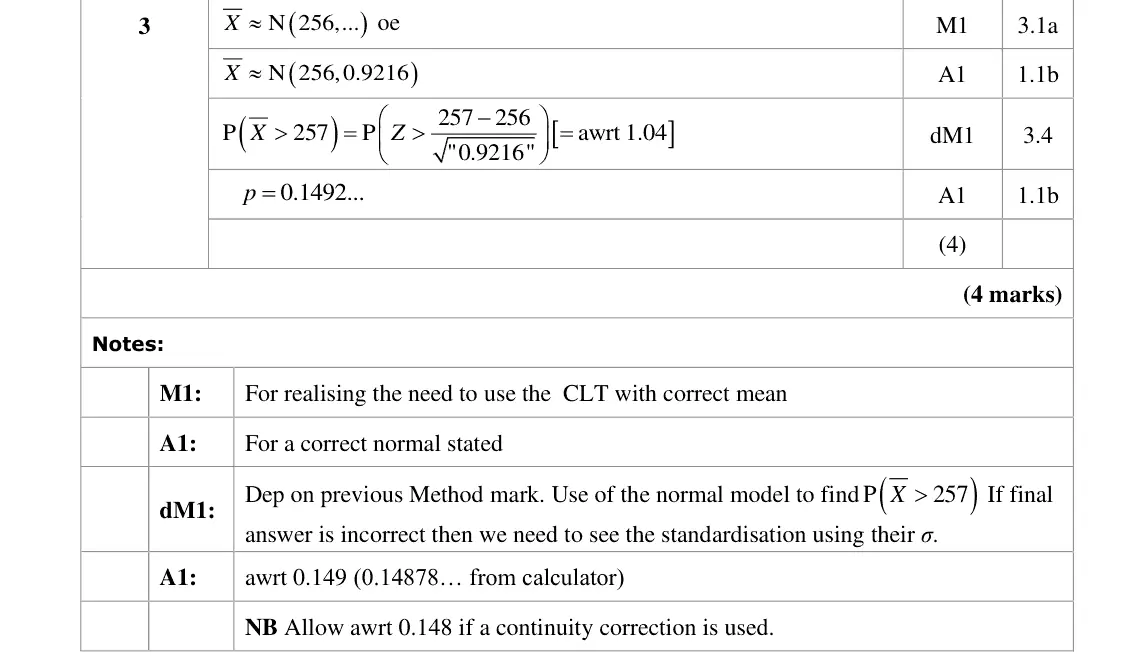
Many of the candidates who realised that the central limit theorem was needed gained at least the first 2 marks. The most common error was using 0.9216 400 for the variance rather than 0.9216 100 . Use of correct notation was not good with the statements like ( ) ~ N 256,0.9216 X often being used correctly as ( ) ~ N 256,0.9216 X . Candidates should be aware that there is an assessment objective in the new specification that requires “correct use of mathematical notation” and correct handling of normal distribution notation may be required in future assessments.
Key points from the mark scheme and examiner's report
dividing by 400 instead of 100 was the common error
poor normal notation
Oct 2020 · Paper 3B (Further Statistics 1) · Q7(a)8 marks
Mark scheme (whole question; this part is marked with the orange bar)
Examiner's comment
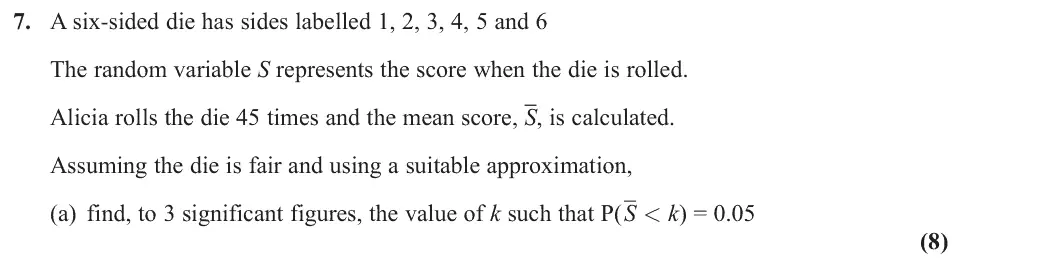
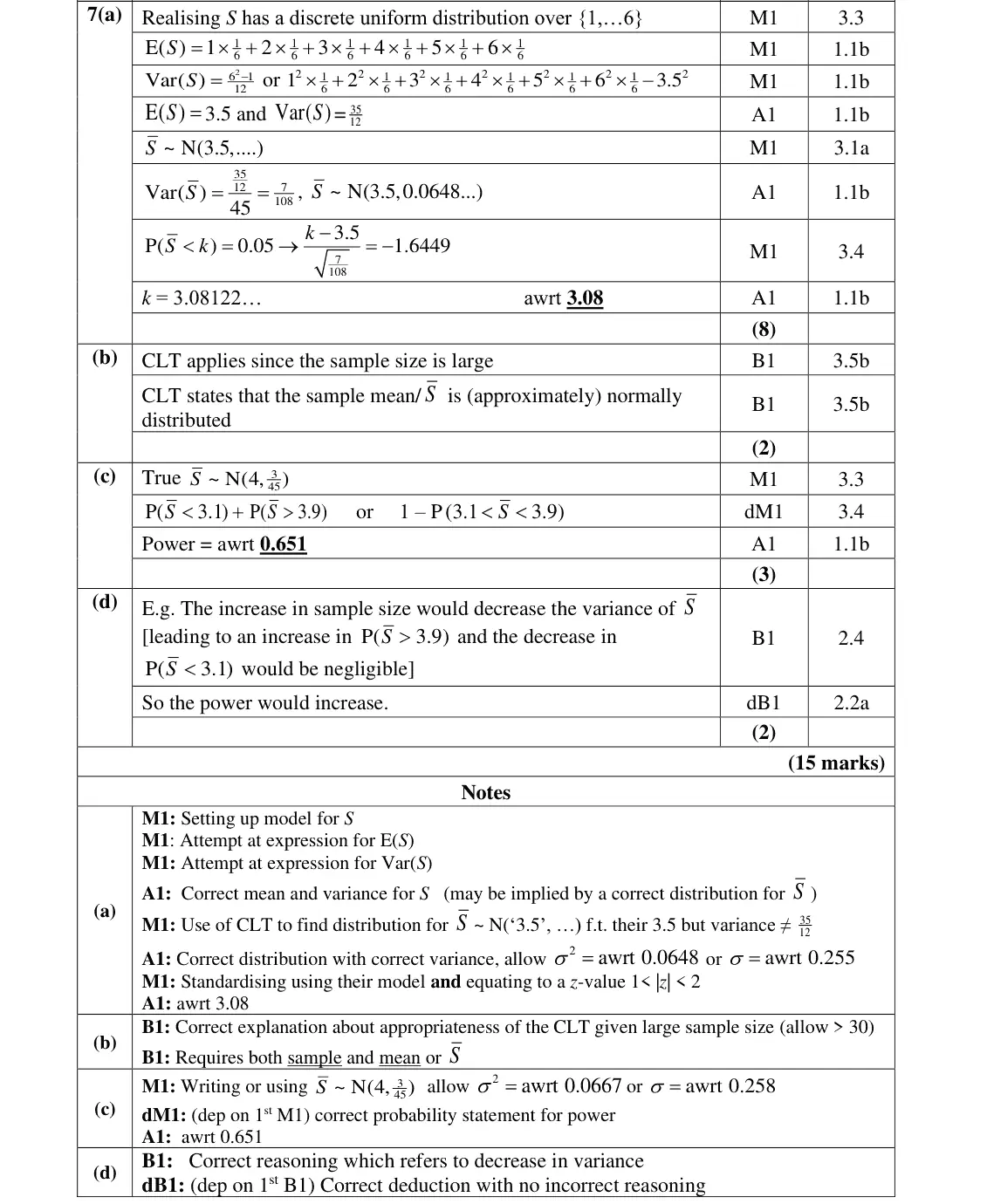
Most candidates recognised the discrete uniform distribution in part (a), correctly finding its mean and variance. Many then correctly identified the sampling distribution of the mean as a normal distribution (using the CLT) although many made an error with the variance failing to divide by 45. Attempts at standardisation were commonly shown although some used the original variance. Whilst there were many completely correct attempts there were one or two with sign errors on their value of z leading to an incorrect answer that was higher than the mean. Many candidates struggled in part (b) through lack of rigour in their statements.
Key points from the mark scheme and examiner's report
discrete uniform: E(S) = 3.5, Var(S) = 35/12
CLT: S̄ ≈ N(3.5, 7/108)
(k − 3.5)/√(7/108) = −1.6449, k = 3.08
failing to divide the variance by 45
Oct 2020 · Paper 3B (Further Statistics 1) · Q7(b)2 marks
Mark scheme (whole question; this part is marked with the orange bar)
Examiner's comment
Many candidates struggled in part (b) through lack of rigour in their statements. Comments often lacked reference to sample mean when referring to using normal distribution as an approximation. Only a small number referred to the need for sample size to be large.
Key points from the mark scheme and examiner's report
sample size 45 is large so the sample mean is approximately normally distributed
must refer to both sample size and the mean
Oct 2020 · Paper 3B (Further Statistics 1) · Q7(c)3 marks
Mark scheme (whole question; this part is marked with the orange bar)
Examiner's comment
Part (c) was commonly successful although common errors were using the original variance or finding the complement of power. Whilst most correctly suggested the power would increase in part (d), many failed to
Key points from the mark scheme and examiner's report
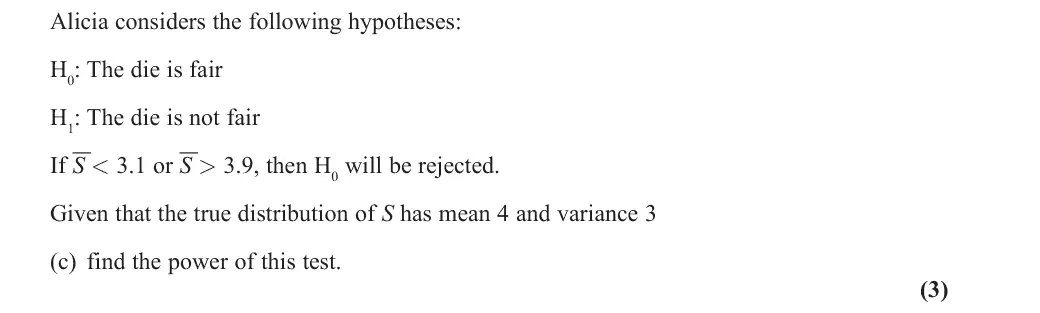
true S̄ ~ N(4, 3/45)
power = P(S̄ < 3.1) + P(S̄ > 3.9) = 0.651
using the unscaled variance or giving the complement
June 2019 · Paper 3B (Further Statistics 1) · Q36 marksEasy
Mark scheme (whole question; this part is marked with the orange bar)
Examiner's comment
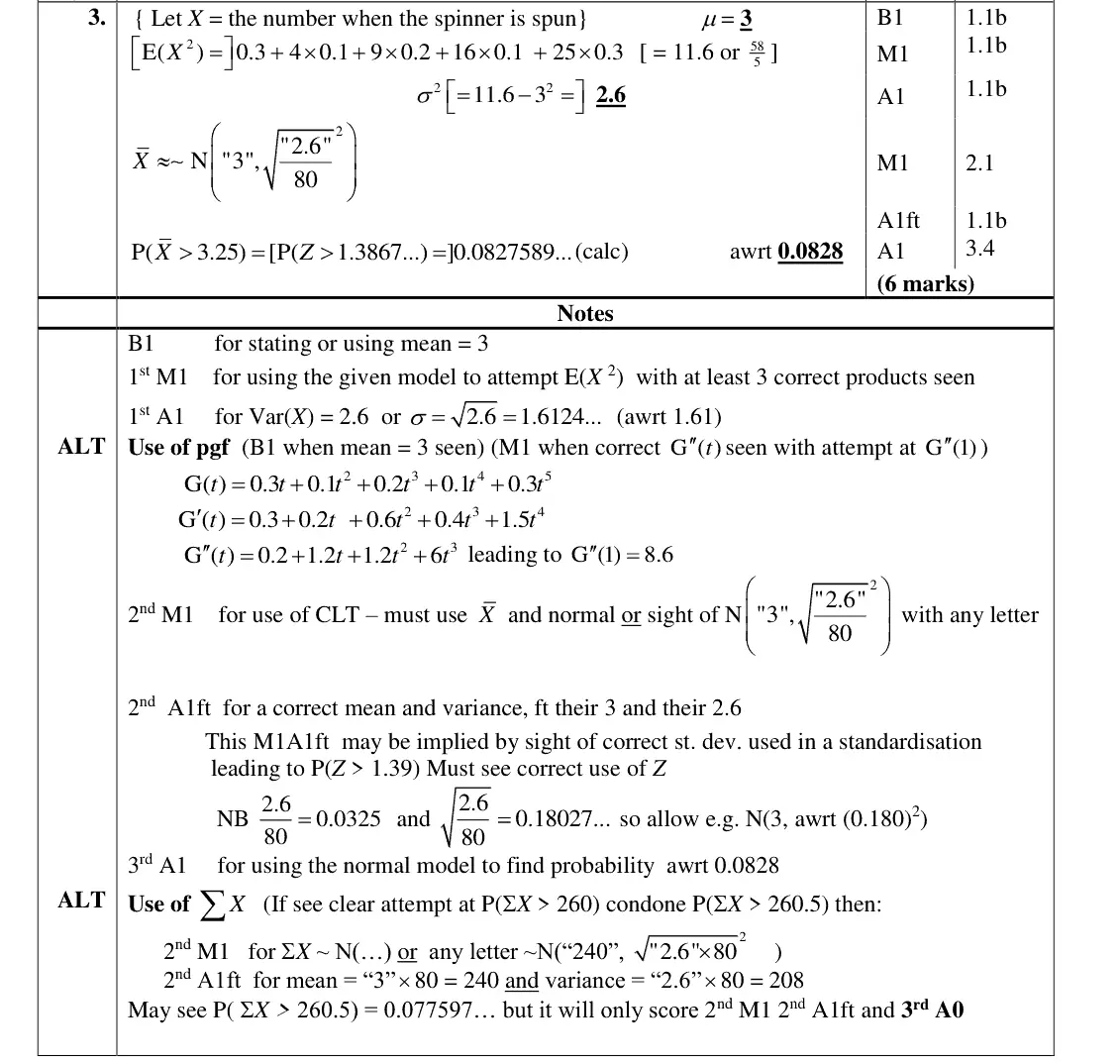
This turned out to be the most successfully answered question on the paper with nearly 70% scoring full marks. Even those who did not spot the need to use the central limit theorem could often score the first 3 marks although some still struggled to use the correct formula for the variance with – E(X), instead of – E(X2), a common error. Use of correct notation was not good with the statements like 2.6 ~ N 3, 80 X often being used correctly as 2 2.6 ~ N 3, 80 X . Candidates should be aware that there is an assessment objective in the new specification that requires “correct use of mathematical notation” and correct handling of normal distribution notation may be required in future assessments.
Key points from the mark scheme and examiner's report
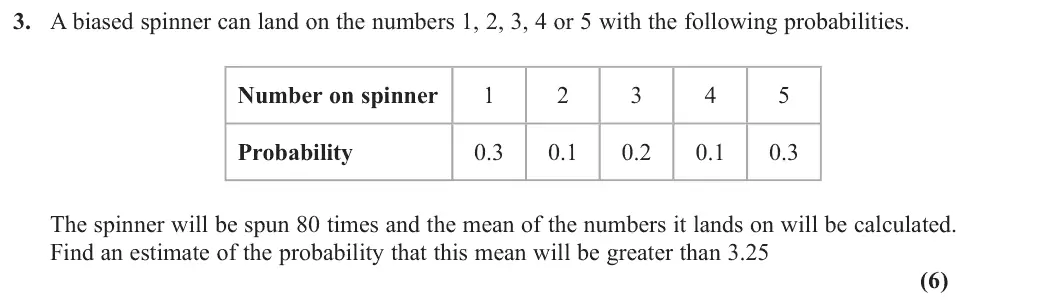
mean 3, Var(X) = 11.6 − 3² = 2.6
CLT: X̄ ≈ N(3, 2.6/80)
P(X̄ > 3.25) = 0.0828
Var using E(X) not E(X²) was common
poor normal notation
Find an Edexcel Further Maths tutor
Stuck on this? Book a trial lesson with our Further Maths tutor.