E(XY) and Var(aX ± bY) for independent variables are given.
Since 2018
14 question parts, 75 marks
Notes, worked examples and practice for this topic are being written by our tutors. The past-paper questions below are ready now: work each one on paper, then open the mark scheme and the examiner's comment.
Tap a question to zoom it. Mark scheme and examiner's comment open under each question.
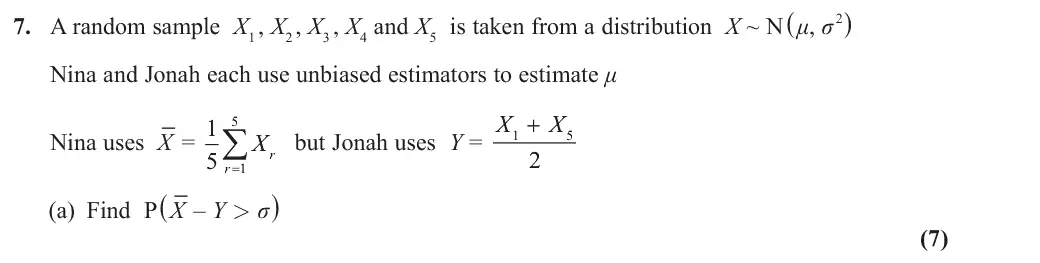
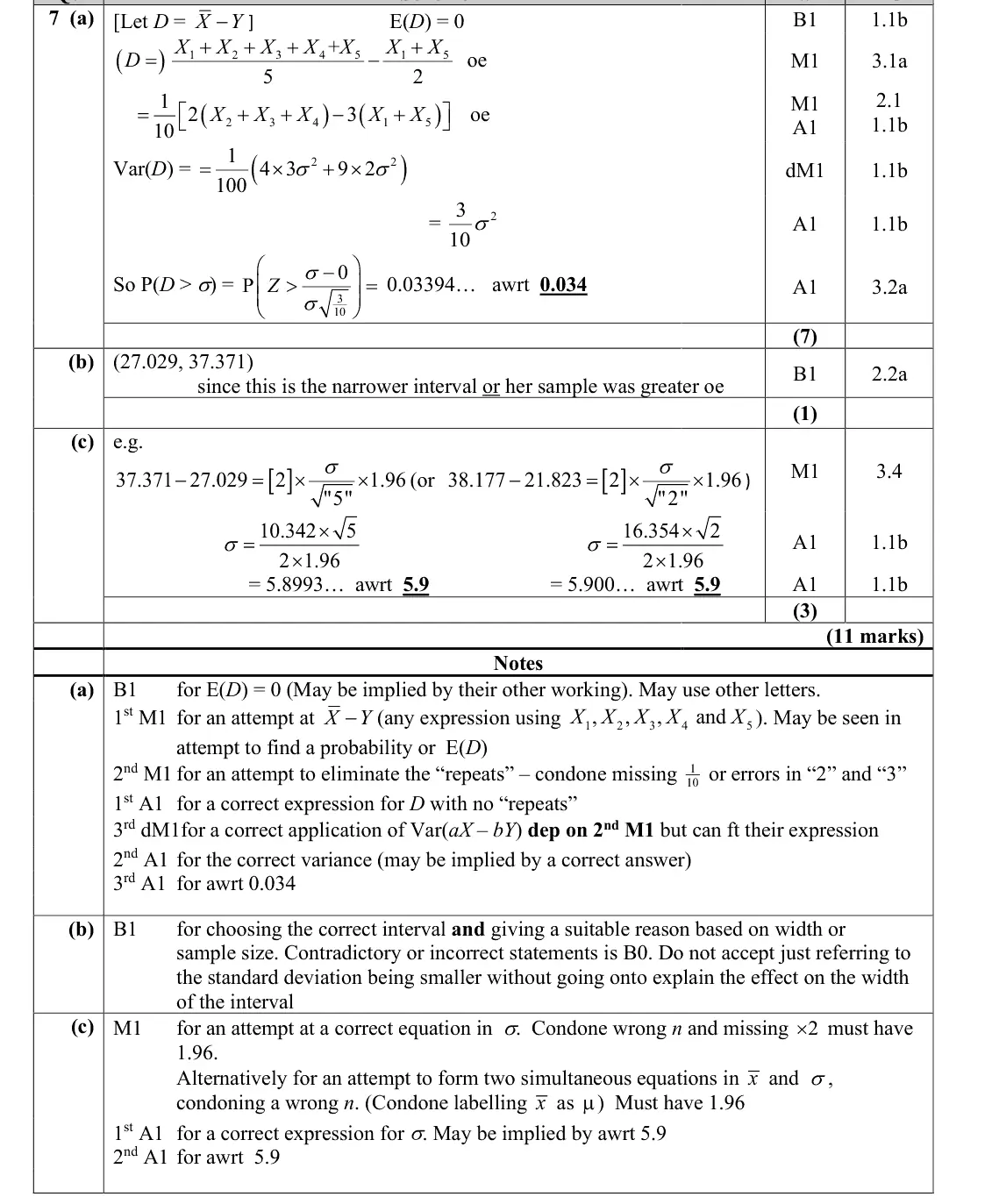
June 2025 · Paper 4B (Further Statistics 2) · Q7(a)7 marks
Mark scheme (whole question; this part is marked with the orange bar)
Examiner's comment
This was the most demanding question on the paper and it was extremely rare to see any meaningful progress made in part (a). It was unusual to see more than half of the available marks scored for the question overall. In part (a) candidates were typically able to find the expected value for X , however in Y - most cases this was the only mark scored. Sometimes candidates did start to write an expression involving the individual values taken from the sample but made no attempt to simplify the expression or appreciate that some of the observations were the same (and so remove/combine some of the repeats). This meant that no further marks were scored. Despite the difficulties encountered in part (a), a pleasing number of candidates made good progress in the final part of this question. Usually, they were able to form a valid equation
Key points from the mark scheme and examiner's report
D = X̄ − Y = (1/10)[2(X₂ + X₃ + X₄) − 3(X₁ + X₅)] (collect the repeated X₁, X₅ first)
E(D) = 0, Var(D) = (12 + 18)σ²/100 = 0.3σ²
P(D > σ) = P(Z > 1/√0.3) = 0.034
very few progressed beyond E(D)
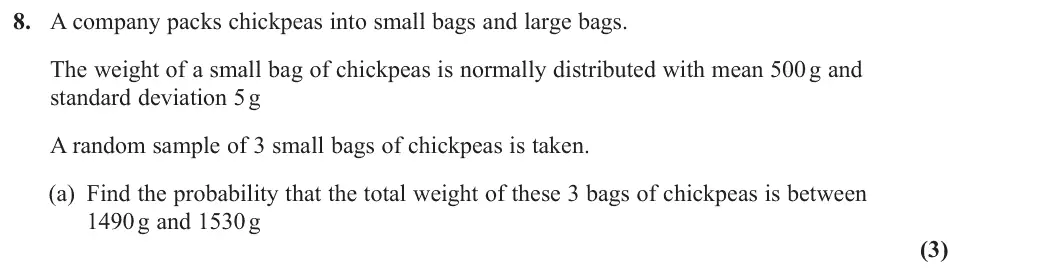
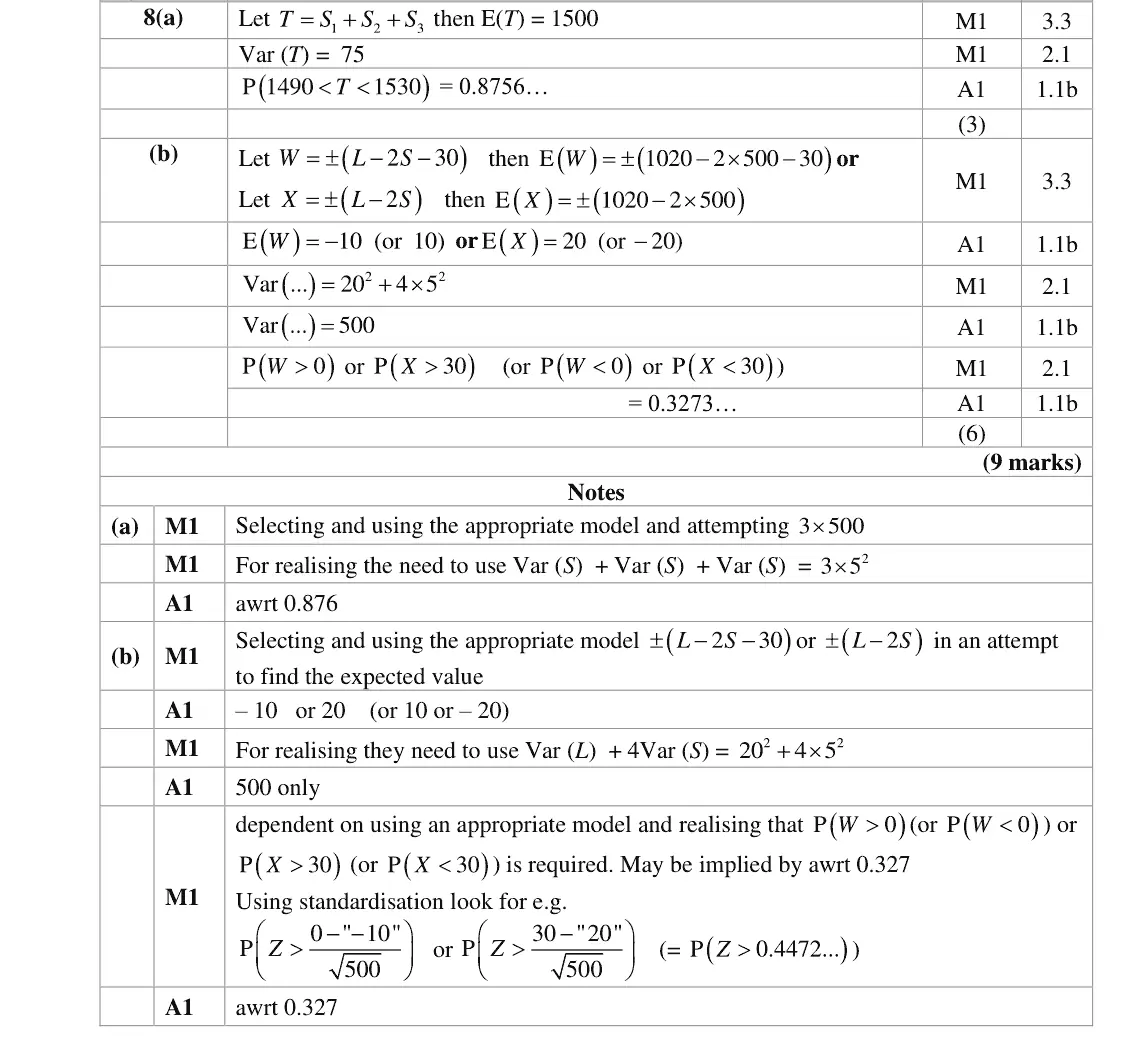
June 2024 · Paper 4B (Further Statistics 2) · Q8(a)3 marks
Mark scheme (whole question; this part is marked with the orange bar)
Examiner's comment
This was possibly one of the most successfully answered questions on the paper and demonstrated great confidence amongst the majority of candidates when working with combinations of random variables. Typically, in parts (a) and (b) candidates were able to select appropriate models and found correct means for their variables. Where errors did occur, it was often in finding the variance with the misconception that they were working with e.g. 2 Var(3 ) 9Var( ) 9 X X = = rather than 2 1 2 3 Var( ) Var( ) Var( ) 3 X X X + + = .
Key points from the mark scheme and examiner's report
T = S₁ + S₂ + S₃ ~ N(1500, 3 × 5² = 75), not 9 × 25
P(1490 < T < 1530) = 0.876
June 2024 · Paper 4B (Further Statistics 2) · Q8(b)6 marks
Mark scheme (whole question; this part is marked with the orange bar)
Examiner's comment
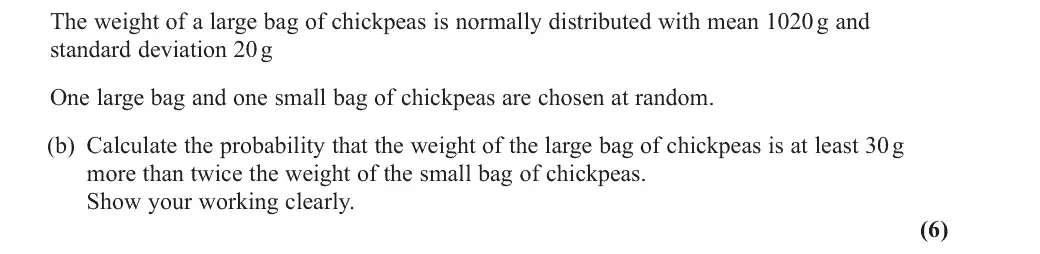
This was possibly one of the most successfully answered questions on the paper and demonstrated great confidence amongst the majority of candidates when working with combinations of random variables. Typically, in parts (a) and (b) candidates were able to select appropriate models and found correct means for their variables. Where errors did occur, it was often in finding the variance with the misconception that they were working with e.g. 2 Var(3 ) 9Var( ) 9 X X = = rather than 2 1 2 3 Var( ) Var( ) Var( ) 3 X X X + + = . In part (b), those who kept the model simple and intuitive ( 2 ) L S - were most likely to avoid errors in choosing the required probability to achieve the answer in part (b). Fortunately, those who had misunderstood how to find the variance when combining three independent random variables in part (a) did not result in making the same error in this part as they correctly found 2 2 5 4 20 + with the only rare error being in forgetting to square the standard deviations given in the question. Some candidates did form the model ( 2 30) L S - - , although this was less common.
Key points from the mark scheme and examiner's report
X = L − 2S ~ N(20, 20² + 4 × 5² = 500)
P(X ≥ 30) = P(Z > 0.447) = 0.327
keep the model simple (L − 2S)
June 2023 · Paper 4B (Further Statistics 2) · Q4(a)3 marks
Mark scheme (whole question; this part is marked with the orange bar)
Examiner's comment
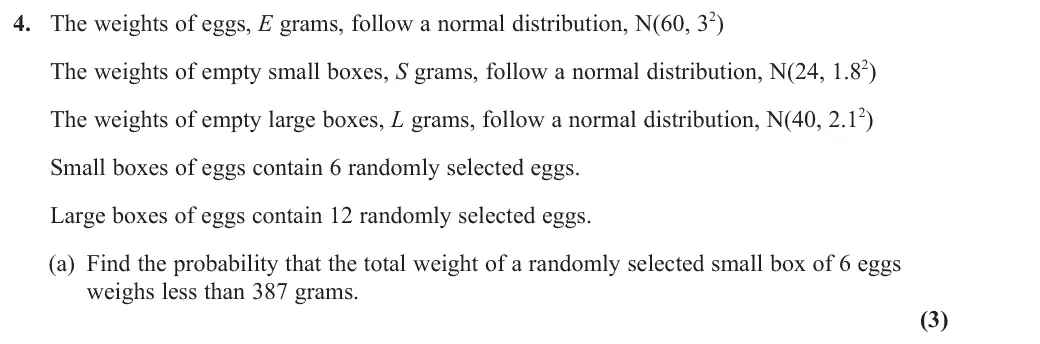
This was another fairly routine question. However, a surprisingly high number of students appeared to struggle to reach correct answers to both parts. Almost all candidates understood the method for combining means to gain the first mark in (a), but a good number used an incorrect method to find the combined variance. The most common error was squaring the 6 and using 36 instead of 6 to multiply the variance for one egg. This error cost these candidates two marks in (a). Candidates who only scored one mark in (a) were often able to gain two more in (b) for combining means. However, those who had a limited understanding of how to combine variances continued to struggle. This question produced a fairly polarised number of marks gained. A good number of candidates found the question routine and easily gained all marks. However, those that struggled with variances usually scored significantly fewer marks.
Key points from the mark scheme and examiner's report
W = E₁ + … + E₆ + S ~ N(384, 6 × 3² + 1.8² = 57.24)
P(W < 387) = 0.654
common error multiplying the egg variance by 36 instead of 6
June 2023 · Paper 4B (Further Statistics 2) · Q4(b)5 marks
Mark scheme (whole question; this part is marked with the orange bar)
Examiner's comment
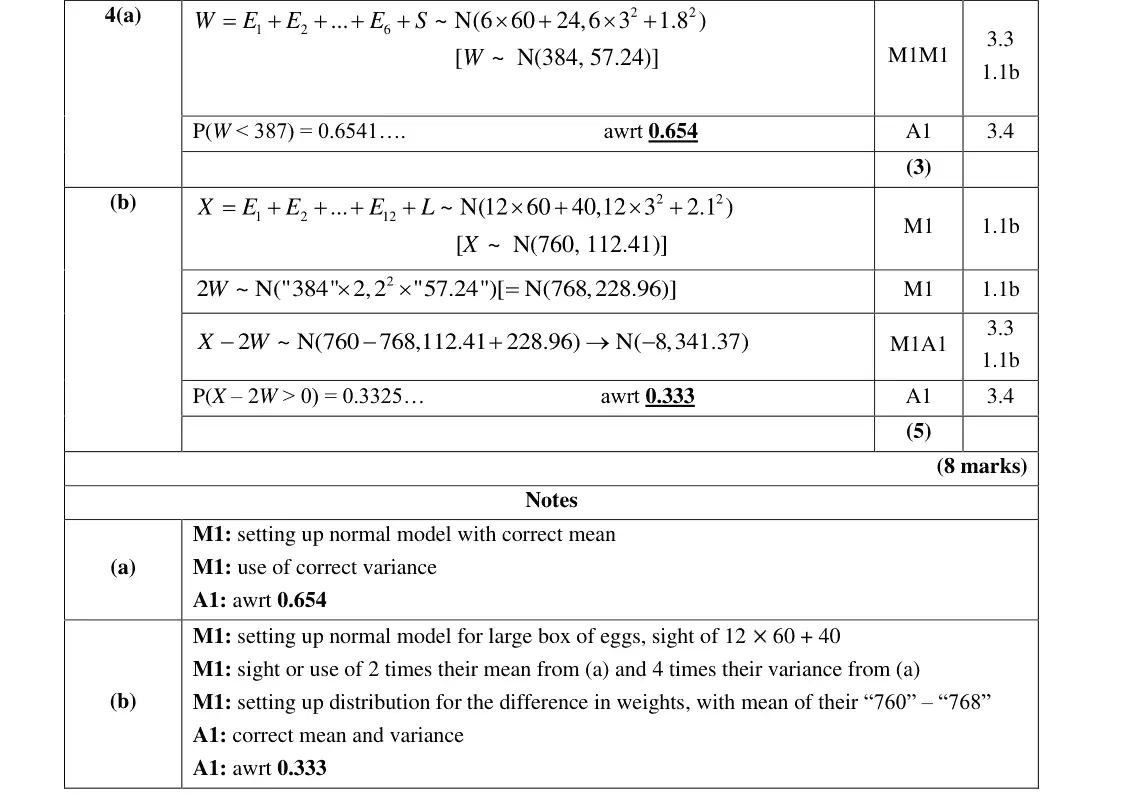
This was another fairly routine question. However, a surprisingly high number of students appeared to struggle to reach correct answers to both parts. In part (b), candidates were required to carry out a similar task as in (a), but also be able to distinguish between the method for adding variables to that of comparing multiples of the same variable.
Key points from the mark scheme and examiner's report
X = 12 eggs + L ~ N(760, 112.41)
2W ~ N(768, 4 × 57.24) (a multiple, so ×4, not a sum of two boxes)
X − 2W ~ N(−8, 341.37)
P(X − 2W > 0) = 0.333
June 2022 · Paper 4B (Further Statistics 2) · Q36 marks
Mark scheme (whole question; this part is marked with the orange bar)
Examiner's comment
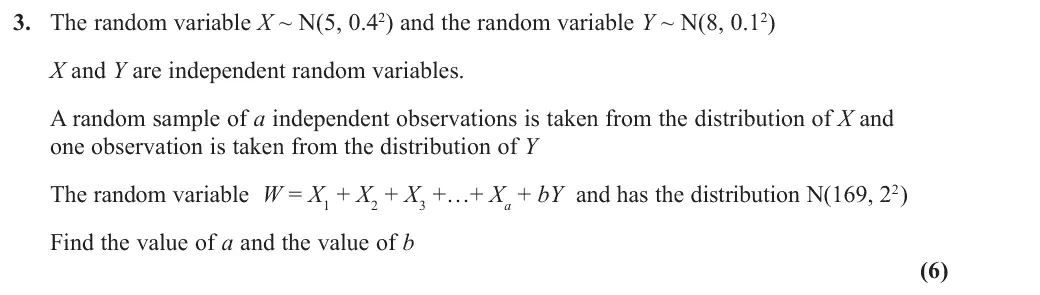
4 Candidates are generally well prepared for this type of question and most successfully scored full marks here. Occasional slips included forgetting to square b in the equation for the variance. Most were able to solve their simultaneous equations with ease and go on to select the appropriate pair of solutions from the quadratic equation.
Key points from the mark scheme and examiner's report
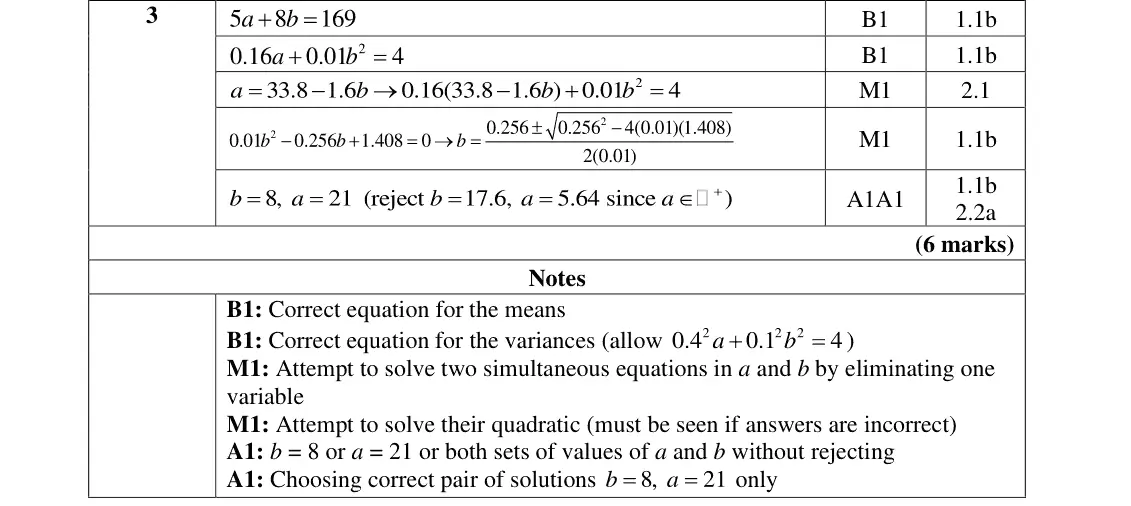
means: 5a + 8b = 169
variances: 0.16a + 0.01b² = 4 (b is squared, a is not)
quadratic 0.01b² − 0.256b + 1.408 = 0 gives b = 8, a = 21 (reject b = 17.6 since a = 5.64 not an integer)
forgetting to square b was the usual slip
Nov 2021 · Paper 4B (Further Statistics 2) · Q7(a)3 marks
Mark scheme (whole question; this part is marked with the orange bar)
Key points from the mark scheme and examiner's report
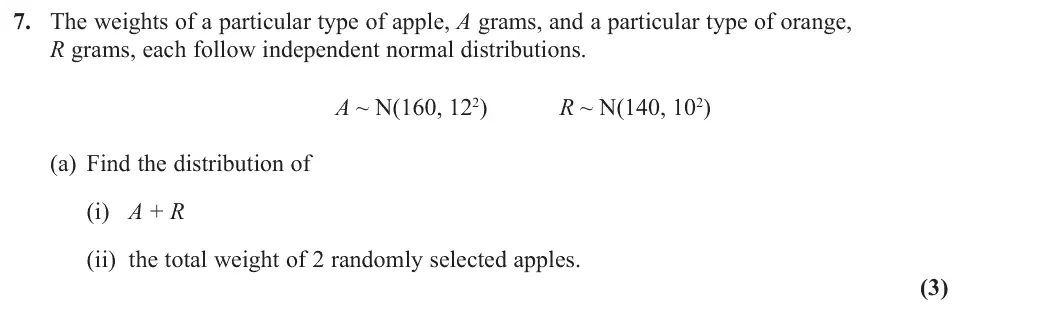
A + R ~ N(300, 12² + 10²)
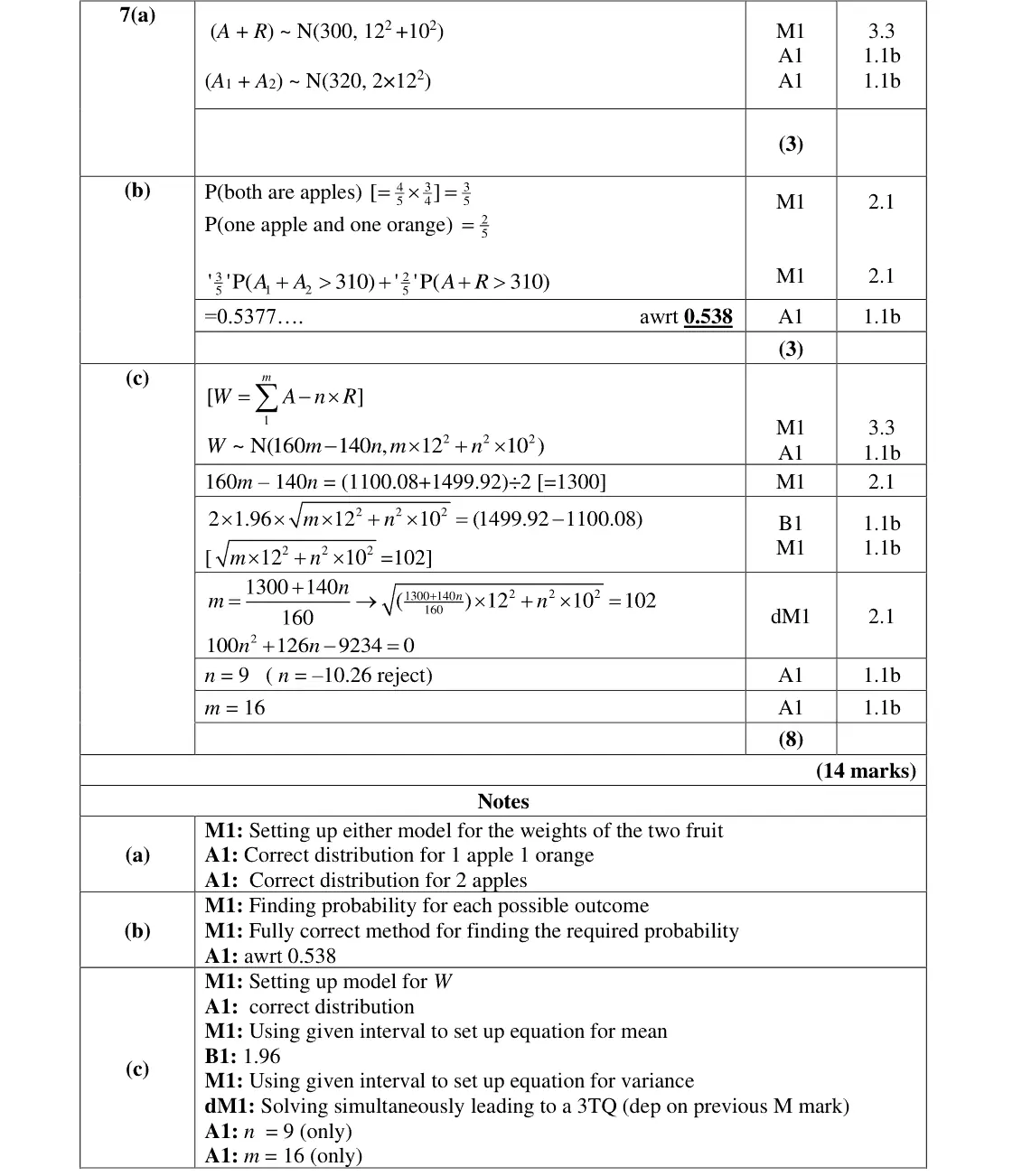
A₁ + A₂ ~ N(320, 2 × 12²), not 4 × 12² (that would be 2A)
Nov 2021 · Paper 4B (Further Statistics 2) · Q7(b)3 marks
Mark scheme (whole question; this part is marked with the orange bar)
Key points from the mark scheme and examiner's report
P(two apples) = 3/5, P(apple and orange) = 2/5
0.6 P(A₁ + A₂ > 310) + 0.4 P(A + R > 310) = 0.538
Nov 2021 · Paper 4B (Further Statistics 2) · Q7(c)8 marks
Mark scheme (whole question; this part is marked with the orange bar)
Key points from the mark scheme and examiner's report
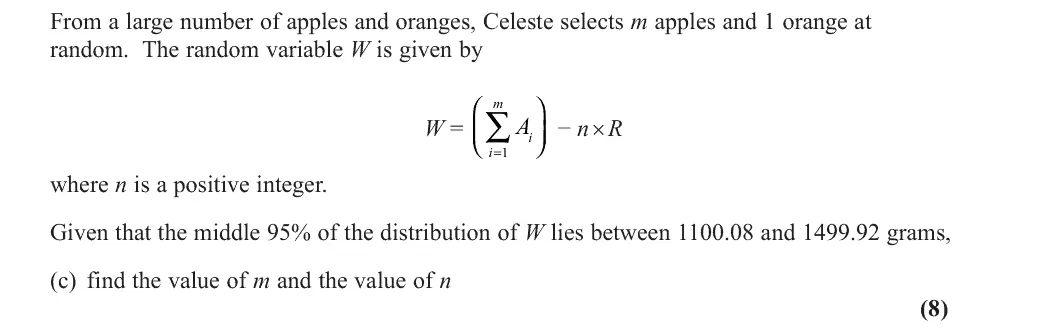
W ~ N(160m − 140n, 144m + 100n²)
mean 1300 from the midpoint
1.96σ = 199.92 gives σ = 102
substitute m = (1300 + 140n)/160 into the variance equation: 100n² + 126n − 9234 = 0, n = 9, m = 16
Oct 2020 · Paper 4B (Further Statistics 2) · Q7(a)6 marks
Mark scheme (whole question; this part is marked with the orange bar)
Key points from the mark scheme and examiner's report
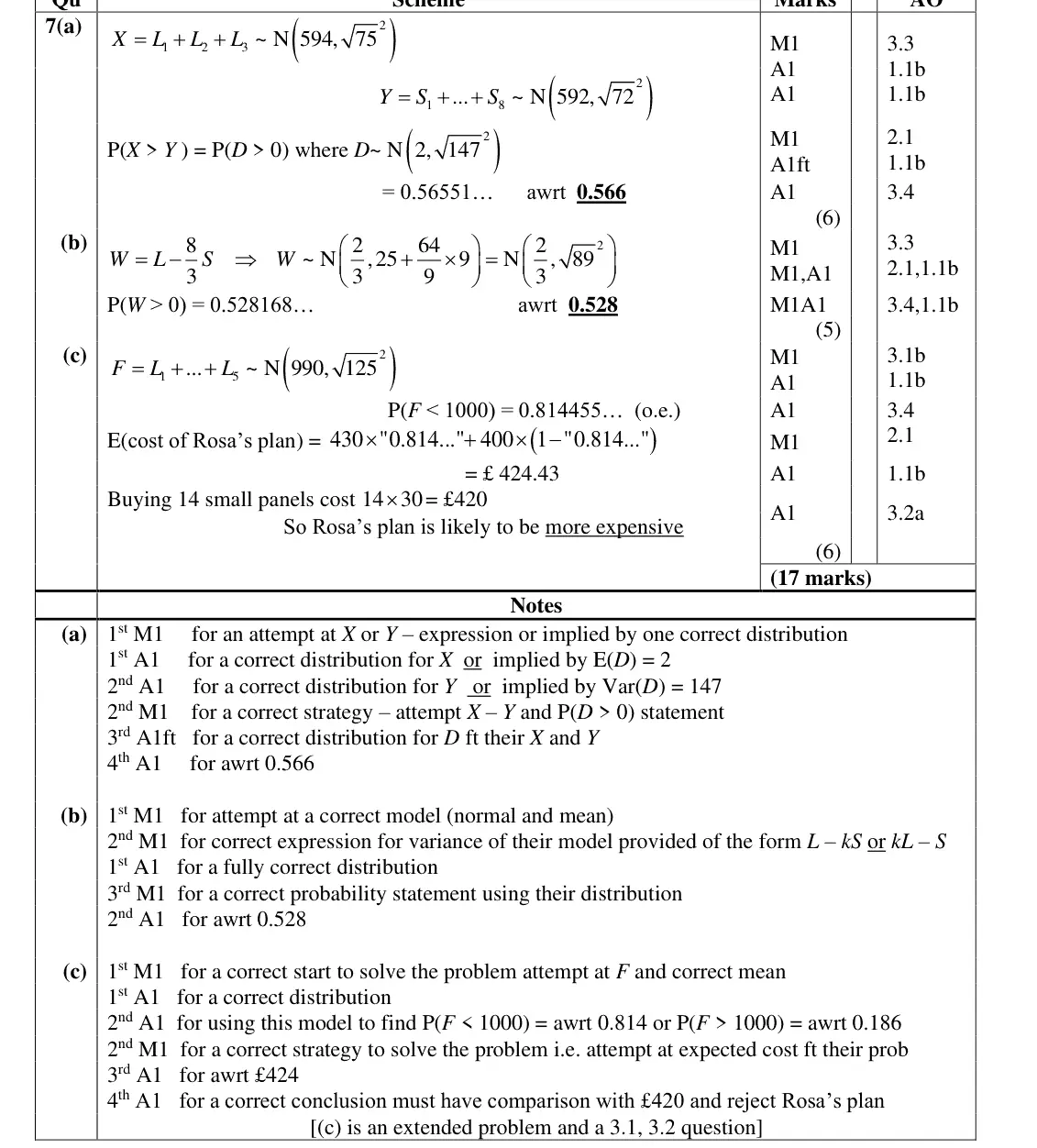
sum of 3 large ~ N(594, 75), sum of 8 small ~ N(592, 72)
D = X − Y ~ N(2, 147)
P(D > 0) = 0.566
Oct 2020 · Paper 4B (Further Statistics 2) · Q7(b)5 marks
Mark scheme (whole question; this part is marked with the orange bar)
Key points from the mark scheme and examiner's report
W = L − (8/3)S ~ N(2/3, 25 + (64/9) × 9 = 89)
multiply the variance by (8/3)², not 8/3
P(W > 0) = 0.528
Oct 2020 · Paper 4B (Further Statistics 2) · Q7(c)6 marks
Mark scheme (whole question; this part is marked with the orange bar)
Key points from the mark scheme and examiner's report
F = sum of 5 large ~ N(990, 125)
P(F < 1000) = 0.814
expected cost 430 × 0.814 + 400 × 0.186 = £424.43 > £420 for 14 small panels, so Rosa's plan is more expensive
extended problem-solving part
June 2019 · Paper 4B (Further Statistics 2) · Q7(a)6 marks
Mark scheme (whole question; this part is marked with the orange bar)
Examiner's comment
The majority of candidates made a good attempt at part (a). Part (b) was tackled with varying degrees of success. The most common error was to use the distribution 2X + 2nW which led to an incorrect variance. Others common errors included setting 252 "5.04 " n equal to –0.8 rather than 0.8 and "0.81 " n changing 0.81n to 0.9n which resulted in a linear equation rather than a quadratic.
Key points from the mark scheme and examiner's report
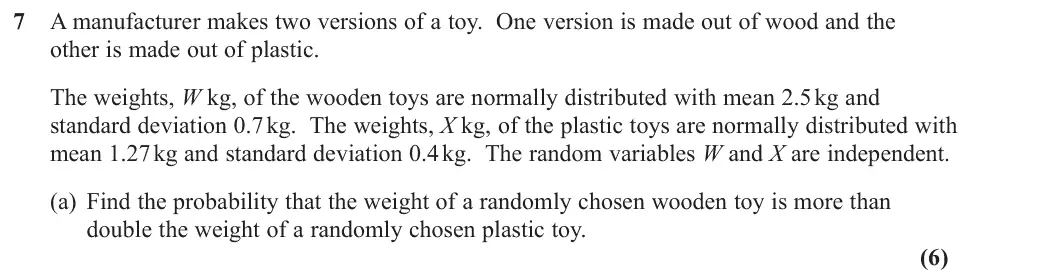
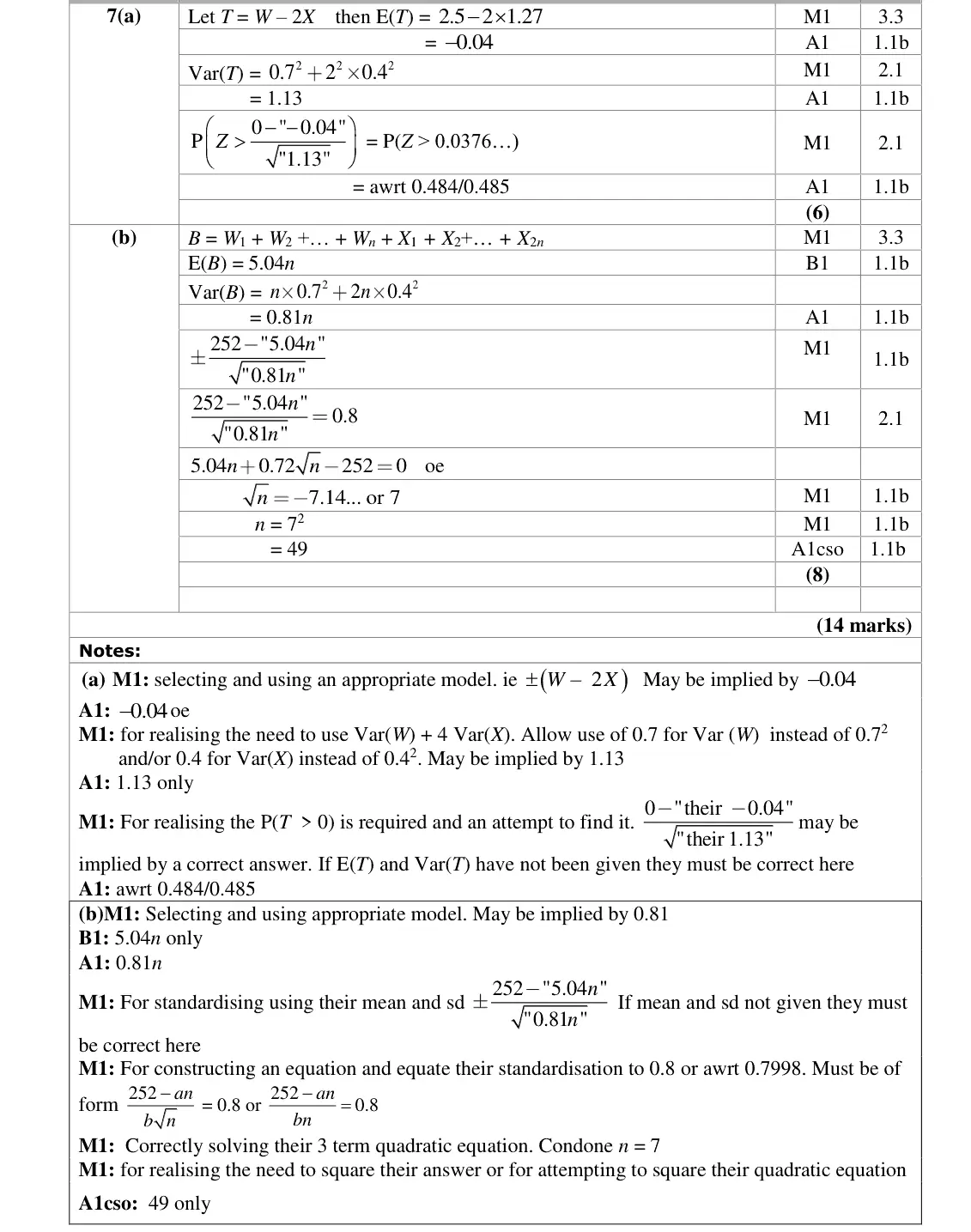
T = W − 2X: E(T) = −0.04, Var(T) = 0.7² + 4 × 0.4² = 1.13
P(T > 0) = 0.484
June 2019 · Paper 4B (Further Statistics 2) · Q7(b)8 marks
Mark scheme (whole question; this part is marked with the orange bar)
Examiner's comment
The majority of candidates made a good attempt at part (a). Part (b) was tackled with varying degrees of success. The most common error was to use the distribution 2X + 2nW which led to an incorrect variance. Others common errors included setting 252 "5.04 " n equal to –0.8 rather than 0.8 and "0.81 " n changing 0.81n to 0.9n which resulted in a linear equation rather than a quadratic.
Key points from the mark scheme and examiner's report
sum of n W's and 2n X's: mean 5.04n, variance 0.81n (not 2X + 2nW)