Notes, worked examples and practice for this topic are being written by our tutors. The past-paper questions below are ready now: work each one on paper, then open the mark scheme and the examiner's comment.
Tap a question to zoom it. Mark scheme and examiner's comment open under each question.
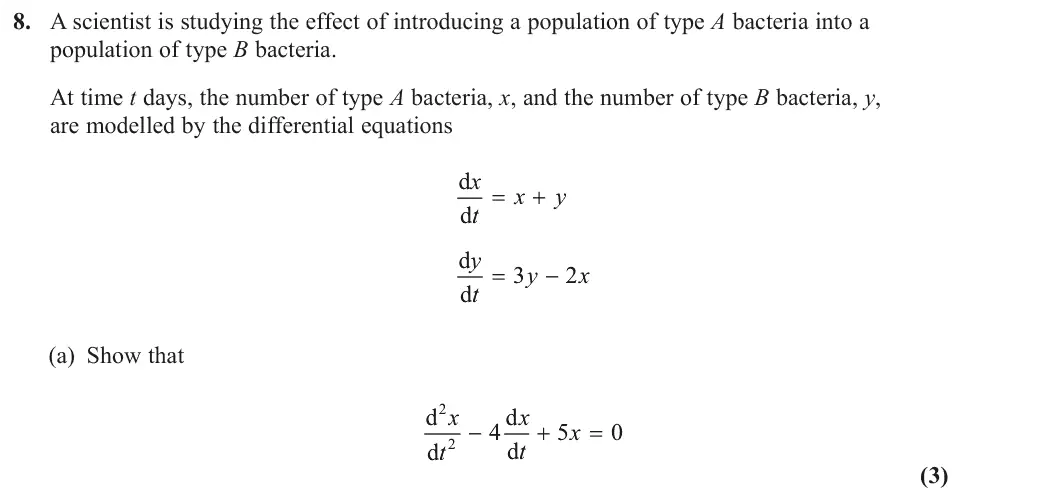
June 2024 · Paper 1 (Core Pure 1) · Q8(a)3 marks
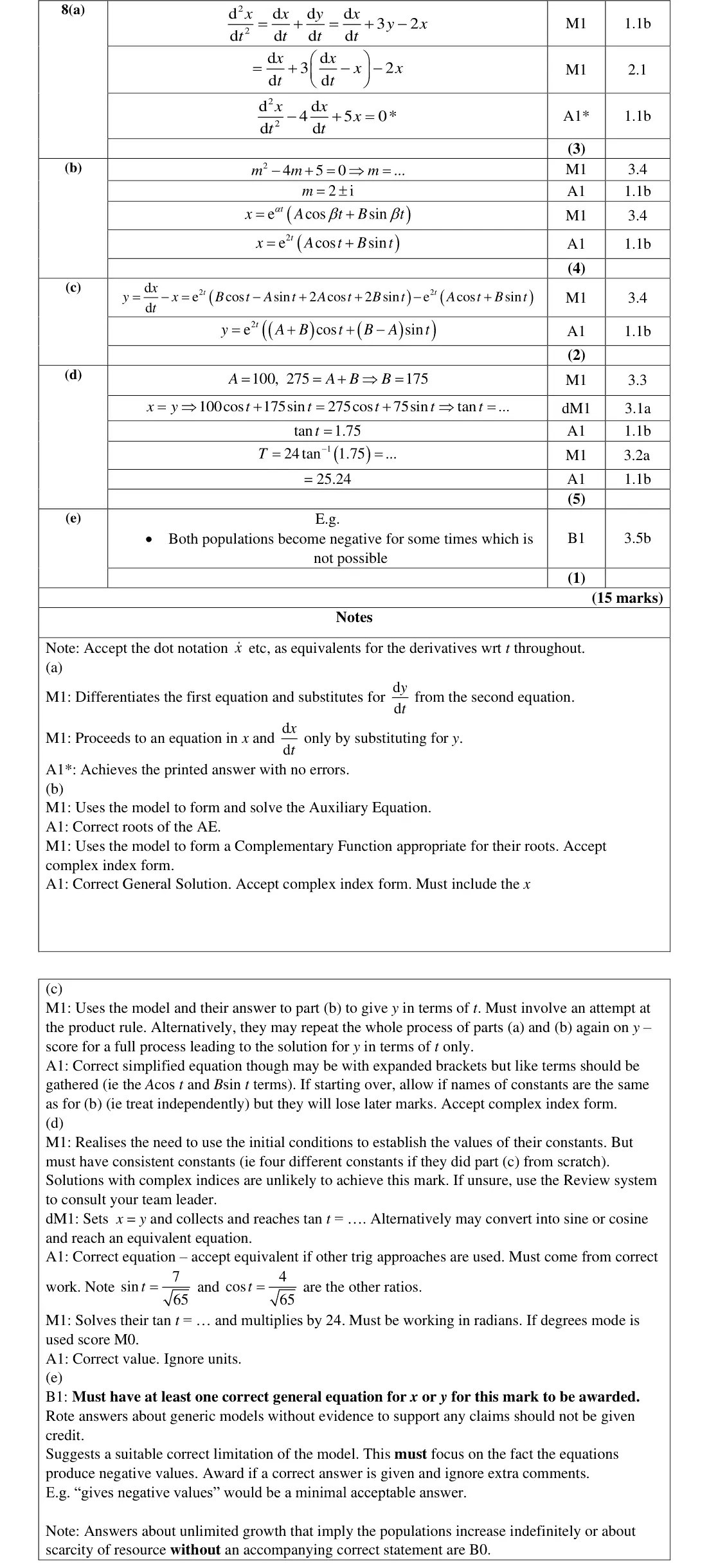
Mark scheme (whole question; this part is marked with the orange bar)
Examiner's comment
Once again candidates coped well with this contextual connected derivatives question, and other than the last 3 marks this was well answered by the majority of the candidates. Most were able to complete what they could in the time available, and only a few did not reach the end, indicating there was no lack of time on the paper. In part (a), most candidates attempted the question as expected, with minor variations in the process of which equations they differentiated first, and most were successful, although there were a number who pushed boundaries in terms of the steps shown given that it was a proof/show that question along with some poor organisation of their work. A small number took the option of finding expressions for the first and second derivatives of x and substituting them into the given differential equation and showing that all terms cancelled to give zero. Mostly this approach was also successful.
Key points from the mark scheme and examiner's report
differentiate dx/dt, substitute dy/dt, then replace y using the first equation
printed answer so every step needed
June 2024 · Paper 1 (Core Pure 1) · Q8(c)2 marks
Mark scheme (whole question; this part is marked with the orange bar)
Examiner's comment
Once again candidates coped well with this contextual connected derivatives question, and other than the last 3 marks this was well answered by the majority of the candidates. Most were able to complete what they could in the time available, and only a few did not reach the end, indicating there was no lack of time on the paper. Part (c) was less well answered but still usually done well. Most candidates used the equation d d x y x t = - with a valid attempt at differentiating x, and this was usually done well with appropriate use of the product rule. Occasionally sign errors were made in the subtraction of x giving terms such as 3A - B in the coefficients, but the differentiation itself was done well. A few candidates forgot to subtract the x after a successful differentiation despite having quoted the derivative. The greater problems arose for the candidates who started over from the initial equations to find y, although this was a less common method. There was mixed success in whether these reached the correct differential equation for y, with it not being given, and so some entirely different equations were formed. Additionally, even when correct, these usually used the same lettering for their constants as for part (b), which meant progress could not be made sensibly in part (d). Those who realised different lettering was needed had a much harder time trying to reconcile them in part (d), although it was possible via extra work. Some who did this realised that they could not make progress and reverted to the more direct approach. In another longer winded method, some candidates substituted their x into the original equation for d d y t to produce a linear differential equation in y and t which they attempted to solve using an integrating factor – a lot of work for two marks and not usually successfully completed.
Key points from the mark scheme and examiner's report
y = dx/dt − x using the product rule
keep the same constants A and B as in (b)
June 2024 · Paper 1 (Core Pure 1) · Q8(d)5 marks
Mark scheme (whole question; this part is marked with the orange bar)
Examiner's comment
Once again candidates coped well with this contextual connected derivatives question, and other than the last 3 marks this was well answered by the majority of the candidates. Most were able to complete what they could in the time available, and only a few did not reach the end, indicating there was no lack of time on the paper. Part (d) was generally started suitably by candidates who had found expressions for x and y, who generally attempted to use the initial conditions to find A and B. Those who had started again in part (c) and used the same constants were usually unable to get any further, while those who had four constants needed to proceed to use derivative statements to find the constant and so often simply gave up. For those who had suitable equation and found value for A and B, the next step was straightforward, equating their x and y equations and proceeding to find a value for tan t. Only a small number of such candidates failed to reach an expression for tan t, though errors rearranging, such as from 175cos 100sin t t = to 100 tan 175 t = , occurred in some candidates work, but the majority of candidates were able to reach the correct vale for tan t. Very few proceeded by sine or cosine approaches. The last two marks in this mark did proved discriminating, with only a minority of candidates proceeding to the correct final answer. The most common answer by far was T = 1.05, with correct arctan process, but neglecting to multiply by 24 to change from days to hours. Use of degrees also occurred relatively frequently, but again generally without the conversion to hours anyway, but losing the final two marks regardless of if they did this. A few cases occurred where the correct process was carried out following an incorrect tan t value but generally those who did convert into hours had fully correct solutions to this point.
Key points from the mark scheme and examiner's report
A = 100, B = 175 from t = 0
x = y gives tan t = 1.75
T is in HOURS so × 24: T = 25.24 (1.05 is the common wrong answer)
radians
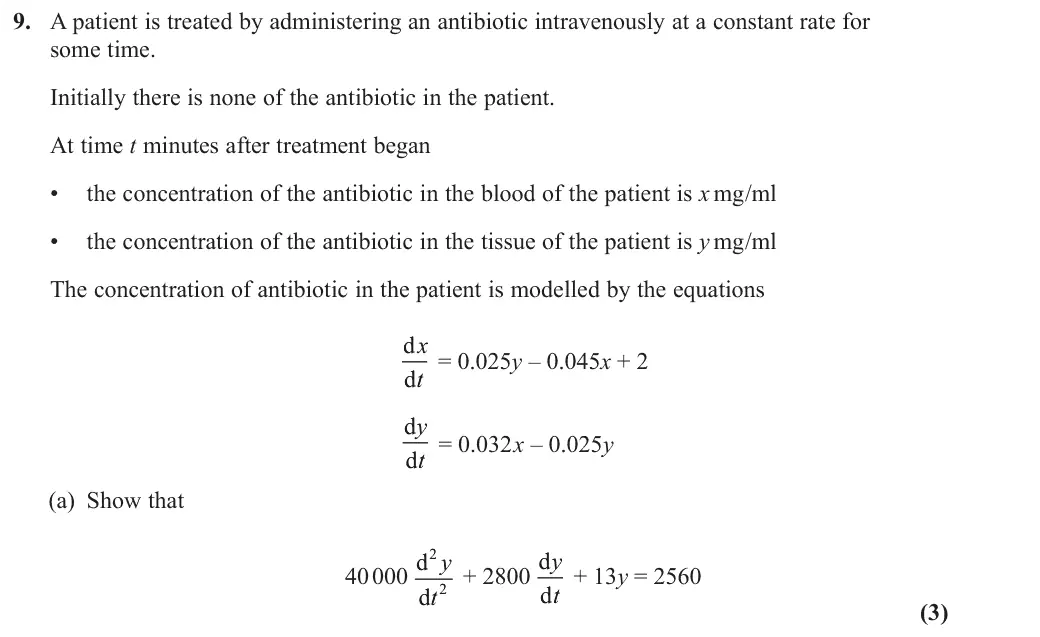
June 2023 · Paper 2 (Core Pure 2) · Q9(a)3 marks
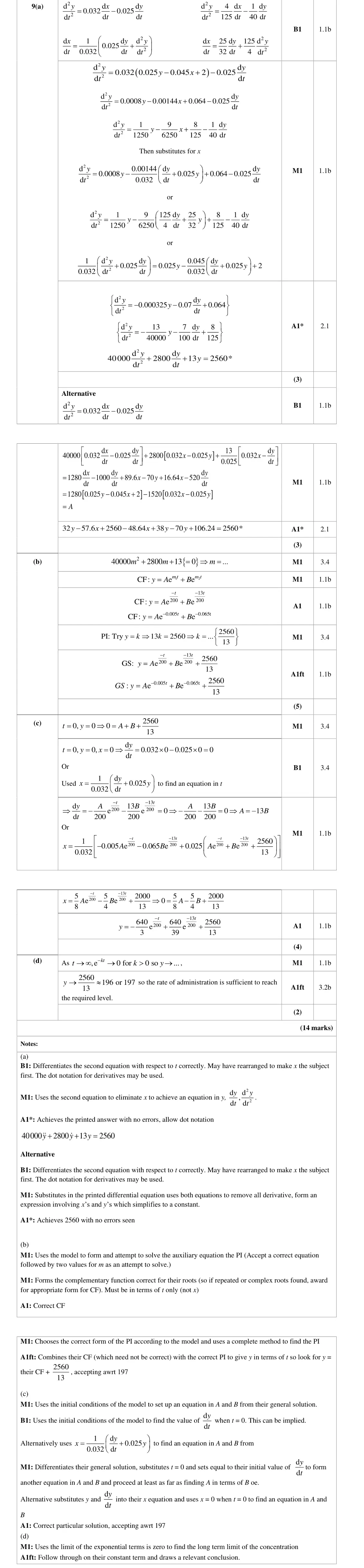
Mark scheme (whole question; this part is marked with the orange bar)
Examiner's comment
(a) There were many different methods used by the candidates. The algebra being complicated by unpleasant decimals/fractions which led to many careless errors. Most candidates found a correct expression involving 2 2 d d y x , and after some manipulation substituted for x. There were quite a few cases, following slips, where the given differential equation managed to appear, which did not seem to follow the working. In these cases, candidates should go back at the end and try to correct their working.
Key points from the mark scheme and examiner's report
differentiate dy/dt, substitute dx/dt, then eliminate x using the second equation
awkward decimals caused slips
the given answer appearing after errors was penalised
June 2023 · Paper 2 (Core Pure 2) · Q9(c)4 marks
Mark scheme (whole question; this part is marked with the orange bar)
Examiner's comment
(c) Most candidates substituted t = 0 and y = 0 to find one simple equation; finding the second proved to be a little more problematic. This was a good discriminator with many choosing the efficient method of using d 0 d y x = and gaining two equations in A and B. Some took the more arduous root of finding an equation for x in terms of t, to varying degrees of success. Once candidates had simultaneous equations, they generally went on to solve them, with overall success dependent upon the accuracy of their equations.
Key points from the mark scheme and examiner's report
y = 0 at t = 0, and x = 0 at t = 0 gives dy/dt = 0
y = 2560/13 − (640/3)e^(−t/200) + (640/39)e^(−13t/200)
finding the second condition was the discriminator
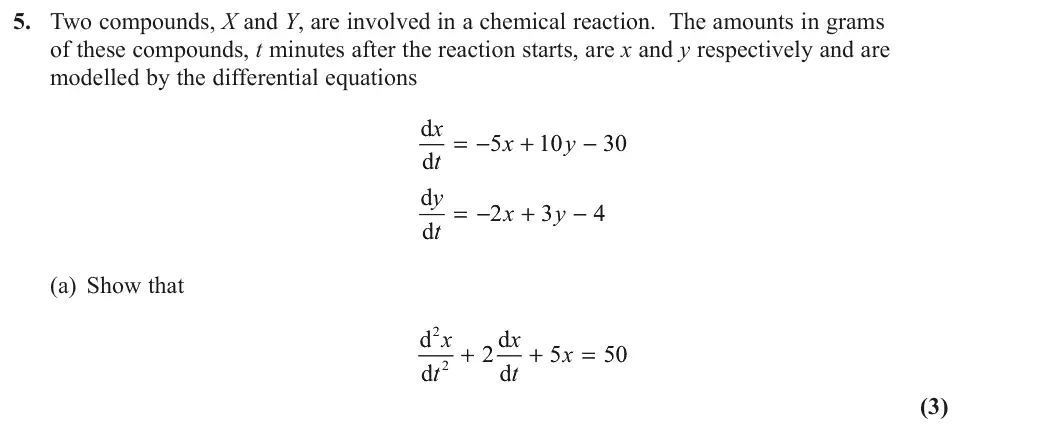
Oct 2020 · Paper 1 (Core Pure 1) · Q5(a)3 marks
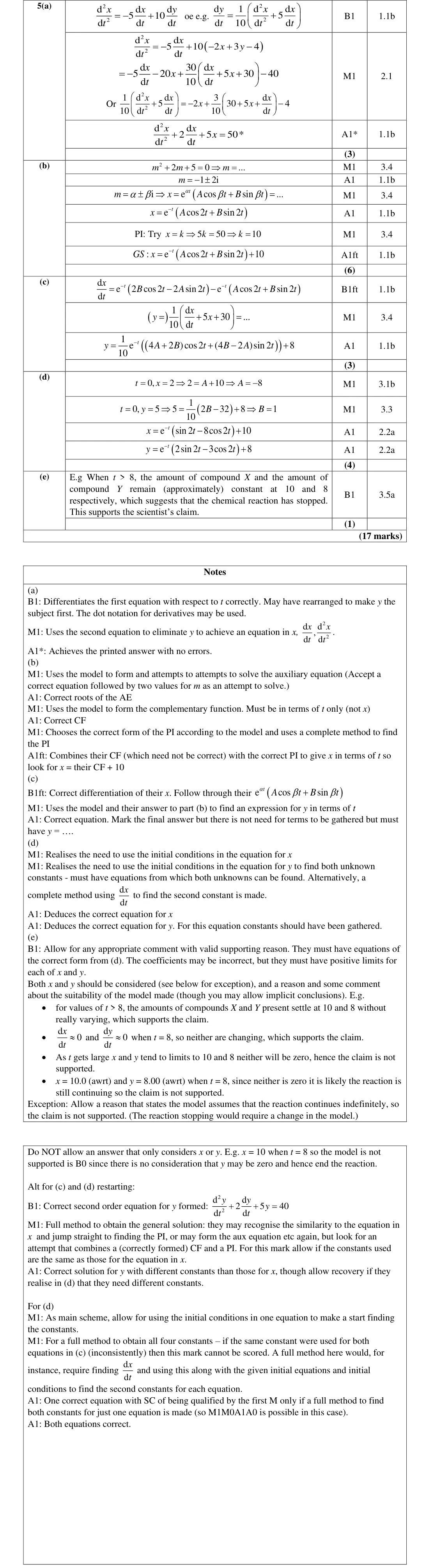
Mark scheme (whole question; this part is marked with the orange bar)
Examiner's comment
(a) This part was reasonable well attempted, with many scoring all three marks. Many started off by rearranging the first equation before differentiating to obtain an expression for y’, while others started by differentiating the given expression for x’. Either way they usually managed to correctly achieve the required result. A few used verifications to prove the result. A common error was to give x’’ as -5 + 10y’ which could gain only the M mark. A small number of candidates attempted to revert to similar work as for parts (a) and (b), but for the variable y instead of x. As well as being a highly inefficient method, many of these also confused constant by calling their constants in each of the equations for x and y by the same letters, which also impacted how much they could score in part (d).
Key points from the mark scheme and examiner's report
differentiate the first equation, substitute dy/dt and eliminate y
common error x'' = −5x' + 10y' left unsubstituted
Oct 2020 · Paper 1 (Core Pure 1) · Q5(c)3 marks
Mark scheme (whole question; this part is marked with the orange bar)
Examiner's comment
(c) Most realised they needed to differentiate their general solution, and the first Bft mark was usually gained for their correct and accurate method. The next mark was also attainable by the majority, as they realised, they needed to find an expression for y in terms of t and used an appropriate equation to do so. Many however lost the final accuracy mark, often by combining their constant terms incorrectly. A small number of candidates attempted to revert to similar work as for parts (a) and (b),
Key points from the mark scheme and examiner's report
y = (1/10)(dx/dt + 5x + 30): y = (1/10)e⁻ᵗ((4A + 2B)cos 2t + (4B − 2A)sin 2t) + 8
product rule
slips combining the constants
re-solving for y with the same constants is wrong
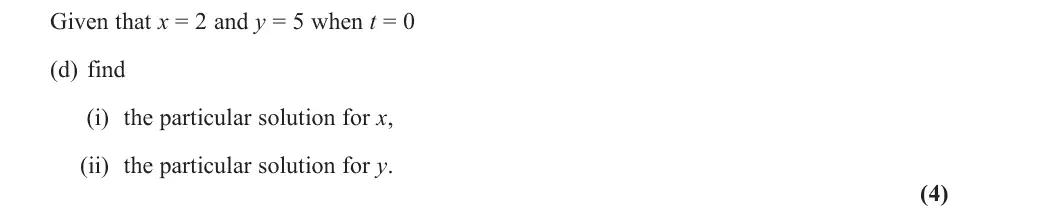
Oct 2020 · Paper 1 (Core Pure 1) · Q5(d)4 marks
Mark scheme (whole question; this part is marked with the orange bar)
Examiner's comment
by the same letters, which also impacted how much they could score in part (d). (d) The most common mark profile here was M1M1A0A0. Most used the initial conditions in their equations for x and y and found values for their constants but either due to earlier error or slips in algebra (finding B) both accuracy marks ended up being lost.
Key points from the mark scheme and examiner's report
A = −8, B = 1: x = e⁻ᵗ(sin 2t − 8cos 2t) + 10, y = e⁻ᵗ(2sin 2t − 3cos 2t) + 8
most scored M1M1A0A0
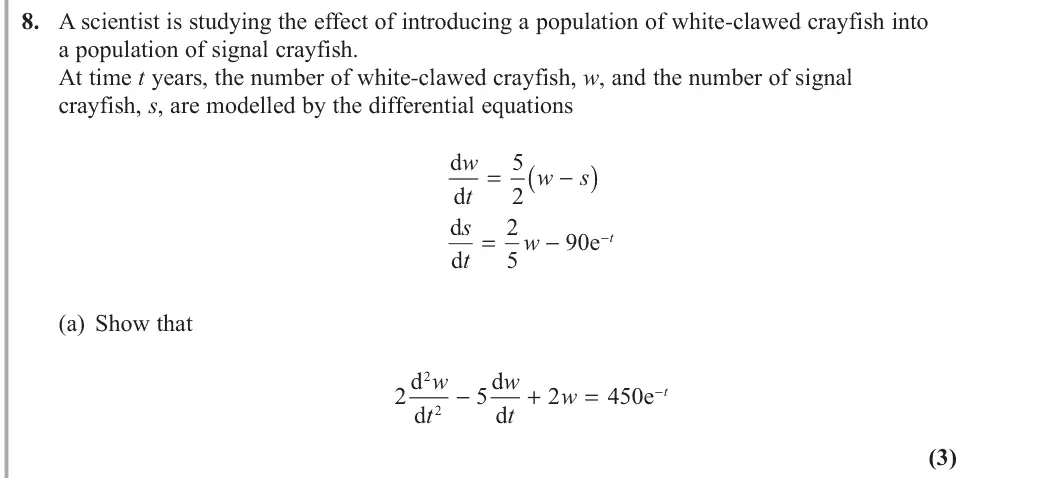
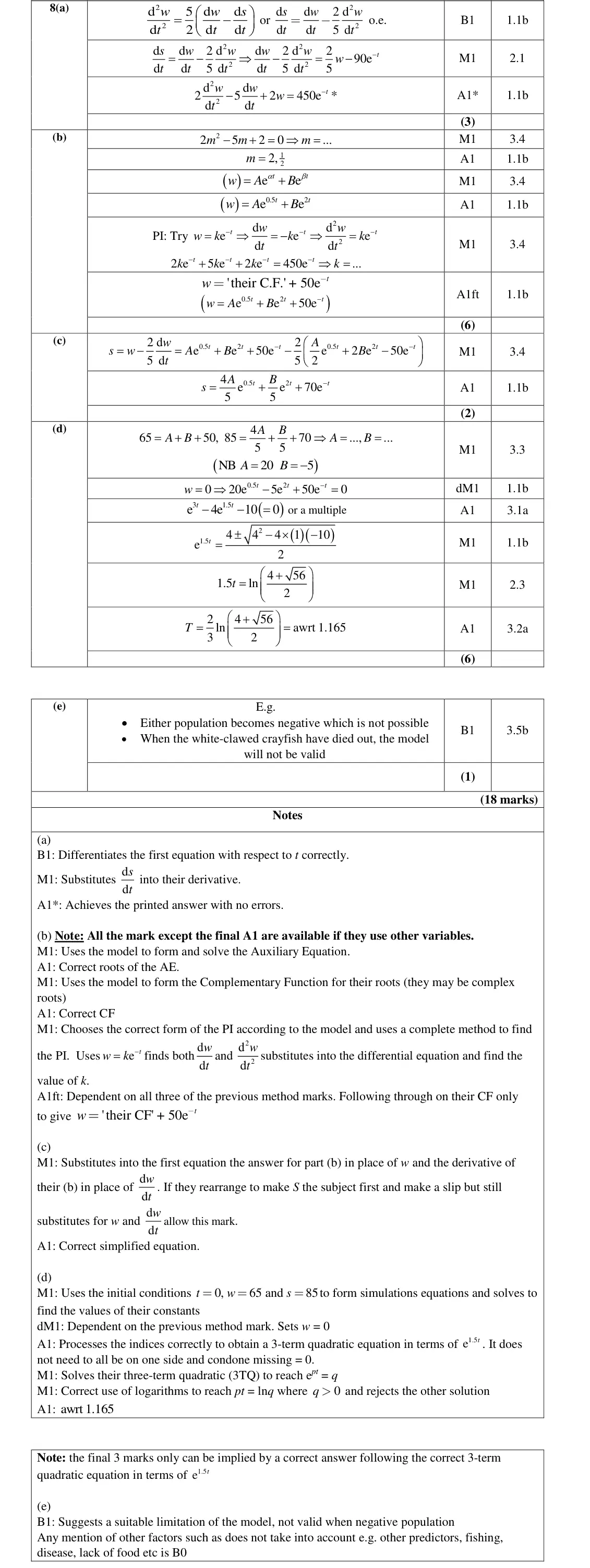
June 2019 · Paper 1 (Core Pure 1) · Q8(a)3 marks
Mark scheme (whole question; this part is marked with the orange bar)
Examiner's comment
(a) The majority of candidates answered this part well and the most common errors were sign slips or numerical copying mistakes. Some candidates used dot notation despite the question been written with 𝑑𝑤 𝑑𝑡 and failed to give the answer as required.
Key points from the mark scheme and examiner's report
differentiate the first equation and substitute ds/dt
printed answer so no slips
keep dw/dt notation, not dots
June 2019 · Paper 1 (Core Pure 1) · Q8(c)2 marks
Mark scheme (whole question; this part is marked with the orange bar)
Examiner's comment
(c) A significant number of candidates did not attempt this part of the question. Many successfully gained the method mark, but there were frequent sign errors in applying “- 2 5 𝑑𝑤 𝑑𝑡 “. A significant minority replaced their w in the second equation and integrated to find s. Only one solution that I saw attempted to find a constant for their solution.
Key points from the mark scheme and examiner's report
s = w − (2/5)dw/dt = (4A/5)e^(0.5t) + (B/5)e^(2t) + 70e⁻ᵗ
sign errors
integrating the second equation instead
often not attempted
June 2019 · Paper 1 (Core Pure 1) · Q8(d)6 marks
Mark scheme (whole question; this part is marked with the orange bar)
Examiner's comment
(d) The majority of candidates gained the first two marks in this section but failed to proceed beyond setting w = 0. A significant number failed to create a 3TQ in e1.5t because they didn’t multiply the whole equation by 𝑒-𝑡and had little chance of gaining the last 4 marks. There was mixed success in solving the 3TQ – some made a substitution using x = e1.5 t, but others attempted more complicated substitutions, or tried to square their equation with little progress. Those who solved their 3TQ were able to correctly undo the logs, but failed to round correctly.
Key points from the mark scheme and examiner's report
A = 20, B = −5
w = 0 gives e^(3t) − 4e^(1.5t) − 10 = 0, a quadratic in e^(1.5t)
T = awrt 1.165
many failed to multiply through by eᵗ to form the 3-term quadratic
Find an Edexcel Further Maths tutor
Stuck on this? Book a trial lesson with our Further Maths tutor.