39 question parts, 155 marks, 5 with a difficulty rating from the examiner's report
Notes, worked examples and practice for this topic are being written by our tutors. The past-paper questions below are ready now: work each one on paper, then open the mark scheme and the examiner's comment.
Tap a question to zoom it. Mark scheme and examiner's comment open under each question.
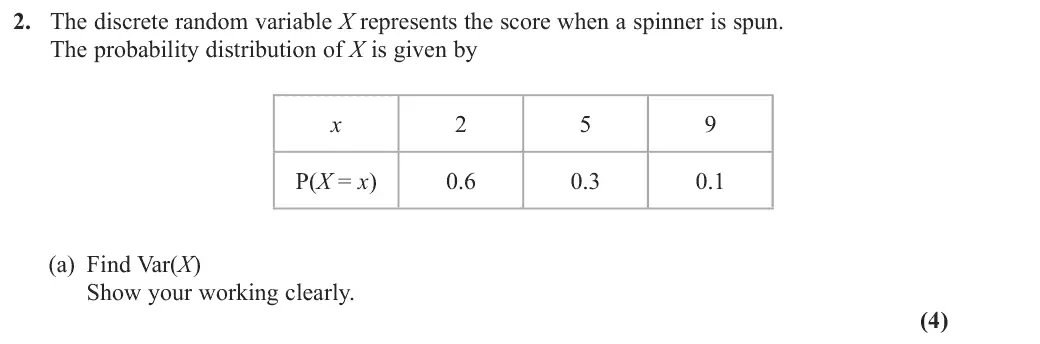
June 2025 · AS Paper 2 (Further Statistics 1) · Q2(a)4 marks
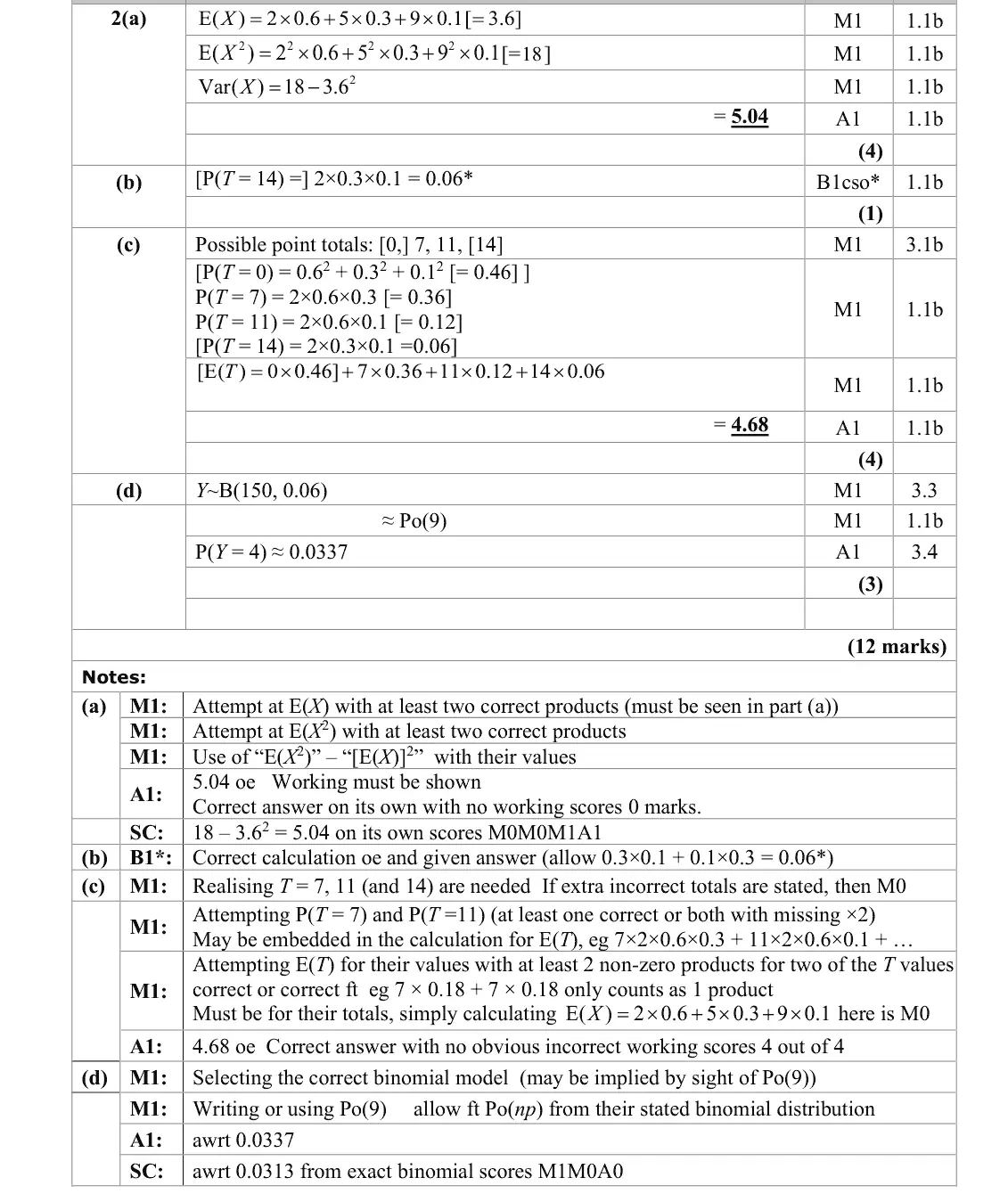
Mark scheme (whole question; this part is marked with the orange bar)
Examiner's comment
(a) Students generally did well to follow the instructions that working was required here and many showed clearly all stages in calculating the variance. calculated in part (a). Some missed the instruction for scoring 0 points and went on to give extra point values which were not possible. Another common error was to just list the possible totals and select the one that appeared most often, rather than calculating an expected value.
Key points from the mark scheme and examiner's report
E(X) = 3.6, E(X²) = 18, Var(X) = 18 − 3.6² = 5.04
working must be shown (answer only scores 0)
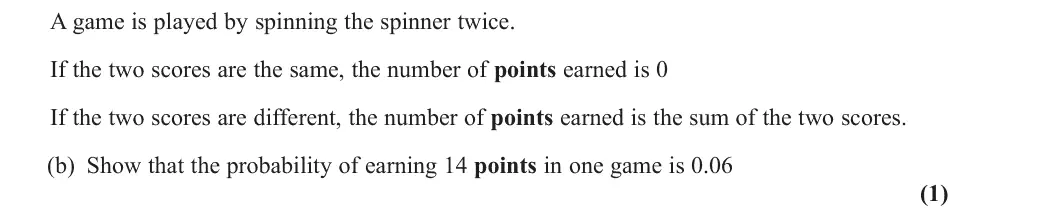
June 2025 · AS Paper 2 (Further Statistics 1) · Q2(b)1 mark
Mark scheme (whole question; this part is marked with the orange bar)
Examiner's comment
(b) Nearly all students realised that there were two ways of obtaining 14 points and showed clearly the calculation needed in order to do so.
Key points from the mark scheme and examiner's report
14 points from 5 and 9 in either order: 2 × 0.3 × 0.1 = 0.06
June 2025 · AS Paper 2 (Further Statistics 1) · Q2(c)4 marks
Mark scheme (whole question; this part is marked with the orange bar)
Examiner's comment
Overall, good attempts were seen at this question, but part (c) proved to be one of the more discriminating parts of the paper. (c) There was a mixed response to this part. Some simply restated the expected value calculated in part (a). Some missed the instruction for scoring 0 points and went on to give
Key points from the mark scheme and examiner's report
errors: restating E(X), extra impossible totals, picking the most likely total
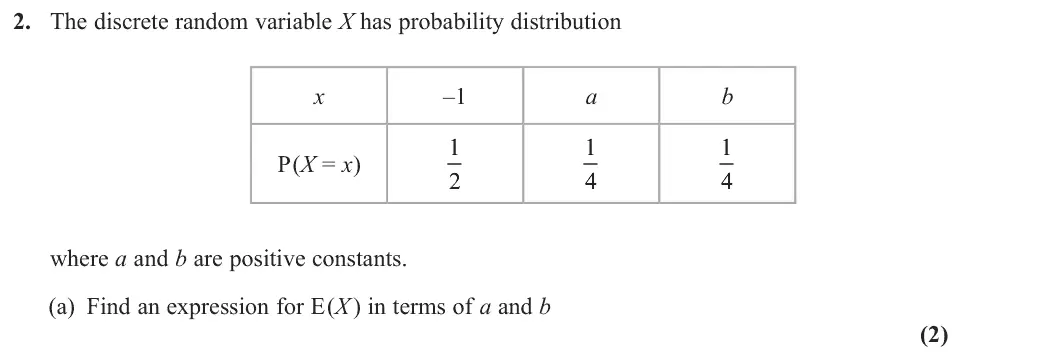
June 2025 · Paper 3B (Further Statistics 1) · Q2(a)2 marks
Mark scheme (whole question; this part is marked with the orange bar)
Examiner's comment
While this question was not straightforward, it had a comfortably familiar look to the candidates, and little wording. Part (a) of this question was a gentle starting point, with nearly all candidates scoring both marks.
Key points from the mark scheme and examiner's report
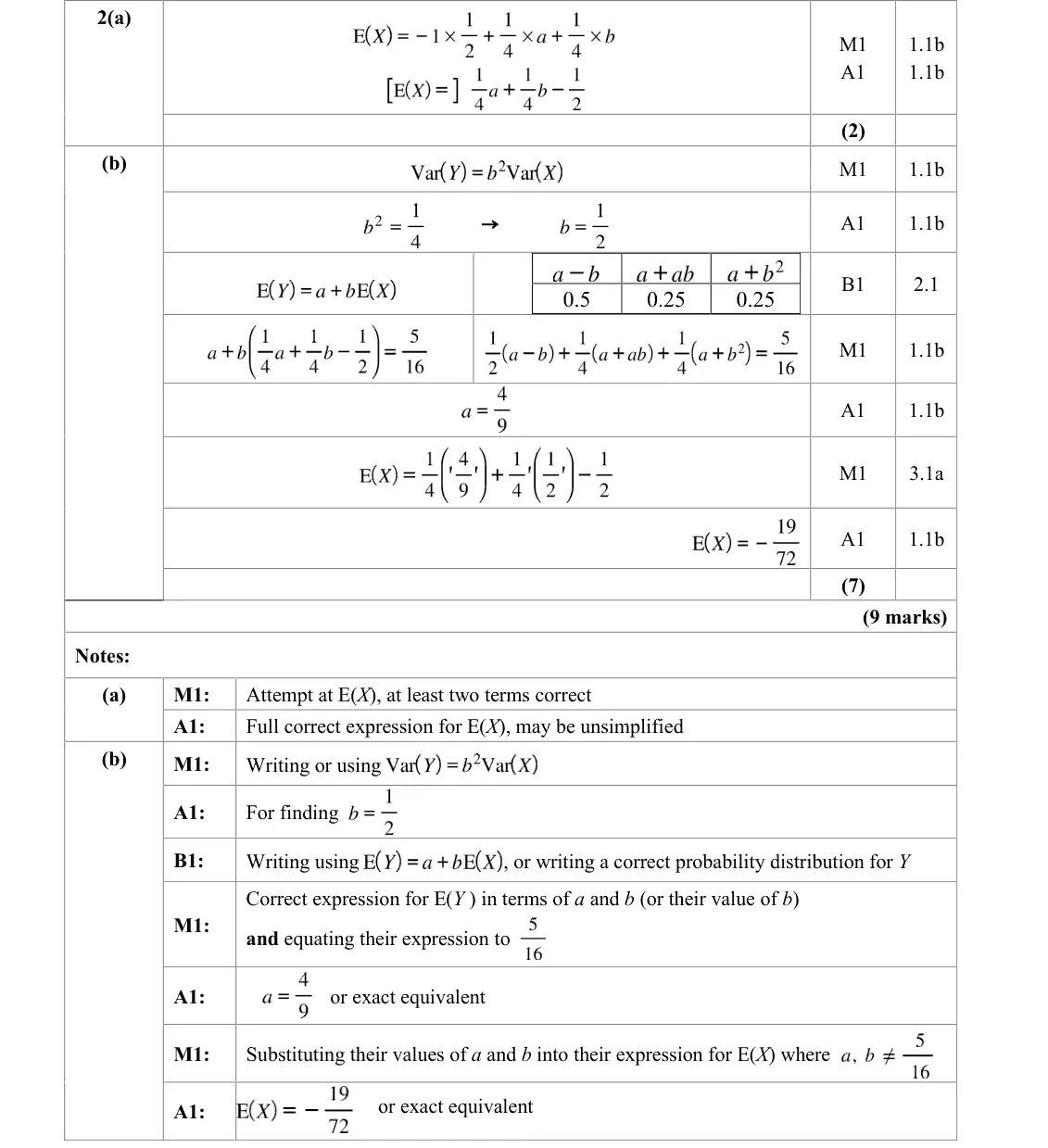
E(X) = −1/2 + a/4 + b/4
June 2025 · Paper 3B (Further Statistics 1) · Q2(b)7 marks
Mark scheme (whole question; this part is marked with the orange bar)
Examiner's comment
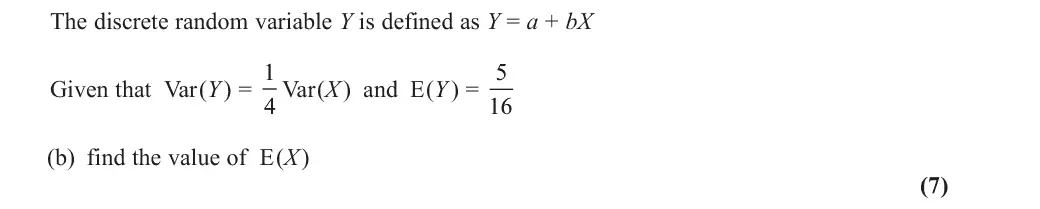
While this question was not straightforward, it had a comfortably familiar look to the candidates, and little Part (b) worked well to discriminate between candidates. There was a wide range of marks achieved, with most scoring 3 or more marks, and many scoring full marks. The main pitfall for this question was candidates almost auto-piloting to find E(X 2) and Var(X), which were not helpful approaches in this instance. Another key aspect those who struggled on this question missed was utilising the statement given in the question of . Most candidates found the expectation of the linear coding, but not the variance. Failure to act on this key piece of the question generally limited the candidate to 2 or 3 marks on part (b). Conversely, those who did use that information from the question and found a value of b, tended to get full marks if their b was correct. Aside from these, candidates tended to lose marks simply due to algebraic slips, which at times were made more impactful due to candidates not showing their working.
Key points from the mark scheme and examiner's report
Var(Y) = b²Var(X) so b = 1/2
E(Y) = a + bE(X) = 5/16 gives a = 4/9
E(X) = −19/72
auto-piloting into E(X²) and Var(X) did not help
many ignored the variance condition
June 2025 · Paper 3B (Further Statistics 1) · Q6(b)5 marks
Mark scheme (whole question; this part is marked with the orange bar)
Examiner's comment
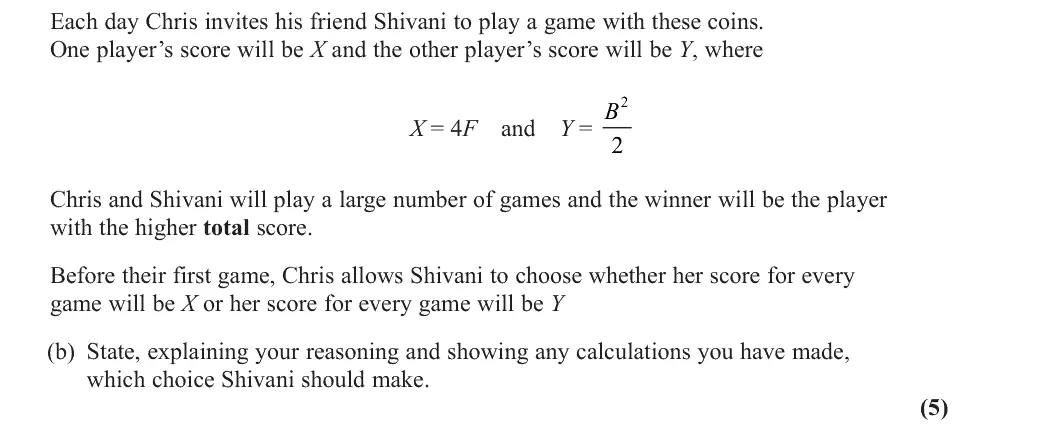
This question was accessible to the candidates, helped by the first parts being routine. The final part of the question did require some problem-solving, but most candidates were still able to score a good number of marks. Part (b) took the question in a new direction, and most candidates were able to make inroads into this part. Almost all realised that they needed to consider expectations, and the majority of these went on to find E(X) correctly. This was vital, as it gave them access to the final method mark. Candidates struggled to find E(B2) correctly, with a large number simply squaring E(B). This meant that, many candidates scored 3 of the 5 marks, as they usually went on to compare their two expectations correctly and choose X. However, a decent number of candidates were able to navigate part (b) and gain full marks. The question allowed for good discrimination between candidates of varying ability levels with almost all gaining 2 or 3 marks, and a many going further to score full marks. Some candidates used E(X)n, which was accepted. However, these candidates often included the n as part of the variable, while this did not make a difference for E(X), they ended up with E(Y) being multiplied by n2, which is incorrect. A few candidates who struggled tried to find the expectations using summations but did not do so correctly. Whenever candidates had their expressions for E(X) and E(Y) they almost always made a correct conclusion and scored the final mark. Candidates should be advised to take care to label their working clearly and correctly. Some candidates did not label their expressions and never referred to what they had as means or expectations, and hence did not score any marks.
Key points from the mark scheme and examiner's report
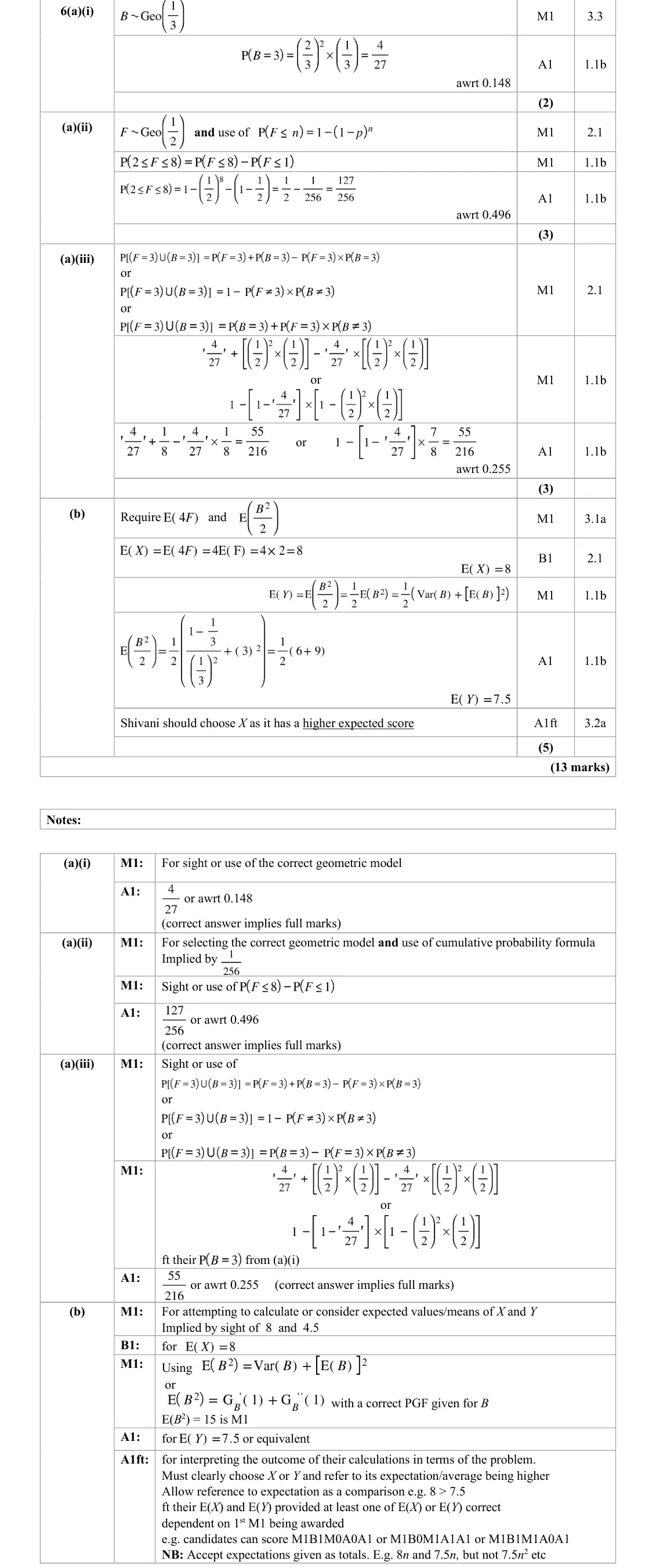
E(4F) = 8
E(B²/2) = ½(Var(B) + [E(B)]²) = ½(6 + 9) = 7.5
choose X
squaring E(B) is the common error
June 2024 · AS Paper 2 (Further Statistics 1) · Q36 marks
Mark scheme (whole question; this part is marked with the orange bar)
Examiner's comment
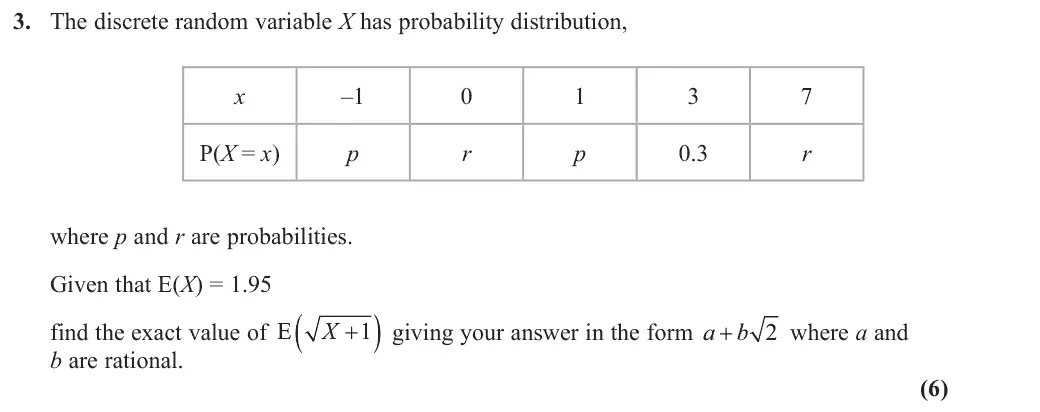
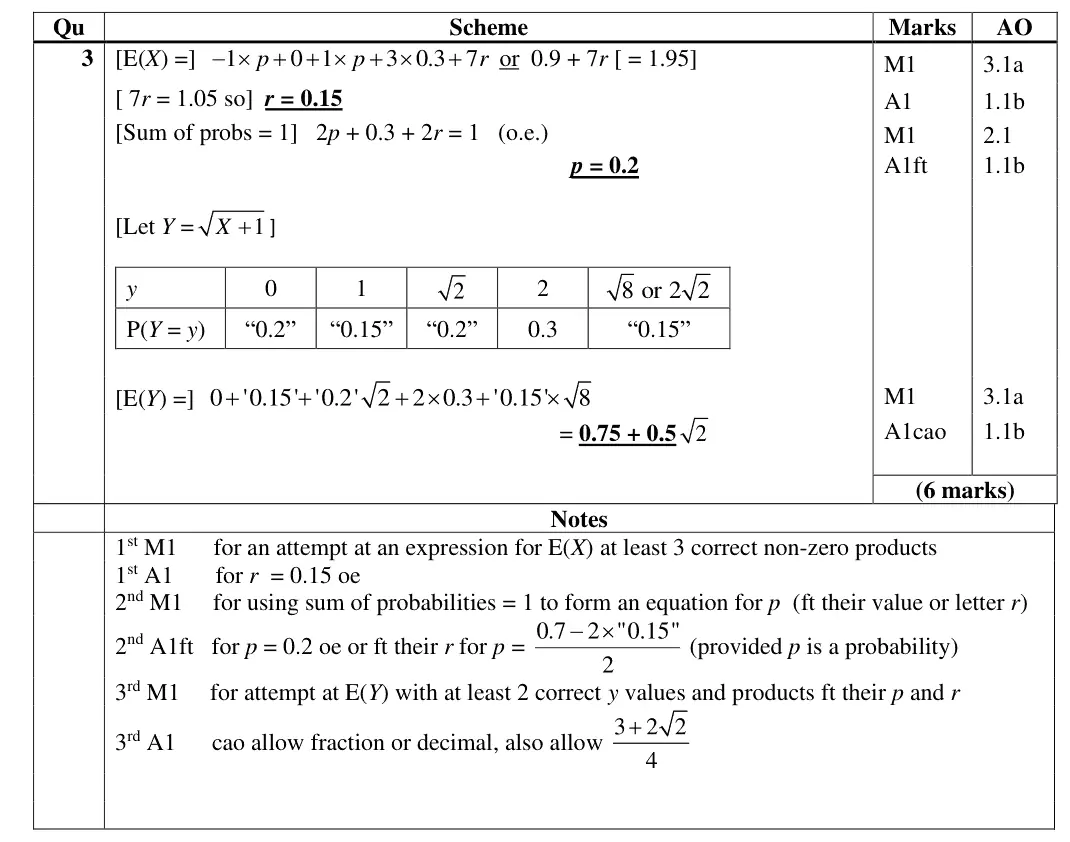
Many fully correct responses were seen to this question. Virtually all students found r and p correctly. Some then went on to make a slip when using these values to find the required expectation but were at least able to pick up the final method mark by showing their working clearly. Some attempted to find E(X) then and 1 and square root this.
Key points from the mark scheme and examiner's report
E(X) = 0.9 + 7r = 1.95 gives r = 0.15
Σp = 1 gives p = 0.2
tabulate Y = √(X + 1): 0, 1, √2, 2, 2√2
E(Y) = 0.75 + 0.5√2
some wrongly took √(E(X) + 1)
June 2024 · Paper 3B (Further Statistics 1) · Q1(a)3 marks
Mark scheme (whole question; this part is marked with the orange bar)
Examiner's comment
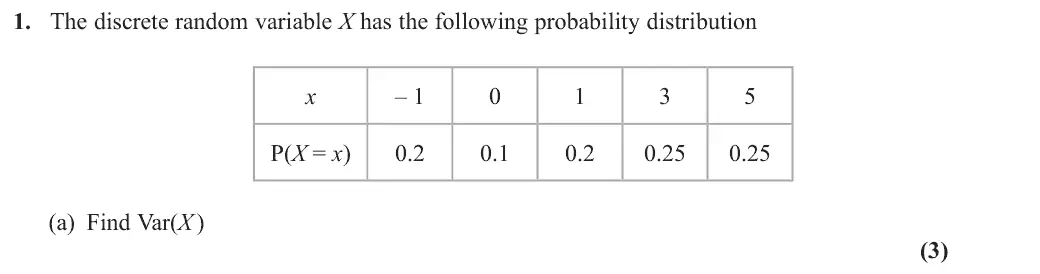
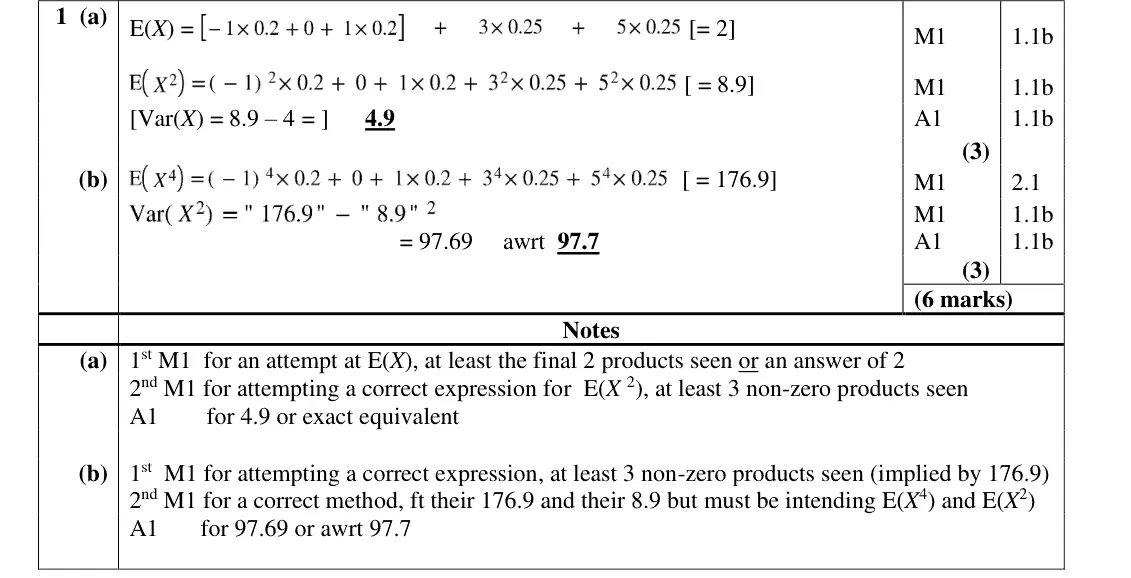
This was a nice opening question with little text to read and demands which were very familiar to the candidates. As such, almost all candidates scored full marks on Question 1. Those who lost marks did so most commonly through arithmetic errors (8.9 – 4 = 5.9 was surprisingly common). The need for candidates to show their working was highlighted here, as the mark scheme was most forgiving of errors if a candidate showed their working.
Key points from the mark scheme and examiner's report
E(X) = 2, E(X²) = 8.9, Var(X) = 8.9 − 4 = 4.9
arithmetic slips (8.9 − 4 = 5.9)
show working
June 2024 · Paper 3B (Further Statistics 1) · Q1(b)3 marks
Mark scheme (whole question; this part is marked with the orange bar)
Examiner's comment
This was a nice opening question with little text to read and demands which were very familiar to the candidates. As such, almost all candidates scored full marks on Question 1. Those who lost marks did so most commonly through arithmetic errors (8.9 – 4 = 5.9 was surprisingly common). The need for candidates to show their working was highlighted here, as the mark scheme was most forgiving of errors if a candidate showed their working.
Key points from the mark scheme and examiner's report
Var(X²) = E(X⁴) − [E(X²)]² = 176.9 − 8.9² = 97.69
June 2024 · Paper 3B (Further Statistics 1) · Q5(d)3 marks
Mark scheme (whole question; this part is marked with the orange bar)
Examiner's comment
This question was the first on the paper to cause any real issues to most candidates. It covered an aspect of the specification which tends to not be as well answered as others: Quality of Tests. Part (d)(i) was answered correctly in general, again showing that candidates understand what is meant by power and size. However, part (d)(ii) caused candidates problems. It appeared that many did not perhaps think deeply enough, saw ‘expected value’, and immediately used E(X) = np – gaining them no marks. Candidates did tend to use the correct distribution, but they needed to find a correct probability to gain any marks. Therefore, most candidates scored zero on this part of the question.
Key points from the mark scheme and examiner's report
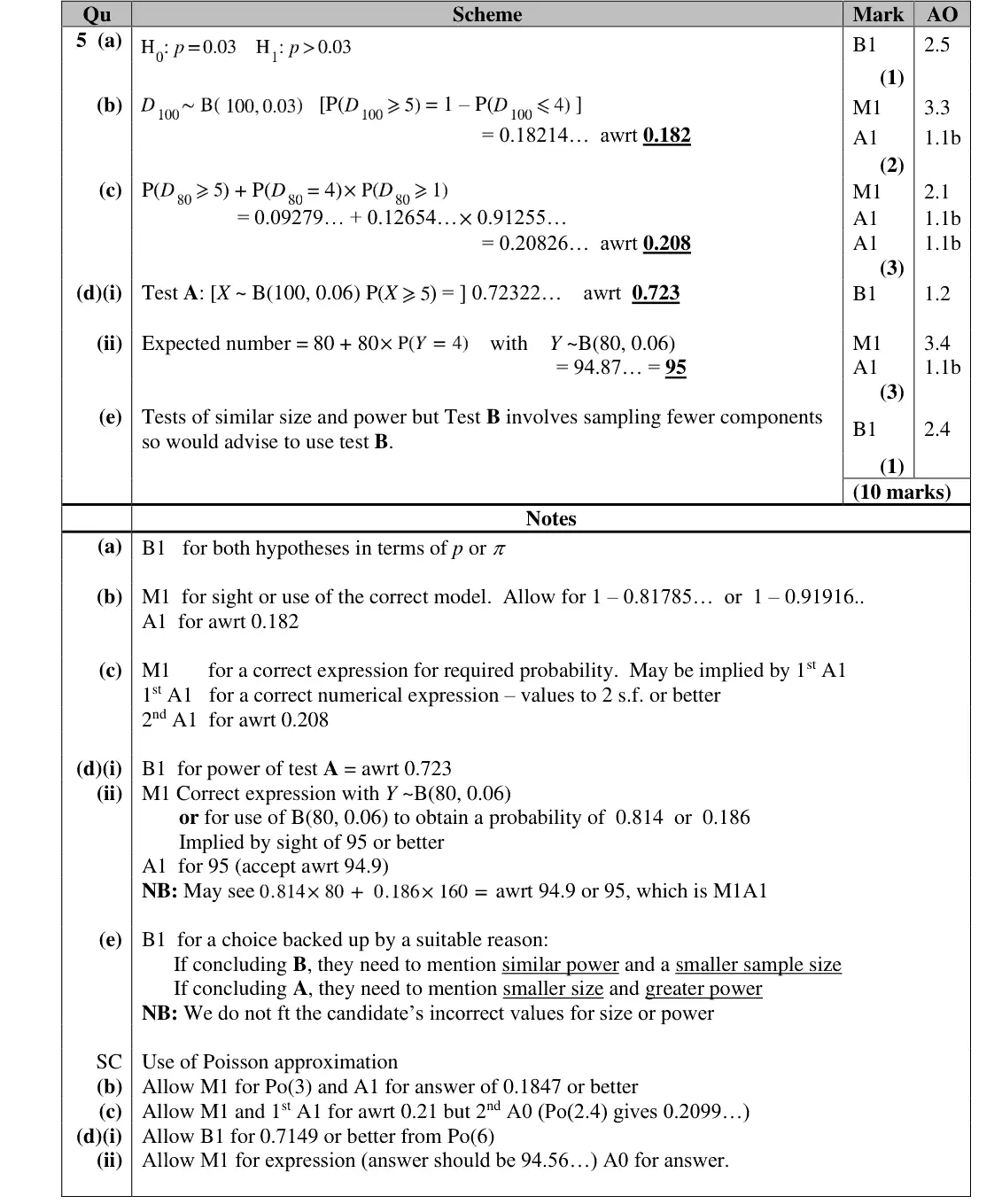
(i) power of A: P(X ≥ 5) for B(100, 0.06) = 0.723
(ii) 80 + 80 × P(Y = 4) with Y ~ B(80, 0.06) = 94.9 (95)
using np gained nothing
most scored 0 on (ii)
June 2024 · Paper 3B (Further Statistics 1) · Q7(c)6 marks
Mark scheme (whole question; this part is marked with the orange bar)
Examiner's comment
Candidates understandably found this question very challenging. It started off very easily in parts (a) and (b) but stepped up in difficulty considerably in part (c). The demand and nuance of (c) was beyond almost all candidates. In part (c), candidates needed to set up a random variable for the number of wins, then use an arithmetic sum to reach an expression for profit. They then needed to find the expectation of their expression, after modelling their random variable using the correct binomial distribution, to reach the given answer. This approach was not a familiar one to the majority of candidates. Most changed their random variable to an expected number of wins at the start of their solution, which led to the candidates working in terms of n. This is incorrect, and candidates who did this tended to score just 1 mark for stating the distribution of their random variable. Candidates often realised that they needed to use an arithmetic sum. However, they did so after converting to 0.2n, which meant they were no longer working with a random variable and hence could not evaluate the expectation correctly.
Key points from the mark scheme and examiner's report
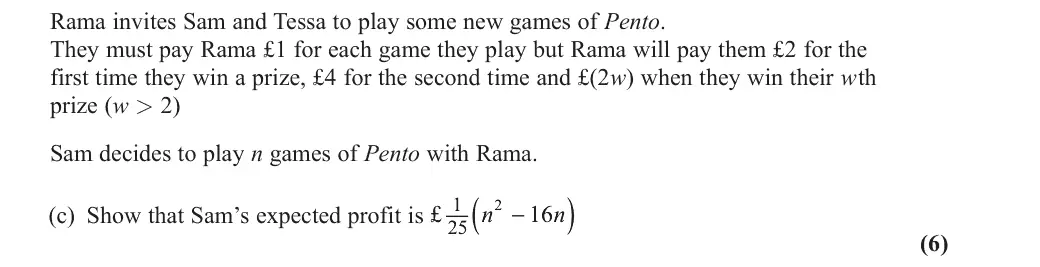
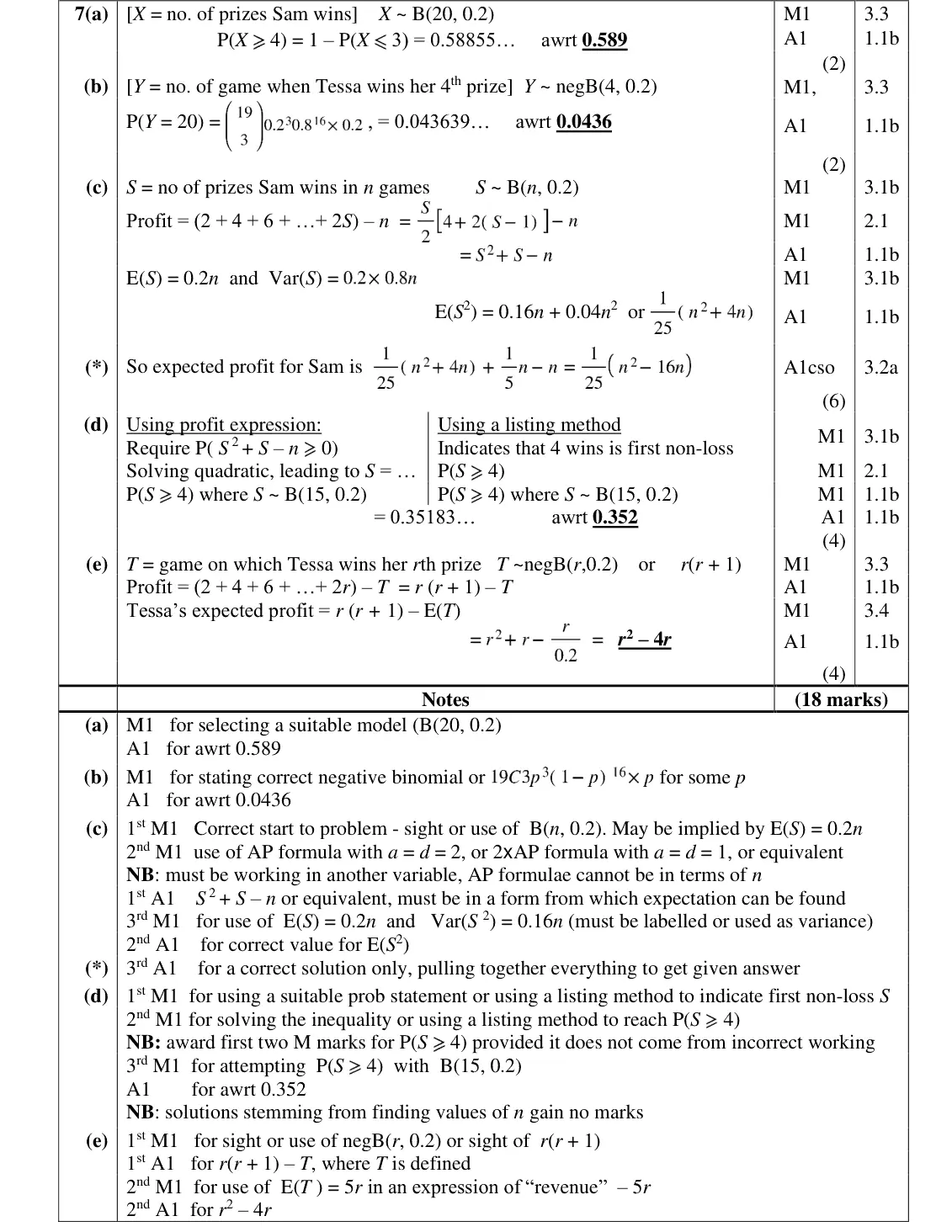
S ~ B(n, 0.2)
profit = 2 + 4 + … + 2S − n = S² + S − n
E(S²) = Var(S) + [E(S)]² = 0.16n + 0.04n²
expected profit (n² − 16n)/25
replacing S by its expected value 0.2n at the start is wrong
beyond almost all candidates
June 2024 · Paper 3B (Further Statistics 1) · Q7(e)4 marks
Mark scheme (whole question; this part is marked with the orange bar)
Examiner's comment
Candidates understandably found this question very challenging. It started off very easily in parts (a) and (b) but stepped up in difficulty considerably in part (c). The demand and nuance of (c) was beyond almost all candidates. Part (e) required a similar approach to (c). Very few candidates answered (c) correctly, but a cohort were able to form an expression for the revenue in (e) by using an arithmetic sum. Those that did often went on to gain full marks. However, in general candidates gained no marks for (e), or only the initial mark for stating the distribution correctly. Question 7 was certainly a very challenging question. To prepare to answer questions such as these successfully, candidates should be encouraged to: define the variable they are working with, state the distribution of that variable, and consider taking the expectation of a random variable or an expression in terms of a random variable properly when directed to by the word ’expected’ in the question.
Key points from the mark scheme and examiner's report
T ~ NB(r, 0.2)
profit = r(r + 1) − T
E(T) = r/0.2 = 5r
expected profit r² − 4r
June 2023 · AS Paper 2 (Further Statistics 1) · Q16 marks
Mark scheme (whole question; this part is marked with the orange bar)
Examiner's comment
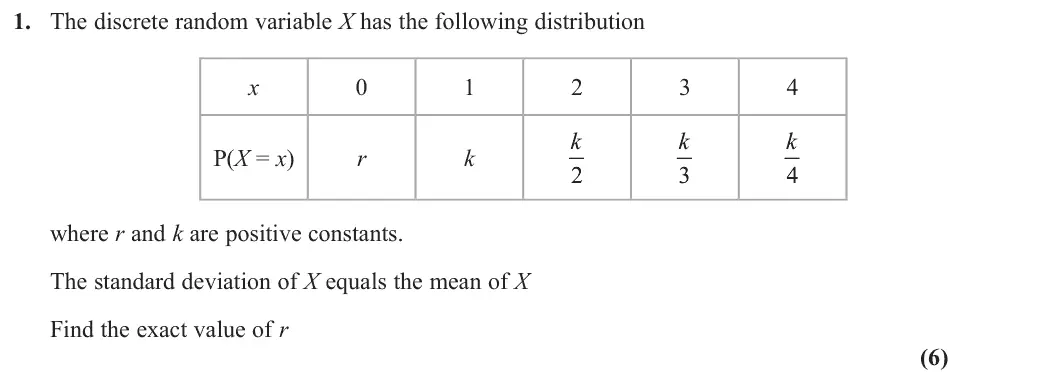
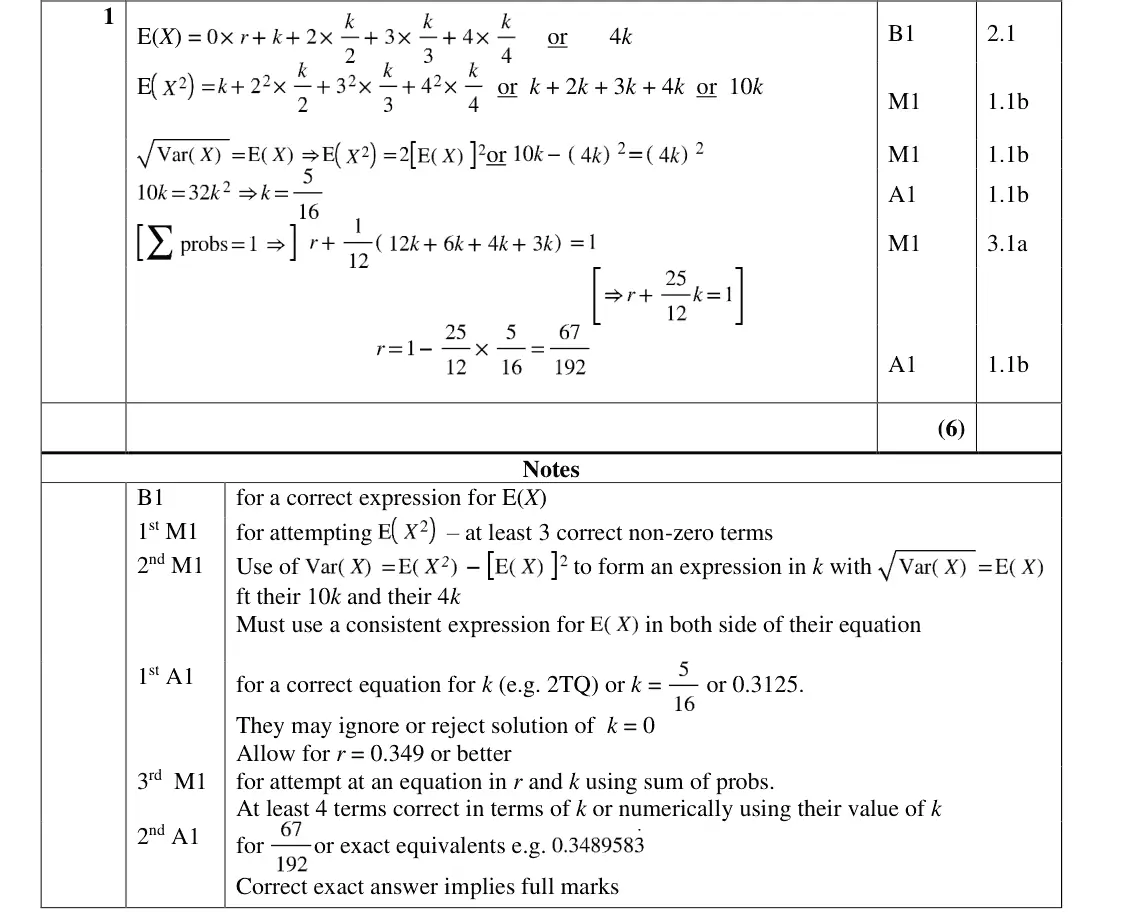
This was a generally welcoming first question as it had little wording and required skills that all candidates should immediately recognise. A large proportion of candidates were able to score full marks. Candidates not scoring full marks usually gained the B1 for ( ) E X and the first M1 for ( ) 2 E X , with many also gaining the final M1 for summing the probabilities. The issue that proved most challenging for the candidates was forming an equation with their standard deviation and mean. There were a lot of algebraic errors, such as taking the square of terms individually. Candidates should be reminded of the importance of clearly labelling the expressions they find. Some candidates did not use the mean as ( ) E X or did not label their variance as such. Therefore, they were unable to gain method marks for using their expressions correctly as it was not clear they were equating their standard deviation to their ( ) E X . This question would have likely provided a helpful confidence boost early in the paper. Many candidates answered correctly, and most of those who made an error would have been unaware as most errors still gave plausible values of k and r.
Key points from the mark scheme and examiner's report
E(X) = 4k, E(X²) = 10k
√Var(X) = E(X) gives 10k − 16k² = 16k², k = 5/16
Σp = 1 gives r + 25k/12 = 1, r = 67/192
main difficulty forming the sd = mean equation (squaring terms individually)
label E(X) and Var(X) clearly
June 2023 · Paper 3B (Further Statistics 1) · Q1(a)2 marks
Mark scheme (whole question; this part is marked with the orange bar)
Examiner's comment
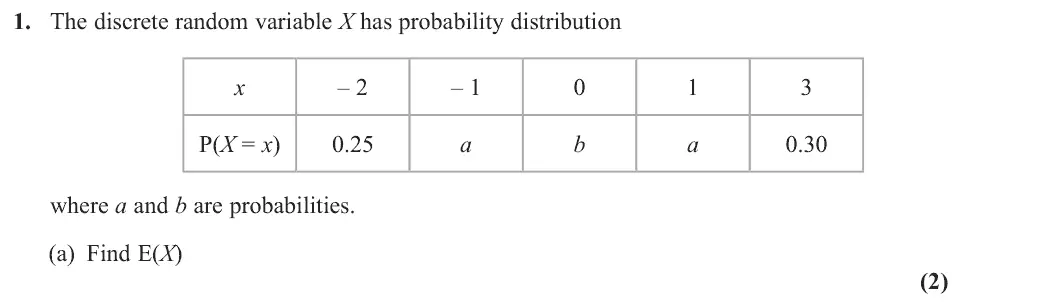
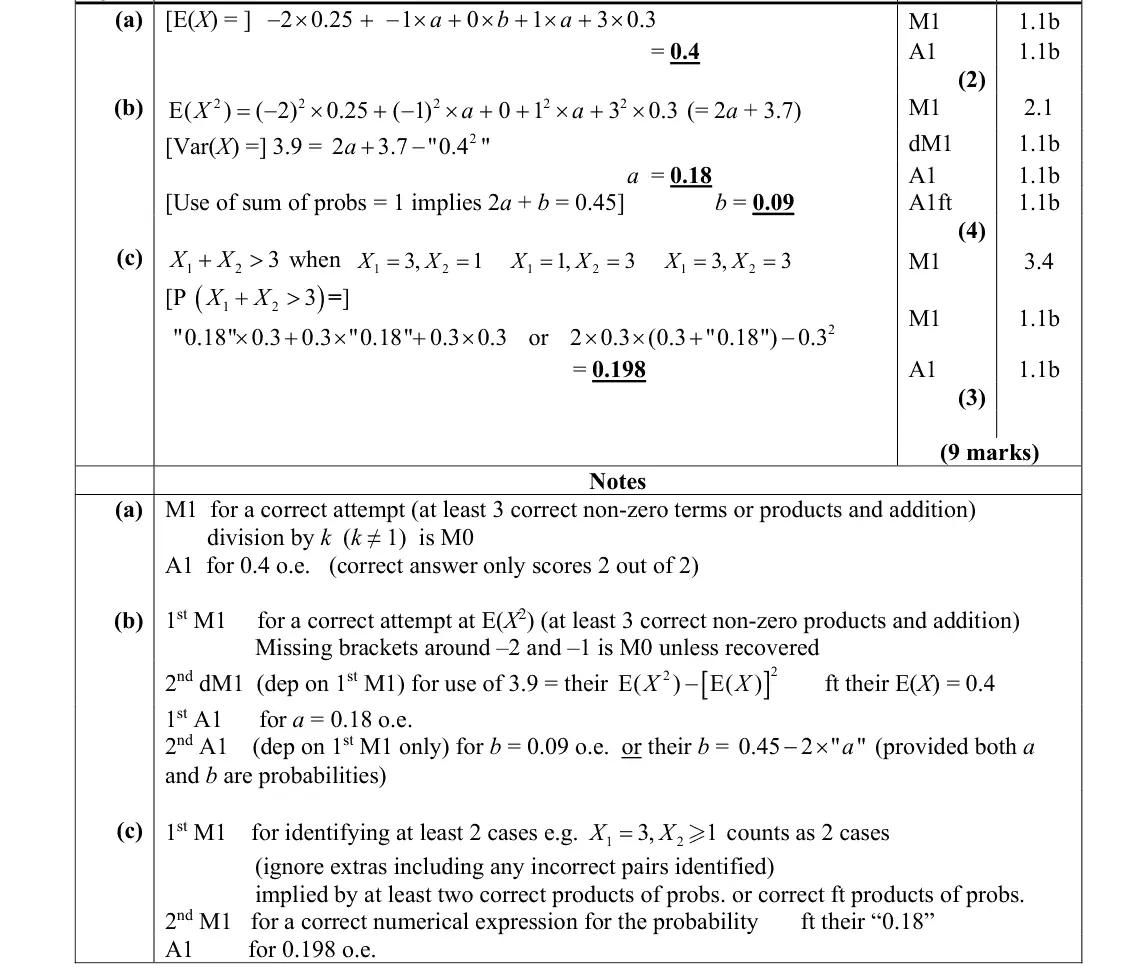
This was a good start to the paper for many. Parts (a) and (b) were very well attempted with virtually all scoring both marks in (a). In part (b), there are some students who confused E(X2) with Var(X) and so set up 2a + 3.7 = 3.9 leading to a common incorrect answer of a = 0.1. A follow through mark was available for those who went on to find a consistent but incorrect value of b.
Key points from the mark scheme and examiner's report
symmetric a terms cancel: E(X) = −0.5 + 0.9 = 0.4
June 2023 · Paper 3B (Further Statistics 1) · Q1(b)4 marks
Mark scheme (whole question; this part is marked with the orange bar)
Examiner's comment
This was a good start to the paper for many. Parts (a) and (b) were very well attempted with virtually all scoring both marks in (a). In part (b), there are some students who confused E(X2) with Var(X) and so set up 2a + 3.7 = 3.9 leading to a common incorrect answer of a = 0.1. A follow through mark was available for those who went on to find a consistent but incorrect value of b.
Key points from the mark scheme and examiner's report
E(X²) = 2a + 3.7
3.9 = 2a + 3.7 − 0.4² so a = 0.18
sum of probabilities gives b = 0.09
confusing E(X²) with Var(X) gave a = 0.1
June 2023 · Paper 3B (Further Statistics 1) · Q1(c)3 marks
Mark scheme (whole question; this part is marked with the orange bar)
Examiner's comment
Part (c) was more demanding. Many identified at least one combination of X1 and X2 that would lead to the sum being greater than 3, but often only went on to obtain two of the three correct products of probabilities. Some believed there were two ways of obtaining X1 = 3 and X2 = 3. Another common mistake was by those who believed the distribution of X1 + X2 was the same as the distribution of 2X1 and these responses often scored 0 marks.
Key points from the mark scheme and examiner's report
June 2022 · AS Paper 2 (Further Statistics 1) · Q4(a)2 marks
Mark scheme (whole question; this part is marked with the orange bar)
Examiner's comment
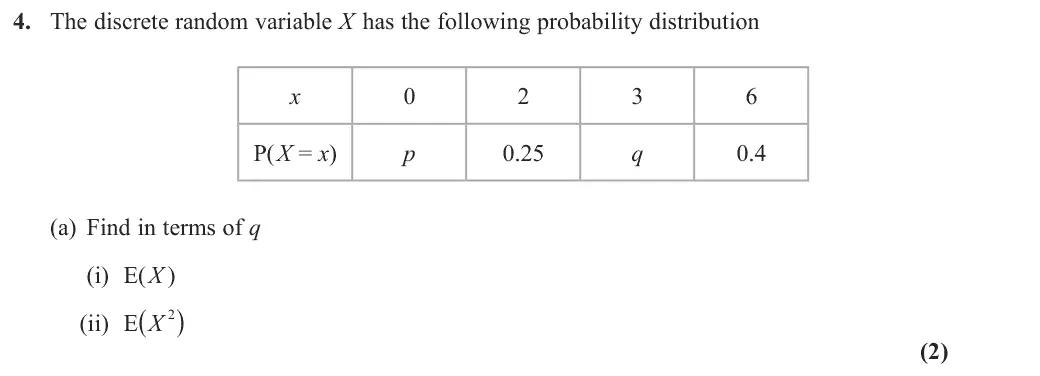
This was a standard question about discrete random variables, expectation and variance. In part (a) the vast majority of students were able to apply the correct formula to find E(X) in terms of q however in (ii) there were a small number of students who squared their p values rather than the x values leading to an incorrect value for E(X2)
Key points from the mark scheme and examiner's report
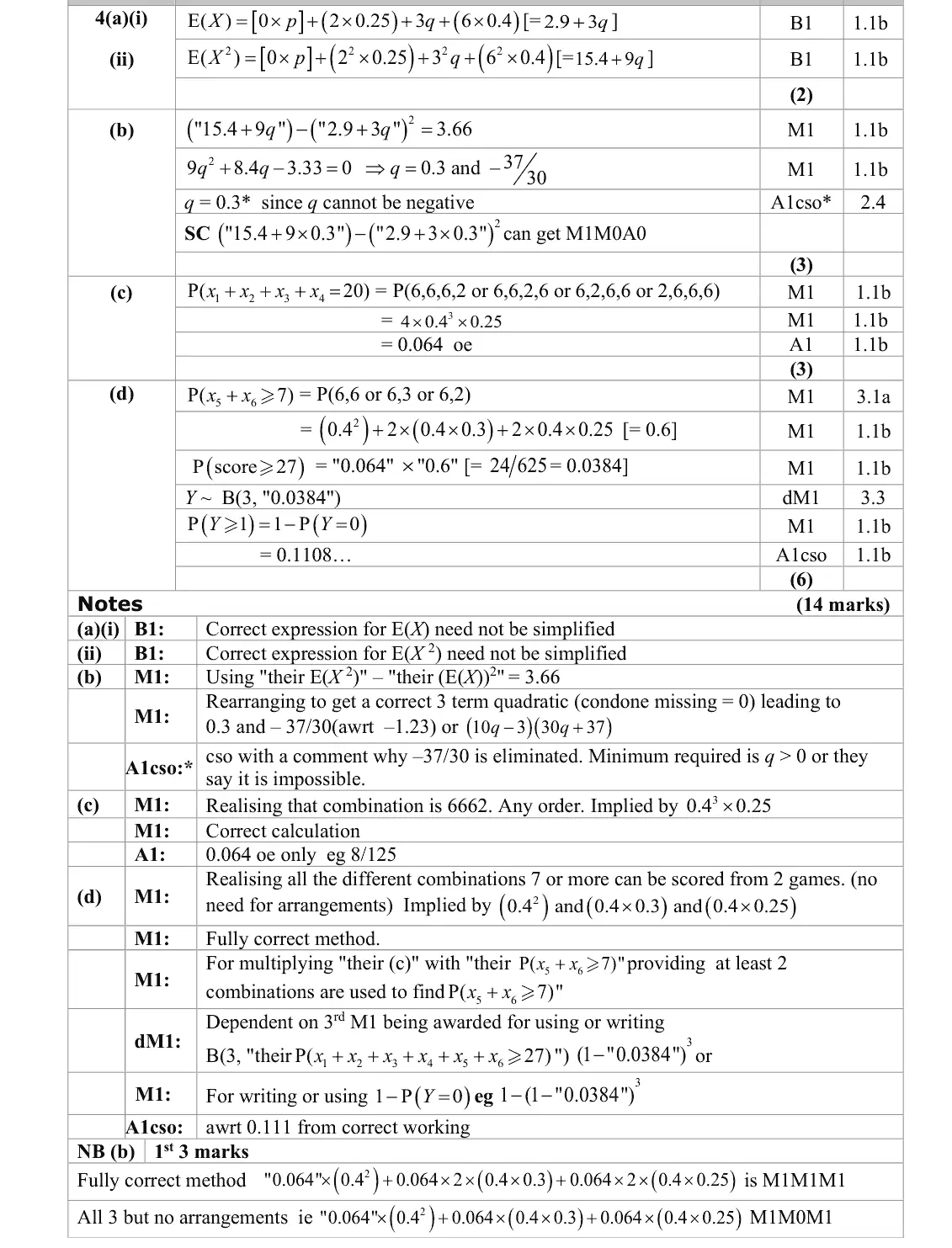
(i) E(X) = 2.9 + 3q
(ii) E(X²) = 15.4 + 9q
some squared the probabilities instead of the x values
June 2022 · AS Paper 2 (Further Statistics 1) · Q4(b)3 marks
Mark scheme (whole question; this part is marked with the orange bar)
Examiner's comment
This was a standard question about discrete random variables, expectation and variance. Part (b) was a ‘show that’ question with the required answer given in the question. As such all necessary steps needed to be shown leading to the answer of 0.3. Students should be encouraged to show both solutions to their quadratic equation and to also explain why 0.3 was the given solution rather than the alternative solution of -1.23. Simply crossing out this answer or writing ‘reject’ does not explain why this answer is not enough.
Key points from the mark scheme and examiner's report
must say why the negative root is rejected (q cannot be negative)
substituting 0.3 only scores M1
June 2022 · AS Paper 2 (Further Statistics 1) · Q4(c)3 marks
Mark scheme (whole question; this part is marked with the orange bar)
Examiner's comment
This was a standard question about discrete random variables, expectation and variance. Part (c) proved to be a good discriminator with few candidate gaining full marks. Students were generally able to identify the required combinations of 6662 leading to a total of 20 from the four games. However, many students did not consider the different arrangements of these scores leading to the very common incorrect answer of 0.016 Although part (d) was more challenging, students still, generally, made a good attempt As in part (c) many students omitted to include the different combinations leading to a total of 7 or more. Common incorrect answers for the first two marks were • identifying 6, 2 or 6, 3 but omitting 6, 6. • ignoring the 2 different arrangements of 6, 2 and 6, 3 or incorrectly including 2 arrangements of 6, 6. • mistakenly adding (rather than multiplied) the probability that the total of the first four games was 20 (their answer to part (c)) to their probability the next two games had a total of 7 or more. Once the probability of scoring a total of 27 or more had been found a large number of students simply multiplied their probability by 3 rather than using (and stating) a binomial model with n = 3 and their p value. Those students who showed all of their steps including multiplications and the new model were often able to pick up at least half of the available marks, even when they had made errors.
Key points from the mark scheme and examiner's report
total 20 only from 6, 6, 6, 2 in any order: 4 × 0.4³ × 0.25 = 0.064
commonest error was omitting the 4 arrangements (0.016)
June 2022 · AS Paper 2 (Further Statistics 1) · Q4(d)6 marks
Mark scheme (whole question; this part is marked with the orange bar)
Examiner's comment
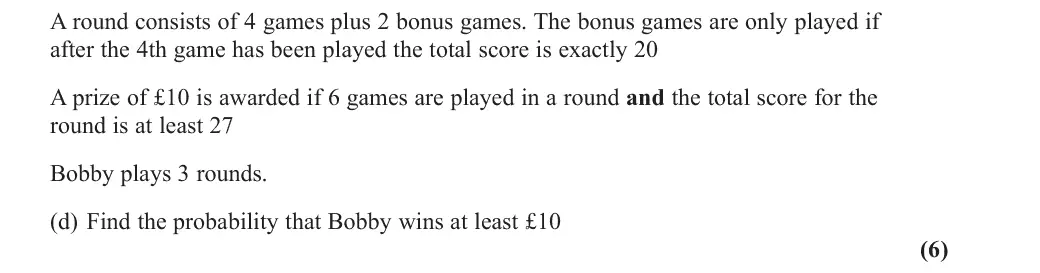
This was a standard question about discrete random variables, expectation and variance. Although part (d) was more challenging, students still, generally, made a good attempt at this final part of the paper. Students should be encouraged to read all the information given in a question paying particular attention to any words in bold. As in part (c) many students omitted to include the different combinations leading to a
Key points from the mark scheme and examiner's report
bonus games total ≥ 7: (6,6), (6,3), (6,2) with arrangements = 0.6
P(prize) = 0.064 × 0.6 = 0.0384
Y ~ B(3, 0.0384), P(Y ≥ 1) = 1 − 0.9616³ = 0.111
errors missed (6,6) or arrangements, or added instead of multiplied
June 2022 · Paper 3B (Further Statistics 1) · Q2(a)1 markEasy
Mark scheme (whole question; this part is marked with the orange bar)
Examiner's comment
This was another straightforward question with nearly 65% scoring full marks. The principles of expectation algebra were clearly understood well and nearly all gave a correct answer to part (a) and most went on to complete part (b) correctly too. There were some algebraic or sign errors when
Key points from the mark scheme and examiner's report
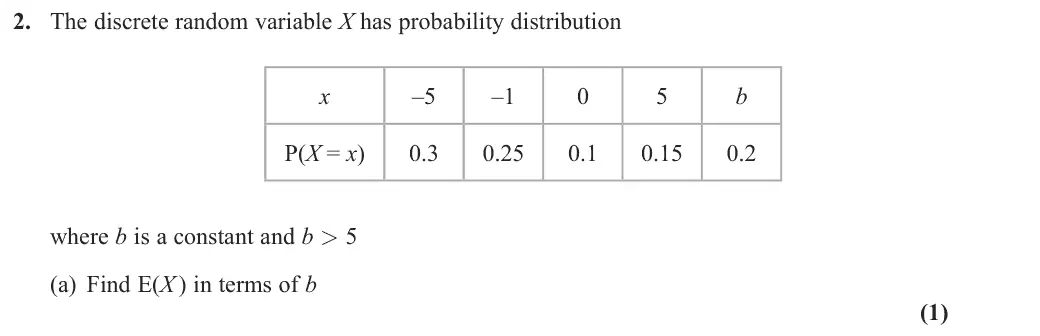
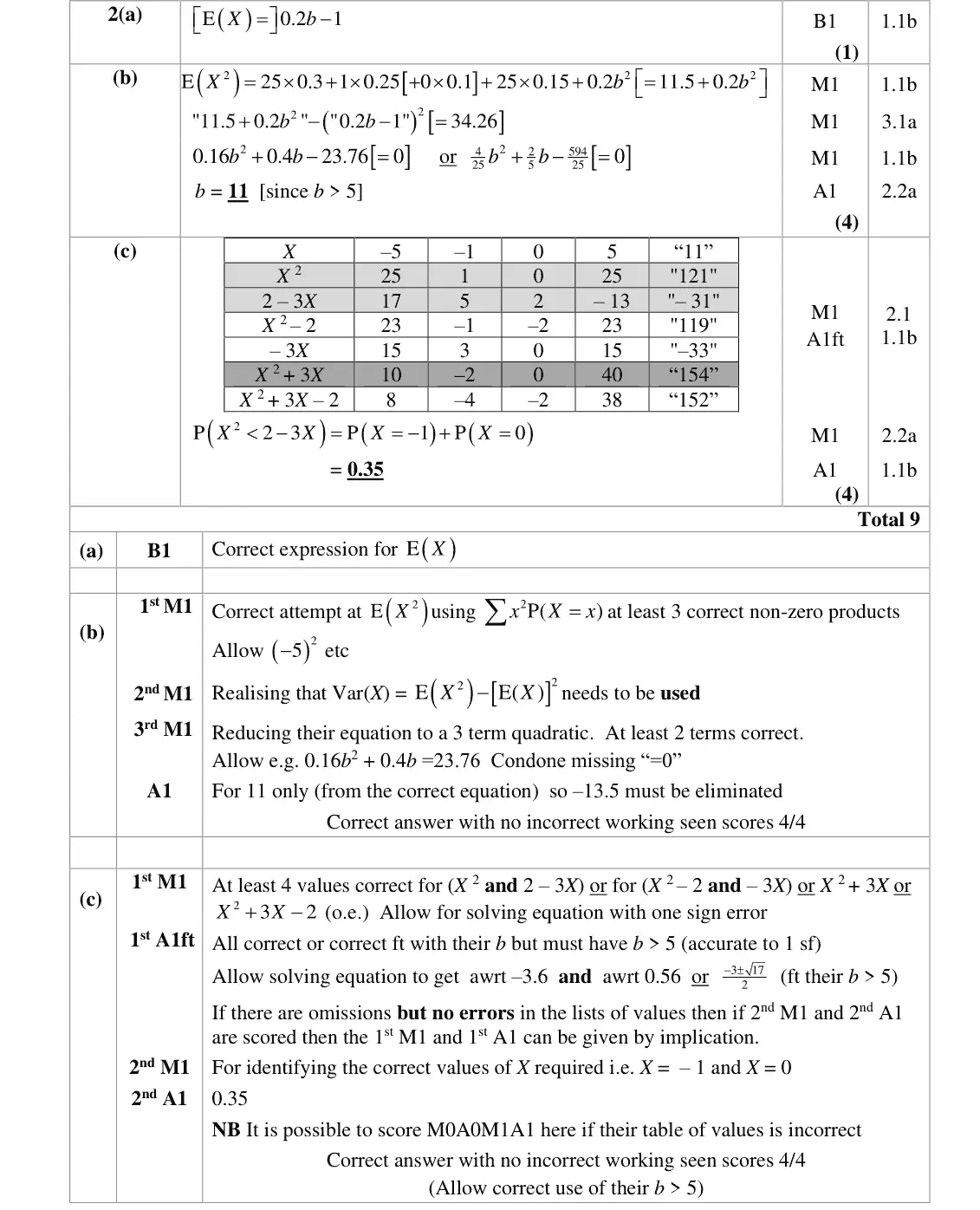
E(X) = 0.2b − 1
June 2022 · Paper 3B (Further Statistics 1) · Q2(b)4 marksEasy
Mark scheme (whole question; this part is marked with the orange bar)
Examiner's comment
This was another straightforward question with nearly 65% scoring full marks. The principles of most went on to complete part (b) correctly too. There were some algebraic or sign errors when substituting but few cases of E(X2) being equated to 34.26 or failing to square E(X). In part (c) most
Key points from the mark scheme and examiner's report
E(X²) = 11.5 + 0.2b²
Var = E(X²) − [E(X)]² gives 0.16b² + 0.4b − 23.76 = 0, b = 11 (reject −13.5 since b > 5)
June 2022 · Paper 3B (Further Statistics 1) · Q2(c)4 marksEasy
Mark scheme (whole question; this part is marked with the orange bar)
Examiner's comment
This was another straightforward question with nearly 65% scoring full marks. The principles of substituting but few cases of E(X2) being equated to 34.26 or failing to square E(X). In part (c) most chose to substitute values and compare the two sides of the inequality though there were occasional arithmetic errors seen here. Others chose to solve the quadratic inequality which was usually more reliable in terms of accuracy provided they knew to take the “inside” region. Having established that X = 0 and – 1 were the values of interest, some students weren’t sure how to relate this to the original distribution whilst others who identified the correct probabilities multiplied them rather than adding.
Key points from the mark scheme and examiner's report
tabulate X² and 2 − 3X, or solve the quadratic inequality (inside region): only X = −1 and X = 0 work
P = 0.25 + 0.1 = 0.35
some multiplied the probabilities
Nov 2021 · Paper 3B (Further Statistics 1) · Q4(a)6 marks
Mark scheme (whole question; this part is marked with the orange bar)
Examiner's comment
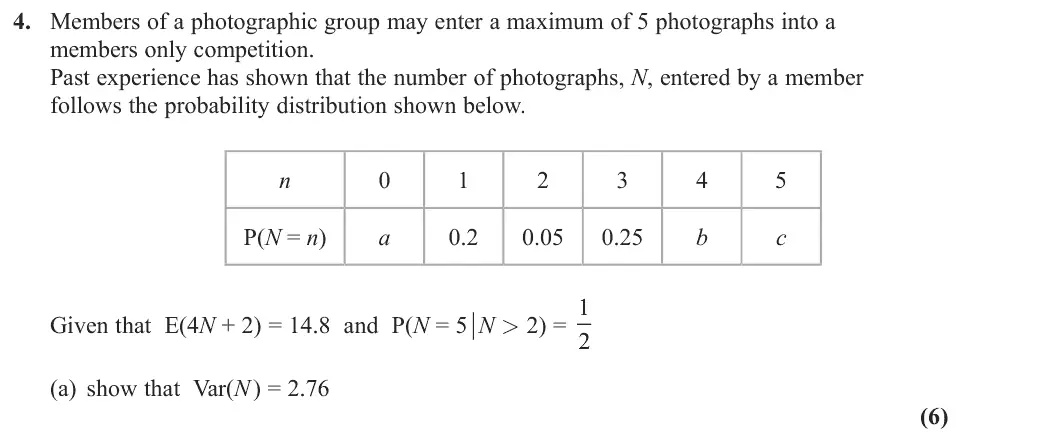
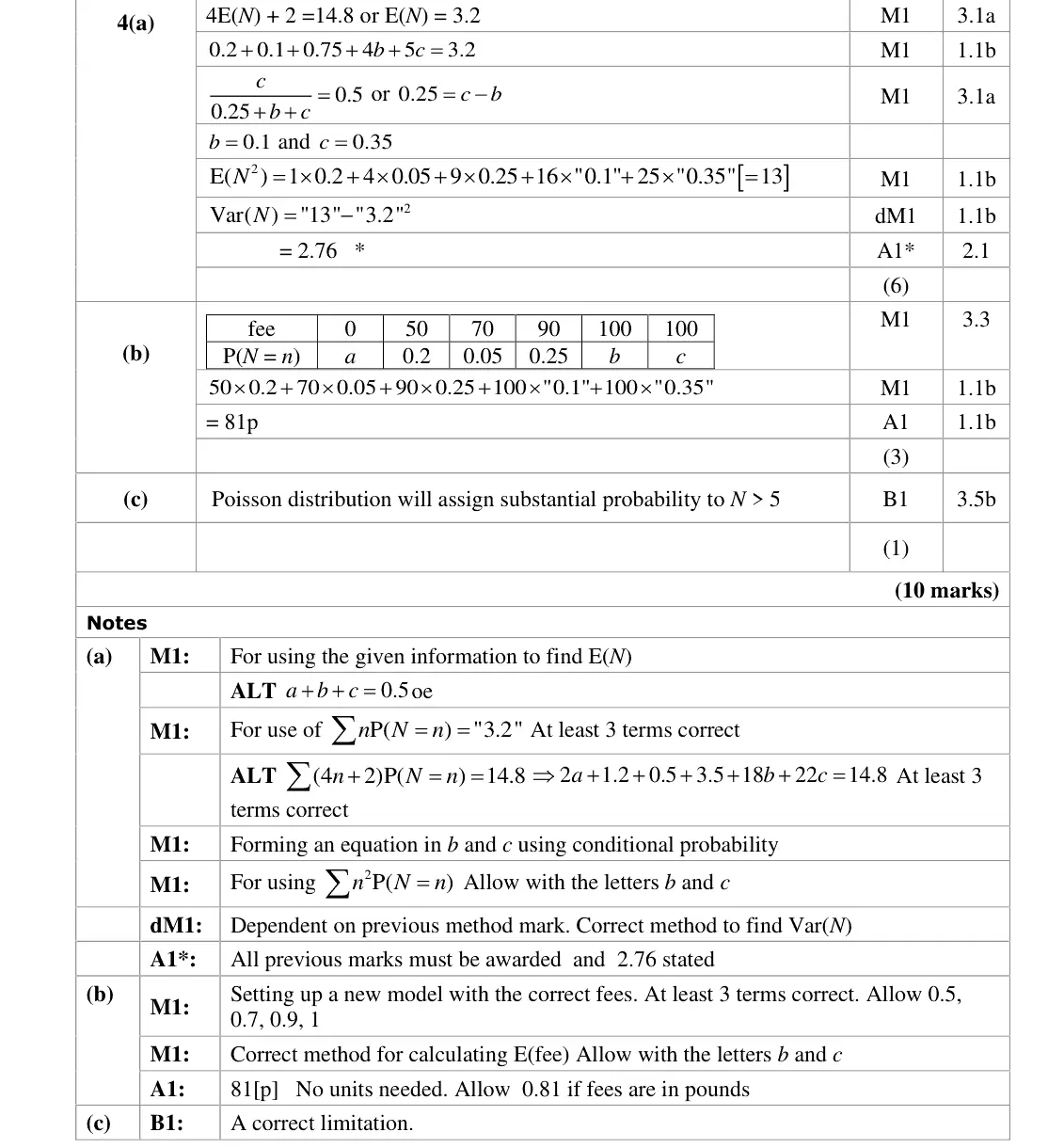
The approach candidates used to this question varied. Most candidates were able to use the conditional probability to form an equation in terms of b and c. The method used by candidates then differed. Those who realised E(N) = 3.2 were generally the most successful as this results in an equation in terms of b and c only and then solved the 2 simultaneous equations. Those who chose to calculate E(4N + 2) ended up with an equation in terms of a, b and c. to form a third equation they needed to use the sum of the probabilities equates to 1. Many of the candidates who used this method were unable to then solve 3 simultaneous equations.
Key points from the mark scheme and examiner's report
E(4N + 2) = 14.8 so E(N) = 3.2
conditional probability c/(0.25 + b + c) = 1/2
b = 0.1, c = 0.35
E(N²) = 13, Var = 13 − 3.2² = 2.76
using E(4N + 2) directly brings in a and needs three equations
Nov 2021 · Paper 3B (Further Statistics 1) · Q4(b)3 marks
Mark scheme (whole question; this part is marked with the orange bar)
Examiner's comment
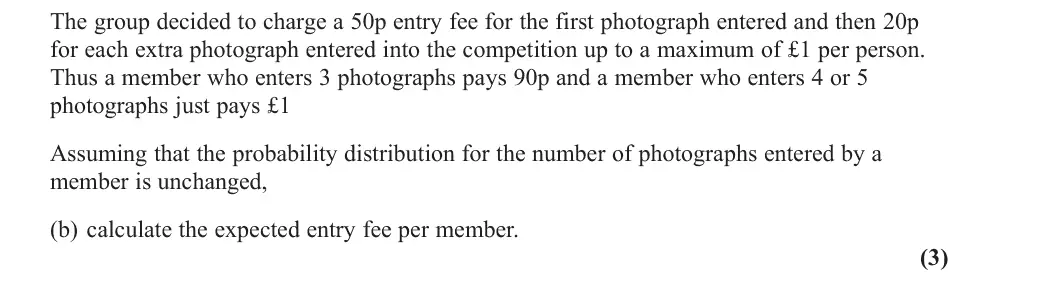
In part (b) the most common error was a failure to include a fee of zero. Those who had some form of probability demonstrated that they knew how to calculate the expected fee to gain the second method mark.
Key points from the mark scheme and examiner's report
fees 0, 50, 70, 90, 100, 100 pence
expected fee 81p
missing the zero fee
Oct 2020 · AS Paper 2 (Further Statistics 1) · Q37 marks
Mark scheme (whole question; this part is marked with the orange bar)
Examiner's comment
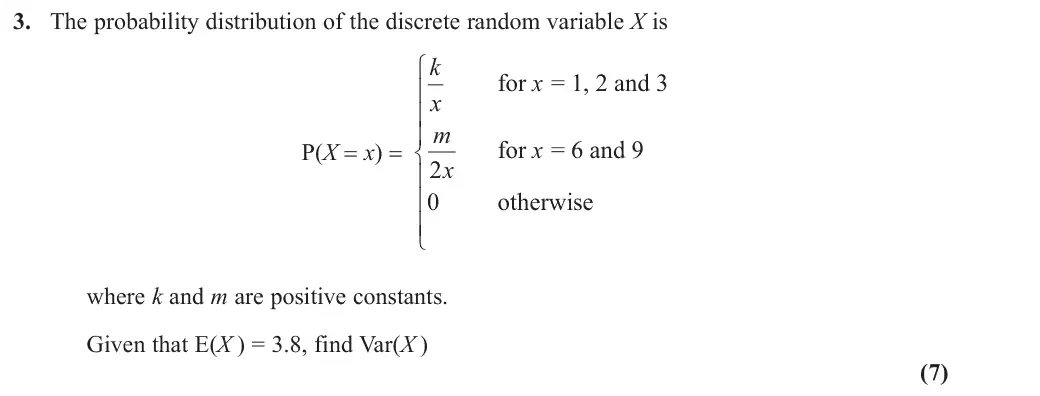
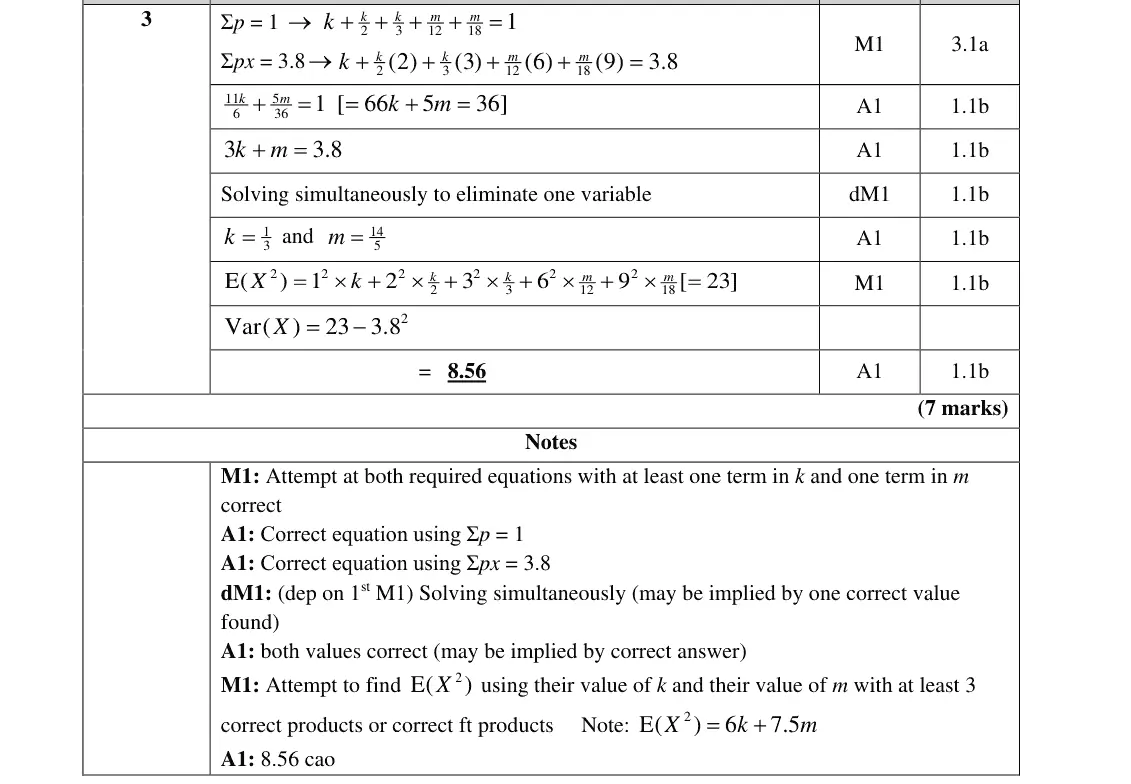
Candidates made generally good attempts at this question; however, numerical slips prevented many from scoring full marks. Most understood to solve this problem they would need two equations: one using 1 p Σ = and one using 3.8 px Σ = . Weaker candidates left x in their equations and made little progress. Of those successfully solving their simultaneous equations and finding a correct value of k and m, many struggled to accurately replace these values in their expression for 2 E( ) X . A few made the common error by failing to square E( ) X when finding the variance.
Key points from the mark scheme and examiner's report
Σp = 1 gives 66k + 5m = 36
Σxp = 3.8 gives 3k + m = 3.8
k = 1/3, m = 14/5
E(X²) = 23
Var(X) = 23 − 3.8² = 8.56
numerical slips common
weaker candidates left x in the equations or forgot to square E(X)
Oct 2020 · Paper 3B (Further Statistics 1) · Q4(a)3 marks
Mark scheme (whole question; this part is marked with the orange bar)
Examiner's comment
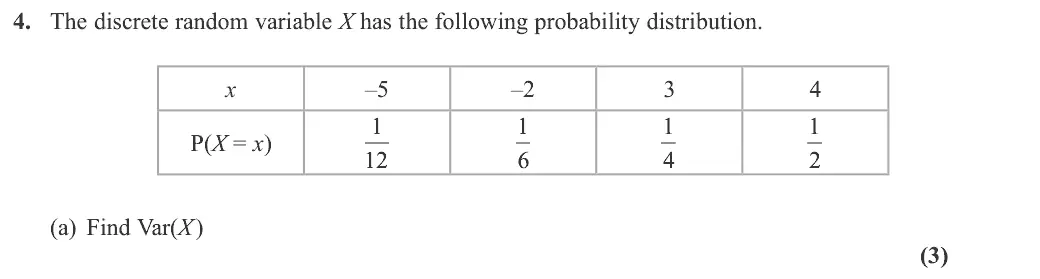
discriminating the most able. Part (a) was very accessible with only an occasional candidate forgetting to square mean when subtracting. Answers to part (b) were well structured and most found the correct distribution for Y
Key points from the mark scheme and examiner's report
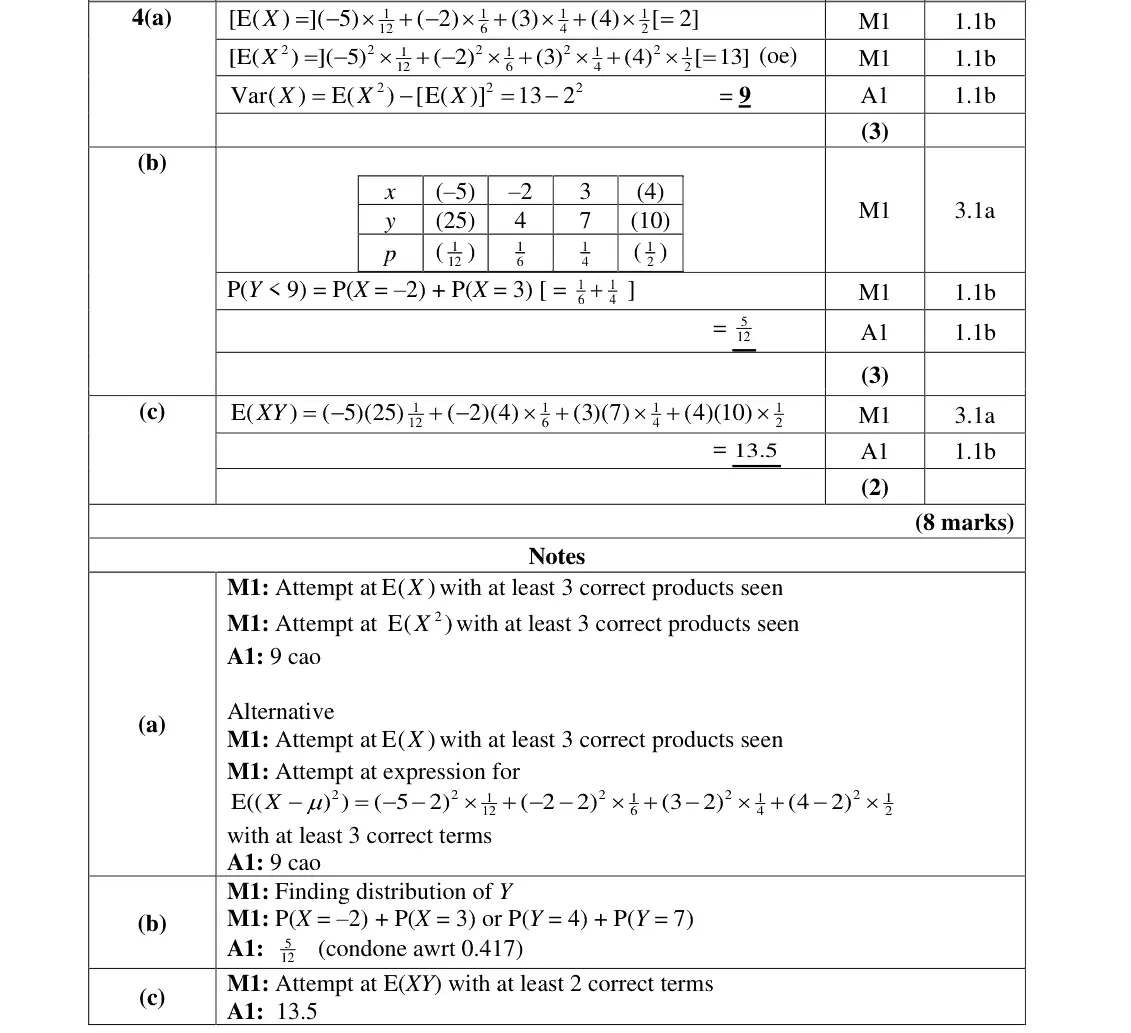
E(X) = 2, E(X²) = 13, Var(X) = 13 − 2² = 9
forgetting to square the mean
Oct 2020 · Paper 3B (Further Statistics 1) · Q4(b)3 marks
Mark scheme (whole question; this part is marked with the orange bar)
Examiner's comment
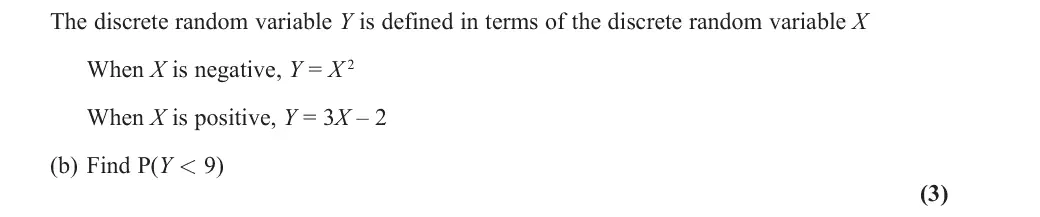
Answers to part (b) were well structured and most found the correct distribution for Y and used this to calculate the required probability.
Key points from the mark scheme and examiner's report
tabulate Y: 25, 4, 7, 10
P(Y < 9) = P(X = −2) + P(X = 3) = 5/12
Oct 2020 · Paper 3B (Further Statistics 1) · Q4(c)2 marks
Mark scheme (whole question; this part is marked with the orange bar)
Examiner's comment
Question 4 provided a good source of marks for most candidates with only part (c) discriminating the most able. Part (a) was very accessible with only an occasional Part (c) caused more of a problem with a significant number of candidates thinking that E(XY)=E(X)E(Y) leading to common incorrect answer of 19. Successful candidates listed all of the options for XY.
Key points from the mark scheme and examiner's report
E(XY) = Σ xy P(X = x) = 13.5 (list every xy)
E(X)E(Y) = 19 is the common wrong answer
Oct 2020 · Paper 3B (Further Statistics 1) · Q7(a)8 marks
Mark scheme (whole question; this part is marked with the orange bar)
Examiner's comment
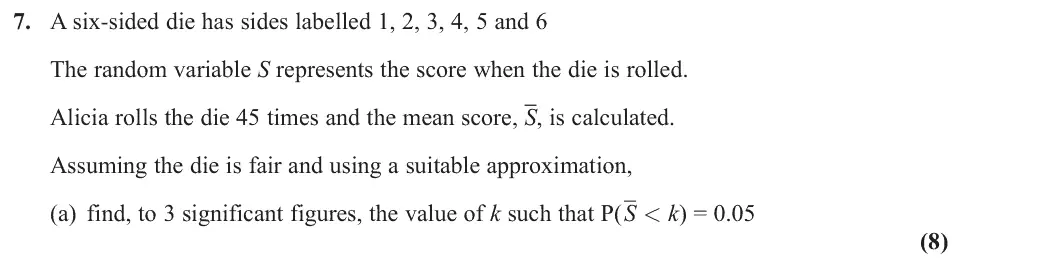
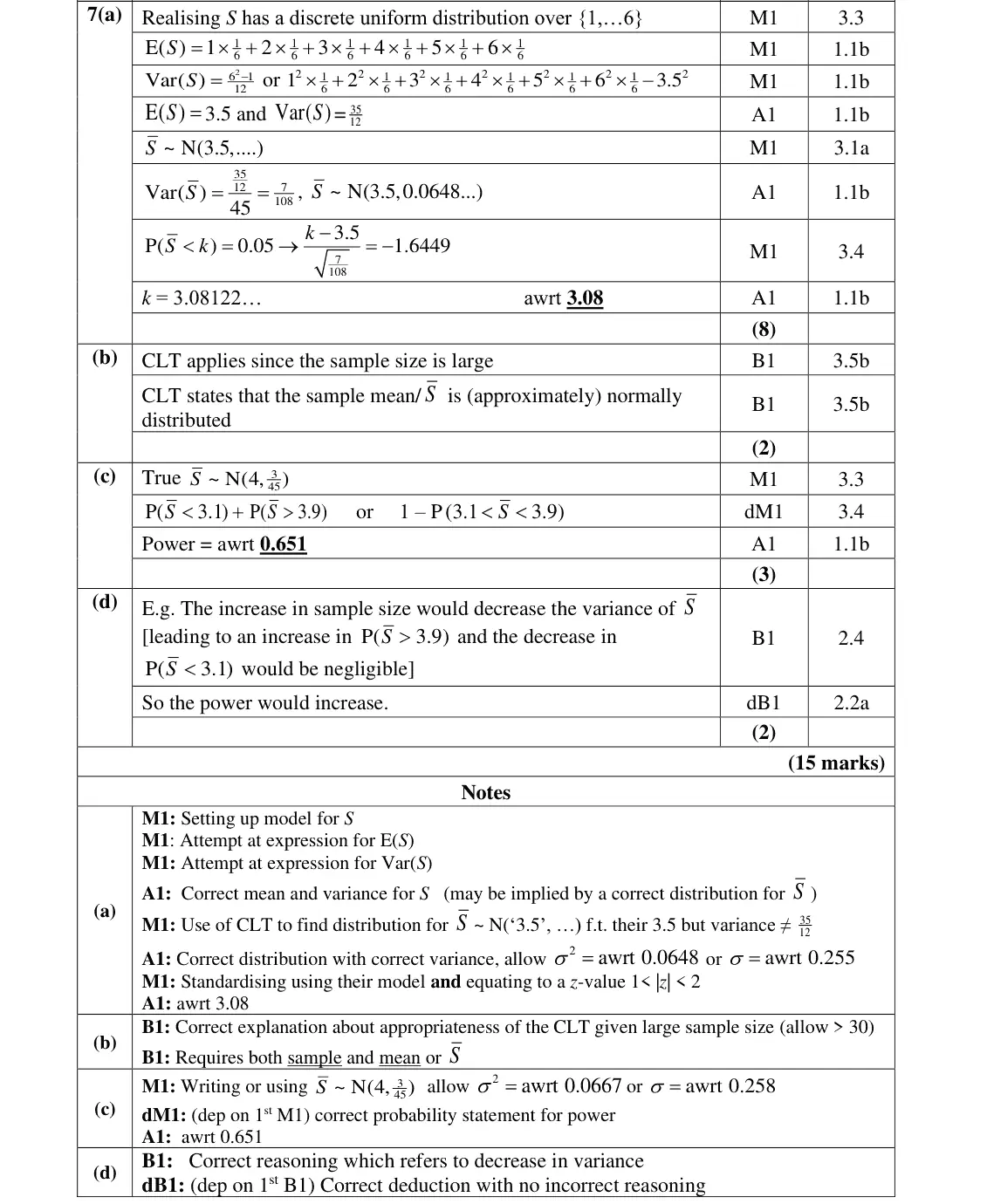
Most candidates recognised the discrete uniform distribution in part (a), correctly finding its mean and variance. Many then correctly identified the sampling distribution of the mean as a normal distribution (using the CLT) although many made an error with the variance failing to divide by 45. Attempts at standardisation were commonly shown although some used the original variance. Whilst there were many completely correct attempts there were one or two with sign errors on their value of z leading to an incorrect answer that was higher than the mean. Many candidates struggled in part (b) through lack of rigour in their statements.
Key points from the mark scheme and examiner's report
discrete uniform: E(S) = 3.5, Var(S) = 35/12
CLT: S̄ ≈ N(3.5, 7/108)
(k − 3.5)/√(7/108) = −1.6449, k = 3.08
failing to divide the variance by 45
June 2019 · AS Paper 2 (Further Statistics 1) · Q4(a)1 mark
Mark scheme (whole question; this part is marked with the orange bar)
Examiner's comment
Parts (a) and (b) were answered very well but a few candidates miscopied their 16r as 6r and proceeded to use this incorrect value in part (c). Most could make a start with part (c) by finding E(X) and hence
Key points from the mark scheme and examiner's report
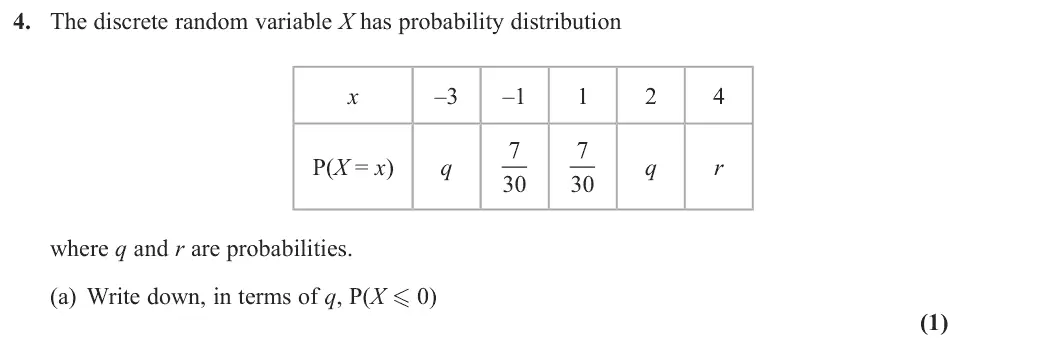
P(X ≤ 0) = q + 7/30
June 2019 · AS Paper 2 (Further Statistics 1) · Q4(b)2 marks
Mark scheme (whole question; this part is marked with the orange bar)
Examiner's comment
Parts (a) and (b) were answered very well but a few candidates miscopied their 16r as 6r and proceeded to use this incorrect value in part (c). Most could make a start with part (c) by finding E(X) and hence
Key points from the mark scheme and examiner's report
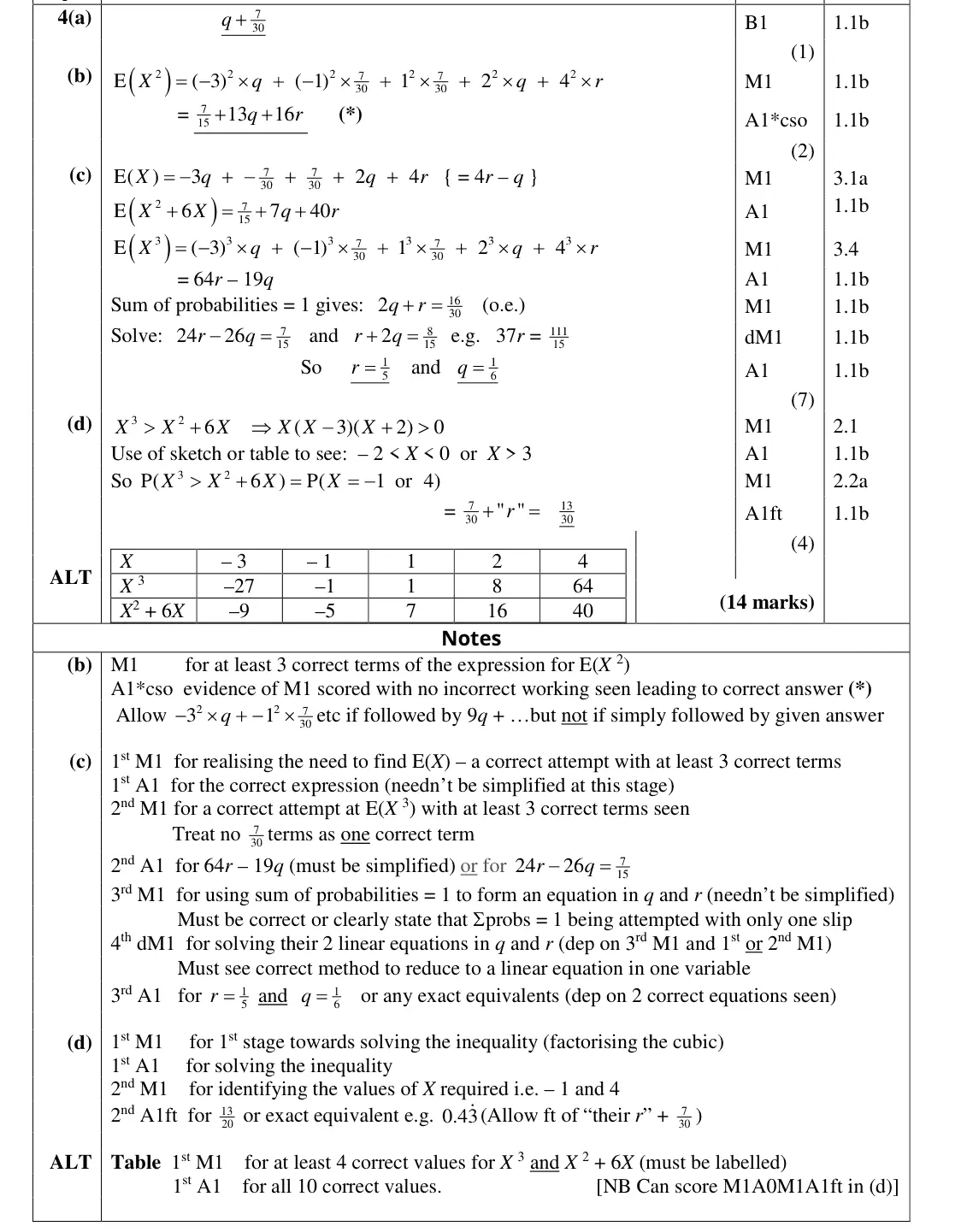
E(X²) = Σx²P(X = x) = 7/15 + 13q + 16r
given answer so show the terms
June 2019 · AS Paper 2 (Further Statistics 1) · Q4(c)7 marks
Mark scheme (whole question; this part is marked with the orange bar)
Examiner's comment
to use this incorrect value in part (c). Most could make a start with part (c) by finding E(X) and hence 6E(X) and E(X 2) + E(6X). Many also managed to find an expression for E(X 3) though sometimes there were sign errors on the negative terms. Finding a second equation in q and r seemed to evade a few but most used the sum of the probabilities to form a second equation and were able to solve their two equations which, if no previous errors had been made, usually led to the correct answers. There were a few blank responses to part (d) and a few who tried comparing expected values and then gave up but a
Key points from the mark scheme and examiner's report
E(X) = 4r − q, so E(X² + 6X) = 7/15 + 7q + 40r
E(X³) = 64r − 19q
Σp = 1 gives 2q + r = 8/15
r = 1/5, q = 1/6
sign errors on negative cubes
some miscopied 16r as 6r
June 2019 · AS Paper 2 (Further Statistics 1) · Q4(d)4 marks
Mark scheme (whole question; this part is marked with the orange bar)
Examiner's comment
few blank responses to part (d) and a few who tried comparing expected values and then gave up but a good number made a start on part (d) and quite a few of them, with the help of the final A1 follow through mark, achieved all 4 marks. Some started by rearranging the inequality and factorising the cubic but often they stopped here seemingly unable to draw a simple sketch and solve the cubic inequality. The most common approach though was to form a table with the 10 values for X 3 and X 2 + 6X and by comparing these values to identify X = – 1 and 4 as the required cases and then write down the appropriate probability.
Key points from the mark scheme and examiner's report
X(X − 3)(X + 2) > 0 gives −2 < X < 0 or X > 3, i.e. X = −1 or 4 (or tabulate X³ and X² + 6X)
P = 7/30 + 1/5 = 13/30
many factorised but could not solve the cubic inequality
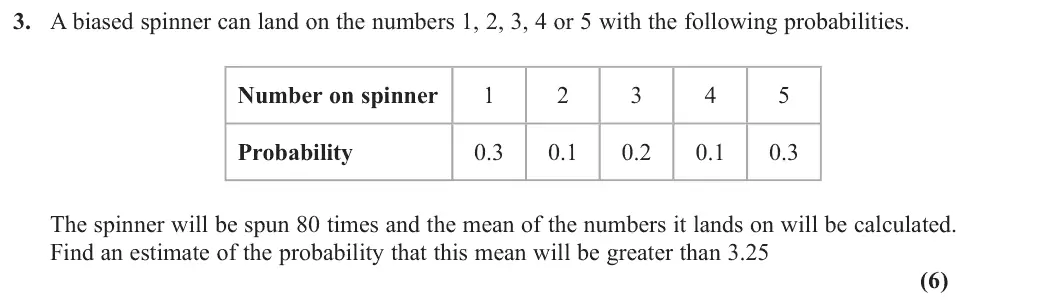
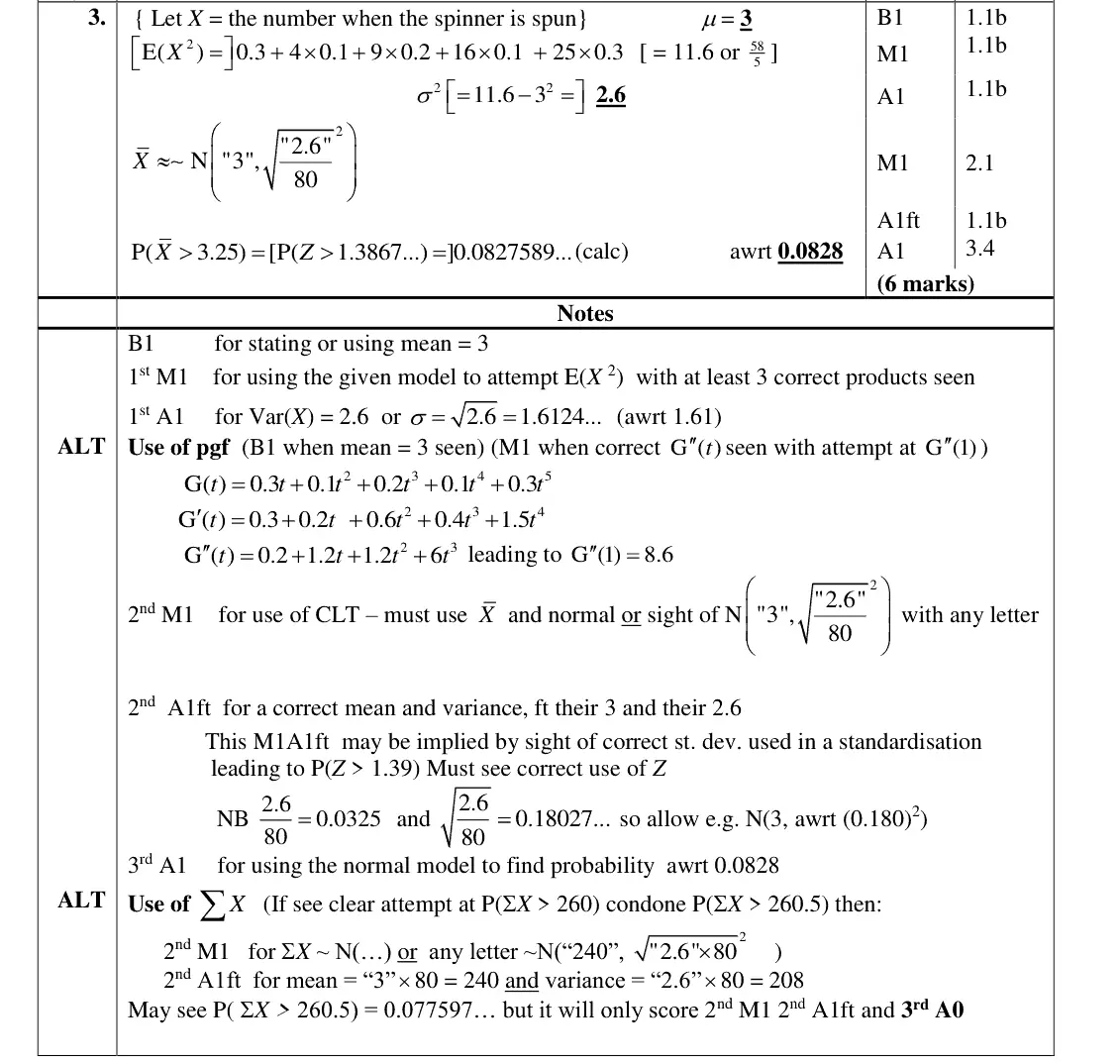
June 2019 · Paper 3B (Further Statistics 1) · Q36 marksEasy
Mark scheme (whole question; this part is marked with the orange bar)
Examiner's comment
This turned out to be the most successfully answered question on the paper with nearly 70% scoring full marks. Even those who did not spot the need to use the central limit theorem could often score the first 3 marks although some still struggled to use the correct formula for the variance with – E(X), instead of – E(X2), a common error. Use of correct notation was not good with the statements like 2.6 ~ N 3, 80 X often being used correctly as 2 2.6 ~ N 3, 80 X . Candidates should be aware that there is an assessment objective in the new specification that requires “correct use of mathematical notation” and correct handling of normal distribution notation may be required in future assessments.
Key points from the mark scheme and examiner's report
mean 3, Var(X) = 11.6 − 3² = 2.6
CLT: X̄ ≈ N(3, 2.6/80)
P(X̄ > 3.25) = 0.0828
Var using E(X) not E(X²) was common
poor normal notation
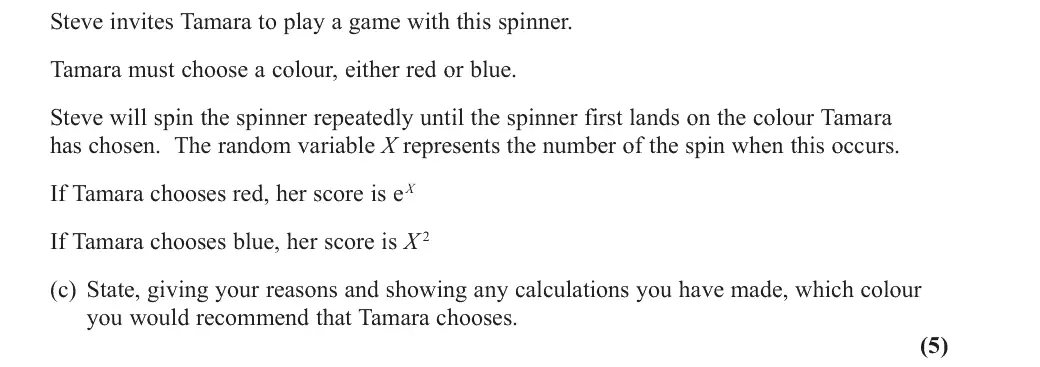
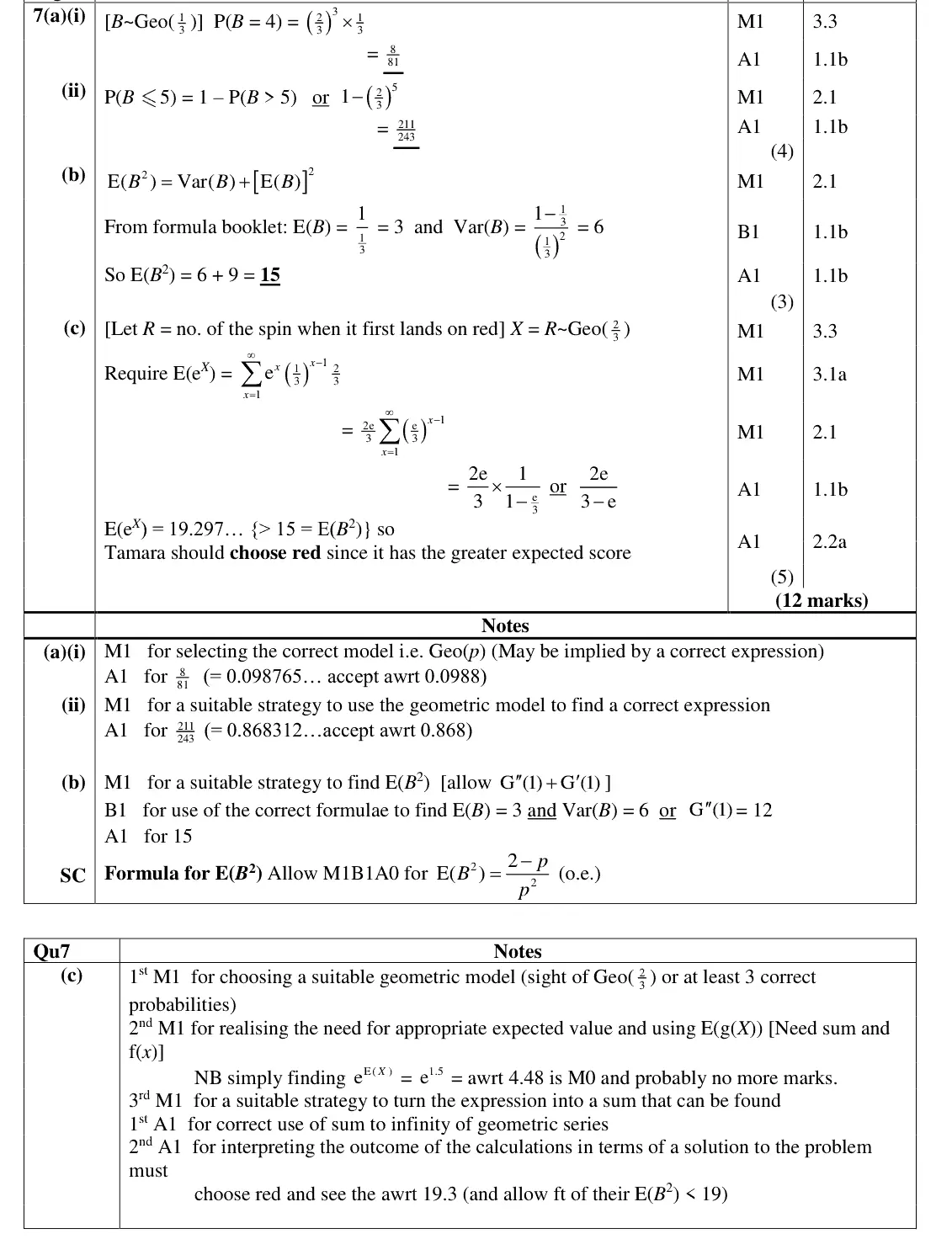
June 2019 · Paper 3B (Further Statistics 1) · Q7(c)5 marksMedium
Mark scheme (whole question; this part is marked with the orange bar)
Examiner's comment
error being to use E(B2) = [E(B)]2 . Part (c) was the most challenging question on the paper. Many obtained the first mark for identifying the correct distribution for the number of the spin when it first lands on red. The main problem was that candidates didn’t know how to find E(eX) with eE(X) being the most common incorrect approach. Some tried to argue from comparing the graphs of y = ex and y = x2 but there was no consideration of appropriate probabilities and some numerical approaches floundered in the same way. A small number found the correct probability generating function G(t) and then gave the very succinct solution G(e) but this was rare! Over 5% though did find the correct value of E(eX) and after comparing this with E(B2) were able to secure all the marks for this question.
Key points from the mark scheme and examiner's report
red: X ~ Geo(2/3)
E(eˣ) = Σ eˣ(1/3)^(x−1)(2/3) = 2e/(3 − e) = 19.3 > 15 so choose red (or G(e) from the pgf)
e^E(X) is the common wrong method
hardest part on the paper
June 2018 · AS Paper 2 (Further Statistics 1) · Q3(a)1 mark
Mark scheme (whole question; this part is marked with the orange bar)
Examiner's comment
The majority of students were able to gain the mark for part (a).
Key points from the mark scheme and examiner's report
E(B) = 2.5 by symmetry
June 2018 · AS Paper 2 (Further Statistics 1) · Q3(b)5 marks
Mark scheme (whole question; this part is marked with the orange bar)
Examiner's comment
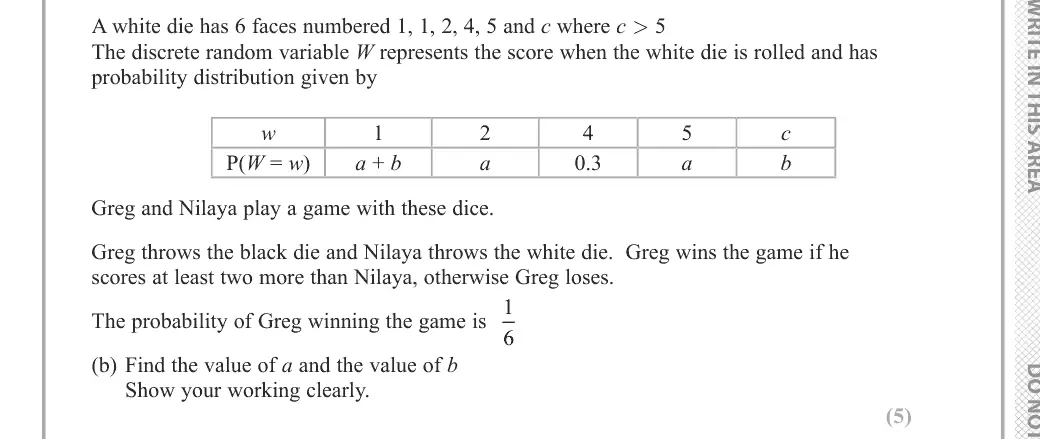
Part (b) proved to be a challenge for all but the most able. Those who wrote down the ways in which Greg could win faired best as they were then able to attempt to find the probability in terms of a and b however, this was rarely seen. Most students tried to just write down the probability of Greg winning straight away with little success. However, they usually managed to use the fact that the total of the probabilities must equal one to gain the mark for 3 2 0.7 a b
Key points from the mark scheme and examiner's report
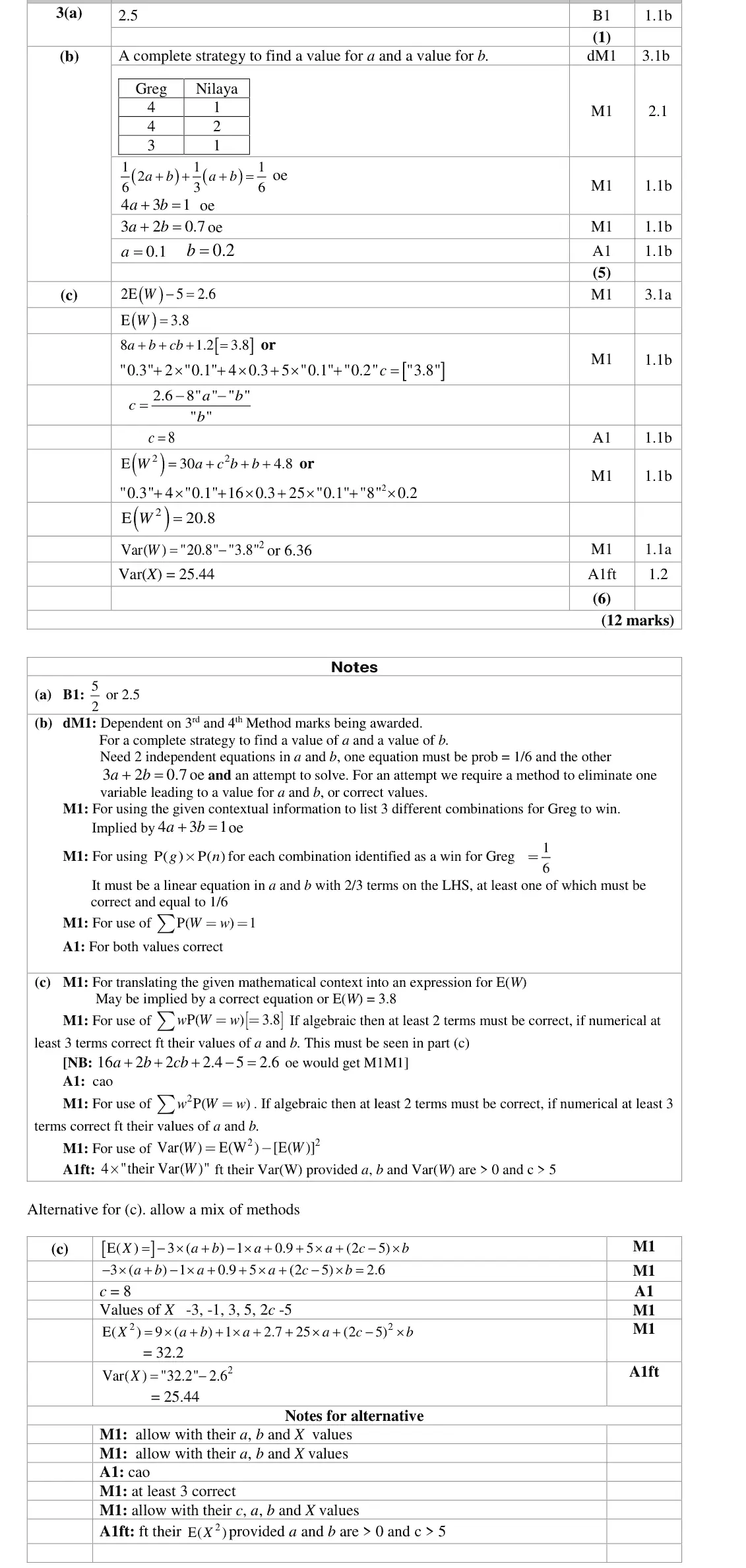
list Greg's wins (4,1), (4,2), (3,1): (1/6)(2a + b) + (1/3)(a + b) = 1/6 gives 4a + 3b = 1
sum of probabilities gives 3a + 2b = 0.7
a = 0.1, b = 0.2
most tried to write the probability straight down without listing outcomes
June 2018 · AS Paper 2 (Further Statistics 1) · Q3(c)6 marks
Mark scheme (whole question; this part is marked with the orange bar)
Examiner's comment
In part (c) students used a mixture of possible methods. The majority of students knew the correct formula for the variance but did not check it was all in W or X. All too often they used using 2 W 2 2 E 2 5 E( ) X . Another common error was to try to find . E( ) E( ) X W
Key points from the mark scheme and examiner's report
E(W) = (2.6 + 5)/2 = 3.8 gives c = 8
E(W²) = 20.8, Var(W) = 6.36
Var(X) = 4Var(W) = 25.44
common errors mixing W and X in the variance formula or writing E(X²) = 4E(W²) − 25
Find an Edexcel Further Maths tutor
Stuck on this? Book a trial lesson with our Further Maths tutor.