Notes, worked examples and practice for this topic are being written by our tutors. The past-paper questions below are ready now: work each one on paper, then open the mark scheme and the examiner's comment.
Tap a question to zoom it. Mark scheme and examiner's comment open under each question.
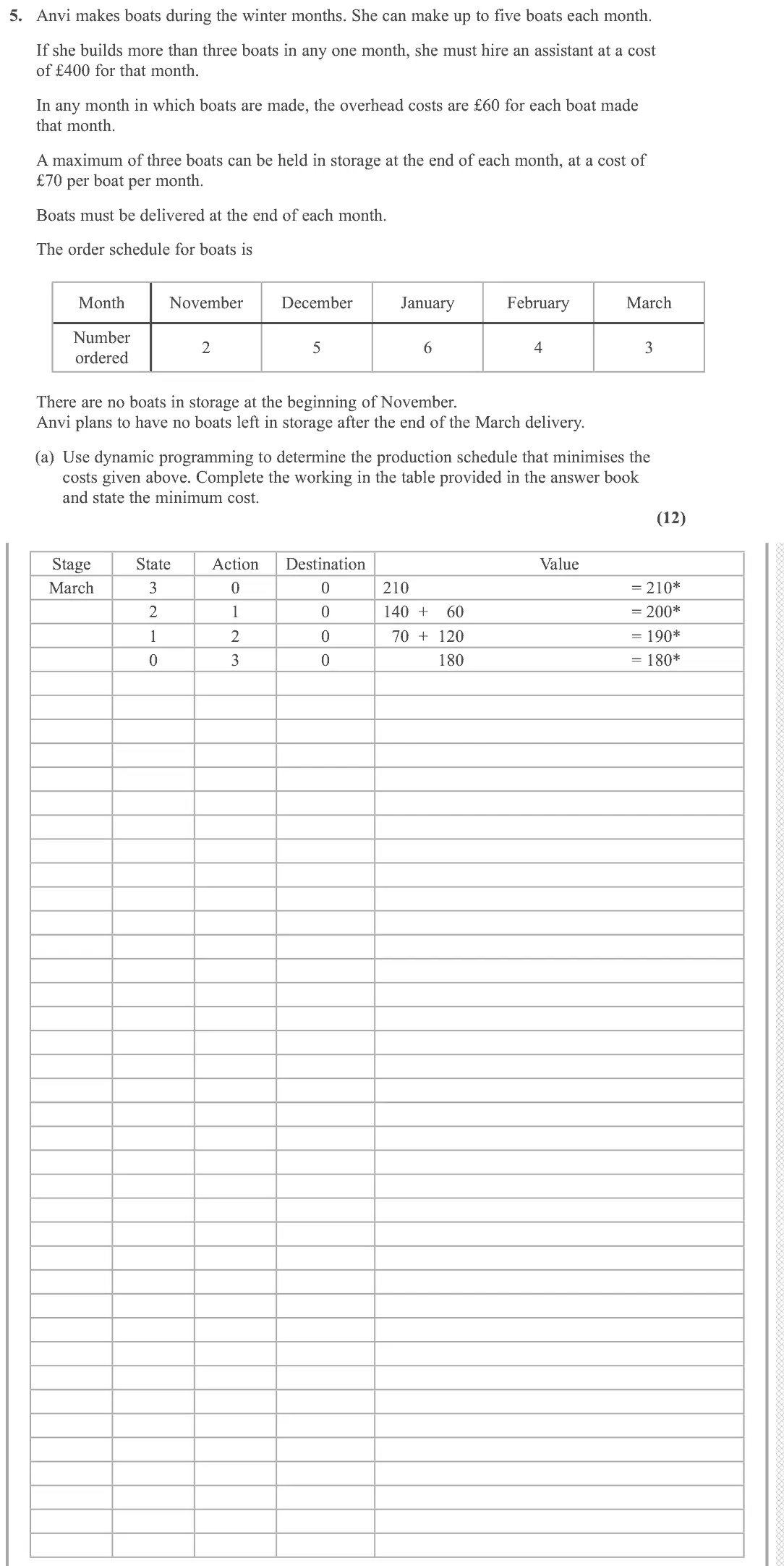
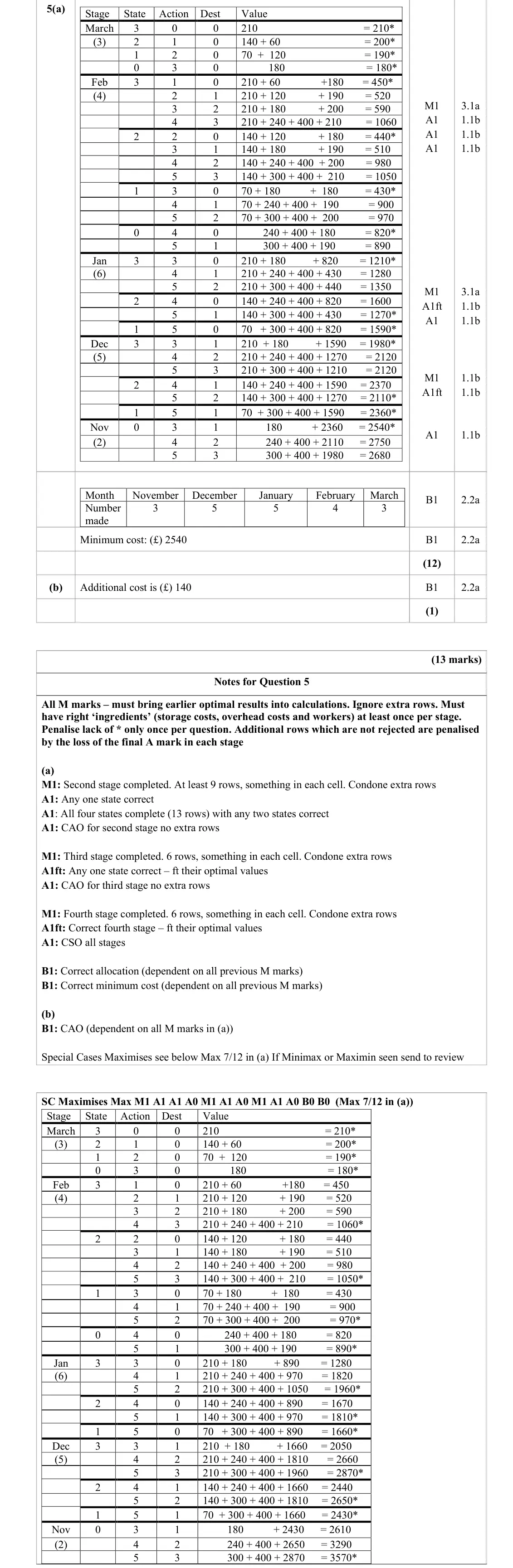
June 2025 · Paper 4D (Decision 2) · Q5(a)12 marks
Mark scheme (whole question; this part is marked with the orange bar)
Examiner's comment
A significant number of candidates made a reasonable attempt at this question, and they were assisted by having the first stage printed as a starting point. Some common errors seen were not remembering to include the optimum values from the previous stage in the calculations and omitting either a whole state or one or more rows from a state. Some candidates realised from their subsequent calculations that February state 3 was not required for the final solution and chose to delete this, which was penalised. Other errors were generally due to numerical slips
Key points from the mark scheme and examiner's report
first stage (March) printed
states = boats in storage (0 to 3)
cost = 60 per boat made + 400 if more than 3 made + 70 per boat stored
carry forward optimal values
make 3, 5, 5, 4, 3
minimum cost £2540
omitting a state or rows, or deleting February state 3, lost marks
June 2025 · Paper 4D (Decision 2) · Q5(b)1 mark
Mark scheme (whole question; this part is marked with the orange bar)
Examiner's comment
when calculating values. In part (b) many candidates failed to calculate the minimum additional cost.
Key points from the mark scheme and examiner's report
best plan with more than 3 boats in November costs £2680 (from the Nov table), so additional cost £140
many failed to find it
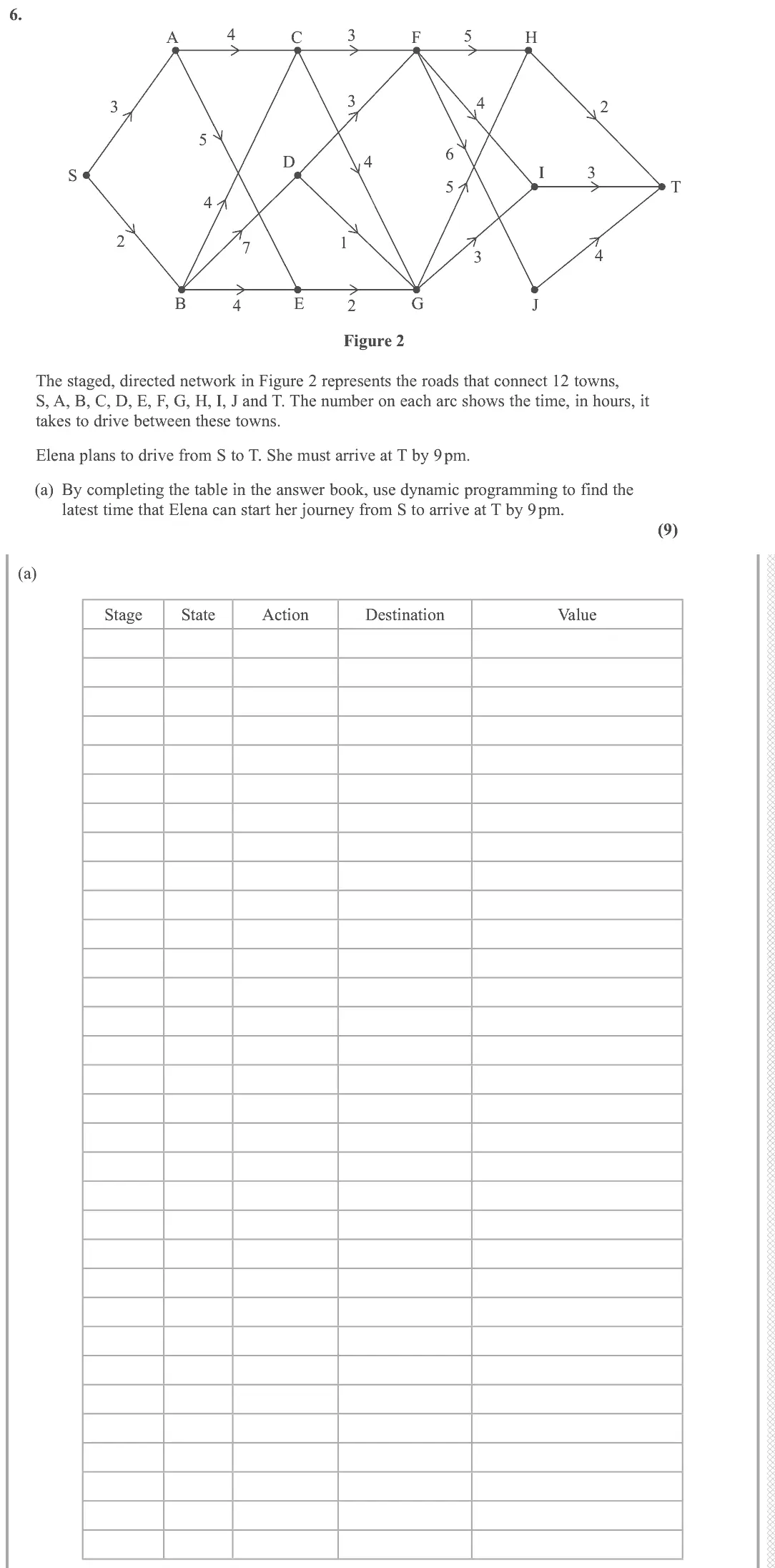
June 2024 · Paper 4D (Decision 2) · Q6(a)9 marks
Mark scheme (whole question; this part is marked with the orange bar)
Examiner's comment
This proved to be a very accessible question, with many candidates obtaining full marks, or very close to full marks. Most candidates were able to produce the correct dynamic programming table, perhaps with one small error, either in indicating the optimum values or in a numerical value. Most also calculated the correct starting time and route. A small number of candidates found the minimax (or maximin) route instead of minimising and were penalised. A few candidates, instead of calculating the minimum duration needed to travel the route, started from the finishing time and worked in terms of the starting time for each stage on the route. This was perfectly acceptable and the best of these worked in the 24-hour clock.
Key points from the mark scheme and examiner's report
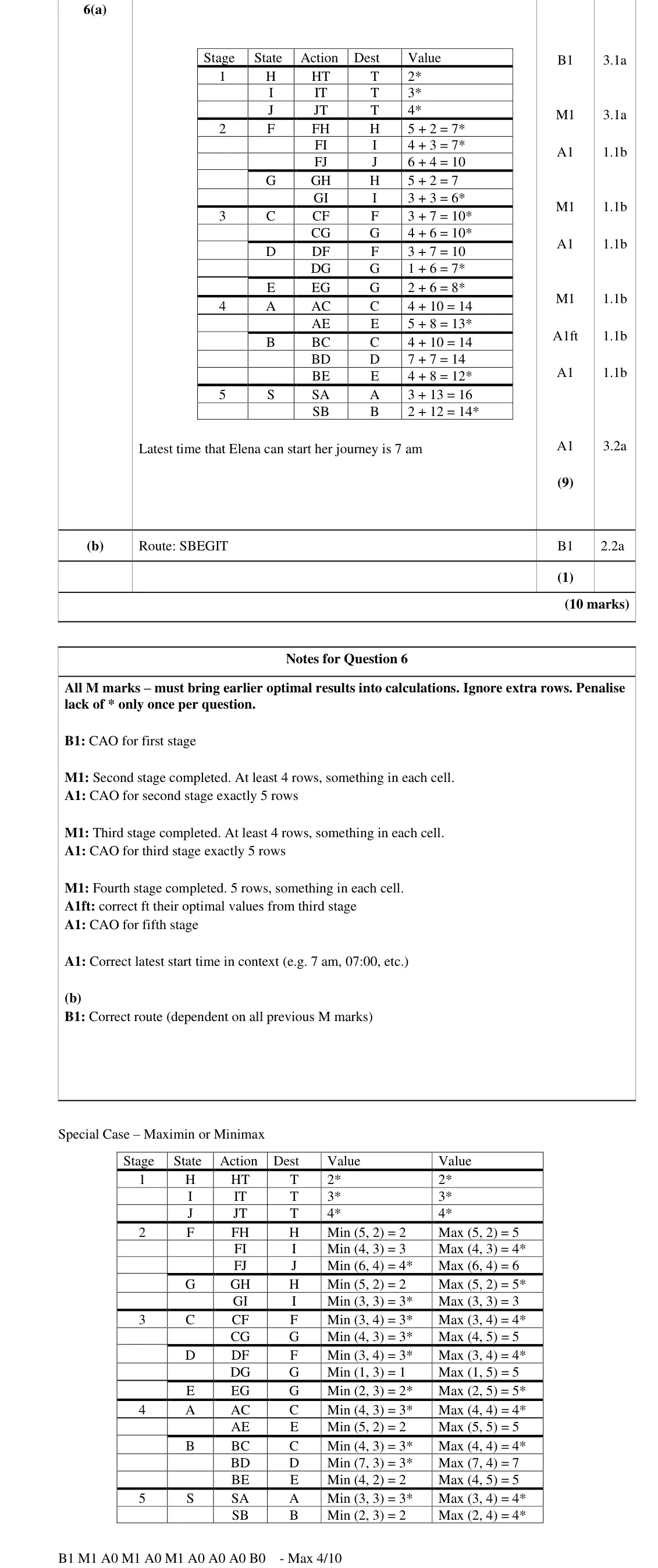
minimisation (not minimax or maximin, which score at most 4)
stage 1 H 2, I 3, J 4
working back gives minimum time 14 hours from S
latest start 7 am
June 2024 · Paper 4D (Decision 2) · Q6(b)1 mark
Mark scheme (whole question; this part is marked with the orange bar)
Examiner's comment
This proved to be a very accessible question, with many candidates obtaining full marks, or very close to full marks. Most candidates were able to produce the correct dynamic programming table, perhaps with one small error, either in indicating the optimum values or in a numerical value. Most also calculated the correct starting time and route. A small number of candidates found the minimax (or maximin) route instead of minimising and were penalised. A few candidates, instead of calculating the minimum duration needed to travel the route, started from the finishing time and worked in terms of the starting time for each stage on the route. This was perfectly acceptable and the best of these worked in the 24-hour clock.
Key points from the mark scheme and examiner's report
S–B–E–G–I–T
June 2023 · Paper 4D (Decision 2) · Q613 marks
Mark scheme (whole question; this part is marked with the orange bar)
Examiner's comment
Although this was an unstructured dynamic programming question, there were many good answers seen. There were two alternative, fully correct solutions, one with the earnings from a location being added when that location first appeared in the table (as a state) and the second with the earnings added when the location was used as a destination. In both cases candidates correctly worked backwards from S adding the cost of travel, earnings and previous values into each stage. There were occasional arithmetical errors seen. Those candidates with good solutions correctly identified the optimum schedule, stating this clearly and giving the expected earnings, although a small number made an error here. There were a number of common errors seen, with a significant number of candidates attempting to work forwards. Some of those working backwards omitted the first stage, attempting to start at H, I and J instead of S and some interchanged the state and destination. All of these attempts lost a significant number of marks.
Key points from the mark scheme and examiner's report
work backwards from S: stages weeks 4 to 1, value = fee − travel cost + best later value
maximise
optimal schedule S–A–C–G–J–S
maximum expected income £16 100
working forwards scores at most 6, omitting the first stage or swapping state and destination lost marks
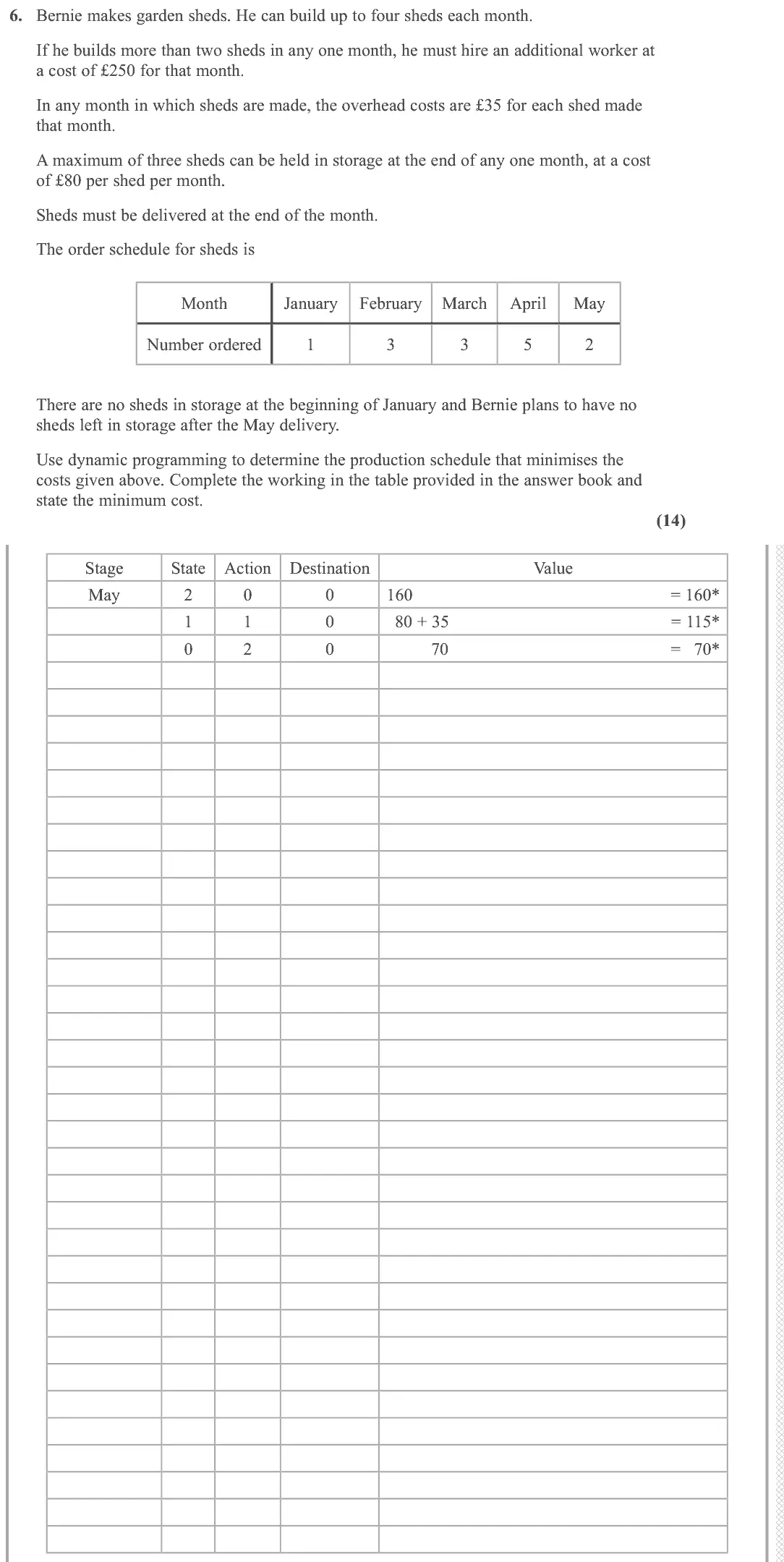
June 2022 · Paper 4D (Decision 2) · Q614 marks
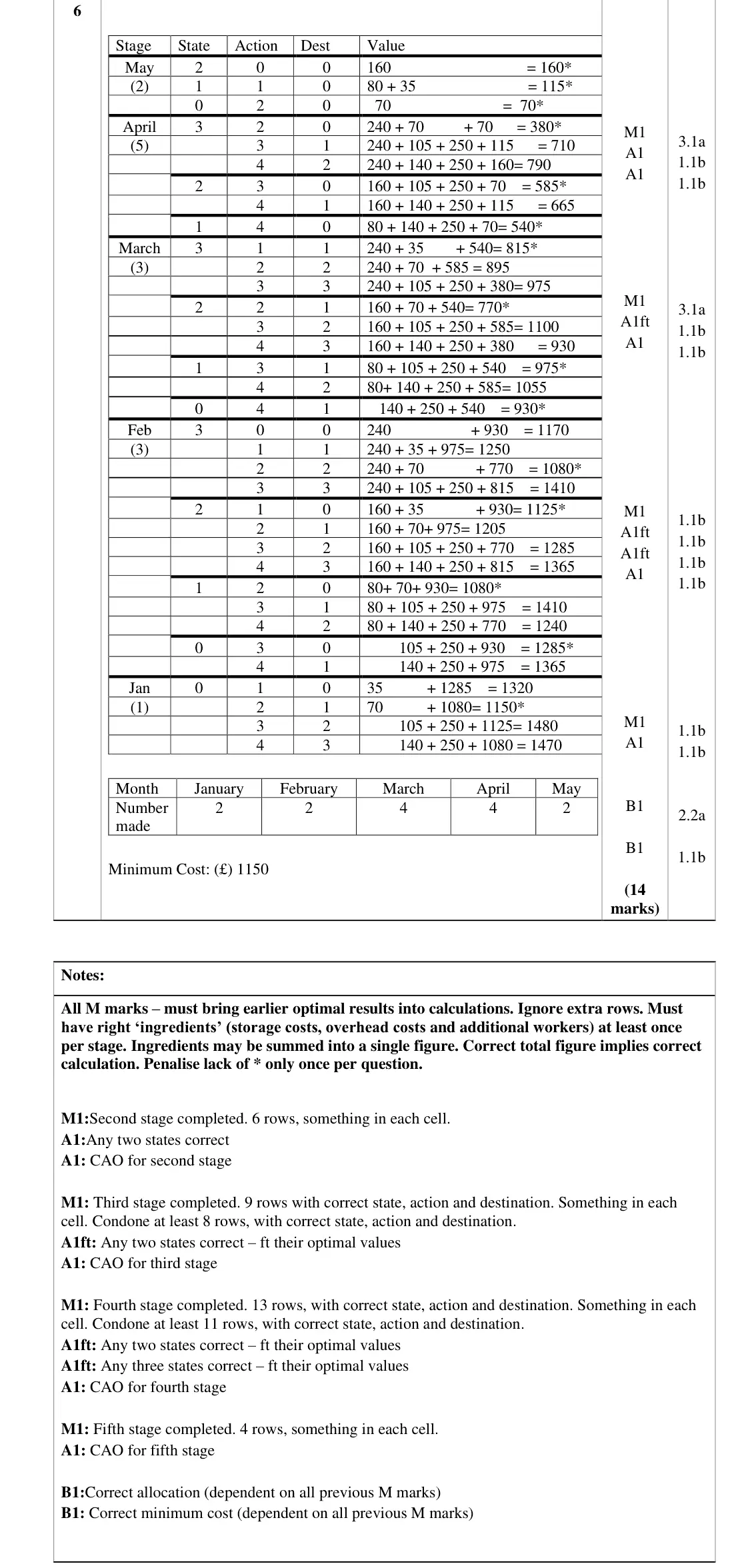
Mark scheme (whole question; this part is marked with the orange bar)
Examiner's comment
Candidates’ attempts at this question gained marks across the full range, with about a quarter gaining full marks and an approximately equal number gaining none. It was evident that the problem was made accessible to a proportion of candidates using the starting point of May as an example to scaffold their solution. Some candidates left the pages for this question blank. Others gained no marks due either to failing, throughout, to include one or more of the costs given in the question or failing to include earlier optimal results in their calculations. Candidates should be reminded that the essential feature of dynamic programming is to carry forward optimal results from stage to stage. Of those that earned some marks many were able to complete the stage, state, action and destination columns. Errors were mainly due to incorrect multiples of 35 and/or 80 being added. A few candidates lost marks for omitting state 0 for February and March, missing the possibility that no sheds were in storage. Others, however, were not penalised for including extra rows with more than 3 sheds stored or more than 4 sheds made. Pure arithmetic errors were not very common and mostly resulted in the loss of one mark, or occasionally two. Most of those who completed the table obtained the optimum solution and minimum cost.
Key points from the mark scheme and examiner's report
stages are months worked back from May, states = sheds in storage (0 to 3, include state 0)
cost = 35 per shed made + 250 if more than 2 made + 80 per shed stored
carry forward optimal values
make 2, 2, 4, 4, 2
minimum cost £1150
wrong multiples of 35 or 80 common
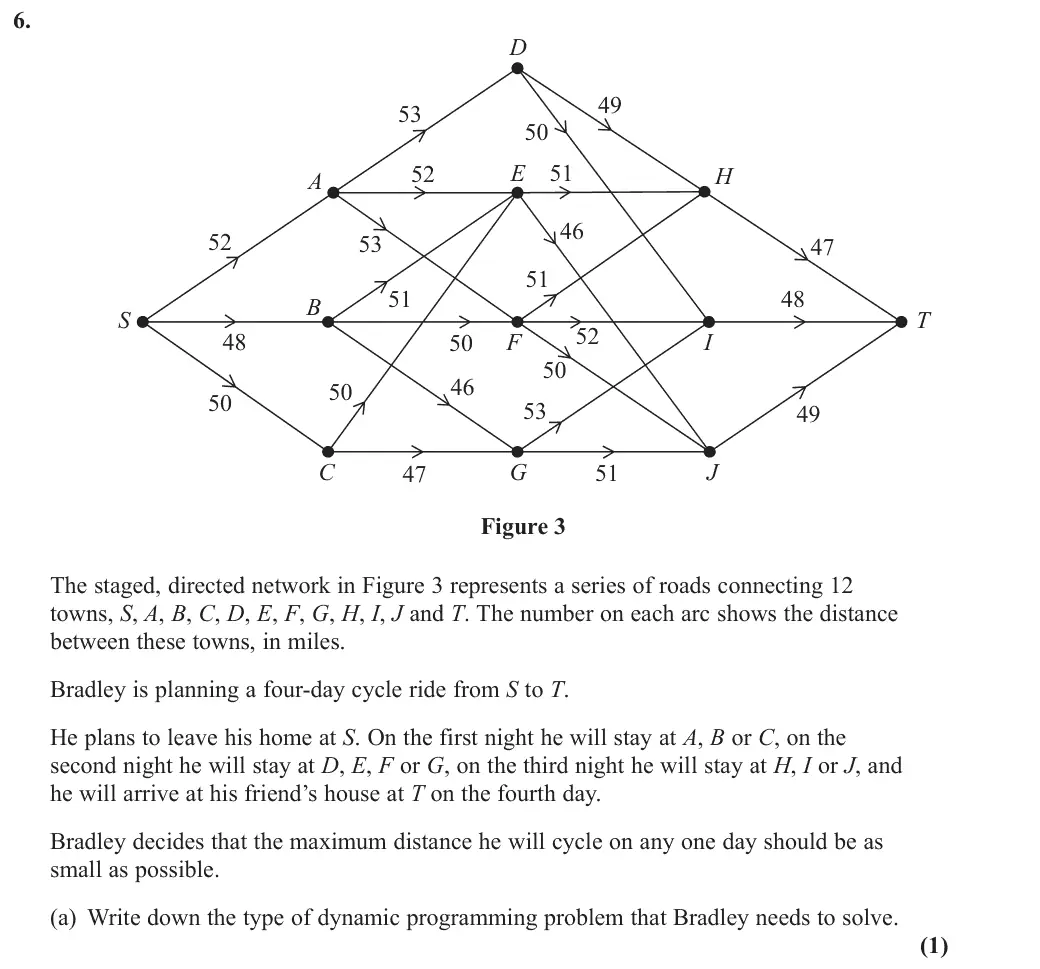
Nov 2021 · Paper 4D (Decision 2) · Q6(a)1 mark
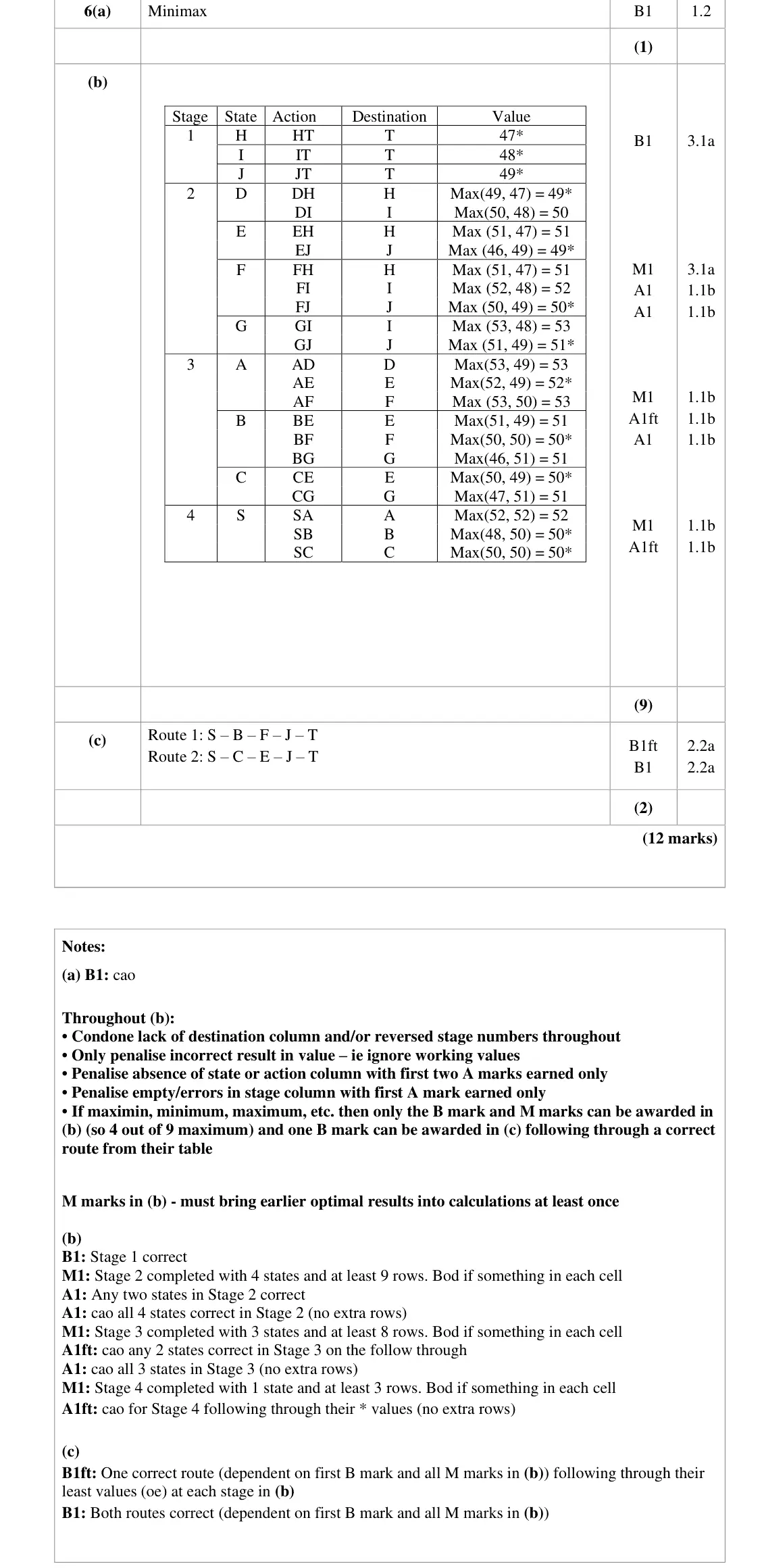
Mark scheme (whole question; this part is marked with the orange bar)
Key points from the mark scheme and examiner's report
minimax
Nov 2021 · Paper 4D (Decision 2) · Q6(b)9 marks
Mark scheme (whole question; this part is marked with the orange bar)
Key points from the mark scheme and examiner's report
value = max(arc, best from destination), keep the minimum at each state
stage 1 H 47, I 48, J 49
stage 2 has 9 rows
S value 50
using maximin, minimum or maximum scores at most 4
Nov 2021 · Paper 4D (Decision 2) · Q6(c)2 marks
Mark scheme (whole question; this part is marked with the orange bar)
Key points from the mark scheme and examiner's report
trace back: S–B–F–J–T and S–C–E–J–T
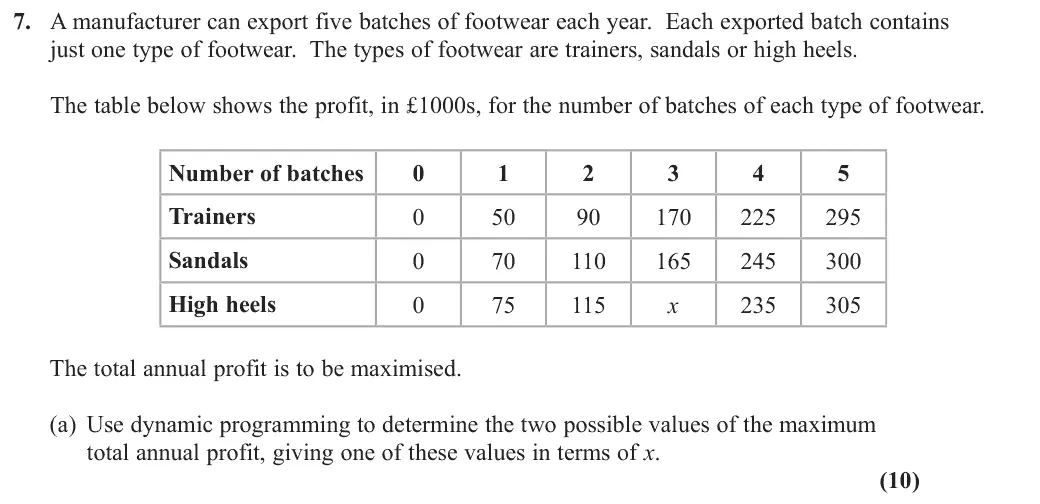
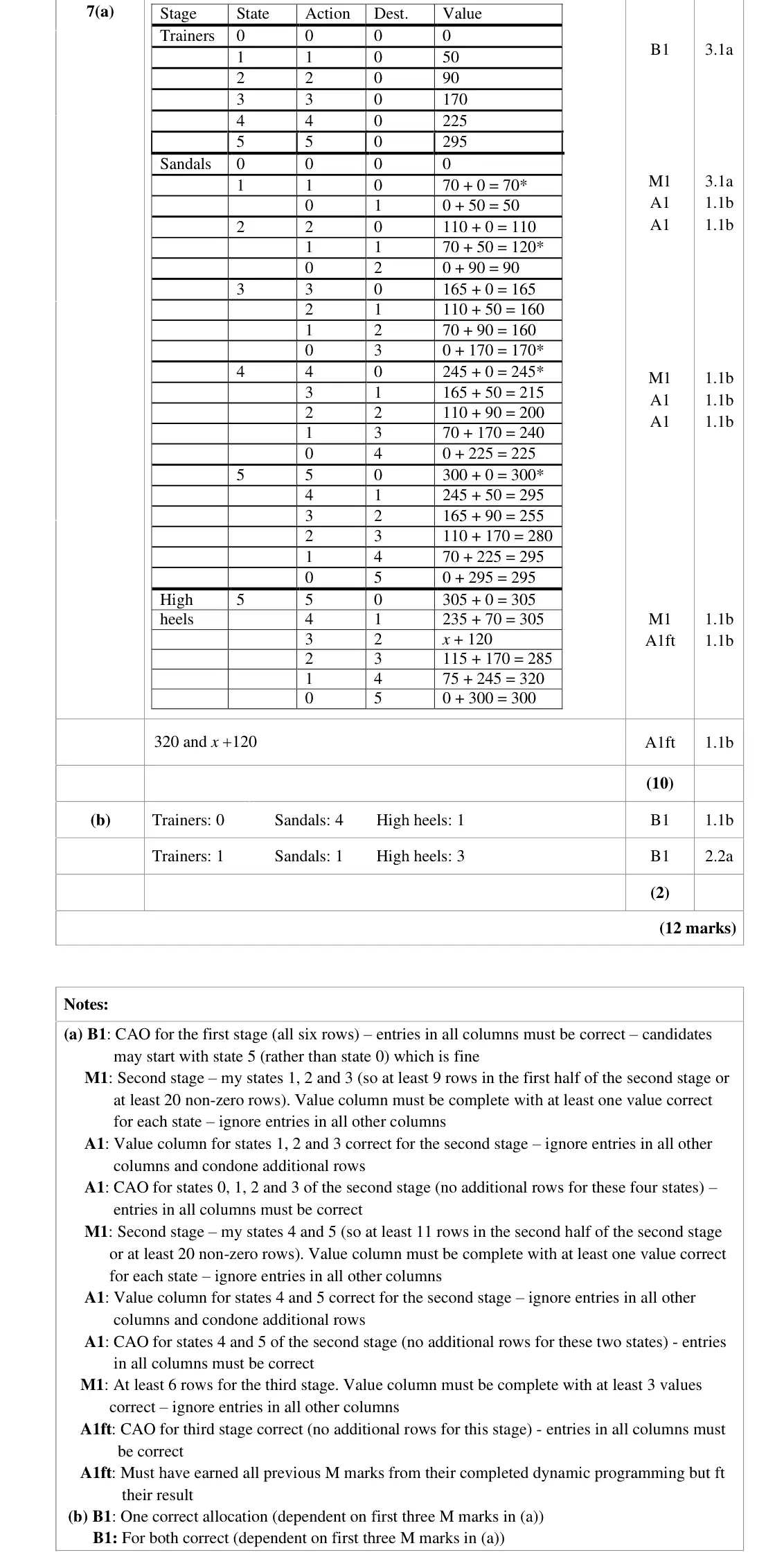
Oct 2020 · Paper 4D (Decision 2) · Q7(a)10 marks
Mark scheme (whole question; this part is marked with the orange bar)
Key points from the mark scheme and examiner's report
stages trainers, sandals, high heels
states = batches available
full stage 2 has 21 rows (states 0 to 5)
final stage values 305, 305, x + 120, 285, 320, 300
maximum 320 or x + 120
Oct 2020 · Paper 4D (Decision 2) · Q7(b)2 marks
Mark scheme (whole question; this part is marked with the orange bar)
Key points from the mark scheme and examiner's report
trace back: trainers 0, sandals 4, high heels 1, or trainers 1, sandals 1, high heels 3 (when x = 200)
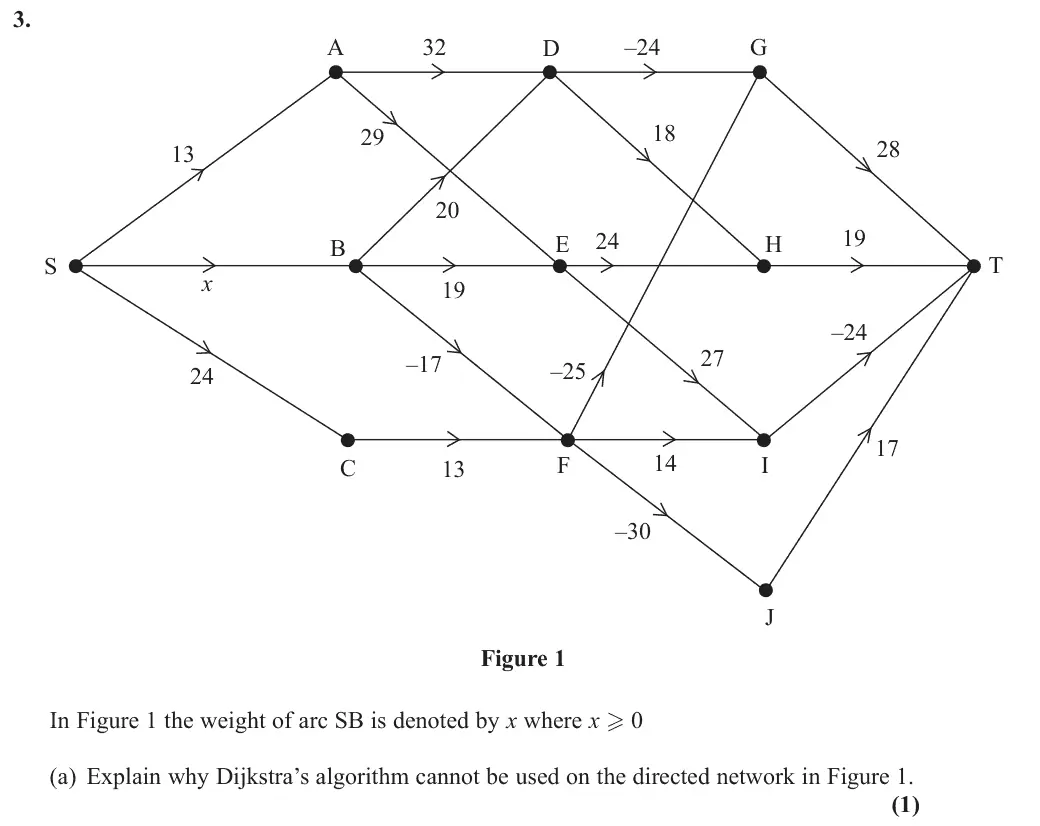
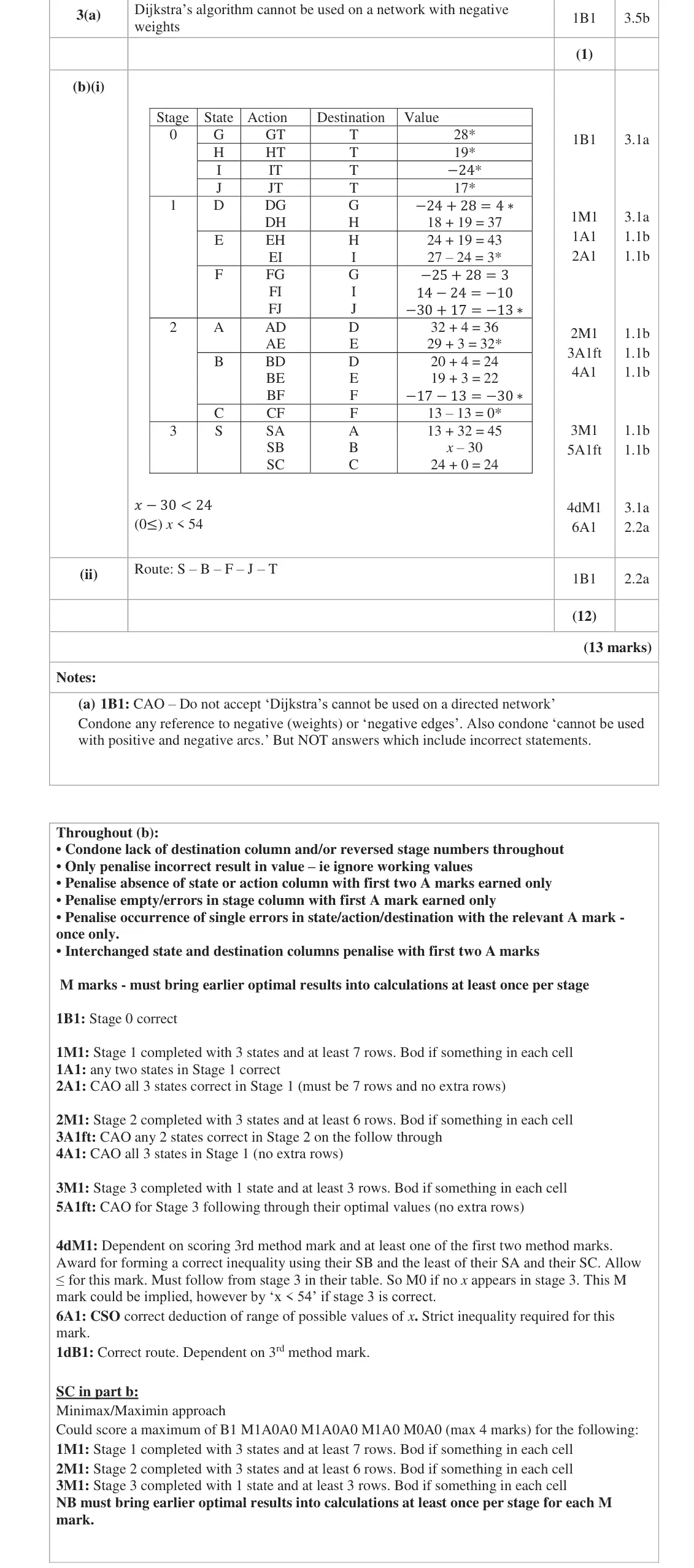
June 2019 · Paper 4D (Decision 2) · Q3(a)1 mark
Mark scheme (whole question; this part is marked with the orange bar)
Examiner's comment
Once again, testing a familiar area of the specification which migrated from the legacy qualification, this question provided a good source of marks for many candidates. However, part (a) was not generally as well answered as the rest of the question, many candidates failed to correctly indicate that the algorithm can only be applied to weights that are not negative. Still others, who did identify the key reason, lost the mark due to the inclusion of additional, false, reasons. As already mentioned, most candidates proved to be well prepared for part (b). Those that didn’t do
Key points from the mark scheme and examiner's report
Dijkstra cannot be used because the network has negative weights
'cannot be used on a directed network' scores 0
extra false reasons lose the mark
June 2019 · Paper 4D (Decision 2) · Q3(b)12 marks
Mark scheme (whole question; this part is marked with the orange bar)
Examiner's comment
Once again, testing a familiar area of the specification which migrated from the legacy qualification, As already mentioned, most candidates proved to be well prepared for part (b). Those that didn’t do well either forgot to carry forward previous optimal values. or had misunderstood the question to be a minimax/maximin problem but these candidates were in the minority. One costly error, made by some candidates, was the inclusion of an insufficient number of rows in stage one of their table. It would be advisable for candidates to be reminded to perform a straightforward check that their table contains sufficient rows for the number of arcs on the digraph in cases such as these. In fact, most candidates appeared to find the application of a dynamic programming approach to a minimisation problem based on a digraph relatively straightforward and coped very well with the blank table and lack of scaffolding in the answer book. Occasionally, candidates mislabelled their states and destinations giving reversed actions and as with the legacy qualification, arithmetic errors were fairly common. A very small number of candidates did not evaluate their calculations at each stage: calculating only the optimal row. Candidates should be advised that in decision mathematics they must rigorously apply the algorithm in full. Most candidates’ presentation here, however, was clear and easy to follow although a minority crossed out working and then attempted to squeeze in alternative answers, making it difficult for examiners to follow their working. Once candidates had completed the programming, most were able to find a suitable range for 𝑥 based on the values in their final stage. Some candidates, however, appeared to be reluctant to carry the -30 into stage 3 and so obtained an incorrect value for SB at the end of the table which in turn led to an incorrect result for the range for 𝑥. A significant number of candidates misunderstood the final part of the question, quoting the minimum total weight along the route (setting 𝑥 = 0) rather than giving the route itself.
Key points from the mark scheme and examiner's report
minimisation stage/state/action table from T back to S
stage 1 needs 7 rows (missing rows was costly)
value via B is x − 30, so x − 30 < 24 gives 0 ≤ x < 54 (strict)
route S–B–F–J–T
forgetting to carry forward optimal values or treating it as minimax lost marks
Find an Edexcel Further Maths tutor
Stuck on this? Book a trial lesson with our Further Maths tutor.