33 question parts, 123 marks, 1 with a difficulty rating from the examiner's report
Notes, worked examples and practice for this topic are being written by our tutors. The past-paper questions below are ready now: work each one on paper, then open the mark scheme and the examiner's comment.
Tap a question to zoom it. Mark scheme and examiner's comment open under each question.
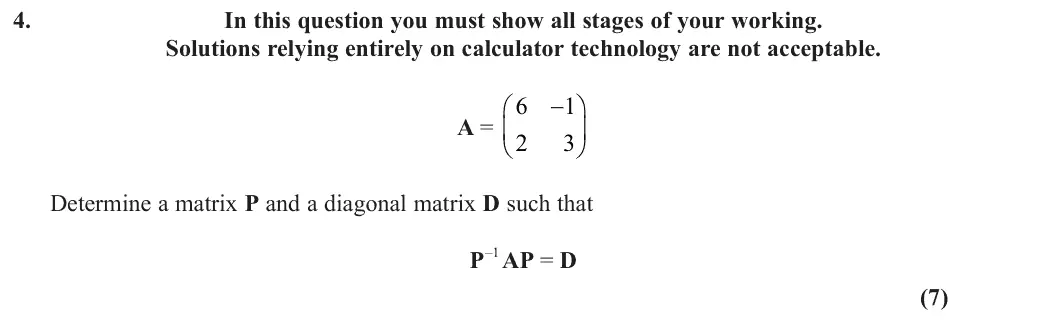
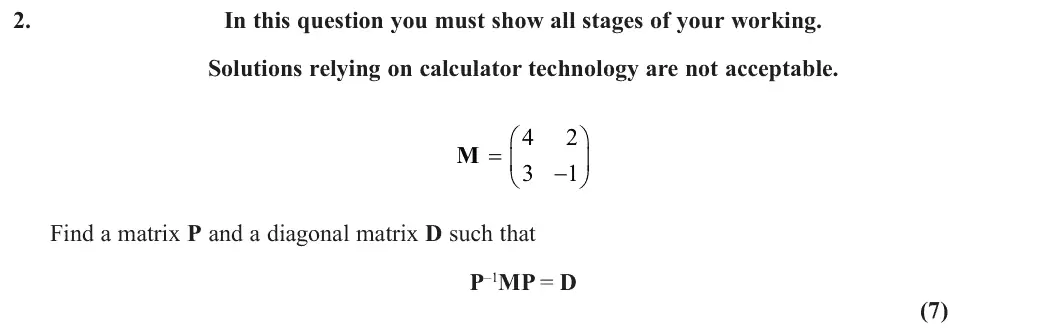
June 2025 · AS Paper 2 (Further Pure 2) · Q47 marks
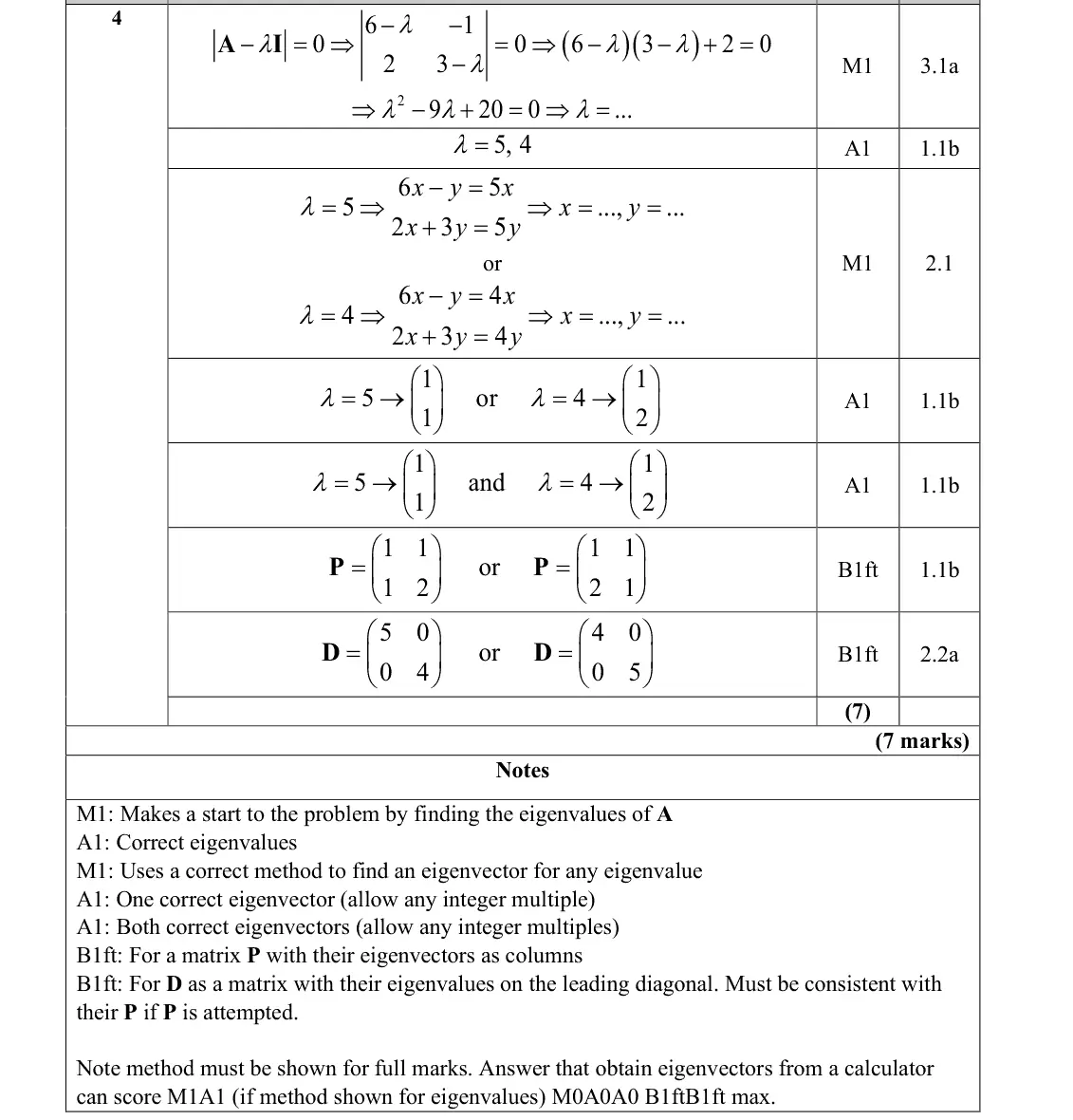
Mark scheme (whole question; this part is marked with the orange bar)
Examiner's comment
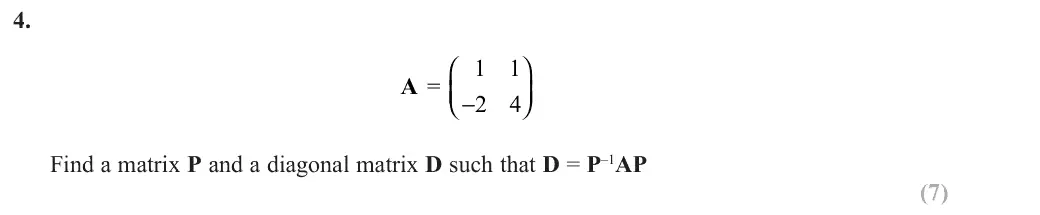
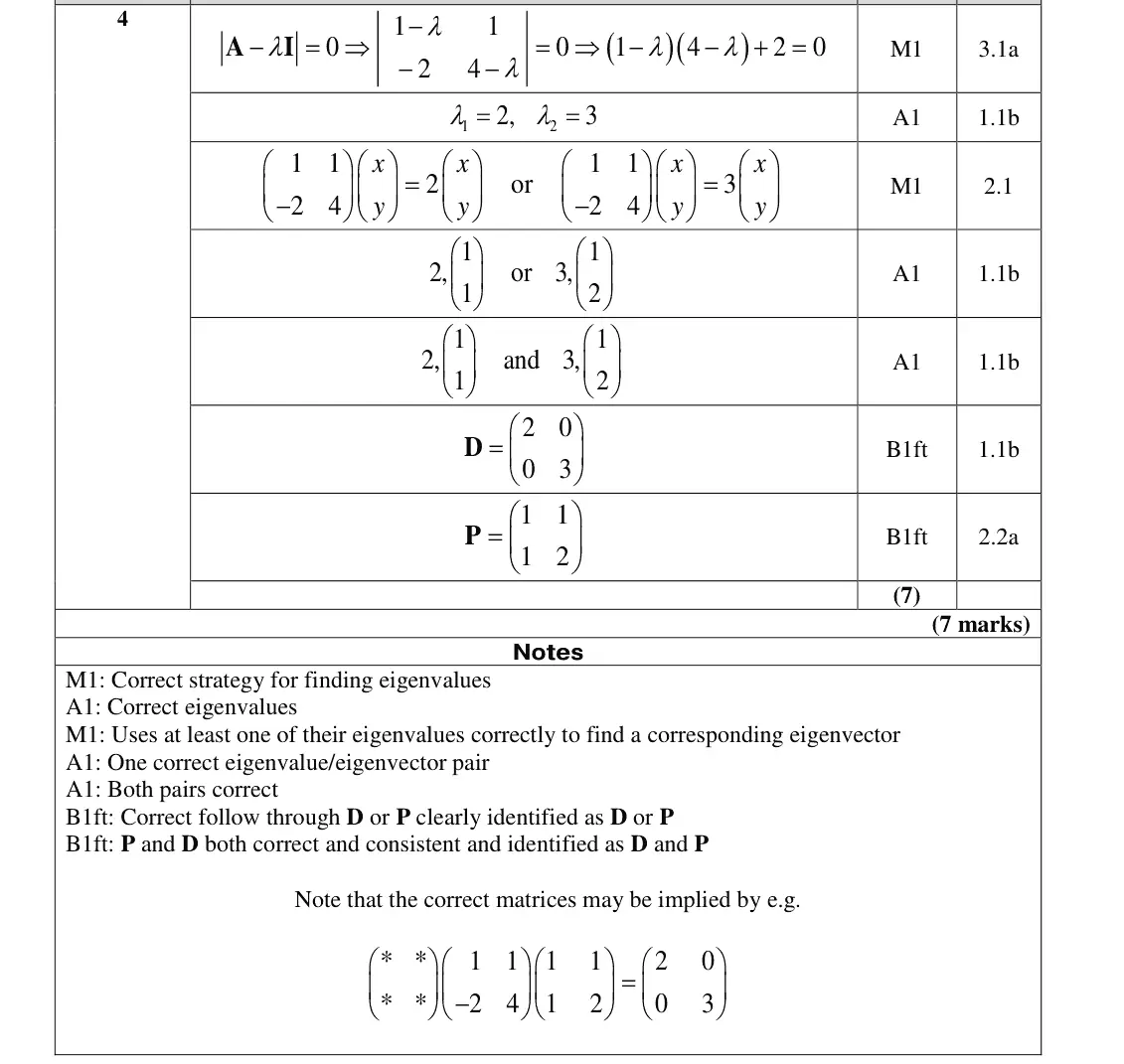
This was a very routine extended question which again most of the learners were able to complete successfully. Errors in finding the eigenvalues were rare, only one seen where an attempt was made but no marks were scored (a couple made no attempt at all) with an incorrect method for the eigenvalues and no attempt at the eigenvectors. A couple did make slips in finding the eigenvalues, obtaining 2 1 instead of 1 2 for the eigenvalue 4, for example, being seen, while another had no discernible correct method but did end up with “eigenvectors” for the matrix. The follow-through marks at the end helped mitigate mark loss here. However, the vast majority scored full marks for this question, with all cases that proceeded to answer at the end scoring both follow through marks for their matrices D and P.
Key points from the mark scheme and examiner's report
λ² − 9λ + 20 = 0, λ = 4, 5
eigenvectors (1, 1) for 5 and (1, 2) for 4
P = (1 1
1 2), D = diag(5, 4) in consistent order
calculator eigenvectors score at most M1A1 + B1B1
very well answered
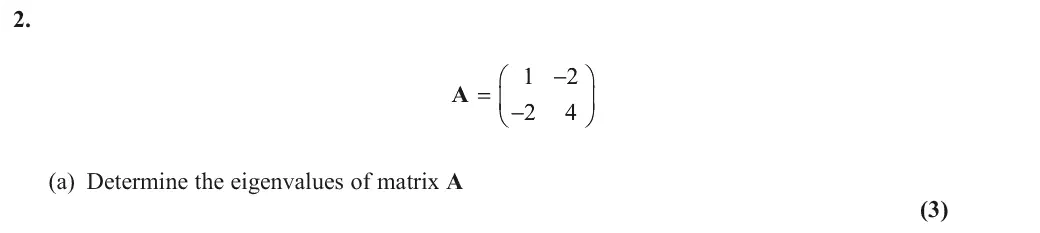
June 2025 · Paper 4A (Further Pure 2) · Q2(a)3 marks
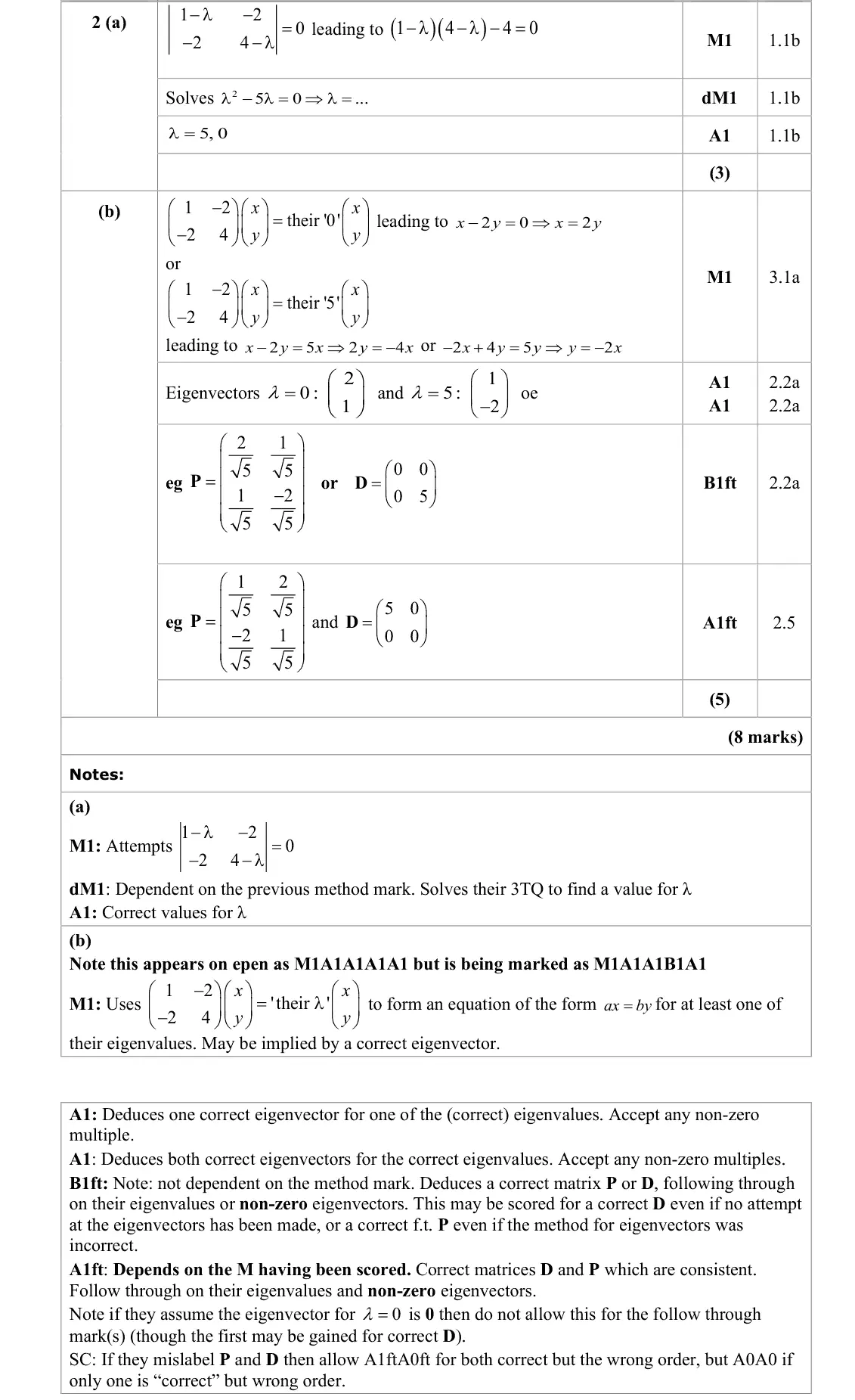
Mark scheme (whole question; this part is marked with the orange bar)
Examiner's comment
This was a very straightforward question for the majority that could easily have been first on the paper. Very few had trouble finding the eigenvalues in part (a), although some rejected the eigenvalue 0 and gave only 5. Errors in the expansion were very rare, and non-scorers were mainly those who made no effort to answer the question at all.
Key points from the mark scheme and examiner's report
λ² − 5λ = 0: λ = 0 and 5
do not reject 0
June 2025 · Paper 4A (Further Pure 2) · Q2(b)5 marks
Mark scheme (whole question; this part is marked with the orange bar)
Examiner's comment
This was a very straightforward question for the majority that could easily have been first on Part (b) was also answered well overall, though a significant number forgot to normalise their vectors for P, which was the most common mistake made, though most scored full marks. Astute candidates were able to state the matrix D at the start and secure the B mark early on, but most left stating both matrices until the end. Setting up the eigenvector equations was done well by most, with very few cases of stating them without any working seen, and once they reached x = 2y or y = -2x most were able to establish the eigenvectors, although the second most common error was to get one (or both) the wrong way up, ie 1 instead of 2 for or similar for λ = . 5 0 λ = 2 1 Most then were able to firm a matrix P from their vectors, though as noted some did not normalise first. One surprising factor was the number of candidates who at this point then tried to find D by expanding the equation for the diagonalisation process rather than just state it using the theory, and as a result a few managed neither a correct P or D since the process went wrong without a normalised P. But those who knew the theory were able to score the B1ft for a correct D even if they neglected to normalise, and the follow through marks gave access to those who had made a slip in one of the eigenvectors to still score four of the give marks available for this part.
Key points from the mark scheme and examiner's report
eigenvectors (2, 1) for 0 and (1, −2) for 5
normalise (divide by √5) for orthogonal P, D in matching order
not normalising was the commonest error
June 2024 · AS Paper 2 (Further Pure 2) · Q3(a)3 marks
Mark scheme (whole question; this part is marked with the orange bar)
Examiner's comment
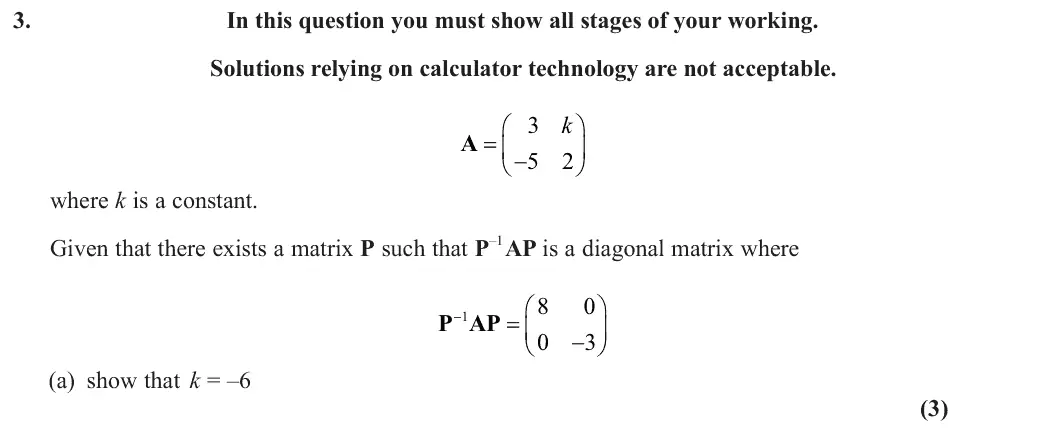
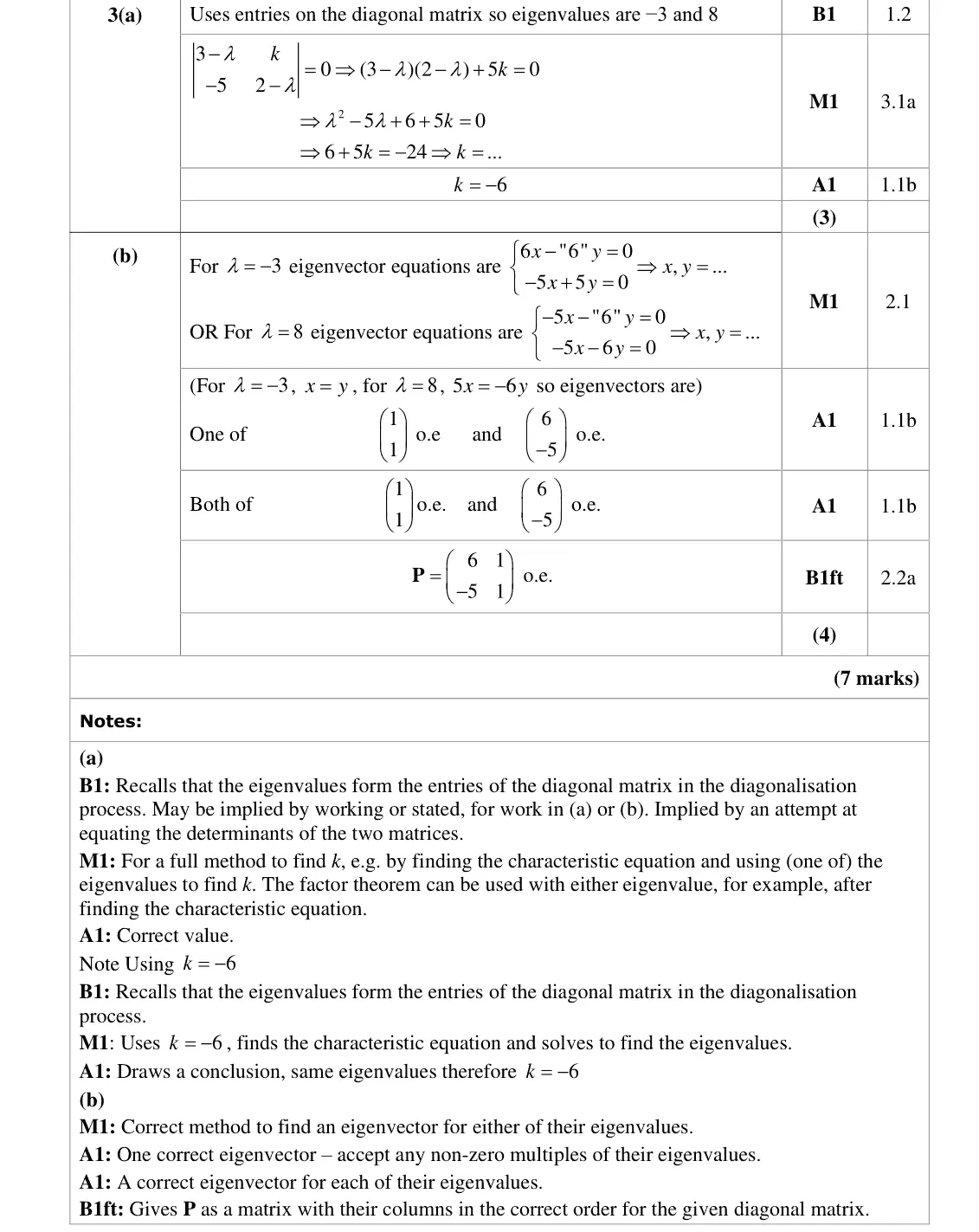
There were a few blank attempts, but many candidates found this question accessible and scored full marks. Part (a) Candidates who deduced that the eigenvalues are -3 and 8 then found the characteristic equation to successfully show that 6 k = -. A few candidates found the characteristic equation but did not but did not deduce the eigenvalues.
Key points from the mark scheme and examiner's report
some found the characteristic equation but did not use the eigenvalues
June 2024 · AS Paper 2 (Further Pure 2) · Q3(b)4 marks
Mark scheme (whole question; this part is marked with the orange bar)
Examiner's comment
There were a few blank attempts, but many candidates found this question accessible and scored full marks. Part (b) It was pleasing that of the few candidates who attempted part (a) did go on to successfully use 6 k = - and found the eigenvectors and matrix P. There was the occasional sign slip but those that attempted this part did so successfully.
Key points from the mark scheme and examiner's report
eigenvectors (6, −5) for λ = 8 and (1, 1) for λ = −3
P = (6 1
−5 1), columns in the order matching diag(8, −3)
occasional sign slips
June 2024 · Paper 4A (Further Pure 2) · Q4(a)2 marks
Mark scheme (whole question; this part is marked with the orange bar)
Examiner's comment
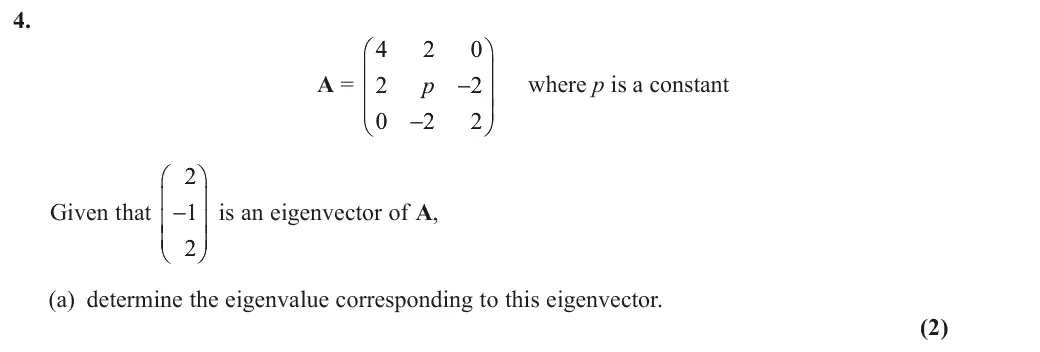
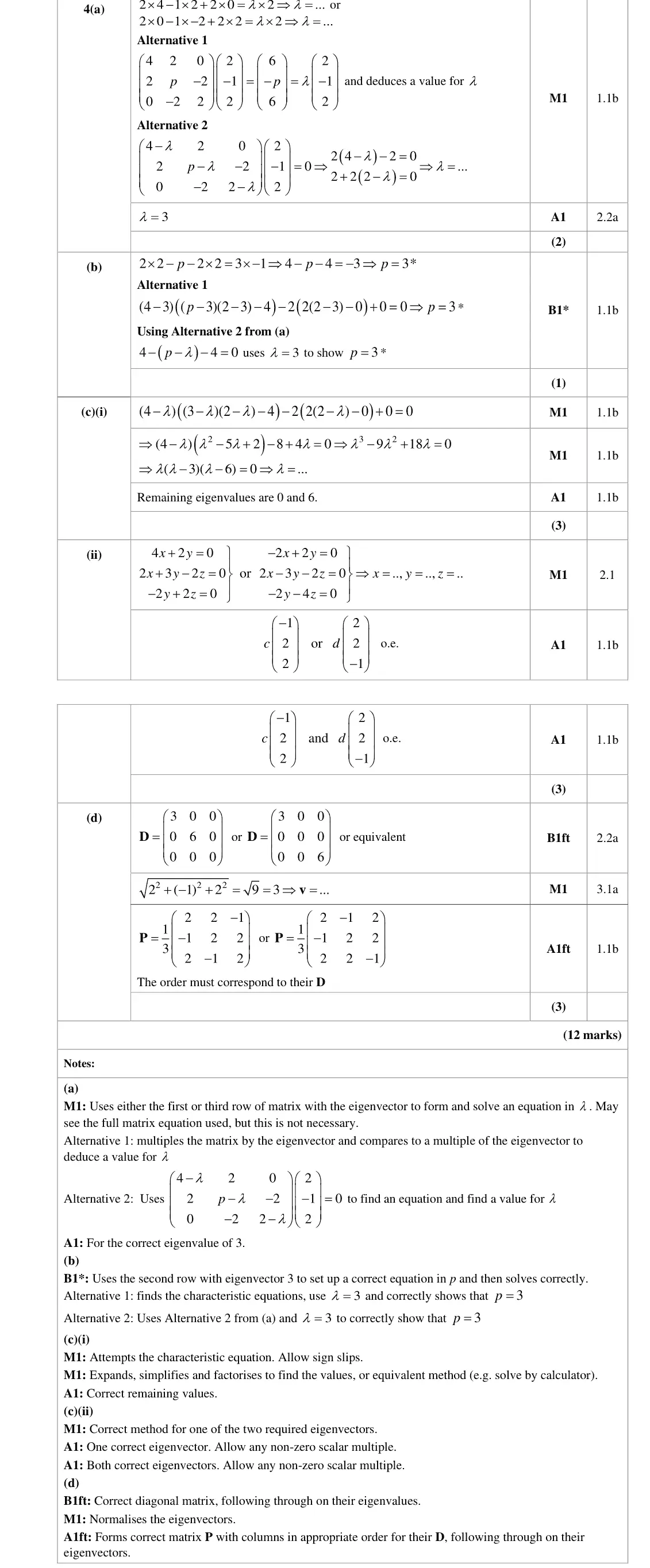
Again, the majority of candidates found this question accessible, there was a common error in part (d) when find the matrix P many candidates did not find the normalised eigenvectors. Part (a) There were a few approached to this question, with the majority using 4 2 0 2 2 2 2 1 1 0 2 2 2 2 p - - = - - to form and solve an equation for . Other approaches were 4 2 0 2 6 2 2 2 1 1 0 2 2 2 6 2 p p - - = - = - - deducing a value for and 4 2 0 2 2 2 1 0 0 2 2 2 p - - - - = - - deducing a value for .
Key points from the mark scheme and examiner's report
first or third row: 2(4 − λ) − 2 = 0, λ = 3
June 2024 · Paper 4A (Further Pure 2) · Q4(b)1 mark
Mark scheme (whole question; this part is marked with the orange bar)
Examiner's comment
Again, the majority of candidates found this question accessible, there was a common error in part (d) when find the matrix P many candidates did not find the normalised eigenvectors. Part (b) the majority of candidates used their answer to in part (a) and the middle row to show that 3 p = . A few candidates restarted and found the determinant and set = 0 with their value for .
Key points from the mark scheme and examiner's report
middle row: 4 − p − 4 = −3, p = 3
June 2024 · Paper 4A (Further Pure 2) · Q4(c)6 marks
Mark scheme (whole question; this part is marked with the orange bar)
Examiner's comment
Again, the majority of candidates found this question accessible, there was a common error in part (d) when find the matrix P many candidates did not find the normalised eigenvectors. Part (c) Well done by most candidates finding the determinant, setting = 0 and solving to find the other eigenvalues. Candidate knew the method to find the eigenvectors with a few slips in signs and mixing up 2’s and 1’s e.g. 2 1 1 - instead of 1 2 2 - .
Key points from the mark scheme and examiner's report
λ³ − 9λ² + 18λ = 0: λ = 0 and 6
eigenvectors (−1, 2, 2) for 0 and (2, 2, −1) for 6
sign and 1/2 swaps common
June 2024 · Paper 4A (Further Pure 2) · Q4(d)3 marks
Mark scheme (whole question; this part is marked with the orange bar)
Examiner's comment
Again, the majority of candidates found this question accessible, there was a common error in part (d) when find the matrix P many candidates did not find the normalised eigenvectors. Part (d) Candidate who had managed to find eigenvectors generally score B1 for writing down the matrix D. Quite a few candidates did not score marks for finding matrix P and they did not find the magnitude of their eigenvectors. Candidates who did used the correct order for their eigenvalues and eigenvectors. This this part allowed follow through on their eigenvalues and eigenvectors.
Key points from the mark scheme and examiner's report
A symmetric so P orthogonal: normalise each eigenvector (divide by 3) and order columns to match D = diag(3, 6, 0) etc.
many did not normalise
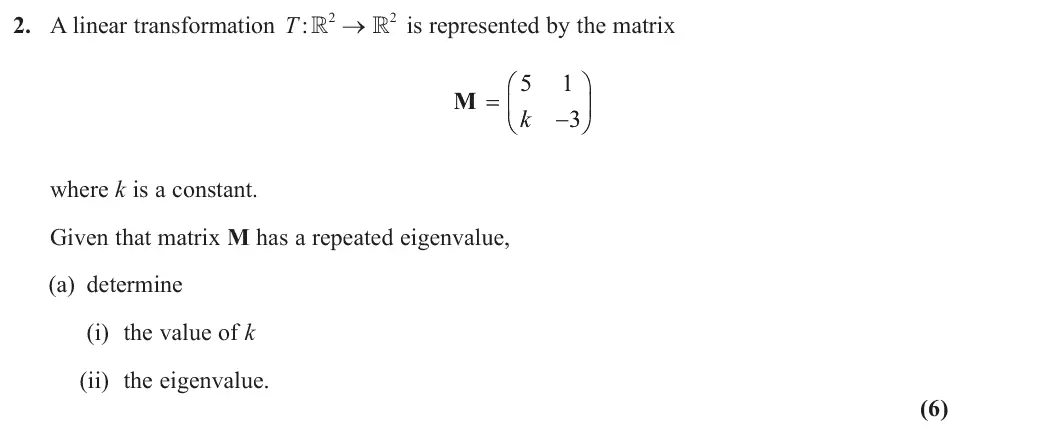
June 2023 · AS Paper 2 (Further Pure 2) · Q2(a)6 marks
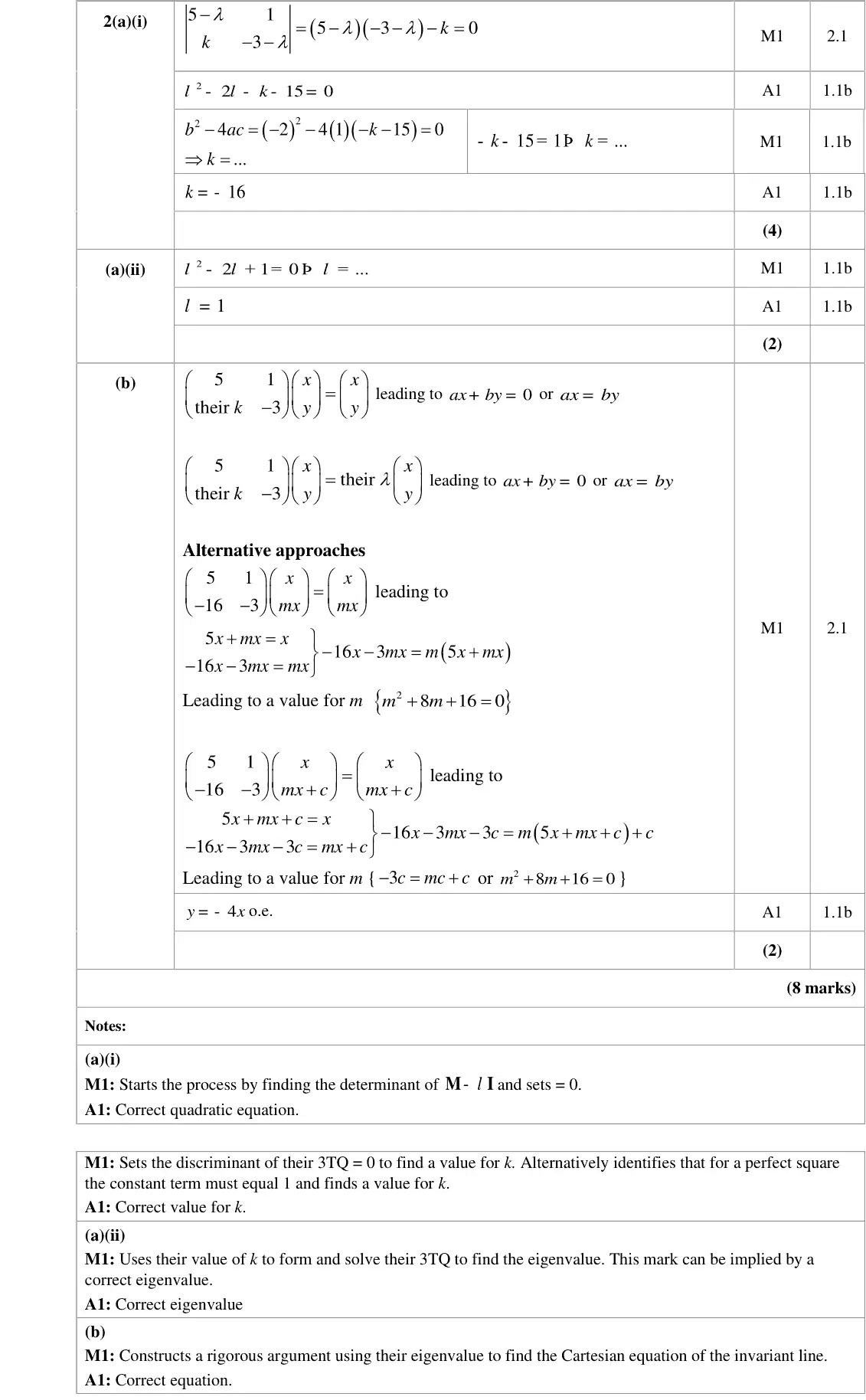
Mark scheme (whole question; this part is marked with the orange bar)
Examiner's comment
(a) The majority of candidates knew the process required to find the eigenvalues of a matrix, finding a quadratic equation. Most candidates knew how to deal with repeated eigenvalue and attempted to find the value of k and the eigenvalue. There were a few slips with algebra.
Key points from the mark scheme and examiner's report
det(M − λI) = 0 gives λ² − 2λ − k − 15 = 0
repeated root so discriminant 4 + 4(k + 15) = 0: k = −16
eigenvalue λ = 1
a few algebra slips
June 2023 · AS Paper 2 (Further Pure 2) · Q2(b)2 marks
Mark scheme (whole question; this part is marked with the orange bar)
Examiner's comment
(b) Those candidates who successfully achieved the correct values k = 16, eigenvalue = 1 used these to find the Cartesian equation of the invariant line. Candidates with an incorrect eigenvalue struggled with this part.
Key points from the mark scheme and examiner's report
the invariant line is spanned by the eigenvector for λ = 1: 4x + y = 0, i.e. y = −4x
wrong eigenvalues from (a) made this hard
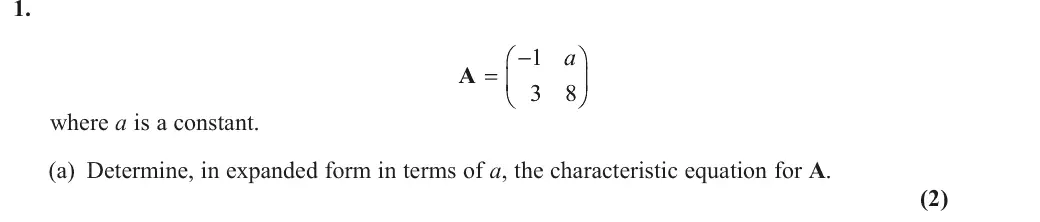
June 2023 · Paper 4A (Further Pure 2) · Q1(a)2 marks
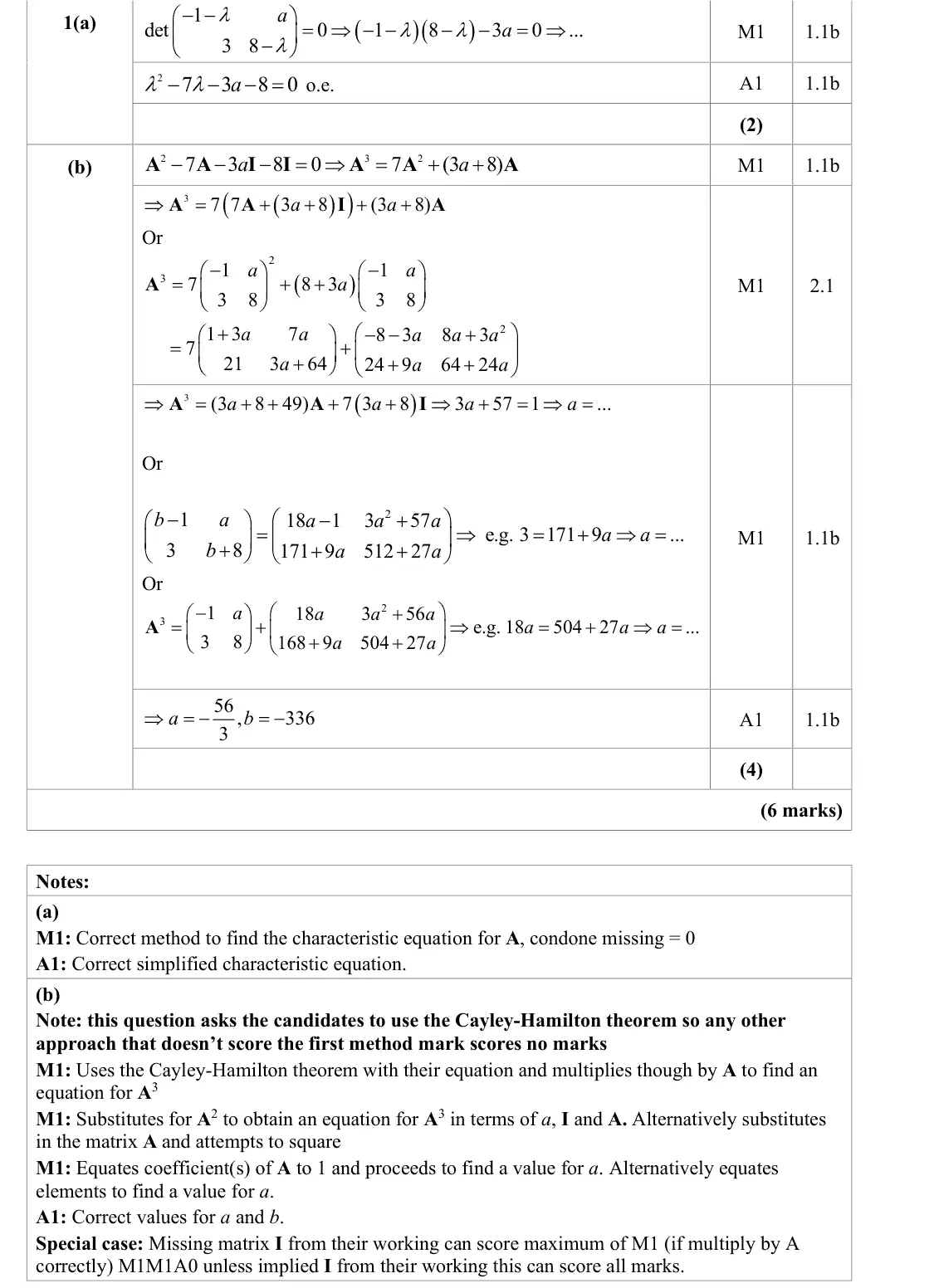
Mark scheme (whole question; this part is marked with the orange bar)
Examiner's comment
(a) The majority of the candidates knew how to find the characteristic equation; however, a small number did not set = 0 losing a mark.
Key points from the mark scheme and examiner's report
det(A − λI) = 0: λ² − 7λ − 3a − 8 = 0
must be an equation (= 0)
June 2023 · Paper 4A (Further Pure 2) · Q1(b)4 marks
Mark scheme (whole question; this part is marked with the orange bar)
Examiner's comment
(b) Many candidates scored the first mark for using the Cayley-Hamilton theorem to write an equation for 3 A . A few candidates did not know where to go from there; there were two main options, either replacing 2 A with ( ) 7 8 3a + + A Ι or substituting in for the matrix A. Equation coefficient of A and I or using the diagonal matrix to find a value for a. Candidates who did not use the Cayley-Hamilton theorem and just substituted in for the matrix A scored no marks.
Key points from the mark scheme and examiner's report
A² = 7A + (3a + 8)I, multiply by A and substitute for A² again: A³ = (3a + 57)A + 7(3a + 8)I
coefficient of A = 1 gives a = −56/3, b = −336
methods not using Cayley–Hamilton score 0
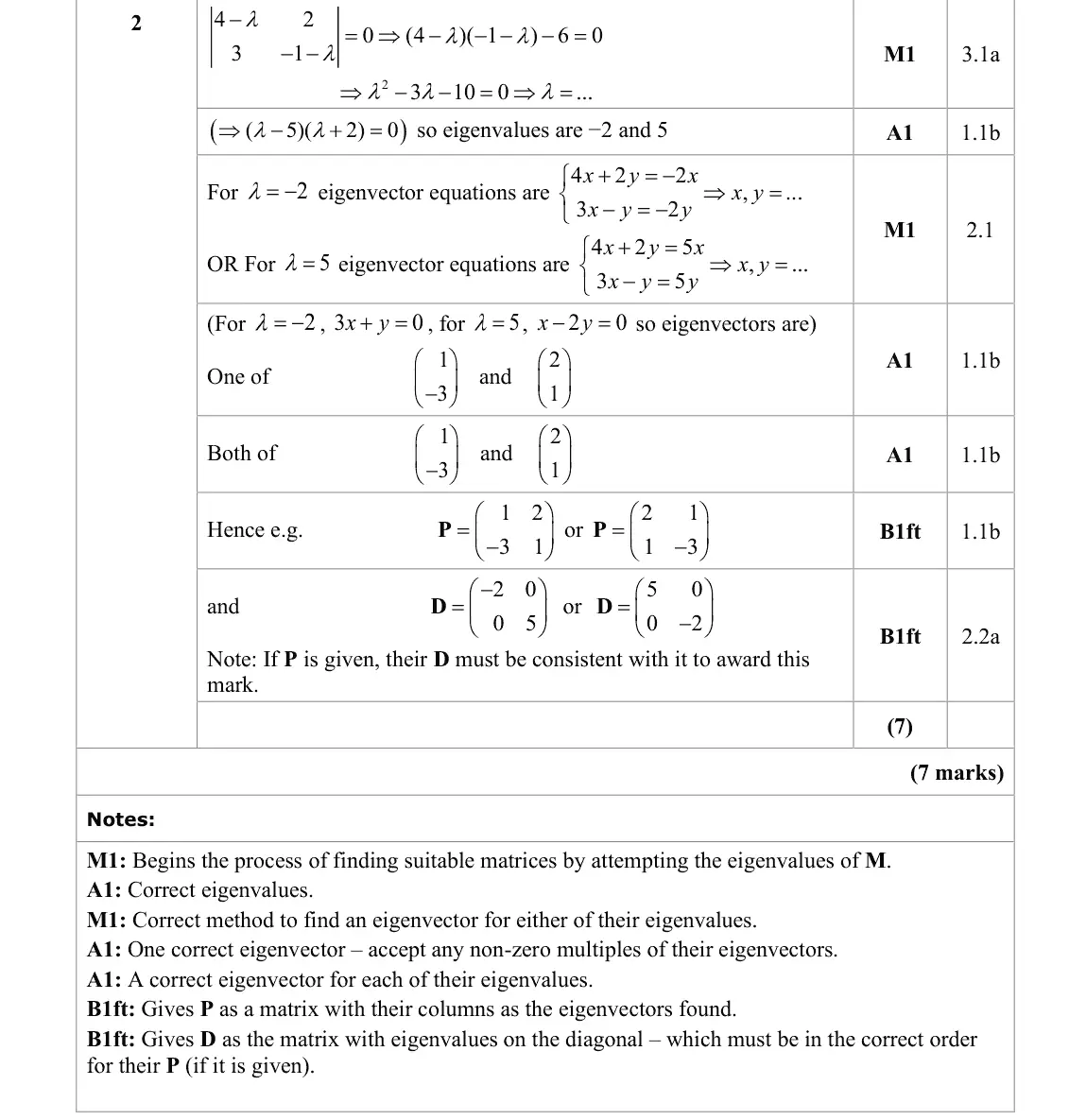
June 2022 · AS Paper 2 (Further Pure 2) · Q27 marksHard
Mark scheme (whole question; this part is marked with the orange bar)
Examiner's comment
This familiar topic was answered very well with 75% of candidates scoring 6/7 or 7/7, and only those who offered no answer at all failing to score at least three marks. The process for diagonalisation is well known and was carried out well, with few errors made, and follow through marks enabling the latter marks to be accessed even when slips calculating the eigenvectors had been made.
Key points from the mark scheme and examiner's report
λ² − 3λ − 10 = 0, λ = −2, 5
eigenvectors (1, −3) and (2, 1)
P has the eigenvectors as columns, D = diag(−2, 5) in the matching order
very well answered
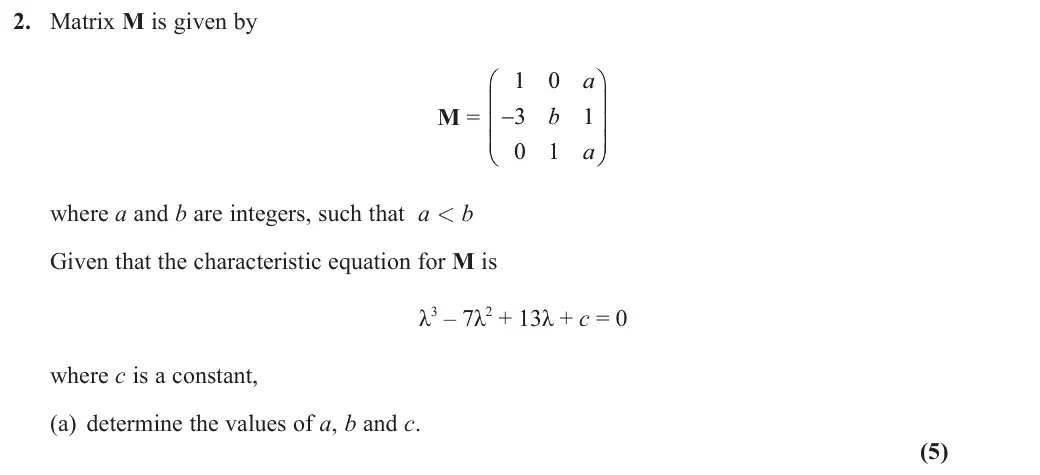
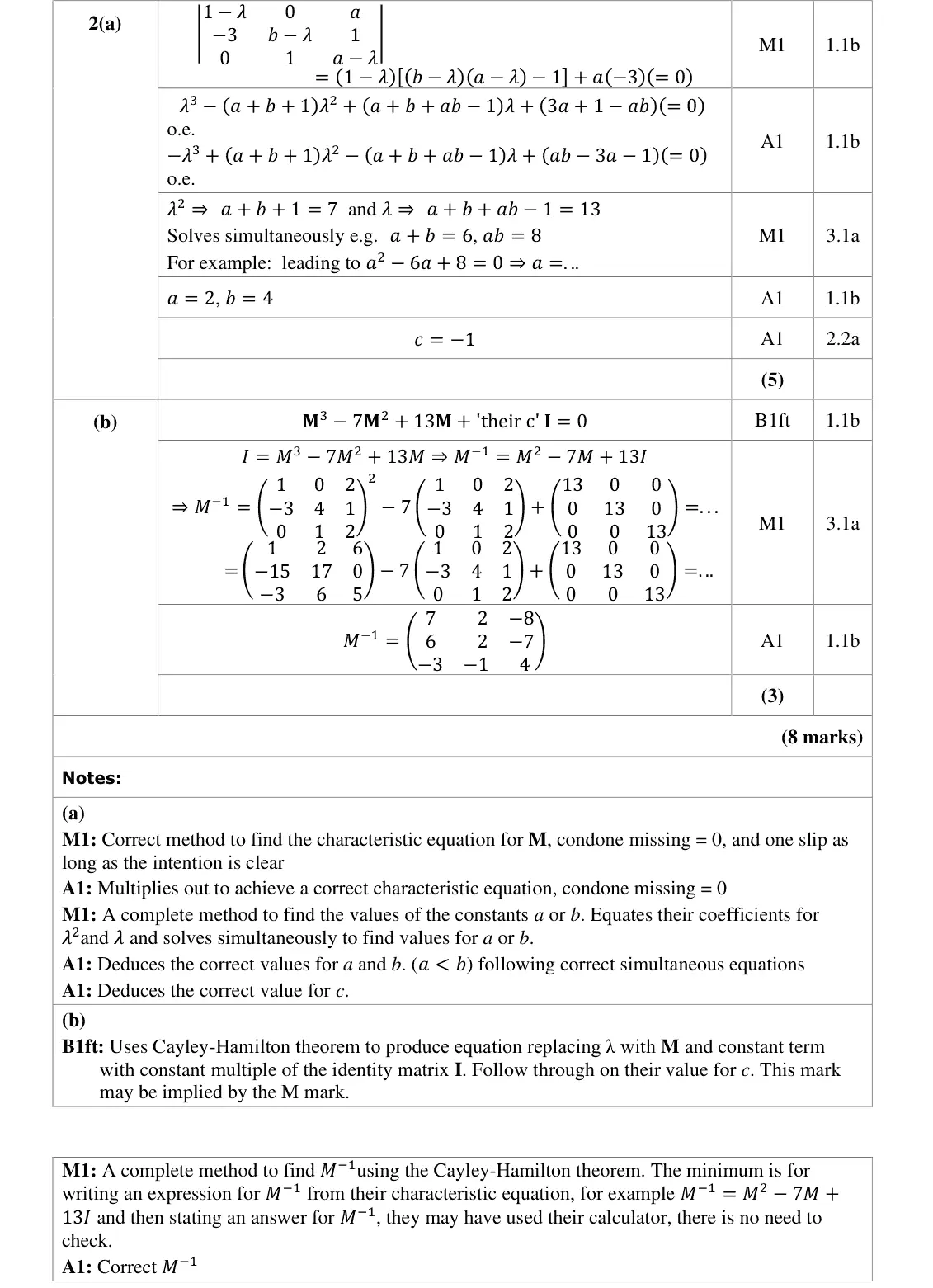
June 2022 · Paper 4A (Further Pure 2) · Q2(a)5 marks
Mark scheme (whole question; this part is marked with the orange bar)
Examiner's comment
Part (a) Most candidates understood the need to produce the characteristic equation but some made slips in finding the coefficients usually by omitting a term or making sign errors. It was less common for them to make a mistake in solving their simultaneous equations.
Key points from the mark scheme and examiner's report
expand det(M − λI): compare λ² and λ coefficients: a + b = 6, ab = 8, so a = 2, b = 4 (a < b), c = −1
slips in the characteristic equation were common
June 2022 · Paper 4A (Further Pure 2) · Q2(b)3 marks
Mark scheme (whole question; this part is marked with the orange bar)
Examiner's comment
Part (b) Most candidates understood what they needed to do, using their values of a, b and c to find the Cayley Hamilton equation. They then were able to multiply through by M-1 and rearrange to find matrix expression for M-1. Due to an error in the value of c many failed to reach the correct answer, with some giving up before finding the required matrix.
Key points from the mark scheme and examiner's report
M³ − 7M² + 13M − I = 0 so M⁻¹ = M² − 7M + 13I
an error in c spoilt many answers
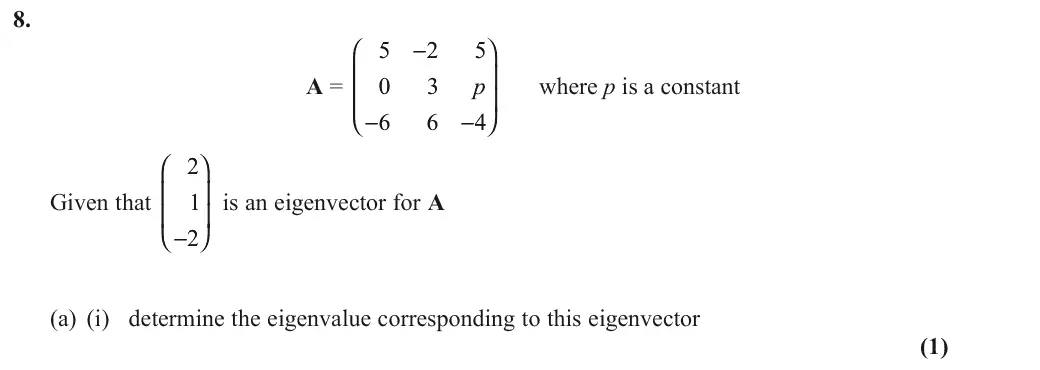
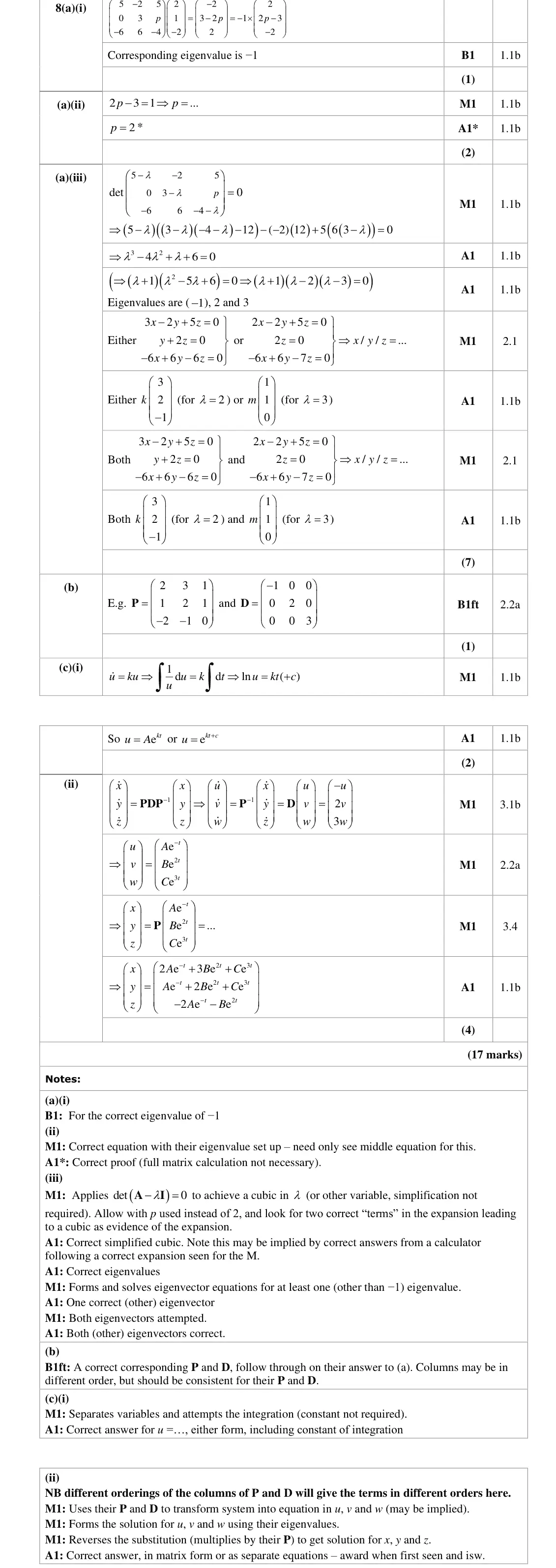
Nov 2021 · Paper 4A (Further Pure 2) · Q8(a)(i)1 mark
Mark scheme (whole question; this part is marked with the orange bar)
Key points from the mark scheme and examiner's report
A(2, 1, −2) = −1 × (2, 1, −2) so eigenvalue −1
Nov 2021 · Paper 4A (Further Pure 2) · Q8(a)(ii)2 marks
Mark scheme (whole question; this part is marked with the orange bar)
Key points from the mark scheme and examiner's report
middle row 3 − 2p = −1 gives p = 2
Nov 2021 · Paper 4A (Further Pure 2) · Q8(a)(iii)7 marks
Mark scheme (whole question; this part is marked with the orange bar)
Key points from the mark scheme and examiner's report
λ³ − 4λ² + λ + 6 = 0 = (λ + 1)(λ − 2)(λ − 3)
eigenvectors (3, 2, −1) for 2 and (1, 1, 0) for 3
Nov 2021 · Paper 4A (Further Pure 2) · Q8(b)1 mark
Mark scheme (whole question; this part is marked with the orange bar)
Key points from the mark scheme and examiner's report
P has the eigenvectors as columns, D the eigenvalues in the same order
Nov 2021 · Paper 4A (Further Pure 2) · Q8(c)(i)2 marks
Mark scheme (whole question; this part is marked with the orange bar)
Key points from the mark scheme and examiner's report
separate variables: u = Ae^(kt) (constant needed)
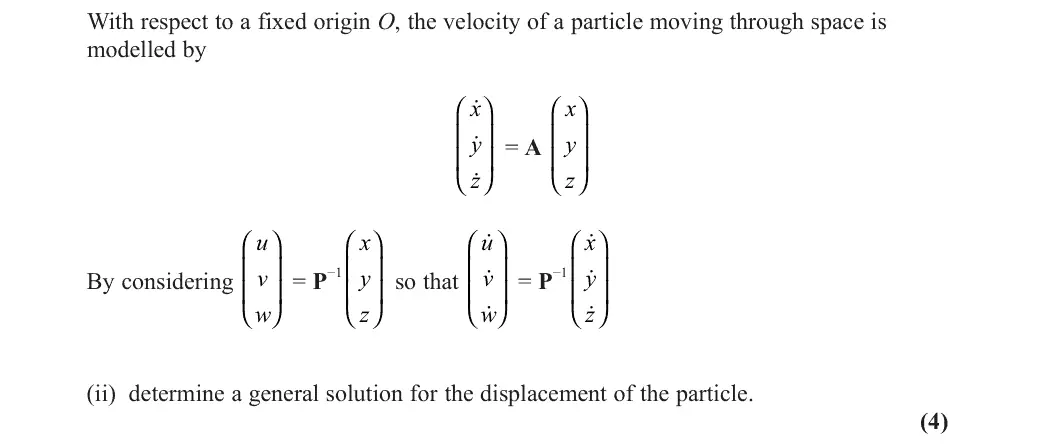
Nov 2021 · Paper 4A (Further Pure 2) · Q8(c)(ii)4 marks
Mark scheme (whole question; this part is marked with the orange bar)
Key points from the mark scheme and examiner's report
u̇ = Du decouples into u = Ae⁻ᵗ, v = Be²ᵗ, w = Ce³ᵗ
then (x, y, z) = P(u, v, w): x = 2Ae⁻ᵗ + 3Be²ᵗ + Ce³ᵗ etc.
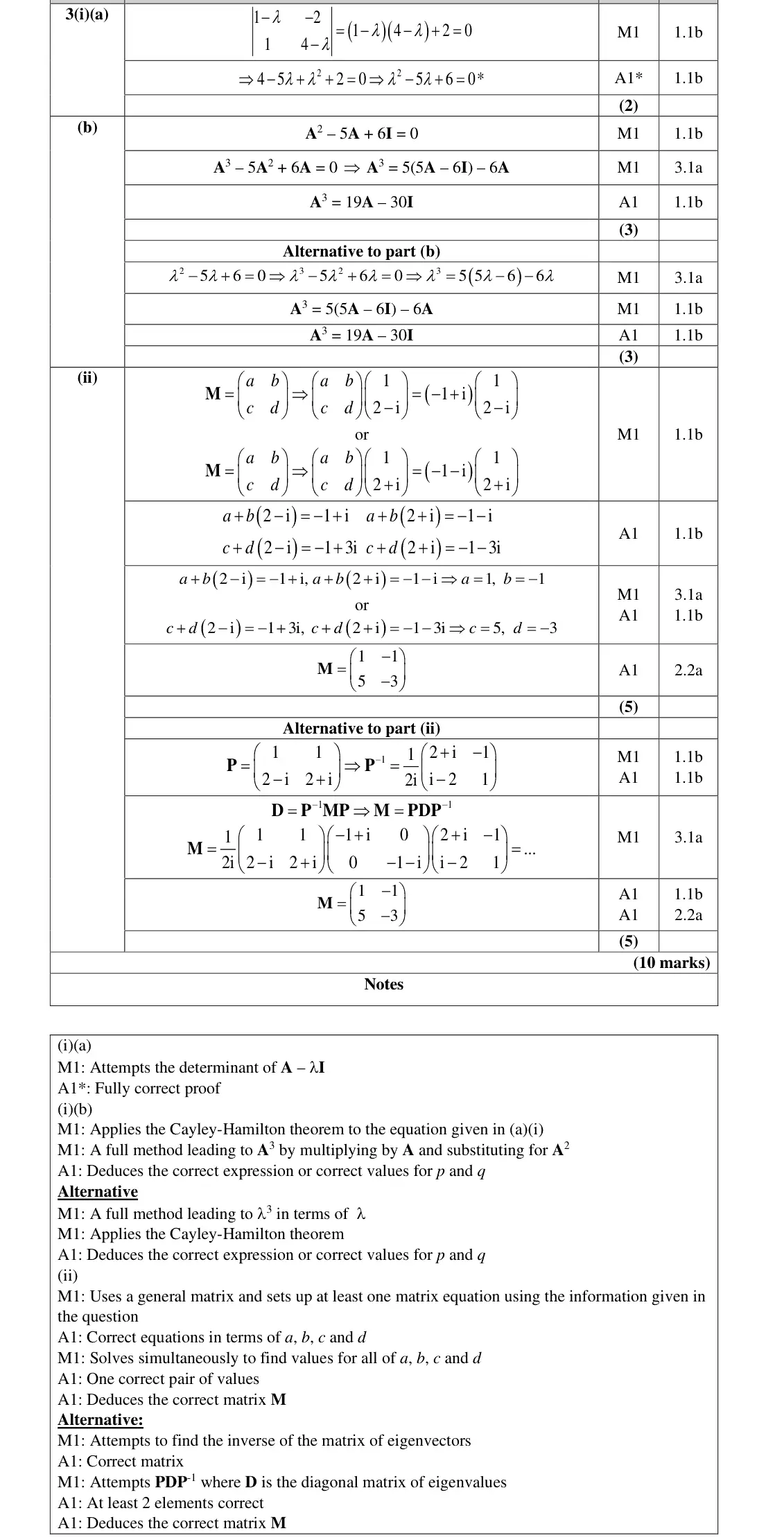
Oct 2020 · AS Paper 2 (Further Pure 2) · Q3(i)(a)2 marks
Mark scheme (whole question; this part is marked with the orange bar)
Key points from the mark scheme and examiner's report
Oct 2020 · AS Paper 2 (Further Pure 2) · Q3(i)(b)3 marks
Mark scheme (whole question; this part is marked with the orange bar)
Key points from the mark scheme and examiner's report
Cayley–Hamilton: A² = 5A − 6I
multiply by A and substitute for A² again: A³ = 19A − 30I, so p = 19, q = −30
Oct 2020 · AS Paper 2 (Further Pure 2) · Q3(ii)5 marks
Mark scheme (whole question; this part is marked with the orange bar)
Key points from the mark scheme and examiner's report
M(1, 2 − i) = (−1 + i)(1, 2 − i) etc. gives equations in a, b, c, d
or M = PDP⁻¹ with P the eigenvector matrix
M = (1 −1
5 −3)
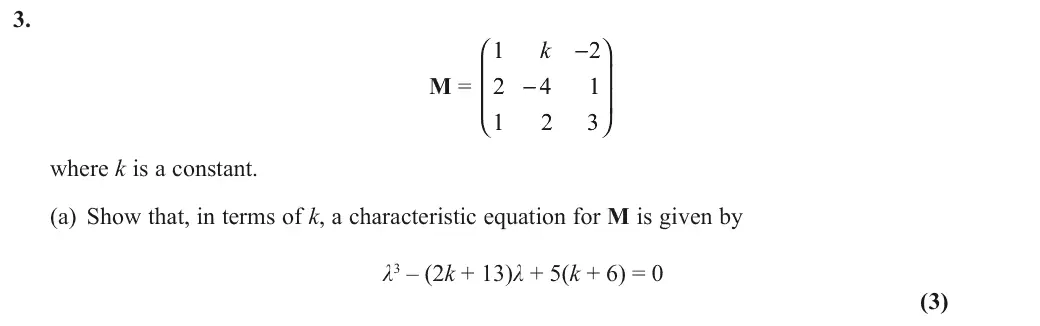
Oct 2020 · Paper 4A (Further Pure 2) · Q3(a)3 marks
Mark scheme (whole question; this part is marked with the orange bar)
Key points from the mark scheme and examiner's report
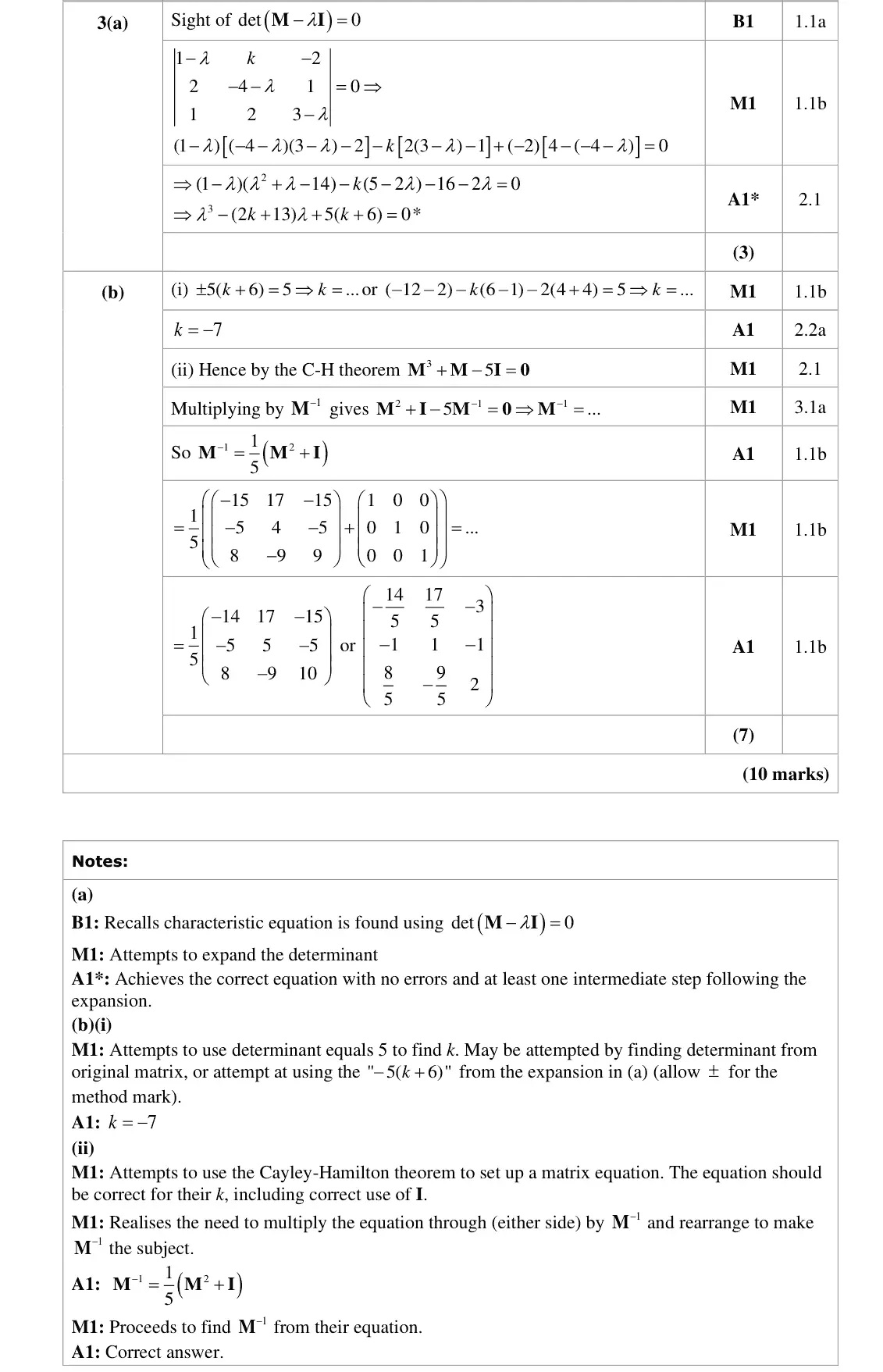
det(M − λI) = 0 expanded
printed answer so at least one intermediate step after expansion needed
Oct 2020 · Paper 4A (Further Pure 2) · Q3(b)7 marks
Mark scheme (whole question; this part is marked with the orange bar)
Key points from the mark scheme and examiner's report
det M = 5 gives −5(k + 6) = 5 so k = −7
C-H: M³ + M − 5I = 0, multiply by M⁻¹: M⁻¹ = (M² + I)/5
then evaluate M²
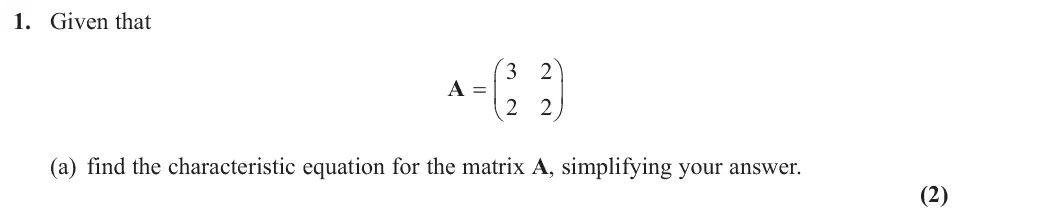
June 2019 · AS Paper 2 (Further Pure 2) · Q1(a)2 marks
Mark scheme (whole question; this part is marked with the orange bar)
Examiner's comment
This question was generally done well by candidates who were well prepared for this exam Part (a) was done well by the majority of candidates, with a few candidates losing a mark due to not forming an equation, missing = 0. Part (b) the question stated ‘Hence’ requiring candidates to use their answer to part (a) and the Cayley-Hamilton Theorem. A few candidates found A-1 and then tried to express in terms of A and I, gaining no marks. Some candidates did not fully apply the Cayley Hamilton 2 2 5 2 0 A A 5 2 0 A A I Theorem writing instead of . Candidates who use the theorem correctly went on to achieve the correct result.
Key points from the mark scheme and examiner's report
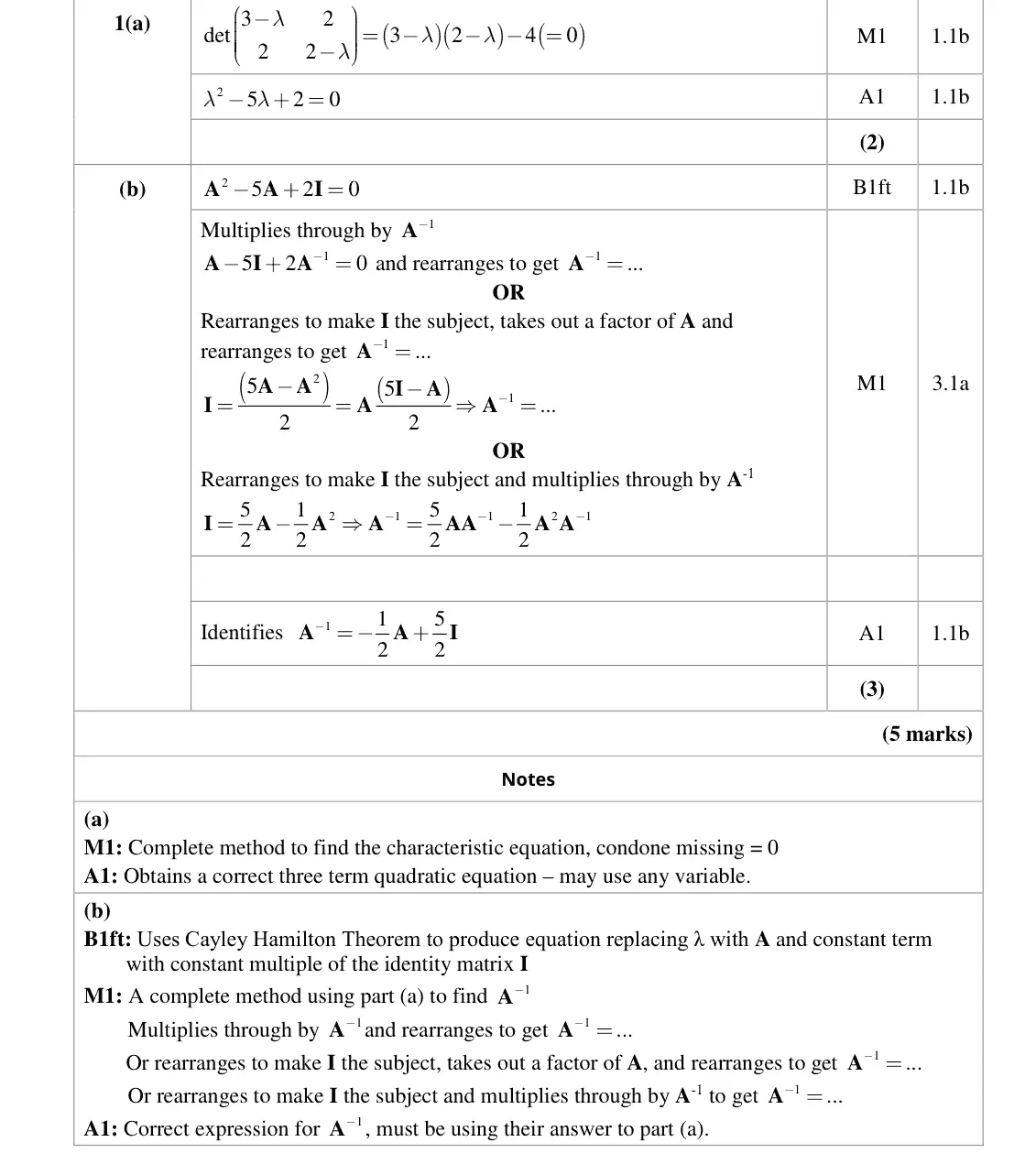
det(A − λI) = (3 − λ)(2 − λ) − 4
λ² − 5λ + 2 = 0
must be an equation (= 0 missing loses the A mark)
June 2019 · AS Paper 2 (Further Pure 2) · Q1(b)3 marks
Mark scheme (whole question; this part is marked with the orange bar)
Examiner's comment
This question was generally done well by candidates who were well prepared for this exam Part (b) the question stated ‘Hence’ requiring candidates to use their answer to part (a) and the Cayley-Hamilton Theorem. A few candidates found A-1 and then tried to express in terms of A and I, gaining no marks. Some candidates did not fully apply the Cayley Hamilton 2 2 5 2 0 A A 5 2 0 A A I Theorem writing instead of . Candidates who use the theorem correctly went on to achieve the correct result.
Key points from the mark scheme and examiner's report
Cayley–Hamilton: A² − 5A + 2I = 0 (2I, not 2), multiply by A⁻¹
A⁻¹ = −½A + (5/2)I
finding A⁻¹ directly then matching scores 0
June 2019 · Paper 4A (Further Pure 2) · Q2(a)5 marks
Mark scheme (whole question; this part is marked with the orange bar)
Examiner's comment
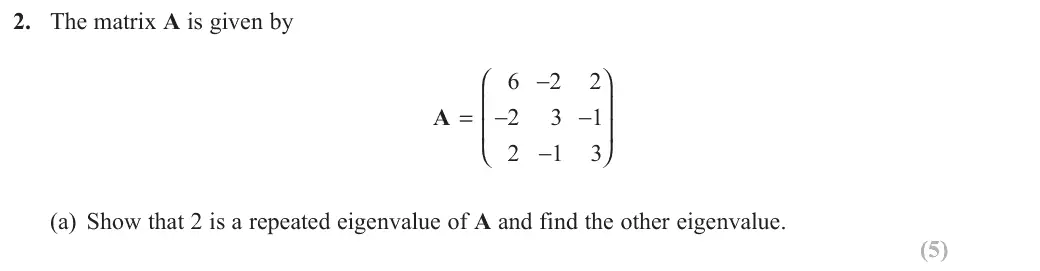
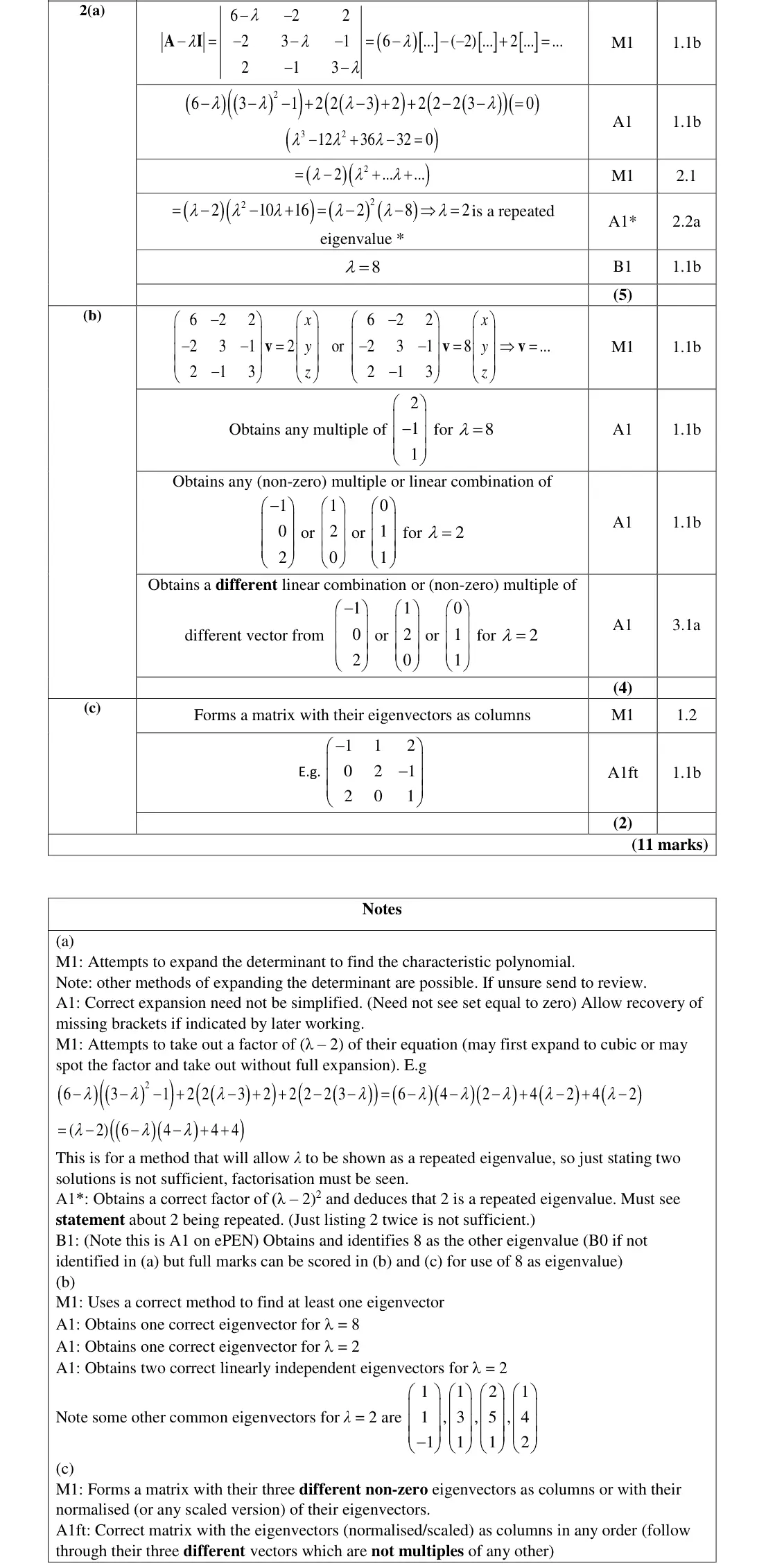
This question was well answered by candidates, although a lack of attention to details lost some marks. For part (a) most candidates understood how to find eigenvalues and successfully found the characteristic polynomial before attempting to factorise. There were only a small number of cases of incorrect factorisation, some of the algebraic manipulation being inaccurate and resulting in 3 distinct eigenvalues, such as 2, 4 and 6. As part (a) was a “show” question, evidence was needed that there were repeated roots, not simply an assertion that such was the case, so some lost marks because they didn't specify either that 2 was a repeated eigenvalue or the other eigenvalue being 8.
Key points from the mark scheme and examiner's report
factorisation must be seen and 2 stated as repeated
other eigenvalue 8
June 2019 · Paper 4A (Further Pure 2) · Q2(b)4 marks
Mark scheme (whole question; this part is marked with the orange bar)
Examiner's comment
This question was well answered by candidates, although a lack of attention to details lost some marks. The methods required were shown to be well understood with accuracy in part (b) being the main cause for lost marks. In part (b) errors mainly arose from bad algebra, particularly for the eigenvector related to eigenvalue 8, but the correct method for finding eigenvectors was shown by most. There were many correct alternatives found for the eigenvectors for λ = 2 and attaining three correct eigenvectors A for was the most common outcome for this part.
Key points from the mark scheme and examiner's report
λ = 8: (2, −1, 1)
λ = 2: two independent vectors satisfying 2x − y + z = 0, e.g. (−1, 0, 2), (1, 2, 0)
algebra slips mainly for λ = 8
June 2019 · Paper 4A (Further Pure 2) · Q2(c)2 marks
Mark scheme (whole question; this part is marked with the orange bar)
Examiner's comment
This question was well answered by candidates, although a lack of attention to details lost some marks. Again, part (c) was answered well by candidates, who used their column vectors to produce a suitable matrix P. Due to the follow through mark here, that meant most candidates were able to score both marks in this part. A few candidates normalised their eigenvectors first, the process of diagonalising a symmetric matrix using P and its transpose, which still gains the marks here. Such a procedure was not necessary and indicates that some candidates are unaware of difference in the two cases. Of those who did not achieve full marks in part (c), this was mainly due to only having found one eigenvector for the eigenvalue 2. In such cases either use of the zero vector as one column, or a repeated column or simply leaving part (c) unanswered resulted. There were a few cases where the two eigenvectors for λ = 2 were multiples, which could score only one mark in part (c).
Key points from the mark scheme and examiner's report
P has the three eigenvectors as columns (any order)
normalising not needed (A is symmetric but P⁻¹AP only asked)
failing to find two eigenvectors for λ = 2 led to repeated or zero columns
June 2018 · AS Paper 2 (Further Pure 2) · Q47 marks
Mark scheme (whole question; this part is marked with the orange bar)
Examiner's comment
This was a good source of marks for many students and full marks were fairly common although there were also several completely blank responses. The most common error was to form the eigenvectors incorrectly from correct equations.
Key points from the mark scheme and examiner's report