Nothing is given; the integrating factor must be known.
Since 2018
40 question parts, 134 marks, 4 with a difficulty rating from the examiner's report
Notes, worked examples and practice for this topic are being written by our tutors. The past-paper questions below are ready now: work each one on paper, then open the mark scheme and the examiner's comment.
Tap a question to zoom it. Mark scheme and examiner's comment open under each question.
June 2025 · Paper 1 (Core Pure 1) · Q4(b)3 marks
Mark scheme (whole question; this part is marked with the orange bar)
Examiner's comment
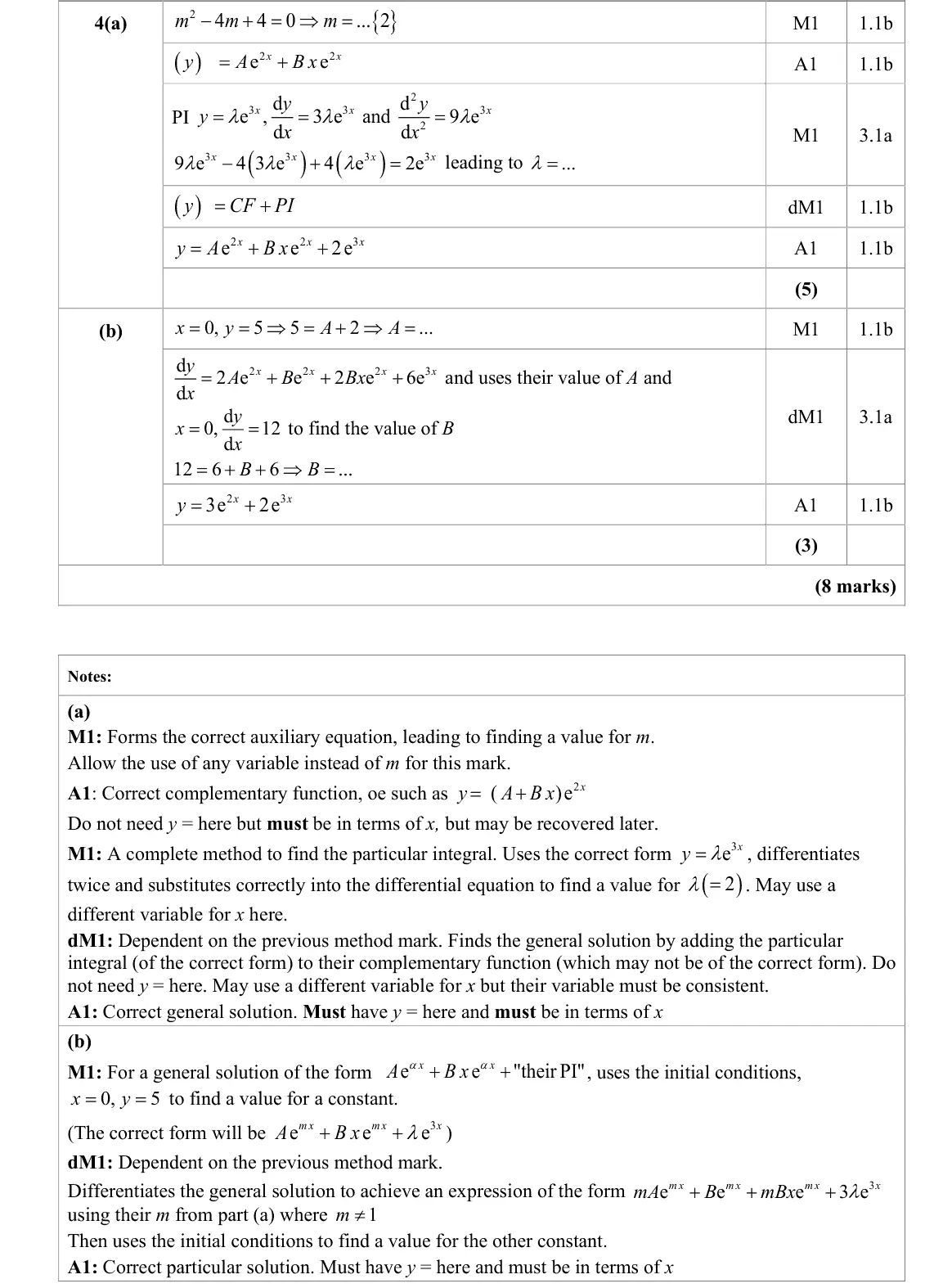
causing them to lose marks later in part (b). 2 2 e e x x y A B = + Most students tried the correct form for the PI and usually proceeded to the obtain it correctly. A few candidates correctly differentiated but then substituted their differentials into 3e x 2 3e x incorrect terms. The most common incorrect forms for the PI were and . y x y x λ = λ = This cost them the final three marks in part (a). However, they were able to access the first two marks in part (b) if they had a correct complementary function. There were occasional slips made when writing down the general solution. Candidates rarely forgot the y = in their final answer. (b) Most students who had a correct CF went on to score the marks in part (b), with the majority who had already scored all five marks in part (a), then scoring everything in part (b). 0 y = There were minor errors when substituting and into their general solution, with 0 x = being seen on occasions. 5 2 A B = + + There were very few mistakes seen in the application of the product rule, though some candidates forgot to differentiate their PI. d y Errors were rarely seen in the substitutions of and their value for A . 0, 12 x = = d x Occasionally there were errors in the final answer following correct work; sometimes 5 was written for A and occasionally the coefficient of x in one of the exponentials was given incorrectly.
Key points from the mark scheme and examiner's report
y = 5 at x = 0 gives A = 3
differentiate (product rule) and use dy/dx = 12 to get B = 0: y = 3e²ˣ + 2e³ˣ
June 2025 · Paper 1 (Core Pure 1) · Q8(a)1 mark
Mark scheme (whole question; this part is marked with the orange bar)
Examiner's comment
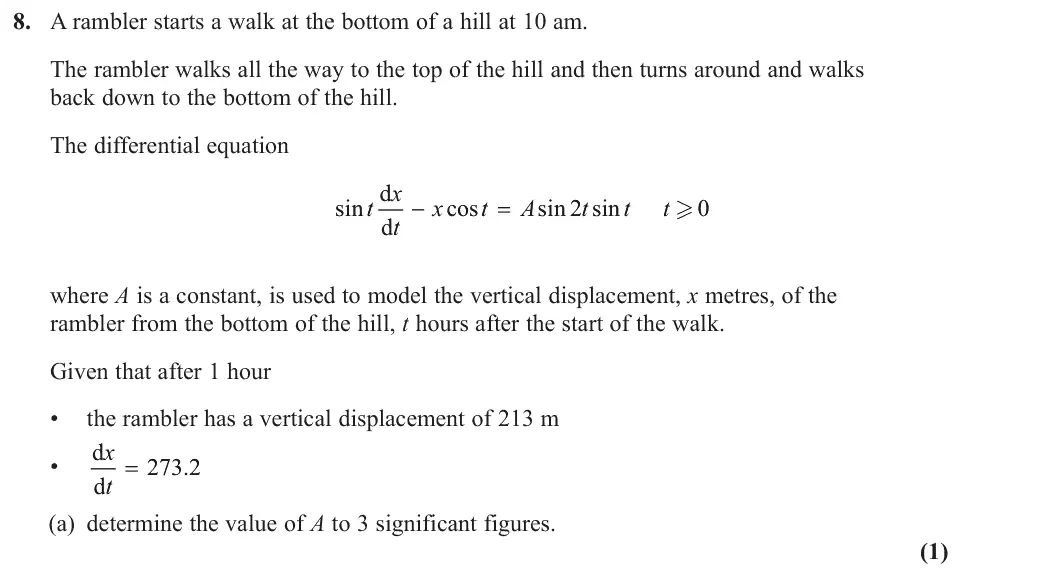
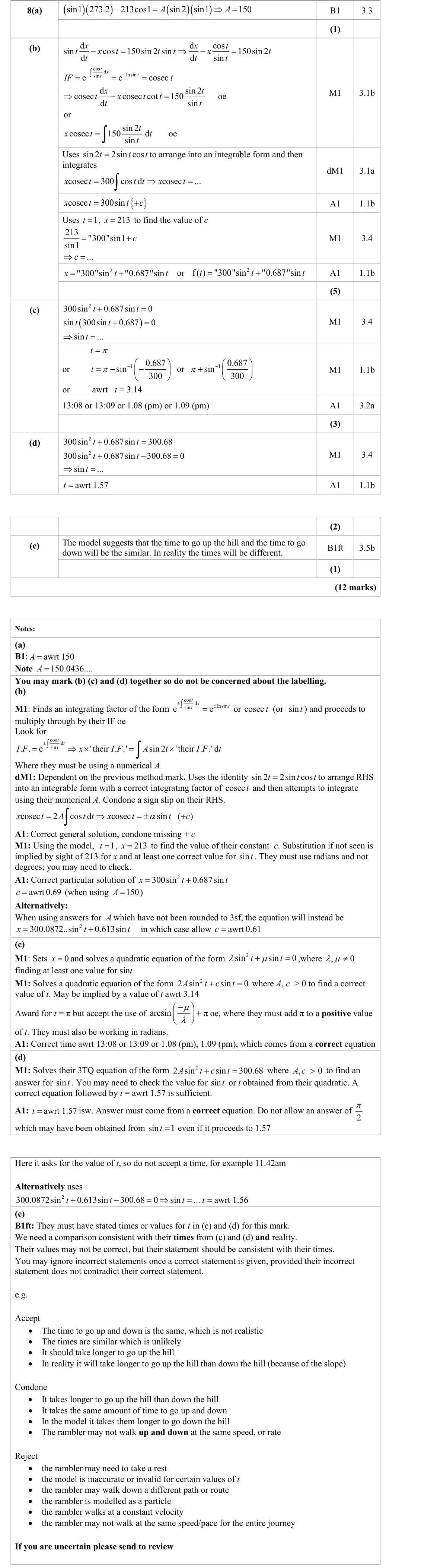
(a) This was extremely well answered with many of the candidates able to correctly find the value of A. A common error was candidates incorrectly using degrees mode on their calculator. The other main errors generally came from misreads of the original equations.
Key points from the mark scheme and examiner's report
substitute t = 1, x = 213, dx/dt = 273.2 into the equation: A ≈ 150
radians, not degrees
June 2025 · Paper 1 (Core Pure 1) · Q8(b)5 marks
Mark scheme (whole question; this part is marked with the orange bar)
Examiner's comment
(b) This question was poorly answered overall with many candidates not receiving all marks. Most candidates understood they needed an integrating factor and cosec t was generally found with a minority instead finding sint . However, a minority could not find either of these. Candidates with sint could make little further progress. For candidates with the correct IF the LHS was formed correctly but integrating the expression of the RHS did cause difficulty for some as they were unable to use the correct identities with the “2” often lost. Some candidates left their expressions in terms of A instead of a numeric value until the latter stages though this was condoned if the value was used later. There was a small number of candidates who used the more exact value of A from (a) but again this was condoned. The majority who progressed to integrating remembered to include c + and were able to use the constraints to find a value. Notation in this question for some candidates was poor, although condoned with the integral symbol and dt often not written correctly at each stage.
Key points from the mark scheme and examiner's report
divide by sin t
integrating factor cosec t (not sin t)
RHS 150 sin 2t/sin t = 300cos t using sin 2t = 2sin t cos t
x cosec t = 300sin t + c
t = 1, x = 213 gives c ≈ 0.687: x = 300sin²t + 0.687sin t
June 2025 · Paper 1 (Core Pure 1) · Q8(c)3 marks
Mark scheme (whole question; this part is marked with the orange bar)
Examiner's comment
(c) This question caused difficulties for candidates. Those who were able to start could find at least one root for sint and gain the M1. However, many candidates neglected to consider the case sin 0 t = . A value of t such as 0, -0.00228... were found by the majority and most then continued onto a correct first positive value pi or 3.1438... However, it was noticeable that some candidates omitted these and found the subsequent values by adding 2 pi . Many candidates who got correct values then failed to write the time as they had not understood the question fully.
Key points from the mark scheme and examiner's report
sin t(300sin t + 0.687) = 0
first positive root after the start t ≈ 3.14 h, so about 13:08 (1.08 pm)
many ignored sin t = 0, skipped the first root or did not give a time
June 2025 · Paper 1 (Core Pure 1) · Q8(d)2 marks
Mark scheme (whole question; this part is marked with the orange bar)
Examiner's comment
(d) Most candidates with a quadratic of the correct form were able to access the question but many unfortunately used rounded figures. The roots for sint were generally found correctly but often just written as 1 instead of the more accurate 0.9999.... The use of sin 1 t = was then often seen leading to 2 pi which meant they lost the accuracy mark. A minority of students then went on to write out a time which was not required here. It is worth noting several candidates could not access this question due to not getting the required form from part (b).
Key points from the mark scheme and examiner's report
solve 300sin²t + 0.687sin t = 300.68: t ≈ 1.57 (not π/2 from rounding sin t to 1)
premature rounding
June 2025 · Paper 1 (Core Pure 1) · Q8(e)1 mark
Mark scheme (whole question; this part is marked with the orange bar)
Examiner's comment
(e) This was quite poorly answered even for candidates who had correct values. Linking the values to the context caused issues and some candidates incorrectly talked about later values as opposed to the specific values found in (c) and (d). It was pleasing to see correct comments for incorrect values that were condoned here. But the context caused difficulties with many candidates failing to realise going up the hill should take longer. Some could not articulate their thoughts sufficiently to demonstrate the understanding required for the mark. The most common correct answer was “it should take longer to go up than come down”.
Key points from the mark scheme and examiner's report
the model gives about equal times up and down, but in reality going up the hill should take longer
Mark scheme (whole question; this part is marked with the orange bar)
Examiner's comment
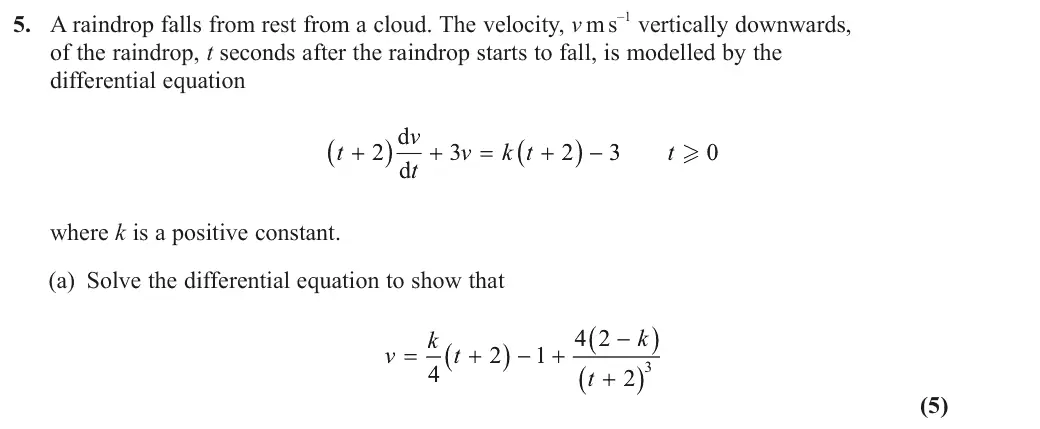
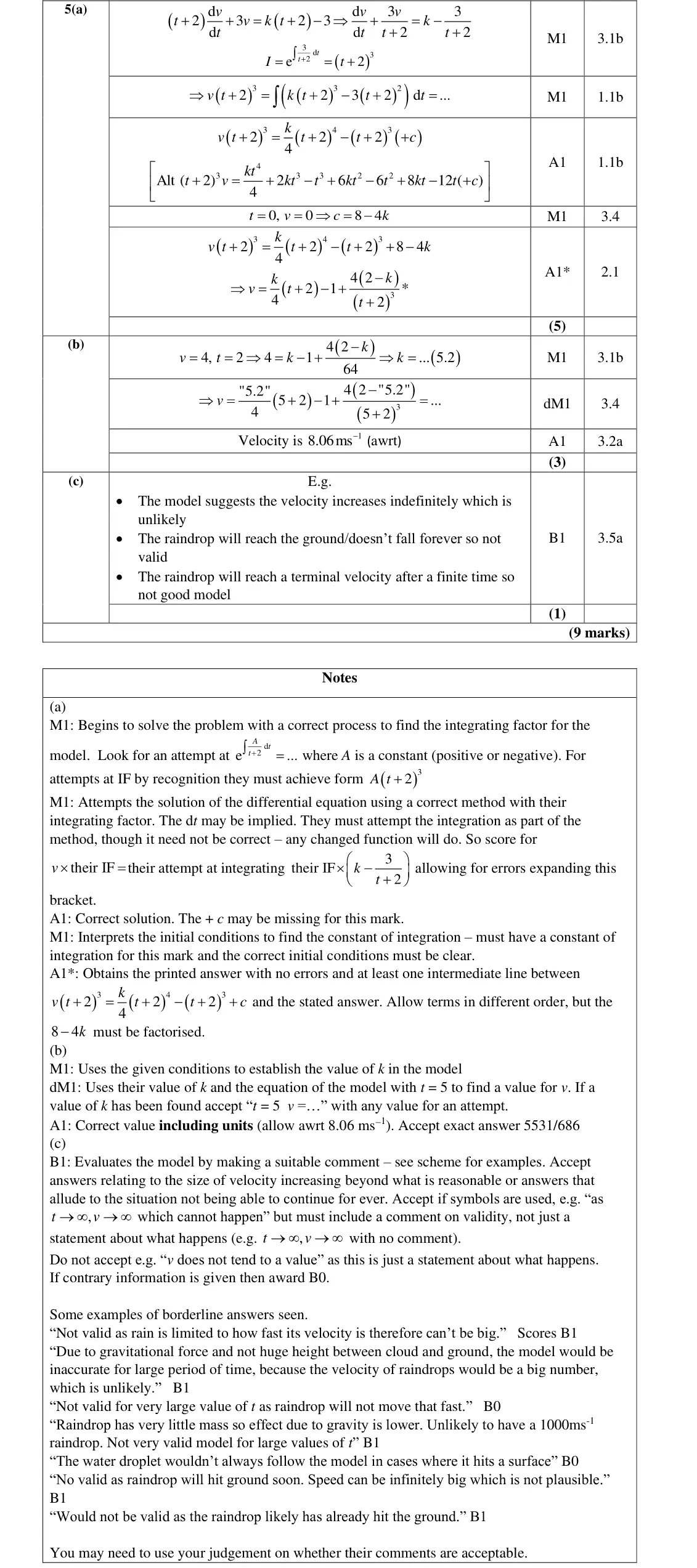
Despite being a context question, which often caused difficulties in comprehension, this question was well answered by the majority, who could easily see through the context to focus on the mathematics required and were able to for the most part to give answers in context at the end. In part (a) most candidates were able to obtain full marks for fully correct solutions to the differential equation, though it was the least successfully answered part in the question overall. Very few failed to realise that an integrating factor was needed and nearly all were successful in establishing that the factor was ( ) 3 2 t + . If they did not then no progress was likely to be made in this part. After finding the integrating factor, again most were able to use it correctly and attempt the integration, though a small number did not obtain either the correct left- or right-hand side. A left-hand side of ( ) 2 2 v t + was seen a few times, while for the right-hand side the most common error was ( ) ( ) 4 3 2 3 2 d k t t t + - + . However, most were able to obtain a correct equation and attempt to integrate. A few opted to expand before integration, giving a much hard task to reach the given solution later, and a few attempted to use integration by parts on ( ) 3 3 2 2 t k t + - + without success, but most were able to obtain the most direct answer as they could see the form that was being aimed for. The most common error in this part was to integrate correctly on both sides, including a constant but then failing to use the initial conditions t = 0, v = 0, either just stating that ( ) 4 2 c k = - without justification, attempting to use v = 4 and t = 2 in their attempt to find c (whether successful or not). Omission of the constant of integration entirely was rare. Correct completion to the given equation generally followed when the correct conditions were used.
Key points from the mark scheme and examiner's report
divide by (t + 2) first
integrating factor (t + 2)³
use v = 0 when t = 0 to find the constant
June 2024 · Paper 1 (Core Pure 1) · Q5(b)3 marks
Mark scheme (whole question; this part is marked with the orange bar)
Examiner's comment
Despite being a context question, which often caused difficulties in comprehension, this question was well answered by the majority, who could easily see through the context to focus on the mathematics required and were able to for the most part to give answers in context at the end. Part (b) was the best answered part of the question overall, with only a very small number of candidates unable to make any progress – usually following having tried to use the use v = 4 and t = 2 conditions in part (a) so not relating them to part (b). A few tried to use their wrong (a) to continue which led to a loss of marks, and candidates would be best advised to make use of given answers on papers rather than proceeding with their own versions. Most were able to follow the correct procedure of substituting use v = 4 and t = 2 into the equation, usually then calculating a correct k and proceeding on to a value for v. Most often this value was correct and m/s units were stated scoring all the marks, though a few did omit the units and so lost the accuracy. There were also some who had arithmetical errors for k, with k = 5 arising from erroneously also substituting for t in place of the k in the ( ) 4 2 k - being a common such slip. But these could still proceed to a value for v to gain the method. Also a few candidates gave an answer of 8.1 m/s (insufficient precision), while many candidates gave their answer as a fraction, which could achieve the A mark if the correct units were present.
Key points from the mark scheme and examiner's report
use the given answer to (a) with v = 4, t = 2 to find k = 5.2, then t = 5: 8.06 m s⁻¹ (units needed)
do not reuse the conditions in (a)
June 2024 · Paper 1 (Core Pure 1) · Q5(c)1 mark
Mark scheme (whole question; this part is marked with the orange bar)
Examiner's comment
Despite being a context question, which often caused difficulties in comprehension, this question was well answered by the majority, who could easily see through the context to focus on the mathematics required and were able to for the most part to give answers in context at the end. Part (c) was generally well answered with most candidates able to give a reason and conclusion related to the context. Most common was to state that v → as t → and either that this is not realistic (or similar) or to mention terminal velocity, or the raindrop hitting the ground. It was also common for candidates to mention that this would mean that the droplet would travel faster that the speed of light, or to continue increasing indefinitely, which is not possible. But not all achieved the mark as some gave either factually incorrect or nonsensical answers (such as not being able to have infinite rain), for instance stating that v increases exponentially, or think that 0 v → as t increases. There was a requirement to explicitly say that the model is invalid or similar, which some also failed to do, just stating what happens, but with no interpretation.
Key points from the mark scheme and examiner's report
v → ∞ as t → ∞, which is unrealistic (terminal velocity / raindrop reaches the ground)
must say the model is not valid, not just what happens
June 2024 · Paper 1 (Core Pure 1) · Q8(d)5 marks
Mark scheme (whole question; this part is marked with the orange bar)
Examiner's comment
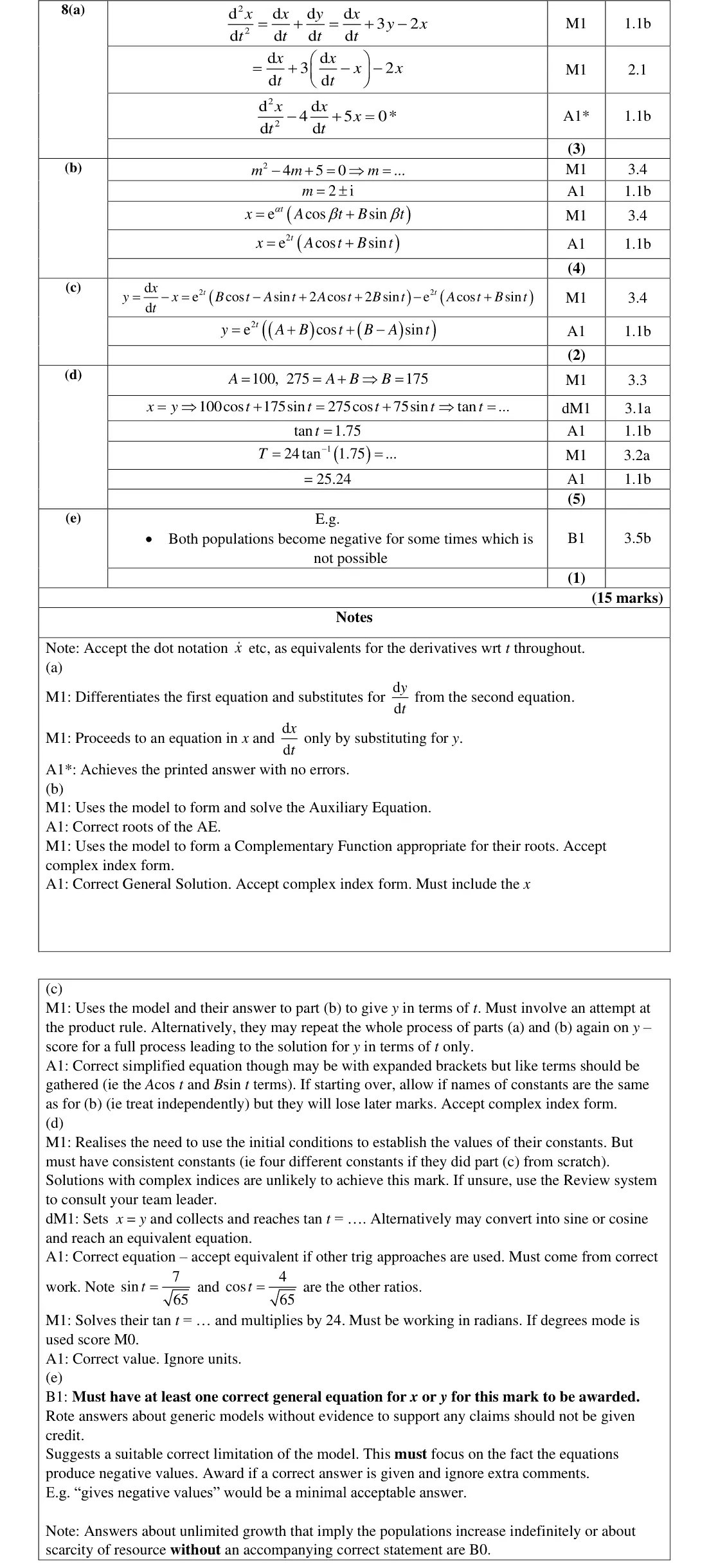
Once again candidates coped well with this contextual connected derivatives question, and other than the last 3 marks this was well answered by the majority of the candidates. Most were able to complete what they could in the time available, and only a few did not reach the end, indicating there was no lack of time on the paper. Part (d) was generally started suitably by candidates who had found expressions for x and y, who generally attempted to use the initial conditions to find A and B. Those who had started again in part (c) and used the same constants were usually unable to get any further, while those who had four constants needed to proceed to use derivative statements to find the constant and so often simply gave up. For those who had suitable equation and found value for A and B, the next step was straightforward, equating their x and y equations and proceeding to find a value for tan t. Only a small number of such candidates failed to reach an expression for tan t, though errors rearranging, such as from 175cos 100sin t t = to 100 tan 175 t = , occurred in some candidates work, but the majority of candidates were able to reach the correct vale for tan t. Very few proceeded by sine or cosine approaches. The last two marks in this mark did proved discriminating, with only a minority of candidates proceeding to the correct final answer. The most common answer by far was T = 1.05, with correct arctan process, but neglecting to multiply by 24 to change from days to hours. Use of degrees also occurred relatively frequently, but again generally without the conversion to hours anyway, but losing the final two marks regardless of if they did this. A few cases occurred where the correct process was carried out following an incorrect tan t value but generally those who did convert into hours had fully correct solutions to this point.
Key points from the mark scheme and examiner's report
A = 100, B = 175 from t = 0
x = y gives tan t = 1.75
T is in HOURS so × 24: T = 25.24 (1.05 is the common wrong answer)
radians
June 2024 · Paper 1 (Core Pure 1) · Q8(e)1 mark
Mark scheme (whole question; this part is marked with the orange bar)
Examiner's comment
Once again candidates coped well with this contextual connected derivatives question, and other than the last 3 marks this was well answered by the majority of the candidates. Most were able to complete what they could in the time available, and only a few did not reach the end, indicating there was no lack of time on the paper. The mark in part (e) was scored by only a small minority of candidates. It was the worst answered question part in the entire paper, with many candidates leaving it blank or using rote answers about the values tending to infinity with no indication of an investigation of what actually happens. The rote answers used did not achieve the mark as candidates needed to show understanding that the key issue was that the equations produce negative values (after a relatively short period of time). Instead, candidates wrote comments about predators – clearly using rote predator-prey model answer, which were not relevant to bacteria – or external factors without understanding that models can include these when the parameters are calculated. Many candidates referred to the populations growing exponentially which would make it an unsuitable model, while the concept of limited space, bacteria consuming each other, not considering the number of bacteria dying and other environmental factors were also frequently cited. However, constraints on space and so on for a model studying behaviour of bacteria, which are microscopic and potentially have, for all intents and purposes of the model, unlimited space to grow, are not acceptable. Answers about continual growth do not consider the periods of contraction, which are indeed what invalidates the model in this instance as it breaks down when the population becomes negative. This is another answer that candidates would be well to be armed with in future and be able to determine when each of these types of answer is appropriate to the model in hand.
Key points from the mark scheme and examiner's report
needs a correct general solution
populations become negative, which is impossible
rote "unlimited growth" answers score 0
worst-answered part of the paper
June 2024 · Paper 2 (Core Pure 2) · Q6(b)3 marks
Mark scheme (whole question; this part is marked with the orange bar)
Examiner's comment
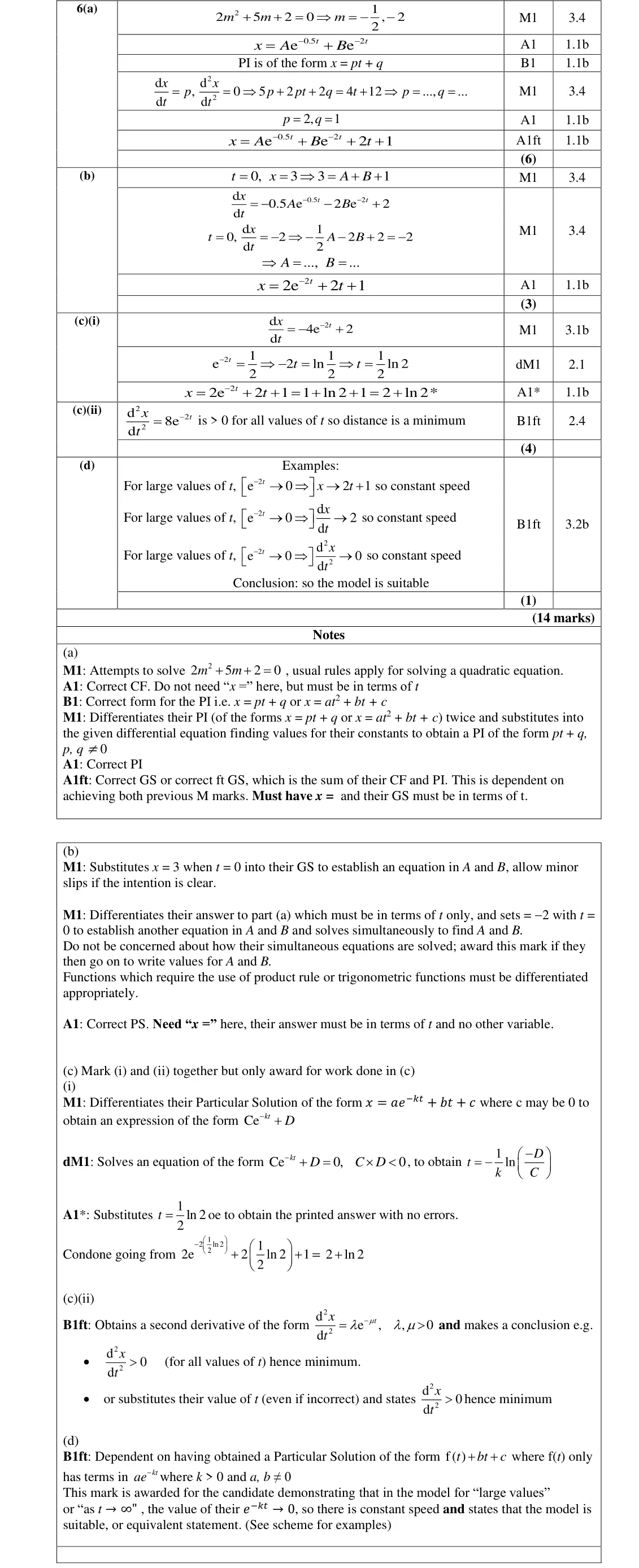
Most candidates made a good attempt at this question, although a significant number were (b) Most candidates used x = 3 and d x t = -with t = 0 correctly and differentiated their 2 d general solution. The particular solution caused some candidates problems, typically with 𝑑𝑥 slips in solving the simultaneous equations they had formed, with a few using 𝑑𝑡= 0 instead of the given value. This would prove to be a costly error as it gave the candidates a particular solution with two exponential terms and led them to lose almost all the remaining marks for question 6.
Key points from the mark scheme and examiner's report
x = 3 and dx/dt = −2 at t = 0 give A = 0, B = 2: x = 2e^(−2t) + 2t + 1
using dx/dt = 0 wrecked later parts
June 2024 · Paper 2 (Core Pure 2) · Q6(c)4 marks
Mark scheme (whole question; this part is marked with the orange bar)
Examiner's comment
Most candidates made a good attempt at this question, although a significant number were unable to access the marks for part (c) (c)(i) Candidates who had found correct values for A and B mostly went on to find the value for t when d x t = . A few errors were seen in applying the logarithm rules. A correct value of 0 d t usually led to a correct minimum value. (c)(ii) Candidates were expected to take the second derivative of the function correctly and justify that this is a minimum by stating their second derivative is greater than 0 (and often also finding its value of 4). This had mixed responses usually from incorrect earlier work. Some candidates incorrectly substituted for x instead of t.
Key points from the mark scheme and examiner's report
dx/dt = −4e^(−2t) + 2 = 0 gives t = ½ln 2, x = 2 + ln 2
(ii) d²x/dt² = 8e^(−2t) > 0 so minimum
substituting x instead of t
June 2024 · Paper 2 (Core Pure 2) · Q6(d)1 mark
Mark scheme (whole question; this part is marked with the orange bar)
Examiner's comment
Most candidates made a good attempt at this question, although a significant number were (d) The final part of the question was perhaps not well answered with most not establishing that the speed becomes constant as 𝑒-2𝑡 tends to zero or failing to draw an appropriate conclusion. Some just assumed that as t increased, the speed must also continue increasing. Some realised the speed approached a constant value 2 but failed to state the model was suitable.
Key points from the mark scheme and examiner's report
as t → ∞, e^(−2t) → 0 so dx/dt → 2, constant speed, so the model is suitable
many said the speed keeps increasing or omitted the conclusion
June 2023 · Paper 1 (Core Pure 1) · Q6(a)3 marks
Mark scheme (whole question; this part is marked with the orange bar)
Examiner's comment
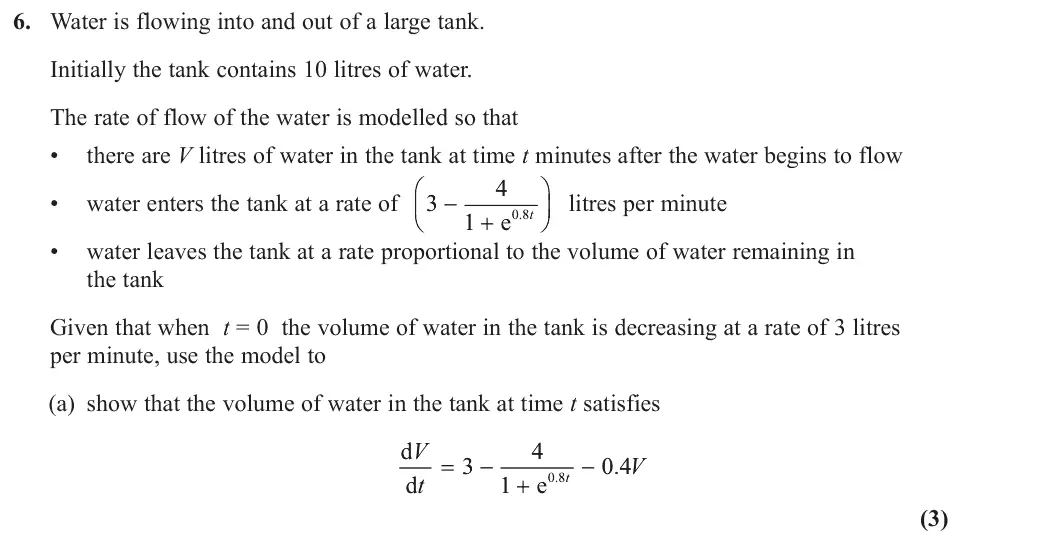
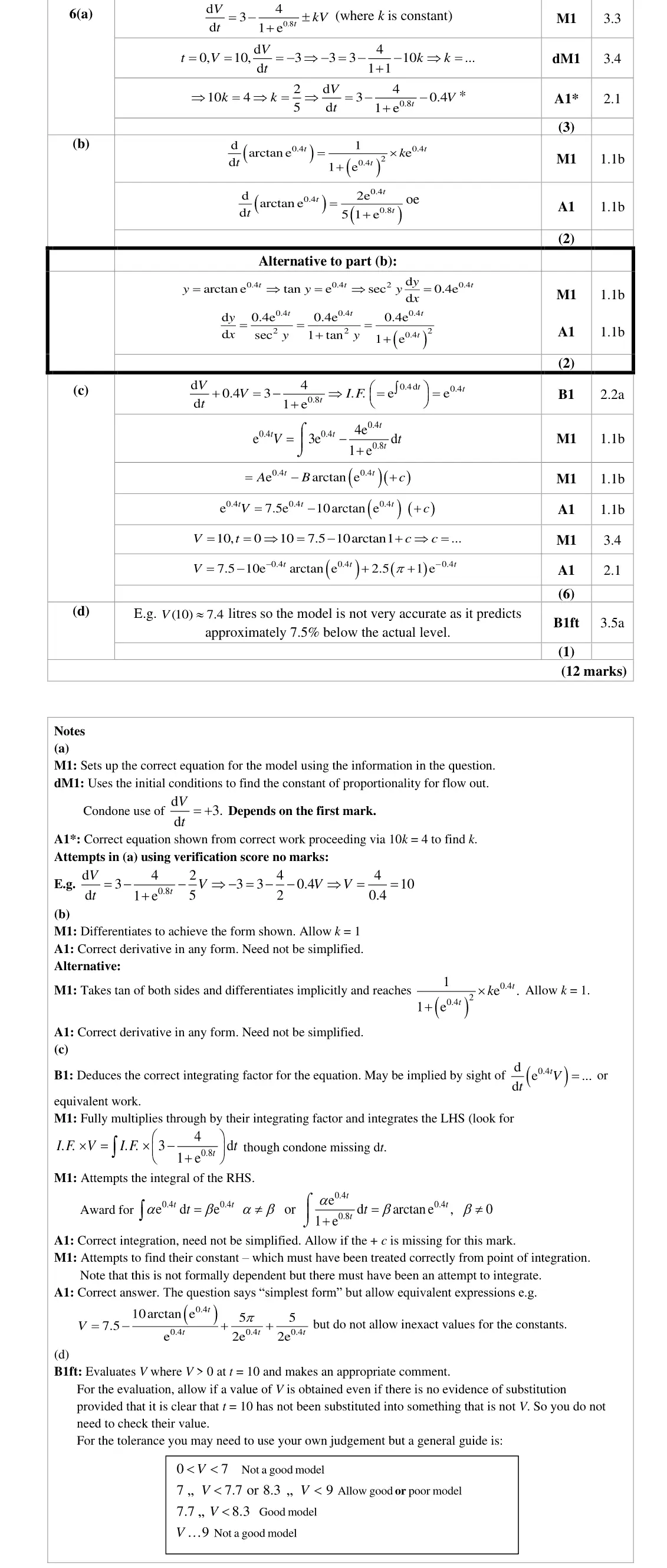
In part (a), a number of candidates failed to score any marks here, with the majority failing to set up the required model in terms of “k”. There were some descriptive attempts and some candidates attempted to write an equation for V rather than for d . d V t The link between the word “rate” and d d V t seemed to be poorly understood. Of those that set up the correct equation the majority scored full marks. A small number used d 3. d V t = + Others attempted this part by starting with the answer given and substituting in the given values to show that they worked. These verification methods gained no marks. Some candidates just ignored this part, even if they scored marks in other parts.
Key points from the mark scheme and examiner's report
dV/dt = 3 − 4/(1 + e⁰·⁸ᵗ) − kV
use t = 0, V = 10, dV/dt = −3 to get k = 0.4
verifying the given equation scores 0
poor link between 'rate' and dV/dt
June 2023 · Paper 1 (Core Pure 1) · Q6(c)6 marks
Mark scheme (whole question; this part is marked with the orange bar)
Examiner's comment
In part (c), a pleasing majority rearranged the differential equation and recognised the technique required and established the correct integrating factor. Most went on to obtain the first method mark, but some lost this, either as they stopped before integrating the LHS or failed to multiply the RHS by the integrating factor. Of those who did, most scored the second method mark, almost always for integrating the first term, though a noticeable minority had an incorrect coefficient, usually because they multiplied by the 0.4. Success with the second term was more mixed, even when part (b) had been answered correctly - the coefficient being a problem for many. Some candidates who failed to differentiate arctan𝑒0.4𝑡 , did integrate successfully, occasionally using a substitution. Some candidates lost the final two marks as they did not include the constant of integration or did not deal with it correctly when dividing by e0.4t. A few did not give an exact value for c, losing the last mark. Some did not use the correct initial conditions when trying to find a value for c, and also lost the last two marks.
Key points from the mark scheme and examiner's report
integrating factor e⁰·⁴ᵗ
∫4e⁰·⁴ᵗ/(1 + e⁰·⁸ᵗ) dt = 10 arctan e⁰·⁴ᵗ using (b)
V = 7.5 − 10e⁻⁰·⁴ᵗ arctan(e⁰·⁴ᵗ) + 2.5(π + 1)e⁻⁰·⁴ᵗ
wrong coefficients and a missing or untreated + c
June 2023 · Paper 1 (Core Pure 1) · Q6(d)1 mark
Mark scheme (whole question; this part is marked with the orange bar)
Examiner's comment
In part (d), although the correct value for V when t = 10 was rarely seen, most candidate who reached an answer for part (c) attempted this and made an appropriate comment. A minority of responses clearly substituted the wrong value for t, usually 8. For a small number of candidates, whose model gave negative value, rather than checking their working, the conclusion appeared to be that it wasn’t a good model. Some forgot to make a comment evaluating the model.
Key points from the mark scheme and examiner's report
V(10) ≈ 7.4 litres, about 7.5% below 8, so the model is not very accurate (a judgement must be made)
substituting t = 8 or forgetting to comment
June 2023 · Paper 2 (Core Pure 2) · Q9(c)4 marks
Mark scheme (whole question; this part is marked with the orange bar)
Examiner's comment
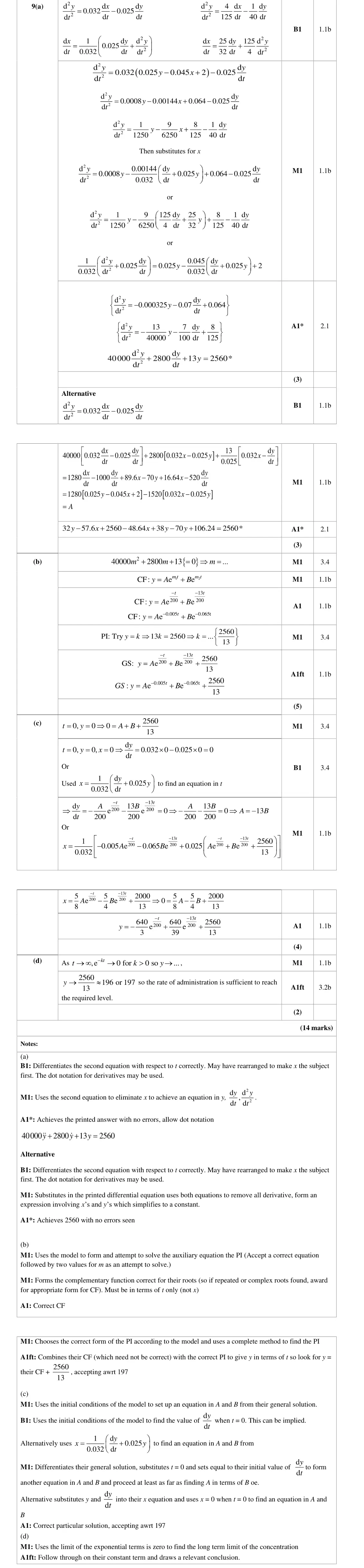
(c) Most candidates substituted t = 0 and y = 0 to find one simple equation; finding the second proved to be a little more problematic. This was a good discriminator with many choosing the efficient method of using d 0 d y x = and gaining two equations in A and B. Some took the more arduous root of finding an equation for x in terms of t, to varying degrees of success. Once candidates had simultaneous equations, they generally went on to solve them, with overall success dependent upon the accuracy of their equations.
Key points from the mark scheme and examiner's report
y = 0 at t = 0, and x = 0 at t = 0 gives dy/dt = 0
y = 2560/13 − (640/3)e^(−t/200) + (640/39)e^(−13t/200)
finding the second condition was the discriminator
June 2023 · Paper 2 (Core Pure 2) · Q9(d)2 marks
Mark scheme (whole question; this part is marked with the orange bar)
Examiner's comment
(d) For most candidates who correctly found y as t → infinity, it did not matter what errors were made in (c) since the result depended only on the constant term. They then drew the correct conclusion. Attempting to find y for a random value of t was generally not successful.
Key points from the mark scheme and examiner's report
as t → ∞, y → 2560/13 ≈ 197, between 185 and 200, so effective
substituting a particular t was not successful
June 2022 · Paper 1 (Core Pure 1) · Q3(a)3 marksEasy
Mark scheme (whole question; this part is marked with the orange bar)
Examiner's comment
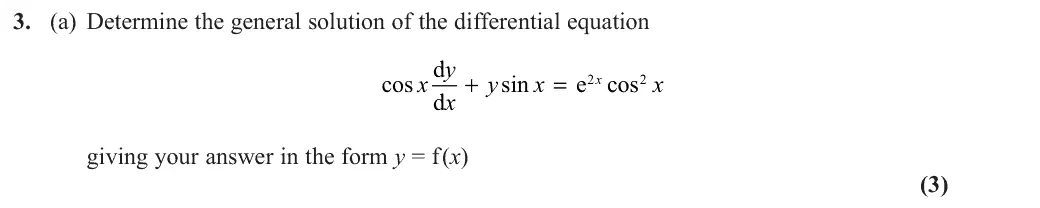
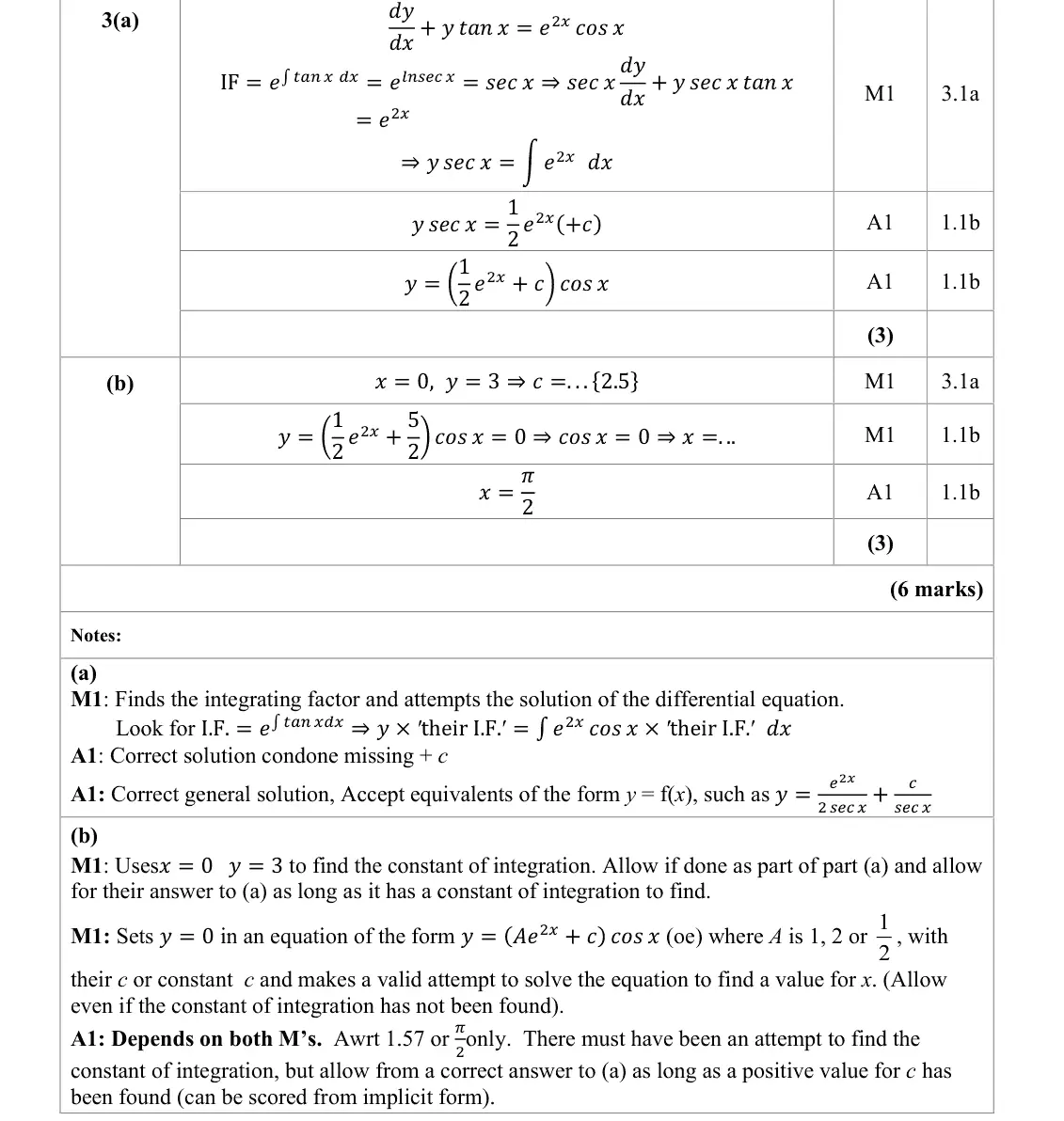
This question was overall very well answered, particularly by those candidates who wrote their expression for y in terms of cos x. Nearly 60% gained full marks, though scores of 0 and 4 were also common. The sole method mark in part (a) had quite a long scope, and those who were not able to identify the integrating factor usually scored no marks at all. However, the majority of candidates managed to score the first three marks by reducing the differential equation to one of the format d ( ) d g y Py x x + = , finding the correct integrating factor, and continuing to an equation of the format y = f(x) as required. Some integrated incorrectly from 2e sec d x x y x = to give 2e 2 x y c = + , but most were able to achieve the correct result and remembered to include the constant. A few candidates made sign errors or slips in the integrating factor leading to attempts at integration by parts on an expression involving 2 2 2 e or cos cos e x x x x or similar, gaining only the method mark.
Key points from the mark scheme and examiner's report
divide by cos x: integrating factor sec x
y sec x = ½e^(2x) + c
y = (½e^(2x) + c)cos x
wrong integration to 2e^(2x)
June 2022 · Paper 1 (Core Pure 1) · Q3(b)3 marksEasy
Mark scheme (whole question; this part is marked with the orange bar)
Examiner's comment
This question was overall very well answered, particularly by those candidates who wrote their expression for y in terms of cos x. Nearly 60% gained full marks, though scores of 0 and 4 were also common. For part (b), the main key factor seemed to be whether the candidates had written their particular integral in terms of cos x or in terms of sec x. While many candidates achieved the first mark and found a (correct) value of c, those candidates who had written the equation in terms of sec x often failed to see that 1 0 sec x = when cos x = 0, and failed to find a correct method to solve their equation and hence could not reach a correct solution. Other less common errors included letting c be a function of x, leading to incorrect solutions. In contract, the vast majority of students who achieved an expression for y in terms of cos x achieved the correct answer of 2 .
Key points from the mark scheme and examiner's report
c = 5/2 from y = 3 at x = 0
½e^(2x) + 5/2 > 0 so y = 0 needs cos x = 0: x = π/2
candidates using sec x form often missed this
June 2022 · Paper 1 (Core Pure 1) · Q10(b)4 marks
Mark scheme (whole question; this part is marked with the orange bar)
Examiner's comment
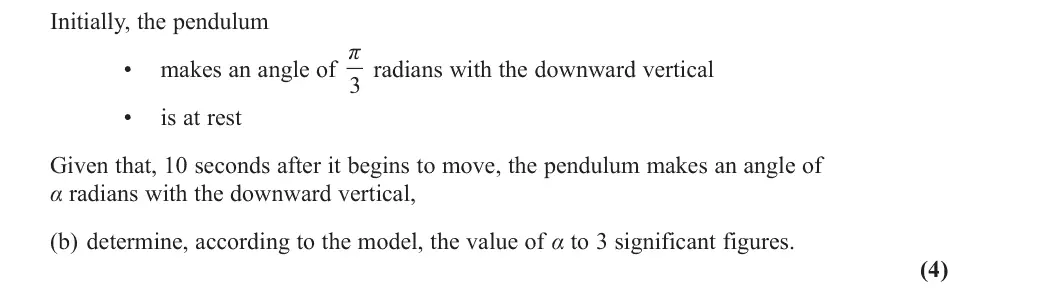
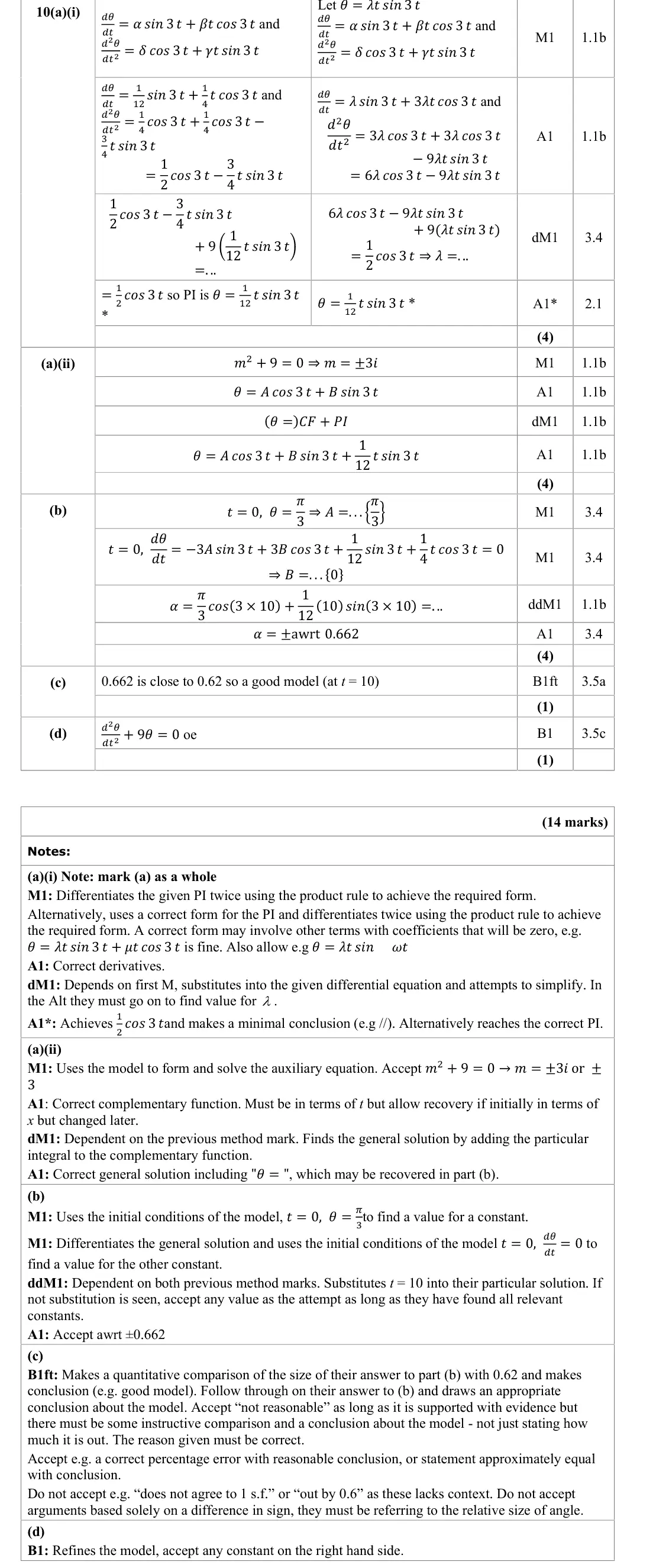
Those who successfully navigated part (a) usually went on to do well in part (b).Candidates who had the correct form for their General Solution found it easy enough to find their A with mixed results for B. Those who recognised how to differentiate successfully here, were usually able to find B = 0, though some guessed this or obtained in fortuitously. Assuming an answer was reached with the qualifying methods gained, candidates were then able to find an estimate for the angle at t =10 seconds, and many correct answers were seen, although 0.66 was sometimes given, losing accuracy. Assessing the model in part (c) was done with varying degrees of success. Those offering a difference in signs between their answer to part (b) and the given value caused some confusion with a significant number of candidates thinking that the model was not good because it was predicting that the pendulum was on the other side of the vertical. Those who suggested it was a good model were more likely to get the mark here but many failed to back this up with a quantitative comparison of their answer and the given 0.62. A fair number of candidates did give the correct response to part (d), but there was a, perhaps
Key points from the mark scheme and examiner's report
θ = π/3 at t = 0 gives A = π/3
dθ/dt = 0 gives B = 0 (product rule)
α = (π/3)cos 30 + (10/12)sin 30 = awrt 0.662
Nov 2021 · Paper 1 (Core Pure 1) · Q6(b)7 marks
Mark scheme (whole question; this part is marked with the orange bar)
Examiner's comment
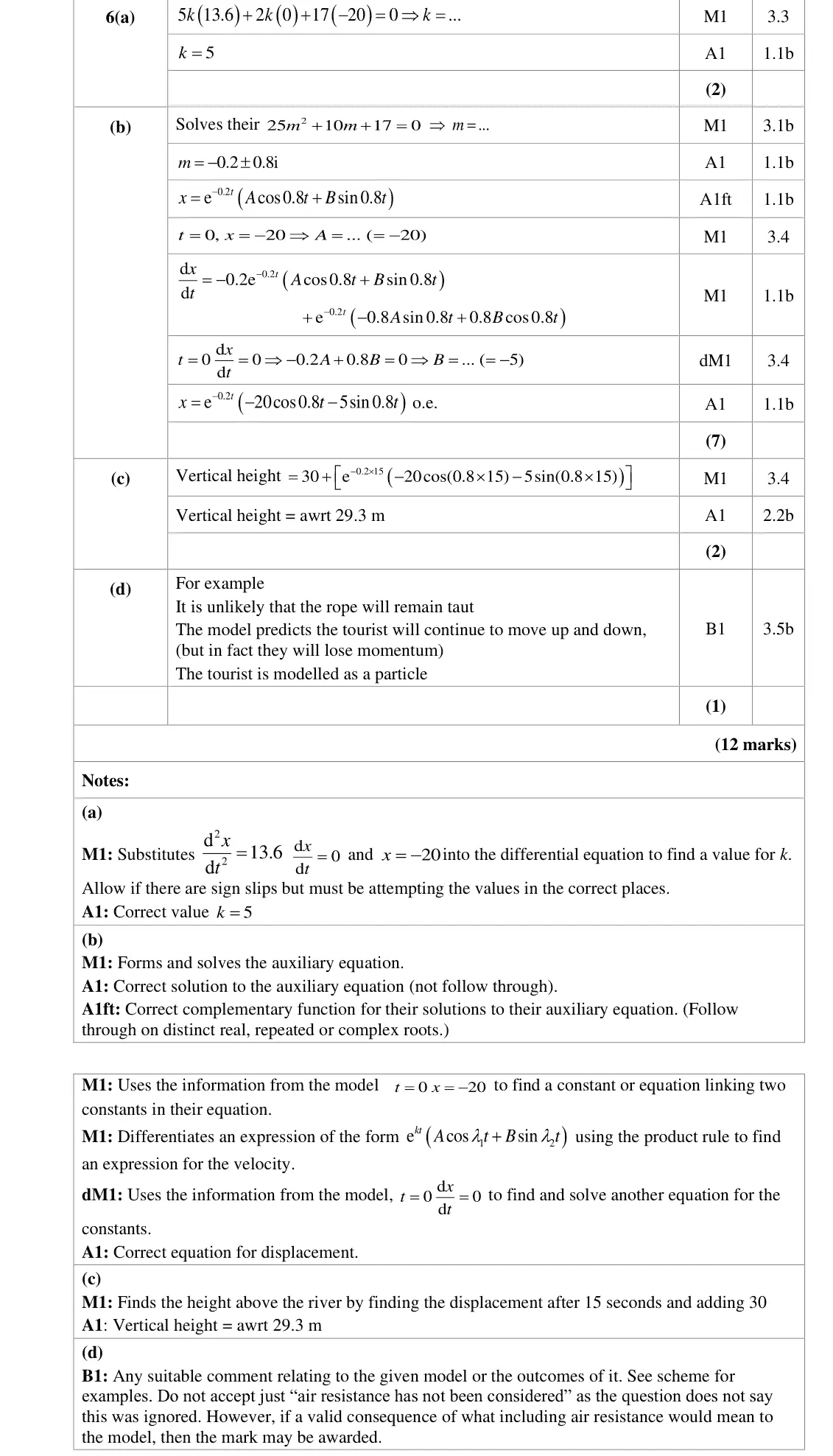
This question worked well in providing a structure with ramping with success in (b) This part was generally well approached by the majority with the first 4 marks accessed by most. The correct form for their complementary function was given by nearly all who attempted the solution, and they were able to substitute the correct values for t and x to find a constant. A few stopped at this point but most who made progress then used the product rule to find an expression for the velocity, and the only common error was in evaluating their second constant.
Key points from the mark scheme and examiner's report
25m² + 10m + 17 = 0, m = −0.2 ± 0.8i
A = −20 from x = −20
product rule with dx/dt = 0 gives B = −5
x = e^(−0.2t)(−20cos 0.8t − 5sin 0.8t)
Nov 2021 · Paper 1 (Core Pure 1) · Q8(a)2 marksMedium
Mark scheme (whole question; this part is marked with the orange bar)
Examiner's comment
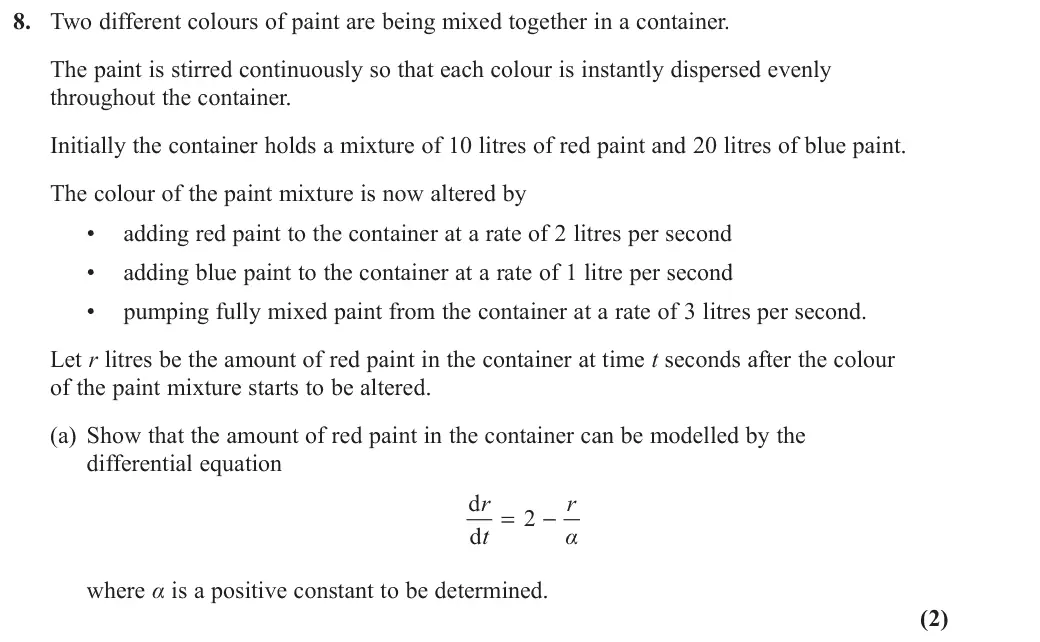
This proved a very challenging question, a step beyond most of the (a) Unfortunately the majority of candidates were unable to gain any marks at all in this part, with less than 15% scoring the M, and only 12% the A mark.
Key points from the mark scheme and examiner's report
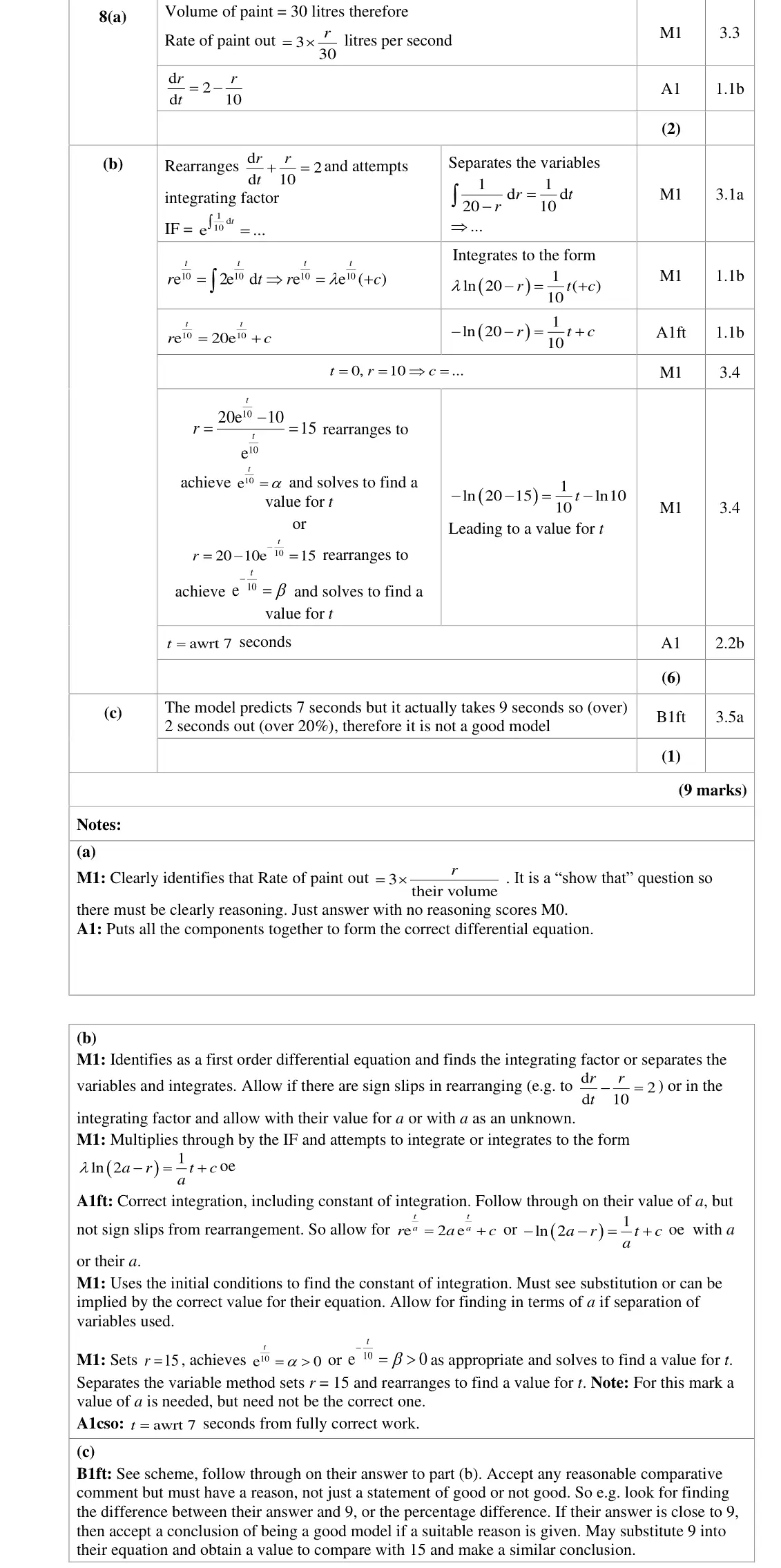
volume stays 30 litres (3 in, 3 out), so red out = 3 × r/30
dr/dt = 2 − r/10, α = 10
reasoning needed
Nov 2021 · Paper 1 (Core Pure 1) · Q8(b)6 marksMedium
Mark scheme (whole question; this part is marked with the orange bar)
Examiner's comment
This proved a very challenging question, a step beyond most of the candidates taking the paper, with 30% success rate on the M in (b) being the best accessed mark of the question. Very few scored the final mark in (c). (b) Those who did attempt this part mainly used the Integrating Factor method even though the variables were separable. A correct method for the Integrating Factor was usually applied and the first 4 marks were available. About 30% were successful in getting under way, with a quarter progressing to the second mark, and about 20% scoring the first 4 marks. Very few put r = 15 and attempted to find a value for t, with less than 10% accessing the final M mark. (c) Most were unable to comment as they had no value from part (b). Those who could have made a comment usually did not get the mark as their comment was too vague, so very few candidates scored this mark.
Key points from the mark scheme and examiner's report
integrating factor e^(t/10) or separate variables
r = 20 − 10e^(−t/10)
equal amounts when r = 15: t = awrt 7 s
many could not set up the equation in (a)
Nov 2021 · Paper 1 (Core Pure 1) · Q8(c)1 mark
Mark scheme (whole question; this part is marked with the orange bar)
Examiner's comment
This proved a very challenging question, a step beyond most of the best accessed mark of the question. Very few scored the final mark in (c). The context of the question was a barrier to many, as it seemed that most candidates did not understand the situation and so made very little progress as they could not set up the initial equation. Proceeding with any value for r could have gained marks, and candidates should attempt to proceed with some value in such cases as method and follow through marks will be available. (c) Most were unable to comment as they had no value from part (b). Those who could have made a comment usually did not get the mark as their comment was too vague, so very few candidates scored this mark.
Key points from the mark scheme and examiner's report
model predicts 7 s but actual is 9 s (over 20% out), so not a good model
needs a reason, not just "good" or "not good"
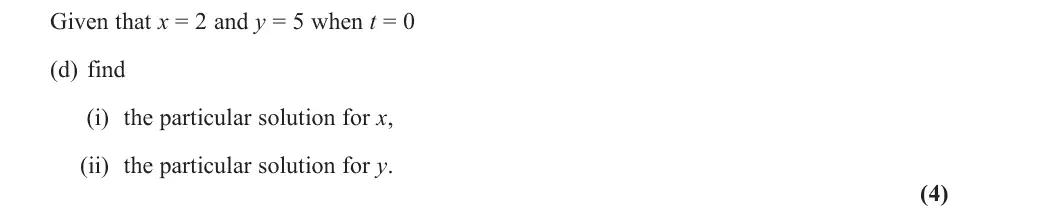
Oct 2020 · Paper 1 (Core Pure 1) · Q5(d)4 marks
Mark scheme (whole question; this part is marked with the orange bar)
Examiner's comment
by the same letters, which also impacted how much they could score in part (d). (d) The most common mark profile here was M1M1A0A0. Most used the initial conditions in their equations for x and y and found values for their constants but either due to earlier error or slips in algebra (finding B) both accuracy marks ended up being lost.
Key points from the mark scheme and examiner's report
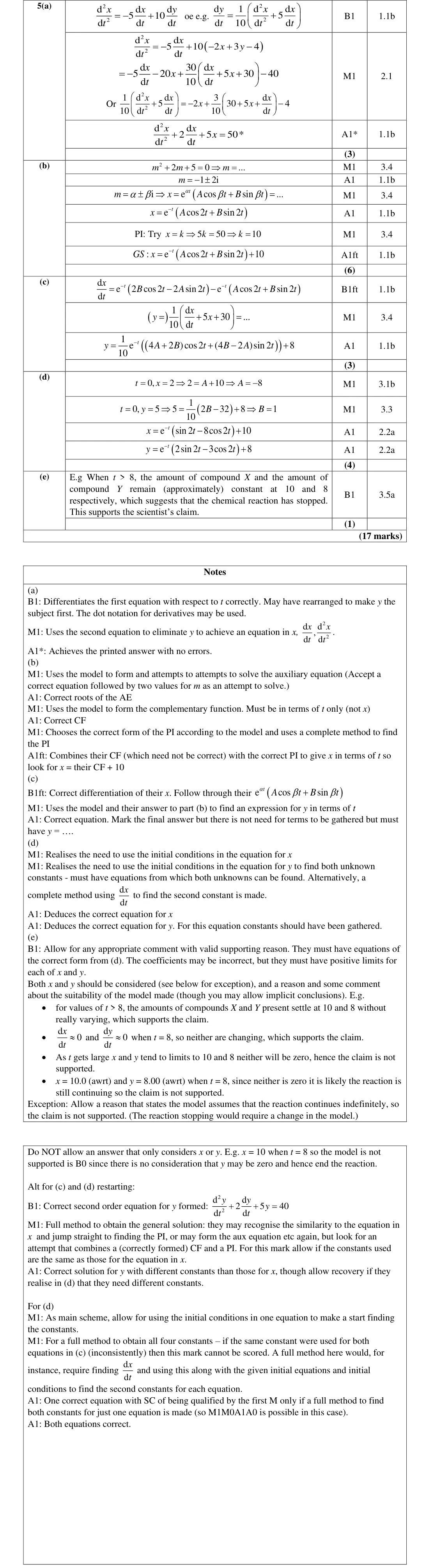
A = −8, B = 1: x = e⁻ᵗ(sin 2t − 8cos 2t) + 10, y = e⁻ᵗ(2sin 2t − 3cos 2t) + 8
most scored M1M1A0A0
Oct 2020 · Paper 1 (Core Pure 1) · Q5(e)1 mark
Mark scheme (whole question; this part is marked with the orange bar)
Examiner's comment
(e) Many candidates made a great effort in this final part of a very long question, although a few thought for one mark it was more trouble than it was worth! Those who gained the mark usually considered the behaviour of both x and y and came to a sensible conclusion. A few considered x’ and y’, which was also fine. Those who came to a conclusion based solely on the behaviour of either x or y did not gain the mark.
Key points from the mark scheme and examiner's report
for t > 8, x and y are almost constant at 10 and 8, so the reaction has (effectively) stopped
must consider both x and y
Oct 2020 · Paper 1 (Core Pure 1) · Q7(a)6 marks
Mark scheme (whole question; this part is marked with the orange bar)
Examiner's comment
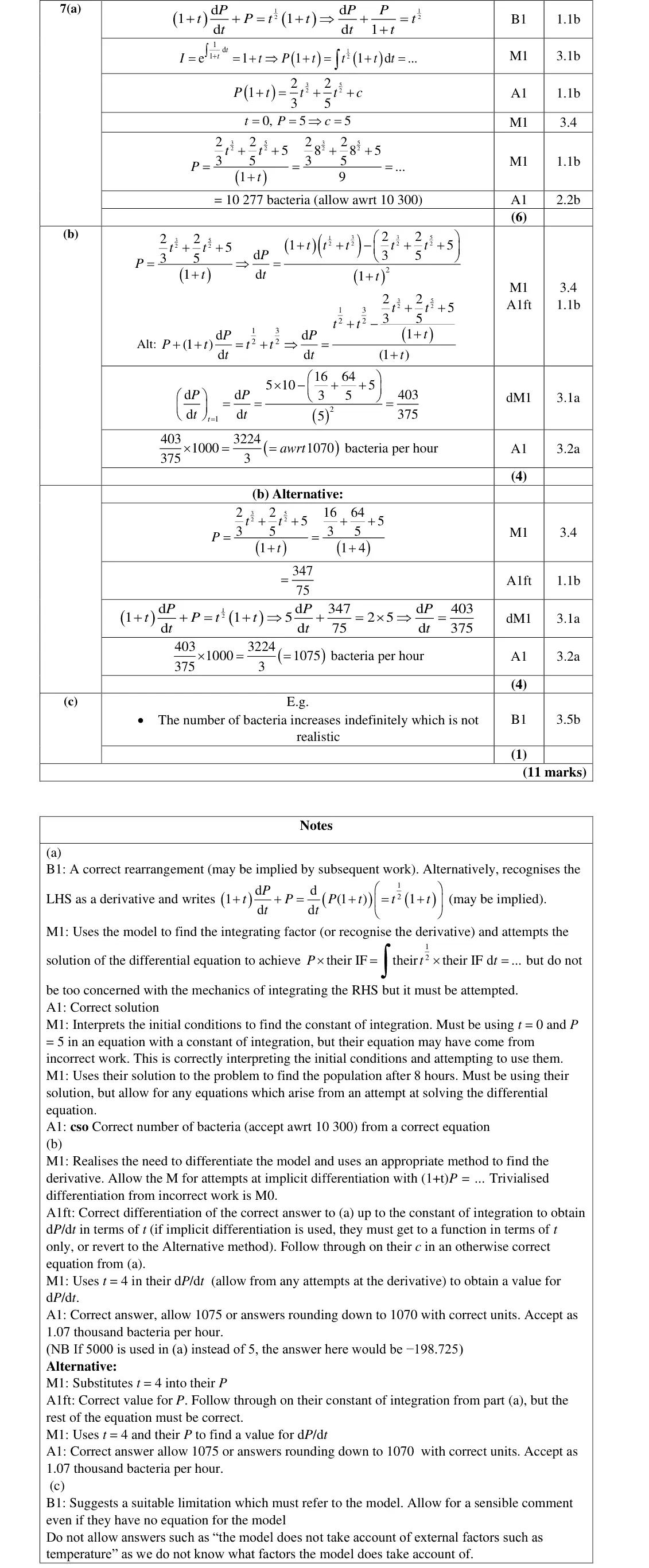
(a) Most started by rearranging the differential equation and trying to find the integrating factor, usually successfully. They then usually went on to integrate and the majority gained the first three marks. Some forgot to multiple both sides by the integrating factor, so they just achieved the first B mark. Some used integration by parts on the right-hand side instead of expanding the brackets, and they were less successful. Only very few candidates omitted ‘+c’ from the integrated equation. The most common error was to use P=5000 when t=0 as the initial condition. Another common error was to rearrange to make P the subject and forget to divide their c by (1+t). But most did attempt to evaluate their P at t = 8.
Key points from the mark scheme and examiner's report
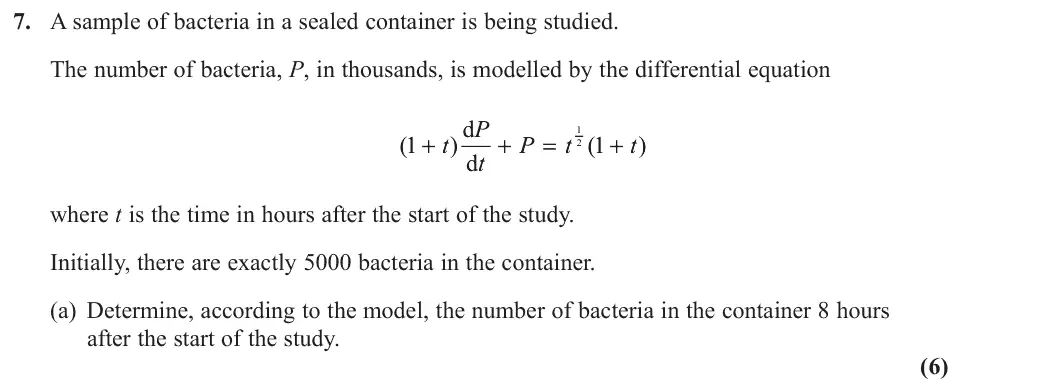
divide by (1 + t): integrating factor 1 + t, P(1 + t) = (2/3)t^(3/2) + (2/5)t^(5/2) + c
P in thousands so P = 5 at t = 0 (using 5000 is the commonest error)
P(8) ≈ 10 277 bacteria
Oct 2020 · Paper 1 (Core Pure 1) · Q7(b)4 marks
Mark scheme (whole question; this part is marked with the orange bar)
Examiner's comment
(b) The entry seemed to be fairly evenly split in using either the main method on the mark scheme or the alternative method, though the main scheme method was probably the more common, though the alternative was actually much more straightforward. Either way, very few multiplied their answer by 1000 to find the correct rate of change of bacteria.
Key points from the mark scheme and examiner's report
differentiate P (quotient rule) or substitute P(4) = 347/75 into the equation: dP/dt = 403/375 thousand, ≈ 1075 bacteria per hour
very few multiplied by 1000
Oct 2020 · Paper 1 (Core Pure 1) · Q7(c)1 mark
Mark scheme (whole question; this part is marked with the orange bar)
Examiner's comment
(c) Most candidates tried to give a context-based reason, such as the atmosphere might not permit growth, but did not relate it to the model. Since there was no information about the assumptions of the model, such answers could not gain credit. A few did realise the model predicted unlimited growth, and some even gave this rote answer without having solved to find an equation for P!
Key points from the mark scheme and examiner's report
P increases without limit, which is unrealistic in a sealed container
external factors not linked to the model score 0
Oct 2020 · Paper 2 (Core Pure 2) · Q3(b)8 marks
Mark scheme (whole question; this part is marked with the orange bar)
Examiner's comment
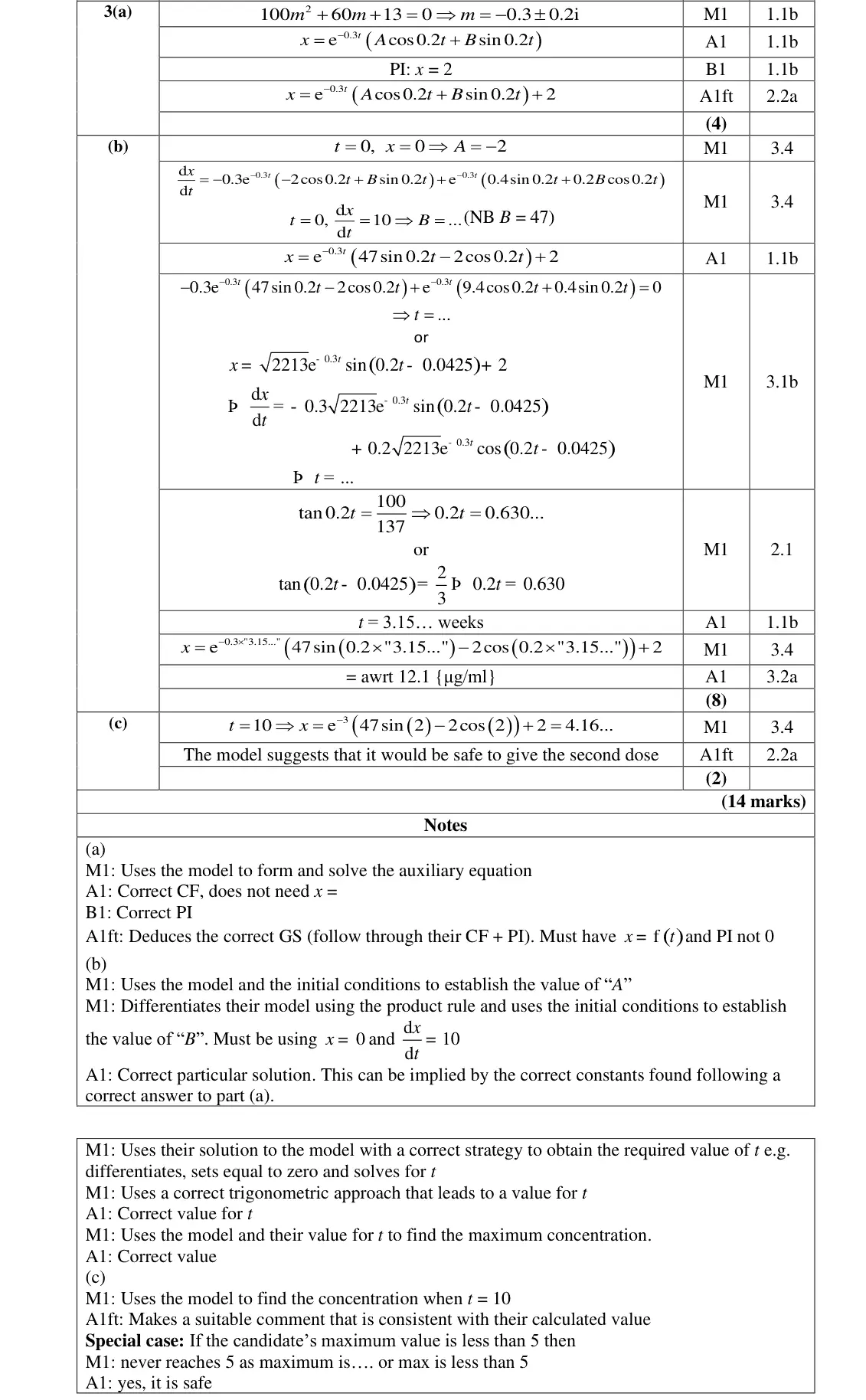
(b) Most candidates used x = 0 and d x 10 t = when t = 0 correctly having used the d product rule when differentiating. A majority found the constants, correctly, to be – 2 and 47 however there were a few careless errors in the calculation of the second of these. A common error seen was to use d x 0 t = to find the value of the second constant. d Candidates who found constant most went on to find a value for t when d x 0 t = but d many careless errors meant that the correct value was obtained by less than half of candidates. A correct value of t often lead to a correct maximum value although a few did fail to add in their PI when evaluating.
Key points from the mark scheme and examiner's report
x = 0 and dx/dt = 10 at t = 0 give A = −2, B = 47 (product rule
dx/dt = 0 used wrongly)
dx/dt = 0 gives tan 0.2t = 100/137, t = 3.15 weeks
maximum awrt 12.1 μg/ml
forgetting to add the PI
Oct 2020 · Paper 2 (Core Pure 2) · Q3(c)2 marks
Mark scheme (whole question; this part is marked with the orange bar)
Examiner's comment
(c) Most were on solid ground here and were able to correctly substitute t =10 and draw the correct conclusion, however, as with the end of part b, a minority carelessly forgot to add in the PI when finding x
Key points from the mark scheme and examiner's report
x(10) = 4.16 < 5 so it is safe to give the second dose
add the PI
June 2019 · Paper 1 (Core Pure 1) · Q5(a)4 marks
Mark scheme (whole question; this part is marked with the orange bar)
Examiner's comment
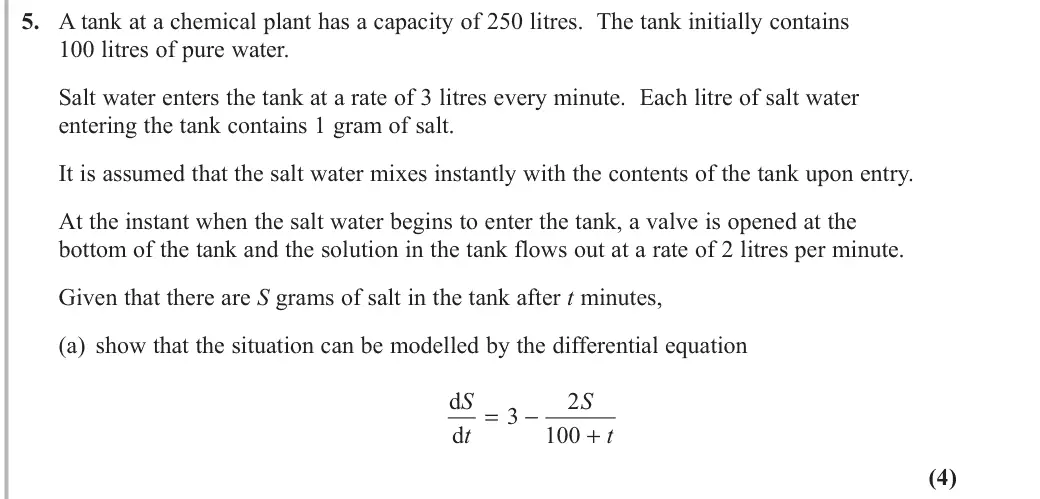
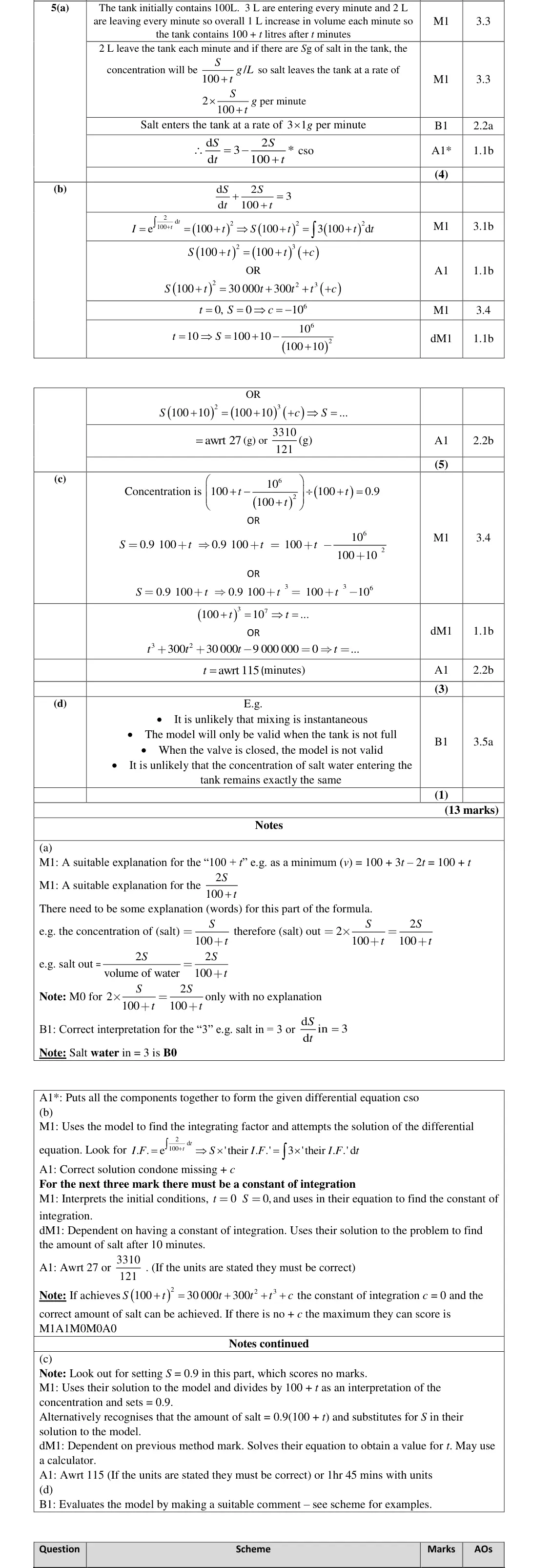
In part (a) many candidates struggled to explain the model successfully. References to the context of the model were required by using words such as “salt in”, “volume” and “concentration”. There was also some confusion between the salt and salt water that entered the tank. There seemed to be a reluctance by many candidates to use words as opposed to symbols and they need to practise these explanation skills There were some excellent fully coherent explanations, but these were relatively rare. The most common correct explanations are volume = 100 + 3t – 2t = 100 + t and that the rate of salt in 2 S S came from was very poor with candidates just writing 2 100 = 3. Whilst showing where 100 t t with no reasoning where they have come from.
Key points from the mark scheme and examiner's report
volume 100 + 3t − 2t = 100 + t
salt out = 2 × S/(100 + t) (concentration × outflow)
salt in 3 g per minute
explanations in words needed, symbols alone score M0
June 2019 · Paper 1 (Core Pure 1) · Q5(b)5 marks
Mark scheme (whole question; this part is marked with the orange bar)
Examiner's comment
In this question, part (b) and (d) were answered very well by the majority of candidates, but significantly fewer managed to answer (a) and (c) successfully. Part (b) was generally attempted correctly with the vast majority of candidates recognising the type of differential equation and correctly using the integrating factor. A small number of candidates omitted the constant of integration and lost the subsequent marks. Common errors when attempting to find the constant of integration are using S = 100 or using c c 0 100 0 0 100 0 instead of or achieving c = +1000000 instead of c -1000000. 2 100 100 Most candidates made an attempt at part (c) although only the minority identified the concentration of
Key points from the mark scheme and examiner's report
integrating factor (100 + t)²
S = 100 + t − 10⁶/(100 + t)²
constant from S = 0 at t = 0 (not S = 100)
awrt 27 g
June 2019 · Paper 1 (Core Pure 1) · Q5(c)3 marks
Mark scheme (whole question; this part is marked with the orange bar)
Examiner's comment
fewer managed to answer (a) and (c) successfully. Most candidates made an attempt at part (c) although only the minority identified the concentration of salt as the mass of salt divided by volume. The units of grams per litre stated in the question could have been used to guide those who were unsure of this relationship. Successful candidates then generally used their calculators efficiently to solve the resulting cubic equation and find the value of t. Common incorrect approaches were setting S or even dS/dt equal to the value for concentration.
Key points from the mark scheme and examiner's report
concentration = S ÷ (100 + t) = 0.9 gives (100 + t)³ = 10⁷, t = awrt 115 minutes
setting S = 0.9 or dS/dt = 0.9 scores 0
June 2019 · Paper 1 (Core Pure 1) · Q5(d)1 mark
Mark scheme (whole question; this part is marked with the orange bar)
Examiner's comment
In this question, part (b) and (d) were answered very well by the majority of candidates, but significantly fewer managed to answer (a) and (c) successfully. Part (d) was often answered correctly with the most common answer relating to the fact that the mixing would not occur instantly. Many candidates tried to comment on the volume of water or the amount of salt tending to infinity, but did not explain how this contradicted the model. Some candidates noted that the capacity of the tank was 250 litres, but did not always highlight that the tank would become invalid once the tank was full.
Key points from the mark scheme and examiner's report
e.g. mixing is not instantaneous, or the model fails once the 250-litre tank is full
saying quantities tend to infinity without linking to the model scores 0
June 2019 · Paper 1 (Core Pure 1) · Q8(d)6 marks
Mark scheme (whole question; this part is marked with the orange bar)
Examiner's comment
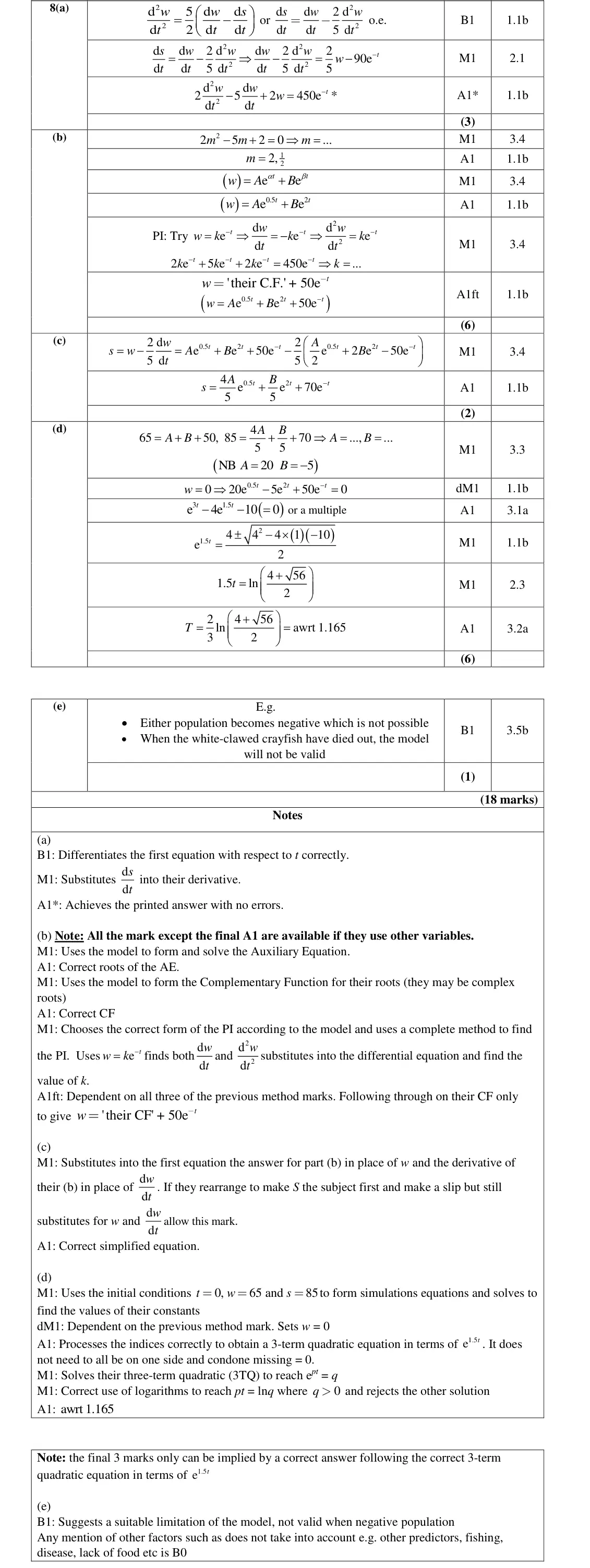
(d) The majority of candidates gained the first two marks in this section but failed to proceed beyond setting w = 0. A significant number failed to create a 3TQ in e1.5t because they didn’t multiply the whole equation by 𝑒-𝑡and had little chance of gaining the last 4 marks. There was mixed success in solving the 3TQ – some made a substitution using x = e1.5 t, but others attempted more complicated substitutions, or tried to square their equation with little progress. Those who solved their 3TQ were able to correctly undo the logs, but failed to round correctly.
Key points from the mark scheme and examiner's report
A = 20, B = −5
w = 0 gives e^(3t) − 4e^(1.5t) − 10 = 0, a quadratic in e^(1.5t)
T = awrt 1.165
many failed to multiply through by eᵗ to form the 3-term quadratic
June 2019 · Paper 1 (Core Pure 1) · Q8(e)1 mark
Mark scheme (whole question; this part is marked with the orange bar)
Examiner's comment
(e) This part was very poorly answered with most candidates talking about other factors instead of the potential for negative values, they did not take the hint from part (d) finding the time when w = 0. Comments were rarely in context and too many failed to mention the validity of the model. General comments I enjoyed the challenge of marking this new Further Maths paper. I think Pearsons need to consider the issue of the number of papers that some examiners are contracted to mark at the same time and how contracts are issued. Several of my team were marking three papers, possibly as a team leader on at least one of them. I have in the past, marked two papers that were running concurrently and I found that quite challenging but not impossible. There were sometimes days when an examiner did no marking on this paper then would spend an equal amount of time just marking this paper. I am not sure how well this works. Several examiners pulled out of this paper, either before it started or as it was starting which left teams short of examiners and the prospect of the marking of the paper not being completed on time. It would have been helpful if extra marking could have been released to those who had finished and wished to continue rather than just to one examiner. While this new version of epen is a great improvement on the previous version which had considerable issues with java script, there are still some concerns. On this paper the marking grid was at the side. This is a better position than at the bottom as was the case on the other paper I marked. There were days when everything ran very slowly, causing the software to crash at frequent intervals. Review was sometimes an issue, often freezing. Examiners were allocated to incorrect teams despite all assurances to the contrary. I personally find some of the reports a lot harder to use especially as they are not always team orientated. Use of Calculators There seemed to be a wide range of calculator usage by candidates and it seems apparent that many teachers are not aware of the extent to which calculators may or may not be used. A couple of examiners have commented on this and have mentioned that some extra guidance to schools as to what is and isn’t acceptable would be of great benefit to all.
Key points from the mark scheme and examiner's report
the white-clawed population becomes negative after T, so the model is not valid
other factors (predators, food, disease) score 0
very poorly answered
June 2019 · Paper 2 (Core Pure 2) · Q5(b)8 marks
Mark scheme (whole question; this part is marked with the orange bar)
Examiner's comment
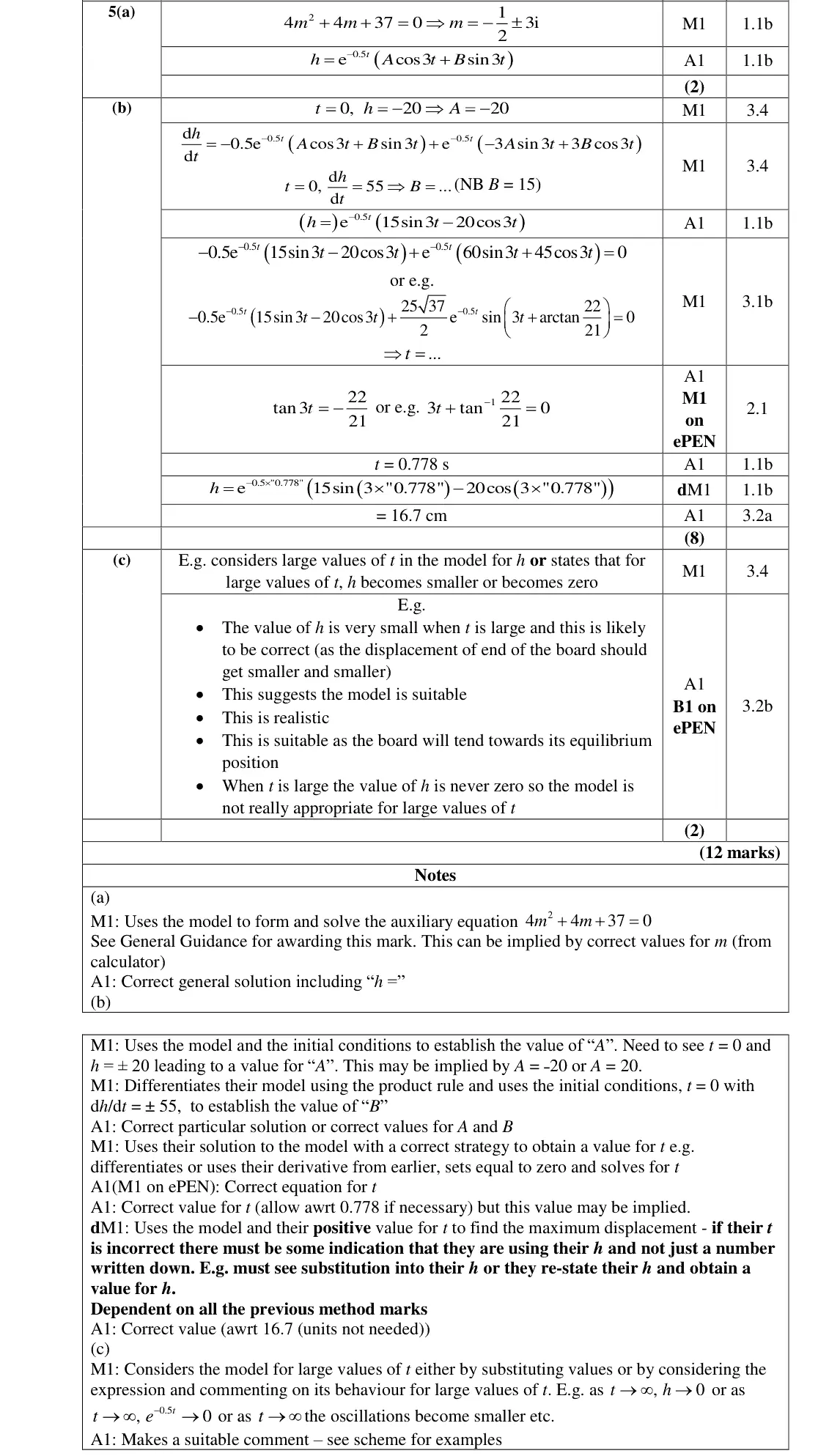
Q5 featured a model involving a second order differential equation and the latter marks in part (b) were not widely scored. In part (b), most candidates were able to appropriately obtain a value for both constants. Common errors were to set h = 20 rather than –20 and to not use the product rule when differentiating h. Finding the maximum proved challenging and many had an incorrect strategy. A significant number of candidates attempted to apply R sin(3t + 𝛼) to the trigonometric part of their h instead of their derivative, leading to answers of R or Re-0.5t. The more sensible route of using sin 3t cos 3t to get an equation in tan 3t saw more success. Those who obtained the correct equation often failed to obtain the smallest positive value of t. Some just dropped the minus sign from the calculator value of tan-1(- 22 21). A small number did not go on to obtain h for their t. Occasionally, work in degrees was seen, often producing clearly unreasonable values for hmax.
Key points from the mark scheme and examiner's report
h = −20 at t = 0 (not +20) gives A = −20
product rule for dh/dt gives B = 15
dh/dt = 0 gives tan 3t = −22/21, smallest positive t = 0.778 s
h max = 16.7 cm
applying R sin(3t + α) to h itself
work in radians
Find an Edexcel Further Maths tutor
Stuck on this? Book a trial lesson with our Further Maths tutor.