34 question parts, 139 marks, 1 with a difficulty rating from the examiner's report
Notes, worked examples and practice for this topic are being written by our tutors. The past-paper questions below are ready now: work each one on paper, then open the mark scheme and the examiner's comment.
Tap a question to zoom it. Mark scheme and examiner's comment open under each question.
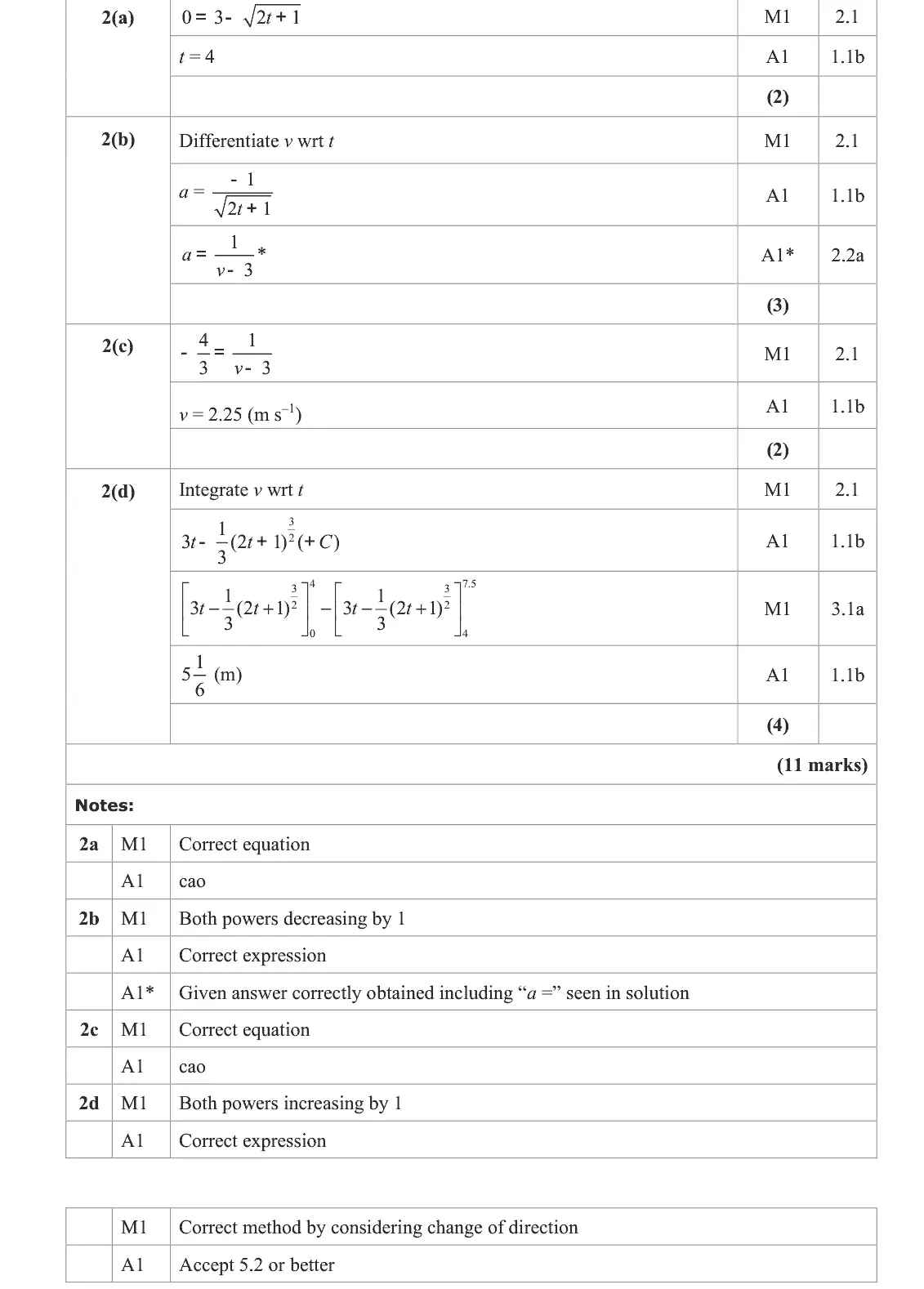
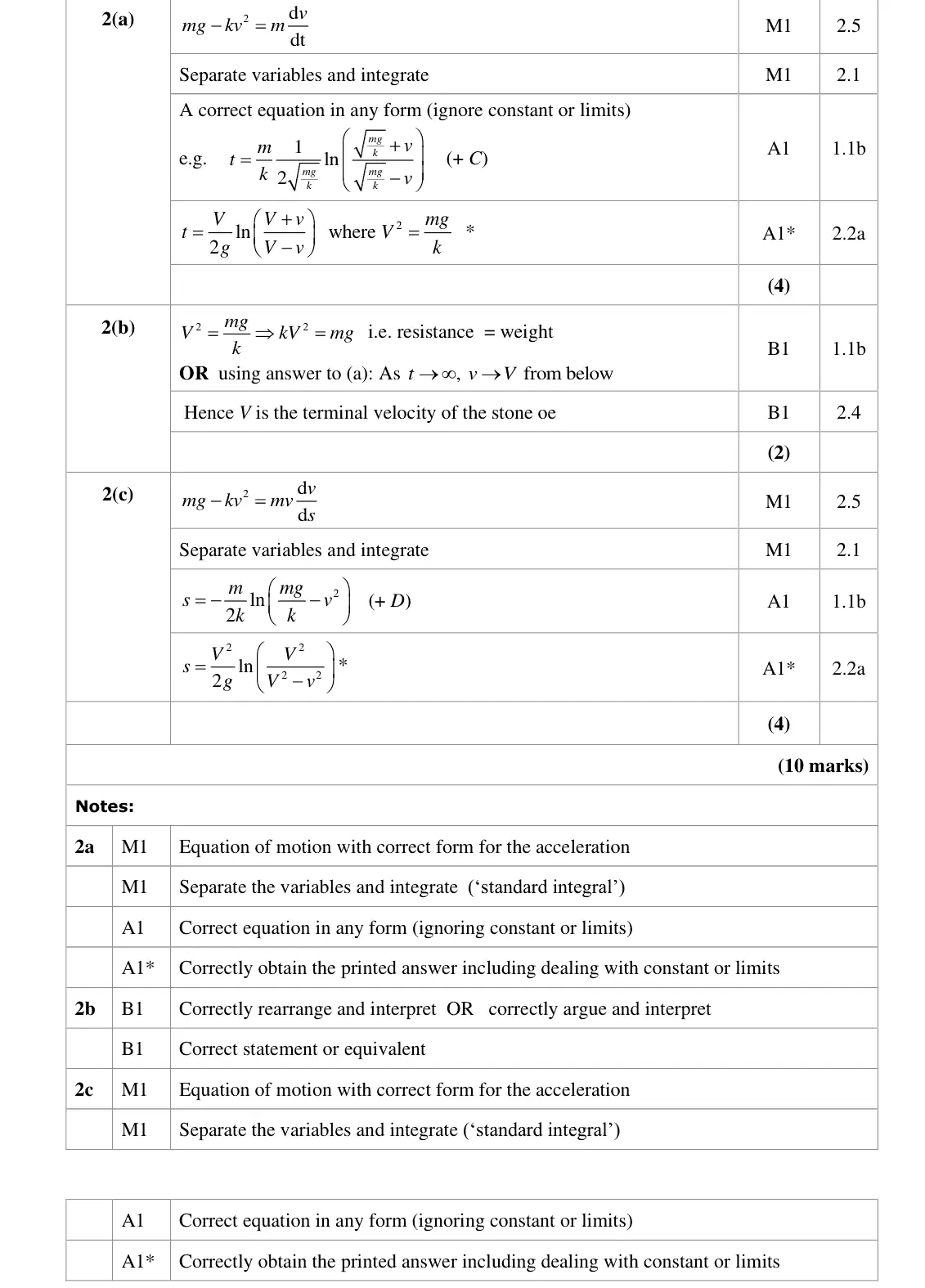
June 2025 · AS Paper 2 (Further Mechanics 2) · Q2(a)2 marks
Mark scheme (whole question; this part is marked with the orange bar)
Examiner's comment
(a) While responses to this part tended to be good, weaker responses did not correctly rearrange the equation, making errors with signs or when squaring. between 0 and 7.5, rather than use the information they had gained in part (a) to separate the calculation as outlined in the mark scheme. Weaker responses often made errors with fractions and negative signs when dealing with the integration.
Key points from the mark scheme and examiner's report
3 − √(2t + 1) = 0 gives t = 4
sign and squaring slips
June 2025 · AS Paper 2 (Further Mechanics 2) · Q2(b)3 marks
Mark scheme (whole question; this part is marked with the orange bar)
Examiner's comment
(b) While most responses made an attempt at differentiation, the fractional index and negative signs proved challenging, particularly within weaker responses. Many learners spent significant effort rearranging algebra to justify their expression being equivalent to the printed answer and a number of otherwise correct responses failed to do this without an error in their working. deceleration negative, while others used their own incorrect expression from part (b) rather than taking the opportunity to restart with the printed answer.
Key points from the mark scheme and examiner's report
differentiate: a = −(2t + 1)^(−1/2) = 1/(v − 3)
the fractional power and signs caused problems
"a =" must be seen
June 2025 · AS Paper 2 (Further Mechanics 2) · Q2(c)2 marks
Mark scheme (whole question; this part is marked with the orange bar)
Examiner's comment
(c) This part offered a good chance for some learners to restart even where their response to the previous sections was incorrect. Weaker responses frequently did not make the deceleration negative, while others used their own incorrect expression from part (b) rather
Key points from the mark scheme and examiner's report
decelerating means a = −4/3: −4/3 = 1/(v − 3) gives v = 2.25 m/s
restart with the printed answer to (b)
June 2025 · AS Paper 2 (Further Mechanics 2) · Q2(d)4 marks
Mark scheme (whole question; this part is marked with the orange bar)
Examiner's comment
(d) Although many correct responses were seen, a notable proportion chose to integrate between 0 and 7.5, rather than use the information they had gained in part (a) to separate the
Key points from the mark scheme and examiner's report
x = 3t − (1/3)(2t + 1)^(3/2)
P turns at t = 4, so split the integral at t = 4 and add the distances: 5 1/6 m
integrating straight from 0 to 7.5 gives displacement only
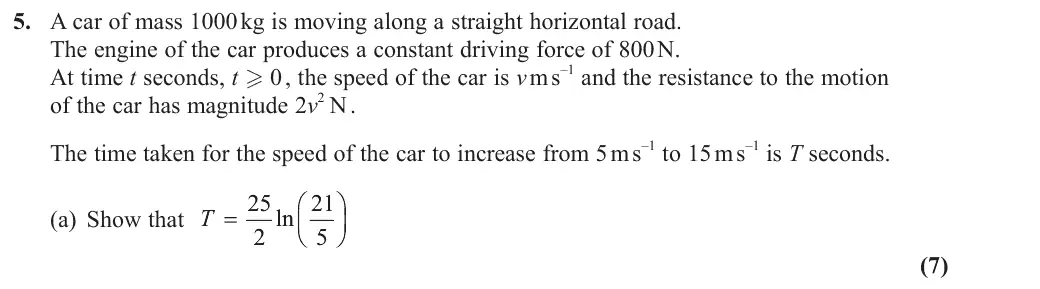
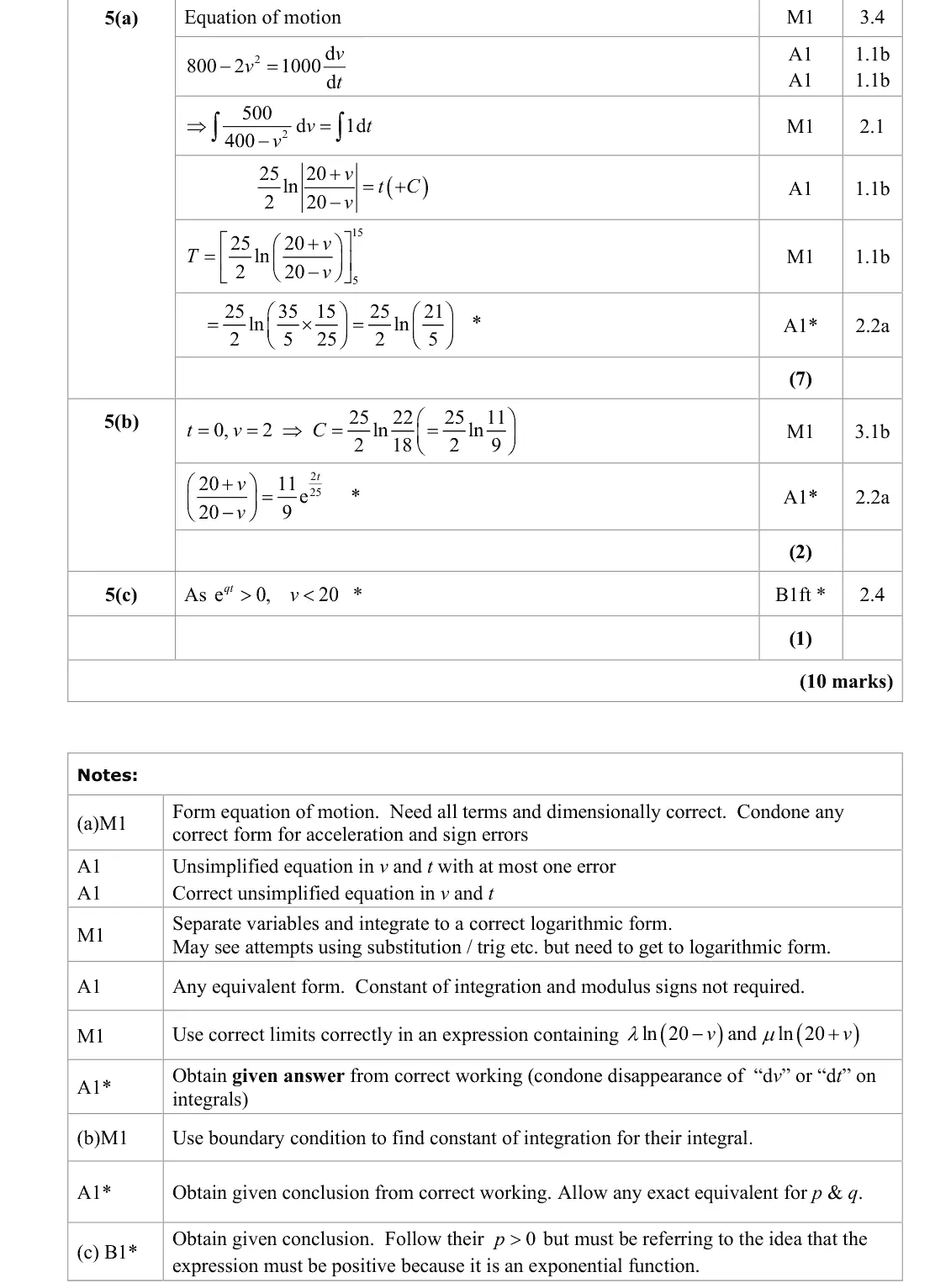
June 2025 · Paper 4C (Further Mechanics 2) · Q5(a)7 marks
Mark scheme (whole question; this part is marked with the orange bar)
Examiner's comment
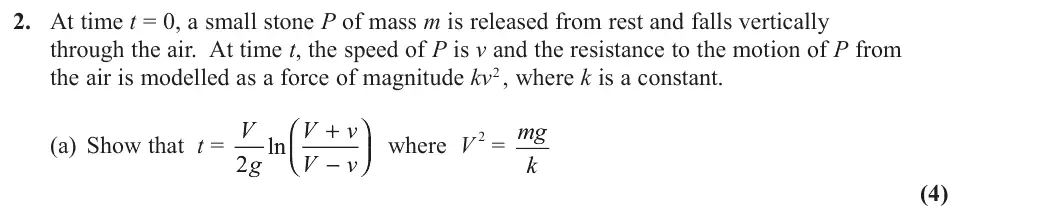
(a) Most candidates began with an equation of motion. The variation came in the integration: weaker responses struggled to separate or identify the variable to integrate. A significant proportion of candidates used substitution and/or partial fractions rather than quote a standard result, and this was often a successful if longer approach. Some otherwise strong responses made errors with fractions or when manipulating logarithms.
Key points from the mark scheme and examiner's report
1000 dv/dt = 800 − 2v²
separate ∫500/(400 − v²) dv = (25/2)ln((20 + v)/(20 − v))
limits 5 to 15 give T = (25/2)ln(21/5)
partial fractions also fine
log manipulation slips
June 2025 · Paper 4C (Further Mechanics 2) · Q5(b)2 marks
Mark scheme (whole question; this part is marked with the orange bar)
Examiner's comment
(b) Stronger responses proceeded as per the mark scheme although a number did not include the coefficient of the logarithm in their working so arrived at an incorrect value for p. Weaker responses tried to use the printed form and substitute to calculate q but this received no credit.
Key points from the mark scheme and examiner's report
v = 2 at t = 0 gives C = (25/2)ln(11/9)
(20 + v)/(20 − v) = (11/9)e^(2t/25), so p = 11/9, q = 2/25
keep the 25/2 coefficient
June 2025 · Paper 4C (Further Mechanics 2) · Q5(c)1 mark
Mark scheme (whole question; this part is marked with the orange bar)
Examiner's comment
(c) Several good responses answered as given in the mark scheme or went through a process of eliminating v = 20 and v > 20 to reach a correct conclusion. Weaker responses focused on either the denominator (v ≠ 20) or considered “terminal velocity” situations / the limit as t → ∞.
Key points from the mark scheme and examiner's report
the exponential is always positive so (20 + v)/(20 − v) > 0 and v < 20
arguments about terminal speed or the limit as t → ∞ do not score
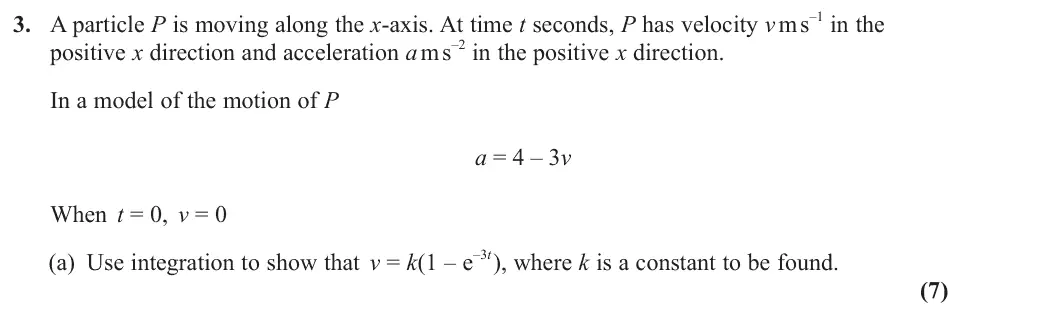
June 2024 · AS Paper 2 (Further Mechanics 2) · Q3(a)7 marks
Mark scheme (whole question; this part is marked with the orange bar)
Examiner's comment
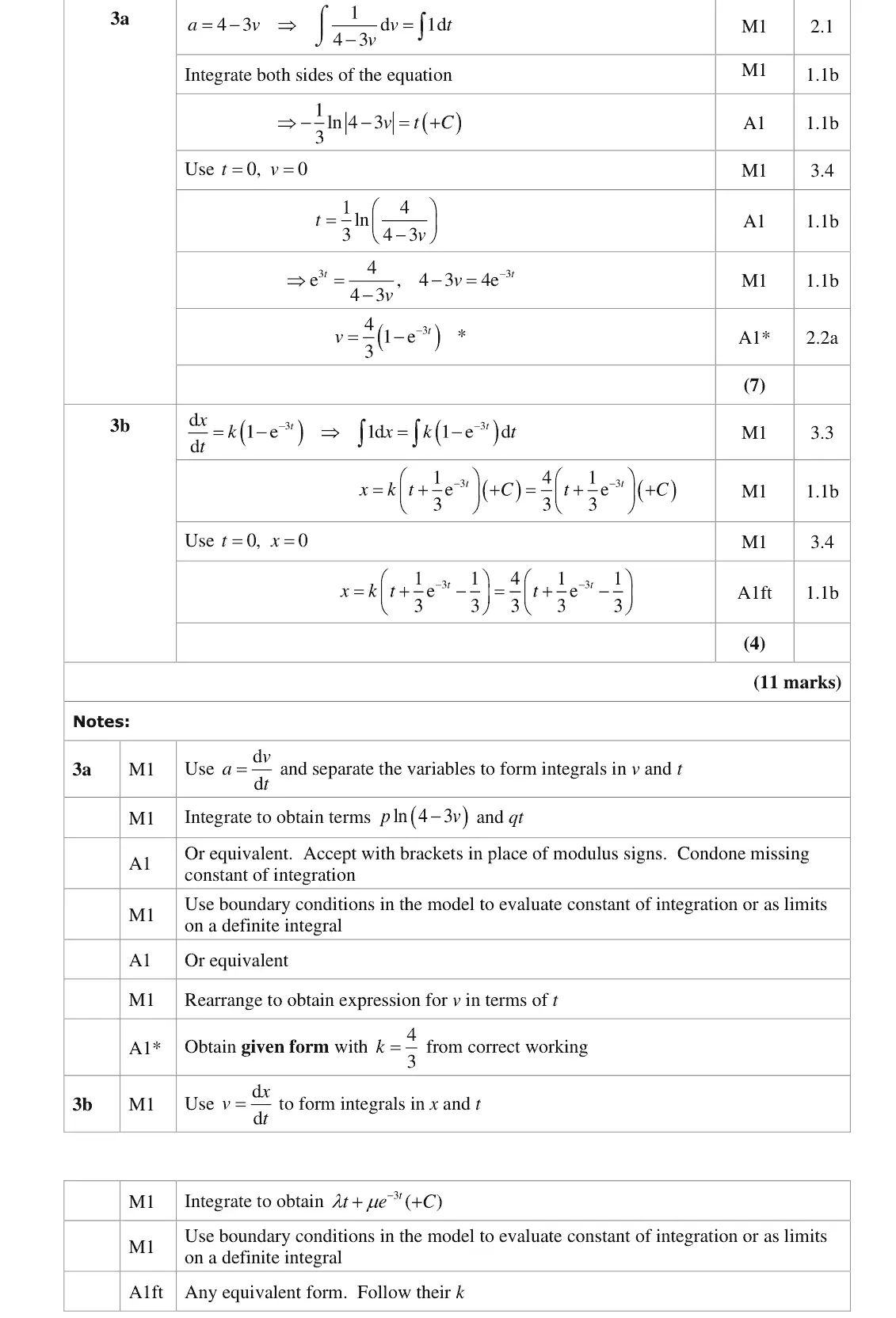
(a) A significant minority of candidates were unable to separate the variables, instead simply trying to integrate 4 – 3v with respect to v in order to find the velocity. For those that adopted the correct approach it was pleasing to see most remember the constant of integration and the algebraic working was generally good if occasionally inefficient. However, a number of candidates made sign errors in their working which they later recovered, and this was penalised via the final mark as the question gave a printed answer.
Key points from the mark scheme and examiner's report
separate variables ∫dv/(4 − 3v) = ∫dt (not integrating 4 − 3v with respect to v)
−(1/3) ln(4 − 3v) = t + C, v = 0 at t = 0
k = 4/3
sign slips recovered lose the final mark
June 2024 · AS Paper 2 (Further Mechanics 2) · Q3(b)4 marks
Mark scheme (whole question; this part is marked with the orange bar)
Examiner's comment
(b) Many candidates answered this part well, including those with an incorrect k. A significant number either did not find a constant of integration or did so using incorrect values of t and x.
Key points from the mark scheme and examiner's report
integrate v = dx/dt: x = (4/3)(t + (1/3)e^(−3t) − 1/3)
constant from x = 0 at t = 0 often omitted or wrongly found
June 2024 · Paper 4C (Further Mechanics 2) · Q1(a)4 marks
Mark scheme (whole question; this part is marked with the orange bar)
Examiner's comment
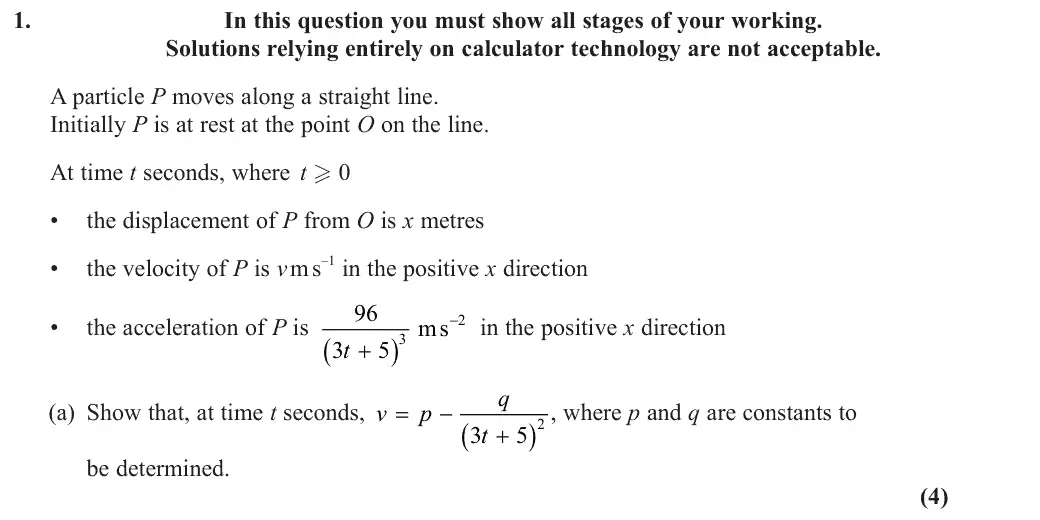
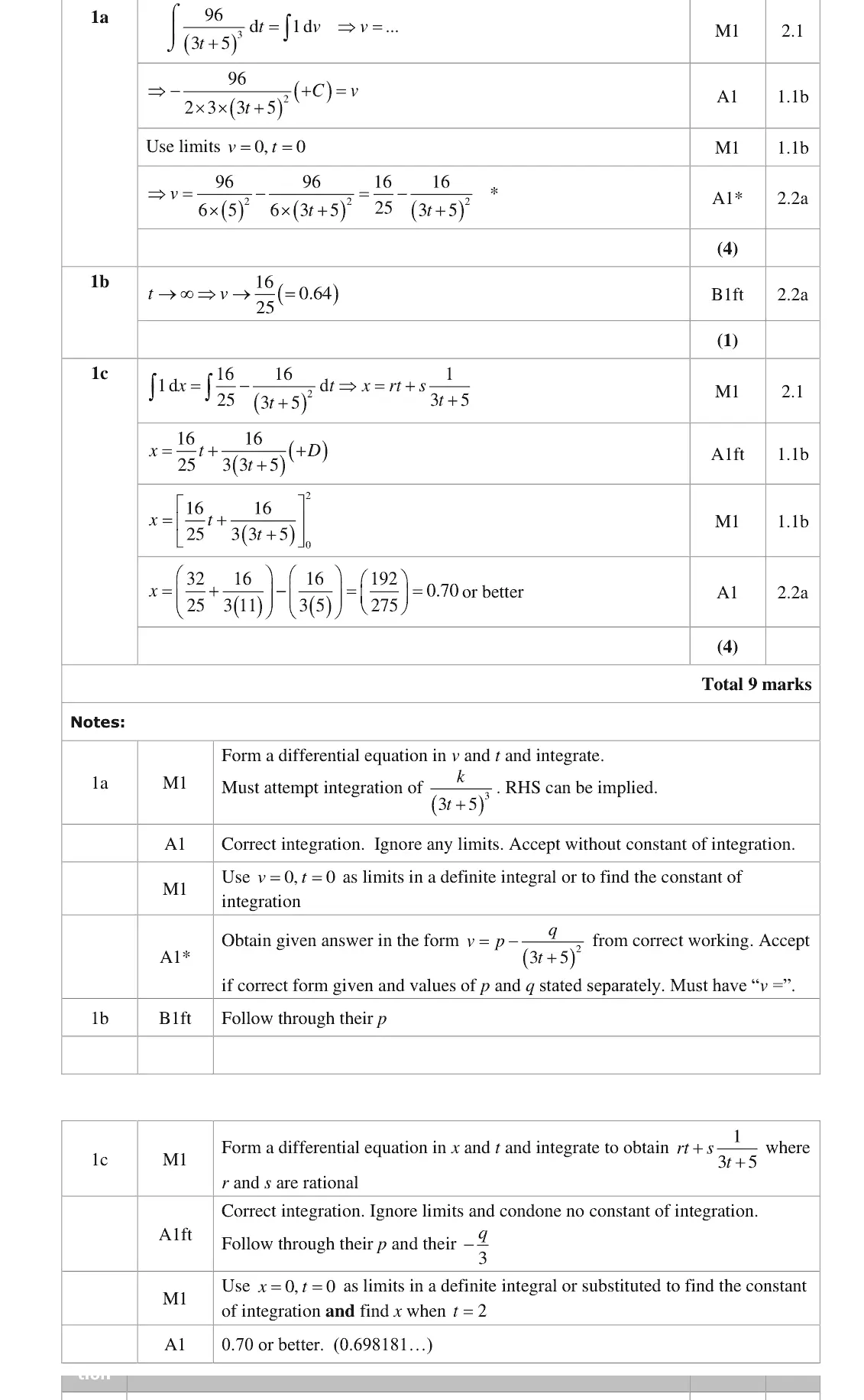
(a) This was generally well attempted with the minority forming a correct initial equation but a significant minority struggled with the integration, either multiplying by 3 (instead of dividing) or by differentiating instead.
Key points from the mark scheme and examiner's report
integrate 96(3t + 5)⁻³ with respect to t (divide by 3, do not multiply or differentiate)
v = 0 at t = 0 gives v = 16/25 − 16/(3t + 5)², so p = 16/25, q = 16
June 2024 · Paper 4C (Further Mechanics 2) · Q1(b)1 mark
Mark scheme (whole question; this part is marked with the orange bar)
Examiner's comment
(b) Pleasingly the vast majority who attempted this used their constant from the first part with only a small number of candidates attempting some unrelated work.
Key points from the mark scheme and examiner's report
as t → ∞, v → p = 16/25 = 0.64 m s⁻¹
June 2024 · Paper 4C (Further Mechanics 2) · Q1(c)4 marks
Mark scheme (whole question; this part is marked with the orange bar)
Examiner's comment
(c) Although the vast majority made a good start to this part, work with fractions and negative signs caused some difficulties for some. A significant minority of candidates incorrectly claimed without substitution that the initial conditions would give a constant of integration of zero, and this resulted in losing both of the final two marks.
Key points from the mark scheme and examiner's report
x = (16/25)t + 16/(3(3t + 5)) + D
must use x = 0 at t = 0 (the constant is not zero)
x = 192/275 ≈ 0.70 m
June 2023 · AS Paper 2 (Further Mechanics 2) · Q2(a)4 marks
Mark scheme (whole question; this part is marked with the orange bar)
Examiner's comment
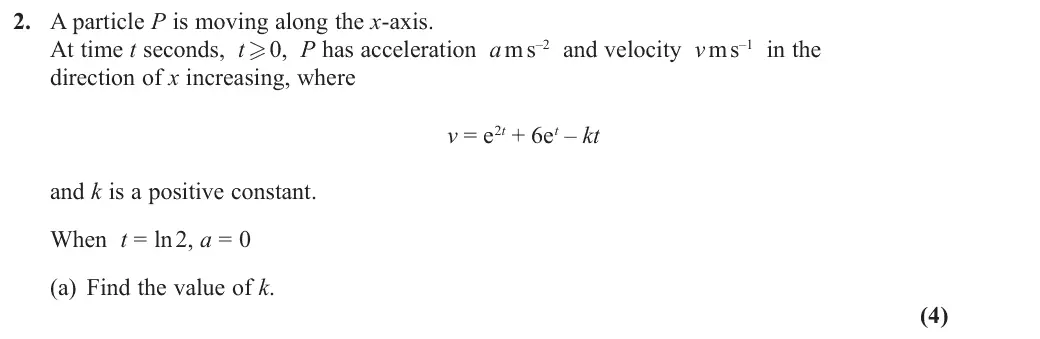
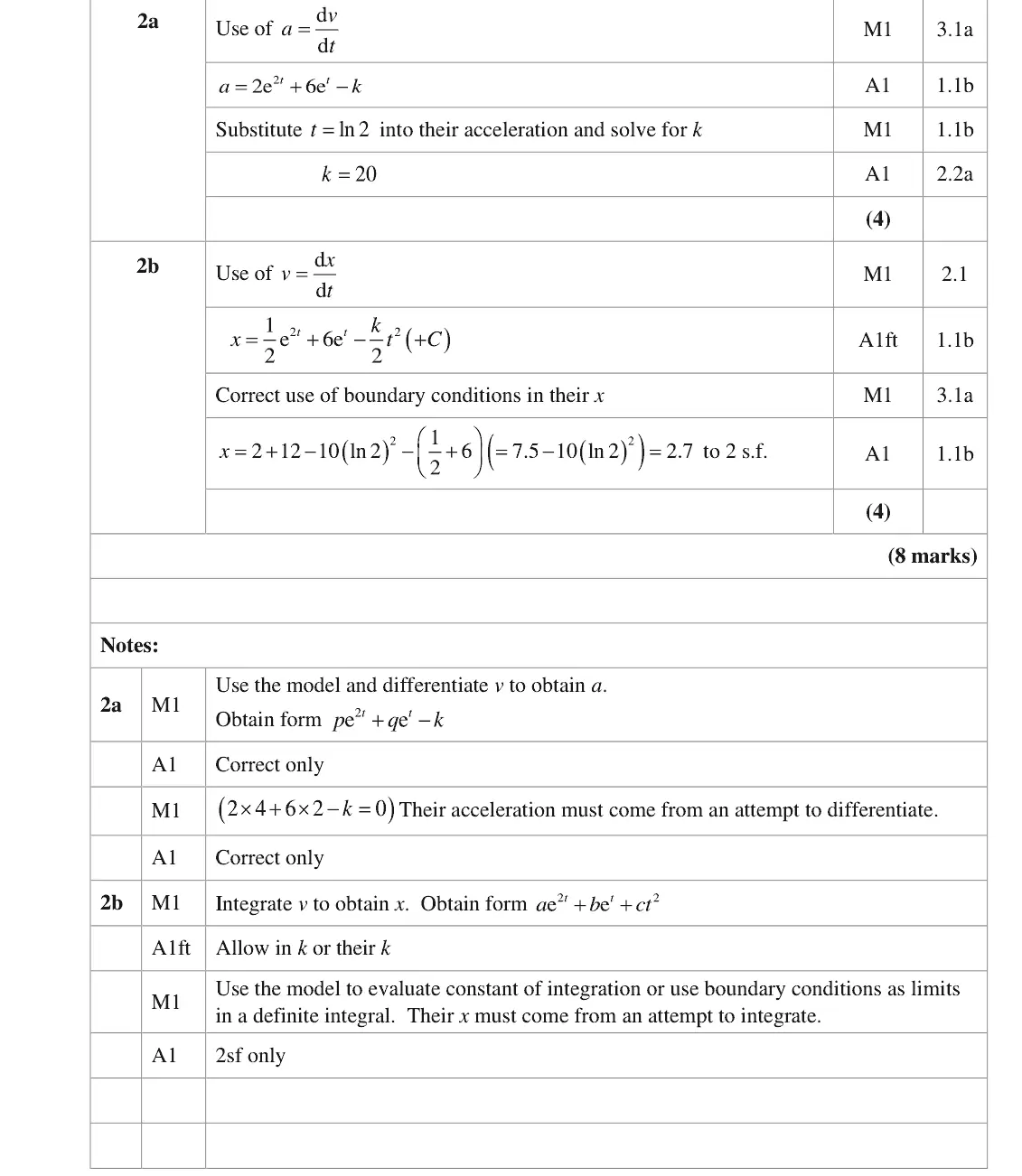
There were more candidates than usual who tried to use the suvat equations to solve this problem about variable acceleration. Many candidates coped well with the differentiation and integration of the exponential functions. The difficulties arose in the t = 2e . t The question asks for the ln 2, substitution of particularly in finding the value of
Key points from the mark scheme and examiner's report
a = dv/dt = 2e^(2t) + 6e^t − k (not suvat)
at t = ln 2: 8 + 12 − k = 0 so k = 20
June 2023 · AS Paper 2 (Further Mechanics 2) · Q2(b)4 marks
Mark scheme (whole question; this part is marked with the orange bar)
Examiner's comment
final answer to part (b) to be given to 2 significant figures – over-specified answers were penalised.
Key points from the mark scheme and examiner's report
integrate v: x = (1/2)e^(2t) + 6e^t − (k/2)t² + C
x = 0 at t = 0 (C = −6.5)
d = 7.5 − 10(ln 2)² = 2.7 to 2 s.f. (over-specified answers penalised)
show the stages
June 2023 · Paper 4C (Further Mechanics 2) · Q2(a)4 marks
Mark scheme (whole question; this part is marked with the orange bar)
Examiner's comment
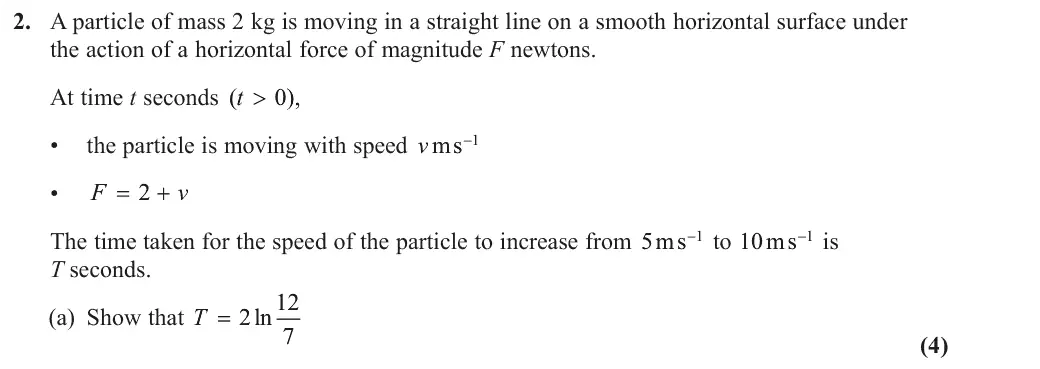
(a) Almost all of the candidates started with a correct differential equation in v and t, although a small minority omitted the mass of the particle. The majority of candidates went on to separate the variables correctly, integrate and use limits to achieve the given answer. A small number used alternative methods such as the use of an integrating factor to solve the differential equation.
Key points from the mark scheme and examiner's report
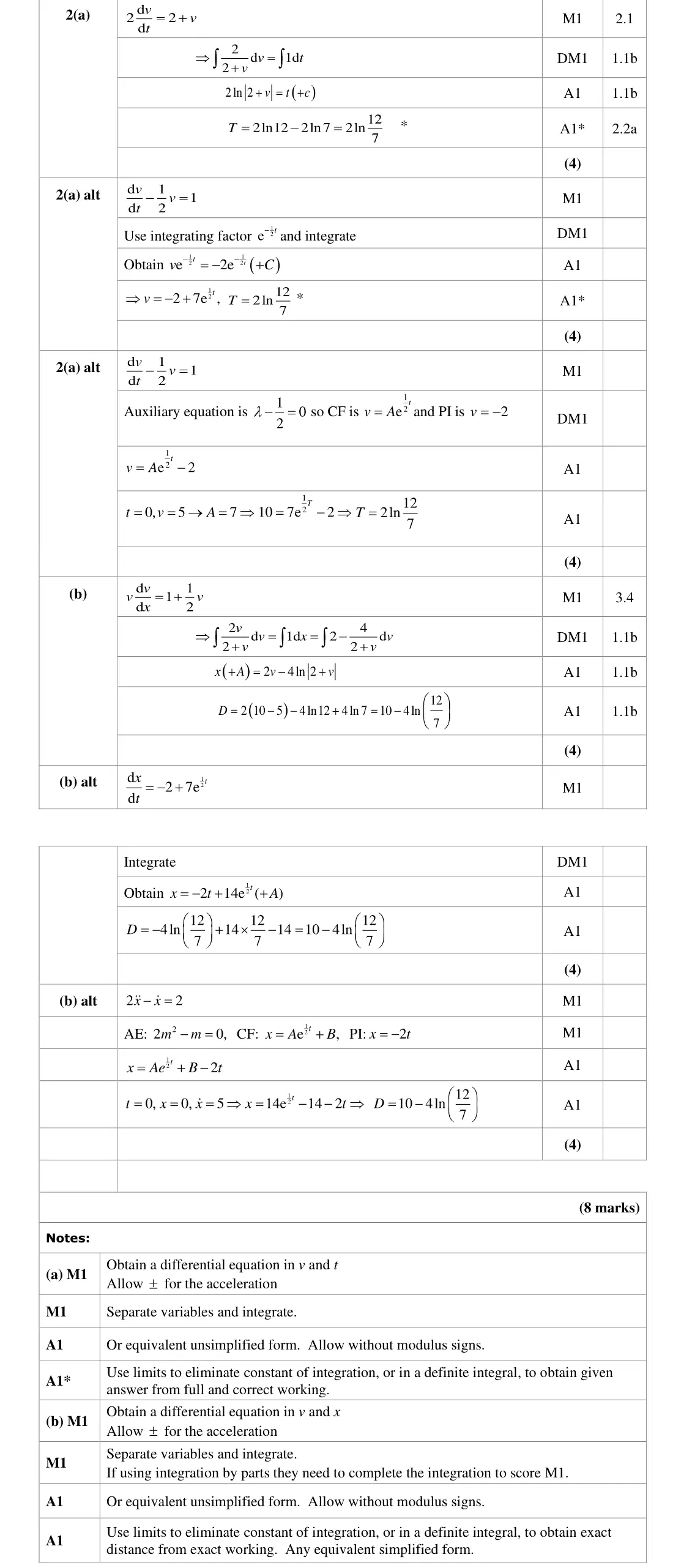
2 dv/dt = 2 + v (mass must be included)
separate: 2ln(2 + v) = t + c
limits v = 5 to 10 give T = 2ln(12/7)
integrating factor or auxiliary-equation methods also accepted
June 2023 · Paper 4C (Further Mechanics 2) · Q2(b)4 marks
Mark scheme (whole question; this part is marked with the orange bar)
Examiner's comment
(b) Most candidates started by writing acceleration as d d v v x to achieve a correct differential equation in v and x. They went on to separate the variables, but 2 d 2 v v v + proved challenging for a significant number of candidates. Those who rewrote the fraction as 4 2 4 2 v v + - + or who used the substitution 2 u v = + usually went on to obtain the correct value of D. Those candidates who attempted to use integration by parts were often unable to complete the integration correctly – those who remembered how to complete ( ) ln 2 d v v + usually obtained the correct solution. A small number integrated the formula for the velocity from part(a), which worked well. A small minority of candidates tried to make inappropriate use of suvat equations to answer this question.
Key points from the mark scheme and examiner's report
June 2022 · AS Paper 2 (Further Mechanics 2) · Q4(a)2 marks
Mark scheme (whole question; this part is marked with the orange bar)
Examiner's comment
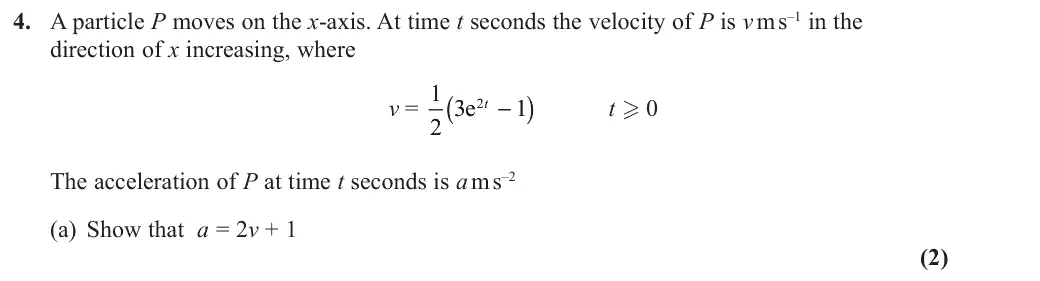
(a) A few candidates did not appear to know how to differentiate an exponential function d . v (see 8MA0 sections 6.2 and 7.1), but the majority understood that The main a = d t difficulty was that the question is a “show that..” question, so the solution needs a clear sequence + or an appropriate concluding statement. A few solutions did ... ... 2 1 a v = = = not mention v at all.
Key points from the mark scheme and examiner's report
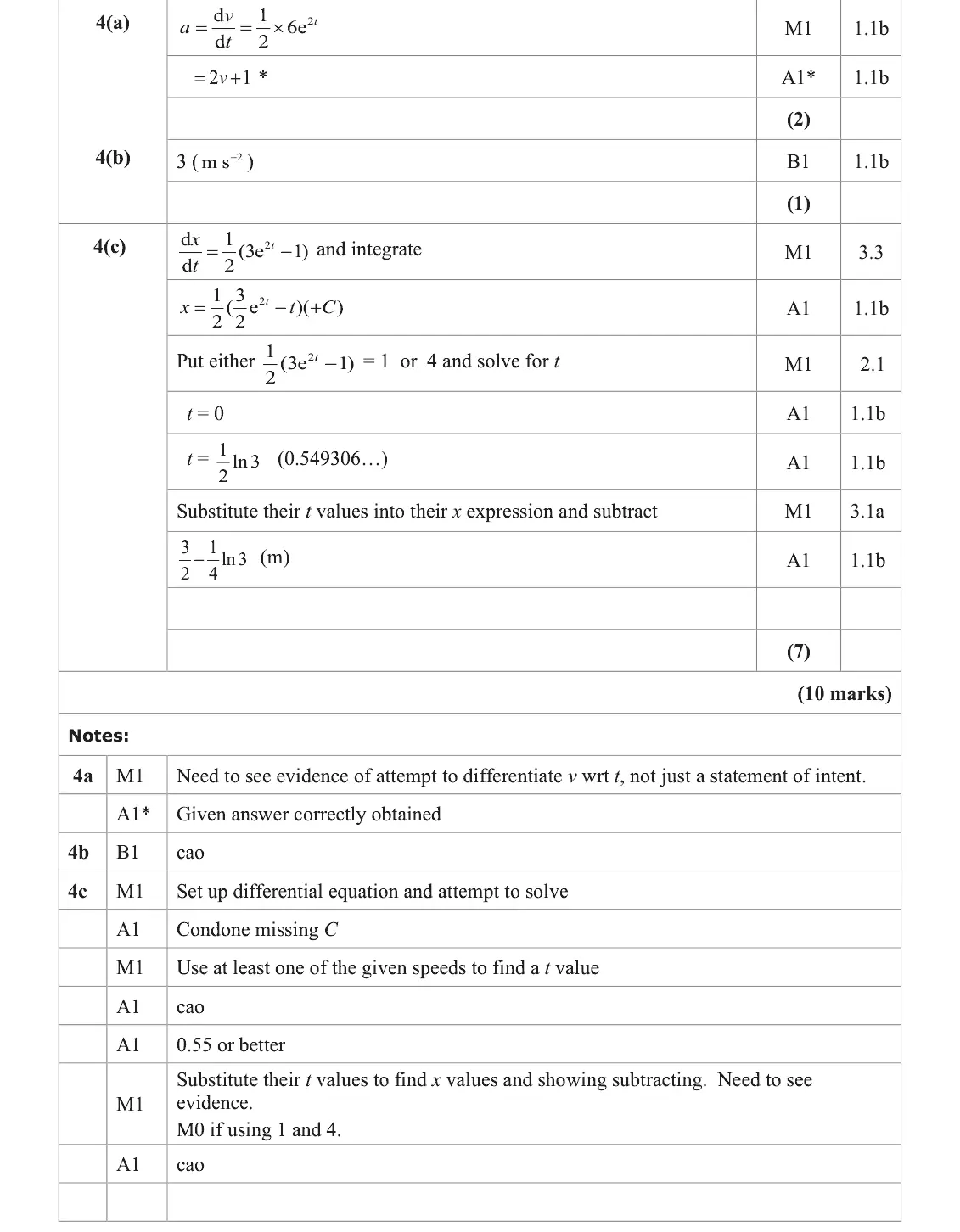
differentiate: a = 3e^(2t) = 2v + 1
show the link to v clearly in a "show that"
June 2022 · AS Paper 2 (Further Mechanics 2) · Q4(b)1 mark
Mark scheme (whole question; this part is marked with the orange bar)
Examiner's comment
(b) Almost all candidates gave the correct solution.
Key points from the mark scheme and examiner's report
3 m s⁻²
June 2022 · AS Paper 2 (Further Mechanics 2) · Q4(c)7 marks
Mark scheme (whole question; this part is marked with the orange bar)
Examiner's comment
(c) Several candidates set up an appropriate differential equation and attempted to integrate. There were some who could not integrate exponential functions, but the most common mistake was to use incorrect limits. The majority of candidates used 1 and 4 as their limits for t instead of using v = and to find the limits for t. The substitution 1 4 v = of the correct limits into their integral was not always correct – some forgot to use the lower limit and others could not manipulate exponentials and logarithms. The question asked for an exact value, so a decimal approximation was not acceptable.
Key points from the mark scheme and examiner's report
integrate dx/dt = (1/2)(3e^(2t) − 1)
find limits t = 0 and t = (1/2) ln 3 from v = 1 and v = 4 (using 1 and 4 as t limits is the common error)
exact 3/2 − (1/4) ln 3 m
June 2022 · Paper 4C (Further Mechanics 2) · Q2(a)4 marks
Mark scheme (whole question; this part is marked with the orange bar)
Examiner's comment
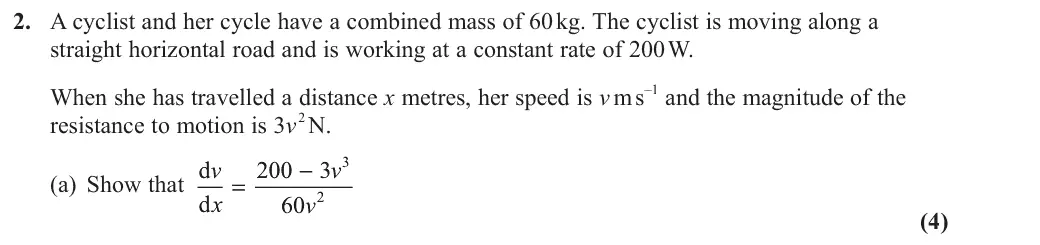
(a) This was another question that most candidates approached with confidence. They combined an expression for the driving force (obtained from the given rate of working) with a correct equation of motion to obtain the given differential equation. The most common route was to form the equation of motion in terms of a or d d v t and then substitute d d v v x , with many showing use of the chain rule to justify this step. The most common error was to use 200 as a force in the equation of motion.
Key points from the mark scheme and examiner's report
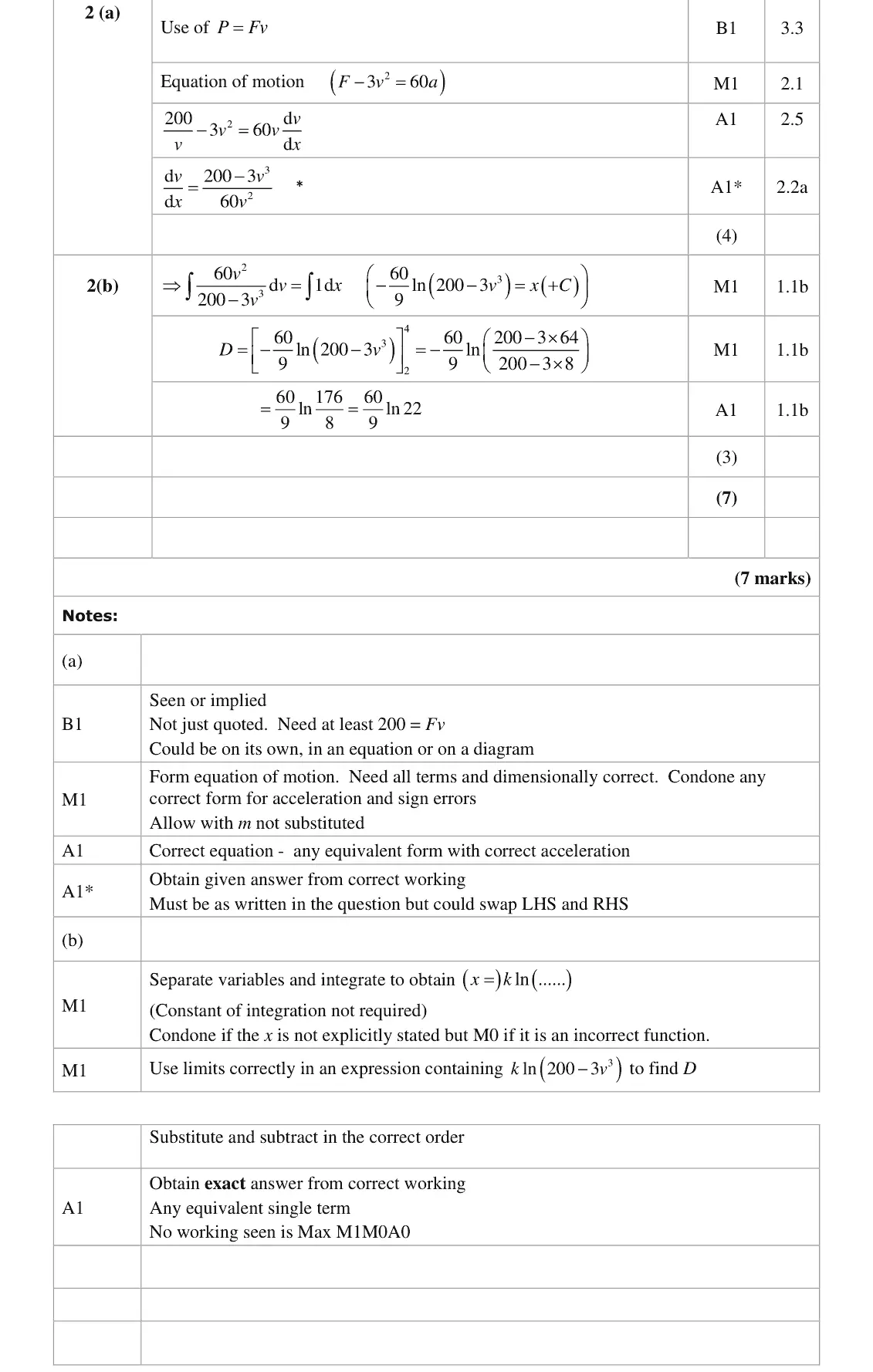
driving force 200/v from P = Fv
200/v − 3v² = 60v dv/dx
commonest error using 200 as a force
show a = v dv/dx
June 2022 · Paper 4C (Further Mechanics 2) · Q2(b)3 marks
Mark scheme (whole question; this part is marked with the orange bar)
Examiner's comment
(b) The majority of candidates went on to separate the variables and integrate the differential equation. Most candidates recognised the form of the integral, but there were a few sign errors. There were a small number of candidates who did not recognise that the equation was separable or had the fraction the wrong way up after separating the variables.
Key points from the mark scheme and examiner's report
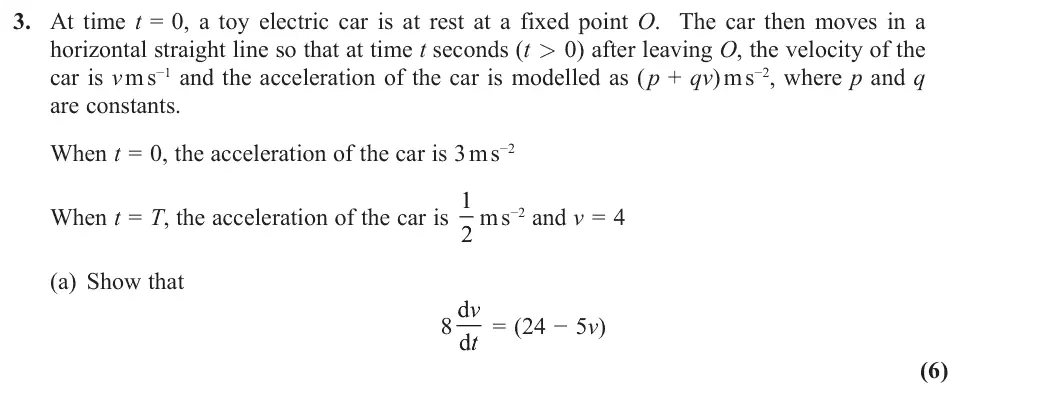
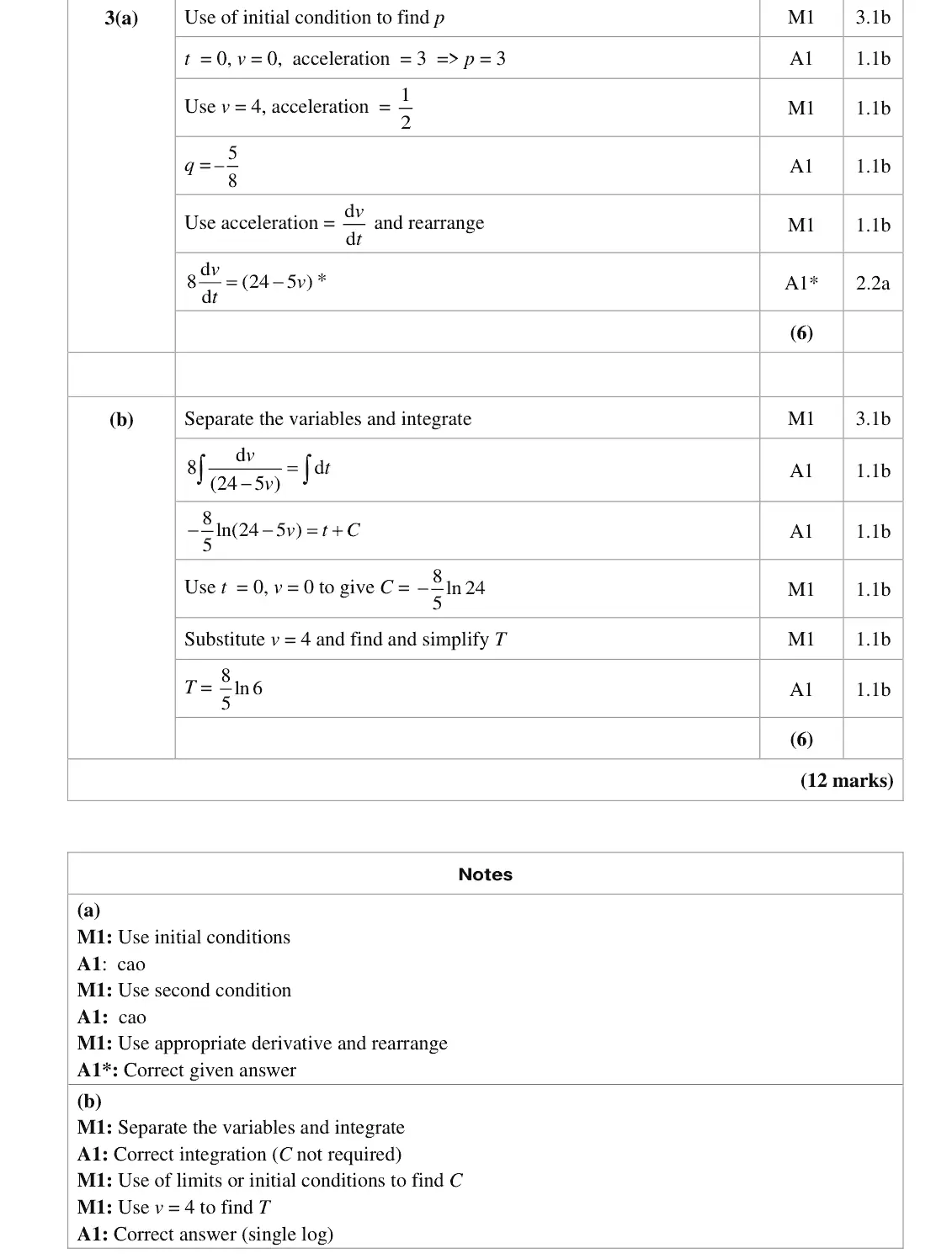
Oct 2020 · AS Paper 2 (Further Mechanics 2) · Q3(b)6 marks
Mark scheme (whole question; this part is marked with the orange bar)
Key points from the mark scheme and examiner's report
separate variables: −(8/5) ln(24 − 5v) = t + C
C from t = 0, v = 0
v = 4 gives T = (8/5) ln 6 as a single log
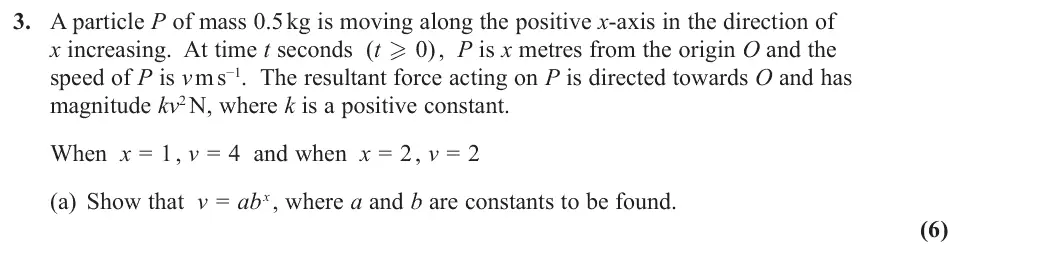
Oct 2020 · Paper 4C (Further Mechanics 2) · Q3(a)6 marks
Mark scheme (whole question; this part is marked with the orange bar)
Key points from the mark scheme and examiner's report
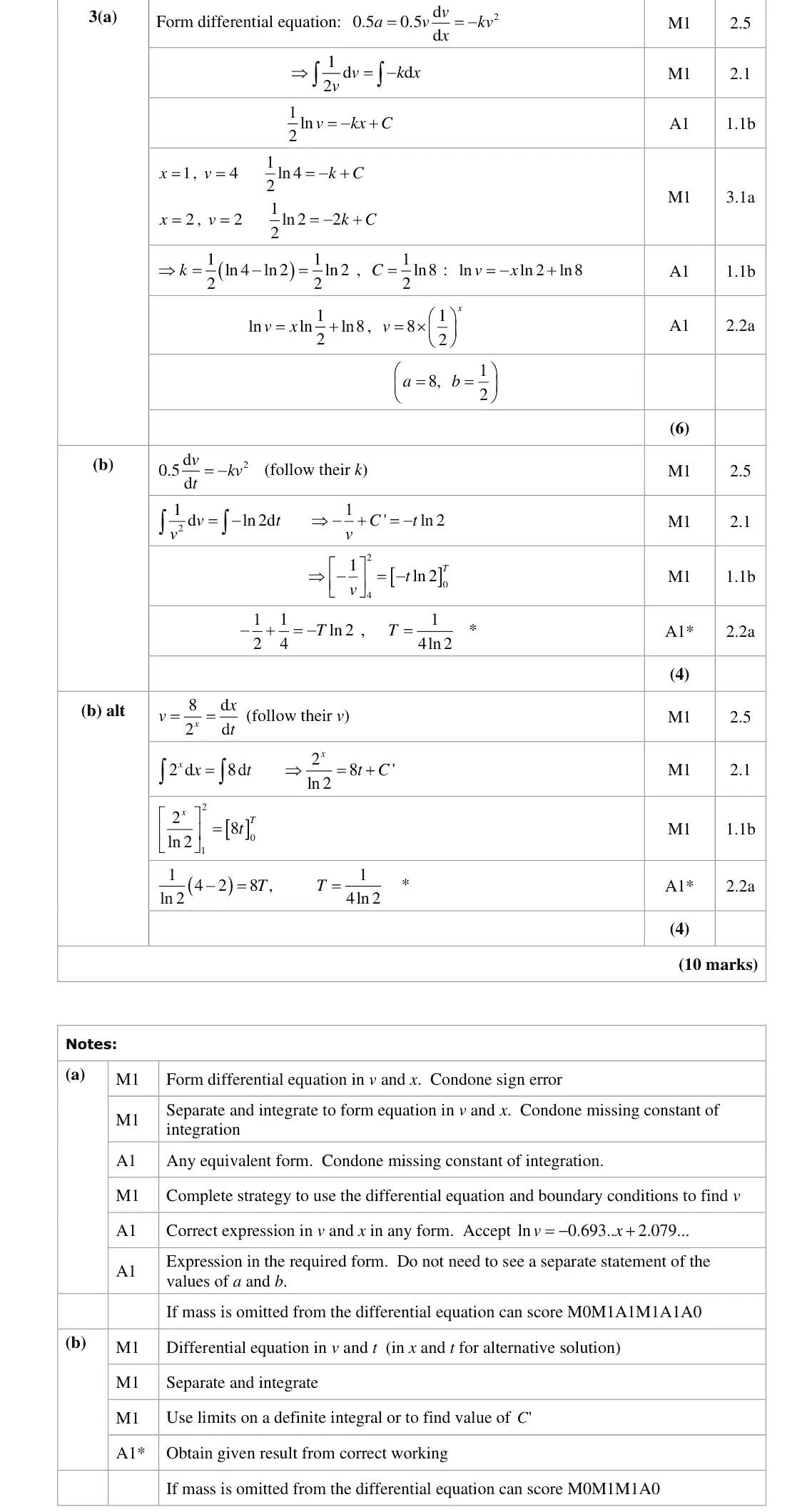
0.5v dv/dx = −kv² (mass must be included, force towards O so negative)
½ln v = −kx + C, k = ½ln 2
v = 8(½)^x so a = 8, b = ½
Oct 2020 · Paper 4C (Further Mechanics 2) · Q3(b)4 marks
Mark scheme (whole question; this part is marked with the orange bar)
Key points from the mark scheme and examiner's report
0.5 dv/dt = −kv² with their k, integrate 1/v² and use limits v = 4 to 2
alternative dx/dt = 8/2^x from 1 to 2
T = 1/(4ln 2)
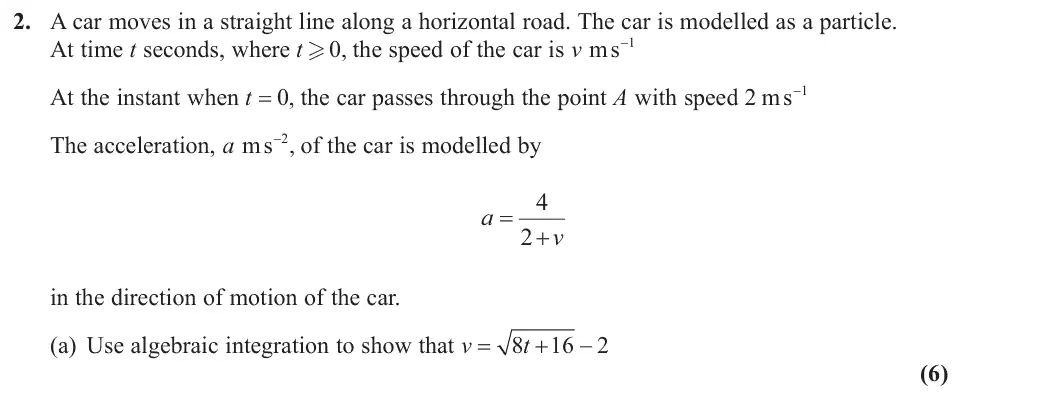
June 2019 · AS Paper 2 (Further Mechanics 2) · Q2(a)6 marksMedium
Mark scheme (whole question; this part is marked with the orange bar)
Examiner's comment
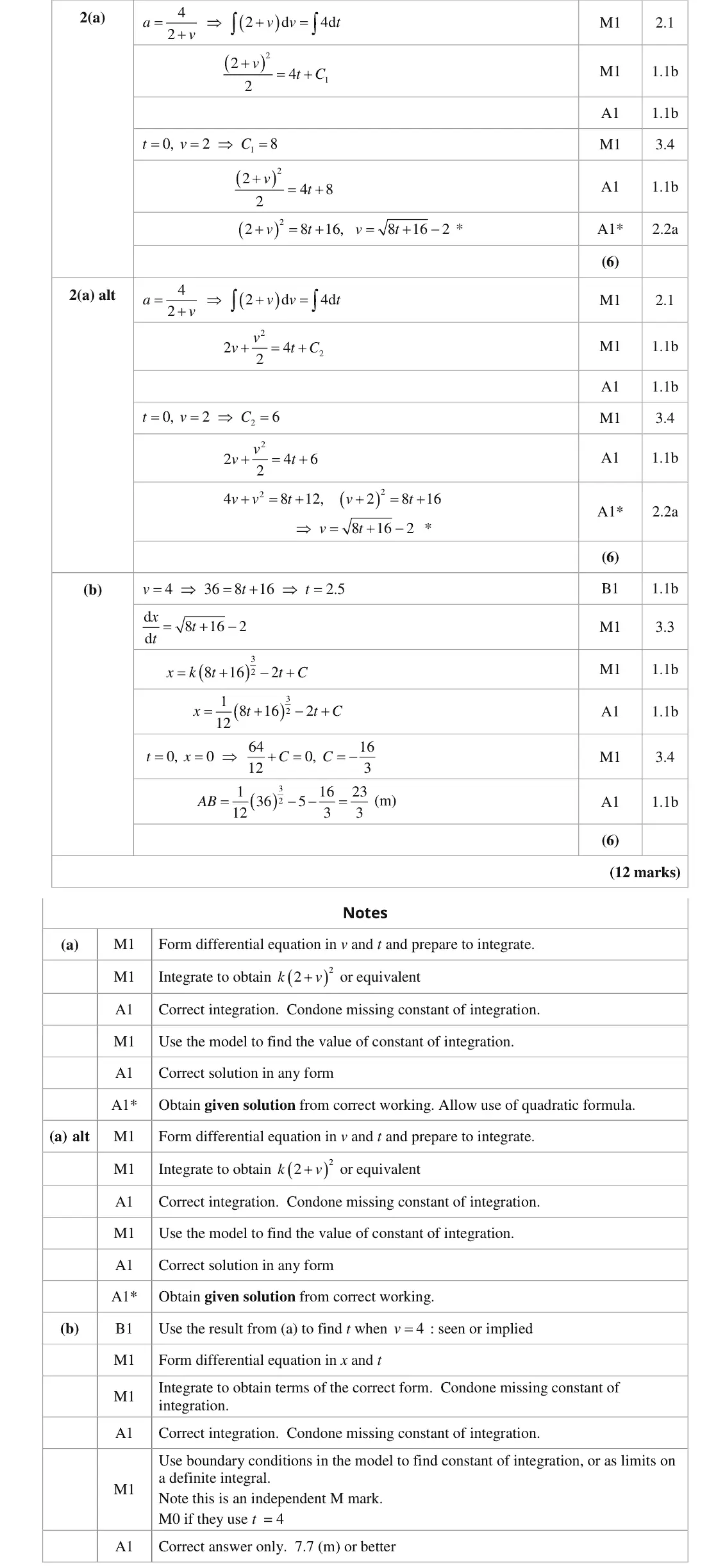
Although 18.5% of the candidates scored full marks for this question, some candidates, in Q02(a), had no idea how to separate variables and ended up with (2 + v) in the denominator and consequently with ln (2 + v) after integrating. Once variables had been separated correctly, the second method on the scheme was the favoured option, with very few forgetting the constant of integration. Rearranging the solution to the given form proved to be a challenge for some, with candidates not appreciating that they had
Key points from the mark scheme and examiner's report
separate variables: ∫(2 + v) dv = ∫4 dt, not (2 + v) in the denominator
v = 2 at t = 0 gives the constant
complete the square to reach v = √(8t + 16) − 2
June 2019 · AS Paper 2 (Further Mechanics 2) · Q2(b)6 marks
Mark scheme (whole question; this part is marked with the orange bar)
Examiner's comment
to complete the square. A few used the quadratic formula successfully. The second part proved to be more difficult with one common mistake being the omission of 8 in the denominator of the integral. A number of candidates square rooted the 8t and 16 and integrated term by term. Many did not realise that they had to use v = 4 to find t and instead used t = 4 as their upper limit losing marks. A few just wrote down the answer, not showing any algebraic integration. Some who used definite integration with the correct limits assumed that when t = 0 the value of the expression was zero.
Key points from the mark scheme and examiner's report
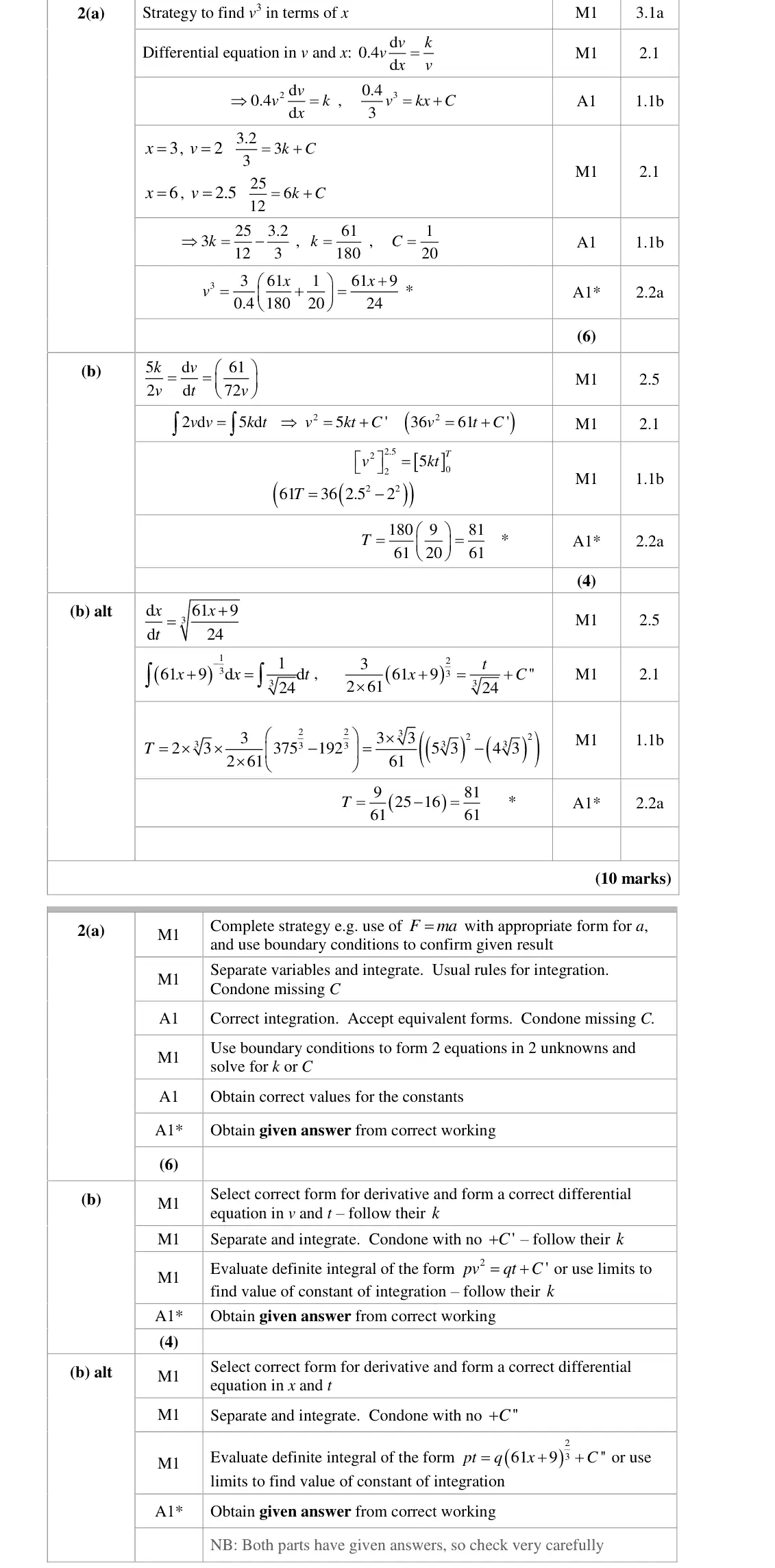
June 2019 · Paper 4C (Further Mechanics 2) · Q2(a)6 marks
Mark scheme (whole question; this part is marked with the orange bar)
Examiner's comment
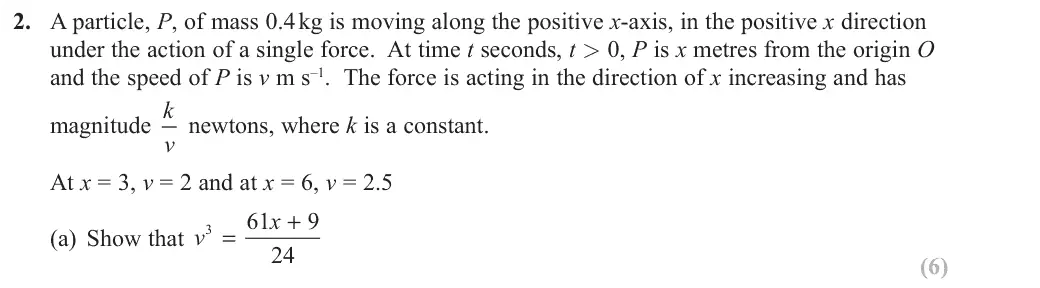
(a) Most candidates set up a correct differential equation in v and x, separated the variables and integrated correctly. This was a “show that…” question, so we needed to see the use of the boundary conditions to find the value of k and of the constant if integration. Many candidates did reach the given result correctly. Several candidates claimed to have reached the given result despite arithmetic slips in their working. from part (a) to form a differential equation in x and t. The latter group of candidates made several errors with the indices and with the coefficients in the integral.
Key points from the mark scheme and examiner's report
0.4v dv/dx = k/v, separate to 0.4v³/3 = kx + C
use both boundary conditions to find k = 61/180 and C = 1/20
given answer so arithmetic must be shown, slips claimed through
June 2019 · Paper 4C (Further Mechanics 2) · Q2(b)4 marks
Mark scheme (whole question; this part is marked with the orange bar)
Examiner's comment
(b) Most candidates did follow the instruction to use algebraic integration, but there were some who simply wrote down an integral followed by the given answer. There were two possible approaches: those candidates who went back to the initial information and formed a differential equation in v and t had an easier integral to complete than those candidates who used the result from part (a) to form a differential equation in x and t. The latter group of candidates made
Key points from the mark scheme and examiner's report
must use algebraic integration
easier route 0.4 dv/dt = k/v giving v² = 5kt + C
via dx/dt = cube root of (61x + 9)/24 is harder and caused index/coefficient errors
writing an integral then the answer scores little
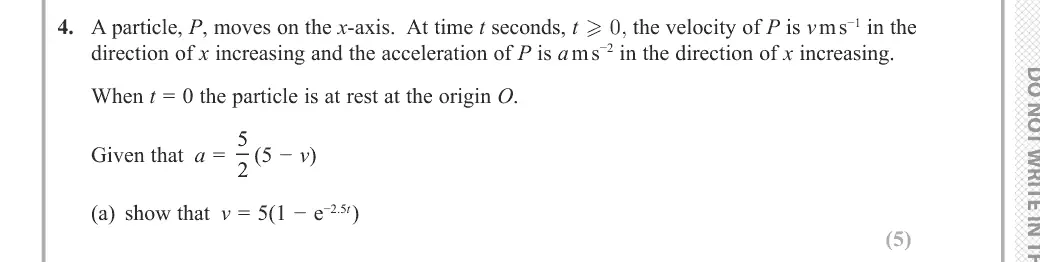
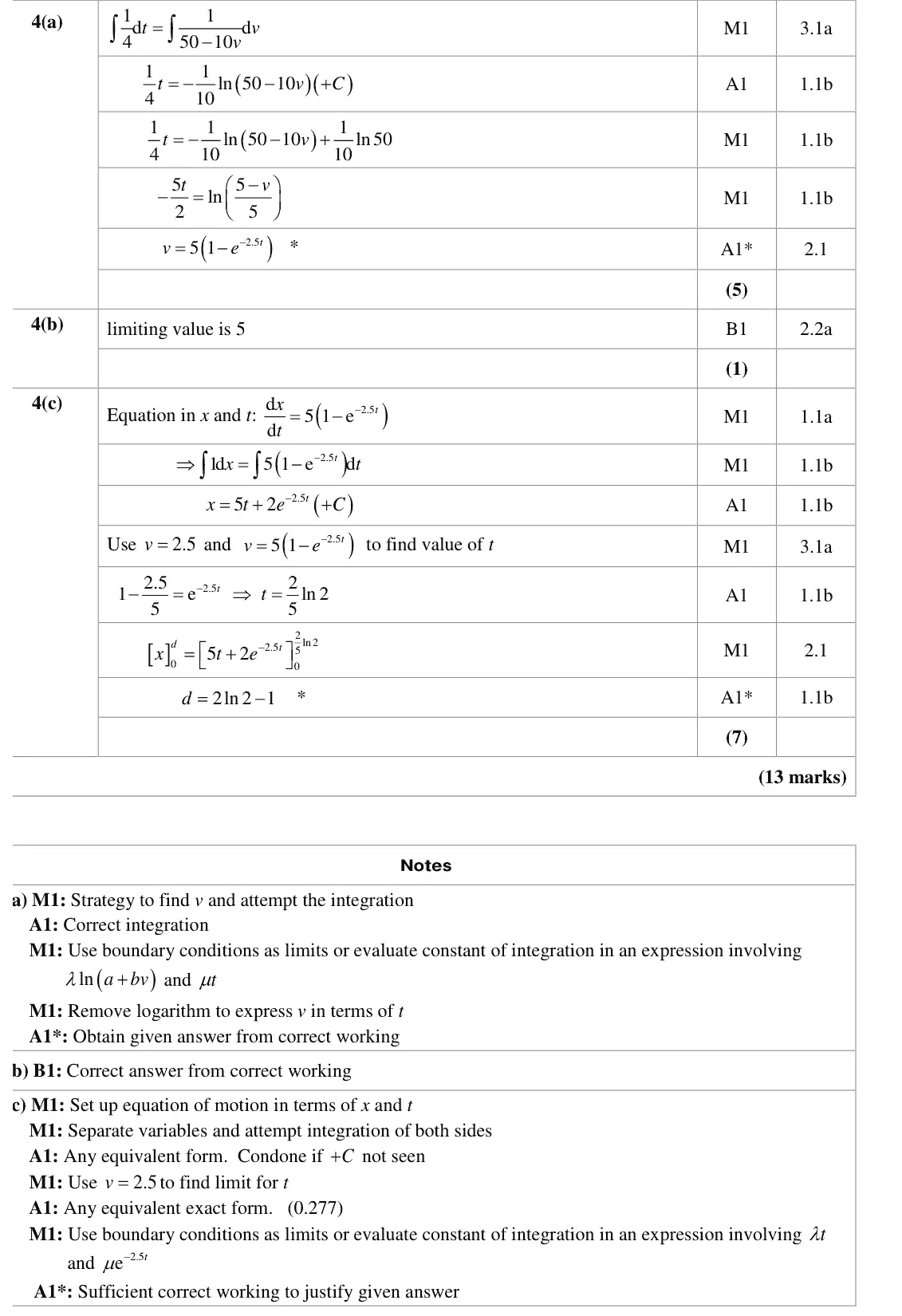
June 2018 · AS Paper 2 (Further Mechanics 2) · Q4(a)5 marks
Mark scheme (whole question; this part is marked with the orange bar)
Examiner's comment
(a) The stronger students completed this with no difficulty. The lack of mathematical experience of the majority was very evident; this question required separation of variables, recognition of the form of the integral and conversion from logarithms to exponentials. Several students did reach the given answer, but they worked through the manipulation of the equations in a very laborious manner.
Key points from the mark scheme and examiner's report
separate variables in dv/dt = (5/2)(5 − v)
ln integral, use v = 0 at t = 0, then remove the logarithm to get v = 5(1 − e^(−2.5t))
laborious manipulation common
June 2018 · AS Paper 2 (Further Mechanics 2) · Q4(b)1 mark
Mark scheme (whole question; this part is marked with the orange bar)
Examiner's comment
(b) This question was effectively a test of whether the students knew about the behaviour of 2.5 e t for large values of t. For many students this was an easy mark, but some talked about a maximum value, rather than the limiting value.
Key points from the mark scheme and examiner's report
limiting value 5 (m/s)
some described a maximum rather than a limiting value
June 2018 · AS Paper 2 (Further Mechanics 2) · Q4(c)7 marks
Mark scheme (whole question; this part is marked with the orange bar)
Examiner's comment
(c) This should have been the easier of the two integrals, but many students did not make the link between v and d d x t . If they did get to the correct integral then the task was not that complex. Independently of the integration, many students did find the correct value of t for v = 2.5. Again, lack of experience showed in the large number of values left as 2 1 ln 5 2 t . Substituting to obtain the given form was a challenge - many students could only do it with the assistance of a calculator.
Key points from the mark scheme and examiner's report
integrate v = dx/dt = 5(1 − e^(−2.5t)) to x = 5t + 2e^(−2.5t) + C
v = 2.5 gives t = (2/5) ln 2
many missed the link v = dx/dt
exact substitution needed, not calculator values
Find an Edexcel Further Maths tutor
Stuck on this? Book a trial lesson with our Further Maths tutor.