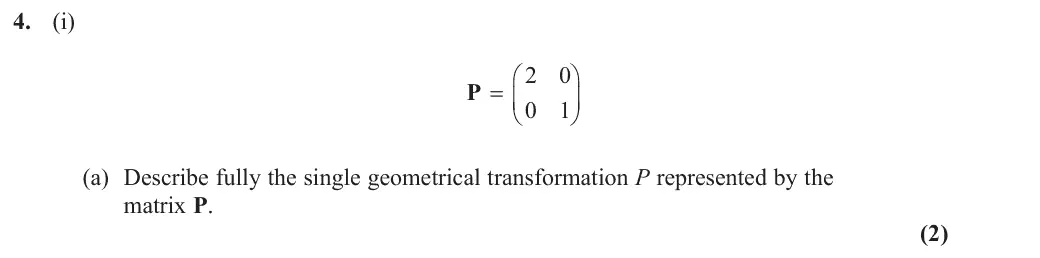
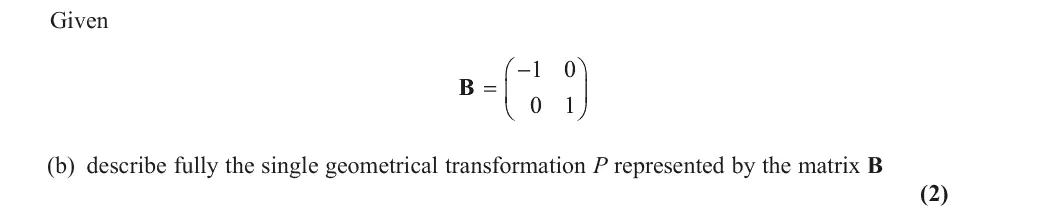
The rotation matrix about O and the reflection matrix in y = (tan θ)x are given.
Since 2018
29 question parts, 69 marks
Notes, worked examples and practice for this topic are being written by our tutors. The past-paper questions below are ready now: work each one on paper, then open the mark scheme and the examiner's comment.
Tap a question to zoom it. Mark scheme and examiner's comment open under each question.
June 2025 · AS Paper 1 (Core Pure) · Q4(i)(a)2 marks
Mark scheme (whole question; this part is marked with the orange bar)
Examiner's comment
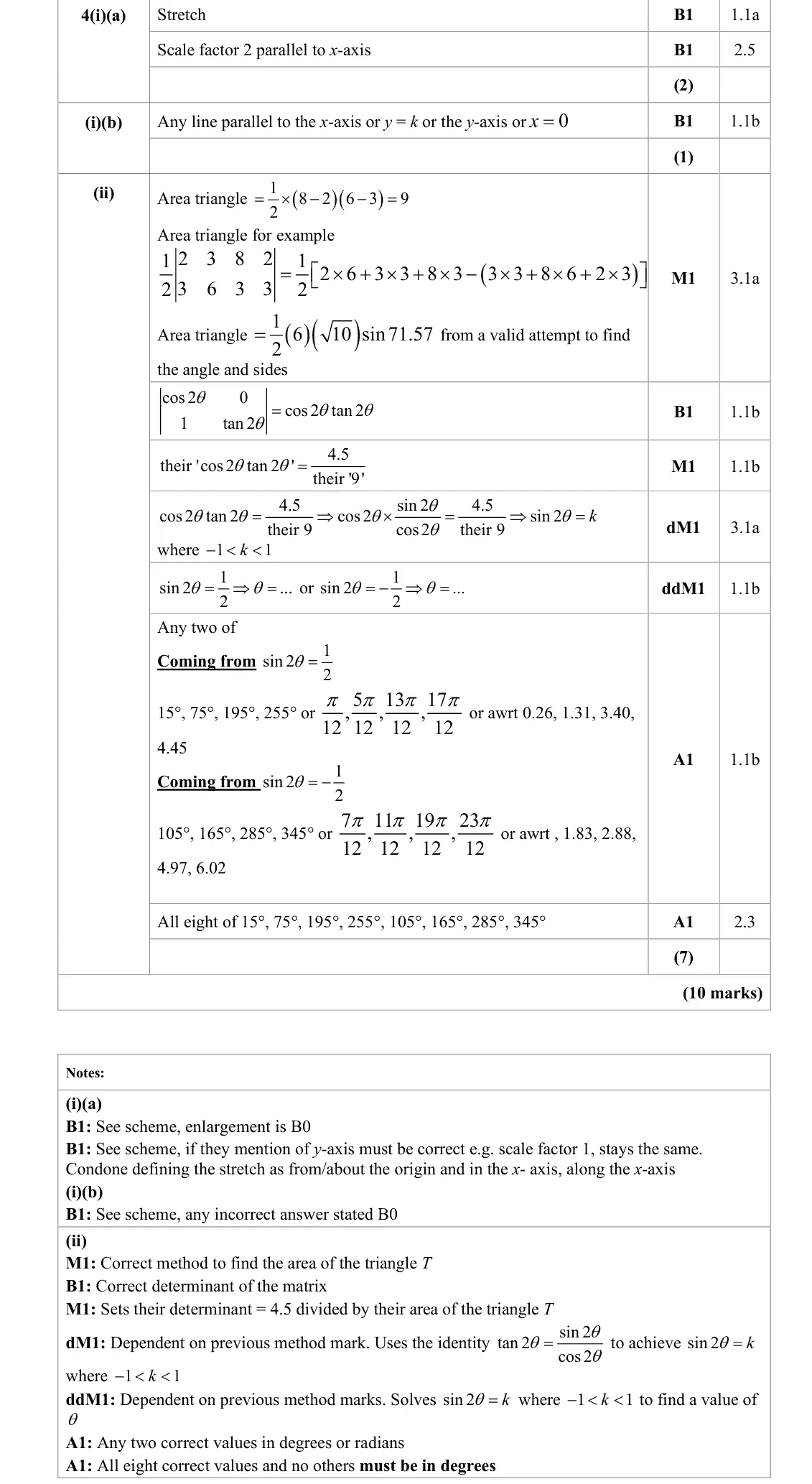
In part (i), the vast majority of the learners recognised that the matrix P represented a stretch with scale factor 2 parallel to the x-axis. Descriptions which involved stretches from the origin, about the origin, in the x-axis and along the x-axis were condoned here although representation by an enlargement was not allowed. A few learners commented that y-axis was invariant. An invariant line was correctly found by the majority of the cohort. In part (ii), the correct area of the triangle T and the correct determinant of the matrix Q were found by many of the cohort with the main error arising here being ( ) Q which subsequently resulted in a loss of marks. Obtaining an area det cos2 tan2 1 theta theta = - scale factor of ½ was obtained by the majority of the learners who then went on to find possible values of theta , having simplified the determinant of Q to sin 2 theta . Very few of the cohort identified the fact that det(Q) could equal ½ or – ½ and thus obtained only four of the eight possible values of theta .
Key points from the mark scheme and examiner's report
stretch scale factor 2 parallel to the x-axis
enlargement scores 0
June 2025 · AS Paper 1 (Core Pure) · Q4(i)(b)1 mark
Mark scheme (whole question; this part is marked with the orange bar)
Examiner's comment
In part (i), the vast majority of the learners recognised that the matrix P represented a stretch with scale factor 2 parallel to the x-axis. Descriptions which involved stretches from the origin, about the origin, in the x-axis and along the x-axis were condoned here although representation by an enlargement was not allowed. A few learners commented that y-axis was invariant. An invariant line was correctly found by the majority of the cohort. In part (ii), the correct area of the triangle T and the correct determinant of the matrix Q were found by many of the cohort with the main error arising here being ( ) Q which subsequently resulted in a loss of marks. Obtaining an area det cos2 tan2 1 theta theta = - scale factor of ½ was obtained by the majority of the learners who then went on to find possible values of theta , having simplified the determinant of Q to sin 2 theta . Very few of the cohort identified the fact that det(Q) could equal ½ or – ½ and thus obtained only four of the eight possible values of theta .
Key points from the mark scheme and examiner's report
any line y = k (parallel to the x-axis), or x = 0
June 2025 · Paper 2 (Core Pure 2) · Q3(b)2 marks
Mark scheme (whole question; this part is marked with the orange bar)
Examiner's comment
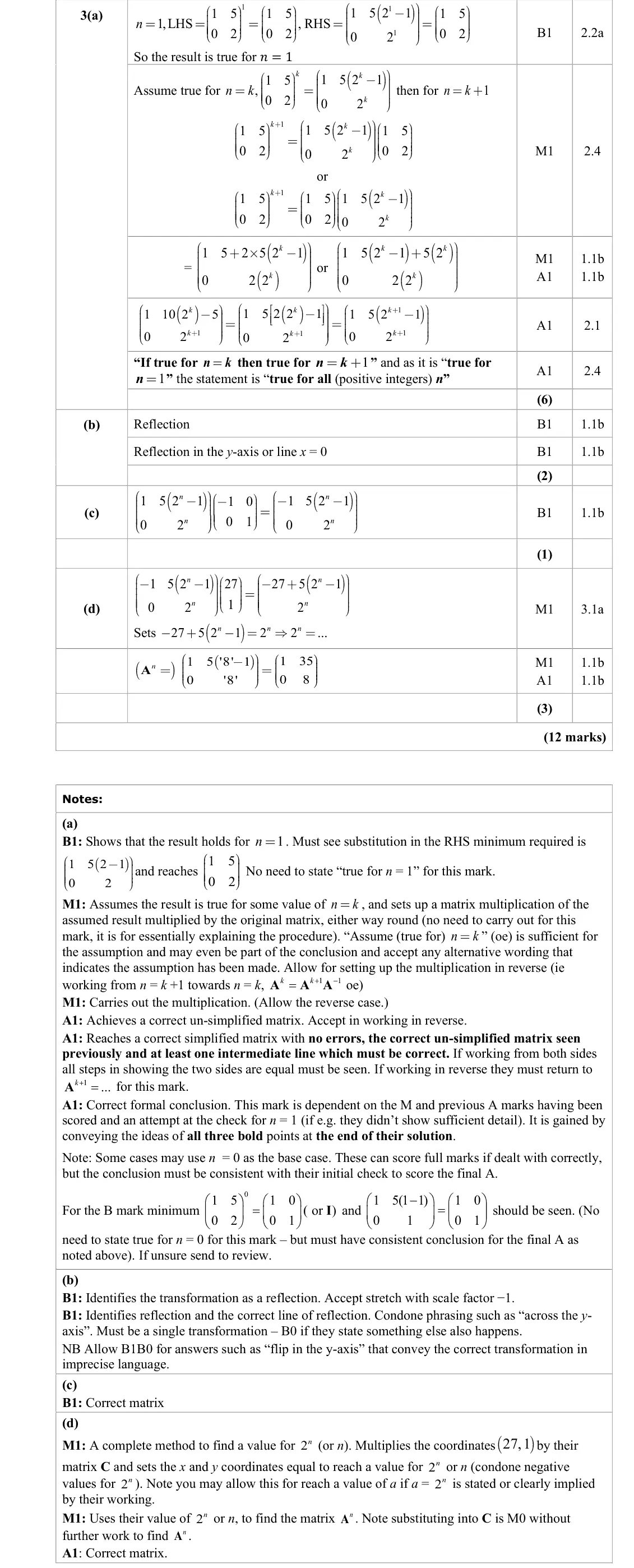
This question was well attempted with the proof by induction being well constructed by many candidates. The proof by induction of powers of matrices seems to be the most favoured of induction questions historically, and this was no exception. The work on transformation was also carried out well, although there was confusion over which matrix was required in the final part by some learners. Part (b) had a bit of a mixed responses, though most were able to give a correct description of the transformation. A common error was giving an incorrect mirror line such as (y = 0) or stating "x-axis" instead or giving no line of reflection at all. Occasionally, candidates confused the transformation with a rotation about the origin. There were also a few learners who described the transformation as scaling of factor -1 parallel to the x-axis, which was given credit as a valid alternative description, but is not to be encouraged. This type of transformation will be a rotation or reflection, and so these types should be expected.
Key points from the mark scheme and examiner's report
reflection in the y-axis (x = 0)
wrong or missing mirror line (y = 0, 'x-axis')
June 2025 · Paper 2 (Core Pure 2) · Q3(c)1 mark
Mark scheme (whole question; this part is marked with the orange bar)
Examiner's comment
This question was well attempted with the proof by induction being well constructed by many candidates. The proof by induction of powers of matrices seems to be the most favoured of induction questions historically, and this was no exception. The work on transformation was also carried out well, although there was confusion over which matrix was required in the final part by some learners. There was again good work seen in part (c), which was mostly completely correct among those who attempted it. The only notable error was the incorrect order of matrix multiplication when performing transformations in a relatively small number of cases.
Key points from the mark scheme and examiner's report
P followed by Q is C = AⁿB (B first): C = (−1, 5(2ⁿ − 1)
0, 2ⁿ)
wrong order of multiplication
June 2025 · Paper 2 (Core Pure 2) · Q3(d)3 marks
Mark scheme (whole question; this part is marked with the orange bar)
Examiner's comment
This question was well attempted with the proof by induction being well constructed by many candidates. The proof by induction of powers of matrices seems to be the most favoured of induction questions historically, and this was no exception. The work on transformation was also carried out well, although there was confusion over which matrix was required in the final part by some learners. Part (d) was a bit less successfully completed, and indeed there were numerous cases of this part being left out by learners who did not know how to proceed. Those who attempted it seldom set up an incorrect equation for their answer to (c), though a few did set up the multiplication the wrong way round, and some others did not use C but An. After setting up a suitable equation most proceeded to find either 2n or n, but a few stopped at this point, forgetting to substitute back into the matrix, while others substituted back into the wrong matrix, C instead of An.
Key points from the mark scheme and examiner's report
C(27, 1) = (−27 + 5(2ⁿ − 1), 2ⁿ)
set the coordinates equal: 2ⁿ = 8
Q is Aⁿ = (1, 35
0, 8), not C
often omitted
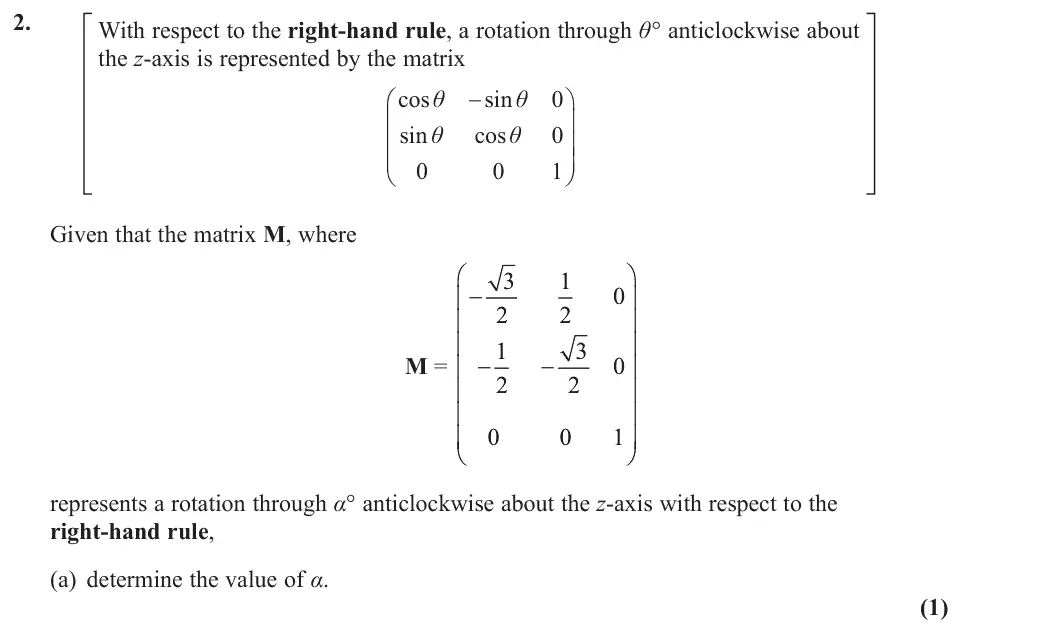
June 2024 · AS Paper 1 (Core Pure) · Q2(a)1 mark
Mark scheme (whole question; this part is marked with the orange bar)
Examiner's comment
Part a) was often answered incorrectly and candidates failed to check their value worked consistently, common incorrect answers included 30 and 150 . ± Part b) was attempted by most students who recognised the need for alpha to be divisible exactly k by 360, it was common to see attempts involving trial and error or calculator use. The odd value of k however not the lowest. Many students who got 300 and 1500 in part a) were able to attempt at finding the LCM of alpha and 360 was seen which were generally successful in finding a calculate k, scoring M1A0. Part c) was very well answered with the large majority achieving this mark. It was pleasing to see candidates that although maybe couldn’t access a) and b) continued to read through the question and pick up marks here. Part d) was a show that question and whilst many candidates appreciated the need for matrix multiplication and furthermore understood the necessary order many failed to show evidence of matrix multiplication which was not sufficient. Those who did show their working generally did so correctly and were able to proceed to the correct answer. Some students left their answer as a vector which was condoned in this question. Candidates who drew a sketch were more successful in part e and f than those who didn’t. It was common to see both the cosine rule and scalar product used in part e), most candidates who selected a correct method were able to proceed to the final answer. Numerical and sign errors were more common when using the cosine rule and calculating AB . Part f) was generally well done although some candidates selected the wrong side and used AB in place of OA or OB, again a sketch helped with this. A small number of candidates failed to round to the required level of accuracy in e) and f) losing the final mark.
Key points from the mark scheme and examiner's report
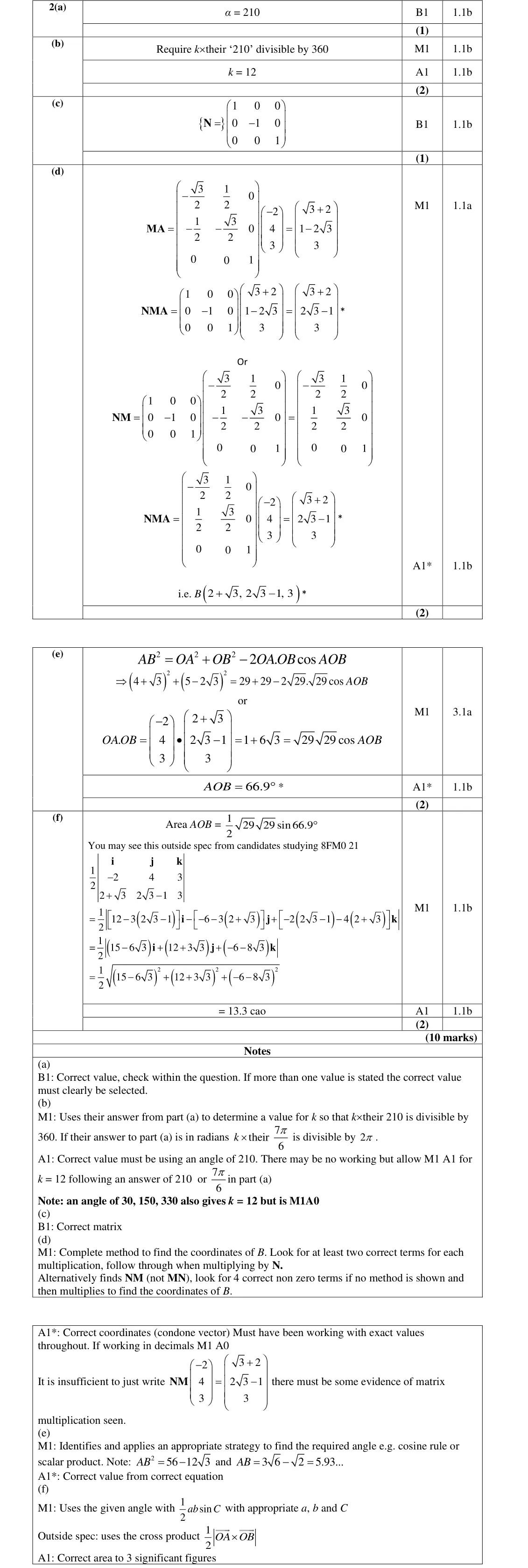
cos α = −√3/2 and sin α = −1/2: α = 210
30 or 150 common wrong answers
check both entries
June 2024 · AS Paper 1 (Core Pure) · Q2(b)2 marks
Mark scheme (whole question; this part is marked with the orange bar)
Examiner's comment
Part a) was often answered incorrectly and candidates failed to check their value worked consistently, common incorrect answers included 30 and 150 . ± Part b) was attempted by most students who recognised the need for alpha to be divisible exactly k by 360, it was common to see attempts involving trial and error or calculator use. The odd value of k however not the lowest. Many students who got 300 and 1500 in part a) were able to attempt at finding the LCM of alpha and 360 was seen which were generally successful in finding a calculate k, scoring M1A0. Part c) was very well answered with the large majority achieving this mark. It was pleasing to see candidates that although maybe couldn’t access a) and b) continued to read through the question and pick up marks here. Part d) was a show that question and whilst many candidates appreciated the need for matrix multiplication and furthermore understood the necessary order many failed to show evidence of matrix multiplication which was not sufficient. Those who did show their working generally did so correctly and were able to proceed to the correct answer. Some students left their answer as a vector which was condoned in this question. Candidates who drew a sketch were more successful in part e and f than those who didn’t. It was common to see both the cosine rule and scalar product used in part e), most candidates who selected a correct method were able to proceed to the final answer. Numerical and sign errors were more common when using the cosine rule and calculating AB . Part f) was generally well done although some candidates selected the wrong side and used AB in place of OA or OB, again a sketch helped with this. A small number of candidates failed to round to the required level of accuracy in e) and f) losing the final mark.
Key points from the mark scheme and examiner's report
210k must be a multiple of 360: k = 12
June 2024 · AS Paper 1 (Core Pure) · Q2(c)1 mark
Mark scheme (whole question; this part is marked with the orange bar)
Examiner's comment
Part a) was often answered incorrectly and candidates failed to check their value worked consistently, common incorrect answers included 30 and 150 . ± Part b) was attempted by most students who recognised the need for alpha to be divisible exactly k by 360, it was common to see attempts involving trial and error or calculator use. The odd value of k however not the lowest. Many students who got 300 and 1500 in part a) were able to attempt at finding the LCM of alpha and 360 was seen which were generally successful in finding a calculate k, scoring M1A0. Part c) was very well answered with the large majority achieving this mark. It was pleasing to see candidates that although maybe couldn’t access a) and b) continued to read through the question and pick up marks here. Part d) was a show that question and whilst many candidates appreciated the need for matrix multiplication and furthermore understood the necessary order many failed to show evidence of matrix multiplication which was not sufficient. Those who did show their working generally did so correctly and were able to proceed to the correct answer. Some students left their answer as a vector which was condoned in this question. Candidates who drew a sketch were more successful in part e and f than those who didn’t. It was common to see both the cosine rule and scalar product used in part e), most candidates who selected a correct method were able to proceed to the final answer. Numerical and sign errors were more common when using the cosine rule and calculating AB . Part f) was generally well done although some candidates selected the wrong side and used AB in place of OA or OB, again a sketch helped with this. A small number of candidates failed to round to the required level of accuracy in e) and f) losing the final mark.
Key points from the mark scheme and examiner's report
N = (1 0 0
0 −1 0
0 0 1)
June 2024 · AS Paper 1 (Core Pure) · Q2(d)2 marks
Mark scheme (whole question; this part is marked with the orange bar)
Examiner's comment
Part a) was often answered incorrectly and candidates failed to check their value worked consistently, common incorrect answers included 30 and 150 . ± Part b) was attempted by most students who recognised the need for alpha to be divisible exactly k by 360, it was common to see attempts involving trial and error or calculator use. The odd value of k however not the lowest. Many students who got 300 and 1500 in part a) were able to attempt at finding the LCM of alpha and 360 was seen which were generally successful in finding a calculate k, scoring M1A0. Part c) was very well answered with the large majority achieving this mark. It was pleasing to see candidates that although maybe couldn’t access a) and b) continued to read through the question and pick up marks here. Part d) was a show that question and whilst many candidates appreciated the need for matrix multiplication and furthermore understood the necessary order many failed to show evidence of matrix multiplication which was not sufficient. Those who did show their working generally did so correctly and were able to proceed to the correct answer. Some students left their answer as a vector which was condoned in this question. Candidates who drew a sketch were more successful in part e and f than those who didn’t. It was common to see both the cosine rule and scalar product used in part e), most candidates who selected a correct method were able to proceed to the final answer. Numerical and sign errors were more common when using the cosine rule and calculating AB . Part f) was generally well done although some candidates selected the wrong side and used AB in place of OA or OB, again a sketch helped with this. A small number of candidates failed to round to the required level of accuracy in e) and f) losing the final mark.
Key points from the mark scheme and examiner's report
M followed by N is NM
NMA = (2 + √3, 2√3 − 1, 3)
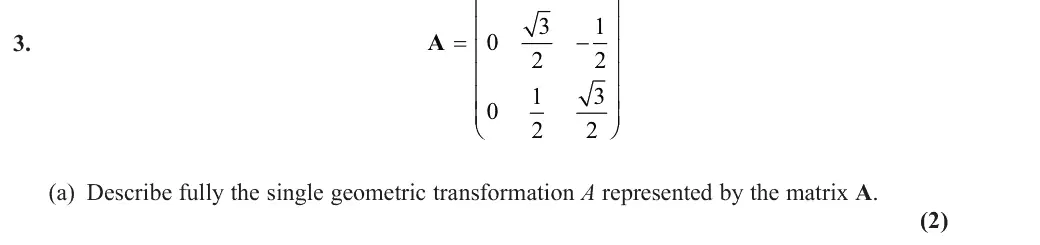
June 2023 · AS Paper 1 (Core Pure) · Q3(a)2 marks
Mark scheme (whole question; this part is marked with the orange bar)
Examiner's comment
Nearly all candidates made some attempt at this question. In part (a), the first B mark was almost always given for rotation, most did also achieve the second B, though some added extra information eg 'around origin' or gave an incorrect description e.g. 'z-plane', 'x = 0' so lost the second B mark.
Key points from the mark scheme and examiner's report
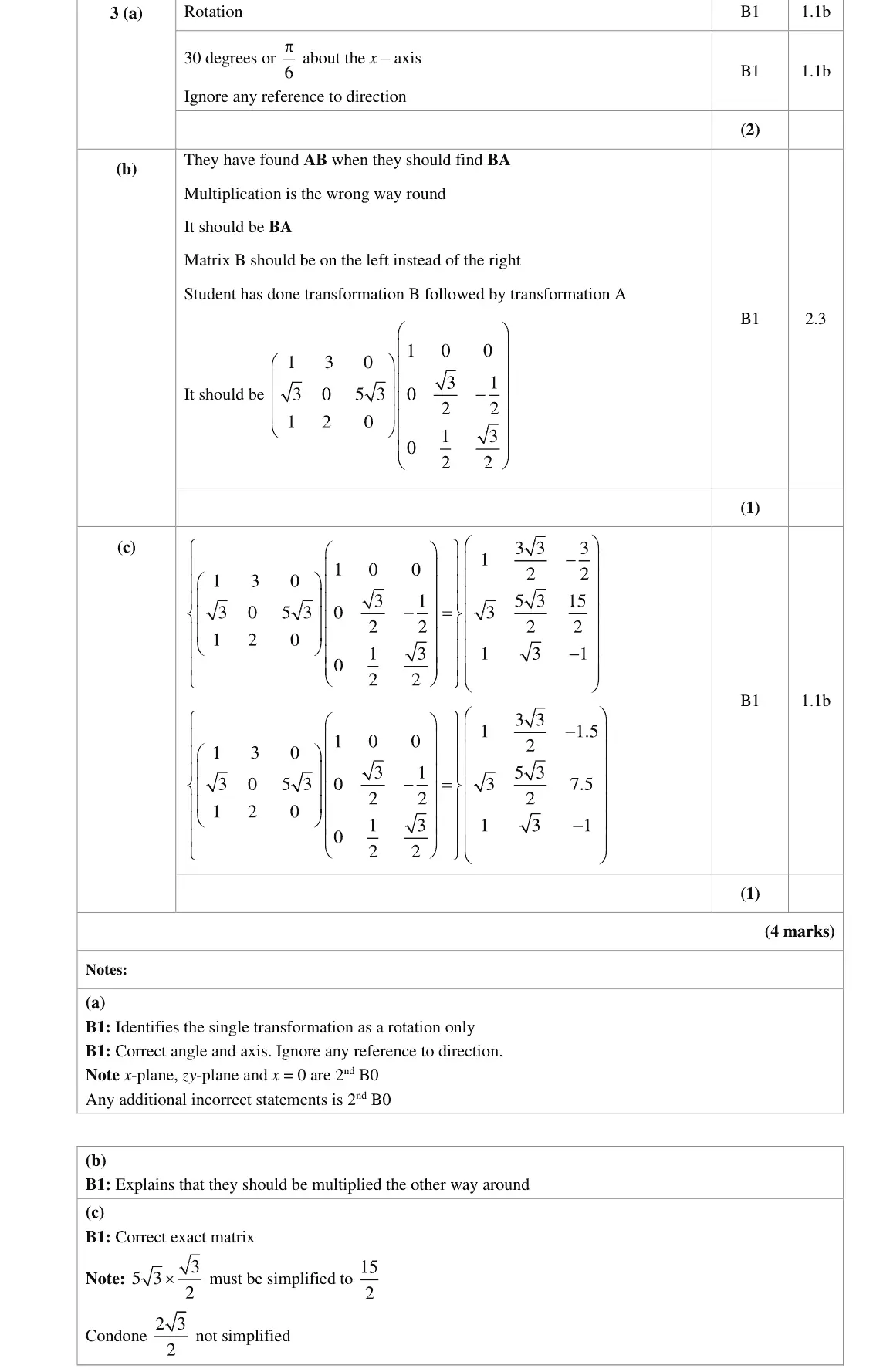
rotation 30° (π/6) about the x-axis
extra or wrong details (about the origin, z-plane, x = 0) lose the second mark
June 2023 · AS Paper 1 (Core Pure) · Q3(b)1 mark
Mark scheme (whole question; this part is marked with the orange bar)
Examiner's comment
Nearly all candidates made some attempt at this question. In part (b), this was generally correct and explained using all examples in the scheme.
Key points from the mark scheme and examiner's report
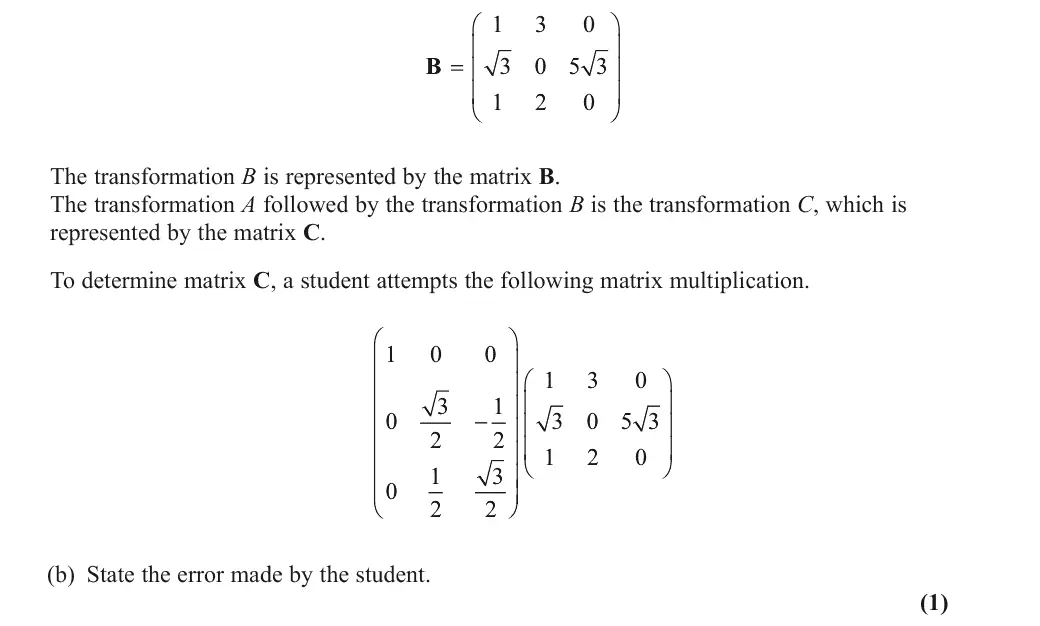
A followed by B is BA, but the student found AB: wrong order
June 2023 · AS Paper 1 (Core Pure) · Q3(c)1 mark
Mark scheme (whole question; this part is marked with the orange bar)
Examiner's comment
Nearly all candidates made some attempt at this question. In part (c), many gained this mark. Where it was lost this was either due to occasional errors in multiplication or, more often, giving the answers to 3sf rather than exact figures as requested. A few just stated the matrices in the correct order but did not proceed to multiply.
Key points from the mark scheme and examiner's report
C = BA = (1 3√3/2 −3/2
√3 5√3/2 15/2
1 √3 −1)
exact values, not 3 s.f.
June 2023 · AS Paper 1 (Core Pure) · Q9(ii)5 marks
Mark scheme (whole question; this part is marked with the orange bar)
Examiner's comment
In part (i), the vast majority of the candidates expanded along the first row to find the determinant of the matrix P and much success was achieved. The most common error was not applying the change of sign rule which resulted in the loss of the first two marks at least. For those responses that had found the correct determinant, the proof of the non-singularity of P proved demanding and although the use of either the discriminant or completing the square were well identified methods, many solutions did not include all of the necessary details and thus fully complete solutions did not often appear. This is a show questions and candidates are remined that they do need to show the reasoning clearly. Just saying no real roots is insufficient they need to show why it has no real roots. In part (ii), the vast majority of the candidates correctly found the coordinates of A' and B' and then equated the distance between them to 58 to form the required quadratic equation. The occasional sign error or incorrect expansions were the main reasons here as to why marks were lost but much success was achieved in this part and many of the cohort scored full marks.
Key points from the mark scheme and examiner's report
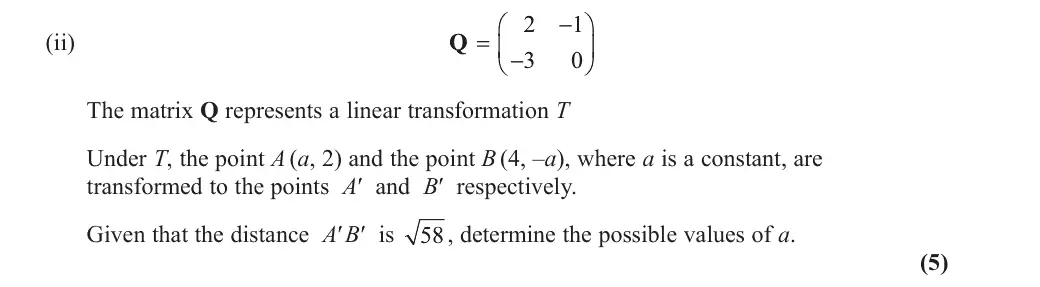
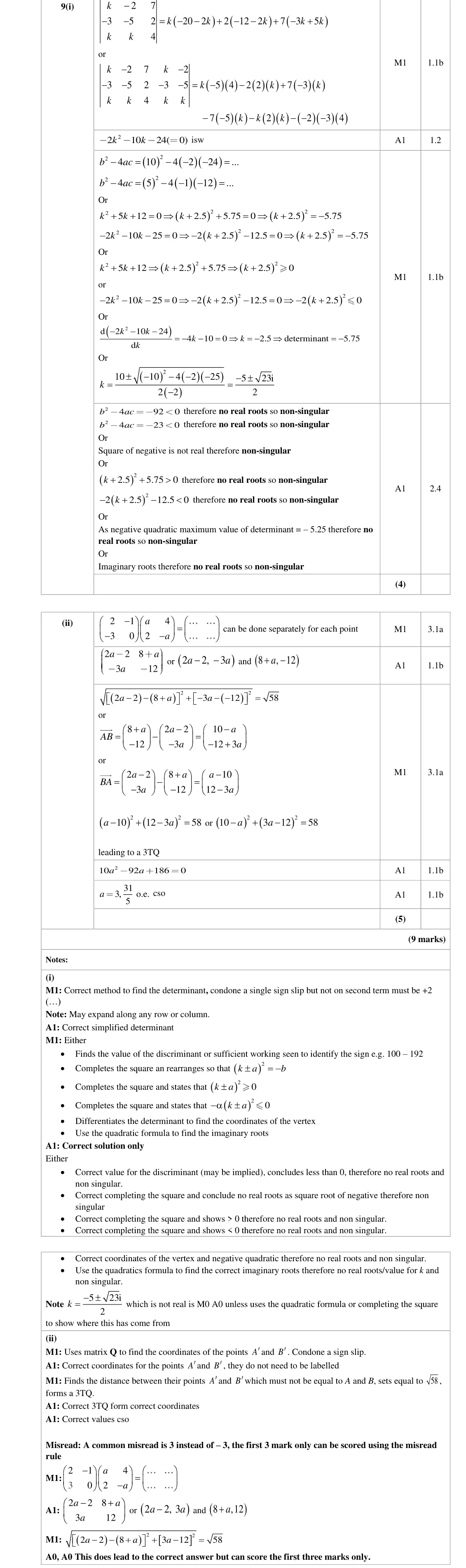
A' = (2a − 2, −3a), B' = (8 + a, −12)
distance² = 58 gives 10a² − 92a + 186 = 0, a = 3 or 31/5
June 2023 · Paper 2 (Core Pure 2) · Q3(b)6 marks
Mark scheme (whole question; this part is marked with the orange bar)
Examiner's comment
(b) There appeared to be confusion between a line of invariant points and an invariant line. A surprising number of students found the line of invariant points x x y y → and quite a few produced an incomplete solution by using x X mx mX → instead of the required x X mx mX c → + . Special cases for the first 2 cases were incorporated into the mark scheme and candidates were able to score some marks. However, a majority did take the correct approach to find right values for m. Having done so quite a few thought that c = 0 for both lines and so produced 3 5 y x = and 2 y x = - rather than 2 y x c = - + .
Key points from the mark scheme and examiner's report
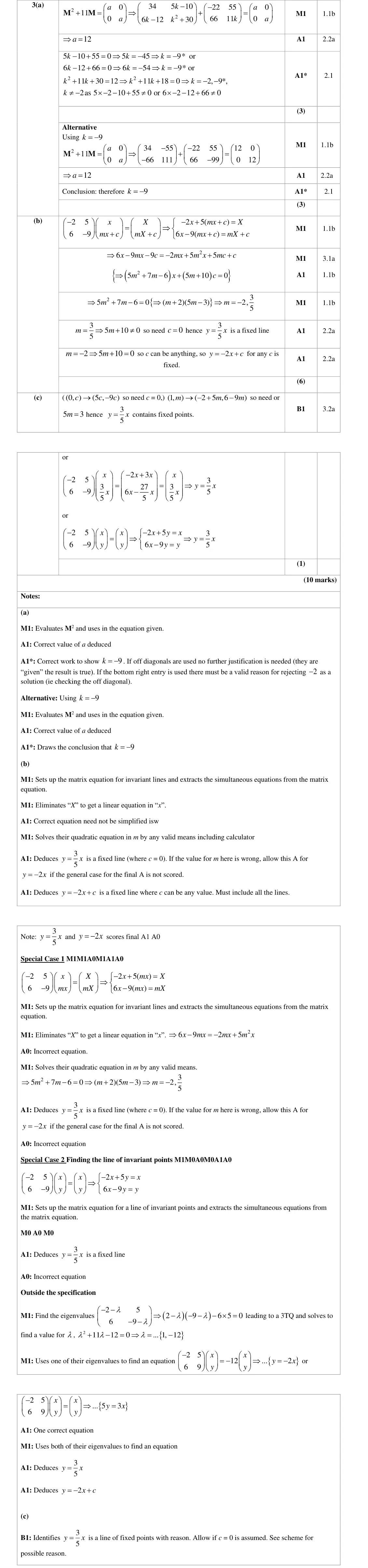
map (x, mx + c) to (X, mX + c): 5m² + 7m − 6 = 0, m = 3/5 or −2
y = (3/5)x (c = 0) and y = −2x + c for any c
confusing invariant lines with a line of invariant points
wrongly setting c = 0 for both
June 2023 · Paper 2 (Core Pure 2) · Q3(c)1 mark
Mark scheme (whole question; this part is marked with the orange bar)
Examiner's comment
(c) Many candidates correctly thought that 3 5 y x = was the line of invariant points, but had difficulty justifying their decision.
Key points from the mark scheme and examiner's report
y = (3/5)x is a line of fixed points since (x, 3x/5) maps to itself
a reason is needed and was often missing
June 2022 · AS Paper 1 (Core Pure) · Q3(a)1 mark
Mark scheme (whole question; this part is marked with the orange bar)
Examiner's comment
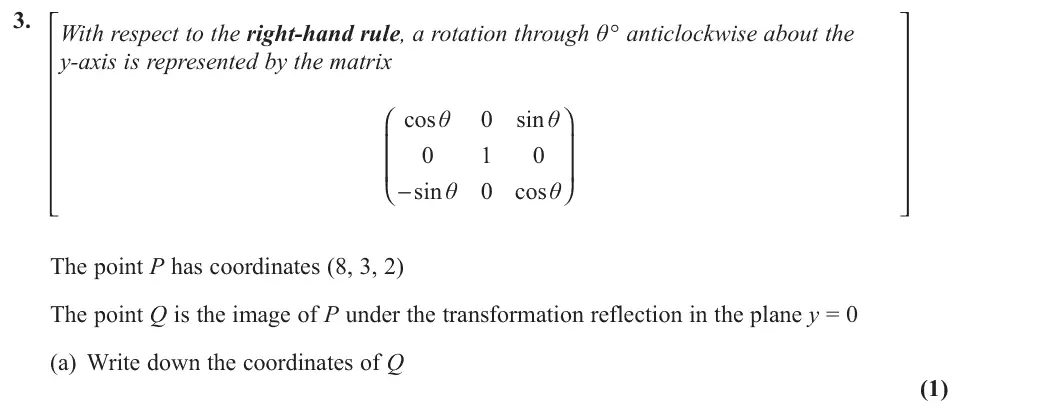
In (a), was found correctly in approximately half of the responses, with an array of alternatives seen: ( ) ( ) ( ) 8,3,2 , 8,3, 2 , 8,3, 2 - - - - etc. Typically, parts (b) and (c) were answered well. The provision of the matrix for the rotation
Key points from the mark scheme and examiner's report
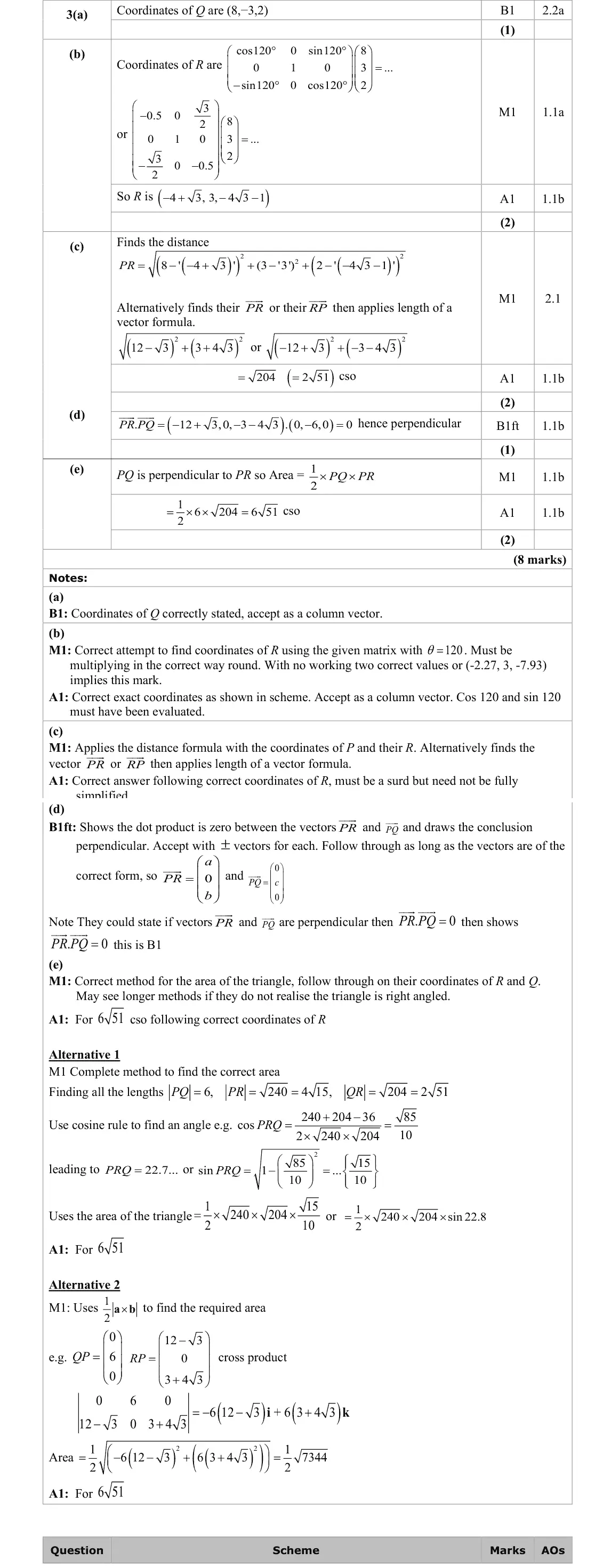
reflection in y = 0 changes the sign of y: Q = (8, −3, 2)
June 2022 · AS Paper 1 (Core Pure) · Q3(b)2 marks
Mark scheme (whole question; this part is marked with the orange bar)
Examiner's comment
Typically, parts (b) and (c) were answered well. The provision of the matrix for the rotation enabled the vast majority of candidates to attempt part (b) successfully, although a disappointing number of students gave inexact answers for R or made slips with the exact values of sin120 or cos120 . More significant errors were seen, including multiplying P by the matrix the wrong way round, or using their position vector for Q instead of P, which led to no marks being scored in this part. In part (c), generally candidates subtracted the position vector for P from their
Key points from the mark scheme and examiner's report
multiply the given matrix with θ = 120° by (8, 3, 2): R = (−4 + √3, 3, −4√3 − 1)
exact values needed
using Q or the wrong order scores 0
June 2022 · AS Paper 1 (Core Pure) · Q3(c)2 marks
Mark scheme (whole question; this part is marked with the orange bar)
Examiner's comment
Typically, parts (b) and (c) were answered well. The provision of the matrix for the rotation enabled the vast majority of candidates to attempt part (b) successfully, although a disappointing in this part. In part (c), generally candidates subtracted the position vector for P from their answer to (b), with occasional sign slips, but the most common error was to stop there: not actually finding the distance between the coordinates of their R and P. Some students with inexact coordinates for R were able to recover and give an exact answer for the distance. was not of the correct form to be able to reach a dot product of 0. For Part (d) was inaccessible to some candidates as they had incorrectly used Q in place of P and as a result their vector PQ those who had proceeded correctly to this point, this part was fairly straightforward, and they candidates reaching 0 and stopping there, presumably thinking that they had done enough. made light work of it. The most common issue was an omission of a conclusion, with some Part (e) was more mixed for those that got this far. There was a significant proportion of candidates that made no attempt, having failed to make progress earlier in the question. Again,
Key points from the mark scheme and examiner's report
PR = (−12 + √3, 0, −3 − 4√3)
length √204 = 2√51
many stopped at the vector
June 2022 · Paper 2 (Core Pure 2) · Q3(b)5 marks
Mark scheme (whole question; this part is marked with the orange bar)
Examiner's comment
Part (b) This was well answered by the majority of candidates, a good number still The errors with (b) included using the square root of the determinant whilst a notable minority were unable to link them at all. A significant number of candidates failed to get a determinant. Part (c) Candidates who successfully found a value for n then went on to find a value for a successfully with only a very few making arithmetic slips. The most common mistakes were not setting their matrix multiplication equal to 123 2 - .
Key points from the mark scheme and examiner's report
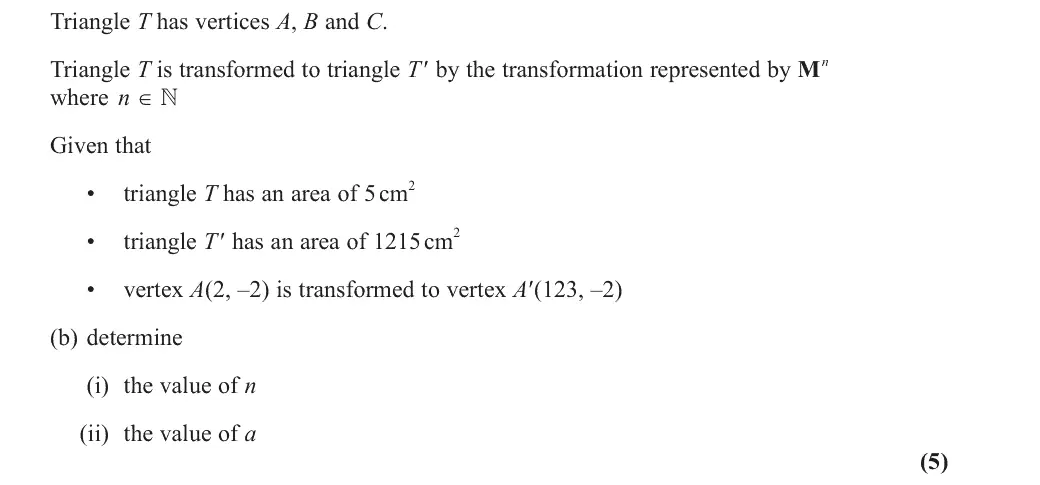
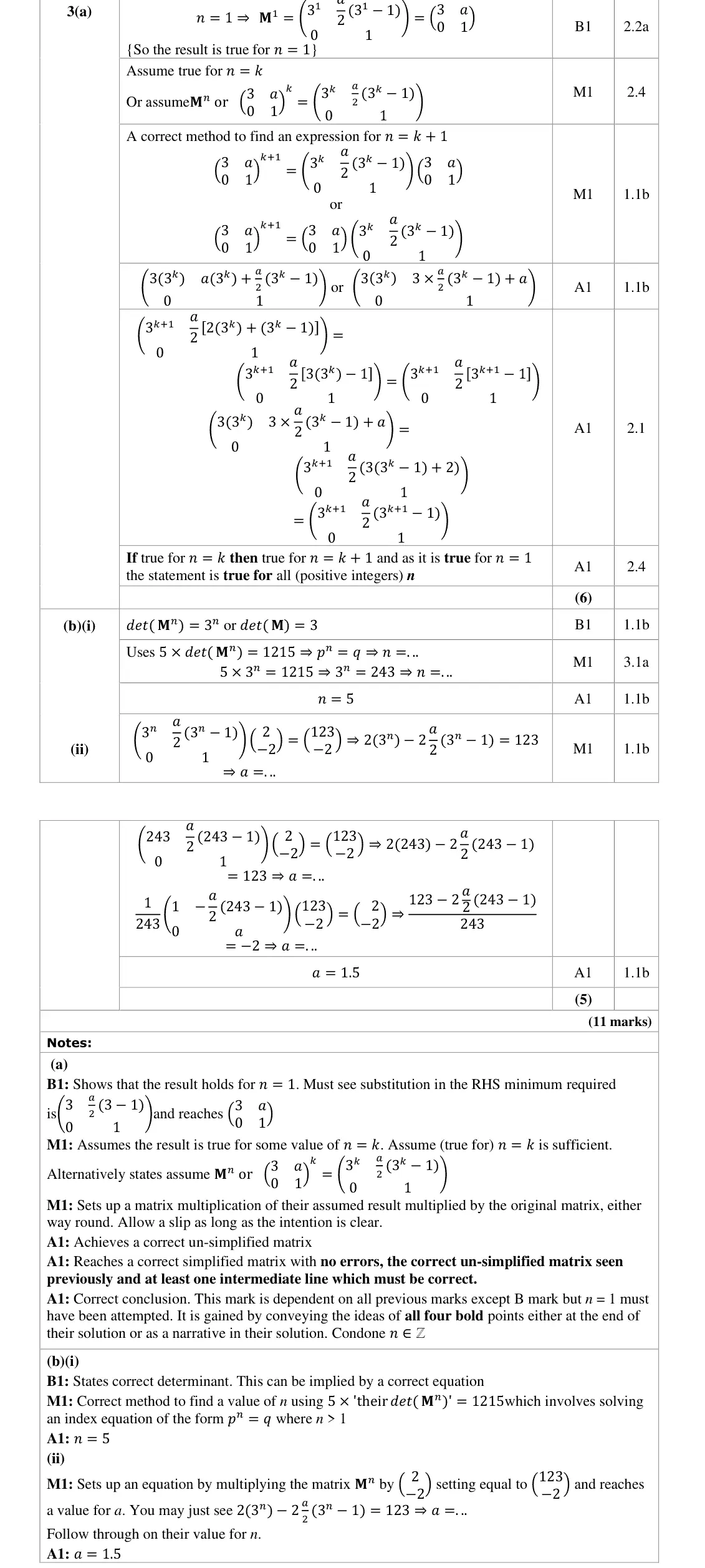
det(Mⁿ) = 3ⁿ so 5 × 3ⁿ = 1215 gives n = 5 (not the square root of the determinant)
Mⁿ(2, −2) = (123, −2) gives a = 1.5
some failed to find a determinant at all
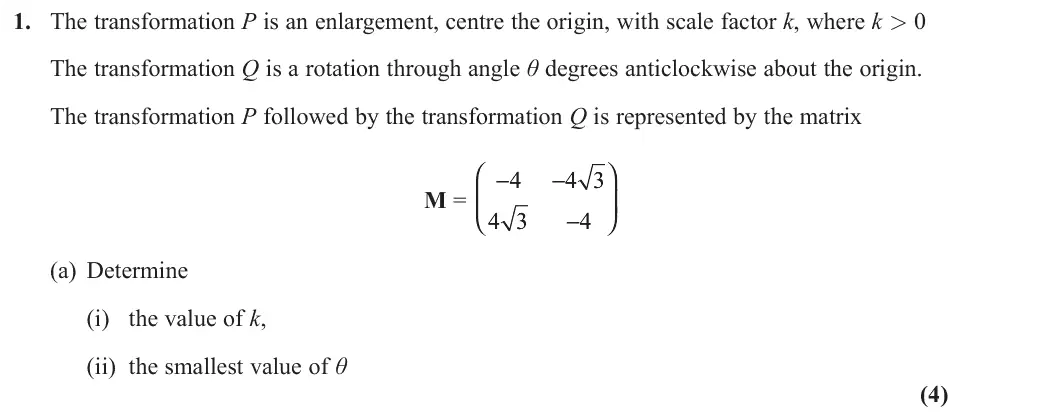
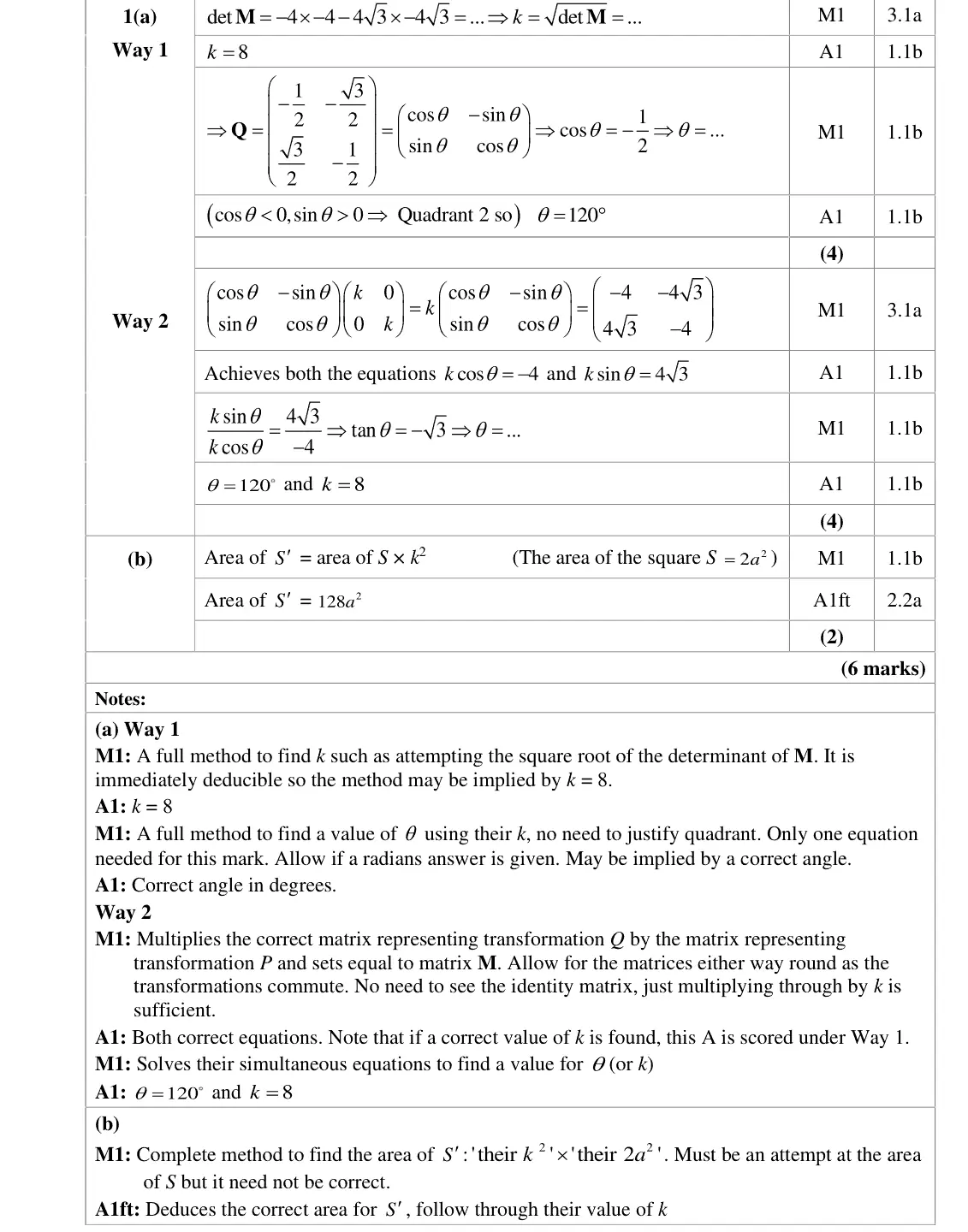
Nov 2021 · Paper 1 (Core Pure 1) · Q1(a)4 marks
Mark scheme (whole question; this part is marked with the orange bar)
Examiner's comment
(a) Most candidates made a good attempt at this part. With over half accessing the first 3 marks. Some were able to just write down a value for k or found the square root of the determinant to give a value which was usually correct. Of the latter, a few did not take the square root, and these gained no marks here. Those who obtained a value for k were then usually able to write down a valid equation and proceed to find a value for theta . The most common error was to give their angle in radians, not degrees, losing the A mark. Those who used Way 2 had more work to do to gain the marks. Most used the correct matrices representing the transformations but were often unable to form and solve two simultaneous equations to find values for k and for theta .
Key points from the mark scheme and examiner's report
k² = det M = 64 so k = 8 (take the square root)
M = 8 × rotation matrix: cos θ = −½, sin θ > 0 so θ = 120° (degrees, not radians)
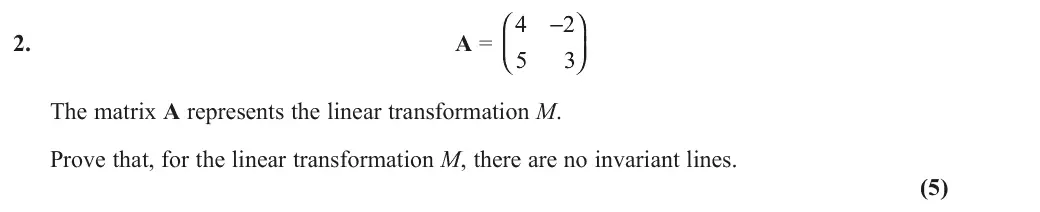
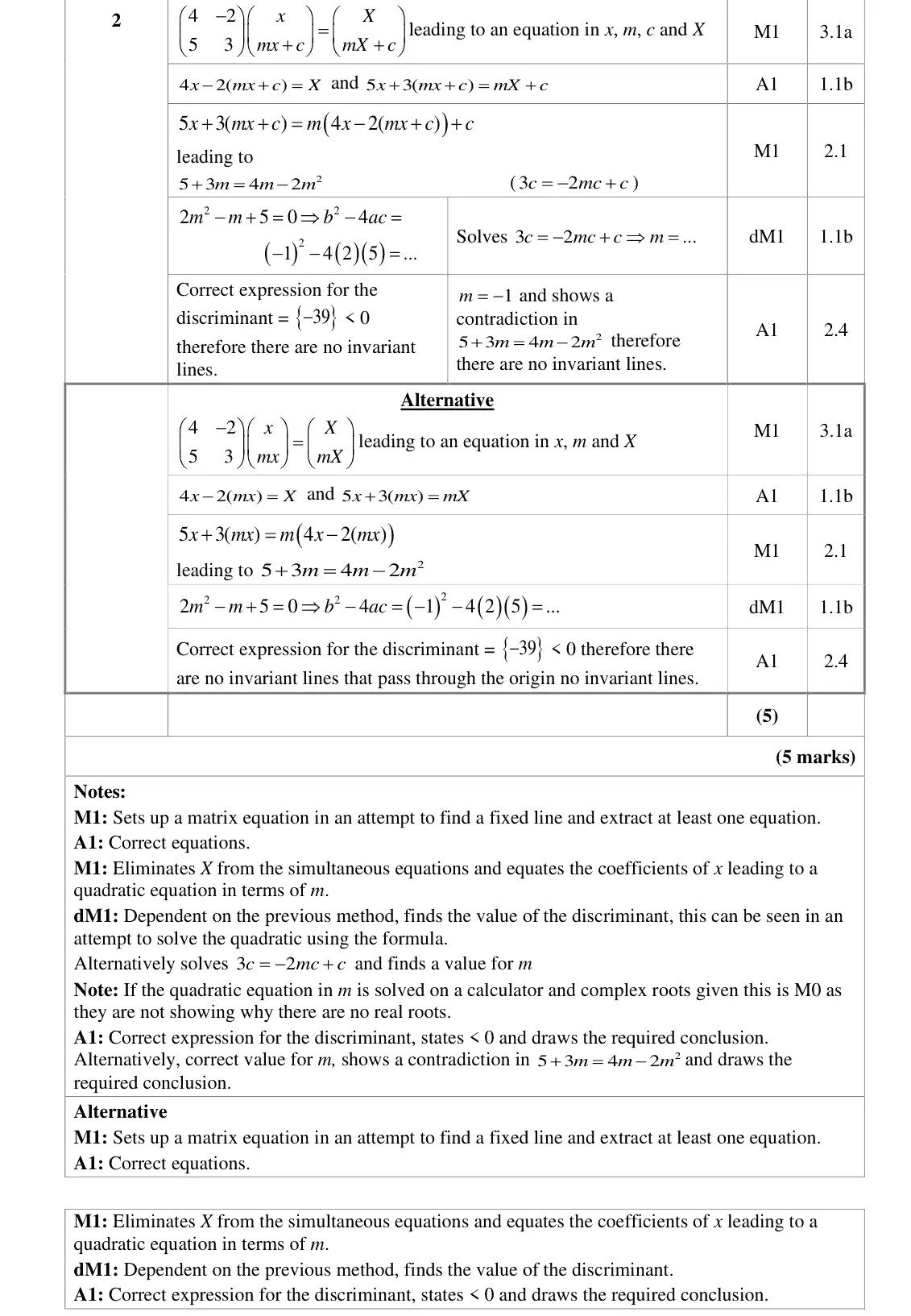
Nov 2021 · Paper 2 (Core Pure 2) · Q25 marks
Mark scheme (whole question; this part is marked with the orange bar)
Examiner's comment
The majority of candidates thought that an invariant line must consist of a line of invariant points and so were not able to produce a comprehensive solution. Only a handful of candidates were able to produce a fully comprehensive solution by not confusing their x’s when mapping (x, mx) onto (x, mx) rather than (x, mx) onto (X, mX).
Key points from the mark scheme and examiner's report
map (x, mx + c) to (X, mX + c): eliminate X to get 2m² − m + 5 = 0 with discriminant −39 < 0, so no invariant lines
most confused invariant lines with lines of invariant points
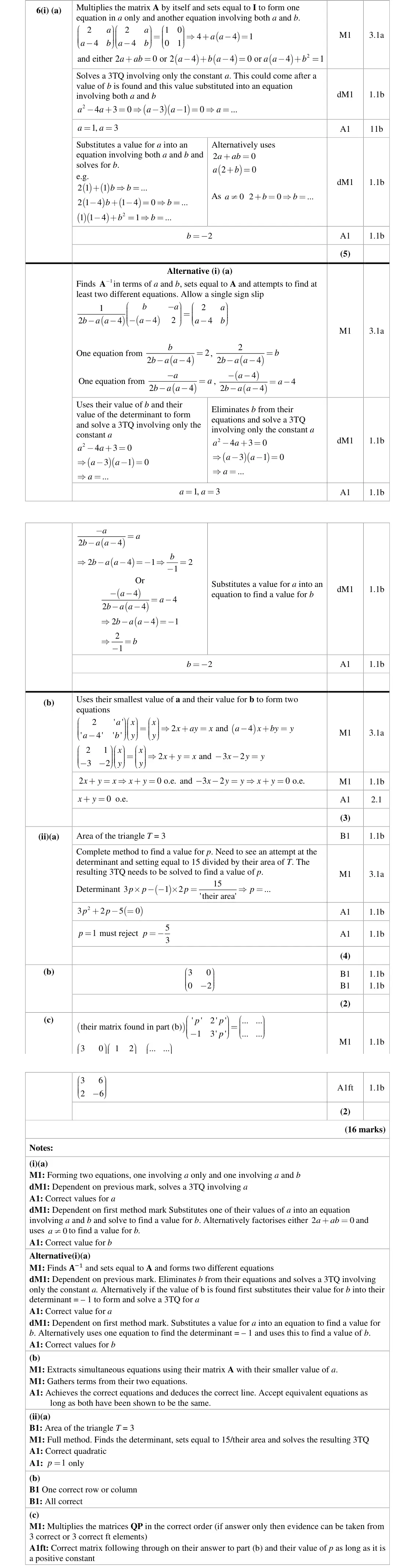
Oct 2020 · AS Paper 1 (Core Pure) · Q6(i)3 marks
Mark scheme (whole question; this part is marked with the orange bar)
Examiner's comment
(i) Part (a) - candidates that used the fact that for a matrix to be a self-inverse then AA = I and A A this did have some success 1 were very successful. However, the majority attempted but very often not. Often the two equations pulled out were not from the different diagonals meaning no marks awarded. Other incorrect methods seen were setting the determinant = 0 and AA I which does not lead to any equations. 1 using (i) Part (b) This was largely not attempted though those that were successful with part (a) were often successful. A common error was to use x and mx + c but then not fully complete the method. Section (ii) on the whole was much better answered Part (a) - only a small number failed to find the area of the object, those that did were often 5 p successful with this part with all candidates correctly discarding . The error that 3 occurred was a sign error in solving. Part (b) - very high success rate Part (c) - Due to the follow through marks available full marks where achieved on this part by nearly all who answered it. Very rarely the order of the matrices was incorrect.
Key points from the mark scheme and examiner's report
with a = 1, b = −2: 2x + y = x and −3x − 2y = y both give x + y = 0
the invariant points form the line y = −x
largely not attempted
Oct 2020 · AS Paper 1 (Core Pure) · Q6(ii)(b)2 marks
Mark scheme (whole question; this part is marked with the orange bar)
Examiner's comment
(i) Part (a) - candidates that used the fact that for a matrix to be a self-inverse then AA = I and A A this did have some success 1 were very successful. However, the majority attempted but very often not. Often the two equations pulled out were not from the different diagonals meaning no marks awarded. Other incorrect methods seen were setting the determinant = 0 and AA I which does not lead to any equations. 1 using (i) Part (b) This was largely not attempted though those that were successful with part (a) were often successful. A common error was to use x and mx + c but then not fully complete the method. Section (ii) on the whole was much better answered Part (a) - only a small number failed to find the area of the object, those that did were often 5 p successful with this part with all candidates correctly discarding . The error that 3 occurred was a sign error in solving. Part (b) - very high success rate Part (c) - Due to the follow through marks available full marks where achieved on this part by nearly all who answered it. Very rarely the order of the matrices was incorrect.
Key points from the mark scheme and examiner's report
Q = (3 0
0 −2)
Oct 2020 · AS Paper 1 (Core Pure) · Q6(ii)(c)2 marks
Mark scheme (whole question; this part is marked with the orange bar)
Examiner's comment
(i) Part (a) - candidates that used the fact that for a matrix to be a self-inverse then AA = I and A A this did have some success 1 were very successful. However, the majority attempted but very often not. Often the two equations pulled out were not from the different diagonals meaning no marks awarded. Other incorrect methods seen were setting the determinant = 0 and AA I which does not lead to any equations. 1 using (i) Part (b) This was largely not attempted though those that were successful with part (a) were often successful. A common error was to use x and mx + c but then not fully complete the method. Section (ii) on the whole was much better answered Part (a) - only a small number failed to find the area of the object, those that did were often 5 p successful with this part with all candidates correctly discarding . The error that 3 occurred was a sign error in solving. Part (b) - very high success rate Part (c) - Due to the follow through marks available full marks where achieved on this part by nearly all who answered it. Very rarely the order of the matrices was incorrect.
Key points from the mark scheme and examiner's report
U followed by V is QP (order matters)
R = (3 6
2 −6)
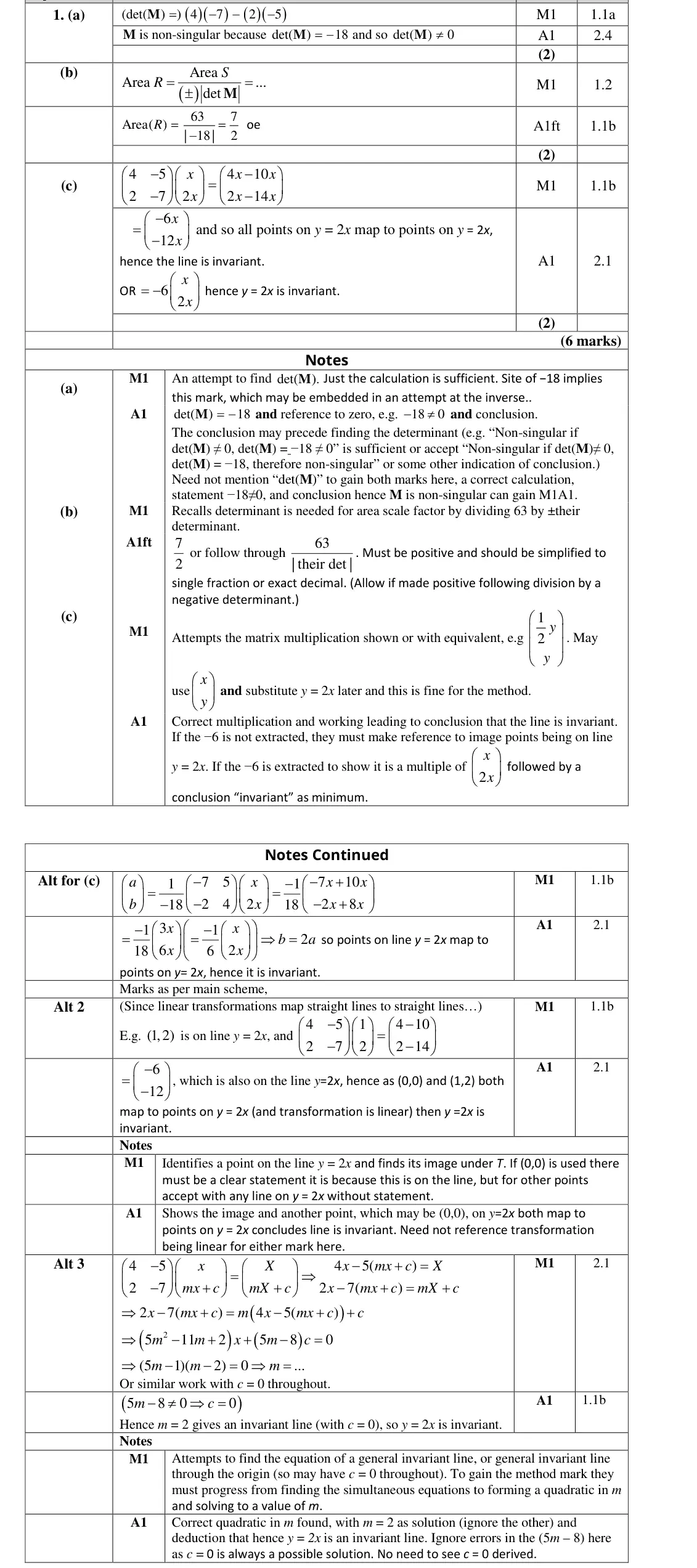
June 2019 · AS Paper 1 (Core Pure) · Q1(c)2 marks
Mark scheme (whole question; this part is marked with the orange bar)
Key points from the mark scheme and examiner's report
M(x, 2x) = (−6x, −12x) = −6(x, 2x), which lies on y = 2x
conclusion "invariant" needed
general y = mx + c route also accepted
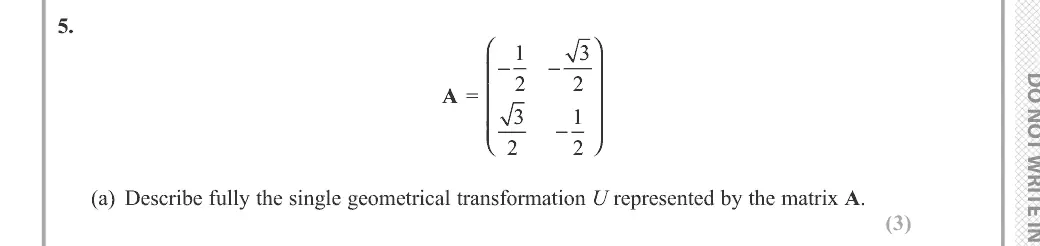
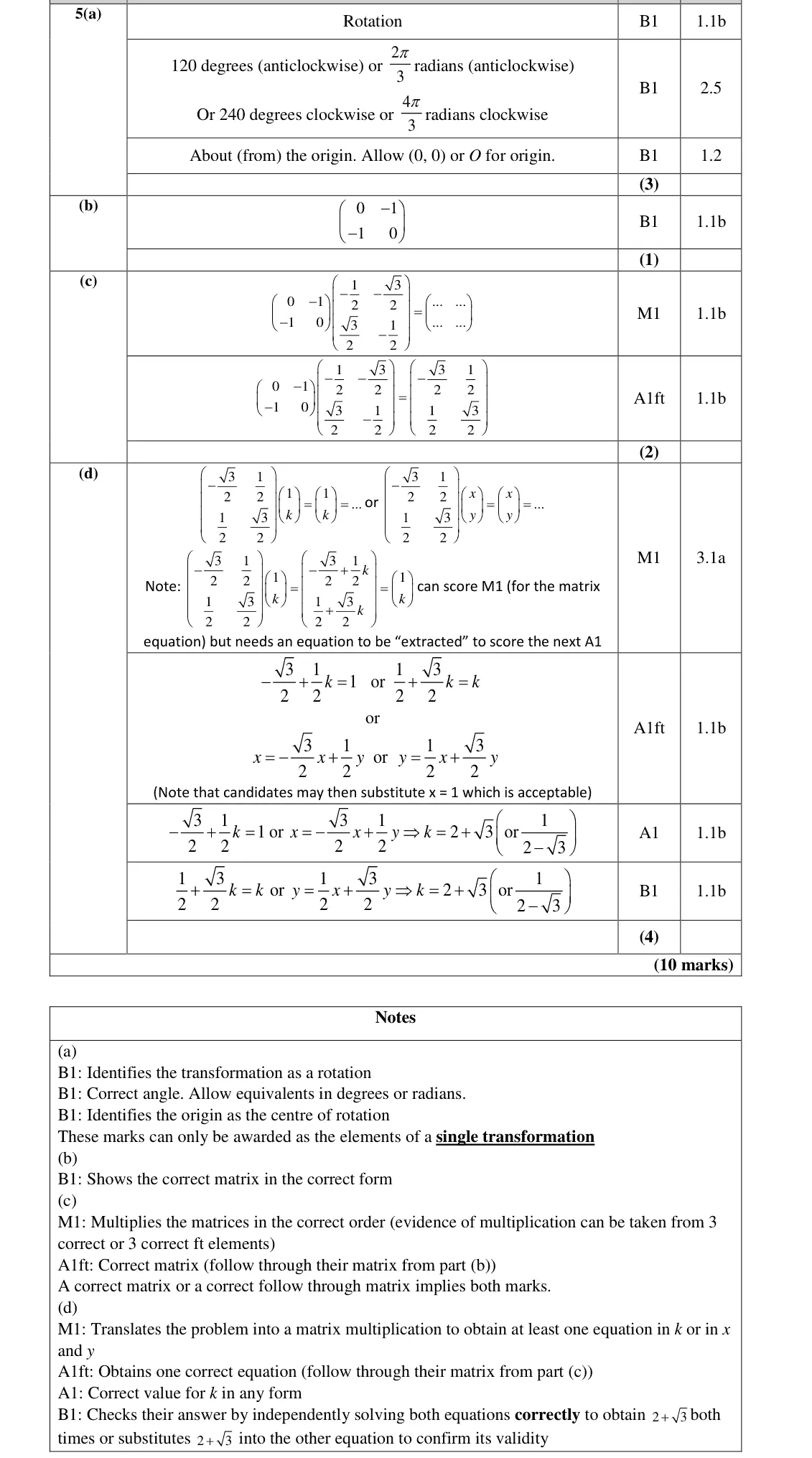
June 2018 · AS Paper 1 (Core Pure) · Q5(a)3 marks
Mark scheme (whole question; this part is marked with the orange bar)
Examiner's comment
Parts (a), (b), (c) should have been routine procedures and it was surprising how any students made mistakes in these parts. In part (a), the majority of students realised that the transformation was a rotation but struggled with the angle, whilst many students failed to mention that the rotation was about the origin. A significant number also lost all three marks by attempting to describe a composite transformation.
Key points from the mark scheme and examiner's report
single rotation 120° anticlockwise about the origin
all three of rotation, angle and centre
composite descriptions score 0
June 2018 · AS Paper 1 (Core Pure) · Q5(b)1 mark
Mark scheme (whole question; this part is marked with the orange bar)
Examiner's comment
Parts (a), (b), (c) should have been routine procedures and it was surprising how any students made mistakes in these parts. Part (b) provided mixed responses. Many did state the correct matrix, but a variety of incorrect matrices were also seen - the entries on the wrong diagonals being the most common. The use of a sketch would be advised to help trace where the coordinates (1, 0) and (0, 1) map to under the transformation, and hence help establish the required matrix.
Key points from the mark scheme and examiner's report
B = (0 −1
−1 0)
entries on the wrong diagonal common
June 2018 · AS Paper 1 (Core Pure) · Q5(c)2 marks
Mark scheme (whole question; this part is marked with the orange bar)
Examiner's comment
Parts (a), (b), (c) should have been routine procedures and it was surprising how any students made mistakes in these parts. Many students did manage to get full marks in (c) due to the follow through mark, however there was a surprising number who mixed up the order of matrix multiplication and hence gained no marks.
Key points from the mark scheme and examiner's report
U followed by V is BA, not AB
wrong order scores 0
June 2018 · AS Paper 1 (Core Pure) · Q5(d)4 marks
Mark scheme (whole question; this part is marked with the orange bar)
Examiner's comment
Part (d) was, on the whole, well attempted with only the final mark causing some difficulty. Most students that attempted (d) managed to achieve M1A1ft, although errors in (b) or (c) prevented them getting any further. Students that had gained full marks in (b) and (c) often went on to get the next A mark for finding a correct value for k but not many went on to use the second equation to confirm this, thus losing the final B mark.
Key points from the mark scheme and examiner's report
C(1, k) = (1, k) gives two equations
k = 2 + √3
must check k in the second equation for the final mark
Find an Edexcel Further Maths tutor
Stuck on this? Book a trial lesson with our Further Maths tutor.