Simpson's rule and the numerical step formulae for differential equations are not given.
Since 2018
23 question parts, 87 marks, 2 with a difficulty rating from the examiner's report
Notes, worked examples and practice for this topic are being written by our tutors. The past-paper questions below are ready now: work each one on paper, then open the mark scheme and the examiner's comment.
Tap a question to zoom it. Mark scheme and examiner's comment open under each question.
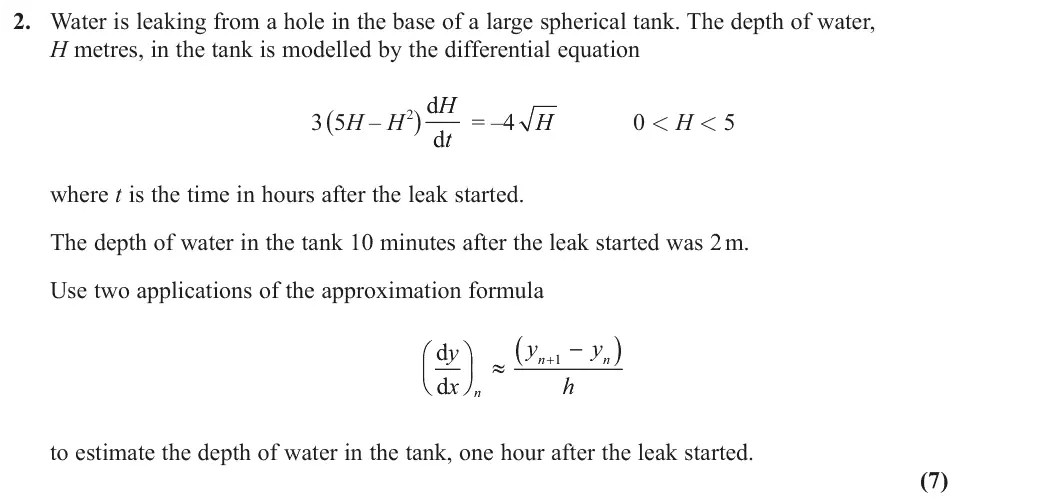
June 2025 · AS Paper 2 (Further Pure 1) · Q27 marks
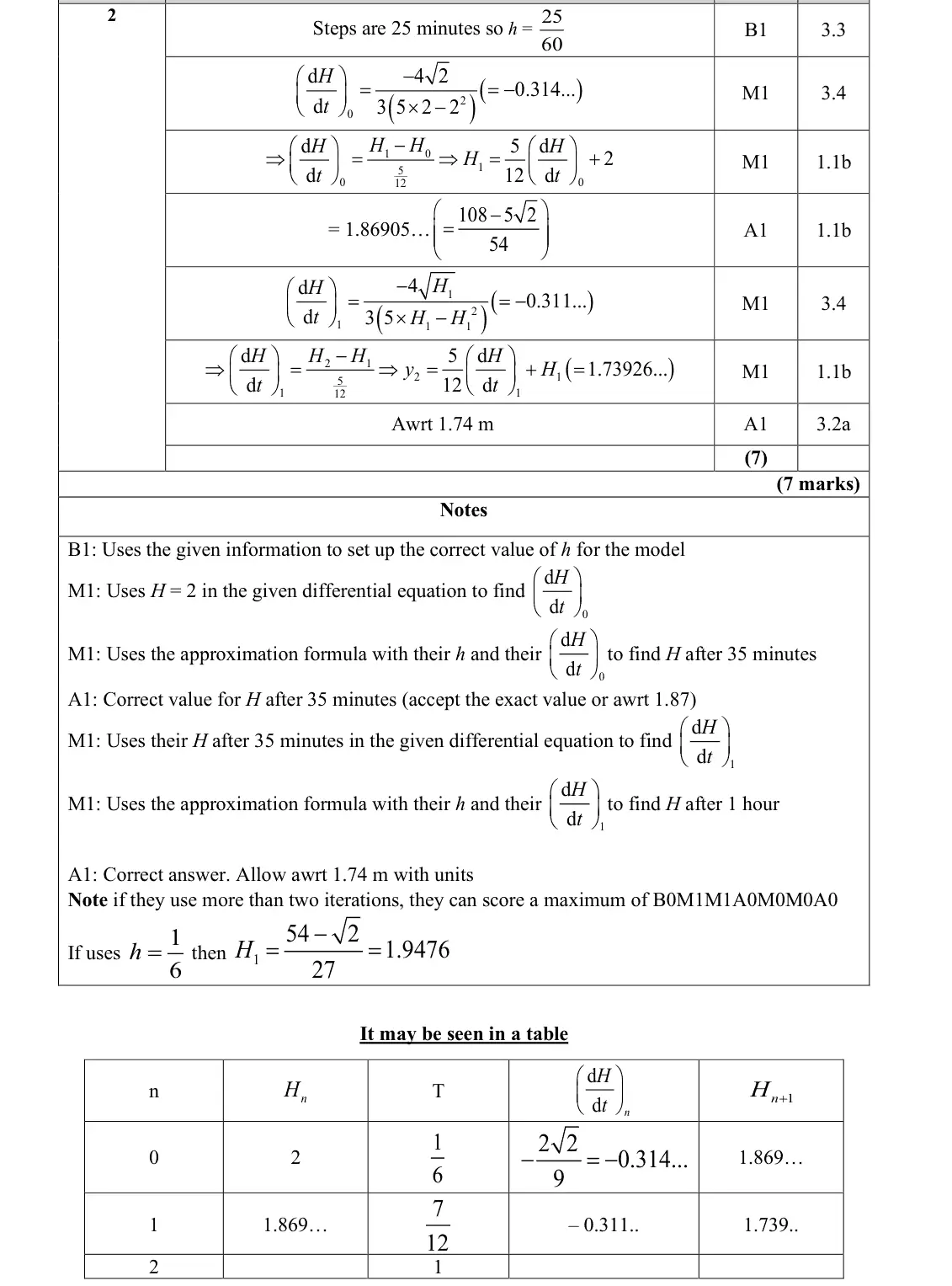
Mark scheme (whole question; this part is marked with the orange bar)
Examiner's comment
Many candidates obtained the correct value for h, but values of 25, 0.5, 1 6 also appeared quite frequently. Most understood the method, although some confused values of t for values of H in the formulae. There were frequent sign slips in the working, often giving increasing values for the depth; if candidates had realised after the first iteration that this must be wrong they might have corrected it early in the process. Most candidates remembered to give the units for their final answer. Many had some combination of a table and other working, which was not always easy to decipher.
Key points from the mark scheme and examiner's report
t in hours, start at t = 1/6 with H = 2, two steps to t = 1 so h = 25/60 = 5/12
H₁ ≈ 1.869, H₂ ≈ 1.74 m (units)
wrong h (25, 0.5, 1/6), sign slips giving an increasing depth, confusing t and H
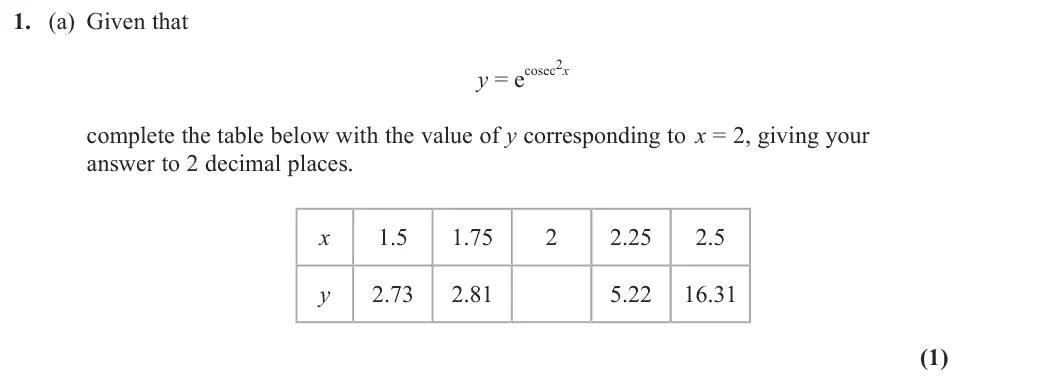
June 2025 · Paper 3A (Further Pure 1) · Q1(a)1 mark
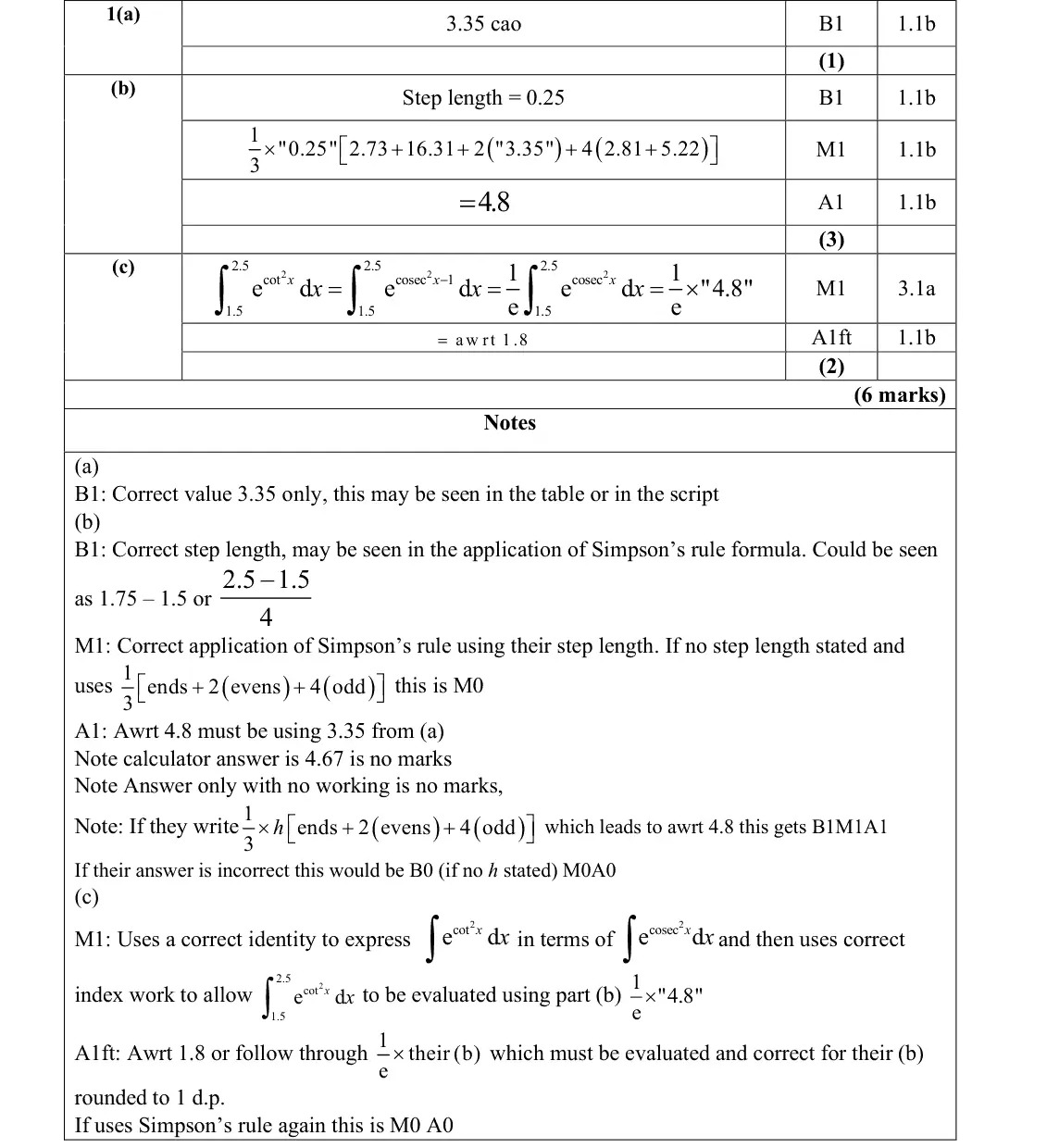
Mark scheme (whole question; this part is marked with the orange bar)
Examiner's comment
This question proved to be accessible with most learners achieving full marks. Part (a) The majority of learners scored this mark, an easy start
Key points from the mark scheme and examiner's report
y = e^(cosec²2) = 3.35 (2 d.p.)
June 2025 · Paper 3A (Further Pure 1) · Q1(b)3 marks
Mark scheme (whole question; this part is marked with the orange bar)
Examiner's comment
This question proved to be accessible with most learners achieving full marks. Part (b) Very few errors were made in identifying the step length, however a few implied h = 1 gaining no marks. A confusion of the "odd" and "even" ordinates roles in the use of Simpson's Rule was seen. As usual, there were also cases of missing brackets. A lack of showing working was also noted in some learners.
Key points from the mark scheme and examiner's report
errors: h = 1, odds and evens swapped, missing brackets, no working
June 2025 · Paper 3A (Further Pure 1) · Q1(c)2 marks
Mark scheme (whole question; this part is marked with the orange bar)
Examiner's comment
This question proved to be accessible with most learners achieving full marks. Part (c) was more challenging. The most common error was identifying the right identity, then mis-applying it, either by getting a sign wrong initially or - a surprisingly common one - writing the correct thing but then multiplying by e instead of dividing. Another sign of lower number-sense, as their integral became nearly 3 times the size instead of nearly 3 times smaller, and they didn't notice. Very occasionally learners applied Simpson’s again, gaining no marks.
Key points from the mark scheme and examiner's report
common errors: sign slip in the identity, multiplying by e instead of dividing, reapplying Simpson's rule (0)
June 2024 · AS Paper 2 (Further Pure 1) · Q2(a)5 marks
Mark scheme (whole question; this part is marked with the orange bar)
Examiner's comment
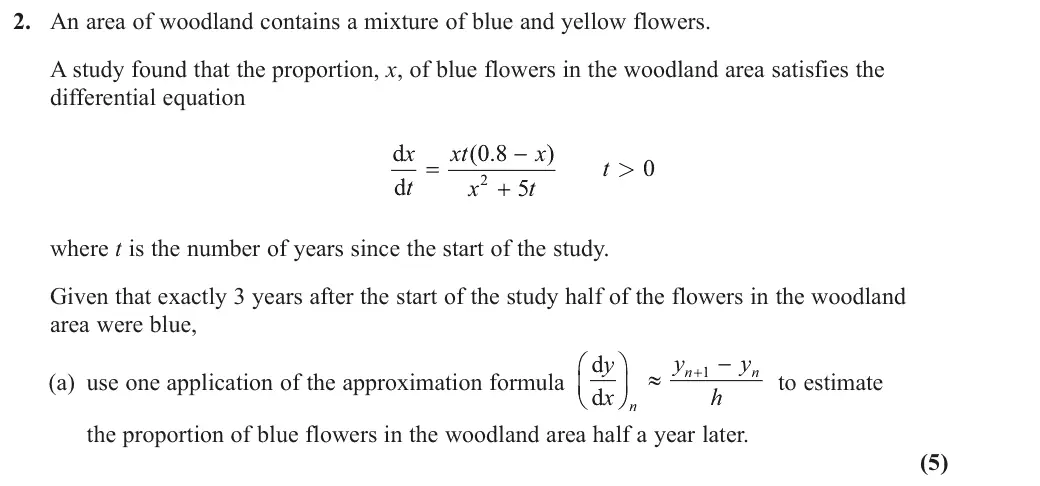
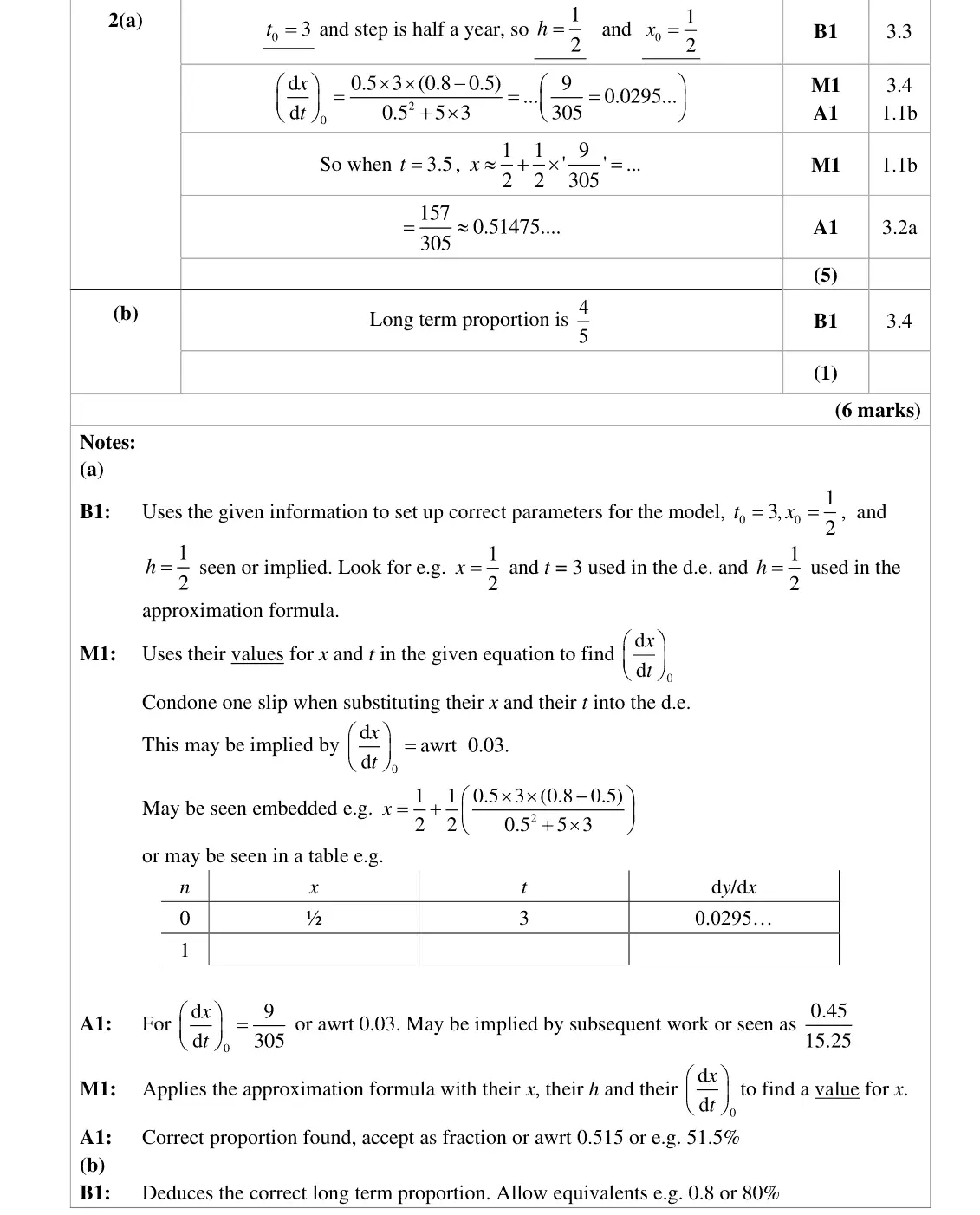
Part (a) of this question proved to be very accessible to most candidates and there were many fully correct solutions. The most common error was to use an incorrect value for 0. x There were a few instances where candidates tried to use the approximation entirely in x and could not proceed.
Key points from the mark scheme and examiner's report
t₀ = 3, x₀ = 0.5, h = 0.5
(dx/dt)₀ = 9/305 ≈ 0.0295
x ≈ 0.5 + 0.5 × 9/305 = 157/305 ≈ 0.515
wrong x₀ the commonest error
June 2024 · AS Paper 2 (Further Pure 1) · Q2(b)1 mark
Mark scheme (whole question; this part is marked with the orange bar)
Examiner's comment
Part (b) was not well answered and the correct answer of 0.8 was rarely seen. It was clear that the majority did not know how to deduce this value from the differential equation.
Key points from the mark scheme and examiner's report
dx/dt → 0 as x → 0.8, so long-term proportion 4/5 (0.8, 80%)
rarely seen
June 2024 · Paper 3A (Further Pure 1) · Q1(a)1 mark
Mark scheme (whole question; this part is marked with the orange bar)
Examiner's comment
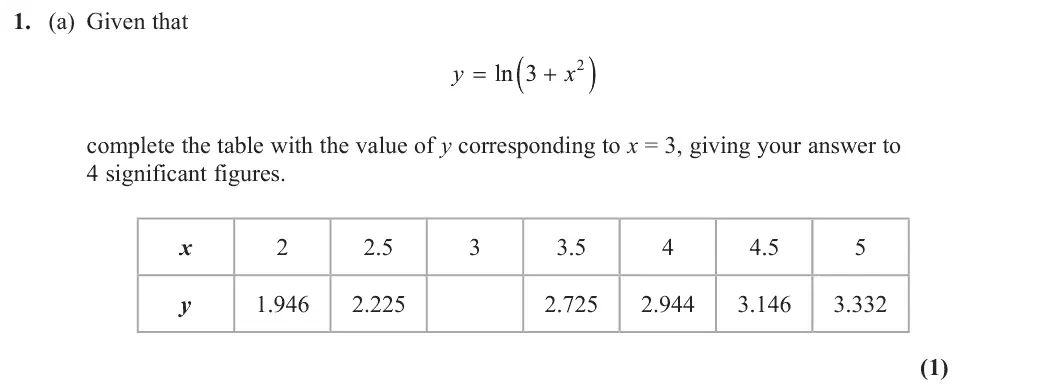
(a), with failure to do this likely to indicate not more marks would be scored on the paper, especially since answers rounding to it were accepted.
Key points from the mark scheme and examiner's report
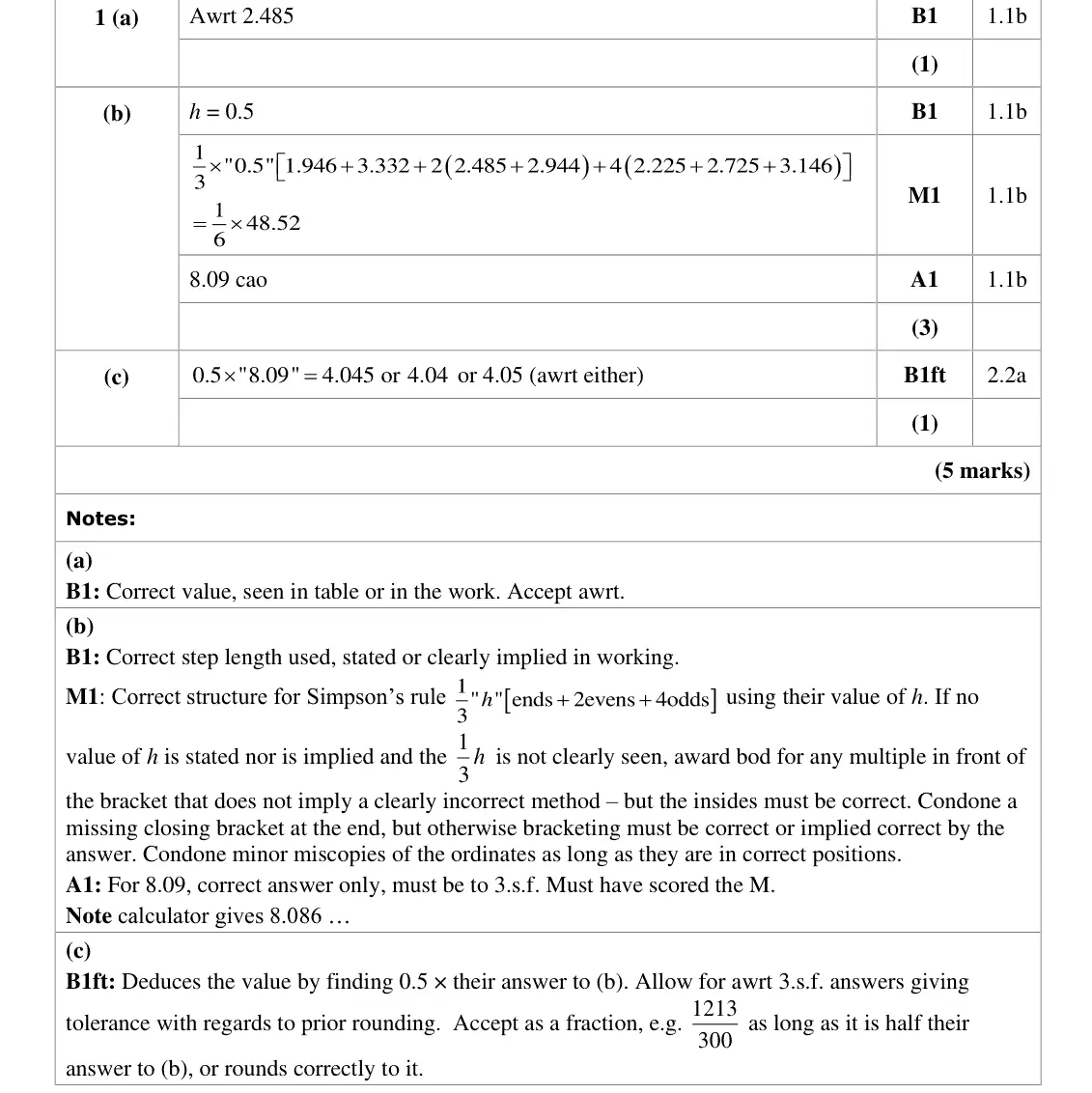
y = ln 12 = awrt 2.485
June 2024 · Paper 3A (Further Pure 1) · Q1(b)3 marks
Mark scheme (whole question; this part is marked with the orange bar)
Examiner's comment
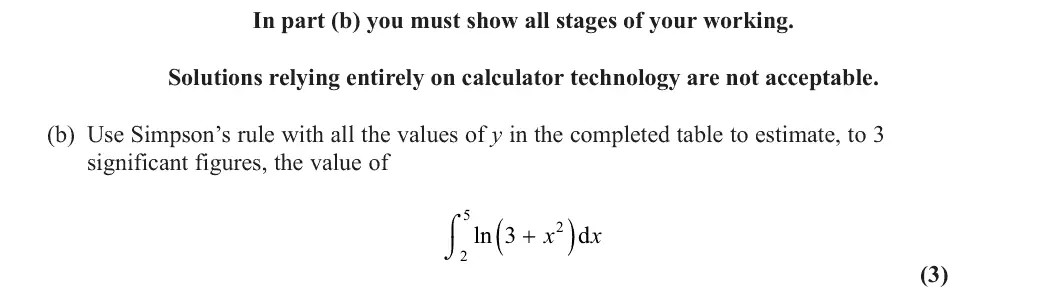
Part (b) was again well attempted by the majority, but various of the expected errors were made by weaker candidates, such as an incorrect value for the strip width such as 3 7 , or confusion of the “odd” and “even” ordinates roles in the use of Simpson’s Rule. As usual, there were also cases of missing brackets, and usually these were not recovered. Even at this level a lack of care when it comes to bracketing costs marks. A lack of showing working was also noted in some students, presumably obtaining the answer from a calculator (which gave the same answer to 3 significant figures) and so scoring no marks. The final mark of part (b) tested accuracy and so candidates who did not round their answer to the required three significant figure accuracy lost the final mark for otherwise correct work. This affected only a minority of candidates and most dutifully rounded to the required accuracy throughout the paper. Most candidates understood the relationship between the estimated integral and the integral asked for in (c) and thus halved their value from (b), though some had to carry out algebraic
Key points from the mark scheme and examiner's report
errors: wrong h, odds and evens swapped, missing brackets, no working shown, not 3 s.f.
June 2024 · Paper 3A (Further Pure 1) · Q1(c)1 mark
Mark scheme (whole question; this part is marked with the orange bar)
Examiner's comment
asked for in (c) and thus halved their value from (b), though some had to carry out algebraic manipulation of the integral before they could see it. The follow through allowed the mark to be scored even following misapplication of Simpson’s Rule, and sometimes this was the only mark scored in the question.
Key points from the mark scheme and examiner's report
ln √(3 + x²) = ½ ln(3 + x²) so the answer is half of (b): awrt 4.04 or 4.05
June 2023 · AS Paper 2 (Further Pure 1) · Q46 marks
Mark scheme (whole question; this part is marked with the orange bar)
Examiner's comment
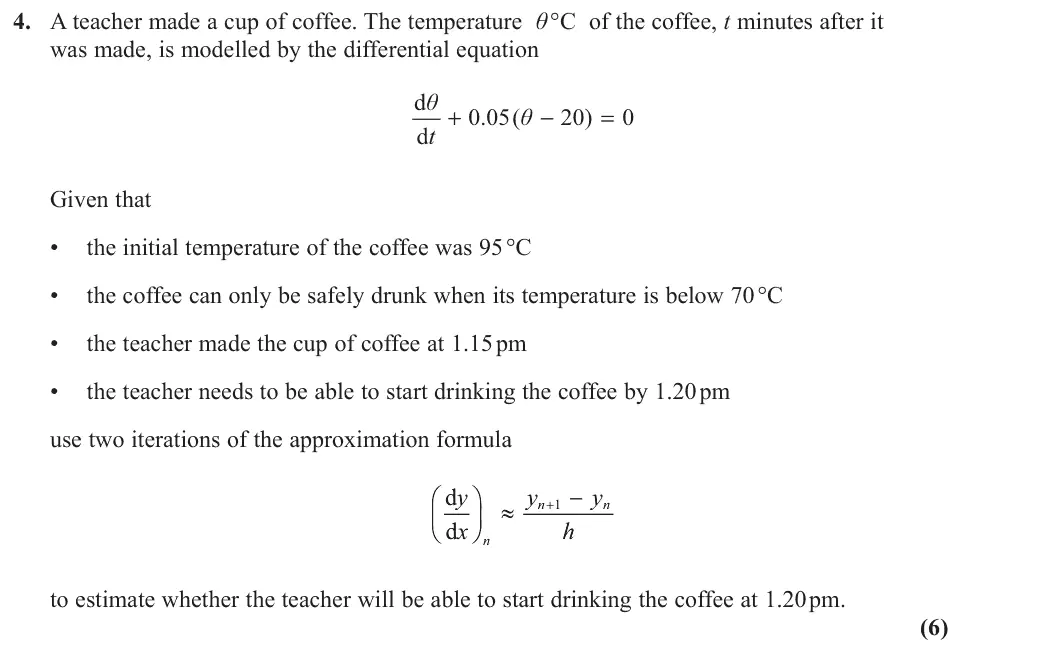
This was another question on another well-rehearsed topic which provided a good source of marks across all grades of student. Although the question was very well answered by most students, there were varying degrees of clarity in their processes. The method was clearly well understood, and its application carried out well. The place where students most commonly lost a mark was with the final conclusion, which was often missing an explicit comparison to justify the answer. Also common by way of error losing just one mark was the final A mark being lost due to calculation error during the process, but the follow through final mark was often gained in such instances. Where responses were incorrect other than calculation error, this was usually a right method but with an incorrect value from the set up - usually h, where time was considered as a duration going from 1.15 to 1.2 rather than a clock time going from 1:15 to 1:20 giving h = 0.025. Others worked in hours so had h = 1 24 , and a few used h = 2.5 for the first iteration then h = 5 for the second. A few also failed to recalculate the value of d dt for the second iteration, using the same value for both.
Key points from the mark scheme and examiner's report
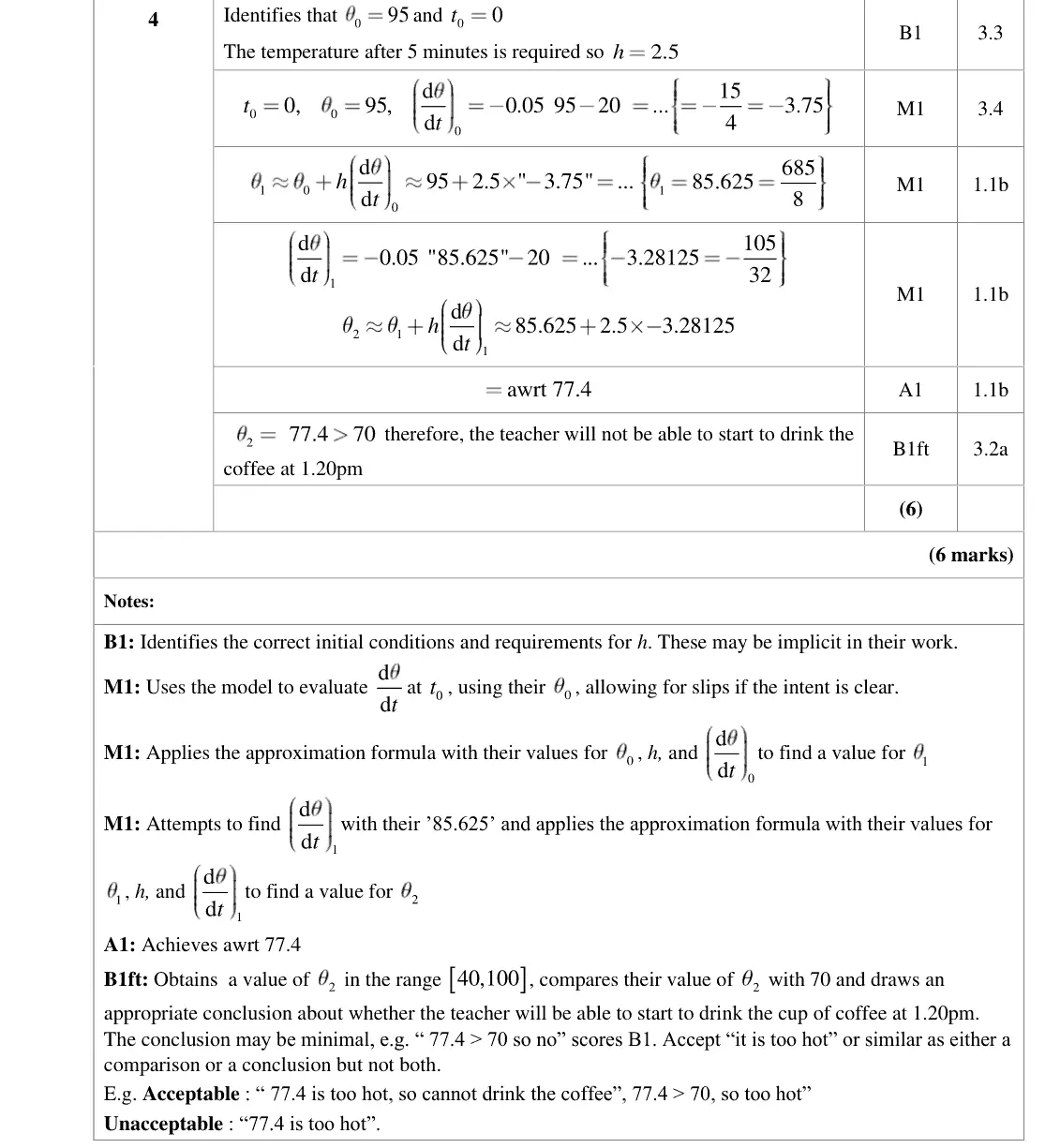
t₀ = 0, θ₀ = 95, h = 2.5 (5 minutes in two steps)
θ₁ = 85.625, θ₂ ≈ 77.4 > 70 so cannot drink it at 1.20 pm
conclusion needs an explicit comparison with 70
h = 0.025 or 1/24 from misreading times
dθ/dt not recalculated for the second step
June 2023 · Paper 3A (Further Pure 1) · Q1(a)4 marks
Mark scheme (whole question; this part is marked with the orange bar)
Examiner's comment
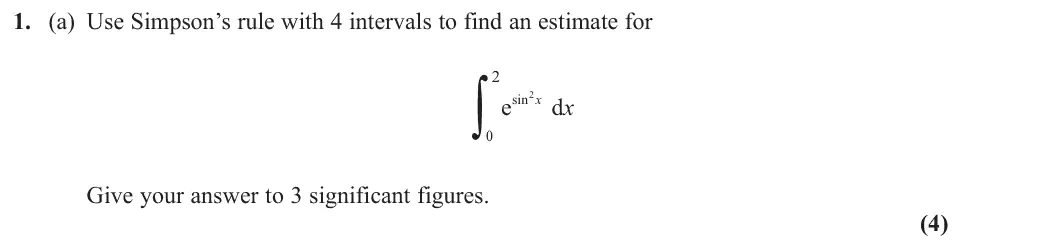
This proved to be an accessible start to the paper for the majority of students with many fully correct solutions seen. Most achieved either full marks or lost just one mark in total, either the level of accuracy in part (a) or the explanation of part (b) being the cause of the loss of a mark. In part (a) it was rare to see incorrect applications of Simpson’s Rule, most seeming well drilled in the process. Occasional incorrect, or omission of the h, did occur, as well as a few cases of the 2 and 4 times multiples being mixed up, or a repeated value or wrong number of ordinate, but none of these were common. An error seen more often was to have their calculator in degree mode when attempting to find the required five ordinates, thus producing an answer far away from the given exact answer. Another common error was to lose the accuracy mark because the answer was not given to the required three significant figures.
Key points from the mark scheme and examiner's report
errors: calculator in degrees, answer not to 3 s.f., h omitted or 2 and 4 swapped
June 2023 · Paper 3A (Further Pure 1) · Q1(b)1 mark
Mark scheme (whole question; this part is marked with the orange bar)
Examiner's comment
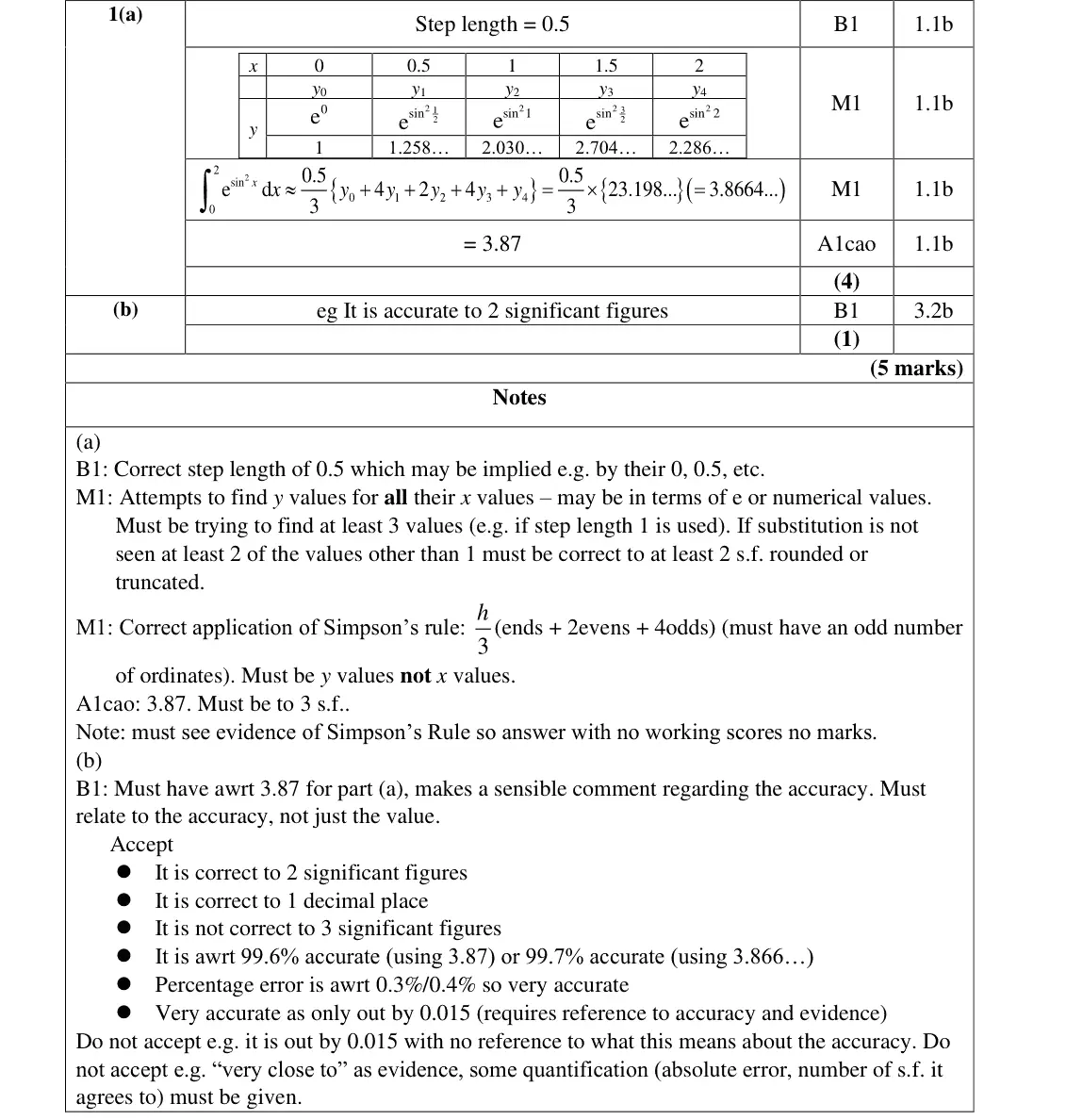
This proved to be an accessible start to the paper for the majority of students with many fully correct solutions seen. Most achieved either full marks or lost just one mark in total, either the level of accuracy in part (a) or the explanation of part (b) being the cause of the loss of a mark. In order to access part (b) a correct attempt resulting in a value rounding to 3.87 needed to have been made in part (a). Those who had wildly incorrect answers from (a) should have realised such answers would not befit the method and check their work, so were not given credit. In commenting about the accuracy of the estimate in part (b), a percentage error was the most popular item of evidence to use. A few did use one of the other viable comments allowed, such as reference to “correct to two significant figures”, “correct to one decimal place” or “accurate as only out by 0.015”. However, there were a few cases where just “accurate” or similar was stated, and these were not deemed sufficient for credit. Some tried to explain how it would be more accurate with shorter steps, without making a specific comment about their result, not appreciating the demand of the question.
Key points from the mark scheme and examiner's report
needs awrt 3.87 in (a)
quantify: correct to 2 s.f., or 0.4% error, or out by only 0.015
just "accurate" or "very close" scores 0
June 2022 · AS Paper 2 (Further Pure 1) · Q27 marks
Mark scheme (whole question; this part is marked with the orange bar)
Examiner's comment
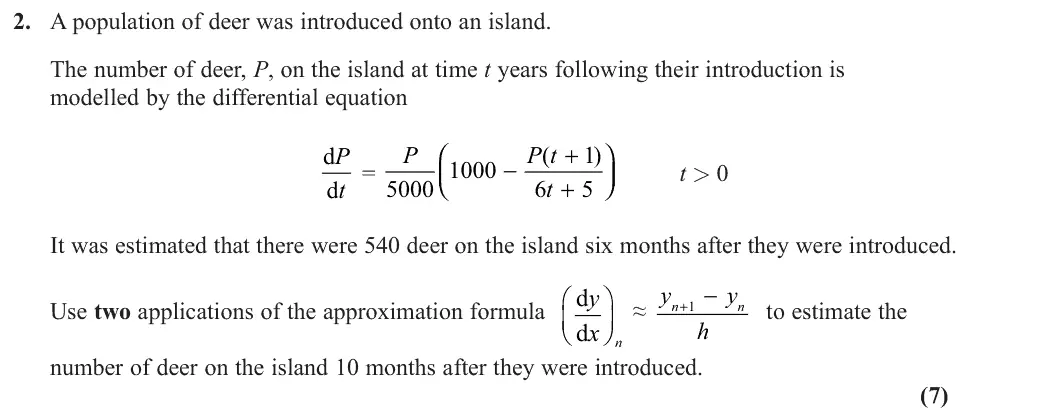
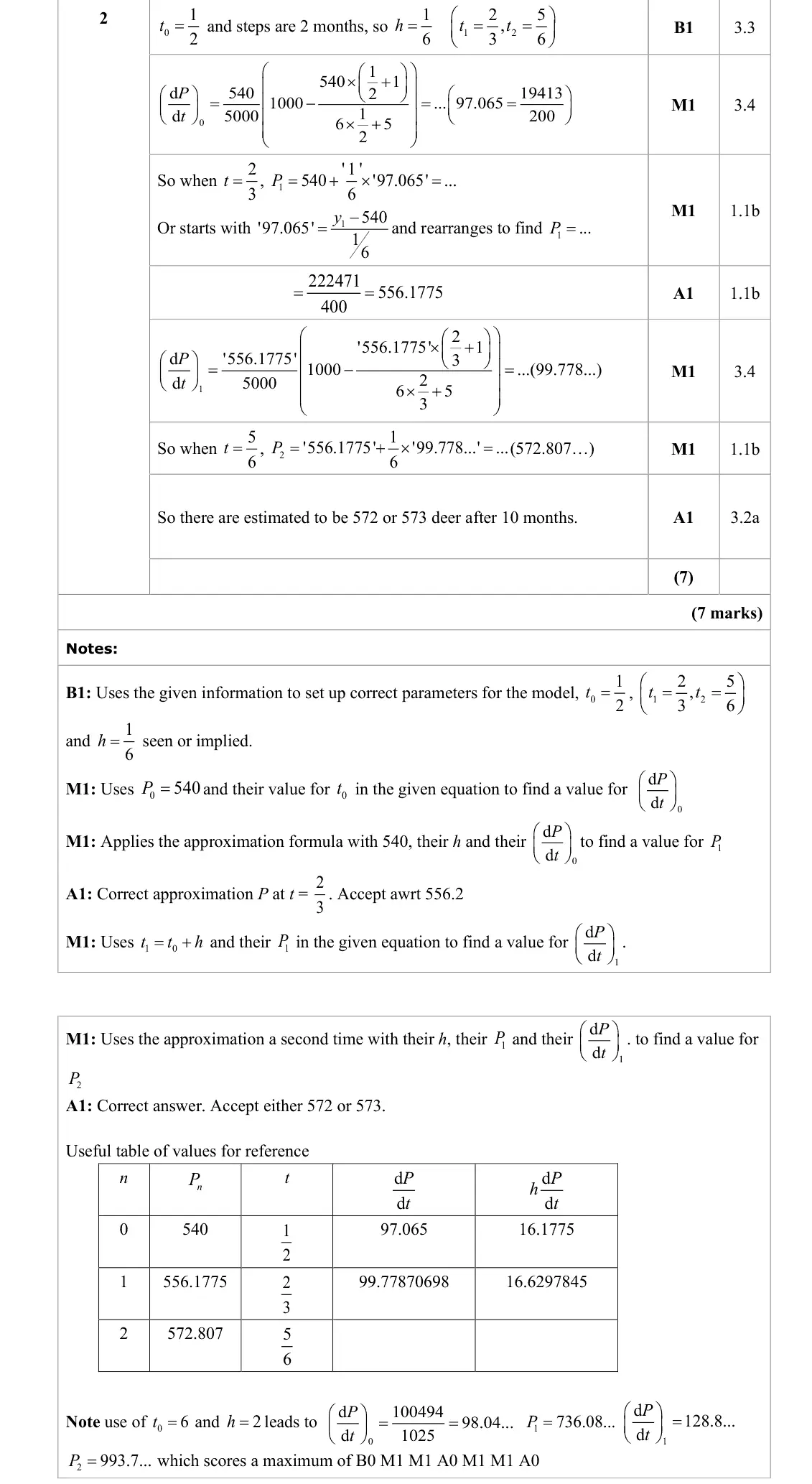
Again, almost all candidates knew how to approach this question and achieved some if not all method marks. A common error was with identifying the initial parameters, with confusion between months vs years leading to use of h = 2 and t0 = 6. In most cases, candidates had clearly shown their methods and were able to follow through both iterations successfully. A few candidates rounded values early and lost accuracy marks, and some omitted a final integer answer to the question, also forfeiting a mark.
Key points from the mark scheme and examiner's report
t in years: t₀ = 1/2, h = 1/6
P₁ = 556.18, P₂ = 572.8 so 572 or 573 deer
using h = 2 and t₀ = 6 (months) is the common error
early rounding and no integer final answer lost marks
June 2022 · Paper 3A (Further Pure 1) · Q4(a)5 marksEasy
Mark scheme (whole question; this part is marked with the orange bar)
Examiner's comment
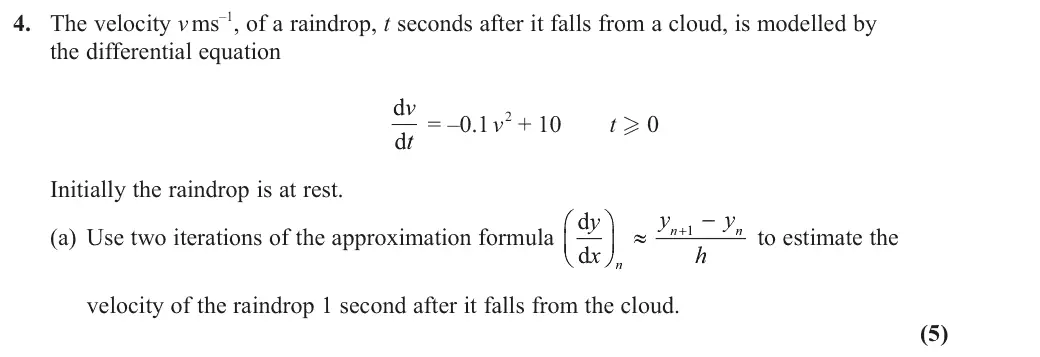
The second most successfully answered question on the paper, with full marks achieved by nearly two thirds of candidates, and 85% achieving at least 6/7. The next most common score was zero marks, scored by 7%, perhaps not entirely surprising in that if the method is not familiar, little progress was likely, and the question was left blank (even though the single mark in (b) could have been gained independently of (a)). Most candidates were able to achieve full marks in part (a) from a correct interpretation of the given formulae, though occasional slips were made during the second iteration. Common errors here were in basic numerical slips such as 10 x 0.5 = 20. Some candidates set out working well using a table to show their evaluated values. However, working should still be shown as an error would have meant that they would lose method marks. One major error sometimes made in those who scored few marks was failing to realise h =0.5 (usually using 1 instead) though this was rare. Some mistakes arose from confusion between v and d d v t when substituting in values to find the final velocity.
Key points from the mark scheme and examiner's report
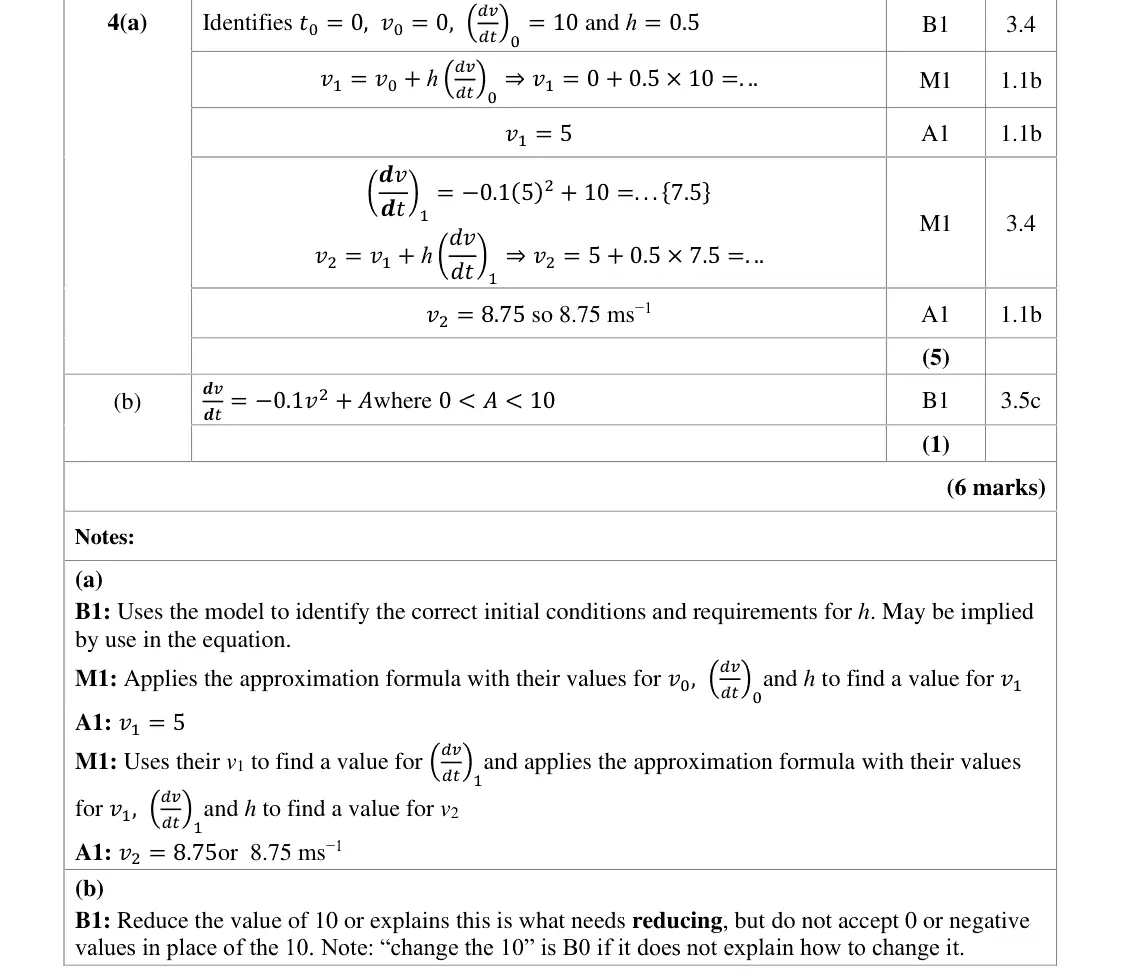
h = 0.5, v₀ = 0, (dv/dt)₀ = 10: v₁ = 5
(dv/dt)₁ = 7.5: v₂ = 8.75 m s⁻¹
errors: h = 1, confusing v with dv/dt, arithmetic slips
June 2022 · Paper 3A (Further Pure 1) · Q4(b)1 markEasy
Mark scheme (whole question; this part is marked with the orange bar)
Examiner's comment
The second most successfully answered question on the paper, with full marks achieved by nearly two thirds of candidates, and 85% achieving at least 6/7. The next most common score was zero marks, scored by 7%, perhaps not entirely surprising in that if the method is not familiar, little progress was likely, and the question was left blank (even though the single mark in (b) could have been gained independently of (a)). Most realised in part (b) that the constant 10 needed to be reduced, though overall the attempts varied in success a lot more than in part (a). Some candidates lost marks here by not being specific enough or too vague in their response. Others tried to manipulate the v2 coefficient instead of the constant changing the -0.1 to -0.05 or -0.01, forgetting that the initial velocity was zero. The most successful responses here were the ones which gave a specific example to highlight their explanation, the most common being changing the constant from 10 to 9.8, though any number less than 10 but greater than 0 was acceptable, and a variety of values were seen.
Key points from the mark scheme and examiner's report
reduce the constant 10 to a value between 0 and 10 (e.g. 9.8)
changing the −0.1 is wrong since v = 0 initially
vague "change the 10" scores 0
Nov 2021 · Paper 3A (Further Pure 1) · Q8(a)4 marks
Mark scheme (whole question; this part is marked with the orange bar)
Examiner's comment
Many candidates demonstrated very good differentiate equation skills. Part (a) Done well by the majority of candidates. Recognises that h = 0.25 as time was in days, finding the value of the first derivative when t = 0 and applying the iterative formula stated in the question. The most common error was in using h = 6, thinking that time was in hours, careful reading of the question was required.
Key points from the mark scheme and examiner's report
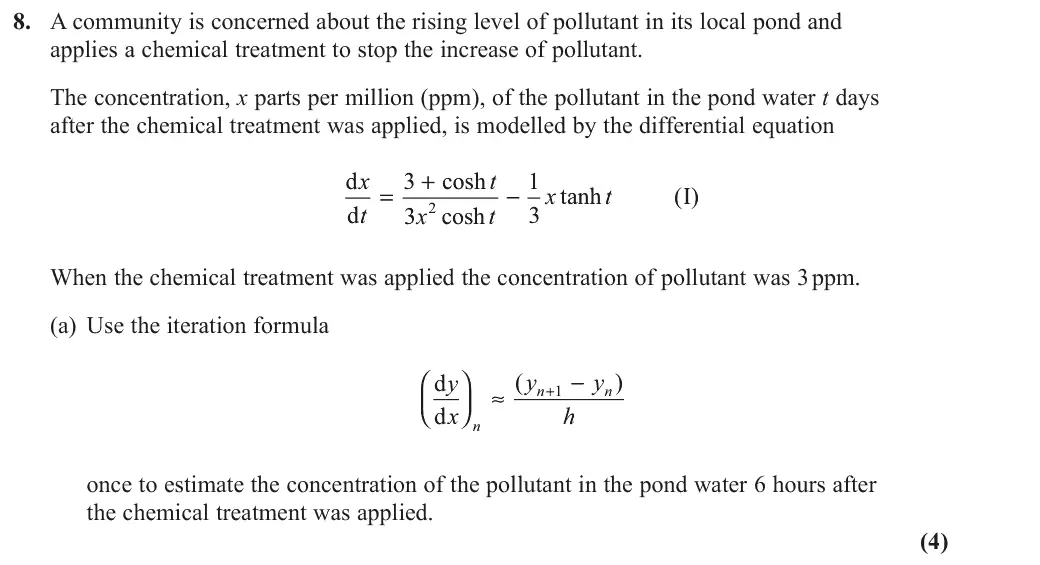
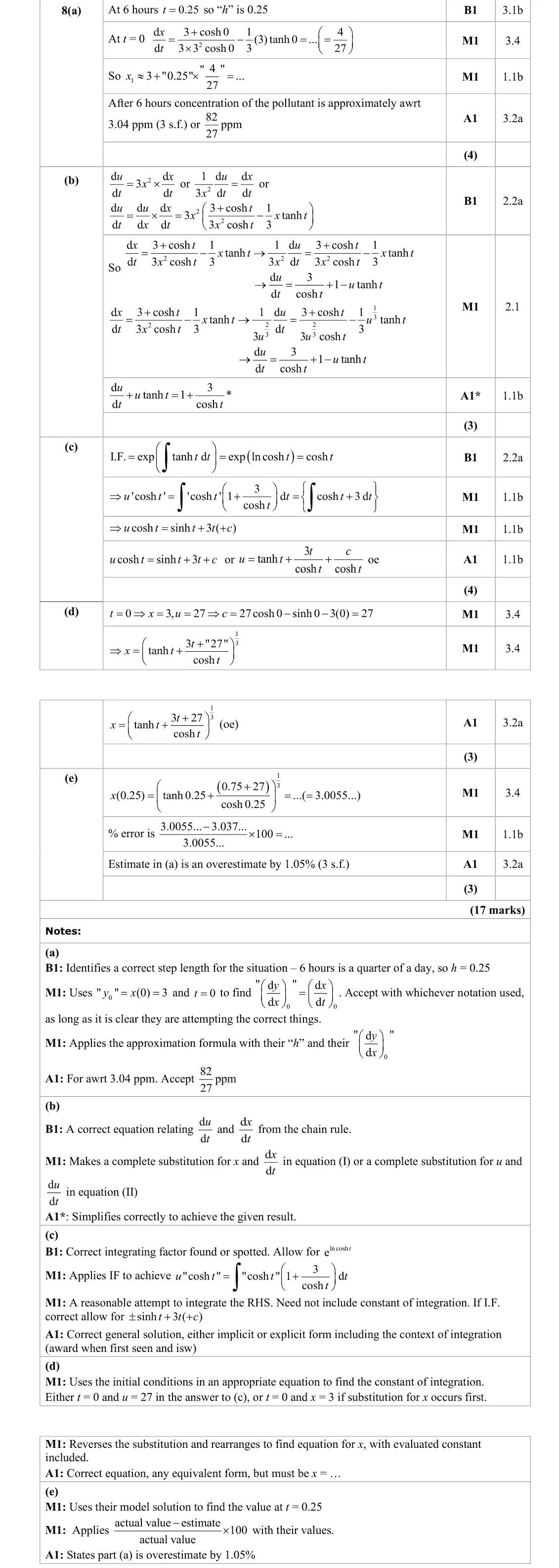
h = 0.25 since 6 hours is a quarter of a day
x'(0) = 4/27
x ≈ 3 + 0.25 × 4/27 = 82/27 ≈ 3.04 ppm
common error h = 6
Nov 2021 · Paper 3A (Further Pure 1) · Q8(e)3 marks
Mark scheme (whole question; this part is marked with the orange bar)
Examiner's comment
Many candidates demonstrated very good differentiate equation skills. Part (e) candidates who managed to achieve an answer for part (d) found the concentration of pollutant when t = 0.25, again a common error was using t = 6. The percentage error was found and it was good to see that the model answer was used as the denominator not the answer to part (a) which was the approximation. Sometimes that final mark was lost due to premature rounding or failing to state that it is an overestimate. Overall candidates appeared to be well prepared for this exam and were able to have good attempt at the majority of the questions.
Key points from the mark scheme and examiner's report
Oct 2020 · AS Paper 2 (Further Pure 1) · Q17 marks
Mark scheme (whole question; this part is marked with the orange bar)
Examiner's comment
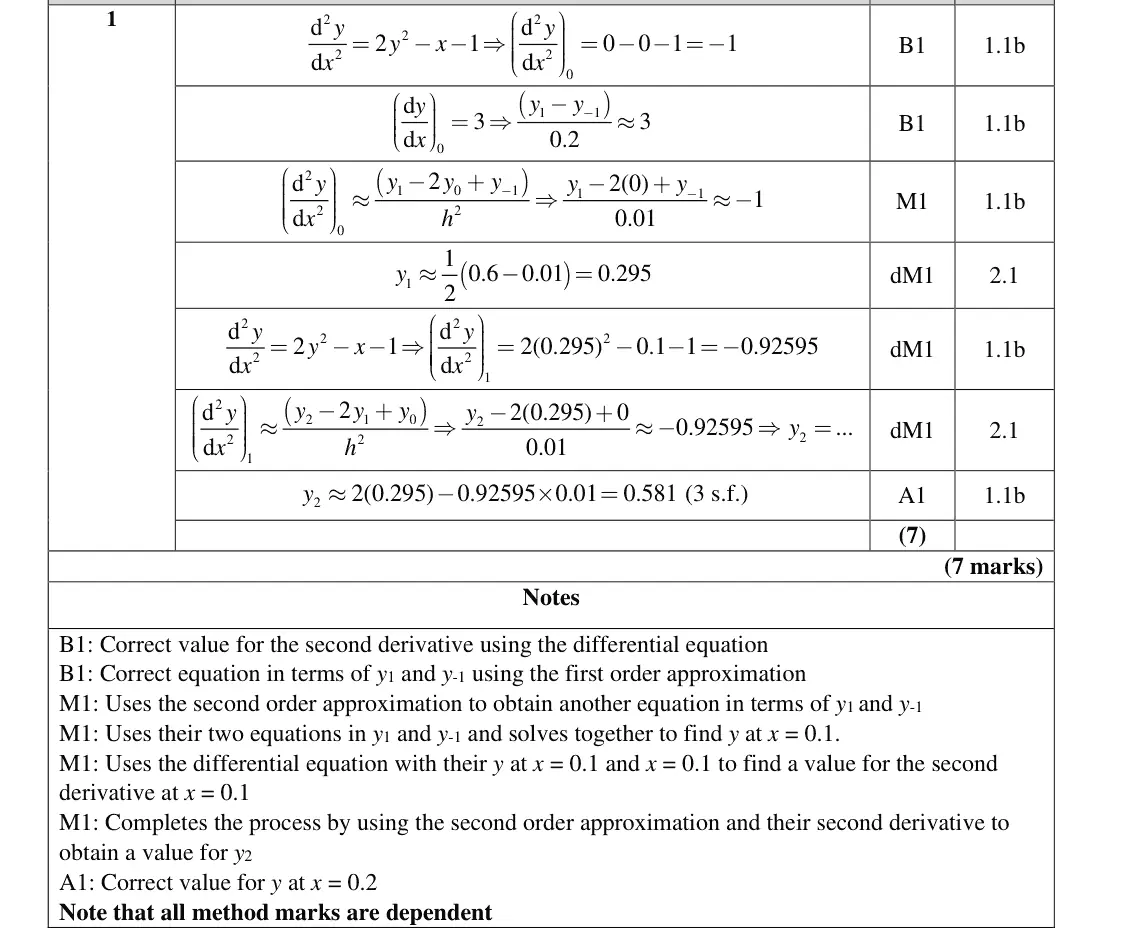
Candidates who attempted this question could at least make a start by finding the value of the second derivative using the given differential equation. Some then went on to use both approximations and realised they needed to solve the resulting simultaneous equations to make progress. 4 candidates scored full marks and 6 candidates made no attempt at this question.
Key points from the mark scheme and examiner's report
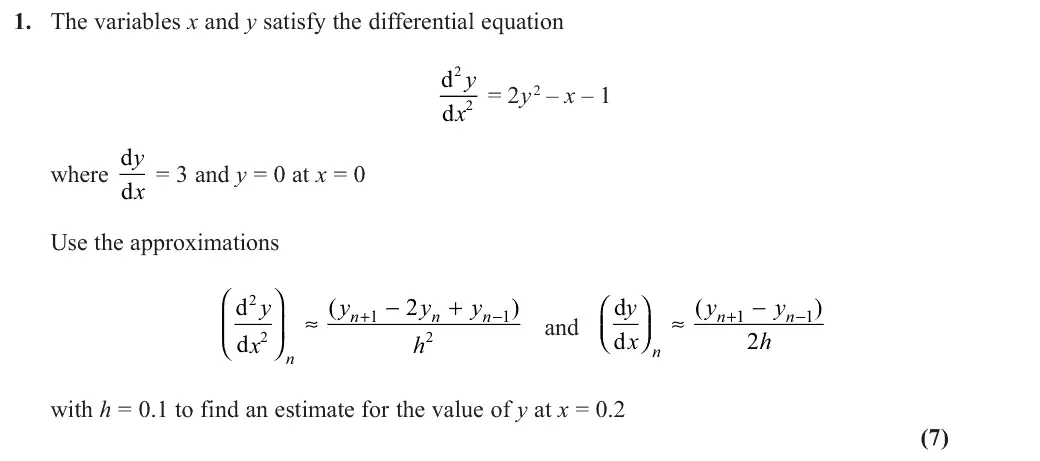
y″₀ = −1 from the equation
central difference (y₁ − y₋₁)/0.2 = 3 and (y₁ − 2y₀ + y₋₁)/0.01 = −1 solved simultaneously: y₁ = 0.295
then y″₁ = −0.92595 and y₂ ≈ 0.581
many did not see the need to eliminate y₋₁
Oct 2020 · Paper 3A (Further Pure 1) · Q26 marks
Mark scheme (whole question; this part is marked with the orange bar)
Examiner's comment
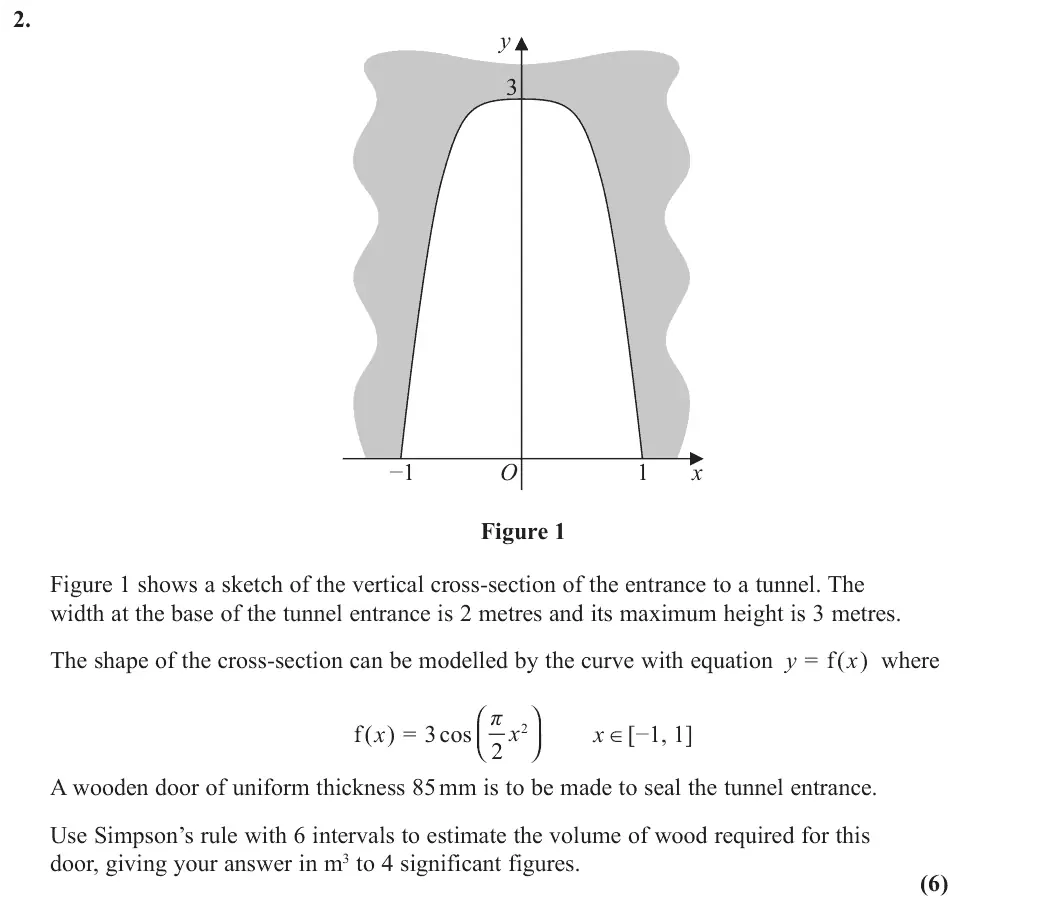
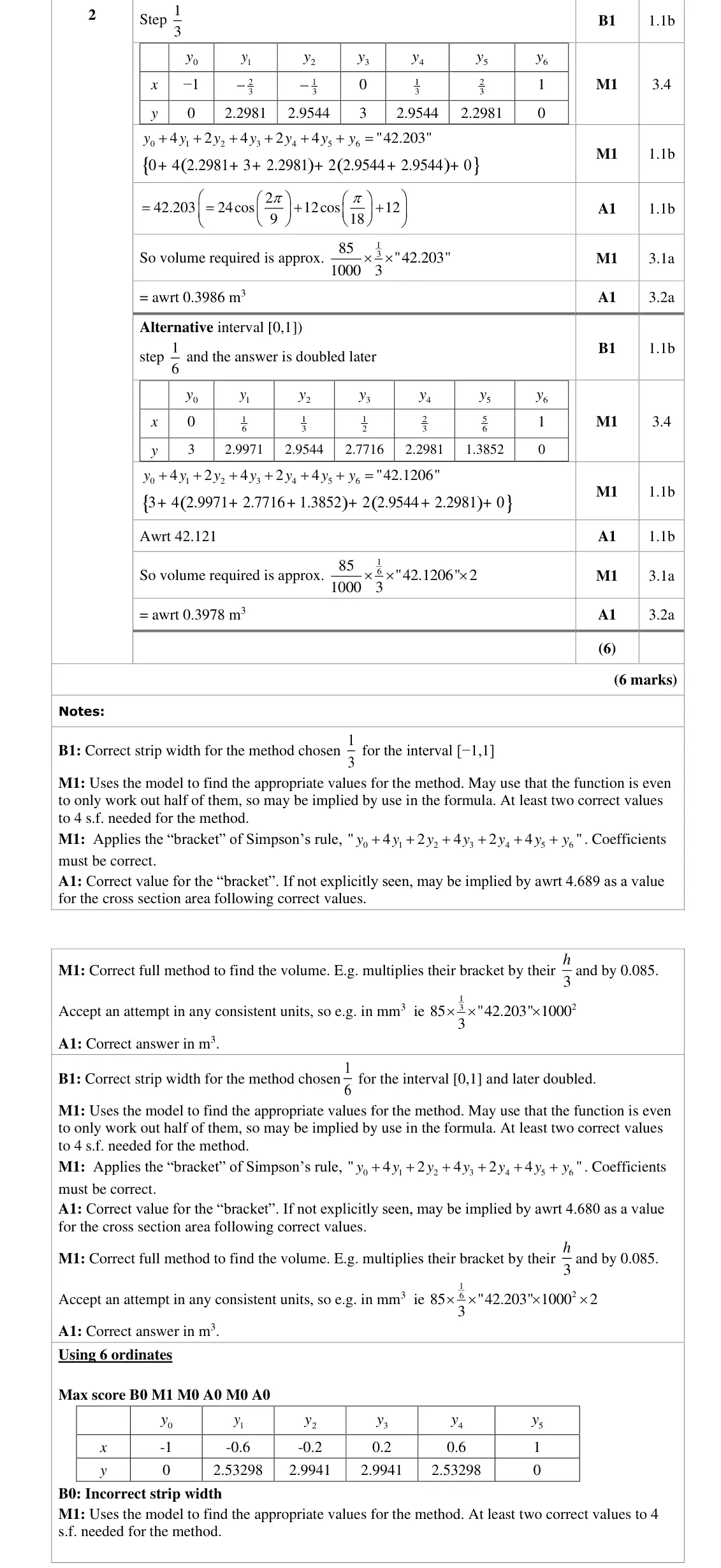
This question was approached well in the majority of cases with most candidates having a good idea of what was expected. The vast majority divided the interval from – 1 to 1 into 6 intervals, calculated y values and applied Simpson’s rule to find the area of the cross section. The most common errors were attempting to use 6 ordinates rather than 6 intervals, getting the coefficients the wrong way round in their application of Simpson’s rule and errors involving the units when finding the volume of wood required from their cross-sectional area. There was also a very small number of students who attempted to use a formula for a volume of revolution, possibly seeing that a volume was required and jumping to the wrong conclusion.
Key points from the mark scheme and examiner's report
h = 1/3 on [−1, 1], seven ordinates
area ≈ 4.689, volume = 0.085 × area ≈ 0.3986 m³ (awrt)
errors: 6 ordinates instead of 6 intervals, Simpson coefficients swapped, mm/m unit slips, volume of revolution used
June 2019 · AS Paper 2 (Further Pure 1) · Q37 marks
Mark scheme (whole question; this part is marked with the orange bar)
Examiner's comment
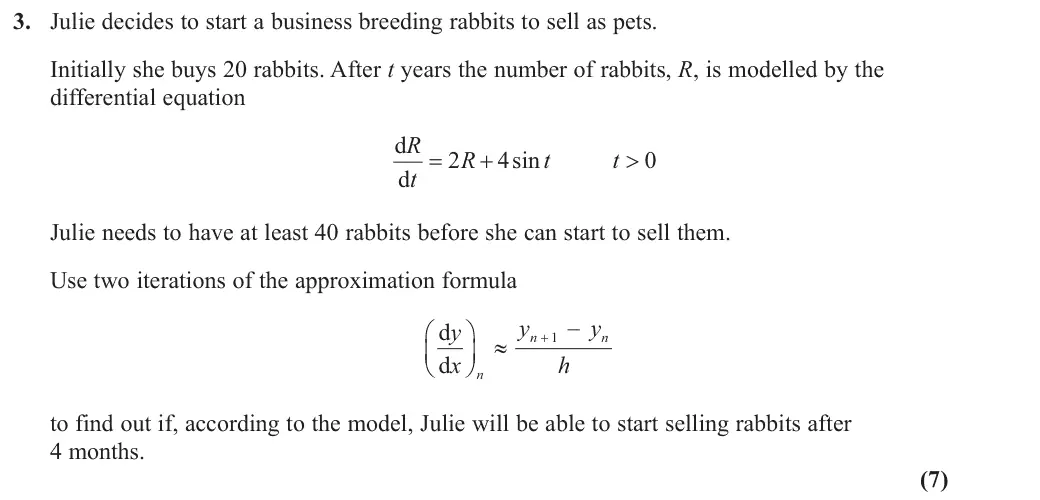
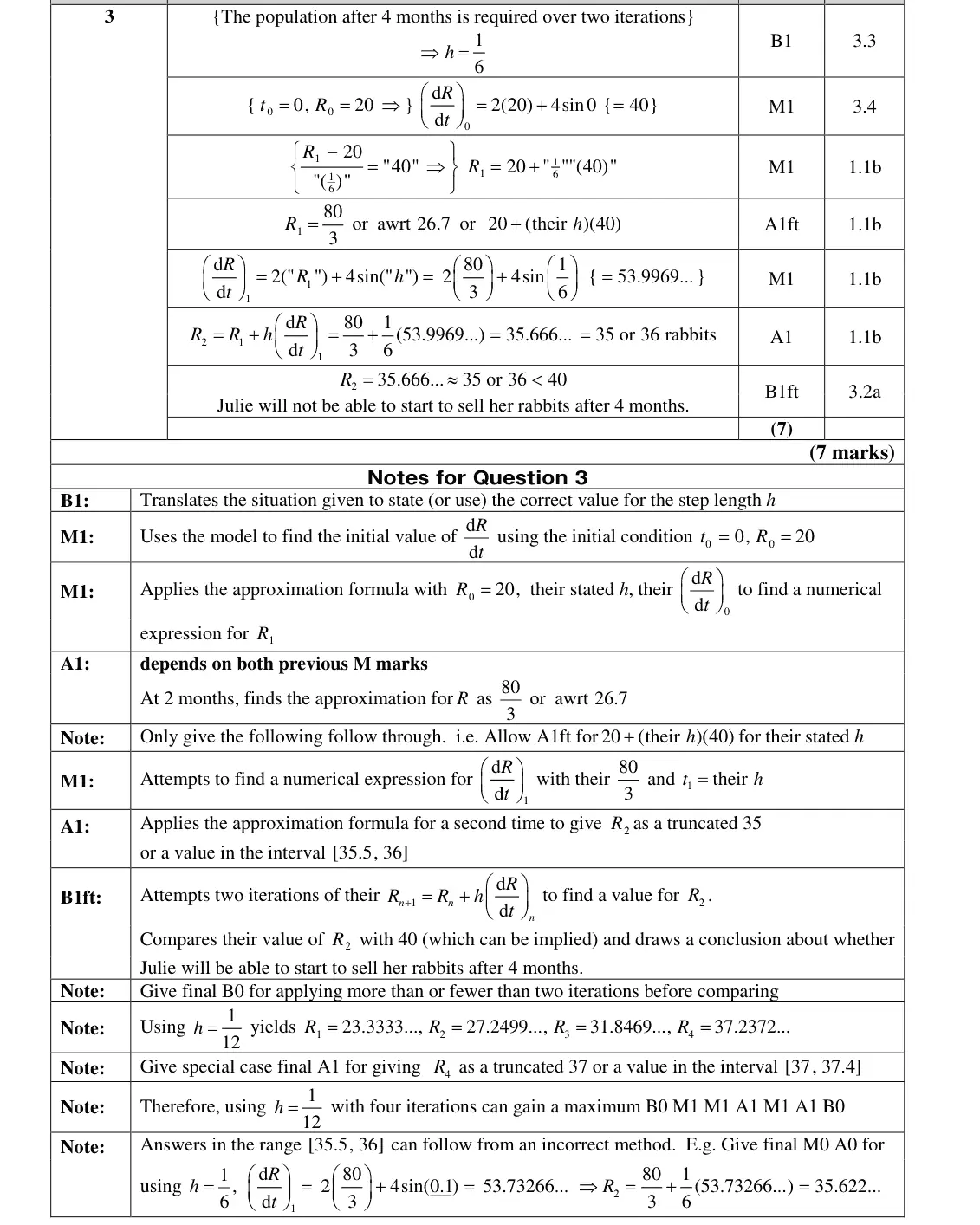
Q3 was well-answered with many candidates scoring full marks. Most candidates applied two iterations of 1 d d n n n R R R h t for 0, 1 n with 0 20 R and found an estimate for the number of rabbits at 4 months. Common errors included using an incorrect value for h such as 0.2, 2 or 1 ; 12 using 0 1 1 1 , 6 3 t t 0 1 1 instead of 0, 6 t t in their first and second iteration, respectively; or incorrectly finding 0 d d R t as 1 2(20) 4sin . 6 A few candidates applied 4 iterations with 1 12 h and some candidates were unaware that they should be working in radians. Nearly all candidates gave a correct conclusion in context for their estimated value of 2 . R
Key points from the mark scheme and examiner's report
t in YEARS so h = 1/6 for two steps to 4 months
R₁ = 80/3, R₂ ≈ 35.7 < 40 so she cannot sell
wrong h (0.2, 2, 1/12) and using degrees in sin t were the common errors
June 2019 · Paper 3A (Further Pure 1) · Q15 marks
Mark scheme (whole question; this part is marked with the orange bar)
Examiner's comment
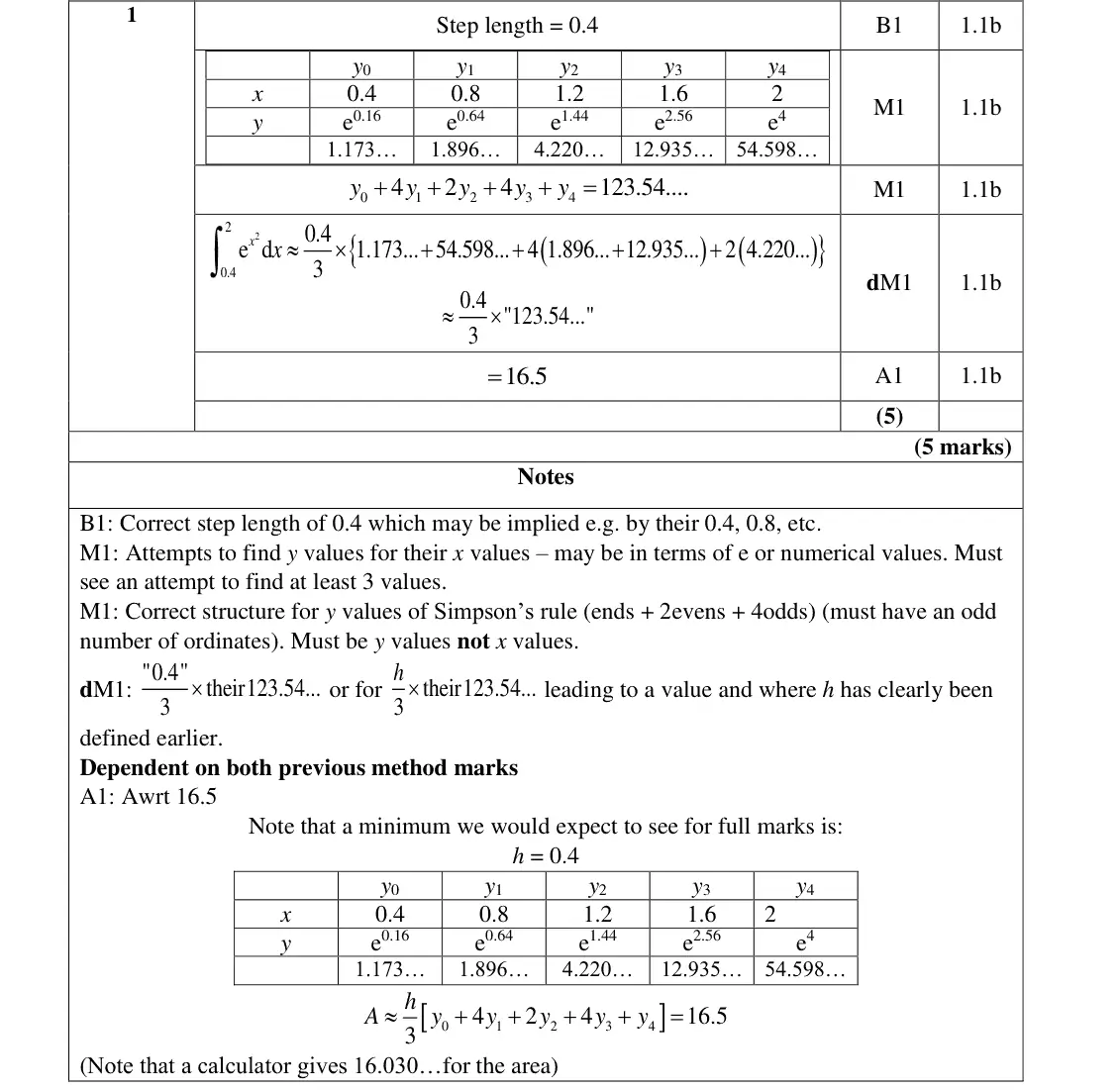
Candidates found this an accessible question at the beginning of the paper with the majority achieving full marks. Many candidates made a successful start and the first two marks, for finding ℎ and evaluating the 𝑦-values, proved to be attainable by almost all candidates. Subsequent mistakes seen included the use of an incorrect number of intervals and mislabelling of their ordinates so that their odds and evens were confused in the formula. Several attempts were seen to use the trapezium rule.
Key points from the mark scheme and examiner's report
h = 0.4 with five ordinates
ends + 4 odds + 2 evens, times h/3: awrt 16.5
errors: wrong number of intervals, odds and evens confused, trapezium rule used instead
June 2018 · AS Paper 2 (Further Pure 1) · Q2(a)6 marks
Mark scheme (whole question; this part is marked with the orange bar)
Examiner's comment
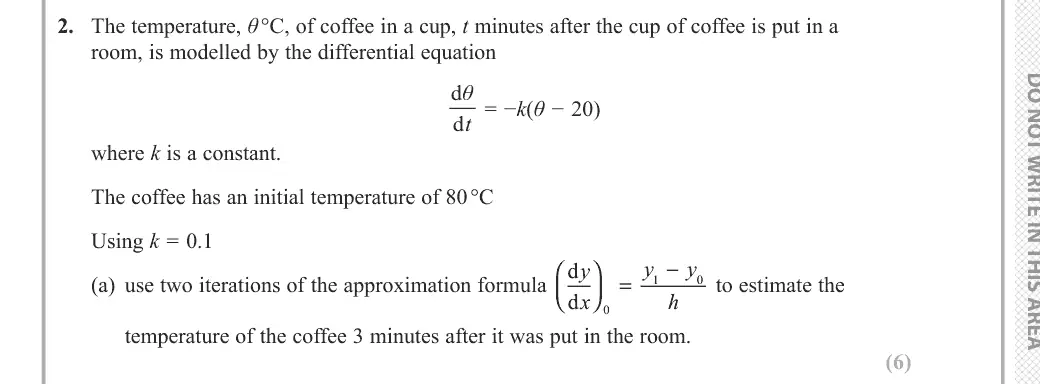
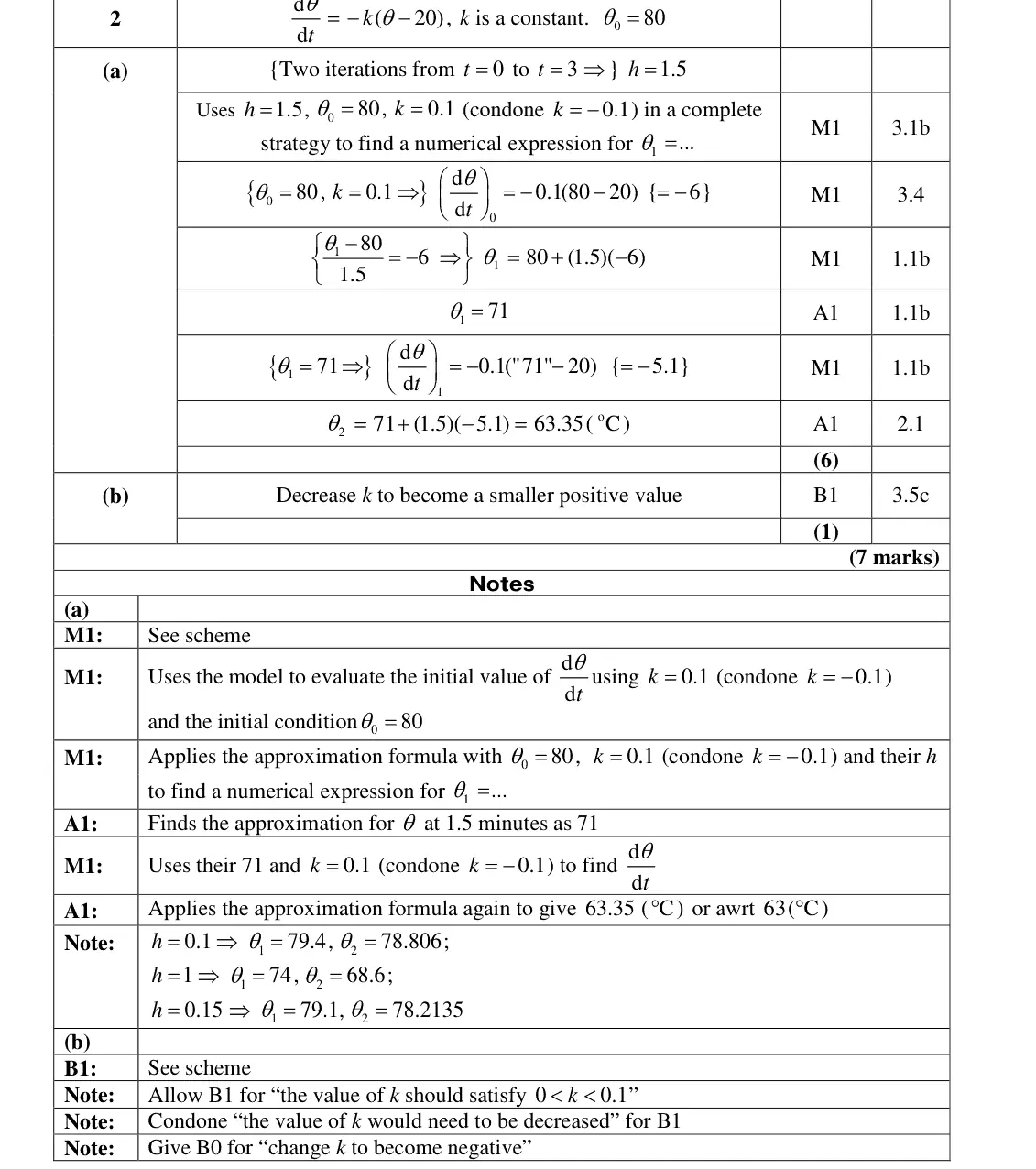
This was a well-answered question with many students scoring full marks in part (a). In part (a), most students applied two iterations of 1 d d n n n h t for 0, 1 n with 0 80 and found their estimate for the temperature of the coffee 3 minutes after it was put in the room. The most common error was using an incorrect value for h such as 0.1, 0.15 or 1. Some students applied an incorrect 0 60.
Key points from the mark scheme and examiner's report
June 2018 · AS Paper 2 (Further Pure 1) · Q2(b)1 mark
Mark scheme (whole question; this part is marked with the orange bar)
Examiner's comment
This was a well-answered question with many students scoring full marks in part (a). In part (b), some students demonstrated a very good understanding of the model by suggesting that ‘k should be decreased to become a smaller positive value’. Many students suggested that ‘the value of k would need to be decreased’ which was allowed as an acceptable suggestion. Incorrect suggestions included ‘increase the value of k’, ‘k should become more negative’ or ‘k should satisfy 1 0 k ’.
Key points from the mark scheme and examiner's report
k should be decreased to a smaller positive value (0 < k < 0.1)
"make k negative" or "increase k" scores 0
Find an Edexcel Further Maths tutor
Stuck on this? Book a trial lesson with our Further Maths tutor.