Notes, worked examples and practice for this topic are being written by our tutors. The past-paper questions below are ready now: work each one on paper, then open the mark scheme and the examiner's comment.
Tap a question to zoom it. Mark scheme and examiner's comment open under each question.
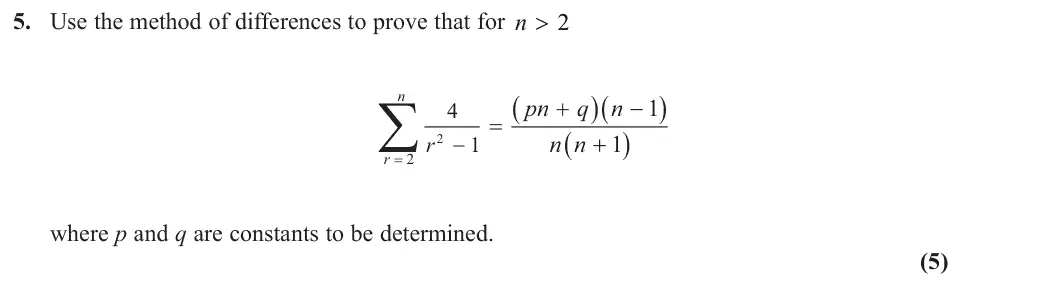
June 2025 · Paper 1 (Core Pure 1) · Q55 marks
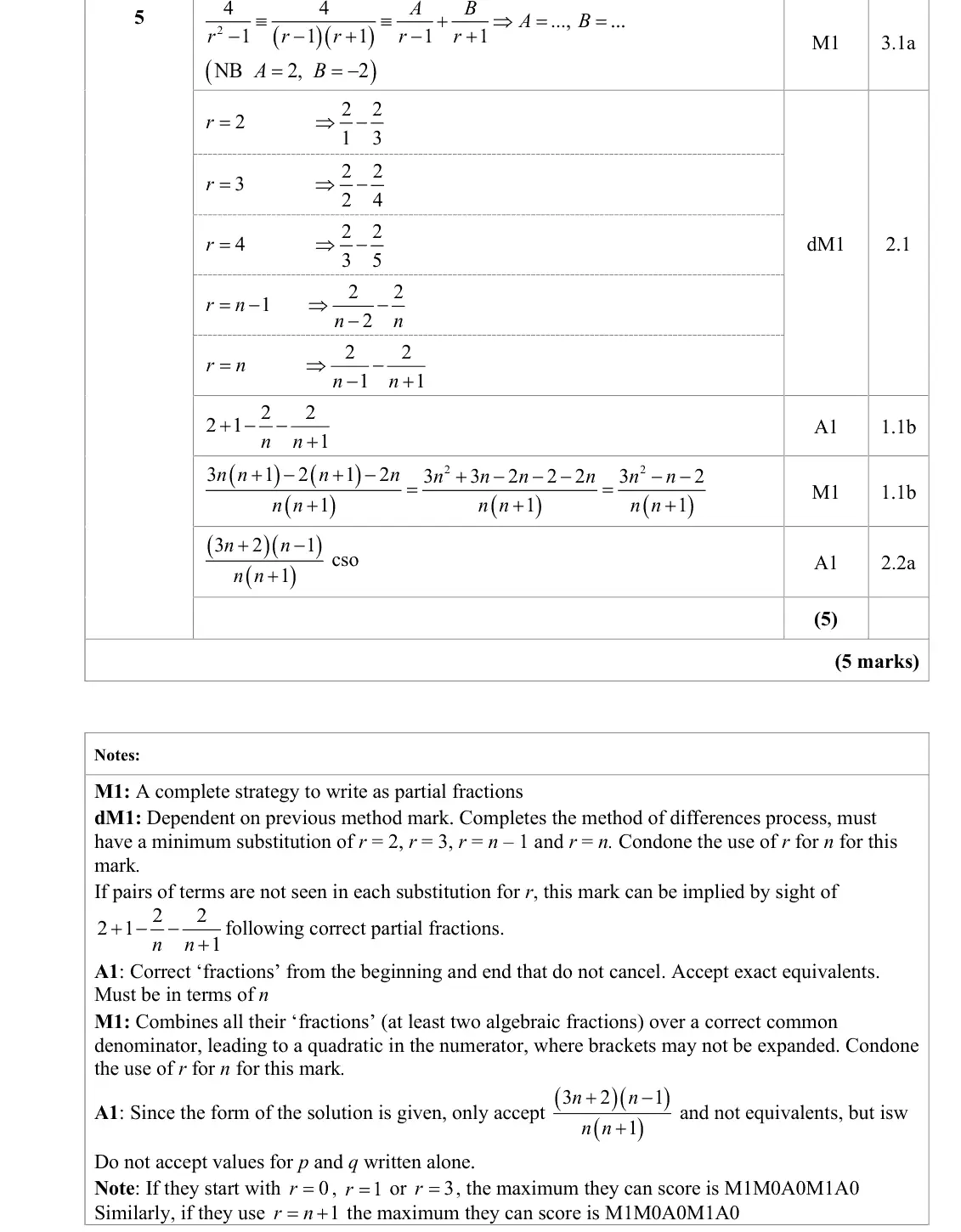
Mark scheme (whole question; this part is marked with the orange bar)
Examiner's comment
This questing required the use of the method of differences which was well understood by candidates. Many scored full marks on this question. Candidates understood the need to split the given fraction into two partial fractions first, and it was rare to see any error in this first step. The next step of listing the terms in the series was well understood although there were solutions seen where the initial term was found incorrectly using r =1 or r = 3 rather than the correct r = 2. Candidates usually wrote out enough terms of the expanded series to show convincingly the cancellation of terms. In this case, the minimum was the first two and last two terms. Some candidates gave the terms using the variable r rather than n thus losing a mark. Having identified the four remaining terms after cancellation, candidates knew how to combine the terms together into a single fraction and proceed to an answer of the required form. There were basic algebraic answers made which prevented reaching the correct answer of ( )( ) ( ) 3 2 1 1 n n n n + - + . The final mark was lost by those candidates who did not give the answer in the exact form specified.
Key points from the mark scheme and examiner's report
4/(r² − 1) = 2/(r − 1) − 2/(r + 1)
start at r = 2 (not r = 1 or 3)
non-cancelling terms 2 + 1 − 2/n − 2/(n + 1)
combine to (3n + 2)(n − 1)/(n(n + 1)), so p = 3, q = 2
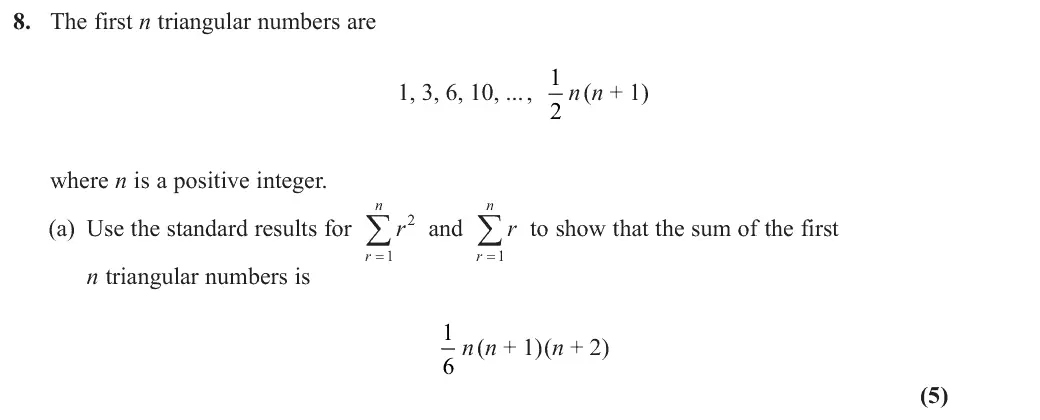
June 2025 · AS Paper 1 (Core Pure) · Q8(a)5 marks
Mark scheme (whole question; this part is marked with the orange bar)
Examiner's comment
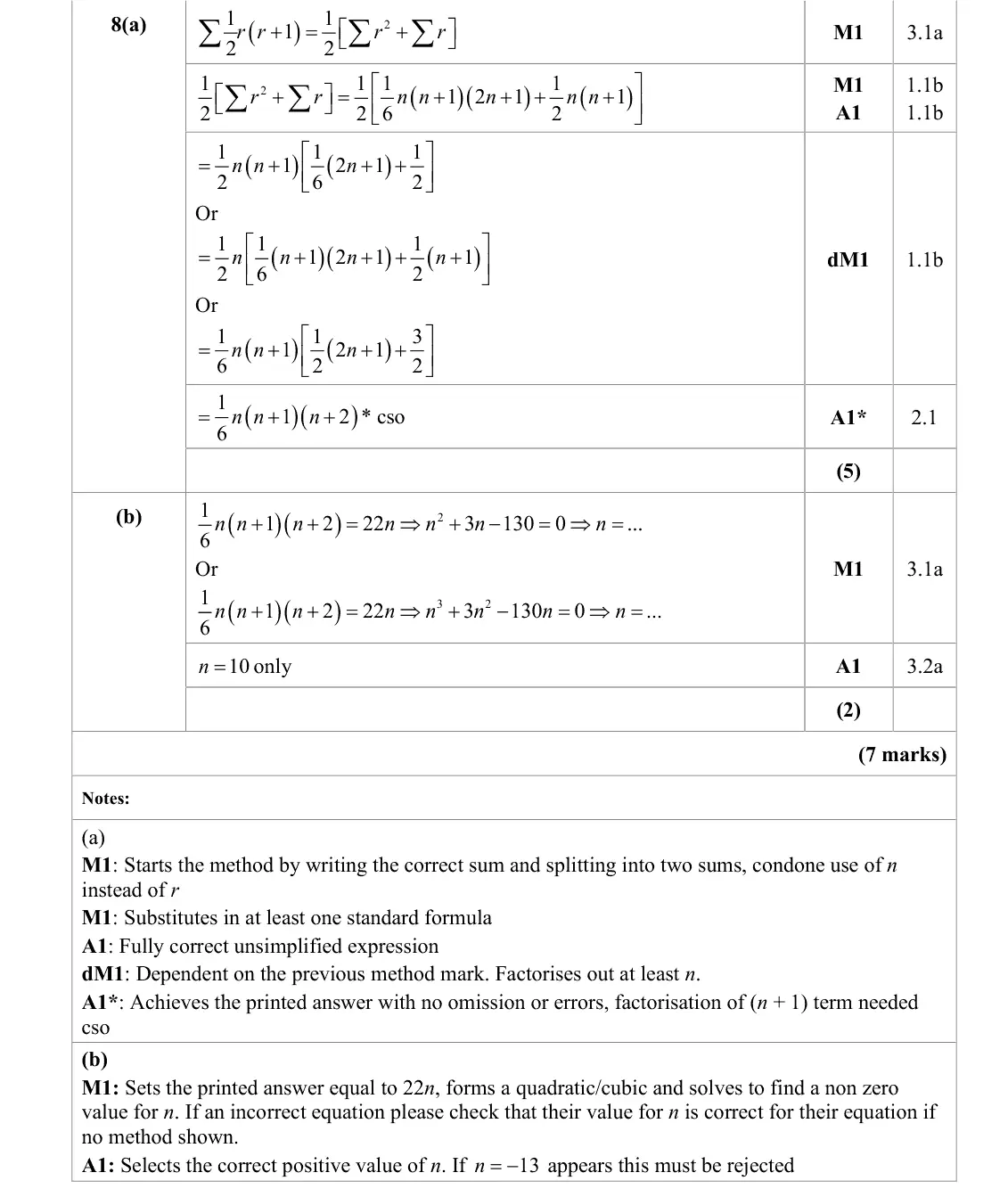
This question was well answered with many completely correct solutions In part (a), the vast majority of the cohort were able to express the required series as the sum of two standard natural number series and then went on to correctly deal with the algebraic demands, such as factorisation, required to obtain the given result. The main reason for any loss of marks in this part was due to the omission of the factor ½ in forming the initial summation.
Key points from the mark scheme and examiner's report
Σ½r(r + 1) = ½(Σr² + Σr)
factor (1/6)n(n + 1)(n + 2)
omitting the ½ was the main error
June 2025 · AS Paper 1 (Core Pure) · Q8(b)2 marks
Mark scheme (whole question; this part is marked with the orange bar)
Examiner's comment
This question was well answered with many completely correct solutions In part (b) much success was achieved with nearly all the learners finding the correct positive solution of the resulting quadratic equation in n.
Key points from the mark scheme and examiner's report
(n + 1)(n + 2) = 132 so n² + 3n − 130 = 0, n = 10 only
June 2024 · AS Paper 1 (Core Pure) · Q3(a)4 marks
Mark scheme (whole question; this part is marked with the orange bar)
Examiner's comment
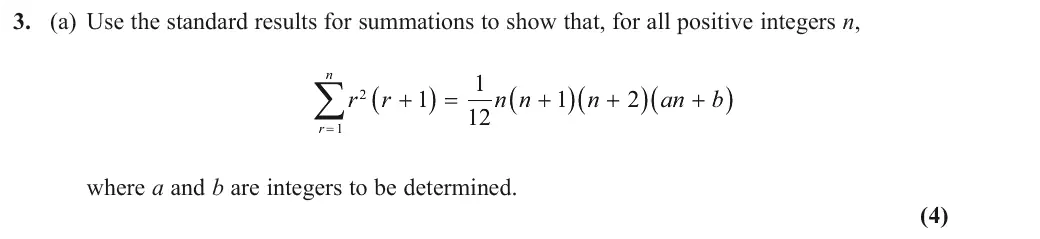
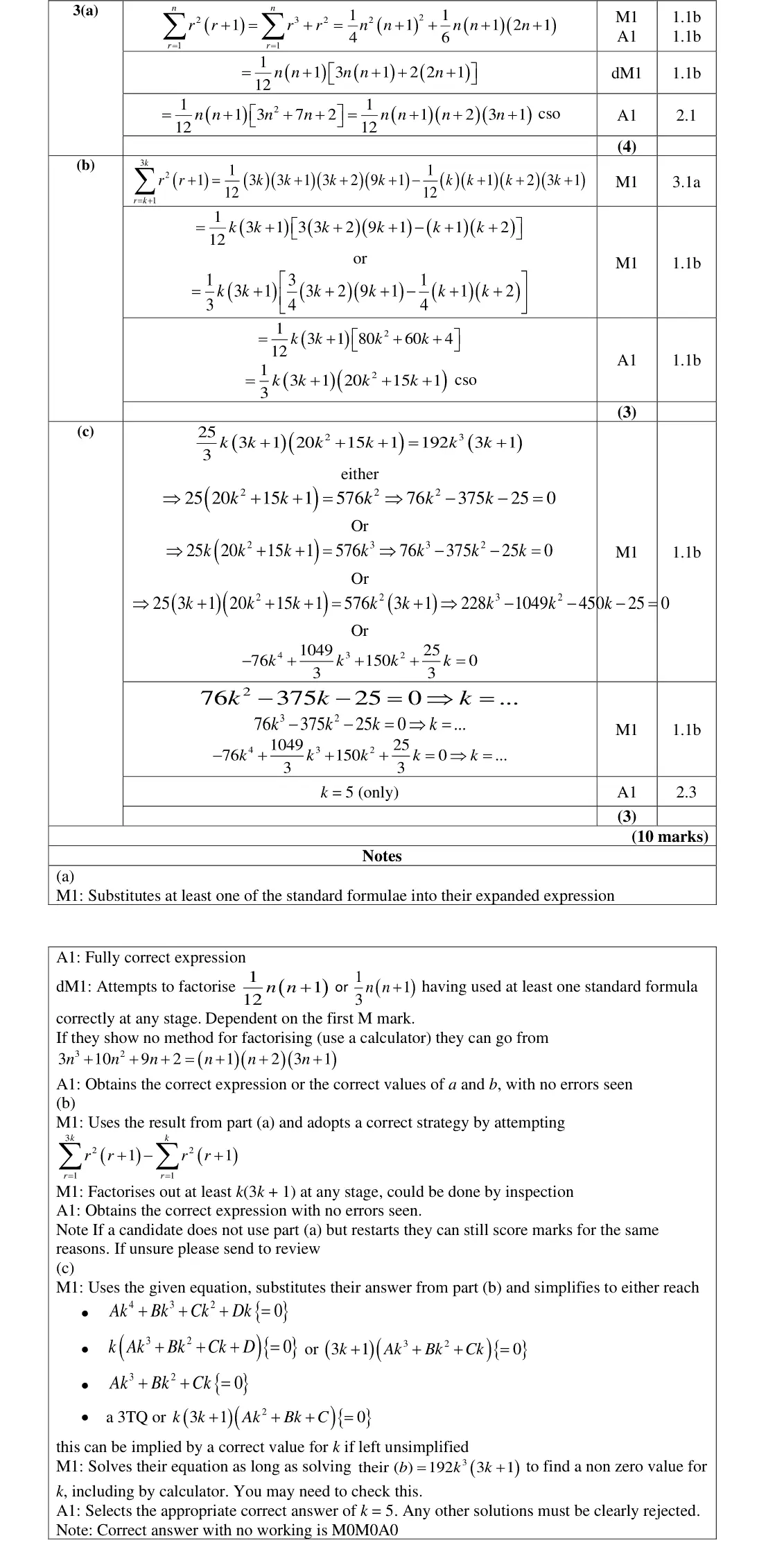
In part (a), the vast majority of the candidates correctly substituted the standard summation formulae into the expanded expression and obtained the final required factorised expression. Occasionally this involved the factorisation of the cubic function 3 2 3 10 9 2 n n n + + + and the use of the calculator to achieve this was acceptable.
Key points from the mark scheme and examiner's report
Σ(r³ + r²) with standard results
factor n(n + 1)/12: (1/12)n(n + 1)(n + 2)(3n + 1), a = 3, b = 1
June 2024 · AS Paper 1 (Core Pure) · Q3(b)3 marks
Mark scheme (whole question; this part is marked with the orange bar)
Examiner's comment
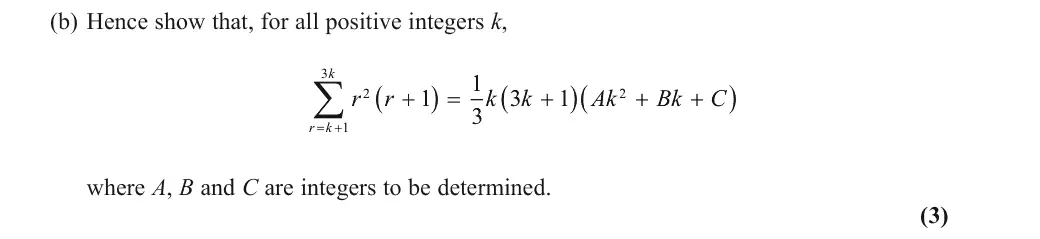
In part (b), the majority of the cohort identified the need to subtract the sum to k terms from the sum to 3k terms and confidently dealt with the associated algebraic demands. Taking out a common factor of at least ( ) 1 k k + , as given in the question, was the most common approach here but expanding the expression into a quartic and then factorising was also seen.
Key points from the mark scheme and examiner's report
sum to 3k minus sum to k
factor (1/12)k(3k + 1)
A = 20, B = 15, C = 1
June 2024 · AS Paper 1 (Core Pure) · Q3(c)3 marks
Mark scheme (whole question; this part is marked with the orange bar)
Examiner's comment
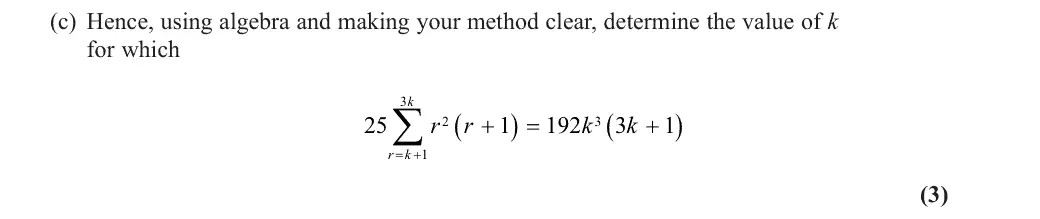
In part (c), many of the candidates used the answer found in part (b) to obtain a correct value for k with the cancellation of the ( ) 1 k k + being a common approach to achieve this. A number of the candidates struggled with the algebraic demands in this part and obtained quartic functions of n that they could not then process.
Key points from the mark scheme and examiner's report
Mark scheme (whole question; this part is marked with the orange bar)
Examiner's comment
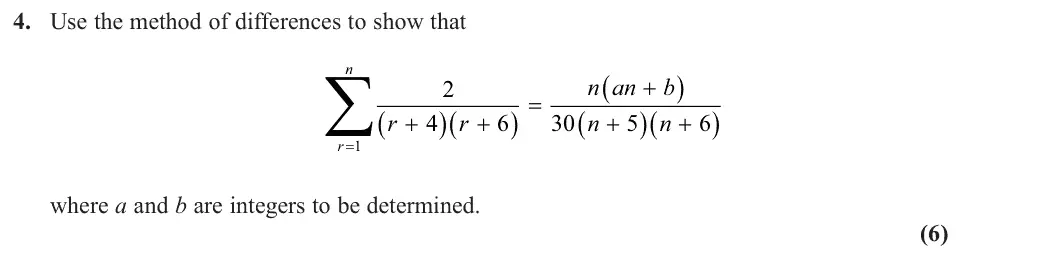
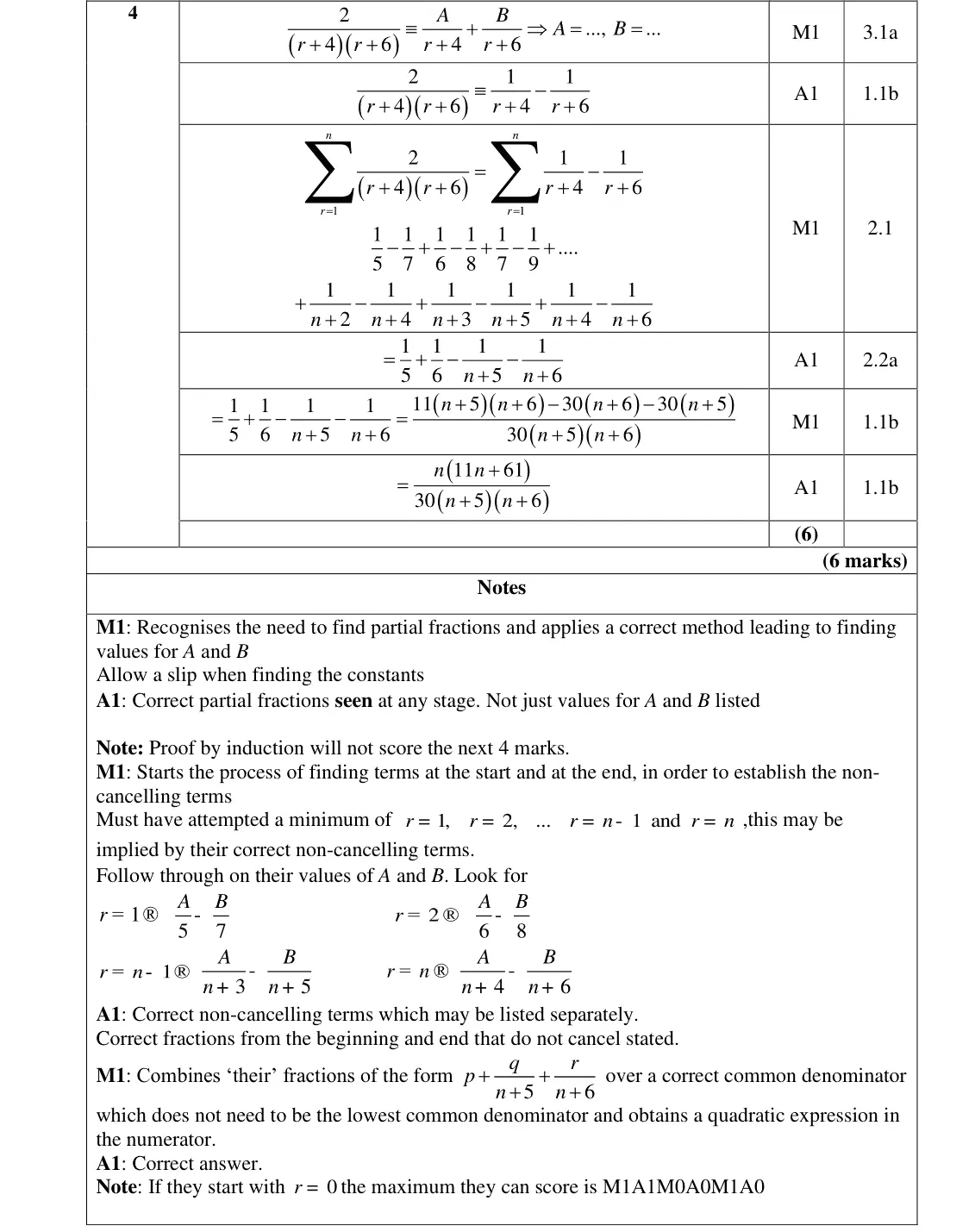
This question was well answered. Most candidates realised that they needed to use partial fractions and apply the method of differences. A few made errors in their partial fractions, but this was extremely rare. Nearly all candidates had the correct cancelling terms. The most common mistakes were simple errors with the algebraic manipulation into the final algebraic fraction. Sometimes confusion arose with negatives or a very occasional arithmetic slip costing some the final accuracy mark. The most common incorrect answer seen was (11 61) 30( 5)( 6) n n n n - + +
Key points from the mark scheme and examiner's report
partial fractions 1/(r + 4) − 1/(r + 6)
list terms at the start and end: 1/5 + 1/6 − 1/(n + 5) − 1/(n + 6)
combine to n(11n + 61)/(30(n + 5)(n + 6))
induction scores at most 2
algebra slips in combining
June 2023 · Paper 1 (Core Pure 1) · Q7(a)2 marks
Mark scheme (whole question; this part is marked with the orange bar)
Examiner's comment
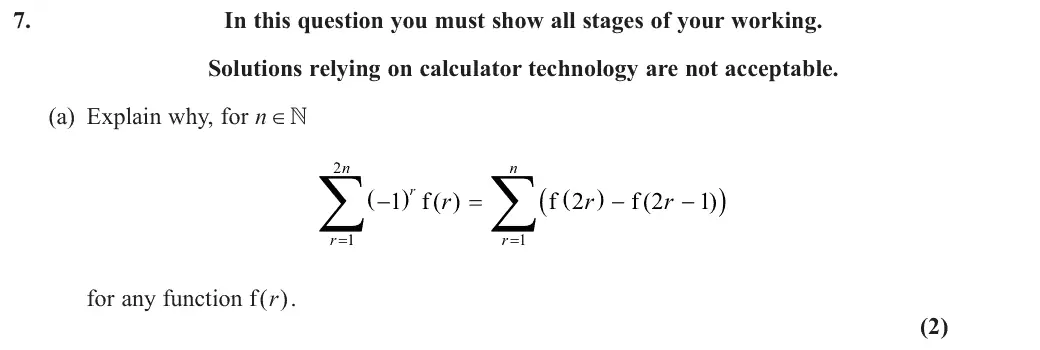
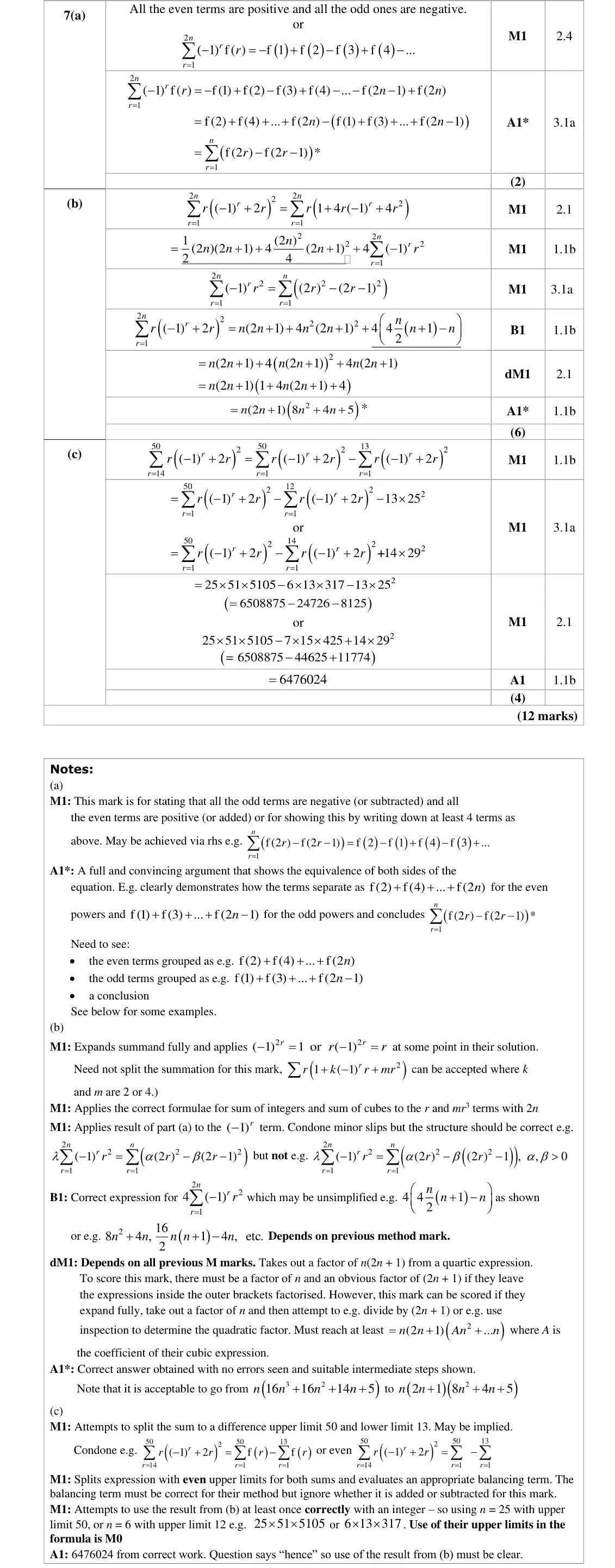
The “Explain why” in part (a) led many candidates to very wordy and unclear answers. Those that seemed to see it more as a “show that” question often scored the method mark and some had a convincing argument to demonstrate the equivalence of both sides of the equation. There was generally an idea about odd terms being negative and evens positive, but this was not always described well enough for the mark with 'alternating' used quite a lot. Those that kept it simple by listing, then grouping and showing RHS = LHS fared best. Very few managed to also justify why the upper limit of the summation needed to be change to n.
Key points from the mark scheme and examiner's report
write out −f(1) + f(2) − f(3) + f(4) …, group the even terms and the odd terms and conclude
vague talk of 'alternating' signs was not enough
June 2023 · Paper 1 (Core Pure 1) · Q7(b)6 marks
Mark scheme (whole question; this part is marked with the orange bar)
Examiner's comment
Part (b) stretched both algebraic skills and problem solving with the requirement to spot that (-1)2r must be even, proving beyond a substantial number of candidates. Quite a few chose to ignore it in their solution, whilst others took it out as a factor from two of the terms resulting from multiplying out the quadratic. Some attempted to use the result from part (a) on (-1)2r and ended up with Σ(2r - (2r - 1)) leading to Σ1 = n. Such errors meant that they could often only score a maximum of two marks in this part. It was also not uncommon for candidates to only multiply some of their terms in the quadratic by r. However, mistakes multiplying through by r didn’t always preclude candidates from achieving some of the marks, depending on where their errors were. For those who progressed further, applying the result from part (a) was sometimes missed for the 4r(-1)r term with work leading to cubic expansions being a common error here. Missing the change from upper limit of 2n to n also tripped up a few candidates, so the mark for applying the correct formulae for sum of integers and sum of cubes was often not awarded. These sources of errors and misconceptions led to some very low scoring responses to this part. However, those candidates that were not put off by the (-1)r were usually successful in applying (-1)2r = 1 and using the result from part (a) to achieve the first 4 marks. There were errors seen, both when candidates kept their terms factorised as much as possible as well as when they multiplied everything out (to leave n multiplied by a cubic expression in n). Some clear, precise and correct solutions were seen, along with some with many lines of working.
Key points from the mark scheme and examiner's report
Mark scheme (whole question; this part is marked with the orange bar)
Examiner's comment
Part (c) was very rarely answered completely correctly. The majority of candidates successfully split the sum to a difference of upper limit 50 and upper limit 13, thus achieving the first method mark. However, very few spotted the need for the upper limits to be even in order to apply the result from part (b). Of the very few that did, it was equally common to use 12 or 14 and make the appropriate adjustment, leading invariably to full marks for the question. Many candidates used n = 25 for their upper limit of 50 and n = 6.5 for their upper limit of 13, but many also tried using their upper limits instead. It was clear that several candidates had used their calculator to find the answer and so having missed out on the 2nd method mark, they had a subtraction sum that did not equal the correct answer they gave.
Key points from the mark scheme and examiner's report
sum to 50 minus sum to 13, but (b) needs an even upper limit: use n = 25 and n = 6 plus the r = 13 term (or n = 7 minus the r = 14 term): 6476024
using n = 6.5 or the upper limits as n was common
June 2023 · AS Paper 1 (Core Pure) · Q8(a)5 marks
Mark scheme (whole question; this part is marked with the orange bar)
Examiner's comment
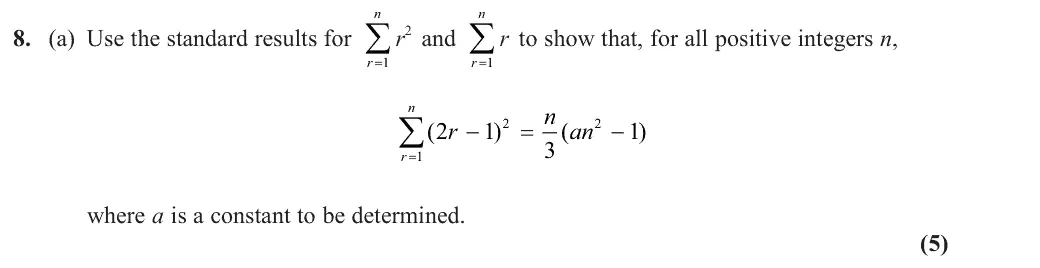
In part (a), a standard question that was very well answered though there were some unavoidable errors when expanding ( ) 2 2 1 r - , most frequently with the 2r term. The majority of candidates knew their sum formulae and where there was an error it was generally incorrectly stating 1 1 1 n r= = which resulted in the last 3 marks being lost. It was pleasing to see that there were very few mistakes in the algebra and even more pleasing to see that those candidates that did make errors and corrected themselves generally knew to do so on all lines of their working so as not to lose the final A.
Key points from the mark scheme and examiner's report
(2r − 1)² = 4r² − 4r + 1
Σ1 = n (not 1)
factor n/3: (n/3)(4n² − 1), a = 4
June 2023 · AS Paper 1 (Core Pure) · Q8(b)3 marks
Mark scheme (whole question; this part is marked with the orange bar)
Examiner's comment
In part (b), this was a more challenging question, due to the necessity to realise that they had the sum of n odd integers already, so the limits had to be considered with more care. Still, a good number of candidates got it right. The mistakes with the limits were mainly of 2 types: 1 - limits at 101 and 999 - they could gain the method mark here as long as they split their sum correctly into ( ) ( ) 999 100 2 2 1 1 2 1 2 1 r r r r = = - - - 2 - attempt at halving the number of three digit numbers and using this at the top limit. Further to the struggle with limits there were a few blank scripts on this part of the question and others thought about the limits but then failed to use part (a).
Key points from the mark scheme and examiner's report
odd 3-digit numbers are r = 51 to 500
sum to 500 minus sum to 50 = 166499850
limits 101 and 999 a common error
answer only scores B1
June 2022 · Paper 1 (Core Pure 1) · Q4(a)4 marks
Mark scheme (whole question; this part is marked with the orange bar)
Examiner's comment
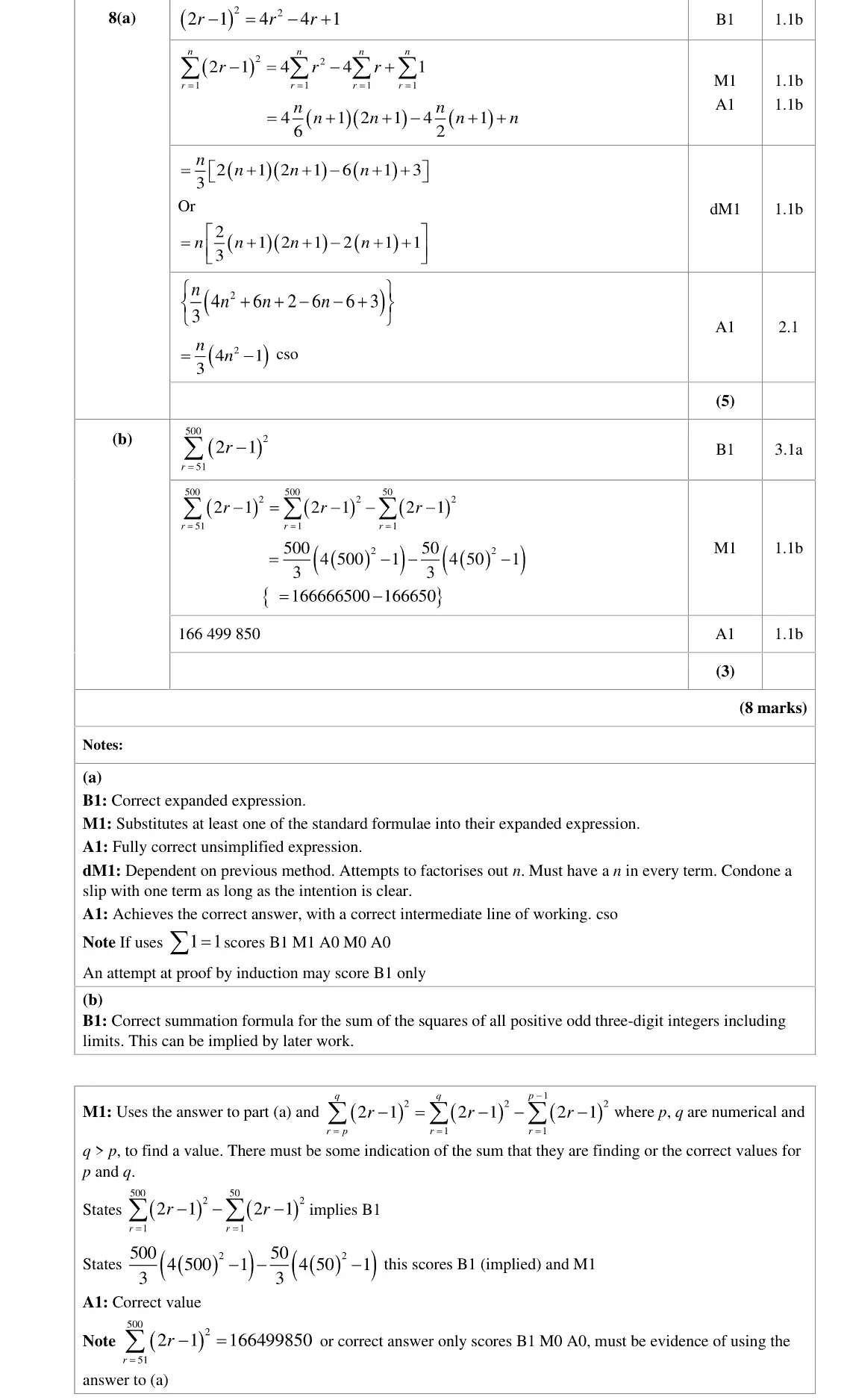
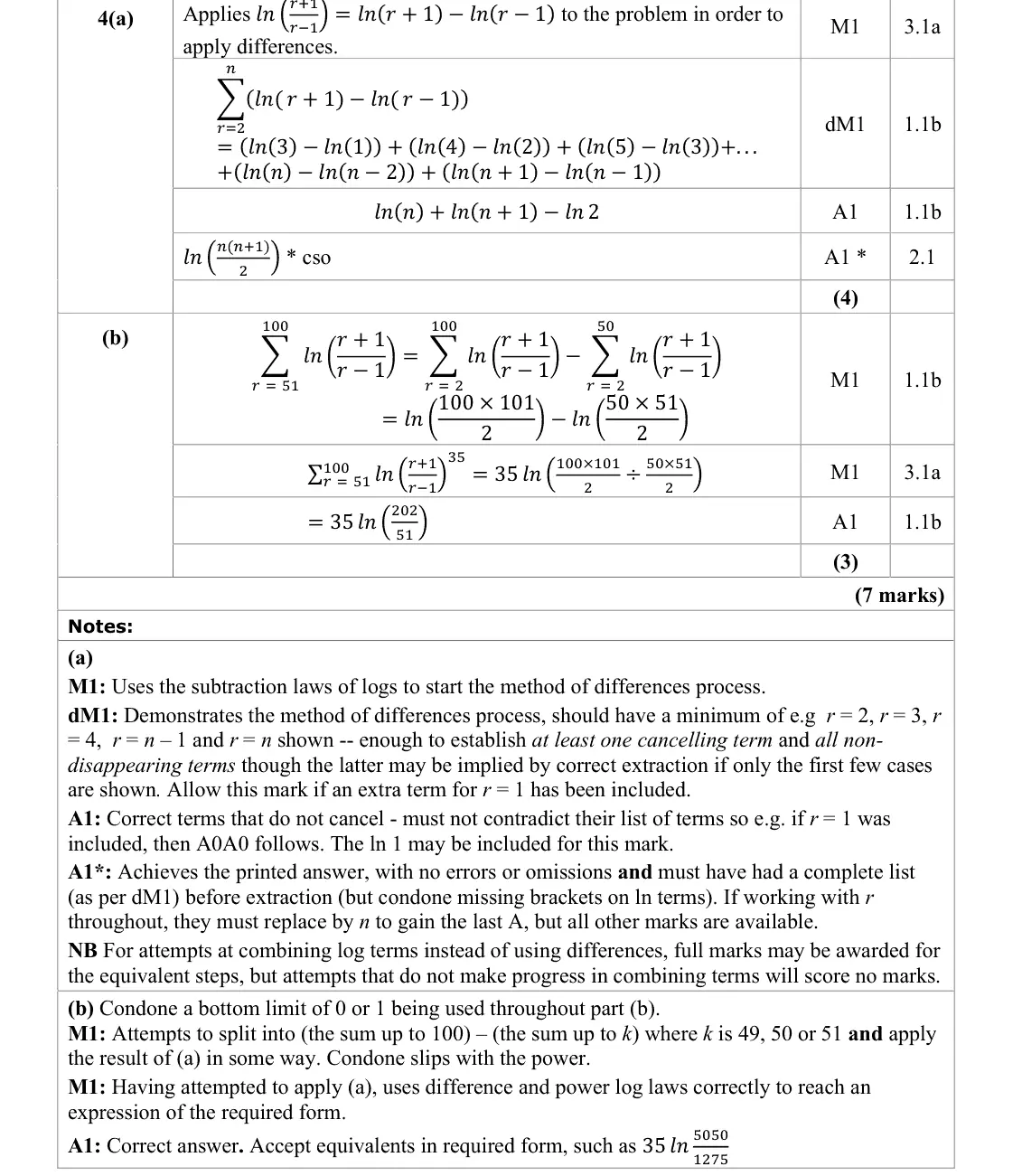
With the modal mark being full marks, scored by nearly 60% of candidates, this question was another that was very well answered. Candidates seemed to be very familiar on using the method of differences on problems involving logs, although a few problems were caused by the lower limit of 2, and some of the work in part (b) was sketchy. In part (a), the majority of candidates correctly used log laws to convert the quotient into a difference, following the lead of the question, and went on to substitute values of typically at least r = 2,3,4, n-1 and n. The majority of candidates who used these values of r, continued to a fully correct answer. Occasionally, r = 0 or r = 1 was used, which lead to inaccurate answers due to logarithms having arguments outside their domain. A few did not write out sufficient terms to make the non-cancelling terms clear, and lost the last two A marks as a result. Also, some candidates gave answers with ln1 included before removing later, whereas others did not show ln1 in their intermediate answer. They then either used -ln2 as ln1/2 and multiplied all 3 terms or demonstrated laws of logs separately. Proofs should be convincing, and require a higher bar to be cleared than simply finding a result. It is noteworthy that there was a significant proportion of candidates who combine logs to a single term and used a cancelling of ratios instead of applying differences. Such were able to score marks, as the methods are consummate, but candidates should aim to use approaches specified in papers. In part (b), many candidates used part (a) and log laws correctly to lead to the correct answers. The most common incorrect methods involved failing to use the power law of logarithms or using it incorrectly. Also, accuracy was occasionally lost where candidates used 𝑟= 49 or 𝑟= 51 when subtracting. Some did not applying the result of part (a) and instead simply substituted values into the given printed summand. There was some confusion with the power, with a few candidates incorrectly bracketing their log power while others completely missed the power of 35 altogether. A number of responses were given full marks on a technicality that no step was incorrect, even though it seemed the power was being mistreated by being left as a power until the last step instead of being taken down as a multiple before applying the result from (a). Those who got the answer fully correct usually simplified their answers fully.
Key points from the mark scheme and examiner's report
ln((r + 1)/(r − 1)) = ln(r + 1) − ln(r − 1)
list terms from r = 2 (not r = 0 or 1) to r = n − 1 and n
Mark scheme (whole question; this part is marked with the orange bar)
Examiner's comment
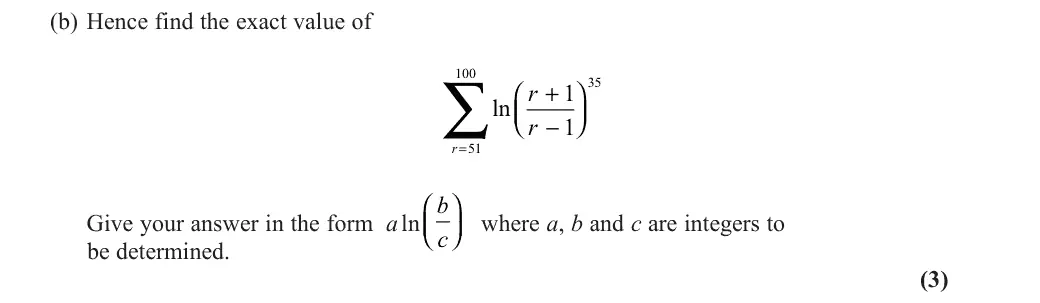
With the modal mark being full marks, scored by nearly 60% of candidates, this question was another that was very well answered. Candidates seemed to be very familiar on using the method of differences on problems involving logs, although a few problems were caused by the lower limit of 2, and some of the work in part (b) was sketchy. In part (b), many candidates used part (a) and log laws correctly to lead to the correct answers. The most common incorrect methods involved failing to use the power law of logarithms or using it incorrectly. Also, accuracy was occasionally lost where candidates used 𝑟= 49 or 𝑟= 51 when subtracting. Some did not applying the result of part (a) and instead simply substituted values into the given printed summand. There was some confusion with the power, with a few candidates incorrectly bracketing their log power while others completely missed the power of 35 altogether. A number of responses were given full marks on a technicality that no step was incorrect, even though it seemed the power was being mistreated by being left as a power until the last step instead of being taken down as a multiple before applying the result from (a). Those who got the answer fully correct usually simplified their answers fully.
Key points from the mark scheme and examiner's report
sum to 100 minus sum to 50 (not 49 or 51), times 35 by the power law: 35 ln(202/51)
power law missed or misused
June 2022 · AS Paper 1 (Core Pure) · Q5(a)4 marks
Mark scheme (whole question; this part is marked with the orange bar)
Examiner's comment
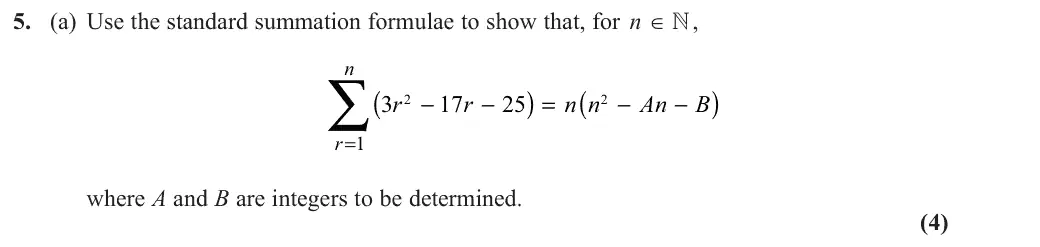
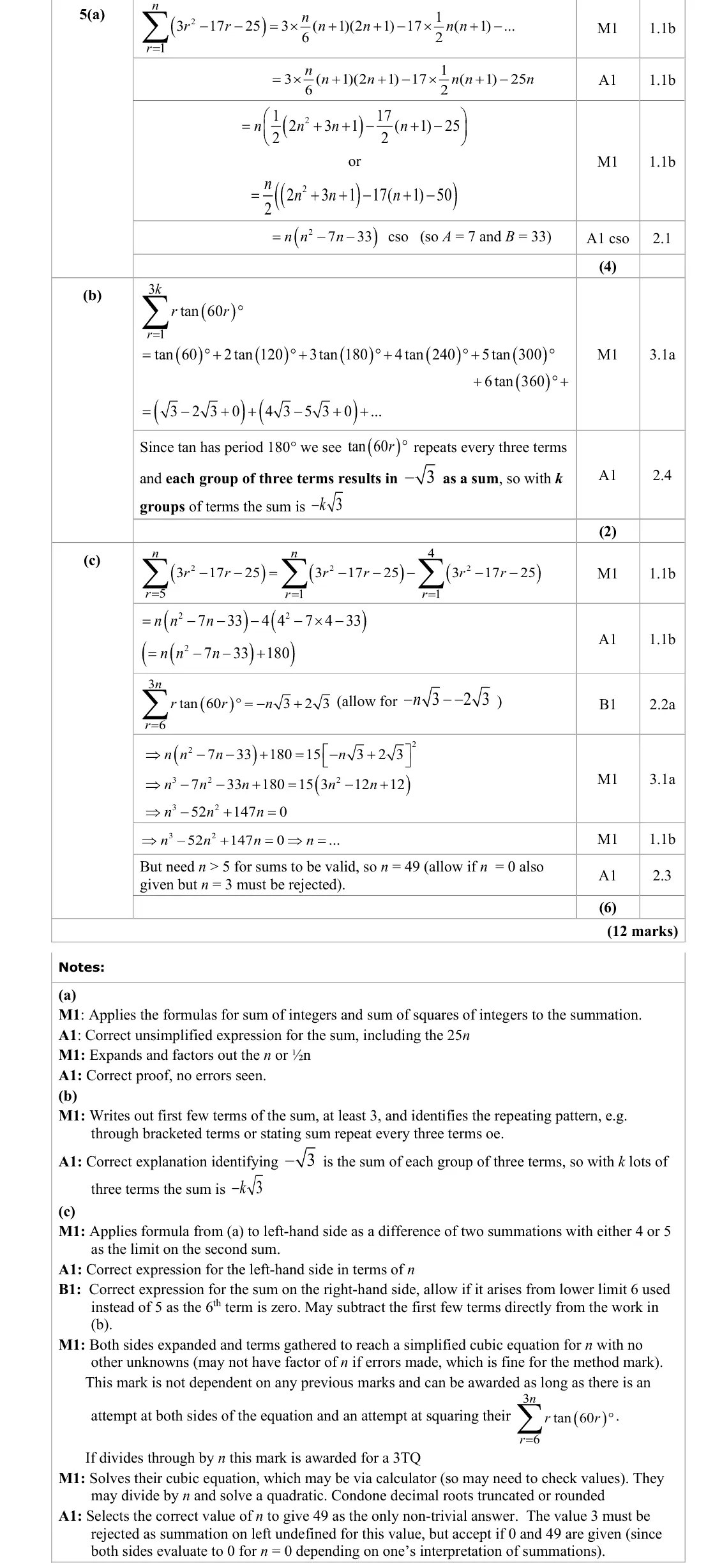
This question had something for everyone and differentiated well between the candidates varying abilities. From the weaker candidates who were at most able to access the familiar part (a), to those who had a reasonable attempt at (c) all the way up to the strongest mathematicians who could fully articulate a correct response to (b) whilst also appreciating the constraints of n and scoring full marks in (c), though this was few and far between. The proof in part (a) was pleasing, there appears to be a general improvement in the quality of proofs being presented, with more attention to detail, fewer missing brackets etc. The procedures involved in finding the sum of n terms using the natural number series were well known and many scored full marks on this part of the question. The only errors seen were due to careless algebraic slips which often resulted in a loss of the final mark in this part.
Key points from the mark scheme and examiner's report
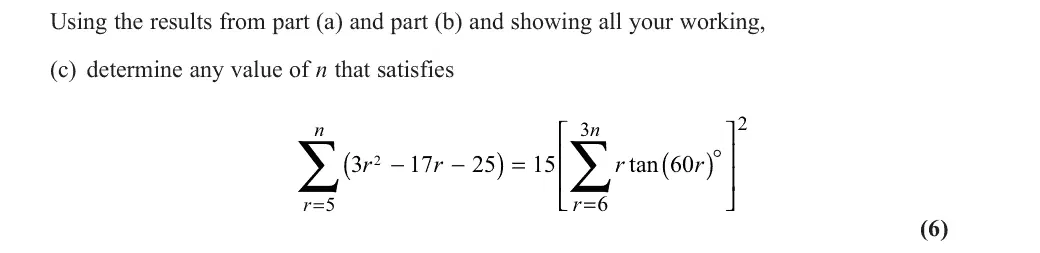
substitute standard results including −25n
take n (or ½n) out: n(n² − 7n − 33), A = 7, B = 33
June 2022 · AS Paper 1 (Core Pure) · Q5(b)2 marks
Mark scheme (whole question; this part is marked with the orange bar)
Examiner's comment
This question had something for everyone and differentiated well between the candidates varying abilities. From the weaker candidates who were at most able to access the familiar part (a), to those who had a reasonable attempt at (c) all the way up to the strongest mathematicians who could fully articulate a correct response to (b) whilst also appreciating the constraints of n and scoring full marks in (c), though this was few and far between. In part (b), the demands of this question were beyond many of the cohort and there was a clear lack of recognition of series of this type. As always, with non-routine series such as this, candidates need to list the first few terms of the series and then recognise the type of series involved. The few candidates who did as such often gained the 2 marks available in this part. Other partly successful methods involved the use of 2 (or 3 though the 3rd was often disregarded) linear sequences, though this seldom achieved full marks. One particular response that deserves merit here was a fully successful attempt at proof by induction.
Key points from the mark scheme and examiner's report
write out terms: √3 − 2√3 + 0 + 4√3 − 5√3 + 0 ...
tan(60r)° has period 3 terms and each group of three sums to −√3, so k groups give −k√3
beyond many
June 2022 · AS Paper 1 (Core Pure) · Q5(c)6 marks
Mark scheme (whole question; this part is marked with the orange bar)
Examiner's comment
This question had something for everyone and differentiated well between the candidates varying abilities. From the weaker candidates who were at most able to access the familiar part (a), to those who had a reasonable attempt at (c) all the way up to the strongest mathematicians who could fully articulate a correct response to (b) whilst also appreciating the constraints of n and scoring full marks in (c), though this was few and far between. In part (c), the high demands of the question defeated much of the cohort and the final answer of n = 49 was very rarely seen. A few candidates did achieved answer n = 49 and n = 3 and did not reject n = 3. Many of the candidates could partly deal with the summations, both of which did not start at the usual r = 1, but the resulting terms and algebra needed to find n defeated the vast majority of the candidates. Moreover, there was clear evidence of candidates who, having been unable to prove the result in part (b), then made no attempt at part (c).
Key points from the mark scheme and examiner's report
left side = n(n² − 7n − 33) + 180 (subtract the n = 4 sum)
right side sum from 6 to 3n = −n√3 + 2√3
n³ − 52n² + 147n = 0, n = 49 (reject n = 3 as n ≥ 5)
n = 49 very rarely seen
Nov 2021 · Paper 2 (Core Pure 2) · Q4(a)5 marks
Mark scheme (whole question; this part is marked with the orange bar)
Examiner's comment
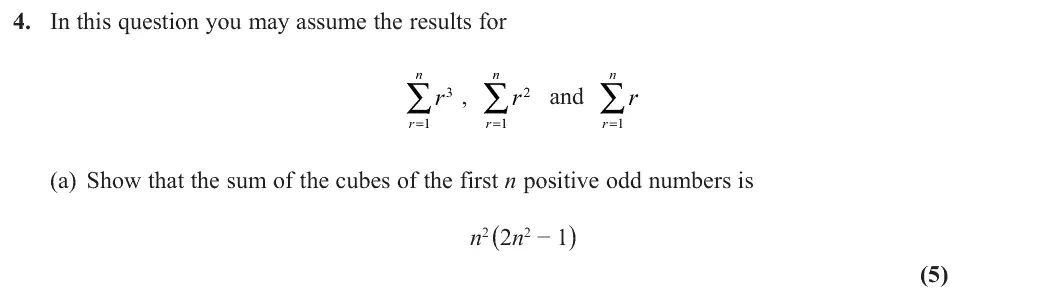
Part (a) A standard question which, as expected, was well done by most candidates. As one would expect there were a few errors made in expansions along the way. The majority of candidates used 2r – 1 as their odd number and were able to expand and sum from 1 to n. Unfortunately, those candidates who decided to work with 2r + 1 also attempted to sum from 1 to n rather than 0 to n – 1 which meant that that were unable to prove the result but still managed to gain 3 out of 5 marks.
Key points from the mark scheme and examiner's report
Σ(2r − 1)³ from 1 to n = 8Σr³ − 12Σr² + 6Σr − n
show a correct intermediate expansion
using (2r + 1)³ summed from 1 to n (not 0 to n − 1) loses the final marks
Nov 2021 · Paper 2 (Core Pure 2) · Q4(b)4 marks
Mark scheme (whole question; this part is marked with the orange bar)
Examiner's comment
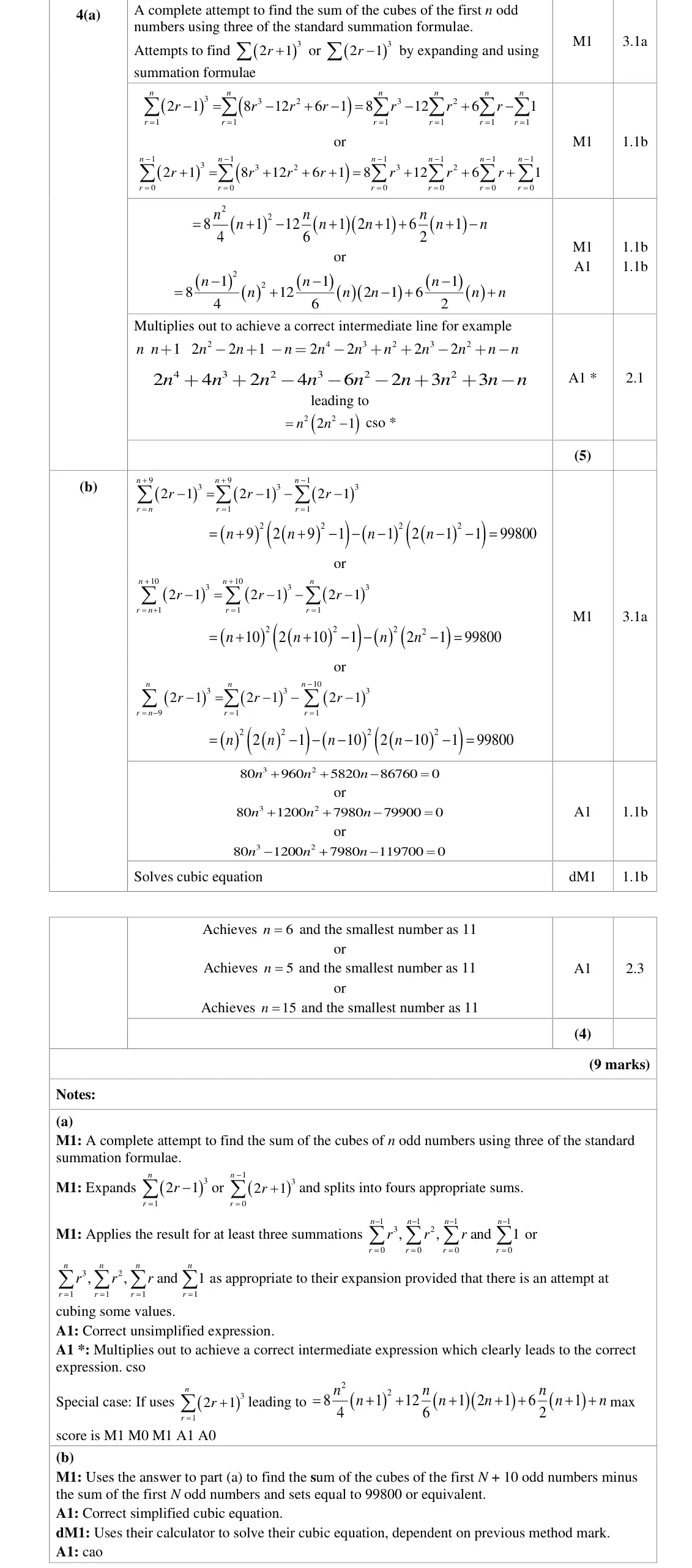
(b) This was a discriminator with only the strongest candidates being able to find a successful approach. Quite a few candidates just equated the result of (a) to 99800 which clearly cannot lead anywhere. Candidates also subtracted to create either 9 or 11 consecutive odd numbers instead of 10. The few who work with one of the alternative series subtractions that actually involved 10 consecutive numbers made a good start but many made careless errors in collecting terms in producing their cubic equation. This left very few who were able to successfully complete the correct solution of 11.
Key points from the mark scheme and examiner's report
difference of two sums of the form in (a) covering exactly 10 consecutive odd numbers, e.g. (n + 10)²(2(n + 10)² − 1) − n²(2n² − 1) = 99 800
solve the cubic: smallest number 11
equating (a) to 99 800, or using 9 or 11 terms
Oct 2020 · AS Paper 1 (Core Pure) · Q5(a)5 marks
Mark scheme (whole question; this part is marked with the orange bar)
Examiner's comment
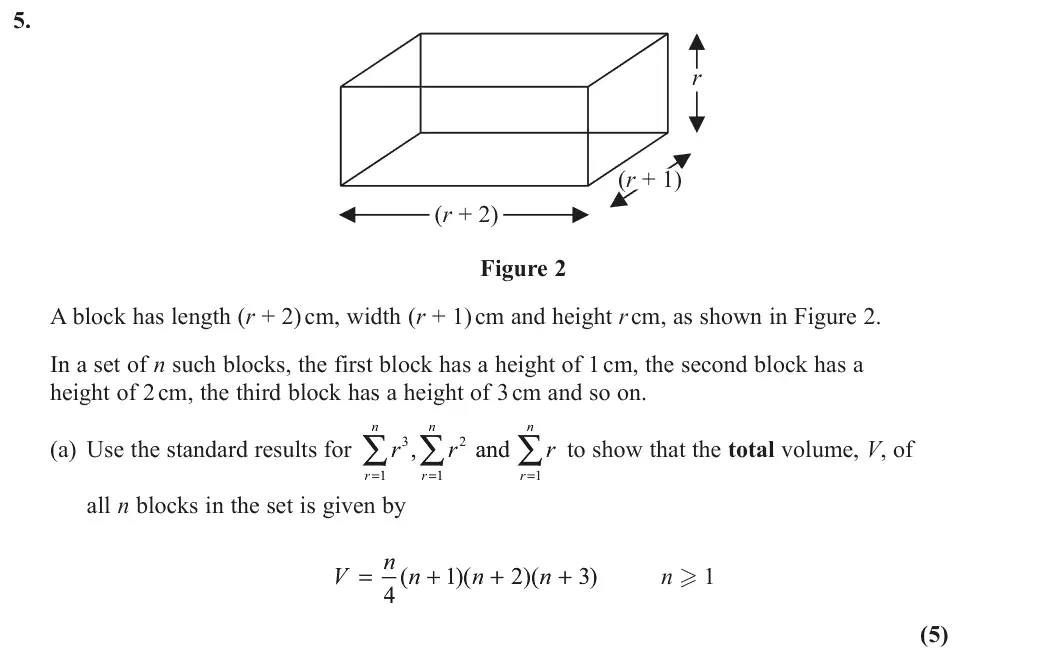
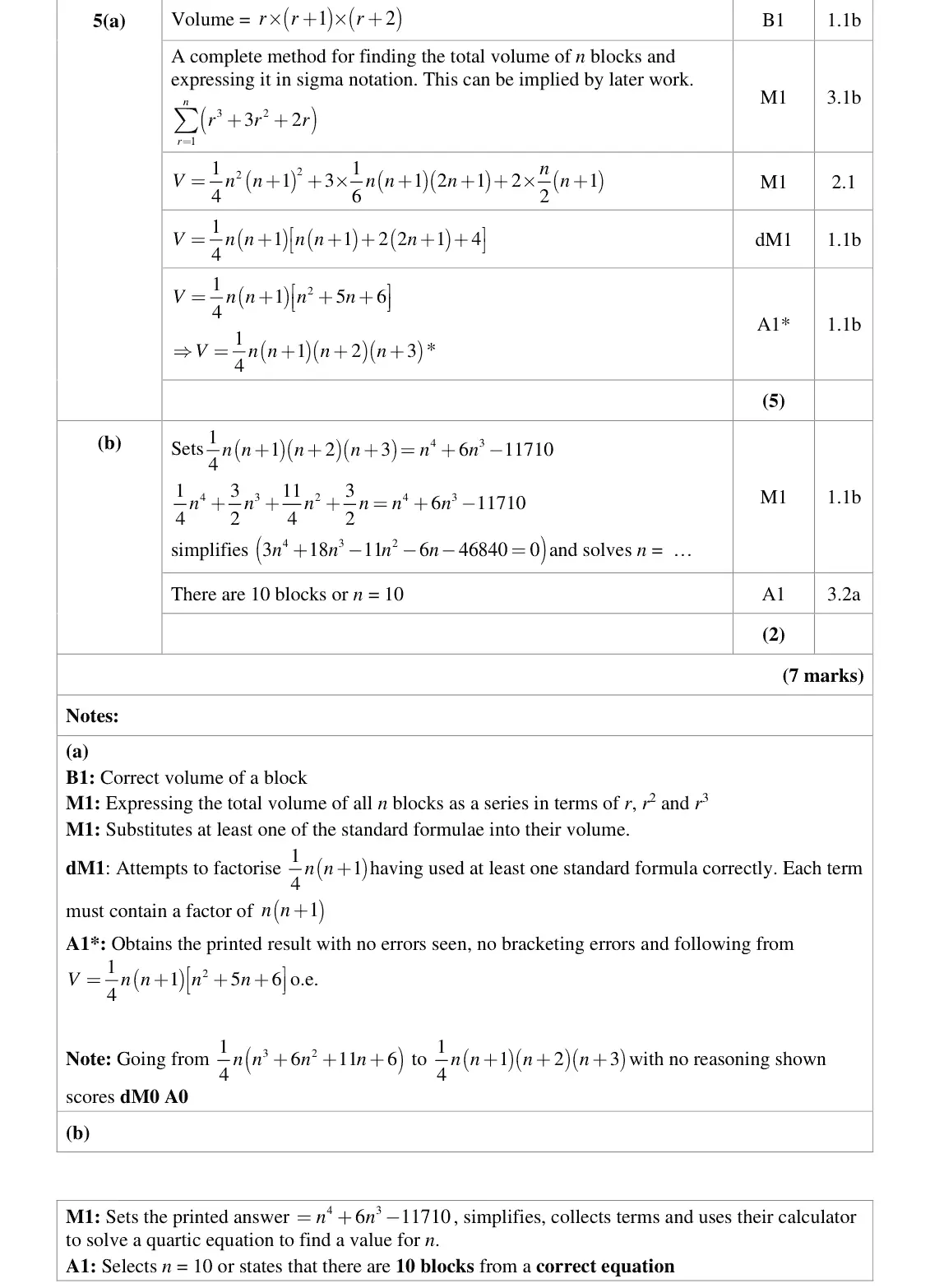
Very well answered on the whole. Candidates spotted that n can be factorised out but many did not spot that 1 n can be 1 1 n 2 2 1 3 1 2 1 2 1 n n n n n n factorised out of 4 6 2 These candidates lost marks as they went from 1 1 3 2 6 11 6 to 1 2 3 n n n n n n n n without method. This is a show 4 4 questions and so and some factorising was required. Candidates need to look at the given answer for clues to which terms to factorise out.
Key points from the mark scheme and examiner's report
volume of block r(r + 1)(r + 2) = r³ + 3r² + 2r
substitute standard results
factorise ¼n(n + 1) early
jumping to the factorised form without working scores dM0 A0
Oct 2020 · AS Paper 1 (Core Pure) · Q5(b)2 marks
Mark scheme (whole question; this part is marked with the orange bar)
Examiner's comment
Part (b) was also answered well though some got to the quartic and struggled to/didn't attempt to solve, whilst others made arithmetic errors, often not all terms were multiplied by the 4. Candidates are expected to use their calculator to solve quartic equations.
Key points from the mark scheme and examiner's report
Mark scheme (whole question; this part is marked with the orange bar)
Examiner's comment
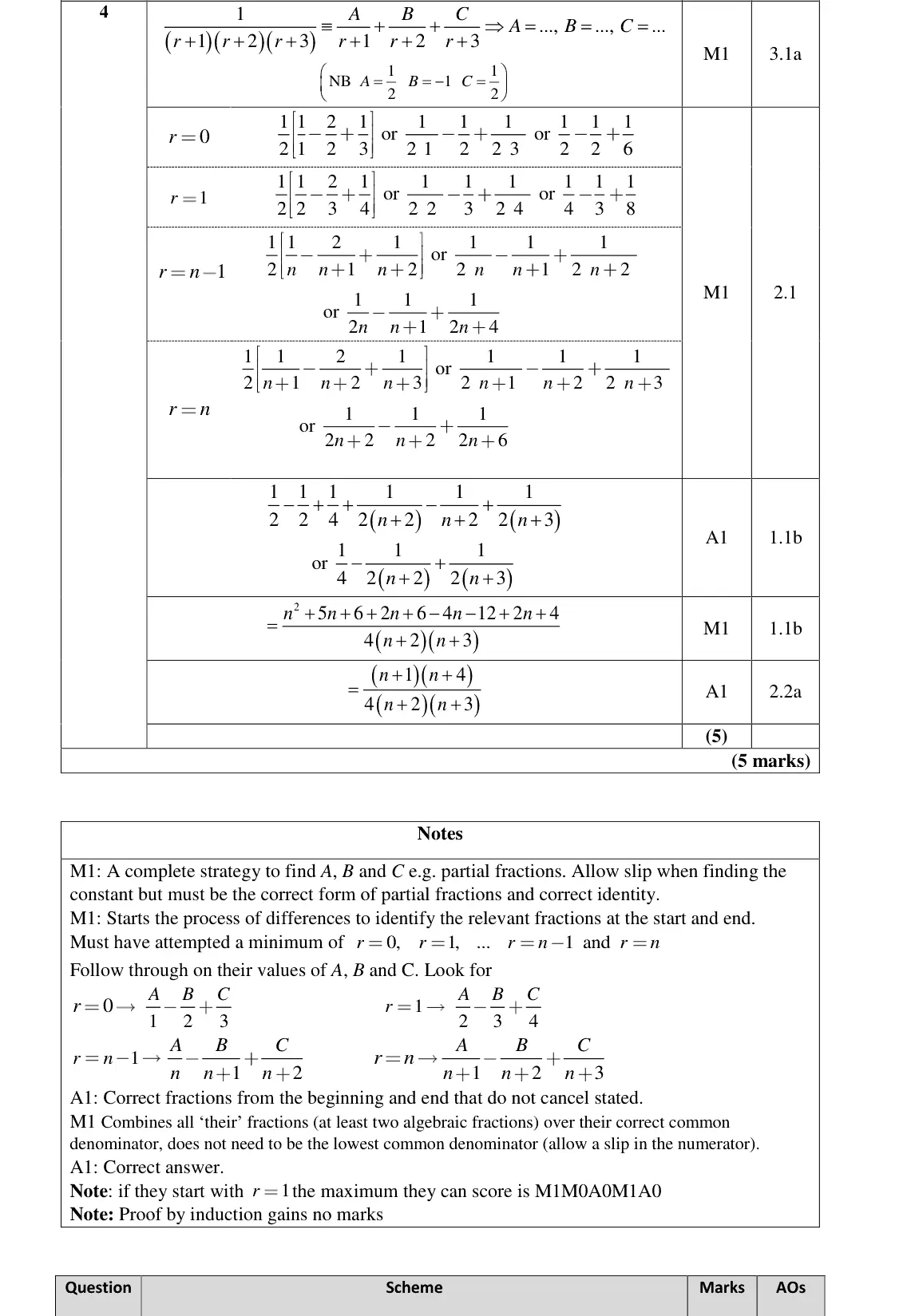
This question differentiated well and many candidates found it challenging. Most candidates realised they needed to split the fraction into partial fractions, and most found correct values for the constants. Most then realised they needed to apply the method of differences. An extremely common error at this point was to start with r = 1, omitting r = 0, and thus only gaining a maximum of two marks for this question. Some candidates struggled to see how the fractions were cancelling and gave up before considering r = n – 1 and r = n, and so could only gain the first M1. Candidates should be encouraged to set out a sufficient number of terms in a clear list and indicating clearly which terms remained about differencing, as candidates who did this tended to make better progress. When candidates had algebraic terms they were generally successful in combining them with a correct common denominator. Errors were sometimes made in simplifying the numerator. A few struggled to combine the numerical fraction, and errors were much more common where the candidate didn’t attempt to simplify fractions or where they keep 3 algebraic fractions and did not combine 1 1 2 2 2 n n
Key points from the mark scheme and examiner's report
partial fractions A = ½, B = −1, C = ½ then method of differences
must start at r = 0 (starting at r = 1 is the commonest error, max 2 marks)
a = 1, b = 4, c = 4
induction scores 0
June 2019 · AS Paper 1 (Core Pure) · Q6(a)3 marks
Mark scheme (whole question; this part is marked with the orange bar)
Key points from the mark scheme and examiner's report
Mark scheme (whole question; this part is marked with the orange bar)
Key points from the mark scheme and examiner's report
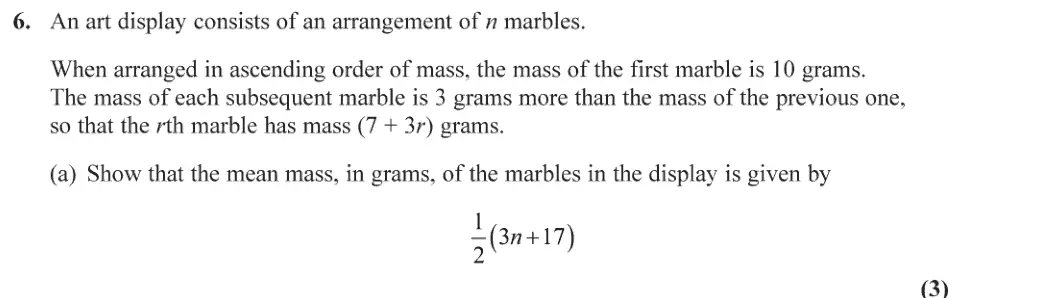
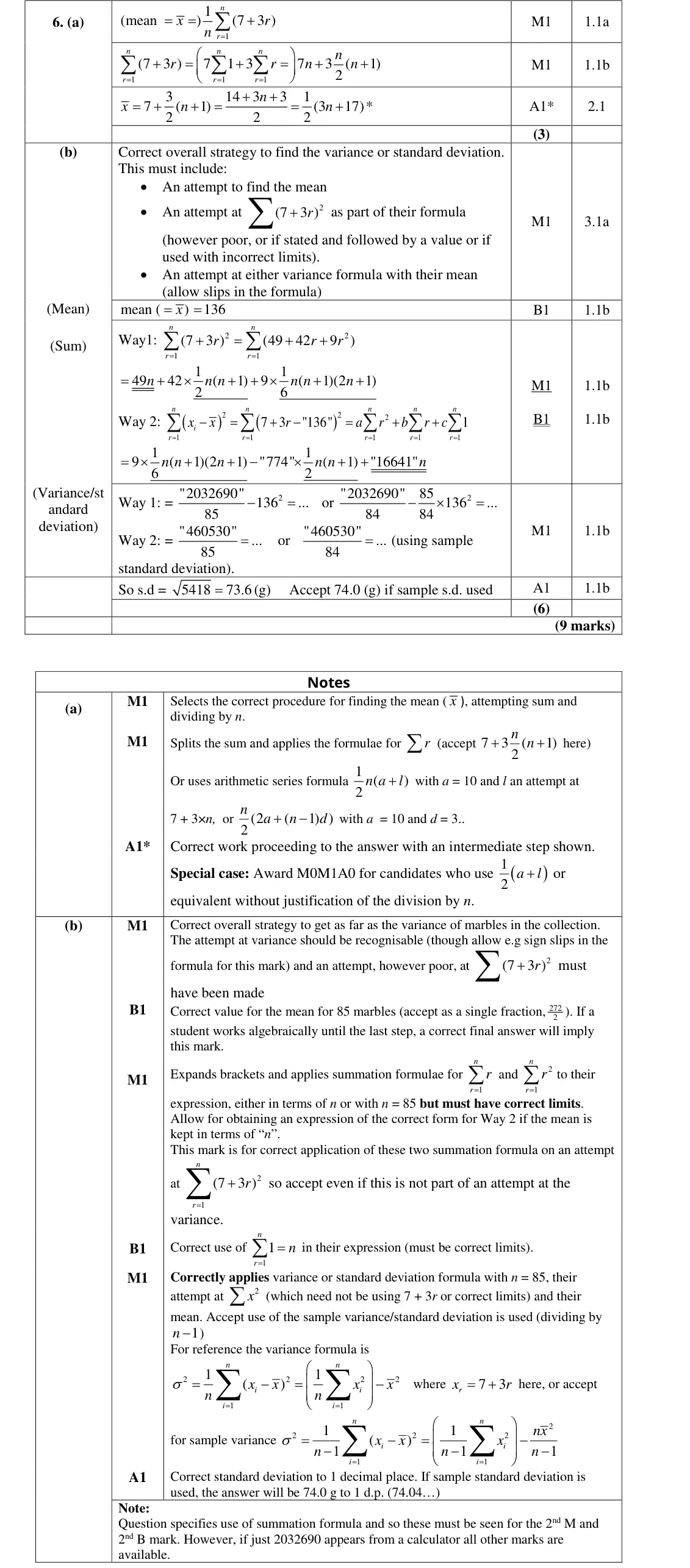
mean 136
Σ(7 + 3r)² = Σ(49 + 42r + 9r²) with n = 85 = 2032690
variance = Σx²/n − mean² = 5418, s.d. 73.6 g (74.0 if sample s.d.)
summation formulae must be shown
June 2018 · AS Paper 1 (Core Pure) · Q6(a)5 marks
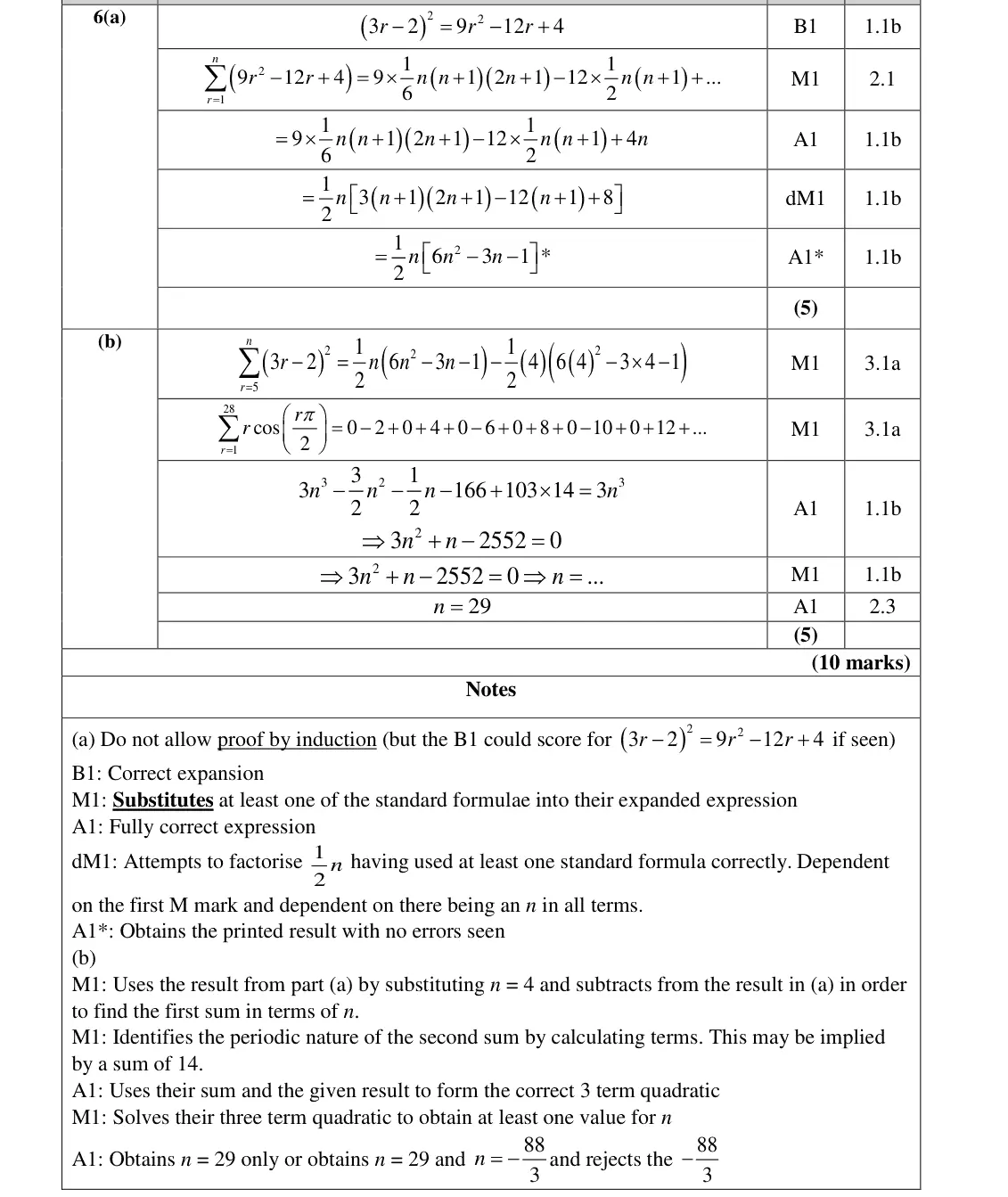
Mark scheme (whole question; this part is marked with the orange bar)
Examiner's comment
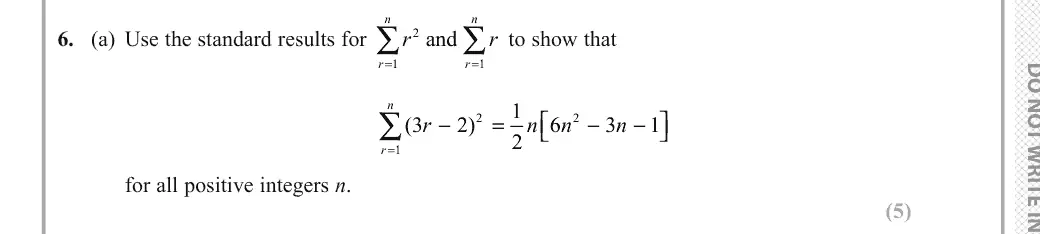
(a) Many students achieved full marks in this part. Those who did not, often made mistakes in the initial expansion of brackets with (3r – 2)2 seen as 9r2 – 6r + 4 a significant number of times. Sometimes the solutions were made far more complex than necessary as students chose to multiply the bracketed expressions out before factorisation rather than looking for common factors first. There were some attempts at proof by induction which in the context of this question generally gained no marks.
Key points from the mark scheme and examiner's report
(3r − 2)² = 9r² − 12r + 4 (9r² − 6r + 4 a common slip)
factor ½n out early
induction not accepted
June 2018 · AS Paper 1 (Core Pure) · Q6(b)5 marks
Mark scheme (whole question; this part is marked with the orange bar)
Examiner's comment
(b) This was much less successful for many students. Some substituted n = 4 and subtracted to achieve the first method mark but a few substituted n = 5 and many did not seem to have noticed the lower limit. The summation of the cosine term caused problems for the majority of students. It was rare to see solutions where the terms of the cosine sum were written out so that students could appreciate the sequence generated. It seemed as though students were determined to use a standard formula to add up these terms rather than look at the problem in a simpler way. Not all students had the “= 3n3” and so never eliminated the cubic term to achieve a 3 term quadratic. Those that had a 3 term quadratic were usually able to earn the method mark for solving it. Of those with the correct solutions, most correctly identified n = 29 as the final answer.
Key points from the mark scheme and examiner's report
lower limit r = 5 so subtract the n = 4 sum (166)
cosine sum is periodic 0 − 2 + 0 + 4 ...: = 14
3n² + n − 2552 = 0, n = 29 only (reject −88/3)
Find an Edexcel Further Maths tutor
Stuck on this? Book a trial lesson with our Further Maths tutor.







![4. Prove that, for n ], n . 0 n ( ) ( ) n + a n + b =∑ = ( ) ( ) ( ) ( ) ( ) r + r + r + c n + n + r where a, b and c are integers to be found. (5)](/img/JUN19_9FM001/JUN19_9FM001_04.webp)