The vector product and scalar triple product are given as determinants.
Since 2018
40 question parts, 145 marks, 5 with a difficulty rating from the examiner's report
Notes, worked examples and practice for this topic are being written by our tutors. The past-paper questions below are ready now: work each one on paper, then open the mark scheme and the examiner's comment.
Tap a question to zoom it. Mark scheme and examiner's comment open under each question.
June 2025 · AS Paper 2 (Further Pure 1) · Q3(a)3 marks
Mark scheme (whole question; this part is marked with the orange bar)
Examiner's comment
Part (a) It was common to see incorrect vectors calculated for AB and AD , using AB and AE so several vector products were formed from the wrong vectors. Position vectors were only occasionally used. There were a lot of sign slips in forming the vector product.
Key points from the mark scheme and examiner's report
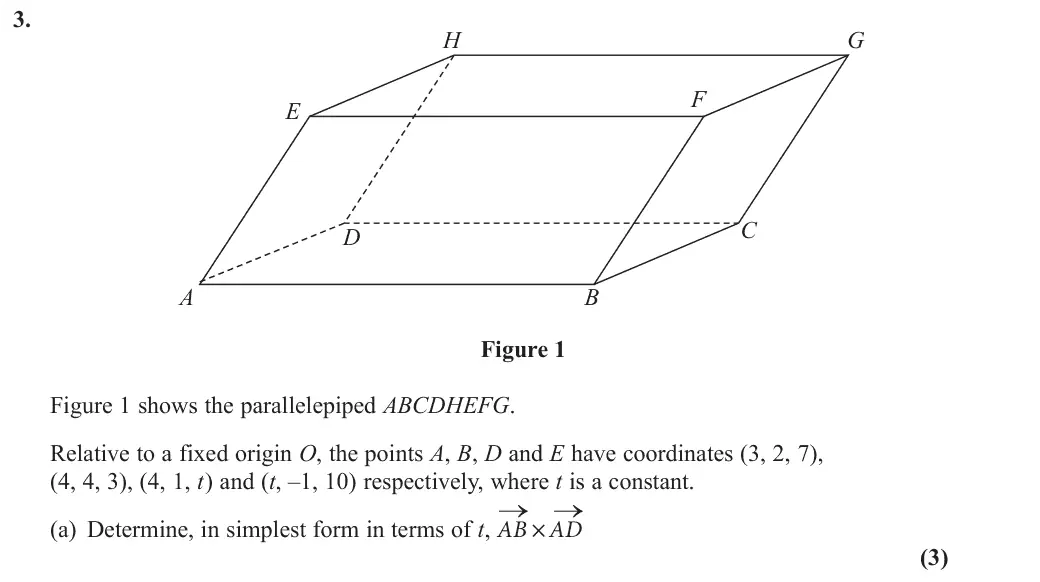
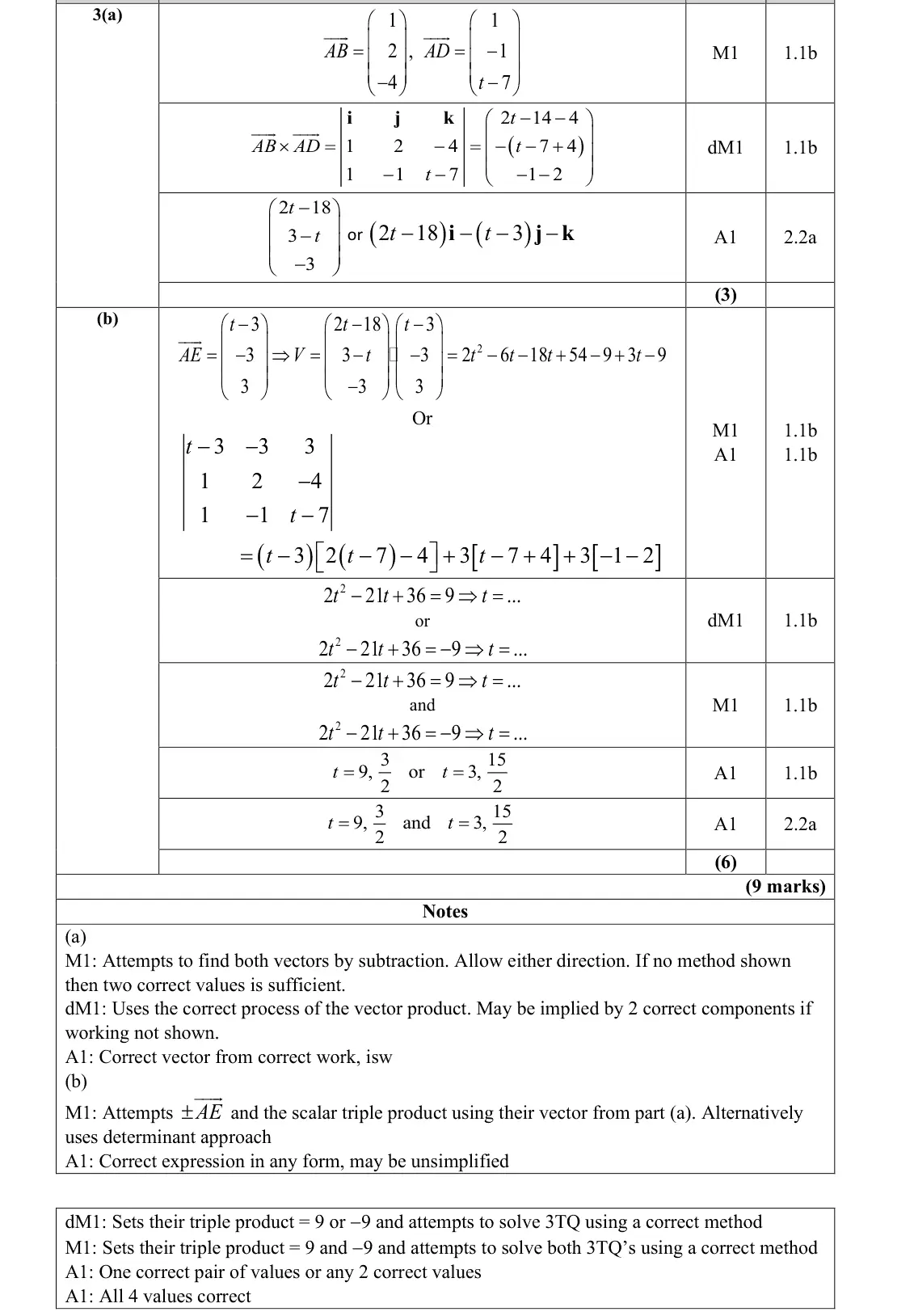
AB = (1, 2, −4), AD = (1, −1, t − 7)
AB × AD = (2t − 18)i − (t − 3)j − 3k
using AE instead of AD and sign slips were common
June 2025 · AS Paper 2 (Further Pure 1) · Q3(b)6 marks
Mark scheme (whole question; this part is marked with the orange bar)
Examiner's comment
Part (b) Many knew how to form the triple scalar product, but several gave result as a vector, then tried to find the modulus to obtain a volume. Those who had used incorrect vectors in (a) could sometimes achieve the correct volume here if they used the determinant approach. Factors of 1 6 or ½ sometimes appeared in their expression for the product, resulting in an incorrect quadratic being solved. There were not many candidates who used both +9 and – 9 for the volume, so most achieved only 2 of the four possible answers.
Key points from the mark scheme and examiner's report
AE.(AB × AD) = 2t² − 21t + 36 = ±9
t = 3, 15/2 (from +9) and t = 9, 3/2 (from −9)
most used only +9 and found two values
factors 1/6 or ½ wrongly included
scalar triple product left as a vector
June 2025 · Paper 3A (Further Pure 1) · Q9(a)3 marks
Mark scheme (whole question; this part is marked with the orange bar)
Examiner's comment
Part (a) The need to form two appropriate vectors and form the cross product was generally well understood. Some did not take enough care with signs in their calculation and so forfeited the third mark.
Key points from the mark scheme and examiner's report
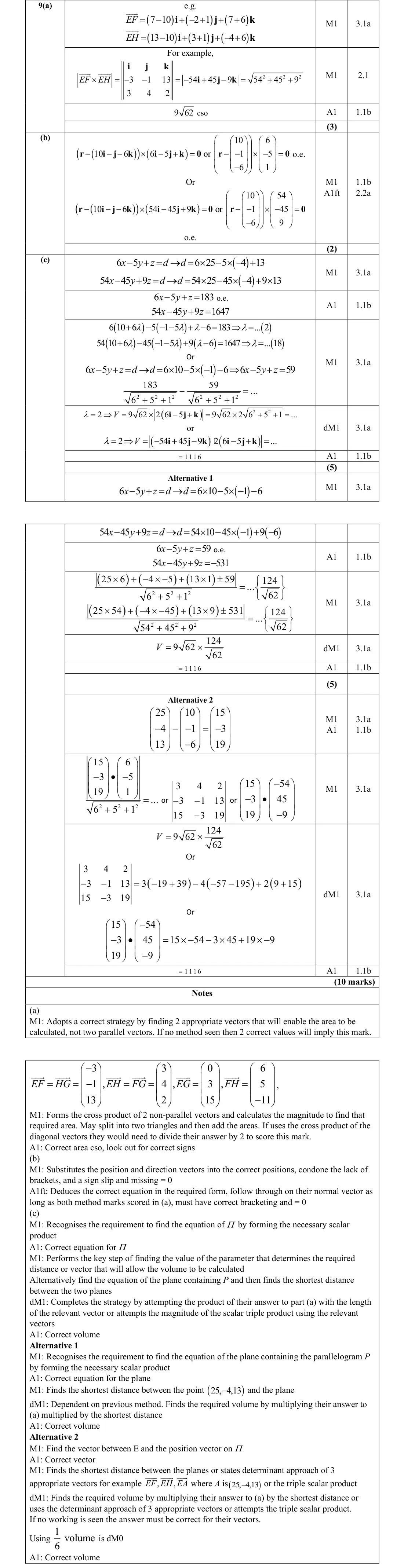
EF × EH = (−54, 45, −9) (two adjacent sides, not a diagonal)
area 9√62
sign slips
June 2025 · Paper 3A (Further Pure 1) · Q9(b)2 marks
Mark scheme (whole question; this part is marked with the orange bar)
Examiner's comment
Part (b) Many identified the correct vectors and placed then correctly. Some did not include = 0 and failed to gain the accuracy mark.
Key points from the mark scheme and examiner's report
direction = normal from (a), e.g. 6i − 5j + k: (r − (10i − j − 6k)) × (6i − 5j + k) = 0
"= 0" often omitted
June 2025 · Paper 3A (Further Pure 1) · Q9(c)5 marks
Mark scheme (whole question; this part is marked with the orange bar)
Examiner's comment
Part (c) Many learners found this part challenging although some offered a very precise and correct solution. Sometimes the solution failed because there was too much generalisation and individual components of a vector were not fully identified. On occasion there were simple arithmetic errors or sign slips. It was not uncommon for a position vector or direction vector to be incorrectly identified. Learners used a wide variety of methods. The most efficient was to calculate the vector between point E and the point on the plane and then use the answer to part (a) to form the vector triple product. Learners were able to get the correct result in a few lines. Those who attempted more complicated methods were often incorrect, either getting their vectors confused or forming the equations of the wrong planes. Some learners were quite poor at explaining their methods so some of these attempts were very difficult to follow.
Key points from the mark scheme and examiner's report
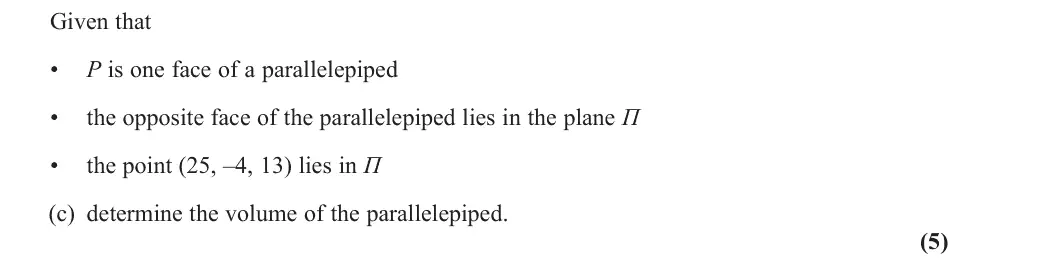
vector from E to (25, −4, 13) = (15, −3, 19)
volume = modulus of its scalar product with EF × EH = 1116 (or area × distance between the planes 6x − 5y + z = 59 and 183)
1/6 wrongly used
found challenging
June 2024 · AS Paper 2 (Further Pure 1) · Q3(a)2 marks
Mark scheme (whole question; this part is marked with the orange bar)
Examiner's comment
With the details of the vector product given in the formula book, most formed the vector product in part (a) correctly although there were a significant number of sign errors. use their answer from part (a). Interestingly some candidates obtained a different vector than their answer to part (a). Most knew and applied the formula for the area and the majority made a good attempt at the modulus although there were some bracketing and algebraic errors. Nearly all remembered to square the “15”, although there was some confusion with the 1 2 in the area formula and the “2” with the vector AB. It was pleasing to see that many could navigate their way through the algebra correctly and obtained the correct values for a. A few opted for a non- vector approach in part (b) and made little progress.
Key points from the mark scheme and examiner's report
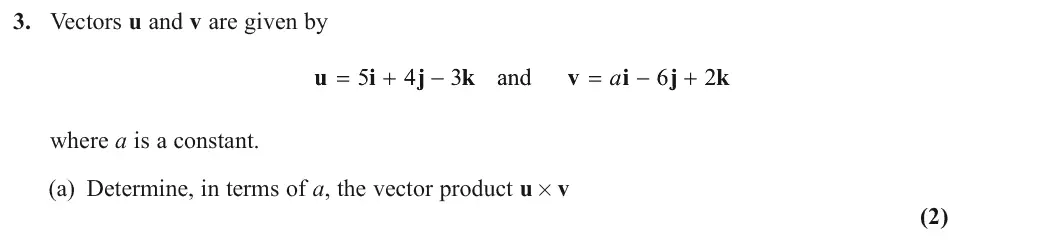
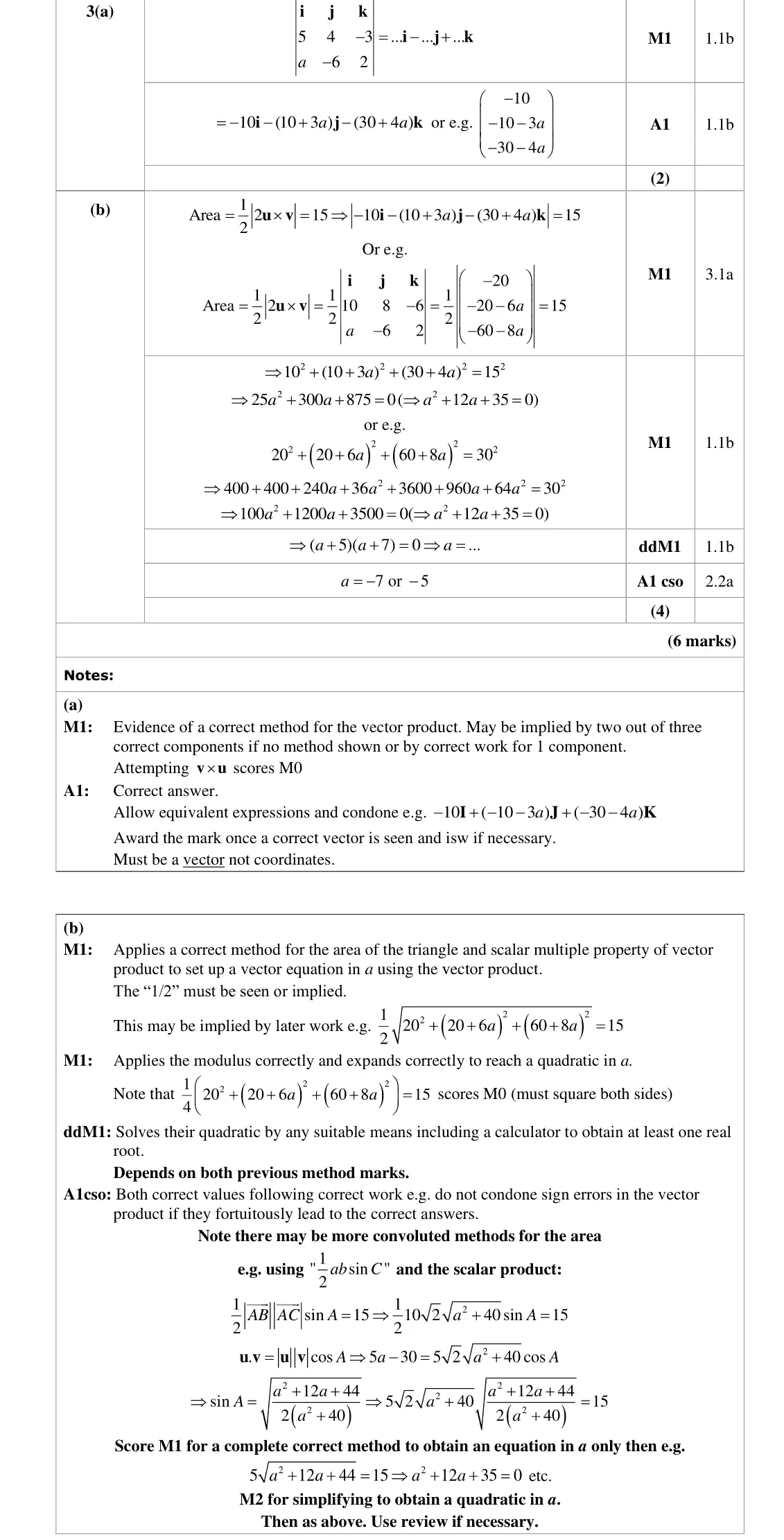
u × v = −10i − (10 + 3a)j − (30 + 4a)k
sign errors in the j component
v × u scores 0
June 2024 · AS Paper 2 (Further Pure 1) · Q3(b)4 marks
Mark scheme (whole question; this part is marked with the orange bar)
Examiner's comment
With the details of the vector product given in the formula book, most formed the vector product In part (b) the majority started again and had another attempt at the vector product, rather than use their answer from part (a). Interestingly some candidates obtained a different vector than vector approach in part (b) and made little progress.
Key points from the mark scheme and examiner's report
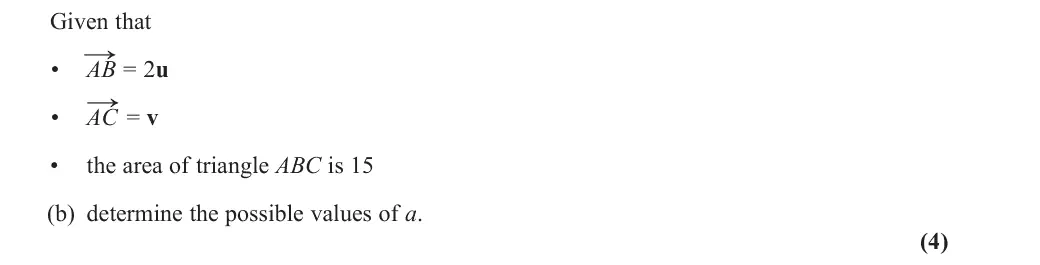
½ modulus of 2u × v = 15 so 10² + (10 + 3a)² + (30 + 4a)² = 15²
a² + 12a + 35 = 0, a = −5 or −7
confusion between the ½ and the factor 2 in AB = 2u
must square both sides
June 2024 · Paper 3A (Further Pure 1) · Q9(i)(a)2 marks
Mark scheme (whole question; this part is marked with the orange bar)
Examiner's comment
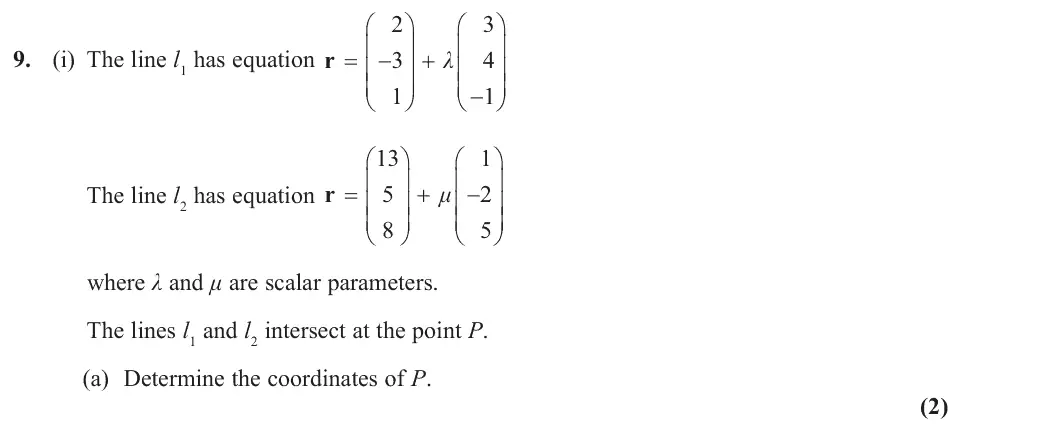
The first two part of this question was well answered while the second part proved far more challenging and discriminating. This is no doubt to do with the fact that part (i) is very familiar vectors work from long standing, while part (ii) contains mathematics novel to the newer specification, which has not been tested in great depth thus far. In part (i)(a), the strategy for finding the intersection point of the two lines was well know. Candidates equated the two parametrised forms of the two lines and solved to find one, or both, of the parameters. Most clearly used a calculator to solve their simultaneous equations and this was an acceptable method for solution. It was pleasing to see candidates checking their work by verifying that the values of their parameters satisfied the third equation that was unused in their solution. There were occasional slips in substitution to achieve the position of the point of intersection, but the majority of solutions to this part were correct and completed with little fuss. Likewise for part (i)(b) most were able to speedily find the normal vector and proceed t the equation of the plane. The usual method of solution to find the equation of the plane was to find the vector product of the direction vectors of the two lines and then to use the r.n=a.n form of the equation of the plane before writing the equation in a Cartesian form, although sometimes the last mark in this part was lost because a Cartesian form was not given. The cross product was completed very well, with only very few making errors, and so the correct equation usually resulted. Occasionally candidates would use an incorrect vector for a, using a direction vector instead of point on the plane, but again these were a minority. It was rare to see an alternative approach using the Cartesian form of the plane from the outset, and when it was used it was far more prone to error in the solution of the equations. Part (ii) of the question proved more demanding for candidates with many not having a clear strategy for proceeding and was the part that was more often simply omitted by candidates than any other part of any question on the paper. It was rare to see the approach using direction cosines from the outset. This unfamiliar topic has yet to be taken on board and those who were aware of it were in the minority. Those who did use the direction cosines generally managed to get as far as cos theta = 1 2 but were not always able to make the step from here to a Cartesian equation for the line. Indeed, many seemed unsure of what the Cartesian equation for a line is, attempting plane equations instead. Most candidates opted for using the projection on to the coordinate axes approach, using the dot product, but working was often not clearly presented and after setting up correct equations there was again often no progression to a Cartesian equation. Solutions often got the first two marks and then proceeded no further. There were, nevertheless, some fully correct solutions via both methods, where the candidates showed a good understanding of the equations of lines in 3 dimensions and how to find them. But overall, even among the A* candidates, the latter two marks in this question were ones that were highly likely to prevent full marks on the paper.
Key points from the mark scheme and examiner's report
June 2024 · Paper 3A (Further Pure 1) · Q9(i)(b)4 marks
Mark scheme (whole question; this part is marked with the orange bar)
Examiner's comment
The first two part of this question was well answered while the second part proved far more challenging and discriminating. This is no doubt to do with the fact that part (i) is very familiar vectors work from long standing, while part (ii) contains mathematics novel to the newer specification, which has not been tested in great depth thus far. In part (i)(a), the strategy for finding the intersection point of the two lines was well know. Candidates equated the two parametrised forms of the two lines and solved to find one, or both, of the parameters. Most clearly used a calculator to solve their simultaneous equations and this was an acceptable method for solution. It was pleasing to see candidates checking their work by verifying that the values of their parameters satisfied the third equation that was unused in their solution. There were occasional slips in substitution to achieve the position of the point of intersection, but the majority of solutions to this part were correct and completed with little fuss. Likewise for part (i)(b) most were able to speedily find the normal vector and proceed t the equation of the plane. The usual method of solution to find the equation of the plane was to find the vector product of the direction vectors of the two lines and then to use the r.n=a.n form of the equation of the plane before writing the equation in a Cartesian form, although sometimes the last mark in this part was lost because a Cartesian form was not given. The cross product was completed very well, with only very few making errors, and so the correct equation usually resulted. Occasionally candidates would use an incorrect vector for a, using a direction vector instead of point on the plane, but again these were a minority. It was rare to see an alternative approach using the Cartesian form of the plane from the outset, and when it was used it was far more prone to error in the solution of the equations. Part (ii) of the question proved more demanding for candidates with many not having a clear strategy for proceeding and was the part that was more often simply omitted by candidates than any other part of any question on the paper. It was rare to see the approach using direction cosines from the outset. This unfamiliar topic has yet to be taken on board and those who were aware of it were in the minority. Those who did use the direction cosines generally managed to get as far as cos theta = 1 2 but were not always able to make the step from here to a Cartesian equation for the line. Indeed, many seemed unsure of what the Cartesian equation for a line is, attempting plane equations instead. Most candidates opted for using the projection on to the coordinate axes approach, using the dot product, but working was often not clearly presented and after setting up correct equations there was again often no progression to a Cartesian equation. Solutions often got the first two marks and then proceeded no further. There were, nevertheless, some fully correct solutions via both methods, where the candidates showed a good understanding of the equations of lines in 3 dimensions and how to find them. But overall, even among the A* candidates, the latter two marks in this question were ones that were highly likely to prevent full marks on the paper.
Key points from the mark scheme and examiner's report
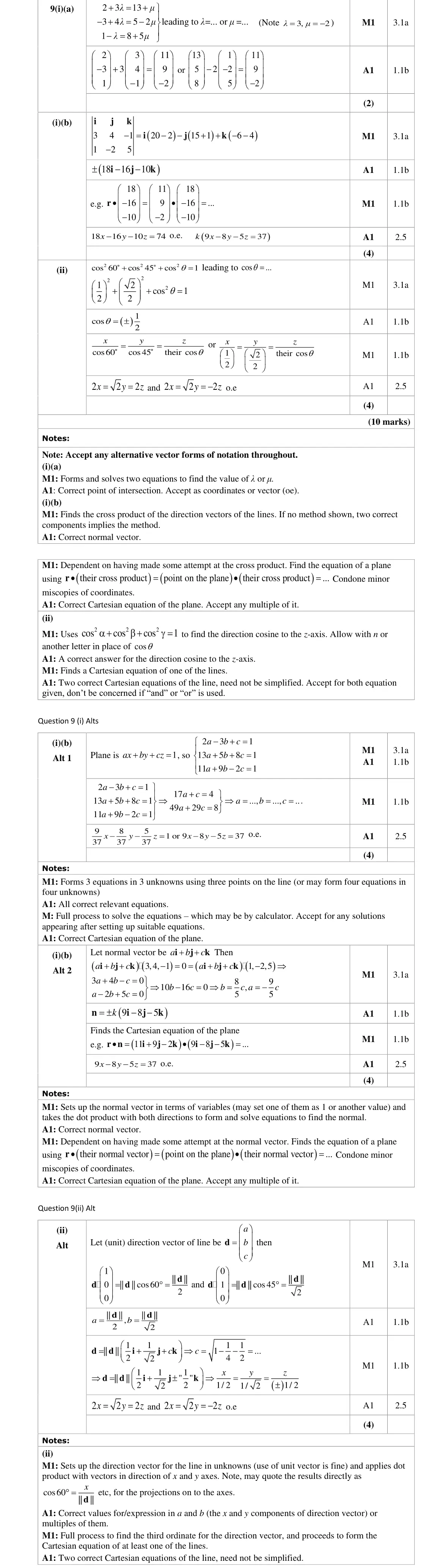
normal = (3, 4, −1) × (1, −2, 5) = (18, −16, −10)
r.n = a.n with a point on the plane: 9x − 8y − 5z = 37
Cartesian form required
using a direction vector as the point
June 2024 · Paper 3A (Further Pure 1) · Q9(ii)4 marks
Mark scheme (whole question; this part is marked with the orange bar)
Examiner's comment
The first two part of this question was well answered while the second part proved far more challenging and discriminating. This is no doubt to do with the fact that part (i) is very familiar vectors work from long standing, while part (ii) contains mathematics novel to the newer specification, which has not been tested in great depth thus far. In part (i)(a), the strategy for finding the intersection point of the two lines was well know. Candidates equated the two parametrised forms of the two lines and solved to find one, or both, of the parameters. Most clearly used a calculator to solve their simultaneous equations and this was an acceptable method for solution. It was pleasing to see candidates checking their work by verifying that the values of their parameters satisfied the third equation that was unused in their solution. There were occasional slips in substitution to achieve the position of the point of intersection, but the majority of solutions to this part were correct and completed with little fuss. Likewise for part (i)(b) most were able to speedily find the normal vector and proceed t the equation of the plane. The usual method of solution to find the equation of the plane was to find the vector product of the direction vectors of the two lines and then to use the r.n=a.n form of the equation of the plane before writing the equation in a Cartesian form, although sometimes the last mark in this part was lost because a Cartesian form was not given. The cross product was completed very well, with only very few making errors, and so the correct equation usually resulted. Occasionally candidates would use an incorrect vector for a, using a direction vector instead of point on the plane, but again these were a minority. It was rare to see an alternative approach using the Cartesian form of the plane from the outset, and when it was used it was far more prone to error in the solution of the equations. Part (ii) of the question proved more demanding for candidates with many not having a clear strategy for proceeding and was the part that was more often simply omitted by candidates than any other part of any question on the paper. It was rare to see the approach using direction cosines from the outset. This unfamiliar topic has yet to be taken on board and those who were aware of it were in the minority. Those who did use the direction cosines generally managed to get as far as cos theta = 1 2 but were not always able to make the step from here to a Cartesian equation for the line. Indeed, many seemed unsure of what the Cartesian equation for a line is, attempting plane equations instead. Most candidates opted for using the projection on to the coordinate axes approach, using the dot product, but working was often not clearly presented and after setting up correct equations there was again often no progression to a Cartesian equation. Solutions often got the first two marks and then proceeded no further. There were, nevertheless, some fully correct solutions via both methods, where the candidates showed a good understanding of the equations of lines in 3 dimensions and how to find them. But overall, even among the A* candidates, the latter two marks in this question were ones that were highly likely to prevent full marks on the paper.
Key points from the mark scheme and examiner's report
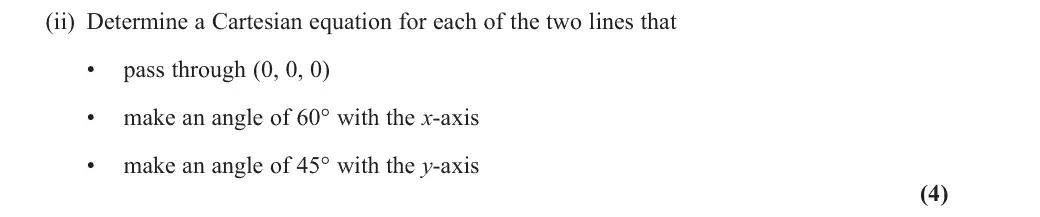
direction cosines: cos²60° + cos²45° + cos²θ = 1 gives cos θ = ±½
lines x/(1/2) = y/(√2/2) = ±z/(1/2), i.e. 2x = √2y = 2z and 2x = √2y = −2z
most omitted part of the paper
unsure of the Cartesian form of a line
June 2023 · AS Paper 2 (Further Pure 1) · Q5(a)7 marks
Mark scheme (whole question; this part is marked with the orange bar)
Examiner's comment
This proved to be a very accessible question on the unloved topic of vectors, with over half achieving the full marks, but a mixed performance among those who did not achieve the maximum score. The mark scheme in part (a) was particularly fair, especially given the very quick alternative method using two scalar products, though only very few students spotted the quicker approach. Most saw the question was about cross products and so proceeded to find the cross product of the vectors on automatic pilot. A few very astute students did consider the definition of the cross product being a vector perpendicular to both given vectors and so solved the two equations from setting the scalar product to zero, picking up the marks very straightforwardly. However, these then had to evaluate the cross product (or use a more long winded approach, but no such was recorded as seen) to compute the area in part (b), so the question overall still had as much demand. The majority of students made a good attempt at the vector product, usually correct although sign errors were common, especially on the j component. For some of the lower grade students this was all they managed in the question, scoring either 1 or 2 marks, but the majority were able to progress further into the question. Most, however, understood the correct strategy required and equated their cross product to λ(2i +3j + 4k), although some used λ=1 and so made no further progress. Sorting out the correct multiple did create problems for some, with minus sign sometimes missing and/or the position of the 2 sometime being incorrect placed (equating j and k components to 3 2 and ±2 respectively) or other such slips. These were still able to form and solve simultaneous equations, though not always correctly with sign errors again being common, but as long as values were reached they could access the method marks. A few students attempted the approach of taking the vector product of their AB x AC with (2i +3j + 4k), and some of these formed simultaneous equations by equating the components to zero. Such methods were less well carried out overall, often losing accuracy along the way. One fairly common incorrect approach was to form the scalar product of the two given vectors and put it equal to either zero or one, before making no further progress. Another noted error was misreading the question to set the cross product equal to the given vector rather than parallel to it.
Key points from the mark scheme and examiner's report
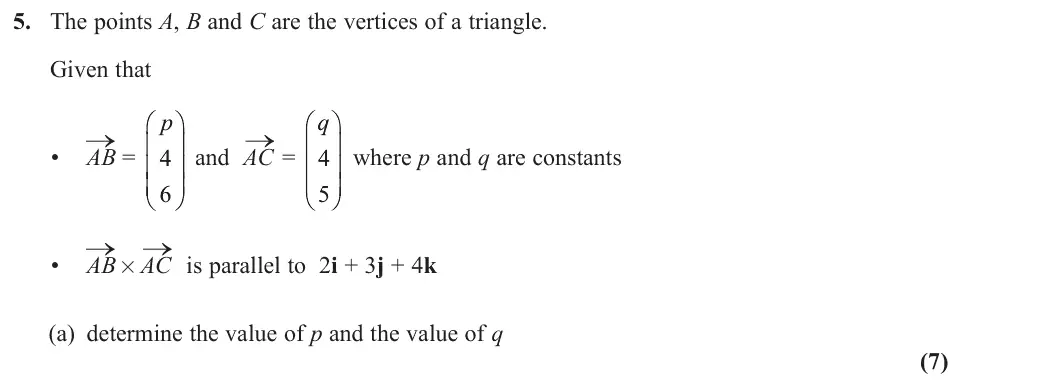
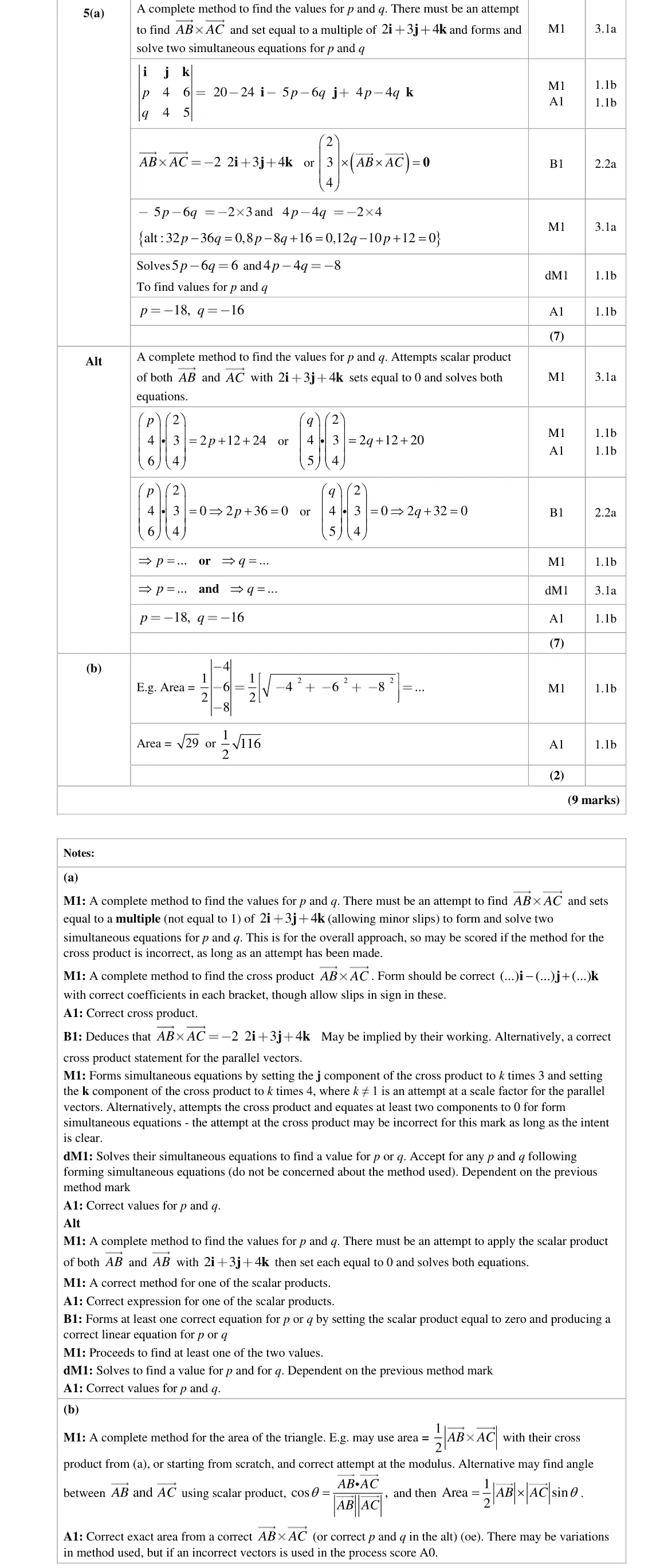
AB × AC = (20 − 24)i − (5p − 6q)j + (4p − 4q)k set equal to λ(2i + 3j + 4k) with λ = −2
or scalar products with 2i + 3j + 4k equal to zero (quicker, rarely seen)
p = −18, q = −16
sign errors in the j component
equating to the vector itself (λ = 1)
June 2023 · AS Paper 2 (Further Pure 1) · Q5(b)2 marks
Mark scheme (whole question; this part is marked with the orange bar)
Examiner's comment
This proved to be a very accessible question on the unloved topic of vectors, with over half achieving the full marks, but a mixed performance among those who did not achieve the maximum score. In part (b) most students knew how to find the area of the triangle, and were often able to recover these marks despite errors in part (a), by using the given vector and a correct scale factor. Use of a clearly incorrect vector, e.g. with a sign error in one component, would lead to the correct answer, but was penalised in the accuracy mark, though if no incorrect vector was seen benefit of doubt was awarded in such cases. In a small number, an incorrect approach to finding the modulus of the vector was seen, usually just adding the components rather than using the Pythagoras identity, while in others a neglect to divide the result of the modulus of the cross product by 2 lost either one or both marks depending on if the formula had been initially quoted or not.
Key points from the mark scheme and examiner's report
½ modulus of (−4, −6, −8) = ½√116 = √29
forgetting the ½ or adding components instead of Pythagoras
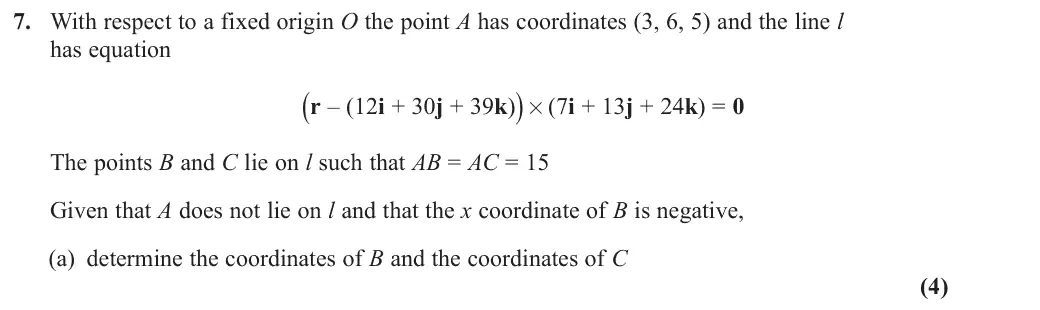
June 2023 · Paper 3A (Further Pure 1) · Q7(a)4 marks
Mark scheme (whole question; this part is marked with the orange bar)
Examiner's comment
Easily the most challenging question of the paper, with many students unable to make progress, especially in the latter parts. However, there were still many who were able to successfully complete the whole question, so there was little evidence time was an issue, but mainly the low scores were due to very poor attempts with students unable to determine what was required. Vectors is, and will continue to be, one of the most demanding subjects for students. However, the majority were able to make some progress in places, though only the higher-grade students could access part (d). The techniques involved throughout seemed to be well known to many, with formulae quoted for various parts. However, in many cases these were not always employed to good effect, but sometimes just stated without the students working out the relevant vectors needed to use in them. It would help the understanding of a solution if students clearly stated which vectors they were using in their attempted solution. The method of evaluating cross products was well demonstrated by the majority, but there were a lot of arithmetic errors, sign errors and poor notation during the workings and simplifications, even for students who knew the required steps. As the question progressed, workings became scrappier as students struggled to find their way through, and possibly hurried to finish the paper, with many attempting dot and cross products of any vector they could find just in case it helped. Part (a) was the best attempted overall, with many students able to obtain an expression for the vector linking the given point A to a general point on the line and proceed to set the distance equal to 15 to find the two values of the parameter. However, some attempted this with just a general point on the line. Others attempted to work out the cross product in the given line equation, using a general point (x, y, z), and attempted to use these in a distance formula to form an equation in x, y or z. These seldom proceeded far enough to attain marks in the alternative method. Most students who started with the appropriate main scheme method achieved at least three of the four marks, but errors in expanding brackets and arithmetic errors cause many to lose the A mark, while others substituted the parameter back into expression for the A to line vector, and mixed up B and C with AB and AC.
Key points from the mark scheme and examiner's report
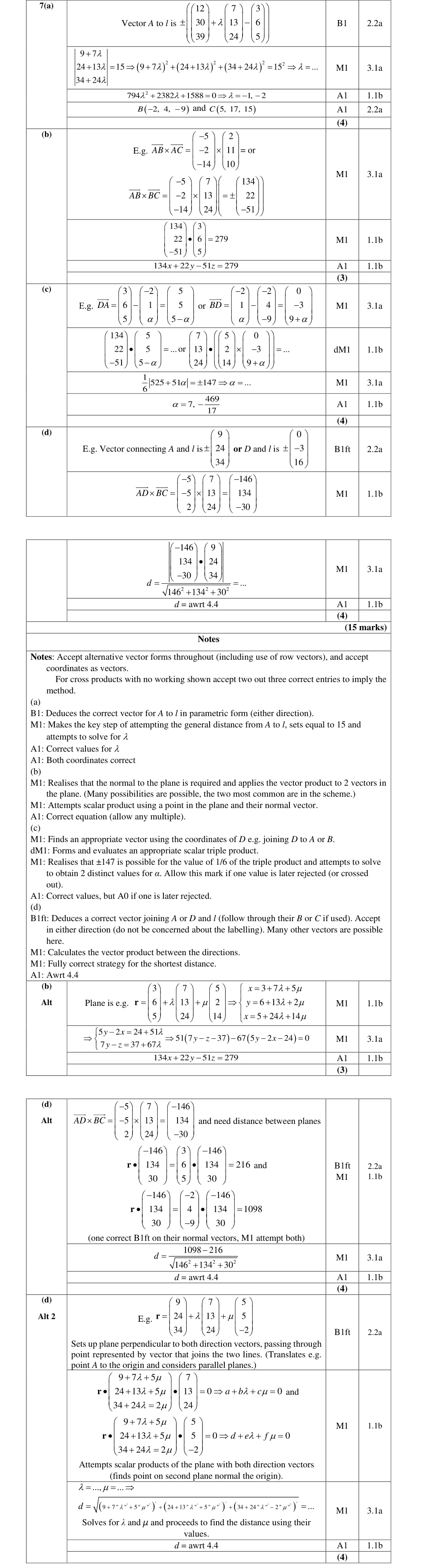
vector from A to l: (9 + 7λ, 24 + 13λ, 34 + 24λ) of modulus 15 gives 794λ² + 2382λ + 1588 = 0, λ = −1, −2
B(−2, 4, −9), C(5, 17, 15)
June 2023 · Paper 3A (Further Pure 1) · Q7(b)3 marks
Mark scheme (whole question; this part is marked with the orange bar)
Examiner's comment
Easily the most challenging question of the paper, with many students unable to make progress, especially in the latter parts. However, there were still many who were able to successfully complete the whole question, so there was little evidence time was an issue, but mainly the low scores were due to very poor attempts with students unable to determine what was required. Vectors is, and will continue to be, one of the most demanding subjects for students. However, the majority were able to make some progress in places, though only the higher-grade students could access part (d). The techniques involved throughout seemed to be well known to many, with formulae quoted for various parts. However, in many cases these were not always employed to good effect, but sometimes just stated without the students working out the relevant vectors needed to use in them. It would help the understanding of a solution if students clearly stated which vectors they were using in their attempted solution. The method of evaluating cross products was well demonstrated by the majority, but there were a lot of arithmetic errors, sign errors and poor notation during the workings and simplifications, even for students who knew the required steps. As the question progressed, workings became scrappier as students struggled to find their way through, and possibly hurried to finish the paper, with many attempting dot and cross products of any vector they could find just in case it helped. Part (b) was done reasonably well with many fully correct solutions seen, and many scoring both methods where errors had led to incorrect coordinates for B and C. Common errors were to use vectors OA and OB rather than AB and AC, while some gave the answer in a vector form rather than in the required Cartesian form. There were also a few students who gave the plane in the alternative vector form shown in the alternative method, but did not attempt to convert into Cartesian form, so scored no marks.
Key points from the mark scheme and examiner's report
normal AB × AC (or AB × BC) = multiple of (134, 22, −51)
134x + 22y − 51z = 279
June 2023 · Paper 3A (Further Pure 1) · Q7(c)4 marks
Mark scheme (whole question; this part is marked with the orange bar)
Examiner's comment
Easily the most challenging question of the paper, with many students unable to make progress, especially in the latter parts. However, there were still many who were able to successfully complete the whole question, so there was little evidence time was an issue, but mainly the low scores were due to very poor attempts with students unable to determine what was required. Vectors is, and will continue to be, one of the most demanding subjects for students. However, the majority were able to make some progress in places, though only the higher-grade students could access part (d). The techniques involved throughout seemed to be well known to many, with formulae quoted for various parts. However, in many cases these were not always employed to good effect, but sometimes just stated without the students working out the relevant vectors needed to use in them. It would help the understanding of a solution if students clearly stated which vectors they were using in their attempted solution. The method of evaluating cross products was well demonstrated by the majority, but there were a lot of arithmetic errors, sign errors and poor notation during the workings and simplifications, even for students who knew the required steps. As the question progressed, workings became scrappier as students struggled to find their way through, and possibly hurried to finish the paper, with many attempting dot and cross products of any vector they could find just in case it helped. Part (c) saw a mixed set of responses. Though many did score full marks, or at least the method marks following earlier error, there were numerous errors made. Some did not attempt DA, but attempted the triple product with OD and their normal vector of (b), while others were able to get the first couple of marks but forgot to use ±147, so didn’t achieve two answers, or omitted the 1 6 entirely from the formula. Of those who successfully carried out the method, many realised the normal vector from part (b) could be used to speed up work, but there was also a considerable number who either reworked this anyway, or used a different vector combination (e.g. used BD as in the scheme) and required another cross product to be used. Of the students who neglected to find the Cartesian equation in part (b), many did proceed to find the relevant triple product in this part and obtain the marks.
Key points from the mark scheme and examiner's report
June 2023 · Paper 3A (Further Pure 1) · Q7(d)4 marks
Mark scheme (whole question; this part is marked with the orange bar)
Examiner's comment
Easily the most challenging question of the paper, with many students unable to make progress, especially in the latter parts. However, there were still many who were able to successfully complete the whole question, so there was little evidence time was an issue, but mainly the low scores were due to very poor attempts with students unable to determine what was required. Vectors is, and will continue to be, one of the most demanding subjects for students. However, the majority were able to make some progress in places, though only the higher-grade students could access part (d). The techniques involved throughout seemed to be well known to many, with formulae quoted for various parts. However, in many cases these were not always employed to good effect, but sometimes just stated without the students working out the relevant vectors needed to use in them. It would help the understanding of a solution if students clearly stated which vectors they were using in their attempted solution. The method of evaluating cross products was well demonstrated by the majority, but there were a lot of arithmetic errors, sign errors and poor notation during the workings and simplifications, even for students who knew the required steps. As the question progressed, workings became scrappier as students struggled to find their way through, and possibly hurried to finish the paper, with many attempting dot and cross products of any vector they could find just in case it helped. By part (d), many students had given up and offered no solution at all. For those who did persevere, the most common approach was for students to quote and attempt to apply the formula for the shortest distance. Clearly many had memorised this in anticipation. However, working out which vectors to use did prove a challenge for many, and this part did discriminate very well at the top-grade range. Where incorrect answers to part (c) had been found, the first three marks were still attainable in this part and were scored by many students. Identifying a vector connecting A and the line was often, but not always, done correctly with the first shown in the mark scheme the prevalent one. Likewise, good progress with the required cross product was often made, and once achieved the completion of the method usually followed. But correct answers were relatively rare, as slips in earlier working, an incorrect alpha being very common, prevented the correct answer being found. Other approaches were seen to this part, by those who either had not learned or remembered the shortest distance formula, and some students were able to work their way to a solution through the alternatives shown in the scheme. These tended to be longer winded and prone to errors in calculation, or required dependence on calculators solving equations, but showed good ability to think through a situation to come up with an approach to the answer.
Key points from the mark scheme and examiner's report
α = 7: common perpendicular AD × BC = (−146, 134, −30)
distance = modulus of (vector joining the lines).n / modulus of n = awrt 4.4
hardest part, only top candidates progressed
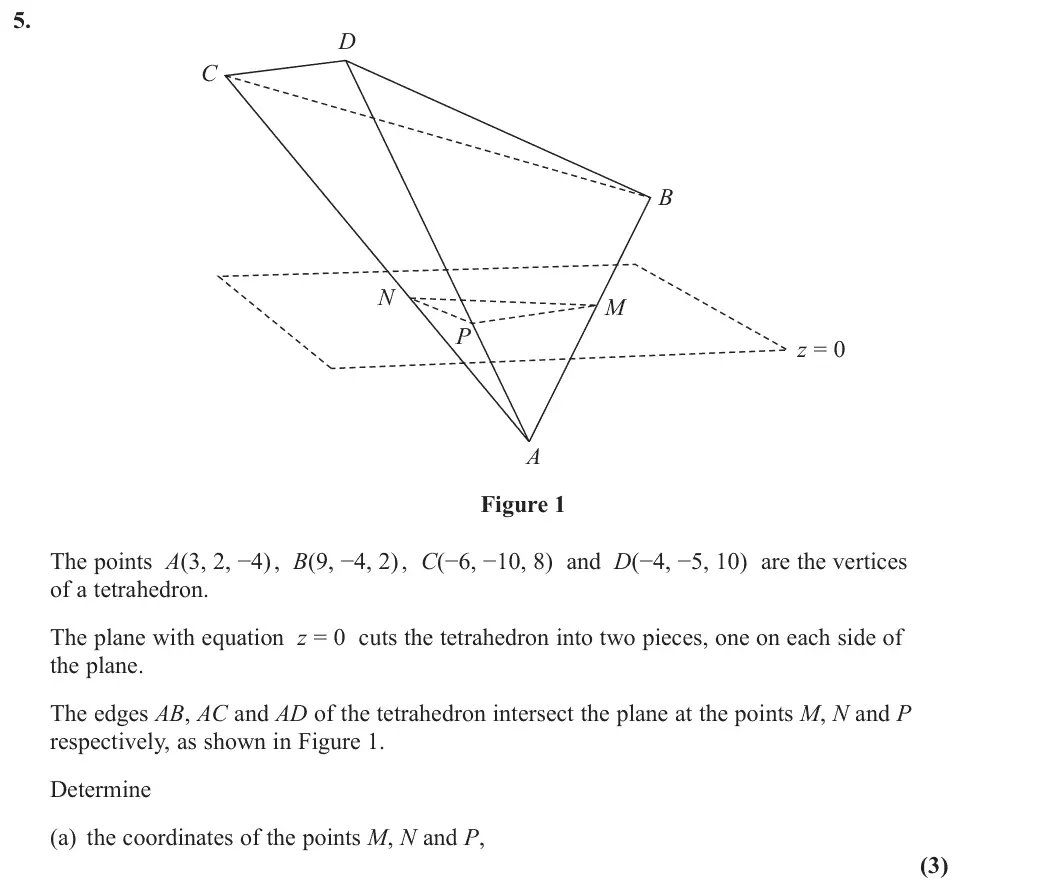
June 2022 · AS Paper 2 (Further Pure 1) · Q5(a)3 marks
Mark scheme (whole question; this part is marked with the orange bar)
Examiner's comment
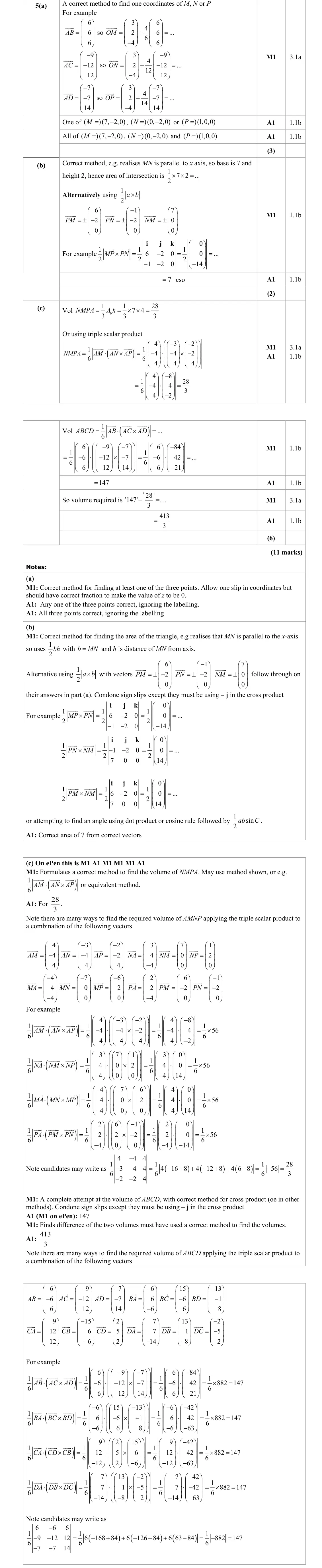
Those candidates who were able to find the coordinates of M, N and P often went on to complete the rest of the question correctly. However, a surprising number of candidates did not seem to understand how to do this and having found vectors for AB, AC and AD, just replaced the z value with a zero. Poor arithmetic hampered a number of candidates in this part of the question, and responses with 1 or 2 incorrect points were common. Only 2 responses were seen in which candidates used the first method shown in the mark scheme to find the area of the triangle. Most attempted to use the cross product and were able to earn a method mark, although a few tried to find an angle using dot product or cosine rule and then ½abSinC. Similarly, no responses were seen using the 1 area base height x method to find the volume of 3
Key points from the mark scheme and examiner's report
M(7, −2, 0), N(0, −2, 0), P(1, 0, 0) by choosing the fraction of each edge that makes z = 0
some just set z = 0 in AB, AC, AD
arithmetic slips common
June 2022 · AS Paper 2 (Further Pure 1) · Q5(b)2 marks
Mark scheme (whole question; this part is marked with the orange bar)
Examiner's comment
Those candidates who were able to find the coordinates of M, N and P often went on to complete the rest of the question correctly. However, a surprising number of candidates did not seem to understand how to do this and having found vectors for AB, AC and AD, just replaced the z value with a zero. Poor arithmetic hampered a number of candidates in this part of the question, and responses with 1 or 2 incorrect points were common. Only 2 responses were seen in which candidates used the first method shown in the mark scheme to find the area of the triangle. Most attempted to use the cross product and were able to earn a method mark, although a few tried to find an angle using dot product or cosine rule and then ½abSinC. Similarly, no responses were seen using the 1 area base height x method to find the volume of 3
Key points from the mark scheme and examiner's report
MN parallel to the x-axis: ½ × 7 × 2 = 7, or ½ modulus of PM × PN = 7
June 2022 · AS Paper 2 (Further Pure 1) · Q5(c)6 marks
Mark scheme (whole question; this part is marked with the orange bar)
Examiner's comment
NMPA. However nearly all candidates who attempted part (c) knew how to use the triple scalar product and attempted to use it twice for NMPA and ABCD. In a few cases, candidates tried to apply this to find the required volume directly, using 4 of the 8 vertices. Small slips with negative signs or arithmetic were not uncommon but did not prevent candidates earning method mark(s). Using the discriminant of the 3x3 matrix was the most common approach to evaluating this and was usually correct. Lack of labelling of vectors led some candidates to use the wrong vectors in their subsequent calculations and again, those who made their working clear and methodical were more likely to achieve success in this question.
Key points from the mark scheme and examiner's report
using 4 of the 6 vertices of the solid directly is wrong
label vectors clearly to avoid using the wrong ones
June 2022 · Paper 3A (Further Pure 1) · Q3(a)3 marksMedium
Mark scheme (whole question; this part is marked with the orange bar)
Examiner's comment
Vectors is never a popular topic, and with only 35% achieving the modal full marks, this question proved less accessible than its position on the paper suggests it should be, with better access for questions 4 and 6 (the other vector question) being seen. Scores of 7 and 8 were also common, with a more even spread across other marks. In many cases one or two errors were made, but the parts they were made in varied a lot. Part (a) perhaps caused the greatest difficulty, with a number of candidates unsure of which vectors to use. The magnitude of OB was usually found correctly and though most candidates could then form a correct equation from the information given, there were many who did not set up a suitable equation, instead attempting the scalar product of with O O B A . The most common accuracy error involved candidates failing to find the negative solution when square rooting. The value of cos 45º was sometimes incorrectly evaluated and mistakes were common in the manipulation of the equation to arrive at a value for p.
Key points from the mark scheme and examiner's report
direction cosine 4 / modulus of OB = cos 45°, modulus √(17 + 4p²)
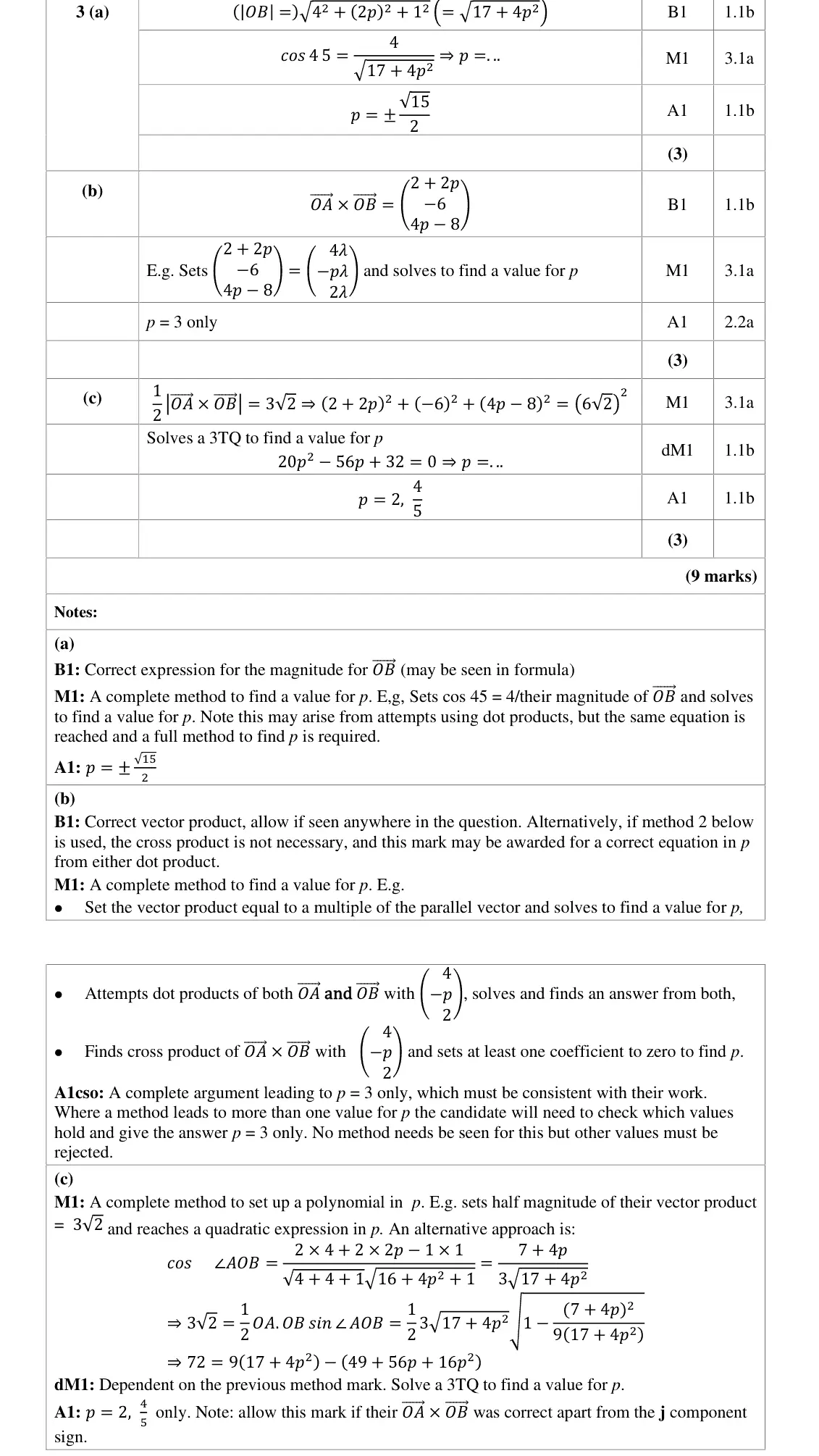
p = ±√15/2
negative root often lost
dot product with OA wrongly used
June 2022 · Paper 3A (Further Pure 1) · Q3(b)3 marksMedium
Mark scheme (whole question; this part is marked with the orange bar)
Examiner's comment
Vectors is never a popular topic, and with only 35% achieving the modal full marks, this question proved less accessible than its position on the paper suggests it should be, with better access for questions 4 and 6 (the other vector question) being seen. Scores of 7 and 8 were also common, with a more even spread across other marks. In many cases one or two errors were made, but the parts they were made in varied a lot. For part (b) most of candidates attempted OB OA and the majority were successful, with occasional sign slips in the j term. However, the rest of this part was the less well done, with an argument that this was the most challenging part. All 3 methods described in the scheme were seen, the most common being setting the vector product equal to a multiple of the parallel vector. Many wrong answers were seen this part, for example some candidates incorrectly equated to zero the dot product of OB OA with the given vector, and not all candidates narrowed down their answer to be only p=3, failing to reject values of 𝑝 that did not hold for all three equations.
Key points from the mark scheme and examiner's report
OA × OB = (2 + 2p, −6, 4p − 8)
equate to a multiple of (4, −p, 2): p = 3 only
must reject values that fail one component
zeroing the dot product is wrong
June 2022 · Paper 3A (Further Pure 1) · Q3(c)3 marksMedium
Mark scheme (whole question; this part is marked with the orange bar)
Examiner's comment
Vectors is never a popular topic, and with only 35% achieving the modal full marks, this question proved less accessible than its position on the paper suggests it should be, with better access for questions 4 and 6 (the other vector question) being seen. Scores of 7 and 8 were also common, with a more even spread across other marks. In many cases one or two errors were made, but the parts they were made in varied a lot. Part (c) was usually very well answered by all candidates who attempted it, with the vast majority achieving full marks, and it was easily the best answered part of this question. Slips in the vector product (as described above) or in simplifying to the 3 term quadratic were the most common errors, but the method required was shown by most, via the main scheme. The alternatively, long winded method was attempted by a few, but usually did not reach a solution.
Key points from the mark scheme and examiner's report
½ modulus of OA × OB = 3√2 gives 20p² − 56p + 32 = 0: p = 2 or 4/5
best answered part
June 2022 · Paper 3A (Further Pure 1) · Q6(a)2 marksEasy
Mark scheme (whole question; this part is marked with the orange bar)
Examiner's comment
Despite vectors being a topic many find difficult, this proved to be a very accessible question on the topic. Over 60% were able to attain full marks, 95% scored at least two marks, and the mean mark was 5/6, overall being the third most accessible question of the paper. The position of the two vector questions on the paper would have been better interchanged. It was rare to see an incorrect answer to part (a) with incorrect responses usually due to numerical errors when calculating the directions (a sign error/miscopy was relatively common), or mixing up the point vector and the direction vectors of the two vectors on the plane.
Key points from the mark scheme and examiner's report
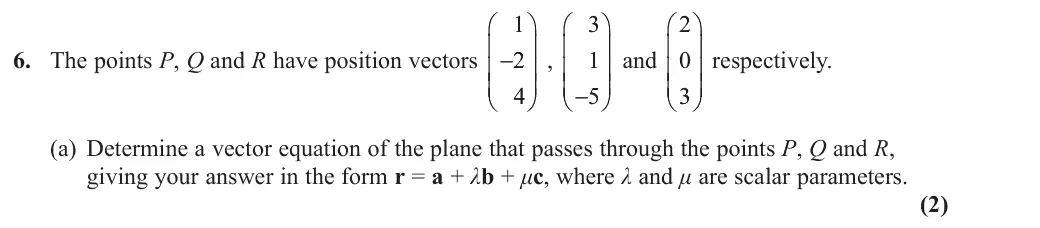
two direction vectors e.g. PQ = (2, 3, −9), PR = (1, 2, −1)
r = (1, −2, 4) + λ(2, 3, −9) + μ(1, 2, −1)
sign slips or mixing position and direction vectors
June 2022 · Paper 3A (Further Pure 1) · Q6(b)4 marksEasy
Mark scheme (whole question; this part is marked with the orange bar)
Examiner's comment
Despite vectors being a topic many find difficult, this proved to be a very accessible question on the topic. Over 60% were able to attain full marks, 95% scored at least two marks, and the mean mark was 5/6, overall being the third most accessible question of the paper. The position of the two vector questions on the paper would have been better interchanged. In part (b) both approaches shown in the scheme were commonly seen, though the main version was the more popular. The most common error in this approach was to set the x coordinate equal to 1 and attempt to solve this with one of the other equations, losing the last three marks. Slips in solving the correct equations were uncommon, but did occur. Another error made by some candidates who used the main method on the scheme there was to assume that x = 0 at the intersection point with the x – axis and obtain awkward equations to solve. Of the candidates who used the alternative method, most were able to find the normal vector and transform the plane into either Cartesian or dot product form, with a successful substitution of y = z =0 to follow. Of the candidates who used this method, calculation errors or using x = 0 were the most common reasons for failing to get to the correct point of intersection. It is worth noting many answers to part (b) were expressed as a column vector as opposed to the requested coordinates though this was condoned. An appreciation of the difference between vectors and coordinates is not well understood.
Key points from the mark scheme and examiner's report
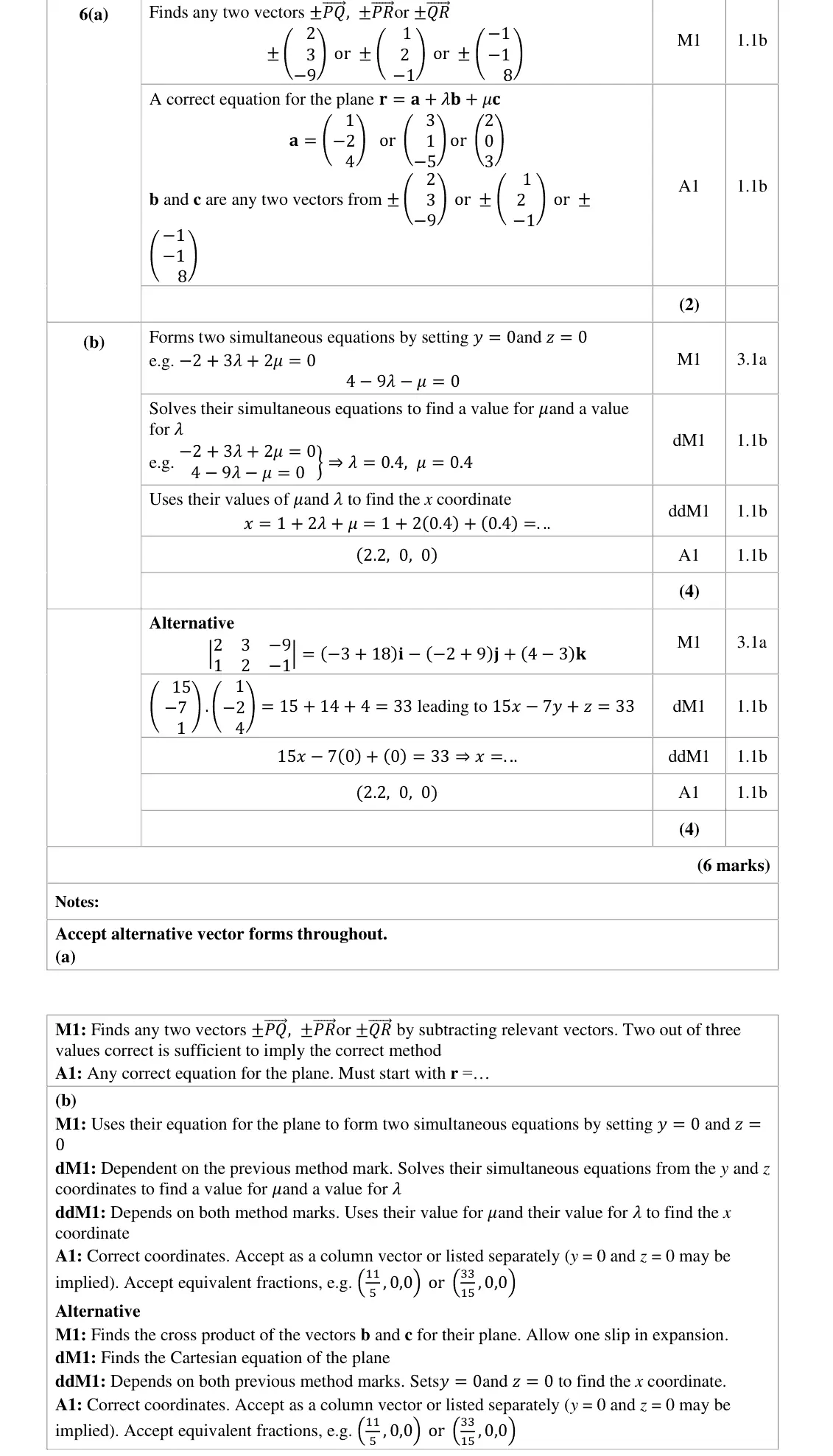
set y = 0 and z = 0: λ = 0.4, μ = 0.4
x = 2.2: (2.2, 0, 0)
alternatively Cartesian 15x − 7y + z = 33
errors: setting x = 0 or x = 1
Nov 2021 · Paper 3A (Further Pure 1) · Q4(a)1 mark
Mark scheme (whole question; this part is marked with the orange bar)
Examiner's comment
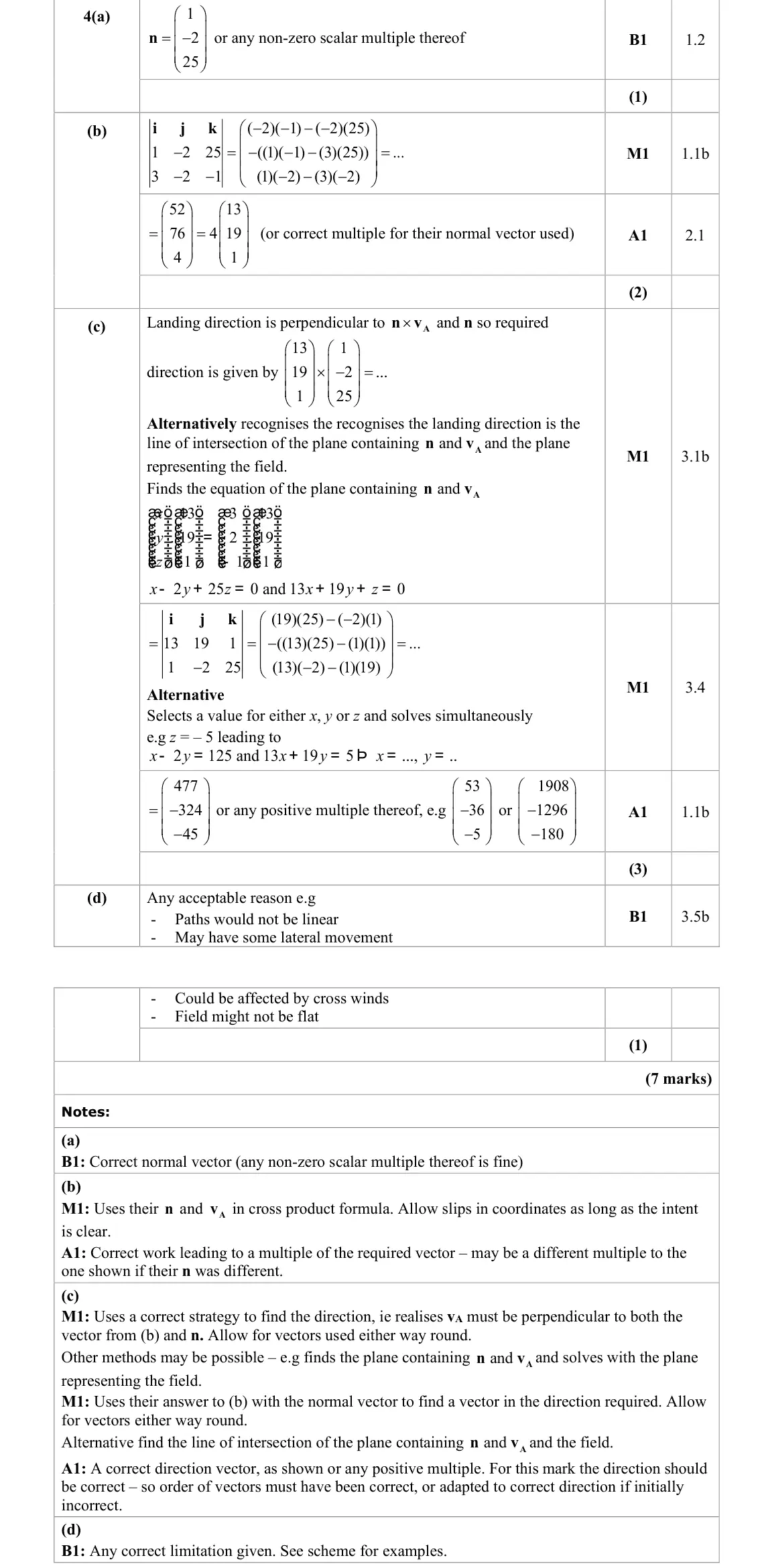
Part (a) The majority of candidates were able to identify the normal vector of the plane. their answer to part (a) so . Candidates needed to make sure that 19 2 x - 5 2 1 they found the cross product in the correct order to give the correct direction of travel of the plane after landing.
Key points from the mark scheme and examiner's report
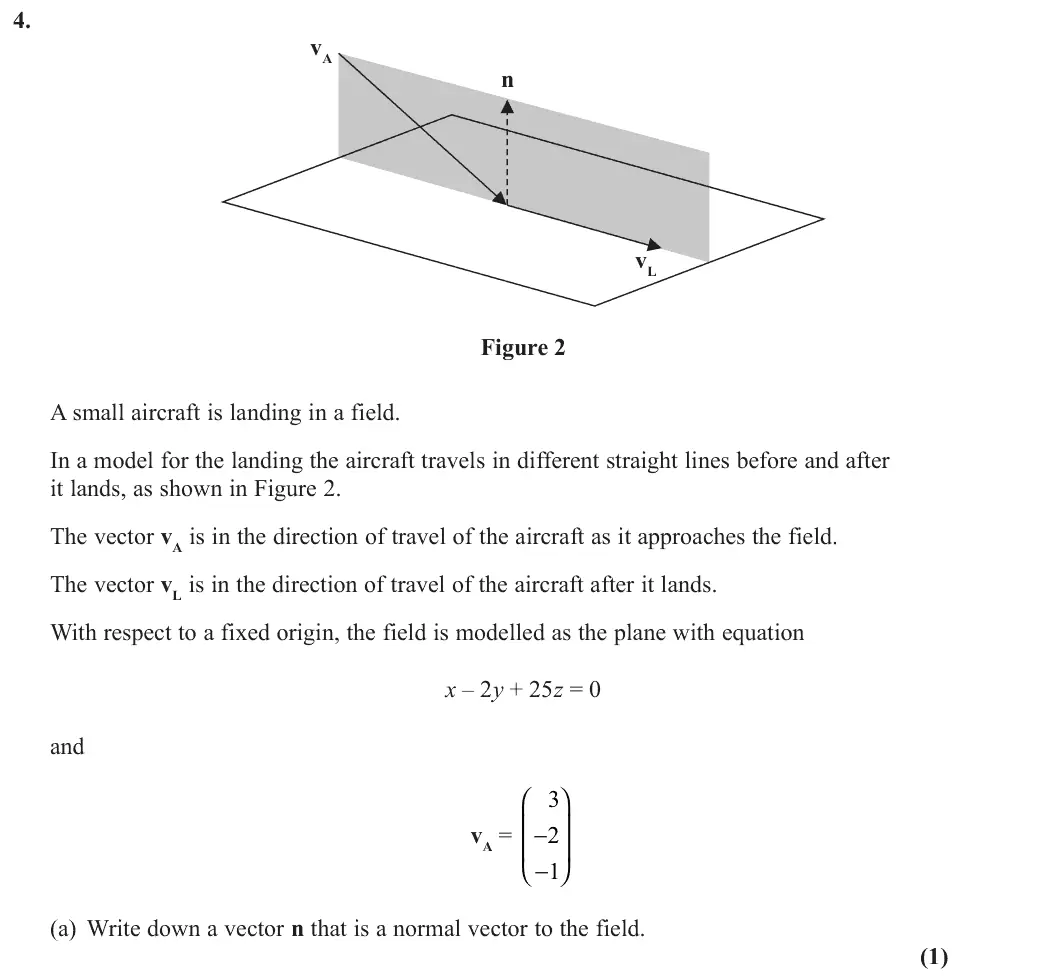
n = i − 2j + 25k or any non-zero multiple
Nov 2021 · Paper 3A (Further Pure 1) · Q4(b)2 marks
Mark scheme (whole question; this part is marked with the orange bar)
Examiner's comment
Part (b) The majority of candidates were able to find the cross product 13 between n and v and showed that it is 4 times . 19 A 1 so needed to find the cross product between their answer to part (b) and 3 1 1 their answer to part (a) so . Candidates needed to make sure that 19 2 x - 5 2 1
Key points from the mark scheme and examiner's report
n × vA = (52, 76, 4) = 4(13, 19, 1), λ = 4 (sign depends on the n used)
Nov 2021 · Paper 3A (Further Pure 1) · Q4(c)3 marks
Mark scheme (whole question; this part is marked with the orange bar)
Examiner's comment
Part (c) Candidates found this part of the question more difficult. They v and n, needed to realise that the landing direction is perpendicular to x n A so needed to find the cross product between their answer to part (b) and
Key points from the mark scheme and examiner's report
vL is perpendicular to n × vA and lies in the field, so take (13, 19, 1) × n = (477, −324, −45), i.e. a positive multiple of (53, −36, −5)
order of the cross product fixes the direction
found difficult
Nov 2021 · Paper 3A (Further Pure 1) · Q4(d)1 mark
Mark scheme (whole question; this part is marked with the orange bar)
Examiner's comment
(d) Candidates were able to have a go at writing down a limitation of the model, with the common correct answers were that the plane will not travel in a straight line and the filed will not be flat.
Key points from the mark scheme and examiner's report
e.g. paths not straight lines, lateral movement or cross winds, field not flat
Nov 2021 · Paper 3A (Further Pure 1) · Q77 marks
Mark scheme (whole question; this part is marked with the orange bar)
Examiner's comment
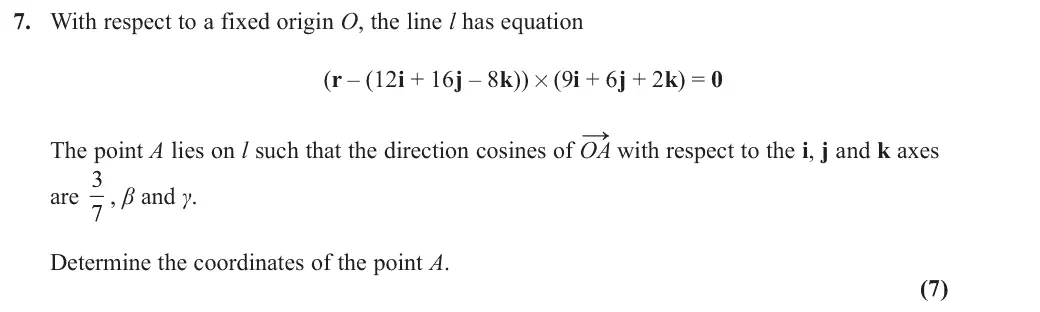
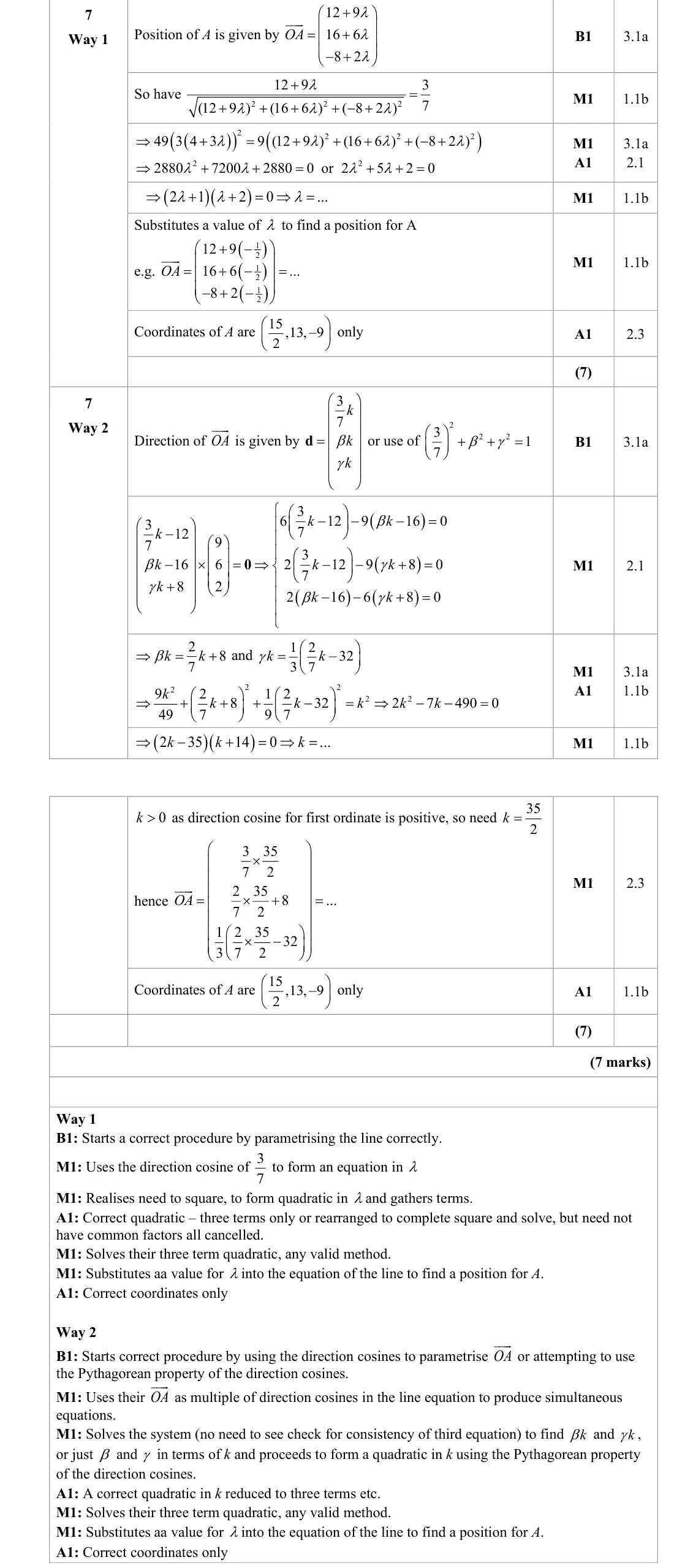
Many candidates only managed to score the first mark for find the parametric equation of the straight line. Some candidate recalled that cos x a but used 2 2 2 12 9 cos 9 6 2 instead of 2 2 2 1 ) 2 9 (12 9 (16 ( 8 2 ) 6 ) λ λ λ λ + + + + + -+ . The few candidates who did use the correct formula solved to find two values of leading to two coordinates. As the direction of cosine was positive the value of 1 2 was required so that 12 9 0 leading to coordinates of A are 15 ,13, 9 2 - only
Key points from the mark scheme and examiner's report
OA = (12 + 9λ, 16 + 6λ, −8 + 2λ)
x-component over modulus of OA = 3/7 gives 2λ² + 5λ + 2 = 0
cosine positive so λ = −1/2: A(15/2, 13, −9) only
many scored only the first mark or used the direction vector's cosine
Oct 2020 · AS Paper 2 (Further Pure 1) · Q5(a)3 marks
Mark scheme (whole question; this part is marked with the orange bar)
Examiner's comment
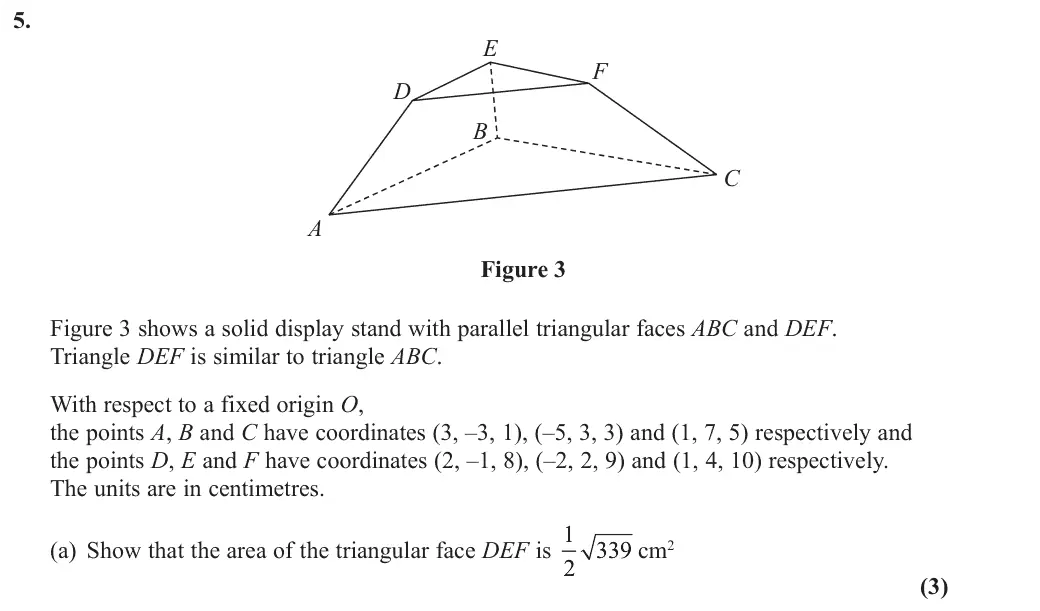
Part (a) was answered well by the majority of candidates. The application of the vector product was well known although some candidates reverted to trigonometric methods such as the cosine rule to find one of the angles and then went on to find the area. Such methods often lost the final mark for not working in exact terms to convincingly proved the given result. In part (b)
Key points from the mark scheme and examiner's report
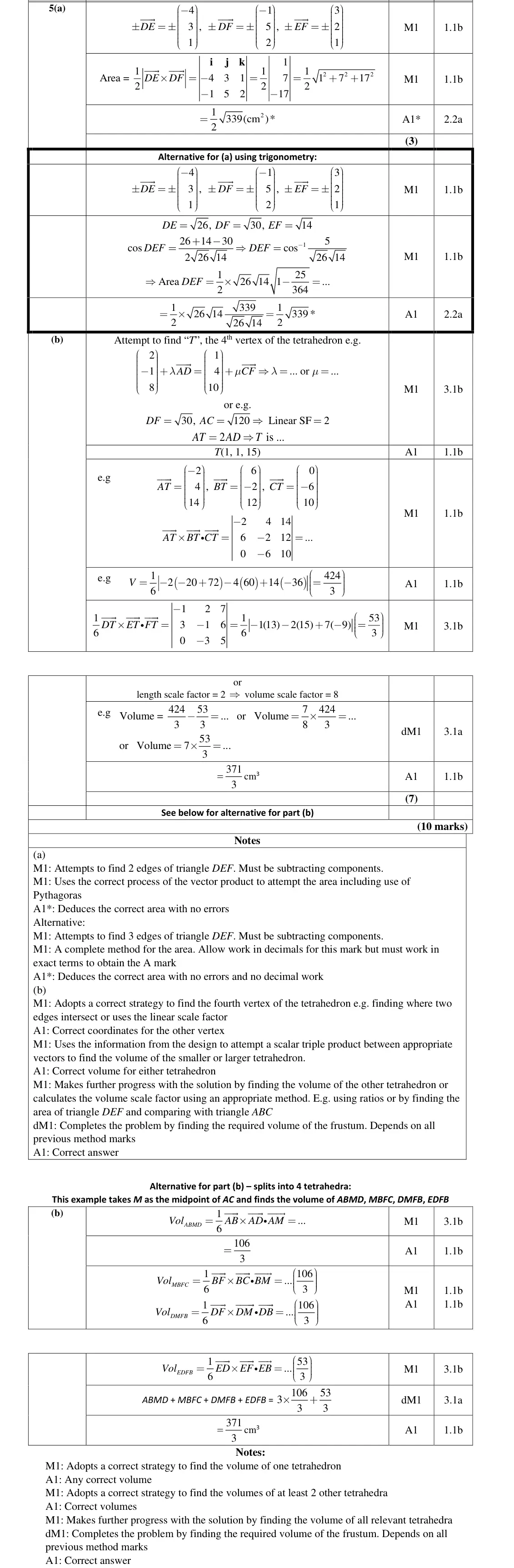
½ modulus of DE × DF = ½√(1² + 7² + 17²) = ½√339
trigonometric (cosine rule) routes must stay exact
Oct 2020 · AS Paper 2 (Further Pure 1) · Q5(b)7 marks
Mark scheme (whole question; this part is marked with the orange bar)
Examiner's comment
working in exact terms to convincingly proved the given result. In part (b) there were no candidates who adopted the anticipated strategies for find the volume of the display stand. Of those who did score marks in this part, all but one treated the solid as a tetrahedron and used 3 of the vertices to attempt the vector triple product. These candidates were credited with this approach with 2 marks and was interpreted as an attempt to find the volume of at least part of the solid. One candidate made significant progress by splitting the solid into several tetrahedra and finding the volume of each one before adding them up. The strategy was sound and was only spoilt by arithmetic errors along the way.
Key points from the mark scheme and examiner's report
frustum: extend to apex T(1, 1, 15) (linear scale factor 2), volumes 424/3 and 53/3 by scalar triple product, difference 371/3 cm³ (or split into four tetrahedra)
most wrongly treated the solid as one tetrahedron
Oct 2020 · Paper 3A (Further Pure 1) · Q3(a)3 marks
Mark scheme (whole question; this part is marked with the orange bar)
Examiner's comment
This question was a routine application of the vector product and scalar triple product and there were few candidates who were unable to achieve a good proportion of the marks available. Errors were mainly sign errors and arithmetic errors with an occasional Cartesian equation given in part b rather than the required vector equation, and vector OD being used as the third vector or a missing factor of 1/6 in part c.
Key points from the mark scheme and examiner's report
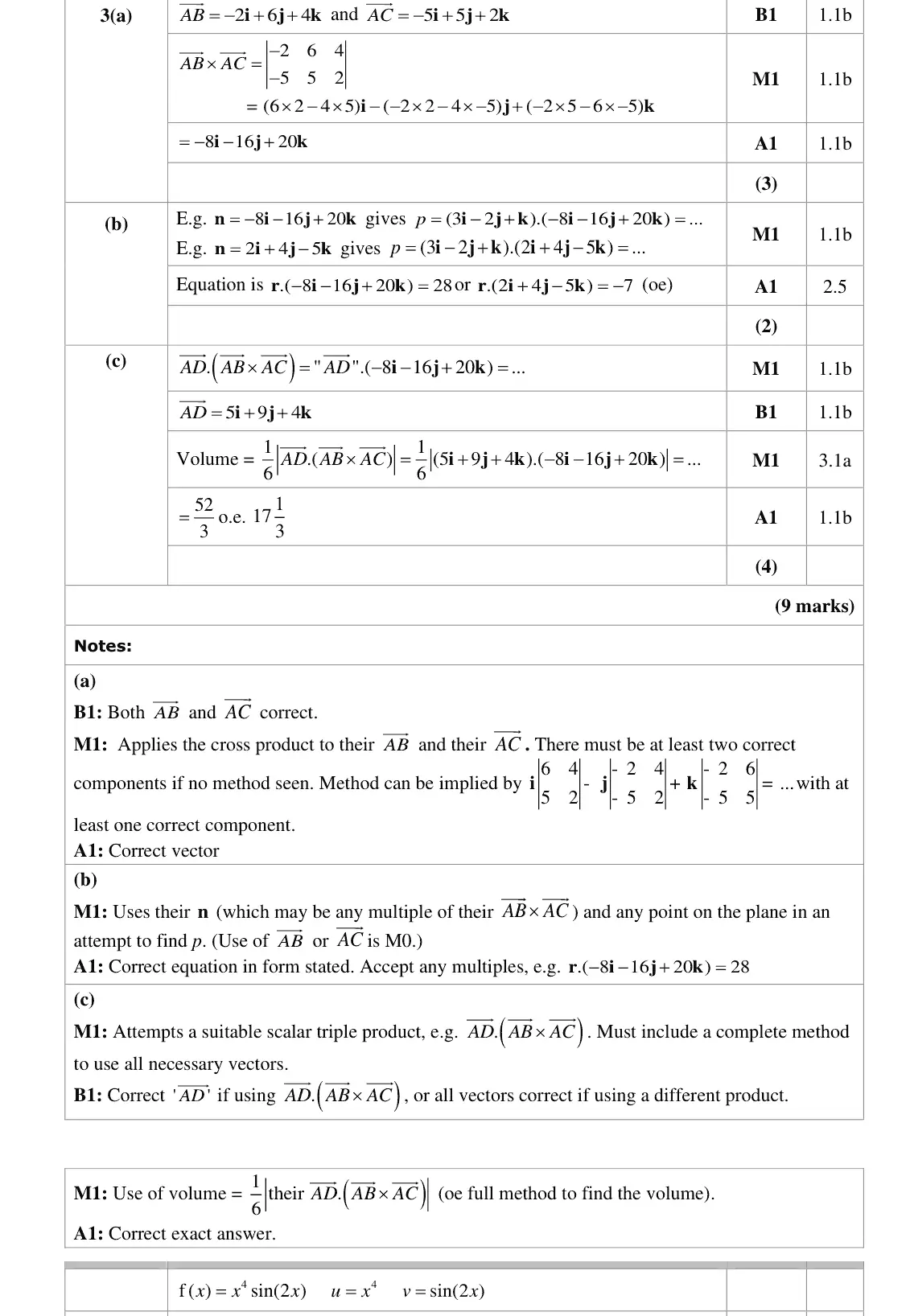
AB = −2i + 6j + 4k, AC = −5i + 5j + 2k
AB × AC = −8i − 16j + 20k
sign and arithmetic slips
Oct 2020 · Paper 3A (Further Pure 1) · Q3(b)2 marks
Mark scheme (whole question; this part is marked with the orange bar)
Examiner's comment
This question was a routine application of the vector product and scalar triple product and there were few candidates who were unable to achieve a good proportion of the marks available. Errors were mainly sign errors and arithmetic errors with an occasional Cartesian equation given in part b rather than the required vector equation, and vector OD being used as the third vector or a missing factor of 1/6 in part c.
Key points from the mark scheme and examiner's report
n from (a) with a point on the plane: r.(2i + 4j − 5k) = −7 (or r.(−8i − 16j + 20k) = 28)
Cartesian equation given instead of the vector form
Oct 2020 · Paper 3A (Further Pure 1) · Q3(c)4 marks
Mark scheme (whole question; this part is marked with the orange bar)
Examiner's comment
This question was a routine application of the vector product and scalar triple product and there were few candidates who were unable to achieve a good proportion of the marks available. Errors were mainly sign errors and arithmetic errors with an occasional Cartesian equation given in part b rather than the required vector equation, and vector OD being used as the third vector or a missing factor of 1/6 in part c.
Key points from the mark scheme and examiner's report
AD = 5i + 9j + 4k
volume = (1/6) modulus of AD.(AB × AC) = 52/3
errors: using OD instead of AD, missing the 1/6
June 2019 · AS Paper 2 (Further Pure 1) · Q4(a)4 marks
Mark scheme (whole question; this part is marked with the orange bar)
Examiner's comment
Q4 was accessible to most candidates, but it was clear that there were a few candidates who had not revised the vector cross product formula. In Q4(a), most candidates found the area of triangle ABC by applying the method 1 . 2 AB AC Some candidates found the correct answer by applying the vector cross product between two other edges of triangle ABC. Some candidates applied the formula 1 ˆ sin( ), 2 AB AC BAC ˆ BAC had been found by using the scalar product formula. A few candidates where angle applied 1 (base)(height) after correctly deducing that ABC was isosceles. Common errors 2 included incorrect cross product calculations; finding AB AC even after previously stating a correct formula 1 or misconstruing the area formula as 1 ; 2 AB AC . 2 OA OB Q4(b) proved more challenging since no solution was possible without the application of the scalar triple product. Some candidates used a complete method of applying to find the value of d, although some used 1 1 or 1 instead of 1 . 1 , 21 6 AD AB AC 3 2 6 There were several manipulation and calculation errors seen in the evaluation of the scalar triple 18 0 36 AB AC i j k product in terms of d. Those that used from Q4(a) usually found 3 18 1 d 7 0 21. 6 a correct after solving A common error was the confusion 6 4 36 d between the modulus of a scalar and the magnitude of a vector, leading to some candidates d 2 2 Another common error was to simplify 36 90 (54) (3 144) 126. d writing to d 2 2 give 3 90 (36 ) (90) . d or
Key points from the mark scheme and examiner's report
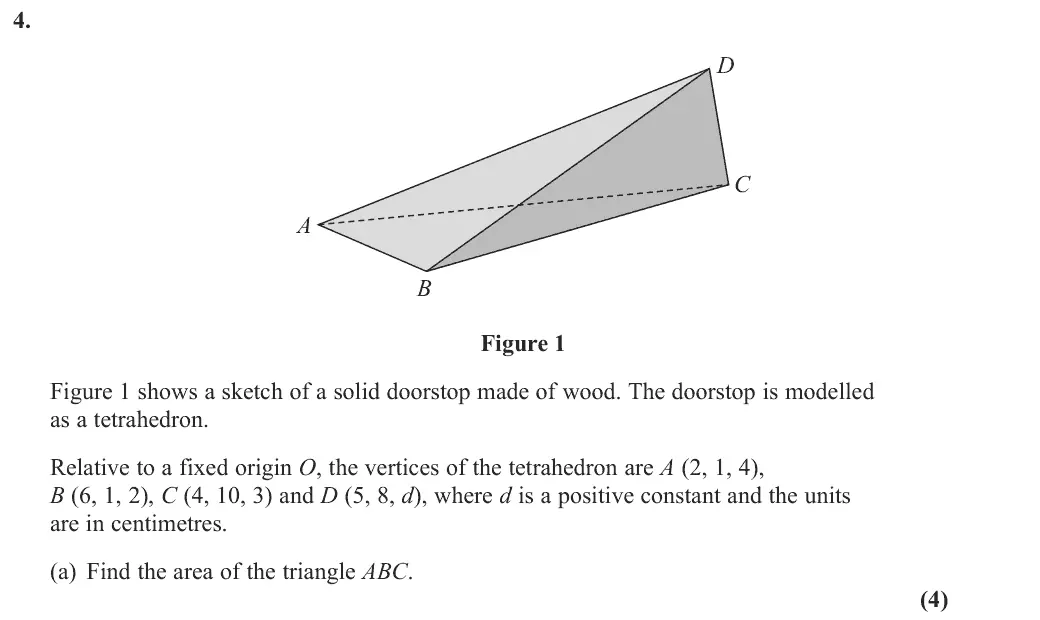
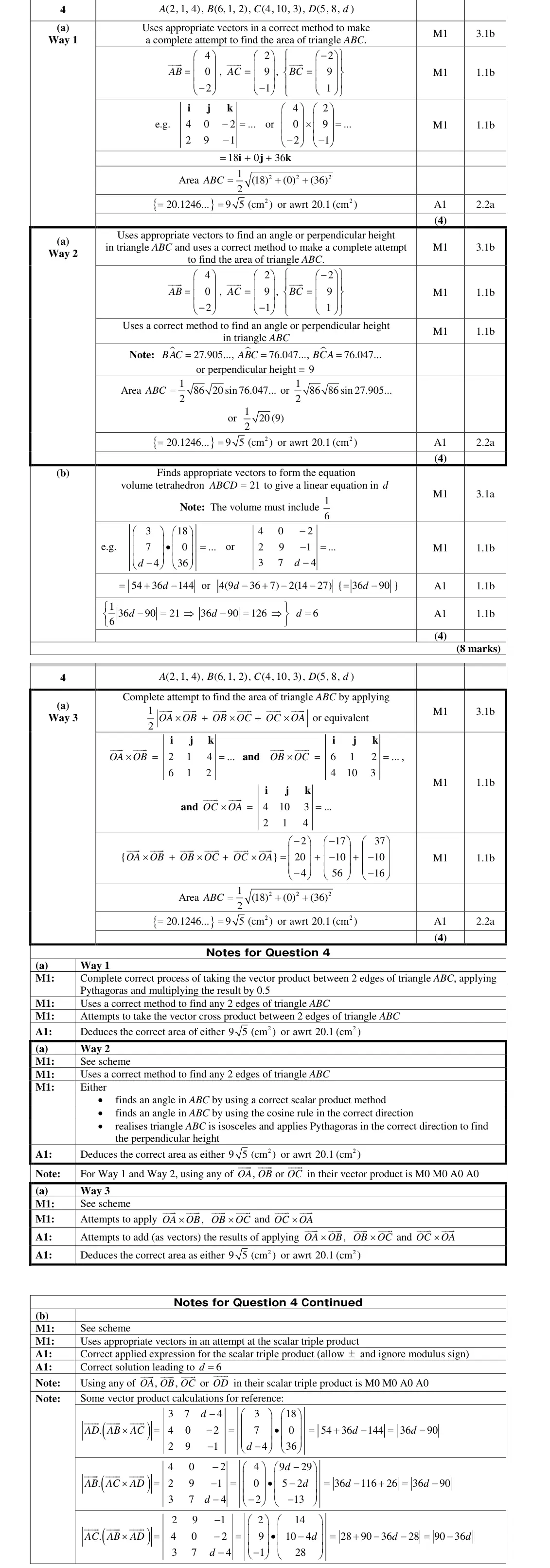
½ modulus of AB × AC = ½√(18² + 0² + 36²) = 9√5 ≈ 20.1 cm²
using position vectors OA, OB scores 0
cross-product slips and missing ½
June 2019 · AS Paper 2 (Further Pure 1) · Q4(b)4 marks
Mark scheme (whole question; this part is marked with the orange bar)
Examiner's comment
Q4 was accessible to most candidates, but it was clear that there were a few candidates who had not revised the vector cross product formula. In Q4(a), most candidates found the area of triangle ABC by applying the method 1 . 2 AB AC Some candidates found the correct answer by applying the vector cross product between two other edges of triangle ABC. Some candidates applied the formula 1 ˆ sin( ), 2 AB AC BAC ˆ BAC had been found by using the scalar product formula. A few candidates where angle applied 1 (base)(height) after correctly deducing that ABC was isosceles. Common errors 2 included incorrect cross product calculations; finding AB AC even after previously stating a correct formula 1 or misconstruing the area formula as 1 ; 2 AB AC . 2 OA OB Q4(b) proved more challenging since no solution was possible without the application of the scalar triple product. Some candidates used a complete method of applying to find the value of d, although some used 1 1 or 1 instead of 1 . 1 , 21 6 AD AB AC 3 2 6 There were several manipulation and calculation errors seen in the evaluation of the scalar triple 18 0 36 AB AC i j k product in terms of d. Those that used from Q4(a) usually found 3 18 1 d 7 0 21. 6 a correct after solving A common error was the confusion 6 4 36 d between the modulus of a scalar and the magnitude of a vector, leading to some candidates d 2 2 Another common error was to simplify 36 90 (54) (3 144) 126. d writing to d 2 2 give 3 90 (36 ) (90) . d or
Key points from the mark scheme and examiner's report
(1/6) modulus of AD.(AB × AC) = 21 gives modulus of 36d − 90 = 126, d = 6
must include 1/6 (not 1/3 or 1/2)
confusing scalar modulus with vector magnitude
June 2019 · Paper 3A (Further Pure 1) · Q7(a)6 marks
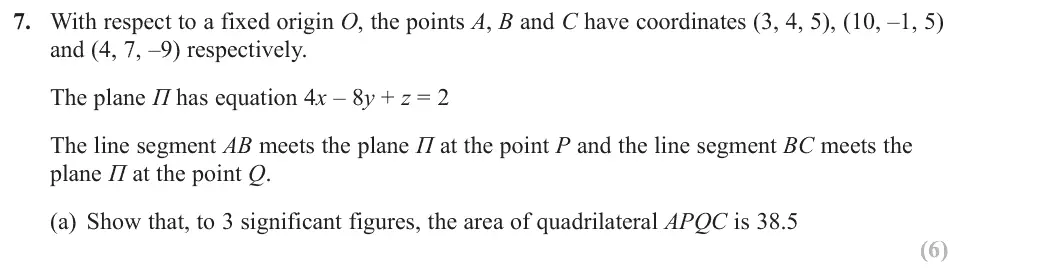
Mark scheme (whole question; this part is marked with the orange bar)
Examiner's comment
In part (a), it was rare to see a correct strategy for the area of the quadrilateral. Candidates understood the idea of how to find the intersection of the two lines; only numerical slips prevented candidates getting the correct coordinates for the two points. The most successful candidates here drew a diagram of the situation and were then able to find the required area by splitting it up into smaller triangles and using the cross product. It was very common to see candidates attempt to evaluate a cross product which would produce the area of a single triangle and then write down the given answer. Another common problem, which a diagram would have avoided, was to add the areas of overlapping triangles.
Key points from the mark scheme and examiner's report
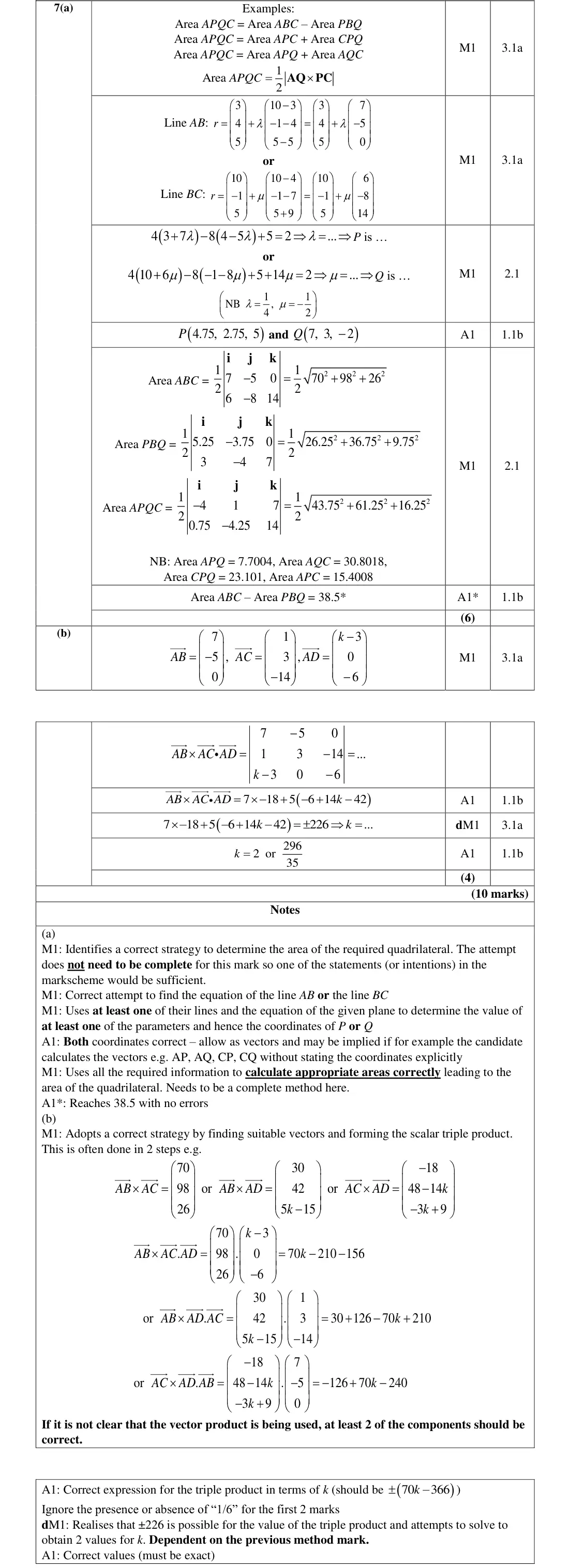
P(4.75, 2.75, 5), Q(7, 3, −2) from lines AB, BC meeting the plane
area ABC − area PBQ using ½ modulus of cross products
strategy rarely correct: one triangle then the given answer, or overlapping triangles added
draw a diagram
June 2019 · Paper 3A (Further Pure 1) · Q7(b)4 marks
Mark scheme (whole question; this part is marked with the orange bar)
Examiner's comment
In part (b) the strategy was generally well known. Errors involved the use of incorrect vectors even though the correct formula was written down. Candidates knew how the scalar triple product related to the required volume although a spurious 1/6 was seen in the formula at times. Of those candidates that correctly evaluated the scalar triple product many ignored the fact that its value could be plus or minus 2 and also the requirements of the question which asked for the values of k.
Key points from the mark scheme and examiner's report
scalar triple product of AB, AC, AD = 70k − 366 (or its negative)
set equal to ±226: k = 2 or 296/35
errors: wrong vectors, spurious 1/6, ignoring the negative case
June 2018 · AS Paper 2 (Further Pure 1) · Q4(a)3 marks
Mark scheme (whole question; this part is marked with the orange bar)
Examiner's comment
This question was accessible to most students, but it was clear that there were a few students who had not revised the vector cross product formula. Most students arrived at the given answer in part (a) by applying the method 1 . 2 AB AC Some students found the correct answer by applying the vector cross product between two other edges of triangle ABC. A few students arrived at the given answer by applying the formula 1 ˆ sin( ), 2 AB AC BAC where angle ˆ BAC had been found by using the scalar product formula.
Key points from the mark scheme and examiner's report
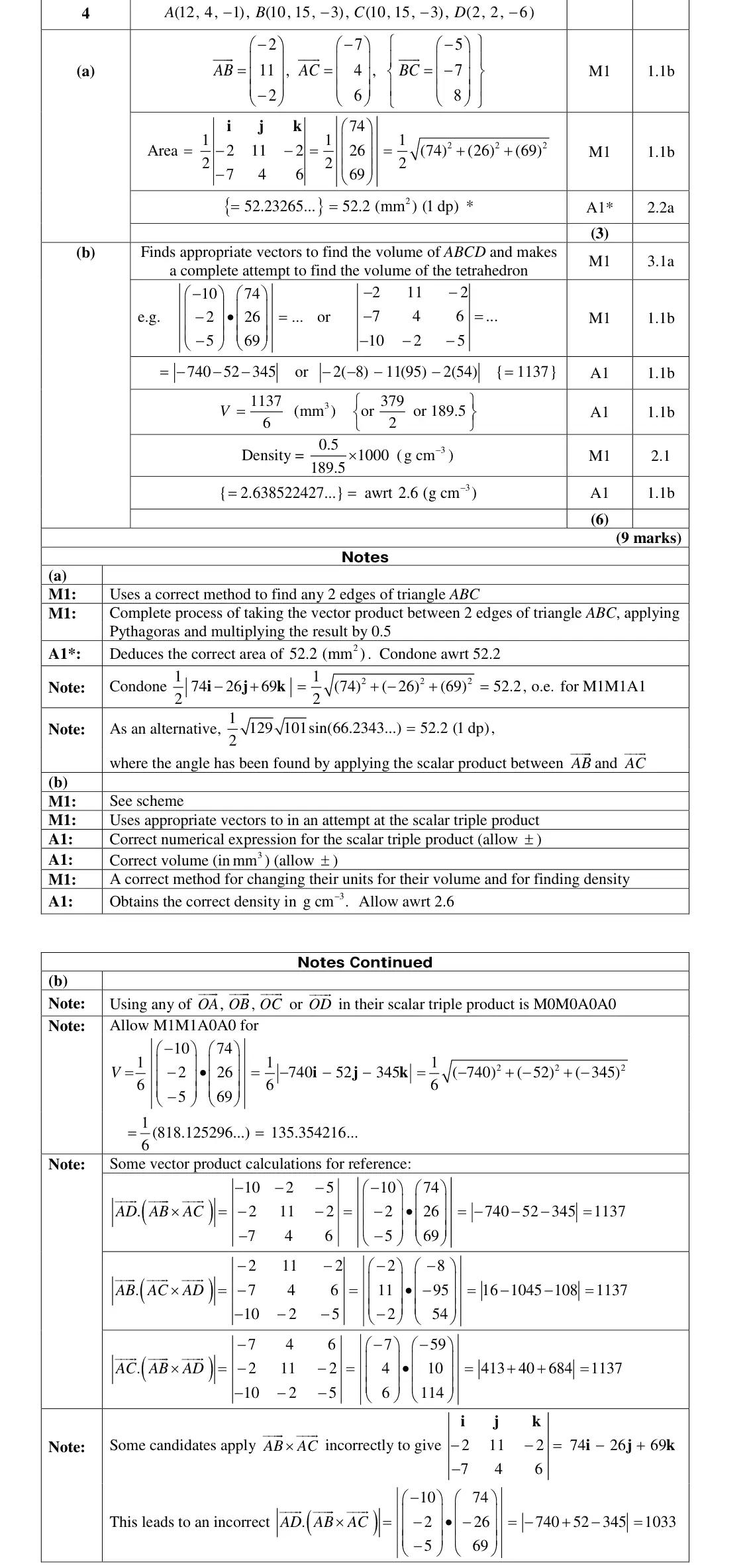
area = ½ modulus of AB × AC = ½√(74² + 26² + 69²) = 52.2 mm²
sign slips in the cross product (74i − 26j + 69k)
June 2018 · AS Paper 2 (Further Pure 1) · Q4(b)6 marks
Mark scheme (whole question; this part is marked with the orange bar)
Examiner's comment
This question was accessible to most students, but it was clear that there were a few students who had not revised the vector cross product formula. In part (b), many students applied the correct method 1 6 AD AB AC to find the volume of the crystal. There were several manipulation and calculation errors seen in evaluating the volume with some students evaluating AB AC to give an incorrect 74 26 69 . i j k Some students, who obtained a correct 10 74 1 2 26 , 6 5 69 evaluated this incorrectly to give 2 2 2 1 ( 740) ( 52) ( 345) . 6 Many students converted the units correctly to find the density, with a few students converting the lengths to centimetres before evaluating the volume. The formula for density was known by most students, but there were instances of density written as Volume , Mass (Mass)(Volume) or (Mass) (Volume).
Key points from the mark scheme and examiner's report