Nothing is given; π∫y² dx and π∫x² dy must be known.
Since 2018
39 question parts, 126 marks, 3 with a difficulty rating from the examiner's report
Notes, worked examples and practice for this topic are being written by our tutors. The past-paper questions below are ready now: work each one on paper, then open the mark scheme and the examiner's comment.
Tap a question to zoom it. Mark scheme and examiner's comment open under each question.
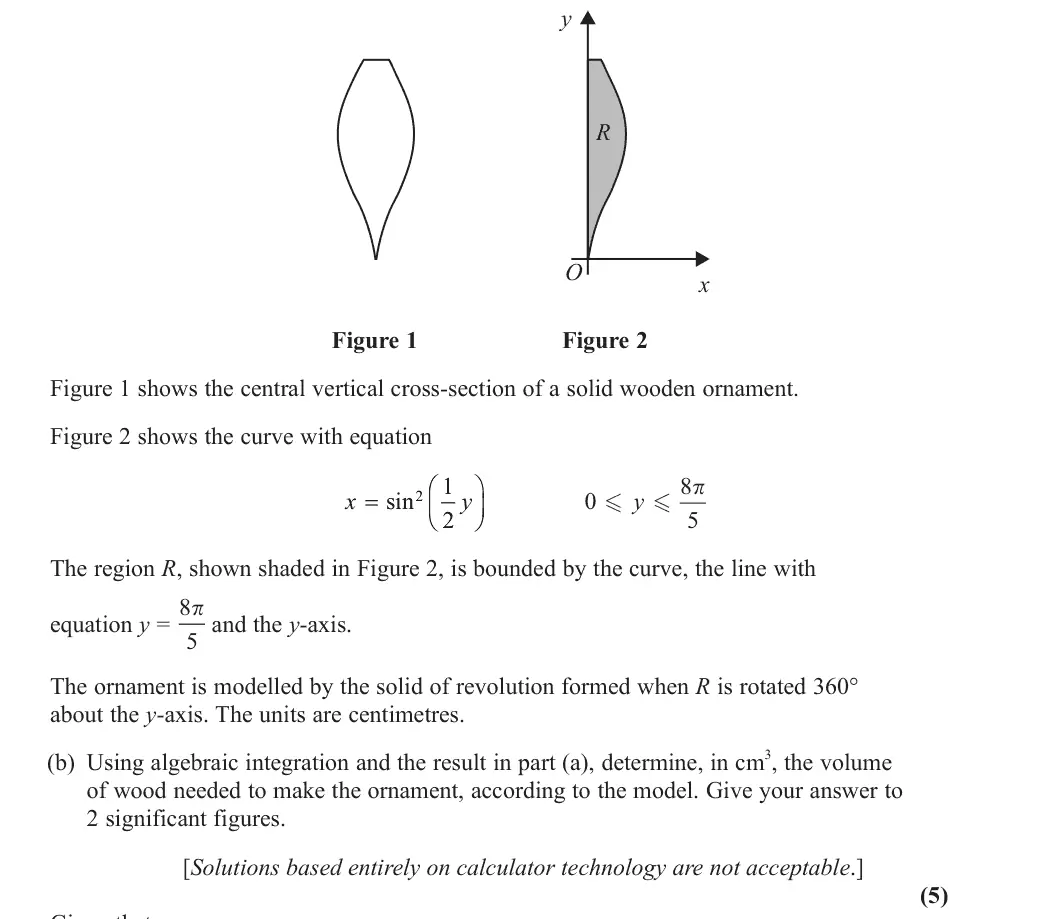
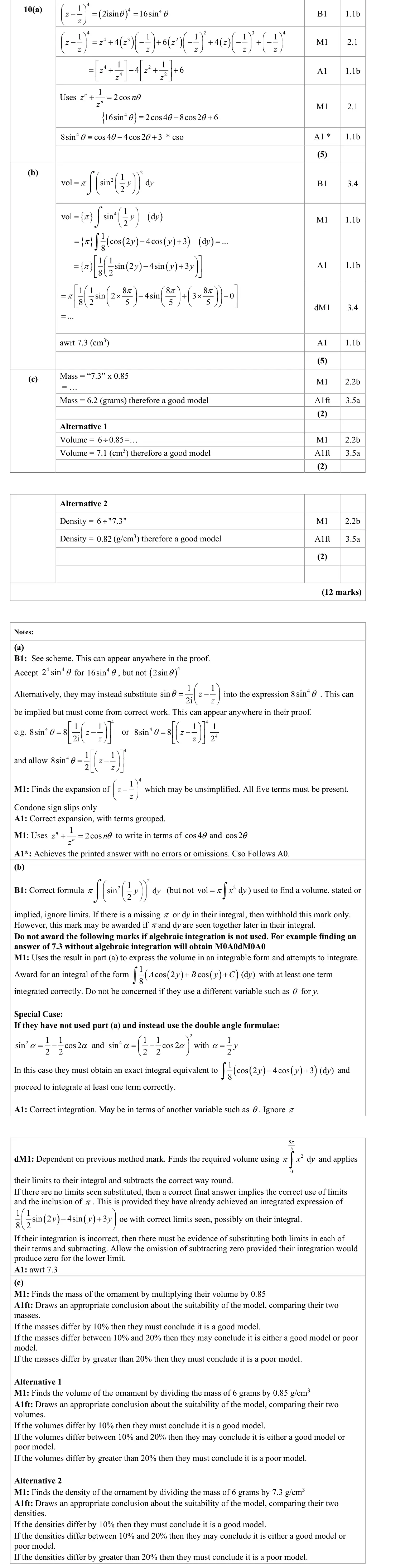
June 2025 · Paper 1 (Core Pure 1) · Q10(b)5 marks
Mark scheme (whole question; this part is marked with the orange bar)
Examiner's comment
This question assessed candidates’ understanding of complex number identities, algebraic integration techniques, and modelling using volumes of revolution and density. The question had multiple points of entry for candidates, with many of them being able to gain marks in each part of the question. This question was accessible to most candidates and was a good discriminator of candidates’ ability to prove trigonometric identities, manage trigonometric substitutions carefully, and interpret a mathematical model in context. Those who showed methodical working and attention to algebraic detail were well rewarded. (b) This required the candidates to use the result from part (a) in an algebraic integration to calculate the volume of a solid of revolution. Candidates who correctly applied the volume formula and appropriately substituted the result from part (a) were usually successful. The most common error was the omission of the factor of 8, which appeared in the identity from part (a) but was not always accounted for in the integration. Some candidates failed to recognise that the angle in the expression was 1 2 y and did not adjust the integrand accordingly. This led to costly mistakes in terms of marks lost. Other common errors involved the omission of pi for the final two marks or dy for the B mark in their integrals. A small number of candidates attempted to derive the integrand independently using double angle identities, with varying success. While a few obtained the correct volume via this route, most introduced errors in sign or expansion, typically leading to incorrect final answers.
Key points from the mark scheme and examiner's report
V = π∫x² dy = π∫sin⁴(y/2) dy from 0 to 8π/5
use (a) with θ = y/2: (1/8)(cos 2y − 4cos y + 3)
≈ 7.3 cm³
omitting the factor 1/8 or not adapting the angle to y/2
June 2025 · Paper 1 (Core Pure 1) · Q10(c)2 marks
Mark scheme (whole question; this part is marked with the orange bar)
Examiner's comment
This question assessed candidates’ understanding of complex number identities, algebraic integration techniques, and modelling using volumes of revolution and density. The question had multiple points of entry for candidates, with many of them being able to gain marks in each part of the question. This question was accessible to most candidates and was a good discriminator of candidates’ ability to prove trigonometric identities, manage trigonometric substitutions carefully, and interpret a mathematical model in context. Those who showed methodical working and attention to algebraic detail were well rewarded. (c) This was generally very well answered. Most candidates used their result from part (b) to make a suitable comparison between the calculated volume, the given density, and the provided mass. The most successful responses included the correct use of a density formula and an appropriate conclusion regarding the suitability of the model. Where marks were lost, it was usually because candidates did not have a valid result from part (b) to refer to or did not recall the correct formula for density.
Key points from the mark scheme and examiner's report
mass = 7.3 × 0.85 ≈ 6.2 g, close to 6 g, so a good model (or compare volumes or densities)
conclusion needed
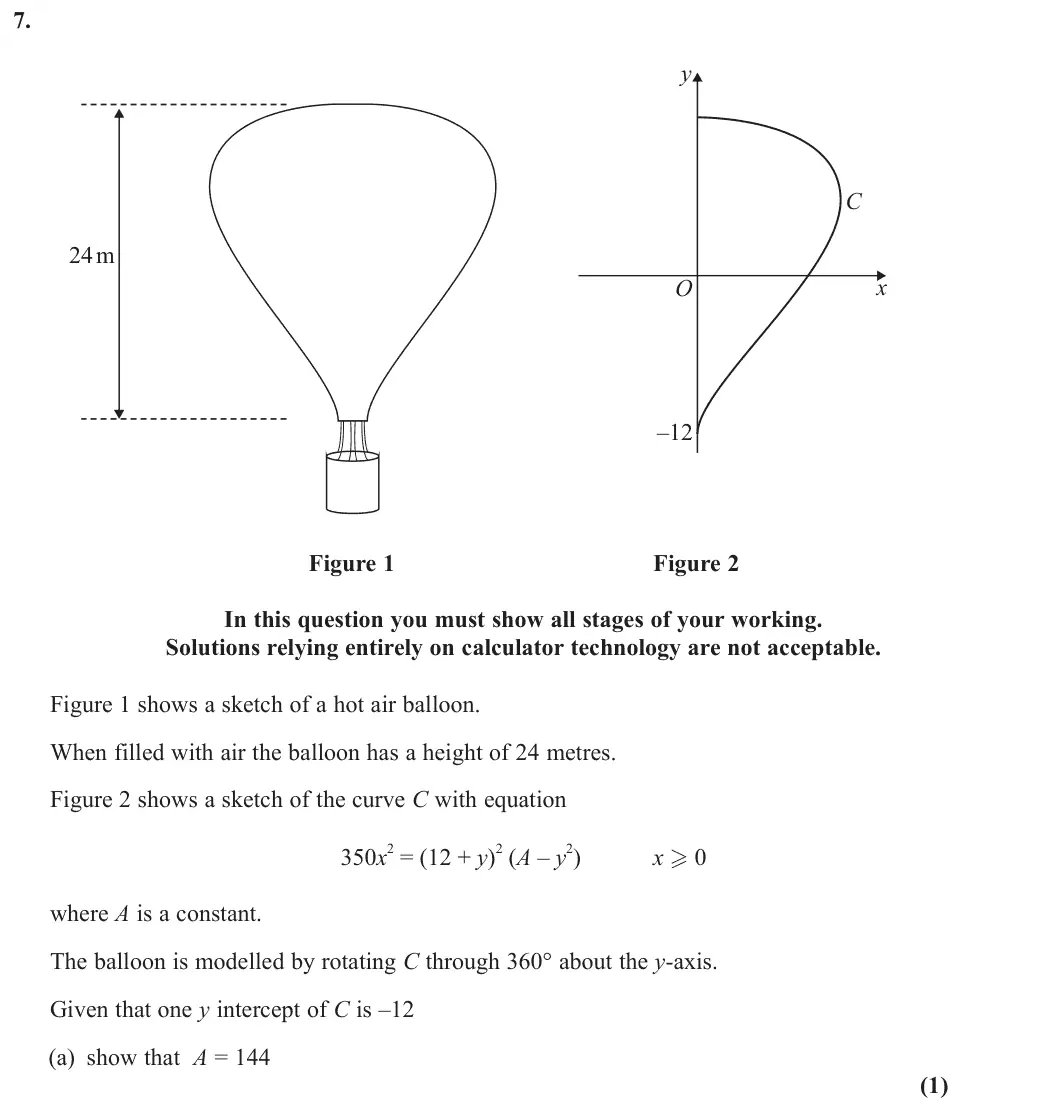
June 2025 · AS Paper 1 (Core Pure) · Q7(a)1 mark
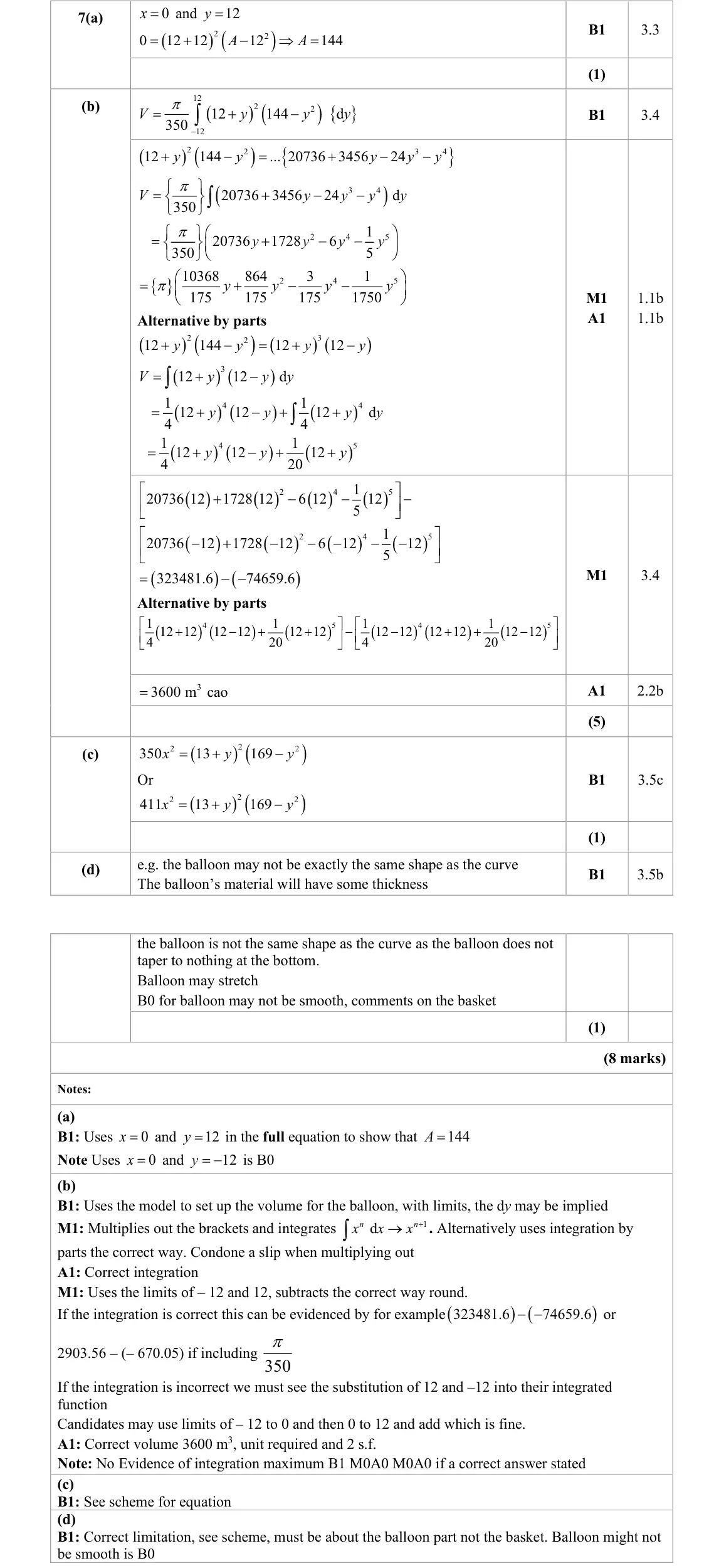
Mark scheme (whole question; this part is marked with the orange bar)
Examiner's comment
Perhaps surprisingly, part (a) was only answered correctly by a small minority of learners. 12 y = - The common error was to use the given coordinate in the curve equation resulting ( ) in the equation which erroneously led to A = 144. A few learners did not ( ) ( ) 2 0 0 12 A = -- into the whole equation just ( ) 12 y = substitute = scoring no marks. 2 12 0 A -
Key points from the mark scheme and examiner's report
the other intercept is y = 12 (height 24): substitute x = 0, y = 12 in the full equation: A = 144
using y = −12 proves nothing and scores 0
answered correctly by few
June 2025 · AS Paper 1 (Core Pure) · Q7(b)5 marks
Mark scheme (whole question; this part is marked with the orange bar)
Examiner's comment
In part (b), the volume of a solid of revolution was well known. The usual next step was to ) ( ) expand the brackets ( to achieve a sum of four terms. Errors in the location 2 2 12 144 y y + - of powers and other errors in simplification led to loss of subsequent accuracy marks. In the stage of evaluating the integral between the two limits, learners should be strongly advised to show explicit substitution of the upper limit into the integral minus the substitution of the lower limit rather than going straight to decimals which if evaluated incorrectly would lead to the loss of method marks. The majority of learners who achieved the correct answer rounded to 2 significant figures and gave the required units.
Key points from the mark scheme and examiner's report
V = (π/350)∫ from −12 to 12 of (12 + y)²(144 − y²) dy
expand to 20736 + 3456y − 24y³ − y⁴
3600 m³ (2 s.f., units)
show the limits substituted
June 2025 · AS Paper 1 (Core Pure) · Q7(c)1 mark
Mark scheme (whole question; this part is marked with the orange bar)
Examiner's comment
) ( ) ( 2 In part (c) it was very rare to see the answer which resulted 2 2 411 13 169 x y y = + - from using an enlargement of the curve by a factor of 13 . For answers aiming for the 12 ) ( ) ( 2 alternative , errors seen included not replacing 12 with 13, 144 2 2 350 13 169 x y y = + - with 169 or both and also the misplacing of the powers. Learners continue to find questions asking for comments on a model used to be challenging. Comments that just referred to the ballon e.g. “the balloon may not be smooth” gained no credit. There needed to be reference to the model, maybe implied, for there to be a chance of awarding the mark. Perhaps surprisingly, the more obvious response that the model and balloon did not have the same shape where the basket was rarely seen
Key points from the mark scheme and examiner's report
Mark scheme (whole question; this part is marked with the orange bar)
Examiner's comment
Perhaps surprisingly, part (a) was only answered correctly by a small minority of learners. 12 y = - The common error was to use the given coordinate in the curve equation resulting ( ) in the equation which erroneously led to A = 144. A few learners did not ( ) ( ) 2 0 0 12 A = -- into the whole equation just ( ) 12 y = substitute = scoring no marks. 2 12 0 A - In part (b), the volume of a solid of revolution was well known. The usual next step was to ) ( ) expand the brackets ( to achieve a sum of four terms. Errors in the location 2 2 12 144 y y + - of powers and other errors in simplification led to loss of subsequent accuracy marks. In the stage of evaluating the integral between the two limits, learners should be strongly advised to show explicit substitution of the upper limit into the integral minus the substitution of the lower limit rather than going straight to decimals which if evaluated incorrectly would lead to the loss of method marks. The majority of learners who achieved the correct answer rounded to 2 significant figures and gave the required units. ) ( ) ( 2 In part (c) it was very rare to see the answer which resulted 2 2 411 13 169 x y y = + - from using an enlargement of the curve by a factor of 13 . For answers aiming for the 12 ) ( ) ( 2 alternative , errors seen included not replacing 12 with 13, 144 2 2 350 13 169 x y y = + - with 169 or both and also the misplacing of the powers. Learners continue to find questions asking for comments on a model used to be challenging. Comments that just referred to the ballon e.g. “the balloon may not be smooth” gained no credit. There needed to be reference to the model, maybe implied, for there to be a chance of awarding the mark. Perhaps surprisingly, the more obvious response that the model and balloon did not have the same shape where the basket was rarely seen
Key points from the mark scheme and examiner's report
balloon not exactly the shape of the curve, material thickness, balloon stretches
"not smooth" or comments about the basket score 0
June 2024 · AS Paper 1 (Core Pure) · Q8(a)2 marks
Mark scheme (whole question; this part is marked with the orange bar)
Examiner's comment
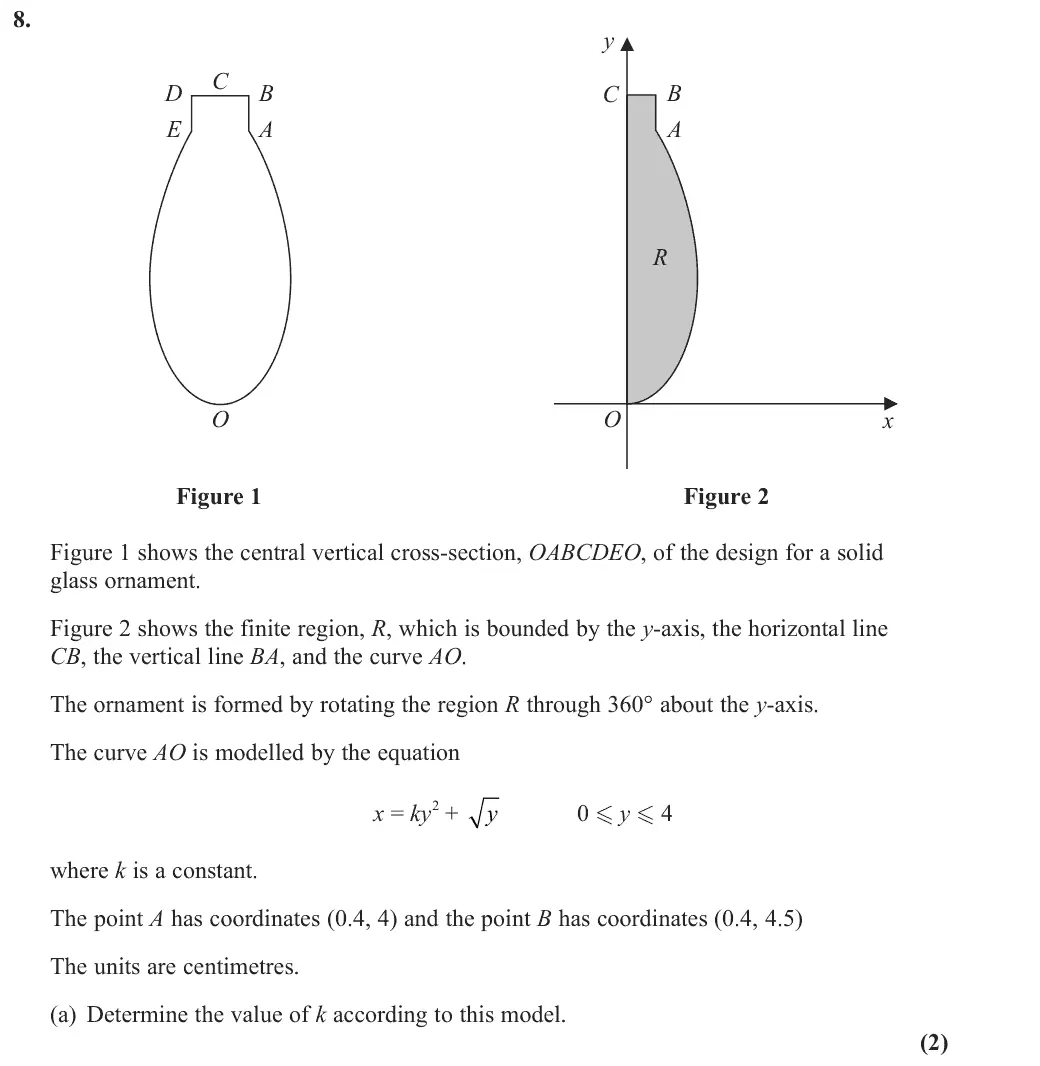
Considering this was the final question on the paper it was pleasing to see that most candidates were able to access this question and made good progress towards a solution, understanding the of 𝑥𝑥2 rather than the integration. method needed for the volume of revolution. The main errors were with the algebraic expansion In part a) most candidates successfully found k. Where errors occurred, they were through using the point (0.4, 4.5) or forgetting to square root y before finding k. A minority of candidates showed some misunderstanding of roots, erroneously attempting the ‘negative’ root of 4; however, the MS did not repeatedly penalise these students as they were still able to complete the full question correctly for their k with only the final accuracy mark in part b) not available to them. Whilst many made a good attempt in part b) the expansion of 𝑥𝑥2 threw up two main errors: using 3 5 +0.1 instead of – 0.1 to create the second term; and, creating a term in y instead of y . The 2 2 finding 𝑥𝑥2, just squaring each term. latter was the most common error. A significant minority only achieved 2 terms when incorrectly There was some use of calculator instead of algebraic integration, but this was rare. On the whole, integration was good. The volume of the cylinder was often missed or incorrectly calculated occasionally an attempt was made which resulted in area leading to three marks being lost due not to being able to sum the two volumes. Where the volume of the cylinder was omission of 𝜋𝜋 in the calculation was extremely rare however the requirement of "exact value" attempted both use of integration and use of formula were seen in equal measures. The loss or was often ignored to lose the final A mark. A small number of candidates tried to integrate the curve between 0 and 4.5 solely, misunderstanding the model provided. These candidates were still able to score 4/7 though often they lost further marks along the way. For parts c) and d) most candidates knew what was expected to achieve this mark, following through on any incorrect answer in part b) to achieve the B1 in d). Part c) was generally well-answered with most candidates commenting on a limitation such as the potential for the glass not to be smooth or the curve not to be an exact fit to the ornament’s shape. However, a significant minority failed to note that the ornament was solid, making comments relating to ‘thickness’ of glass. The most common error in part d) was to calculate the percentage error relative to their model not the true volume. However, many candidates are still not correctly interpreting the ‘trigger word’ “evaluate”, failing to appraise the model in terms of good/bad and thus losing this mark despite having correct information to work from.
Key points from the mark scheme and examiner's report
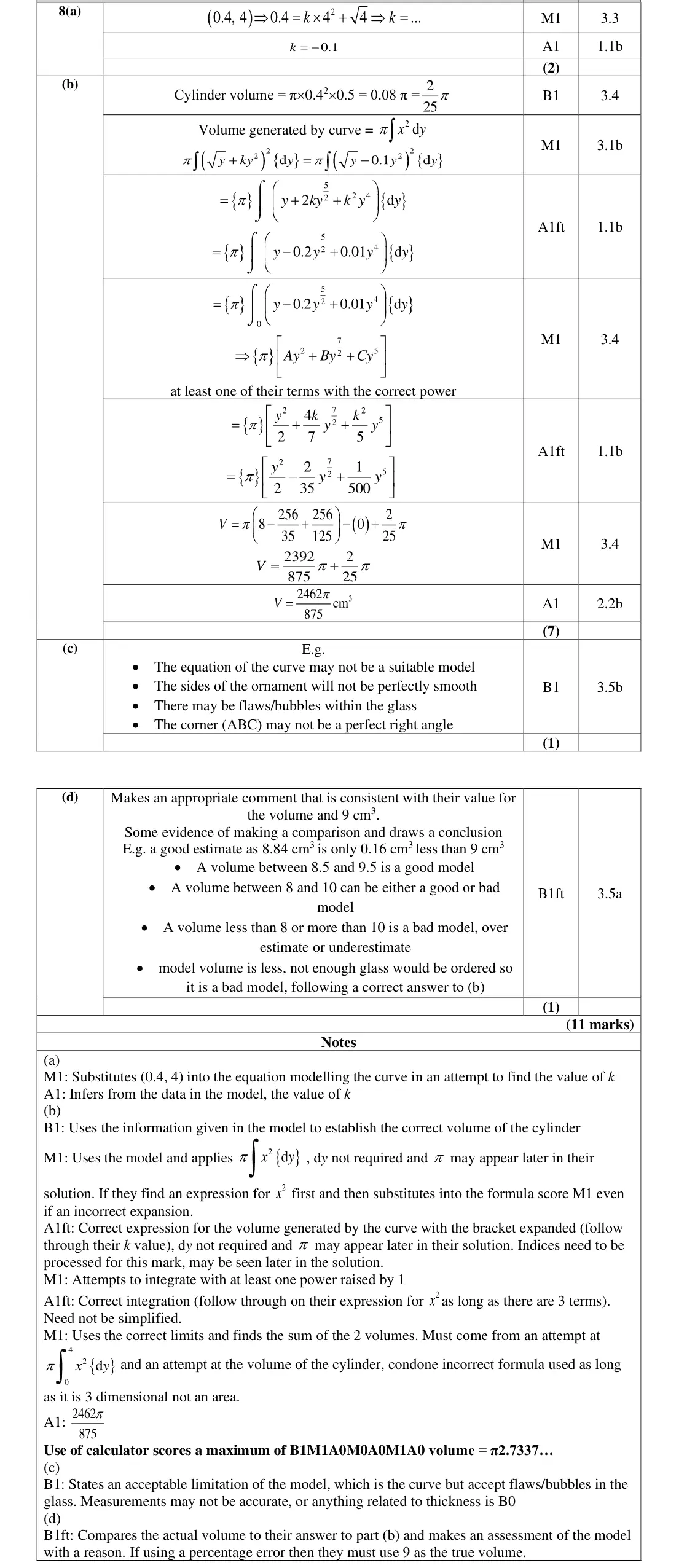
substitute A(0.4, 4): 0.4 = 16k + 2, k = −0.1
using (0.4, 4.5) or forgetting the square root
June 2024 · AS Paper 1 (Core Pure) · Q8(b)7 marks
Mark scheme (whole question; this part is marked with the orange bar)
Examiner's comment
Considering this was the final question on the paper it was pleasing to see that most candidates were able to access this question and made good progress towards a solution, understanding the of 𝑥𝑥2 rather than the integration. method needed for the volume of revolution. The main errors were with the algebraic expansion In part a) most candidates successfully found k. Where errors occurred, they were through using the point (0.4, 4.5) or forgetting to square root y before finding k. A minority of candidates showed some misunderstanding of roots, erroneously attempting the ‘negative’ root of 4; however, the MS did not repeatedly penalise these students as they were still able to complete the full question correctly for their k with only the final accuracy mark in part b) not available to them. Whilst many made a good attempt in part b) the expansion of 𝑥𝑥2 threw up two main errors: using 3 5 +0.1 instead of – 0.1 to create the second term; and, creating a term in y instead of y . The 2 2 finding 𝑥𝑥2, just squaring each term. latter was the most common error. A significant minority only achieved 2 terms when incorrectly There was some use of calculator instead of algebraic integration, but this was rare. On the whole, integration was good. The volume of the cylinder was often missed or incorrectly calculated occasionally an attempt was made which resulted in area leading to three marks being lost due not to being able to sum the two volumes. Where the volume of the cylinder was omission of 𝜋𝜋 in the calculation was extremely rare however the requirement of "exact value" attempted both use of integration and use of formula were seen in equal measures. The loss or was often ignored to lose the final A mark. A small number of candidates tried to integrate the curve between 0 and 4.5 solely, misunderstanding the model provided. These candidates were still able to score 4/7 though often they lost further marks along the way. For parts c) and d) most candidates knew what was expected to achieve this mark, following through on any incorrect answer in part b) to achieve the B1 in d). Part c) was generally well-answered with most candidates commenting on a limitation such as the potential for the glass not to be smooth or the curve not to be an exact fit to the ornament’s shape. However, a significant minority failed to note that the ornament was solid, making comments relating to ‘thickness’ of glass. The most common error in part d) was to calculate the percentage error relative to their model not the true volume. However, many candidates are still not correctly interpreting the ‘trigger word’ “evaluate”, failing to appraise the model in terms of good/bad and thus losing this mark despite having correct information to work from.
Key points from the mark scheme and examiner's report
π∫ from 0 to 4 of x² dy with x² = y − 0.2y^(5/2) + 0.01y⁴ plus cylinder π × 0.4² × 0.5 = 2π/25
total 2462π/875 cm³
expansion of x² the main error
calculator only max 2 marks
June 2024 · AS Paper 1 (Core Pure) · Q8(c)1 mark
Mark scheme (whole question; this part is marked with the orange bar)
Examiner's comment
Considering this was the final question on the paper it was pleasing to see that most candidates were able to access this question and made good progress towards a solution, understanding the of 𝑥𝑥2 rather than the integration. method needed for the volume of revolution. The main errors were with the algebraic expansion In part a) most candidates successfully found k. Where errors occurred, they were through using the point (0.4, 4.5) or forgetting to square root y before finding k. A minority of candidates showed some misunderstanding of roots, erroneously attempting the ‘negative’ root of 4; however, the MS did not repeatedly penalise these students as they were still able to complete the full question correctly for their k with only the final accuracy mark in part b) not available to them. Whilst many made a good attempt in part b) the expansion of 𝑥𝑥2 threw up two main errors: using 3 5 +0.1 instead of – 0.1 to create the second term; and, creating a term in y instead of y . The 2 2 finding 𝑥𝑥2, just squaring each term. latter was the most common error. A significant minority only achieved 2 terms when incorrectly There was some use of calculator instead of algebraic integration, but this was rare. On the whole, integration was good. The volume of the cylinder was often missed or incorrectly calculated occasionally an attempt was made which resulted in area leading to three marks being lost due not to being able to sum the two volumes. Where the volume of the cylinder was omission of 𝜋𝜋 in the calculation was extremely rare however the requirement of "exact value" attempted both use of integration and use of formula were seen in equal measures. The loss or was often ignored to lose the final A mark. A small number of candidates tried to integrate the curve between 0 and 4.5 solely, misunderstanding the model provided. These candidates were still able to score 4/7 though often they lost further marks along the way. For parts c) and d) most candidates knew what was expected to achieve this mark, following through on any incorrect answer in part b) to achieve the B1 in d). Part c) was generally well-answered with most candidates commenting on a limitation such as the potential for the glass not to be smooth or the curve not to be an exact fit to the ornament’s shape. However, a significant minority failed to note that the ornament was solid, making comments relating to ‘thickness’ of glass. The most common error in part d) was to calculate the percentage error relative to their model not the true volume. However, many candidates are still not correctly interpreting the ‘trigger word’ “evaluate”, failing to appraise the model in terms of good/bad and thus losing this mark despite having correct information to work from.
Key points from the mark scheme and examiner's report
curve may not be a suitable model, sides not smooth, bubbles in the glass
measurement accuracy or glass thickness scores 0
June 2024 · AS Paper 1 (Core Pure) · Q8(d)1 mark
Mark scheme (whole question; this part is marked with the orange bar)
Examiner's comment
Considering this was the final question on the paper it was pleasing to see that most candidates were able to access this question and made good progress towards a solution, understanding the of 𝑥𝑥2 rather than the integration. method needed for the volume of revolution. The main errors were with the algebraic expansion In part a) most candidates successfully found k. Where errors occurred, they were through using the point (0.4, 4.5) or forgetting to square root y before finding k. A minority of candidates showed some misunderstanding of roots, erroneously attempting the ‘negative’ root of 4; however, the MS did not repeatedly penalise these students as they were still able to complete the full question correctly for their k with only the final accuracy mark in part b) not available to them. Whilst many made a good attempt in part b) the expansion of 𝑥𝑥2 threw up two main errors: using 3 5 +0.1 instead of – 0.1 to create the second term; and, creating a term in y instead of y . The 2 2 finding 𝑥𝑥2, just squaring each term. latter was the most common error. A significant minority only achieved 2 terms when incorrectly There was some use of calculator instead of algebraic integration, but this was rare. On the whole, integration was good. The volume of the cylinder was often missed or incorrectly calculated occasionally an attempt was made which resulted in area leading to three marks being lost due not to being able to sum the two volumes. Where the volume of the cylinder was omission of 𝜋𝜋 in the calculation was extremely rare however the requirement of "exact value" attempted both use of integration and use of formula were seen in equal measures. The loss or was often ignored to lose the final A mark. A small number of candidates tried to integrate the curve between 0 and 4.5 solely, misunderstanding the model provided. These candidates were still able to score 4/7 though often they lost further marks along the way. For parts c) and d) most candidates knew what was expected to achieve this mark, following through on any incorrect answer in part b) to achieve the B1 in d). Part c) was generally well-answered with most candidates commenting on a limitation such as the potential for the glass not to be smooth or the curve not to be an exact fit to the ornament’s shape. However, a significant minority failed to note that the ornament was solid, making comments relating to ‘thickness’ of glass. The most common error in part d) was to calculate the percentage error relative to their model not the true volume. However, many candidates are still not correctly interpreting the ‘trigger word’ “evaluate”, failing to appraise the model in terms of good/bad and thus losing this mark despite having correct information to work from.
Key points from the mark scheme and examiner's report
8.84 cm³ is close to 9 cm³ so a good model
comparison and conclusion needed
June 2024 · Paper 2 (Core Pure 2) · Q9(a)2 marks
Mark scheme (whole question; this part is marked with the orange bar)
Examiner's comment
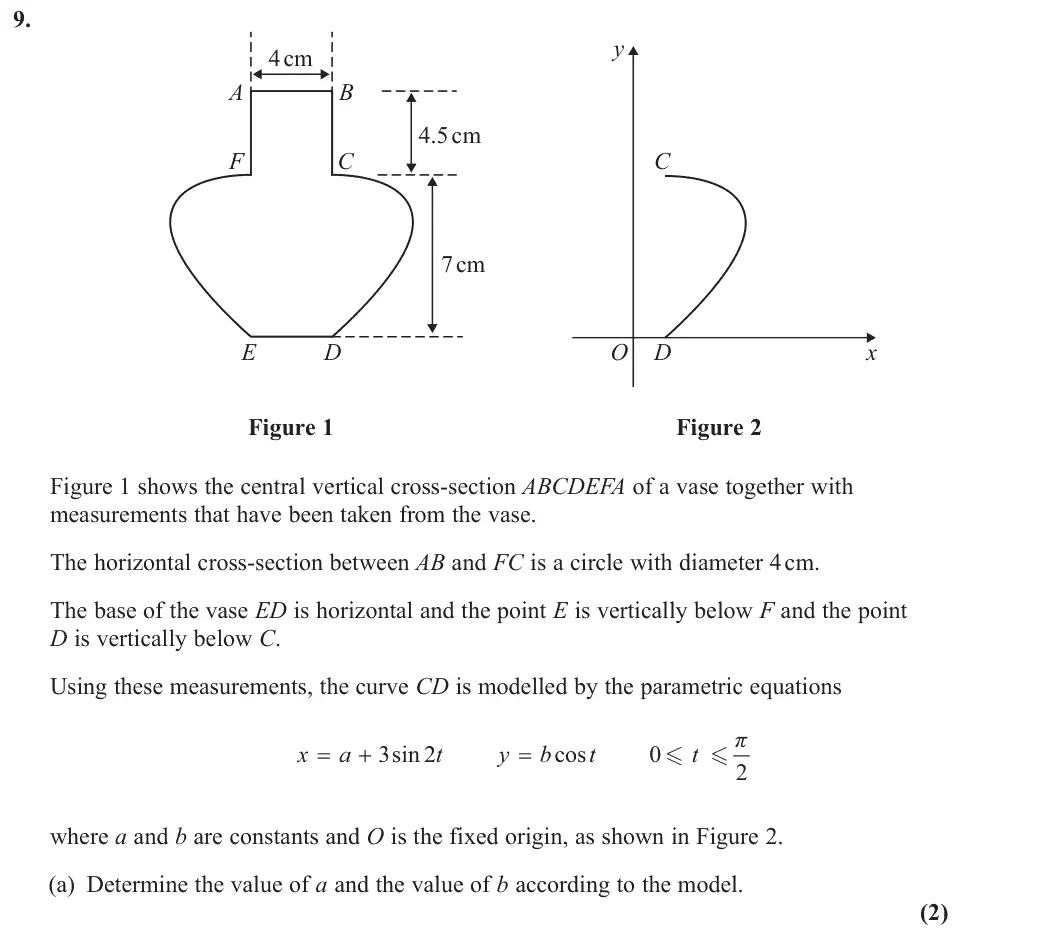
This question proved challenging for most candidates with many failing to make any progress (a) This was generally well-answered with the majority reaching correct values for a and b , though it was noted that many candidates performed significant unnecessary working to a = 0 achieve these values. Some candidates reached and thus restricted their available marks for (b)
Key points from the mark scheme and examiner's report
at D (t = π/2) x = a = 2
at C (t = 0) y = b = 7
June 2024 · Paper 2 (Core Pure 2) · Q9(b)7 marks
Mark scheme (whole question; this part is marked with the orange bar)
Examiner's comment
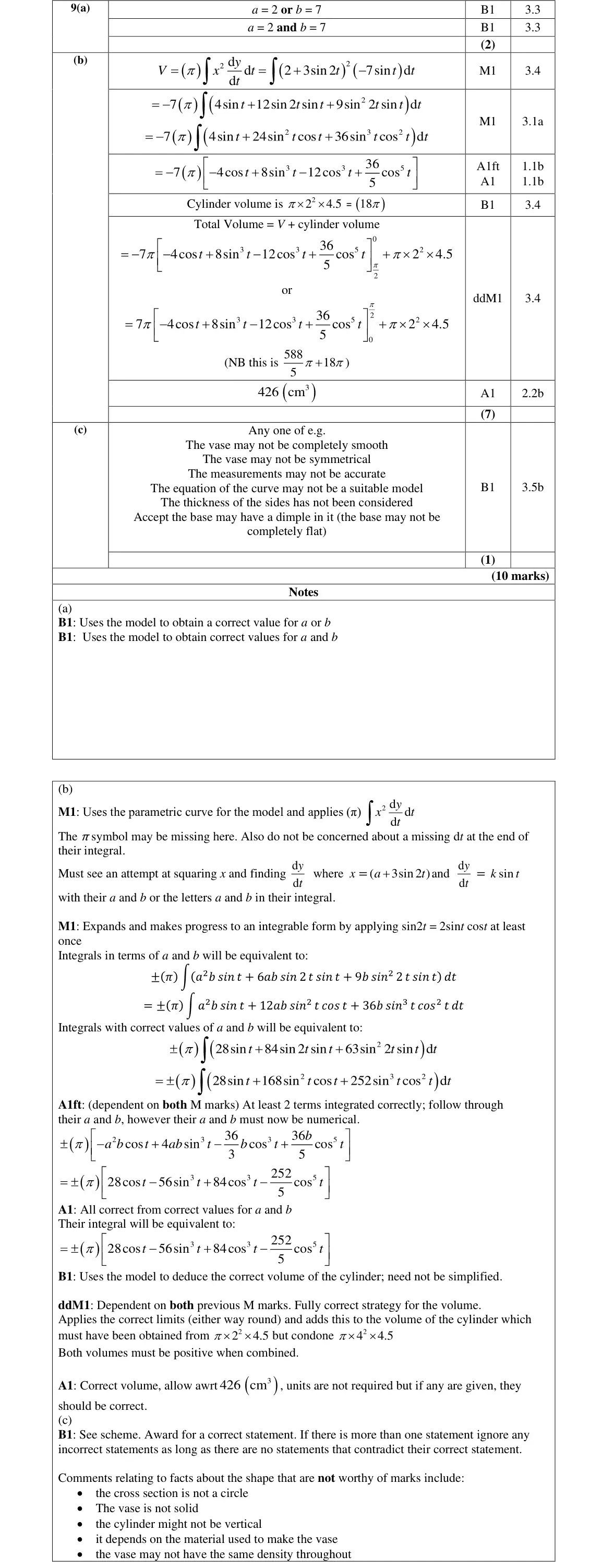
This question proved challenging for most candidates with many failing to make any progress at all in part (b). for (b) (b) This was by some margin the most technically demanding section of the paper, and many candidates only managed to score 1 or 2 marks here. However, many candidates did identify 2 d d y the need to rotate around the y axis leading to the requirement to apply ( pi ) x t d t This is where candidates generally ceased scoring marks (other than scoring the later mark for the volume of the cylinder). Few candidates progressed to an integrable form via the use of sin 2t identities (some instead attempting identities moving towards terms incos4t but stopping short of an attempt at integration by parts or another correct method). Those who did use the correct identity were often still unable to perform any integration correctly. Where 2 correct integration was seen it was generally on their sint and t terms, but very few sin cos t candidates progressed to a fully correct integral and often their attempts at part (b) ended prematurely. sometimes appeared with no working, candidates having used The correct value of 588 5 their calculator, and they gained no credit for this. Some candidates did attempt alternate methods of integration such as parts or conversion to a cartesian form. However, these routes were equally technically demanding and did not generally lead to better outcomes, with fully correct responses via either of these methods rarely seen.
Key points from the mark scheme and examiner's report
V = π∫x² (dy/dt) dt with x = 2 + 3sin 2t, dy/dt = −7sin t
Mark scheme (whole question; this part is marked with the orange bar)
Examiner's comment
This question proved challenging for most candidates with many failing to make any progress (c) This was generally well-answered by those who attempted it, with a mixture of correct responses regarding smoothness/symmetry, failure to consider the thickness of the vase or the curve not accurately modelling the shape of the vase. However, several candidates misunderstood the relevant limitations of the model and commented on things such as the vase being solid, the cylinder not being vertical (or equivalent) or even the cross section being wrong, all of which scored no marks.
Key points from the mark scheme and examiner's report
e.g. vase not smooth or symmetrical, thickness of the sides ignored, measurements inaccurate, base not flat
'vase not solid' or 'cross-section not a circle' scored 0
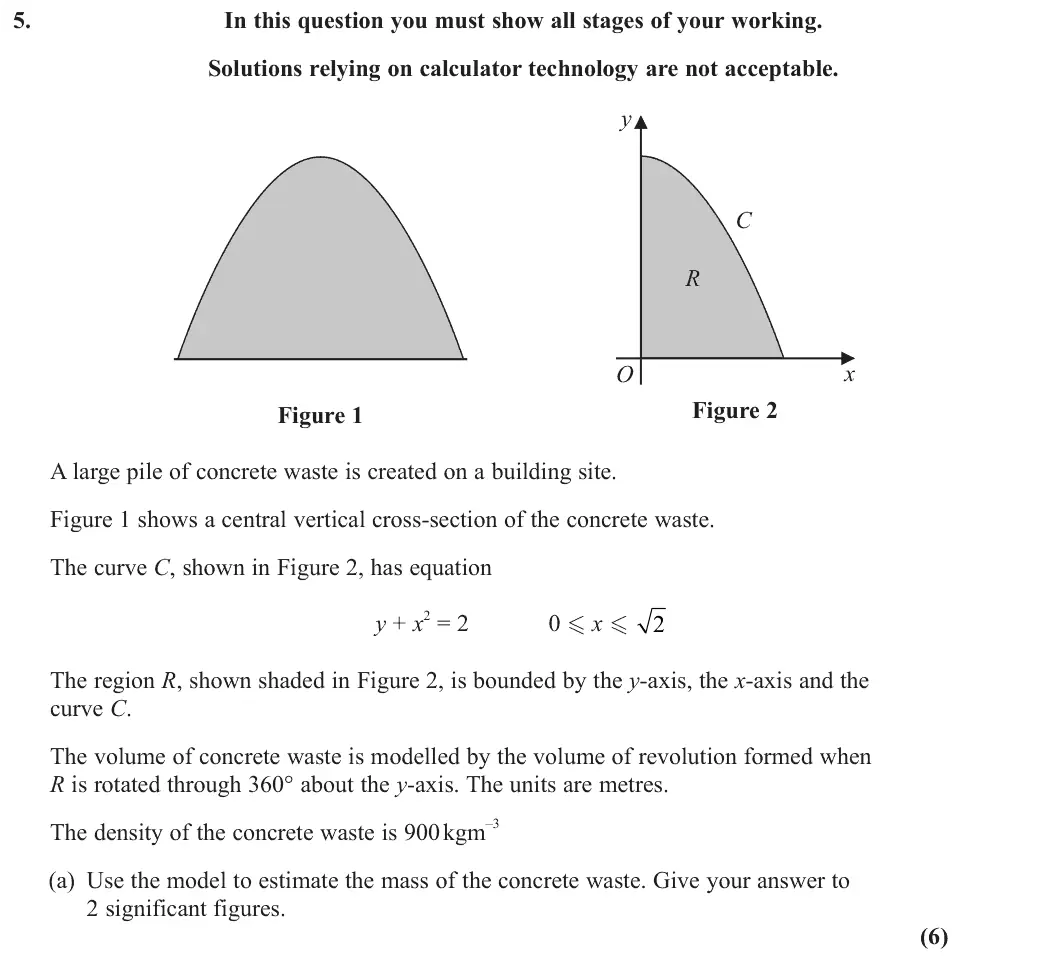
June 2023 · AS Paper 1 (Core Pure) · Q5(a)6 marks
Mark scheme (whole question; this part is marked with the orange bar)
Examiner's comment
In part (a), the majority of candidates used the correct volume of revolution formula, taken around the y-axis, to set up and process the associated integration. The main errors seem in this part were either the use of an incorrect upper limit on the integration, usually 2, or taking the revolution around the x-axis. However, many of the cohort obtained the correct mass of 5700 kg.
Key points from the mark scheme and examiner's report
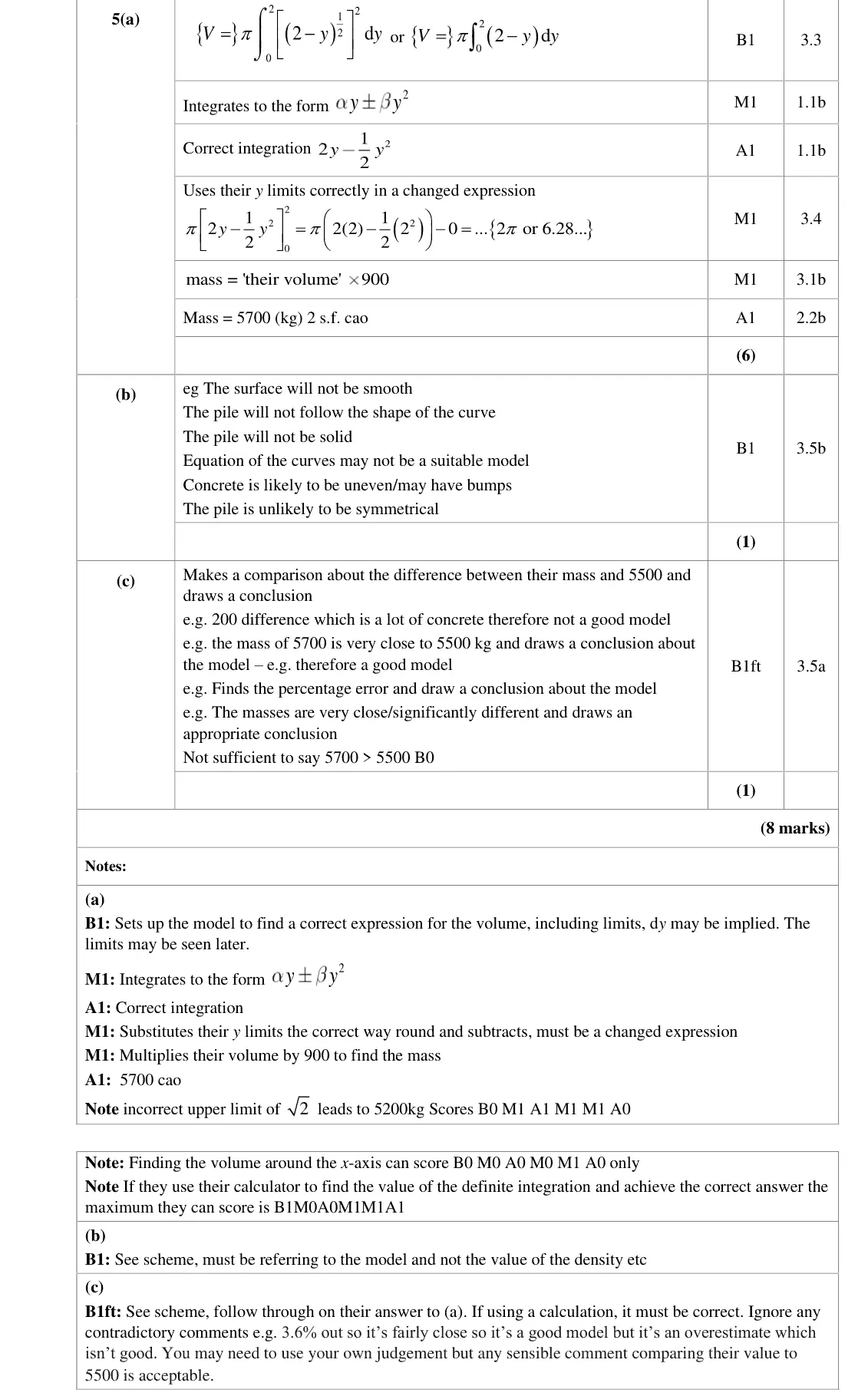
about the y-axis: V = π∫ from 0 to 2 of (2 − y) dy = 2π
mass = 900 × 2π ≈ 5700 kg
upper limit √2 or rotating about the x-axis common errors
June 2023 · AS Paper 1 (Core Pure) · Q5(b)1 mark
Mark scheme (whole question; this part is marked with the orange bar)
Examiner's comment
In parts (b) and (c), many of the candidates gave valid comments relating to the limitation and evaluation of the model and thus obtained the two available marks. Any marks lost here were mainly due to references to density or an incorrect calculation of errors.
Key points from the mark scheme and examiner's report
surface not smooth, pile not solid or not symmetric, curve may be a poor fit
comments about density score 0
June 2023 · AS Paper 1 (Core Pure) · Q5(c)1 mark
Mark scheme (whole question; this part is marked with the orange bar)
Examiner's comment
In parts (b) and (c), many of the candidates gave valid comments relating to the limitation and evaluation of the model and thus obtained the two available marks. Any marks lost here were mainly due to references to density or an incorrect calculation of errors.
Key points from the mark scheme and examiner's report
compare 5700 with 5500 (e.g. 3.6% too big) and draw a conclusion
just "5700 > 5500" scores 0
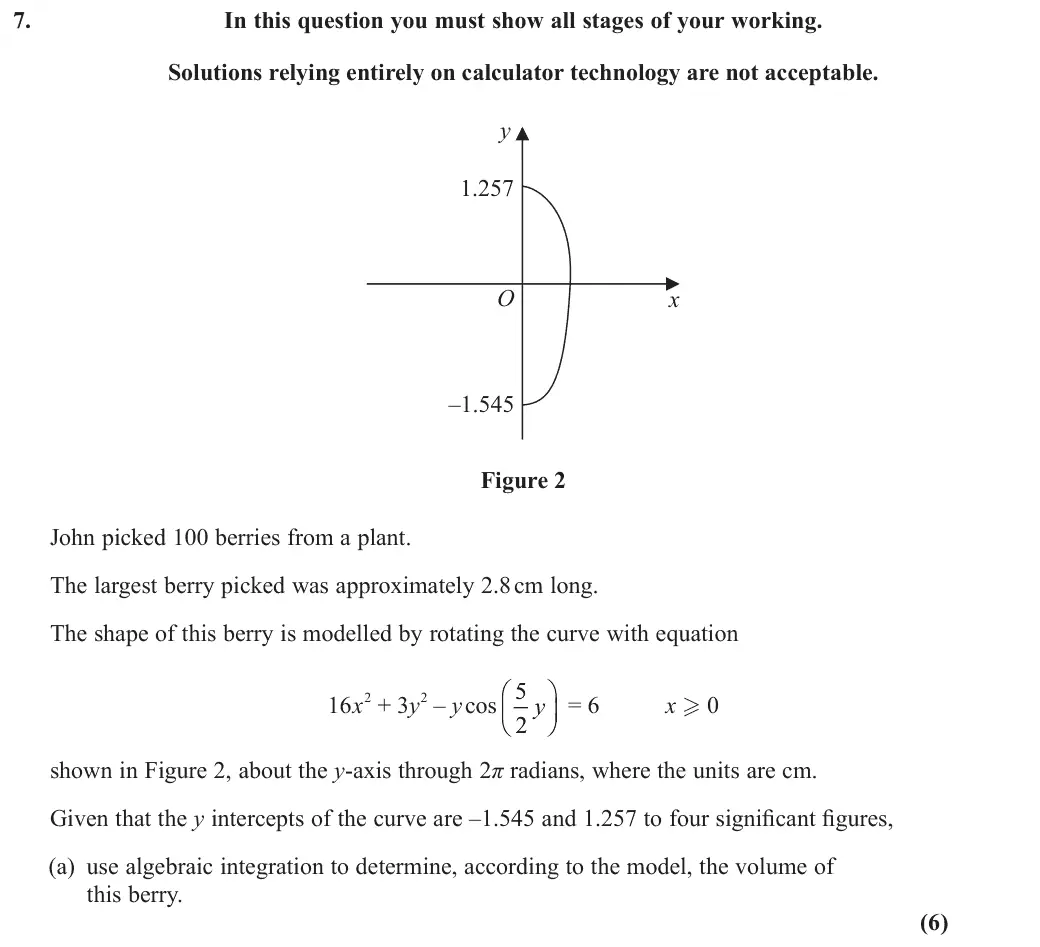
June 2023 · Paper 2 (Core Pure 2) · Q7(a)6 marks
Mark scheme (whole question; this part is marked with the orange bar)
Examiner's comment
(a) Most candidates knew the correct formula for the volume of revolution and were not put off by rotation about the y-axis. The majority integrated the correct function of y. Generally, there was no problem integrating 6 – 3y2 and most were able to integrate 5 cos 2 y y correctly using integration by parts. Common mistakes were missing the y out of the sine term and having the incorrect sign in front of the 4 5 cos 25 2 y . Some candidates either did not recognise the need to integrate by parts, or attempted it without success. Substitution of limits did create some problems. Candidates need to realise how easy it is to slip up when using a calculator to do the entire calculation and should be encouraged to show their working in order to demonstrate that they are performing the expected evaluation by showing the substitution of limits. A significant cohort failed to mention units in their final answer, which was required and would frequently be penalised. Some candidates had clearly used their calculator to get the ‘correct’ answer with the incorrect integration.
Key points from the mark scheme and examiner's report
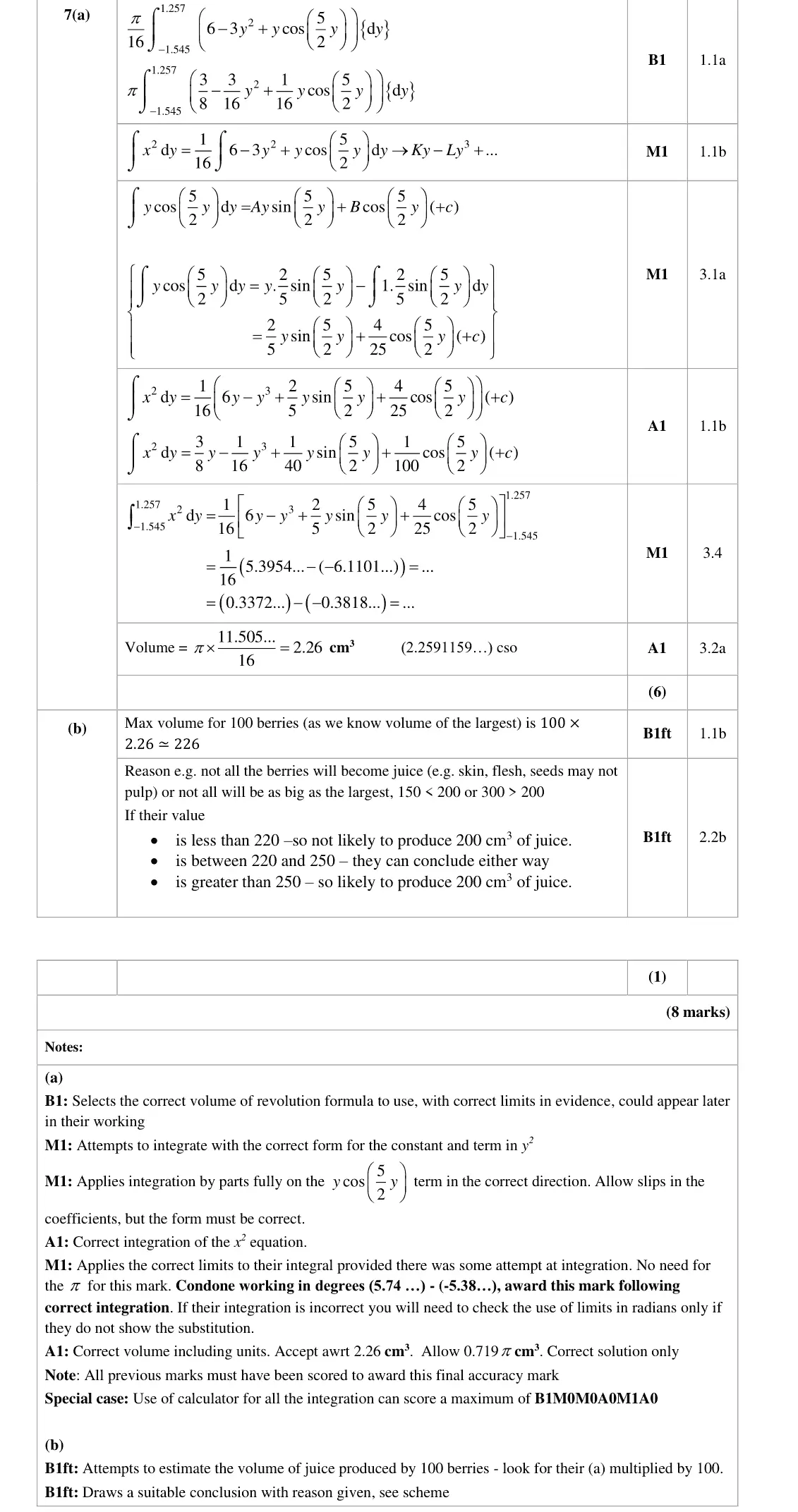
V = π∫x² dy between −1.545 and 1.257 with x² = (6 − 3y² + y cos(5y/2))/16
integrate y cos(5y/2) by parts
radians
2.26 cm³
missing y in the sine term and sign errors
show the substitution of limits
June 2023 · Paper 2 (Core Pure 2) · Q7(b)2 marks
Mark scheme (whole question; this part is marked with the orange bar)
Examiner's comment
(b) The majority of candidates correctly multiplied their answer to (a) by 100 but do need an explanation relating this to 200 and noting that this is the largest possible or that not all of the grapes will turn to juice – a simple yes or no without further explanation is not enough.
Key points from the mark scheme and examiner's report
100 × 2.26 ≈ 226 is an upper bound as this was the largest berry, and not all of a berry becomes juice, so probably not enough
a bare yes or no scores 0
June 2022 · Paper 1 (Core Pure 1) · Q8(b)1 markHard
Mark scheme (whole question; this part is marked with the orange bar)
Examiner's comment
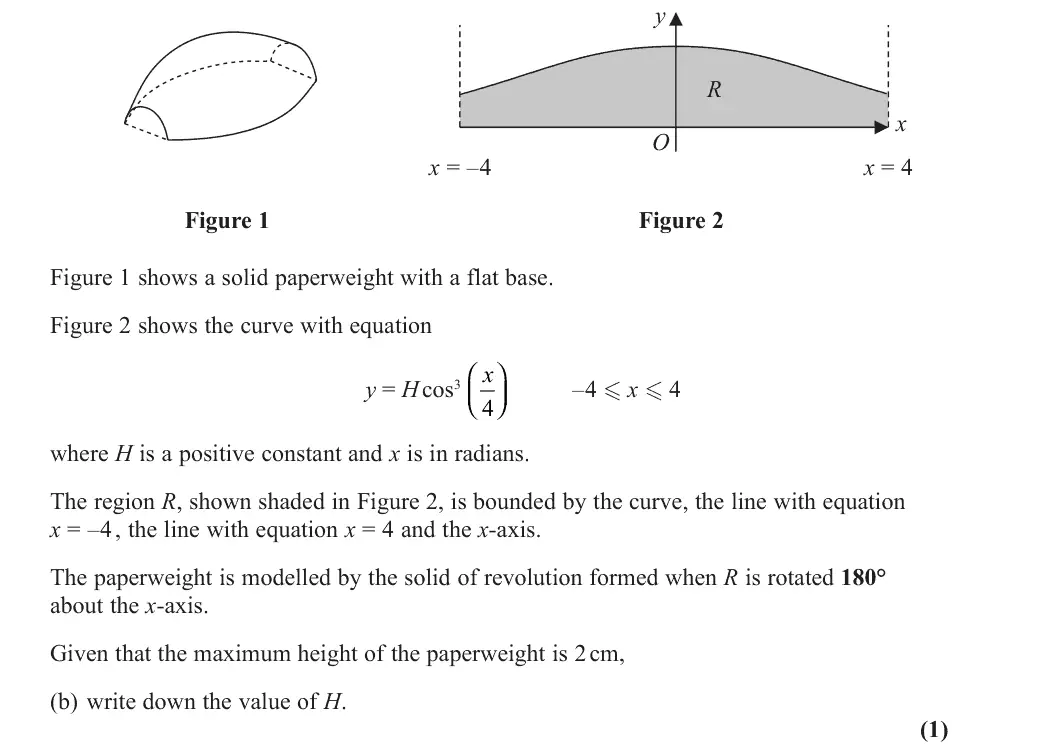
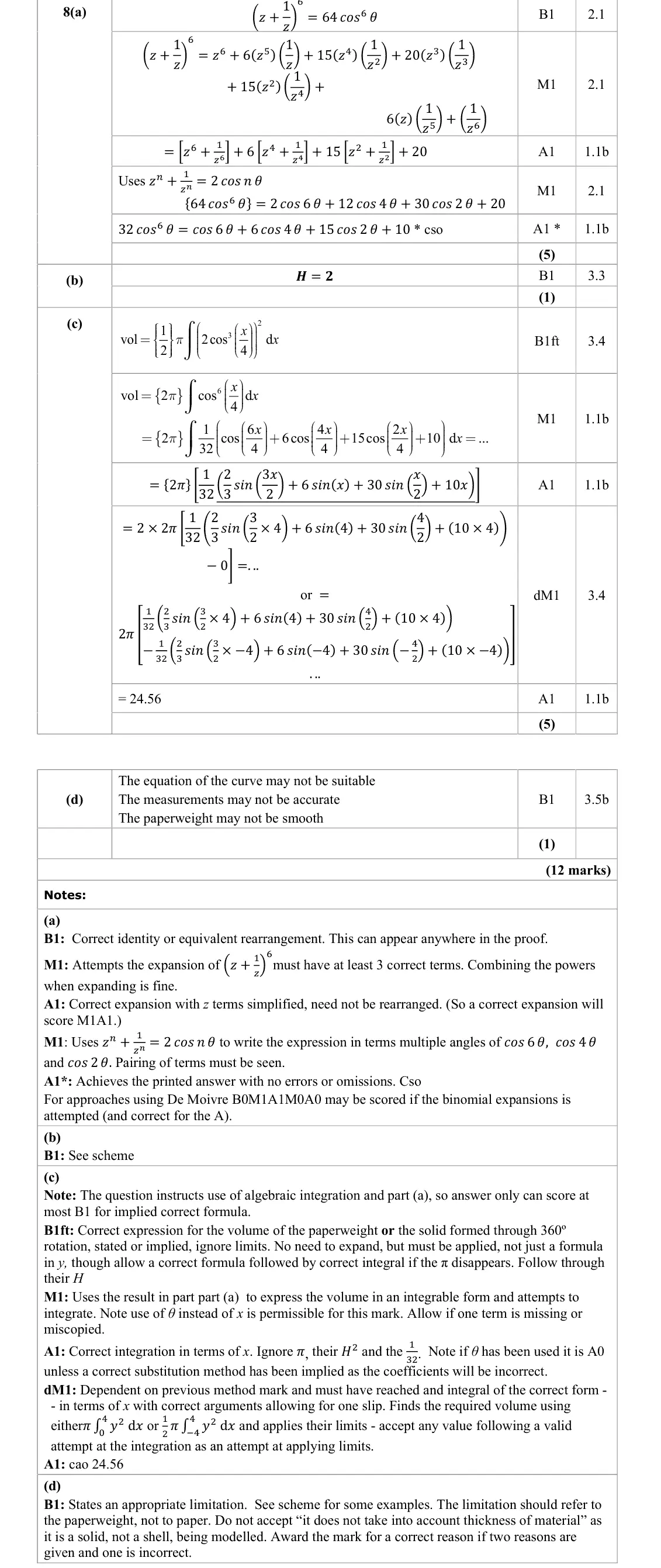
The difficult of the paper did increase over the last few questions with less than a quarter of candidates able to score full marks for this question, though 85% were able to score at least 7 out of 12 in a tapering distribution of scores from the mode of full marks all the way down to zero marks. Almost all candidates stated the correct value H = 2 for part (b).
Key points from the mark scheme and examiner's report
maximum height at x = 0: H = 2
June 2022 · Paper 1 (Core Pure 1) · Q8(c)5 marksMedium
Mark scheme (whole question; this part is marked with the orange bar)
Examiner's comment
The difficult of the paper did increase over the last few questions with less than a quarter of candidates able to score full marks for this question, though 85% were able to score at least 7 out of 12 in a tapering distribution of scores from the mode of full marks all the way down to zero marks. In part (c), the majority of candidates succeeded in forming a suitable expression leading to a volume of revolution and went on to attempt to integrate and apply the correct upper and lower limits. However, obtaining the correct expression for the volume, and carrying out the integration, were not always done well. The most common mistakes were not spotting the argument had changed to 4 x leading to an incorrect integral, using the full volume of revolution through 360º, or incorrect use of limits. Some used theta and appropriate substitution which scored the M mark but changing to x caused some problems. There were some very good solutions and fully correct answers but also many incorrect answers. Common incorrect answers included 12.28 (half) and 49.12 (double).
Key points from the mark scheme and examiner's report
V = ½π∫ from −4 to 4 of 4cos⁶(x/4)dx (180° rotation, so half the usual volume)
use (a) with θ = x/4 (arguments 6x/4, x, x/2)
24.56 cm³
full 360° volume or wrong arguments are common errors
June 2022 · Paper 1 (Core Pure 1) · Q8(d)1 markHard
Mark scheme (whole question; this part is marked with the orange bar)
Examiner's comment
The difficult of the paper did increase over the last few questions with less than a quarter of candidates able to score full marks for this question, though 85% were able to score at least 7 out of 12 in a tapering distribution of scores from the mode of full marks all the way down to zero marks. Most candidates made a successful comment in part (d), usually either relating to the smoothness of the paperweight or the equation of the curve. It was noticeable that some candidates did not understand what a paperweight was and assumed it was made with paper! Some candidates incorrectly argued that the thickness of the material had not been had into account, but this paperweight was not hollow, so thickness was not relevant here.
Key points from the mark scheme and examiner's report
e.g. the curve equation may not fit, measurements inaccurate, surface not smooth
thickness of material is irrelevant (solid)
June 2022 · AS Paper 1 (Core Pure) · Q8(a)1 mark
Mark scheme (whole question; this part is marked with the orange bar)
Examiner's comment
This was definitely the most poorly responded to question on the paper, with a lot of responses being left blank or only the odd part attempted. This is likely due to two factors, the difficulty of the question, which showed a clear divide between the stronger mathematicians and those who have struggled to access a deeper understanding, but also the likelihood that a number of students will have ran out of time as is often the case with mathematics. For those that did attempt the question part (a) was generally answered quite well with the main mistake been a = 8.
Key points from the mark scheme and examiner's report
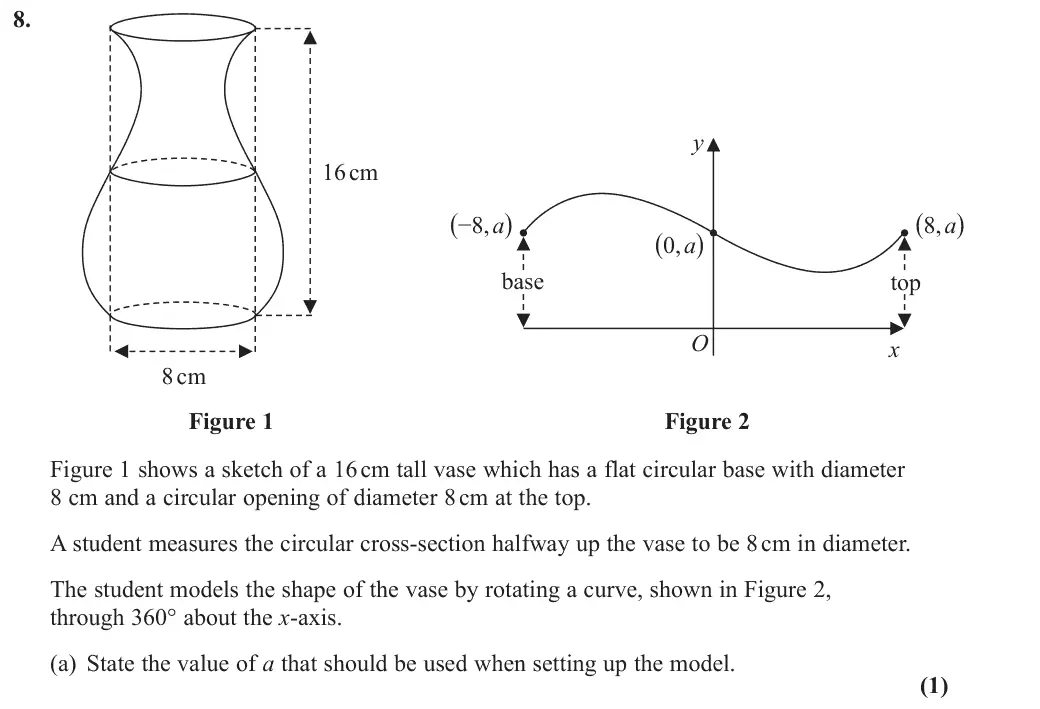
radius at base, middle and top is 4 so a = 4 (a = 8 a common error)
June 2022 · AS Paper 1 (Core Pure) · Q8(b)7 marks
Mark scheme (whole question; this part is marked with the orange bar)
Examiner's comment
This was definitely the most poorly responded to question on the paper, with a lot of responses being left blank or only the odd part attempted. This is likely due to two factors, the difficulty of the question, which showed a clear divide between the stronger mathematicians and those who have struggled to access a deeper understanding, but also the likelihood that a number of students will have ran out of time as is often the case with mathematics. In (b) a number of students concluded that they've not been taught how to differentiate trig functions meaning that the first two marks were inaccessible, it was disappointing to see they had not appreciated maximum and minimum points of the trigonometric curves. Furthermore a number of students also answered part (b) using a full calculator solution, whilst students abilities to master new technology is encouraged and pleasing to see and whilst the question was not explicit that full calculator use should not be the case students should be encouraged to look at the number of marks awarded to each part of the question and understand the need to show a proportionate amount of working, using their technological abilities to check their solutions. For those students who did attempt this question, both models achieved some success. For model A B1B0 was commonly awarded and quite frequently full marks for this model. For model B those that did attempt to differentiate, set equal to zero and solve the common misconception was failing to appreciate that the value of x found was not the distance from the base thus losing the third mark they did however attempt to find the y value appreciating the need to multiply by 2 to find the diameter. Other mistakes in this part of the question were poor differentiation skills poor arithmetic skills and poor algebraic manipulation skills which is very surprising and disheartening to see from further mathematicians.
Key points from the mark scheme and examiner's report
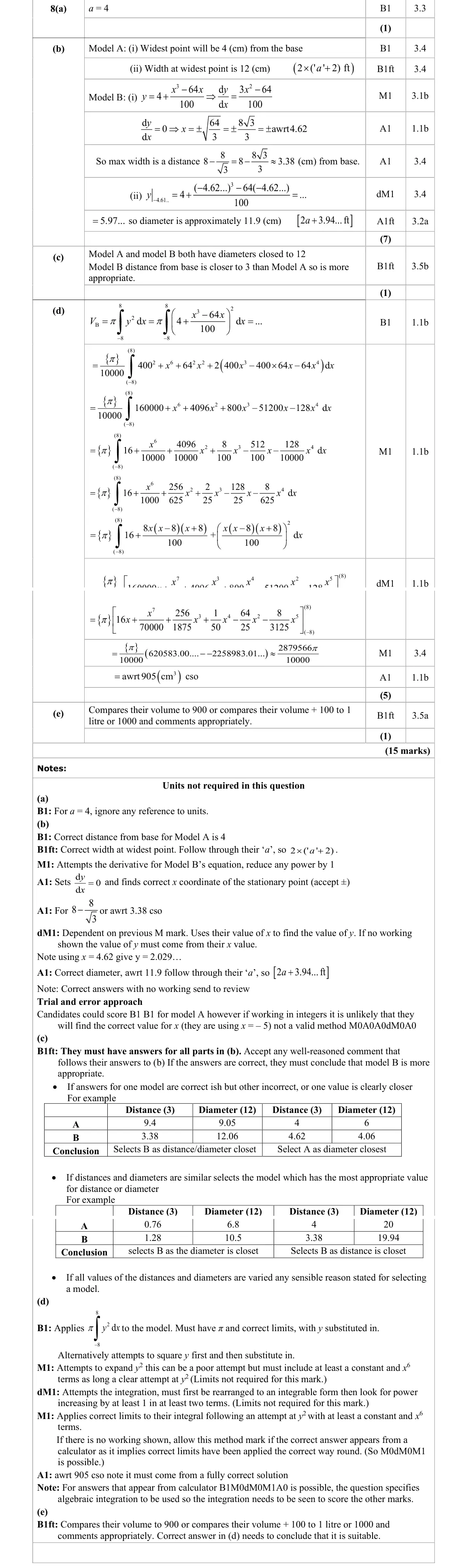
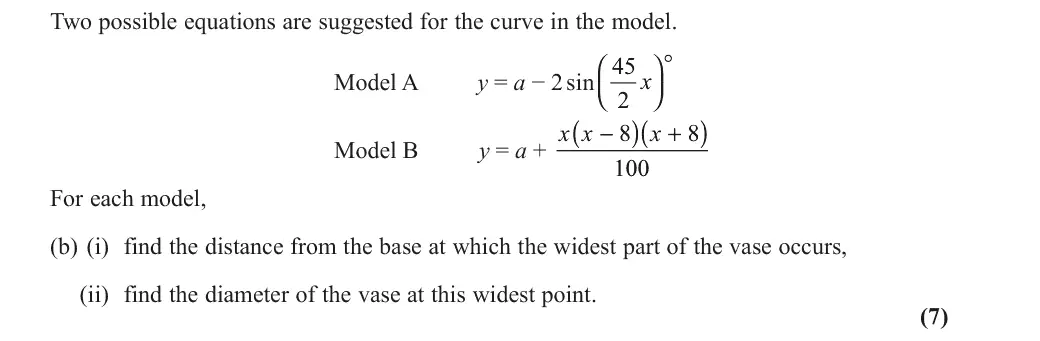
Model A: widest 4 cm from the base, diameter 12 cm
Model B: dy/dx = (3x² − 64)/100 = 0, x = −8/√3, distance 8 − 8/√3 ≈ 3.38 cm, diameter ≈ 11.9 cm
diameter = 2y
marks are for A-level Maths differentiation in context
June 2022 · AS Paper 1 (Core Pure) · Q8(c)1 mark
Mark scheme (whole question; this part is marked with the orange bar)
Examiner's comment
This was definitely the most poorly responded to question on the paper, with a lot of responses being left blank or only the odd part attempted. This is likely due to two factors, the difficulty of the question, which showed a clear divide between the stronger mathematicians and those who have struggled to access a deeper understanding, but also the likelihood that a number of students will have ran out of time as is often the case with mathematics. The mark in part (c) wasn't always accessible to the students as many had not achieved all four answers in (b), however candidates still went on to attempt this part. For those that had achieved four comparable answers in (b) the majority of them choose the correct model with a suitable explanation, some however went on to choose the wrong model as they focused on purely the diameter although the difference between the diameters was very marginal.
Key points from the mark scheme and examiner's report
both diameters ≈ 12 but Model B's 3.38 cm is closer to 3 cm, so B is more appropriate
needs answers for all of (b)
June 2022 · AS Paper 1 (Core Pure) · Q8(d)5 marks
Mark scheme (whole question; this part is marked with the orange bar)
Examiner's comment
This was definitely the most poorly responded to question on the paper, with a lot of responses being left blank or only the odd part attempted. This is likely due to two factors, the difficulty of the question, which showed a clear divide between the stronger mathematicians and those who have struggled to access a deeper understanding, but also the likelihood that a number of students will have ran out of time as is often the case with mathematics. Part (d) was probably the most familiar part of this question to candidates, they understood the need to use the correct formula and had a good understanding of the limits required. Many achieved the B mark, though a minority failed to recognise the need to attempt y2 resulting in no marks. For those that had an understanding of the procedures required there were major concerns with the algebraic manipulation to find y2. Many failed to reach the minimal requirement of a constant and x6 term thus losing out on the rest of the marks, a very costly mistake that should not be occurring at this level. For those who did manage to reach the expected requirement few were actually correct, however they did then go on to achieve the M marks and this was only penalised in the last mark. Another surprising point to note was very few candidates were showing the substitution of the limits into their integrated expression which then caused examiners to have to check very carefully the workings out, often resulting in M0 due to, likely, an arithmetic slip - it is advised to all candidates undergoing exams to always share intention and make methods clear.
Key points from the mark scheme and examiner's report
V = π∫ from −8 to 8 of (4 + (x³ − 64x)/100)² dx
expand before integrating
awrt 905 cm³
June 2022 · AS Paper 1 (Core Pure) · Q8(e)1 mark
Mark scheme (whole question; this part is marked with the orange bar)
Examiner's comment
This was definitely the most poorly responded to question on the paper, with a lot of responses being left blank or only the odd part attempted. This is likely due to two factors, the difficulty of the question, which showed a clear divide between the stronger mathematicians and those who have struggled to access a deeper understanding, but also the likelihood that a number of students will have ran out of time as is often the case with mathematics. Finally in part (e) a number of candidates confused themselves with the real life situation being portrayed, many comparing their answer in (d) to 1100 or just 100. For those that did interpret the situation correctly nearly all went on to conclude correctly. There are unfortunately still candidates who when making a comparison are not referring to the given and calculated values.
Key points from the mark scheme and examiner's report
the vase holds 900 cm³
905 is very close so Model B is suitable
comparing with 1100 or 100 was a common misreading
Nov 2021 · Paper 2 (Core Pure 2) · Q7(b)6 marks
Mark scheme (whole question; this part is marked with the orange bar)
Examiner's comment
Part (b) This was generally well done, with candidates correctly using the sinh y in terms of exponential or volume of revolution formula. Expressing 2 using the double angle formula for cosh 2y were equally popular, to arrange it an integrable form. There were many fully correct attempts but some with careless slips along the way followed through to an incorrect conclusion. There were also some candidates who used 3 as the upper 3 limit instead of ln
Key points from the mark scheme and examiner's report
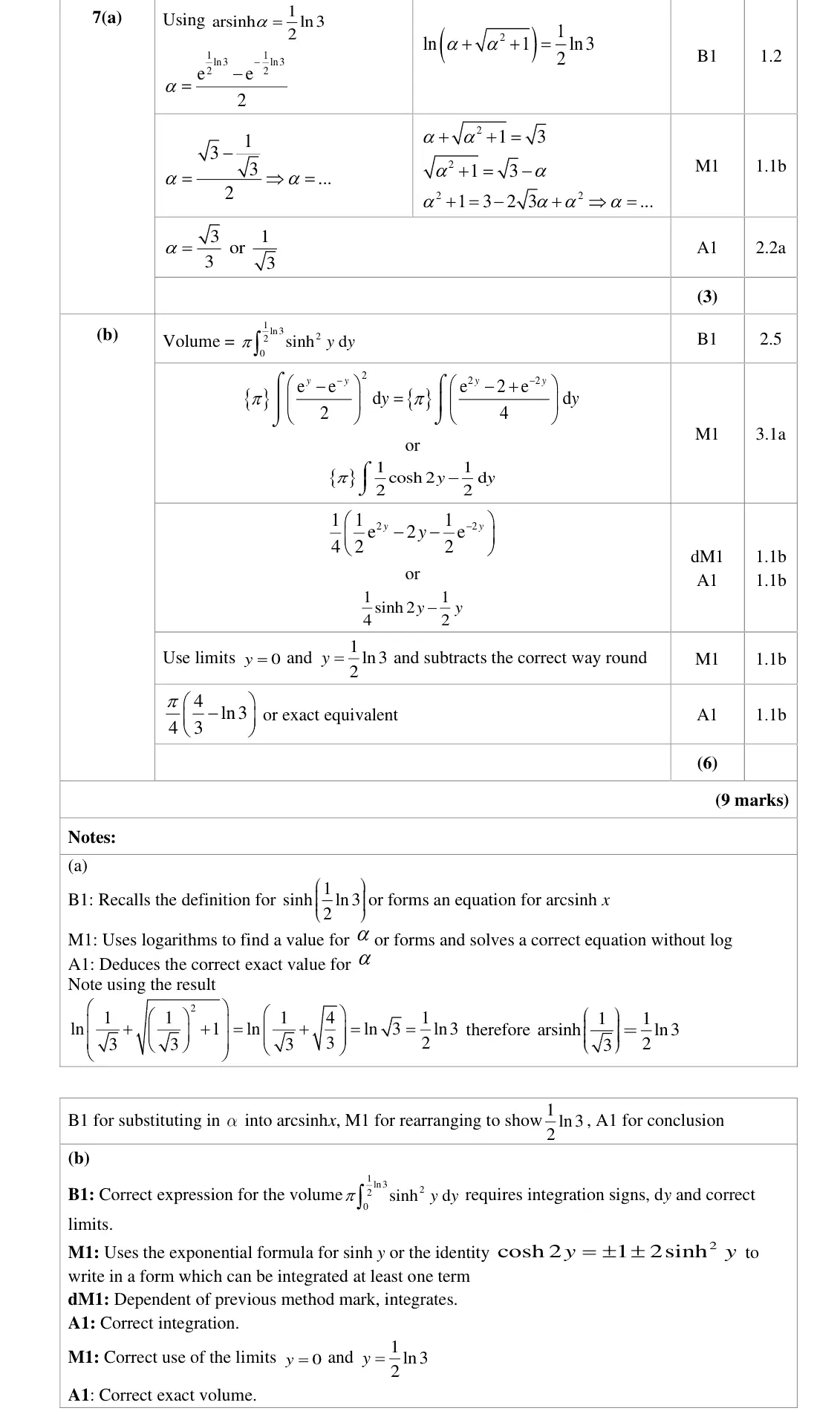
V = π∫ sinh²y dy from 0 to ½ ln 3
sinh²y = ½(cosh 2y − 1) or exponentials
(π/4)(4/3 − ln 3)
using 1/√3 or √3 as the upper limit instead of ½ ln 3
Oct 2020 · AS Paper 1 (Core Pure) · Q35 marks
Mark scheme (whole question; this part is marked with the orange bar)
Examiner's comment
Many candidates ended up at the given answer but from incorrect working. The most error was with the integration 2 2 3 3 1 1 d 3 3 r x x r x . Another error seen was multiplying their answer by 4 to get to what they knew they needed. Other incorrect responses involved trying to integrate 2r . A surprising number of responses were blank for question that should be very familiar.
Key points from the mark scheme and examiner's report
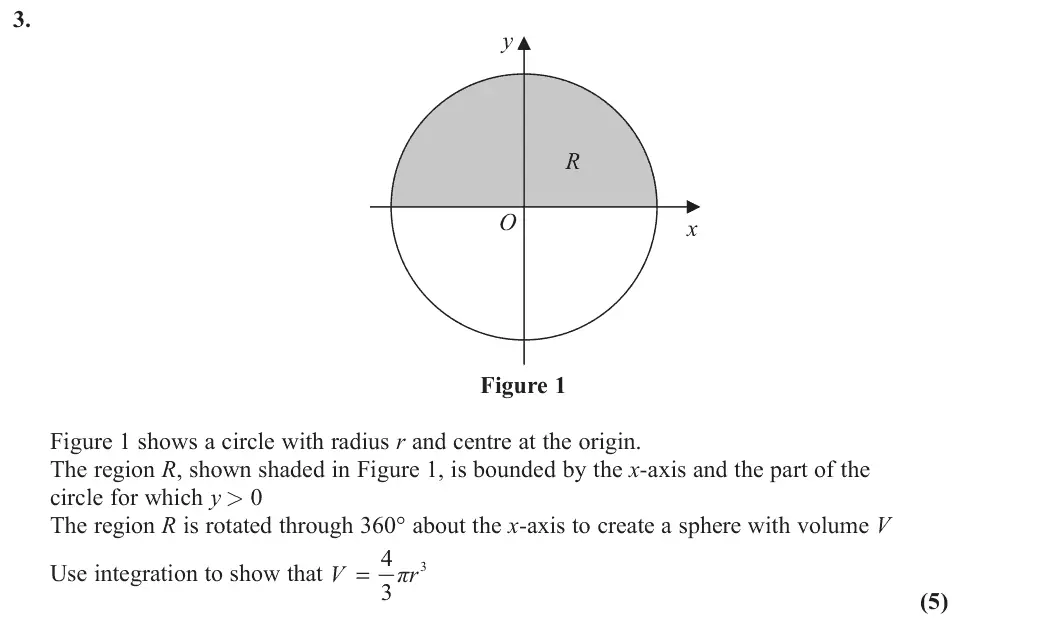
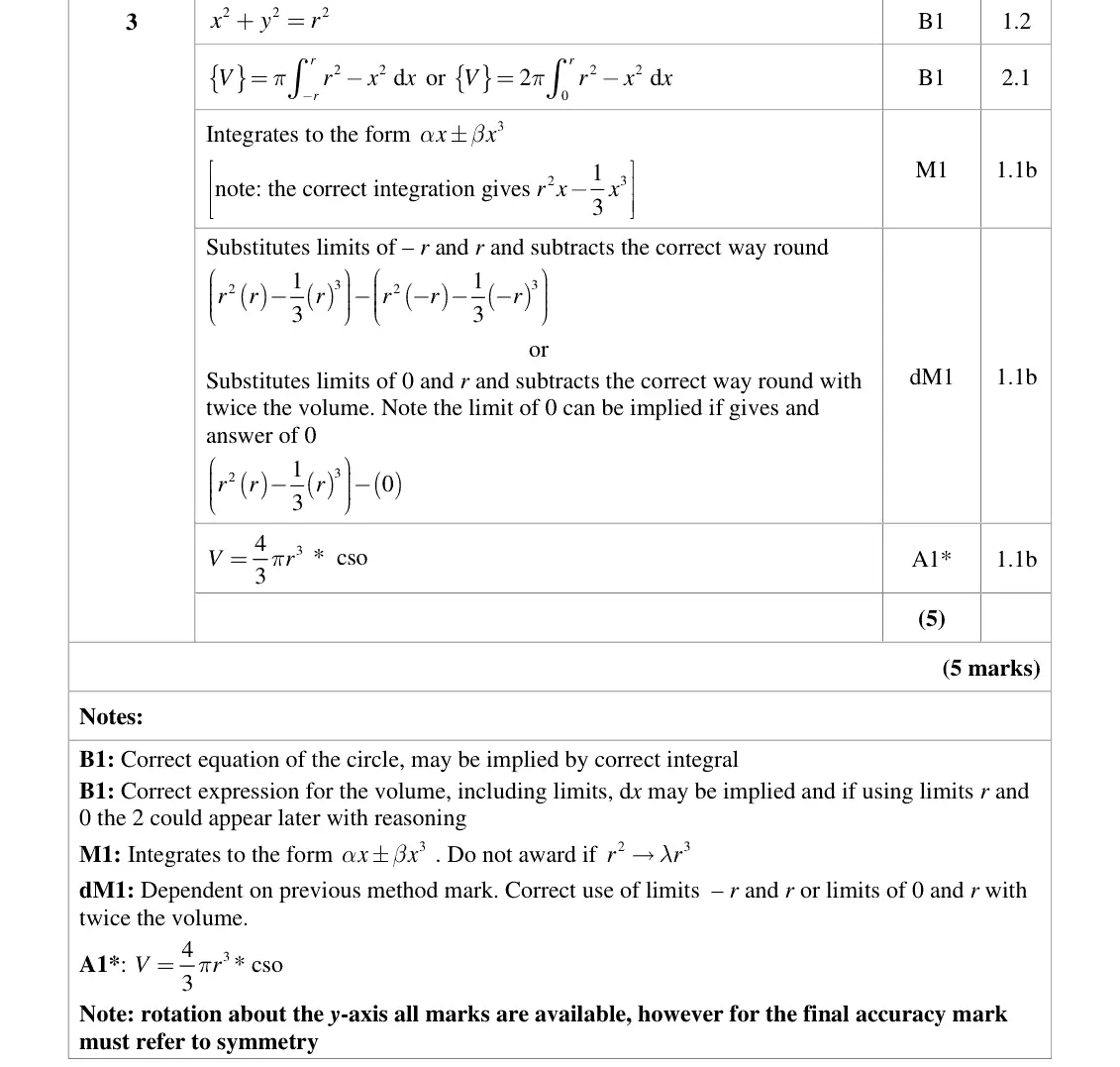
y² = r² − x²
V = π∫ from −r to r of (r² − x²) dx (or 2π∫ from 0 to r)
integrate r² to r²x, not r³
many reached the printed answer from wrong working or fudged by × 4
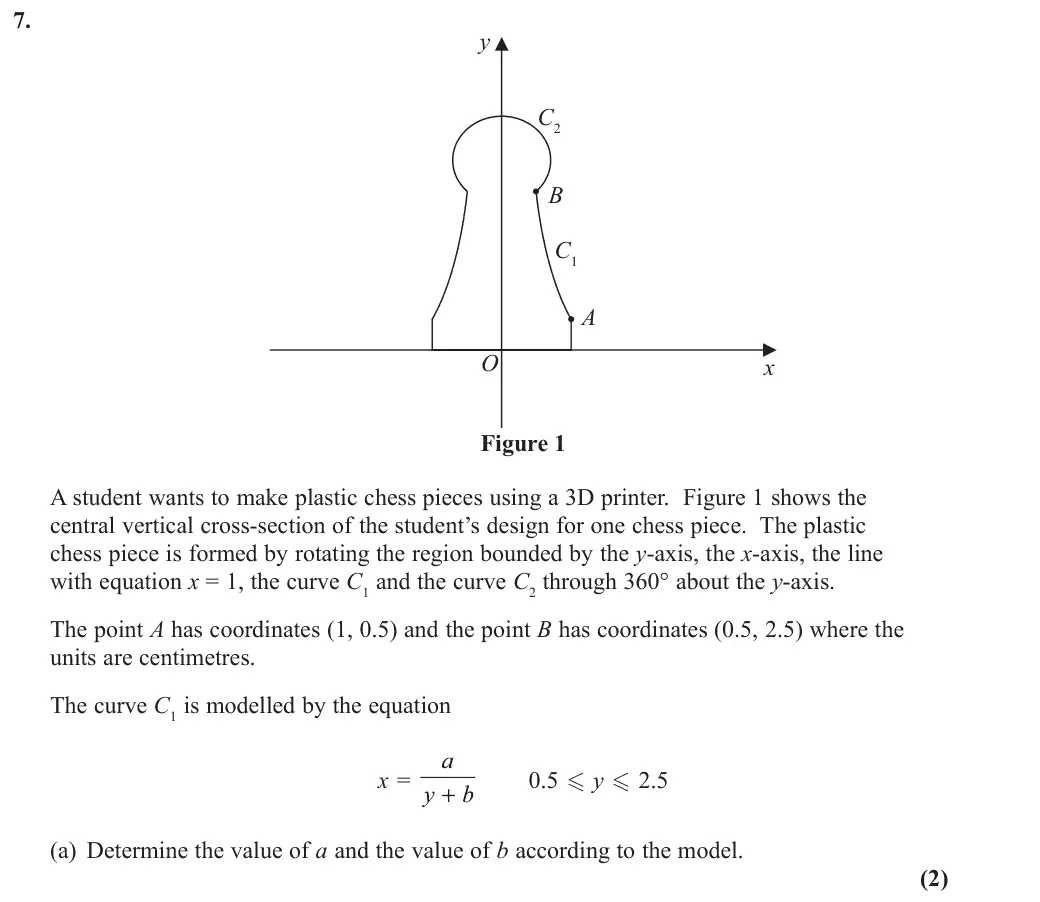
Oct 2020 · Paper 2 (Core Pure 2) · Q7(a)2 marks
Mark scheme (whole question; this part is marked with the orange bar)
Examiner's comment
(a) Most candidates wrote down the correct equations and were able to successfully evaluate a and b
Key points from the mark scheme and examiner's report
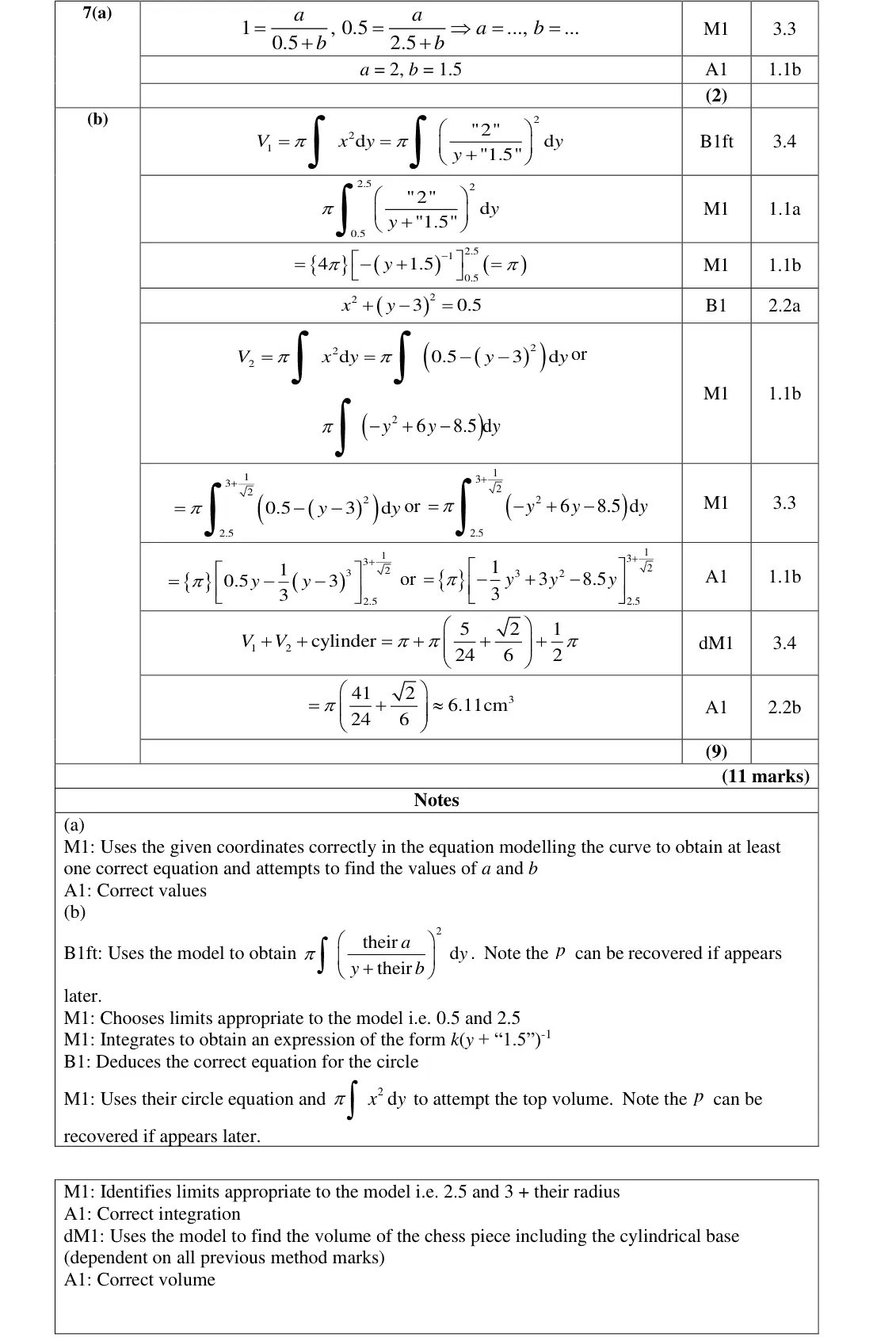
substitute A(1, 0.5) and B(0.5, 2.5): a = 2, b = 1.5
Oct 2020 · Paper 2 (Core Pure 2) · Q7(b)9 marks
Mark scheme (whole question; this part is marked with the orange bar)
Examiner's comment
(b) Only a handful of candidates were able to complete this question successfully. There were quite a few who made no attempt, possibly because they ran out of time. For C1 most candidates obtained the correct integral and most, but not all, used the correct limits. The actual integration was ok for many but, disappointingly, quite a few did not recognise how simple the integration was. For C2 quite a few candidates tried to find some fraction of the volume of a sphere, which went nowhere. The other common errors were to find the wrong radius or even the wrong limits for their integration. There were quite a few correct integrals here but then, too often, careless errors were made in substituting the limits. The volume of the base cylinder was often found correctly. Many candidates did not attempt to add their values together at the end which could be due to running out of time. A few candidates need to note that they will not gain the marks for evaluating an integral on their calculator – they must demonstrate the ability to integrate as required in the question by the phrase ‘use calculus’
Key points from the mark scheme and examiner's report
V₁ = π∫(2/(y + 1.5))²dy from 0.5 to 2.5 = π
circle x² + (y − 3)² = 0.5, V₂ = π∫(0.5 − (y − 3)²)dy from 2.5 to 3 + 1/√2
plus cylinder π/2
total π(41/24 + √2/6) ≈ 6.11 cm³
wrong radius or limits for the circle, fractions of a sphere, forgetting the cylinder
June 2019 · AS Paper 1 (Core Pure) · Q98 marks
Mark scheme (whole question; this part is marked with the orange bar)
Key points from the mark scheme and examiner's report
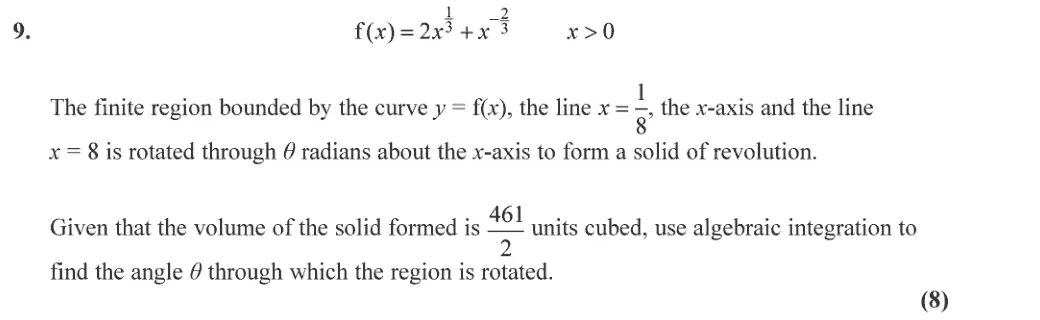
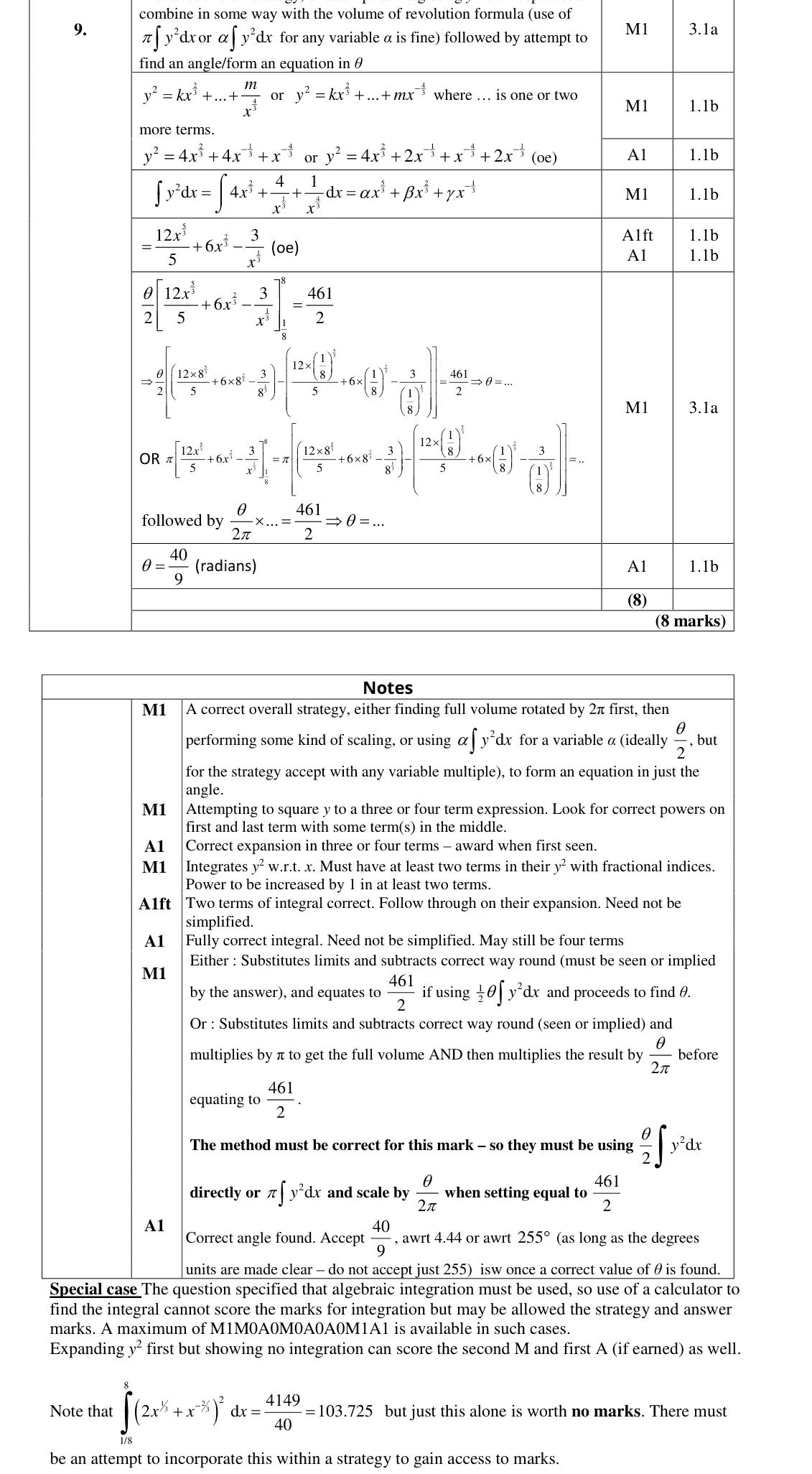
volume = (θ/2)∫y² dx (or π∫y² dx scaled by θ/2π)
y² = 4x^(2/3) + 4x^(−1/3) + x^(−4/3)
limits 1/8 to 8
θ = 40/9 rad
calculator-only integration scores at most 3
June 2019 · Paper 2 (Core Pure 2) · Q8(a)1 mark
Mark scheme (whole question; this part is marked with the orange bar)
Examiner's comment
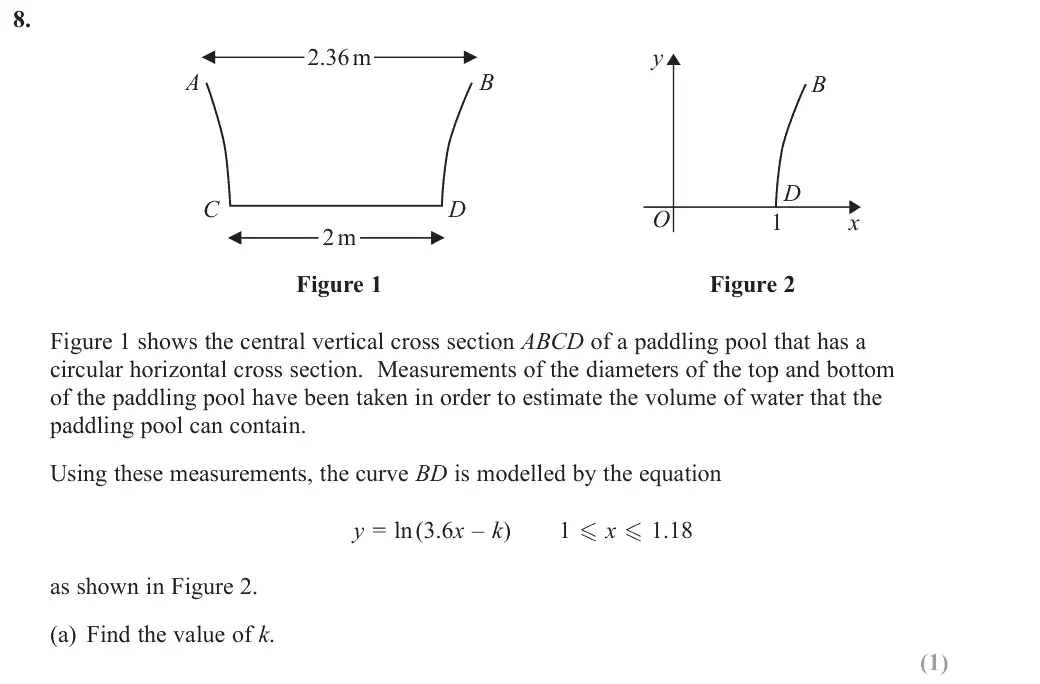
The last question challenged many, but there were a lot of accessible marks here, although a In part (a), most were able to use the model with x = 1 and y = 0 to find k correctly. candidates were slightly less successful in part (b) however, with a few unable to recognise the need to
Key points from the mark scheme and examiner's report
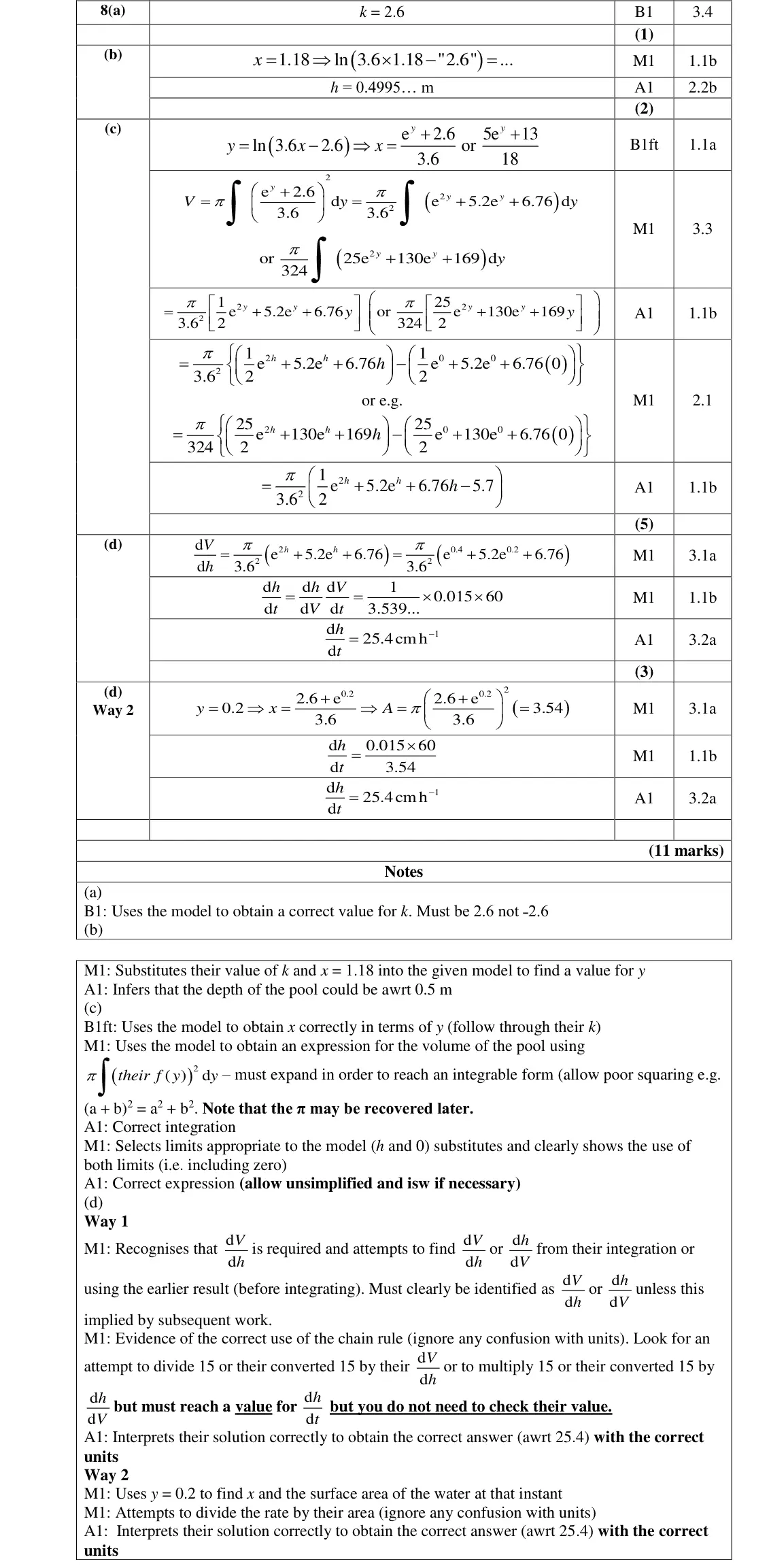
D is (1, 0): ln(3.6 − k) = 0 so k = 2.6 (not −2.6)
June 2019 · Paper 2 (Core Pure 2) · Q8(b)2 marks
Mark scheme (whole question; this part is marked with the orange bar)
Examiner's comment
The last question challenged many, but there were a lot of accessible marks here, although a were slightly less successful in part (b) however, with a few unable to recognise the need to use the 1.18 given beside the model equation for curve BD. A small number left their answer as a natural logarithm. Most knew that a volume of revolution was required in part (c) although some omitted the pi zero limit. Use of the answer to part (b) as the upper limit was occasionally seen.
Key points from the mark scheme and examiner's report
depth = y at x = 1.18: ln(3.6 × 1.18 − 2.6) = 0.4995 ≈ 0.5 m
leaving it as a log
June 2019 · Paper 2 (Core Pure 2) · Q8(c)5 marks
Mark scheme (whole question; this part is marked with the orange bar)
Examiner's comment
The last question challenged many, but there were a lot of accessible marks here, although a Most knew that a volume of revolution was required in part (c) although some omitted the pi from the formula (or had 2 pi ) or they attempted ∫y2dx rather than ∫x2dy. Most made x the subject of the formula correctly although slips were seen in squaring, including failing to find a middle term or not squaring the denominator in their single fraction expression for x. Integration was commonly successful although a significant number neglected to substitute the zero limit. Use of the answer to part (b) as the upper limit was occasionally seen.
Key points from the mark scheme and examiner's report
V = π∫x²dy from 0 to h with x = (e^y + 2.6)/3.6
π/3.6²(½e^(2h) + 5.2eʰ + 6.76h − 5.7)
using ∫y²dx, missing π, not substituting the 0 limit, squaring slips
June 2019 · Paper 2 (Core Pure 2) · Q8(d)3 marks
Mark scheme (whole question; this part is marked with the orange bar)
Examiner's comment
The last question challenged many, but there were a lot of accessible marks here, although a fully correct solution to part (d) was rarely seen. Part (d) proved discriminating although most who made an attempt recognised that the chain rule could be deployed and for the most part it was used correctly. Weaker attempts tended to involve calculating V and then attempting to adjust its value. Many otherwise successful candidates were unable to correctly manage the different units used in the question. A very small number of exceptional candidates were able to deduce that the rate of change of h with respect to time was proportional to the circular surface area of the pool and correctly proceeded without any need for calculus.
Key points from the mark scheme and examiner's report
dh/dt = (dV/dt)/(dV/dh) with dV/dh = 3.539 at h = 0.2 and 15 L/min = 0.9 m³/h: 25.4 cm h⁻¹ (units needed)
unit conversion is the commonest error
dV/dh equals the surface area
June 2018 · AS Paper 1 (Core Pure) · Q9(a)2 marks
Mark scheme (whole question; this part is marked with the orange bar)
Examiner's comment
This proved to be a challenging end to the paper, with signs that some students were struggling to finish in time, although some blank responses may have been due to students simply not knowing where to start. Contextual questions are a necessity on the new specification, so students will have to get used to tackling them. Part (a) did prove accessible to most students, with some degree of progress being made. Many achieved both marks for correct values, though some did make slips in simplification of some terms. A few did not correctly associate the coordinates, but did at least try to engage with the question.
Key points from the mark scheme and examiner's report
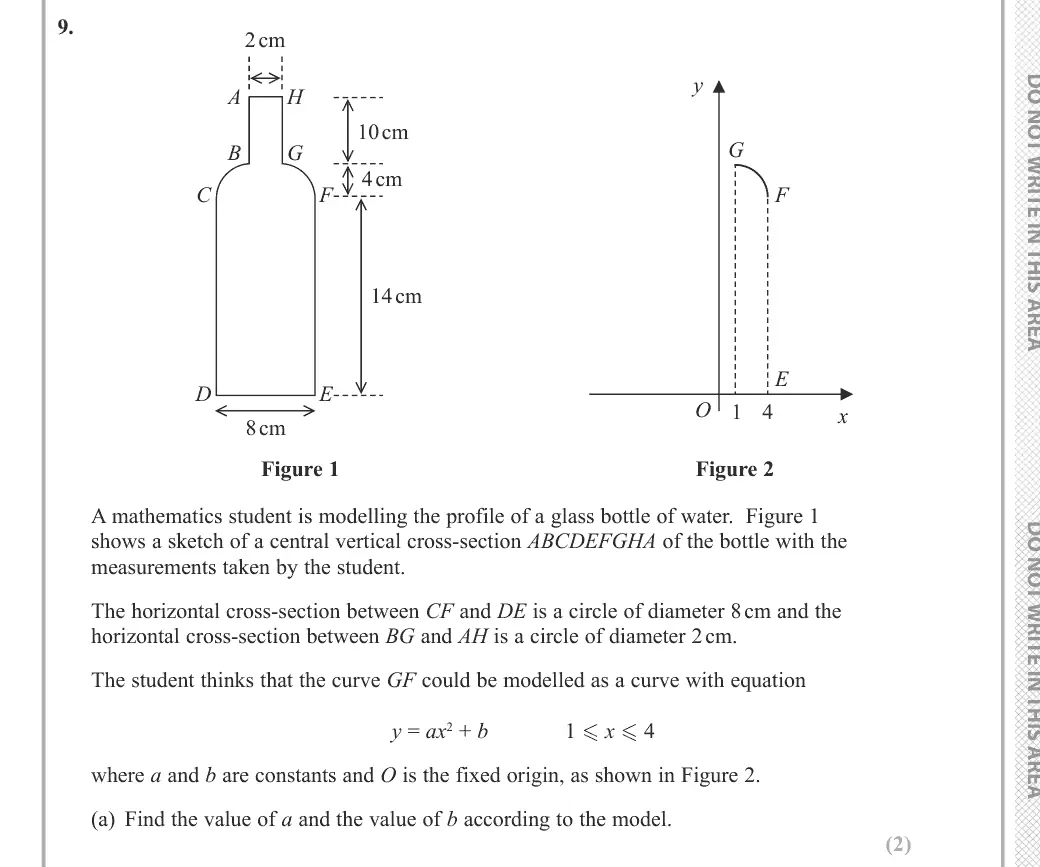
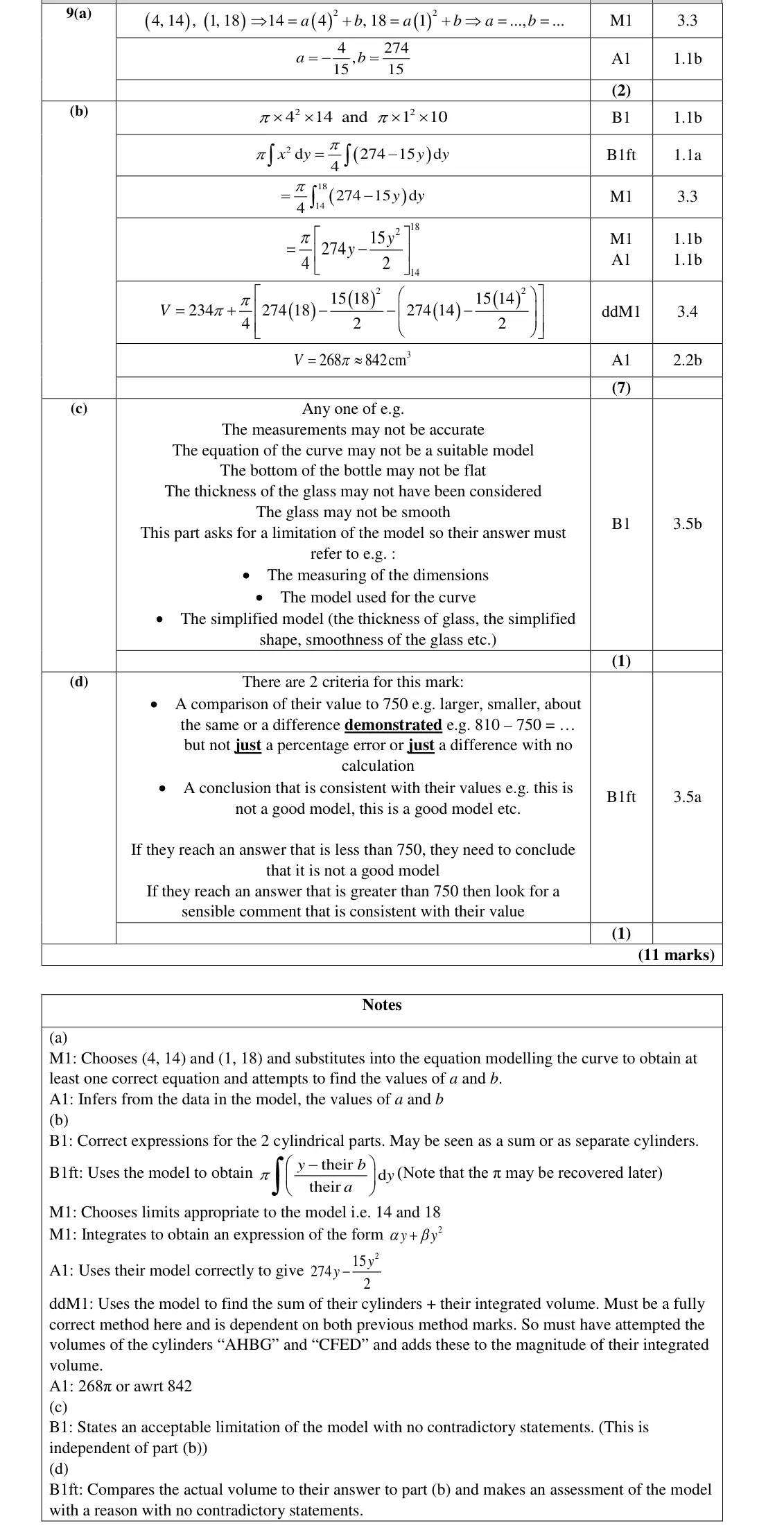
substitute (4, 14) and (1, 18): a = −4/15, b = 274/15
June 2018 · AS Paper 1 (Core Pure) · Q9(b)7 marks
Mark scheme (whole question; this part is marked with the orange bar)
Examiner's comment
This proved to be a challenging end to the paper, with signs that some students were struggling to finish in time, although some blank responses may have been due to students simply not knowing where to start. Contextual questions are a necessity on the new specification, so students will have to get used to tackling them. Part (b) tested the understanding of volumes of revolution in context and many failed to correctly identify the cylindrical parts of the bottle that were needed to form the overall shape. Many omitted these altogether, while others attempted a single cylinder down the centre. Another popular error was to attempt to subtract a cylinder from the solid formed from the rotation of the curve. Most were able to form the correct follow through expression for their answers to (a), but many did not use the correct limits in the context of the question, with 0 and 4, or 1 and 4, being very common choices. There were also many who attempted a volume of revolution about the x-axis, who could gain no credit other than for the cylinders (if they found them). Even the integration proved somewhat problematic in that some students did not show their working. Presumably some students used their calculators to perform definite integration but it should be emphasised that in questions such as these, full working should be shown. Those who did show the working for the integration mostly did acquire the method mark, and those with correct a and b consequently gained the accuracy too. Putting the volumes together was successfully achieved by those who did work out the correct portions that were needed, though some students omitted the pi on the integral. For many, failure to correctly identify the two required cylinders lost the final two marks of this part.
Key points from the mark scheme and examiner's report
volume about the y-axis π∫x² dy with limits 14 and 18 plus two cylinders π×4²×14 and π×1²×10
268π ≈ 842 cm³
omitting the cylinders or wrong limits (0 to 4) common
June 2018 · AS Paper 1 (Core Pure) · Q9(c)1 mark
Mark scheme (whole question; this part is marked with the orange bar)
Examiner's comment
This proved to be a challenging end to the paper, with signs that some students were struggling to finish in time, although some blank responses may have been due to students simply not knowing where to start. Contextual questions are a necessity on the new specification, so students will have to get used to tackling them. Part (c) saw a wide variety of answers, many suitable to access the mark. However, a common response was to state the bottle may not be full, which did not score as it is not a limitation of the model. Students need to understand that a limitation of the model needs to refer to a feature of the model, such appropriateness of an equation used, or any aspects that may affect its suitability to be used.
Key points from the mark scheme and examiner's report
must be a limitation of the model (thickness of glass, curve equation, flat base, measurement accuracy)
"bottle may not be full" scores 0
June 2018 · AS Paper 1 (Core Pure) · Q9(d)1 mark
Mark scheme (whole question; this part is marked with the orange bar)
Examiner's comment
This proved to be a challenging end to the paper, with signs that some students were struggling to finish in time, although some blank responses may have been due to students simply not knowing where to start. Contextual questions are a necessity on the new specification, so students will have to get used to tackling them. Part (d) was not as well answered. There was perhaps some confusion as to the difference between a limitation and an evaluation of the model, with some students again referring to a limitation here. It was important that a comparison be made here, and there was no need to offer a reason why it may or may not have been appropriate, but simply to have drawn a conclusion from the comparison as to whether the model is suitable or not. An appreciation that the label should be an under-estimate of the true volume, so that the bottle could contain this amount with some room to spare, was not shown by many students. Those students who answered correctly here mainly focussed on how far out (with specific reference to “greater than”, “less than”), their value was from the stated volume and hence made an evaluation of the model.
Key points from the mark scheme and examiner's report
compare their volume with 750 (e.g. 842 > 750) and conclude on the model
just a percentage error is not enough
Find an Edexcel Further Maths tutor
Stuck on this? Book a trial lesson with our Further Maths tutor.