CP4.1 Understand and use the relationship between roots and coefficients…
Section
CP4 Further algebra and functions
Level
AS & A level
Statement
Understand and use the relationship between roots and coefficients of polynomial equations up to quartic equations.
Guidance
For example, given a cubic polynomial equation with roots α, β and γ students should be able to evaluate expressions such as (i) α² + β² + γ², (ii) 1/α + 1/β + 1/γ, (iii) (3 + α)(3 + β)(3 + γ), (iv) α³ + β³ + γ³.
Mark scheme (whole question; this part is marked with the orange bar)
Examiner's comment
Solutions to this question usually showed an appreciation of the techniques required thus gaining the method marks but failed to gain accuracy marks because of mistakes in algebraic manipulation. The sum of roots and the product of roots were obtained correctly with very few having sign errors in the signs of the sum and of the product. Most then appreciated the need to eliminate one of alpha or beta from the pair of simultaneous equations that they had formed. The more straightforward substitution of 7 3 alpha beta = - was seen almost as often as the more awkward 7 3 alpha beta - = Attempts to simplify the resulting equation saw algebraic errors or insufficient simplification so that a correct simplified quadratic was not achieved. Often a cubic resulted which was solved via a calculator which was acceptable here, although previous errors led to incorrect values for alpha or beta being obtained. With the value of alpha or beta , most followed a correct method to achieve the three roots. There were cases where the values obtained deterred learners from proceeding to three roots so losing the final method and accuracy mark.
Key points from the mark scheme and examiner's report
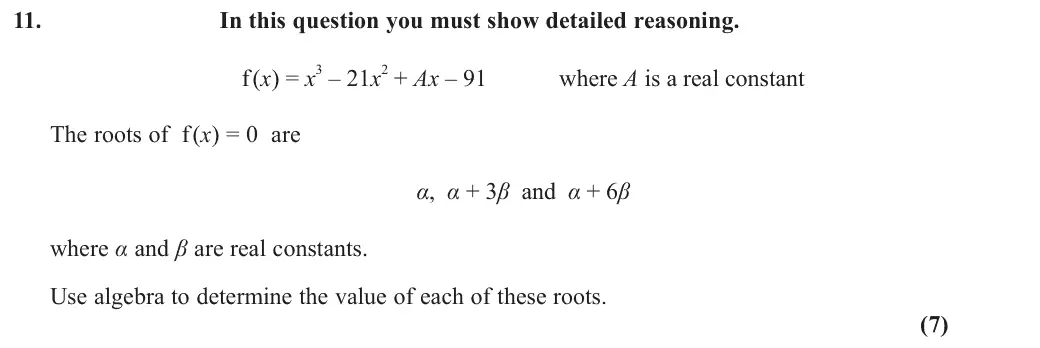
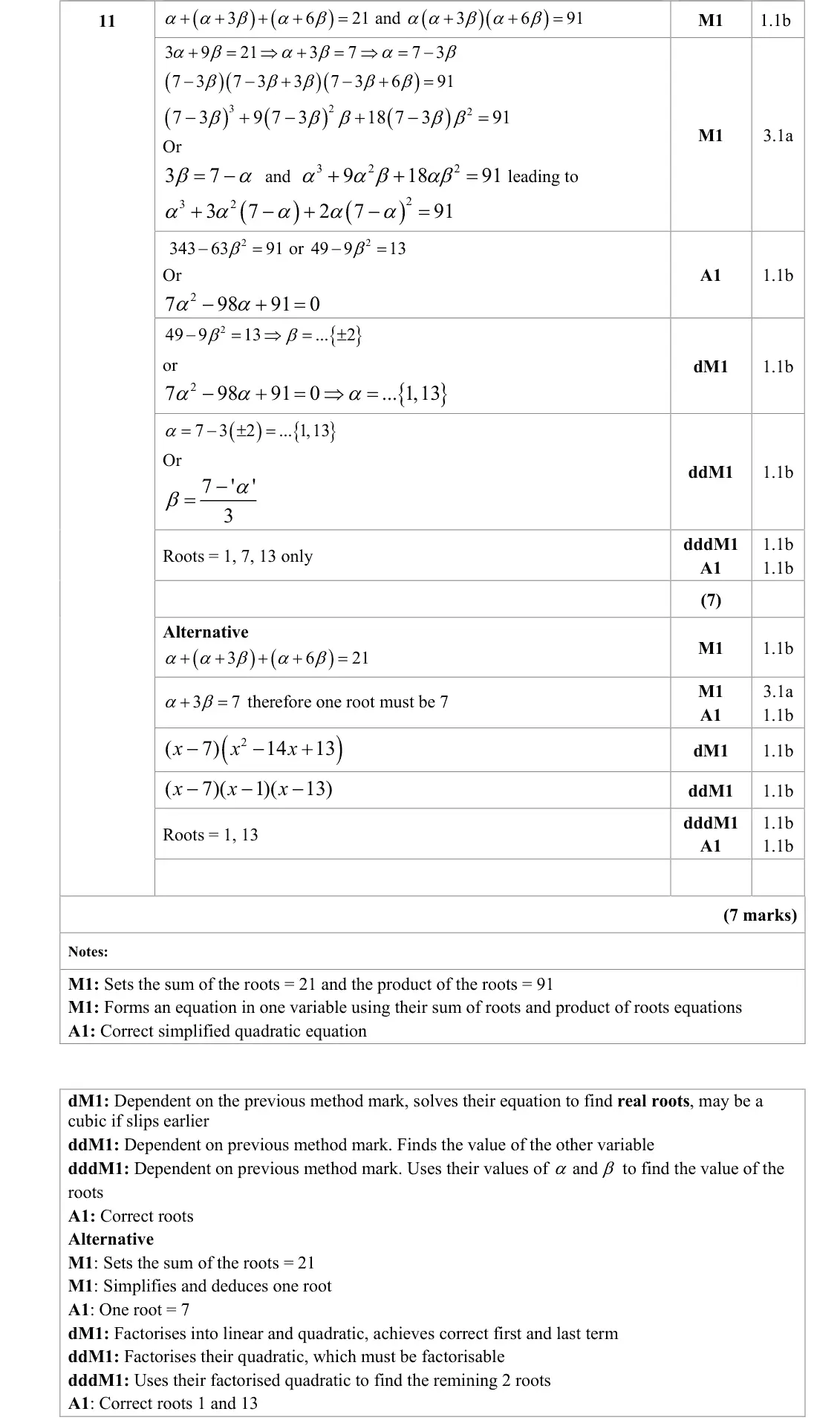
sum: 3α + 9β = 21 so α + 3β = 7, i.e. 7 is a root
product α(α + 3β)(α + 6β) = 91
49 − 9β² = 13, β = ±2
roots 1, 7, 13
algebra slips cost accuracy
June 2025 · Paper 1 (Core Pure 1) · Q65 marks
Mark scheme (whole question; this part is marked with the orange bar)
Examiner's comment
This was a well attempted question. It emphasised that candidates should read the entire question before embarking on their solution as some assumed the triangle was equilateral. Those candidates then usually attempted to answer the question using an exponential method for nth roots of a complex number, scoring no marks. Most students were awarded the B mark for sight of 2 – 4i. They then had to find a real root of the cubic. There were many routes to finding the real root, but the most reliable methods included a sensible diagram. A sizeable minority of candidates either did not realise that the height of the triangle was 8 and used 4 or instead thought that their height was also the root. There were a few attempts at the use of 1 sin 2 ab C where students were unsure what they were trying to find. For students who found the correct triangle height of 3, those that did not go on to find the correct roots of 5 or –1 usually used 3 or -3 as the root, gaining no further credit. A clear majority of candidates, however, found the real root quickly and efficiently, gaining the first method mark. Where this mark was awarded, students generally went on to score dM1 and ddM1 and very often the A mark unless there were slips in working or only one possible function was found. Having found the three roots, candidates had the choice of using roots of polynomials or the factor theorem to find the resulting cubic expressions. Candidates had less algebraic work to do if they used the factor theorem and generally made fewer errors with this approach. There were a pleasing number of accurate and well-presented solutions from candidates who used the sums and products of roots, showing that it could be done efficiently.
Key points from the mark scheme and examiner's report
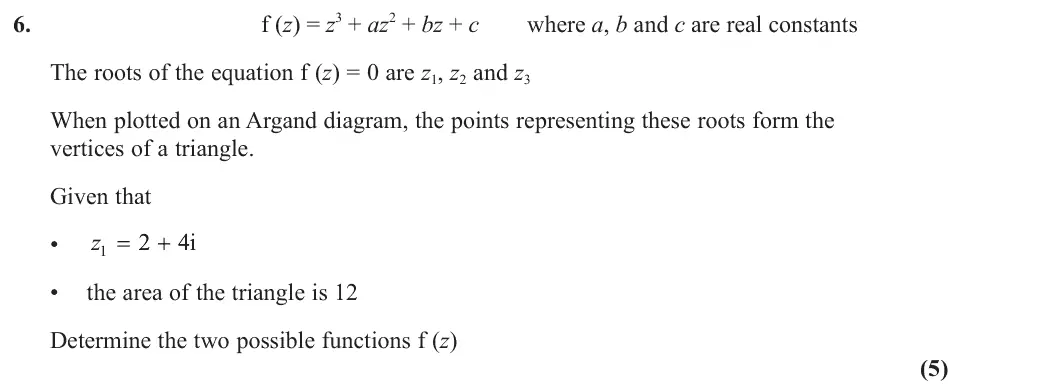
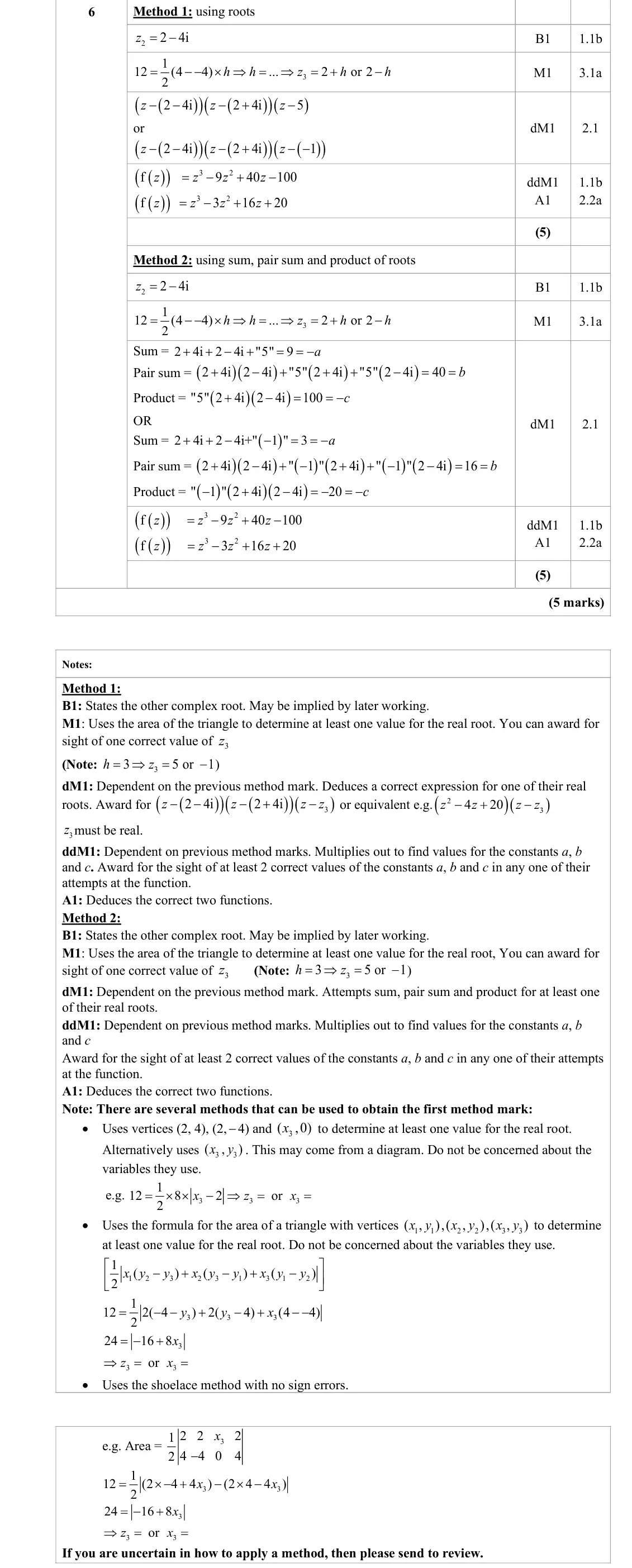
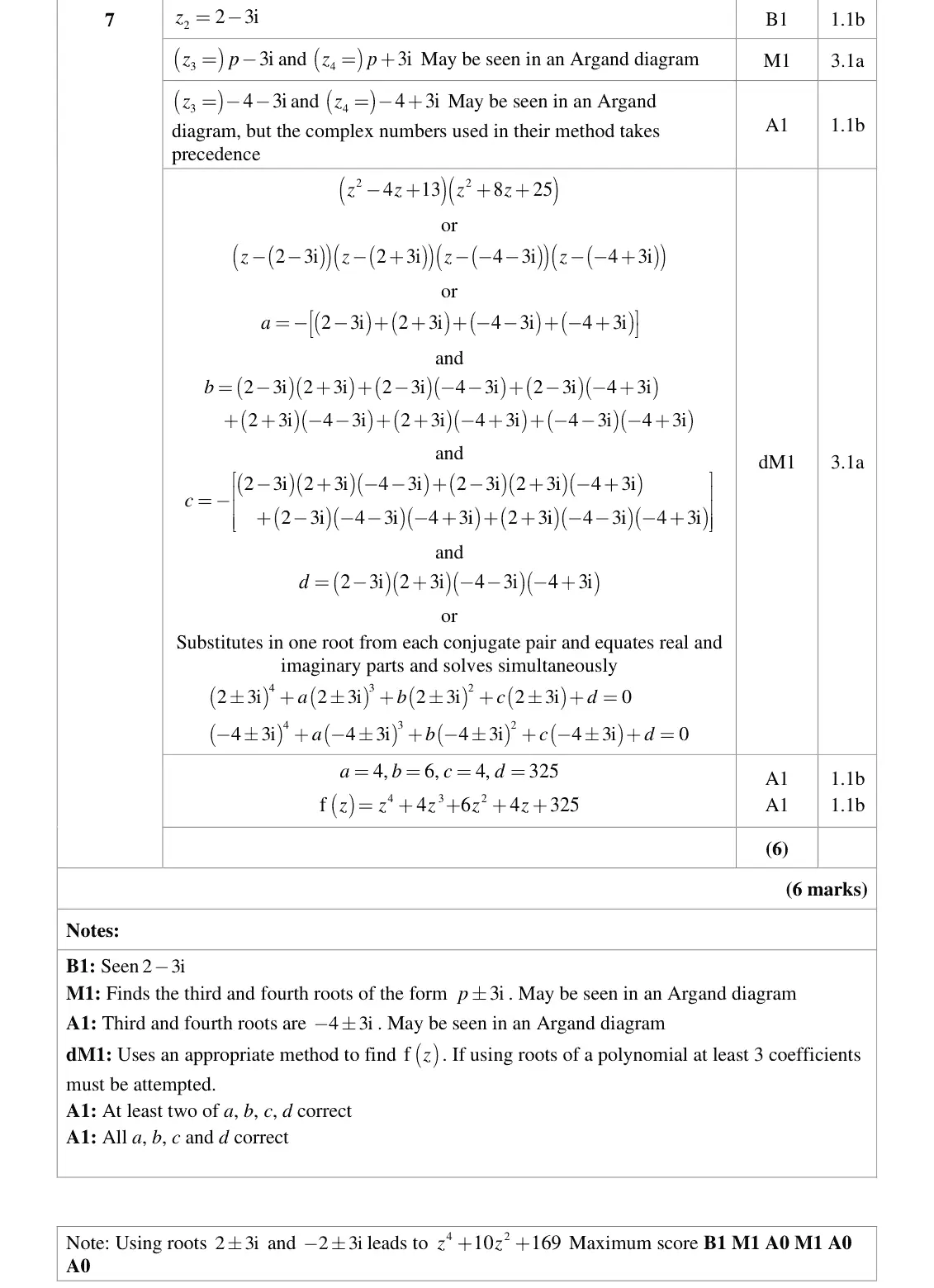
z₂ = 2 − 4i
triangle base 8, area 12 gives height 3, so the real root is 5 or −1
assuming an equilateral triangle, or using height 4 or root ±3
June 2025 · Paper 2 (Core Pure 2) · Q6(a)3 marks
Mark scheme (whole question; this part is marked with the orange bar)
Examiner's comment
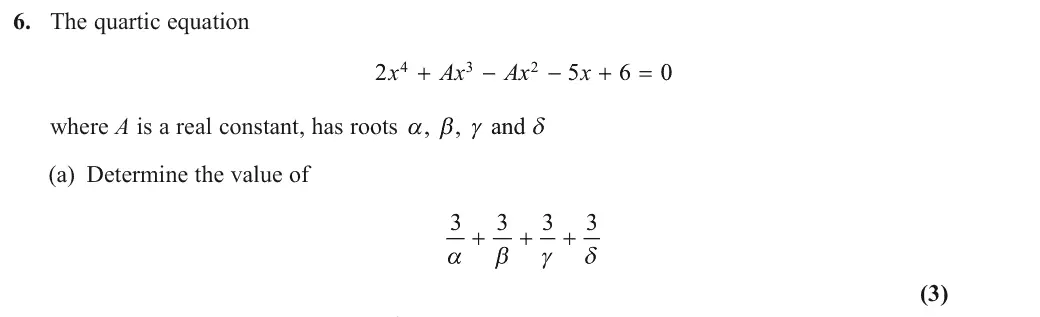
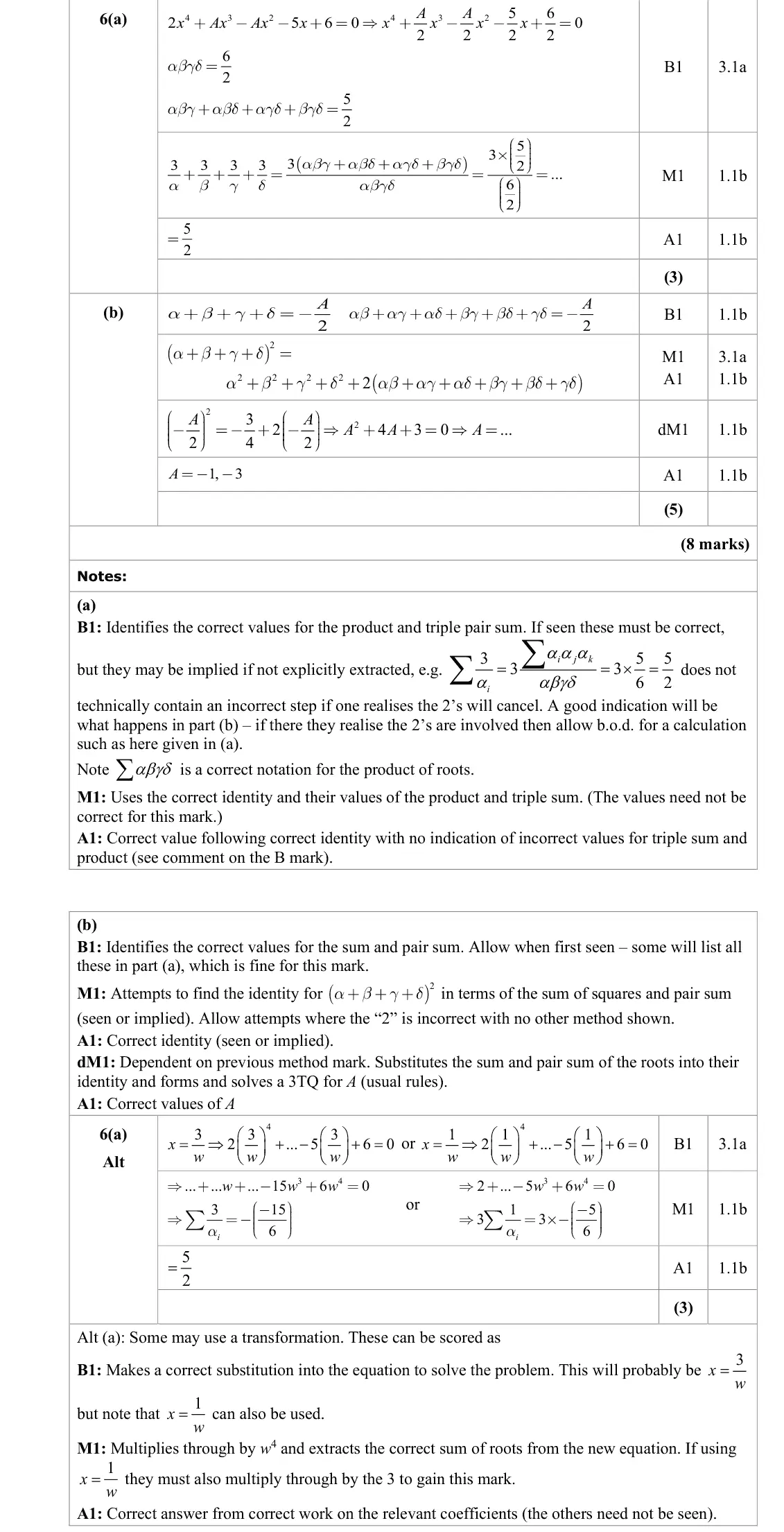
Learners demonstrated a solid understanding of roots of polynomials with the majority scoring highly on both part (a) and part (b), and this was one of the better answered questions of the paper overall. The clearest solutions were those where learners stated the product, triple pair sum and also the sum and pair sum at the outset, rather than embedding these in their workings. Part (a) was very well answered. Generally, learners substituted into the correct identity and most achieved full marks here. There were occasional errors for example omitting the 3 from the numerator or a sign error and the product of roots given as 6 2 alpha beta γδ = - , meaning at most one mark could be scored. A few could not combine algebraic fractions correctly e.g. 3 3 3 3 12 alpha beta γ δ alpha beta γ δ + + + = + + + . There were very few who attempted to find the transformed quartic and then identify the sum of roots.
Key points from the mark scheme and examiner's report
divide by 2: αβγδ = 3, Σαβγ = 5/2
Σ3/α = 3Σαβγ/αβγδ = 5/2
omitting the 3 or sign errors with the product
June 2025 · Paper 2 (Core Pure 2) · Q6(b)5 marks
Mark scheme (whole question; this part is marked with the orange bar)
Examiner's comment
Learners demonstrated a solid understanding of roots of polynomials with the majority scoring highly on both part (a) and part (b), and this was one of the better answered questions of the paper overall. The clearest solutions were those where learners stated the product, triple pair sum and also the sum and pair sum at the outset, rather than embedding these in their workings. In part (b) candidates were usually able to state the relationship between the square of the sum, the sum of squares and the pair sum and were confident in reaching the required result. Those who did not (or wanted to show the derivation for the benefit of the marker) had little trouble in finding the square of the sum of four roots. Those who quoted from memory however sometimes misquoted the identity, e.g giving it as ( ) ( ) 2 2 2 2 2 4 alpha beta γ δ alpha beta γ δ alpha beta alpha γ alpha δ beta δ γδ + + + = + + + + + + + + . Learners who did not state the values for the sum and pair sum often made sign errors when substituting into the identity (ie 2 2 A instead of 2 2 A - ) and it was often not clear that these were using the correct expressions for the sum and pair sum, thus forfeiting a mark. Most candidates were able to reach a 3 term quadratic and solve using a valid method, including by calculator. A lot of mistakes came from simple calculation errors such as 2 2 2 2 A A - = or 2 2 2 A A - - x = , and double sign errors were sometimes made meaning the “correct” final answer was not a guarantee of fully correct work, and markers had to check diligently.
Key points from the mark scheme and examiner's report
Mark scheme (whole question; this part is marked with the orange bar)
Examiner's comment
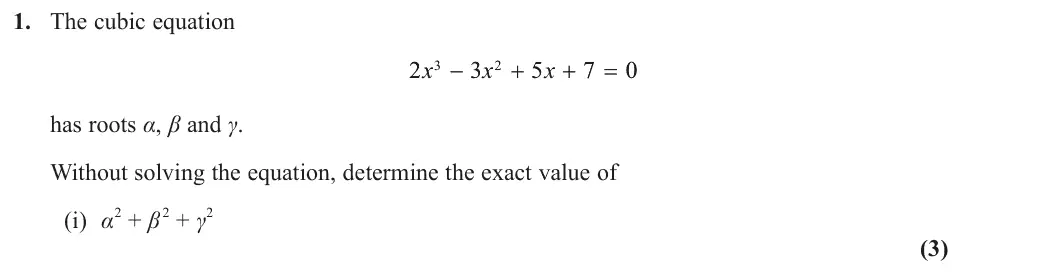
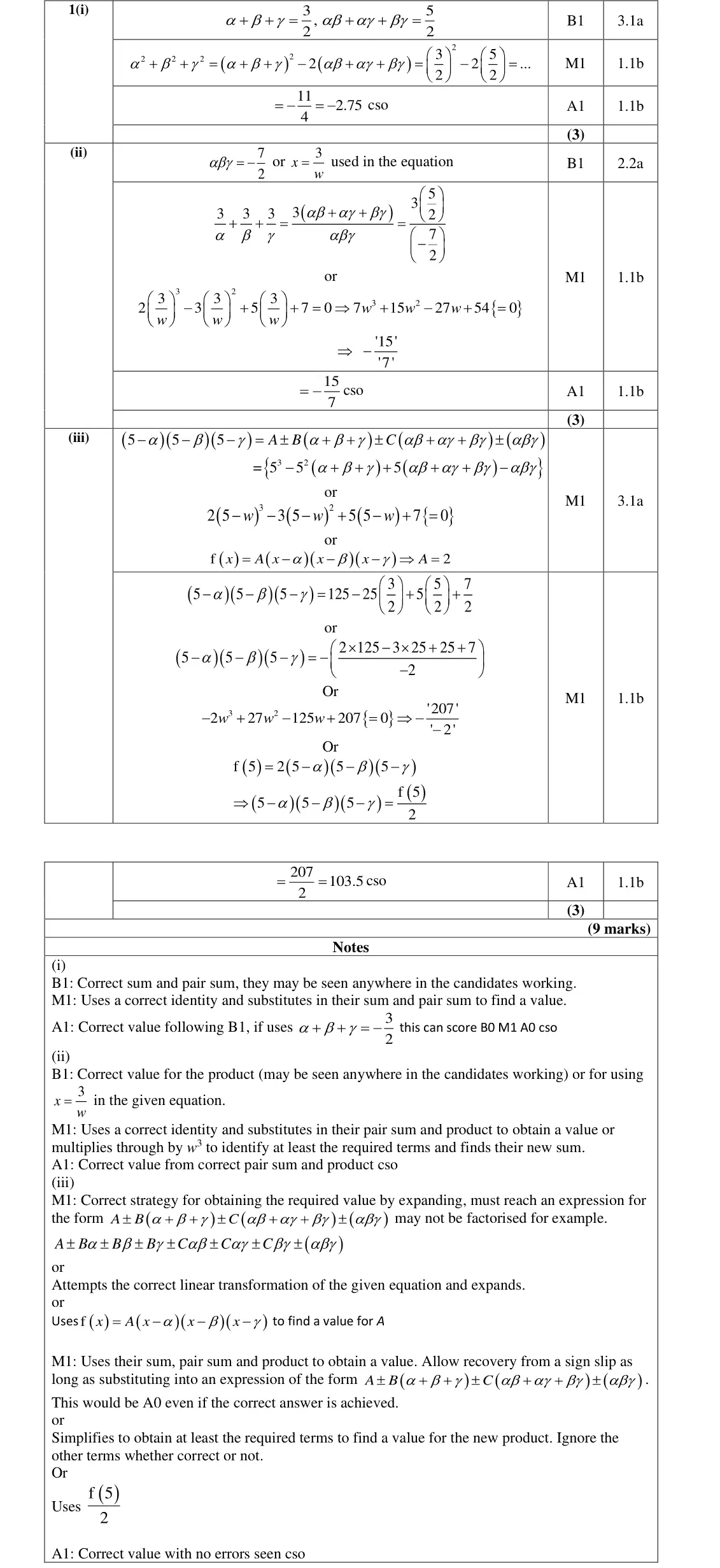
This question was generally well-answered and showed an improvement in previous years regarding candidates’ understanding of the methods. In part a) a significant majority of candidates reached the correct value following a correct identity and evaluation of the sum and pair sum. The most common error seen was for candidates to simply square their sum (rather than forming an identity as required), which lost them all marks (unless they used the correct pair sum in a later part, which many did), or losing the 3 coefficient of 2 on their pair sum term. It was pleasing to note that very few candidates used - 2 for the value of the sum. Again, part b) was answered well with the modal outcome being 3/3; again, the majority of candidates formed a correct identity (either writing the numerator as 3 x pair sum or writing the overall as 3 x (pair sum/products) with relatively similar frequency) and substituting in the correct values. There were occasional slips where candidates formed an incorrect identity (generally losing the 3), though some candidates showed weaker fundamentals in the algebraic manipulation, some resulting in 3 x sum / product and others ‘adding’ the denominators and attempting to use the reciprocal of their sum of roots in some capacity – a surprising error at this level. Finally, part c) was the more challenging part but again candidates did well, with a majority scoring either 2 or 3 marks here. Expanding the given identity to form an identity using all three of their values was by far the most common approach, and the majority scored at least two marks in this way (commonly making sign slips only to lose the A mark e.g. 193/2 being a common answer). Some candidates sadly, whilst attempting this approach, lost the product term entirely and unfortunately scored no marks whilst demonstrating a correct approach but without the requisite algebraic skills required at this level. Attempts using linear transformations were infrequently seen (only a handful in part b), with a few more in c) – again, often candidates scored only the one mark in part c) via this method, often simply failing to find their transformed functions product having correctly expanded the necessary terms (-2 and 207). Overall, this was a very accessible start to the paper with the vast majority of candidates able to achieve some marks, and a majority scoring very well.
Key points from the mark scheme and examiner's report
Σα = 3/2, Σαβ = 5/2
Σα² = (Σα)² − 2Σαβ = −11/4
just squaring the sum loses all marks
June 2024 · AS Paper 1 (Core Pure) · Q1(ii)3 marks
Mark scheme (whole question; this part is marked with the orange bar)
Examiner's comment
This question was generally well-answered and showed an improvement in previous years regarding candidates’ understanding of the methods. In part a) a significant majority of candidates reached the correct value following a correct identity and evaluation of the sum and pair sum. The most common error seen was for candidates to simply square their sum (rather than forming an identity as required), which lost them all marks (unless they used the correct pair sum in a later part, which many did), or losing the 3 coefficient of 2 on their pair sum term. It was pleasing to note that very few candidates used - 2 for the value of the sum. Again, part b) was answered well with the modal outcome being 3/3; again, the majority of candidates formed a correct identity (either writing the numerator as 3 x pair sum or writing the overall as 3 x (pair sum/products) with relatively similar frequency) and substituting in the correct values. There were occasional slips where candidates formed an incorrect identity (generally losing the 3), though some candidates showed weaker fundamentals in the algebraic manipulation, some resulting in 3 x sum / product and others ‘adding’ the denominators and attempting to use the reciprocal of their sum of roots in some capacity – a surprising error at this level. Finally, part c) was the more challenging part but again candidates did well, with a majority scoring either 2 or 3 marks here. Expanding the given identity to form an identity using all three of their values was by far the most common approach, and the majority scored at least two marks in this way (commonly making sign slips only to lose the A mark e.g. 193/2 being a common answer). Some candidates sadly, whilst attempting this approach, lost the product term entirely and unfortunately scored no marks whilst demonstrating a correct approach but without the requisite algebraic skills required at this level. Attempts using linear transformations were infrequently seen (only a handful in part b), with a few more in c) – again, often candidates scored only the one mark in part c) via this method, often simply failing to find their transformed functions product having correctly expanded the necessary terms (-2 and 207). Overall, this was a very accessible start to the paper with the vast majority of candidates able to achieve some marks, and a majority scoring very well.
Key points from the mark scheme and examiner's report
αβγ = −7/2
3Σαβ/αβγ = −15/7 (or substitute x = 3/w)
sign of the product a common slip
June 2024 · AS Paper 1 (Core Pure) · Q1(iii)3 marks
Mark scheme (whole question; this part is marked with the orange bar)
Examiner's comment
This question was generally well-answered and showed an improvement in previous years regarding candidates’ understanding of the methods. In part a) a significant majority of candidates reached the correct value following a correct identity and evaluation of the sum and pair sum. The most common error seen was for candidates to simply square their sum (rather than forming an identity as required), which lost them all marks (unless they used the correct pair sum in a later part, which many did), or losing the 3 coefficient of 2 on their pair sum term. It was pleasing to note that very few candidates used - 2 for the value of the sum. Again, part b) was answered well with the modal outcome being 3/3; again, the majority of candidates formed a correct identity (either writing the numerator as 3 x pair sum or writing the overall as 3 x (pair sum/products) with relatively similar frequency) and substituting in the correct values. There were occasional slips where candidates formed an incorrect identity (generally losing the 3), though some candidates showed weaker fundamentals in the algebraic manipulation, some resulting in 3 x sum / product and others ‘adding’ the denominators and attempting to use the reciprocal of their sum of roots in some capacity – a surprising error at this level. Finally, part c) was the more challenging part but again candidates did well, with a majority scoring either 2 or 3 marks here. Expanding the given identity to form an identity using all three of their values was by far the most common approach, and the majority scored at least two marks in this way (commonly making sign slips only to lose the A mark e.g. 193/2 being a common answer). Some candidates sadly, whilst attempting this approach, lost the product term entirely and unfortunately scored no marks whilst demonstrating a correct approach but without the requisite algebraic skills required at this level. Attempts using linear transformations were infrequently seen (only a handful in part b), with a few more in c) – again, often candidates scored only the one mark in part c) via this method, often simply failing to find their transformed functions product having correctly expanded the necessary terms (-2 and 207). Overall, this was a very accessible start to the paper with the vast majority of candidates able to achieve some marks, and a majority scoring very well.
Key points from the mark scheme and examiner's report
125 − 25Σα + 5Σαβ − αβγ = 207/2
or f(5) = 2(5 − α)(5 − β)(5 − γ) so 207/2
June 2024 · Paper 1 (Core Pure 1) · Q1(a)7 marks
Mark scheme (whole question; this part is marked with the orange bar)
Examiner's comment
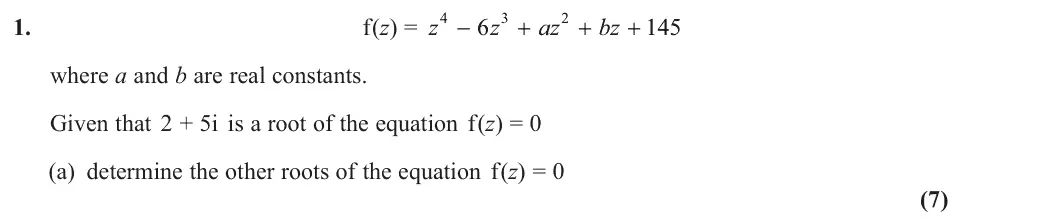
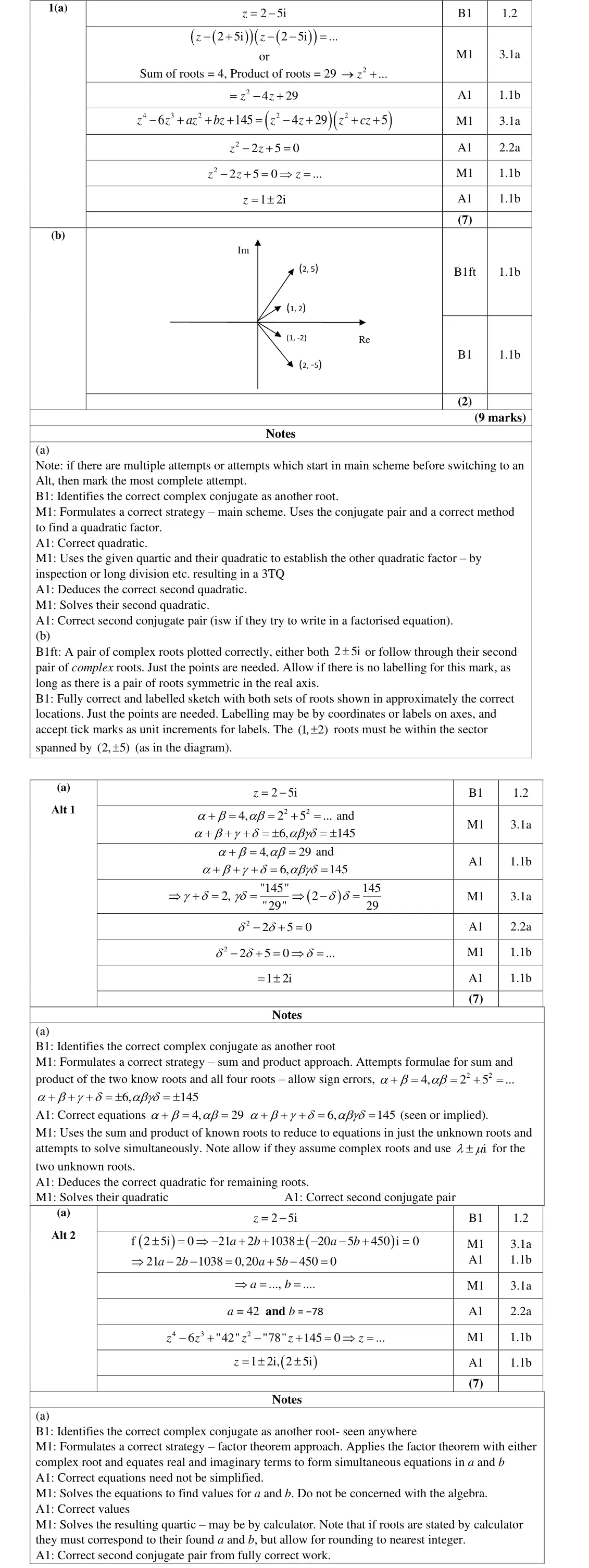
The majority of students found this an accessible start to the paper with many fully correct solutions, and the most common error being a failure to sketch the roots correctly on their diagram for part (b). In part (a) almost all of the candidates got the B mark for the complex conjugate as another root and the majority were able to find all four roots correctly. Only a very small number of candidates gave the wrong “conjugate” root, 2 5i -- , with omission of the question altogether being a more common reason for the loss of the B mark. The most direct and simplest method for finding the remaining roots was to find the quadratic factor 2 4 29 z z - + from the conjugate pair of roots and then factor out by inspection to obtain the second quadratic factor before solving. However, most using this method used polynomial division to obtain the other quadratic factor, which created a lot more work and potential for error, although it is mostly done well. Only a few answer this method in the most efficient way, but holistically this was marginally the most common method of those on the scheme. The other very common approach was using the formulae for the sum, sum of product pairs and product of roots (Alt 1). The inclusion of the manipulation of roots of polynomials on the specification seems to have made this a much more common approach. Again, this was done very well overall, usually resulting in the correct roots, though errors in manipulation were slightly more common in this approach (usually introducing a sign error in one term in the resulting quadratic). Explanations were often minimal in these approaches, sometime making it different to follow the work. Variations such as using i x y for the other two roots were also seen used, and generally successful. The factor theorem approach (Alt 2) was the least popular approach, seen on occasionally, and candidates adopting this method often stopped as they were unable to cope with the resulting algebra. They tended to be the most erratic and relied on calculator assistance to expand the complex equations and solve often incorrect quadratics that resulted. A difficulty that arose was that nearly correct quadratics could sometimes lead to the “correct” roots as candidates would round to nearest integers for the real and imaginary terms, but the accuracy marks were only permitted for fully correct work. It is also noteworthy that many candidates felt the need to find the values of a and b, which were not necessary to find in the main scheme or Alt 1 and not needed. This again created extra unnecessary work but was ignored if it was not part of the solution leading to the roots. An awareness of the demand of the question was lacking in many candidate who automatically assumed the needed to do this. Within all methods used there were the usual numerical errors, usually focussing on incorrect multiplication of complex numbers and not using i2 as -1.
Key points from the mark scheme and examiner's report
the other root is the conjugate 2 − 5i, not −2 − 5i
quadratic factor z² − 4z + 29 then divide or compare coefficients
sum/product and factor-theorem routes also accepted
June 2024 · Paper 1 (Core Pure 1) · Q2(a)1 mark
Mark scheme (whole question; this part is marked with the orange bar)
Examiner's comment
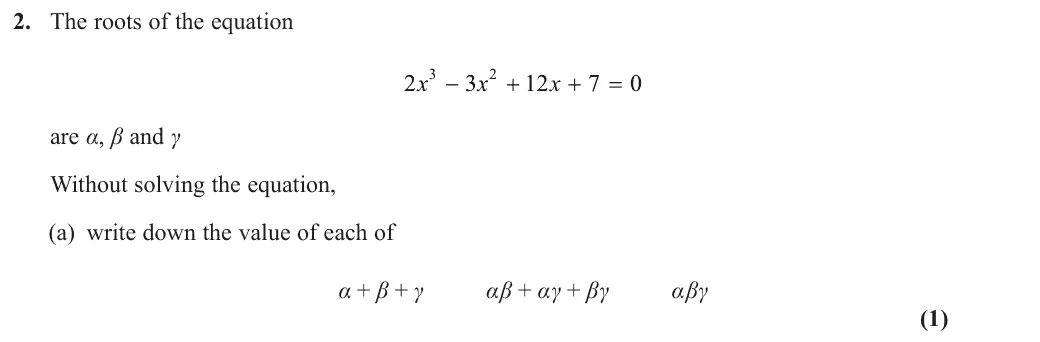
Candidates were clearly well prepared for this type of question with most achieving full marks. Many of the candidates had already exemplified competence with the sum and product of roots methods in question 1 and were able to fully correctly complete this question too. In part (a), the only notable errors were errors in signs of the required sum, sum of product pairs and product of roots or the neglect to divide through by the 2 resulting in double the correct values, both of which happened only occasionally. The vast majority of candidates identified the correct values.
Key points from the mark scheme and examiner's report
signs of Σα, Σαβ, αβγ
divide by the leading coefficient 2
June 2024 · Paper 1 (Core Pure 1) · Q2(b)7 marks
Mark scheme (whole question; this part is marked with the orange bar)
Examiner's comment
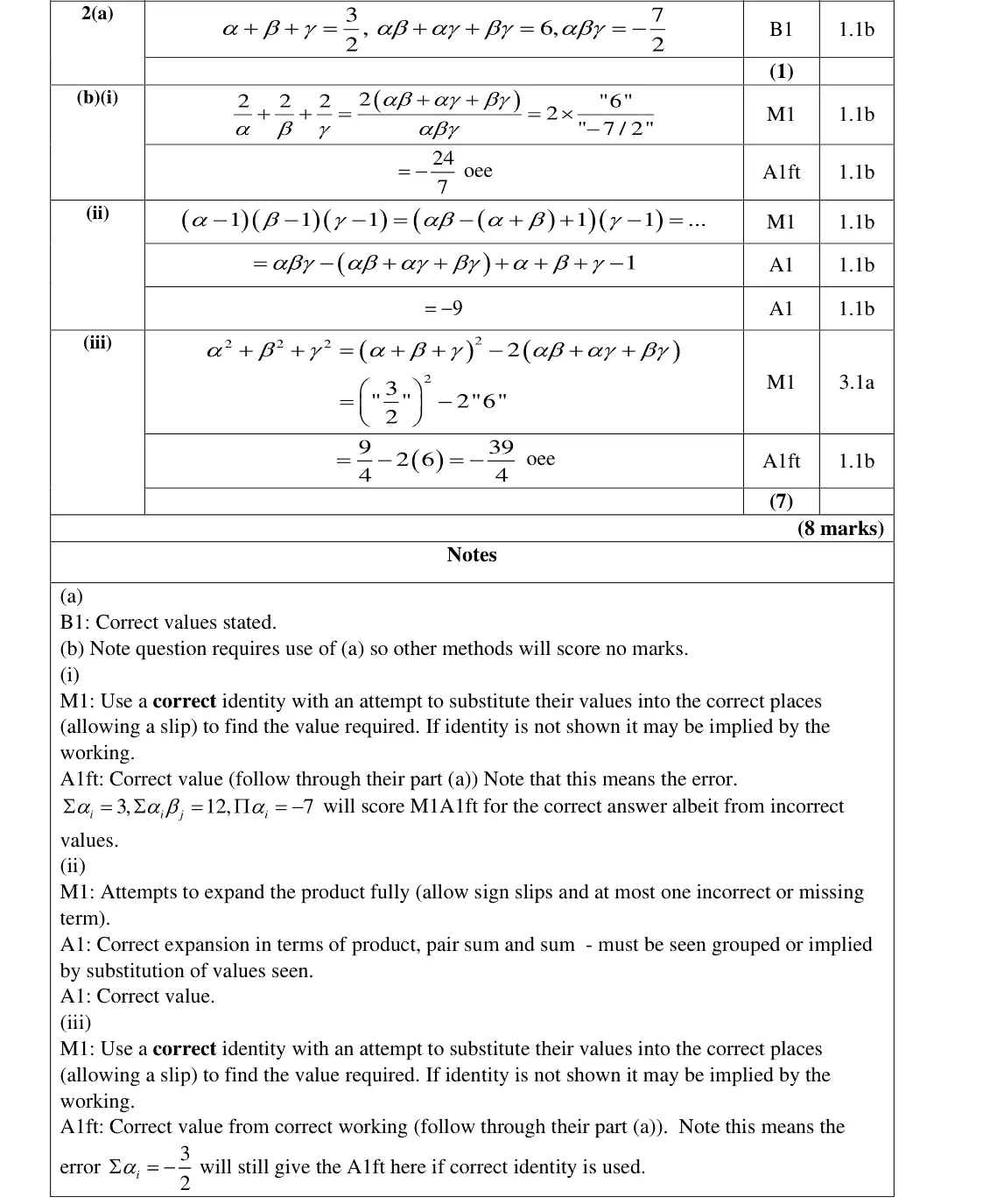
Candidates were clearly well prepared for this type of question with most achieving full marks. Many of the candidates had already exemplified competence with the sum and product of roots methods in question 1 and were able to fully correctly complete this question too. In part (b), the methods were well known, though a few candidates neglected the instruction to use the answers to part (a) and attempt transformation approaches (forfeiting the marks). In part (b)(i) candidates usually derived the correct identity and made the appropriate substitution. Many used ∑ notation in their numerator, showing good use of notation to shorten the expression. A few lost both marks by inserting the 3 2 in their denominator rather than the correct 7 2 - , or less commonly the 3 2 was inserted as the value for ∑ alpha beta . Many were able to gain the accuracy for follow through even in the rare cases that wrong values were found in part (a), while only a small number made slips simplifying from a correct initial substitution. For part (b)(ii), in most cases there was an attempt to expand the product. Where this did not happen it was usually due to an attempt at applying a transformation w = x ± 1 to find the new product of roots, but this was not permitted marks. The expansions, when attempted, were generally done well but a common error in a number of instances was that the final term “-1” was omitted or had the incorrect sing in the end result. Either way, the final two marks were lost. Occasionally a slip in signs or incorrect introductory values resulted in the final mark being lost. Finally, in part (b)(iii) most candidates again achieved the correct identity and the correct answer. However, it was in this part that the most inaccuracies in the identity occurred. Incorrect identities included the sum of squares of roots being 2 ( ) 2 - , ( ) 2 3 - or ( ) 2 3 - . The most common error, though. was using 7 2 - instead of 3 2 for ∑ alpha . Overall the formation of the identities was therefore very good, with part (b)(ii) causing most difficulties and errors tended to be slips in substitution of simplification.
Key points from the mark scheme and examiner's report
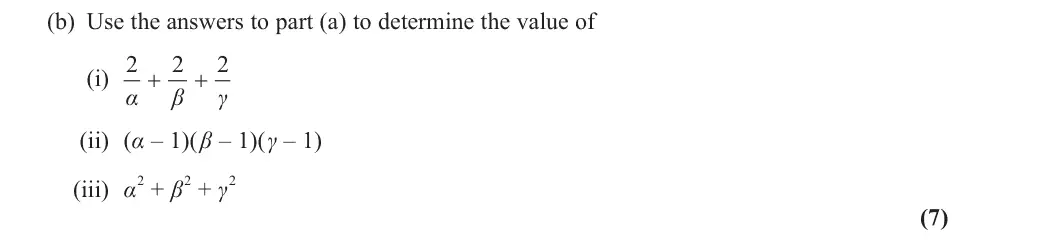
must use the answers to (a): transformation methods score nothing
(ii) expand (α − 1)(β − 1)(γ − 1) fully
(iii) α² + β² + γ² = (Σα)² − 2Σαβ
June 2023 · AS Paper 1 (Core Pure) · Q2(a)4 marks
Mark scheme (whole question; this part is marked with the orange bar)
Examiner's comment
In part (a), much success was achieved in finding the values of a and b with the two main methods, namely forming a quadratic function using the two complex roots or the use of the sum and pair sum, being used equally by the cohort. Occasionally, Alternative 2 was seen but the inability to give the associated simultaneous equations in a and b resulted in a loss of marks. The error, in Alternative 1, in making the product of roots = +175 was seen quite often and thus produced incorrect values for a and b.
Key points from the mark scheme and examiner's report
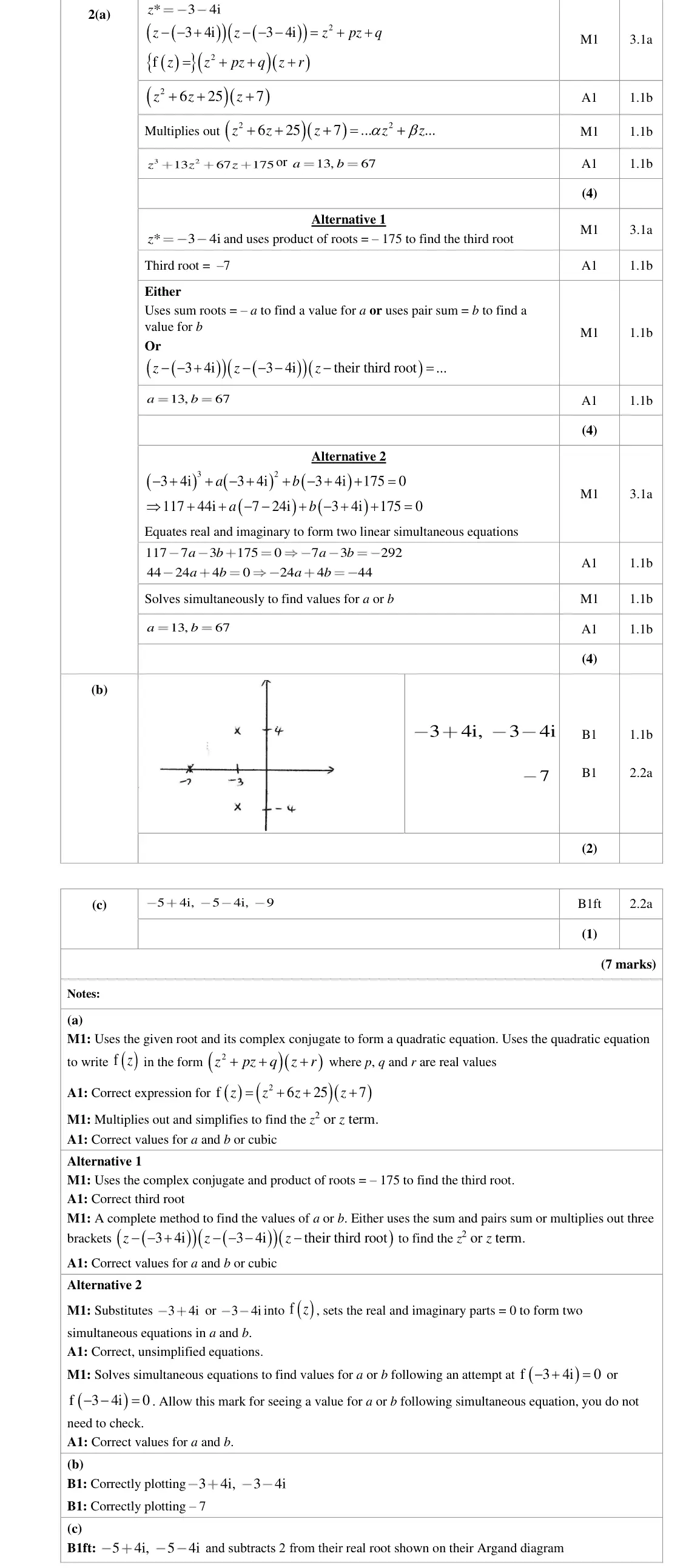
conjugate −3 − 4i
quadratic factor z² + 6z + 25, third root −7 (product of roots −175, not +175)
a = 13, b = 67
June 2023 · AS Paper 1 (Core Pure) · Q10(i)5 marks
Mark scheme (whole question; this part is marked with the orange bar)
Examiner's comment
In part (i), the vast majority of the candidates correctly expressed z as a function of w and then 4 w + 1 substituted it into the given quartic equation. In general the expansions of and 3 3 w+ 1 were handled well and the most common error was not multiplying the – 30 term by 3 81 when rearranging the equation into the requested form. In part (ii), many of the candidates were able to form the two required equations in and using the sum and product of the roots of the given equation and then went on to solve for and 81 81 + - . The equating of the product of roots to instead of was a fairly common error but 4 4 was condoned for the method mark. The way in which the given roots were labelled did cause confusion with some of the cohort with the root 2 being incorrectly taken as , presumably from the fact that students often think of the three roots as being labelled , and .
Key points from the mark scheme and examiner's report
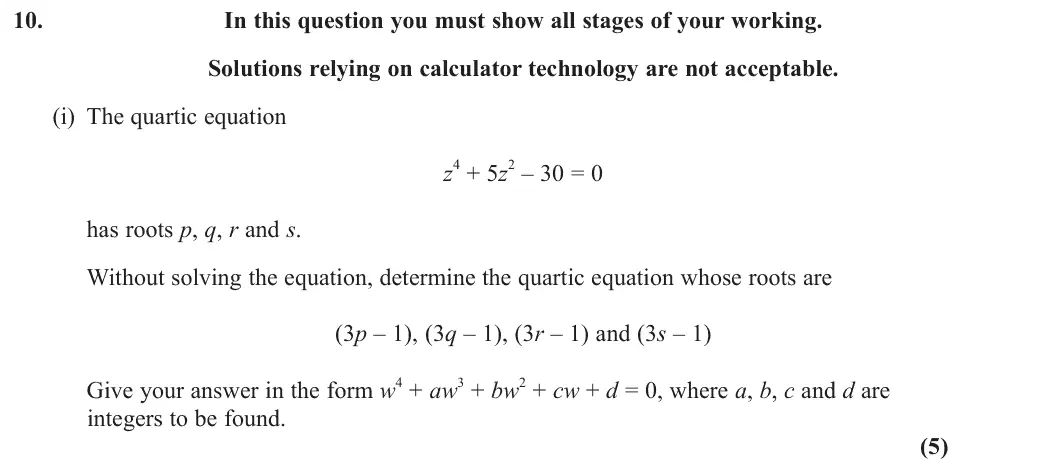
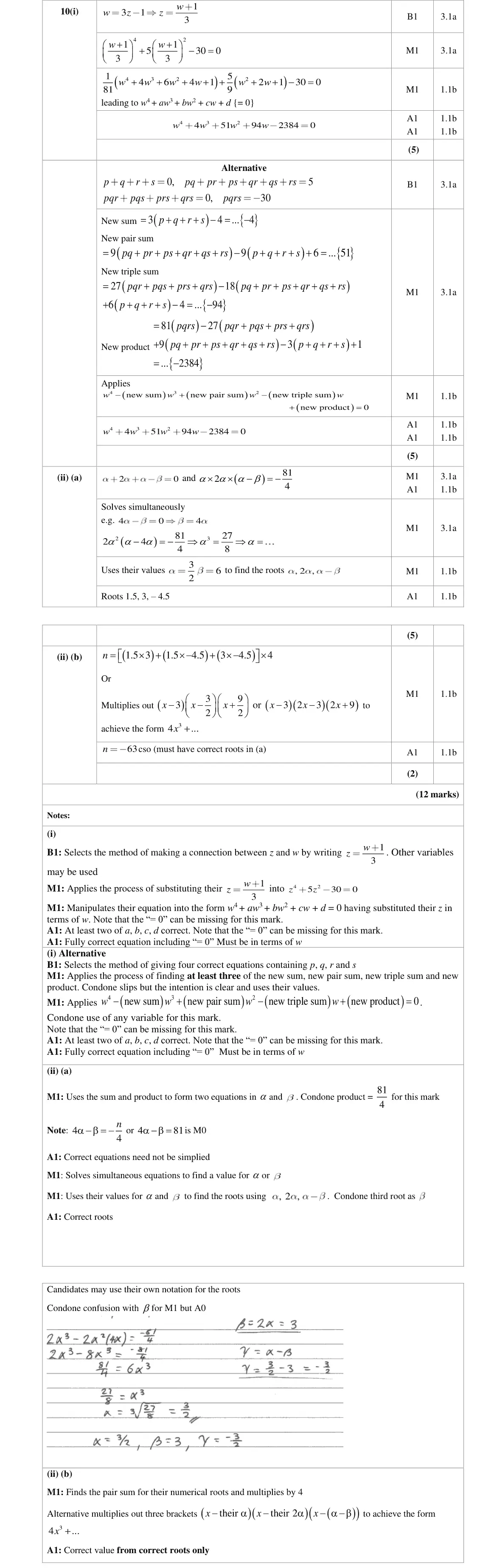
z = (w + 1)/3 substituted
multiply through by 81 including the −30
w⁴ + 4w³ + 51w² + 94w − 2384 = 0
June 2023 · AS Paper 1 (Core Pure) · Q10(ii)(a)5 marks
Mark scheme (whole question; this part is marked with the orange bar)
Examiner's comment
In part (i), the vast majority of the candidates correctly expressed z as a function of w and then 4 w + 1 substituted it into the given quartic equation. In general the expansions of and 3 3 w+ 1 were handled well and the most common error was not multiplying the – 30 term by 3 81 when rearranging the equation into the requested form. In part (ii), many of the candidates were able to form the two required equations in and using the sum and product of the roots of the given equation and then went on to solve for and 81 81 + - . The equating of the product of roots to instead of was a fairly common error but 4 4 was condoned for the method mark. The way in which the given roots were labelled did cause confusion with some of the cohort with the root 2 being incorrectly taken as , presumably from the fact that students often think of the three roots as being labelled , and .
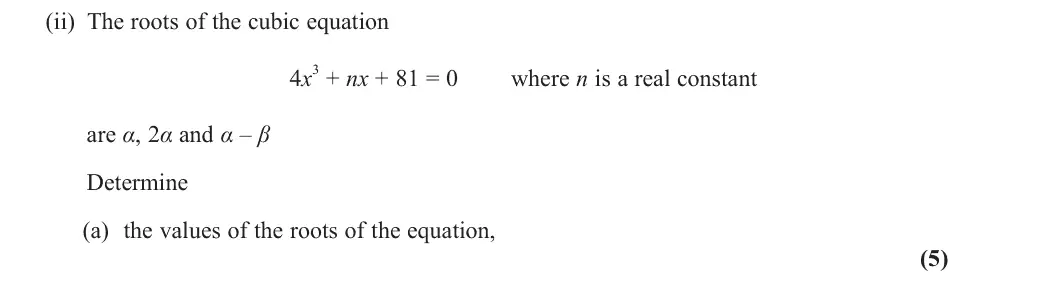
Key points from the mark scheme and examiner's report
sum of roots 4α − β = 0 (no x² term) and product 2α²(α − β) = −81/4
α = 3/2, β = 6
roots 1.5, 3, −4.5
June 2023 · AS Paper 1 (Core Pure) · Q10(ii)(b)2 marks
Mark scheme (whole question; this part is marked with the orange bar)
Examiner's comment
In part (i), the vast majority of the candidates correctly expressed z as a function of w and then 4 w + 1 substituted it into the given quartic equation. In general the expansions of and 3 3 w+ 1 were handled well and the most common error was not multiplying the – 30 term by 3 81 when rearranging the equation into the requested form. In part (ii), many of the candidates were able to form the two required equations in and using the sum and product of the roots of the given equation and then went on to solve for and 81 81 + - . The equating of the product of roots to instead of was a fairly common error but 4 4 was condoned for the method mark. The way in which the given roots were labelled did cause confusion with some of the cohort with the root 2 being incorrectly taken as , presumably from the fact that students often think of the three roots as being labelled , and .
Key points from the mark scheme and examiner's report
n = 4 × pair sum = 4(4.5 − 6.75 − 13.5) = −63
or expand (x − 3)(2x − 3)(2x + 9)
June 2023 · Paper 1 (Core Pure 1) · Q15 marks
Mark scheme (whole question; this part is marked with the orange bar)
Examiner's comment
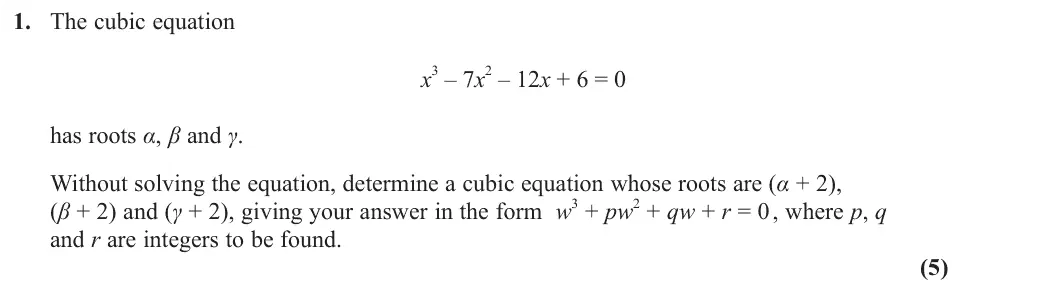
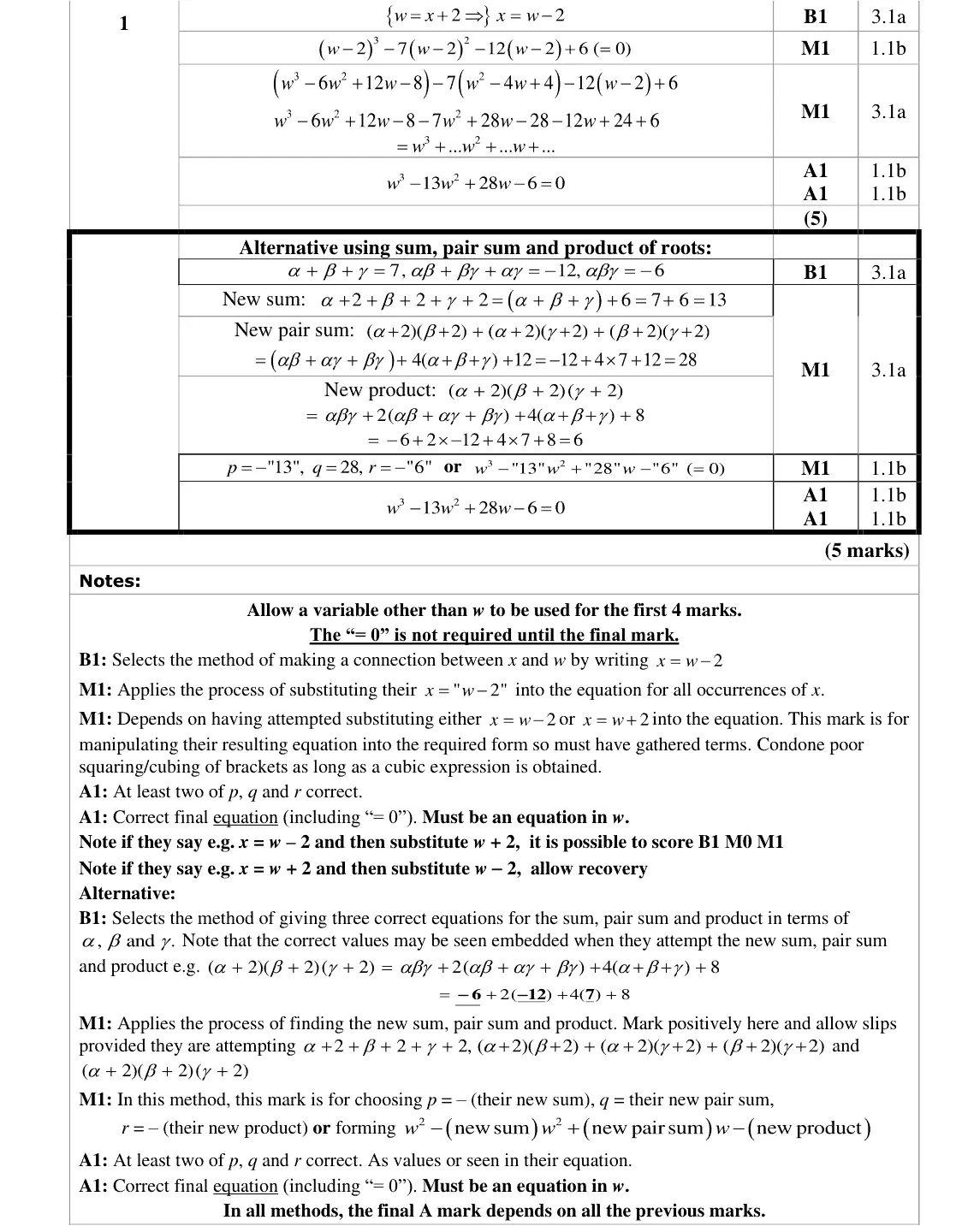
This question was very well answered with a majority of candidates achieving full marks, particularly by those candidates who chose to use a substitution method. Candidates who applied x = w - 2 and substituted would often score the majority of the marks available. Errors that were seen with this method included algebraic slips in expanding brackets and also a failure to write the final equation with the “= 0”. Some candidates mistakenly used x = w + 2 or even x = x + 2. Candidates who used the sum, pair, product method were less successful and it was not uncommon for them to get sufficiently lost in the algebra to get no further marks but there were still many fully correct answers. Some candidates failed to find three correct equations for the B1 mark and this led to mistakes in their final answer. Those candidates who used this method could often then get the first method mark for finding the new sum, pair sum and product. There was mixed success in identifying the positive and negative nature of their p, q and r. Other final errors were in failing to write an equation including “= 0” as with the main scheme. Another successful but less common method was also seen which involved candidates using the substitution 𝑤= 𝑥+ 2 into the target cubic and comparing coefficients to derive the values of 𝑝, 𝑞 and 𝑟. A few candidates attempted a very long-winded approach, where they attempted to expand the new equation in the form {(x – ( alpha + 2)}{x – ( beta + 2)}{x - (γ + 2)} then used the sum, pair sum and product of roots in their new equation. These attempts rarely scored more than the first two marks.
Key points from the mark scheme and examiner's report
substitute x = w − 2 (not w + 2): w³ − 13w² + 28w − 6 = 0
the final answer must be an equation (= 0)
the sum, pair-sum and product route was less successful
June 2023 · Paper 2 (Core Pure 2) · Q8(c)(ii)3 marks
Mark scheme (whole question; this part is marked with the orange bar)
Examiner's comment
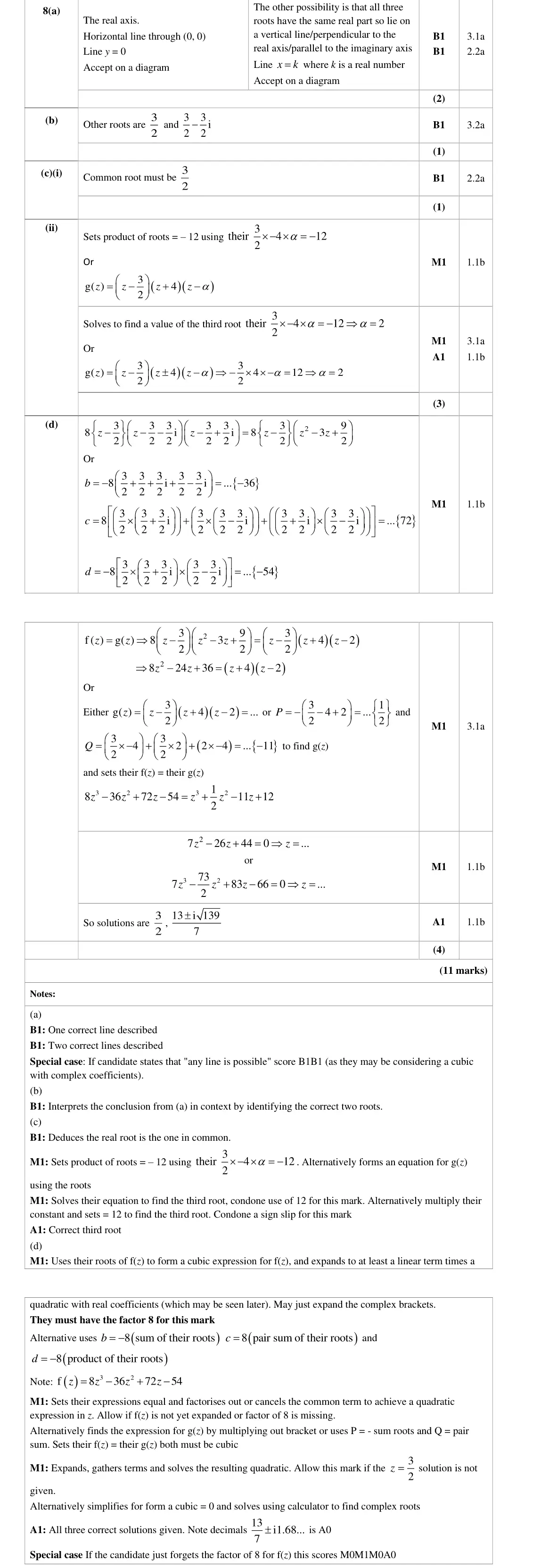
This was a really good question for testing understanding. If a candidate scored on part (a) they mostly went on to achieve (b), (c)(i) and (c)(ii). Of those who attempted part (d), about half didn’t account for the fact that the coefficient of z3 was 8 so scored a maximum of 1 out of 4; the most successful solutions were from those who used sum and product of root results to obtain both cubics and then solved the resulting equation. In (c)(ii), many candidates chose the appropriate method but a significant number set the product of roots = 12 instead of –12.
Key points from the mark scheme and examiner's report
Mark scheme (whole question; this part is marked with the orange bar)
Examiner's comment
This was a really good question for testing understanding. If a candidate scored on part (a) they mostly went on to achieve (b), (c)(i) and (c)(ii). Of those who attempted part (d), about half didn’t account for the fact that the coefficient of z3 was 8 so scored a maximum of 1 out of 4; the most successful solutions were from those who used sum and product of root results to obtain both cubics and then solved the resulting equation. Part (d) was very poorly answered with many candidates not understanding how to proceed with the question. Those that did were generally successful although there was a tendency to slip into decimals which lost them the final mark. Quite a few candidates forgot that f(z) needed a coefficient of 8 on the cube term, losing most of the marks. Omitting the factor of 8 often led candidates to a linear equation where equating ( ) f z and ( ) g z preventing method marks being achieved later in this part. A few candidates made errors in identifying the coefficients of g(𝑧) but most were successful in achieving a cubic form for 𝑔(𝑧). A notable number of candidates who were able to successfully arrive at the required roots provided their roots in a decimal form rather than the exact form which was required. Many candidates expanded, rather than removing the 3 2 z - and this often led to a decimal solution for the roots (losing a mark) because they only solved the solution in their calculator.
Key points from the mark scheme and examiner's report
cancel the common factor to get 7z² − 26z + 44 = 0: z = 3/2, (13 ± i√139)/7
forgetting the factor 8 scored at most 1
decimals lose the A mark
June 2022 · AS Paper 1 (Core Pure) · Q4(i)3 marks
Mark scheme (whole question; this part is marked with the orange bar)
Examiner's comment
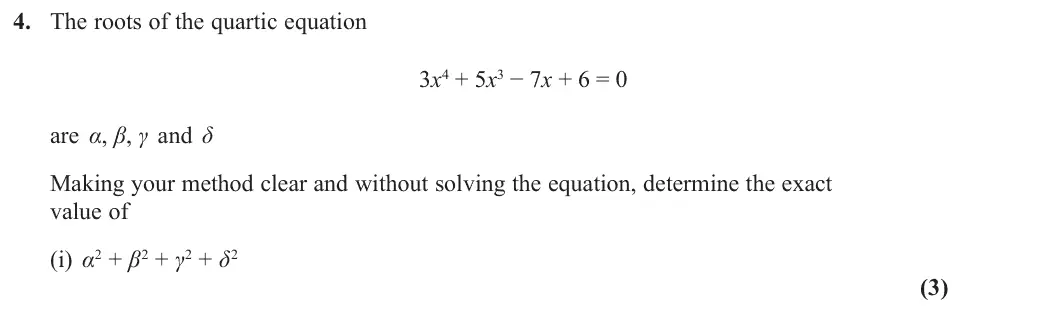
This was an accessible question which saw good variation in marks, from the weakest candidates (who occasionally secured no marks) right up to a pleasing number of candidates who secured full marks. The absence of the x^2 term (and hence the sum of pair products = 0) caught a large number of students off guard – many spotted this as seen by a huge number of scribbles (often leading to mistakes where they forgot to fully change their solutions), but many others didn’t. In (a), a majority of candidates reached the correct result for the M mark but without the B and A marks due to using an incorrect value for the pair sum (commonly – 7/3). Unfortunately a few did achieve 25/9 but did not explicitly show the full formula or that they were substituting 0 and thus could not gain the relevant marks as this could not be implied. A very small minority attempted to use a nonlinear transformation which fortuitously arrived at the correct answer due to the pair sum equalling zero, however as this was an incorrect method scored 0 marks. Part (a) was also the most frequently ‘skipped’ part of this question, somewhat surprisingly. Part (b) was generally well answered, very few chose to use the method of finding the transformed quartic. The majority of candidates reaching a correct result for the M mark (though a reasonable minority showed poor fraction manipulation, failing to change the numerators) and the most common error was with the sign on either numerator or, more commonly, denominator. However, overall this part was well answered. Part (c) was also attempted well, the MS being generous in allowing a majority of candidates to achieve 2/3 marks and a pleasing number achieving all 3. Candidates attempting the linear transformation rarely picked up more than the first M mark, mainly due to forgetting to evaluate their e/a for their expanded expression. Students attempting the other route of expansion were more commonly rewarded with 2/3 for an expansion allowing two values to be substituted in.
Key points from the mark scheme and examiner's report
Σα = −5/3, Σαβ = 0 (no x² term, often missed)
Σα² = (Σα)² − 2Σαβ = 25/9
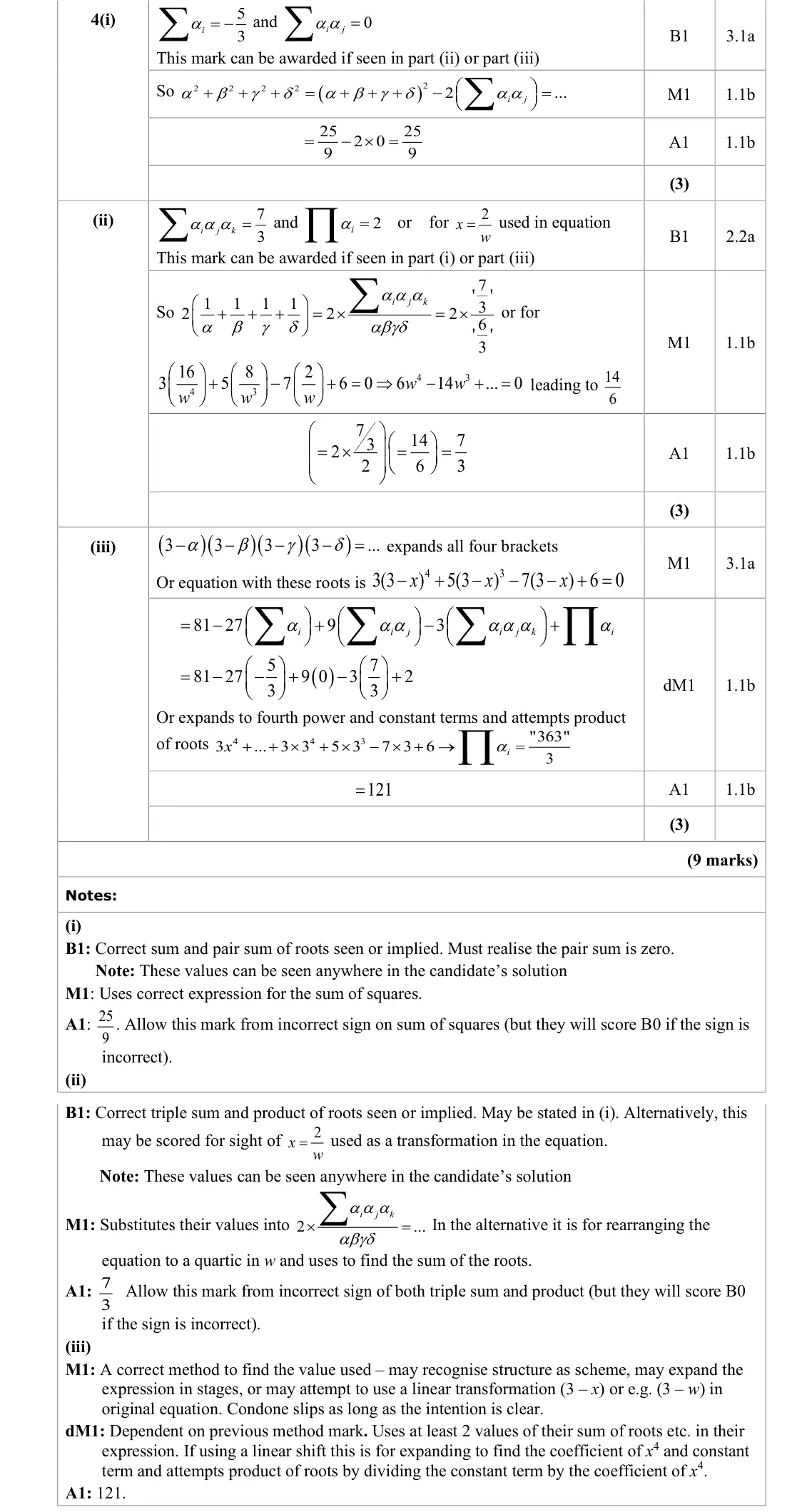
June 2022 · AS Paper 1 (Core Pure) · Q4(ii)3 marks
Mark scheme (whole question; this part is marked with the orange bar)
Examiner's comment
This was an accessible question which saw good variation in marks, from the weakest candidates (who occasionally secured no marks) right up to a pleasing number of candidates who secured full marks. The absence of the x^2 term (and hence the sum of pair products = 0) caught a large number of students off guard – many spotted this as seen by a huge number of scribbles (often leading to mistakes where they forgot to fully change their solutions), but many others didn’t. In (a), a majority of candidates reached the correct result for the M mark but without the B and A marks due to using an incorrect value for the pair sum (commonly – 7/3). Unfortunately a few did achieve 25/9 but did not explicitly show the full formula or that they were substituting 0 and thus could not gain the relevant marks as this could not be implied. A very small minority attempted to use a nonlinear transformation which fortuitously arrived at the correct answer due to the pair sum equalling zero, however as this was an incorrect method scored 0 marks. Part (a) was also the most frequently ‘skipped’ part of this question, somewhat surprisingly. Part (b) was generally well answered, very few chose to use the method of finding the transformed quartic. The majority of candidates reaching a correct result for the M mark (though a reasonable minority showed poor fraction manipulation, failing to change the numerators) and the most common error was with the sign on either numerator or, more commonly, denominator. However, overall this part was well answered. Part (c) was also attempted well, the MS being generous in allowing a majority of candidates to achieve 2/3 marks and a pleasing number achieving all 3. Candidates attempting the linear transformation rarely picked up more than the first M mark, mainly due to forgetting to evaluate their e/a for their expanded expression. Students attempting the other route of expansion were more commonly rewarded with 2/3 for an expansion allowing two values to be substituted in.
Key points from the mark scheme and examiner's report
Σαβγ = 7/3, αβγδ = 2
2Σ1/α = 2Σαβγ/αβγδ = 7/3
sign errors with −b/a, d/a
June 2022 · AS Paper 1 (Core Pure) · Q4(iii)3 marks
Mark scheme (whole question; this part is marked with the orange bar)
Examiner's comment
This was an accessible question which saw good variation in marks, from the weakest candidates (who occasionally secured no marks) right up to a pleasing number of candidates who secured full marks. The absence of the x^2 term (and hence the sum of pair products = 0) caught a large number of students off guard – many spotted this as seen by a huge number of scribbles (often leading to mistakes where they forgot to fully change their solutions), but many others didn’t. In (a), a majority of candidates reached the correct result for the M mark but without the B and A marks due to using an incorrect value for the pair sum (commonly – 7/3). Unfortunately a few did achieve 25/9 but did not explicitly show the full formula or that they were substituting 0 and thus could not gain the relevant marks as this could not be implied. A very small minority attempted to use a nonlinear transformation which fortuitously arrived at the correct answer due to the pair sum equalling zero, however as this was an incorrect method scored 0 marks. Part (a) was also the most frequently ‘skipped’ part of this question, somewhat surprisingly. Part (b) was generally well answered, very few chose to use the method of finding the transformed quartic. The majority of candidates reaching a correct result for the M mark (though a reasonable minority showed poor fraction manipulation, failing to change the numerators) and the most common error was with the sign on either numerator or, more commonly, denominator. However, overall this part was well answered. Part (c) was also attempted well, the MS being generous in allowing a majority of candidates to achieve 2/3 marks and a pleasing number achieving all 3. Candidates attempting the linear transformation rarely picked up more than the first M mark, mainly due to forgetting to evaluate their e/a for their expanded expression. Students attempting the other route of expansion were more commonly rewarded with 2/3 for an expansion allowing two values to be substituted in.
Key points from the mark scheme and examiner's report
expand: 81 − 27Σα + 9Σαβ − 3Σαβγ + αβγδ = 121
or substitute 3 − x and use the product of roots
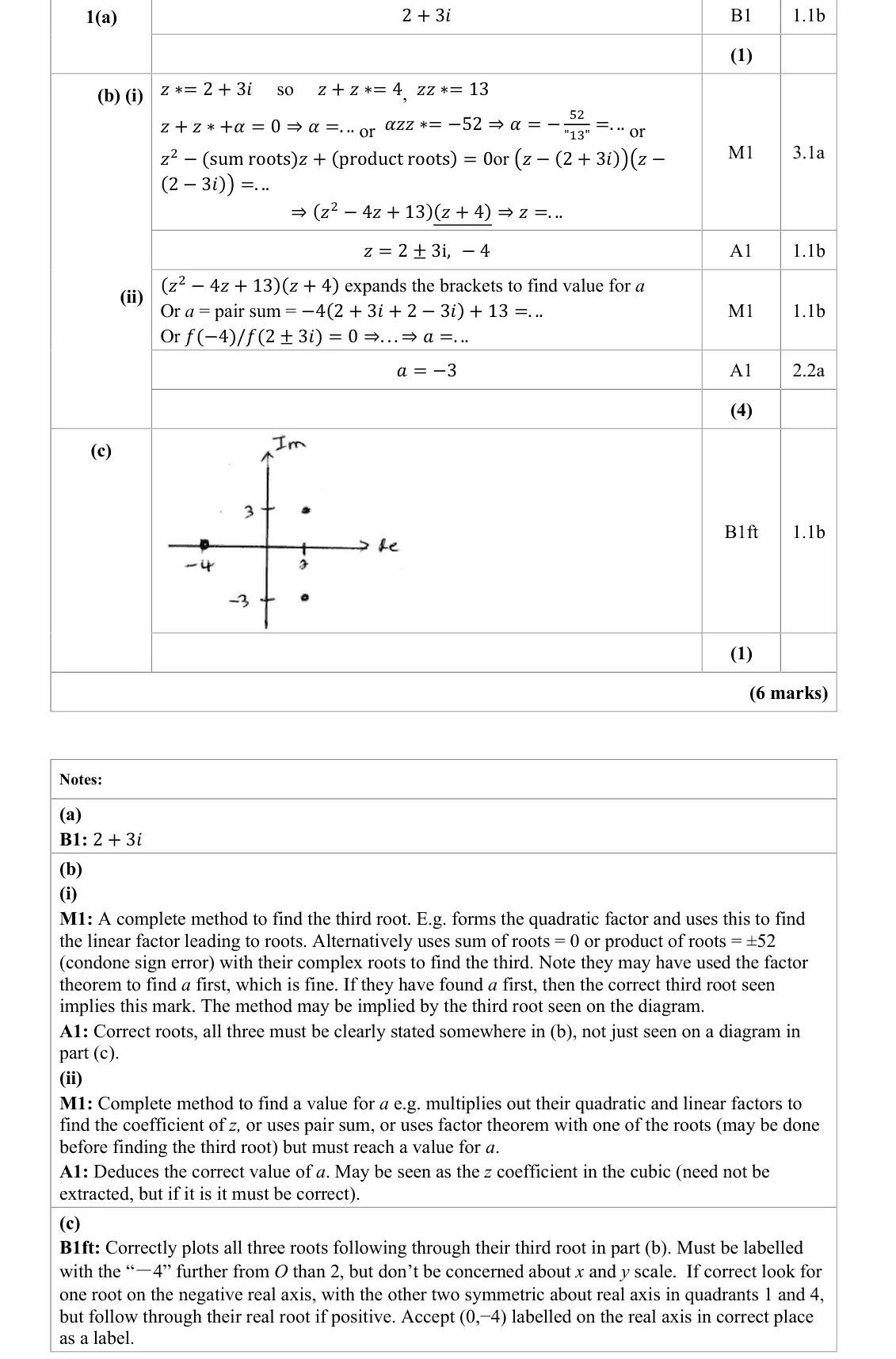
June 2022 · Paper 1 (Core Pure 1) · Q1(b)4 marks
Mark scheme (whole question; this part is marked with the orange bar)
Examiner's comment
Part (b) was well done by a majority of candidates. Most were able to find the third root by 52 - considering the product of the roots , or by first finding the quadratic factor and then 13 using this to find the linear factor. Some successfully attempted the inefficient method of long division to find the linear factor, while a few used the sum of roots, which was an efficient way. Sign errors caused some problems where candidates used the product of the roots or the pair sum. It is noteworthy that a significant proportion of candidates omitted to list the three roots in part (b)(i), losing the A mark, even though they were asked to solve completely. Most candidates went on to use either their expanded equation or the pair sum of roots to obtain a value for a (with errors depending on the value of their third root - common mistake was finding a = 29 (=16 + 13) from an error in the signs.). Some attempted to use the sum of the roots in order to find a value for a, gaining no marks. The Argand diagram for part (c) was usually correct, following through their third root, and plotting their value of a (so (-3, 0) instead of (-4, 0)) rather than the root found in (b). The scale was often not good, but was not stringently assessed although labelling was expected. Some sketches had no, or poor, labels, or had -4 much closer to O than 2 was to O or equidistant. A greater care of scale and labelling is needed.
Key points from the mark scheme and examiner's report
quadratic factor z² − 4z + 13, or product of roots = −52 or sum = 0, gives z = −4
list all three roots (often omitted)
a = −3 from expanding (z² − 4z + 13)(z + 4) or the pair sum
sign errors with the product of roots
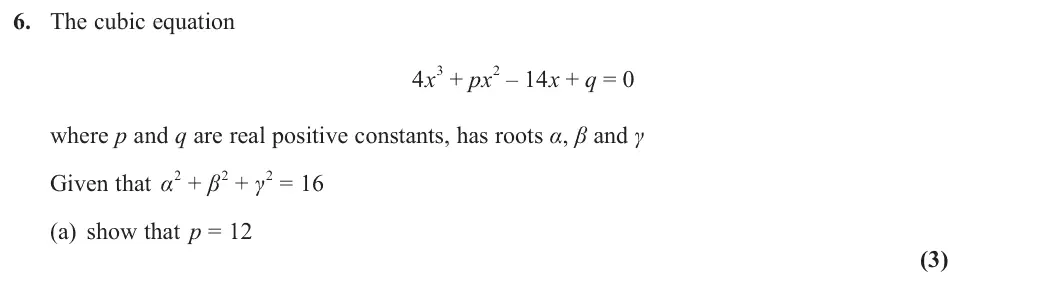
June 2022 · Paper 2 (Core Pure 2) · Q6(a)3 marks
Mark scheme (whole question; this part is marked with the orange bar)
Examiner's comment
There were a lot of fully correct responses here throughout all three question parts. It was rare to see incorrect formulae for the sum, pair sum and product in terms of the coefficients of the cubic and slips with the required identities were also not common. A few algebraic
Key points from the mark scheme and examiner's report
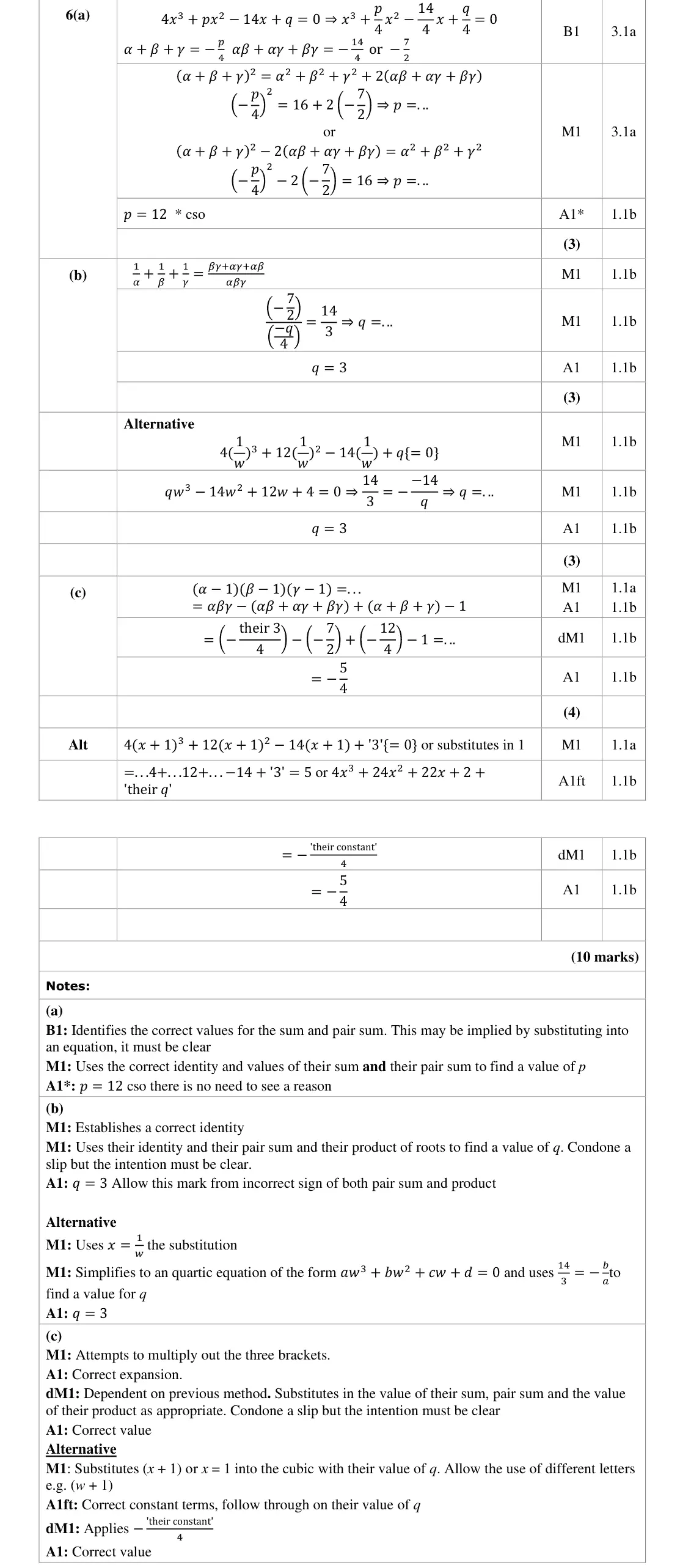
divide by 4: Σα = −p/4, Σαβ = −7/2
use (Σα)² = Σα² + 2Σαβ to get p = 12
June 2022 · Paper 2 (Core Pure 2) · Q6(b)3 marks
Mark scheme (whole question; this part is marked with the orange bar)
Examiner's comment
errors were evident, particularly with obtaining the value of q in part (b).
Key points from the mark scheme and examiner's report
Σ1/α = Σαβ/αβγ with αβγ = −q/4 gives q = 3
sign slips with the product
x = 1/w substitution also accepted
June 2022 · Paper 2 (Core Pure 2) · Q6(c)4 marks
Mark scheme (whole question; this part is marked with the orange bar)
Examiner's comment
Part (c) was slightly less well done although the standard method of multiplying out the brackets was usually correct. However, the “– 1” was occasionally lost. This was also true in the alternative where some students stopped when they had obtained the constant instead
Key points from the mark scheme and examiner's report
expand: αβγ − Σαβ + Σα − 1 = −5/4
the −1 was often lost
substituting x + 1 and taking −constant/4 also accepted
Nov 2021 · Paper 1 (Core Pure 1) · Q36 marksMedium
Mark scheme (whole question; this part is marked with the orange bar)
Examiner's comment
This question caused many problems and less than 10% of candidates gained full marks. The most popular method was the alternative on the mark scheme, which was harder work and more prone to error. Over a half did achieve the first three marks but then often went wrong or gave up with less than a third scoring the final two Ms. Some got very confused and substituted their expressions in the wrong places. Those who used the main method on the scheme usually only gained the first three marks. Most of them did not realise they had to divide through by an appropriate factor before equating coefficients, losing the last three marks. A common error was to let x = 4w – 1, and these usually scored a total of 2 marks.
Key points from the mark scheme and examiner's report
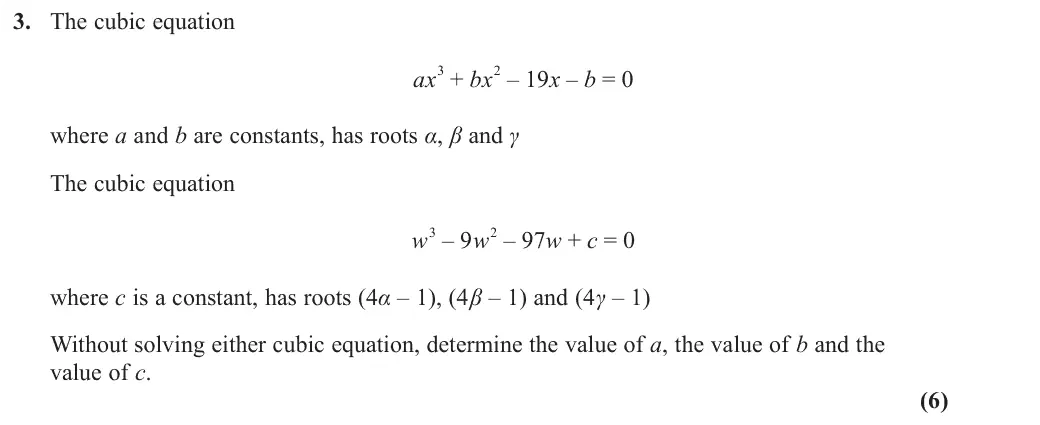
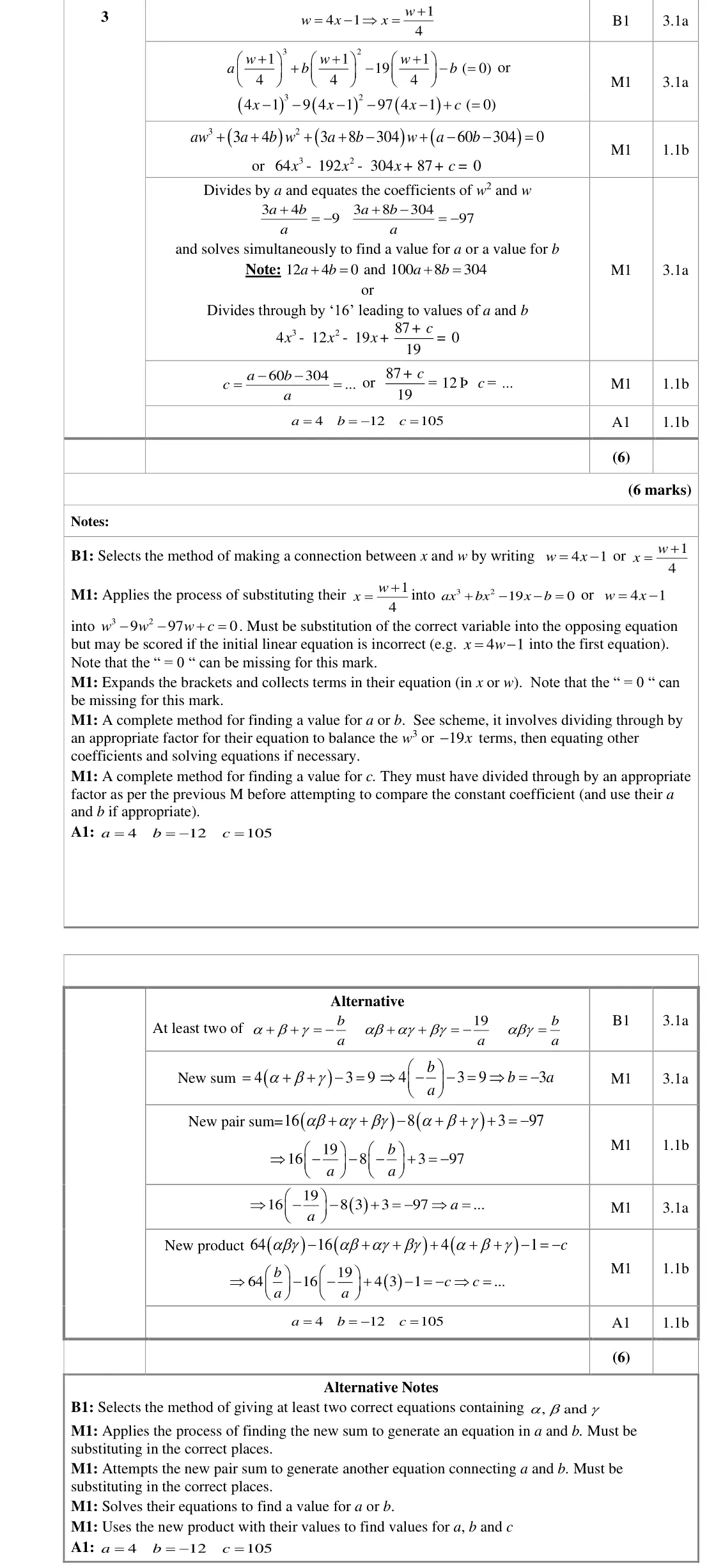
substitute x = (w + 1)/4 into the first cubic (not x = 4w − 1), then divide by a before equating coefficients
or use Σα etc. with new sum, pair sum, product
a = 4, b = −12, c = 105
Oct 2020 · AS Paper 1 (Core Pure) · Q76 marks
Mark scheme (whole question; this part is marked with the orange bar)
Examiner's comment
A small number of blank responses but most managed to attempt this question. About half correctly identified the 3rd and 4th root whilst the other half incorrectly used 2 3i , this meant 110100 was a common mark trait along with full marks Finding quadratic equations for each pair of roots and the then multiplying to find the quartic equation was the most successful approach. Candidates who attempted to use the roots of a polynomial often made sign slips.
Key points from the mark scheme and examiner's report
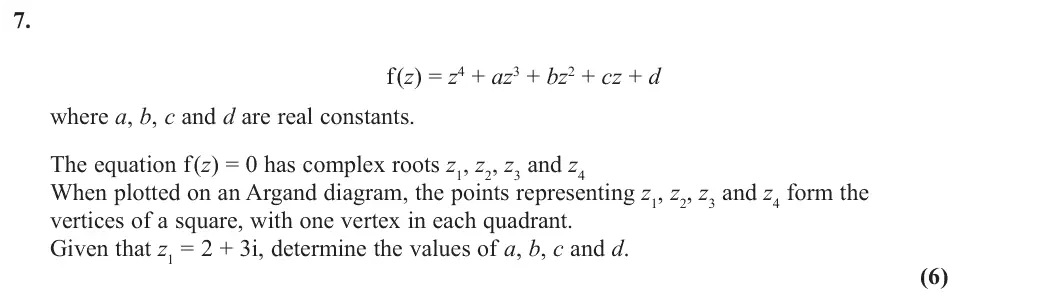
conjugate 2 − 3i
square centred on the origin gives −4 ± 3i (using −2 ± 3i was a common error)
(z² − 4z + 13)(z² + 8z + 25): a = 4, b = 6, c = 4, d = 325
Oct 2020 · AS Paper 1 (Core Pure) · Q9(a)3 marks
Mark scheme (whole question; this part is marked with the orange bar)
Examiner's comment
On the whole this question was very successful for those that attempted it. Part (a) was answered very well with the main error coming from their product being ⅓ only a couple used c and – d in place of c a and d a
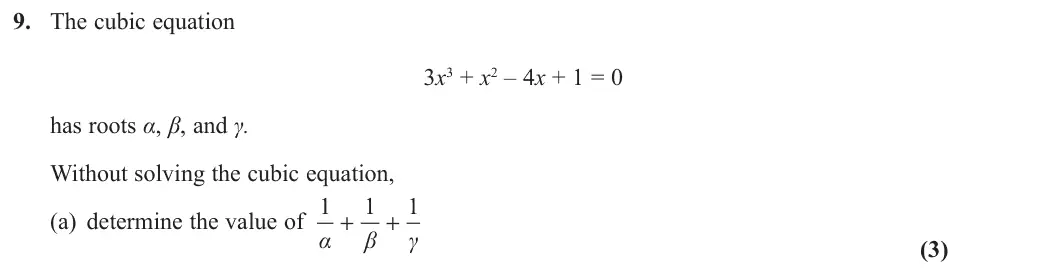
Key points from the mark scheme and examiner's report
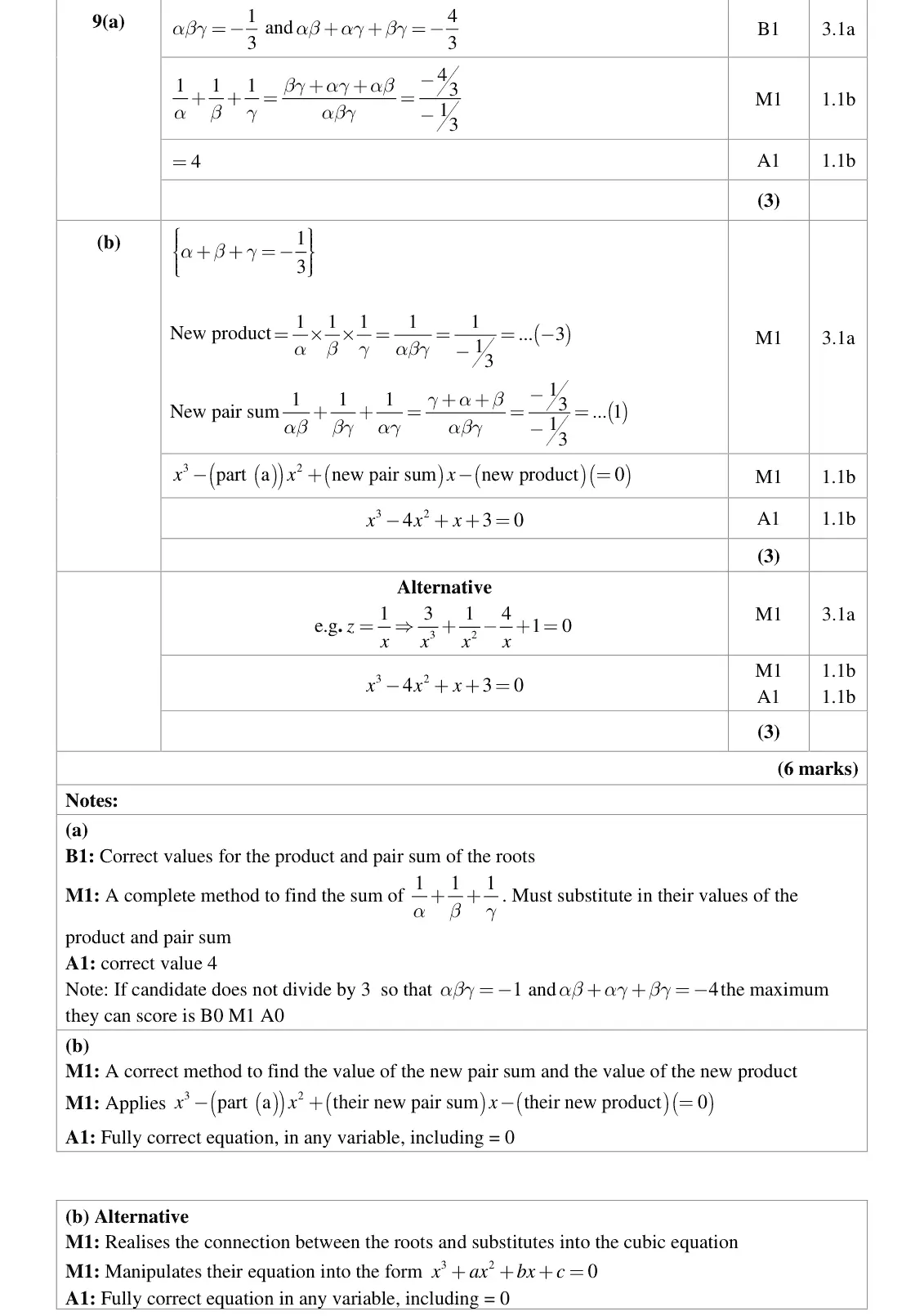
αβγ = −1/3, Σαβ = −4/3 (divide by 3)
Σ1/α = Σαβ/αβγ = 4
Oct 2020 · AS Paper 1 (Core Pure) · Q9(b)3 marks
Mark scheme (whole question; this part is marked with the orange bar)
Examiner's comment
On the whole this question was very successful for those that attempted it. Part (b) the alternate method was the most popular and the most effective. Those that didn't achieve full marks were either due to not manipulating their equation into a cubic or omitting = 0 The main scheme did have some success but most made errors in their new pair some or used b a and d a in place of b a and d a
Key points from the mark scheme and examiner's report
substitute x = 1/w (most effective) or new sums: x³ − 4x² + x + 3 = 0
include "= 0"
Oct 2020 · Paper 1 (Core Pure 1) · Q1(a)7 marks
Mark scheme (whole question; this part is marked with the orange bar)
Examiner's comment
even if they had made an error in (a). Scales were not expected on the Argand diagram although the relative positions of the roots needed to be realistic for the second B mark.
Key points from the mark scheme and examiner's report
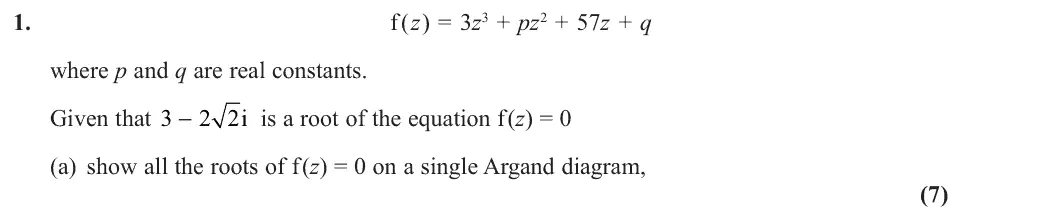
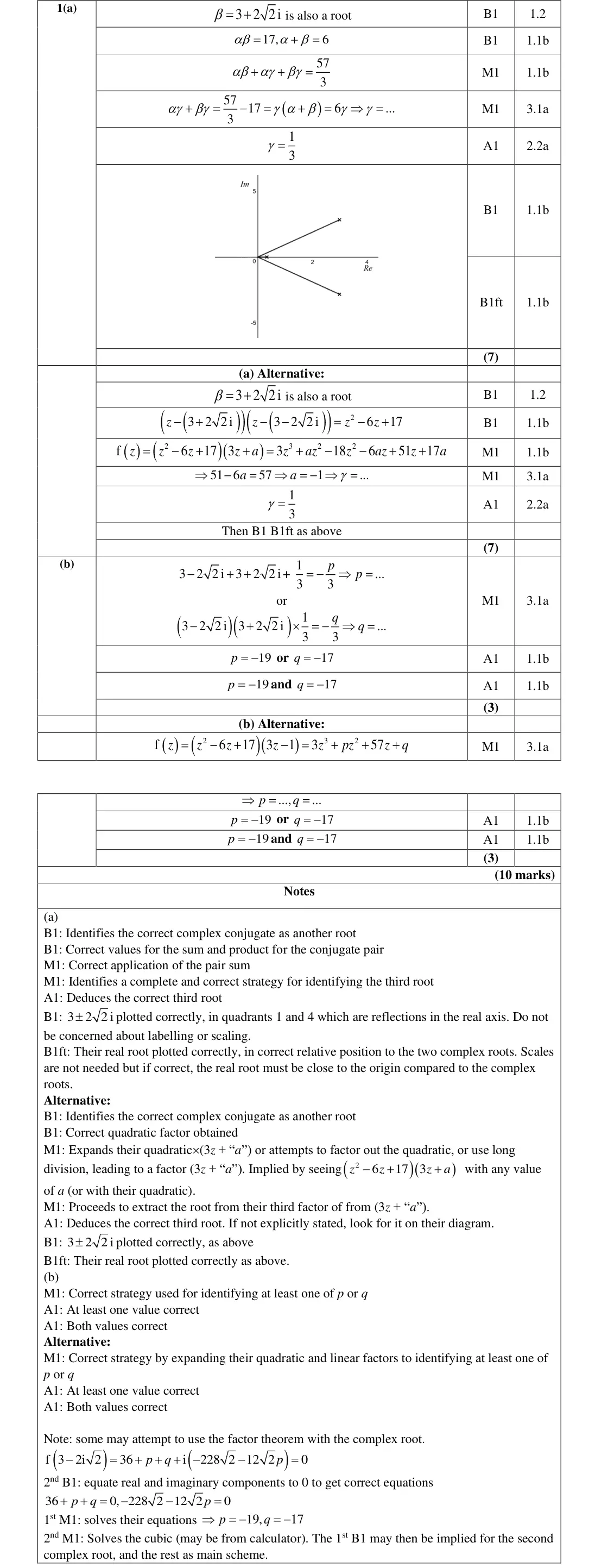
conjugate 3 + 2√2i is a root
pair sum 6 and product 17 (quadratic z² − 6z + 17)
third root from Σαβ = 57/3 or by factorising (3z − 1): γ = 1/3
plot the conjugate pair symmetric in the real axis and 1/3 near the origin
Oct 2020 · Paper 1 (Core Pure 1) · Q1(b)3 marks
Mark scheme (whole question; this part is marked with the orange bar)
Examiner's comment
This question was generally well done with over half of the candidates gaining full marks and a mean score of 8 out of 10. Indeed, all gained the first B mark for the correct complex conjugate as another root, so got a start in the question. The most common approach was the alternative method given in the mark scheme. Most managed to find the quadratic factor by considering the sum and product of the roots of the conjugate pair. Some sign or conceptual errors leading to errors in the z2 – 6z +17 were seen. Having found the quadratic factor most tried to expand and consider coefficients of z. Some attempted a long division method but these often could not complete to find the third root. Those who chose to apply the pair sum to find the third root were usually successful, and these usually found correct values for p and q by considering the sum and then the product of all three roots. The Argand diagrams were well drawn, with almost all candidates gaining the B mark for the conjugate pair. The follow through mark meant that most could gain the second B mark
Key points from the mark scheme and examiner's report
sum of roots = −p/3 and product = −q/3, or expand (z² − 6z + 17)(3z − 1): p = −19, q = −17
June 2019 · AS Paper 1 (Core Pure) · Q25 marks
Mark scheme (whole question; this part is marked with the orange bar)
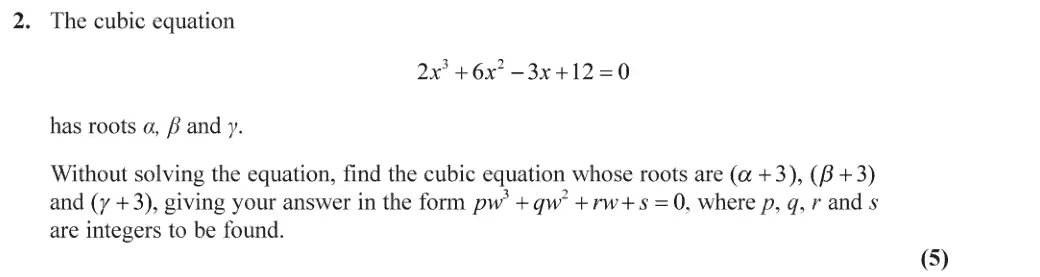
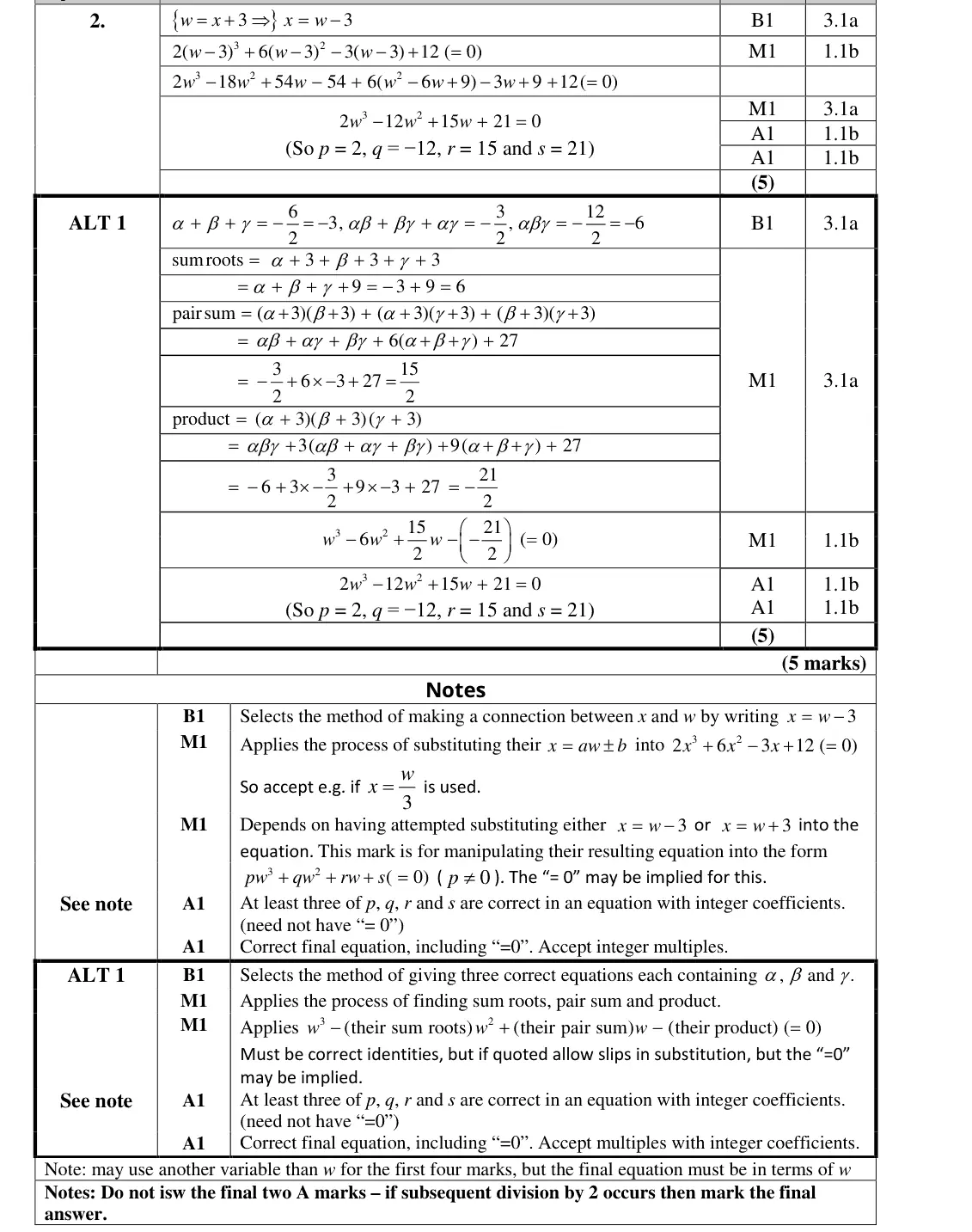
Key points from the mark scheme and examiner's report
substitute x = w − 3 (or new sum, pair sum, product)
2w³ − 12w² + 15w + 21 = 0
integer coefficients
do not divide by 2 afterwards
June 2019 · AS Paper 1 (Core Pure) · Q7(a)6 marks
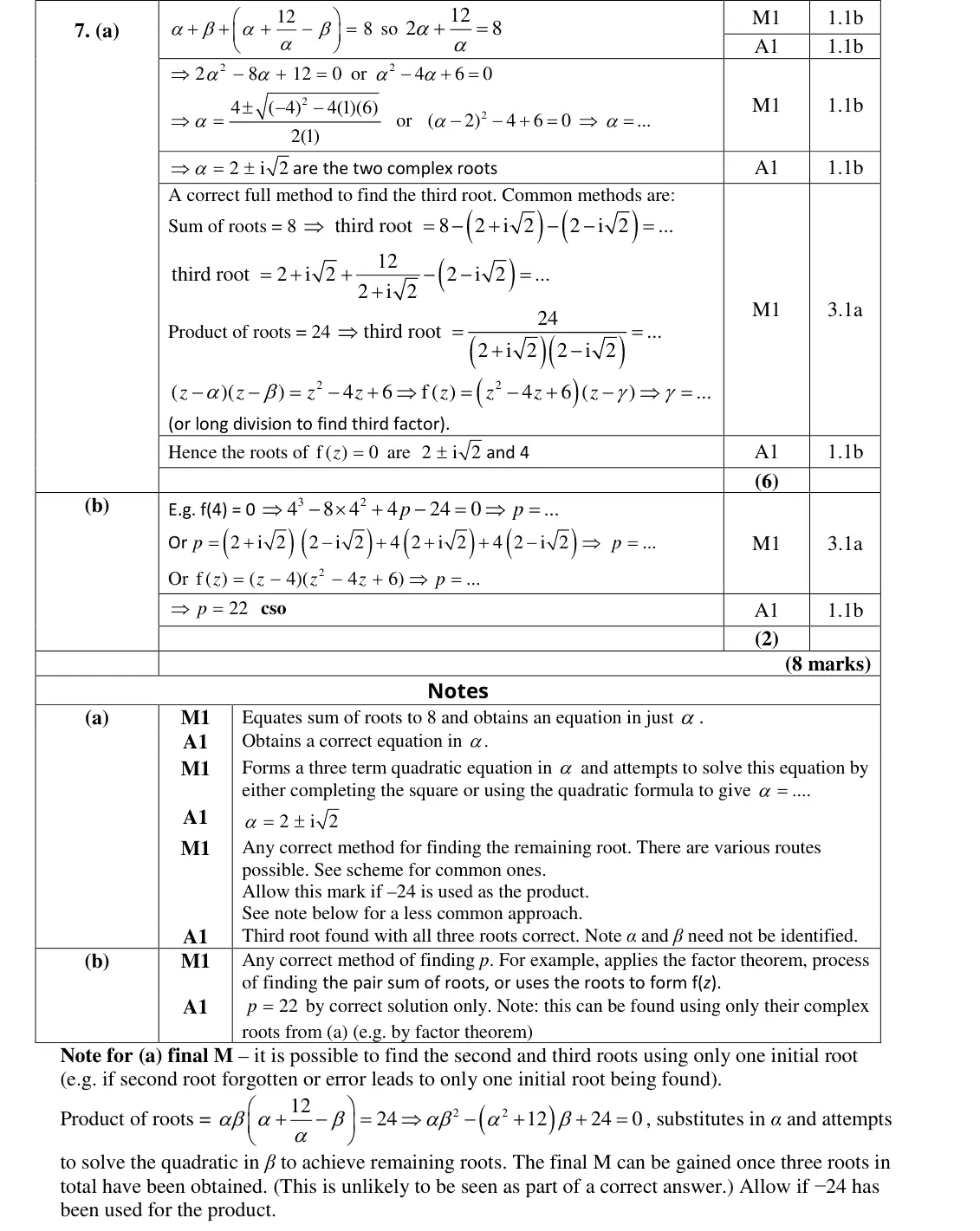
Mark scheme (whole question; this part is marked with the orange bar)
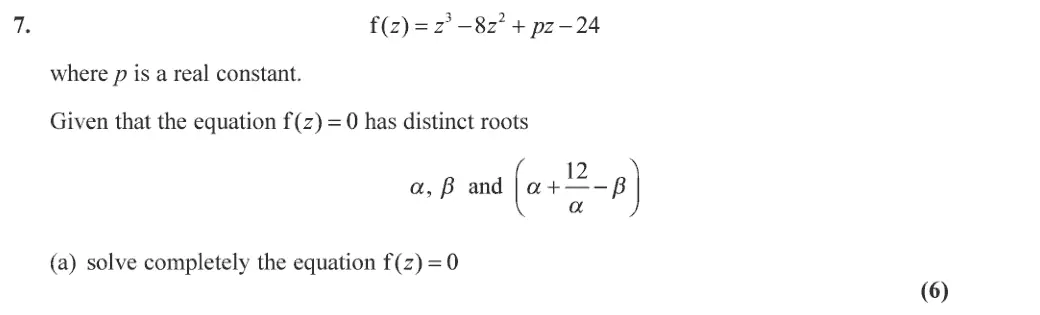
Key points from the mark scheme and examiner's report
Mark scheme (whole question; this part is marked with the orange bar)
Key points from the mark scheme and examiner's report
f(4) = 0 or pair sum of roots or expand (z − 4)(z² − 4z + 6): p = 22
June 2019 · Paper 1 (Core Pure 1) · Q1(b)5 marks
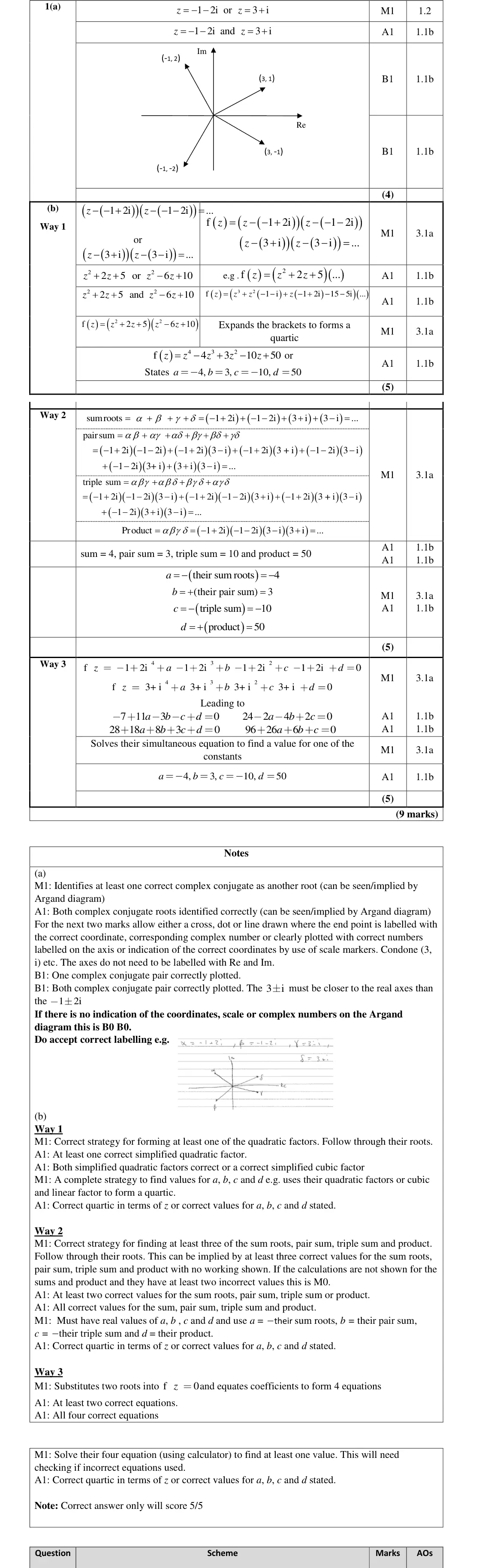
Mark scheme (whole question; this part is marked with the orange bar)
Examiner's comment
Part (b) proved to be more challenging for some candidates. The most common approach was attempt to find the sum, pair sum, triple sum and product of the four roots. Most were able to find a correct sum and product, but errors were sometimes made when attempting to find the pair and triple sums. Some errors were due to a missing pair or triple sum, but most errors occurred in the algebraic manipulation of the terms. Most candidates realised they needed a = -sum, but a few candidates omitted the minus on the triple sum, and so lost the last M mark. A significant number of candidates attempted to find two quadratics using the sum and product of conjugate pair roots. Most were able to form correct quadratics and then go on to multiplying these out to obtain a quartic. Common errors with this approach were to make a sign error when attempting to apply 𝑖2 = -1, or to apply “+ sum” rather than “- sum” for the x-term in the quadratic. Some candidates made slips when multiplying out the quadratic factors, and one or two lost the final A mark for stating a quartic in term of x and not z. A few chose to substitute roots into a general quartic obtained two or more simultaneous equations, but often these contained errors. Most then failed to correctly solve their equations to find a, b, c & d.
Key points from the mark scheme and examiner's report
quadratic factors z² + 2z + 5 and z² − 6z + 10 then expand, or sum/pair sum/triple sum/product of roots
a = −4, b = 3, c = −10, d = 50
sign slips with i² = −1 and forgetting a = −(sum) or c = −(triple sum)
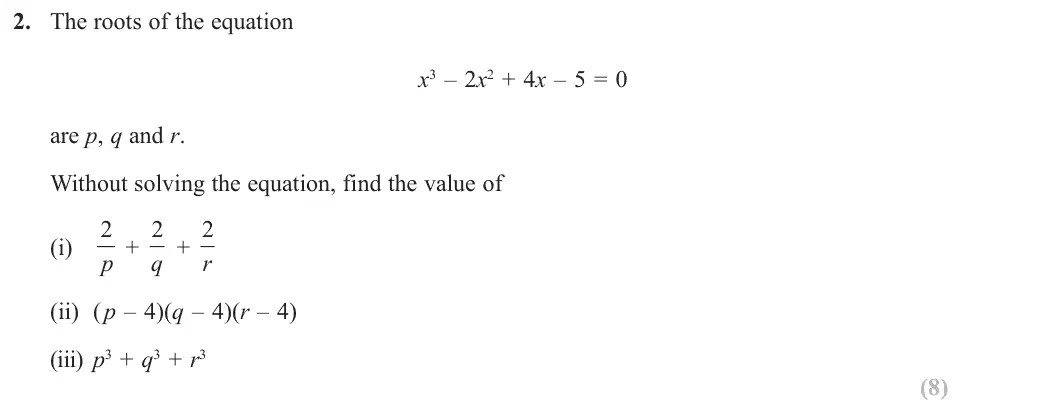
June 2019 · Paper 2 (Core Pure 2) · Q28 marks
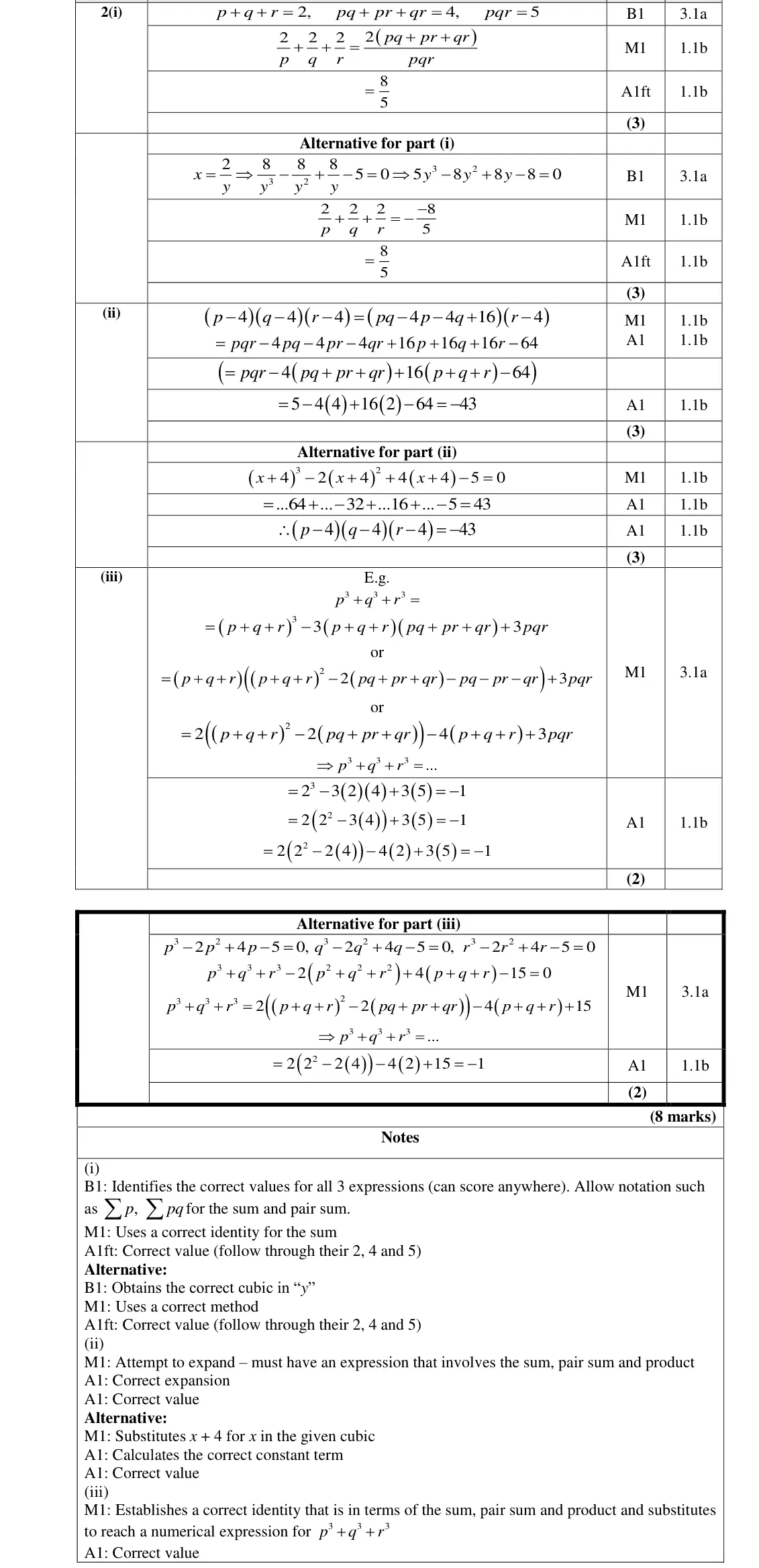
Mark scheme (whole question; this part is marked with the orange bar)
Examiner's comment
Question 2 involved the roots of a cubic equation and it was common to be awarding the first six marks for parts (i) and (ii). Most began their answer with the correct values for the sum, pair sum and product with sign errors being very rare. In part (i) the vast majority expressed the new sum correctly in terms of the pair sum and product and proceeded correctly. A small number thought that 2 p + 2 q + 2 r was equal to 2(p + q + r) pqr . The alternative of substituting x = 2 y to find the cubic in y was not common but was usually correct. In part (ii), most were able to multiply out and obtain a usable expression. A common error was the absence of the constant –64. As with (i), the alternative was not widely seen. Part (iii) proved very difficult since only a relatively small number of candidates were able to recall a correct identity for the sum of the cubes. Those who tried to produce one were almost always unsuccessful.
Key points from the mark scheme and examiner's report
Σp = 2, Σpq = 4, pqr = 5
(i) 2Σpq/pqr = 8/5
(ii) expand: 5 − 16 + 32 − 64 = −43, constant −64 often missed
Mark scheme (whole question; this part is marked with the orange bar)
Examiner's comment
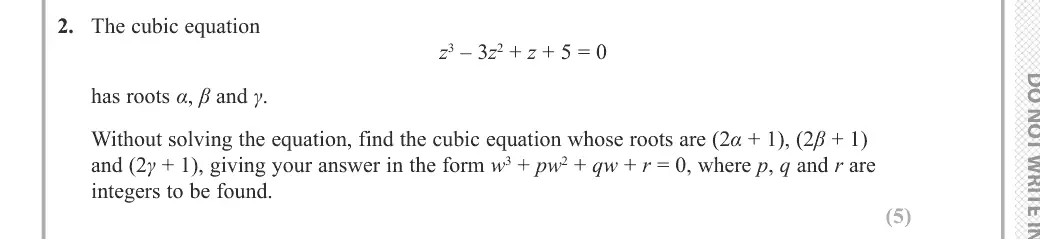
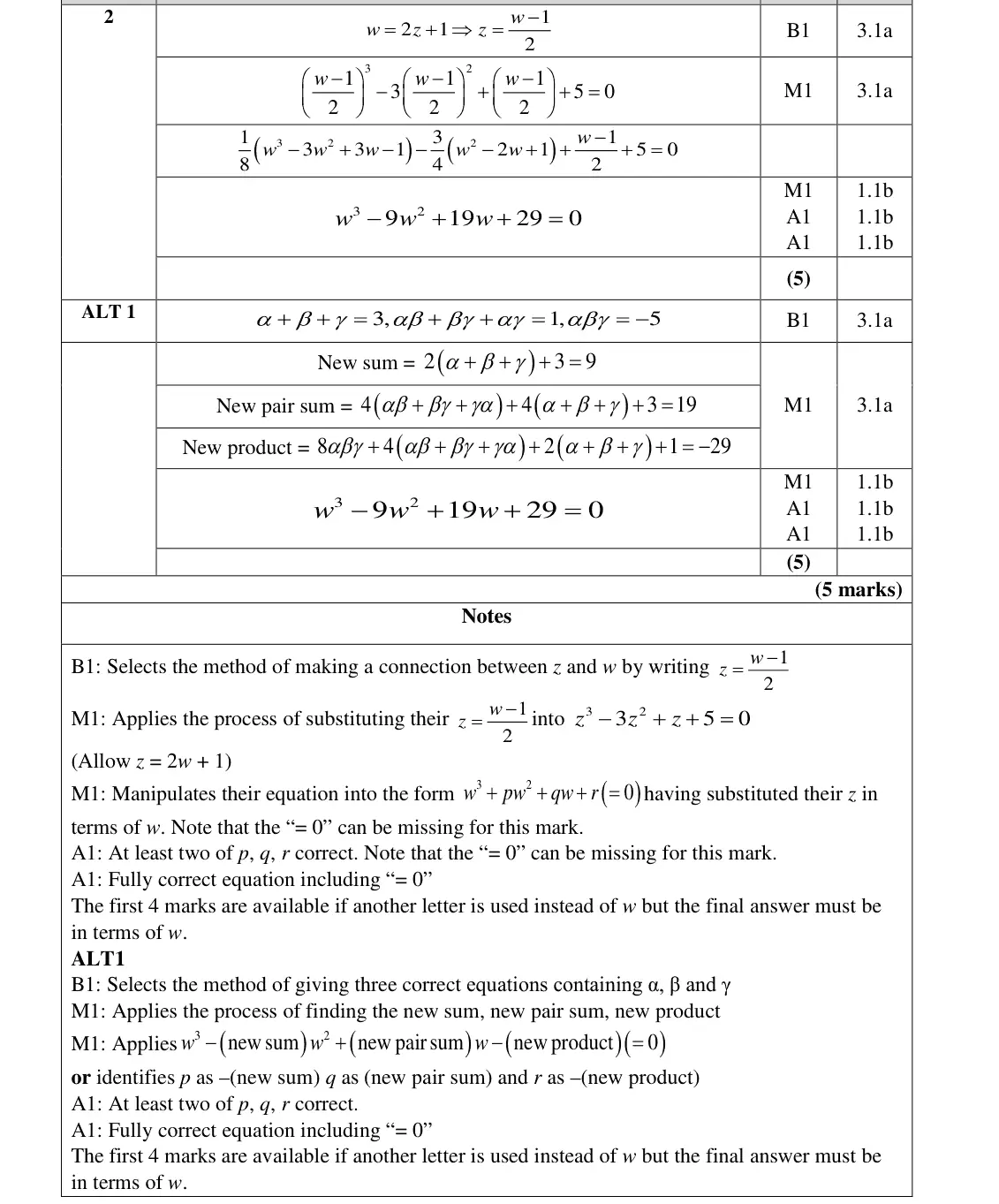
This question was a new topic on the specification, though use of the sum and product of roots has been on the IAL specification, but the specimen papers will have been the only previous examples some will have seen. Most students used the main approach in the scheme for this question and this certainly seemed to be the most effective method. Overall the question was answered really well with the main errors being from basic algebraic manipulation. This has really evidenced the need for students studying mathematics at this level to be competent with algebraic manipulation. There were a number of students who confused their variables though most managed to correct this at the end. The alternate method posed more problems. This style of answer may be more familiar than the linear transformation and so in time students may learn the best approach to this type of question. Many students used b/a and d/a instead of -b/a and -d/a. Again algebraic manipulation lead to lost marks, though not as often as in the main scheme. Omitting the “ = 0” and hence losing the final A mark was rare.
Key points from the mark scheme and examiner's report
substitute z = (w − 1)/2 (or use new sum, pair sum, product)
w³ − 9w² + 19w + 29 = 0
algebra slips and −b/a sign errors common
include "= 0"
June 2018 · AS Paper 1 (Core Pure) · Q77 marks
Mark scheme (whole question; this part is marked with the orange bar)
Examiner's comment
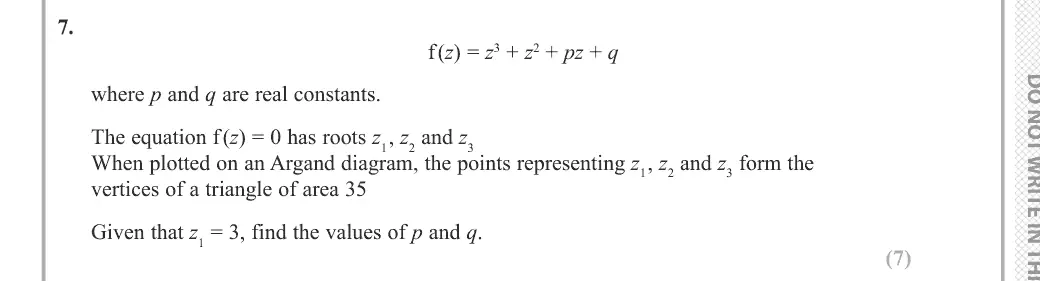
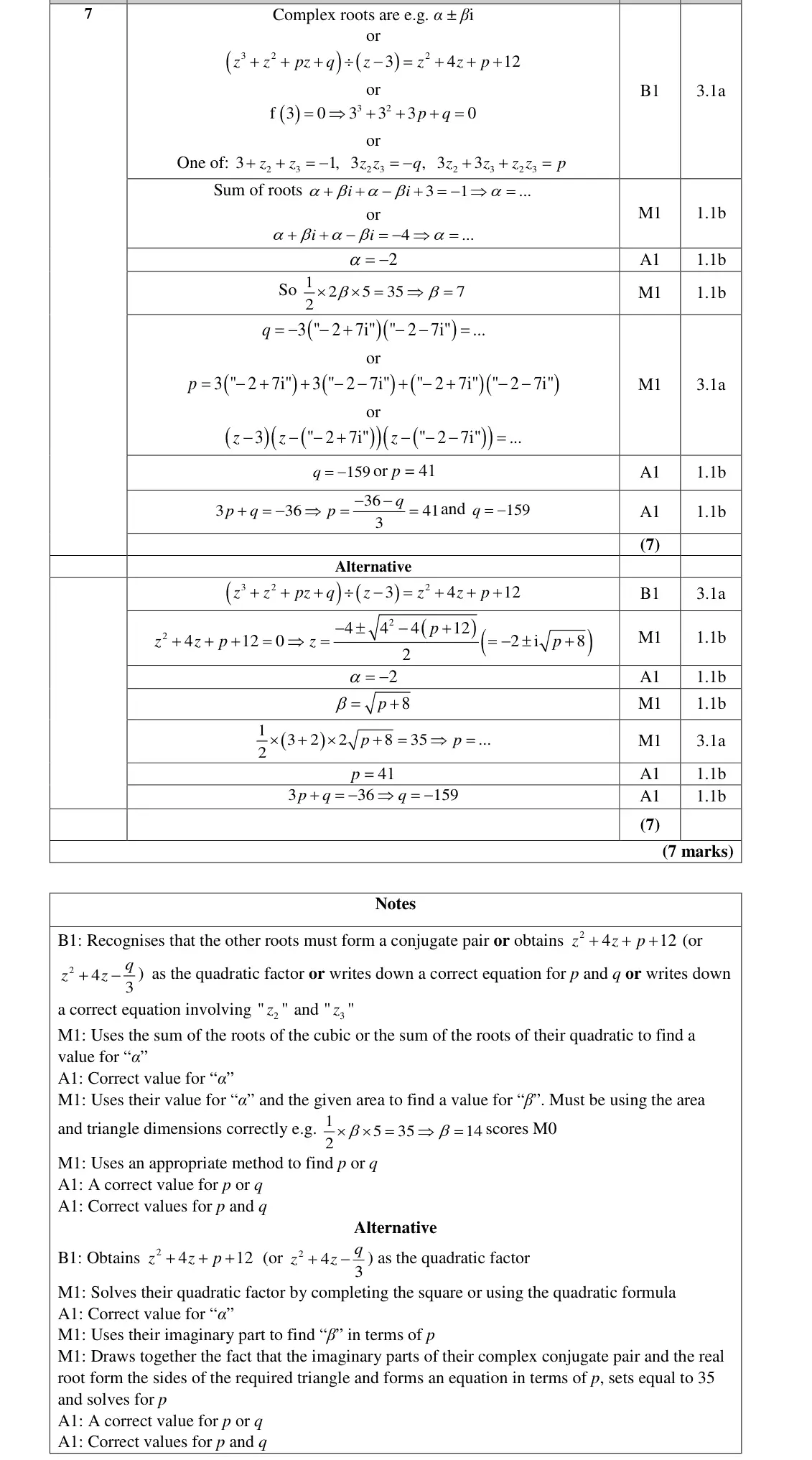
This proved to be a very challenging question, and a significant number of blank or very low scoring attempts were seen. Many students produced work worthy of the first mark (many achieved it several times over) but failed to make progress beyond this – either going round in circles or making wild assumptions. Most recognised that an equation could be formed in terms of the area of the triangle but the bigger challenge was to find another way into the question, i.e. by using the sum of roots or, occasionally by dividing the polynomial by (z – 3), although very few recognised that they could solve the quadratic and hence find the other two roots. Most successful students realised that the other two roots needed to be a conjugate pair and then were able to use the sum of roots to find the real part. Many diagrams did not show a conjugate pair so the method to find the imaginary part using the area of a triangle was not always successful. Those that found values for the real and imaginary part of the other roots were able to find values for p and q. Many used the method in the scheme, but some multiplied out (z – 3)(z – “(–2 + 7i)”)(z – “(–2 – 7i)”) successfully. Many who tried the alternative approach divided successfully by (z – 3) but were unable to use the quadratic to any great effect. Drawing a diagram certainly helped in this question.
Key points from the mark scheme and examiner's report
other roots a conjugate pair α ± βi
sum of roots gives α = −2
triangle area ½ × 2β × 5 = 35 gives β = 7
p = 41, q = −159
very challenging, many made wild assumptions
a diagram helps
Find an Edexcel Further Maths tutor
Stuck on this? Book a trial lesson with our Further Maths tutor.