Mark scheme (whole question; this part is marked with the orange bar)

Examiner's comment
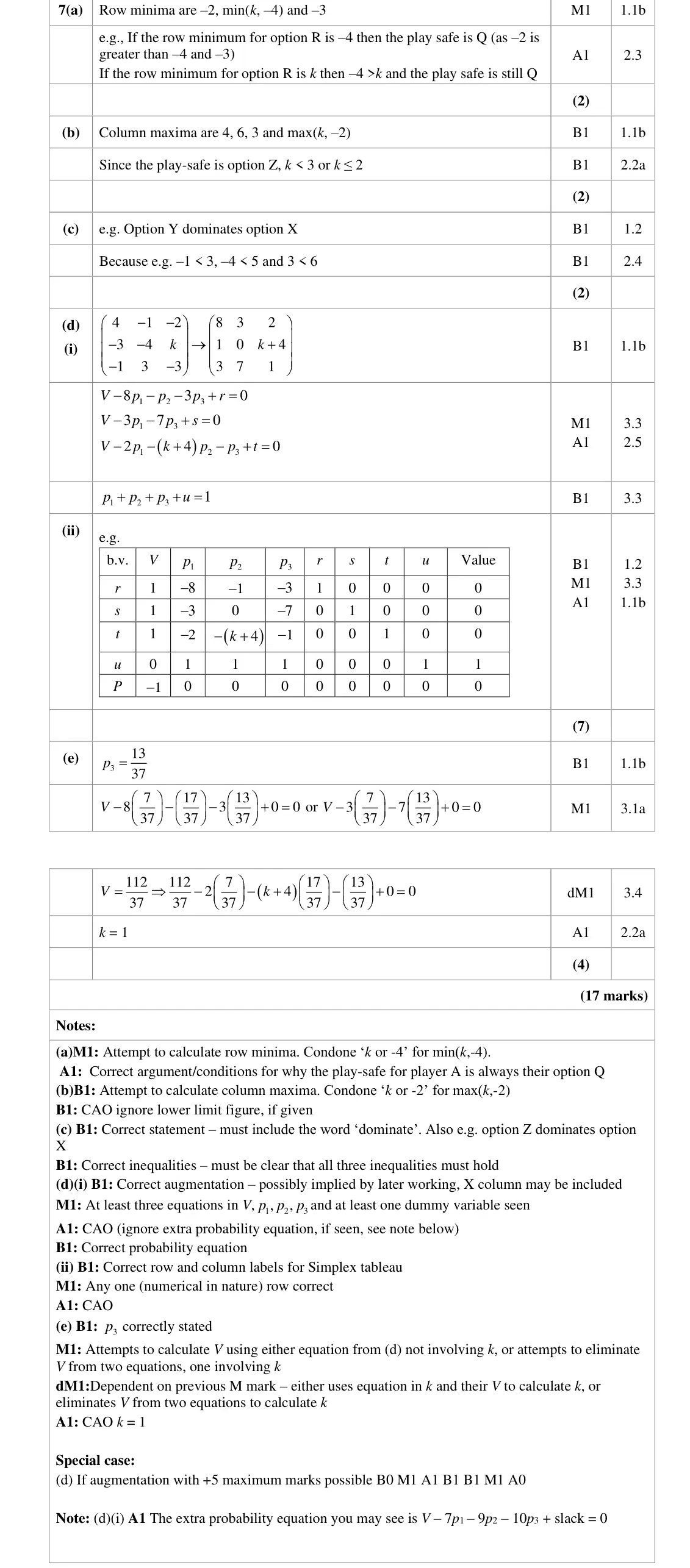
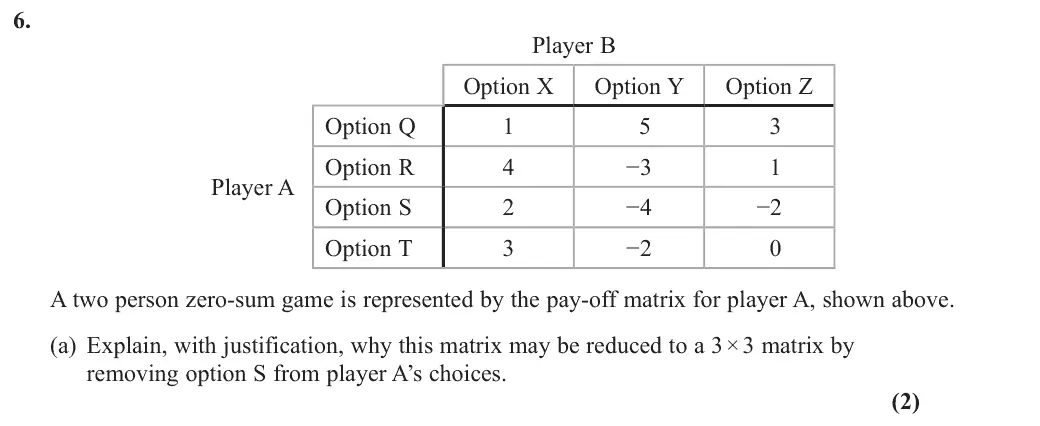
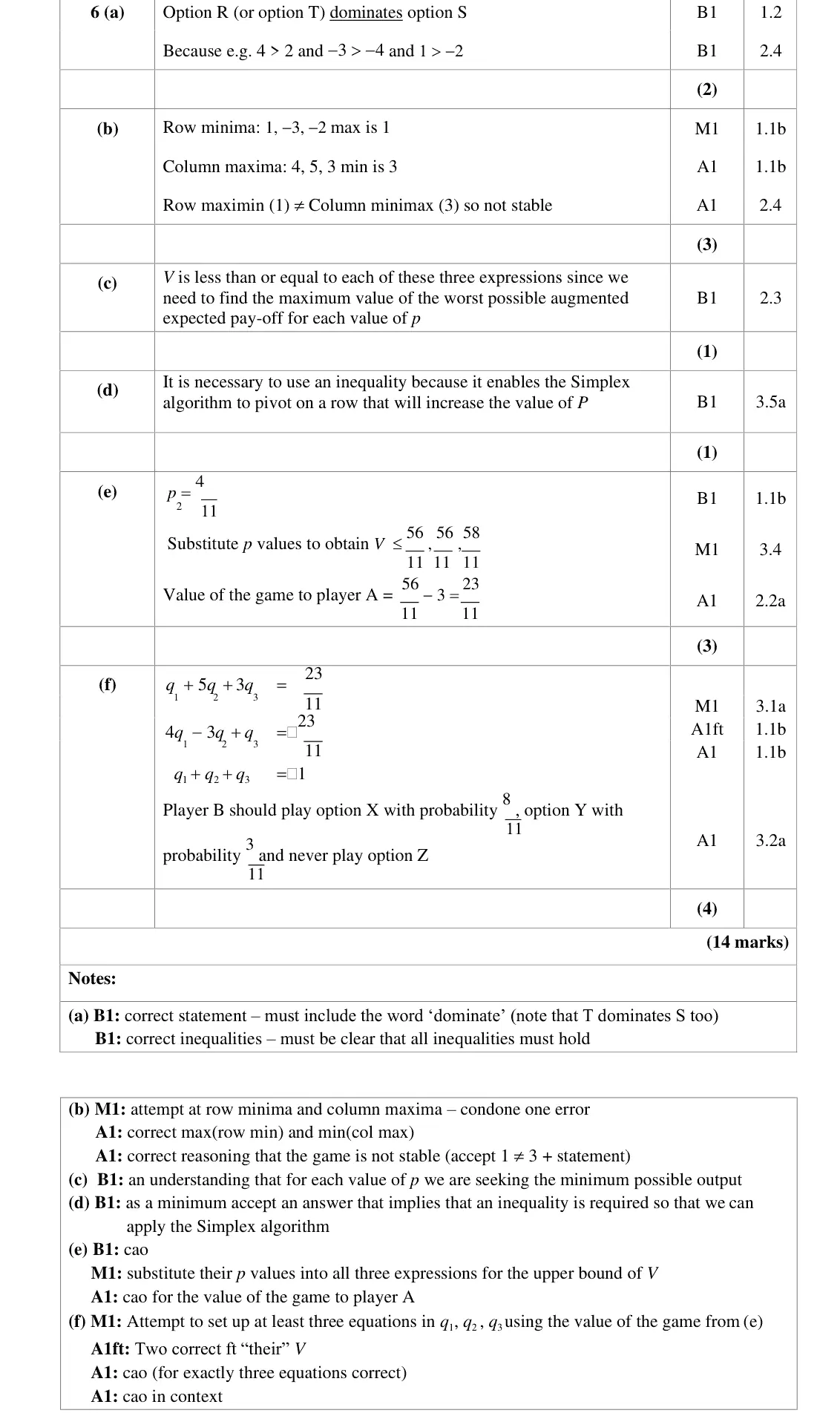
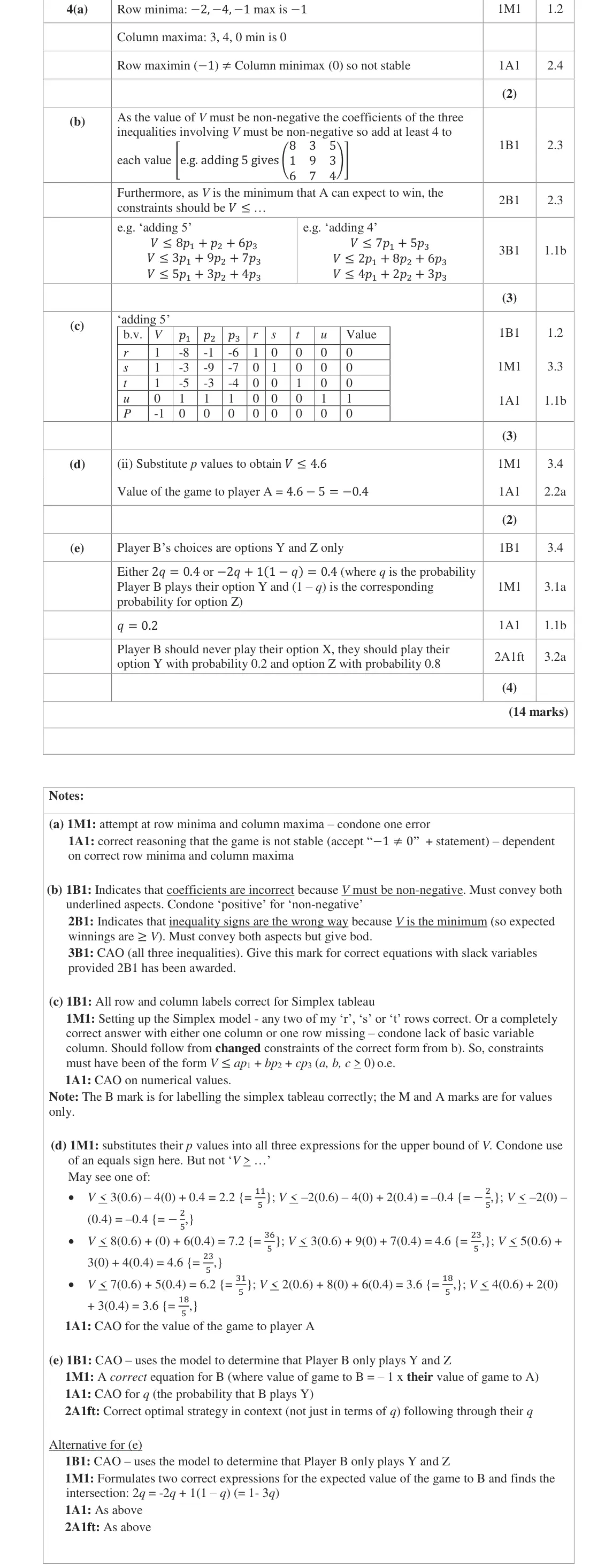
Candidates’ attempts at this question gained marks across the full range.. Most candidates attempted to find the row minima and column maxima, although a small number found the row maxima and column minima, and then stated that the row maximin was not equal to the column minimax. Some candidates failed to clearly identify the maximin and minimax values and a few failed to show all the minima and maxima and were penalised. Most candidates realised that Option Q was always better than Option T, but a number failed to use the word dominate in their explanation and were penalised. Some candidates failed to list the three comparative inequalities to justify their explanation. Many candidates correctly augmented the table (either by adding 3 or 4) and attempted to set up the problem by writing down a series of constraints. Some candidates only listed these as inequalities instead of equations. A small number of candidates incorrectly used rows instead of columns to form their constraints. Most candidates wrote down the objective function, but a number omitted to state maximise with this. When writing the probability constraint, a number of candidates incorrectly set this equal to zero. Many candidates attempted to complete the simplex tableau, although some included errors from their earlier working. A very small number of candidates recognised that Option Y dominated Option Z for Player B and reduced the problem further at this stage, before writing down their constraints and completing the tableau. In part d, there were two alternative approaches seen, both of which produced fully correct solutions. Some candidates calculated the value of p3 and then used this to calculate the value of the game by considering all three options for B. Some candidates only used one option for B to obtain a possible value for the game and were penalised here. Candidates then defined probabilities for Player B, setting up and solving these correctly. They then stated the correct strategy for B, although a small number failed to state that B never plays Option Z. With the alternative approach, candidates recognised that Option Y dominated Option Z for B and reduced the problem accordingly. These candidates then defined probabilities for Player B, set up a pair of expressions or equations and solved these. Again, candidates stated the optimum strategy for B.
Key points from the mark scheme and examiner's report
- Q dominates T since −3 > −4, 2 > 0, 5 > 2
- must use 'dominates' and give all three inequalities