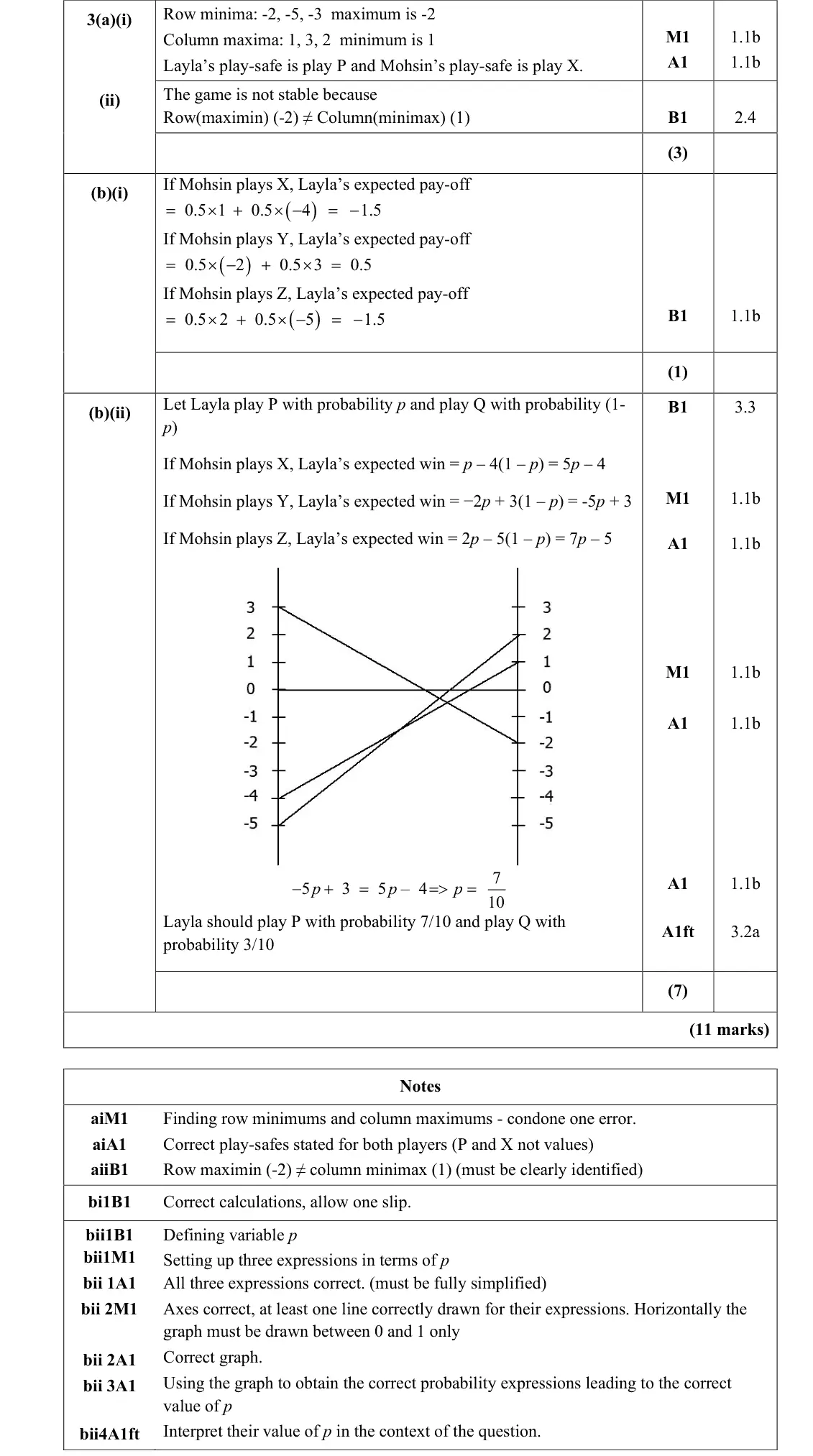
June 2025 · AS Paper 2 (Decision 2) · Q3(b)(i)1 mark
Mark scheme (whole question; this part is marked with the orange bar)
Examiner's comment
the play-safe strategies. A significant number of learners either did not attempt part (b) or made an error in their calculations. Most learners were able to write down the correct three probability expressions, although some failed to define their probabilities before doing so. Most then went on to draw a graph of the three lines, although some were poorly drawn with the horizontal axis extending way beyond 1 and one or more lines incorrect. Those learners who drew an accurate graph then attempted to calculate the value of p, although some incorrectly used the intersection of 5p – 4 and 7p – 5 for this. Most then stated the strategy for Layla, using their value of p.
Key points from the mark scheme and examiner's report
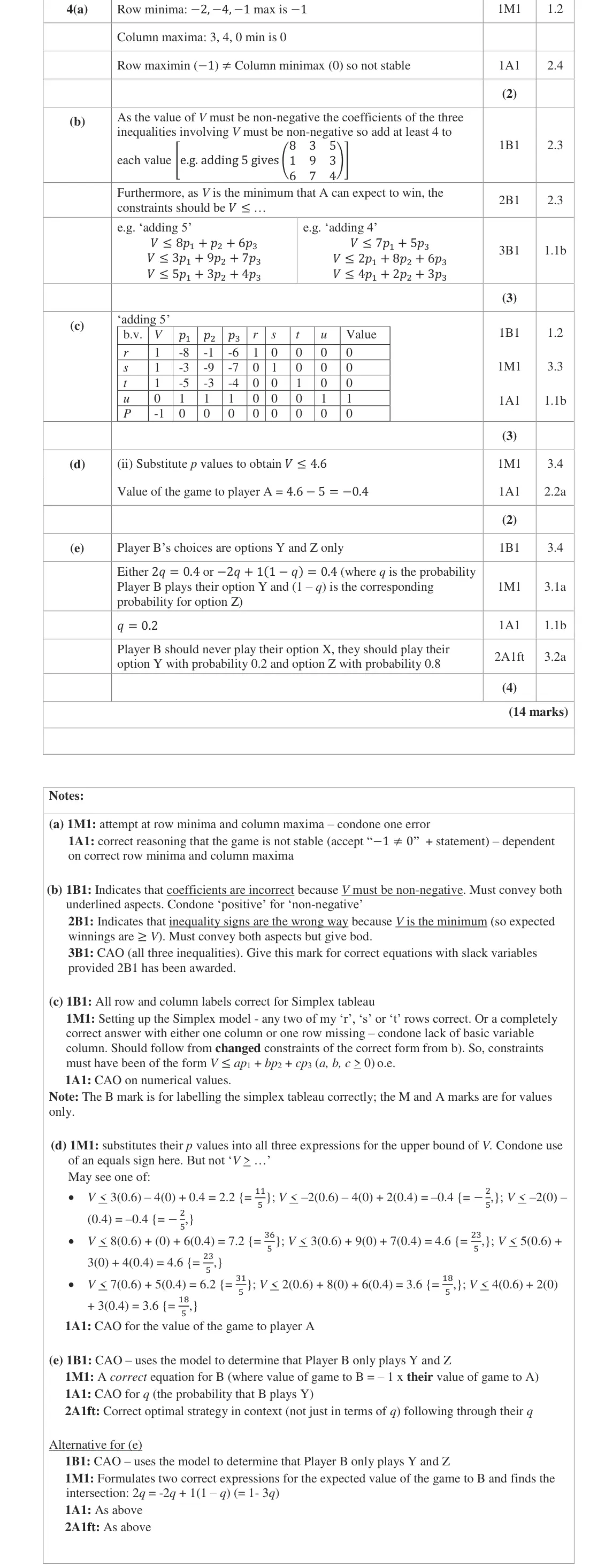
half of each row: X −1.5, Y 0.5, Z −1.5
many omitted (b) or slipped
June 2025 · AS Paper 2 (Decision 2) · Q3(b)(ii)7 marks
Mark scheme (whole question; this part is marked with the orange bar)
Examiner's comment
Most learners attempted to find the row maximin and column minimax, although a small number made errors in this process. Having done so, many learners then stated the correct play- safe strategies and, giving a reason, stated that the game is not stable, although some omitted
Key points from the mark scheme and examiner's report
define p = P(Layla plays P)
lines 5p − 4, 3 − 5p, 7p − 5 for 0 ≤ p ≤ 1 only
optimal point is 3 − 5p = 5p − 4 so p = 7/10: P 0.7, Q 0.3
using 5p − 4 and 7p − 5 was a common error
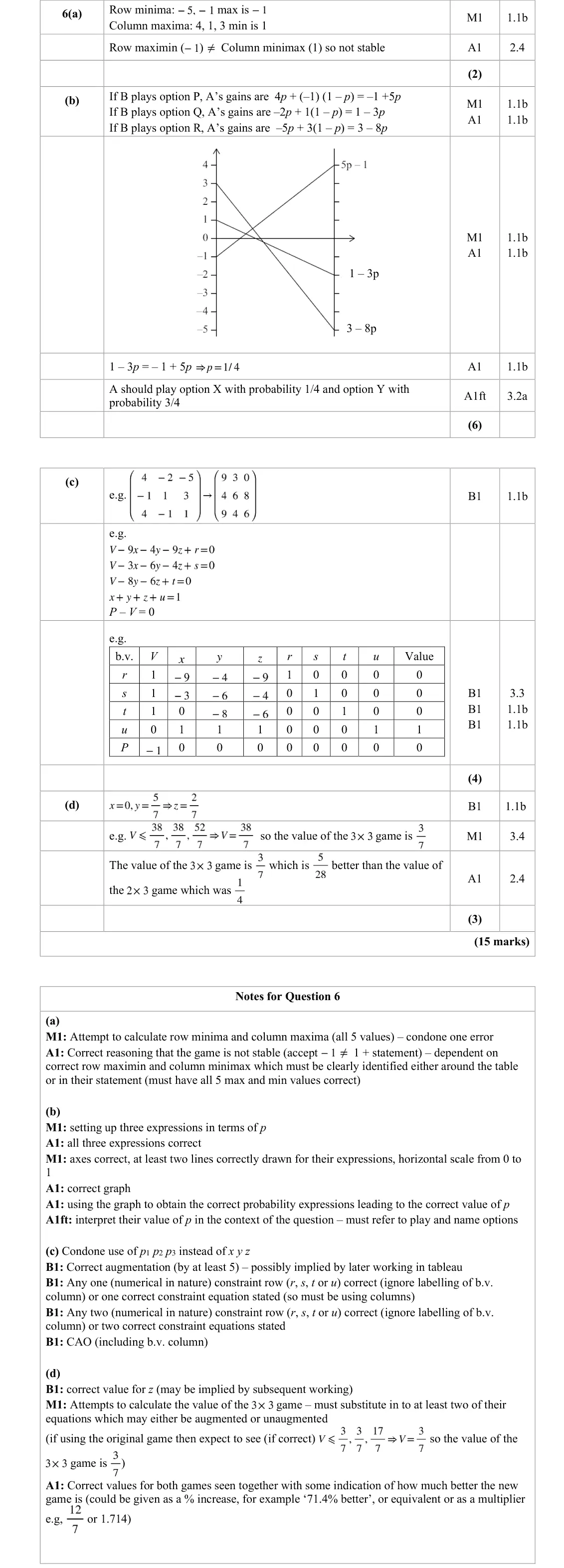
June 2025 · Paper 4D (Decision 2) · Q6(b)6 marks
Mark scheme (whole question; this part is marked with the orange bar)
Examiner's comment
penalised here. In part (b) those candidates who attempted this, generally wrote down or formed the correct three probability expressions, although some made errors. They then attempted to draw a graph with incorrect scales and drawn without the use of a ruler. Candidates then attempted to find the optimum point, although some incorrectly chose the lowest point of intersection. Most stated the strategy based on their calculated value of p. In part (c) most
Key points from the mark scheme and examiner's report
expected gains 5p − 1, 1 − 3p, 3 − 8p
plot for 0 ≤ p ≤ 1 with a ruler and suitable scale
highest point of the lowest boundary: 1 − 3p = 5p − 1 so p = 1/4
X with probability 1/4, Y 3/4
choosing the lowest intersection was a common error
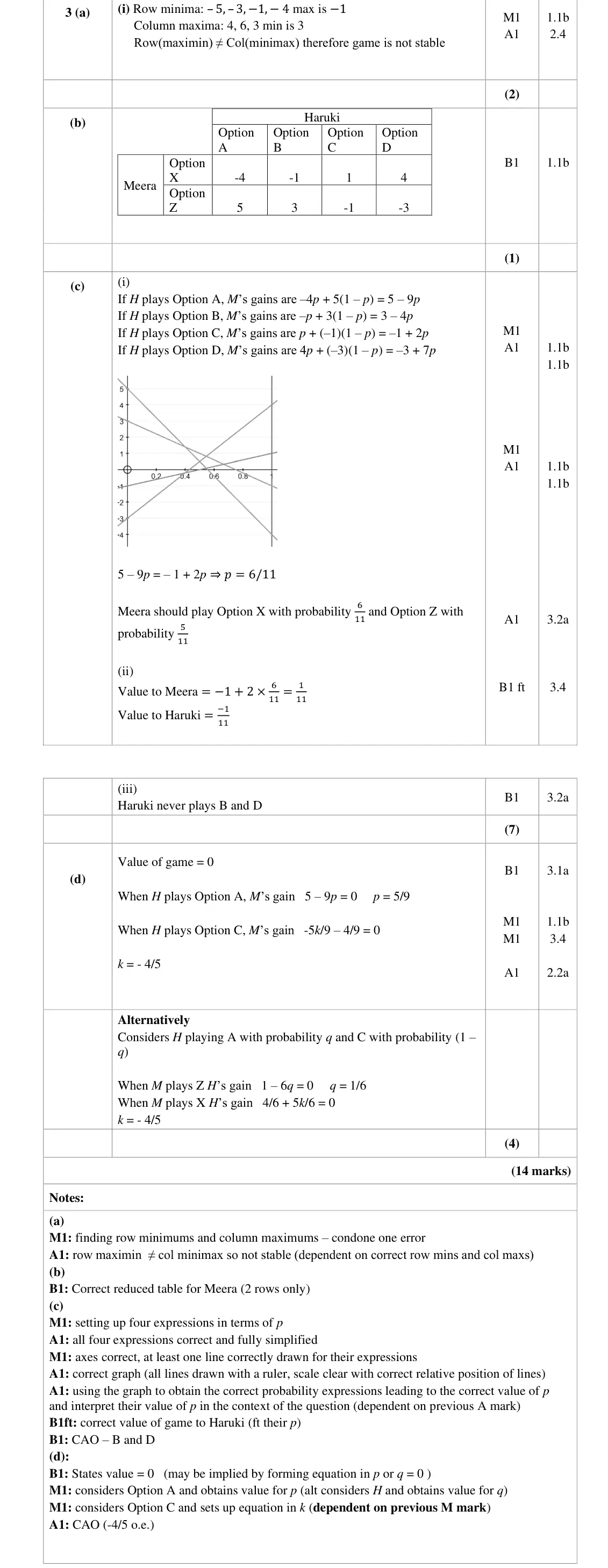
June 2024 · AS Paper 2 (Decision 2) · Q3(c)7 marks
Mark scheme (whole question; this part is marked with the orange bar)
Examiner's comment
Most candidates attempted to find the row minima and column maxima, although a small number found the row maxima and column minima instead and some candidates made a slip with one of their values. Most correctly stated that the row maximin did not equal the column minimax. Most candidates were able to correctly write down the reduced table, although some failed to transpose or retained Option Y. Many candidates wrote the correct four expressions and attempted to draw the graph, although some failed to use a ruler, or made their graph so small that it was difficult to pick out the correct point of intersection. Some candidates chose the wrong point of intersection and therefore calculated an incorrect probability. Some candidates incorrectly stated Meera’s options as playing X or playing Y instead of X or Z. Many candidates failed to state the correct two options that Haruki should not play.
Key points from the mark scheme and examiner's report
June 2024 · AS Paper 2 (Decision 2) · Q3(d)4 marks
Mark scheme (whole question; this part is marked with the orange bar)
Examiner's comment
The final part of this question was a good discriminator, as many candidates failed to realise that the value of the game must now be zero and therefore made no progress. Those candidates who did realise the value of game, tried to set up at least one equation in k and solve it, although some made errors when doing so.
Key points from the mark scheme and examiner's report
equal value for both players means value 0
from A's line 5 − 9p = 0 so p = 5/9
then C's line −5k/9 − 4/9 = 0 gives k = −4/5
many did not see the value is 0 and made no progress
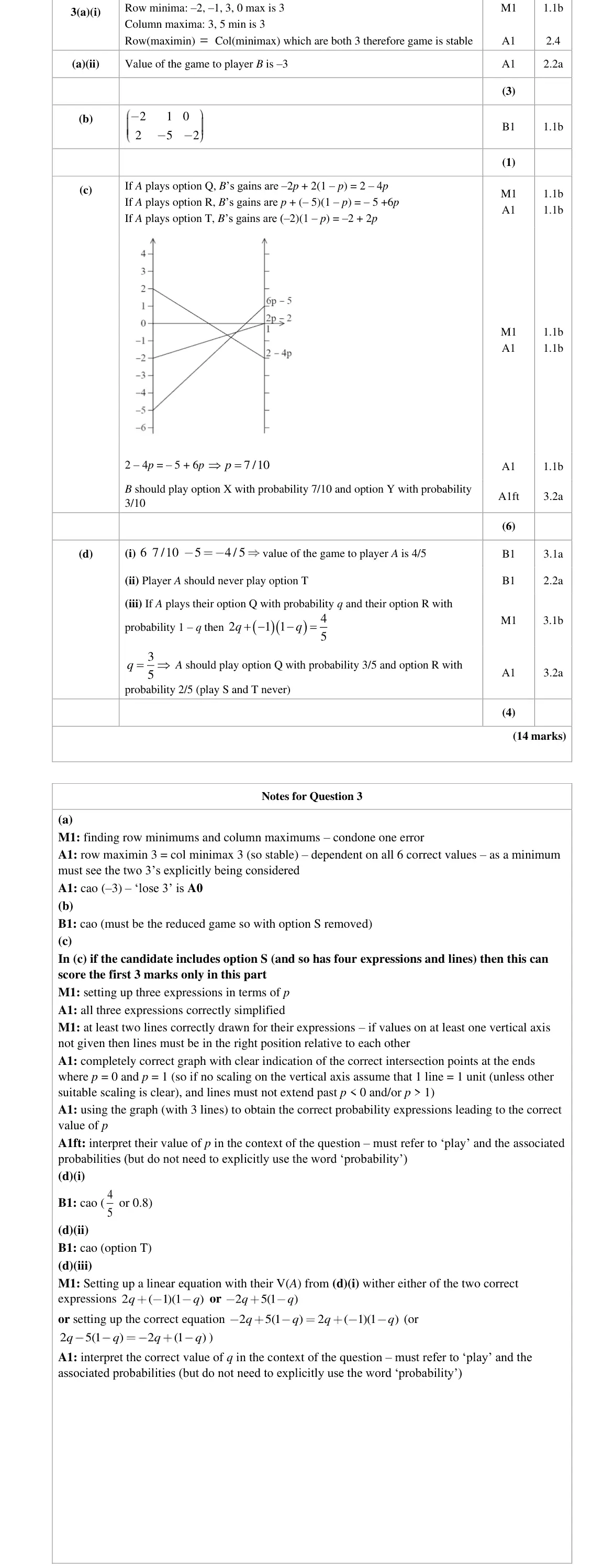
June 2023 · AS Paper 2 (Decision 2) · Q3(c)6 marks
Mark scheme (whole question; this part is marked with the orange bar)
Examiner's comment
In part (c) most candidates set up three correct probability expressions (though some had errors when simplifying these expressions) and then most subsequently went on to draw a graph with 3 lines; a few candidates attempted to just solve pairs of simultaneous equations, scoring no marks. It was noted that some graphs: • were poorly drawn without rulers, • went beyond the axes at p < 0 and p > 1, • had uneven or missing scales on the vertical axes, • were so cramped that it was difficult to identify the correct optimum point. Most candidates attempted to solve the pair of equations for which they considered to be their optimal point from their graph. Those that solved the correct pair usually went on to list the correct options for player B (that is, that they should play option X with probability 7 and 10 option Y with probability 3 ) although a number did not state their answer in context. Those 10 candidates who were successful in finding the correct value of p usually went on to correctly state the value of the reduced game to player A in part (d)(i).
Key points from the mark scheme and examiner's report
B's gains 2 − 4p, −5 + 6p, −2 + 2p drawn for 0 ≤ p ≤ 1
including option S scores at most 3 marks
2 − 4p = −5 + 6p gives p = 7/10: X 0.7, Y 0.3
solving pairs of equations without a graph scores 0
June 2023 · AS Paper 2 (Decision 2) · Q3(d)4 marks
Mark scheme (whole question; this part is marked with the orange bar)
Examiner's comment
state the value of the reduced game to player A in part (d)(i). Very few candidates made any real progress in the remaining parts of (d) indicating that candidates are still unfamiliar with how to solve the game for one player once the solution is known for the other.
Key points from the mark scheme and examiner's report
value to B is −4/5 so value to A is 4/5
T is never played (its line is not at the optimal point)
2q − (1 − q) = 4/5 gives q = 3/5: Q 0.6, R 0.4, never S or T
very few progressed beyond (i)
June 2022 · AS Paper 2 (Decision 2) · Q3(d)7 marks
Mark scheme (whole question; this part is marked with the orange bar)
Examiner's comment
In (d) most candidates set up four correct probability expressions (though some had errors when simplifying these expressions) and then most subsequently went on to draw a graph with 4 lines; a few candidates attempted to just solve pairs of simultaneous equations, scoring no marks. It was noted that some graphs: • were poorly drawn without rulers, • went beyond the axes at p < 0 and p > 1, • had uneven or missing scales on the vertical axes, • were so cramped that it was difficult to identify the correct optimum point. Most candidates attempted to solve the pair of equations for which they considered to be their optimal point from their graph. Those that solved the correct pair usually went on to list the correct options for June (that is, that they should play option X with probability 8/15 and option Y with probability 7/15) although a number did not state their answer in context or did not define p initially as the probability of June playing option X (and hence 1 – p as the probability of them playing option Y). Those candidates who were successful in finding the correct value of p usually went on to correctly state the value of the game to Terry. Very few candidates made any real progress in (e) indicating that candidates are still unfamiliar
Key points from the mark scheme and examiner's report
define p = P(June plays X)
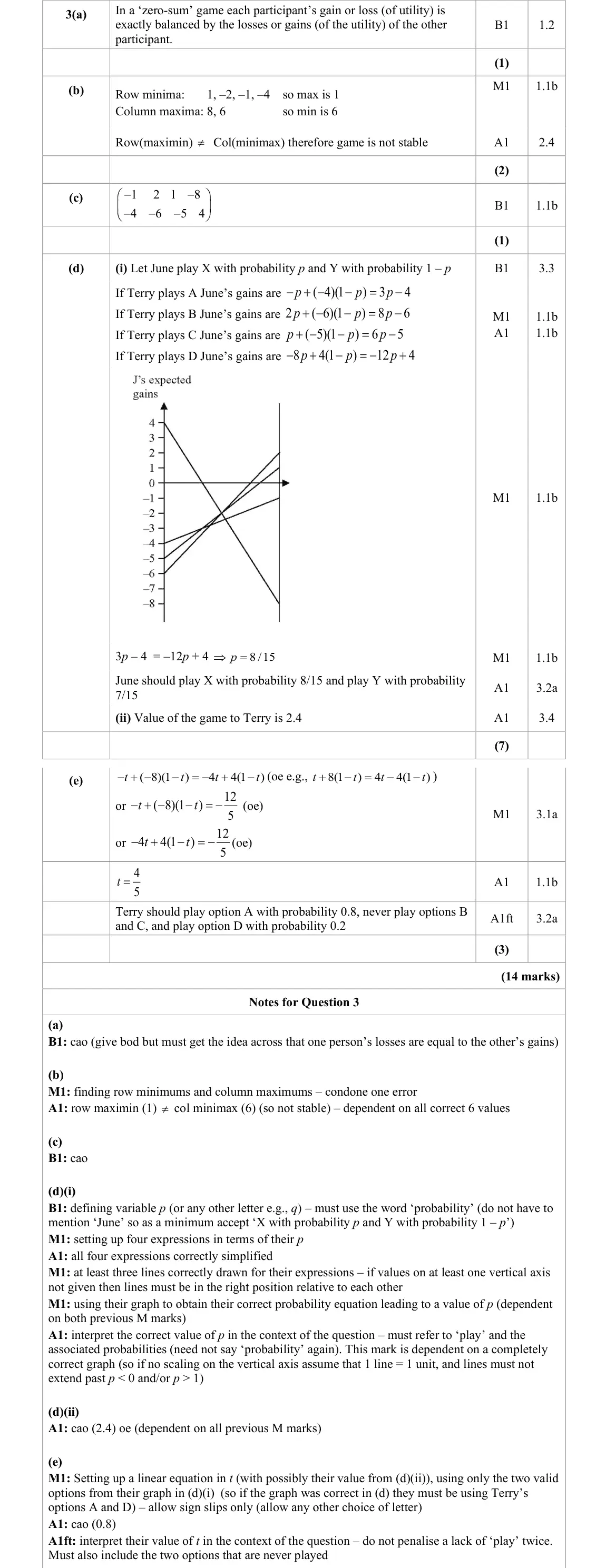
gains 3p − 4, 8p − 6, 6p − 5, −12p + 4 drawn for 0 ≤ p ≤ 1
3p − 4 = −12p + 4 gives p = 8/15: X 8/15, Y 7/15
value to Terry 2.4
solving pairs of equations without a graph scores 0
June 2022 · AS Paper 2 (Decision 2) · Q3(e)3 marks
Mark scheme (whole question; this part is marked with the orange bar)
Examiner's comment
Very few candidates made any real progress in (e) indicating that candidates are still unfamiliar with how to solve the game for one player once the solution is known for the other.
Key points from the mark scheme and examiner's report
only A and D (the lines meeting at the optimal point) are used: −t − 8(1 − t) = −4t + 4(1 − t) or either equal to −12/5
t = 0.8: A 0.8, D 0.2, never B or C
very few made progress
Nov 2021 · Paper 4D (Decision 2) · Q7(b)6 marks
Mark scheme (whole question; this part is marked with the orange bar)
Key points from the mark scheme and examiner's report
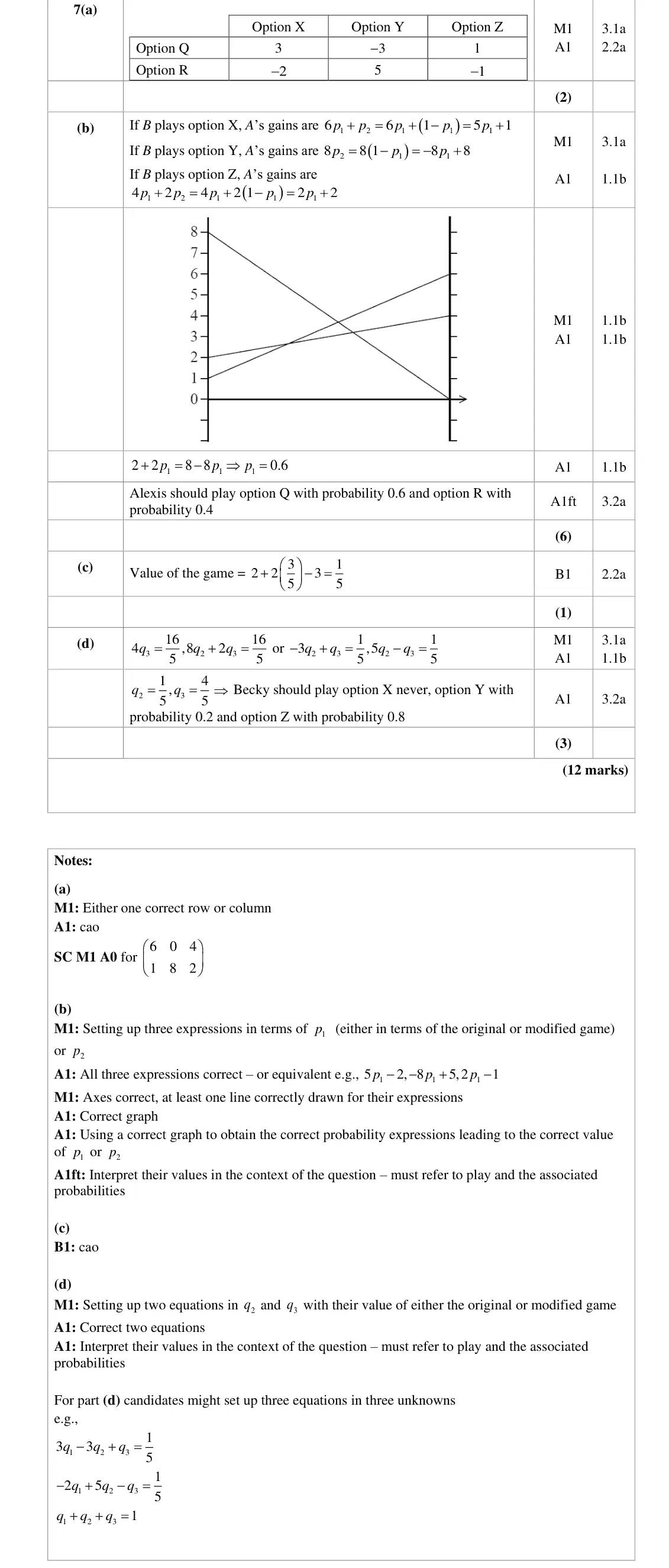
expected gains in terms of p1: X 5p1 − 2, Y 5 − 8p1, Z 2p1 − 1 (or +3 versions)
lowest boundary, highest point where Y and Z meet: 2 + 2p1 = 8 − 8p1 so p1 = 0.6
play Q with probability 0.6, R with 0.4
Nov 2021 · Paper 4D (Decision 2) · Q7(c)1 mark
Mark scheme (whole question; this part is marked with the orange bar)
Key points from the mark scheme and examiner's report
value 2 + 2(0.6) − 3 = 1/5
Nov 2021 · Paper 4D (Decision 2) · Q7(d)3 marks
Mark scheme (whole question; this part is marked with the orange bar)
Key points from the mark scheme and examiner's report
X is not used at the optimal point so q1 = 0
equate Alexis's expected gains to 1/5 with q2 + q3 = 1: q2 = 1/5, q3 = 4/5
never X, Y with probability 0.2, Z with 0.8
Oct 2020 · AS Paper 2 (Decision 2) · Q3(d)7 marks
Mark scheme (whole question; this part is marked with the orange bar)
Key points from the mark scheme and examiner's report
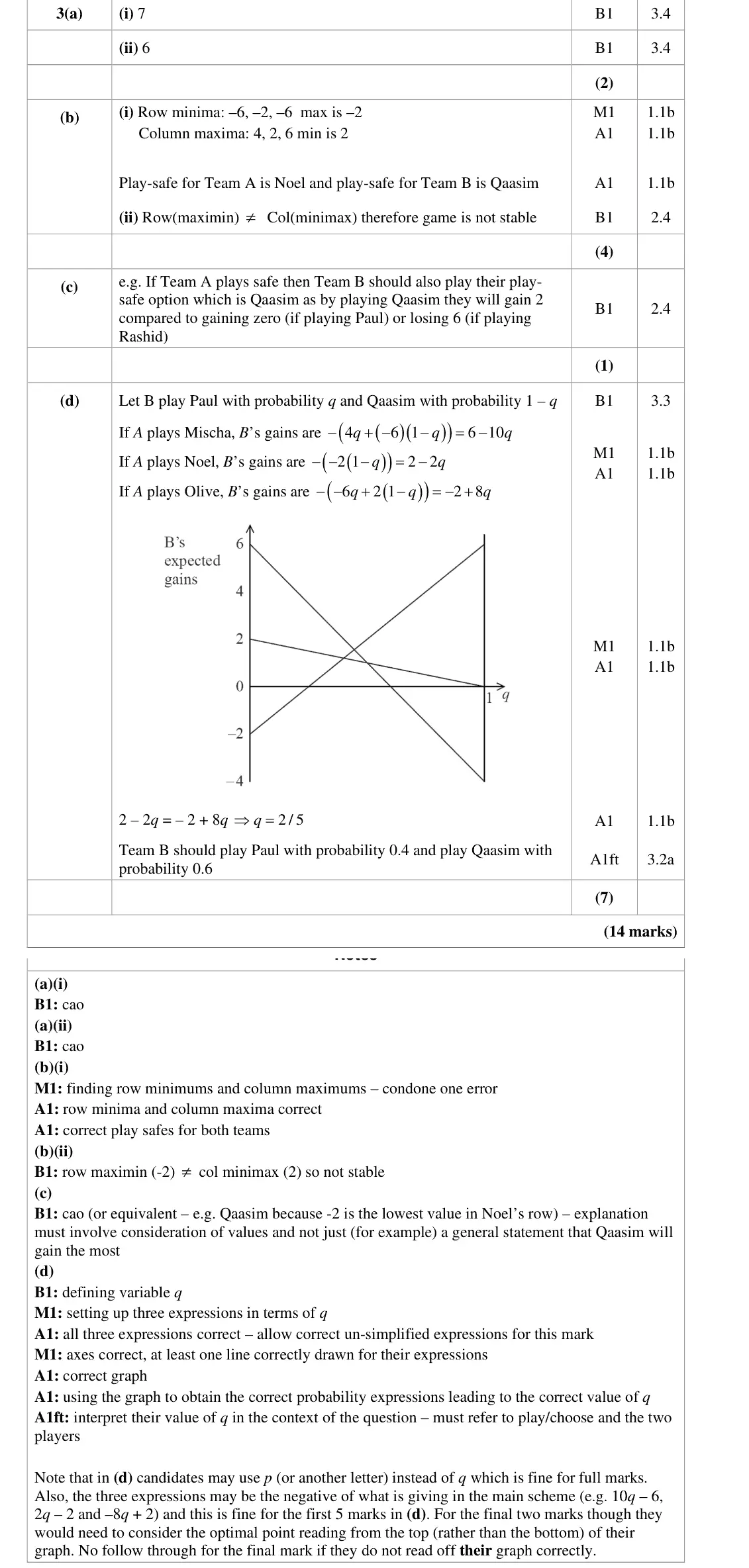
define q = P(B plays Paul)
B's gains are the negatives of the table: 6 − 10q, 2 − 2q, −2 + 8q
graph for 0 ≤ q ≤ 1 and take the highest point of the lowest boundary
June 2019 · AS Paper 2 (Decision 2) · Q4(b)7 marks
Mark scheme (whole question; this part is marked with the orange bar)
Examiner's comment
In (b) most candidates set up three correct probability expressions (though some had errors when simplifying these expressions) and then most subsequently went on to draw a graph with 3 lines; a few candidates attempted to just solve three pairs of simultaneous equations, scoring no marks. It was noted that some graphs: were poorly drawn without rulers, went beyond the axes at p < 0 and p > 1, had uneven or missing scales on the vertical axes, were so cramped that it was difficult to identify the correct optimum point. Most candidates attempted to solve the pair of equations for which they considered to be their optimal point from their graph. Those that solved the correct pair usually went on to list the correct options for A (that is, that A should play option P with probability 0.6 and option Q with probability 0.4) although a number did not state their answer in context or did not define p initially as the probability of A playing option P (and hence 1 – p as the probability of A playing option Q). Very few candidates could come up with a correct explanation for why B should never play option Y; many candidates gave a response that danced around the correct answer, but examiners were looking for an answer that strictly indicated that the graph indicated that for all value of p Brendan could gain more by playing either option X or Z. The responses to part (d)(i) were very mixed with many candidates failing to explain why q satisfied
Key points from the mark scheme and examiner's report
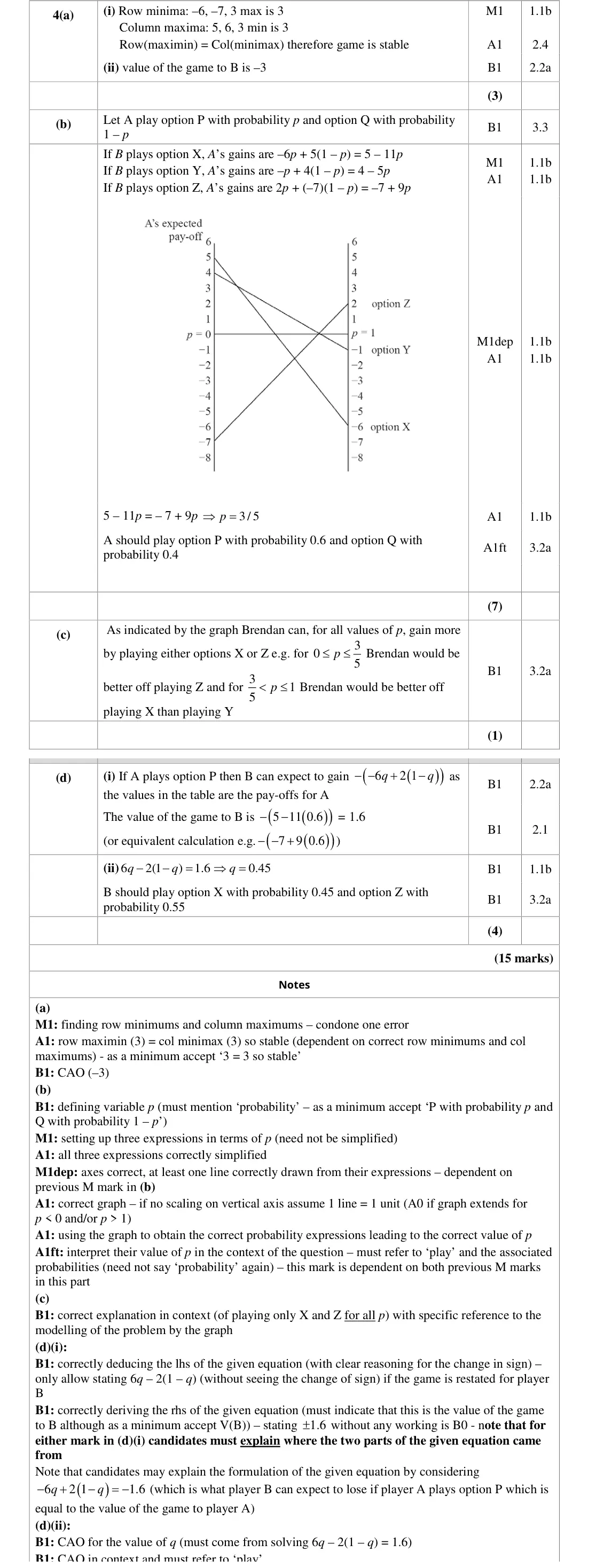
define p as the probability Aljaz plays P
lines 5 − 11p, 4 − 5p, −7 + 9p drawn for 0 ≤ p ≤ 1
5 − 11p = −7 + 9p gives p = 3/5: P with probability 0.6, Q 0.4
solving pairs of equations without a graph scores 0
June 2019 · AS Paper 2 (Decision 2) · Q4(c)1 mark
Mark scheme (whole question; this part is marked with the orange bar)
Examiner's comment
Part (a)(i) was done very well, with most candidates finding correct row minimum and column maximum values, with very few errors. A small number of candidates failed to either correctly identify the row maximin and column minimax, or state that the game was stable with correct justification. In part (ii) most correctly stated the value of the game to Brendan (B) but unsurprisingly gave the answer as 3 (which was the value to Aljaz (A)). In (b) most candidates set up three correct probability expressions (though some had errors when simplifying these expressions) and then most subsequently went on to draw a graph with 3 lines; a few candidates attempted to just solve three pairs of simultaneous equations, scoring no marks. It was noted that some graphs: were poorly drawn without rulers, went beyond the axes at p < 0 and p > 1, had uneven or missing scales on the vertical axes, were so cramped that it was difficult to identify the correct optimum point. Most candidates attempted to solve the pair of equations for which they considered to be their optimal point from their graph. Those that solved the correct pair usually went on to list the correct options for A (that is, that A should play option P with probability 0.6 and option Q with probability 0.4) although a number did not state their answer in context or did not define p initially as the probability of A playing option P (and hence 1 – p as the probability of A playing option Q). Very few candidates could come up with a correct explanation for why B should never play option Y; many candidates gave a response that danced around the correct answer, but examiners were looking for an answer that strictly indicated that the graph indicated that for all value of p Brendan could gain more by playing either option X or Z. The responses to part (d)(i) were very mixed with many candidates failing to explain why q satisfied the given equation – many simply stated the given equation or derived it without explaining that if A 6 2 1 q q plays option P then B can expect to gain (as the values in the table are the pay-offs 5 11 0.6 1.6 for player A) and the value of the game to player B is which implies that 6 2 1 1.6 q q which leads to the given equation. Many candidates simply stated the value of 1.6 without any indication of where it had come from and therefore did not ‘show it’. Part (d)(ii) was done much better but some candidates are clearly not conversant with certain mathematical command words and many derived the value of q from scratch and did not use the given equation in (d)(i). While many correctly found the value of q as 0.45 many did not give the best strategy for B in context or refer to the fact that B should ‘play’ option X with prob. 0.45 (and option Z with prob. 0.55).
Key points from the mark scheme and examiner's report
from the graph, for every p Brendan does better with X or Z than Y (Z for p ≤ 3/5, X for p > 3/5)
must refer to all values of p
June 2019 · AS Paper 2 (Decision 2) · Q4(d)4 marks
Mark scheme (whole question; this part is marked with the orange bar)
Examiner's comment
The responses to part (d)(i) were very mixed with many candidates failing to explain why q satisfied the given equation – many simply stated the given equation or derived it without explaining that if A 6 2 1 q q plays option P then B can expect to gain (as the values in the table are the pay-offs 5 11 0.6 1.6 for player A) and the value of the game to player B is which implies that 6 2 1 1.6 q q which leads to the given equation. Many candidates simply stated the value of 1.6 without any indication of where it had come from and therefore did not ‘show it’. Part (d)(ii) was done much better but some candidates are clearly not conversant with certain mathematical command words and many derived the value of q from scratch and did not use the given equation in (d)(i). While many correctly found the value of q as 0.45 many did not give the best strategy for B in context or refer to the fact that B should ‘play’ option X with prob. 0.45 (and option Z with prob. 0.55).
Key points from the mark scheme and examiner's report
B's gain against P is −(−6q + 2(1 − q)) as the table is A's pay-offs
value to B is −(5 − 11(0.6)) = 1.6
must explain where both sides come from
q = 0.45: X with probability 0.45, Z 0.55
June 2019 · Paper 4D (Decision 2) · Q4(e)4 marks
Mark scheme (whole question; this part is marked with the orange bar)
Examiner's comment
This question tested a far less familiar area of the specification and as such provided something of a the value to be correct for the original problem. Part (e) was a good discriminator at the top end. It was, quite frequently not attempted. Of those that did attempt this part of the question, many candidates did not recognise that p2 = 0 meant that a dominance argument then applied for B which ruled out option X. A number of candidates instead tried to set up simultaneous equations in three variables and were then unable to make further progress. For those candidates who did spot the dominance, about half used an approach involving the value of the game to B taken from the value their obtained in part (d) together
Key points from the mark scheme and examiner's report
p2 = 0 so row Q removed and option X is dominated for B
2q = 0.4 or −2q + (1 − q) = 0.4 gives q = 0.2
never X, Y with probability 0.2, Z with 0.8
many missed the dominance and tried three unknowns
June 2018 · AS Paper 2 (Decision 2) · Q2(e)6 marks
Mark scheme (whole question; this part is marked with the orange bar)
Examiner's comment
examiners did allow these students to score all the mark in (e) on the follow through. In (e) the majority of students set up three correct probability expressions (though some had errors when simplifying these expressions) and then most subsequently went on to draw a graph with 3 lines; a few students attempted to just solve three pairs of simultaneous equations, scoring no marks. It was noted that some graphs: were poorly drawn without rulers, went beyond the axes at p < 0 and p > 1, had uneven or missing scales on the vertical axes, were so cramped that it was difficult to identify the correct optimum point. Most students attempted to solve the pair of equations for which they considered to be their optimal point from their graph. Those that solved the correct pair usually went on to list the correct options for team A (that is, that team A should play Mischa with probability 2/3 and Noel with probability 1/3) although a number did not state their answer in context. Even though most students had the correct value of p in (e) most did not realise that part (f) specifically asked for the expected number of points awarded, per round, for both teams and instead went into ‘auto-pilot’ and simply calculate the value of the zero-sum game for both teams.
Key points from the mark scheme and examiner's report
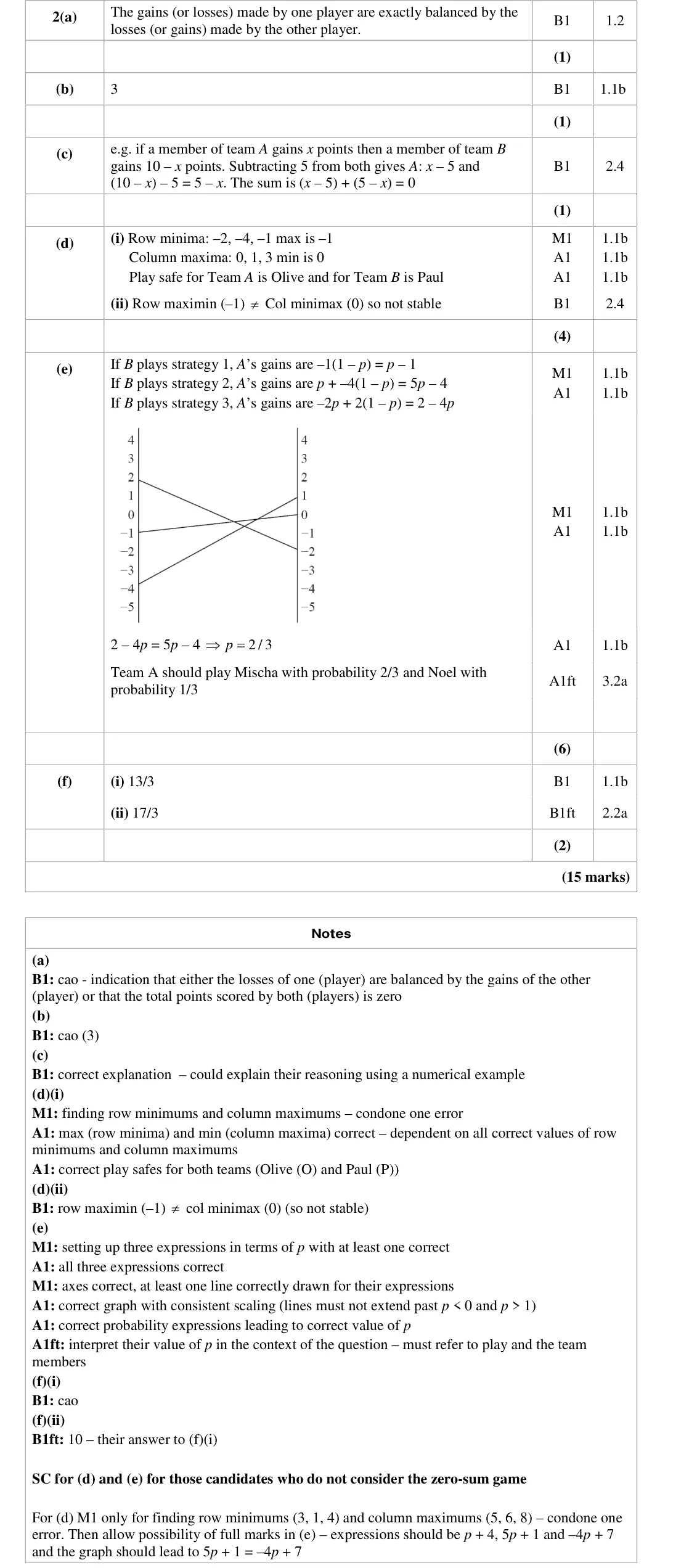
three expressions p − 1, 5p − 4, 2 − 4p
graph with lines only for 0 ≤ p ≤ 1 and consistent scales
2 − 4p = 5p − 4 gives p = 2/3: Mischa with probability 2/3, Noel 1/3
solving pairs of equations without a graph scores 0
June 2018 · AS Paper 2 (Decision 2) · Q2(f)(i)2 marks
Mark scheme (whole question; this part is marked with the orange bar)
Examiner's comment
Even though most students had the correct value of p in (e) most did not realise that part (f) specifically asked for the expected number of points awarded, per round, for both teams and instead went into ‘auto-pilot’ and simply calculate the value of the zero-sum game for both teams.
Key points from the mark scheme and examiner's report
(i) 13/3 (ii) 10 − 13/3 = 17/3
many just gave the value of the zero-sum game instead of the points awarded
Find an Edexcel Further Maths tutor
Stuck on this? Book a trial lesson with our Further Maths tutor.