D2.5.5 Optimal mixed strategies for a game with no stable solution by…

Section
D2.5 Game theory
Level
A level only
Statement
Optimal mixed strategies for a game with no stable solution by converting games to linear programming problems that can be solved by the Simplex algorithm.
Since 2018
17 parts, 61 marks · topic pages: Game theory

Back to the checklist

June 2025 · Paper 4D (Decision 2) · Q6(c) 4 marks
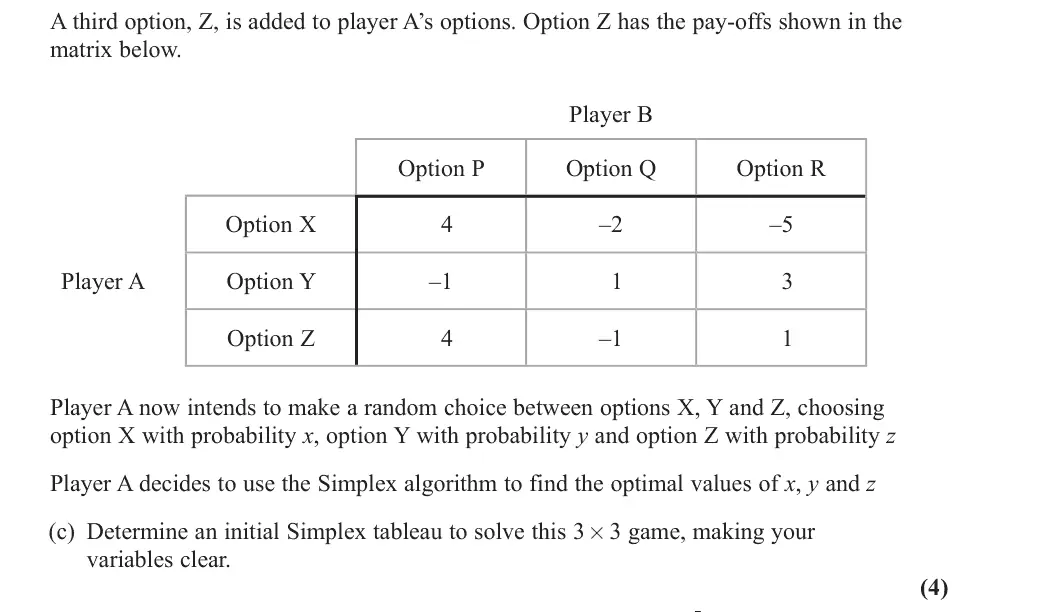
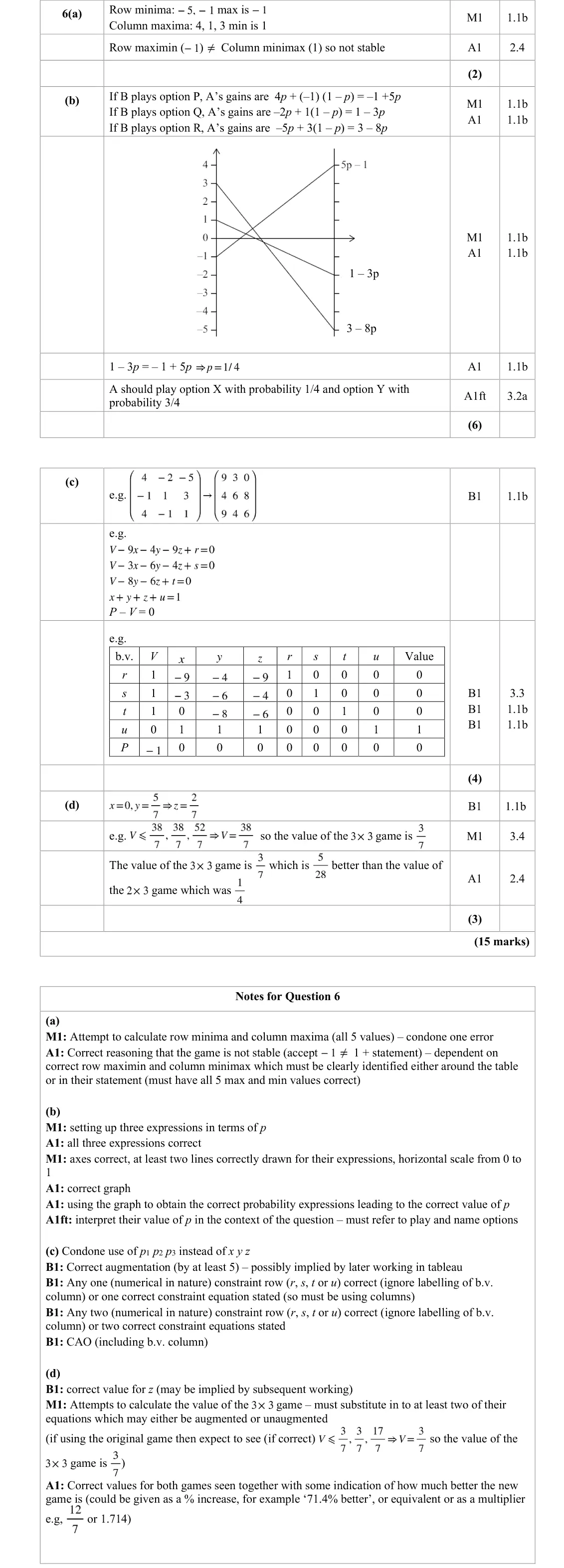
A third option, Z, is added to player A’s options. Option Z has the pay-offs shown in the matrix below. Player B Option P Option Q Option R Option X –2 –5 Player A Option Y –1 Option Z –1 Player A now intends to make a random choice between options X, Y and Z, choosing option X with probability x, option Y with probability y and option Z with probability z Player A decides to use the Simplex algorithm to find the optimal values of x, y and z (c) Determine an initial Simplex tableau to solve this 3 x 3 game, making your variables clear. (4)
June 2025 · Paper 4D (Decision 2) · Q6(d) 3 marks
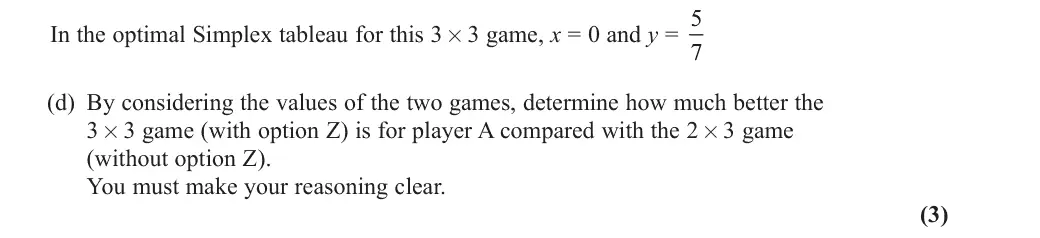
In the optimal Simplex tableau for this 3 x 3 game, x = 0 and y = 5 (d) By considering the values of the two games, determine how much better the 3 x 3 game (with option Z) is for player A compared with the 2 x 3 game (without option Z). You must make your reasoning clear. (3)
June 2024 · Paper 4D (Decision 2) · Q7(b) 5 marks
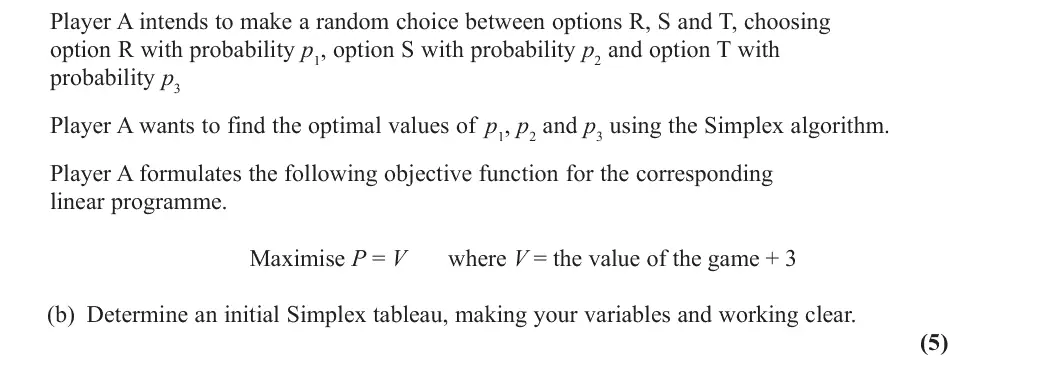
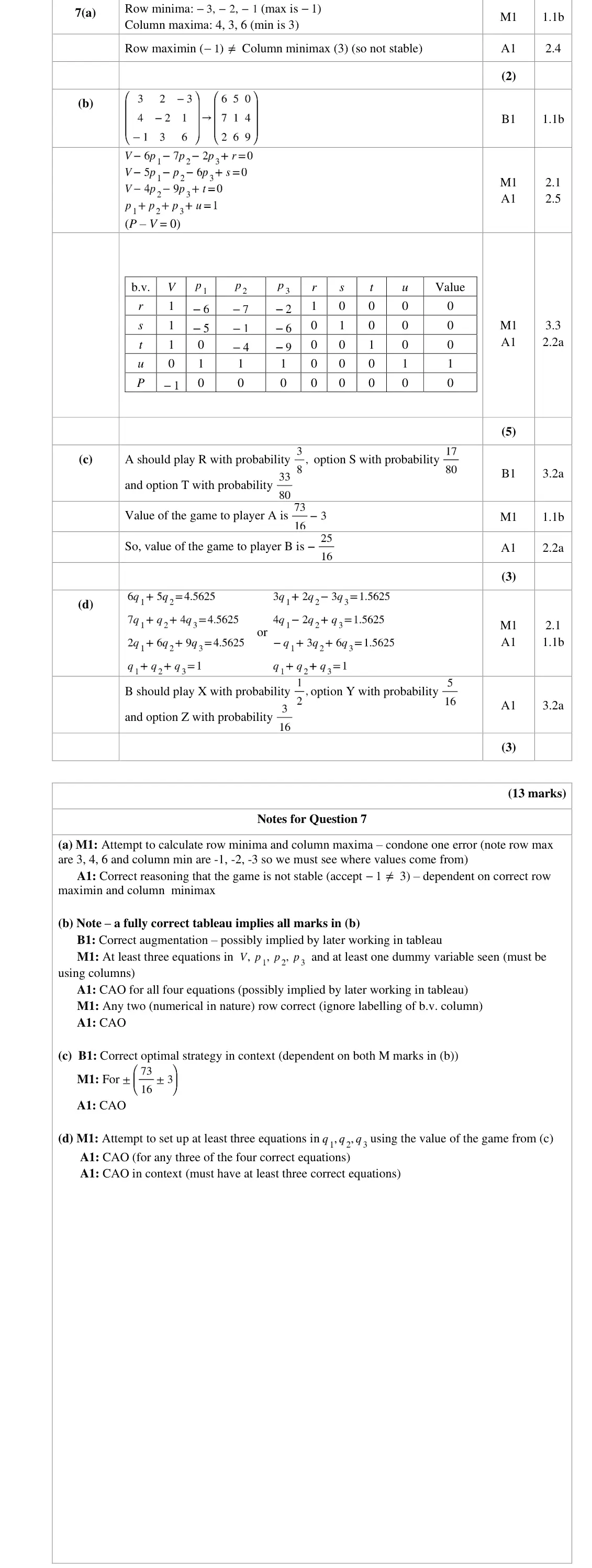
Player A intends to make a random choice between options R, S and T, choosing option R with probability p1, option S with probability p2 and option T with probability p3 Player A wants to find the optimal values of p1, p2 and p3 using the Simplex algorithm. Player A formulates the following objective function for the corresponding linear programme. Maximise P = V where V = the value of the game + 3 (b) Determine an initial Simplex tableau, making your variables and working clear. (5)
June 2024 · Paper 4D (Decision 2) · Q7(c) 3 marks
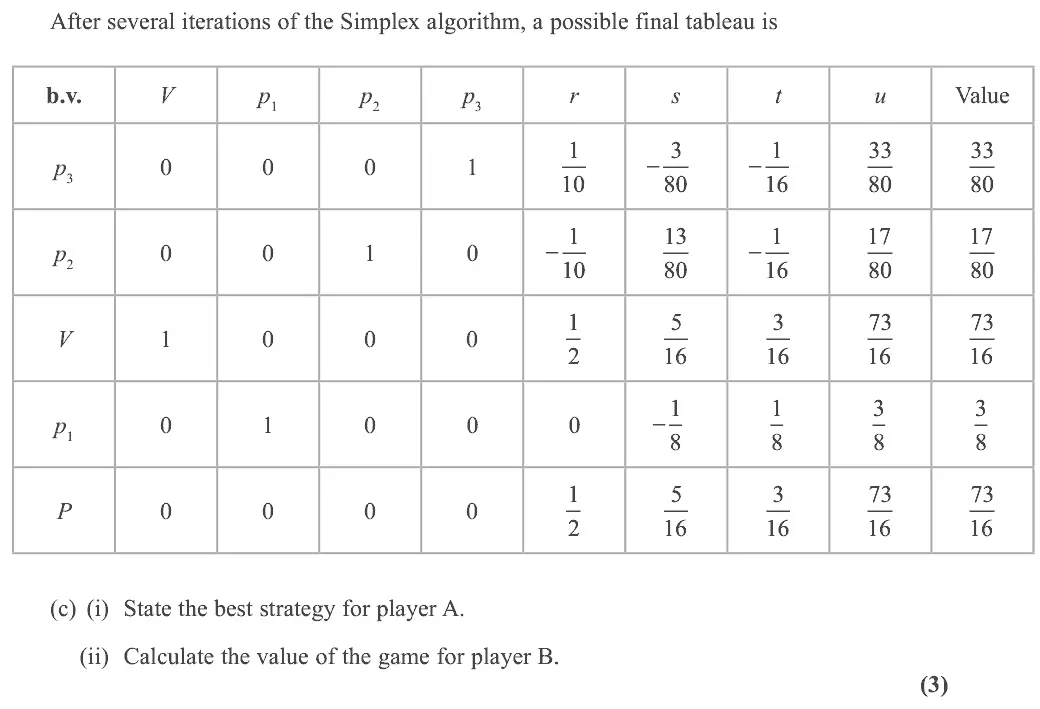
After several iterations of the Simplex algorithm, a possible final tableau is b.v. V p1 p2 p3 r s t u Value -3 -1 p3 -1 -1 p2 V -1 p1 P (c) (i) State the best strategy for player A. (ii) Calculate the value of the game for player B. (3)
June 2024 · Paper 4D (Decision 2) · Q7(d) 3 marks
Player B intends to make a random choice between options X, Y and Z. (d) Determine the best strategy for player B, making your method and working clear. (3)
June 2023 · Paper 4D (Decision 2) · Q8(c) 7 marks
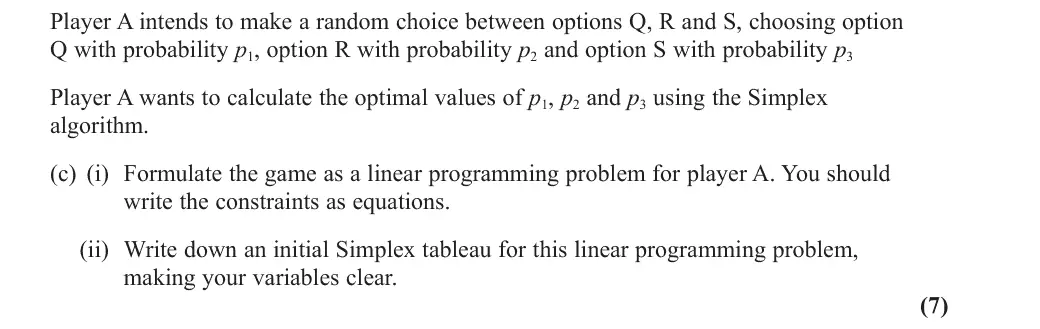
Player A intends to make a random choice between options Q, R and S, choosing option Q with probability p1, option R with probability p2 and option S with probability p3 Player A wants to calculate the optimal values of p1, p2 and p3 using the Simplex algorithm. (c) (i) Formulate the game as a linear programming problem for player A. You should write the constraints as equations. (ii) Write down an initial Simplex tableau for this linear programming problem, making your variables clear. (7)
June 2023 · Paper 4D (Decision 2) · Q8(d) 6 marks
The linear programming problem is solved using the Simplex algorithm. The optimal value of p1 and the optimal value of p2 is is (d) Find the best strategy for player B, defining any variables you use. (6)
June 2022 · Paper 4D (Decision 2) · Q7(d) 7 marks
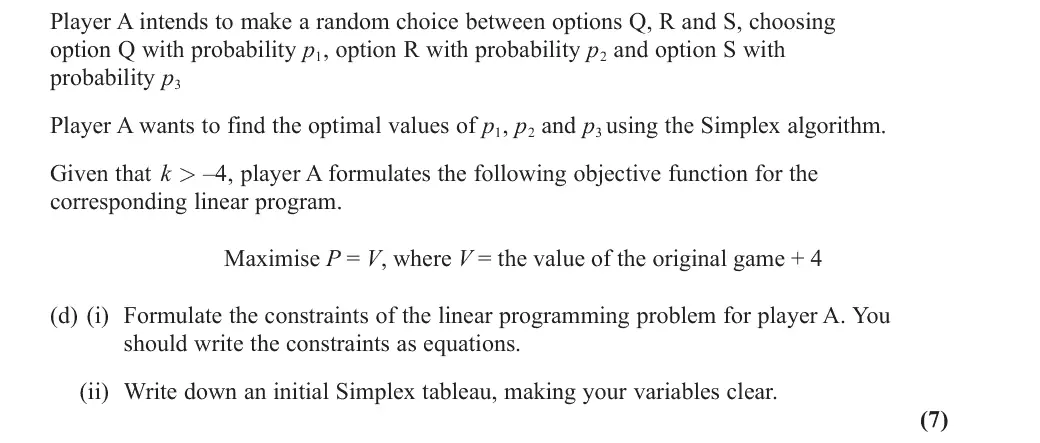
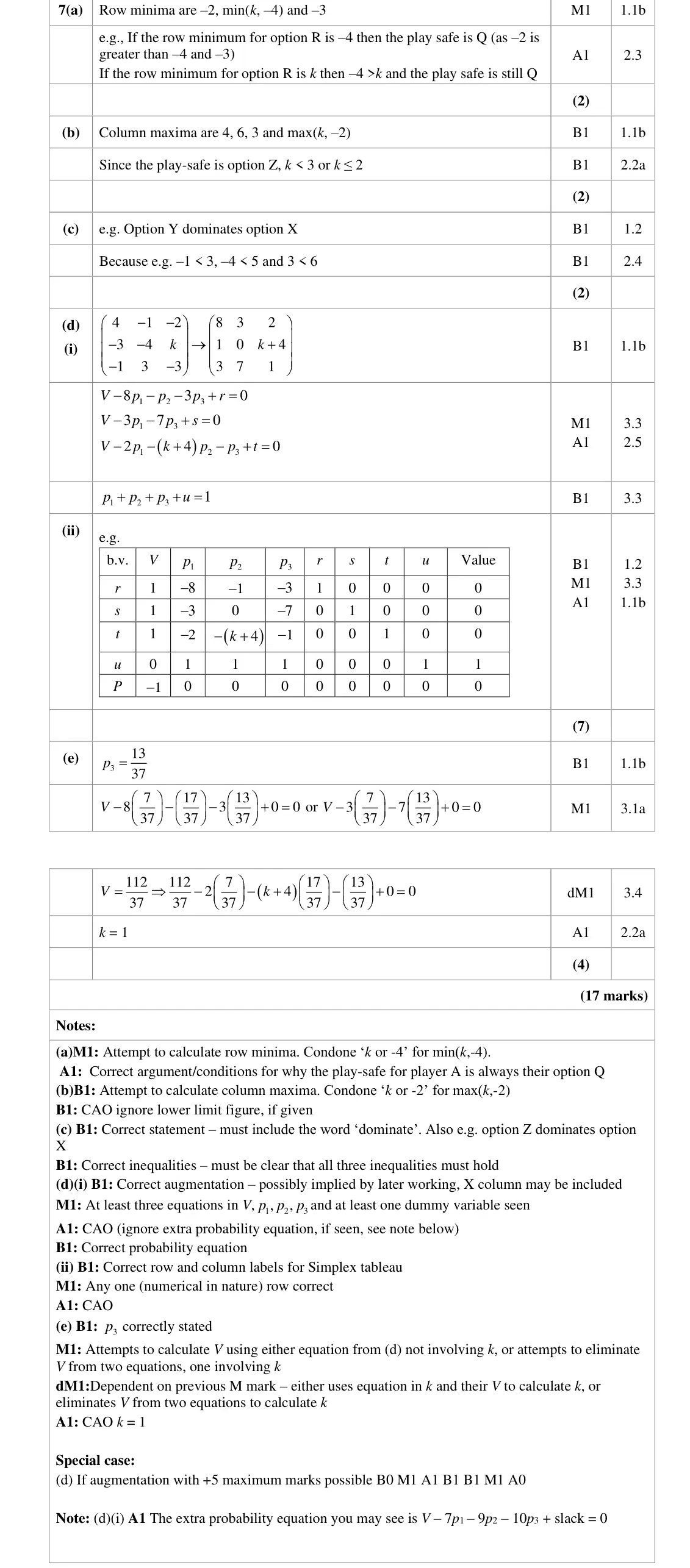
Player A intends to make a random choice between options Q, R and S, choosing option Q with probability p1, option R with probability p2 and option S with probability p3 Player A wants to find the optimal values of p1, p2 and p3 using the Simplex algorithm. Given that k > –4, player A formulates the following objective function for the corresponding linear program. Maximise P = V, where V = the value of the original game + 4 (d) (i) Formulate the constraints of the linear programming problem for player A. You should write the constraints as equations. (ii) Write down an initial Simplex tableau, making your variables clear. (7)
June 2022 · Paper 4D (Decision 2) · Q7(e) 4 marks
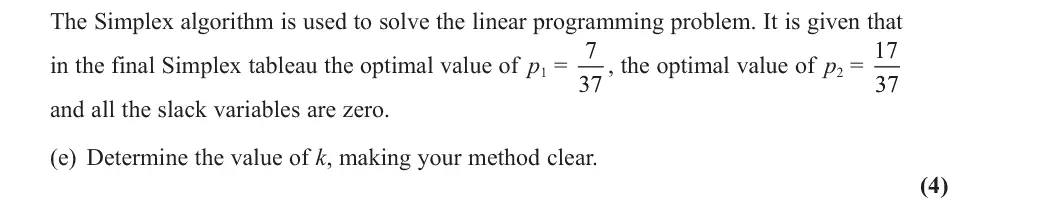
The Simplex algorithm is used to solve the linear programming problem. It is given that in the final Simplex tableau the optimal value of p1 = 7 37 , the optimal value of p2 = 17 and all the slack variables are zero. (e) Determine the value of k, making your method clear. (4)
Nov 2021 · Paper 4D (Decision 2) · Q7(a) 2 marks
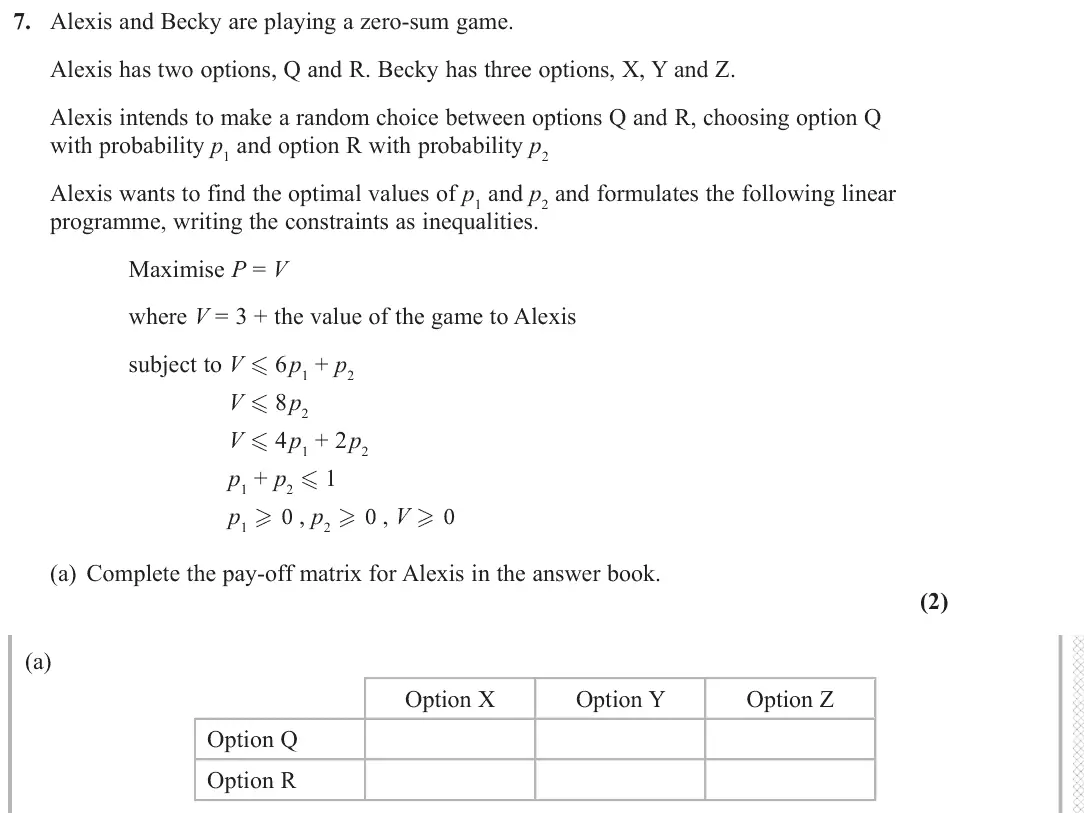
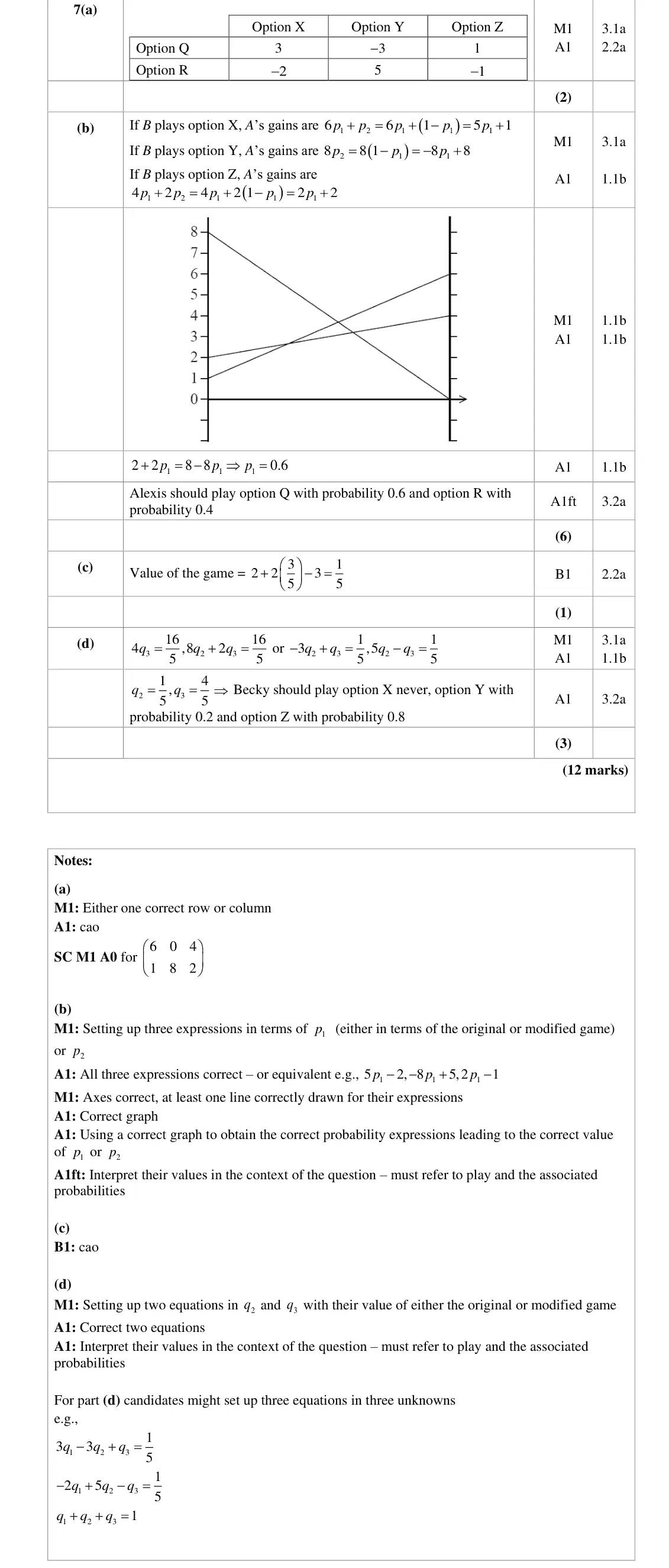
7. Alexis and Becky are playing a zero‑sum game. Alexis has two options, Q and R. Becky has three options, X, Y and Z. Alexis intends to make a random choice between options Q and R, choosing option Q with probability p1 and option R with probability p2 Alexis wants to find the optimal values of p1 and p2 and formulates the following linear programme, writing the constraints as inequalities. Maximise P = V where V = 3 + the value of the game to Alexis subject=to=$V 6p1 + p2 V 8p2 V 4p1 + 2p2 p1 + p2 1 p1 0 , p2 0 , V 0 (a) Complete the pay‑off matrix for Alexis in the answer book. (2)
Oct 2020 · Paper 4D (Decision 2) · Q6(c) 1 mark
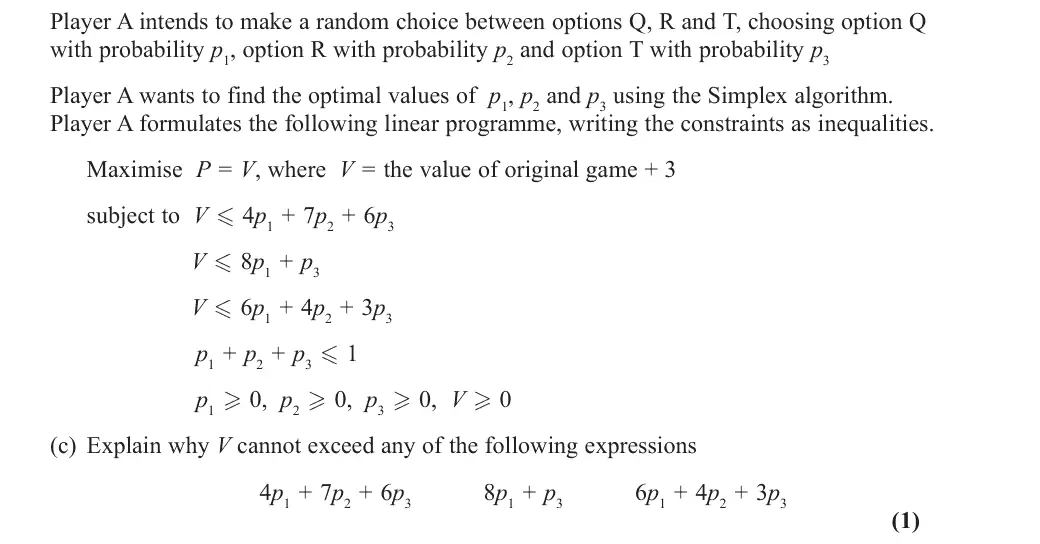
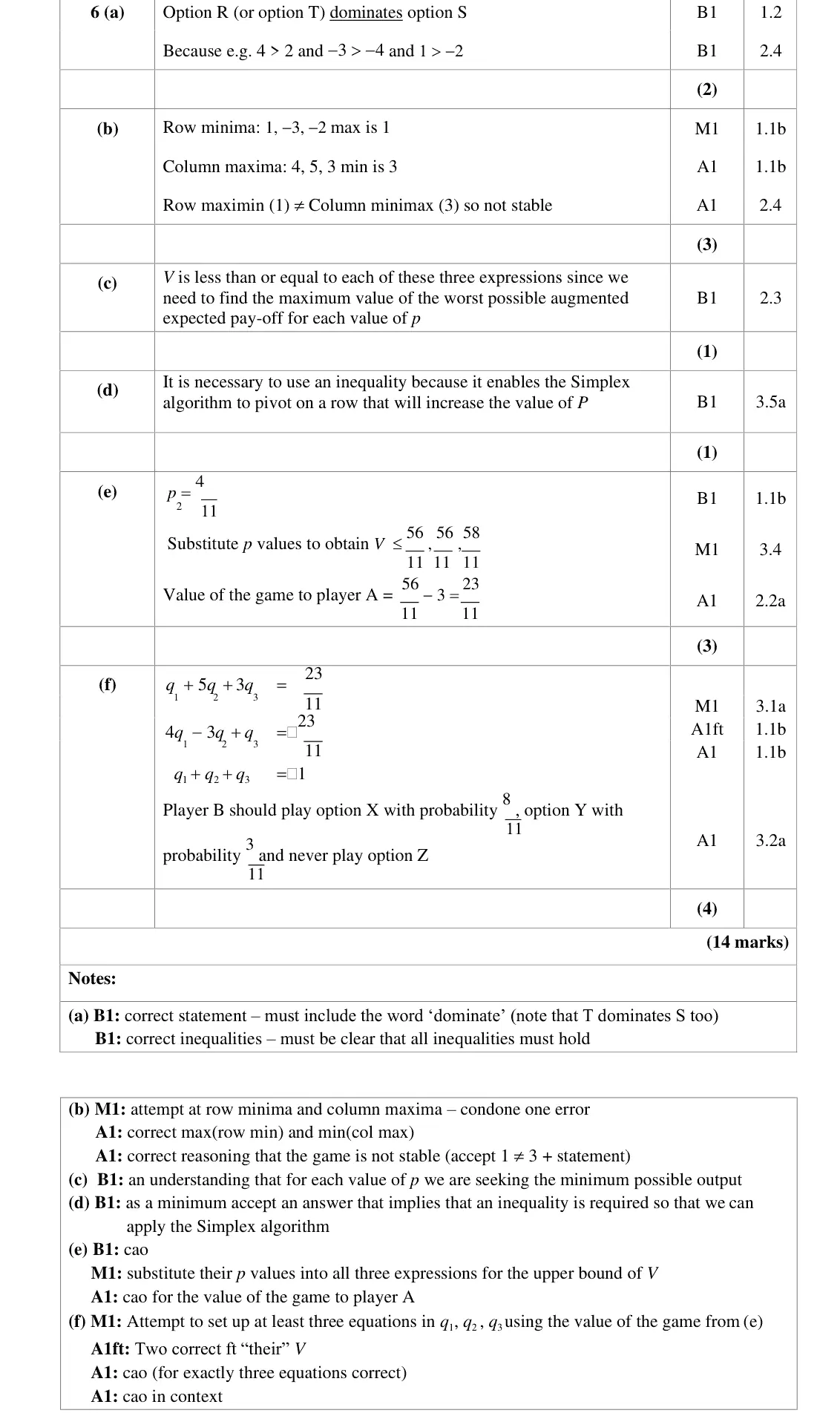
Player A intends to make a random choice between options Q, R and T, choosing option Q with probability p1, option R with probability p2 and option T with probability p3 Player A wants to find the optimal values of p1, p2 and p3 using the Simplex algorithm. Player A formulates the following linear programme, writing the constraints as inequalities. Maximise P = V, where V = the value of original game + 3 subject to V 4p1 + 7p2 + 6p3 V 8p1 + p3 V 6p1 + 4p2 + 3p3 p1 + p2 + p3 1 p1 0, p2 0, p3 0, V 0 (c) Explain why V cannot exceed any of the following expressions 4p1 + 7p2 + 6p3 8p1 + p3 6p1 + 4p2 + 3p3 (1)
Oct 2020 · Paper 4D (Decision 2) · Q6(d) 1 mark
(d) Explain why it is necessary to use the constraint p1 + p2 + p3 1 (1)
Oct 2020 · Paper 4D (Decision 2) · Q6(e) 3 marks
The Simplex algorithm is used to solve the linear programming problem. Given that the optimal value of p1 = 7 11 and the optimal value of p3 = 0 (e) calculate the value of the game to player A. (3)
Oct 2020 · Paper 4D (Decision 2) · Q6(f) 4 marks
Player B intends to make a random choice between options X, Y and Z, choosing option X with probability q1, option Y with probability q2 and option Z with probability q3 (f) Determine the optimal strategy for player B, making your working clear. (4)
June 2019 · Paper 4D (Decision 2) · Q4(b) 3 marks
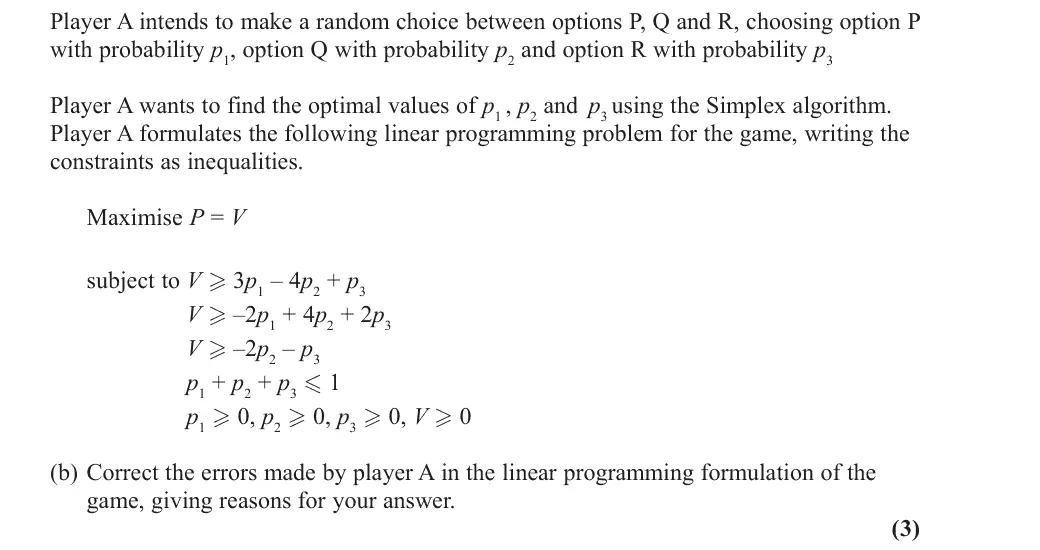
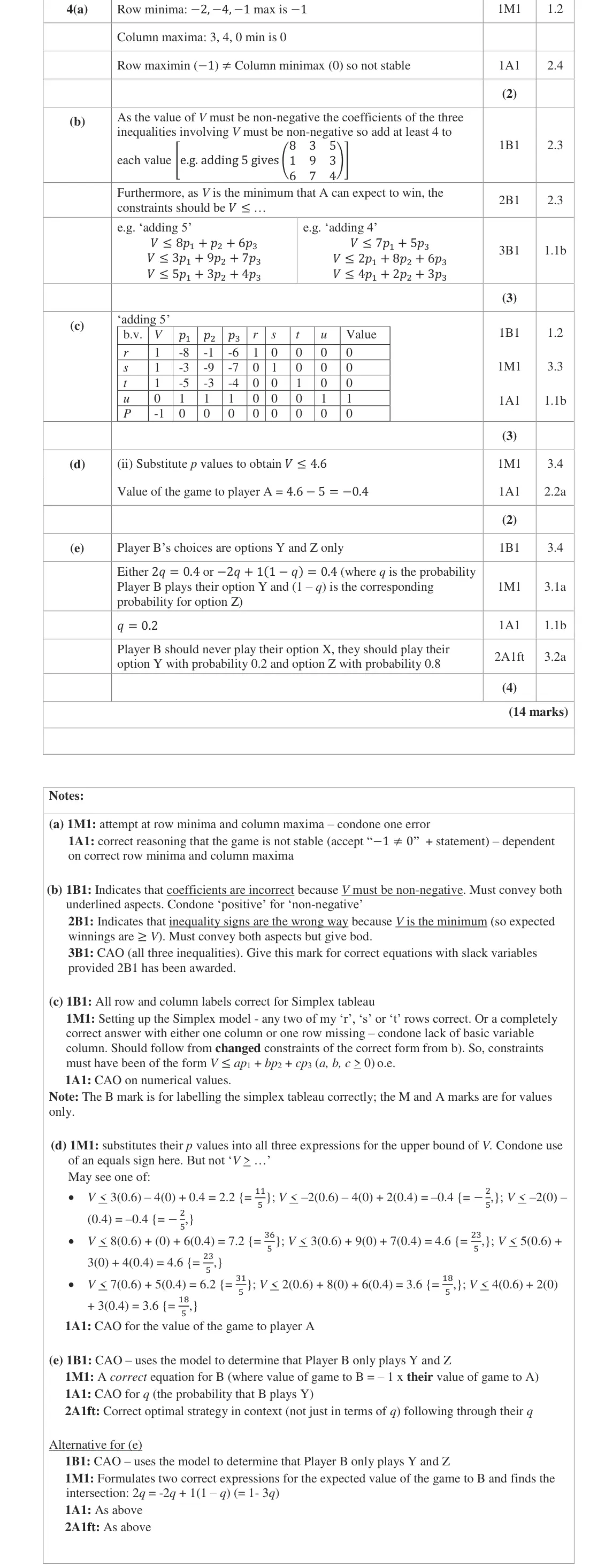
Player A intends to make a random choice between options P, Q and R, choosing option P with probability p1, option Q with probability p2 and option R with probability p3 Player A wants to find the optimal values of p1 , p2 and p3 using the Simplex algorithm. Player A formulates the following linear programming problem for the game, writing the constraints as inequalities. Maximise P = V subject to V . 3p1 – 4p2 + p3 V . –2p1 + 4p2 + 2p3 V . –2p2 – p3 p1 + p2 + p3 - 1 p1 . 0, p2 . 0, p3 . 0, V . 0 (b) Correct the errors made by player A in the linear programming formulation of the game, giving reasons for your answer. (3)
June 2019 · Paper 4D (Decision 2) · Q4(c) 3 marks
(c) Write down an initial Simplex tableau for the corrected linear programming problem. (3)
June 2019 · Paper 4D (Decision 2) · Q4(d) 2 marks
The Simplex algorithm is used to solve the corrected linear programming problem. The optimal values are p1 = 0.6, p2 = 0 and p3= 0.4 (d) Calculate the value of the game to player A. (2)

Find an Edexcel Further Maths tutor

Stuck on this? Book a trial lesson with our Further Maths tutor.

Prefer email? Send an enquiry

If you are under 18, please include a parent's contact details. Enquiries go to enquiries@alevelfurthermathstutor.com and are deleted once handled.