FM2.1.1 Angular speed. v = rω. Uniform motion of a particle moving in a…
Section
FM2.1 Motion in a circle
Level
AS & A level
Statement
Angular speed. v = rω. Uniform motion of a particle moving in a horizontal circle. Radial acceleration in circular motion. The forms rω² and v²/r are required.
Guidance
Problems involving the ‘conical pendulum’, an elastic string, motion on a banked surface, as well as other contexts, may be set.
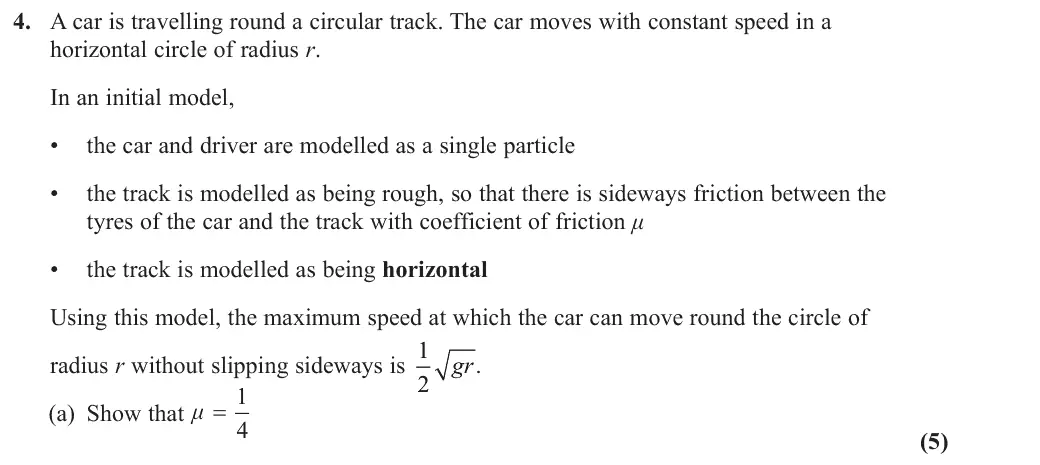
June 2025 · AS Paper 2 (Further Mechanics 2) · Q4(a)5 marks
Mark scheme (whole question; this part is marked with the orange bar)
Examiner's comment
(a) Although this printed answer was reached by the majority of learners, responses varied in the level of accuracy and structure. The strongest responses stated what equations were being used while weaker ones often made false claims about equality of expressions or had a great deal of working crossed (or cancelled) out so that sometimes the only visible writing was the printed answer. Better responses realised that for five marks some evidence of working before reaching the conclusion was needed.
Key points from the mark scheme and examiner's report
R = mg
F = m(gr/4)/r = mg/4 at maximum speed
F = μR gives μ = 1/4
show the equations used, not just the printed answer
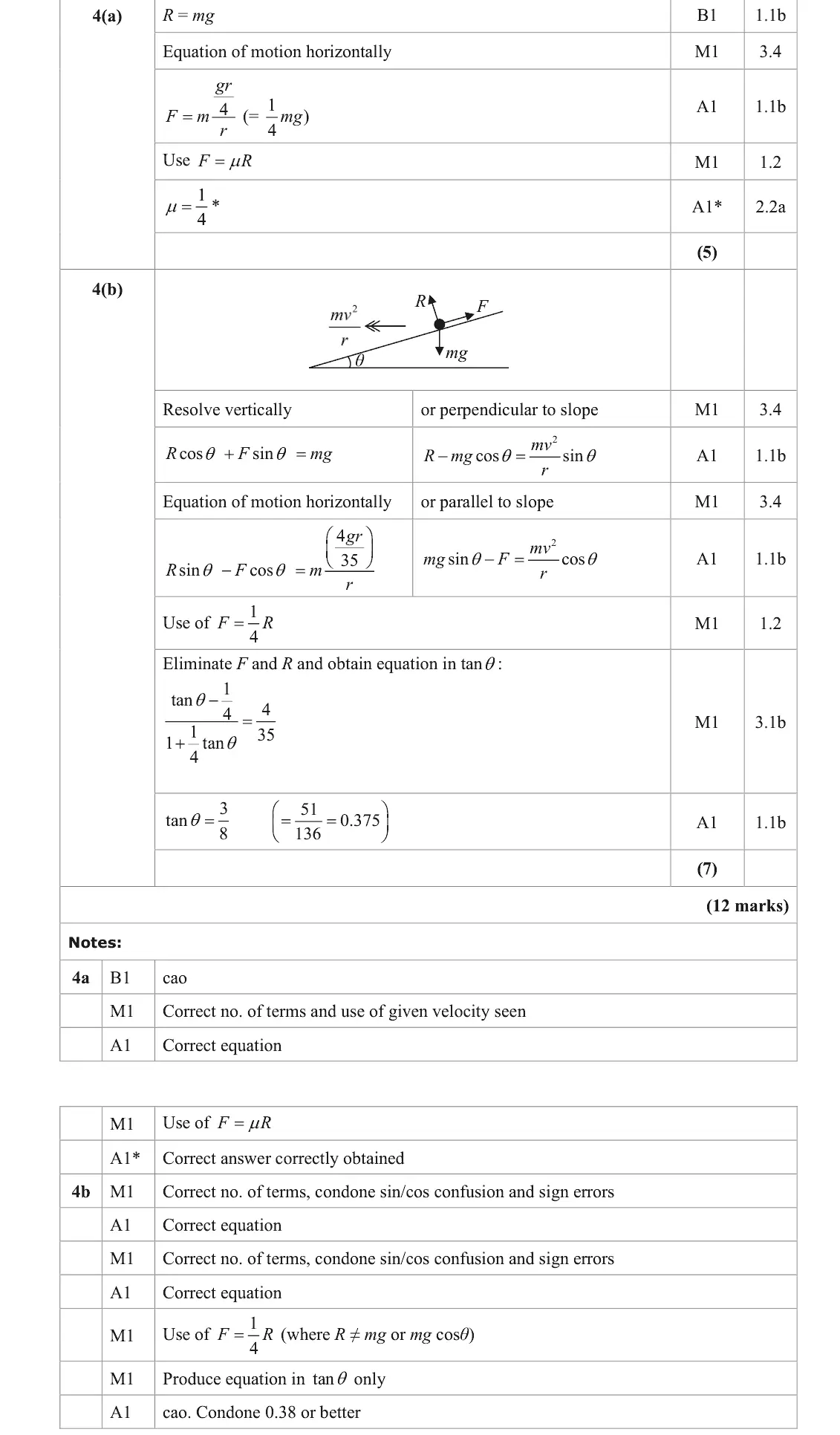
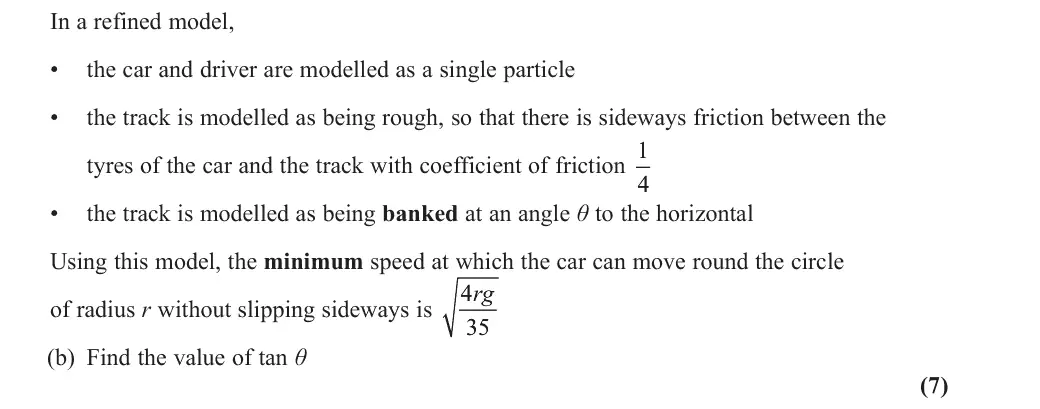
June 2025 · AS Paper 2 (Further Mechanics 2) · Q4(b)7 marks
Mark scheme (whole question; this part is marked with the orange bar)
Examiner's comment
(b) This proved a challenge for a notable proportion of learners, although many strong responses were seen. Weaker responses often assumed that there was no resultant force perpendicular to the slope, or that the acceleration acted parallel to the slope. Other responses had friction acting down the slope. A number of responses setup correct equations in two directions but were not then able to successfully eliminate unknowns to achieve an equation in tan theta .
Key points from the mark scheme and examiner's report
minimum speed so friction acts UP the slope
R cos θ + F sin θ = mg, R sin θ − F cos θ = mv²/r with F = R/4 and v² = 4rg/35
eliminate to (tan θ − 1/4)/(1 + tan θ/4) = 4/35, tan θ = 3/8
some assumed no resultant perpendicular to the slope
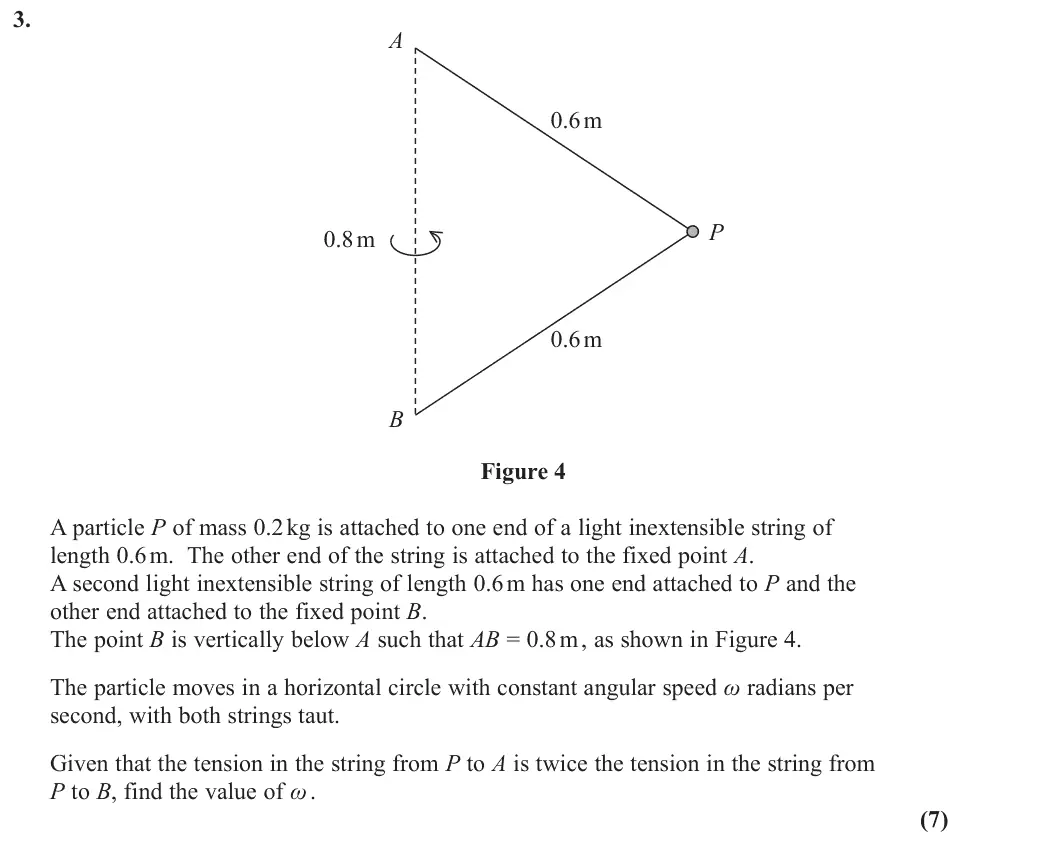
June 2025 · Paper 4C (Further Mechanics 2) · Q37 marks
Mark scheme (whole question; this part is marked with the orange bar)
Examiner's comment
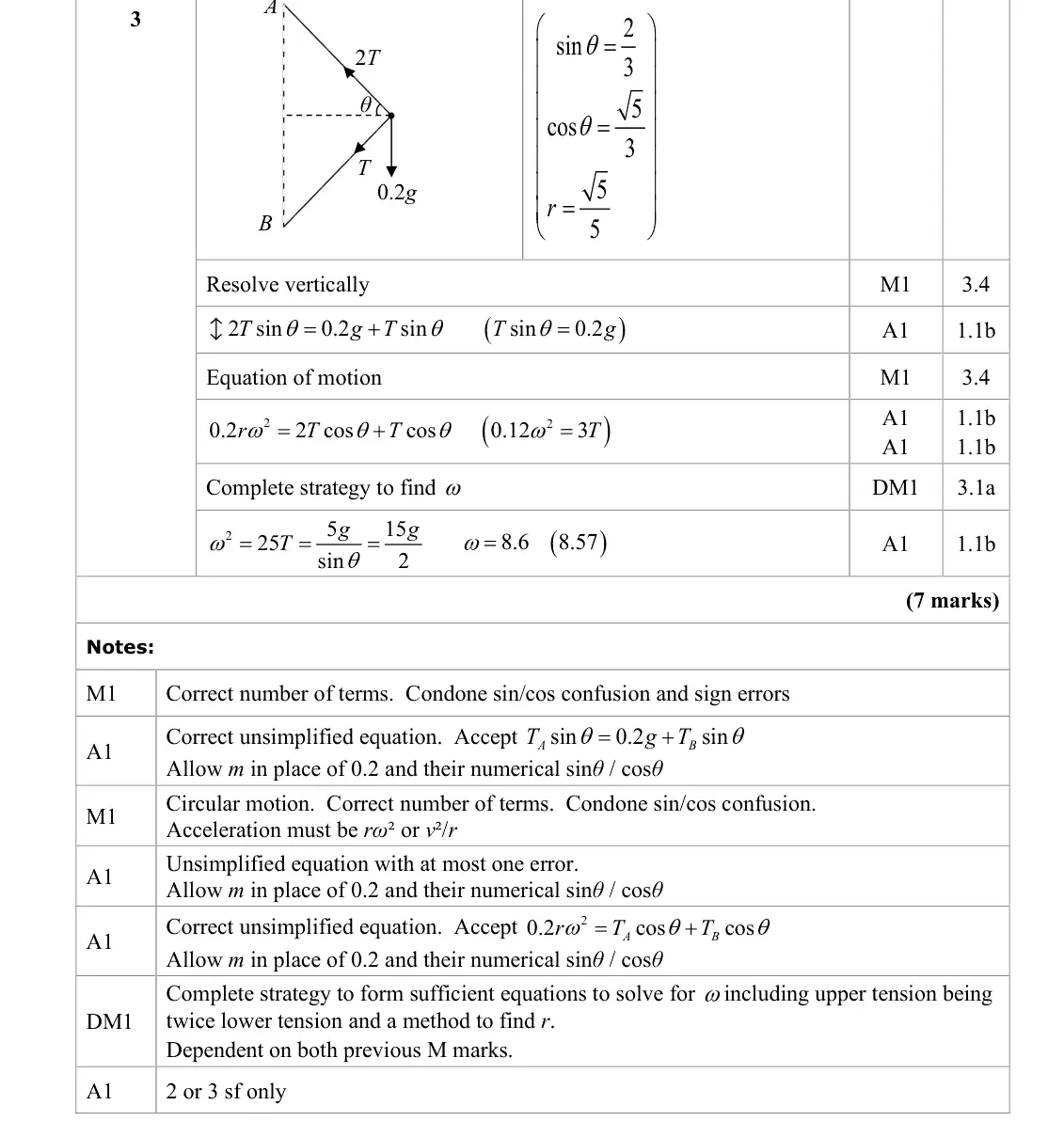
Although this was an unstructured question most candidates had good ideas of how to solve it. Stronger responses were rather short and similar to the mark scheme, but a significant proportion made calculation errors at the end or gave an over-accurate answer. Weaker responses tended to either assume equilibrium horizontally or along one of the strings and a number were unsure of the formulae for circular motion.
Key points from the mark scheme and examiner's report
geometry: sin θ = 2/3 (θ from horizontal), r = √5/5 m
vertically 2T sin θ = 0.2g + T sin θ
horizontally 0.2rω² = 3T cos θ
ω² = 15g/2, ω = 8.6 (2 or 3 s.f.)
common errors assuming equilibrium horizontally or along a string
June 2024 · AS Paper 2 (Further Mechanics 2) · Q2(a)6 marks
Mark scheme (whole question; this part is marked with the orange bar)
Examiner's comment
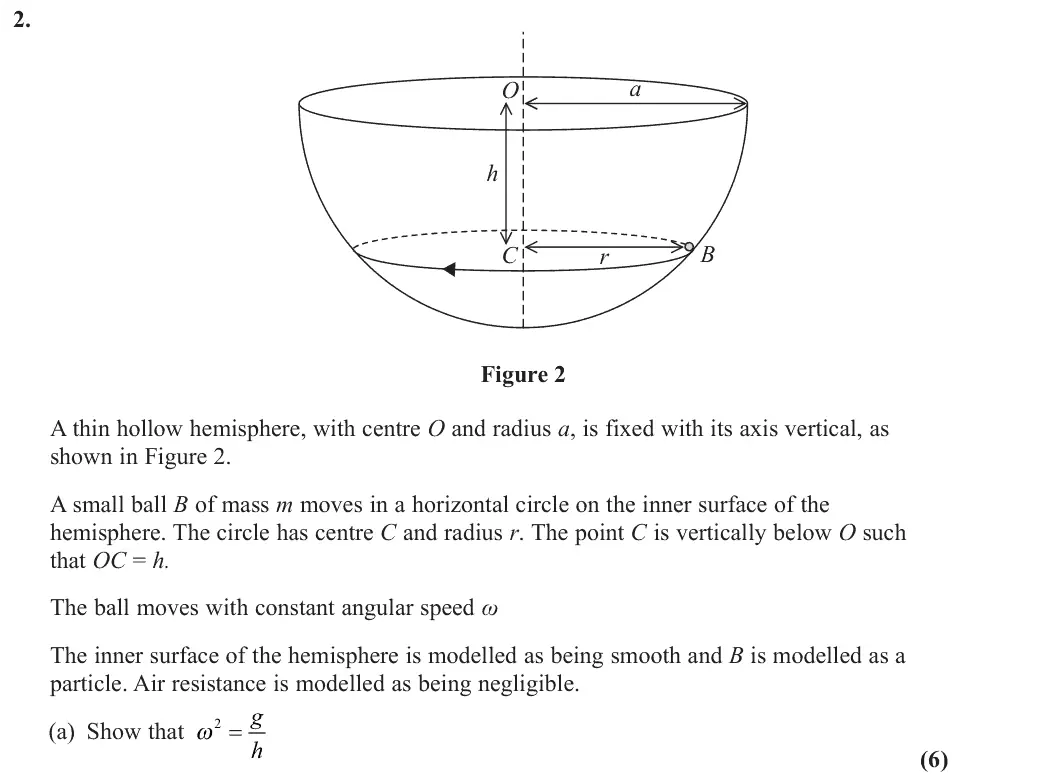
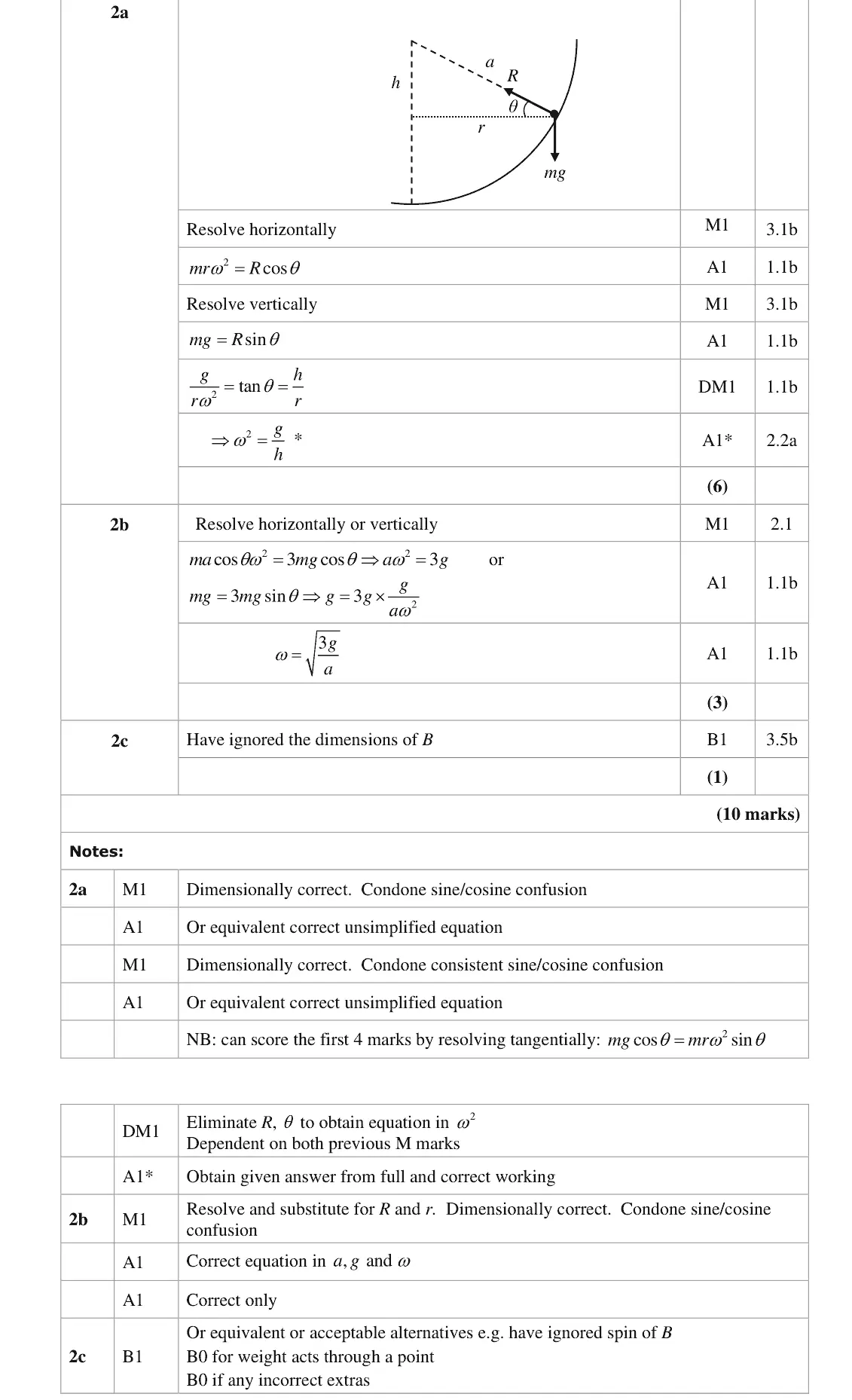
(a) Most candidates recognised the need to resolve forces and while the majority did so horizontally and vertically, common errors included equating R to sin mg . A significant number of candidates who resolved correctly were then unable to apply the geometry of the situation to change their equation in r or a to one in h.
Key points from the mark scheme and examiner's report
R acts along the radius towards O
horizontally mrω² = R cos θ, vertically mg = R sin θ
tan θ = h/r eliminates θ to give ω² = g/h
R = mg sin θ is a common error
June 2024 · AS Paper 2 (Further Mechanics 2) · Q2(b)3 marks
Mark scheme (whole question; this part is marked with the orange bar)
Examiner's comment
(b) A large number of candidates did not attempt part (b) but it was well answered by those who did, including those who had not completed part (a). A common error was to change the weight of the particle to 3mg.
Key points from the mark scheme and examiner's report
horizontally m(a cos θ)ω² = 3mg cos θ so aω² = 3g, ω = √(3g/a)
the weight stays mg (not 3mg)
June 2024 · AS Paper 2 (Further Mechanics 2) · Q2(c)1 mark
Mark scheme (whole question; this part is marked with the orange bar)
Examiner's comment
(c) Common incorrect answers included claiming that the particle had no mass/weight or that there was no friction.
Key points from the mark scheme and examiner's report
the dimensions (size) of B have been ignored
"no mass", "no friction" or "weight acts at a point" score 0
June 2024 · Paper 4C (Further Mechanics 2) · Q3(a)6 marks
Mark scheme (whole question; this part is marked with the orange bar)
Examiner's comment
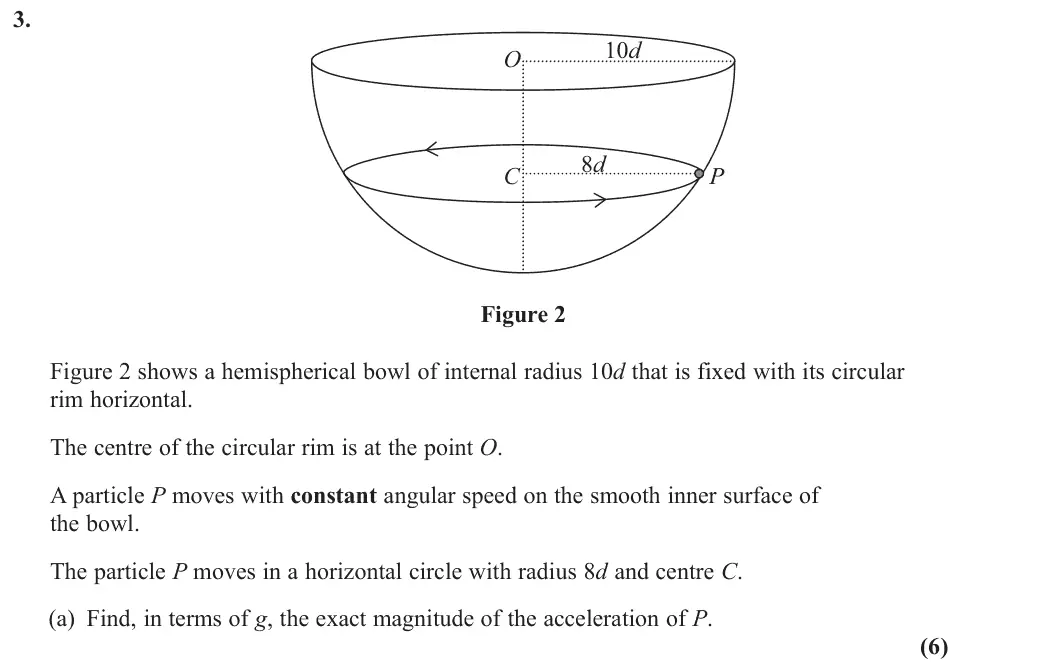
(a) This question was successfully completed by most candidates, although some used rather lengthy methods with duplication of work and unnecessary geometric reasoning. A number formed the first two equations but then could not use the geometry of the situation or assumed an incorrect angle theta (usually 45°), so scored no more marks. A small number of candidates successfully resolved radially and tangentially, but in general the majority who attempted this approach incorrectly assumed equilibrium in one of these directions. A significant minority of candidates successfully achieved the correct result then went on to find the resultant of 4 3 g and the gravitational g: this was only penalised by the loss of the final mark.
Key points from the mark scheme and examiner's report
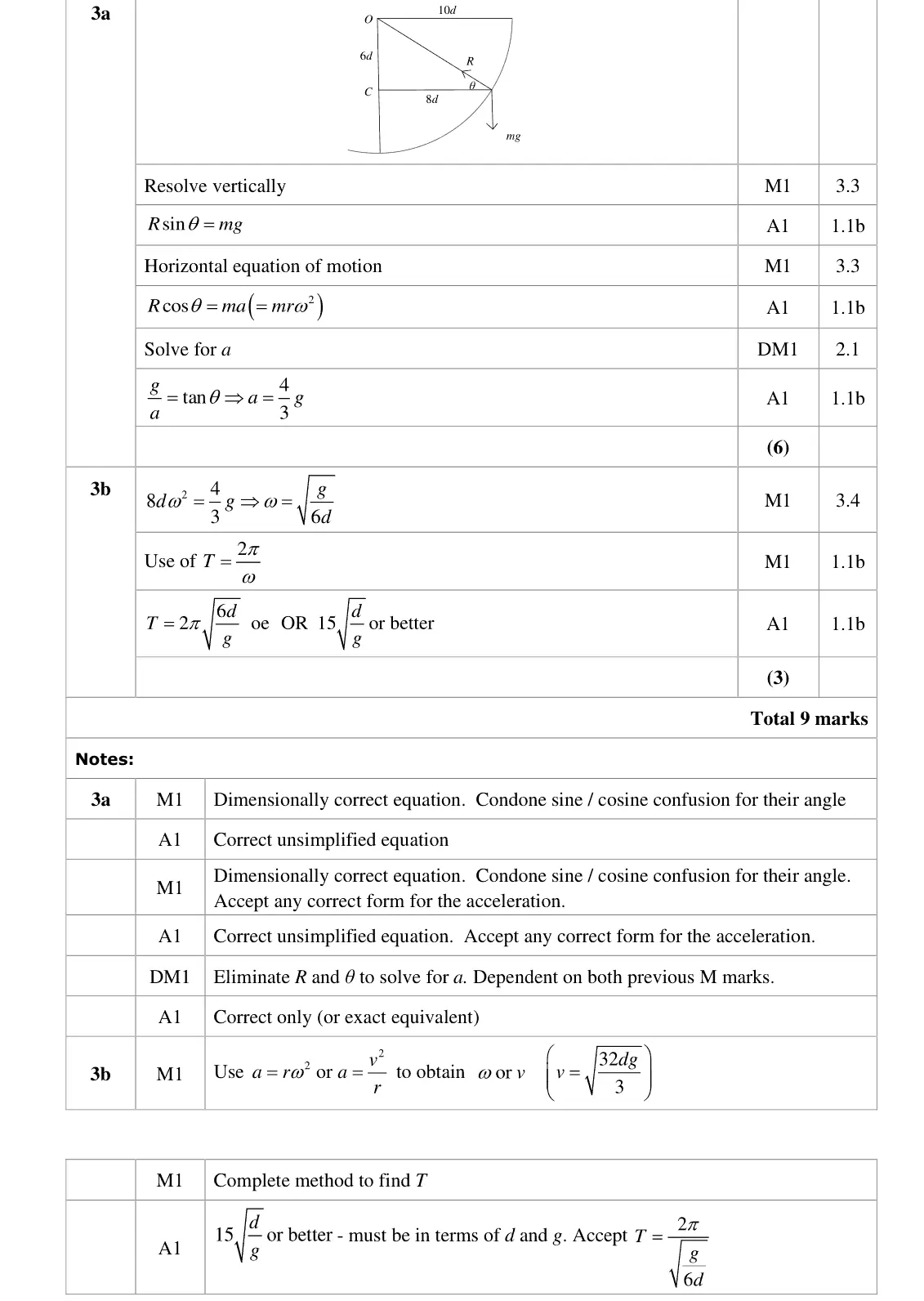
R through O
OC = 6d by Pythagoras
R sin θ = mg, R cos θ = ma
a = g/tan θ = 4g/3 exact
common errors assuming θ = 45° or combining with g at the end
June 2024 · Paper 4C (Further Mechanics 2) · Q3(b)3 marks
Mark scheme (whole question; this part is marked with the orange bar)
Examiner's comment
(b) Most candidates were successful in this part and even when not the majority knew the formula for the time period. A small number of unsuccessful candidates made some attempt to compare linear and angular velocities, via the use of 2 pi r, but got confused in their algebra or used an incorrect radius.
Key points from the mark scheme and examiner's report
8dω² = 4g/3 so ω = √(g/6d)
T = 2π/ω = 2π√(6d/g) ≈ 15√(d/g)
June 2023 · AS Paper 2 (Further Mechanics 2) · Q39 marks
Mark scheme (whole question; this part is marked with the orange bar)
Examiner's comment
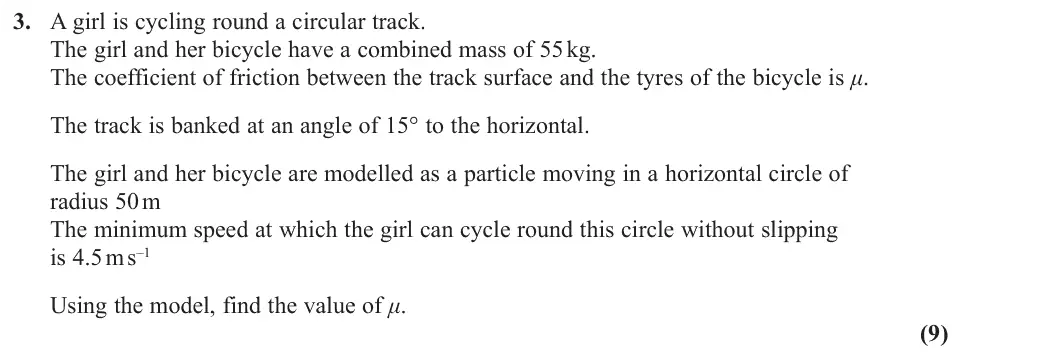
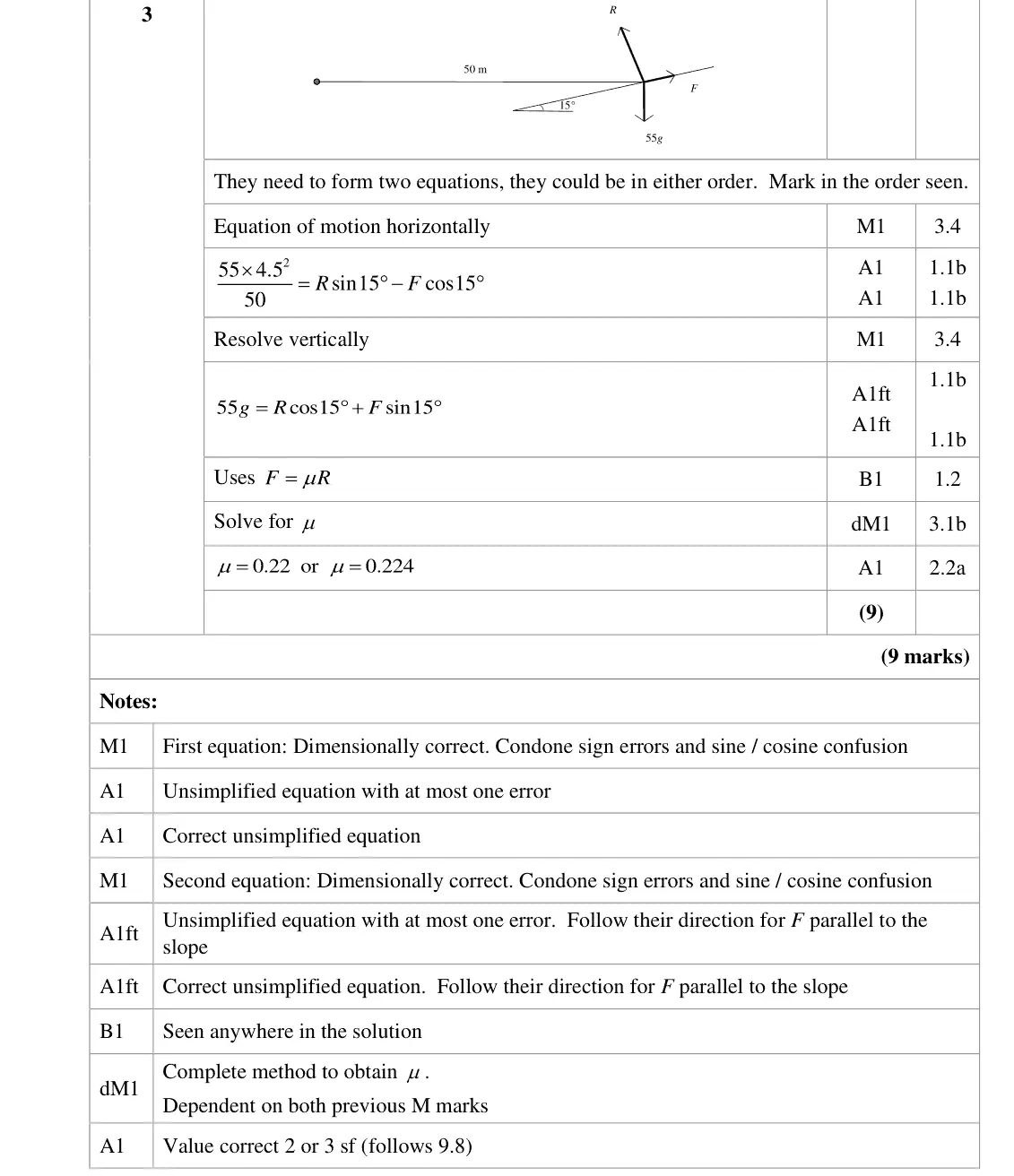
The majority of candidates recognised that they needed to resolve the forces acting on the cyclist. The first difficulty was to understand that at minimum speed the friction will be acting up the slope (and parallel to the slope). Those candidates who attempted to resolve horizontally and vertically usually obtained equations of the correct form. Only a small number of candidates who attempted to resolve parallel and perpendicular to the slope made any useful progress. Many candidates started with the incorrect equation 55 cos15 , R g = with no indication of any understanding that they needed to include a component of the acceleration in this equation. Most candidates did try to use the equation for motion in a horizontal circle at some point in their response. The solution of this problem requires the substitution of a value for g, so final answers given to more than 3 significant figures were not accepted.
Key points from the mark scheme and examiner's report
at minimum speed friction acts UP the slope
horizontally 55(4.5²)/50 = R sin 15° − F cos 15°
vertically 55g = R cos 15° + F sin 15°
F = μR gives μ = 0.22
R = 55g cos 15° (ignoring acceleration) is a common error
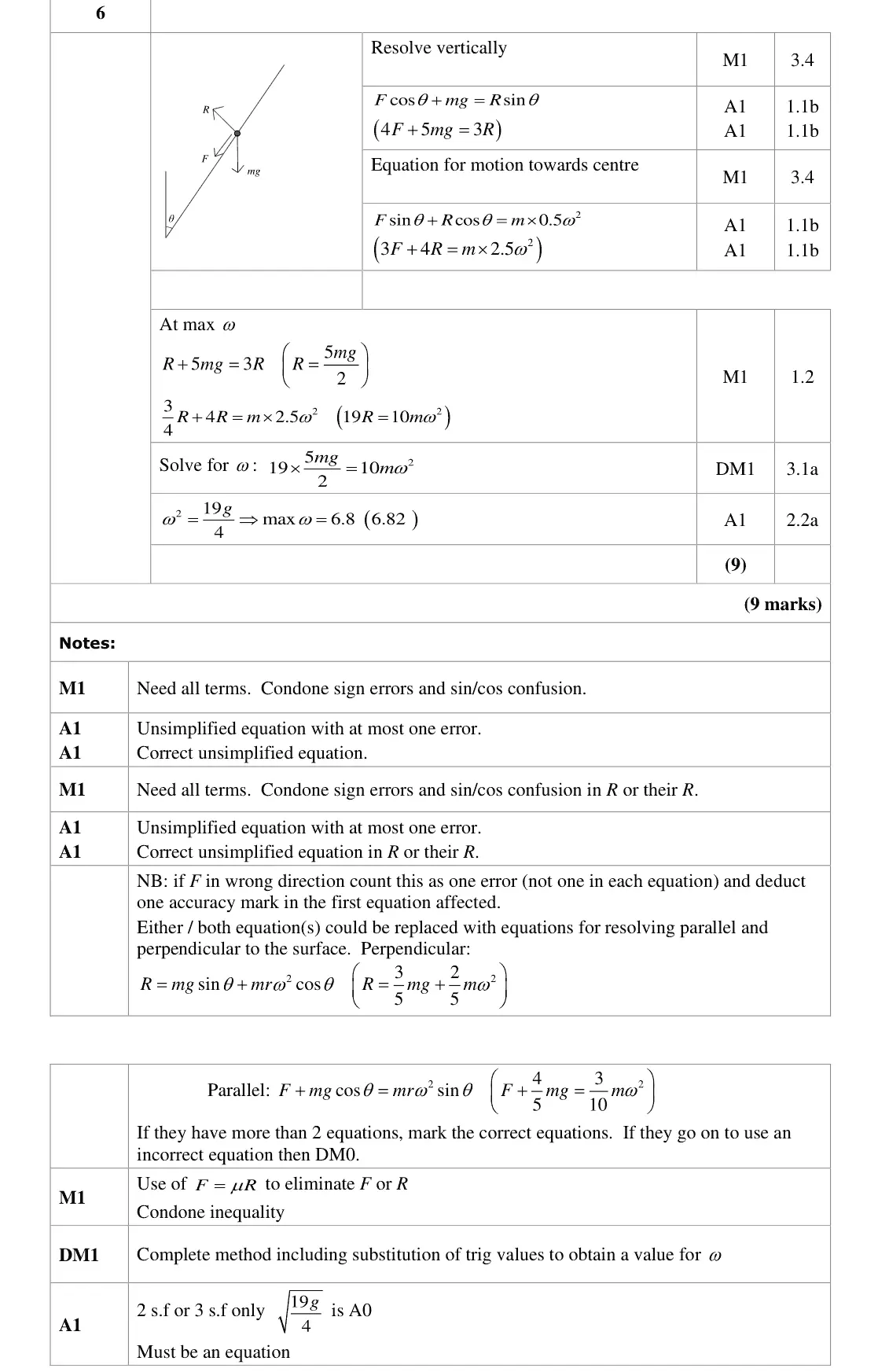
June 2023 · Paper 4C (Further Mechanics 2) · Q69 marks
Mark scheme (whole question; this part is marked with the orange bar)
Examiner's comment
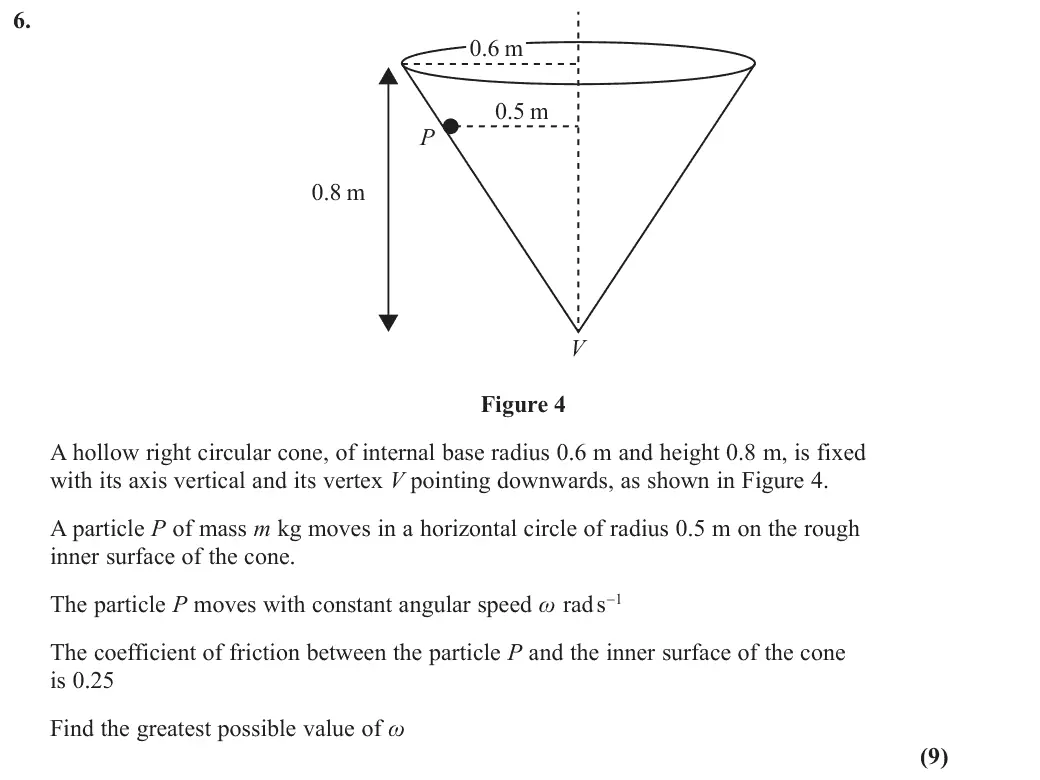
There were several clear and concise solutions of this question. Those candidates who chose to resolve parallel and perpendicular to the surface of the cone often forgot the component of the acceleration in one or both of their equations. Some candidates had the force due to the friction acting in the wrong direction – a few who were uncertain of the correct direction tried both options to be certain of which one gave the greater value of . As in question 4, there were candidates who resolved vertically to obtain the incorrect equation cos . R mg = Those candidates who left the answer as 19 4 g did not score the final A mark.
Key points from the mark scheme and examiner's report
at max ω friction acts down the slope and is limiting
vertically F cos θ + mg = R sin θ, horizontally F sin θ + R cos θ = m(0.5)ω² with F = 0.25R, tan θ = 3/4
ω² = 19g/4, ω = 6.8
common errors omitting acceleration components, friction in the wrong direction, R cos θ = mg
exact √(19g/4) not accepted
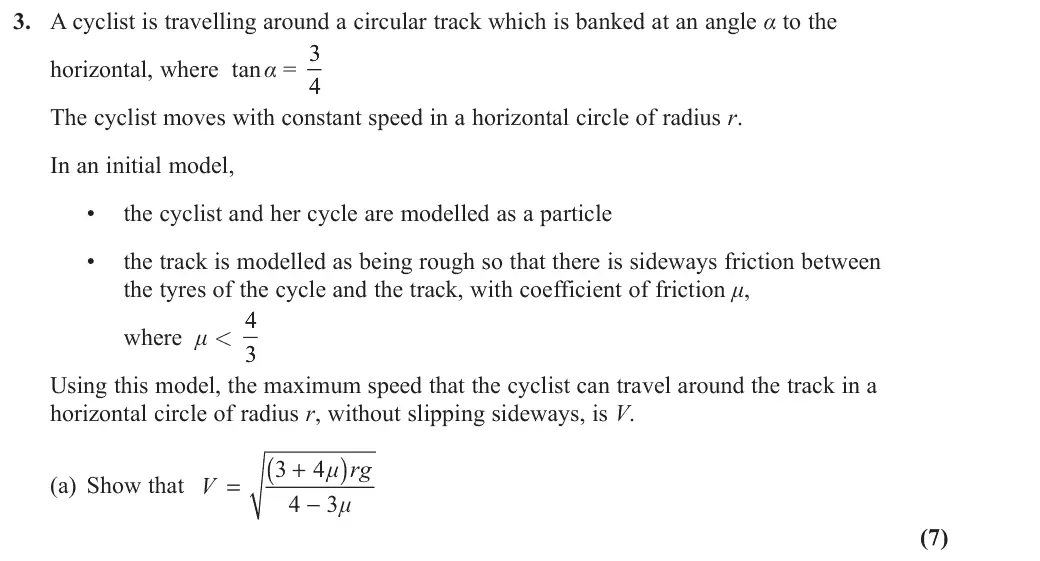
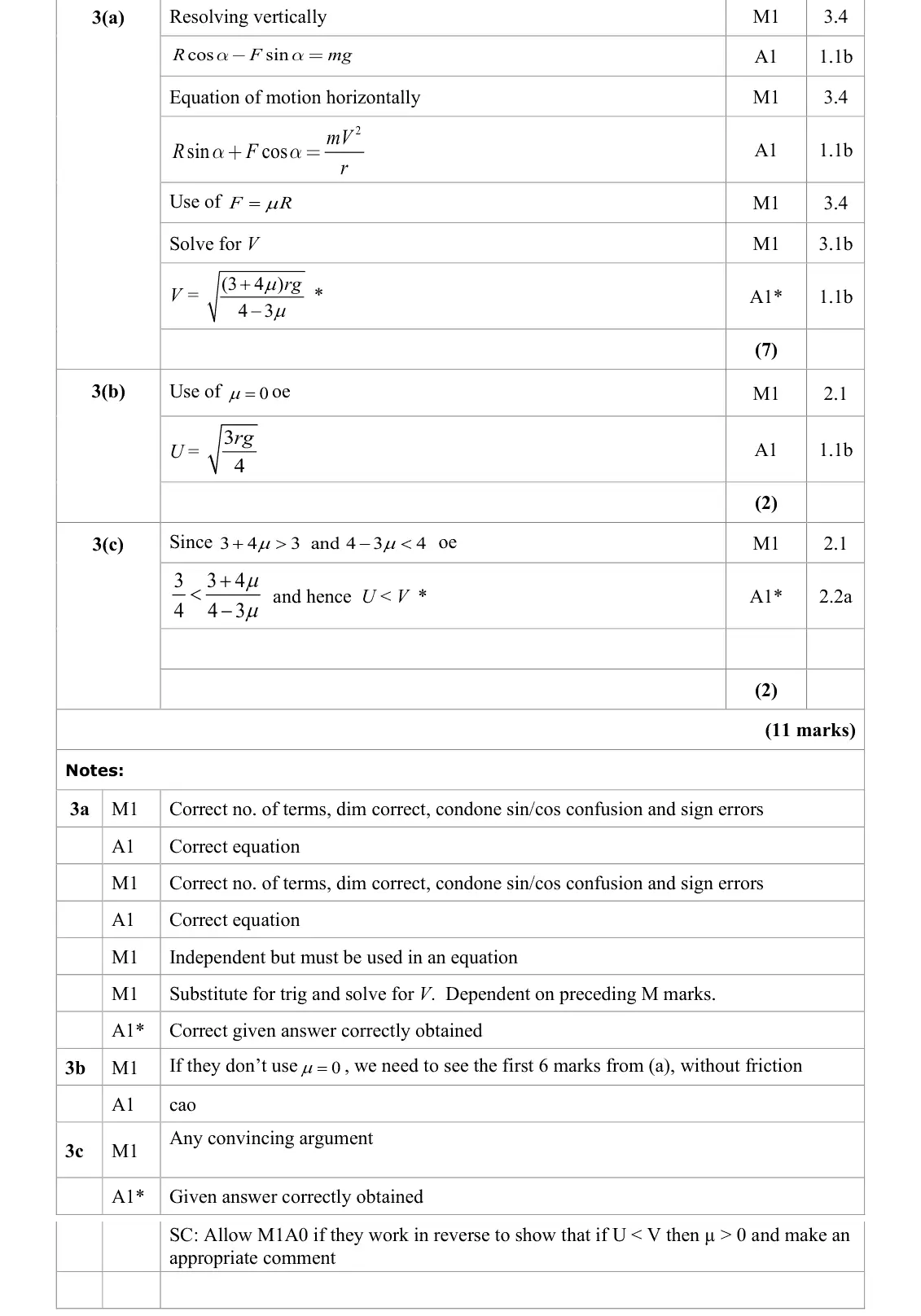
June 2022 · AS Paper 2 (Further Mechanics 2) · Q3(a)7 marks
Mark scheme (whole question; this part is marked with the orange bar)
Examiner's comment
(a) There were several completely blank pages responses to this question and others which demonstrated little understanding of the problem. The majority of candidates did start with an attempt to resolve. Some responses included no mention of friction at all and the cos cos errors and were common. Those candidates who resolved R mg R mg alpha = alpha = successfully in both directions usually went on to reach the given answer. 0 substitute into the given answer for part (a). mu =
Key points from the mark scheme and examiner's report
maximum speed so friction acts down the slope: R cos α − F sin α = mg and R sin α + F cos α = mV²/r with F = μR
sin/cos errors and missing friction common
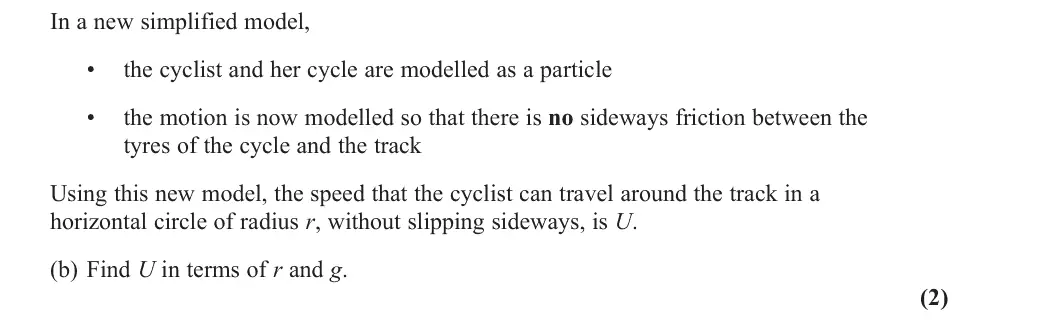
June 2022 · AS Paper 2 (Further Mechanics 2) · Q3(b)2 marks
Mark scheme (whole question; this part is marked with the orange bar)
Examiner's comment
(b) Many candidates obtained the correct answer, but the majority did so by starting again and resolving in both directions again. Very few realised that they simply needed to 0 substitute into the given answer for part (a). mu =
Key points from the mark scheme and examiner's report
put μ = 0 in the answer to (a): U = √(3rg/4)
most needlessly resolved again
June 2022 · AS Paper 2 (Further Mechanics 2) · Q3(c)2 marks
Mark scheme (whole question; this part is marked with the orange bar)
Examiner's comment
(c) The majority of candidates did not understand what they needed to do to obtain this result. Some tried substituting values for mu to test the statement. Several candidates 3 , mentioned in the question, should be part of the solution. A few thought that the value 4 0, worked backwards, showing that if U then which is true, but does not answer mu > V < the question as written.
Key points from the mark scheme and examiner's report
3 + 4μ > 3 and 4 − 3μ < 4 so (3 + 4μ)/(4 − 3μ) > 3/4
testing values of μ is not a proof
working backwards earns M1 only
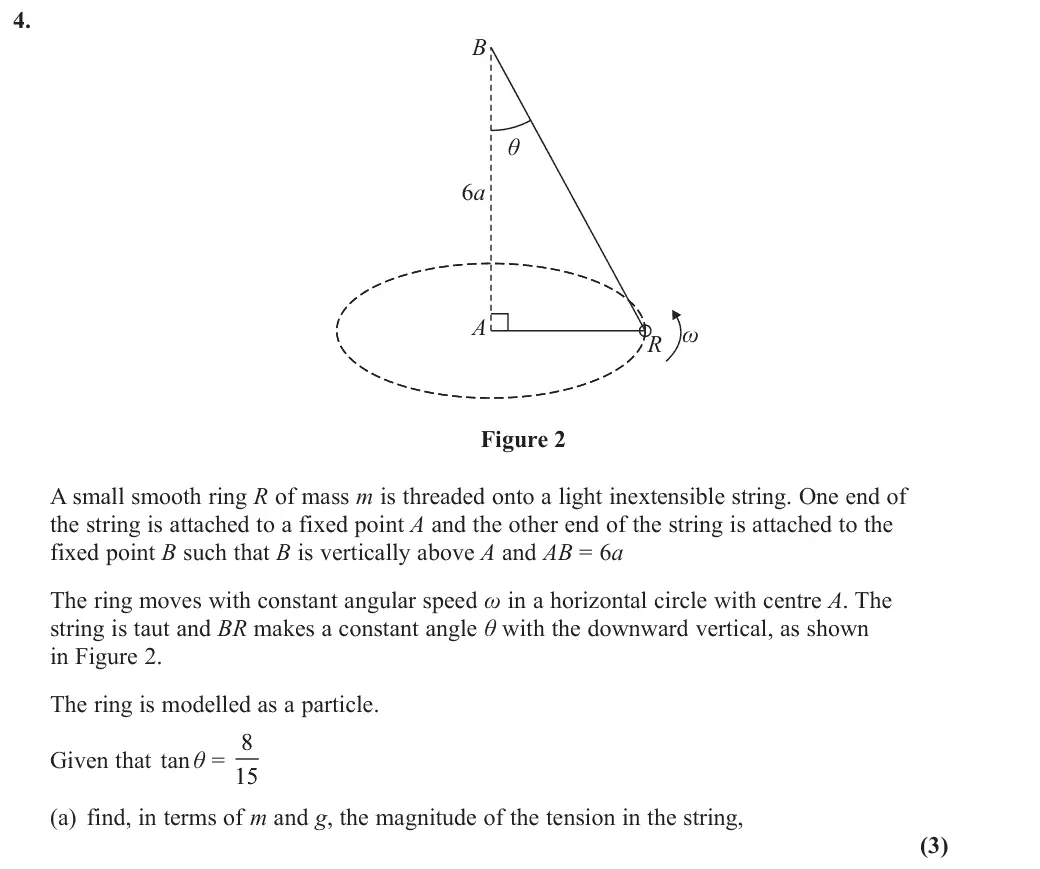
June 2022 · Paper 4C (Further Mechanics 2) · Q4(a)3 marks
Mark scheme (whole question; this part is marked with the orange bar)
Examiner's comment
(a) Most students found this task very straight forward and many scored full marks. The most common errors were confusion between sine and cosine and basic arithmetic errors in finding the value of cos .
Key points from the mark scheme and examiner's report
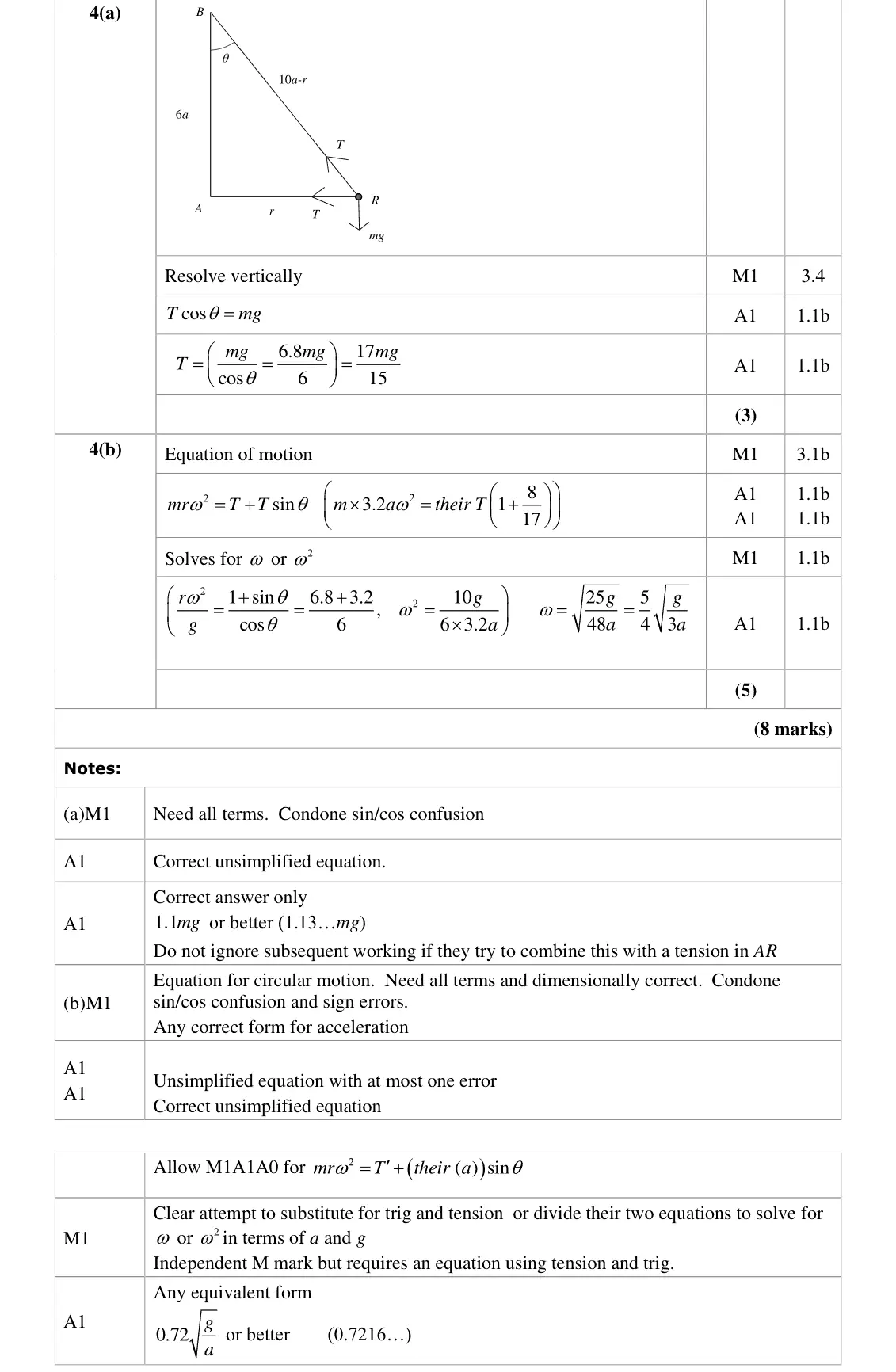
BR = 10a − r with r = 3.2a, cos θ = 15/17
resolve vertically T cos θ = mg, T = 17mg/15
sin/cos confusion common
June 2022 · Paper 4C (Further Mechanics 2) · Q4(b)5 marks
Mark scheme (whole question; this part is marked with the orange bar)
Examiner's comment
(b) Many candidates found this part equally accessible. However, it was common to see candidates either ignoring the tension in the horizontal portion of the string or assuming that the tensions in the two portions of the string would be different. Careful reading of the question reveals that it is a single piece of string connected to A and B, with the smooth ring threaded on. With greater attention to detail, most of the errors could have been avoided. When students were able to set up a correct equation of motion, the most common mistake was in the basic algebra, often making errors when square rooting and simplifying.
Key points from the mark scheme and examiner's report
smooth ring: same tension in AR and BR
T + T sin θ = m(3.2a)ω²
ω = (5/4)√(g/3a)
errors ignoring the horizontal part of the string or using different tensions
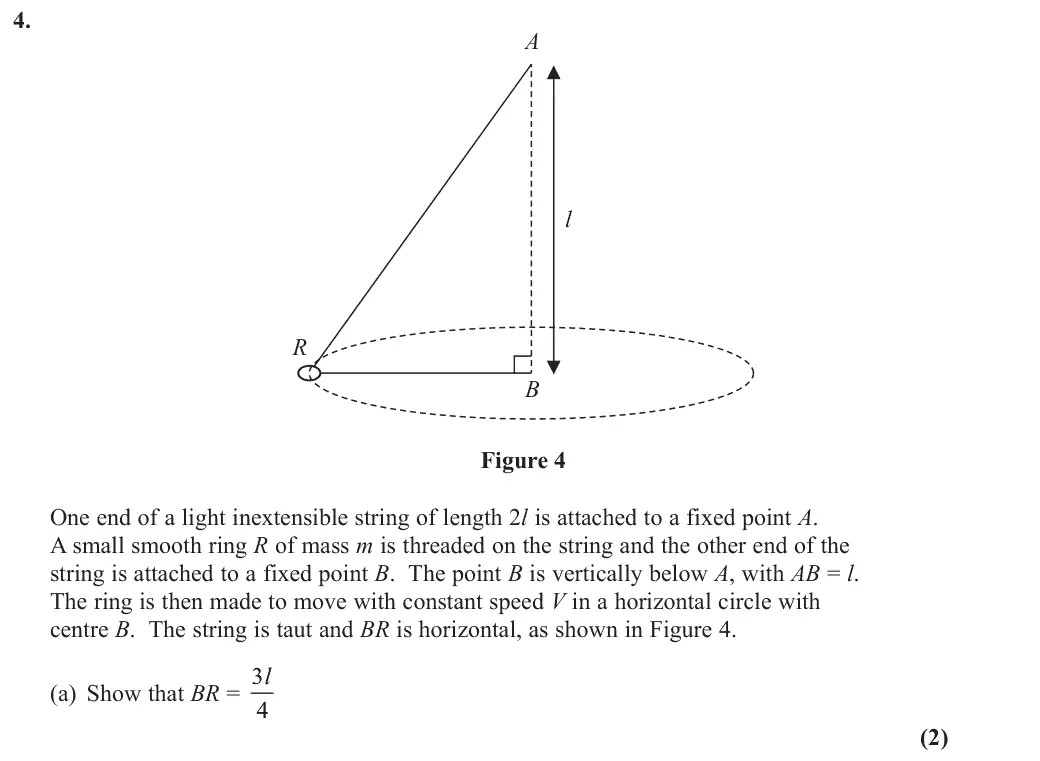
Nov 2021 · Paper 4C (Further Mechanics 2) · Q4(a)2 marks
Mark scheme (whole question; this part is marked with the orange bar)
Key points from the mark scheme and examiner's report
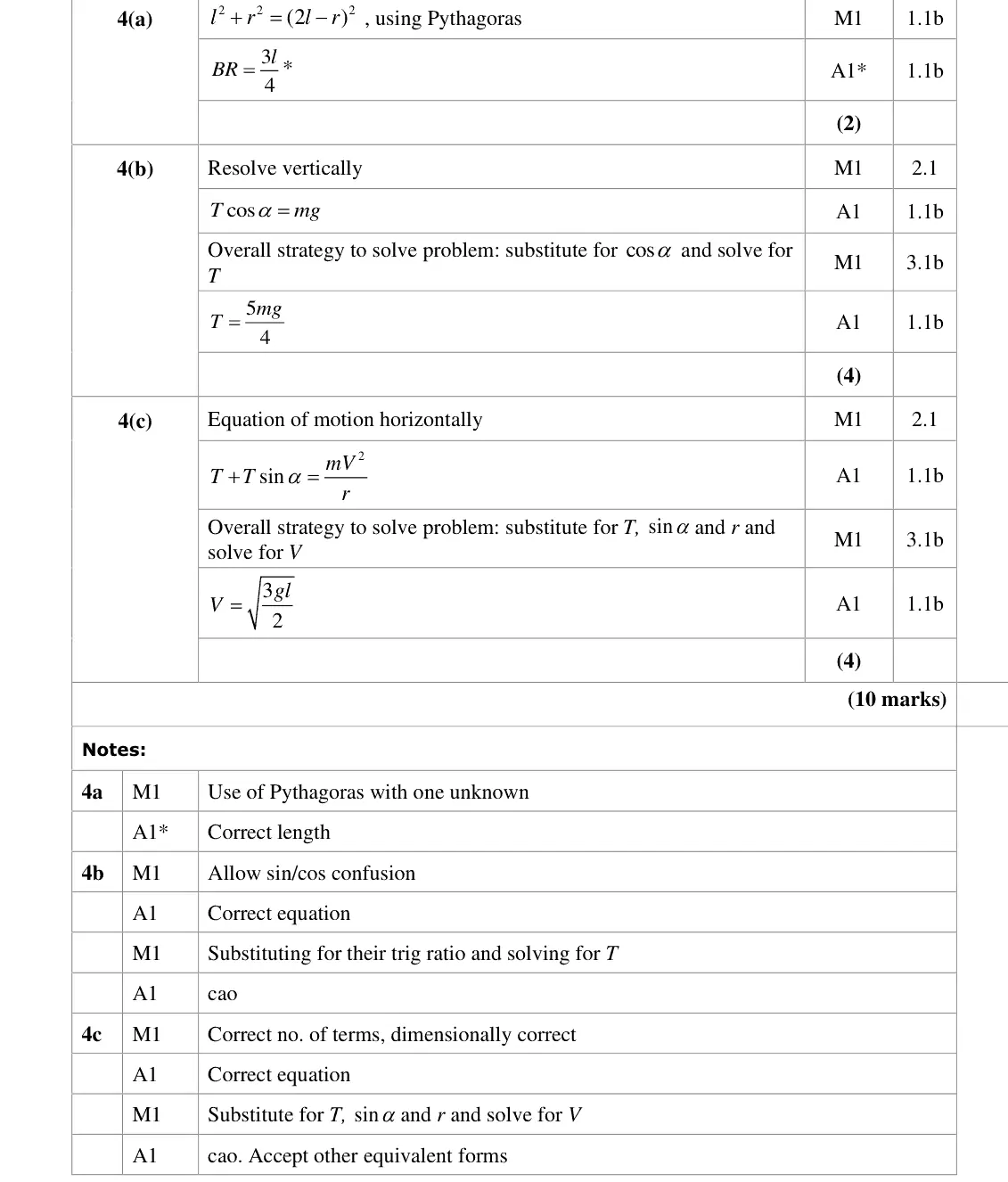
Pythagoras l² + r² = (2l − r)² gives BR = 3l/4
Nov 2021 · Paper 4C (Further Mechanics 2) · Q4(b)4 marks
Mark scheme (whole question; this part is marked with the orange bar)
Key points from the mark scheme and examiner's report
smooth ring so the same tension in both parts of the string
resolve vertically T cos α = mg with cos α = 4/5
T = 5mg/4
Nov 2021 · Paper 4C (Further Mechanics 2) · Q4(c)4 marks
Mark scheme (whole question; this part is marked with the orange bar)
Key points from the mark scheme and examiner's report
horizontally both parts pull towards B: T + T sin α = mV²/r with r = 3l/4
V = √(3gl/2)
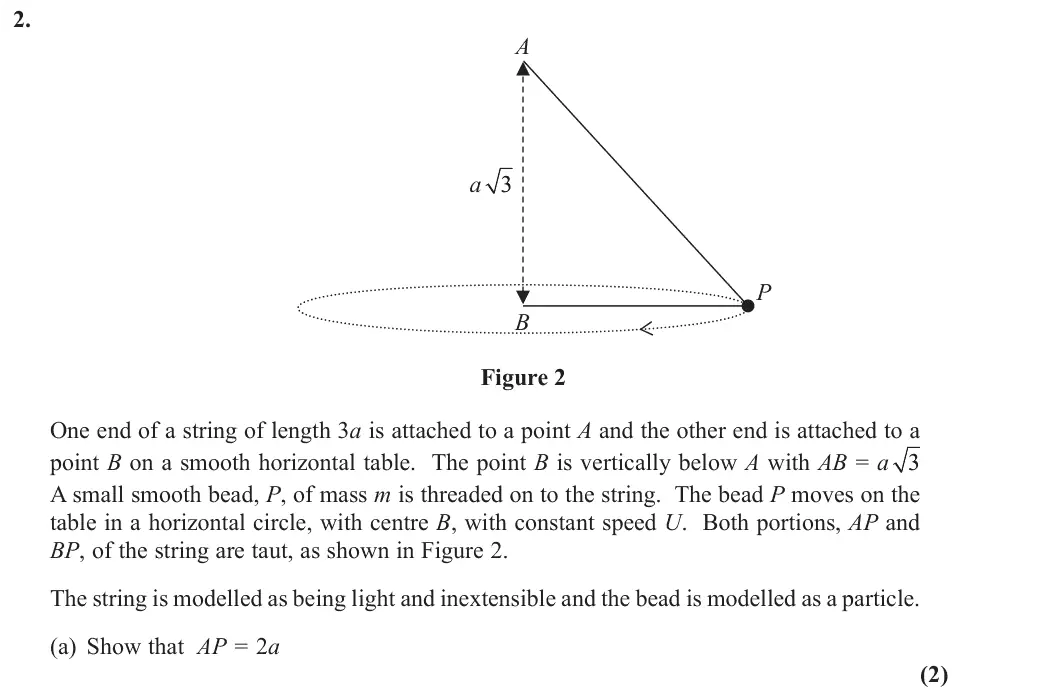
Oct 2020 · AS Paper 2 (Further Mechanics 2) · Q2(a)2 marks
Mark scheme (whole question; this part is marked with the orange bar)
Key points from the mark scheme and examiner's report
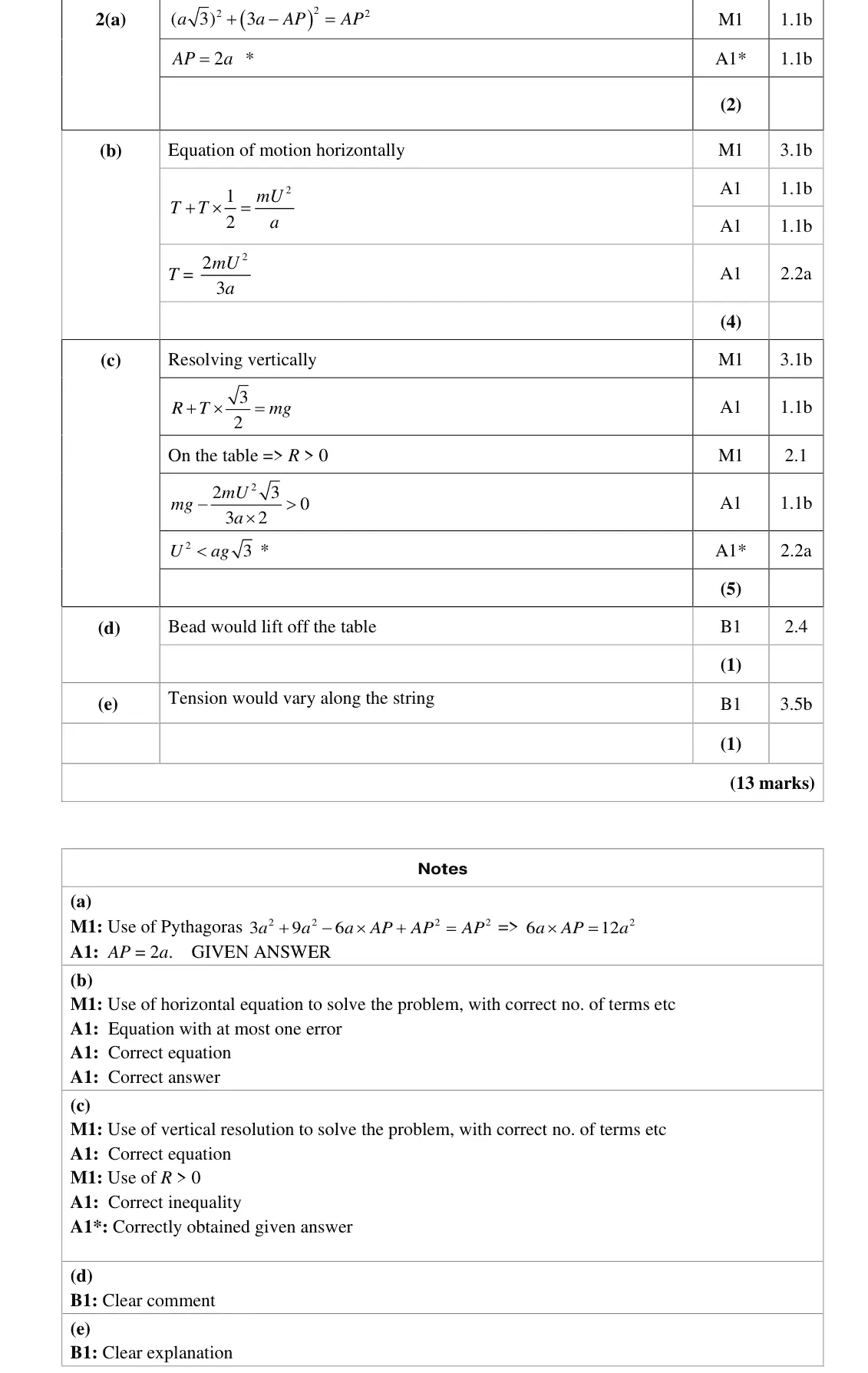
Pythagoras with BP = 3a − AP and AB = a√3 gives AP = 2a
Oct 2020 · AS Paper 2 (Further Mechanics 2) · Q2(b)4 marks
Mark scheme (whole question; this part is marked with the orange bar)
Key points from the mark scheme and examiner's report
the same tension T in both portions (smooth bead on one string)
horizontally T + T cos 60° = mU²/a, radius a, so T = 2mU²/(3a)
Oct 2020 · AS Paper 2 (Further Mechanics 2) · Q2(c)5 marks
Mark scheme (whole question; this part is marked with the orange bar)
Key points from the mark scheme and examiner's report
resolve vertically R + T(√3/2) = mg
on the table needs R > 0, giving U² < ag√3
Oct 2020 · AS Paper 2 (Further Mechanics 2) · Q2(d)1 mark
Mark scheme (whole question; this part is marked with the orange bar)
Key points from the mark scheme and examiner's report
the bead would lift off the table
Oct 2020 · AS Paper 2 (Further Mechanics 2) · Q2(e)1 mark
Mark scheme (whole question; this part is marked with the orange bar)
Key points from the mark scheme and examiner's report
the tension would vary along the string (no longer the same in AP and BP)
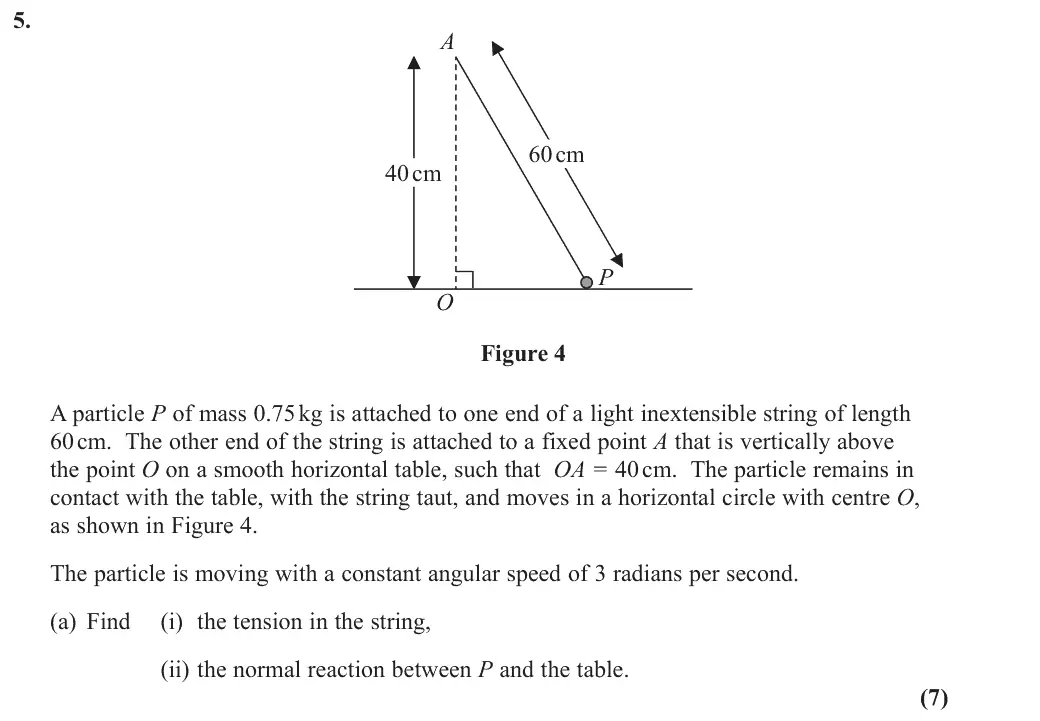
Oct 2020 · Paper 4C (Further Mechanics 2) · Q5(a)7 marks
Mark scheme (whole question; this part is marked with the orange bar)
Key points from the mark scheme and examiner's report
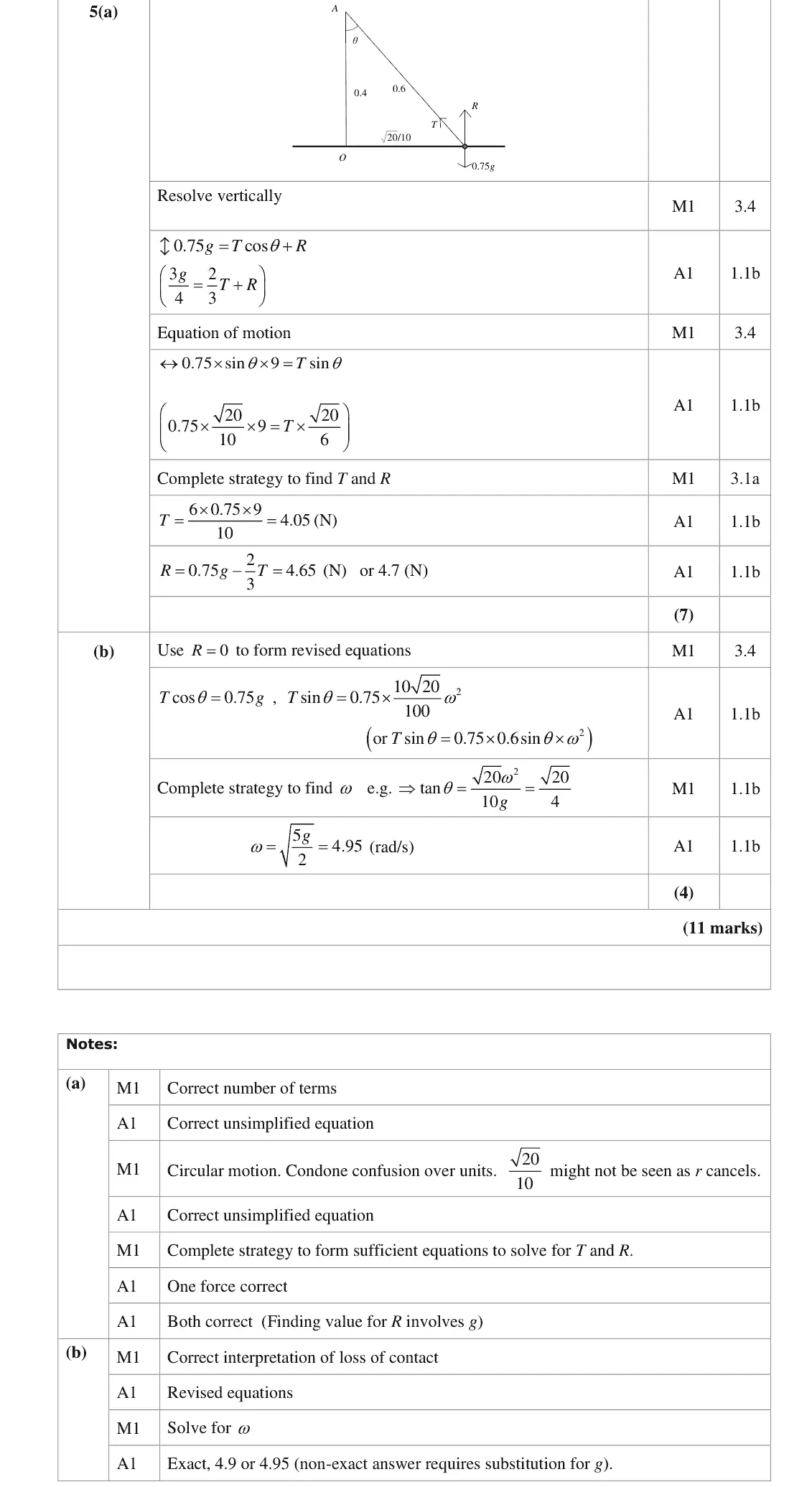
radius √20/10 m = 0.447 m (convert cm)
vertically 0.75g = T cos θ + R with cos θ = 2/3
horizontally T sin θ = 0.75 × r × 9
T = 4.05 N, R = 4.65 N
Oct 2020 · Paper 4C (Further Mechanics 2) · Q5(b)4 marks
Mark scheme (whole question; this part is marked with the orange bar)
Key points from the mark scheme and examiner's report
losing contact means R = 0
tan θ = rω²/g gives ω = √(5g/2) = 4.95 rad s⁻¹
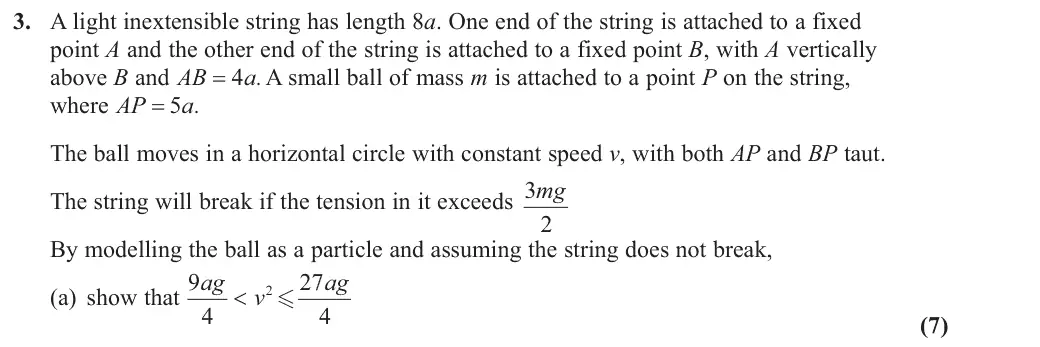
June 2019 · AS Paper 2 (Further Mechanics 2) · Q3(a)7 marks
Mark scheme (whole question; this part is marked with the orange bar)
Examiner's comment
In Q03(a) there were many attempts with the same tension in both strings, others with no right angle at B, others with the same tension and no right angle and a small number with tension only in the string attached to A and no mention of tension in the other part of the string. Those who set up the problem correctly generally scored the first 4 marks although a minority used a wrong radius. A few applied the inequalities to TA rather than TB and some did not realise that they had to use TB > 0. Candidates were more successful
Key points from the mark scheme and examiner's report
different tensions in AP and BP
BP is horizontal (3-4-5 triangle, radius 3a)
T_A = 5mg/4 from resolving vertically
T_B > 0 and T_B ≤ 3mg/2 give the two inequalities
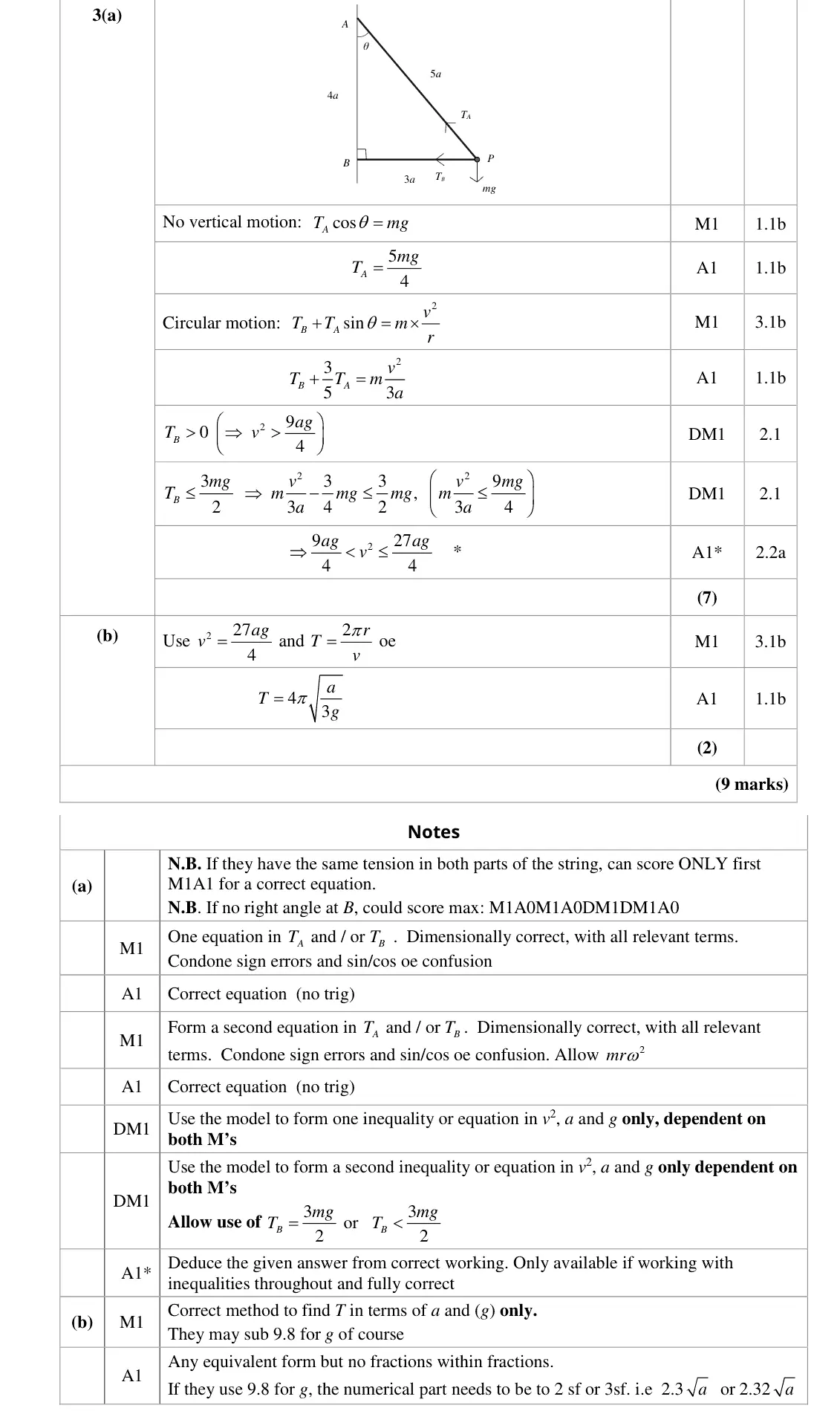
June 2019 · AS Paper 2 (Further Mechanics 2) · Q3(b)2 marks
Mark scheme (whole question; this part is marked with the orange bar)
Examiner's comment
in finding the second inequality. In the second part, some just found ω or thought that v and ω were the same and others used 27 ag as v rather than v2. Nevertheless, there were 4 some correct solutions.
Key points from the mark scheme and examiner's report
least time uses the greatest v² = 27ag/4 and T = 2πr/v: 4π√(a/(3g))
some confused v with ω
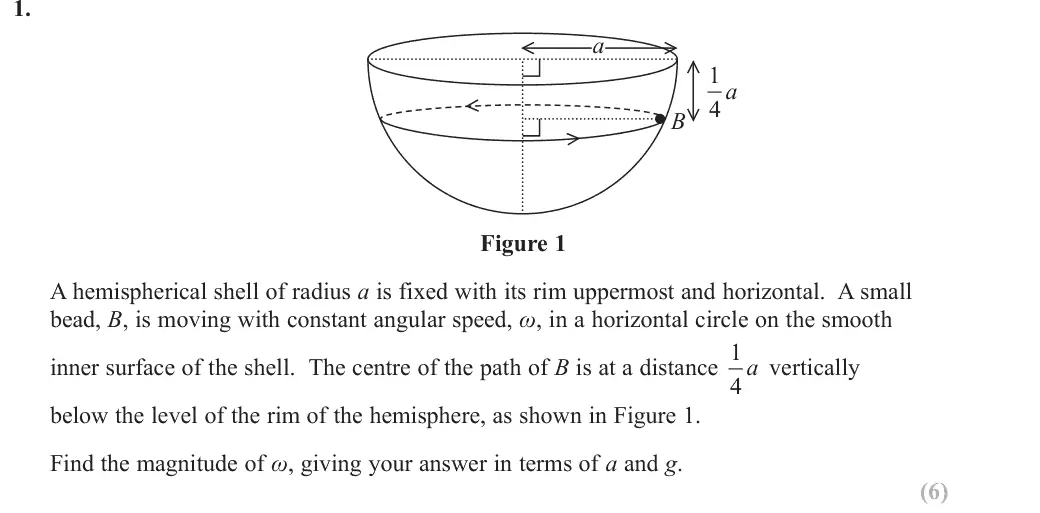
June 2019 · Paper 4C (Further Mechanics 2) · Q16 marks
Mark scheme (whole question; this part is marked with the orange bar)
Examiner's comment
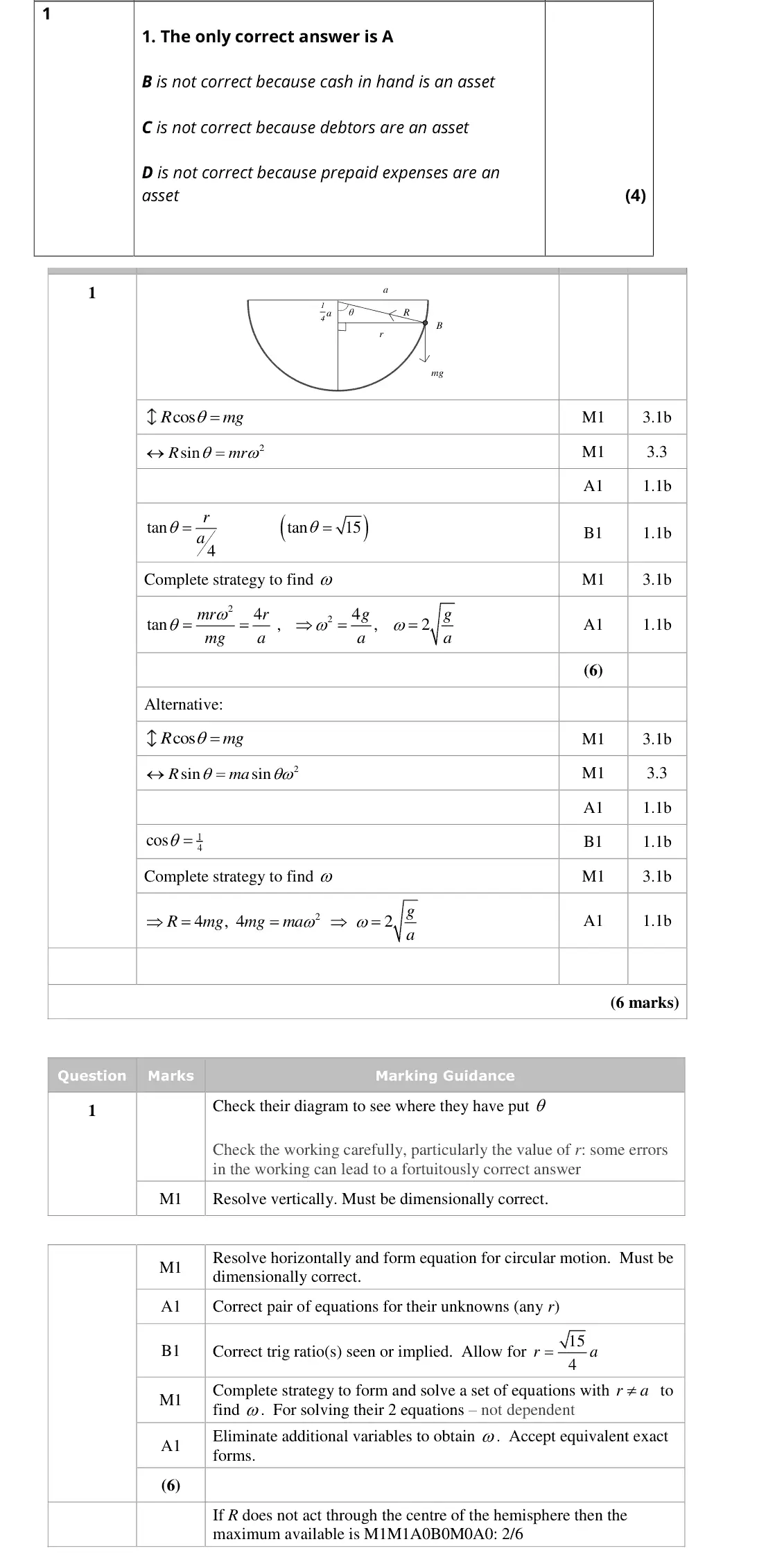
Most candidates understood that the normal reaction between the shell and the bead acts through the centre of the hemisphere. The majority of candidates were able to form the two key equations, resolving horizontally for the circular motion, and resolving vertically. For many, the trig substitution to solve for was clear and they completed the question successfully. There were two common errors: several candidates assumed that the radius of the path of B was a, and several thought it was 17 . 4 a
Key points from the mark scheme and examiner's report
omega = 2√(g/a)
R acts through the centre of the hemisphere: resolve vertically R cos θ = mg and horizontally R sin θ = mrω² with r = a sin θ, cos θ = 1/4
common errors taking the radius of the path as a or as √17a/4
June 2018 · AS Paper 2 (Further Mechanics 2) · Q2(a)7 marks
Mark scheme (whole question; this part is marked with the orange bar)
Examiner's comment
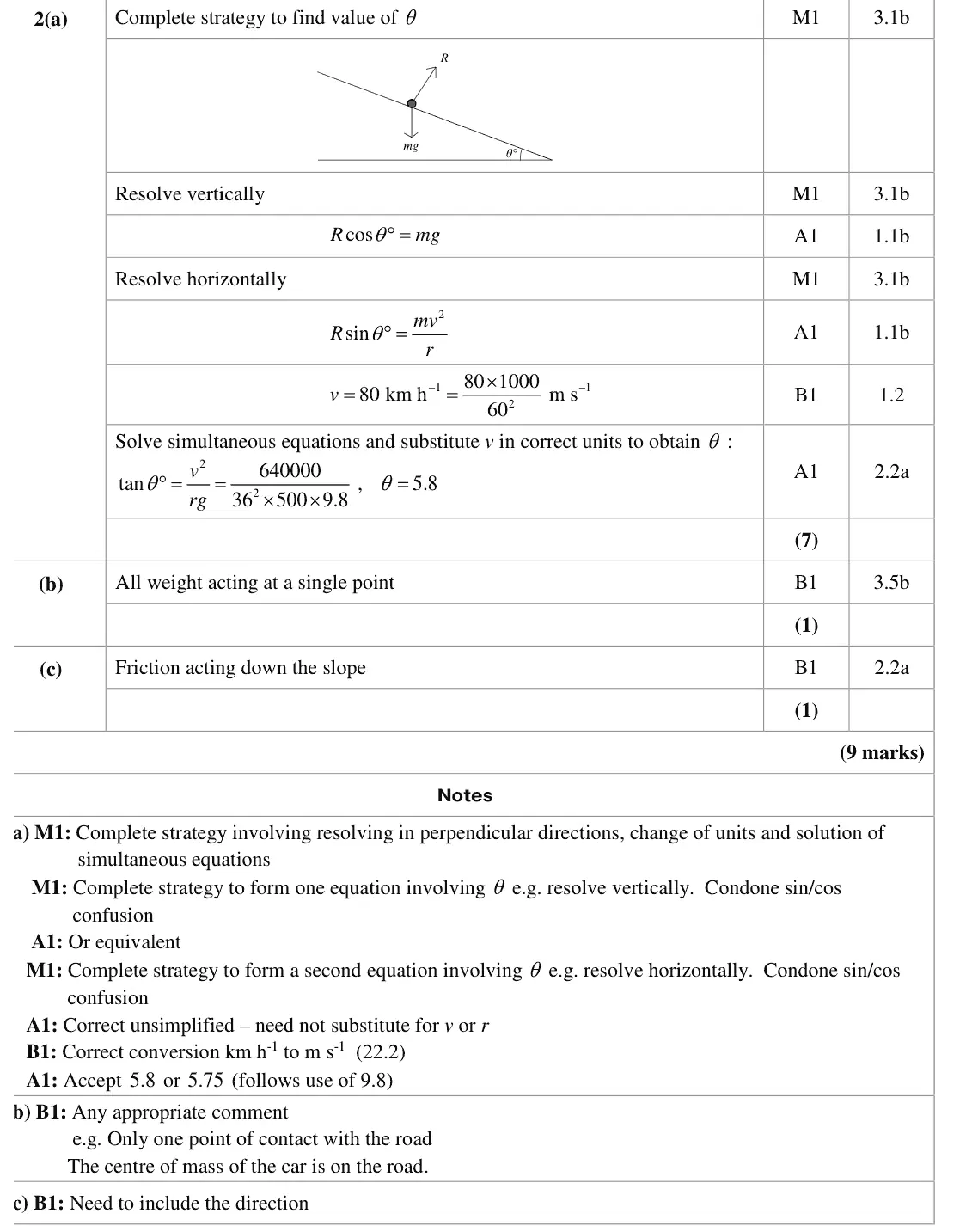
(a) The majority of students started by resolving the forces acting on the car - usually working horizontally and vertically. A small number of students considered the forces acting parallel to the plane. Many of the equations were correct, but there was some evidence of sine/cosine confusion. Most students converted the speed of the car from 1 kmh to 1 ms and went on to use their equations to find the value of , with several reaching the correct answer. A few students quoted a remembered formula 2 tan . v rg In this instance it was a valid approach, but it was a risky strategy because if the formula was misquoted then the only mark available was the mark for correct conversion of units.
Key points from the mark scheme and examiner's report
resolve vertically R cos θ = mg and horizontally R sin θ = mv²/r
convert 80 km/h to 22.2 m/s
tan θ = v²/(rg) gives θ = 5.8
sin/cos confusion
June 2018 · AS Paper 2 (Further Mechanics 2) · Q2(b)1 mark
Mark scheme (whole question; this part is marked with the orange bar)
Examiner's comment
(b) The only model mentioned in the question is of the car as a particle. Most comments did not relate to this model at all. There were several comments about the friction, and the unlikelihood of uniform banking of the bend. Many students did not make any comment.
Key points from the mark scheme and examiner's report
the limitation must concern the particle model (all weight acts at one point, one point of contact)
comments on friction or uneven banking scored nothing
June 2018 · AS Paper 2 (Further Mechanics 2) · Q2(c)1 mark
Mark scheme (whole question; this part is marked with the orange bar)
Examiner's comment
(c) More able students understood that friction would increase as the speed of the car increased, but they were not so confident about the direction. Many had the force acting towards the centre of the circle.
Key points from the mark scheme and examiner's report
friction acting down the slope
direction is required
many said towards the centre
Find an Edexcel Further Maths tutor
Stuck on this? Book a trial lesson with our Further Maths tutor.