FM2.1.2 Motion of a particle in a vertical circle. Radial and tangential…
Section
FM2.1 Motion in a circle
Level
A level only
Statement
Motion of a particle in a vertical circle. Radial and tangential acceleration in circular motion. Kinetic and potential energy and the conservation of energy principle applied to motion in a vertical circle.
Guidance
Questions may be set which involve complete or incomplete circles.
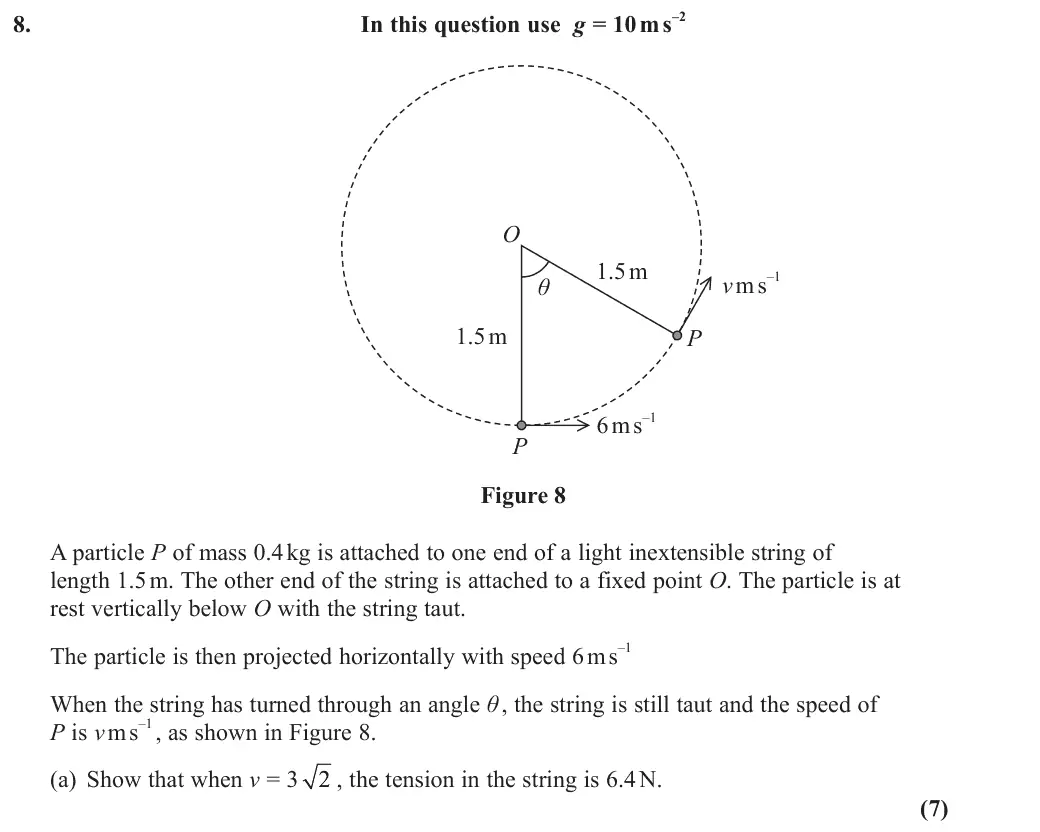
June 2025 · Paper 4C (Further Mechanics 2) · Q8(a)7 marks
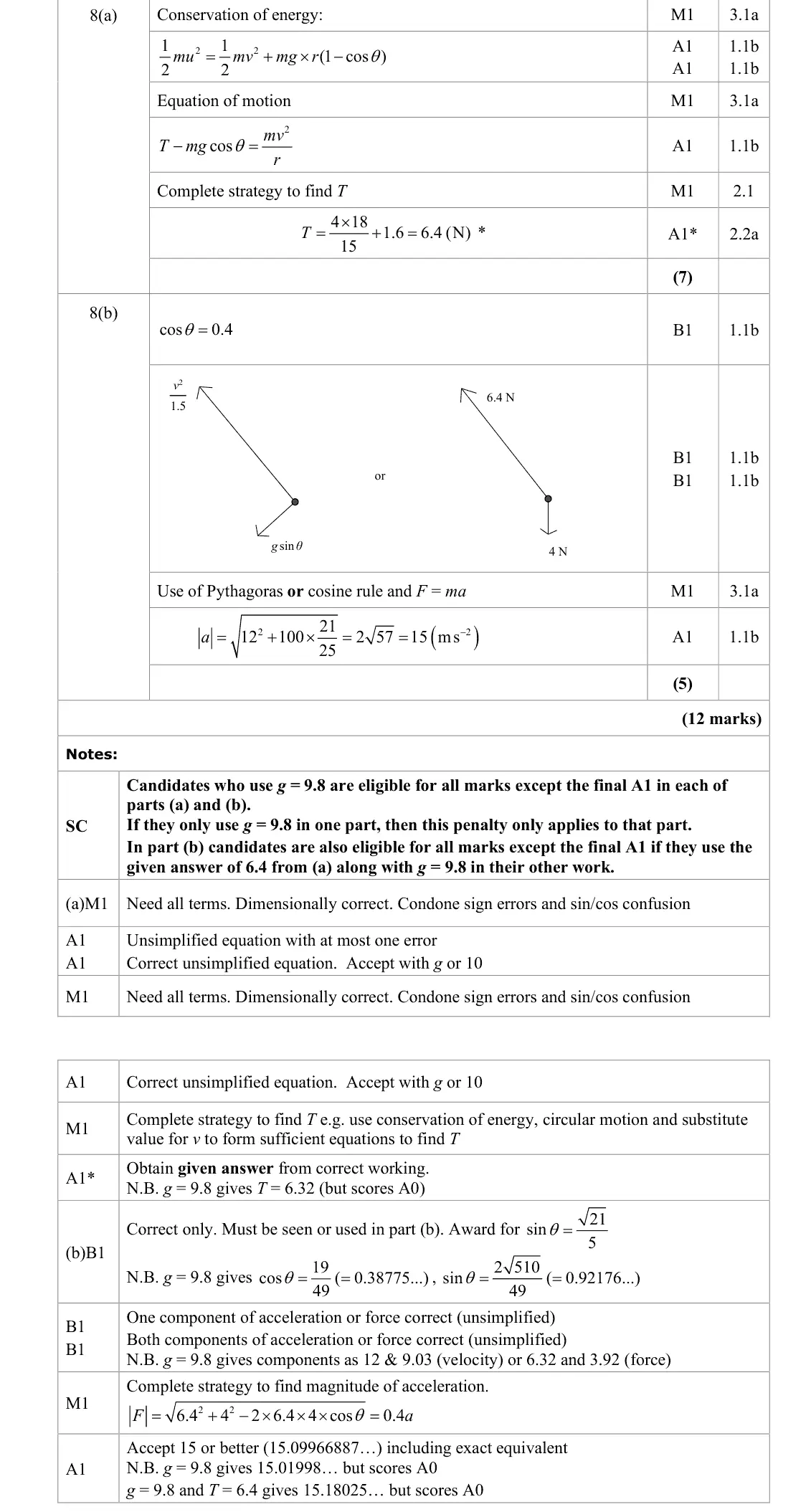
Mark scheme (whole question; this part is marked with the orange bar)
Examiner's comment
(a) Many candidates seemed familiar with the structure of this question. Better responses proceeded as per the mark scheme, but some chose to separate their working into different stages: resolving forces, finding a resultant, using an equation of circular motion, considering kinetic and gravitational energy separately, and then combing. Stronger responses managed this, but a number did not correctly combine their calculations and some of the least accurate had extra terms as a result of double- counting energy or force terms. A significant proportion of candidates missed the instruction to use g = 10 but the mark scheme was adjusted to allow all bar the final mark and this gave all responses a fair outcome.
Key points from the mark scheme and examiner's report
g = 10
energy ½m(36) = ½m(18) + mg(1.5)(1 − cos θ) gives cos θ = 0.4
T − mg cos θ = mv²/r: T = 4.8 + 1.6 = 6.4 N
g = 9.8 loses only the final mark
June 2025 · Paper 4C (Further Mechanics 2) · Q8(b)5 marks
Mark scheme (whole question; this part is marked with the orange bar)
Examiner's comment
(b) This proved to be the most challenging part of the paper, which makes its positioning at the end suitable. A great proportion of weaker responses found only the radial component of acceleration as 12 then combined with the gravitational acceleration of g without realising that a component of g had already been included. Other weaker responses tried unsuccessfully to combine one component of acceleration with another of force. The strongest responses tended to find the components of acceleration and use Pythagroas’ as per the main mark scheme. Again, use of g = 9.8 was common and the mark scheme gave much credit to such responses, only penalising the final mark (if achieved).
Key points from the mark scheme and examiner's report
radial v²/r = 12, tangential g sin θ = 10√21/5
magnitude √(144 + 84) = 2√57 ≈ 15 m s⁻²
common error combining 12 with g as well, double counting gravity
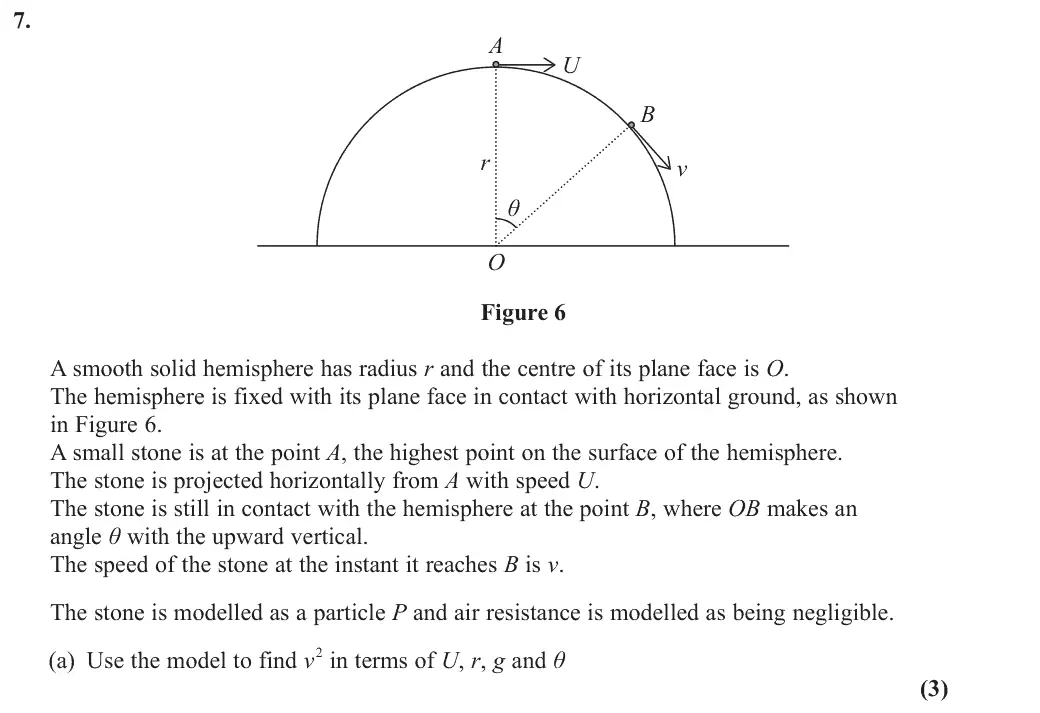
June 2024 · Paper 4C (Further Mechanics 2) · Q7(a)3 marks
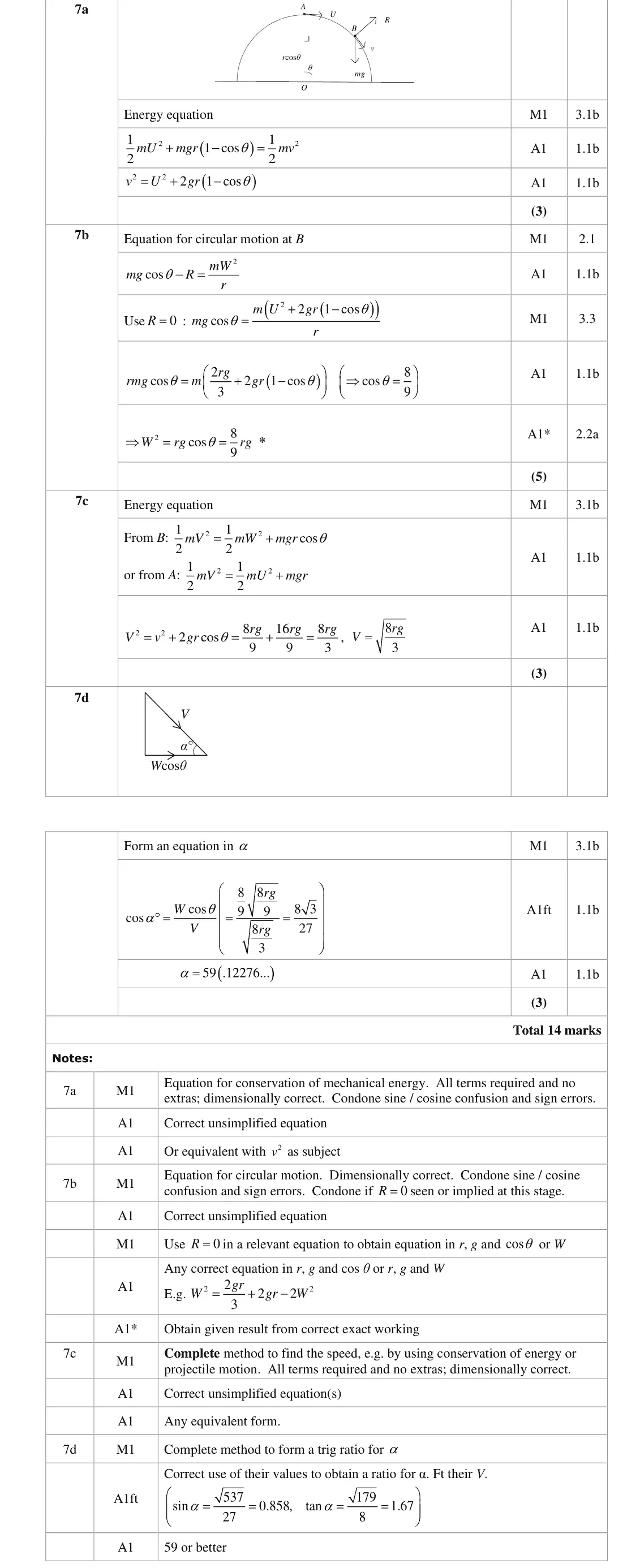
Mark scheme (whole question; this part is marked with the orange bar)
Examiner's comment
(a) The majority of candidates successfully used energy here, although a small number struggled with the gravitational aspect and had sign errors or extra terms and were penalised accordingly.
Key points from the mark scheme and examiner's report
energy: v² = U² + 2gr(1 − cos θ)
sign errors in the GPE term
June 2024 · Paper 4C (Further Mechanics 2) · Q7(b)5 marks
Mark scheme (whole question; this part is marked with the orange bar)
Examiner's comment
(b) Surprisingly few used the equation of motion initially and some, mostly unsuccessful, candidates attempted inequalities or left R in their working until a late stage. The majority of successful attempts were as given in the mark scheme, via finding cos theta first, but a good number did form an equation in only W.
Key points from the mark scheme and examiner's report
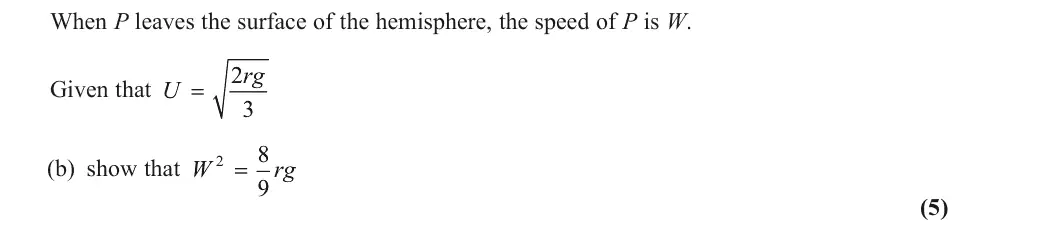
radially mg cos θ − R = mW²/r with R = 0 when it leaves
with U² = 2rg/3, cos θ = 8/9 and W² = rg cos θ = 8rg/9
June 2024 · Paper 4C (Further Mechanics 2) · Q7(c)3 marks
Mark scheme (whole question; this part is marked with the orange bar)
Examiner's comment
(c) Almost every candidate who used energy was successful here. However, the majority chose to approach this via projectile motion and this resulted in a variety of outcomes. From those who did not achieve the result, errors were often confusion over direction vertically or forgetting to include the horizontal component entirely. Only a small number of the weaker candidates attempted to use suvat without resolving.
Key points from the mark scheme and examiner's report
energy from A or B is simplest: V² = W² + 2gr cos θ = 8rg/3, V = √(8rg/3)
projectile routes often lost the horizontal component or confused vertical directions
June 2024 · Paper 4C (Further Mechanics 2) · Q7(d)3 marks
Mark scheme (whole question; this part is marked with the orange bar)
Examiner's comment
(d) This part was mostly successfully attempted, including by those who had not succeeded in previous parts. Common errors included failure to use a correct ratio or one too many or few resolutions of velocities.
Key points from the mark scheme and examiner's report
horizontal velocity W cos θ is unchanged in flight: cos α = W cos θ/V = 8√3/27, α = 59
June 2023 · Paper 4C (Further Mechanics 2) · Q4(a)6 marks
Mark scheme (whole question; this part is marked with the orange bar)
Examiner's comment
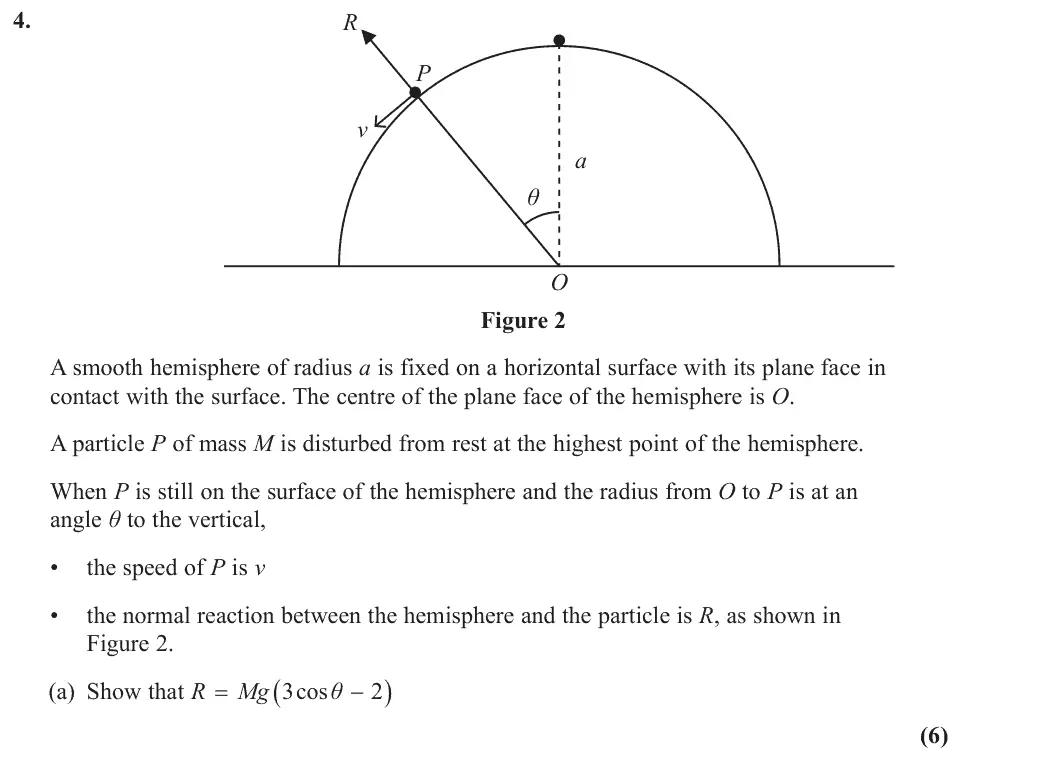
(a) This was a relatively straight forward question about motion in a vertical circle. A few candidates had incorrect signs in the equation of motion and then attempted to “fudge” the given result. A minority of candidates attempted to resolve vertically but most of them did not include a component of the acceleration. (b) The given result in part (a) meant that candidates started with the correct value of cos when 0 R = and, provided they had a correct equation in part (a), they completed the task successfully. A few errors were caused by slips in the algebra.
Key points from the mark scheme and examiner's report
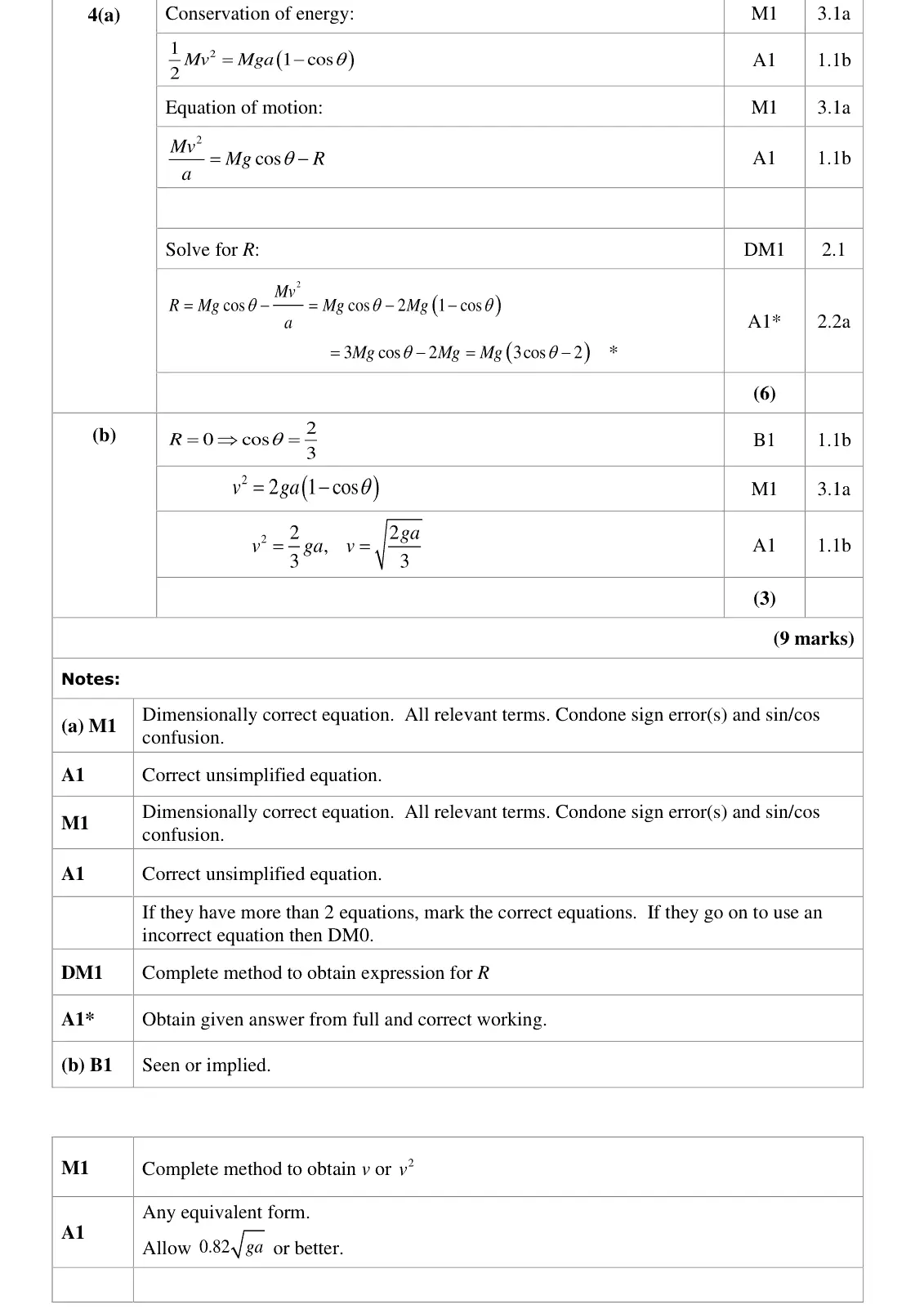
energy ½Mv² = Mga(1 − cos θ)
radially Mg cos θ − R = Mv²/a
resolving vertically without acceleration is wrong
sign errors fudged to the given answer
June 2023 · Paper 4C (Further Mechanics 2) · Q4(b)3 marks
Mark scheme (whole question; this part is marked with the orange bar)
Examiner's comment
(b) The given result in part (a) meant that candidates started with the correct value of cos when 0 R = and, provided they had a correct equation in part (a), they completed the task successfully. A few errors were caused by slips in the algebra.
Key points from the mark scheme and examiner's report
leaves the surface when R = 0: cos θ = 2/3
v² = 2ga(1 − cos θ) gives v = √(2ga/3)
June 2022 · Paper 4C (Further Mechanics 2) · Q7(a)6 marks
Mark scheme (whole question; this part is marked with the orange bar)
Examiner's comment
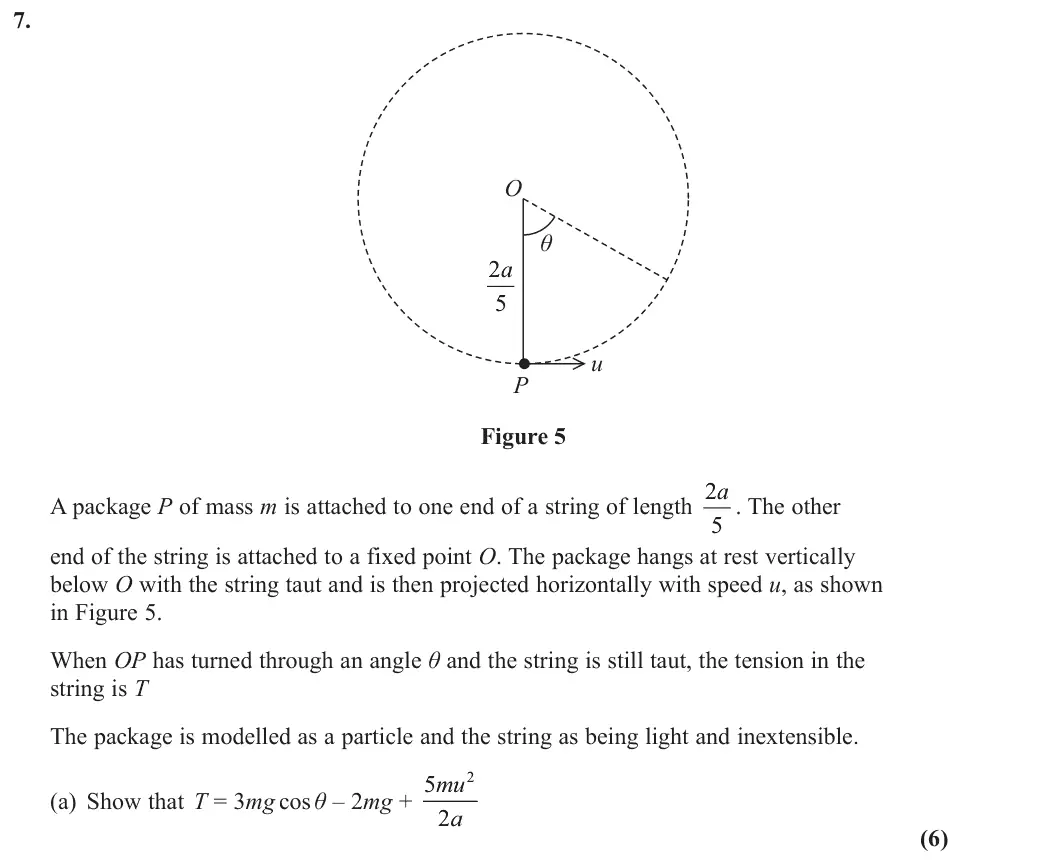
(a) Candidates approached this standard task with confidence. They usually gave a correct equation of motion towards O. They understood that they needed to form a second equation by using conservation of energy, but there were a large number of errors in the change in GPE, with many candidates using 2 cos 5 a in place of ( ) 2 1 cos . 5 a - There was a lot of messy cancelling and crossing out as they attempted to reach the given equation, but very few candidates went back to their initial equations to trace the error.
Key points from the mark scheme and examiner's report
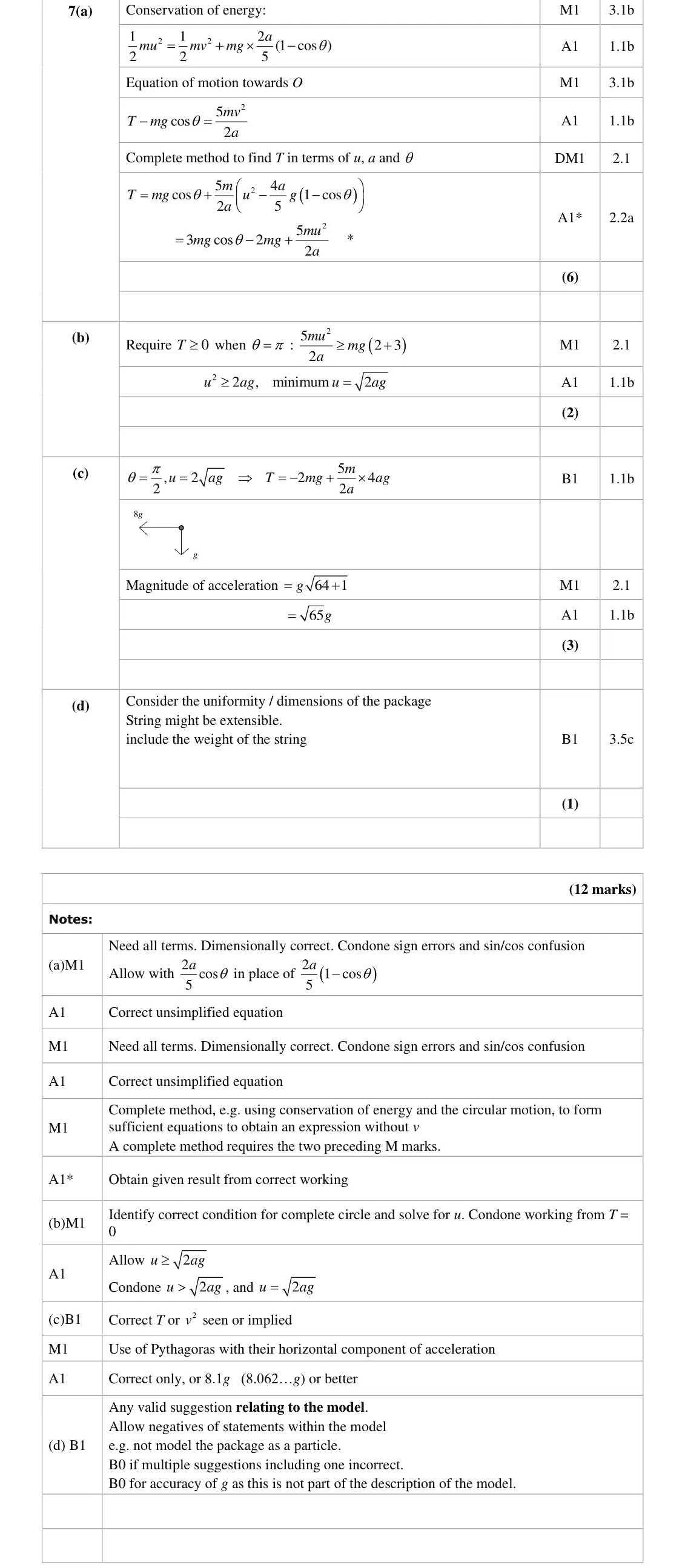
energy ½mu² = ½mv² + mg(2a/5)(1 − cos θ)
T − mg cos θ = 5mv²/(2a)
height gained is (2a/5)(1 − cos θ), not (2a/5)cos θ
June 2022 · Paper 4C (Further Mechanics 2) · Q7(b)2 marks
Mark scheme (whole question; this part is marked with the orange bar)
Examiner's comment
(b) The starting point for most candidates was either 0 T = or 0, T with 180 = either stated or implied. The majority of candidates obtained the correct answer. The most common error was to work with an incorrect value of .
Key points from the mark scheme and examiner's report
need T ≥ 0 at θ = π: u ≥ √(2ag), minimum √(2ag)
errors from using the wrong θ
June 2022 · Paper 4C (Further Mechanics 2) · Q7(c)3 marks
Mark scheme (whole question; this part is marked with the orange bar)
Examiner's comment
(c) The majority of candidates used 90 = in the given equation to obtain 8 . a g = A significant number of candidates stopped at that point and did not go on to consider the vertical component of the acceleration.
Key points from the mark scheme and examiner's report
at θ = π/2, T = 8mg so radial acceleration 8g, tangential g
magnitude √65 g
many stopped at 8g without the vertical component
June 2022 · Paper 4C (Further Mechanics 2) · Q7(d)1 mark
Mark scheme (whole question; this part is marked with the orange bar)
Examiner's comment
(d) The majority of responses suggested considering the weight of the string or the elasticity of the string,
Key points from the mark scheme and examiner's report
e.g. do not model the package as a particle, string extensible, include the weight of the string
accuracy of g is not part of the model
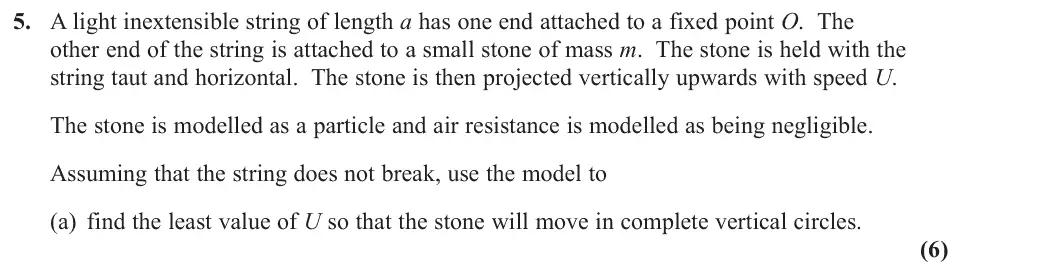
Nov 2021 · Paper 4C (Further Mechanics 2) · Q5(a)6 marks
Mark scheme (whole question; this part is marked with the orange bar)
Key points from the mark scheme and examiner's report
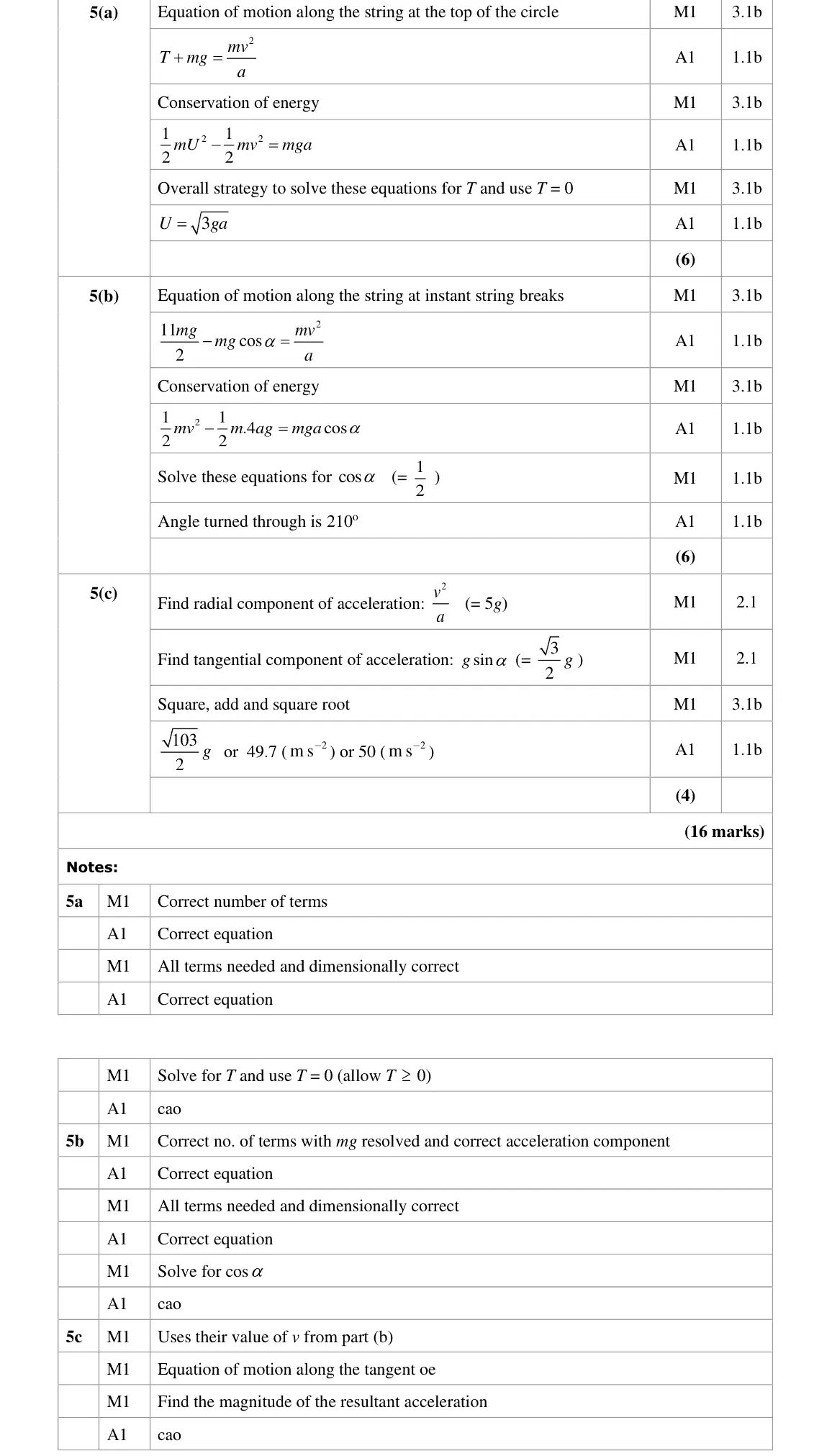
at the top T + mg = mv²/a with T ≥ 0
energy ½mU² − ½mv² = mga
least U = √(3ga)
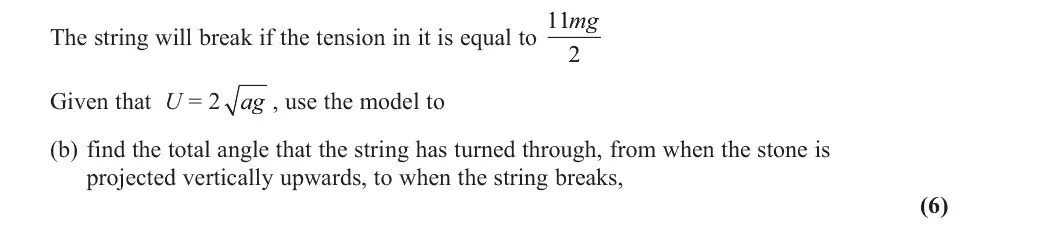
Nov 2021 · Paper 4C (Further Mechanics 2) · Q5(b)6 marks
Mark scheme (whole question; this part is marked with the orange bar)
Key points from the mark scheme and examiner's report
with α from the downward vertical: 11mg/2 − mg cos α = mv²/a and energy ½mv² − ½m(4ag) = mga cos α
cos α = ½
total angle turned 210°
Nov 2021 · Paper 4C (Further Mechanics 2) · Q5(c)4 marks
Mark scheme (whole question; this part is marked with the orange bar)
Key points from the mark scheme and examiner's report
radial v²/a = 5g, tangential g sin α = (√3/2)g
magnitude √103 g/2 ≈ 49.7 m s⁻²
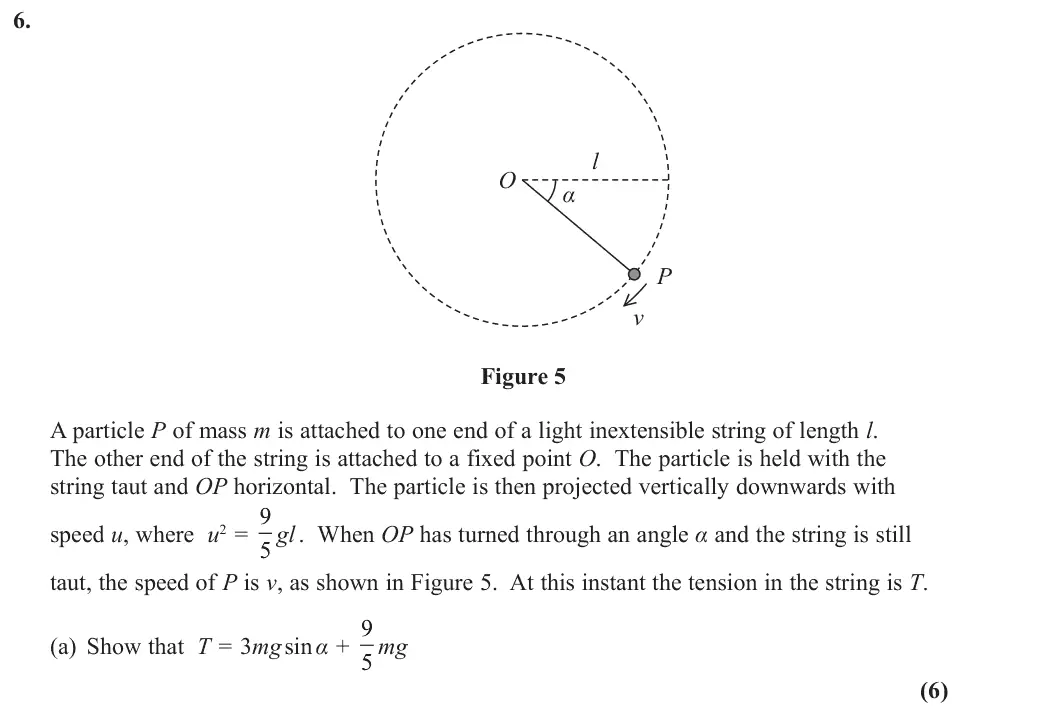
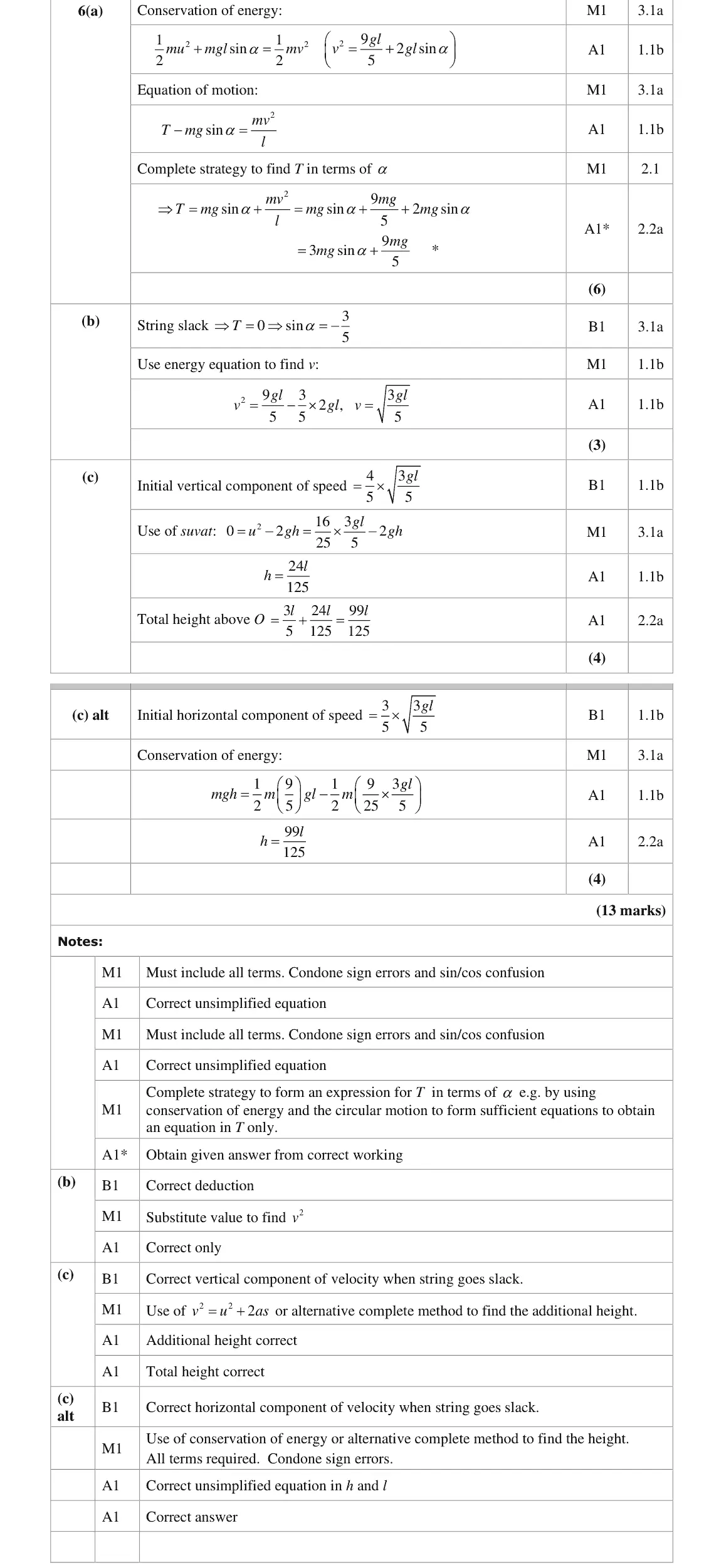
Oct 2020 · Paper 4C (Further Mechanics 2) · Q6(a)6 marks
Mark scheme (whole question; this part is marked with the orange bar)
Key points from the mark scheme and examiner's report
energy v² = 9gl/5 + 2gl sin α (α below horizontal)
T − mg sin α = mv²/l
combine for the given answer
condoned sin/cos confusion in method only
Oct 2020 · Paper 4C (Further Mechanics 2) · Q6(b)3 marks
Mark scheme (whole question; this part is marked with the orange bar)
Key points from the mark scheme and examiner's report
slack when T = 0 so sin α = −3/5 (above O)
v² = 9gl/5 − (3/5)(2gl) gives v = √(3gl/5)
Oct 2020 · Paper 4C (Further Mechanics 2) · Q6(c)4 marks
Mark scheme (whole question; this part is marked with the orange bar)
Key points from the mark scheme and examiner's report
after the string goes slack P is a projectile: vertical component (4/5)√(3gl/5), extra height 24l/125 by suvat
total 3l/5 + 24l/125 = 99l/125
alternative energy with horizontal component (3/5)v unchanged
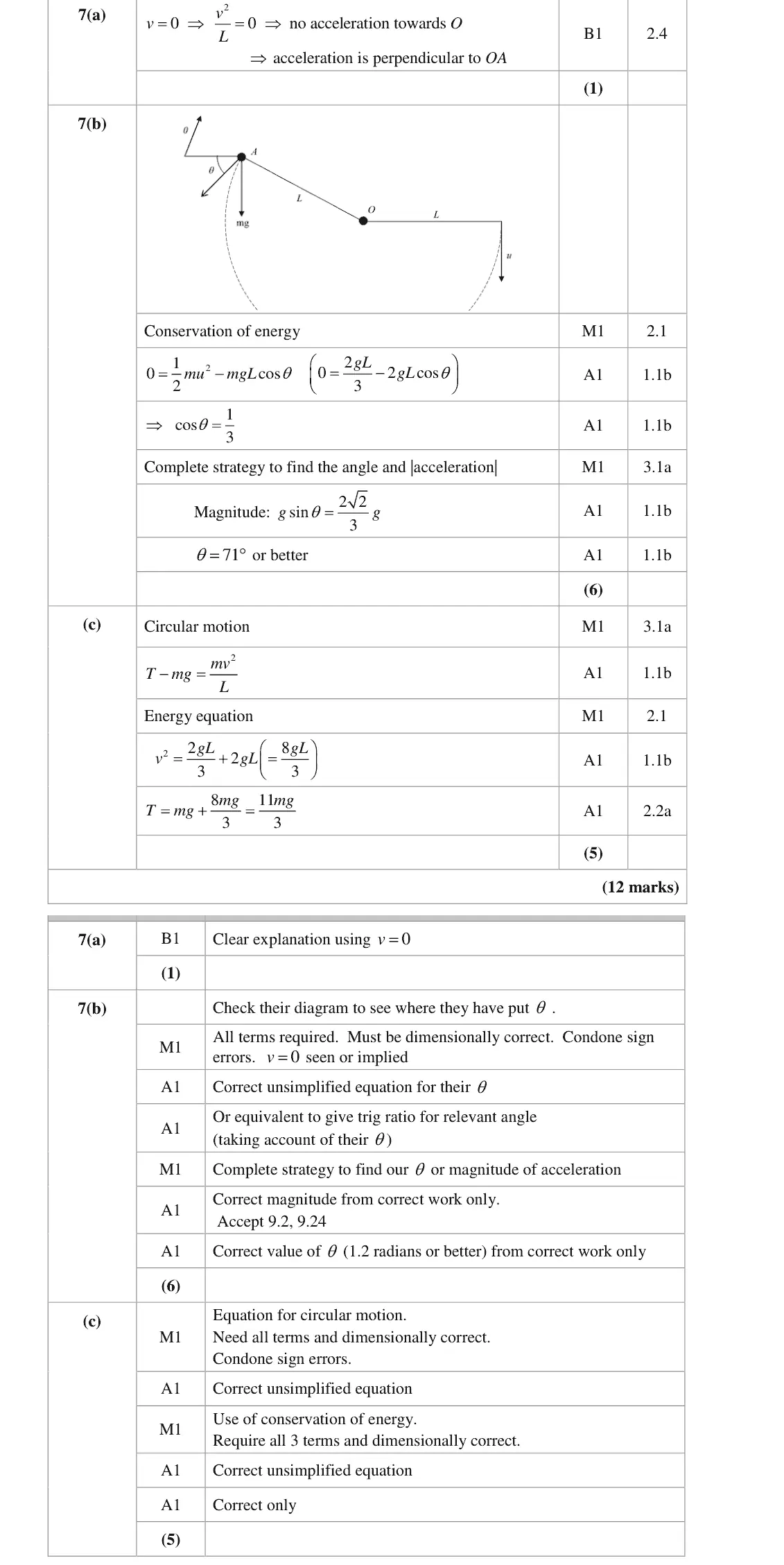
June 2019 · Paper 4C (Further Mechanics 2) · Q7(a)1 mark
Mark scheme (whole question; this part is marked with the orange bar)
Examiner's comment
(a) The transverse component of acceleration is not something that many candidates were aware of. Some were adamant that in circular motion the acceleration was all directed towards the centre of the circle. Only the better candidates were able to explain that the situation was due to P being at instantaneous rest.
Key points from the mark scheme and examiner's report
at A, v = 0 so v²/L = 0: no radial acceleration, only tangential
many wrongly said circular acceleration is always towards the centre
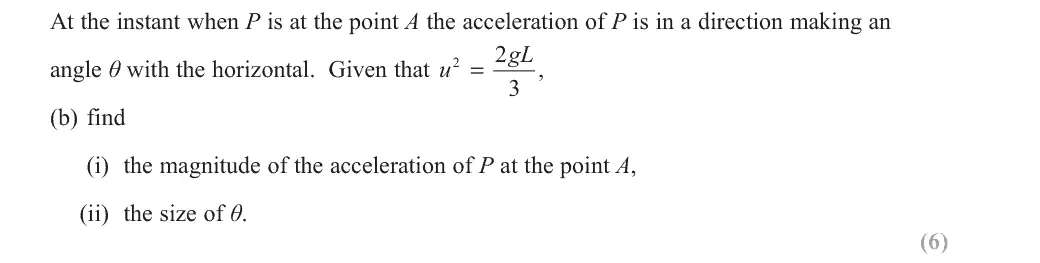
June 2019 · Paper 4C (Further Mechanics 2) · Q7(b)6 marks
Mark scheme (whole question; this part is marked with the orange bar)
Examiner's comment
(b) Several candidates did draw a diagram, but it was common for them to use as the name of an angle that was not equal to the angle in the question. Many candidates were able to use conservation of energy to obtain a correct trig ratio for their angle. Those candidates who understood about the direction of the acceleration often went on to find the correct value for the magnitude of the acceleration. An exact answer in terms of g or an answer to 2 or 3 significant figures were acceptable. Because of the confusion over the angle , an incorrect answer of 19.5 was very common.
Key points from the mark scheme and examiner's report
energy: ½mu² = mgL cos θ gives cos = 1/3
magnitude g sin = 2√2g/3 (9.24)
θ = 71° (19.5° common from mislabelling the angle)
June 2019 · Paper 4C (Further Mechanics 2) · Q7(c)5 marks
Mark scheme (whole question; this part is marked with the orange bar)
Examiner's comment
(c) This was much more like the sort of questions that the candidates had seen in their preparation. They showed a good understanding of how to use the circular motion and conservation of energy to set up the relevant equations, and many of them reached the correct conclusion.
Key points from the mark scheme and examiner's report
energy v² = 2gL/3 + 2gL = 8gL/3, T − mg = mv²/L, T = 11mg/3
Find an Edexcel Further Maths tutor
Stuck on this? Book a trial lesson with our Further Maths tutor.