Mark scheme (whole question; this part is marked with the orange bar)
Examiner's comment
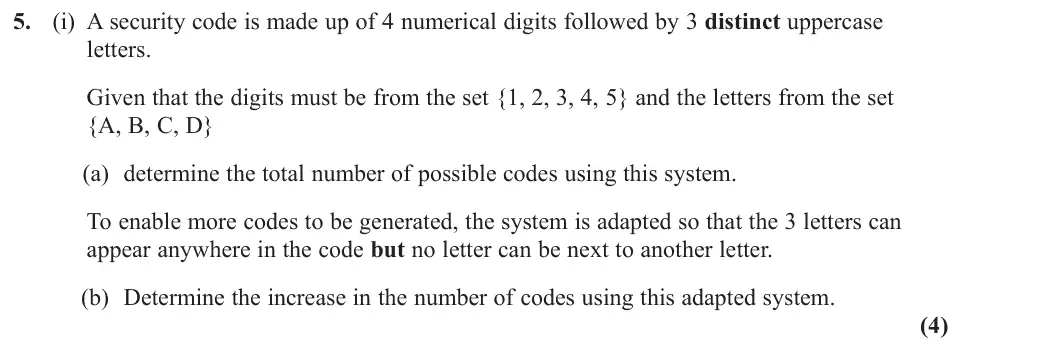
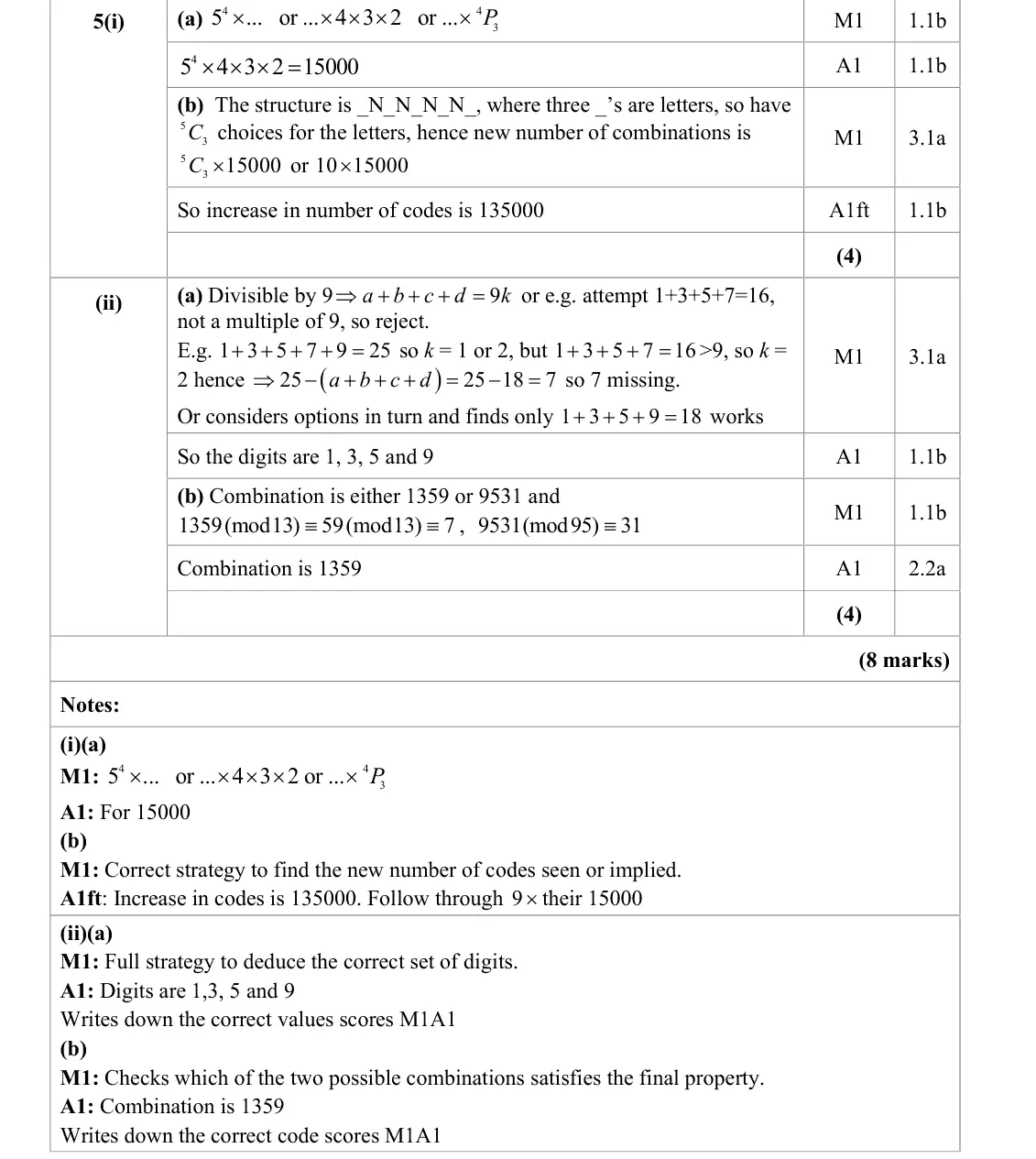
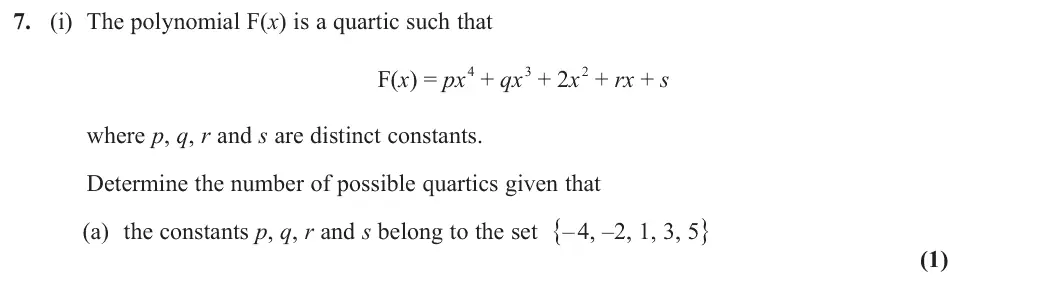
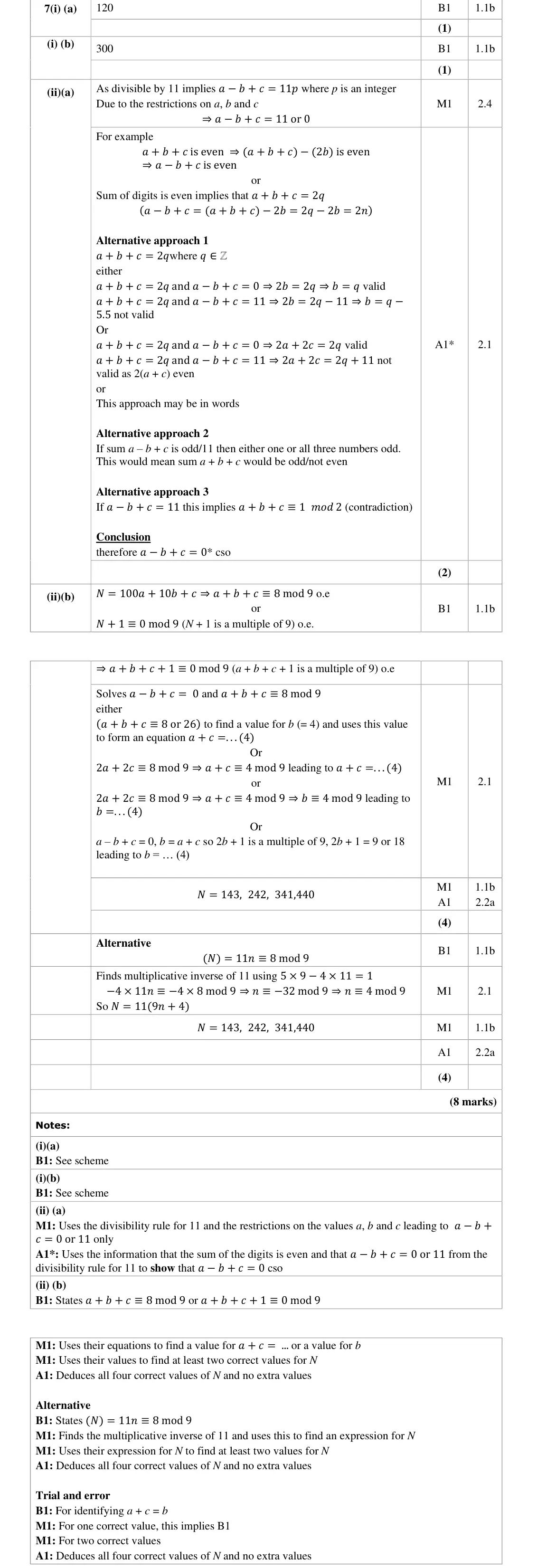
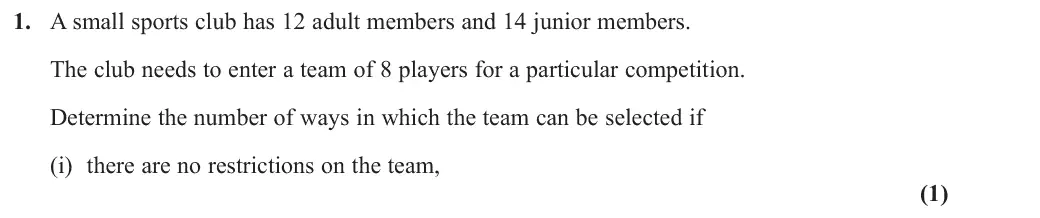
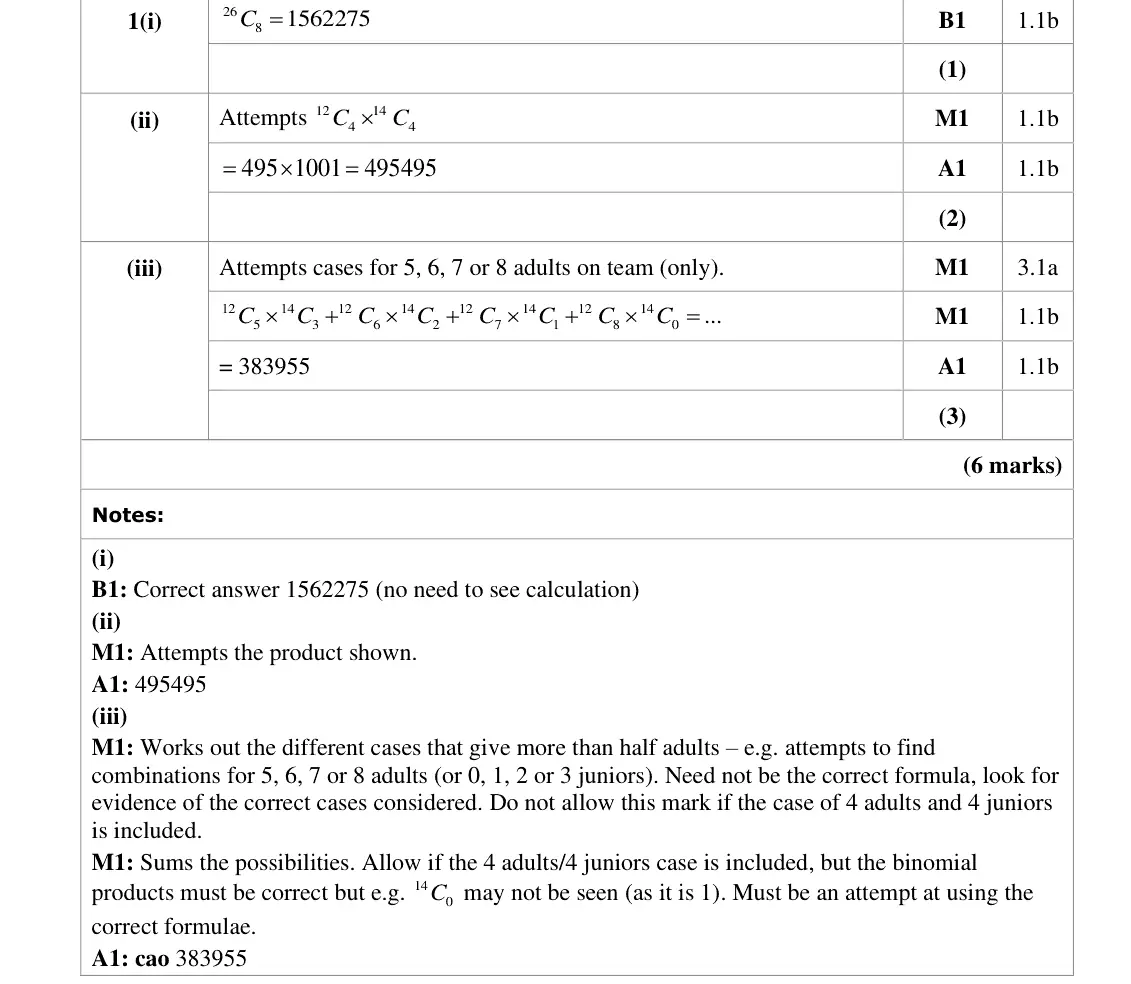
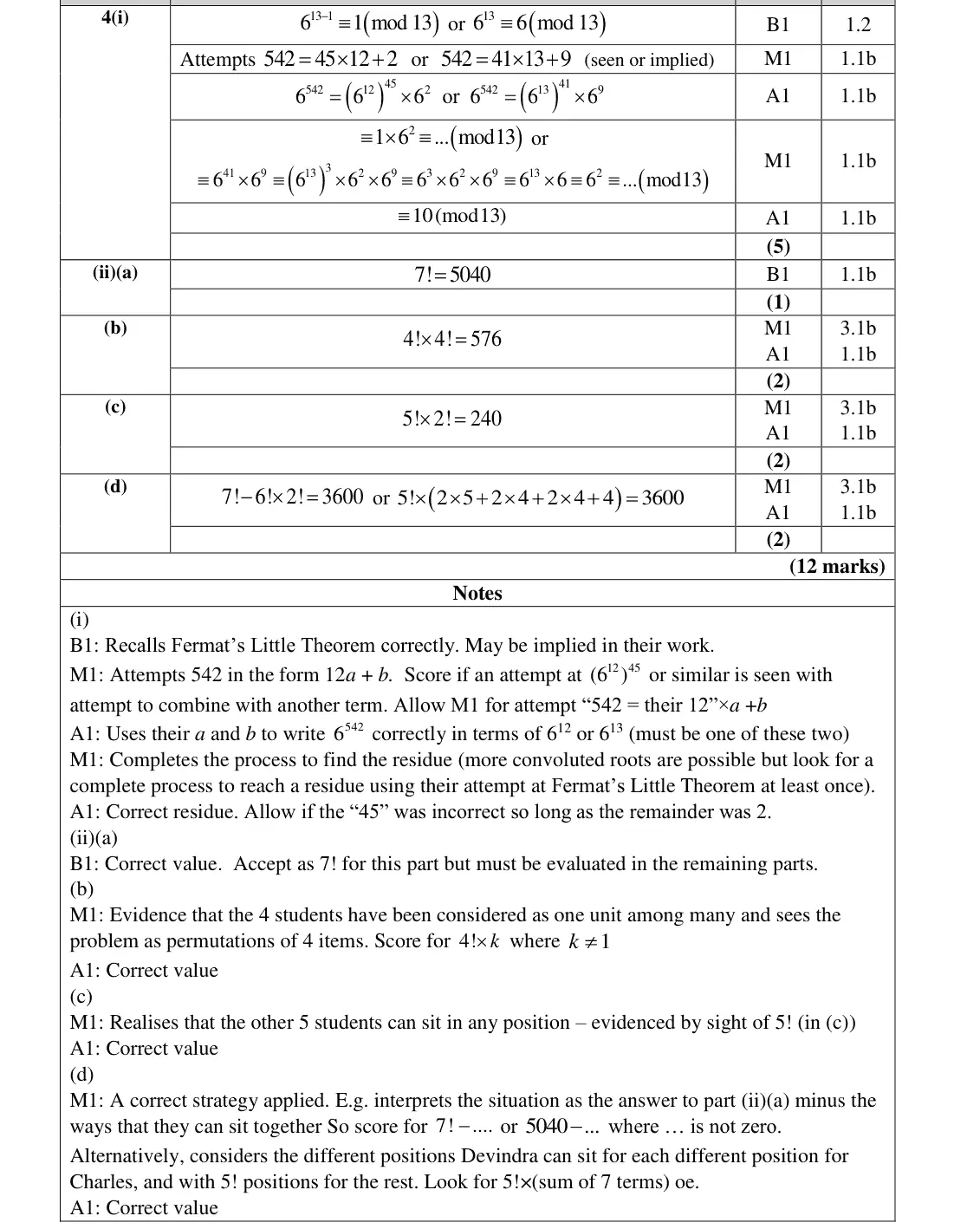
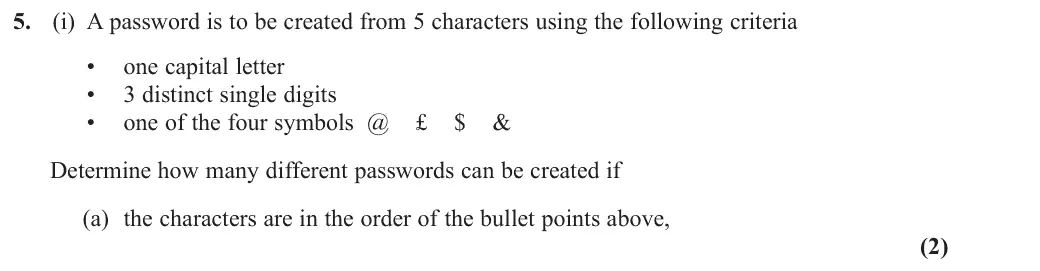
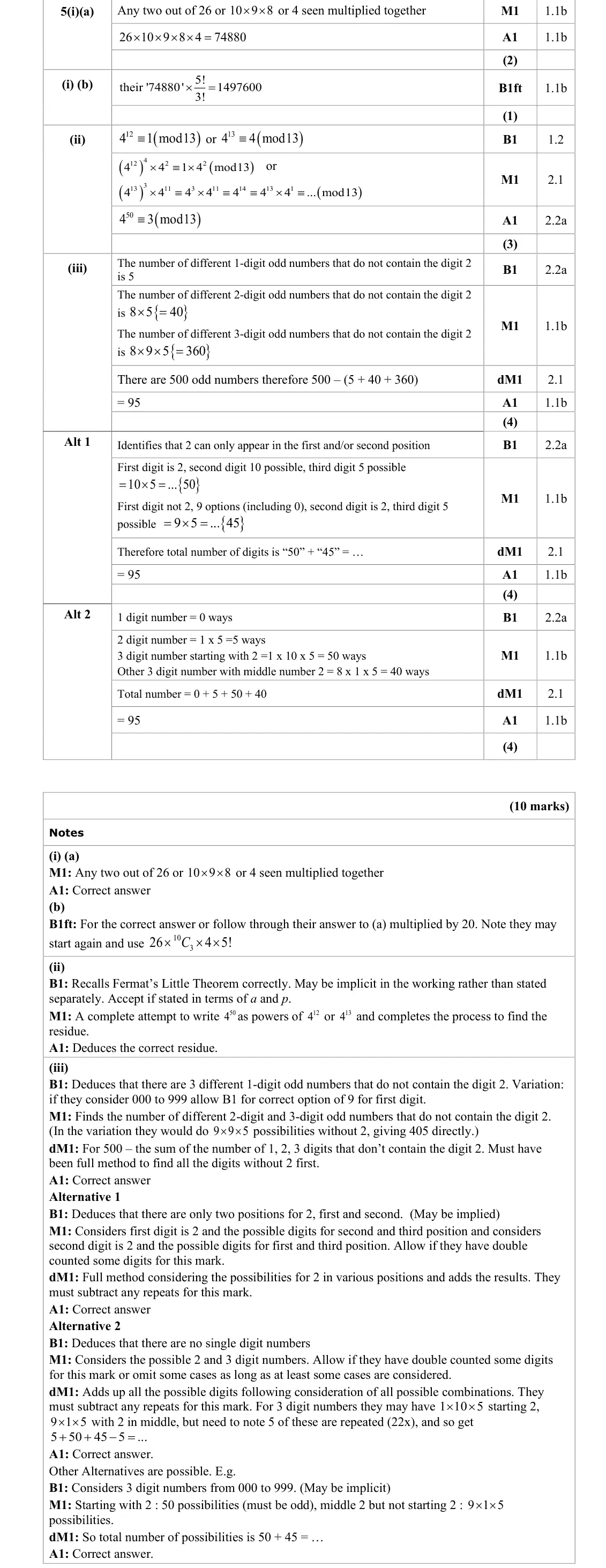
This was an inconsistently answered question, with (i) proving most challenging, (ii) proving very straightforward and (iii) producing a very mixed set of response. It is clear that the ideas of “counting” within number theory are still not well understood, but routine procedures such as applying Fermat’s Little Theorem are carried out very well. The leap between performing an algorithm and thinking through a problem can be big and this question therefore was a good discriminator for the paper. Part (i) was itself a bit mixed in performance, with most able to get started, fewer able to obtain a correct answer for part (a) and only a very small minority achieving a correct answer for (b). Many candidates were not confident working with combinatorics, but most could identify the 26 and the 4 that needed to be multiplied together to get the number of codes for part (a), although a few did have 24 letters in the alphabet rather than 26. The “10 x 9 x 8” or 10P3 for the 3 distinct digits was less commonly attained, with 9 x 8 x 7 often being given, presumably 0 being discounted at a valid digit. A few tried adding rather than multiplying the values for the three cases and so scored no marks. For (i)(b) very few were able to attain the correct answer. The most common thing to do was to multiply the answer to (a) by 5! Thinking that they needed to permute all the possibilities from part (a), not appreciating that the 3 ordered digits were originally chosen from 10, so there were repeats in these permutations from where the same three were chosen in a different order. Only a very few saw that the correct process from (a) to (b) was to multiply by 5! 20 3! = to discount the repeats. More often where correct answers occurred, they arose from working Many left this part out completely. out from scratch that it was 10 4 5! 26 C x x x 3 Part (ii) was answered very well, with even less able candidates able to score full marks in this part. Most stated Fermat’s Little Theorem initially, a good practice, before applying it to the problem, though a few candidates relied on the result being identified by implication within very brief work. Students should have it stressed that they should make the working clear, as answers only will not necessarily score the marks. After identifying the theorem most correctly adapted the powers and proceeded to simplify to the required residue with mistakes in simplifying being rare. A few did try approaches by modular arithmetic approaches without using Fermat’s Little Theorem, but these were unable to score marks as they did not follow the demand of the question Part (iii) was often approached haphazardly, but many were able to find their way to the correct solution, or at least partially correct. Following students work was often a difficult task, with very unclear layout and values appearing all over the place. Very few, after experimenting and finding their answer, went back to present the argument clearly. Again, the importance of making working clear, so that partial credit for incorrect answers may be able to be better awarded, should be stressed to students. In terms of how students approached the problem there were many approaches seen – all those on the mark scheme and variations of them. More students tried direct counting than counting the numbers without 2’s first, though the latter were arguably more successful overall. The most common method was considering the numbers in groups of 100, often listing options. E.g. 000’s =5, 100’s =5, 200’s=50, etc and summing the result. Such methods were effective, though less elegant than ones that considered forms of numbers, considering whether the first digit was 2, the second digit was 2 or the first and second digits were 2 and so on. However, these latter approaches were more prone to inclusion of repeats, or exclusion of some valid cases. Such method often scored the B mark on implication as few made it directly clear about the 1-digit numbers, as this was often subsumed in other cases, but it was clear that the majority realised 2 could not be the final digit (in fact there were only 5 choices for the final digit. Failing to consider multiple 2’s in the number was probably the most common error, with the 22x numbers often counted twice in solutions. Omitting possibilities such as the 2-digit numbers (often when counting x2x but excluding the first digit as 0 without considering 2 digit numbers separately) was also fairly common, while a few using the approach of counting no 2’s first did not correctly work out the 500 odd numbers to subtract from. Various other mistakes were made as well as these few examples. There were also several cases of students considering four-digit numbers seen, misreading or misinterpreting the “less than 1000”. For a deceptively simple question, this was a good demonstration of the level of complexity involved in counting problems and gave students ample opportunity to flex their problem- solving skills.
Key points from the mark scheme and examiner's report
- 26 × 10 × 9 × 8 × 4 = 74880
- 0 is a digit