FP2.6.2 The solution of recurrence relations to obtain closed forms.
Section
FP2.6 Further sequences and series
Level
AS & A level
Statement
The solution of recurrence relations to obtain closed forms.
Guidance
Students should be able to solve relations such as: uₙ₊₁ − 5uₙ = 8, u₁ = 1; 2uₙ₊₂ + 7uₙ₊₁ − 15uₙ = 6, u₁ = 10, u₂ = −17. The terms particular solution, complementary function and auxiliary equation should be known. Use of recurrence relations to model applications, e.g. population growth.
June 2025 · AS Paper 2 (Further Pure 2) · Q3(b)1 mark
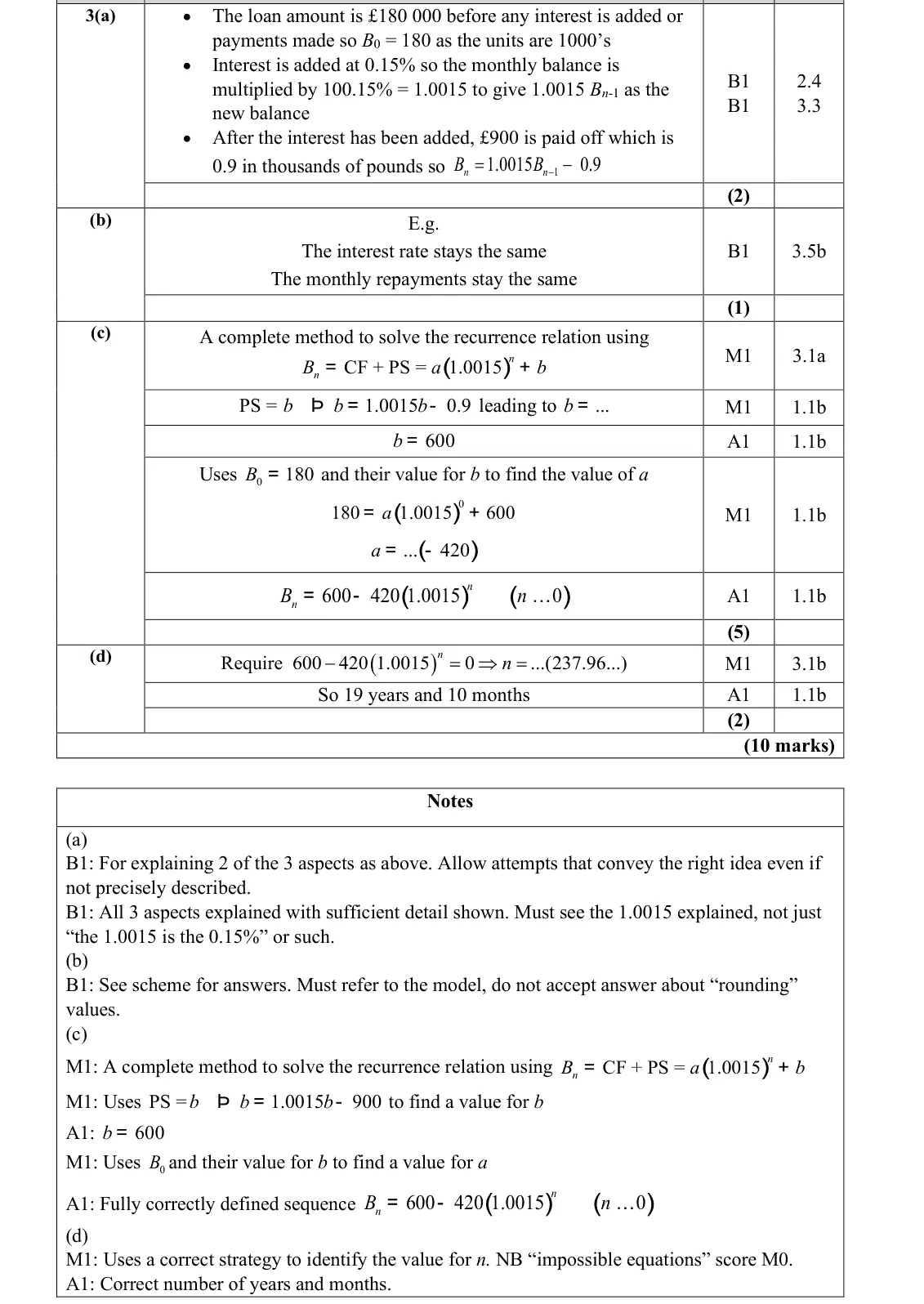
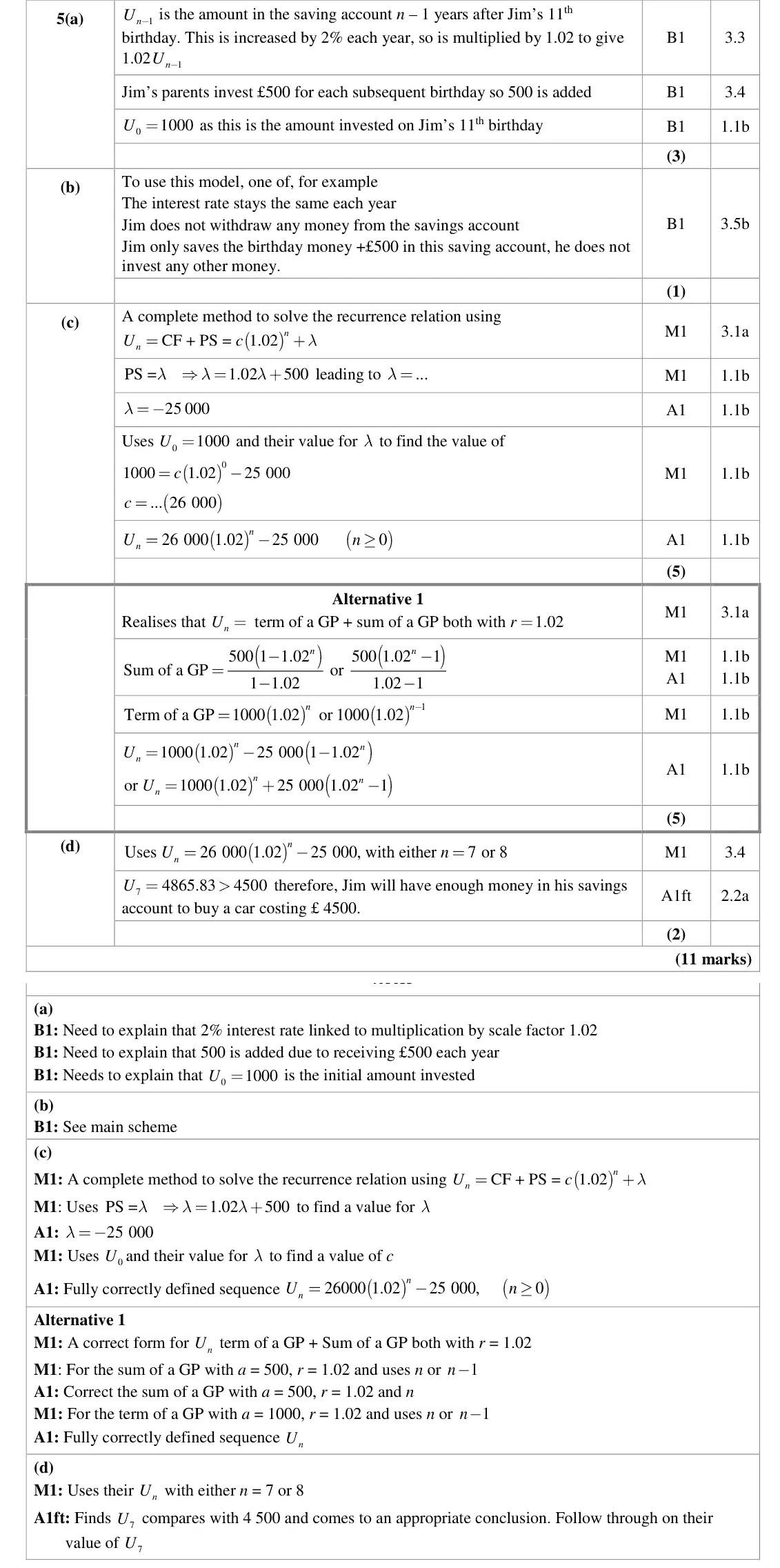
Mark scheme (whole question; this part is marked with the orange bar)
Examiner's comment
An expected question and again well answered by most with full marks being the modal score. A couple again left the question out entirely, while a few score the majority of marks but slipped up somewhere along the way to prevent full marks, usually in the descriptions in (a) or (b). Most gave a suitable reason for part (b) relating to the model, usually focusing on the need for repayments to stay constant. A couple tried to reason about rounding of values, which was not acceptable as it does not engage with the model. In such questions students need to relate their answers to aspects of the model, not try and give a generic answer.
Key points from the mark scheme and examiner's report
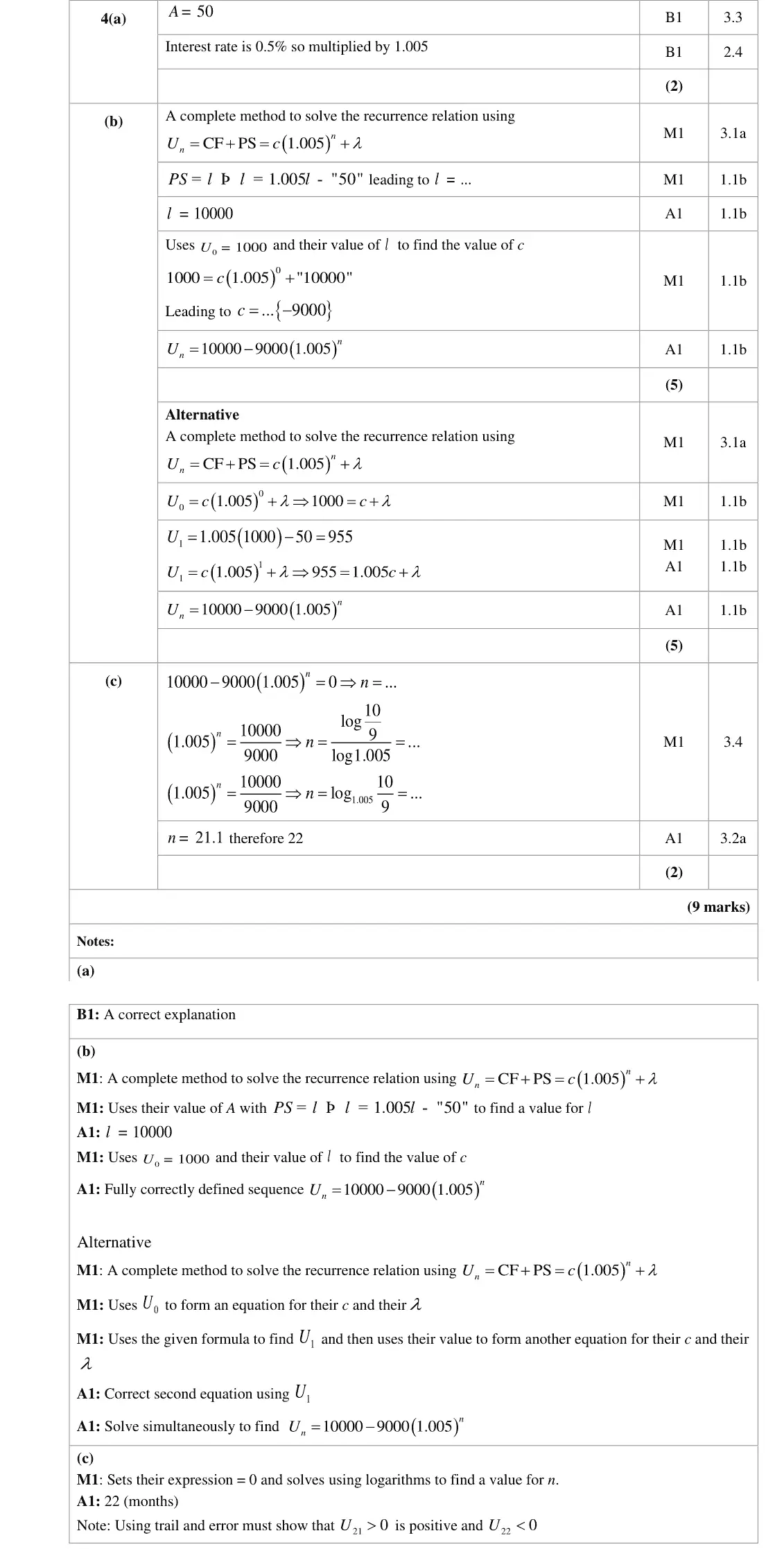
interest rate stays the same, or repayments stay at £900
answers about rounding do not engage with the model and score 0
June 2025 · AS Paper 2 (Further Pure 2) · Q3(c)5 marks
Mark scheme (whole question; this part is marked with the orange bar)
Examiner's comment
An expected question and again well answered by most with full marks being the modal score. A couple again left the question out entirely, while a few score the majority of marks but slipped up somewhere along the way to prevent full marks, usually in the descriptions in (a) or (b). Part (c) was well answered by all those attempting it, with the correct closed form obtained in the majority of responses, and mainly only those offering no attempts scoring no marks. The correct form for the solution was known, and students were able to use the first two terms to find the values of the constants successfully in most cases, with just a couple making errors.
Key points from the mark scheme and examiner's report
Bₙ = a(1.0015)ⁿ + b
b = 1.0015b − 0.9 gives b = 600
B₀ = 180 gives a = −420
Bₙ = 600 − 420(1.0015)ⁿ
well answered
June 2025 · AS Paper 2 (Further Pure 2) · Q3(d)2 marks
Mark scheme (whole question; this part is marked with the orange bar)
Examiner's comment
An expected question and again well answered by most with full marks being the modal score. A couple again left the question out entirely, while a few score the majority of marks but slipped up somewhere along the way to prevent full marks, usually in the descriptions in (a) or (b). There was slightly more of a variable performance in part (d), as though many were able to set up the initial equation needed, not all of them solved the equation correctly, or did not interpret the result to the correct number of months to the nearest month as specified. There was an opportunity for some of those who made errors in (c) that led to impossible equations to identify the error and correct, but sadly this did not happen in the couple of cases it applied in, with the students either not releasing the error, or not being able to see what had gone wrong.
Key points from the mark scheme and examiner's report
600 − 420(1.0015)ⁿ = 0 gives n = 237.96…, i.e. 238 months = 19 years 10 months
errors in solving or converting to years and months
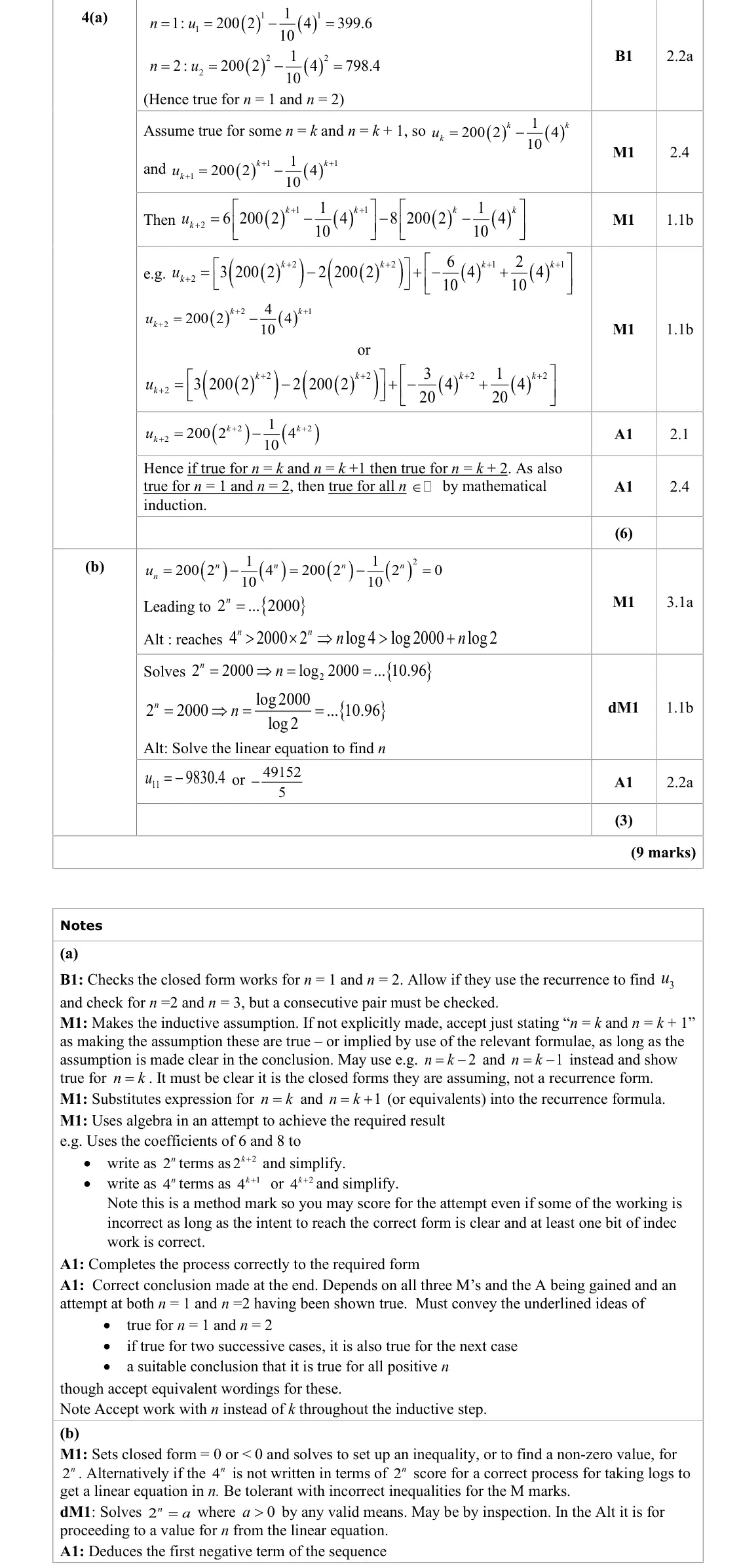
June 2025 · Paper 4A (Further Pure 2) · Q4(b)3 marks
Mark scheme (whole question; this part is marked with the orange bar)
Examiner's comment
There were no surprises in this question with well-prepared students able to score highly. The induction was done well, and most could solve to find the value for n needed in part (b), though some neglected to find the actual 11-th term. Part (b) was answered well and being independent of part (a) candidates who were unhappy with how to perform the induction often still did well with this part. The most common error was not understanding that they were required to provide the actual value of 11 u , with many stopping after establishing that n was 11. Most were able to set up a suitable inequality or equation using the given closed form and proceed to finding a value for 2n , or apply a correct logarithmic approach to produce a linear equation in n, though a few less able students were unable to spot the quadratic in 2n and either used a calculator solve or simply stopped working. Most identified the quadratic in 2n , but there were also many who took logarithms and applied the laws correctly to form a linear equation, and indeed this approach was often done well. Whichever approach was taken solving for n usually followed without trouble to get to n = 11, with mistakes at this stage rare. Some calculated at both n = 10 and n = 11 to find which was the negative, but many were able to identify it was the n = 11 that was needed without substitution – though as noted numerous of these gave no 11-th term and so lost the final A mark. When calculated, the 11-th term was almost always given correctly. Trial and improvement attempts were occasionally seen but were not common.
Key points from the mark scheme and examiner's report
4ⁿ = (2ⁿ)²: uₙ < 0 when 2ⁿ > 2000, n = 11
give the term u₁₁ = −9830.4 (many stopped at n = 11)
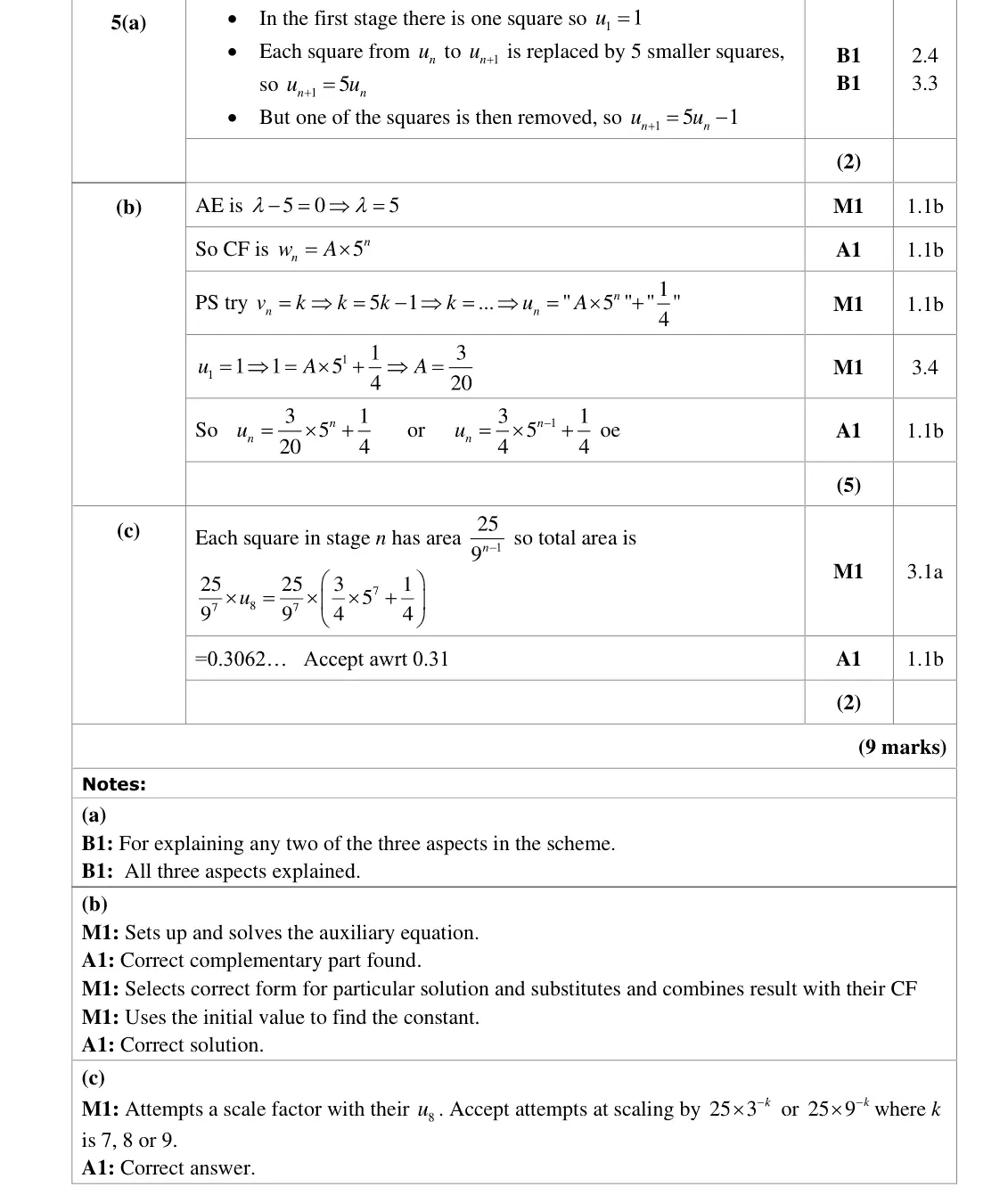
June 2024 · AS Paper 2 (Further Pure 2) · Q5(b)5 marks
Mark scheme (whole question; this part is marked with the orange bar)
Examiner's comment
Candidates found part (b) solving the recurrence relation accessible but struggled to gain all the mars for explaining the recurrence relation. There were again some blank scripts. Part (b) Most candidates solved the auxiliary equation and stated the correct complementary function. They knew the form for the particular solution and found it correctly. Some lost the final mark as they gave their answer as 1 3 1 20 4 5n n u + = x + instead of 3 1 20 4 5n n u = + x .
Key points from the mark scheme and examiner's report
CF A × 5ⁿ, constant PS k = 5k − 1 gives k = 1/4
u₁ = 1 gives A = 3/20
uₙ = (3/20)5ⁿ + 1/4
some wrote uₙ₊₁ instead of uₙ
June 2024 · AS Paper 2 (Further Pure 2) · Q5(c)2 marks
Mark scheme (whole question; this part is marked with the orange bar)
Examiner's comment
Part (c) Only a handful of candidates scored any marks as to score the method mark they needed to find 8u and multiply by 25 3 k - x or 25 9 k - x where k is 7, 8 or 9, some forgot the 25 or 9 k -. Only four candidates score any marks.
Key points from the mark scheme and examiner's report
Mark scheme (whole question; this part is marked with the orange bar)
Examiner's comment
Candidates found this question accessible as a standard question finding the closed form of a second order recurrence relation, the majority scoring full marks. The majority of candidates solved the auxiliary equation and correctly wrote the correct form of the complementary function of a repeated root. Candidate were then able to use the values of 1 u and 2 u to form and solve simultaneous equations to find the constants. They then stated the closed form if the form ... n u = A few candidates had the incorrect auxiliary equation or found the next few terms leading to no marks.
Key points from the mark scheme and examiner's report
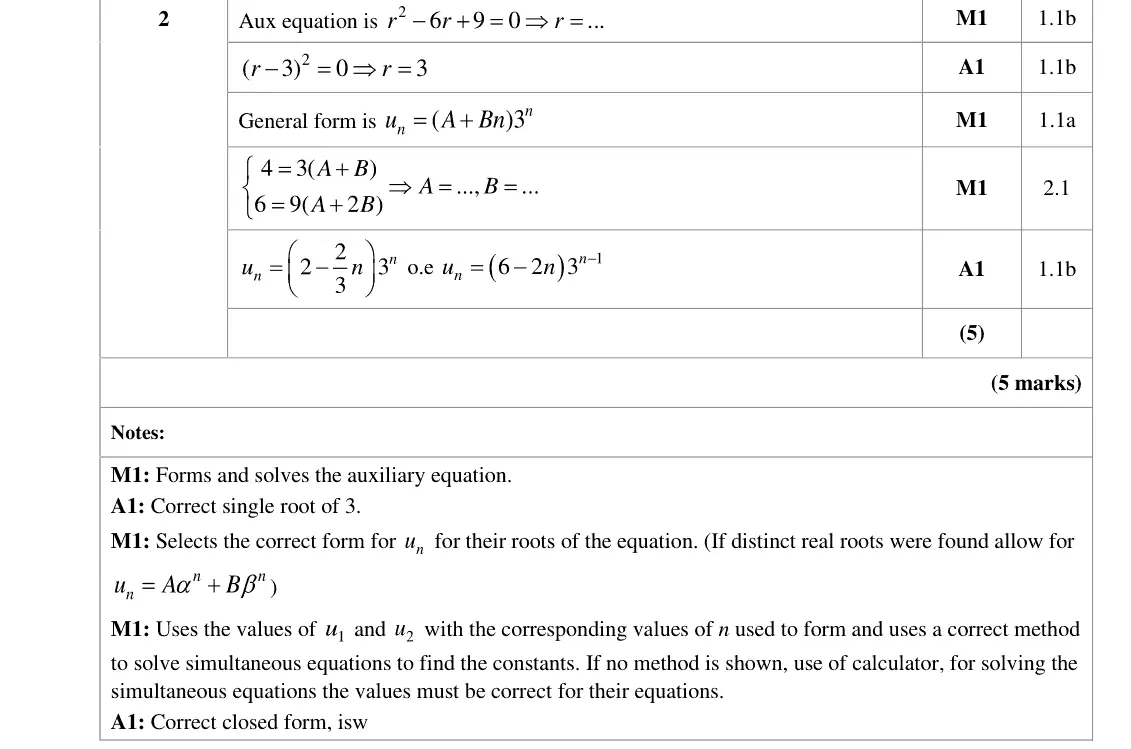
r² − 6r + 9 = 0, repeated root 3, so uₙ = (A + Bn)3ⁿ
June 2023 · AS Paper 2 (Further Pure 2) · Q4(b)5 marks
Mark scheme (whole question; this part is marked with the orange bar)
Examiner's comment
(b) This proved more demanding, only about half the candidates were successful. The incorrect form of the geometric series was the issue for other candidates. (c) Candidates who were successful in part (b) went on to correctly answer this part. Setting their answer to part (b) = 1000 and solves to find a value for n.
Key points from the mark scheme and examiner's report
Uₙ = c(1.005)ⁿ + λ
λ = 1.005λ − 50 gives λ = 10 000
U₀ = 1000 gives c = −9000
Uₙ = 10 000 − 9000(1.005)ⁿ
about half succeeded
wrong geometric-series forms the main error
June 2023 · AS Paper 2 (Further Pure 2) · Q4(c)2 marks
Mark scheme (whole question; this part is marked with the orange bar)
Examiner's comment
(c) Candidates who were successful in part (b) went on to correctly answer this part. Setting their answer to part (b) = 1000 and solves to find a value for n.
Key points from the mark scheme and examiner's report
set Uₙ = 0: (1.005)ⁿ = 10/9, n = 21.1 so 22 months (round up)
trial and error must show U₂₁ > 0 and U₂₂ < 0
June 2023 · Paper 4A (Further Pure 2) · Q3(c)2 marks
Mark scheme (whole question; this part is marked with the orange bar)
Examiner's comment
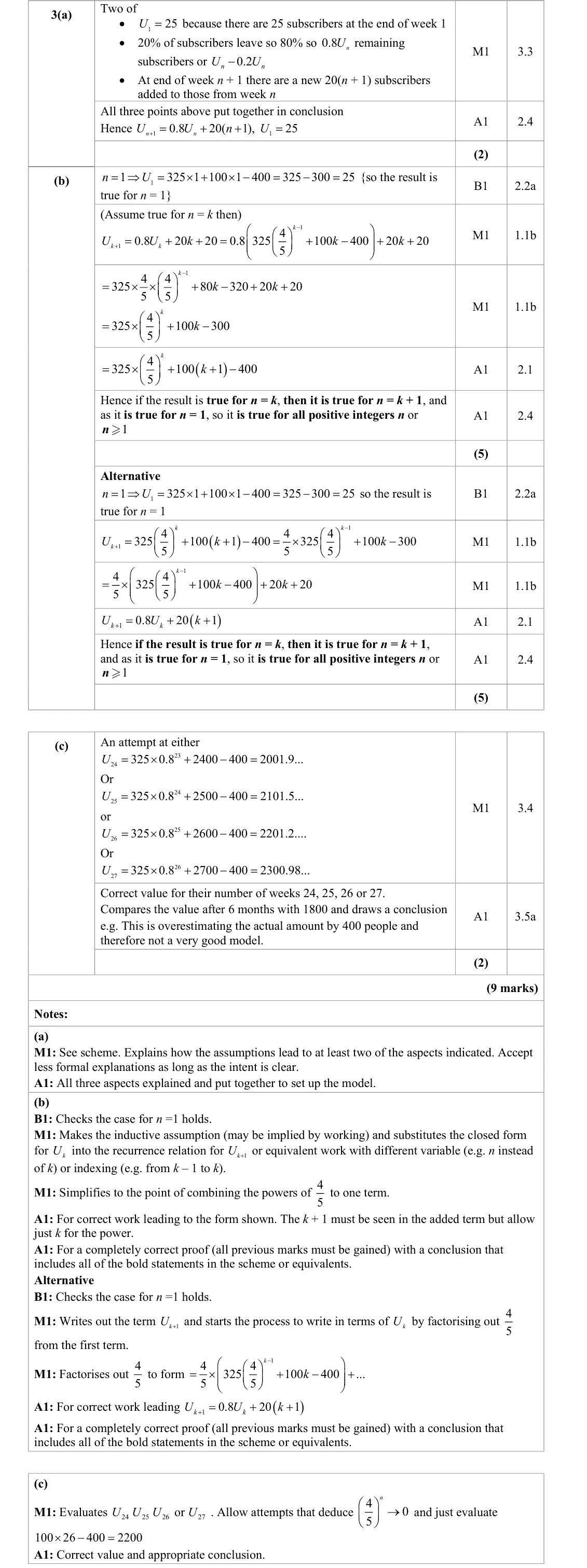
(c) Candidates needed to know how many weeks there were in half a year, and the mark scheme allowed 24, 25, 26 and 27 weeks. Candidates were then able to draw the correct conclusion that it was not a good model.
Key points from the mark scheme and examiner's report
6 months ≈ 24 to 27 weeks: U ≈ 2000 to 2300, over 1800, so the model overestimates and is not good
June 2023 · Paper 4A (Further Pure 2) · Q67 marks
Mark scheme (whole question; this part is marked with the orange bar)
Examiner's comment
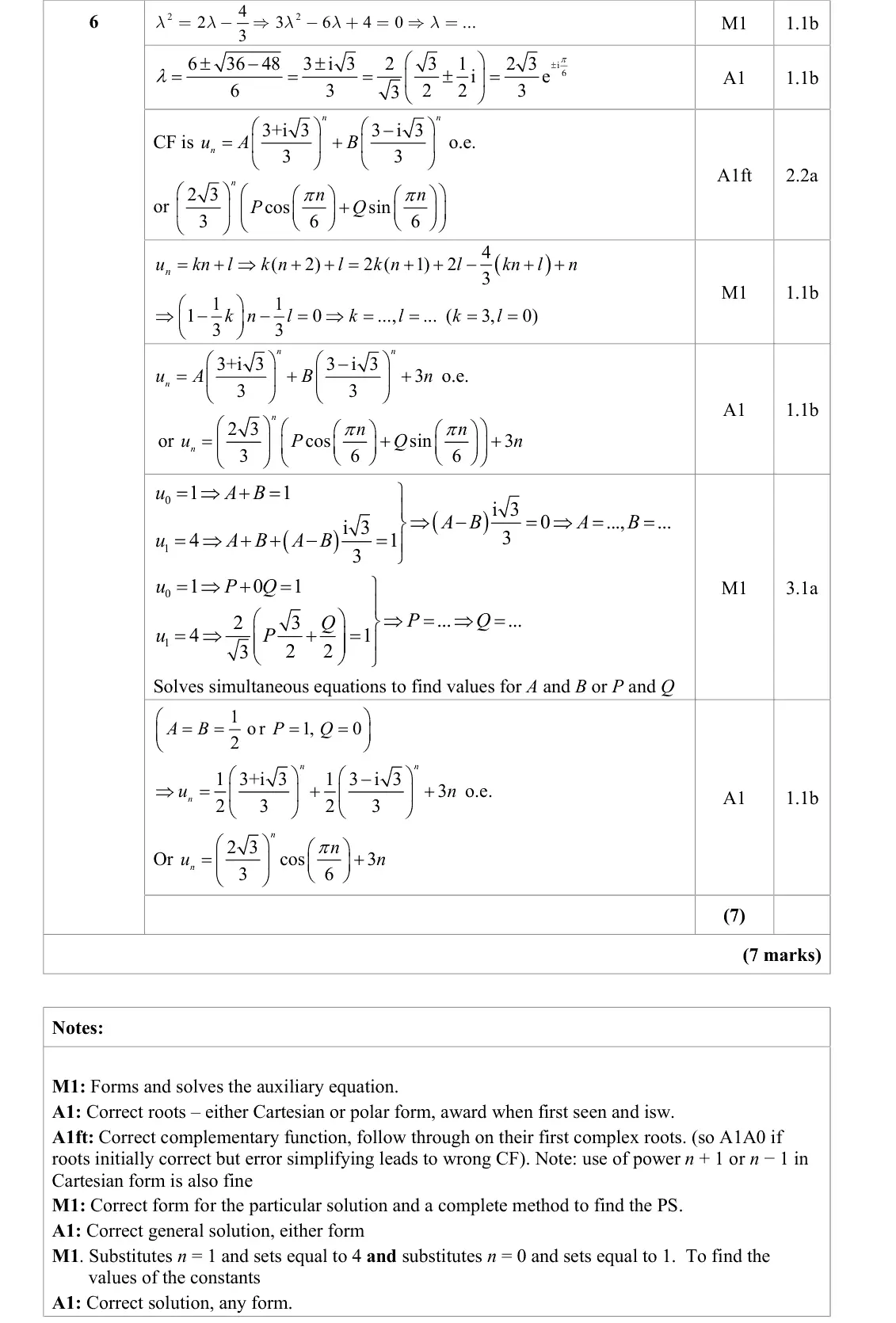
The majority of candidates knew how to find the closed form for a recurrence relation. They were able to form and solve the auxiliary equation. Then wrote down the correct general solution either the Cartesian or polar form. There were some errors with the particular solution, candidates need to use the form nu n = + , some incorrectly used nu n = . Candidates then used 0 1 u = and 1 4 u = to find the values of the constants. There were some numerical slips but the correct method was used.
Key points from the mark scheme and examiner's report
June 2022 · AS Paper 2 (Further Pure 2) · Q5(b)4 marks
Mark scheme (whole question; this part is marked with the orange bar)
Examiner's comment
There was a wide spread of marks again for this question, showing it worked well as a final question discriminator. Only 3 candidates did not score at all (no attempt made), with three modes of 0,4 or 5 marks, the majority did score 4 or more. It was interesting to note that in part (b) most adopted an unanticipated approach via forming an auxiliary equation and particular solution (Alt 2 on the mark scheme), rather than using the information in the question about the given form and setting up and solving equations using the first two terms. Candidates were going through the process they have been taught, rather than taking in the question as given and using the information already presented. However, the process was usually carried out correctly leading to the correct values for a and b.
Key points from the mark scheme and examiner's report
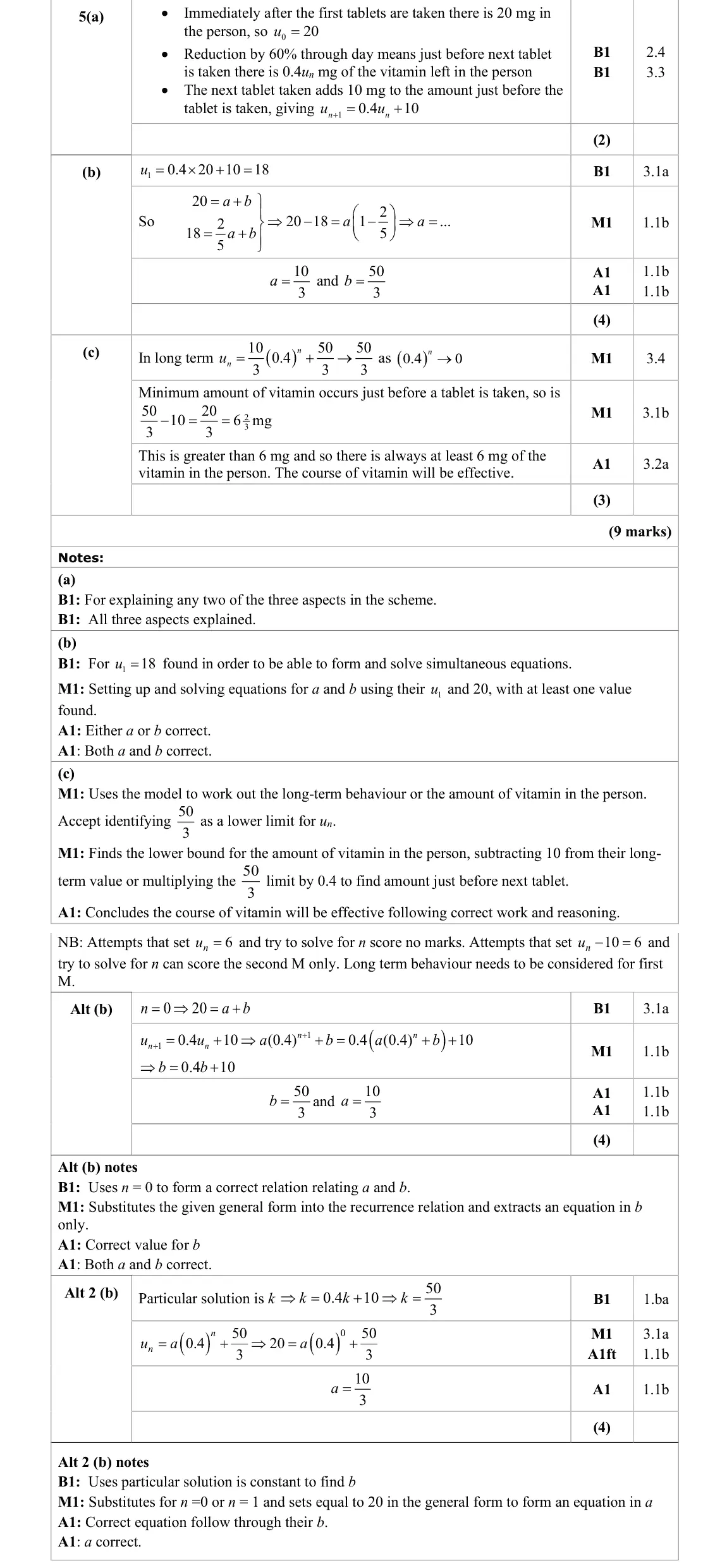
u₁ = 18 then solve 20 = a + b, 18 = 0.4a + b
or particular solution b = 0.4b + 10
a = 10/3, b = 50/3
most used the auxiliary/particular-solution route rather than the given form
June 2022 · AS Paper 2 (Further Pure 2) · Q5(c)3 marks
Mark scheme (whole question; this part is marked with the orange bar)
Examiner's comment
There was a wide spread of marks again for this question, showing it worked well as a final question discriminator. Only 3 candidates did not score at all (no attempt made), with three modes of 0,4 or 5 marks, the majority did score 4 or more. Part (c) was another good discriminating part, fitting for the last part of the paper. Although many were able to identify the long term behaviour (sometimes by substitution of large values), only very few realised they needed to subtract the 10 from this value to find the least amount of vitamin in the body before drawing a conclusion. Those who did realise this went on to make a correct conclusion.
Key points from the mark scheme and examiner's report
uₙ decreases to 50/3 as (0.4)ⁿ → 0
the minimum is just BEFORE a tablet: 50/3 − 10 = 20/3 > 6, so the course is effective
very few subtracted the 10
setting uₙ = 6 scores 0
June 2022 · Paper 4A (Further Pure 2) · Q3(c)1 mark
Mark scheme (whole question; this part is marked with the orange bar)
Examiner's comment
Almost all candidates were able to successfully answer part a, explaining the constraints. Part (c) was also generally very well done, with a variety of different notations used. The induction in part (b) was more variable. It was generally obvious which candidates had
Key points from the mark scheme and examiner's report
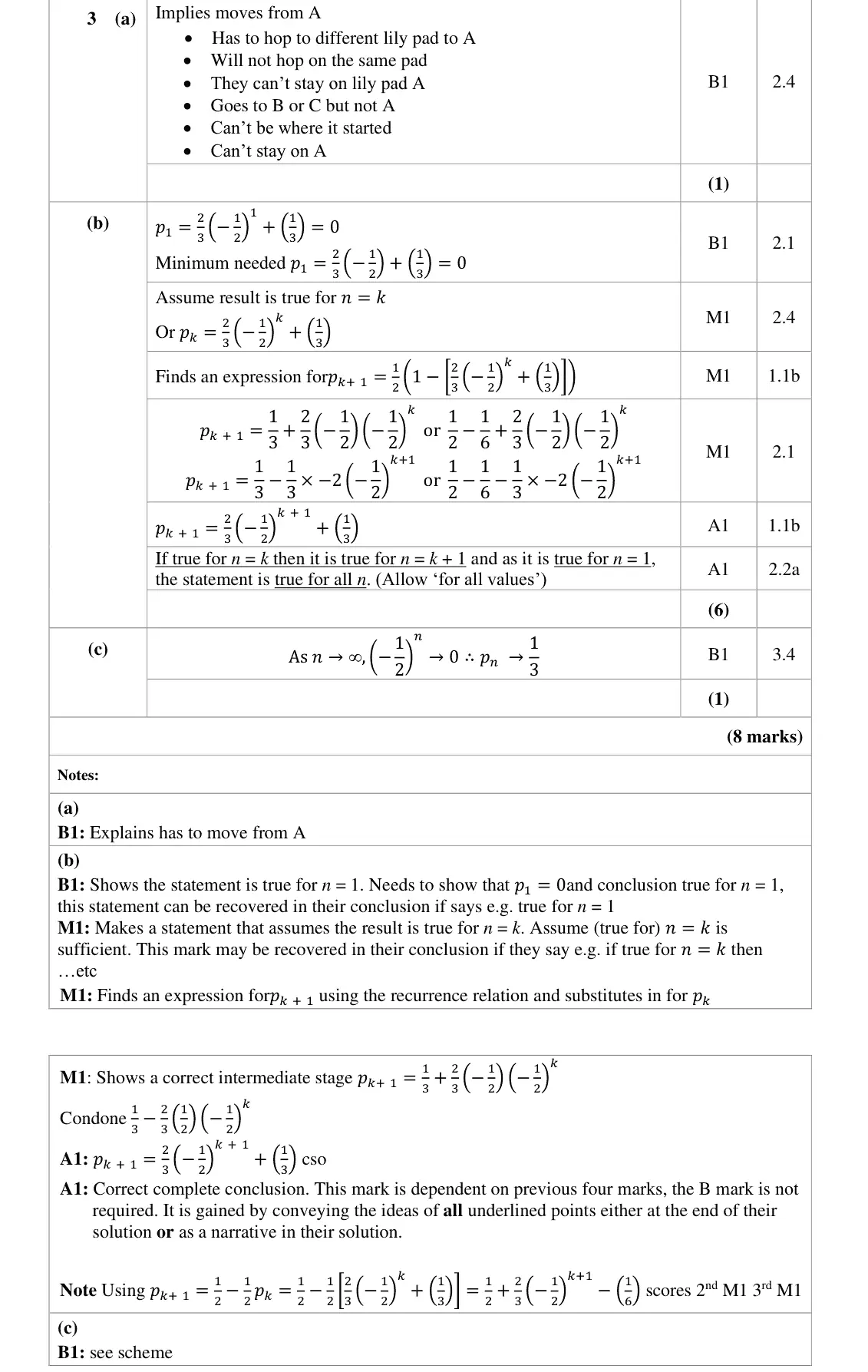
(−½)ⁿ → 0 as n → ∞, so pₙ → 1/3
June 2022 · Paper 4A (Further Pure 2) · Q6(a)4 marks
Mark scheme (whole question; this part is marked with the orange bar)
Examiner's comment
Part (a) Most candidates formed and solve the auxiliary equation obtaining the correct complementary. A few candidates used the wrong form of the complementary function, and others substituted incorrectly in their attempts to find the particular solution.
Key points from the mark scheme and examiner's report
June 2022 · Paper 4A (Further Pure 2) · Q6(b)2 marks
Mark scheme (whole question; this part is marked with the orange bar)
Examiner's comment
Part (b) Those that achieved the correct answer in (a) mainly followed this through with the correct solution. Most of the others gained the method mark for using the information give to find the value for their constants
Key points from the mark scheme and examiner's report
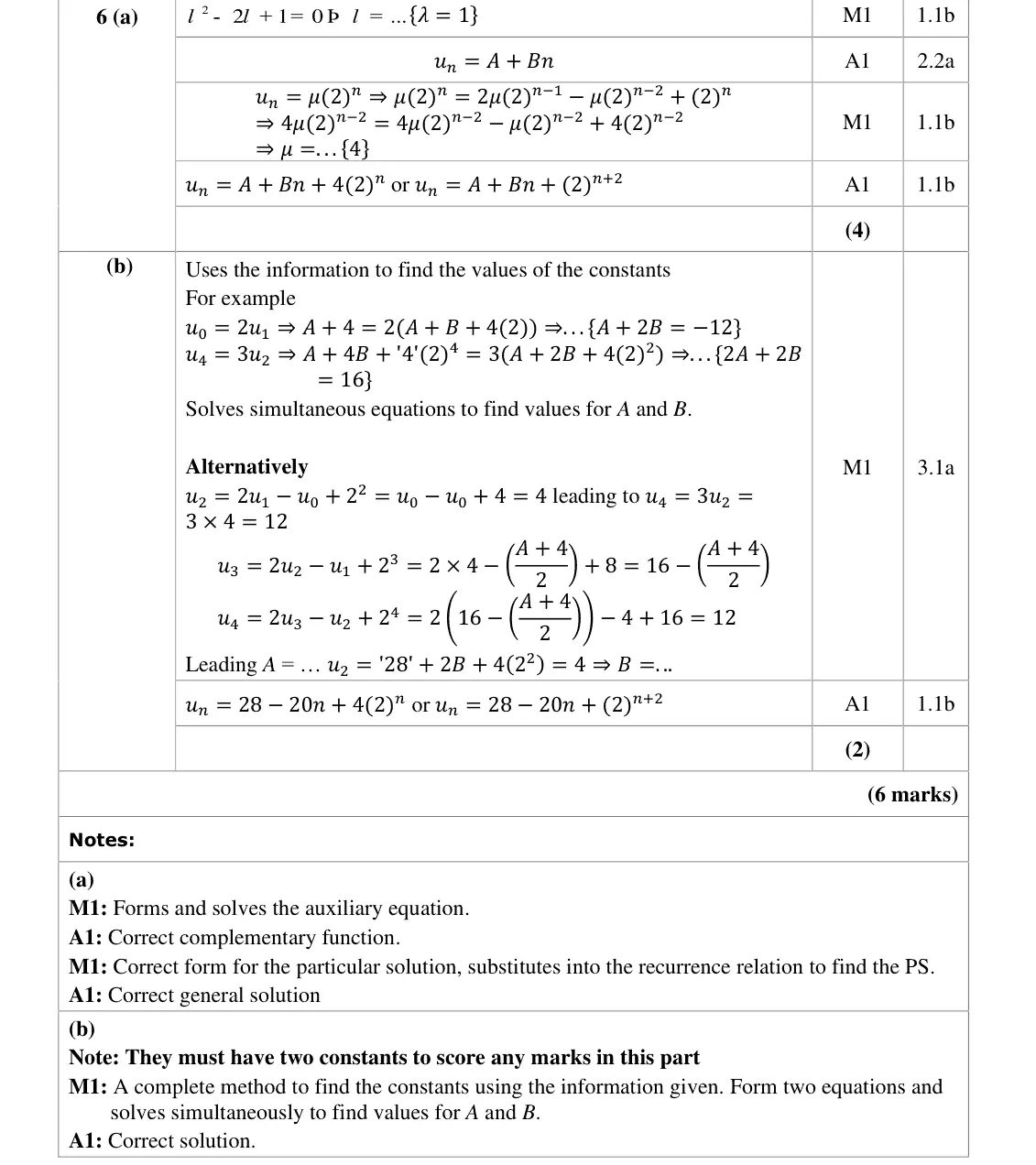
two equations from u₀ = 2u₁ and u₄ = 3u₂: A = 28, B = −20
uₙ = 28 − 20n + 2ⁿ⁺²
Oct 2020 · AS Paper 2 (Further Pure 2) · Q4(c)4 marks
Mark scheme (whole question; this part is marked with the orange bar)
Key points from the mark scheme and examiner's report
Mark scheme (whole question; this part is marked with the orange bar)
Key points from the mark scheme and examiner's report
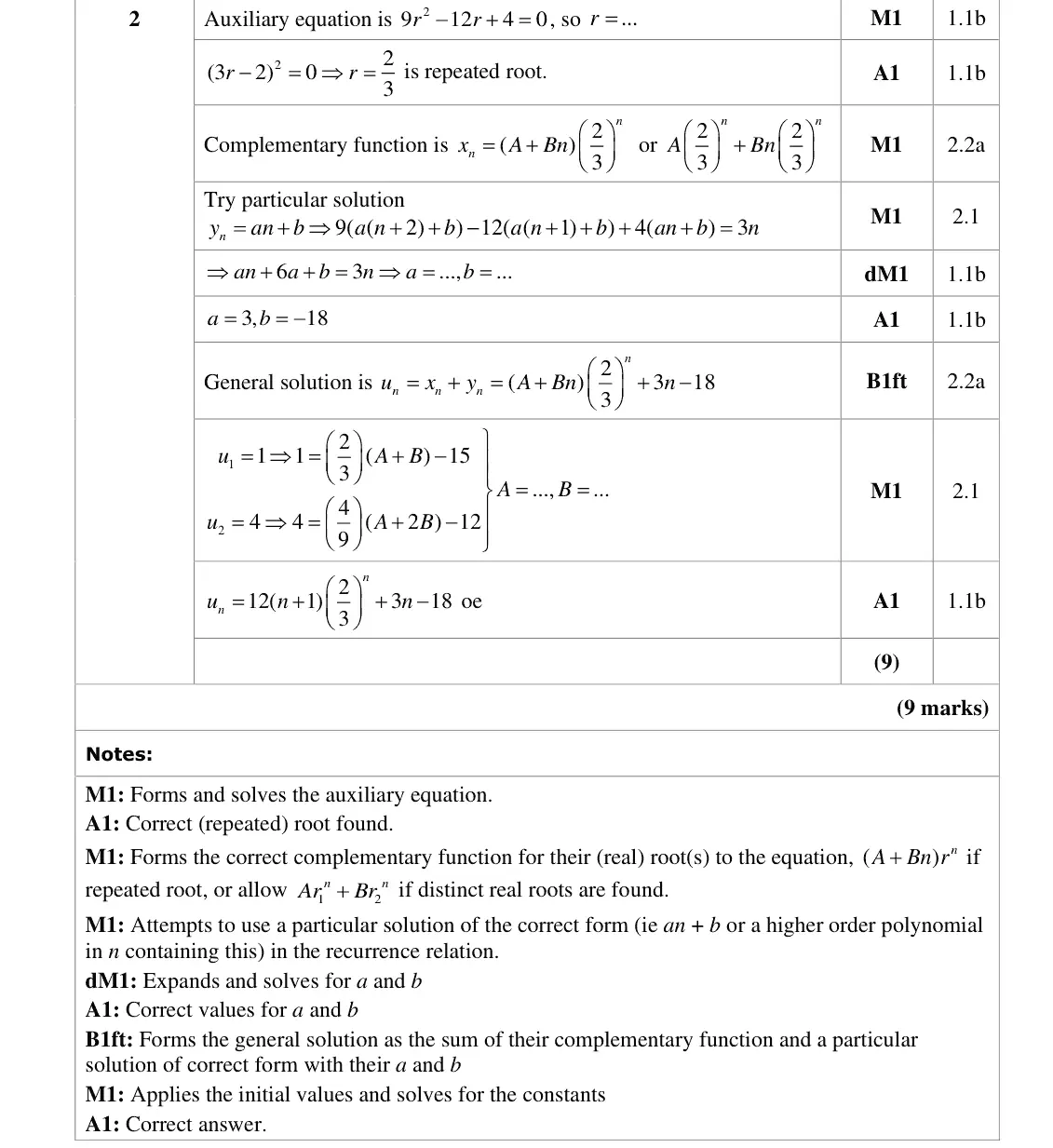
auxiliary 9r² − 12r + 4 = 0, repeated root 2/3 so CF (A + Bn)(2/3)ⁿ
particular solution an + b gives a = 3, b = −18
then use u₁, u₂: uₙ = 12(n + 1)(2/3)ⁿ + 3n − 18
June 2019 · AS Paper 2 (Further Pure 2) · Q5(b)1 mark
Mark scheme (whole question; this part is marked with the orange bar)
Examiner's comment
Part (b) Only a few candidates were able to give a correct assumption for the model. Just saying that the interest does not change is insufficient, it is the interest rate that needs to remain the same. Candidates who said no money was removed from the account scored the mark.
Key points from the mark scheme and examiner's report
the interest RATE stays the same (not "the interest"), or no money is withdrawn / nothing else is paid in
few correct
June 2019 · AS Paper 2 (Further Pure 2) · Q5(c)5 marks
Mark scheme (whole question; this part is marked with the orange bar)
Examiner's comment
Part (c) A minority of candidates did not know how to solve the recurrence relation and scored no further marks for this question. Those candidates who did know how to solve the recurrence relation did so very successfully by in splitting into CF + PS.
Key points from the mark scheme and examiner's report
June 2019 · AS Paper 2 (Further Pure 2) · Q5(d)2 marks
Mark scheme (whole question; this part is marked with the orange bar)
Examiner's comment
Part (d) needed candidates to use the answer to part (c) find the 7th term, which many did successfully who had an answer to part(c). With the conclusion candidates needed to compare the 7th term with £4 500 and comment on whether Jim will have enough money. Some candidates did not show the comparison and hence did not justify their conclusion.
Key points from the mark scheme and examiner's report
18th birthday is n = 7: U₇ = £4865.83 > £4500 so he can buy the car
the comparison must be shown
June 2019 · Paper 4A (Further Pure 2) · Q3(b)5 marks
Mark scheme (whole question; this part is marked with the orange bar)
Examiner's comment
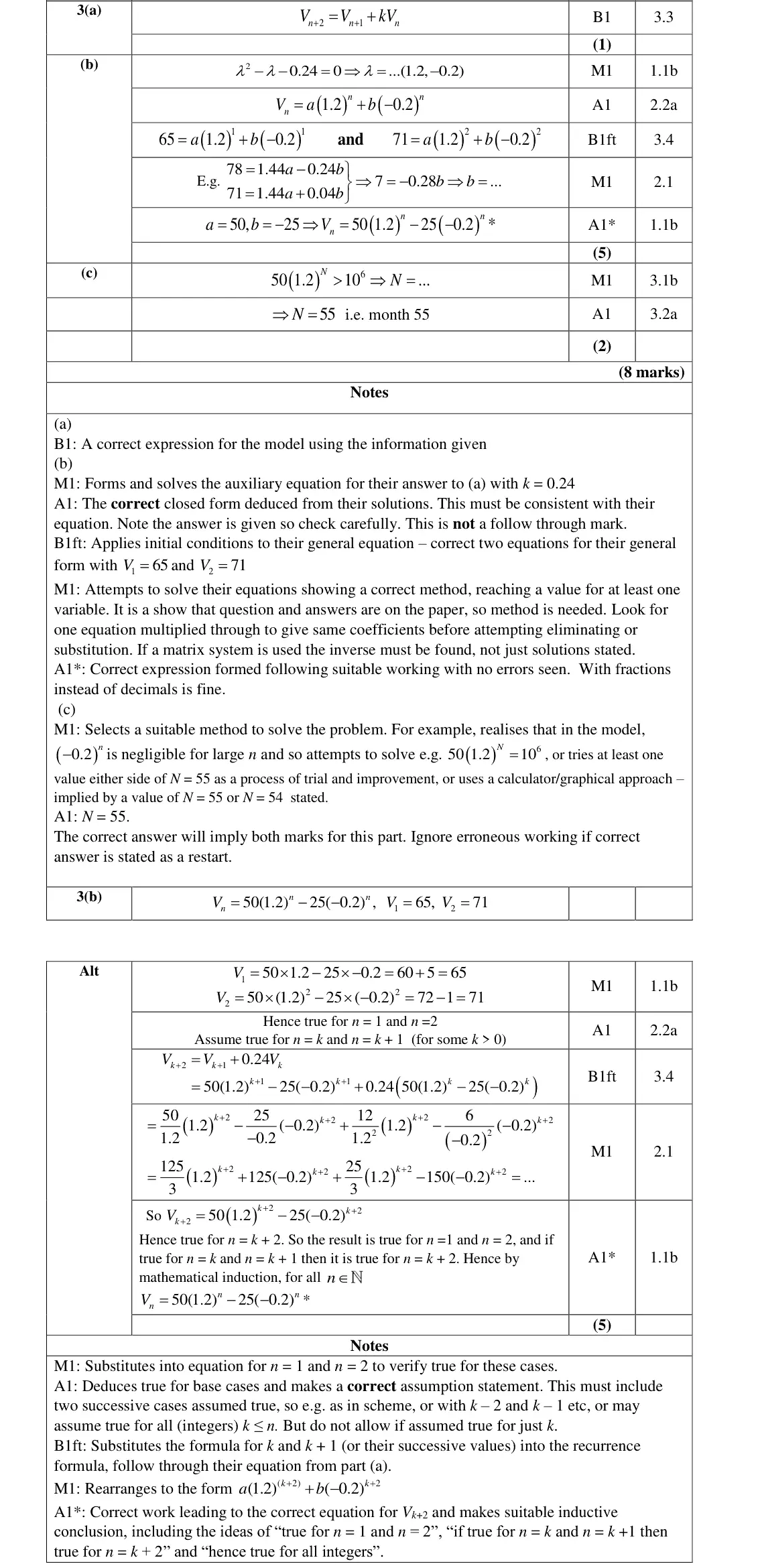
Recurrence relations are a new topic on the specification but the methods required for solving were shown by most. The main hindrance for this question was a lack of showing method to achieve a given solution in part (b). In part (b) the process of forming and solving the auxiliary equation before setting up and solving equations to find the coefficients was demonstrated well by most candidates. However, the question was a “show” and with the given answer on the page, candidates need to ensure that sufficient working is shown. An over reliance on calculator technology meant that many candidates simply wrote down the answers 1.2 and -0.2 to the auxiliary equation, and the values of a and b from the simultaneous equations – but these were given in the question. Particularly for the latter, evidence was required as to where these values came from and so many student lost marks for a failure to show method. While calculator technology is encouraged to be used appropriately in the new specification, candidates need to be more aware of where is and is not appropriate. Where answers are given, method should be evidenced. Where candidates had given an incorrect answer to (a), they either made little progress in (b) when their solutions to the auxiliary equation were not what was expected, or else managed to find the correct solutions for their incorrect equation – as the answers were on the page. There were only a very small minority of candidates who tried to prove the formula using proof by induction, and this was rarely fully successful.
Key points from the mark scheme and examiner's report
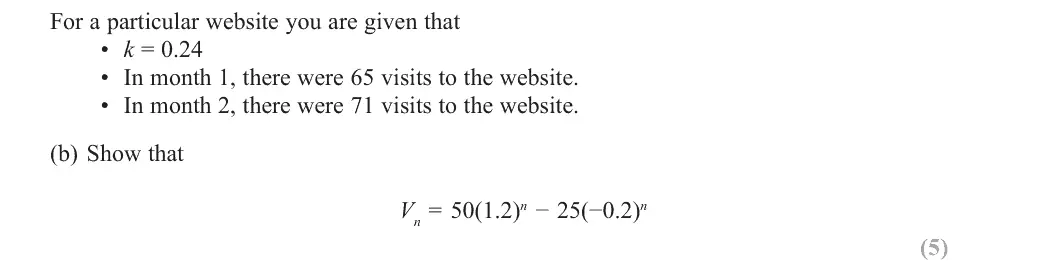
set up V₁ = 65, V₂ = 71 and solve for a = 50, b = −25 with working shown
calculator-only roots or constants lost marks on this show that
induction alternative accepted
June 2019 · Paper 4A (Further Pure 2) · Q3(c)2 marks
Mark scheme (whole question; this part is marked with the orange bar)
Examiner's comment
Recurrence relations are a new topic on the specification but the methods required for solving were shown by most. The main hindrance for this question was a lack of showing method to achieve a given solution in part (b). For part (c) very few candidates used the envisaged method as they did not realise that (-0.2)N is negligible for large N. However, this was not a given answer and so in this part use of calculator method were acceptable and many gave N = 55 as the answer from little or no working, or as a restart after failed attempts to solve a log equation with (-0.2)N included.
Key points from the mark scheme and examiner's report
(−0.2)ⁿ negligible so 50(1.2)ᴺ > 10⁶: N = 55
trial either side also accepted
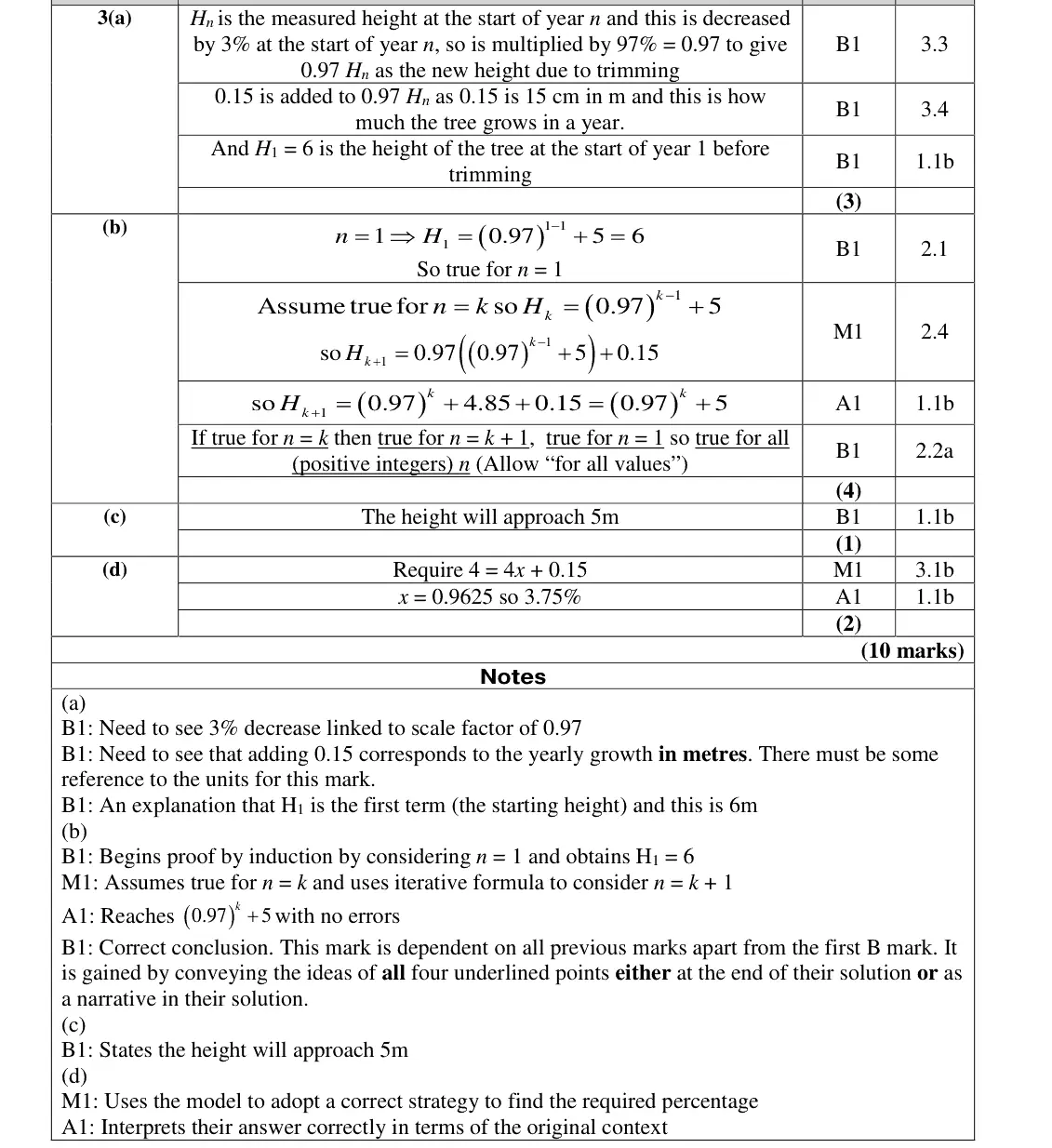
June 2018 · AS Paper 2 (Further Pure 2) · Q3(a)3 marks
Mark scheme (whole question; this part is marked with the orange bar)
Examiner's comment
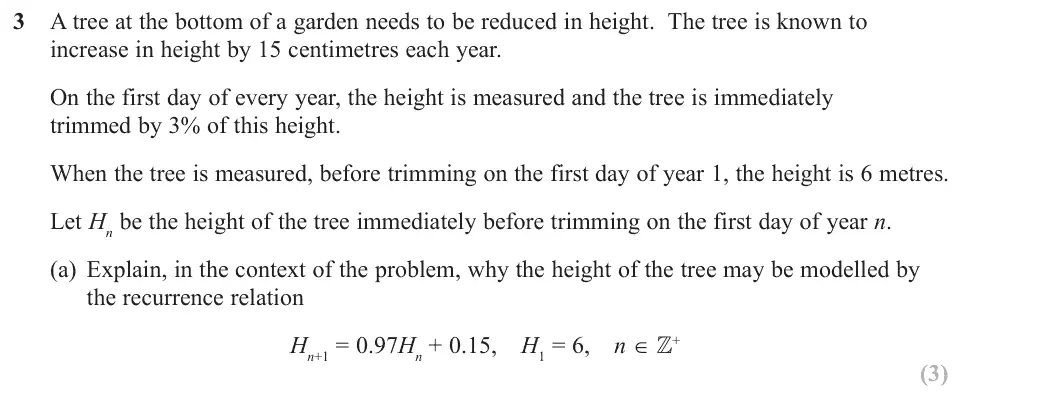
(a) Many students could score at least one of the marks here. It was expected that some reference was made to the “0.97”, the “0.15” and the value of H1. In order to qualify for the second mark, students needed to make reference to the units which was often overlooked.
Key points from the mark scheme and examiner's report
×0.97 for a 3% trim
+ 0.15 is the 15 cm yearly growth IN METRES (units must be mentioned)
H₁ = 6 is the starting height
June 2018 · AS Paper 2 (Further Pure 2) · Q3(c)1 mark
Mark scheme (whole question; this part is marked with the orange bar)
Examiner's comment
(c) There were very few correct answers here. Often students simply stated “it will get bigger” or “it will get smaller”.
Key points from the mark scheme and examiner's report
0.97^(n−1) → 0 so the height approaches 5 m
"gets bigger/smaller" scores 0
very few correct
June 2018 · AS Paper 2 (Further Pure 2) · Q3(d)2 marks
Mark scheme (whole question; this part is marked with the orange bar)
Examiner's comment
(d) Very few students knew how to tackle this part of the question and it was often left blank although a couple of novel approaches were seen to establish the percentage required.
Key points from the mark scheme and examiner's report
long-term value L satisfies L = xL + 0.15: 4 = 4x + 0.15, x = 0.9625 so trim 3.75%
often left blank
Find an Edexcel Further Maths tutor
Stuck on this? Book a trial lesson with our Further Maths tutor.