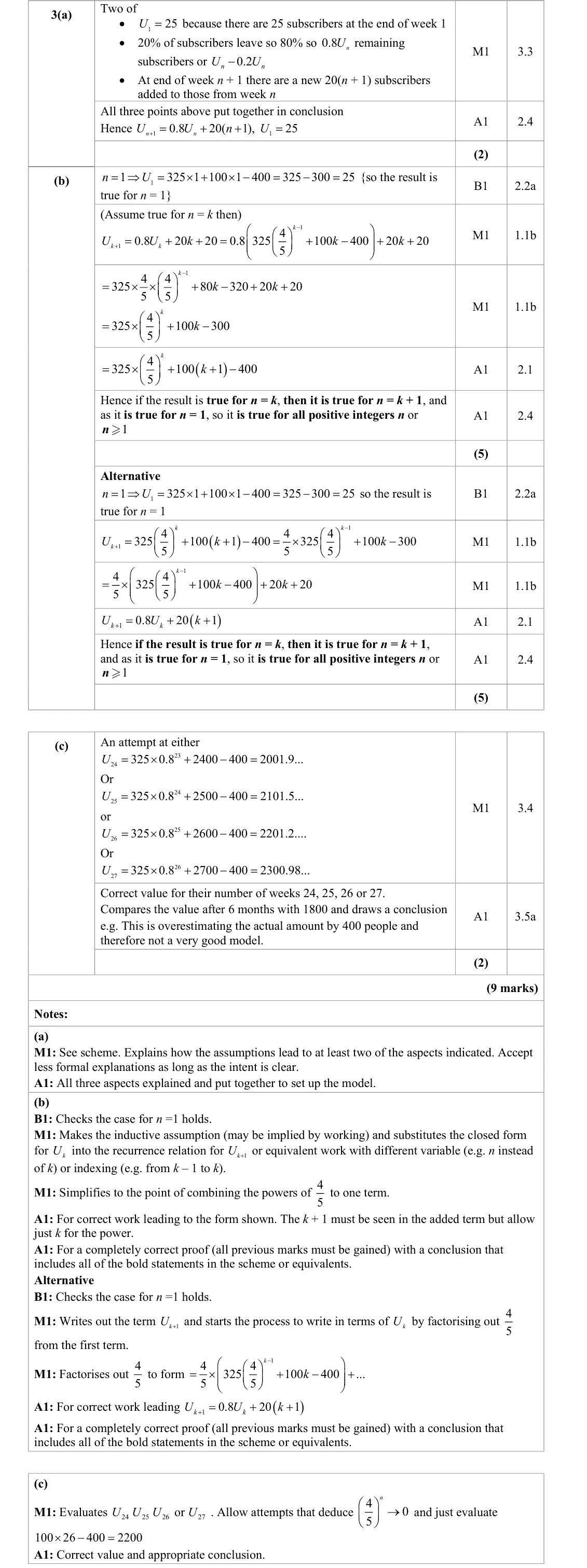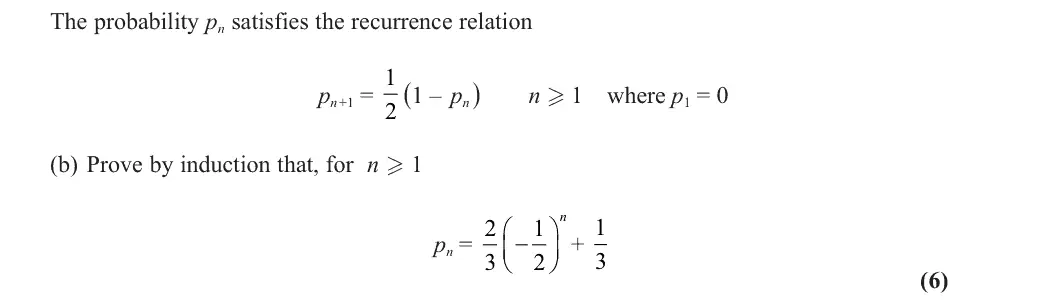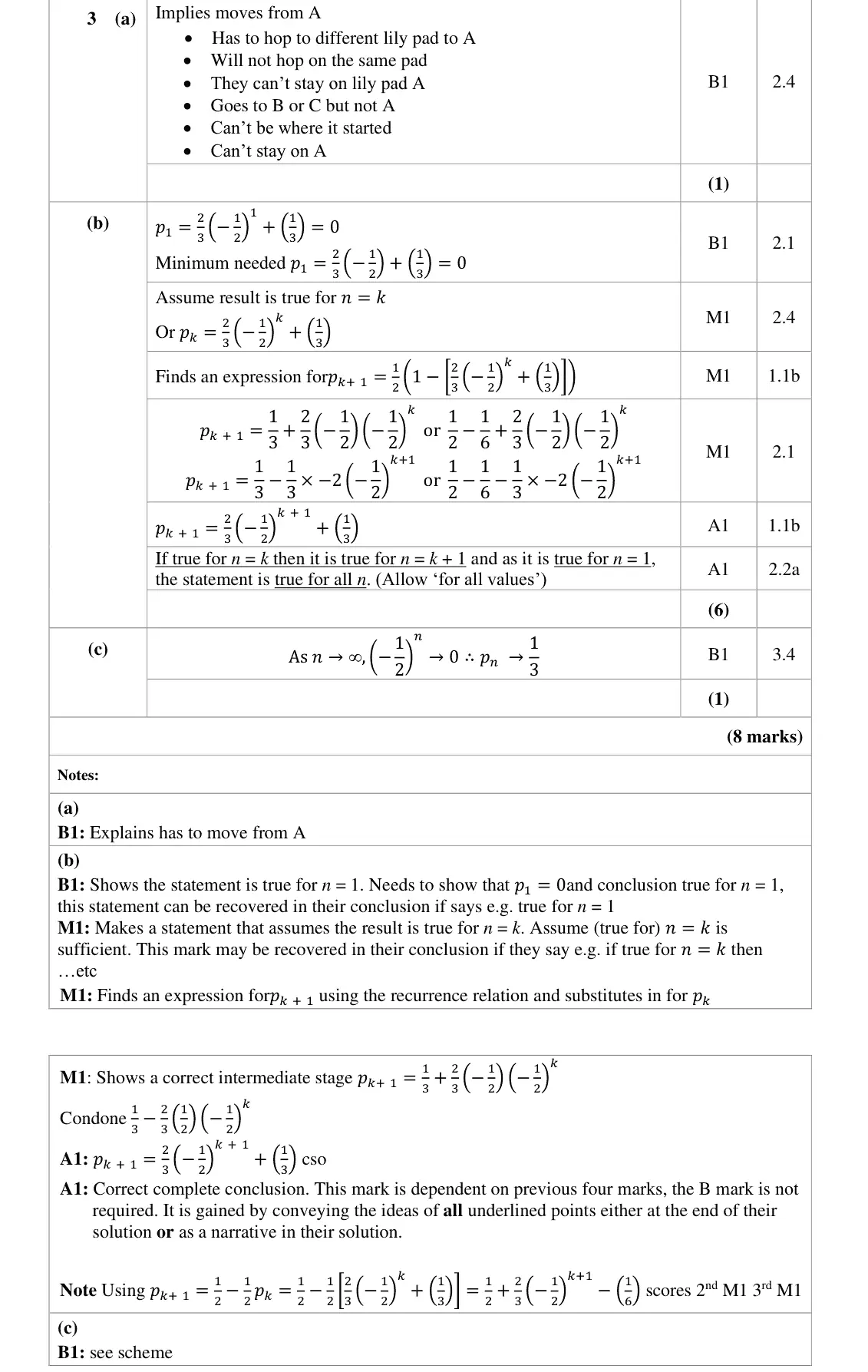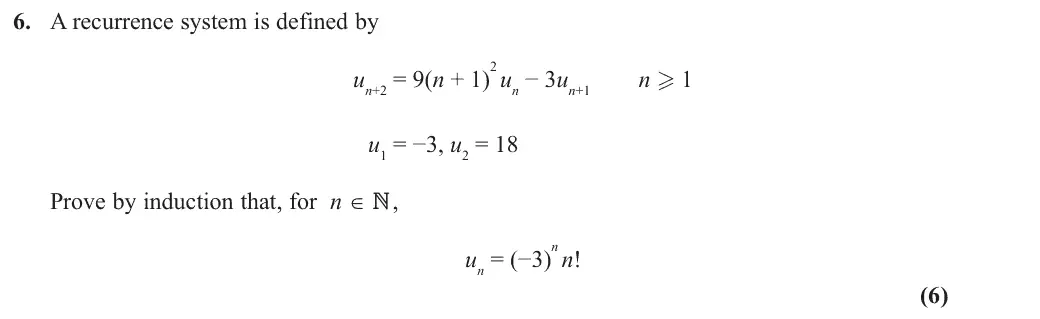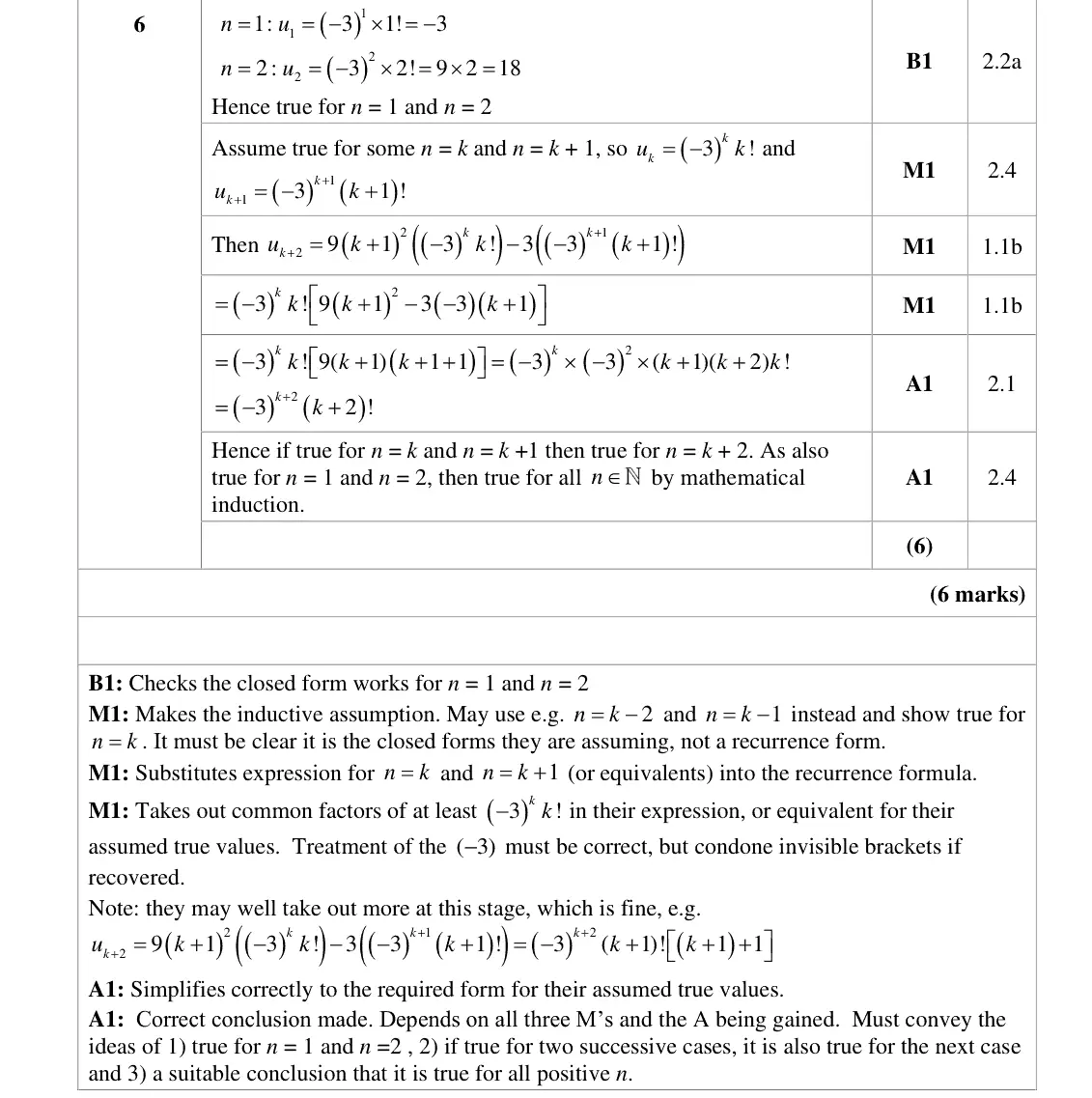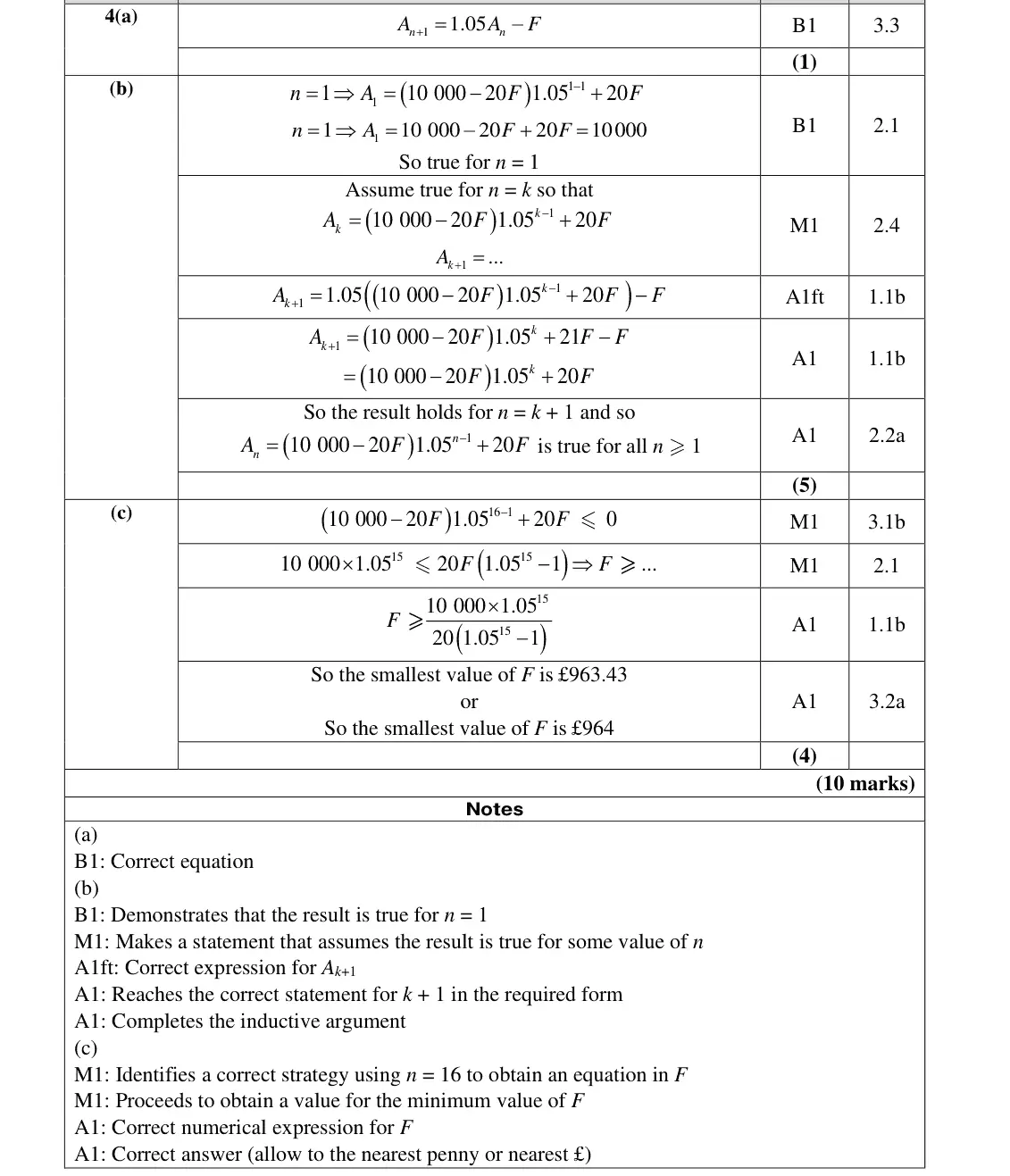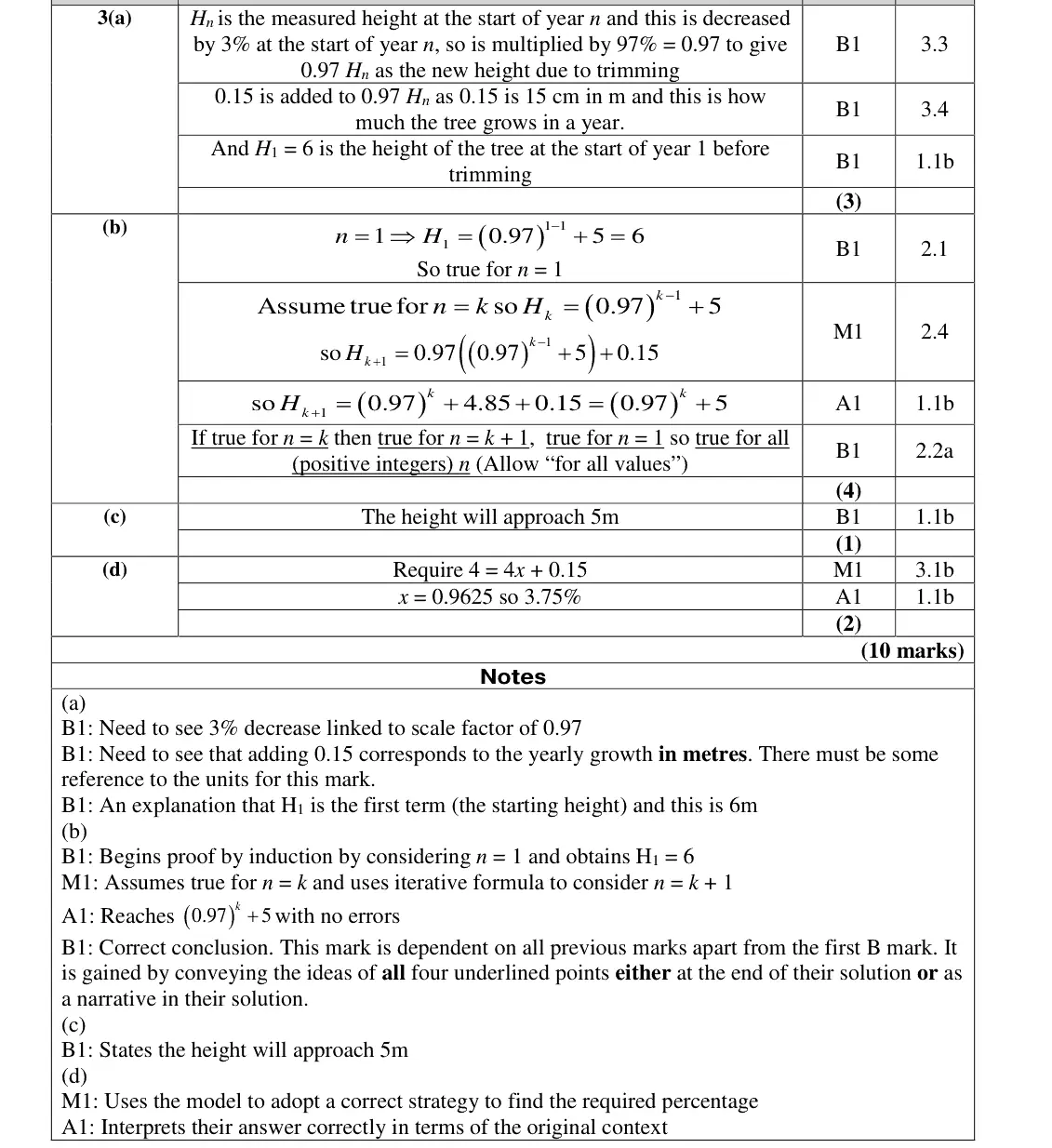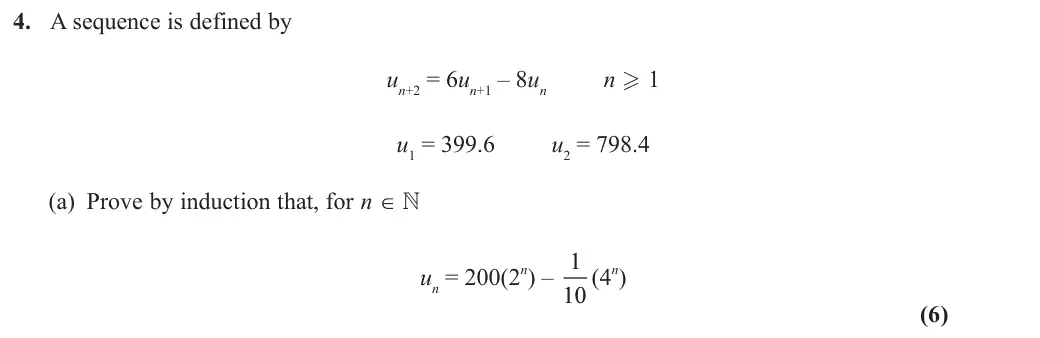
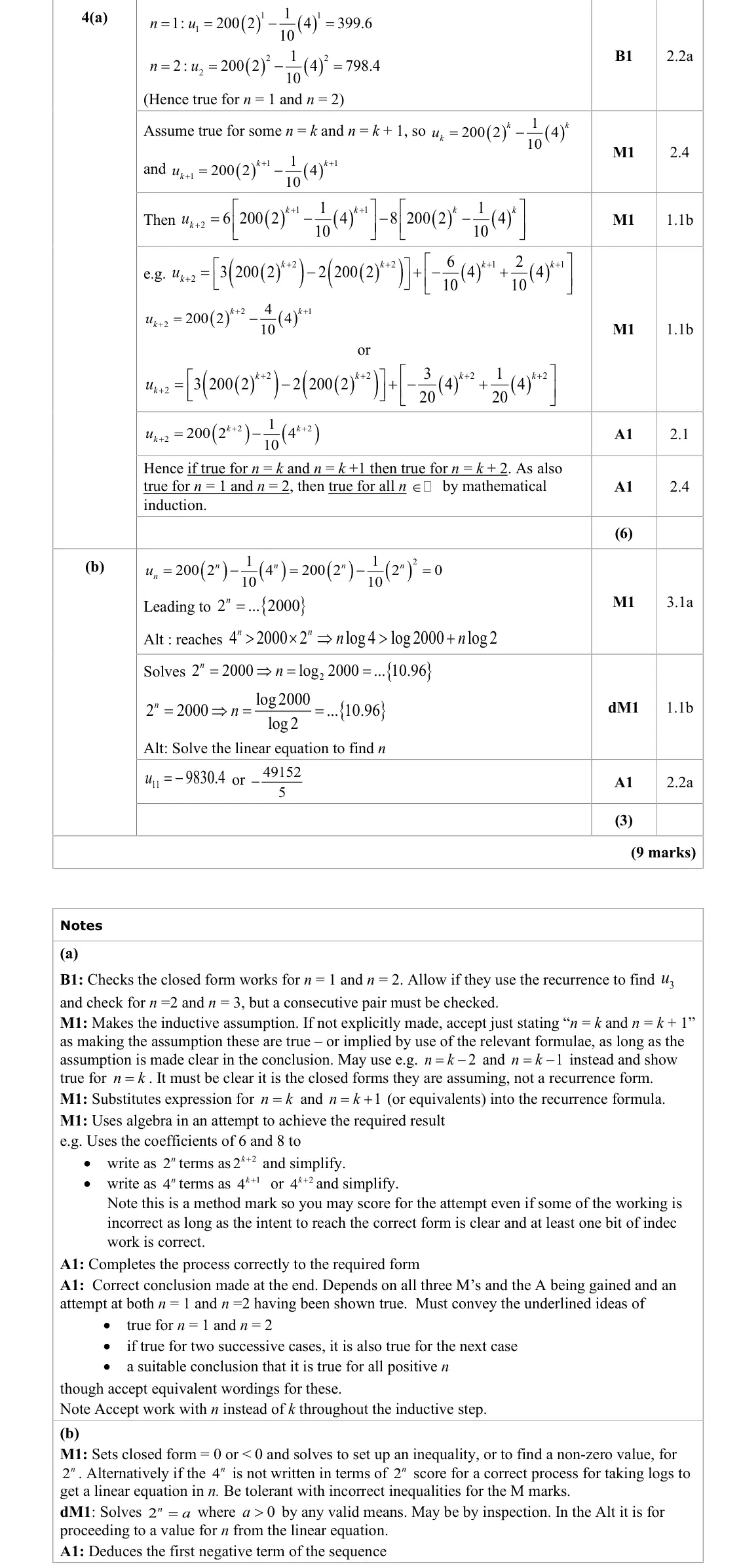
Mark scheme (whole question; this part is marked with the orange bar)
Examiner's comment
There were no surprises in this question with well-prepared students able to score highly. The induction was done well, and most could solve to find the value for n needed in part (b), though some neglected to find the actual 11-th term. Part (a) was answered well in the main but with some inconsistency in the low to mid-grade ranges. Most candidates were familiar with the procedure of proof by induction though a significant number seemed less confident by this type with a recurrence relation of order 2. A few wanted to solve the recurrence relation by means of the auxiliary equation and wasted time at the start with this. Some returned to an induction, but others did not, preferring to solve by other means and so score no marks. The first hindrance was in realising that both the cases n =1 and n = 2 need to be checked at the start. Those who realise this had little trouble doing so, but there was some who instead only checked n = 1, thinking just one case was sufficient, while others instead used 1u and 2u to find 3u and check the closed form works for just n = 3, again a false base case since two consecutive cases of agreement need to be checked (e.g. 1u and 2u could both fail to work but happen to produce a 3u that does work). Tehe next issues was with assuming, where again some only state the assumption for n = k rather than for two consecutive cases. Much of the time these then failed to make further progress as they could not see how to bridge from n = k to n = k + 1 using the recurrence, though a few did realise they need to go to n = k + 2 despite the incorrect assumption so were able to make some progress (though losing the first M and final A as a result). But most did realise the two cases needed to be assumed and made the suitable assumptions. Most went from n = k and n = k + 1 to n = k +2, but a few did use other starting point, such as from n = k – 2, n = k – 1 to n = k or n = k – 1, n = k to n = k +1. Most used k as the variable, but a few used n instead, making the work a bit harder to follow. The actual manipulation of terms for the inductive step was generally done well, including changing the powers, with candidates working clearly and methodically for the most part. A few slips did occur, or unacceptable jumps to the required form without manipulating the powers first where students could not see how to do it, but overall, most were able to bridge the gap between cases, with a variety of approaches seen. The conclusion was generally correct though a number did not quite understand the importance of n = k + 2 being proved as a result of n = k and n = k + 1 being true, especially among those who had not set up the correct base cases or assumption at the start. A few only cited “true for n = 1” as a base case, and the usual incorrect “true for n = k, n = k + 1 and n = k + 2” type conclusion without the implication indicated was seen in a few responses. The majority were well trained in giving a formal conclusion at the end, though, with only a small number omitting one entirely.
Key points from the mark scheme and examiner's report
- check both n = 1 and n = 2
- assume for n = k and k + 1
- substitute into 6uₖ₊₁ − 8uₖ to reach 200(2ᵏ⁺²) − (1/10)4ᵏ⁺²
- conclusion about two successive cases
- one base case only was common