Examiner's comment
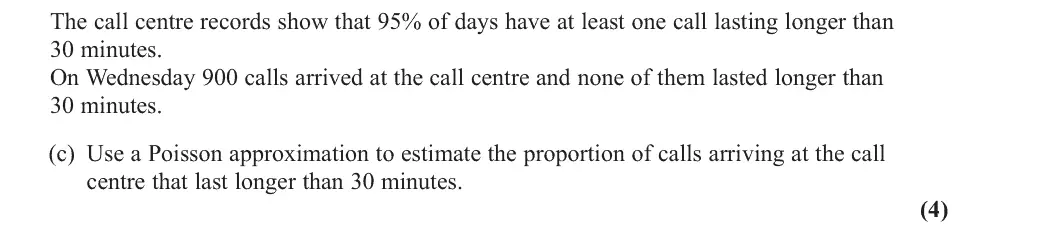
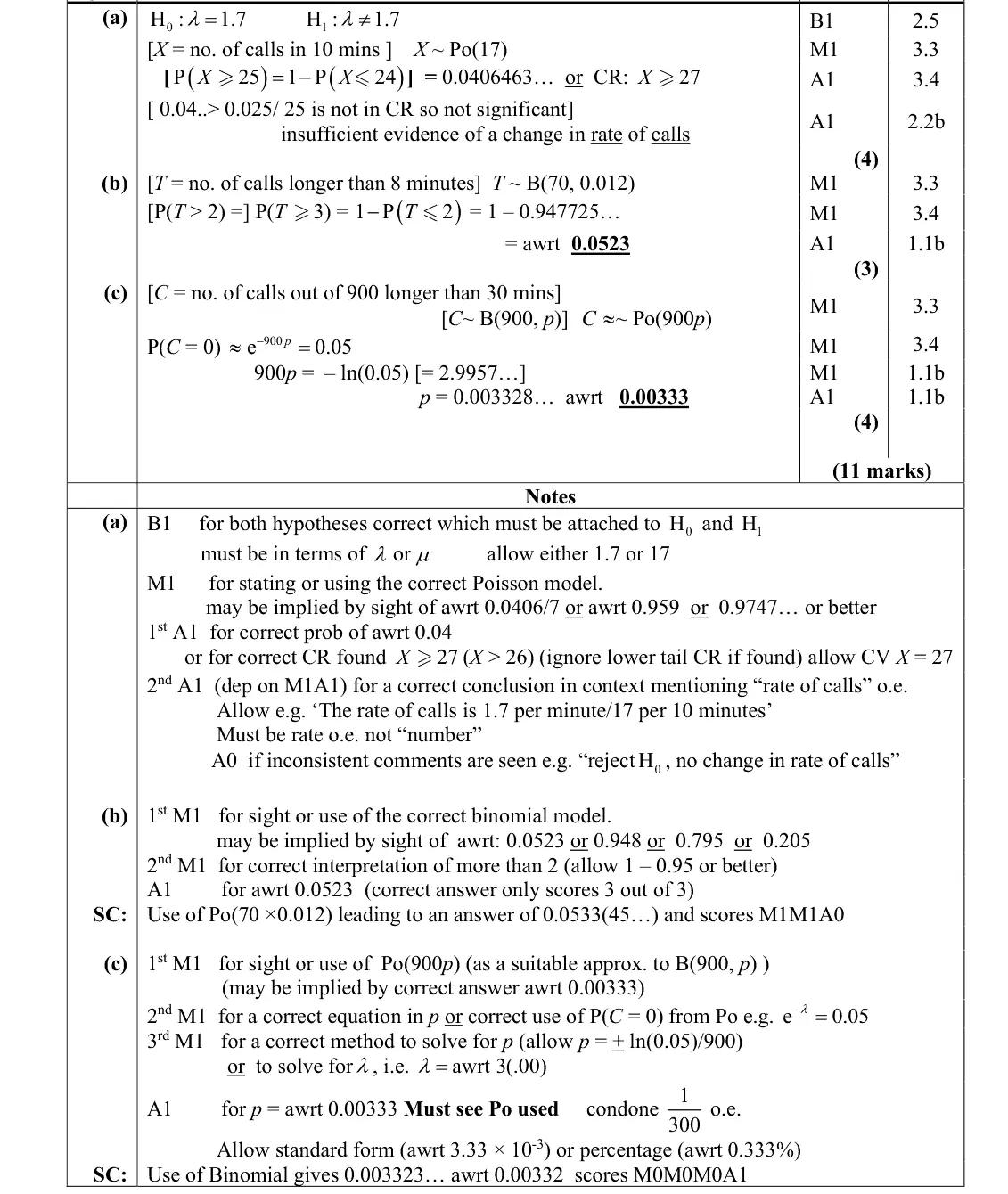
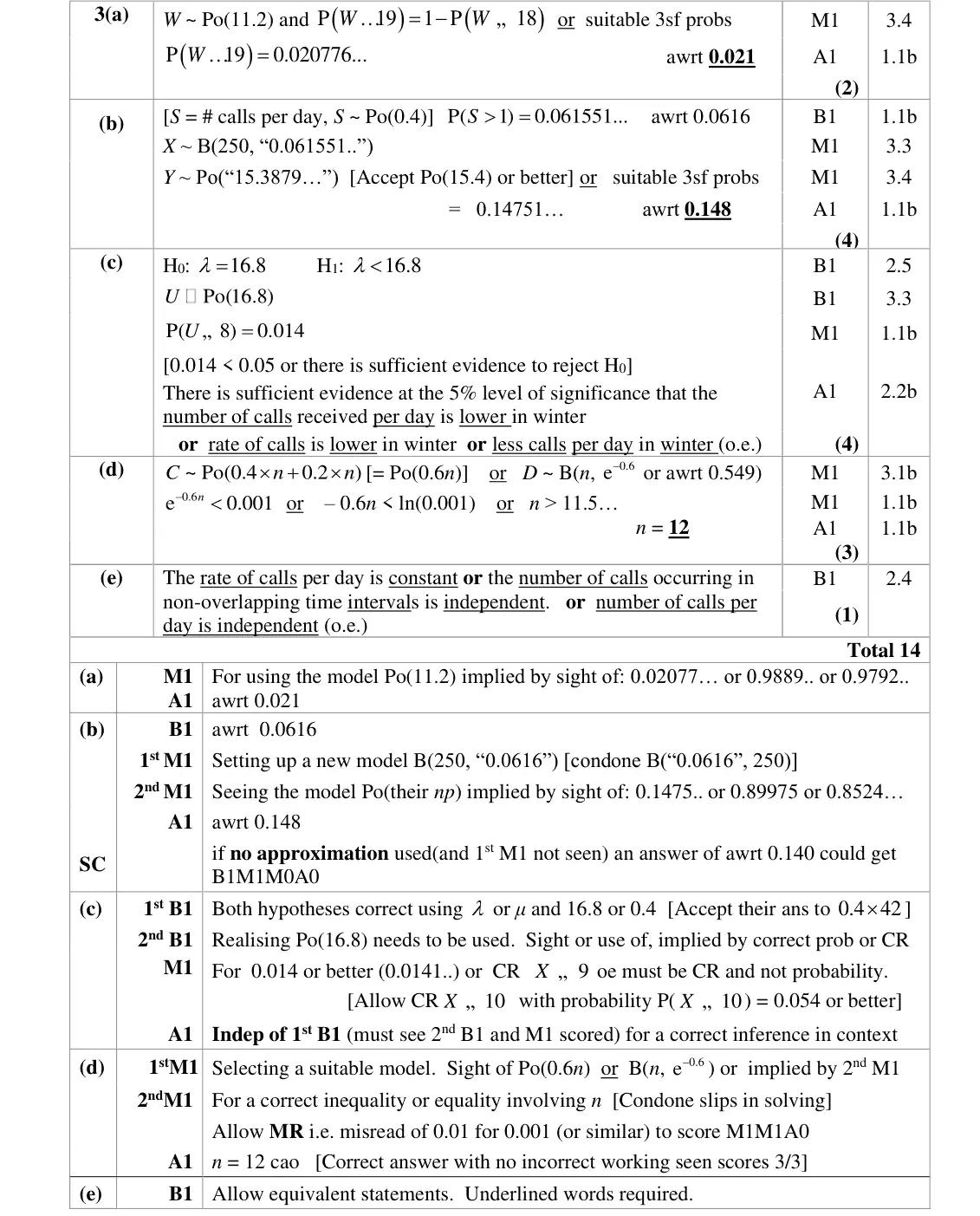
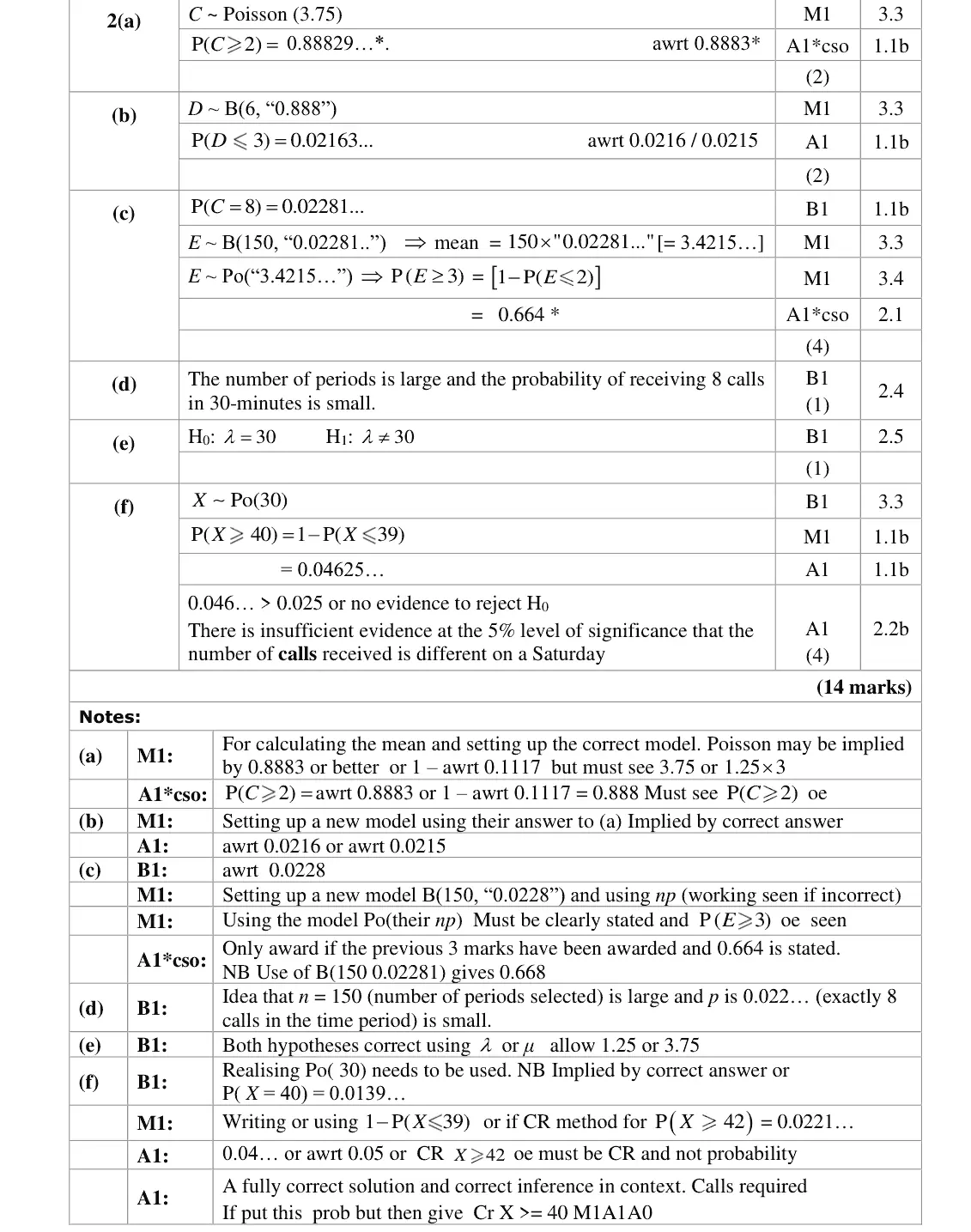
On the whole, this question proved to be one of the more demanding on the paper particularly due to part (c). Students had little difficulty in accessing the marks in part (a) and most were able to secure all 4. Most students choose hypotheses involving = 17 (rather than = 1.7) and most chose a correct two-tailed alternative. Most students successfully navigated their calculators to obtain the correct probability for P(X … 25). Most also chose to find the probability, rather than the critical region, though a typical mistake was to compare the probability to 5% rather than the required 2.5%. Nevertheless the vast majority of students completed the test accurately and were able to give a sufficiently contextual conclusion involving the rate of calls. The most typical errors in failing to secure the final mark was a non-contextual conclusion or one involving the ‘number’, rather than the rate, of calls. Almost all students were able to identify the required binomial distribution in part (b) and of Part (c) was a very good question for differentiating between the highest achievers on the paper. This part created more difficulties for the students and interpreting the information to obtain a Binomial distribution in terms of p. Many plugged in values for p. Of those students working with X ~ B(900,p) who went on to find a Poisson approximation almost all were able to correctly solve e-900p = 0.05. The most typical misconception was students using p = 0.05 and using a Poisson distribution of Po(900 x 0.05). Most were uncertain what to do with this. A few students used their calculators with a Poisson distribution or tables to find that = 3 was the closest parameter to give P(X = 0) = 0.05 and then calculated 3/900 to obtain an answer of 0.003333...