FS2.2.1 The concept of a continuous random variable. The probability…
Section
FS2.2 Continuous probability distributions
Level
AS & A level
Statement
The concept of a continuous random variable. The probability density function and the cumulative distribution function for a continuous random variable.
Guidance
Students will be expected to link with their knowledge of histograms and frequency polygons. Use of the probability density function f(x), where P(a < X ≤ b) = ∫(a to b) f(x) dx. Use of the cumulative distribution function F(x₀) = P(X ≤ x₀) = ∫(−∞ to x₀) f(x) dx. The formulae used in defining f(x) and the calculus required will be consistent with the level expected in A level Mathematics and A level Further Mathematics.
June 2025 · AS Paper 2 (Further Statistics 2) · Q2(a)1 mark
Mark scheme (whole question; this part is marked with the orange bar)
Examiner's comment
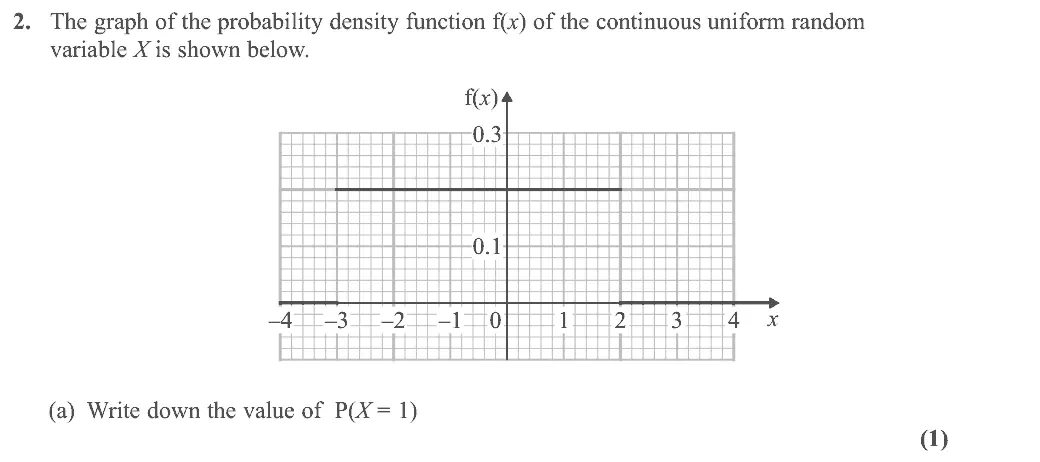
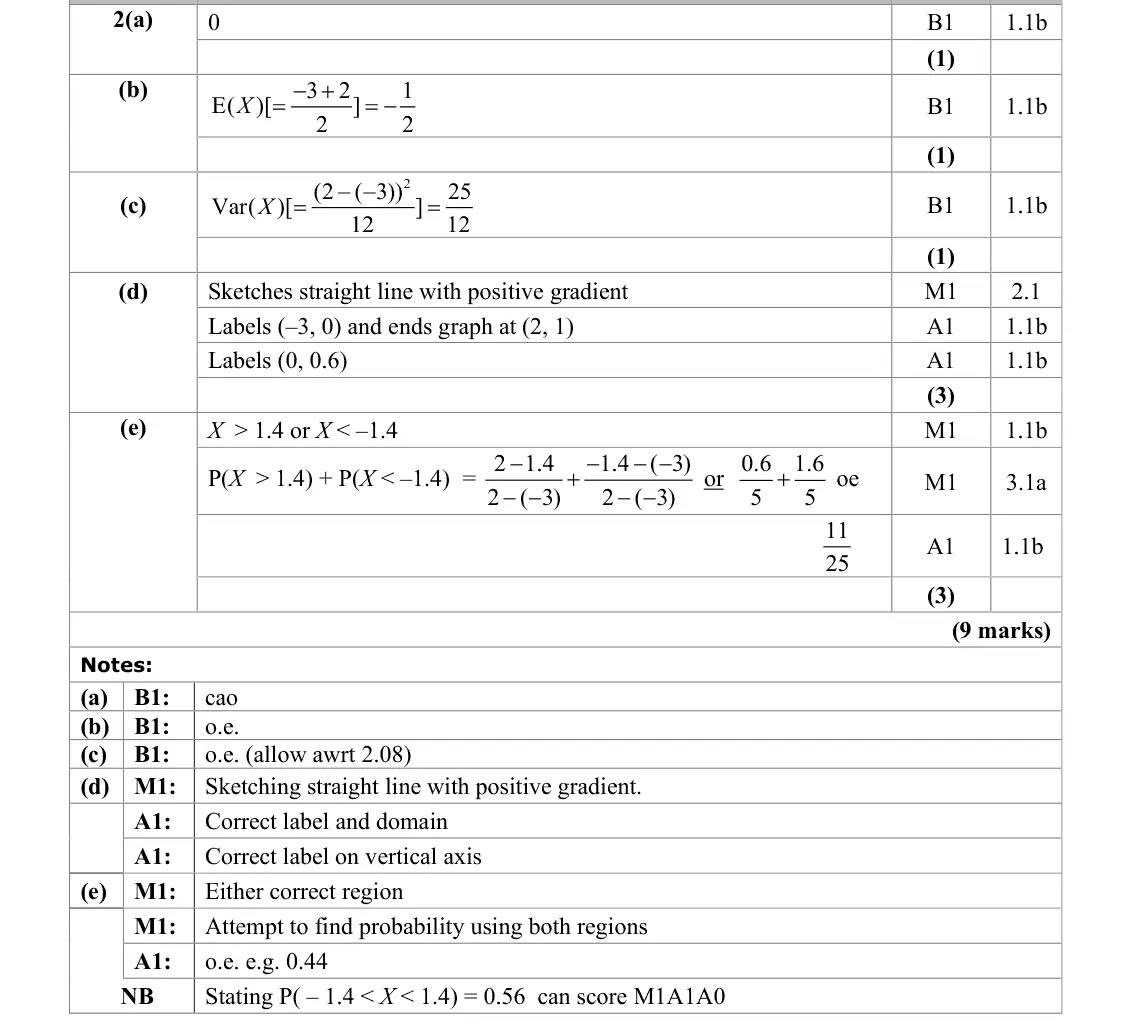
Whilst many gave the correct answer to part (a) there were a number who thought the answer was 0.2 instead. However the calculation of the mean was answered very well and many also went on to find the correct value for Var(X) as well. In part (c) most learners drew a straight
Key points from the mark scheme and examiner's report
P(X = 1) = 0 for a continuous random variable
0.2 (reading the pdf height) a common wrong answer
June 2025 · AS Paper 2 (Further Statistics 2) · Q2(d)3 marks
Mark scheme (whole question; this part is marked with the orange bar)
Examiner's comment
was often given correctly. Part (d) proved more challenging and a common response from those who attempted it was simply to find P(X > 1.4). Those who did consider the negative square root often went on to find the correct probability but some found P( – 1.4 < X < 1.4) = 0.56 instead.
Key points from the mark scheme and examiner's report
straight line with positive gradient from (−3, 0) to (2, 1), crossing the vertical axis at (0, 0.6)
end point (2, 1) often unlabelled
some lines started below the axis or went through O
June 2025 · AS Paper 2 (Further Statistics 2) · Q4(a)2 marks
Mark scheme (whole question; this part is marked with the orange bar)
Examiner's comment
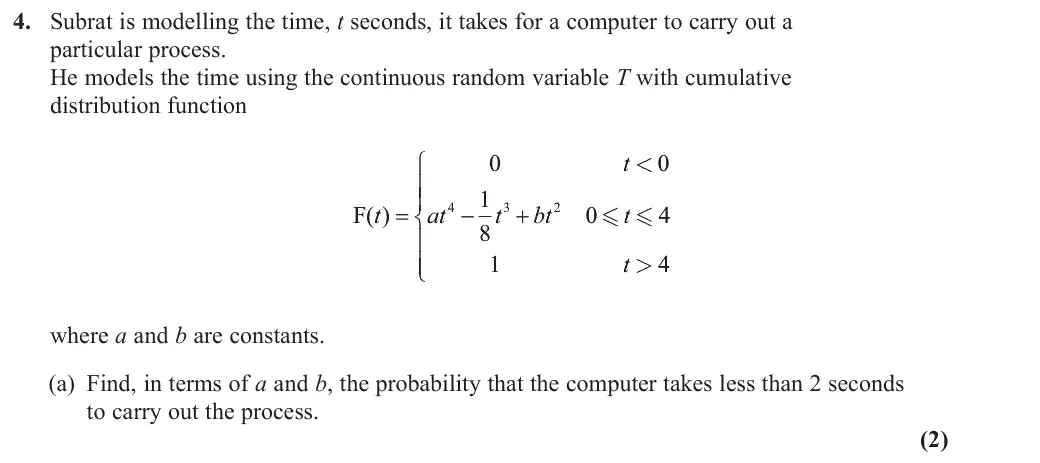
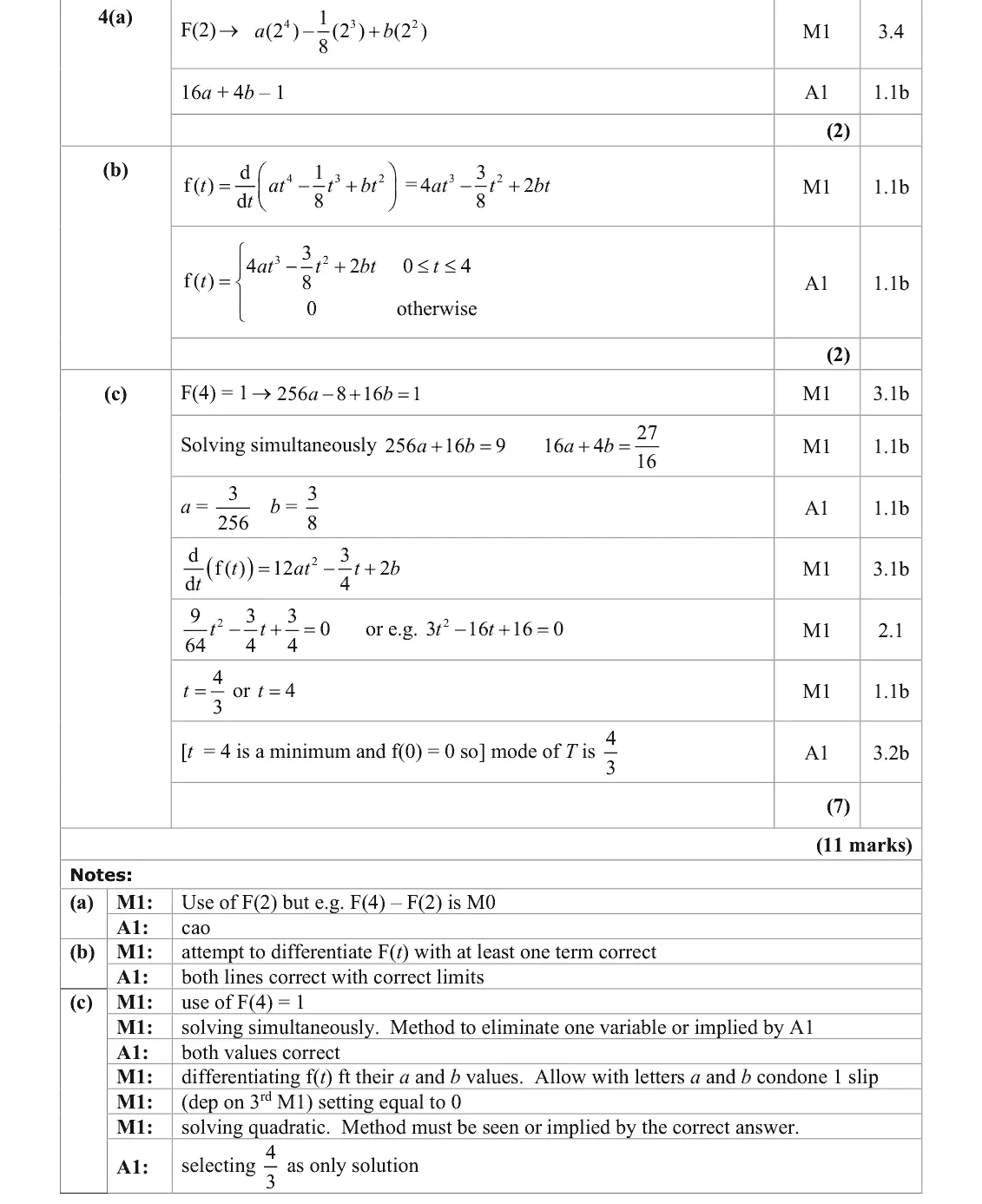
Most learners knew that they needed F(2) for part (a) and usually were able to find a correct expression in terms of a and b though sometimes there was a sign error with 16a – 4b – 1 occasionally seen. A few attempted F(4) – F(2) and made no progress in part (a). The vast majority knew that to find the probability density function (pdf) they should differentiate the cumulative distribution function (cdf) and this was usually carried out correctly. A few failed to define their pdf for all values of t and some integrated the cdf.
Key points from the mark scheme and examiner's report
P(T < 2) = F(2) = 16a + 4b − 1
F(4) − F(2) scores 0
June 2025 · AS Paper 2 (Further Statistics 2) · Q4(c)7 marks
Mark scheme (whole question; this part is marked with the orange bar)
Examiner's comment
Part (c) proved a fitting discriminator for the end of the paper. Many knew that they needed a second equation in a and b and most of these students realised that using F(4) = 1 would give them a suitable equation. Those who found this second equation usually went on to solve correctly and find the correct values for a and b. Some were stumped at this point but a good number realised that they needed to differentiate the pdf and find a turning point. Those who made this step usually arrived at a quadratic expression which they set equal to zero and then set about solving. There were occasional arithmetic slips made in this process but a good number found the two solutions t = 4 and t = 4/3 and many then gave thorough checks that t = 4/3 gave the maximum before clearly selecting this value as the mode.
Key points from the mark scheme and examiner's report
F(2) = 11/16 and F(4) = 1 give a = 3/256, b = 3/8
differentiate f and set to 0: 3t² − 16t + 16 = 0, t = 4/3 or 4
t = 4 is a minimum so mode = 4/3 (exact)
many could not find a second equation
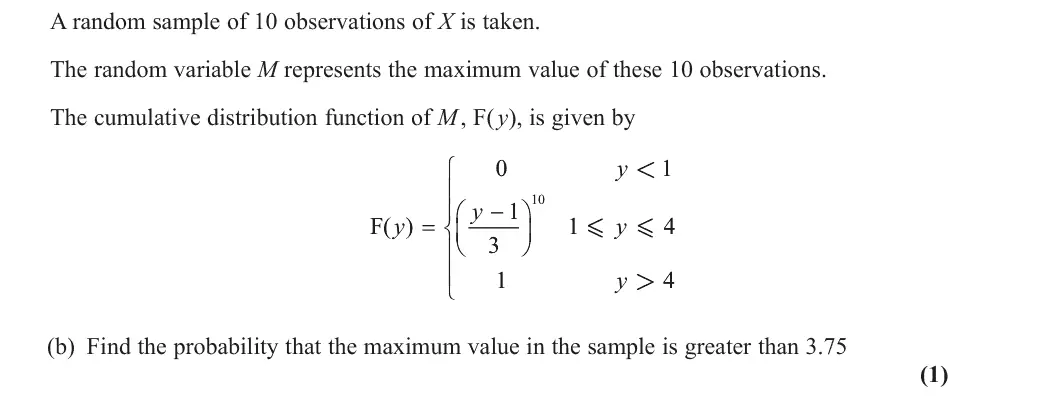
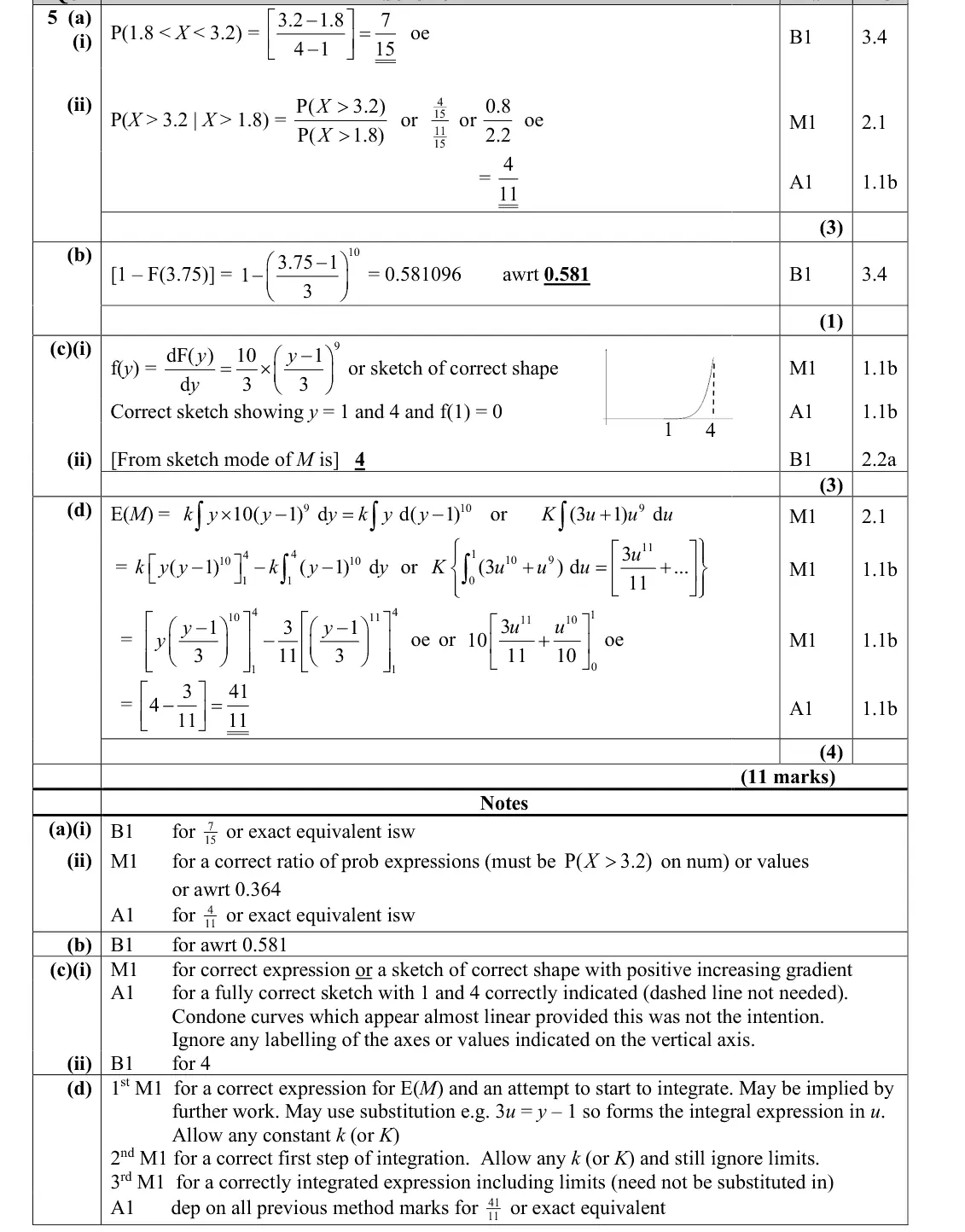
June 2025 · Paper 4B (Further Statistics 2) · Q5(b)1 mark
Mark scheme (whole question; this part is marked with the orange bar)
Examiner's comment
This question tested continuous random variables and candidates were usually able to make good progress in most of the parts. Part (b) was focused on a different continuous random variable and nearly all candidates were able to use the cumulative distribution function to score the mark in this part.
Key points from the mark scheme and examiner's report
1 − F(3.75) = 1 − (2.75/3)¹⁰ = 0.581
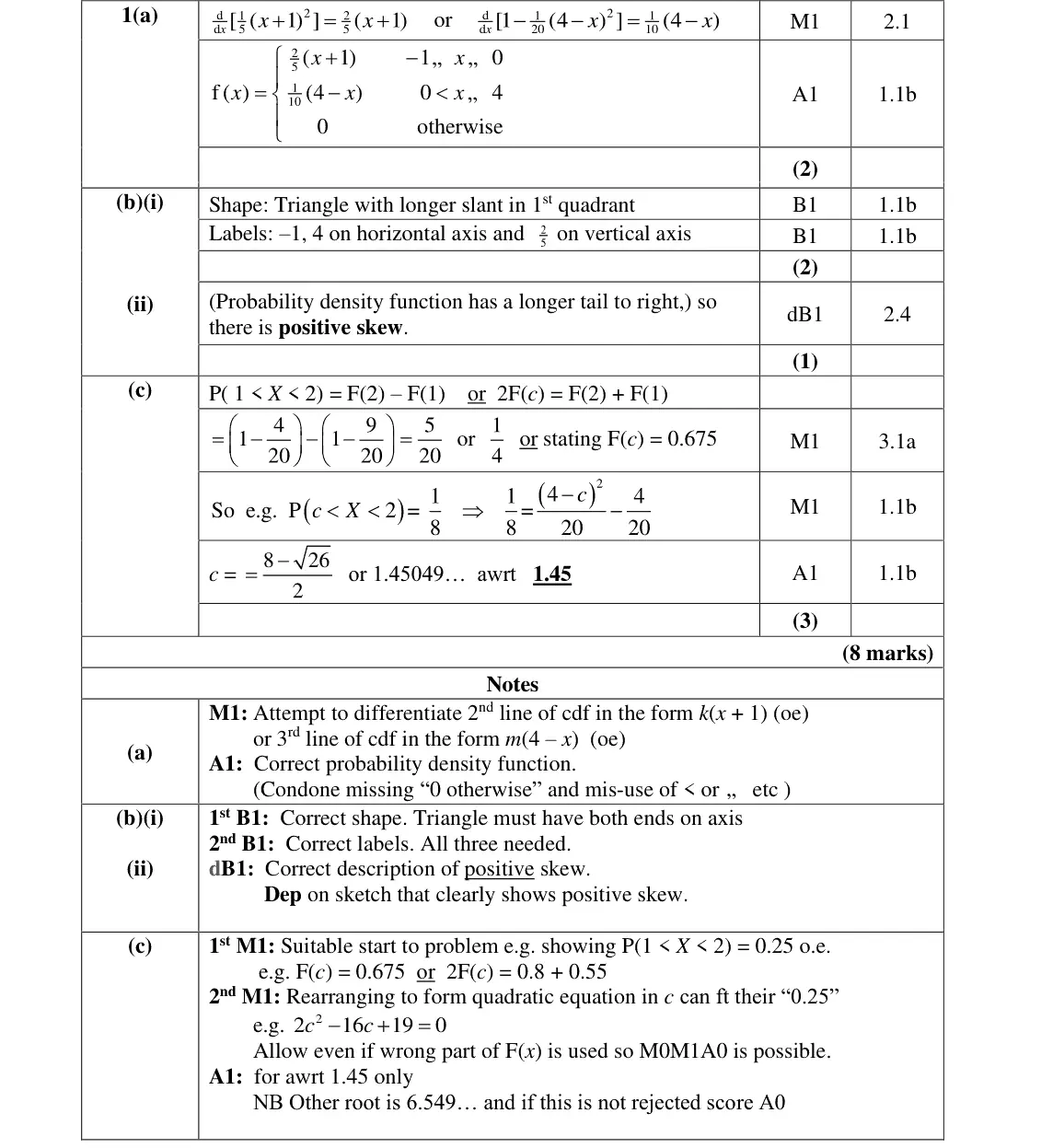
June 2024 · AS Paper 2 (Further Statistics 2) · Q1(b)(i)2 marks
Mark scheme (whole question; this part is marked with the orange bar)
Examiner's comment
The sketch in part (b) was often correct but some did not have a triangle with a base on the x-axis and some failed to give some indication of scale: we expected to see the points x = – 1, x = 4 and the vertex at (0, 0.4). Those who had a correct sketch were usually able to describe the skewness correctly as “positive”.
Key points from the mark scheme and examiner's report
triangle with both ends on the x-axis at −1 and 4 and vertex (0, 0.4), longer slant on the right
scale labels needed
June 2024 · AS Paper 2 (Further Statistics 2) · Q1(c)3 marks
Mark scheme (whole question; this part is marked with the orange bar)
Examiner's comment
Part (c) proved to be more discriminating. The most popular approach was to try and form an equation for c using F(c) – F(1) = F(2) – F(c). Unfortunately, a number of students didn’t realise that the 3rd row of the cumulative distribution function was required, and some had a mixture or simply used the 2nd row. Even those who were using the incorrect parts of F(x) were able to form a quadratic equation in (c) and solve it with many realising that one root had to be rejected because the value was outside the domain of the function.
Key points from the mark scheme and examiner's report
P(1 < X < 2) = F(2) − F(1) = 1/4 so F(c) = 0.675
use the 3rd row of F (many used the 2nd row): 2c² − 16c + 19 = 0, c = 1.45
reject the root 6.55
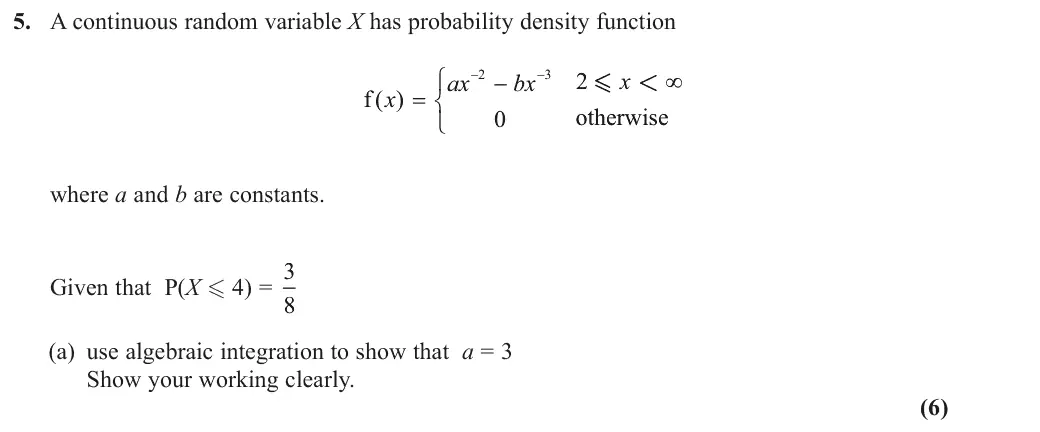
June 2024 · Paper 4B (Further Statistics 2) · Q5(a)6 marks
Mark scheme (whole question; this part is marked with the orange bar)
Examiner's comment
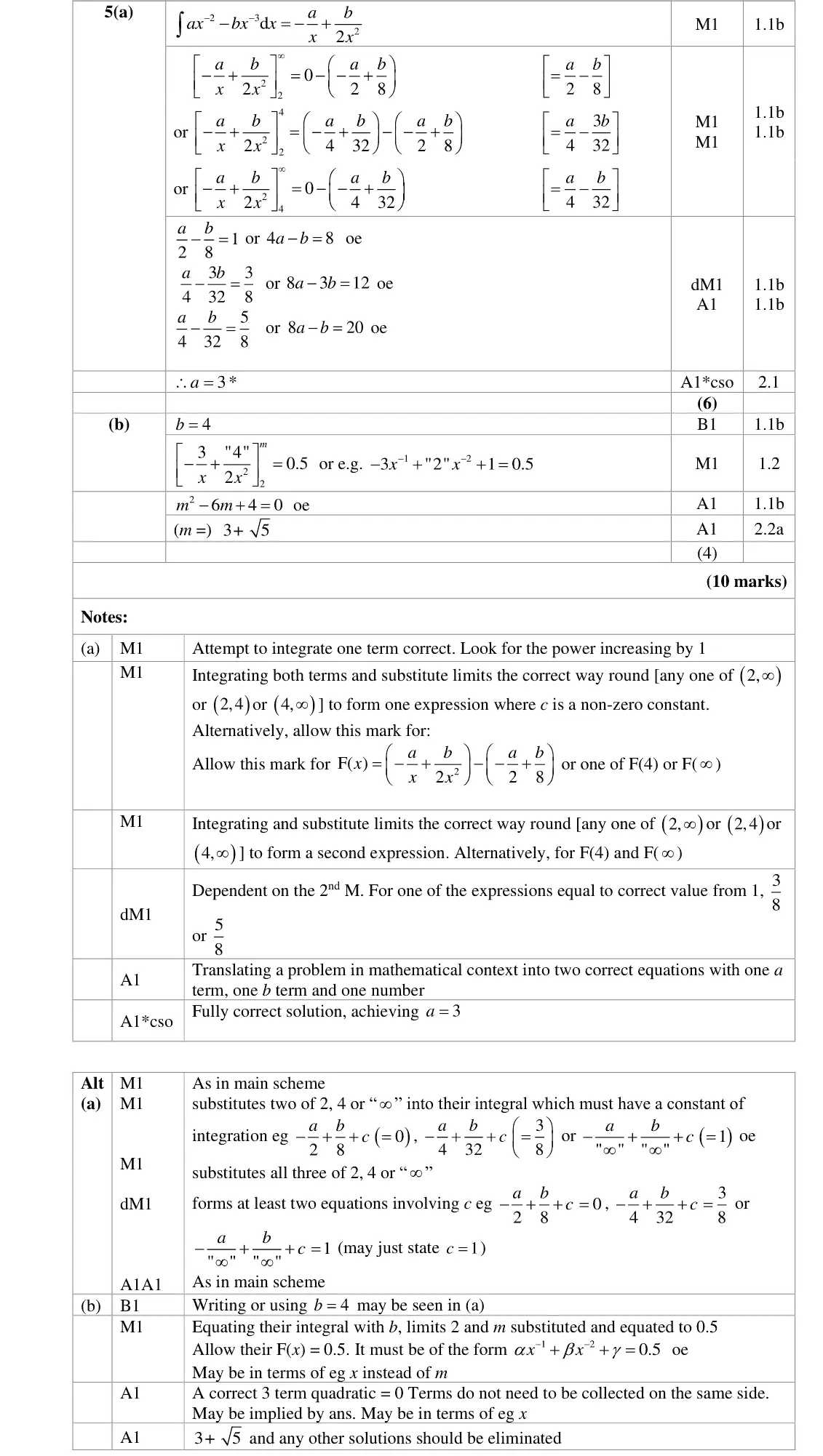
This question required candidates to have a good understanding of continuous random variables and the ability to integrate the probability density function to find the cumulative distribution function. The most common mistake in both parts (a) and (b) was to integrate to find the cumulative distribution function but fail to recognise the need for a constant of integration (or a lower limit of 2). The approach in the main scheme of deriving simultaneous equations via definite integrals seemed slightly more popular than finding the cdf, and proved safer for those who used it. Of those who took the cdf approach with a constant of integration, a few were perplexed to find F(2) 0 = told them nothing new and became stuck. A small number of candidates formed equations with values of x below 2, e.g. expecting F(0) 0 = when this is not necessarily the case.
Key points from the mark scheme and examiner's report
∫(ax⁻² − bx⁻³)dx = −a/x + b/(2x²)
total probability over [2, ∞) gives 4a − b = 8 and P(X ≤ 4) = 3/8 gives 8a − 3b = 12 (or 8a − b = 20)
a = 3, b = 4
forgetting the constant/lower limit 2 when forming the cdf was the main error
June 2024 · Paper 4B (Further Statistics 2) · Q5(b)4 marks
Mark scheme (whole question; this part is marked with the orange bar)
Examiner's comment
This question required candidates to have a good understanding of continuous random variables and the ability to integrate the probability density function to find the cumulative distribution function. The most common mistake in both parts (a) and (b) was to integrate to find the cumulative distribution function but fail to recognise the need for a constant of integration (or a lower limit of 2). The approach in the main scheme of deriving simultaneous equations via definite integrals seemed slightly more popular than finding the cdf, and proved safer for those who used it. Of those who took the cdf approach with a constant of integration, a few were perplexed to find F(2) 0 = told them nothing new and became stuck. A small number of candidates formed equations with values of x below 2, e.g. expecting F(0) 0 = when this is not necessarily the case. A pleasing number of those who did not finish part (a) were nevertheless able to attempt (b) using the one equation they had obtained in (a) and the given value of 3 a = , with many gaining full marks in (b).
Key points from the mark scheme and examiner's report
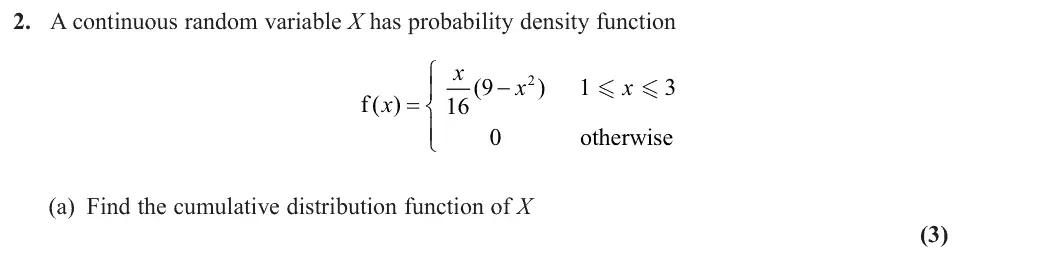
June 2023 · AS Paper 2 (Further Statistics 2) · Q2(a)3 marks
Mark scheme (whole question; this part is marked with the orange bar)
Examiner's comment
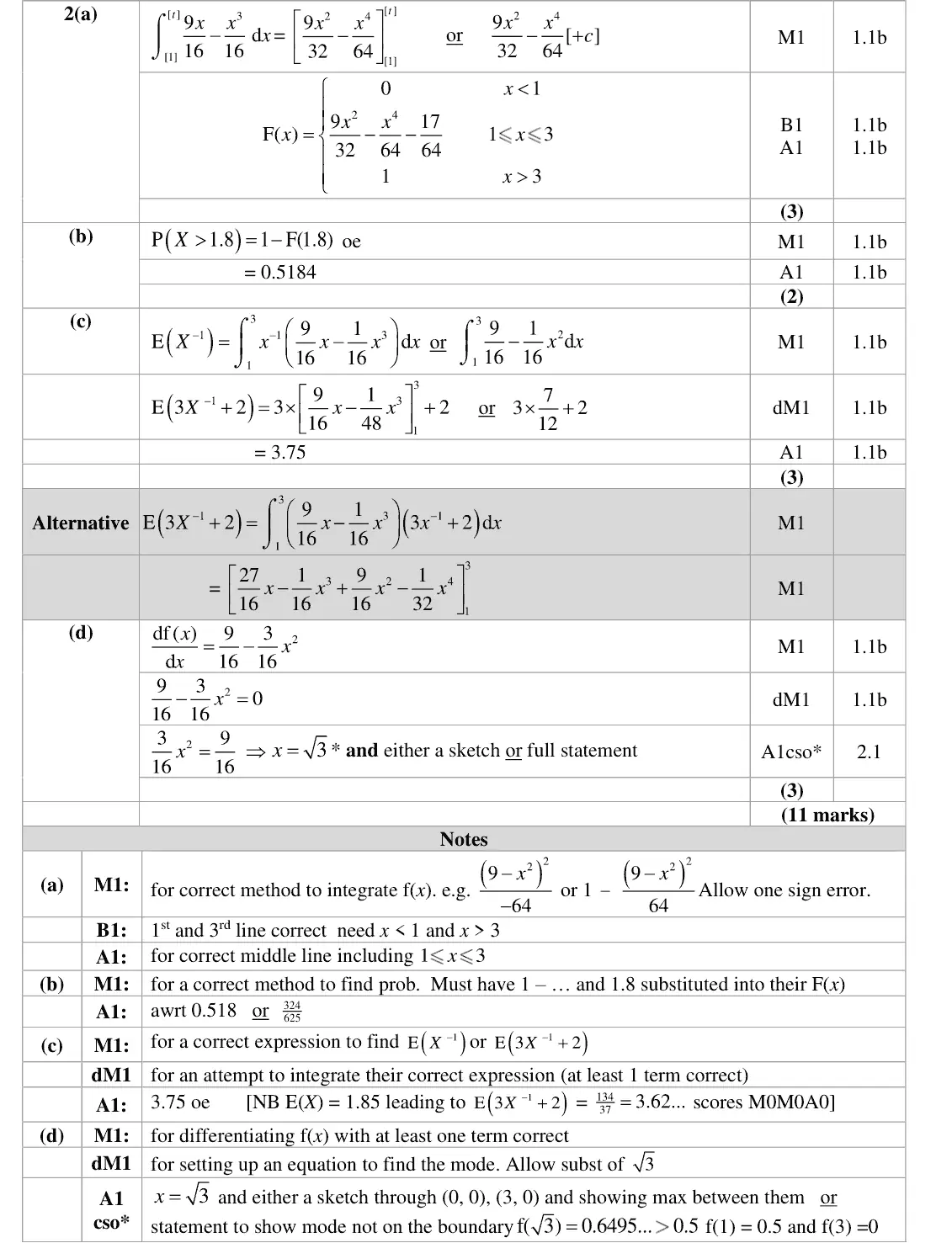
Nearly all knew that to find the cumulative distribution function the probability density function needed to be integrated. This was carried out correctly and some used limits of 1 and x whilst others had a constant of integration and used F(1) = 0 to establish F(x) for x between 1 and 3. Most went on to state the cumulative distribution function correctly.
Key points from the mark scheme and examiner's report
integrate from 1 to x (or use + c with F(1) = 0): F(x) = 9x²/32 − x⁴/64 − 17/64 for 1 ≤ x ≤ 3, with 0 for x < 1 and 1 for x > 3
June 2023 · AS Paper 2 (Further Statistics 2) · Q2(b)2 marks
Mark scheme (whole question; this part is marked with the orange bar)
Examiner's comment
In part (b) some simply evaluated F(1.8) and didn’t seem to realise that to find P(X > 1.8) they needed 1 – F(1.8).
Key points from the mark scheme and examiner's report
P(X > 1.8) = 1 − F(1.8) = 0.5184
some gave F(1.8) only
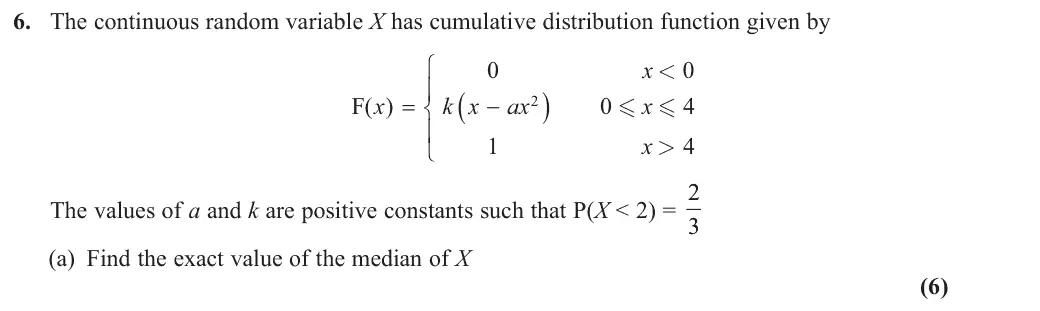
June 2023 · Paper 4B (Further Statistics 2) · Q6(a)6 marks
Mark scheme (whole question; this part is marked with the orange bar)
Examiner's comment
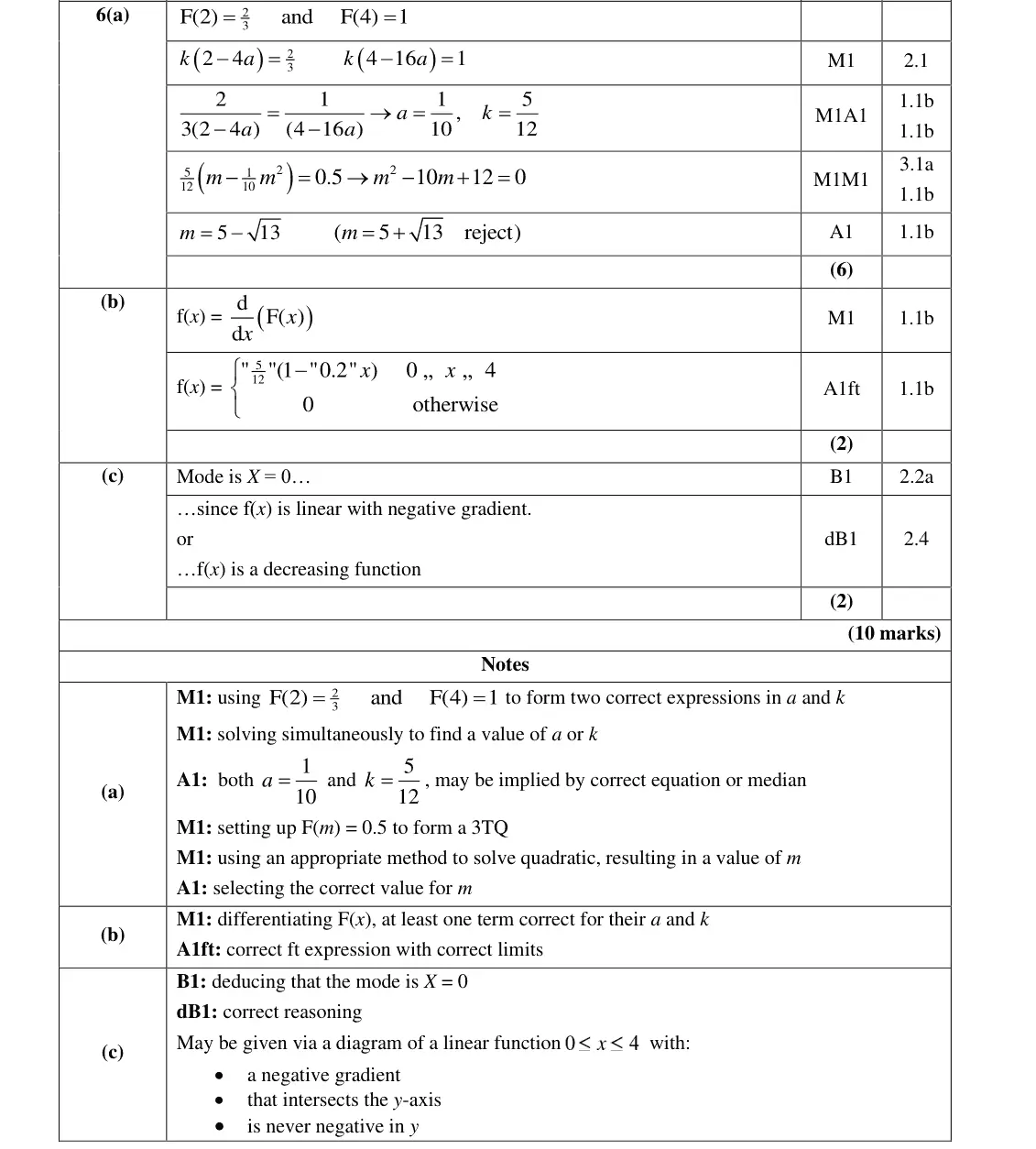
This was a fairly straightforward question on continuous random variables that all candidates would have been expecting. Consequently, the majority of candidates were able to produce good answers to this question. Part (a) was helpfully posed, and most candidates were able to gain all the marks. Those who did struggle usually did so initially by failing to begin by stating both equations correctly. The mark scheme was well-crafted and allowed candidates to still gain 3 marks following such an error.
Key points from the mark scheme and examiner's report
F(2) = 2/3 and F(4) = 1 give k(2 − 4a) = 2/3, k(4 − 16a) = 1, so a = 1/10, k = 5/12
F(m) = 0.5: m² − 10m + 12 = 0, m = 5 − √13 (reject 5 + √13)
June 2022 · AS Paper 2 (Further Statistics 2) · Q2(a)2 marks
Mark scheme (whole question; this part is marked with the orange bar)
Examiner's comment
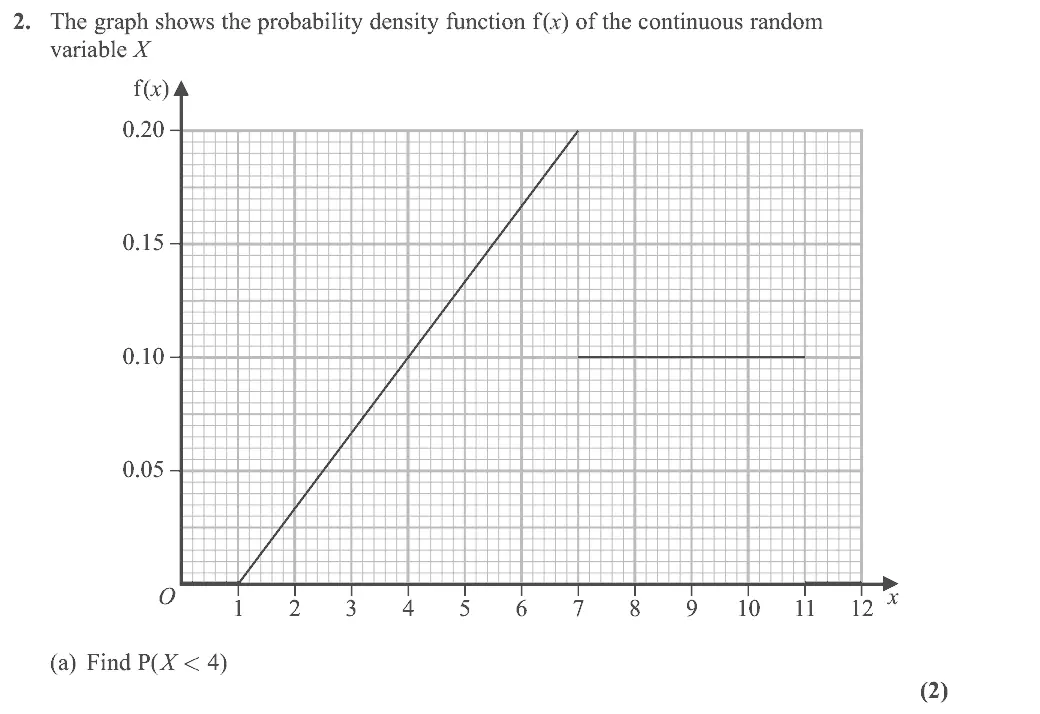
There was a mixed response to question 2 with many candidates not knowing where to begin. In part (a), some candidates recognised that area represents frequency – but a common slip was to see 4 0.1 x . 2
Key points from the mark scheme and examiner's report
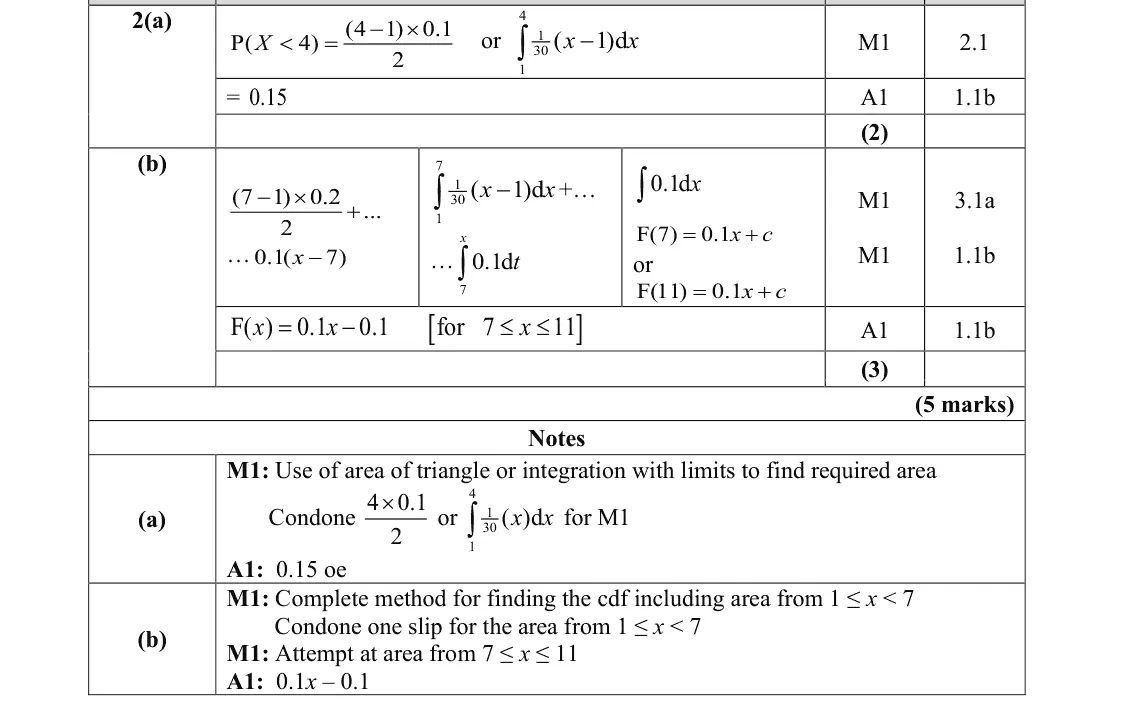
area under f(x) from 1 to 4: triangle ½ × 3 × 0.1 = 0.15
common slip ½ × 4 × 0.1
June 2022 · AS Paper 2 (Further Statistics 2) · Q2(b)3 marks
Mark scheme (whole question; this part is marked with the orange bar)
Examiner's comment
There was a mixed response to question 2 with many candidates not knowing where to begin. In Part (b) was significantly less successful and although partial attempts were seen, only the most able candidates provided complete solutions. It was common to score the second method mark for understanding that the area from 7 <= x <= 11 involved 0.1x. Many neglected to include the area from 1 <= x <= 7. Those using a + c method tended to be successful particularly when applying F(11) = 1. A common mistake was to believe that F(7) = 0.
Key points from the mark scheme and examiner's report
include the area from 1 to 7 (= 0.6) then add 0.1(x − 7), or use F(11) = 1: F(x) = 0.1x − 0.1
many omitted the area from 1 to 7
June 2022 · AS Paper 2 (Further Statistics 2) · Q4(a)3 marks
Mark scheme (whole question; this part is marked with the orange bar)
Examiner's comment
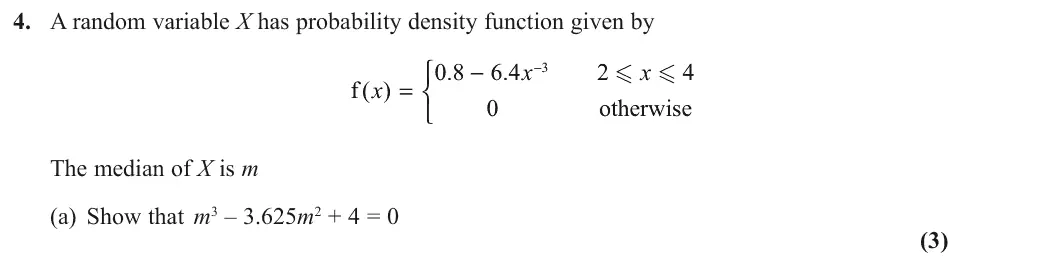
Question 4 was a challenging question which discriminated the most able candidates, particularly in parts (a) and (b). In part (a), there were many attempts at integration and most equated their integral to 0.5 earning at least the first method mark. A surprising number of candidates did not know how to proceed with some plugging in both limits x = 2 and x = 4. Even those who chose correct limits often struggled to get to the final given answer not realising the need to multiply each term by m2.
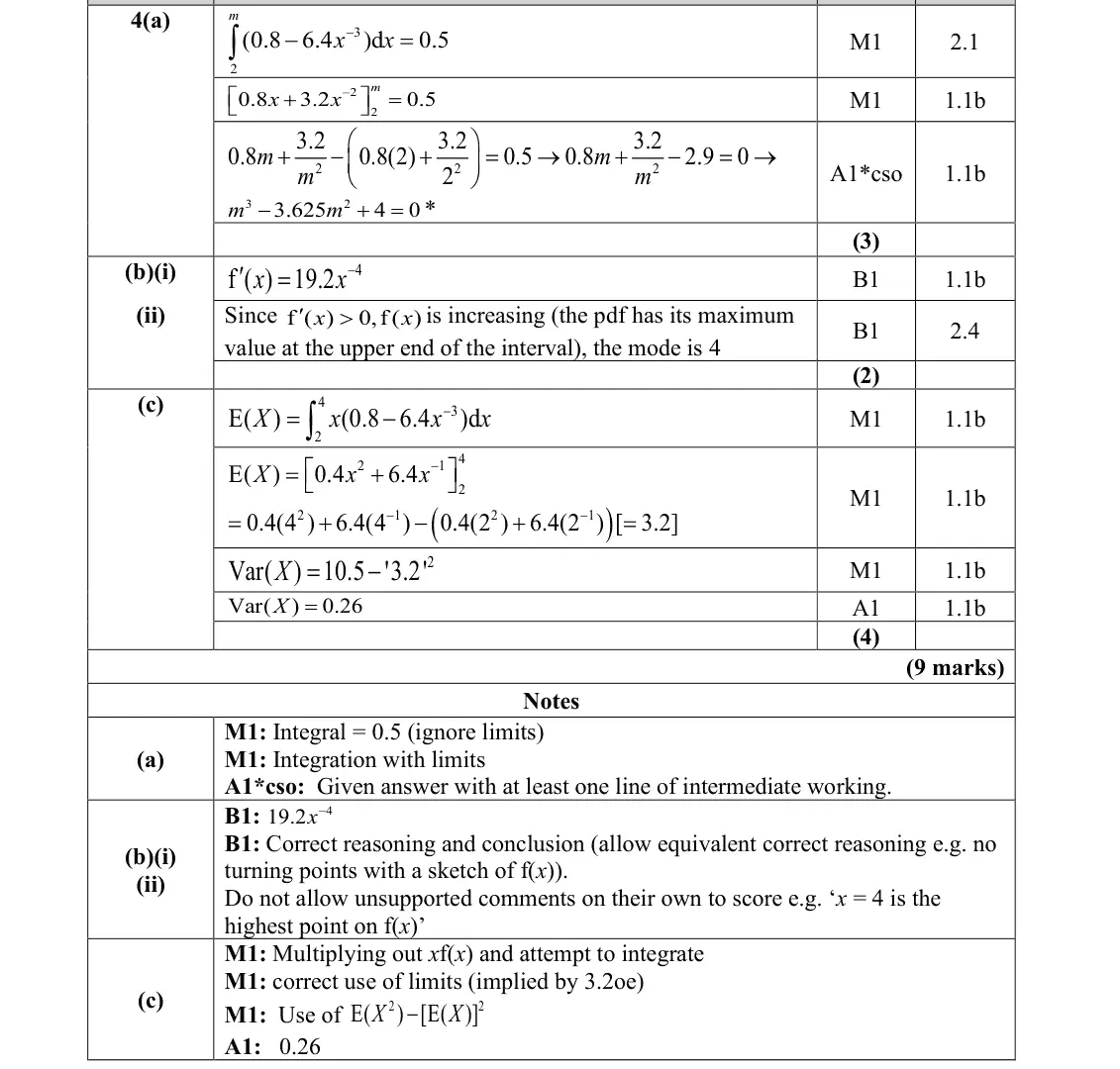
Key points from the mark scheme and examiner's report
integrate from 2 to m and set = 0.5: 0.8m + 3.2/m² − 2.9 = 0, then multiply by m²/0.8
many substituted both limits 2 and 4 or did not multiply through by m²
June 2022 · AS Paper 2 (Further Statistics 2) · Q5(b)3 marks
Mark scheme (whole question; this part is marked with the orange bar)
Examiner's comment
The final question also gave opportunity for the most able candidates to shine as part (c) of this question was the most difficult part of the paper. Although some attempts were made, correct solutions were rarely seen. In part (b), many did not understand that a single probability region was required. Of those actually identifying the critical values of T for the required probabilities, often, a product of P(T < 2.25) x P(T > 2/3) was attempted.
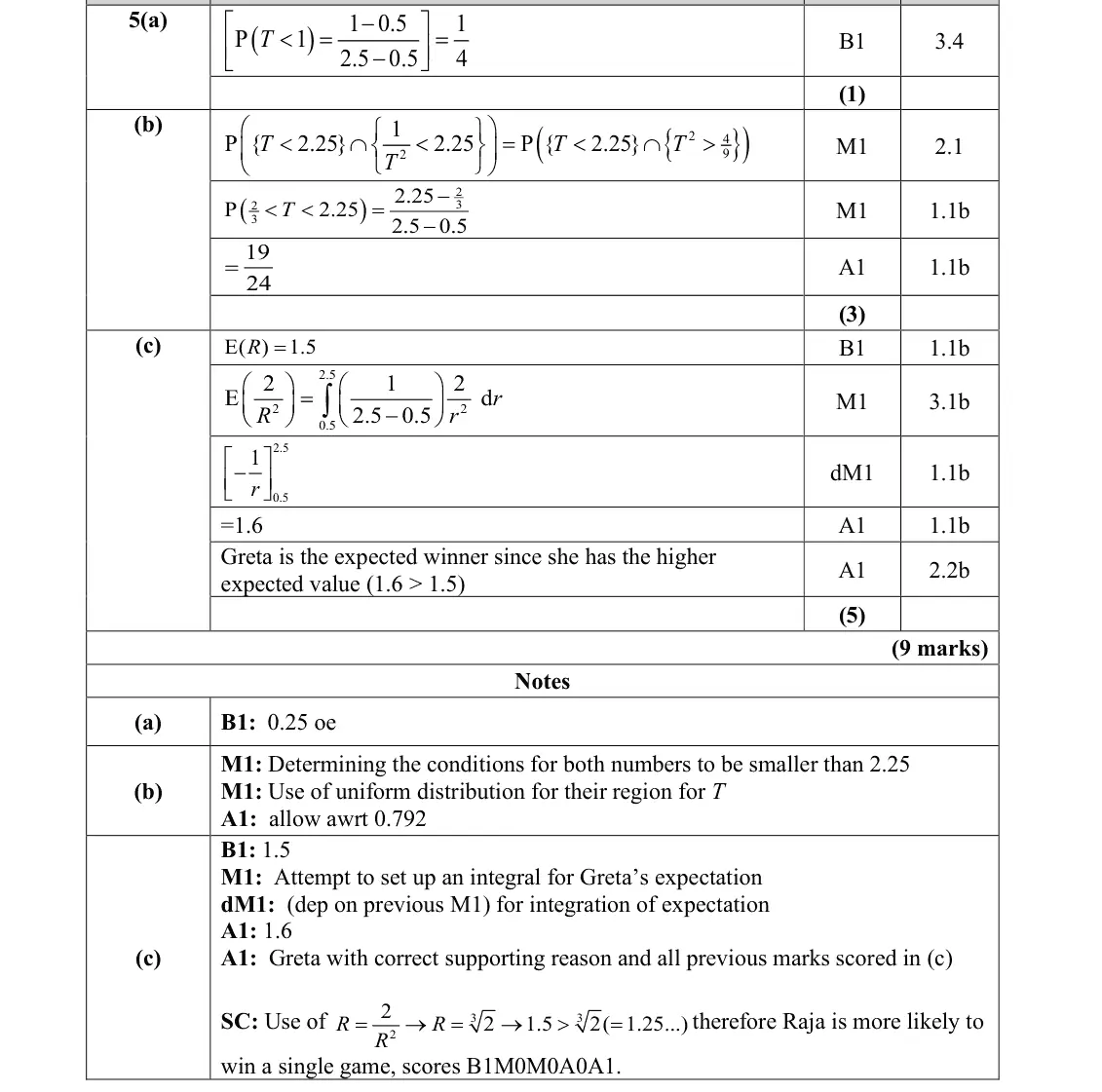
Key points from the mark scheme and examiner's report
M < 2.25 means T > 2/3, so need P(2/3 < T < 2.25) = 19/24 as one interval
common error multiplying P(T < 2.25) × P(T > 2/3)
June 2022 · Paper 4B (Further Statistics 2) · Q8(a)2 marks
Mark scheme (whole question; this part is marked with the orange bar)
Examiner's comment
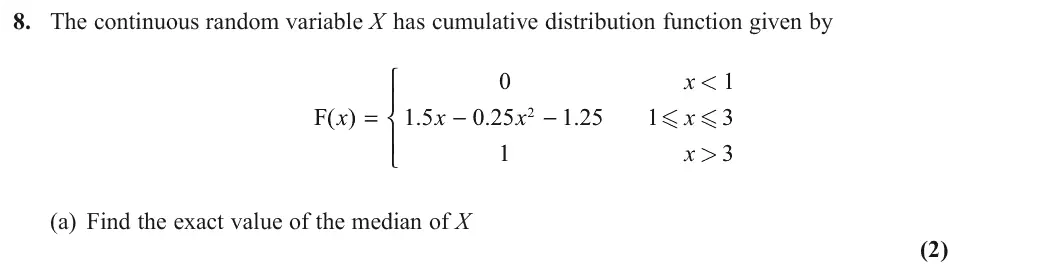
On the whole, this was the most demanding question on the paper, but parts (a) and (b) and to some extent (d) provided accessibility. In part (a) most candidates equated the cumulative distribution function to 0.5 and went on to solve and select the correct exact value for the median. Some were penalised for giving an inexact answer whilst others believed the F(0.5) was required to find the median.
Key points from the mark scheme and examiner's report
June 2022 · Paper 4B (Further Statistics 2) · Q8(b)3 marks
Mark scheme (whole question; this part is marked with the orange bar)
Examiner's comment
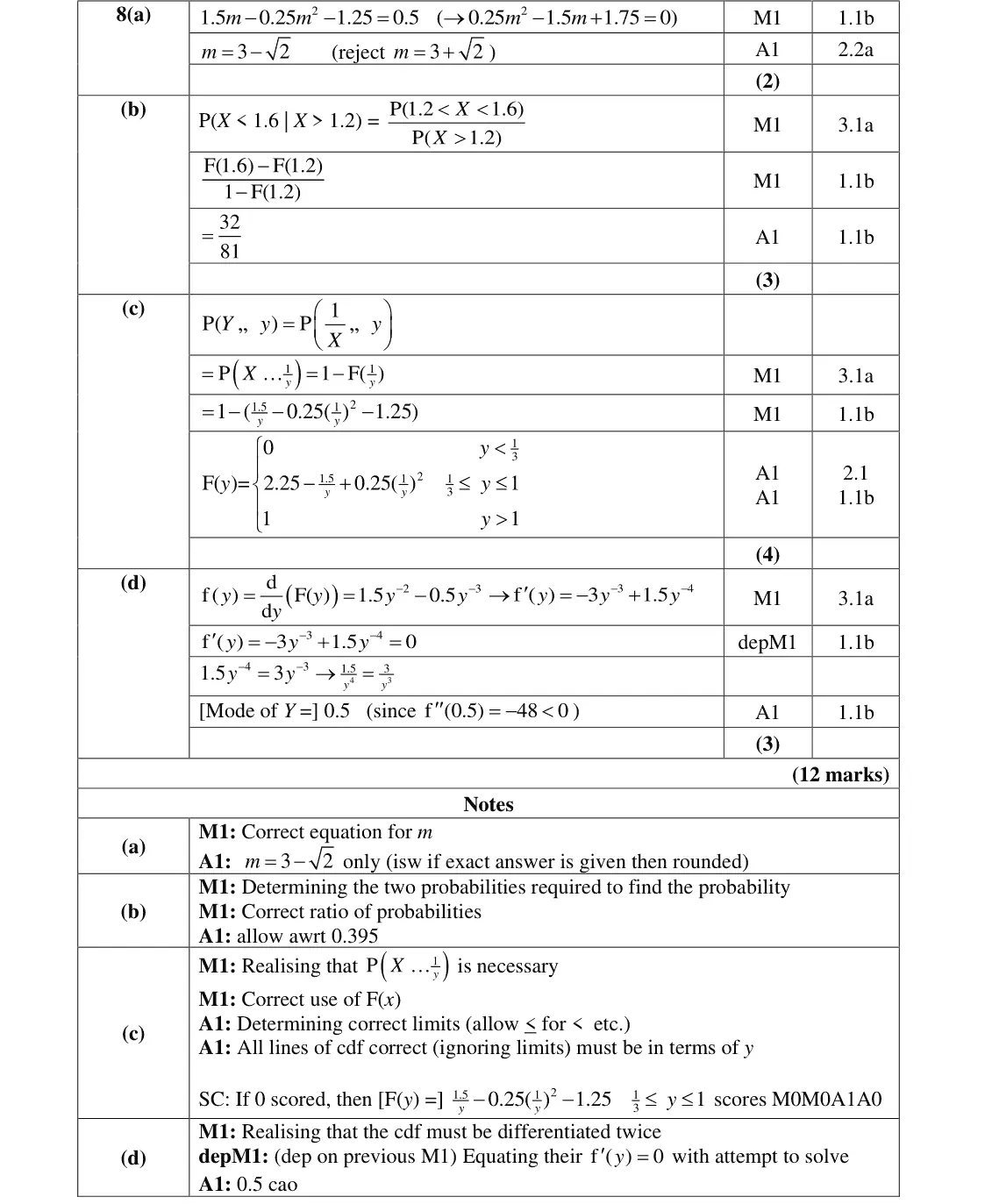
On the whole, this was the most demanding question on the paper, but parts (a) and (b) and to some extent (d) provided accessibility. Part (b) was more difficult but most realised that a conditional probability was required with P(X > 1.2) on the denominator. The numerator proved more challenging and it was not uncommon to see P(X < 1.6) used.
Key points from the mark scheme and examiner's report
June 2022 · Paper 4B (Further Statistics 2) · Q8(c)4 marks
Mark scheme (whole question; this part is marked with the orange bar)
Examiner's comment
Part (c) was the most challenging on the entire paper as virtually all candidates were unable to . Many simply replaced x with 1 1 deal with the inequality in the probability y but did P y „ X not consider the effect that would have on the limits. Many unsuccessful attempts at differentiation and integration were seen. In the final part of the question (d) candidates should have realised the need to differentiate progress here despite the difficulty in (c) and marks were still available for those who persevered.
Key points from the mark scheme and examiner's report
P(Y ≤ y) = P(X ≥ 1/y) = 1 − F(1/y) = 2.25 − 1.5/y + 0.25/y² for 1/3 ≤ y ≤ 1, 0 below and 1 above
the inequality reverses
most just replaced x by 1/y
hardest part of the paper
Nov 2021 · Paper 4B (Further Statistics 2) · Q3(a)2 marks
Mark scheme (whole question; this part is marked with the orange bar)
Key points from the mark scheme and examiner's report
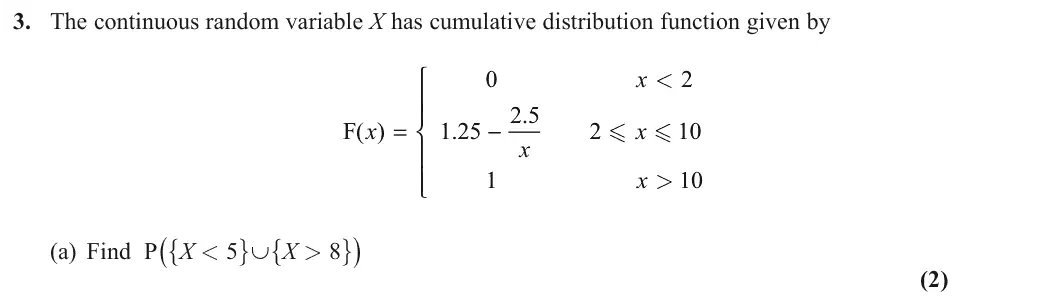
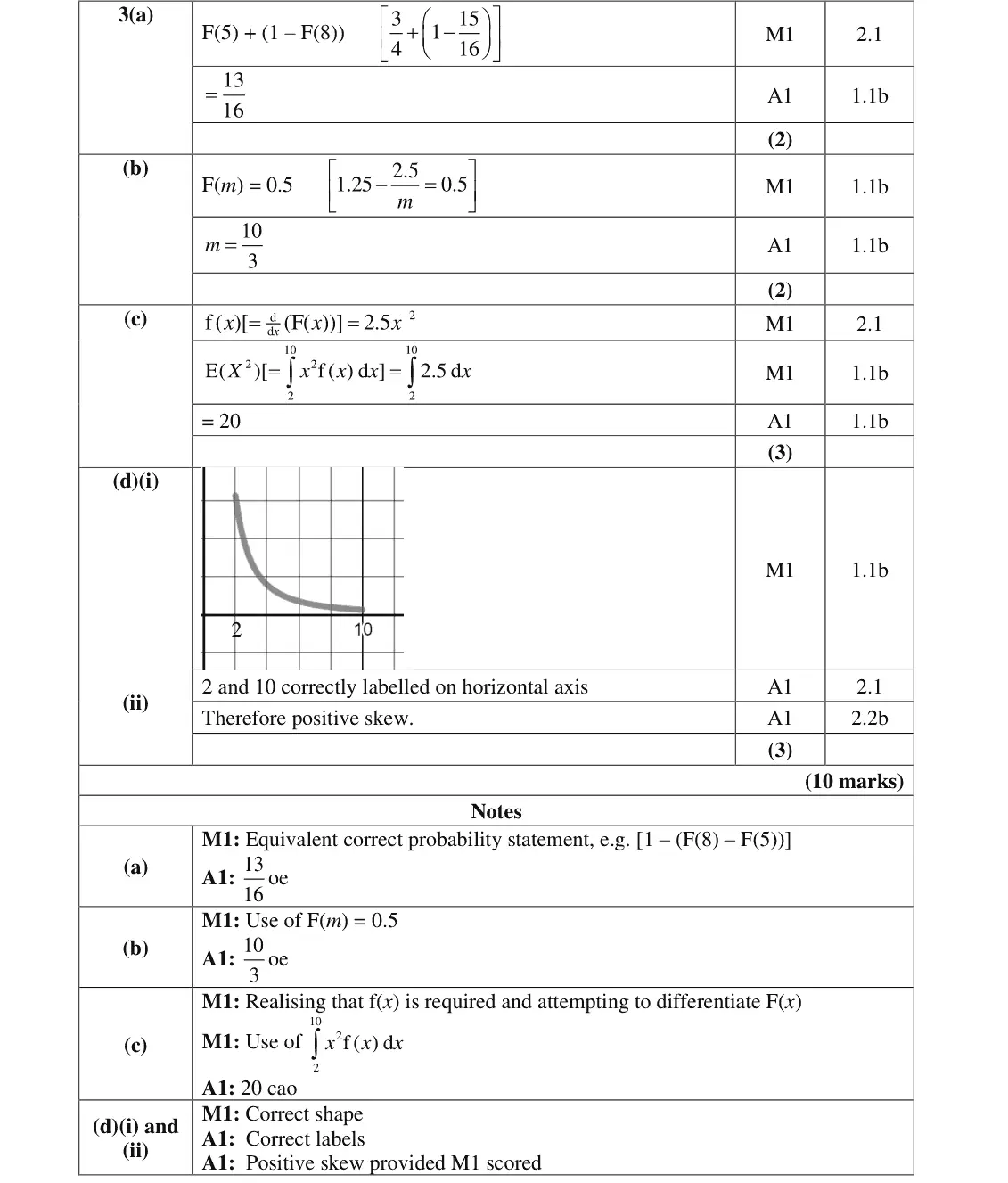
F(5) + 1 − F(8) = 3/4 + 1/16 = 13/16
Nov 2021 · Paper 4B (Further Statistics 2) · Q3(b)2 marks
Mark scheme (whole question; this part is marked with the orange bar)
Key points from the mark scheme and examiner's report
F(m) = 0.5: 1.25 − 2.5/m = 0.5, m = 10/3
Oct 2020 · AS Paper 2 (Further Statistics 2) · Q3(a)4 marks
Mark scheme (whole question; this part is marked with the orange bar)
Key points from the mark scheme and examiner's report
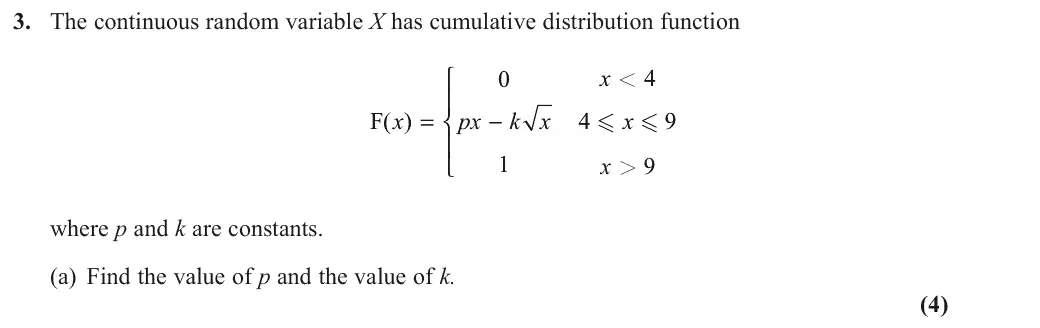
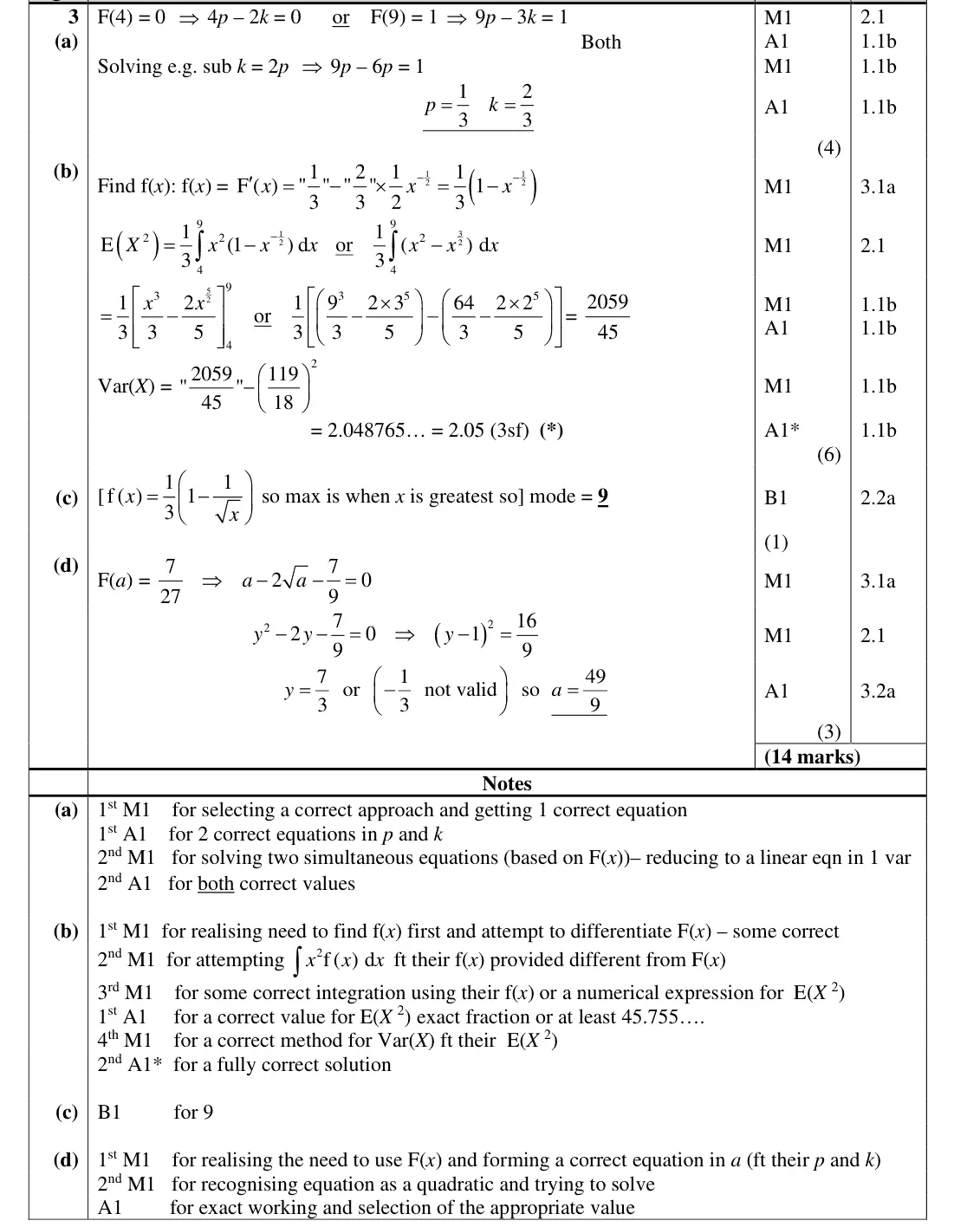
F(4) = 0 gives 4p − 2k = 0
F(9) = 1 gives 9p − 3k = 1
p = 1/3, k = 2/3
Oct 2020 · AS Paper 2 (Further Statistics 2) · Q3(d)3 marks
Mark scheme (whole question; this part is marked with the orange bar)
Key points from the mark scheme and examiner's report
F(a) = 7/27 gives a − 2√a − 7/9 = 0, a quadratic in y = √a
y = 7/3 (reject −1/3), a = 49/9 exact
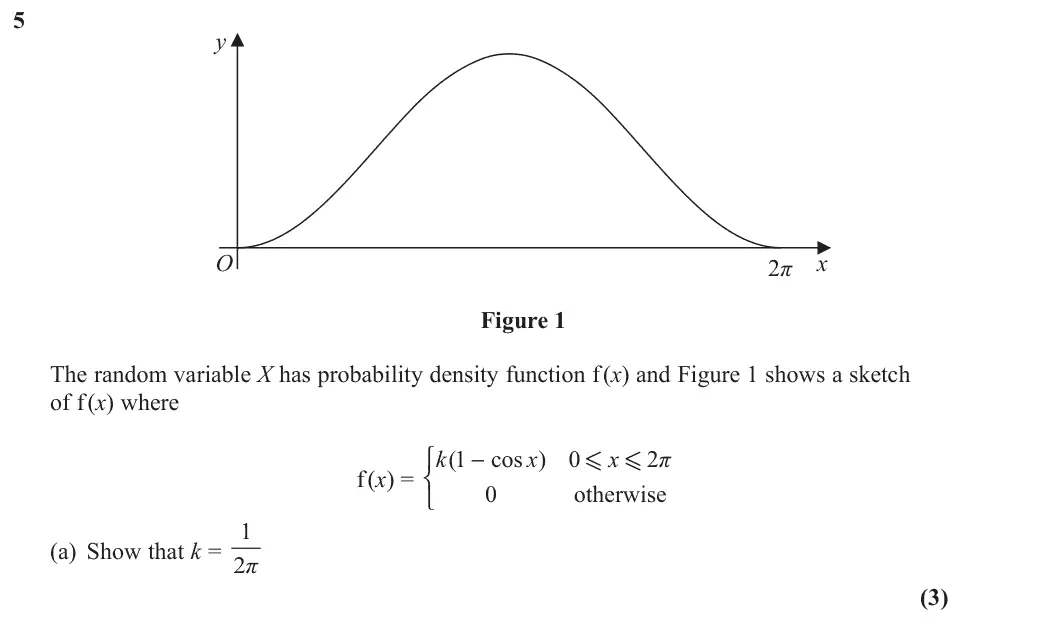
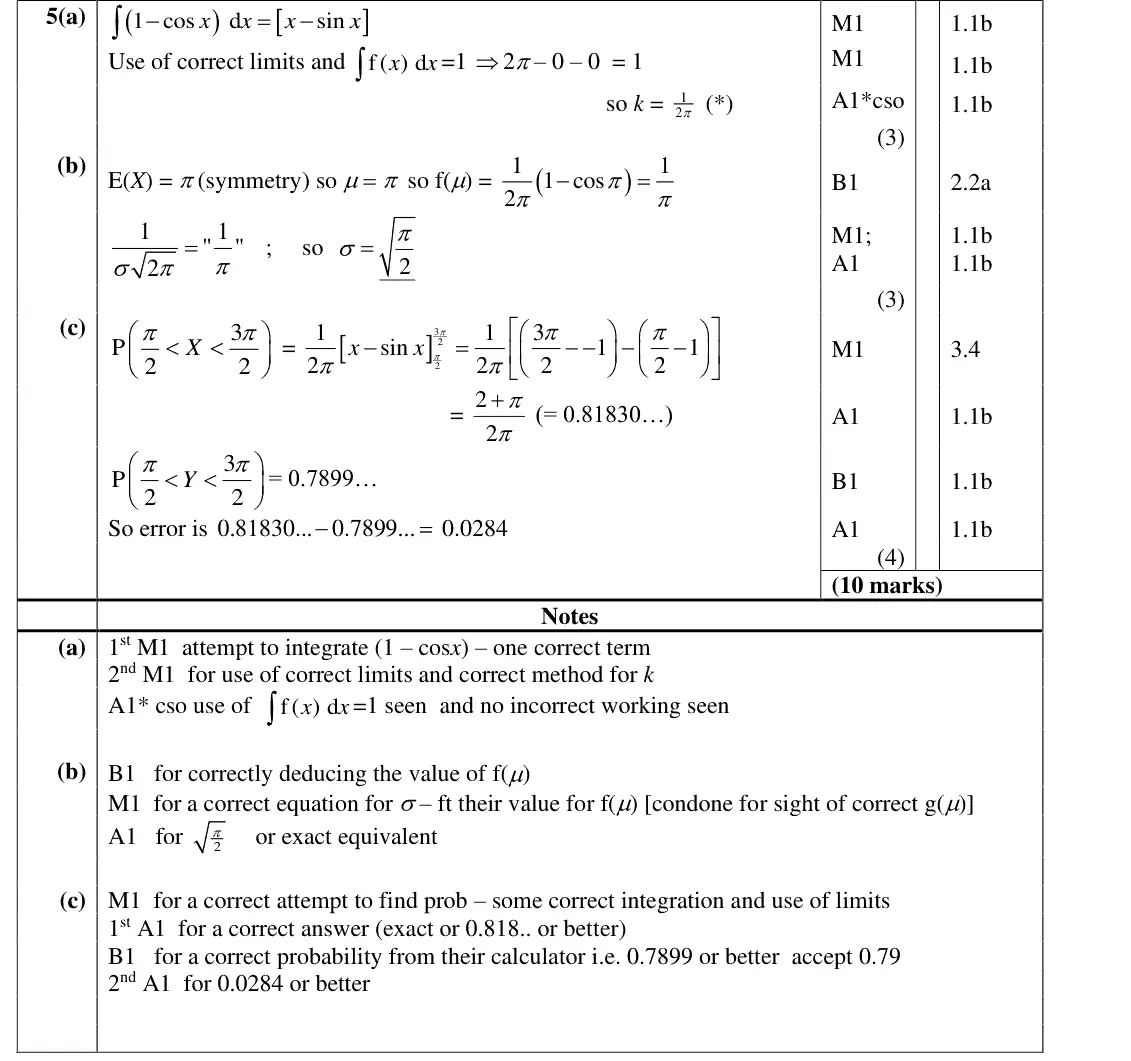
Oct 2020 · Paper 4B (Further Statistics 2) · Q5(a)3 marks
Mark scheme (whole question; this part is marked with the orange bar)
Key points from the mark scheme and examiner's report
∫(1 − cos x)dx = x − sin x
total probability 1 over [0, 2π] gives 2πk = 1
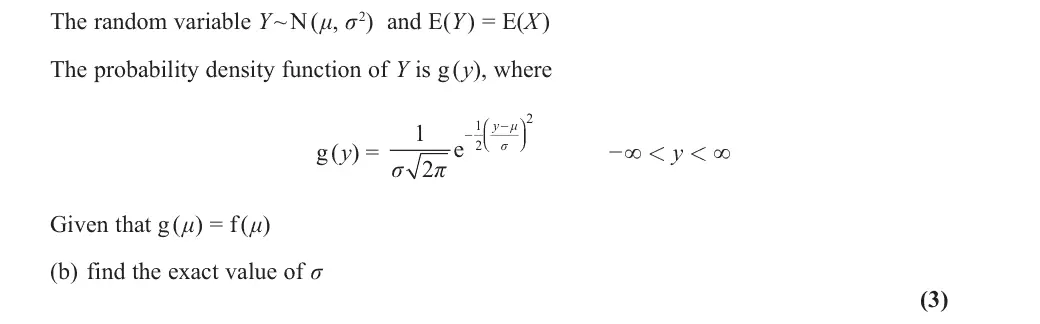
Oct 2020 · Paper 4B (Further Statistics 2) · Q5(b)3 marks
Mark scheme (whole question; this part is marked with the orange bar)
Key points from the mark scheme and examiner's report
by symmetry E(X) = π so μ = π and f(π) = 1/π
1/(σ√(2π)) = 1/π gives σ = √(π/2)
Oct 2020 · Paper 4B (Further Statistics 2) · Q5(c)4 marks
Mark scheme (whole question; this part is marked with the orange bar)
Key points from the mark scheme and examiner's report
P(π/2 < X < 3π/2) = (2 + π)/(2π) = 0.8183 by integration
P(π/2 < Y < 3π/2) = 0.7899 from calculator
error 0.0284
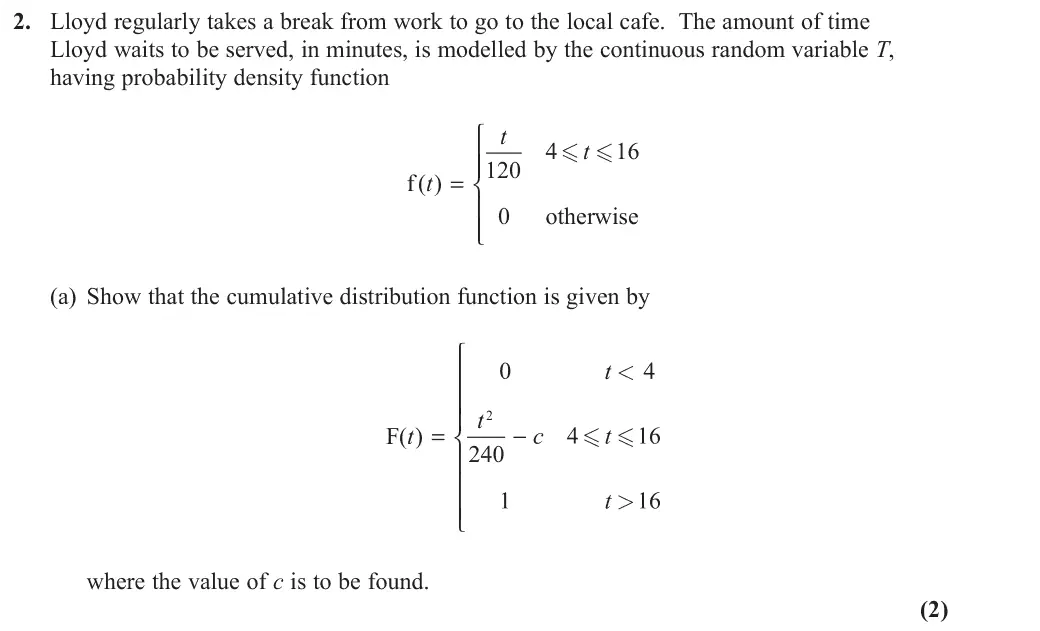
June 2019 · AS Paper 2 (Further Statistics 2) · Q2(a)2 marks
Mark scheme (whole question; this part is marked with the orange bar)
Examiner's comment
In Q2 the majority of candidates were able to gain the marks in parts (a), (b), and (c). part (d) discriminated the most able candidates on this paper as it was uncommon to see full marks being scored here. Many candidates were unable to translate the mathematical problem into an equation they could solve. Those who were able to form an equation were then able to produce a fully correct solution.
Key points from the mark scheme and examiner's report
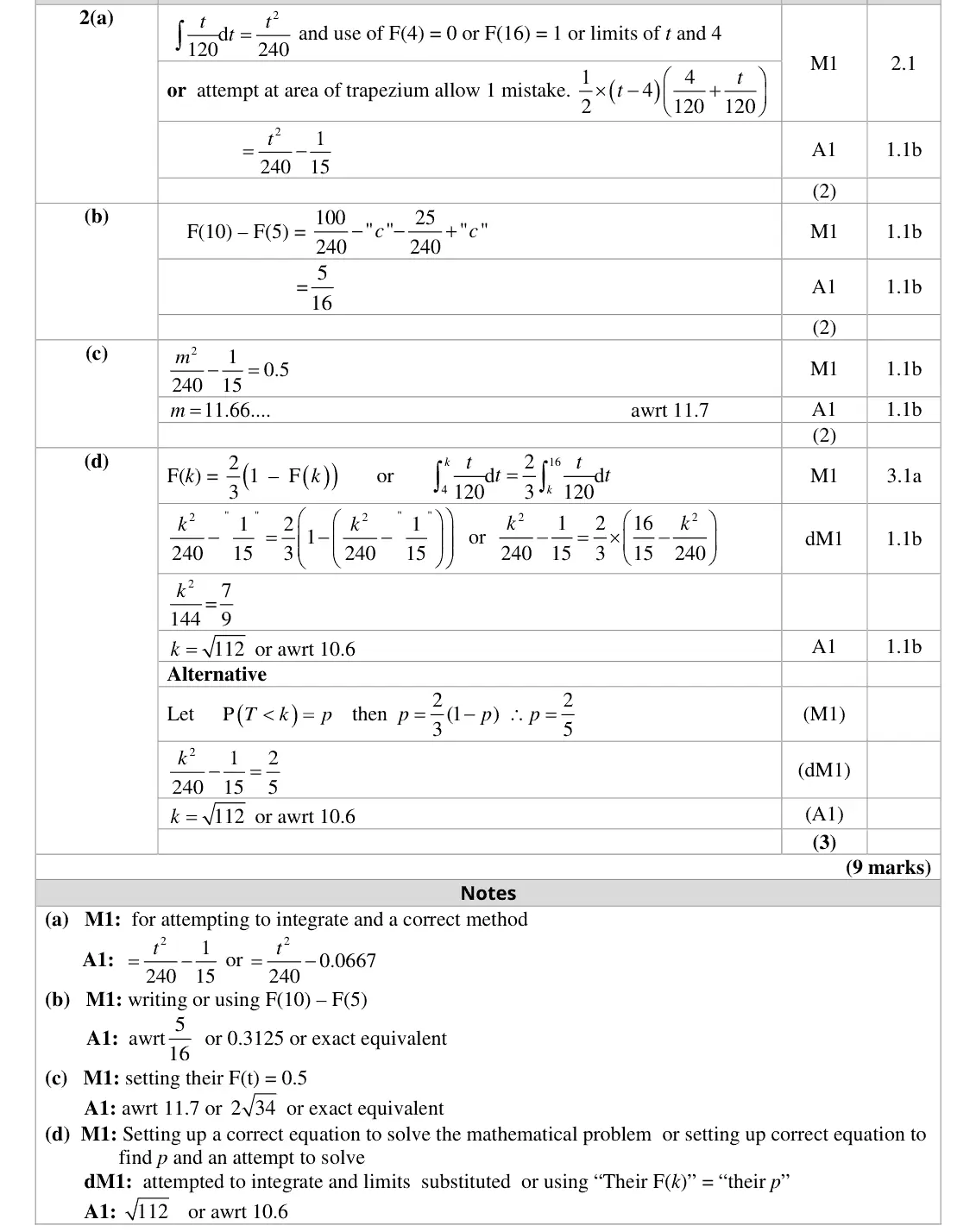
integrate t/120 to t²/240 and use F(4) = 0 or F(16) = 1
c = 1/15
June 2019 · AS Paper 2 (Further Statistics 2) · Q2(b)2 marks
Mark scheme (whole question; this part is marked with the orange bar)
Examiner's comment
In Q2 the majority of candidates were able to gain the marks in parts (a), (b), and (c). part (d) discriminated the most able candidates on this paper as it was uncommon to see full marks being scored here. Many candidates were unable to translate the mathematical problem into an equation they could solve. Those who were able to form an equation were then able to produce a fully correct solution.
Key points from the mark scheme and examiner's report
F(10) − F(5) = 5/16
exact answer
June 2019 · AS Paper 2 (Further Statistics 2) · Q2(d)3 marks
Mark scheme (whole question; this part is marked with the orange bar)
Examiner's comment
In Q2 the majority of candidates were able to gain the marks in parts (a), (b), and (c). part (d) discriminated the most able candidates on this paper as it was uncommon to see full marks being scored here. Many candidates were unable to translate the mathematical problem into an equation they could solve. Those who were able to form an equation were then able to produce a fully correct solution.
Key points from the mark scheme and examiner's report
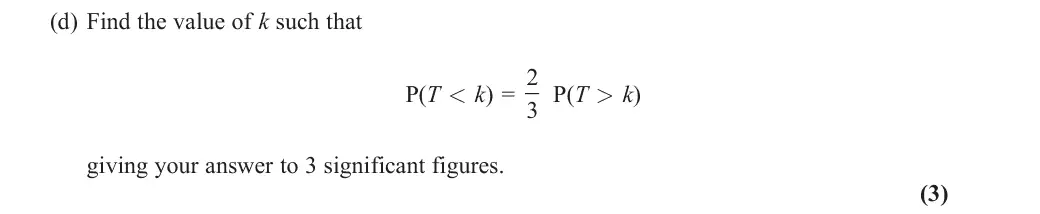
F(k) = (2/3)(1 − F(k)) so F(k) = 2/5
k² = 112, k = 10.6
many could not turn the condition into an equation
June 2019 · Paper 4B (Further Statistics 2) · Q4(a)1 mark
Mark scheme (whole question; this part is marked with the orange bar)
Examiner's comment
This question was another good source of marks for the candidates with many able to gain the mark in part (a). In part (b) the majority of candidates realised that they needed to find f(x) 2 0 f( ) d x x x first and used this to find in part (i). A minority of candidates ignored the demand, given in the question, to show working and use calculus and gave an incomplete method or just wrote and answer of 1.2 resulting in a loss of marks. 2 0 F( ) d x x x The demand was given as also gives an answer of 1.2 In (ii) candidates who had found f(x) knew what was required and went on to find the mode correctly.
Key points from the mark scheme and examiner's report
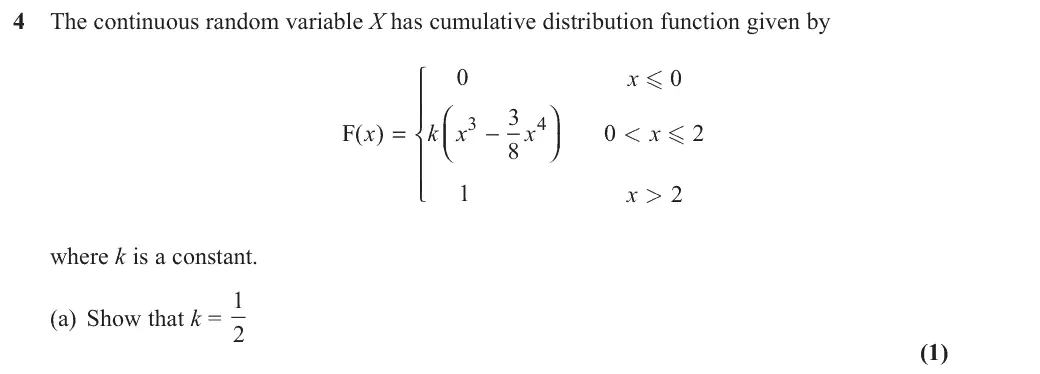
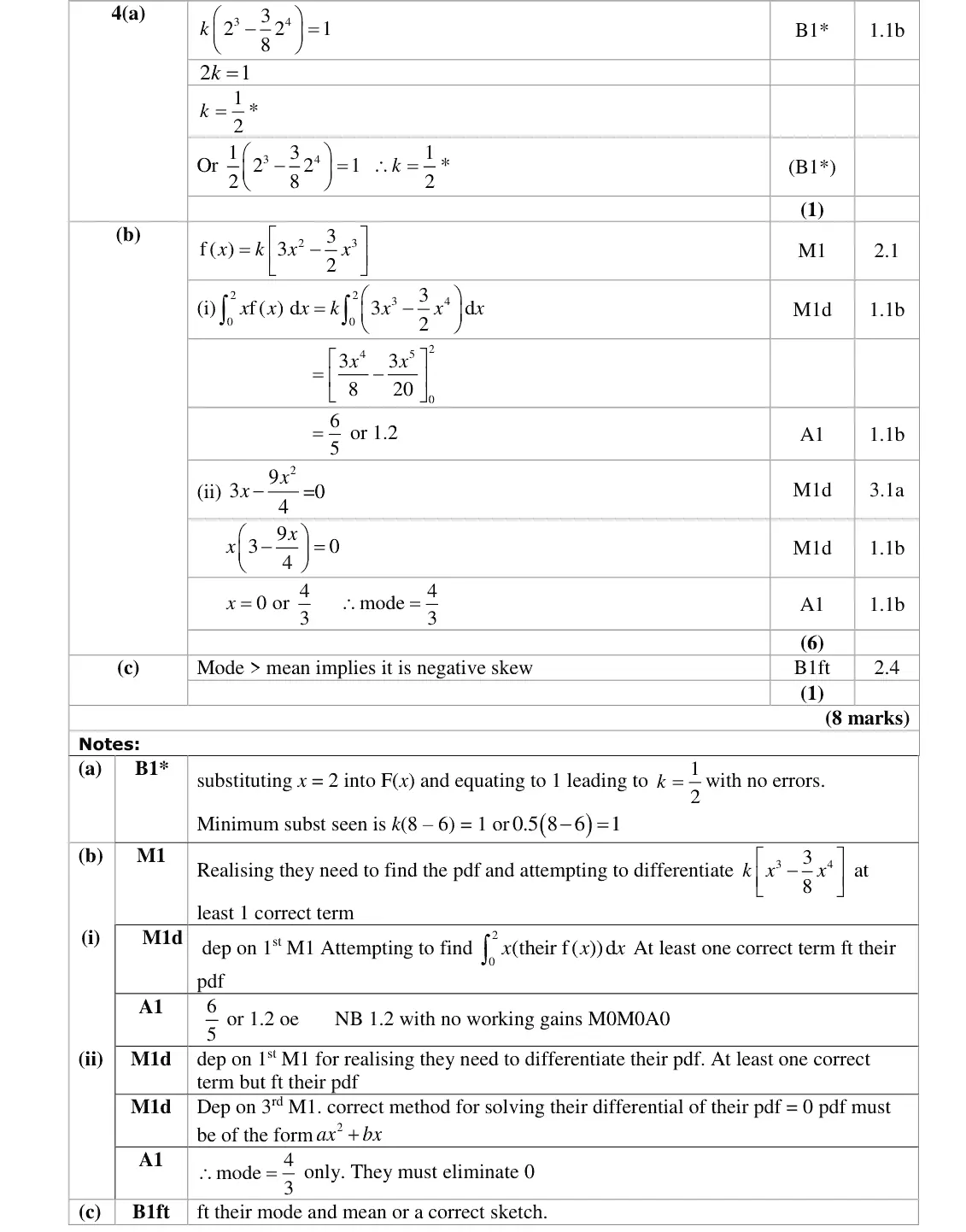
F(2) = 1 gives k(8 − 6) = 1 so k = ½
June 2018 · AS Paper 2 (Further Statistics 2) · Q2(b)2 marks
Mark scheme (whole question; this part is marked with the orange bar)
Examiner's comment
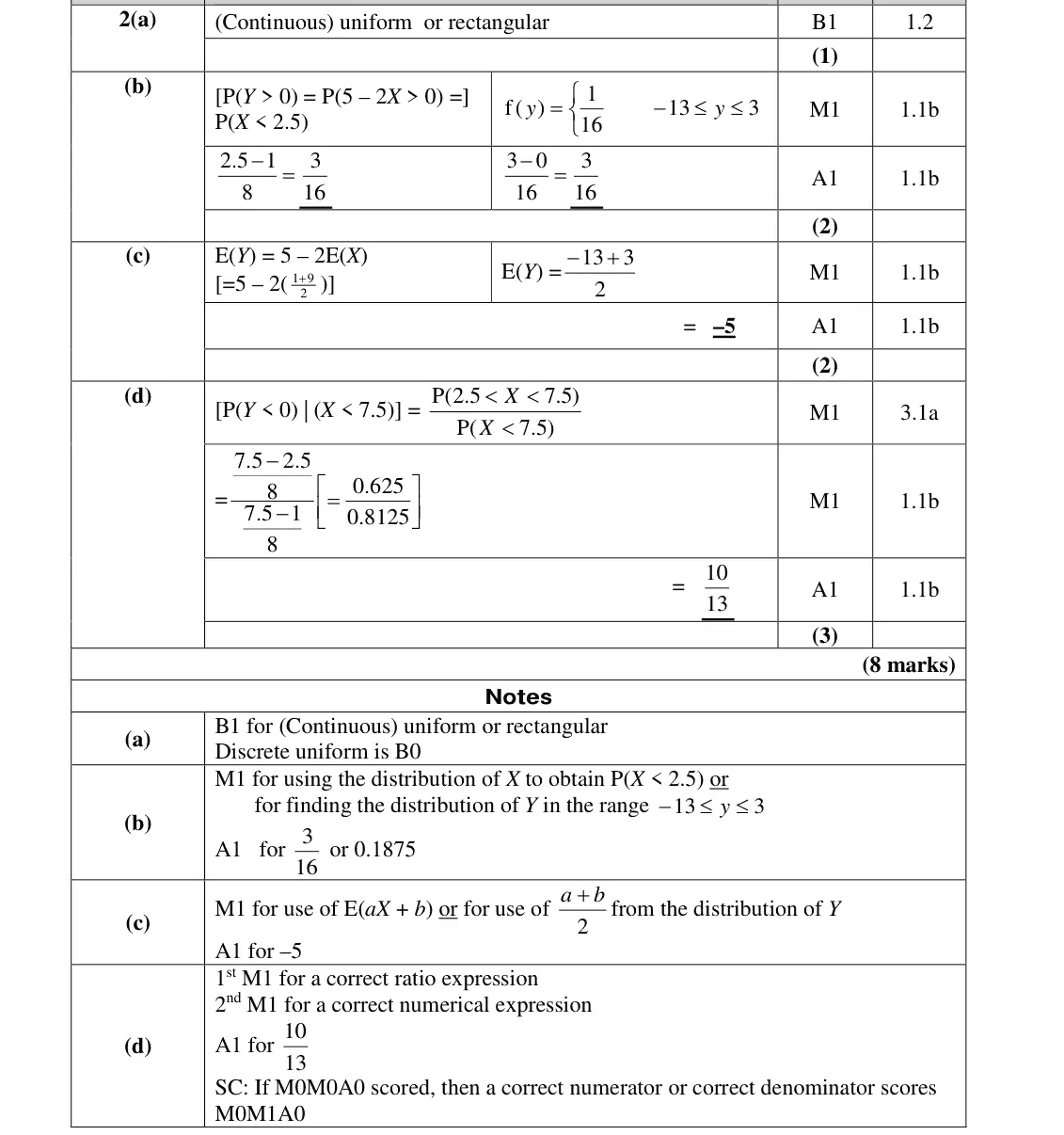
Question 2 discriminated the most able students on this paper as it was rare to see full marks being scored here. Many students were unable to identify the distribution as (continuous) In part (b), some were able to gain the method mark by identifying that P(Y < 0) = P(X < 2.5). It was clear that many did not know what to do with that fact. A common incorrect solution was to treat the distribution as discrete and attempt to calculate P(X < 2).
Key points from the mark scheme and examiner's report
P(Y > 0) = P(X < 2.5) = 1.5/8 = 3/16
or find Y ~ U[−13, 3]
common error treating X as discrete
June 2018 · AS Paper 2 (Further Statistics 2) · Q2(d)3 marks
Mark scheme (whole question; this part is marked with the orange bar)
Examiner's comment
Question 2 discriminated the most able students on this paper as it was rare to see full marks being scored here. Many students were unable to identify the distribution as (continuous) Very little progress was made in part (d) as the conditional probability required was rarely seen. Those who did attempt a conditional probability often assumed independence and gave the product of two probabilities in the numerator. A few scored the special case for a correct probability for the denominator. 4
Key points from the mark scheme and examiner's report
many wrongly assumed independence and multiplied probabilities
June 2018 · AS Paper 2 (Further Statistics 2) · Q4(a)7 marks
Mark scheme (whole question; this part is marked with the orange bar)
Examiner's comment
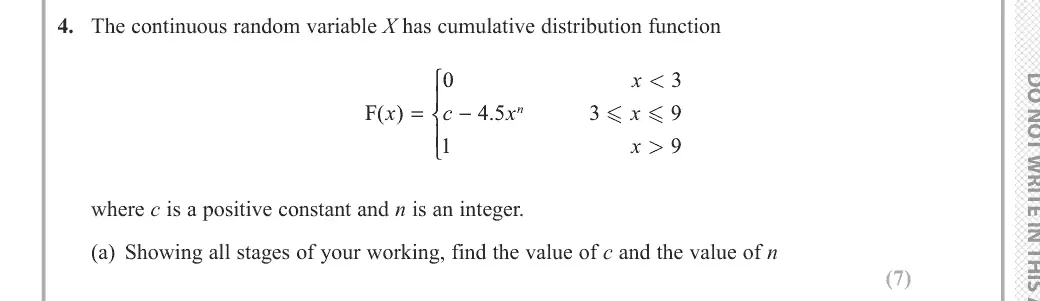
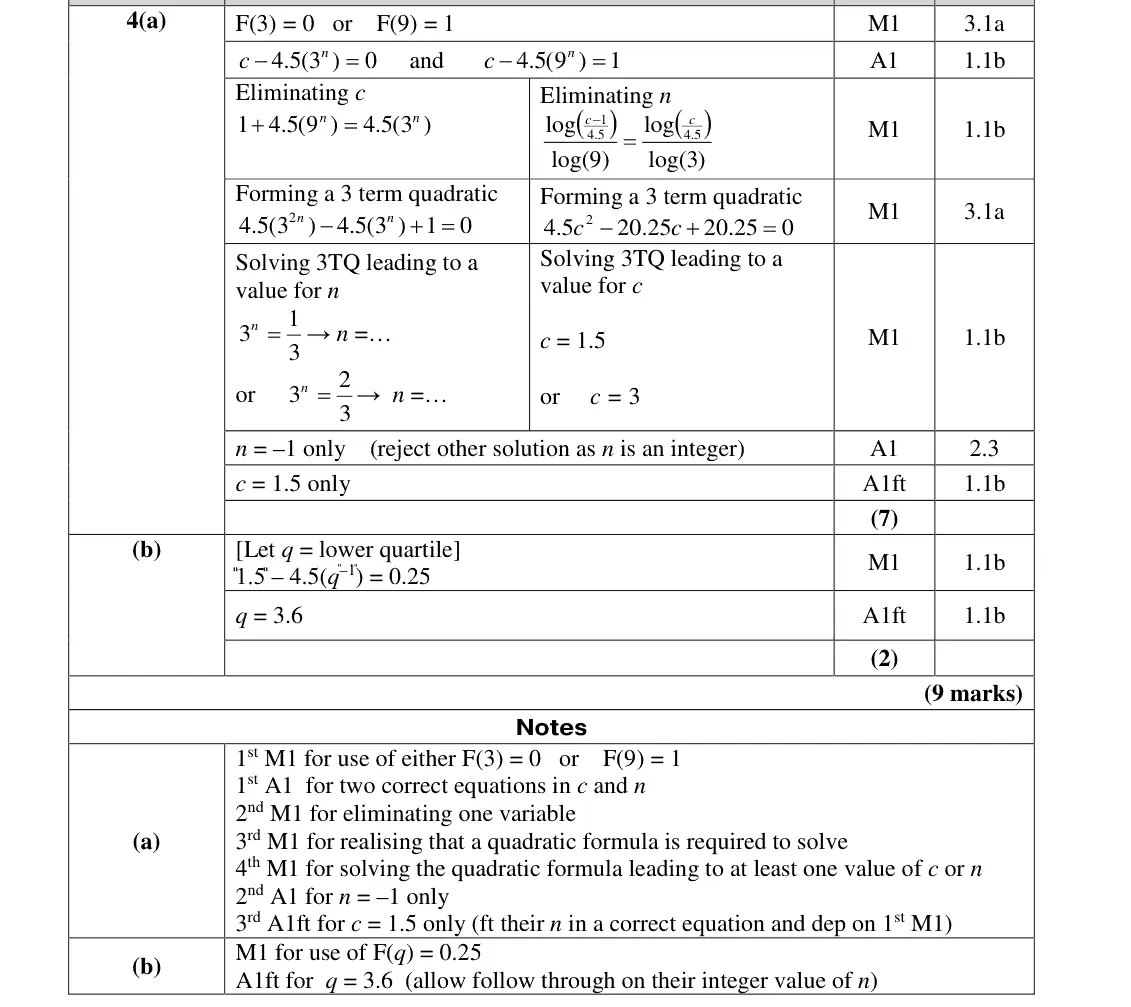
The final question of the paper was also the most demanding. Although there were many attempts seen in part (a) where students demonstrated knowledge that F(3) = 0 or that F(9) = 1 or both, little progress was made in solving these equations simultaneously. More worrying were the students who attempted to first integrate the cumulative distribution function. Students should be aware that this specification rewards those who demonstrate the ability to draw together different areas of knowledge from across the full course of study of A level Further Maths and A level Maths. Here students needed to know how to solve a quadratic equation with the unknown value in the power. Those who persevered could score a follow through mark for a consistent value of c even when an incorrect value of n was found. A better attempt was made at part (b), with some students using F(q) = 0.25 to attempt to find
Key points from the mark scheme and examiner's report
use F(3) = 0 and F(9) = 1
eliminate c to get a quadratic in 3ⁿ: 4.5(3ⁿ)² − 4.5(3ⁿ) + 1 = 0
n = −1 only (integer), c = 1.5
some wrongly integrated F(x)
June 2018 · AS Paper 2 (Further Statistics 2) · Q4(b)2 marks
Mark scheme (whole question; this part is marked with the orange bar)
Examiner's comment
The final question of the paper was also the most demanding. Although there were many A better attempt was made at part (b), with some students using F(q) = 0.25 to attempt to find the value of the lower quartile. Students should check to see that their answer makes sense as some answers given were outside of the range of the x-values of the distribution. 5
Key points from the mark scheme and examiner's report
solve F(q) = 0.25: 1.5 − 4.5/q = 0.25, q = 3.6
check the answer lies between 3 and 9
Find an Edexcel Further Maths tutor
Stuck on this? Book a trial lesson with our Further Maths tutor.