June 2025 · AS Paper 2 (Further Statistics 2) · Q4(b)2 marks
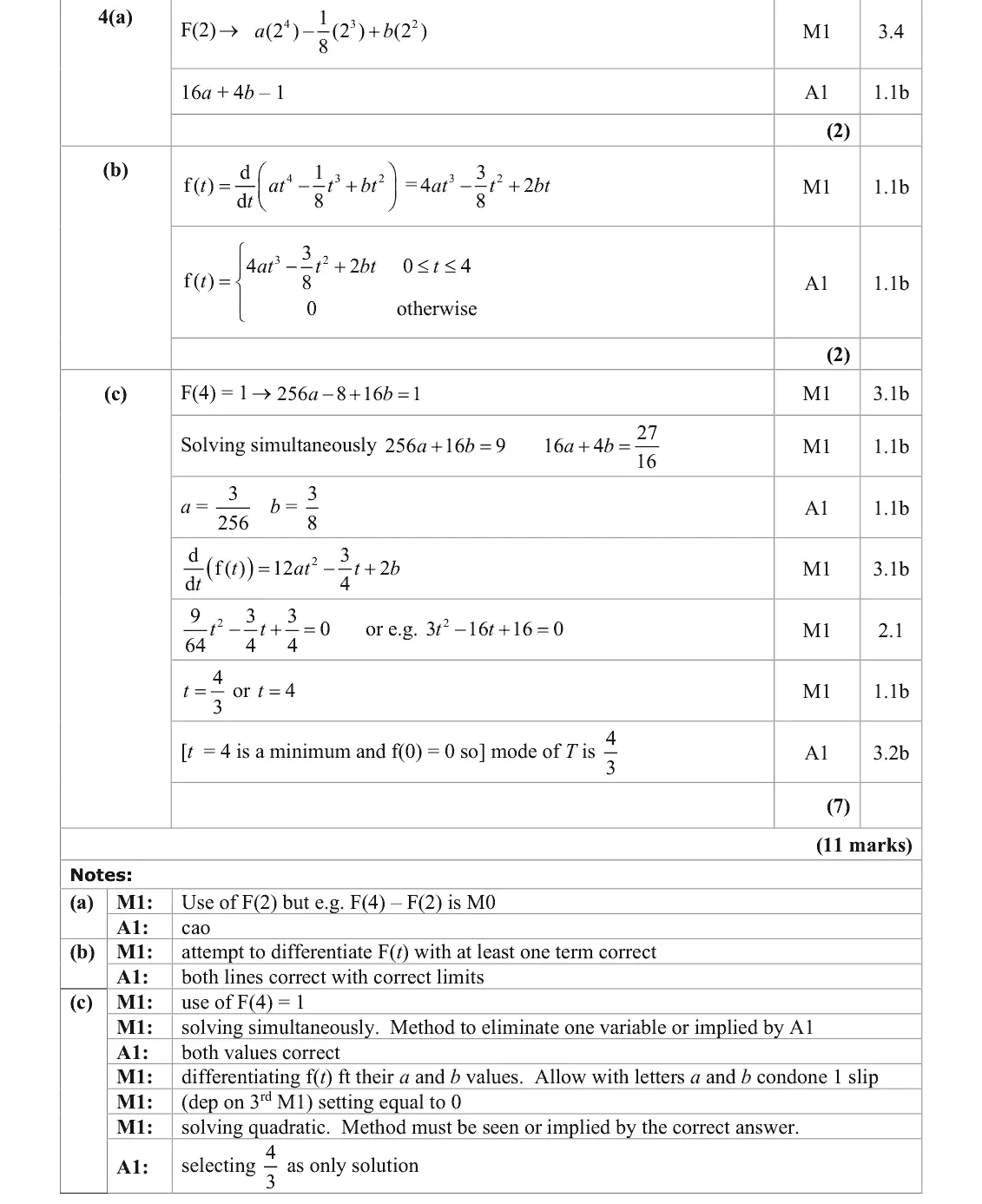
Mark scheme (whole question; this part is marked with the orange bar)
Examiner's comment
Most learners knew that they needed F(2) for part (a) and usually were able to find a correct expression in terms of a and b though sometimes there was a sign error with 16a – 4b – 1 occasionally seen. A few attempted F(4) – F(2) and made no progress in part (a). The vast majority knew that to find the probability density function (pdf) they should differentiate the cumulative distribution function (cdf) and this was usually carried out correctly. A few failed to define their pdf for all values of t and some integrated the cdf. Part (c) proved a fitting discriminator for the end of the paper. Many knew that they needed a second equation in a and b and most of these students realised that using F(4) = 1 would give them a suitable equation. Those who found this second equation usually went on to solve correctly and find the correct values for a and b. Some were stumped at this point but a good number realised that they needed to differentiate the pdf and find a turning point. Those who made this step usually arrived at a quadratic expression which they set equal to zero and then set about solving. There were occasional arithmetic slips made in this process but a good number found the two solutions t = 4 and t = 4/3 and many then gave thorough checks that t = 4/3 gave the maximum before clearly selecting this value as the mode.
Key points from the mark scheme and examiner's report
f(t) = 4at³ − (3/8)t² + 2bt for 0 ≤ t ≤ 4 and 0 otherwise
define f for all t
June 2025 · AS Paper 2 (Further Statistics 2) · Q4(c)7 marks
Mark scheme (whole question; this part is marked with the orange bar)
Examiner's comment
Part (c) proved a fitting discriminator for the end of the paper. Many knew that they needed a second equation in a and b and most of these students realised that using F(4) = 1 would give them a suitable equation. Those who found this second equation usually went on to solve correctly and find the correct values for a and b. Some were stumped at this point but a good number realised that they needed to differentiate the pdf and find a turning point. Those who made this step usually arrived at a quadratic expression which they set equal to zero and then set about solving. There were occasional arithmetic slips made in this process but a good number found the two solutions t = 4 and t = 4/3 and many then gave thorough checks that t = 4/3 gave the maximum before clearly selecting this value as the mode.
Key points from the mark scheme and examiner's report
F(2) = 11/16 and F(4) = 1 give a = 3/256, b = 3/8
differentiate f and set to 0: 3t² − 16t + 16 = 0, t = 4/3 or 4
t = 4 is a minimum so mode = 4/3 (exact)
many could not find a second equation
June 2025 · Paper 4B (Further Statistics 2) · Q5(c)3 marks
Mark scheme (whole question; this part is marked with the orange bar)
Examiner's comment
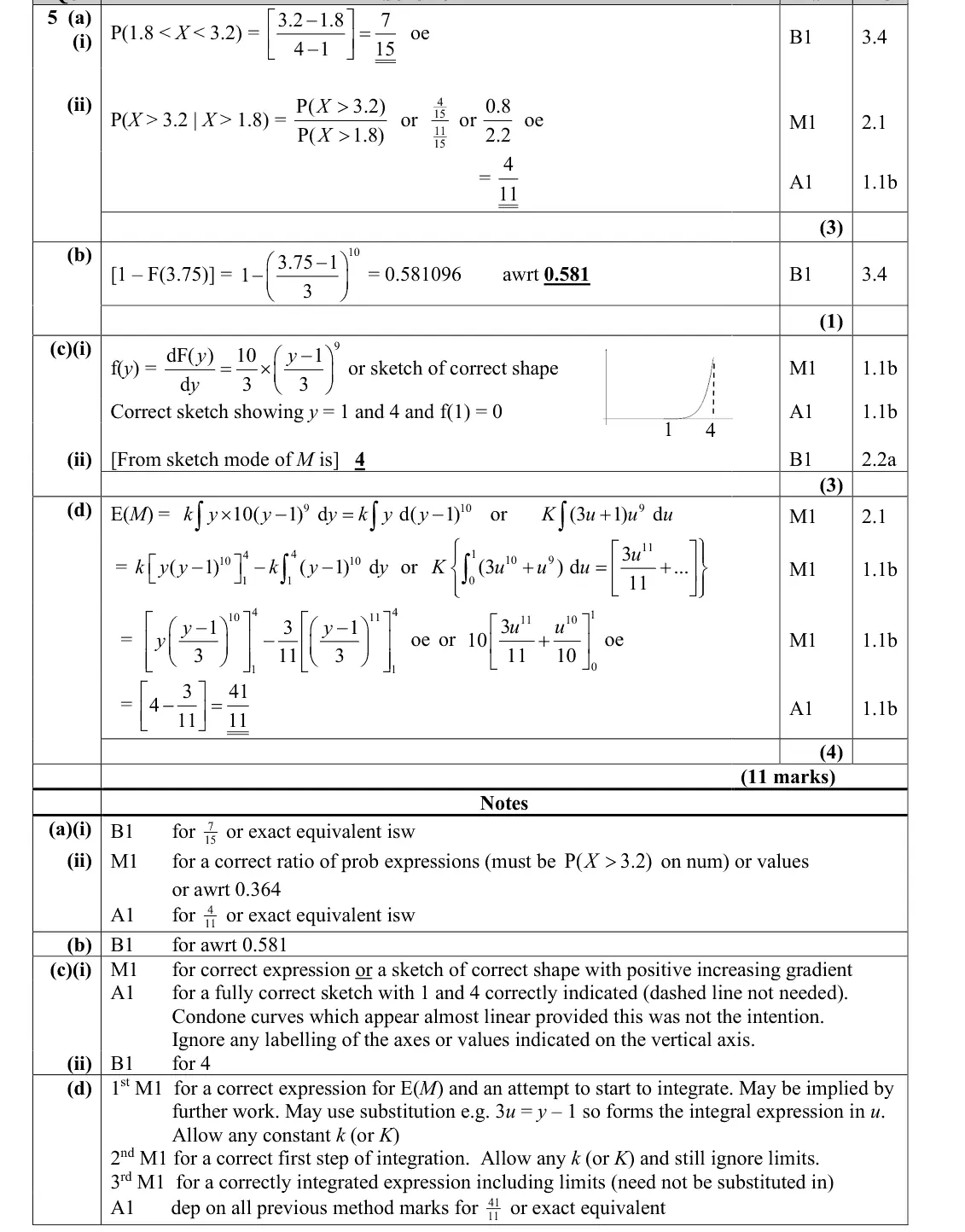
This question tested continuous random variables and candidates were usually able to make good progress in most of the parts. In part (c), candidates found the sketch a challenge, with many not clearly labelling 1 and 4 on the horizontal axis. Vertical values were not required and nor were axis labels on this occasion. Some candidates extended the graph beyond the defined interval, and some graphs which went below the horizontal axis were seen. The mode was usually correctly stated.
Key points from the mark scheme and examiner's report
f(y) = (10/3)((y − 1)/3)⁹: increasing curve from 0 at y = 1 to the end at y = 4, with 1 and 4 labelled and not extended beyond
mode 4
June 2025 · Paper 4B (Further Statistics 2) · Q5(d)4 marks
Mark scheme (whole question; this part is marked with the orange bar)
Examiner's comment
This question tested continuous random variables and candidates were usually able to make good progress in most of the parts. Part (d) required candidates to find the expected value for the random variable. Usually a correct expression was found, but a number of candidates struggled to make any valid progress to integrate the function correctly. Those who did, often opted for the substitution method, whilst others who elected to use integration by parts seemed to make more errors dealing with the coefficients.
Key points from the mark scheme and examiner's report
E(M) = ∫y f(y) dy from 1 to 4 by parts or substitution 3u = y − 1
exact answer 41/11
integration was the stumbling block
June 2024 · AS Paper 2 (Further Statistics 2) · Q1(a)2 marks
Mark scheme (whole question; this part is marked with the orange bar)
Examiner's comment
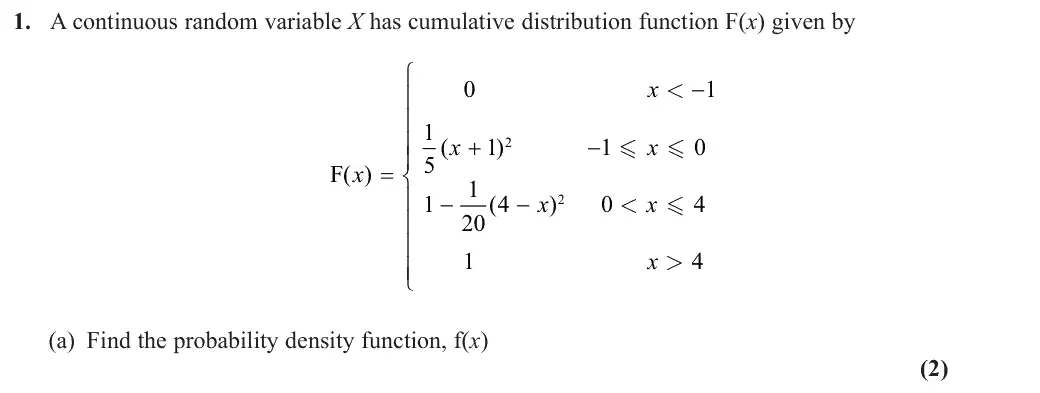
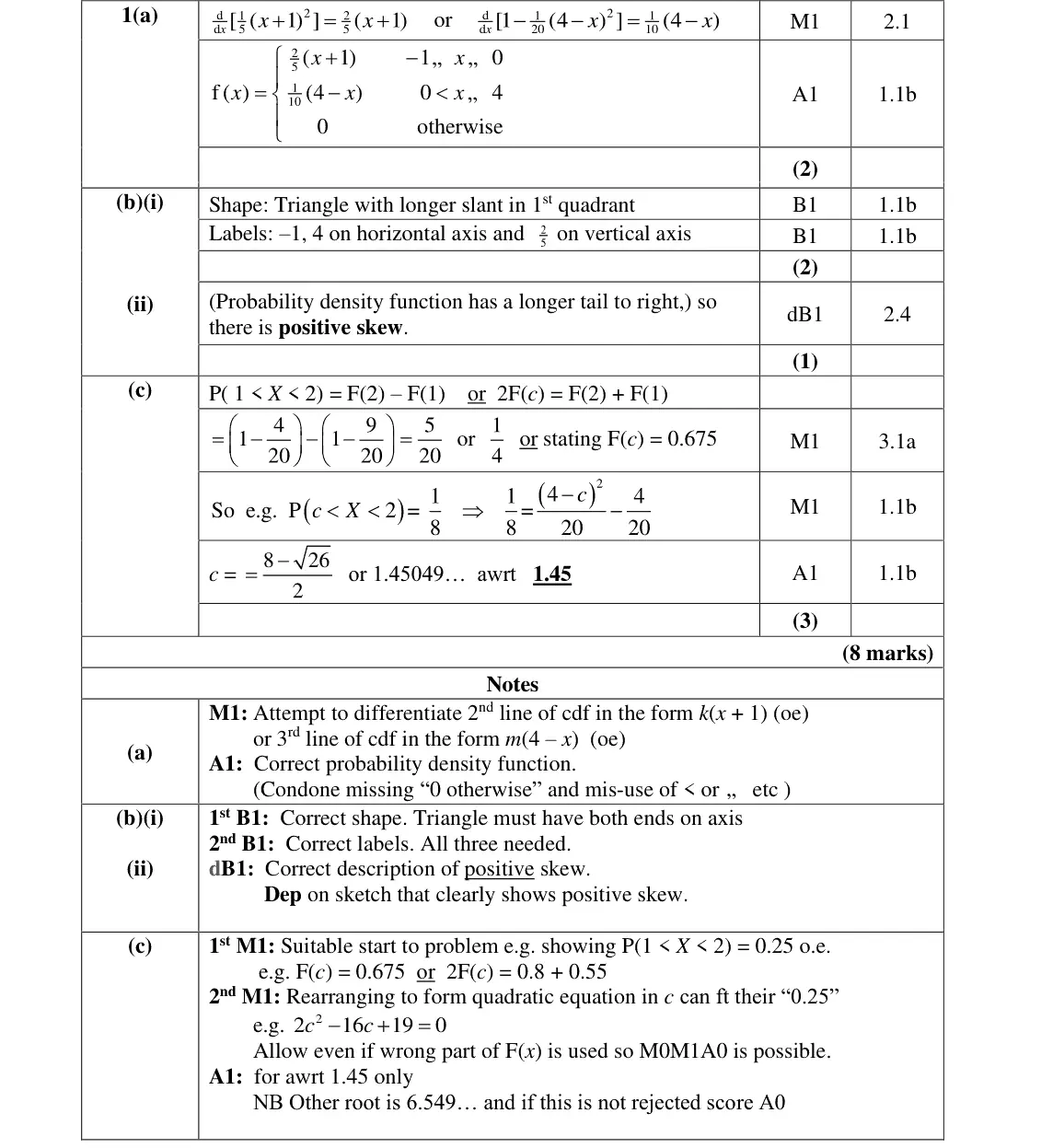
Part (a) was answered well with most students differentiating the 2nd row of F(x) correctly and many managing the 3rd row too though some lost a minus sign. The sketch in part (b) was often correct but some did not have a triangle with a base on the x-axis
Key points from the mark scheme and examiner's report
differentiate each row of F(x): f(x) = (2/5)(x + 1) for −1 ≤ x ≤ 0, (1/10)(4 − x) for 0 < x ≤ 4, 0 otherwise
watch the minus sign on the 3rd row
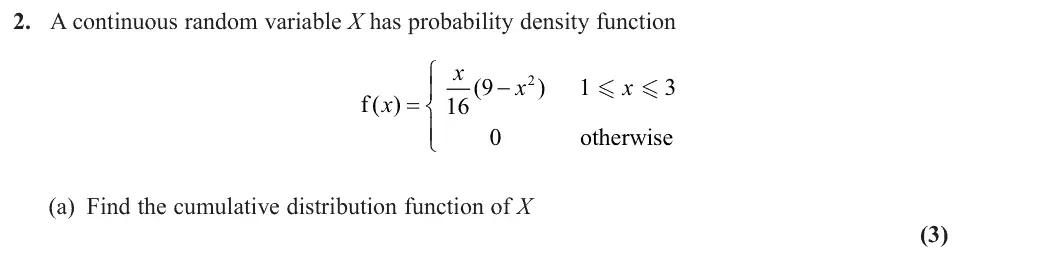
June 2023 · AS Paper 2 (Further Statistics 2) · Q2(a)3 marks
Mark scheme (whole question; this part is marked with the orange bar)
Examiner's comment
Nearly all knew that to find the cumulative distribution function the probability density function needed to be integrated. This was carried out correctly and some used limits of 1 and x whilst others had a constant of integration and used F(1) = 0 to establish F(x) for x between 1 and 3. Most went on to state the cumulative distribution function correctly.
Key points from the mark scheme and examiner's report
integrate from 1 to x (or use + c with F(1) = 0): F(x) = 9x²/32 − x⁴/64 − 17/64 for 1 ≤ x ≤ 3, with 0 for x < 1 and 1 for x > 3
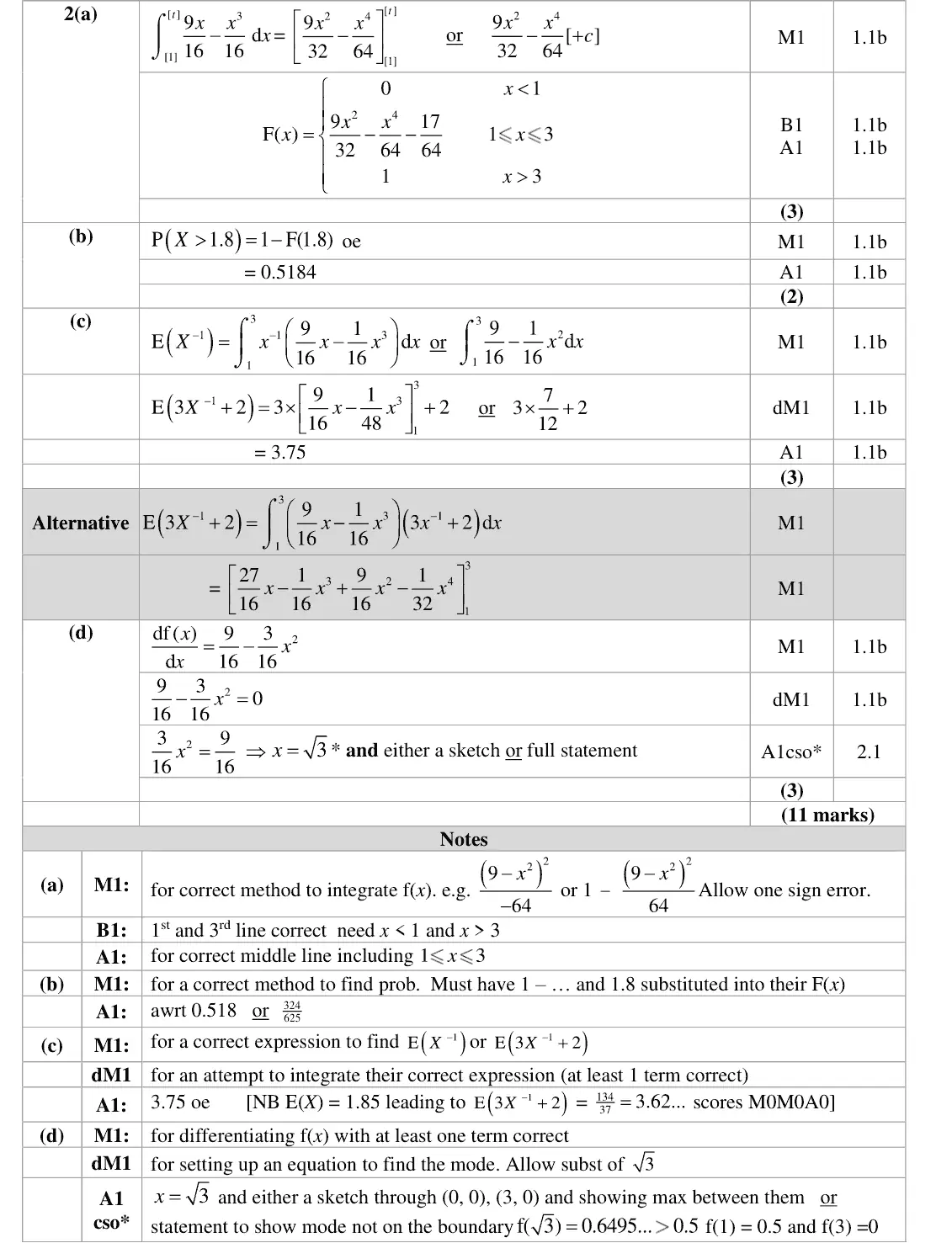
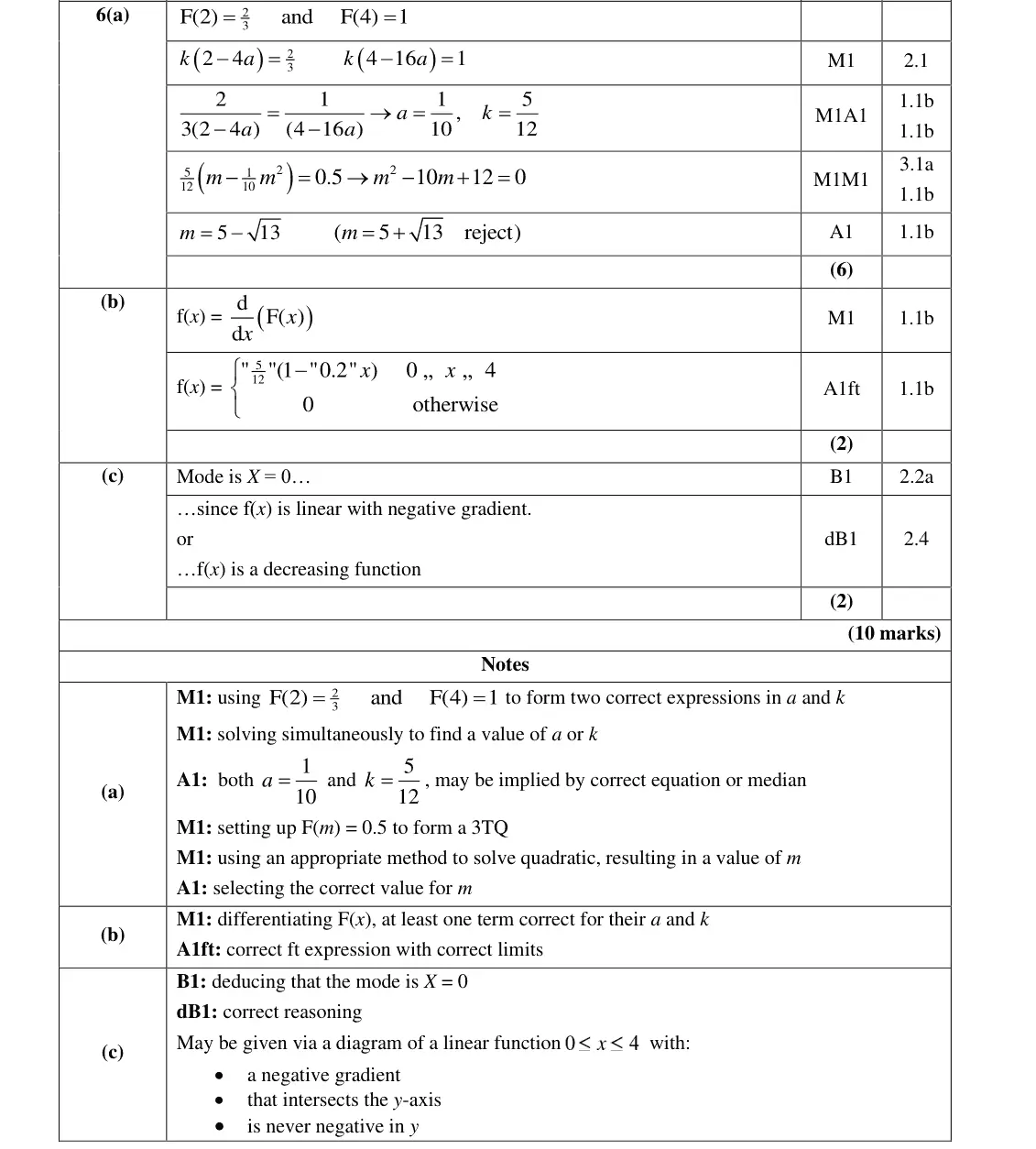
June 2023 · Paper 4B (Further Statistics 2) · Q6(b)2 marks
Mark scheme (whole question; this part is marked with the orange bar)
Examiner's comment
This was a fairly straightforward question on continuous random variables that all candidates would have been expecting. Consequently, the majority of candidates were able to produce good answers to this question. Part (b) was overall well done. Most candidates showed an understanding of the relationship between the cdf and pdf, and knew to differentiate. However, a good number of candidates did not state their pdf properly with an exhaustive domain.
Key points from the mark scheme and examiner's report
f(x) = F′(x) = (5/12)(1 − 0.2x) for 0 ≤ x ≤ 4, 0 otherwise
full domain needed, often omitted
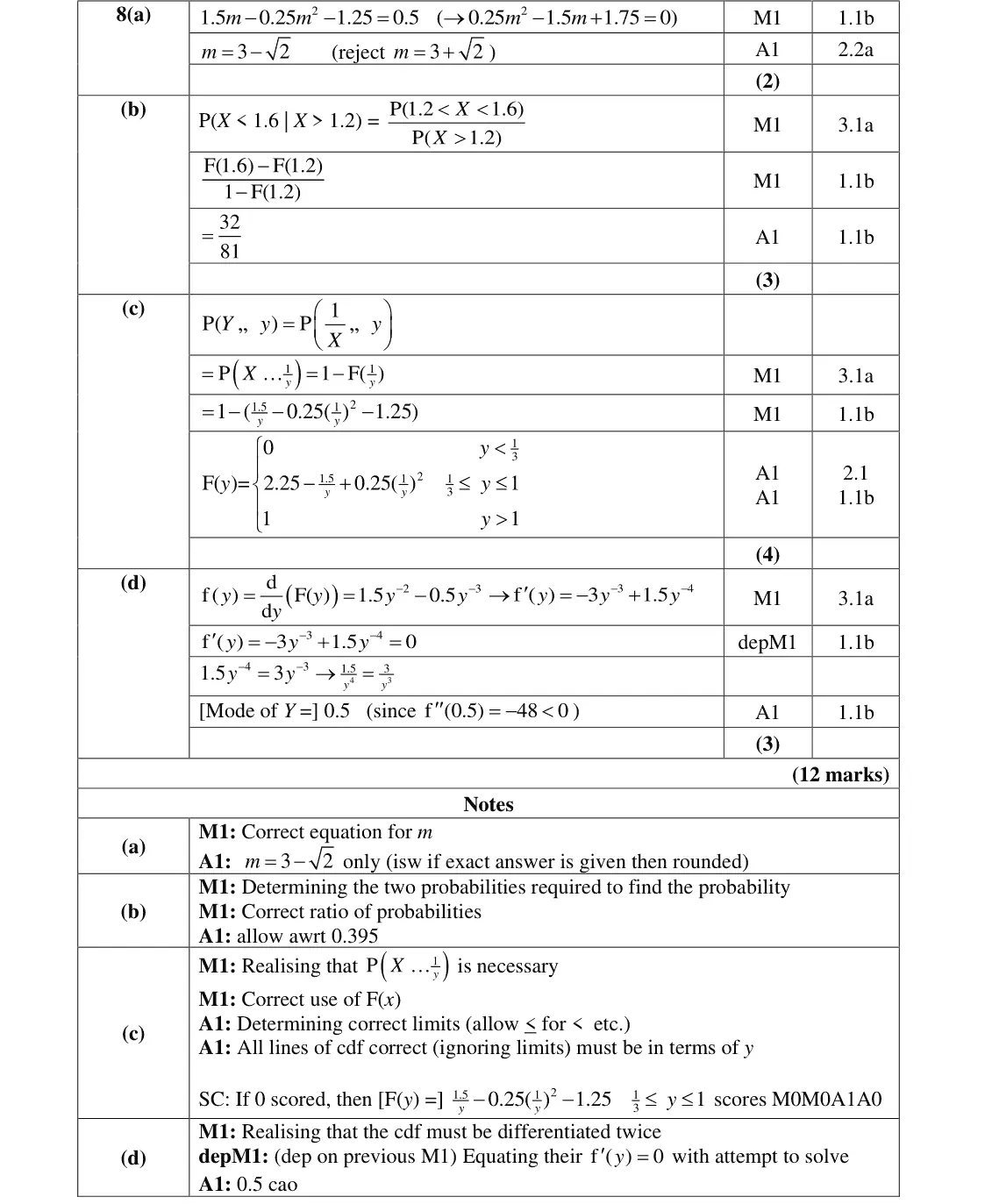
June 2022 · Paper 4B (Further Statistics 2) · Q8(d)3 marks
Mark scheme (whole question; this part is marked with the orange bar)
Examiner's comment
In the final part of the question (d) candidates should have realised the need to differentiate twice to see if there were any maximum turning points in the range. Some were able to make progress here despite the difficulty in (c) and marks were still available for those who
Key points from the mark scheme and examiner's report
Nov 2021 · Paper 4B (Further Statistics 2) · Q3(c)3 marks
Mark scheme (whole question; this part is marked with the orange bar)
Key points from the mark scheme and examiner's report
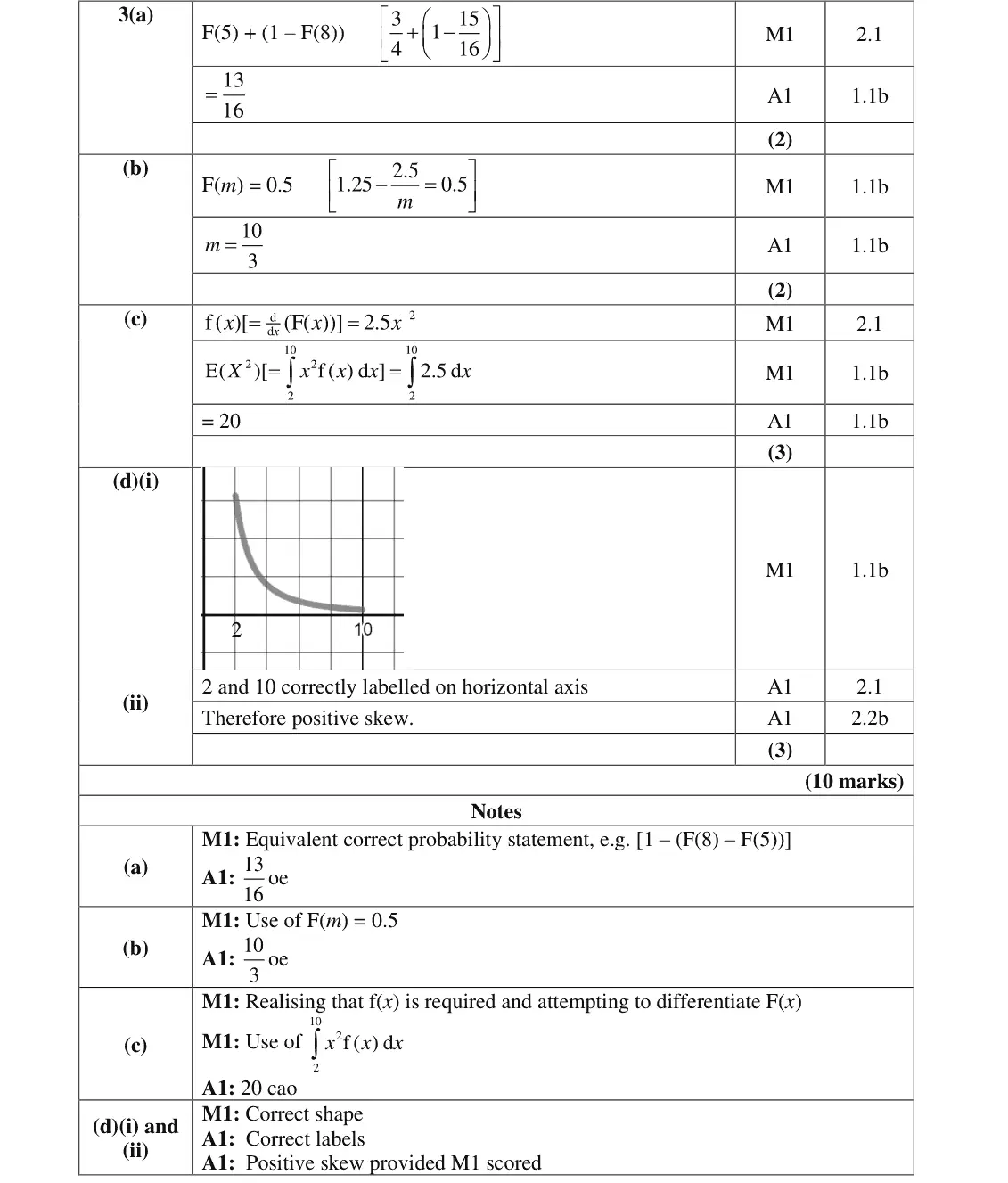
differentiate F: f(x) = 2.5x⁻² on [2, 10]
E(X²) = ∫x² f(x) dx = ∫2.5 dx = 20
Nov 2021 · Paper 4B (Further Statistics 2) · Q3(d)3 marks
Mark scheme (whole question; this part is marked with the orange bar)
Key points from the mark scheme and examiner's report
decreasing curve 2.5/x² from x = 2 to x = 10, with 2 and 10 labelled
positive skew
Oct 2020 · AS Paper 2 (Further Statistics 2) · Q3(b)6 marks
Mark scheme (whole question; this part is marked with the orange bar)
Key points from the mark scheme and examiner's report
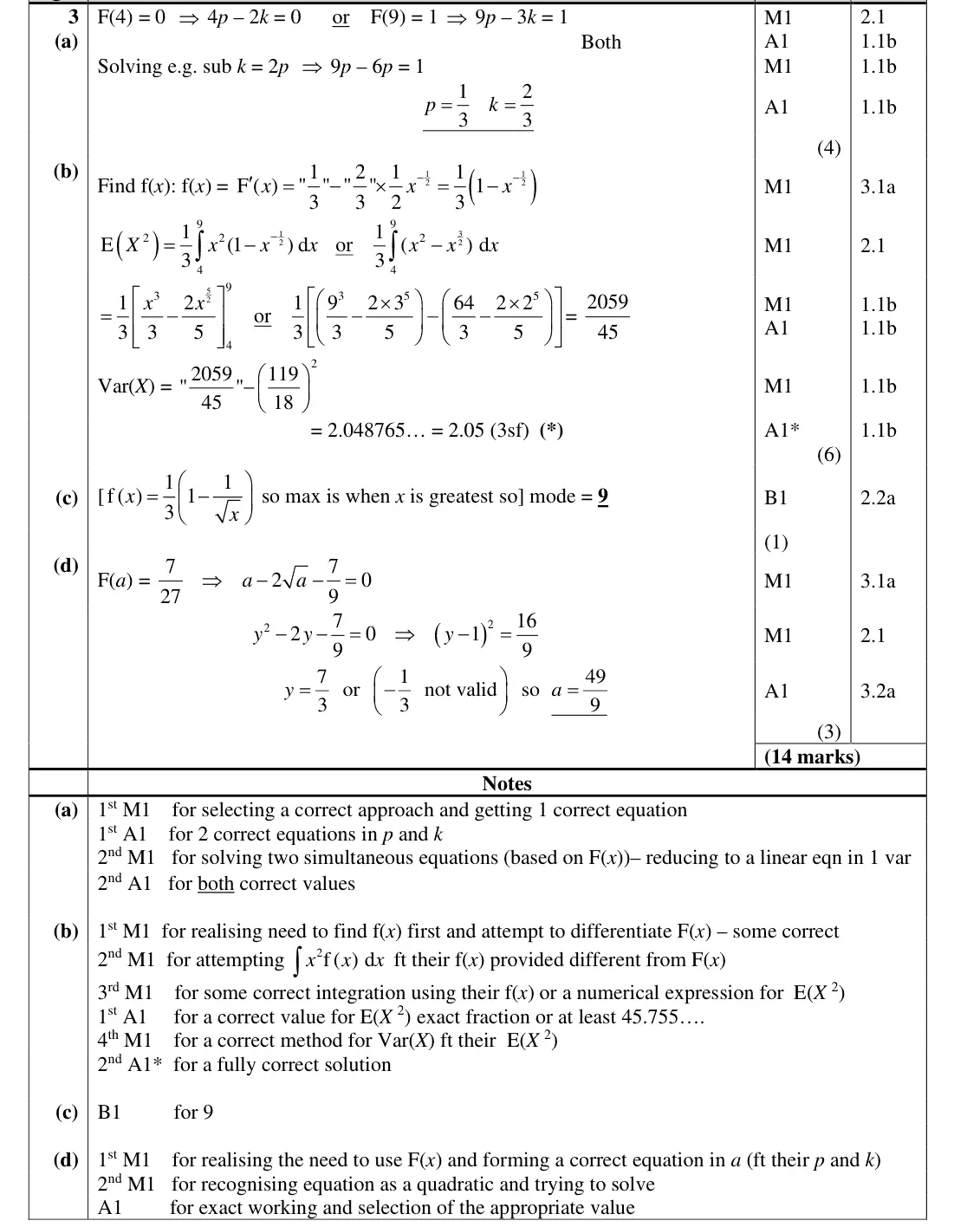
differentiate F first: f(x) = (1/3)(1 − x^(−1/2))
E(X²) = 2059/45
Var(X) = 2059/45 − (119/18)² = 2.0488 = 2.05
Oct 2020 · AS Paper 2 (Further Statistics 2) · Q3(c)1 mark
Mark scheme (whole question; this part is marked with the orange bar)
Key points from the mark scheme and examiner's report
f(x) is increasing on [4, 9] so the mode is 9
June 2019 · AS Paper 2 (Further Statistics 2) · Q2(a)2 marks
Mark scheme (whole question; this part is marked with the orange bar)
Examiner's comment
In Q2 the majority of candidates were able to gain the marks in parts (a), (b), and (c). part (d) discriminated the most able candidates on this paper as it was uncommon to see full marks being scored here. Many candidates were unable to translate the mathematical problem into an equation they could solve. Those who were able to form an equation were then able to produce a fully correct solution.
Key points from the mark scheme and examiner's report
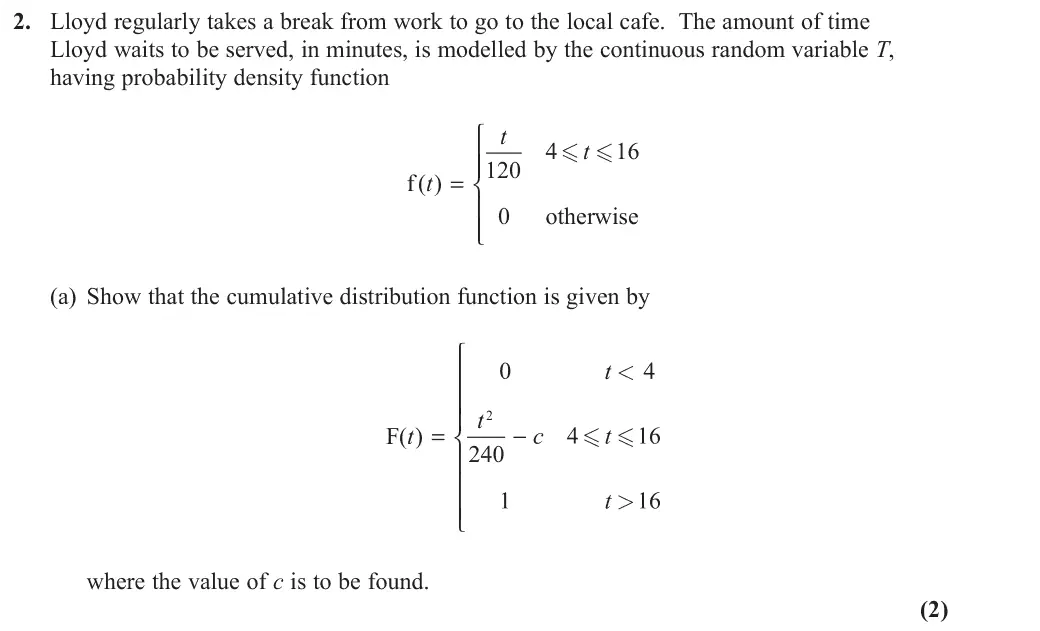
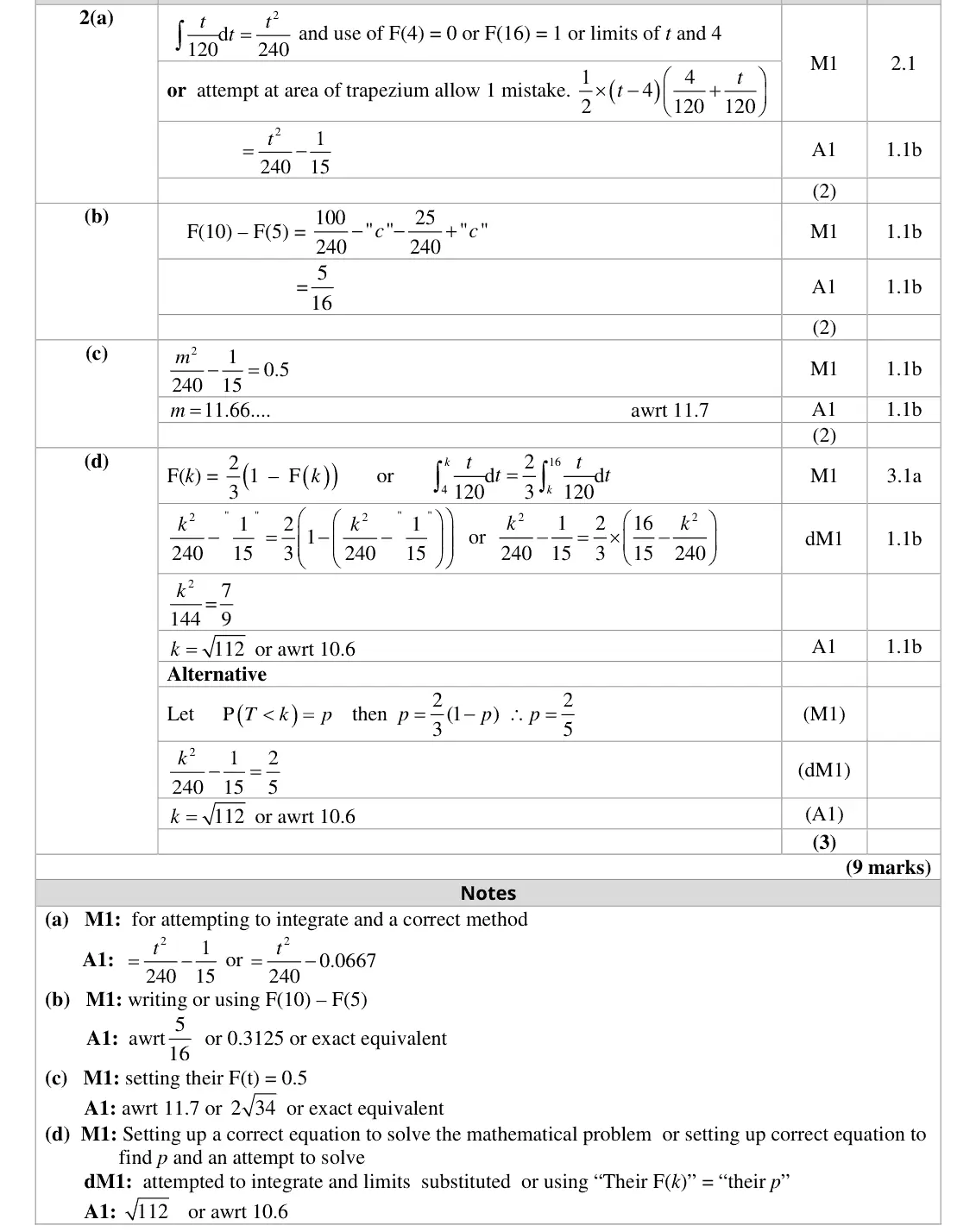
integrate t/120 to t²/240 and use F(4) = 0 or F(16) = 1
c = 1/15
June 2019 · Paper 4B (Further Statistics 2) · Q4(b)6 marks
Mark scheme (whole question; this part is marked with the orange bar)
Examiner's comment
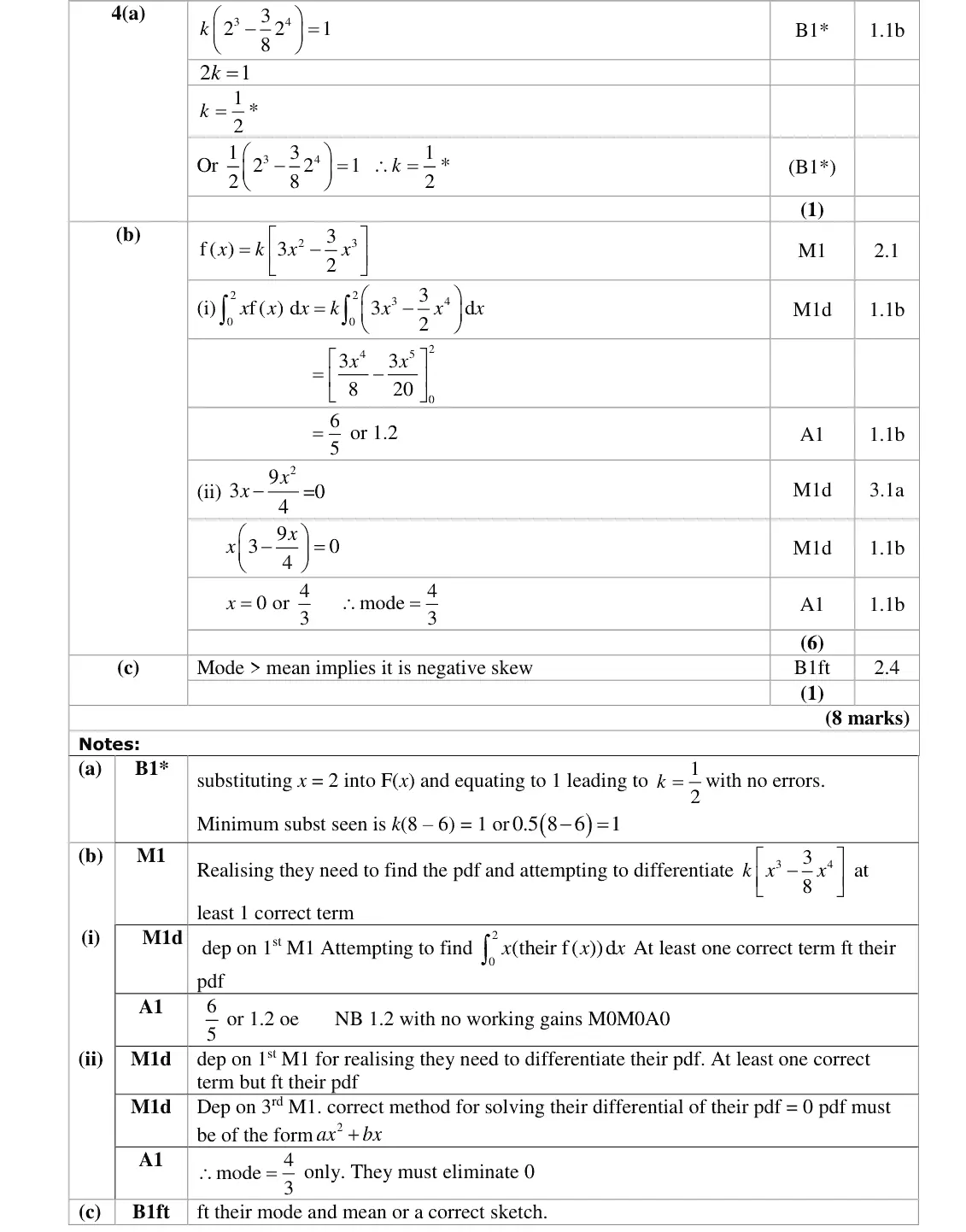
This question was another good source of marks for the candidates with many able to gain the mark in part (a). In part (b) the majority of candidates realised that they needed to find f(x) 2 0 f( ) d x x x first and used this to find in part (i). A minority of candidates ignored the demand, given in the question, to show working and use calculus and gave an incomplete method or just wrote and answer of 1.2 resulting in a loss of marks. 2 0 F( ) d x x x The demand was given as also gives an answer of 1.2 In (ii) candidates who had found f(x) knew what was required and went on to find the mode correctly. Part (b) was well answered. Candidates clearly knew the rules for identifying the type of skewness of a distribution.
Key points from the mark scheme and examiner's report
differentiate F to get f(x) = ½(3x² − 1.5x³)
E(X) = ∫x f(x) dx = 6/5
mode from f′(x) = 0 gives 4/3 (reject 0)
1.2 with no calculus working scores 0
Find an Edexcel Further Maths tutor
Stuck on this? Book a trial lesson with our Further Maths tutor.