June 2025 · AS Paper 2 (Further Statistics 2) · Q2(a)1 mark
Mark scheme (whole question; this part is marked with the orange bar)
Examiner's comment
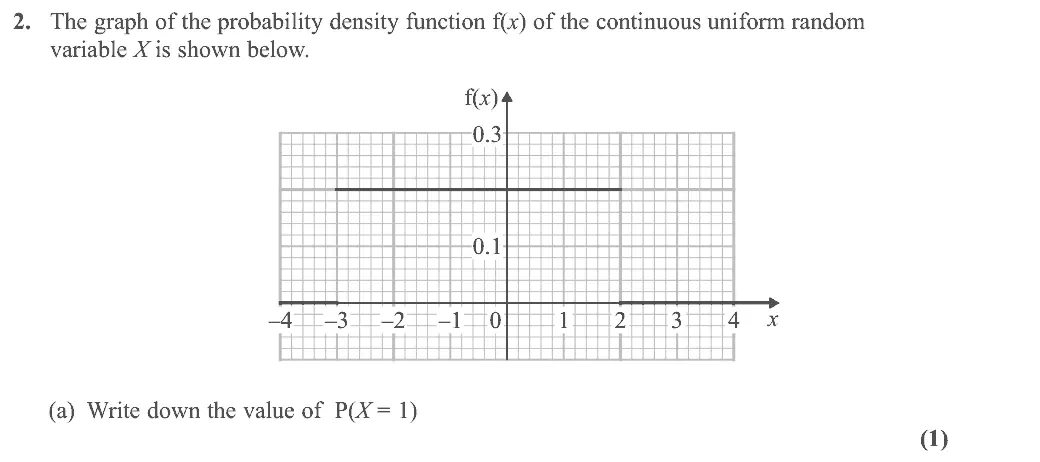
Whilst many gave the correct answer to part (a) there were a number who thought the answer was 0.2 instead. However the calculation of the mean was answered very well and many also went on to find the correct value for Var(X) as well. In part (c) most learners drew a straight
Key points from the mark scheme and examiner's report
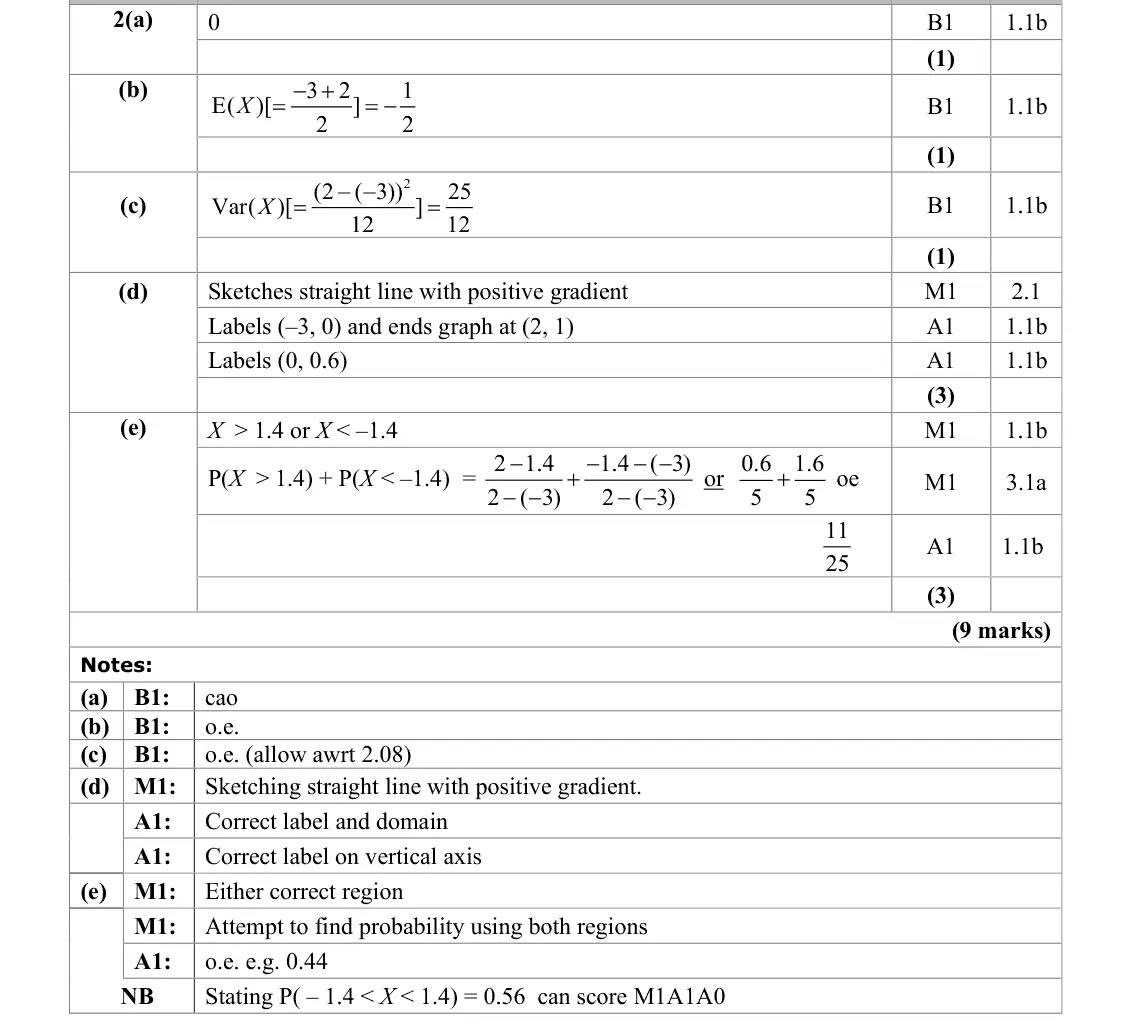
P(X = 1) = 0 for a continuous random variable
0.2 (reading the pdf height) a common wrong answer
June 2025 · AS Paper 2 (Further Statistics 2) · Q2(b)1 mark
Mark scheme (whole question; this part is marked with the orange bar)
Examiner's comment
Whilst many gave the correct answer to part (a) there were a number who thought the answer was 0.2 instead. However the calculation of the mean was answered very well and many also went on to find the correct value for Var(X) as well. In part (c) most learners drew a straight line and usually this had a positive gradient though some started below the x-axis and some passed through the origin. Those who had a more promising line usually labelled the point ( – 3, 0) but many failed to label the end point (2, 1) but the intersection with the vertical axis was often given correctly. Part (d) proved more challenging and a common response from those who attempted it was simply to find P(X > 1.4). Those who did consider the negative square root often went on to find the correct probability but some found P( – 1.4 < X < 1.4) = 0.56 instead.
Key points from the mark scheme and examiner's report
X ~ U[−3, 2] from the graph: E(X) = −1/2
June 2025 · AS Paper 2 (Further Statistics 2) · Q2(c)1 mark
Mark scheme (whole question; this part is marked with the orange bar)
Examiner's comment
went on to find the correct value for Var(X) as well. In part (c) most learners drew a straight line and usually this had a positive gradient though some started below the x-axis and some passed through the origin. Those who had a more promising line usually labelled the point ( – 3, 0) but many failed to label the end point (2, 1) but the intersection with the vertical axis was often given correctly. Part (d) proved more challenging and a common response from
Key points from the mark scheme and examiner's report
Var(X) = (2 − (−3))²/12 = 25/12
June 2025 · AS Paper 2 (Further Statistics 2) · Q2(d)3 marks
Mark scheme (whole question; this part is marked with the orange bar)
Examiner's comment
was often given correctly. Part (d) proved more challenging and a common response from those who attempted it was simply to find P(X > 1.4). Those who did consider the negative square root often went on to find the correct probability but some found P( – 1.4 < X < 1.4) = 0.56 instead.
Key points from the mark scheme and examiner's report
straight line with positive gradient from (−3, 0) to (2, 1), crossing the vertical axis at (0, 0.6)
end point (2, 1) often unlabelled
some lines started below the axis or went through O
June 2025 · AS Paper 2 (Further Statistics 2) · Q2(e)3 marks
Mark scheme (whole question; this part is marked with the orange bar)
Examiner's comment
Whilst many gave the correct answer to part (a) there were a number who thought the answer was 0.2 instead. However the calculation of the mean was answered very well and many also went on to find the correct value for Var(X) as well. In part (c) most learners drew a straight line and usually this had a positive gradient though some started below the x-axis and some passed through the origin. Those who had a more promising line usually labelled the point ( – 3, 0) but many failed to label the end point (2, 1) but the intersection with the vertical axis was often given correctly. Part (d) proved more challenging and a common response from those who attempted it was simply to find P(X > 1.4). Those who did consider the negative square root often went on to find the correct probability but some found P( – 1.4 < X < 1.4) = 0.56 instead.
Key points from the mark scheme and examiner's report
X² > 1.96 means X > 1.4 OR X < −1.4: 0.6/5 + 1.6/5 = 11/25
common errors: only X > 1.4, or P(−1.4 < X < 1.4) = 0.56
June 2025 · Paper 4B (Further Statistics 2) · Q5(a)3 marks
Mark scheme (whole question; this part is marked with the orange bar)
Examiner's comment
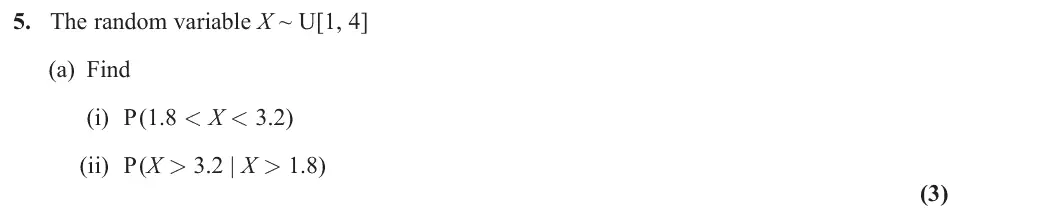
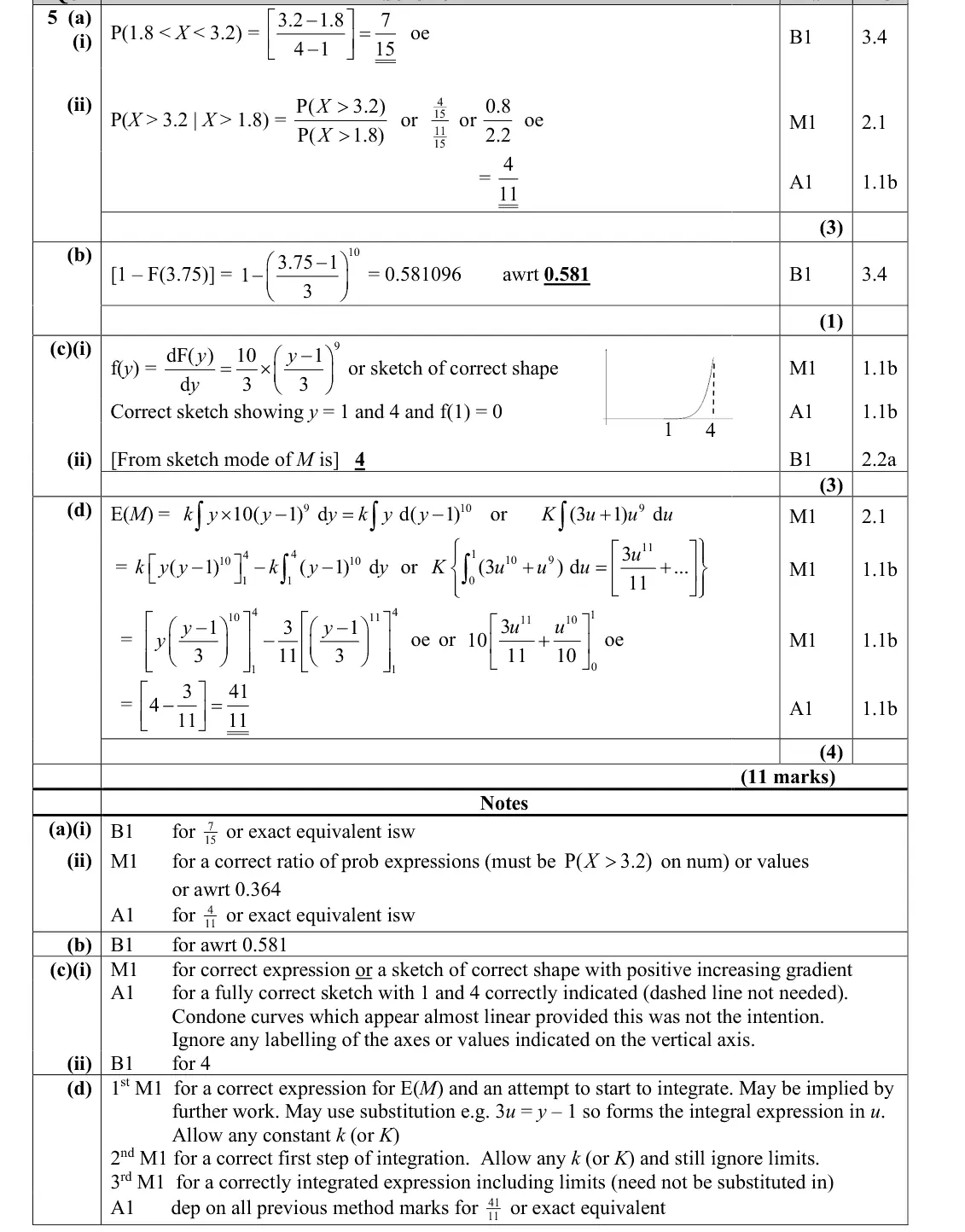
This question tested continuous random variables and candidates were usually able to make good progress in most of the parts. Part (a) required candidates to find probabilities using a uniform distribution. Usually candidates were able to score full marks, although some candidates did not give the exact values, whilst some struggled to find the required interval in (a)(ii) which involved conditional probability.
Key points from the mark scheme and examiner's report
(i) 1.4/3 = 7/15
(ii) P(X > 3.2)/P(X > 1.8) = 0.8/2.2 = 4/11
June 2024 · AS Paper 2 (Further Statistics 2) · Q4(a)1 mark
Mark scheme (whole question; this part is marked with the orange bar)
Examiner's comment
Almost all students gave the correct value for E(X) in part (a) but many didn’t spot that in part
Key points from the mark scheme and examiner's report
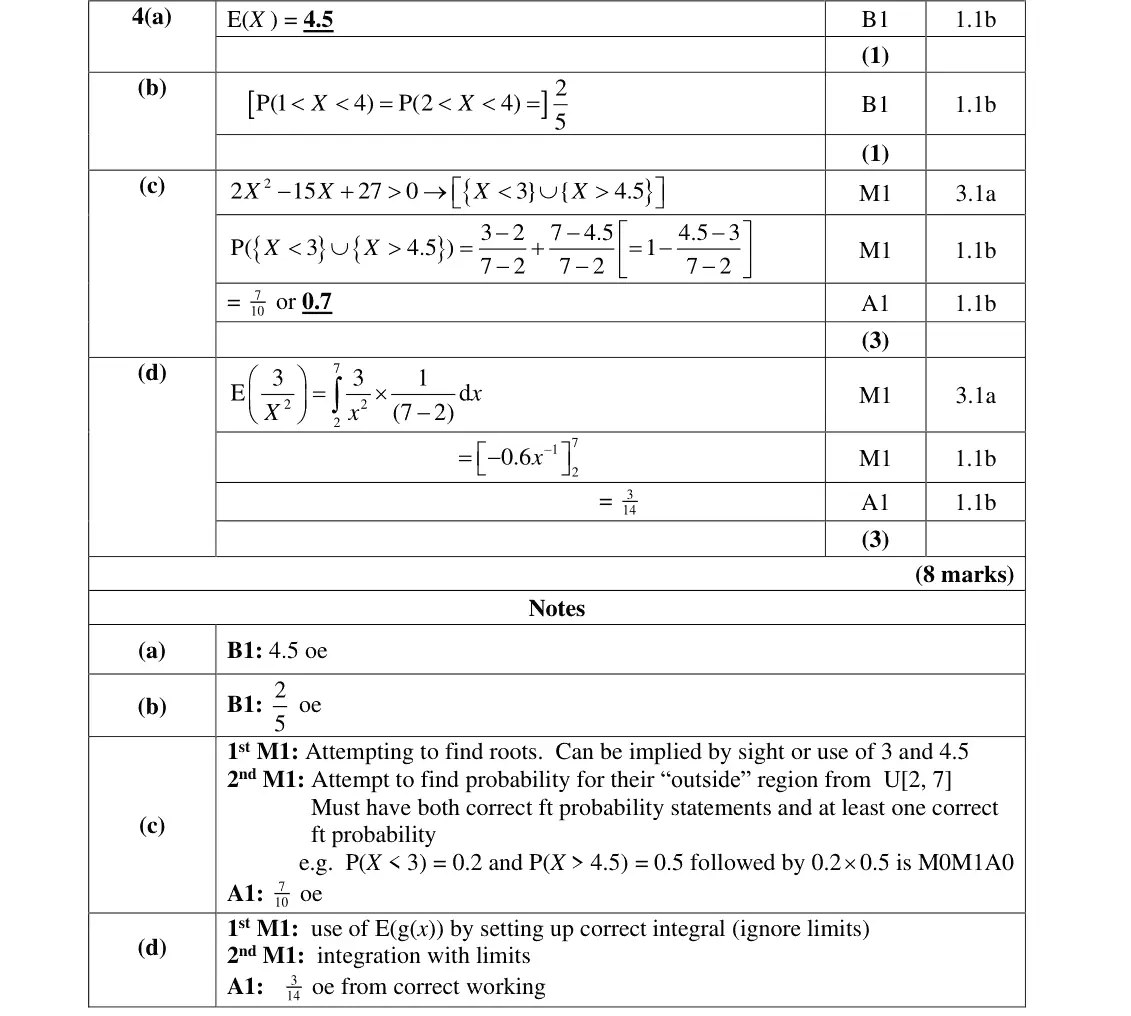
E(X) = (2 + 7)/2 = 4.5
June 2024 · AS Paper 2 (Further Statistics 2) · Q4(b)1 mark
Mark scheme (whole question; this part is marked with the orange bar)
Examiner's comment
(b) P (1 < X < 4) = P(2 < X < 4) and there were a number of incorrect answers of 0.6
Key points from the mark scheme and examiner's report
X cannot be below 2: P(2 < X < 4) = 2/5
0.6 a common wrong answer
June 2024 · AS Paper 2 (Further Statistics 2) · Q4(c)3 marks
Mark scheme (whole question; this part is marked with the orange bar)
Examiner's comment
In part (c) most were able to find the correct critical values of 3 and 4.5 and many realised that the “outside” region was required. There were several errors in finding the two probabilities and a couple of students had the correct values of 0.2 and 0.5 but then multiplied them together rather than adding them.
Key points from the mark scheme and examiner's report
roots 3 and 4.5
need X < 3 or X > 4.5: 0.2 + 0.5 = 0.7
some multiplied 0.2 × 0.5
June 2024 · AS Paper 2 (Further Statistics 2) · Q4(d)3 marks
Mark scheme (whole question; this part is marked with the orange bar)
Examiner's comment
Part (d) was more challenging, and many did not appreciate that this was a case of finding 3 and some interesting attempts at E(g(X)). There were the inevitable attempts to find ( ) 2 E X based on ( ) 2 2 2 7 + finding ( ) 2 which was presumably a variation of the formula for E(X). E X 2 There were a good number of correct solutions though that safely arrived at the correct answer.
Key points from the mark scheme and examiner's report
E(g(X)) = ∫ (3/x²)(1/5) dx from 2 to 7 = 3/14
not 3/E(X²) or 3/E(X)²
June 2024 · Paper 4B (Further Statistics 2) · Q4(a)1 mark
Mark scheme (whole question; this part is marked with the orange bar)
Examiner's comment
This question tested the continuous uniform distribution and an application of this to solve a geometrical problem using the expected value function. Parts (a) and (b) were generally answered correctly, although a few candidates made lots of work for themselves by using integration rather than the standard formulae for the uniform distribution. Only arithmetical slips typically prevented candidates scoring the first four marks on this question.
Key points from the mark scheme and examiner's report
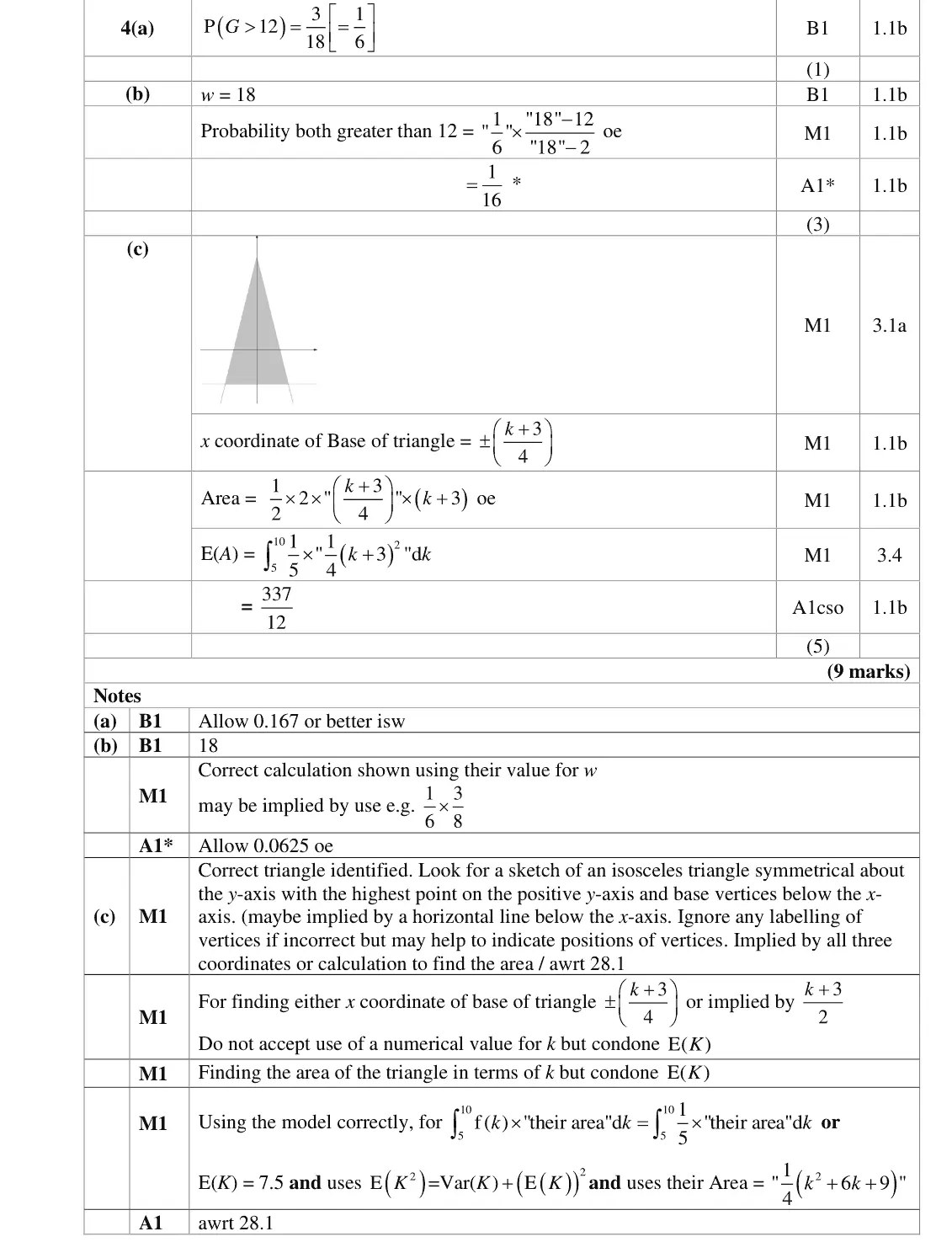
P(G > 12) = 3/18 = 1/6
June 2024 · Paper 4B (Further Statistics 2) · Q4(b)3 marks
Mark scheme (whole question; this part is marked with the orange bar)
Examiner's comment
This question tested the continuous uniform distribution and an application of this to solve a geometrical problem using the expected value function. Parts (a) and (b) were generally answered correctly, although a few candidates made lots of work for themselves by using integration rather than the standard formulae for the uniform distribution. Only arithmetical slips typically prevented candidates scoring the first four marks on this question.
Key points from the mark scheme and examiner's report
E(H) = (2 + w)/2 = 10 so w = 18
P(H > 12) = 6/16
independence: (1/6)(3/8) = 1/16
use standard uniform results rather than integration
June 2024 · Paper 4B (Further Statistics 2) · Q4(c)5 marks
Mark scheme (whole question; this part is marked with the orange bar)
Examiner's comment
This question tested the continuous uniform distribution and an application of this to solve a geometrical problem using the expected value function. A number of candidates made little progress on part (c) because they worked with a particular value of K, usually E(K), seeming to make the underlying assumption that the expectation of the area would correspond to when E( ) k K = . Those who drew a clear correct diagram at the start were usually able to earn a number of marks. Integration to find the expectation was generally preferred by candidates, though those who used expectation algebra were just as successful. Those who opted to integrate sometimes omitted the 1 5 , whilst those who were using expectation algebra sometimes just squared E( ) K rather than working with Var( ) K to find the appropriate value for 2 E( ) K .
Key points from the mark scheme and examiner's report
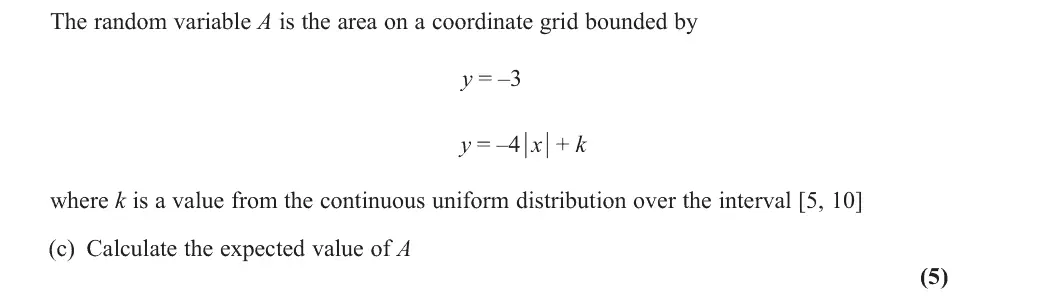
sketch: isosceles triangle with apex (0, k) and base on y = −3 from x = −(k + 3)/4 to (k + 3)/4
area (k + 3)²/4
E(A) = ∫(1/5)(k + 3)²/4 dk from 5 to 10 = 337/12 = 28.1
using area at E(K) = 7.5 is wrong
via expectation need E(K²) = Var(K) + E(K)²
June 2023 · AS Paper 2 (Further Statistics 2) · Q4(a)3 marks
Mark scheme (whole question; this part is marked with the orange bar)
Examiner's comment
1 - = P( 3 2) X In part (a) many identified that they should be considering but even 3 those who missed this were able to demonstrate that they could use the uniform distribution to form a suitable equation for k. In part (b) most could see how to start
Key points from the mark scheme and examiner's report
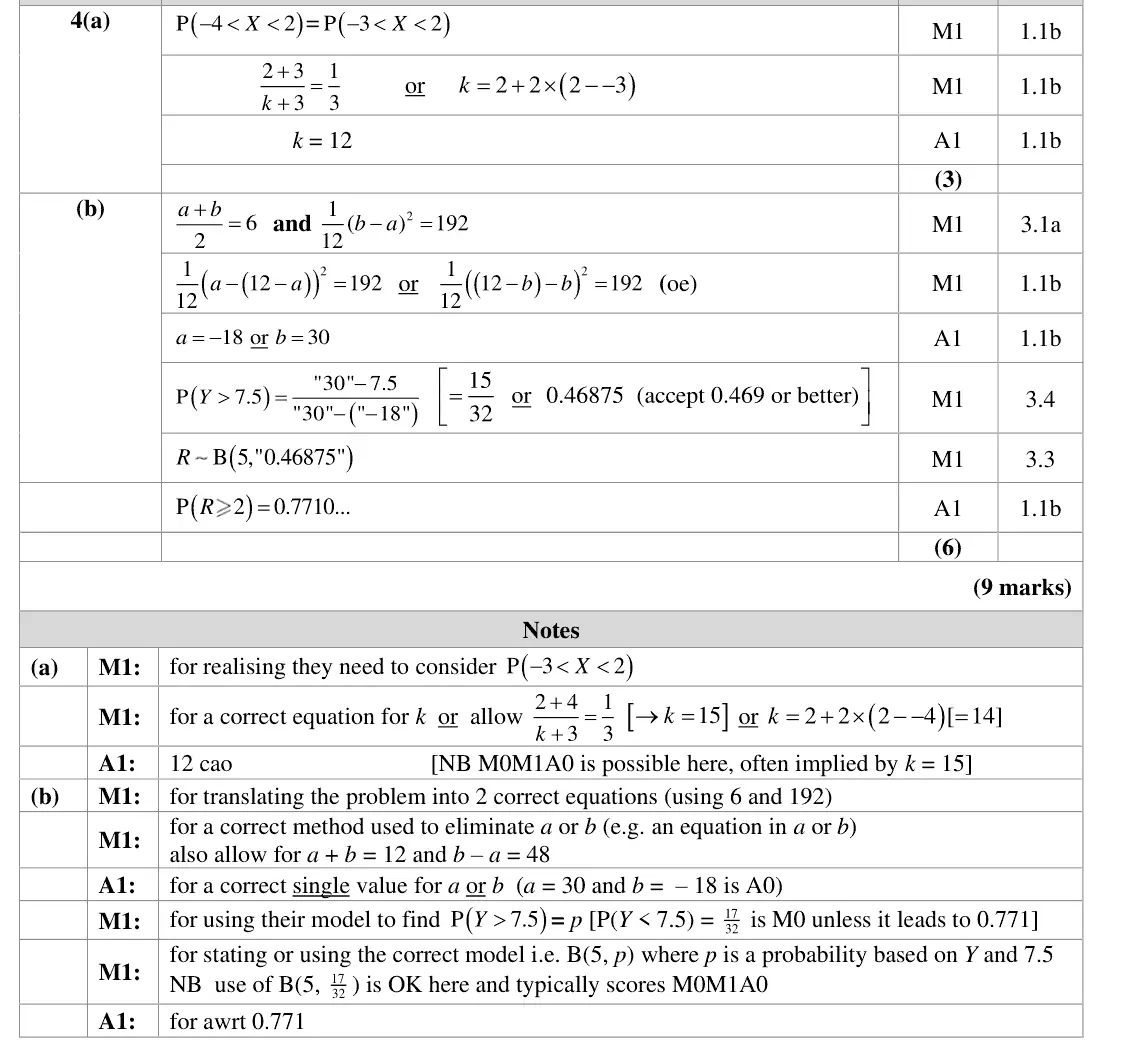
X cannot be below −3, so P(−4 < X < 2) = P(−3 < X < 2) = 5/(k + 3) = 1/3, k = 12
using −4 gives k = 15
June 2023 · AS Paper 2 (Further Statistics 2) · Q4(b)6 marks
Mark scheme (whole question; this part is marked with the orange bar)
Examiner's comment
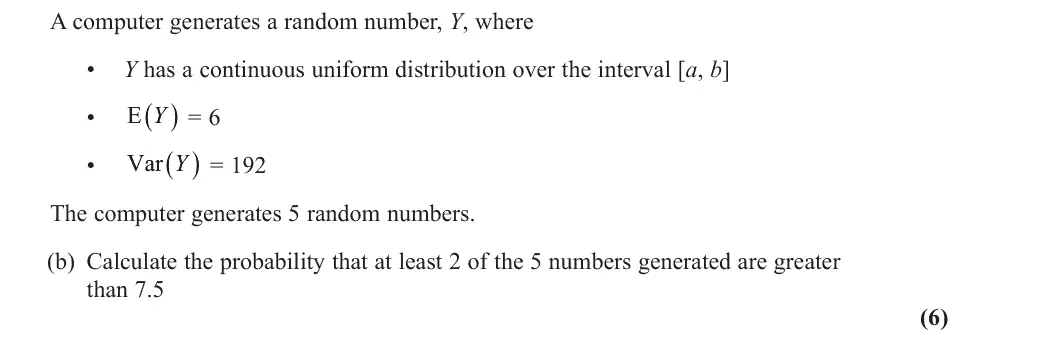
distribution to form a suitable equation for k. In part (b) most could see how to start and wrote down two correct equations for a and b using the given values for E(X) and Var(X). Usually these were solved successfully to obtain the correct values for a and b. Several students stopped at this point, but a good number went on to try and use their values to find P(Y > 7.5). There seemed to be some confusion about which “end” of the distribution to use and several students found P(Y < 7.5) instead. This error is like the mistake highlighted in question 2(b). Some of those who got this far stopped at this point, but a few went on to use a suitable binomial model and those with the correct probability for P(Y > 7.5) usually obtained the correct answer.
Key points from the mark scheme and examiner's report
(a + b)/2 = 6 and (b − a)²/12 = 192 give a = −18, b = 30
P(Y > 7.5) = 15/32
number above 7.5 ~ B(5, 15/32), P(at least 2) = 0.771
several stopped at a and b or used P(Y < 7.5)
June 2023 · Paper 4B (Further Statistics 2) · Q7(a)1 mark
Mark scheme (whole question; this part is marked with the orange bar)
Examiner's comment
the mark in (a) by failing to state a domain for their pdf or by using inconsistent notation.
Key points from the mark scheme and examiner's report
f(r) = 1/8 for 2 ≤ r ≤ 10, 0 otherwise
the domain is needed
June 2023 · Paper 4B (Further Statistics 2) · Q7(b)4 marks
Mark scheme (whole question; this part is marked with the orange bar)
Examiner's comment
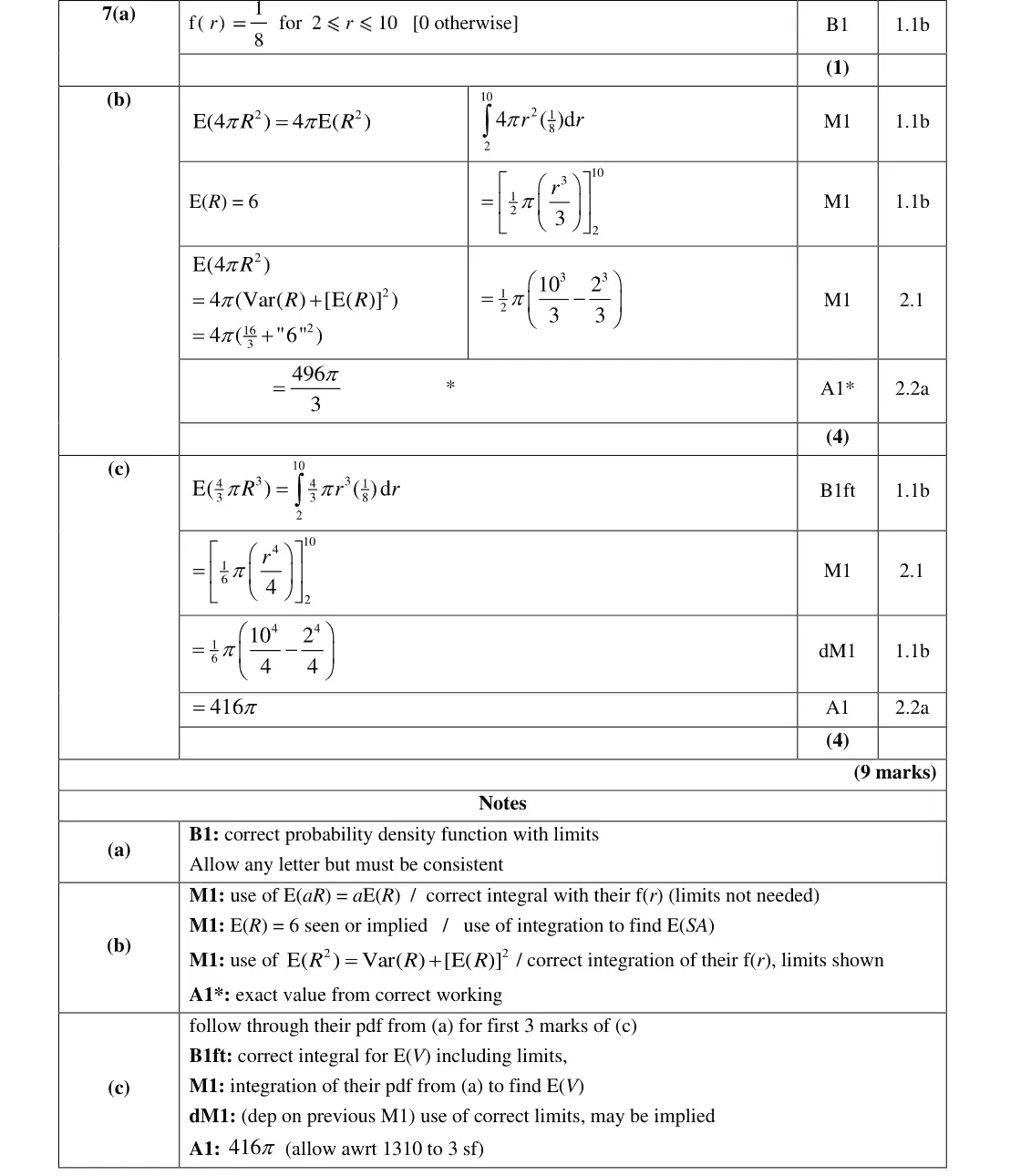
As in the previous part (b), most candidates showed an understanding of pdfs, but with many missing the mark in (a) by failing to state a domain for their pdf or by using inconsistent notation. Part (b) allowed two separate approaches. Candidates perhaps chose the integration approach most often, though it seemed the expectation approach was perhaps executed correctly more often.
Key points from the mark scheme and examiner's report
E(4πR²) = 4π(Var(R) + E(R)²) = 4π(16/3 + 36), or ∫4πr²(1/8)dr from 2 to 10
= 496π/3
June 2023 · Paper 4B (Further Statistics 2) · Q7(c)4 marks
Mark scheme (whole question; this part is marked with the orange bar)
Examiner's comment
Part (c) was more challenging, but a good number of candidates showed sufficient understanding to form a correct integral. Those that did this were usually able to go on to gain all the marks in (c). This question somewhat polarised the results. The more able candidates did not seem to be troubled by the question and went on to gain full marks much of the time. However, a good number of candidates showed quite superficial knowledge of this topic and often only scored a minimum number of marks out of those available.
Key points from the mark scheme and examiner's report
E(V) = ∫(4/3)πr³(1/8)dr from 2 to 10 = (π/6)(10⁴ − 2⁴)/4 = 416π
June 2022 · AS Paper 2 (Further Statistics 2) · Q5(a)1 mark
Mark scheme (whole question; this part is marked with the orange bar)
Examiner's comment
The final question also gave opportunity for the most able candidates to shine as part (c) of this question was the most difficult part of the paper. Although some attempts were made, correct solutions were rarely seen. Most completed part (a) successfully.
Key points from the mark scheme and examiner's report
P(T < 1) = 0.5/2 = 1/4
June 2022 · AS Paper 2 (Further Statistics 2) · Q5(b)3 marks
Mark scheme (whole question; this part is marked with the orange bar)
Examiner's comment
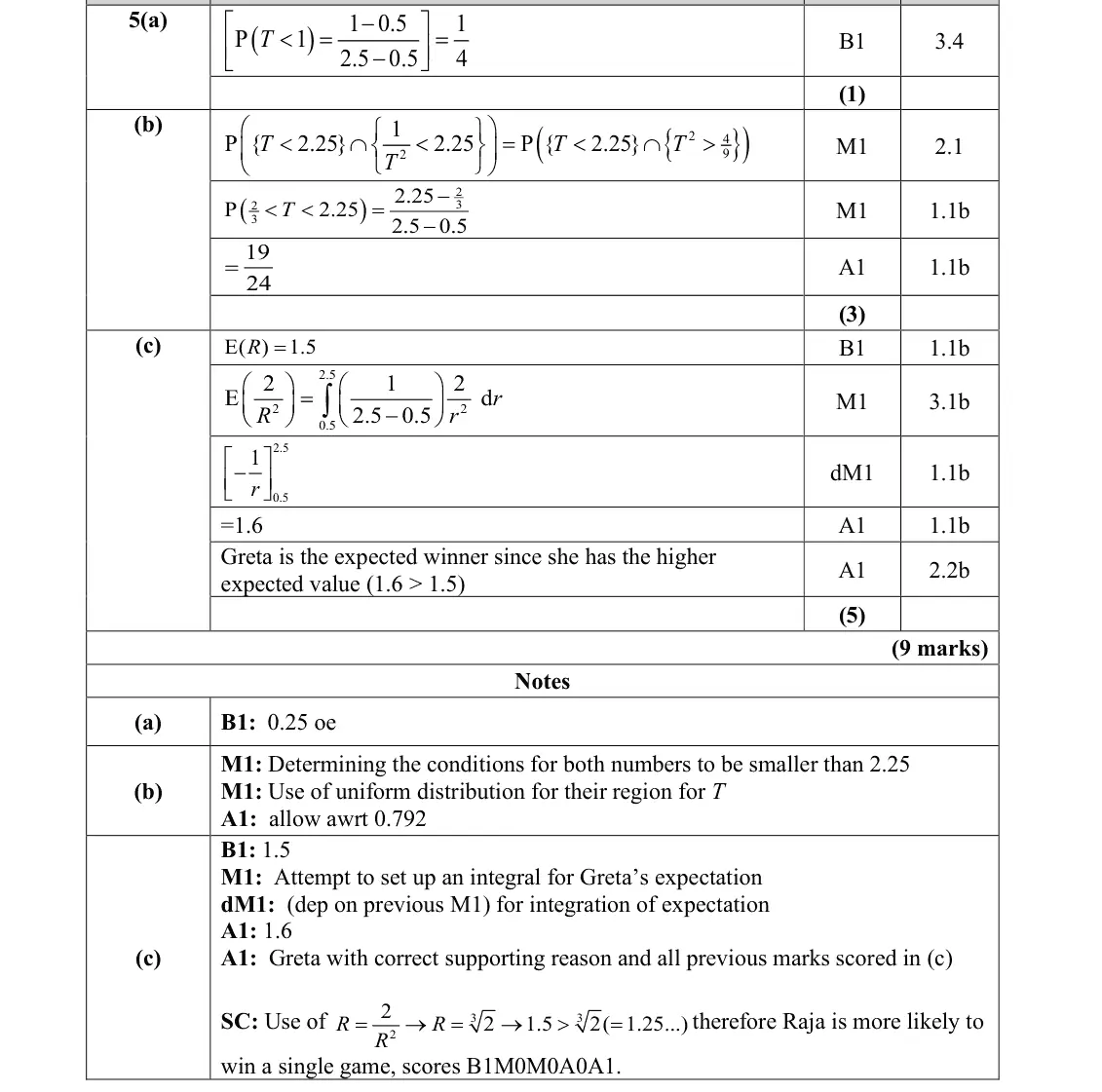
The final question also gave opportunity for the most able candidates to shine as part (c) of this question was the most difficult part of the paper. Although some attempts were made, correct solutions were rarely seen. In part (b), many did not understand that a single probability region was required. Of those actually identifying the critical values of T for the required probabilities, often, a product of P(T < 2.25) x P(T > 2/3) was attempted.
Key points from the mark scheme and examiner's report
M < 2.25 means T > 2/3, so need P(2/3 < T < 2.25) = 19/24 as one interval
common error multiplying P(T < 2.25) × P(T > 2/3)
June 2022 · AS Paper 2 (Further Statistics 2) · Q5(c)5 marks
Mark scheme (whole question; this part is marked with the orange bar)
Examiner's comment
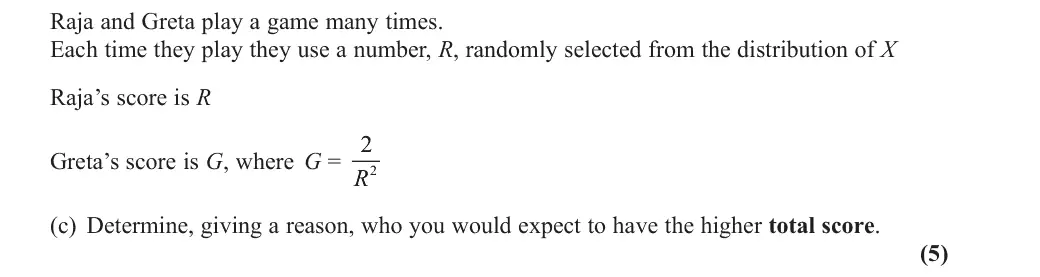
The final question also gave opportunity for the most able candidates to shine as part (c) of this question was the most difficult part of the paper. Although some attempts were made, correct solutions were rarely seen. Finally in part (c), although candidates were able to state E(R) = 1.5, the attempts at finding E(G) were generally poor. A common misconception was that ( ) 2 2 2 2 E E( ) R R = . Some responses concentrated on a single game’s score, rather than the expected total of the game in the long run. Although it was true that Raja was likely to score higher on a single game, the expected total shows that Greta is the expected winner of the game.
Key points from the mark scheme and examiner's report
compare expectations: E(R) = 1.5
E(2/R²) = ∫ (1/2)(2/r²) dr from 0.5 to 2.5 = 1.6, so Greta expects the higher total
E(2/R²) is not 2/E(R)²
single-game arguments get a special case only
hardest part of the paper
June 2022 · Paper 4B (Further Statistics 2) · Q77 marks
Mark scheme (whole question; this part is marked with the orange bar)
Examiner's comment
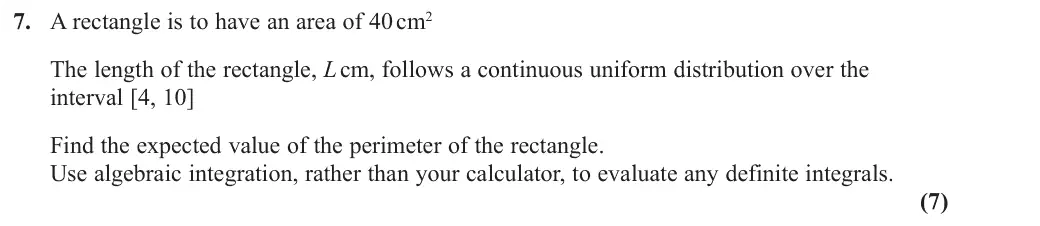
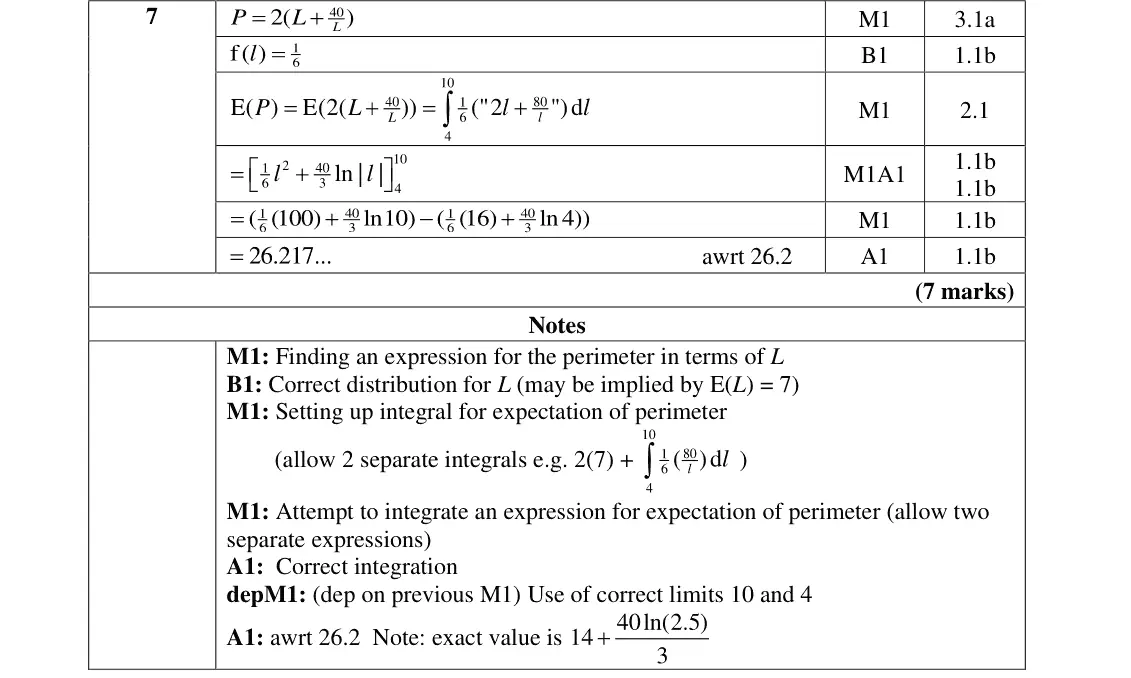
Another challenging question at this stage of the paper, but it was pleasing to see many correct responses. The question gave a big clue stating that integration must be shown – yet some candidates did not attempt any integration at all in their answers. Most recognised that 1 6 f( )l = and many went on to give a correct expression for the perimeter. A common error was to attempt to integrate the expression 80 (2 ) l l l + rather than 80 1 6 (2 ) l l + . Of those with a correct expression, the vast majority showed the correct integration with the substitution of limits in order to arrive at the correct answer.
Key points from the mark scheme and examiner's report
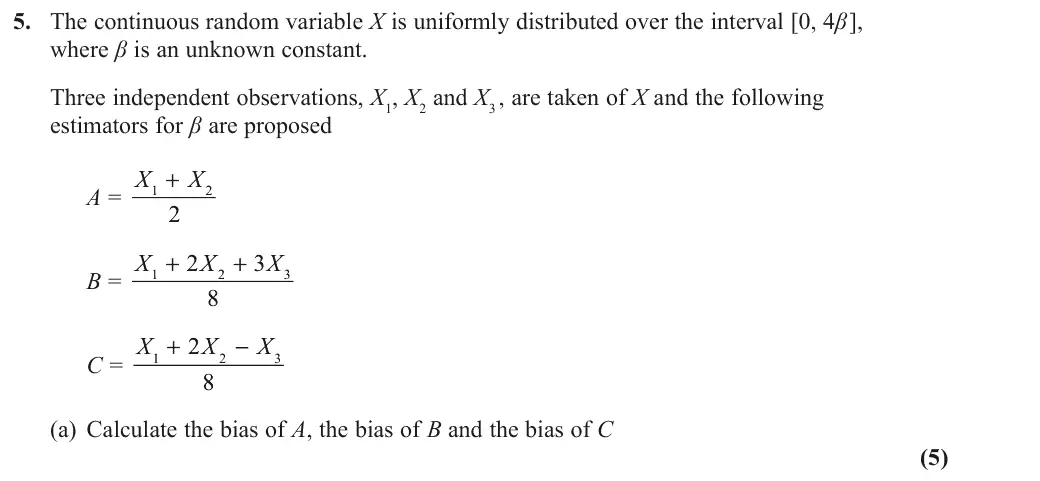
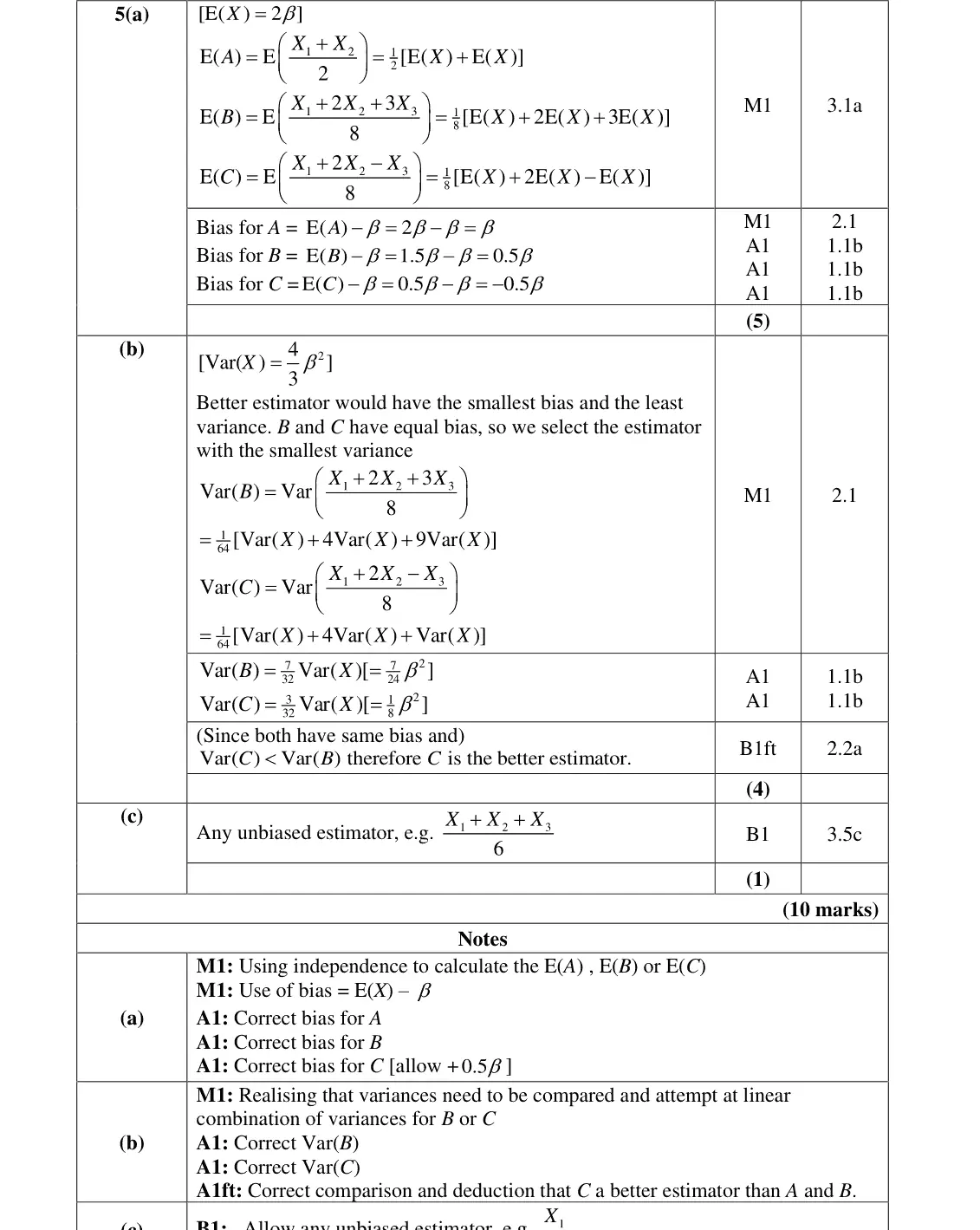
equal-sized bias so C (smaller variance) is better
coefficients are squared, so −X₃ adds variance
Oct 2020 · Paper 4B (Further Statistics 2) · Q8(a)3 marks
Mark scheme (whole question; this part is marked with the orange bar)
Key points from the mark scheme and examiner's report
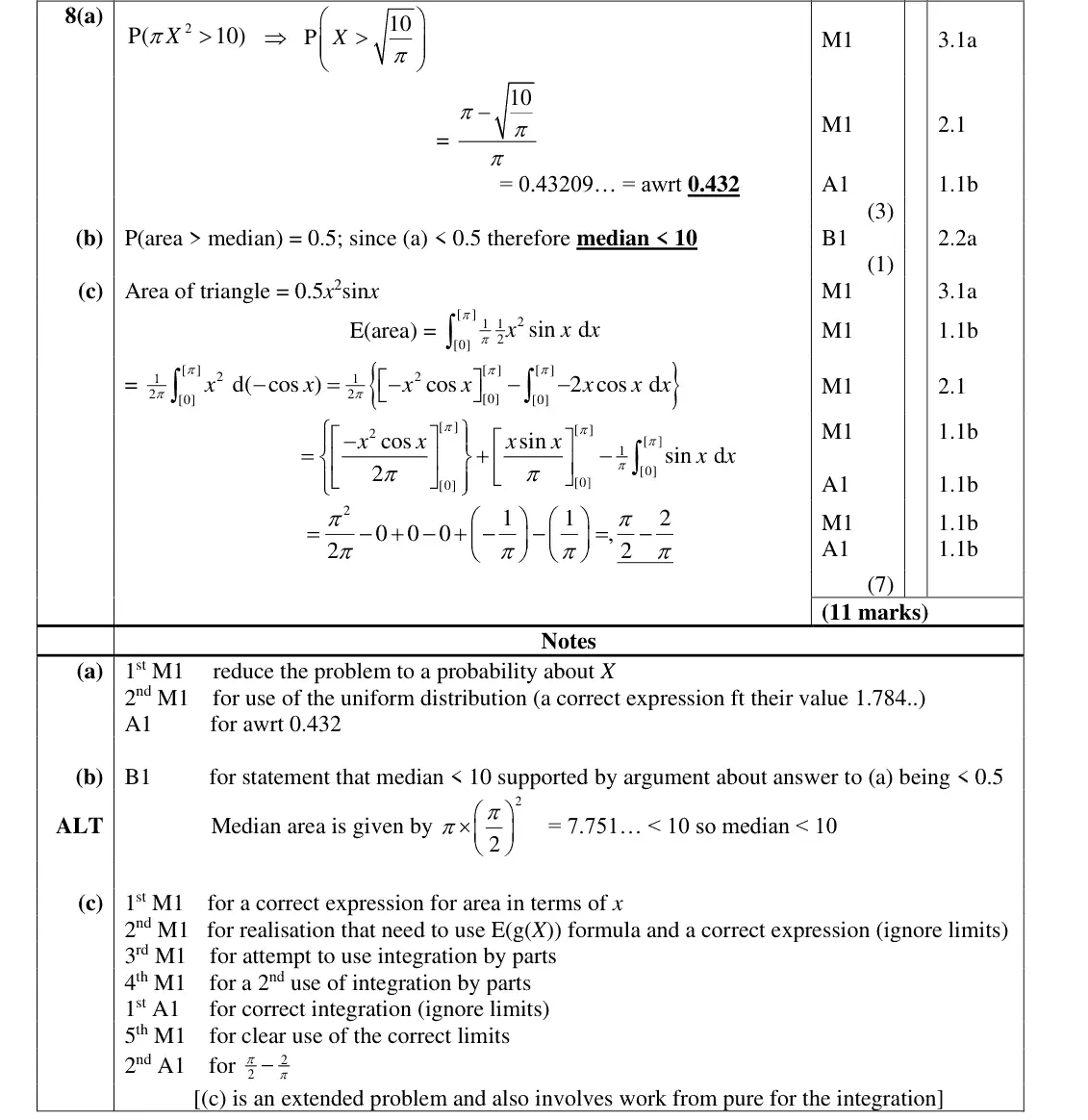
πX² > 10 gives X > √(10/π) = 1.784
P = (π − 1.784)/π = 0.432
Oct 2020 · Paper 4B (Further Statistics 2) · Q8(b)1 mark
Mark scheme (whole question; this part is marked with the orange bar)
Key points from the mark scheme and examiner's report
P(area > 10) < 0.5 so median area < 10 (or median area = π(π/2)² = 7.75)
Oct 2020 · Paper 4B (Further Statistics 2) · Q8(c)7 marks
Mark scheme (whole question; this part is marked with the orange bar)
Key points from the mark scheme and examiner's report
area = ½x² sin x
E(area) = (1/π)∫ ½x² sin x dx over [0, π], integration by parts twice
exact answer π/2 − 2/π
June 2019 · AS Paper 2 (Further Statistics 2) · Q4(a)3 marks
Mark scheme (whole question; this part is marked with the orange bar)
Examiner's comment
This question was well answered with many candidates gaining full marks. Of those candidates who did not gain full marks the most common error in part(a) was to forget that a – 5 could = – 9 and therefore did not give a reason for rejecting – 4 . In part (b)
Key points from the mark scheme and examiner's report
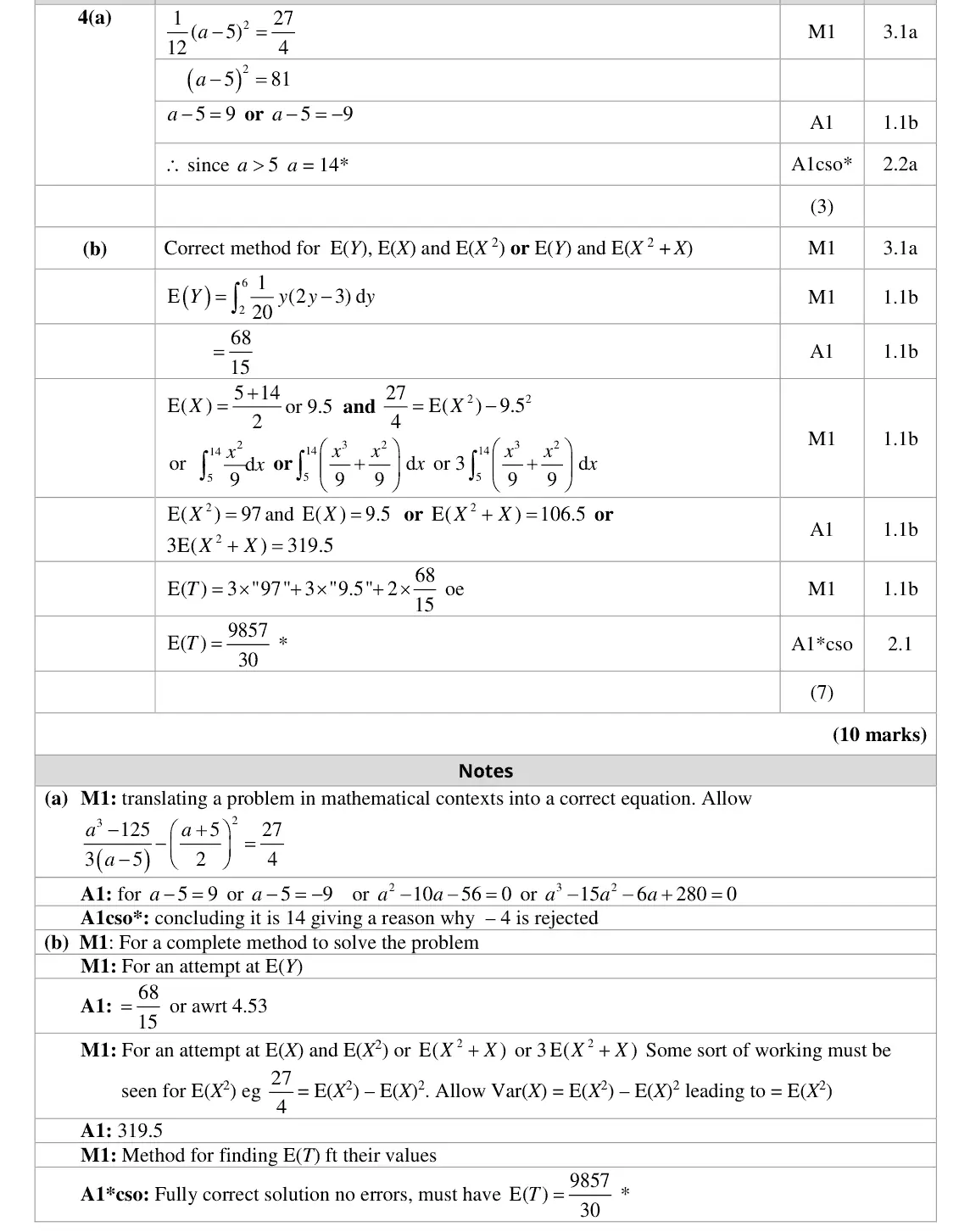
(a − 5)²/12 = 27/4, a − 5 = ±9
must reject a = −4 since a > 5 (often missed)
June 2019 · AS Paper 2 (Further Statistics 2) · Q4(b)7 marks
Mark scheme (whole question; this part is marked with the orange bar)
Examiner's comment
This question was well answered with many candidates gaining full marks. forget that a – 5 could = – 9 and therefore did not give a reason for rejecting – 4 . In part (b) the majority of candidates showed clear their methods with full working.
Key points from the mark scheme and examiner's report
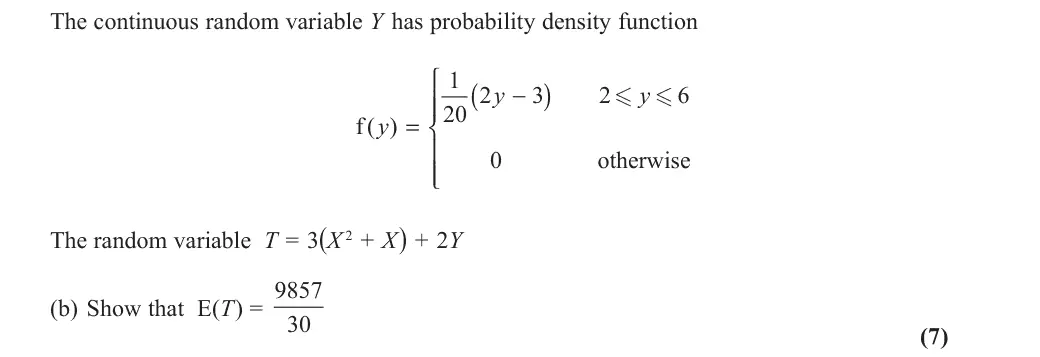
E(Y) = ∫ y f(y) dy = 68/15
E(X) = 9.5, E(X²) = Var(X) + E(X)² = 97
E(T) = 3(97) + 3(9.5) + 2(68/15) = 9857/30
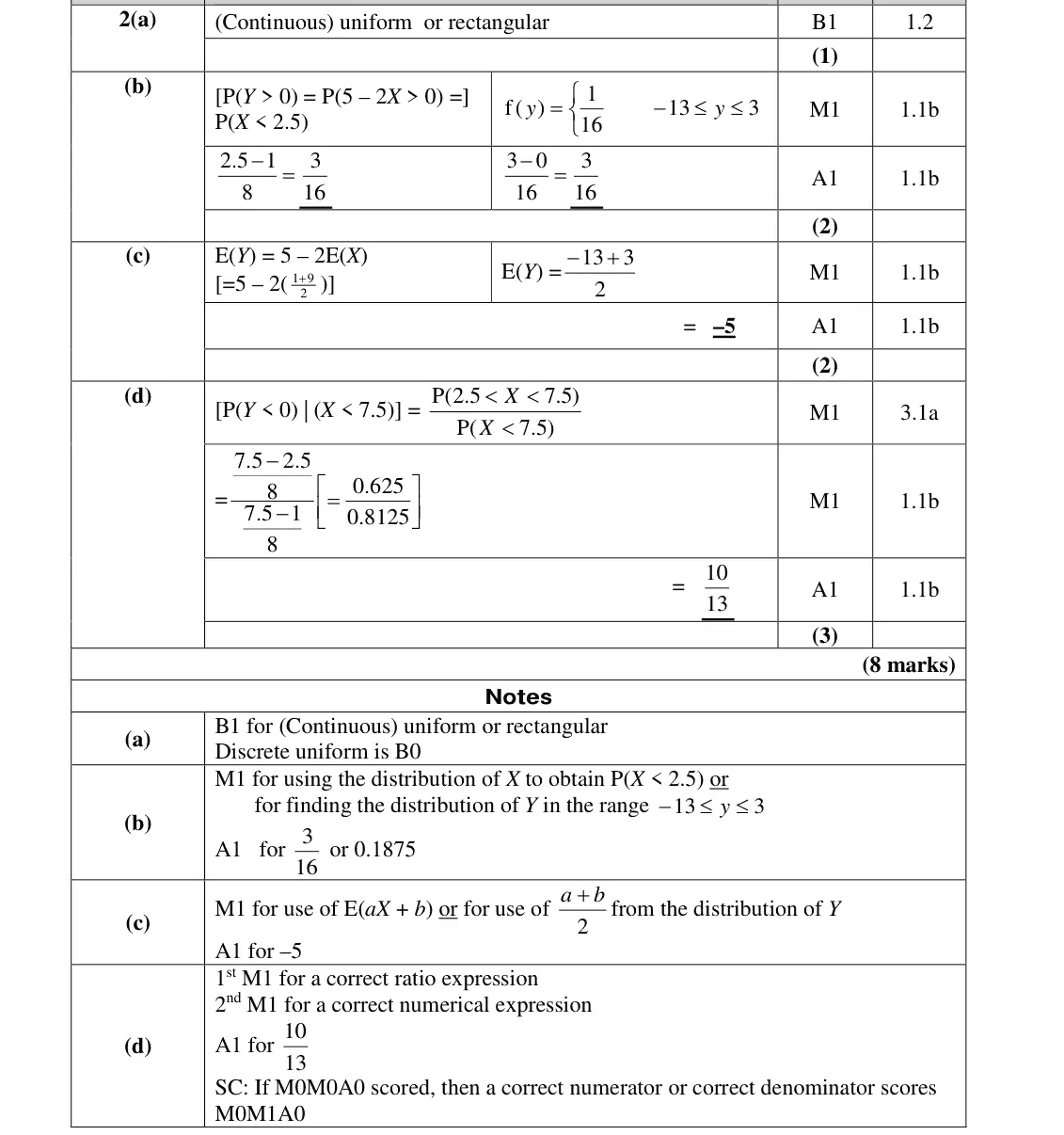
June 2018 · AS Paper 2 (Further Statistics 2) · Q2(a)1 mark
Mark scheme (whole question; this part is marked with the orange bar)
Examiner's comment
Question 2 discriminated the most able students on this paper as it was rare to see full marks being scored here. Many students were unable to identify the distribution as (continuous) uniform in part (a). Some identified it as the normal distribution whilst others believed it to be discrete.
Key points from the mark scheme and examiner's report
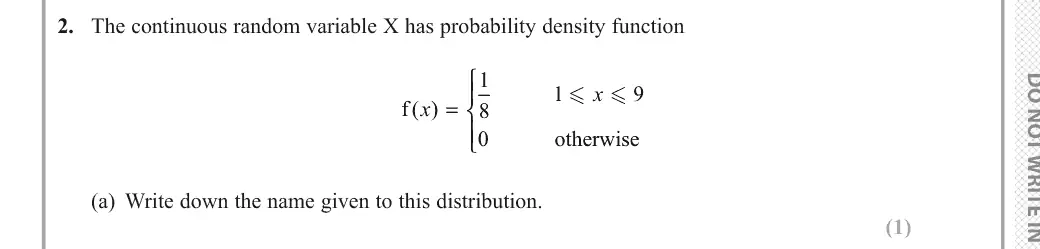
continuous uniform (rectangular)
'discrete uniform' scores 0
some said normal
June 2018 · AS Paper 2 (Further Statistics 2) · Q2(b)2 marks
Mark scheme (whole question; this part is marked with the orange bar)
Examiner's comment
Question 2 discriminated the most able students on this paper as it was rare to see full marks being scored here. Many students were unable to identify the distribution as (continuous) In part (b), some were able to gain the method mark by identifying that P(Y < 0) = P(X < 2.5). It was clear that many did not know what to do with that fact. A common incorrect solution was to treat the distribution as discrete and attempt to calculate P(X < 2).
Key points from the mark scheme and examiner's report
P(Y > 0) = P(X < 2.5) = 1.5/8 = 3/16
or find Y ~ U[−13, 3]
common error treating X as discrete
June 2018 · AS Paper 2 (Further Statistics 2) · Q2(c)2 marks
Mark scheme (whole question; this part is marked with the orange bar)
Examiner's comment
Question 2 discriminated the most able students on this paper as it was rare to see full marks being scored here. Many students were unable to identify the distribution as (continuous) Part (c) was generally well attempted and most demonstrated sound knowledge of E(aX +b) = aE(X) + b. Even those who believed the distribution to be discrete made some progress here. Very little progress was made in part (d) as the conditional probability required was rarely
Key points from the mark scheme and examiner's report
E(Y) = 5 − 2E(X) = 5 − 2(5) = −5
well answered
June 2018 · AS Paper 2 (Further Statistics 2) · Q2(d)3 marks
Mark scheme (whole question; this part is marked with the orange bar)
Examiner's comment
Question 2 discriminated the most able students on this paper as it was rare to see full marks being scored here. Many students were unable to identify the distribution as (continuous) Very little progress was made in part (d) as the conditional probability required was rarely seen. Those who did attempt a conditional probability often assumed independence and gave the product of two probabilities in the numerator. A few scored the special case for a correct probability for the denominator. 4
Key points from the mark scheme and examiner's report