June 2024: AS Paper 25: Further Mechanics 1

40 marks · 11 question parts · Question paper, mark scheme and examiner's report on Pearson's site

Question by question

QTopicMarksDifficulty
1(a) Momentum and impulse 3 —
1(b) Elastic collisions in one dimension 3 —
1(c) Momentum and impulse 3 —
2(a) Work, energy and power 4 —
2(b) Work, energy and power 4 —
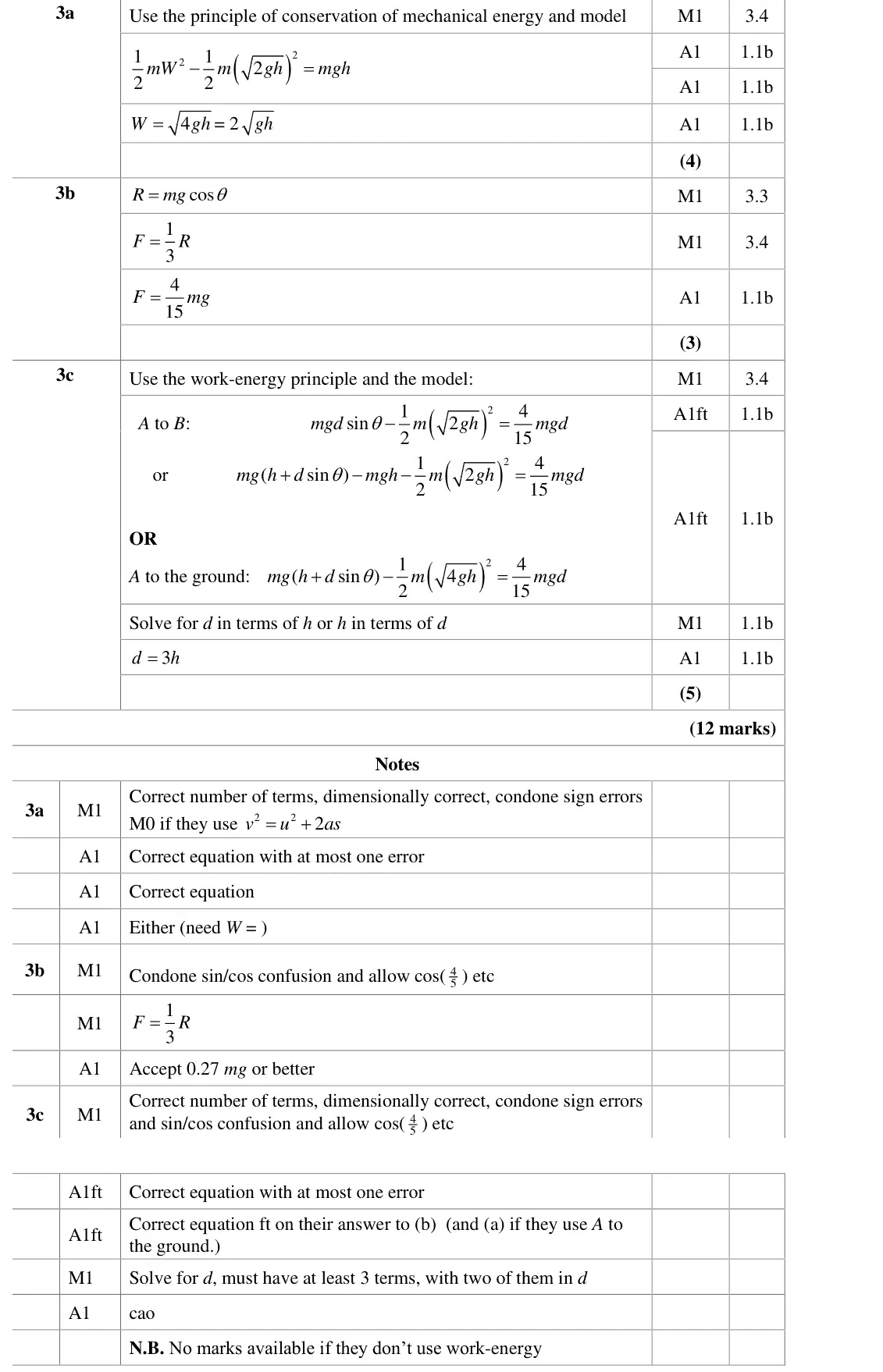
3(a) Work, energy and power 4 —
3(b) Work, energy and power 3 —
3(c) Work, energy and power 5 —
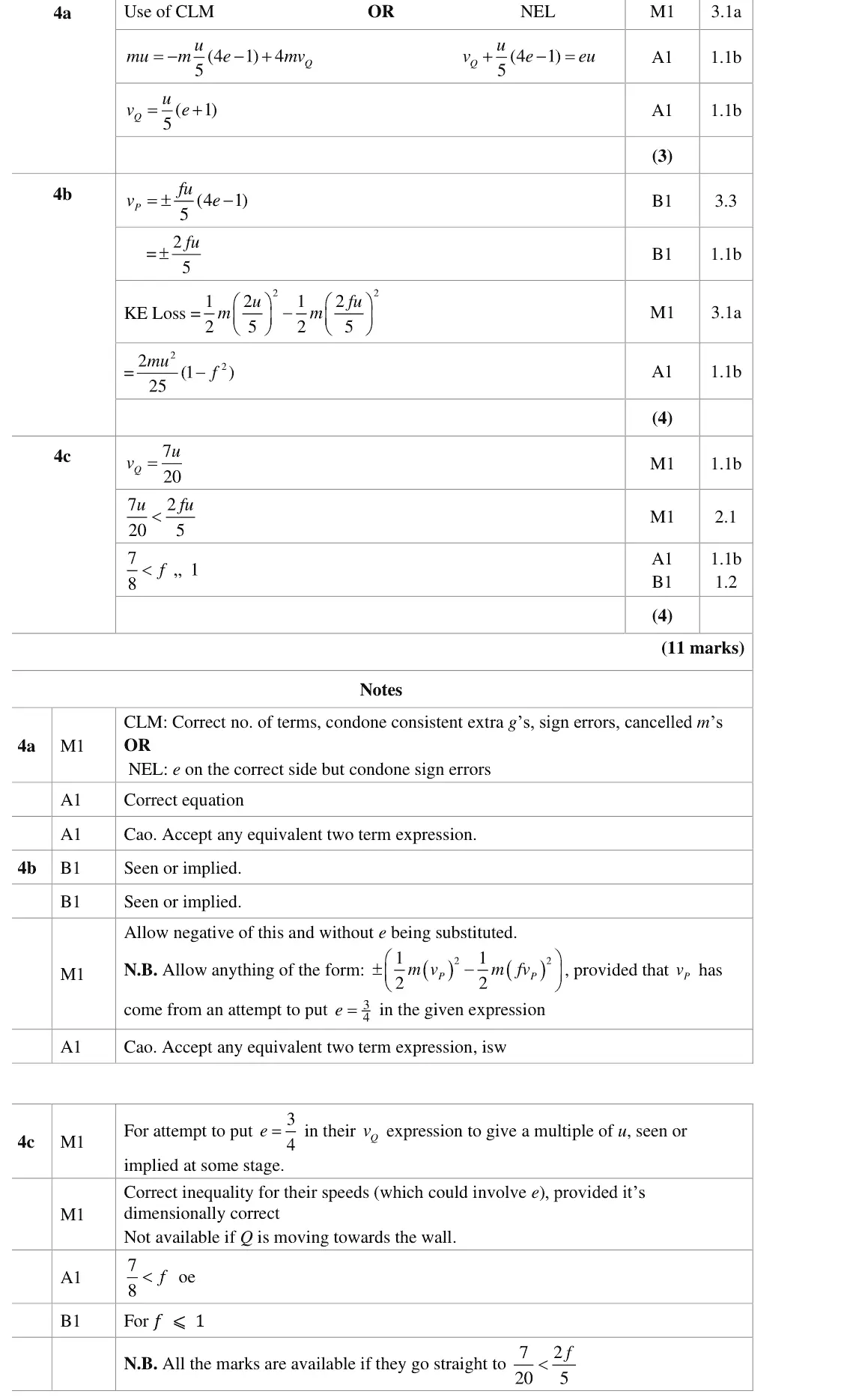
4(a) Elastic collisions in one dimension, Momentum and impulse 3 —
4(b) Elastic collisions in one dimension 4 —
4(c) Elastic collisions in one dimension 4 —

The questions

1(a)1(b)1(c)2(a)2(b)3(a)3(b)3(c)4(a)4(b)4(c)
June 2024 · AS Paper 2 (Further Mechanics 1) · Q1(a) 3 marks momentum and impulse
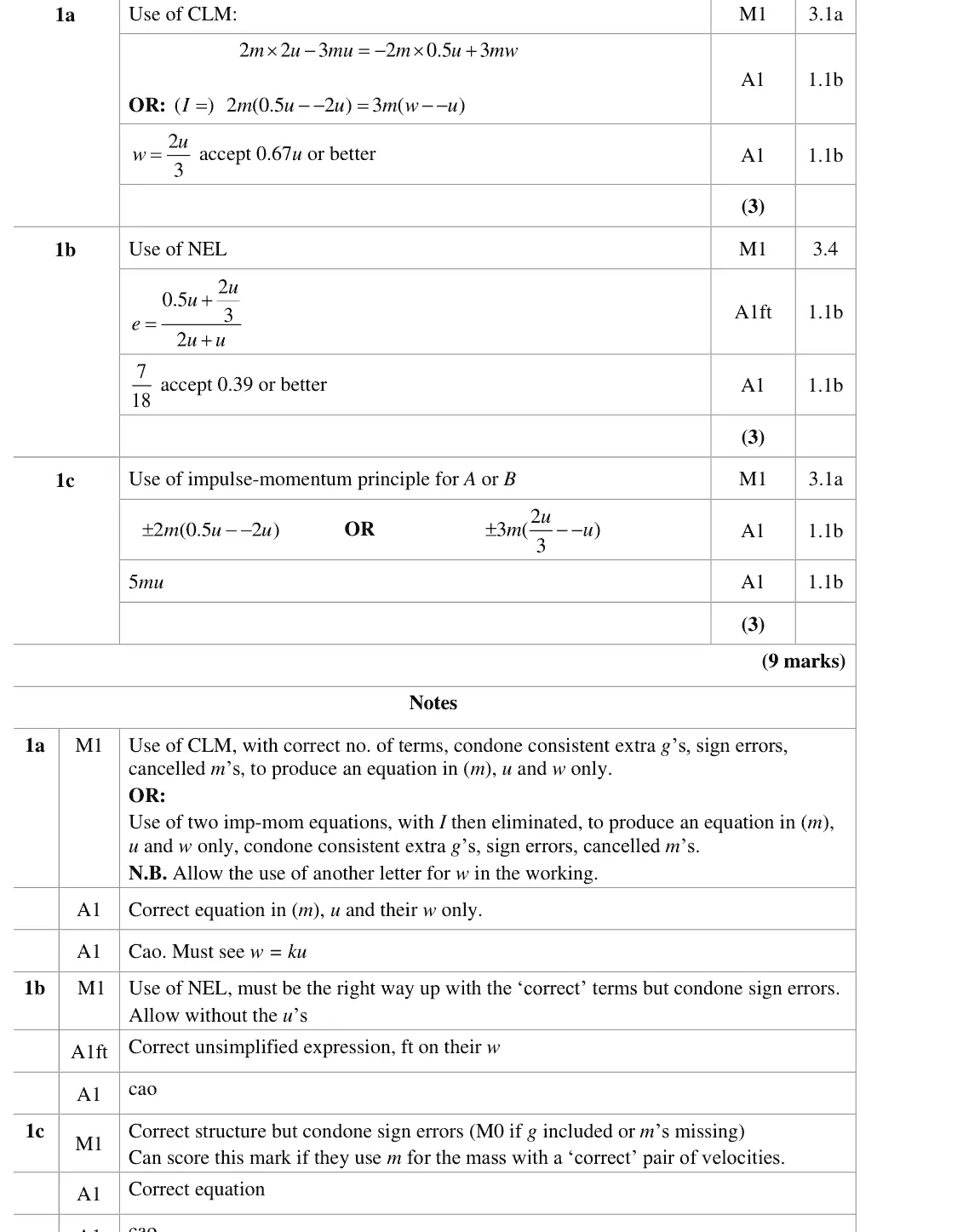
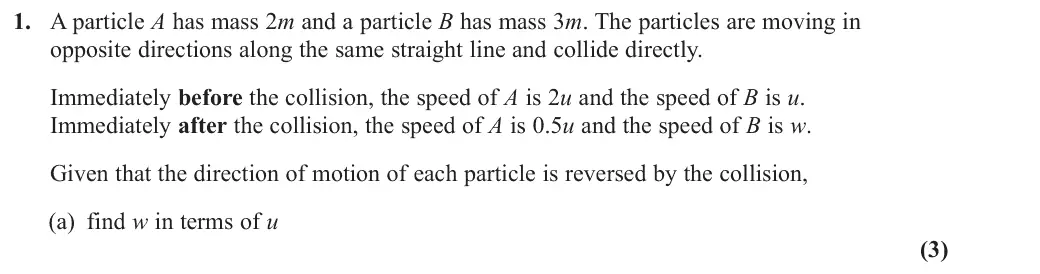
1. A particle A has mass 2m and a particle B has mass 3m. The particles are moving in opposite directions along the same straight line and collide directly. Immediately before the collision, the speed of A is 2u and the speed of B is u. Immediately after the collision, the speed of A is 0.5u and the speed of B is w. Given that the direction of motion of each particle is reversed by the collision, (a) find w in terms of u (3)
June 2024 · AS Paper 2 (Further Mechanics 1) · Q1(b) 3 marks collisions in one dimension
(b) find the coefficient of restitution between the particles, (3)
June 2024 · AS Paper 2 (Further Mechanics 1) · Q1(c) 3 marks momentum and impulse
(c) find, in terms of m and u, the magnitude of the impulse received by A in the collision. (3)
June 2024 · AS Paper 2 (Further Mechanics 1) · Q2(a) 4 marks work energy and power
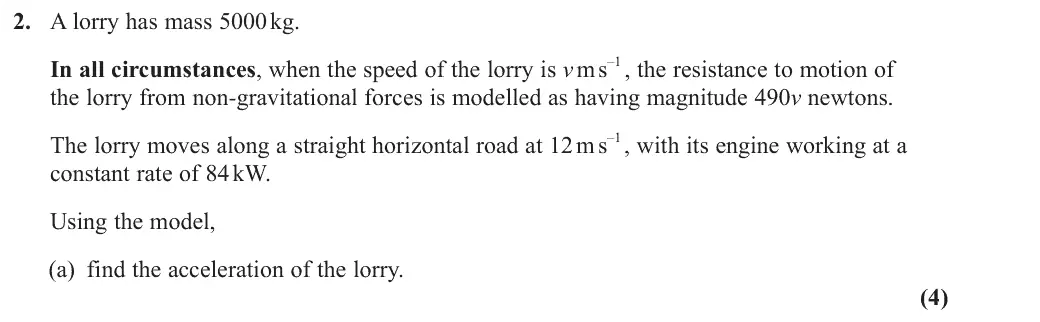
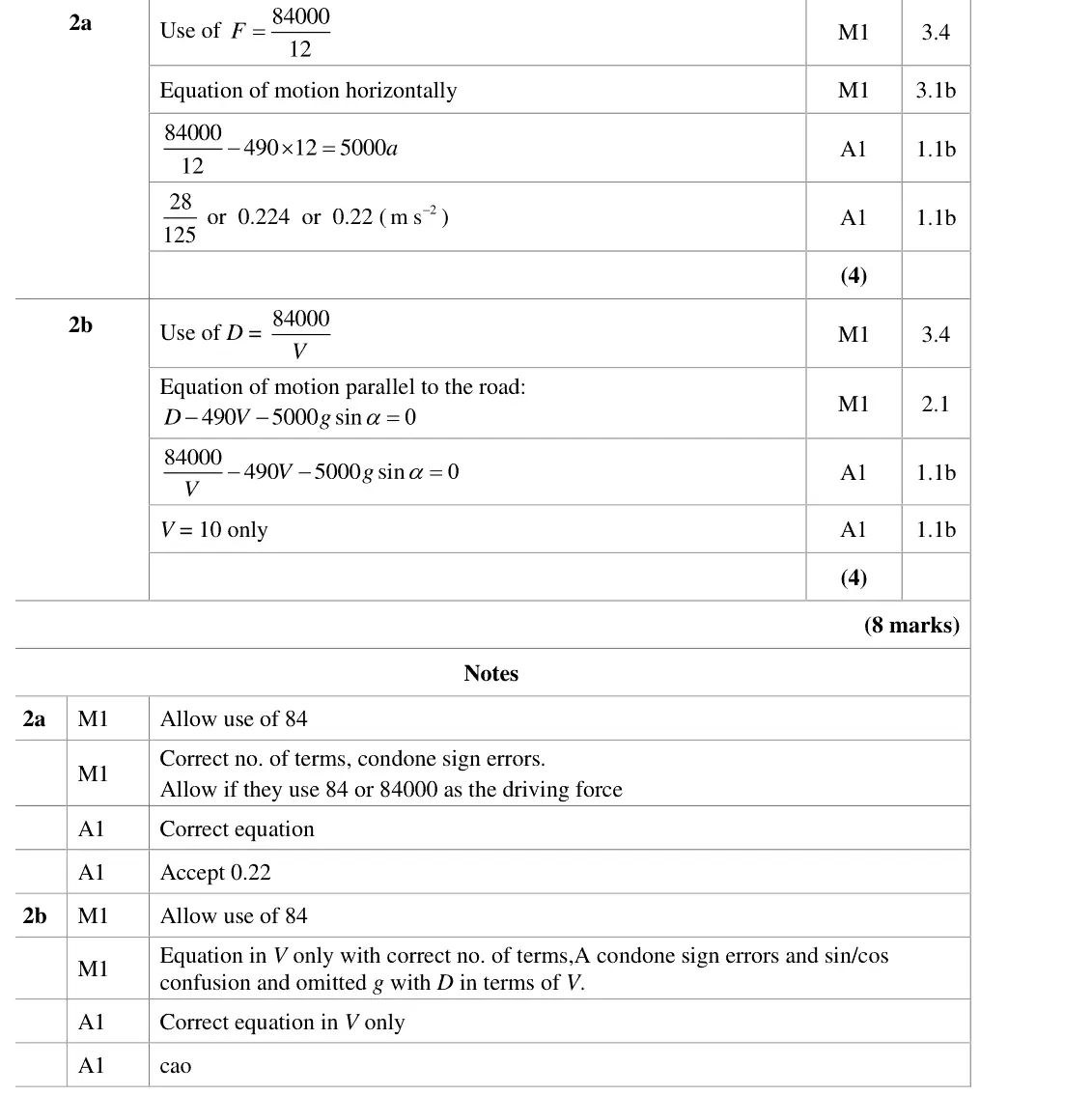
2. A lorry has mass 5000 kg. In all circumstances, when the speed of the lorry is v m s –1 , the resistance to motion of the lorry from non-gravitational forces is modelled as having magnitude 490v newtons. The lorry moves along a straight horizontal road at 12 m s –1 , with its engine working at a constant rate of 84 kW. Using the model, (a) find the acceleration of the lorry. (4)
June 2024 · AS Paper 2 (Further Mechanics 1) · Q2(b) 4 marks work energy and power
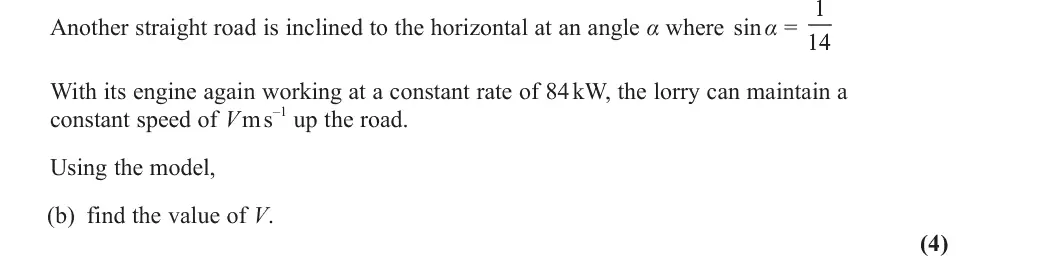
Another straight road is inclined to the horizontal at an angle alpha where sin alpha = With its engine again working at a constant rate of 84 kW, the lorry can maintain a constant speed of V m s –1 up the road. Using the model, (b) find the value of V. (4)
June 2024 · AS Paper 2 (Further Mechanics 1) · Q3(a) 4 marks work energy and power
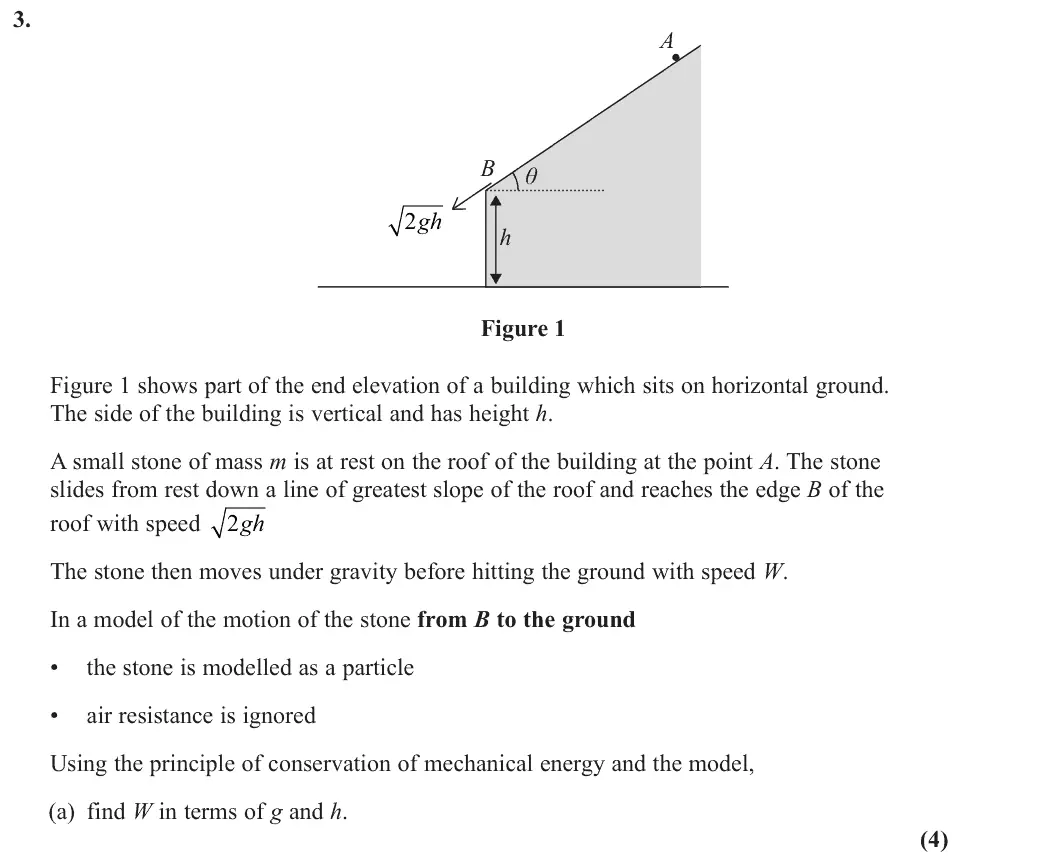
3. A B theta 2gh h Figure 1 Figure 1 shows part of the end elevation of a building which sits on horizontal ground. The side of the building is vertical and has height h. A small stone of mass m is at rest on the roof of the building at the point A. The stone slides from rest down a line of greatest slope of the roof and reaches the edge B of the roof with speed 2gh The stone then moves under gravity before hitting the ground with speed W. In a model of the motion of the stone from B to the ground • the stone is modelled as a particle • air resistance is ignored Using the principle of conservation of mechanical energy and the model, (a) find W in terms of g and h. (4)
June 2024 · AS Paper 2 (Further Mechanics 1) · Q3(b) 3 marks work energy and power
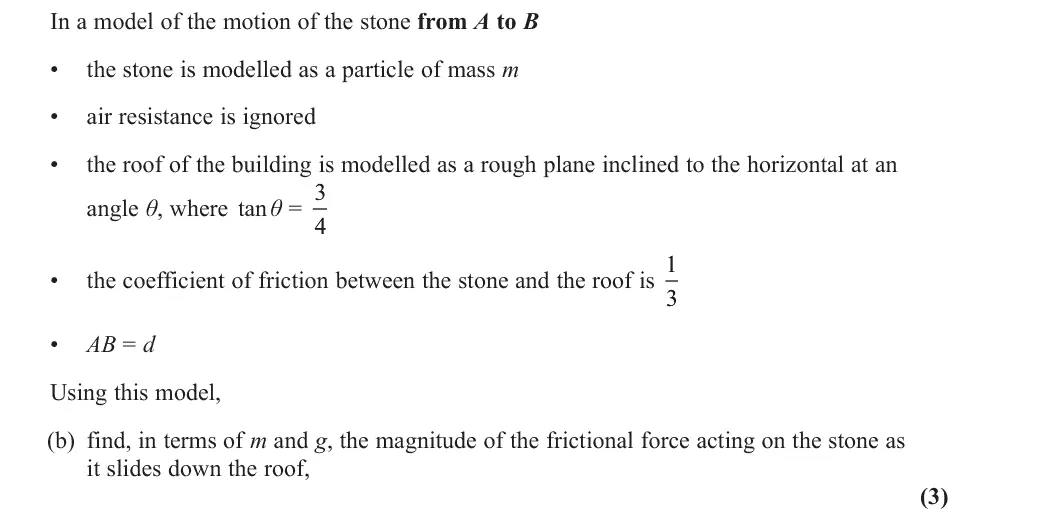
In a model of the motion of the stone from A to B • the stone is modelled as a particle of mass m • air resistance is ignored • the roof of the building is modelled as a rough plane inclined to the horizontal at an angle theta , where tan theta = 3 the coefficient of friction between the stone and the roof is 1 • • AB = d Using this model, (b) find, in terms of m and g, the magnitude of the frictional force acting on the stone as it slides down the roof, (3)
June 2024 · AS Paper 2 (Further Mechanics 1) · Q3(c) 5 marks work energy and power
(c) use the work–energy principle to find d in terms of h. (5)
June 2024 · AS Paper 2 (Further Mechanics 1) · Q4(a) 3 marks collisions in one dimensionmomentum and impulse
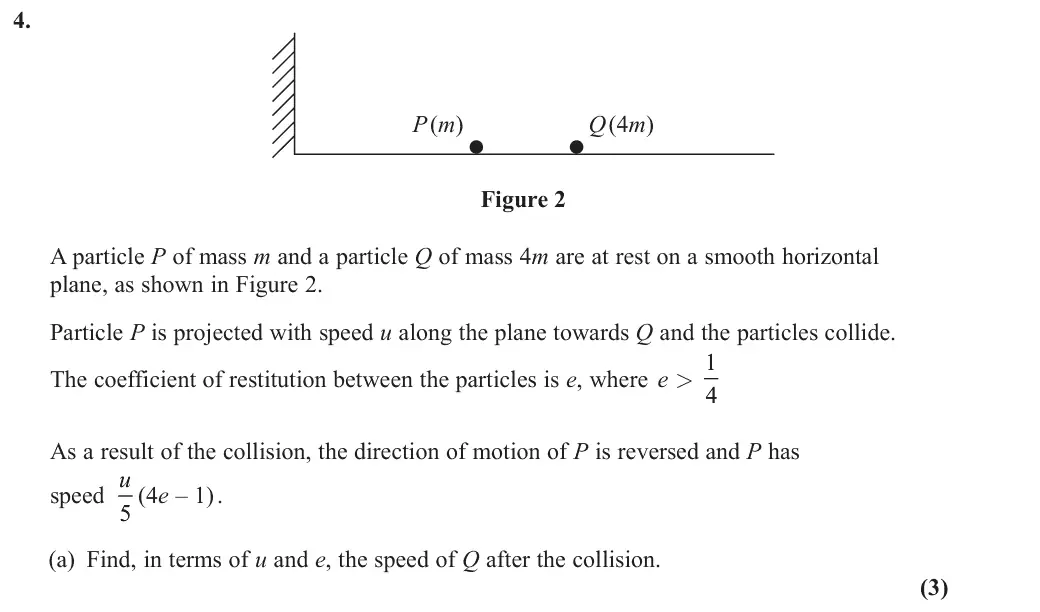
4. P (m) Q (4m) Figure 2 A particle P of mass m and a particle Q of mass 4m are at rest on a smooth horizontal plane, as shown in Figure 2. Particle P is projected with speed u along the plane towards Q and the particles collide. The coefficient of restitution between the particles is e, where e > 1 As a result of the collision, the direction of motion of P is reversed and P has speed u 5 (4e – 1) . (a) Find, in terms of u and e, the speed of Q after the collision. (3)
June 2024 · AS Paper 2 (Further Mechanics 1) · Q4(b) 4 marks collisions in one dimension
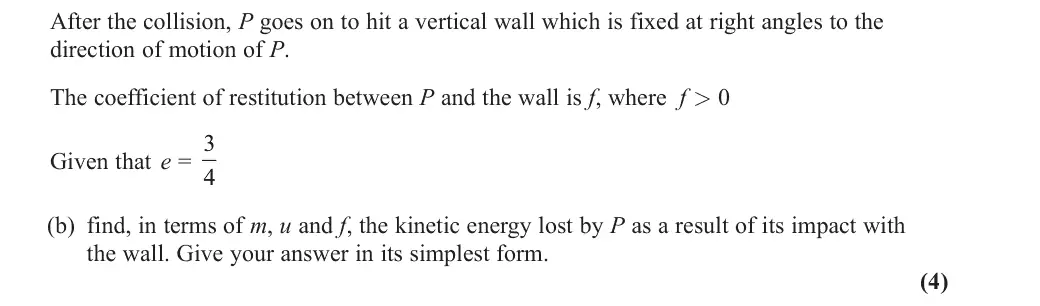
After the collision, P goes on to hit a vertical wall which is fixed at right angles to the direction of motion of P. The coefficient of restitution between P and the wall is f, where f > 0 Given that e = 3 (b) find, in terms of m, u and f, the kinetic energy lost by P as a result of its impact with the wall. Give your answer in its simplest form. (4)
June 2024 · AS Paper 2 (Further Mechanics 1) · Q4(c) 4 marks collisions in one dimension
After its impact with the wall, P goes on to collide with Q again. (c) Find the complete range of possible values of f . (4)

Find an Edexcel Further Maths tutor

Want this paper marked and gone through with a Further Maths tutor? Message us.

Prefer email? Send an enquiry

If you are under 18, please include a parent's contact details. Enquiries go to enquiries@alevelfurthermathstutor.com and are deleted once handled.