Notes, worked examples and practice for this topic are being written by our tutors. The past-paper questions below are ready now: work each one on paper, then open the mark scheme and the examiner's comment.
Tap a question to zoom it. Mark scheme and examiner's comment open under each question.
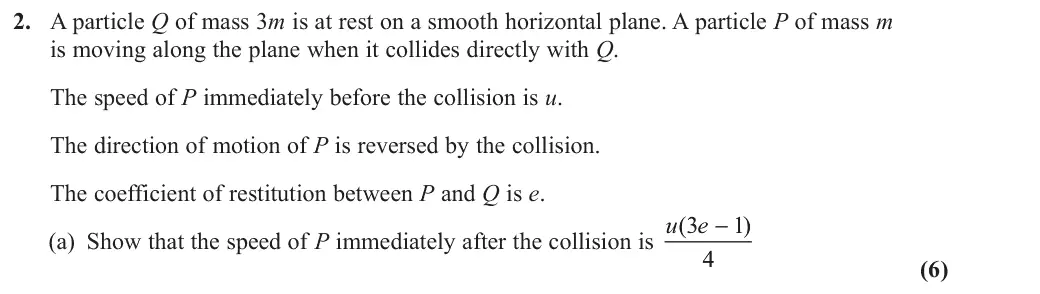
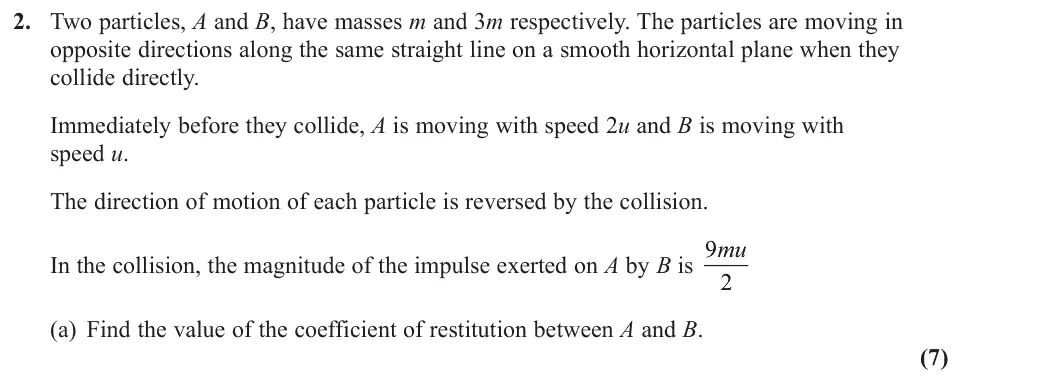
June 2025 · AS Paper 2 (Further Mechanics 1) · Q2(a)6 marks
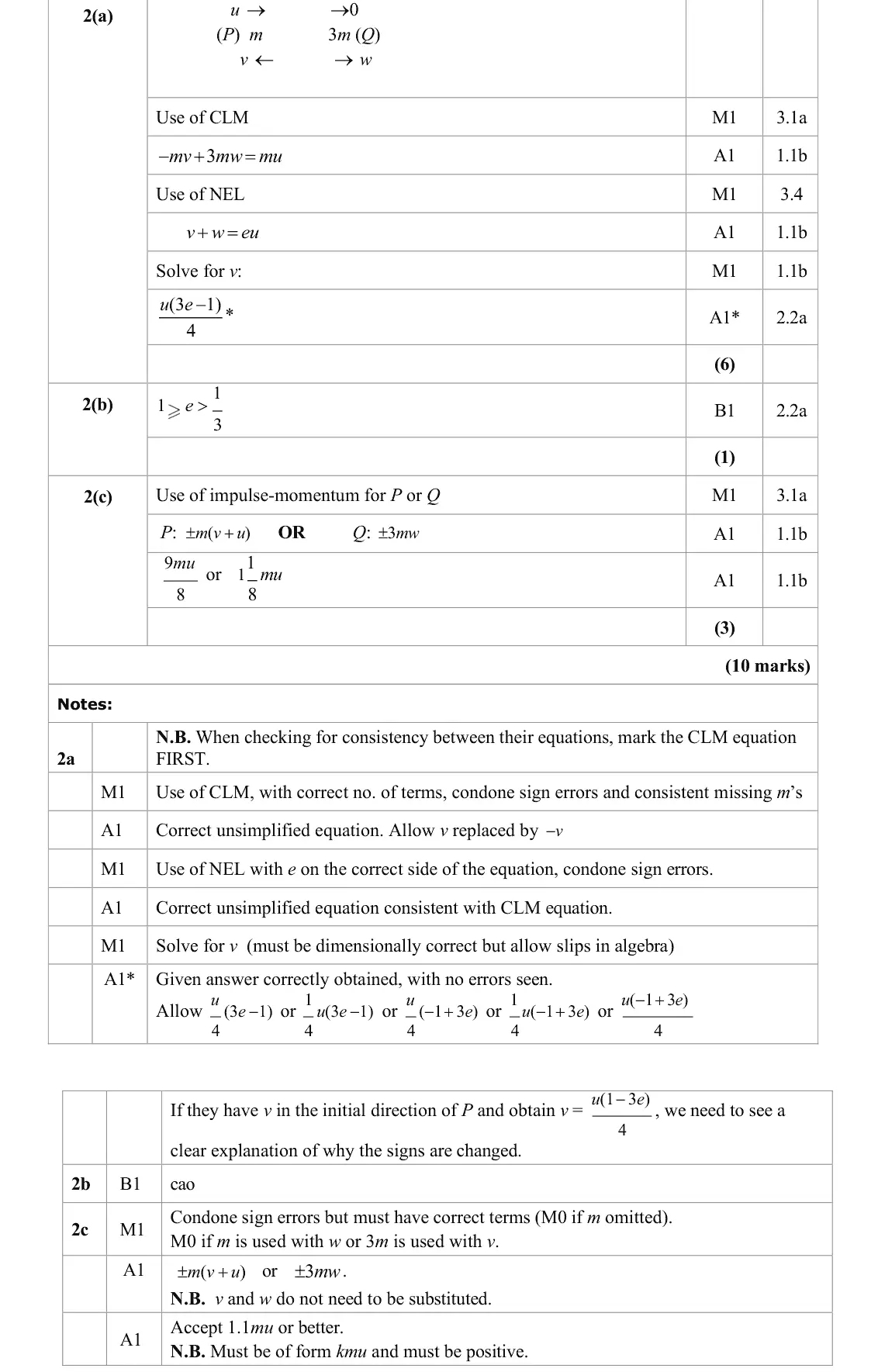
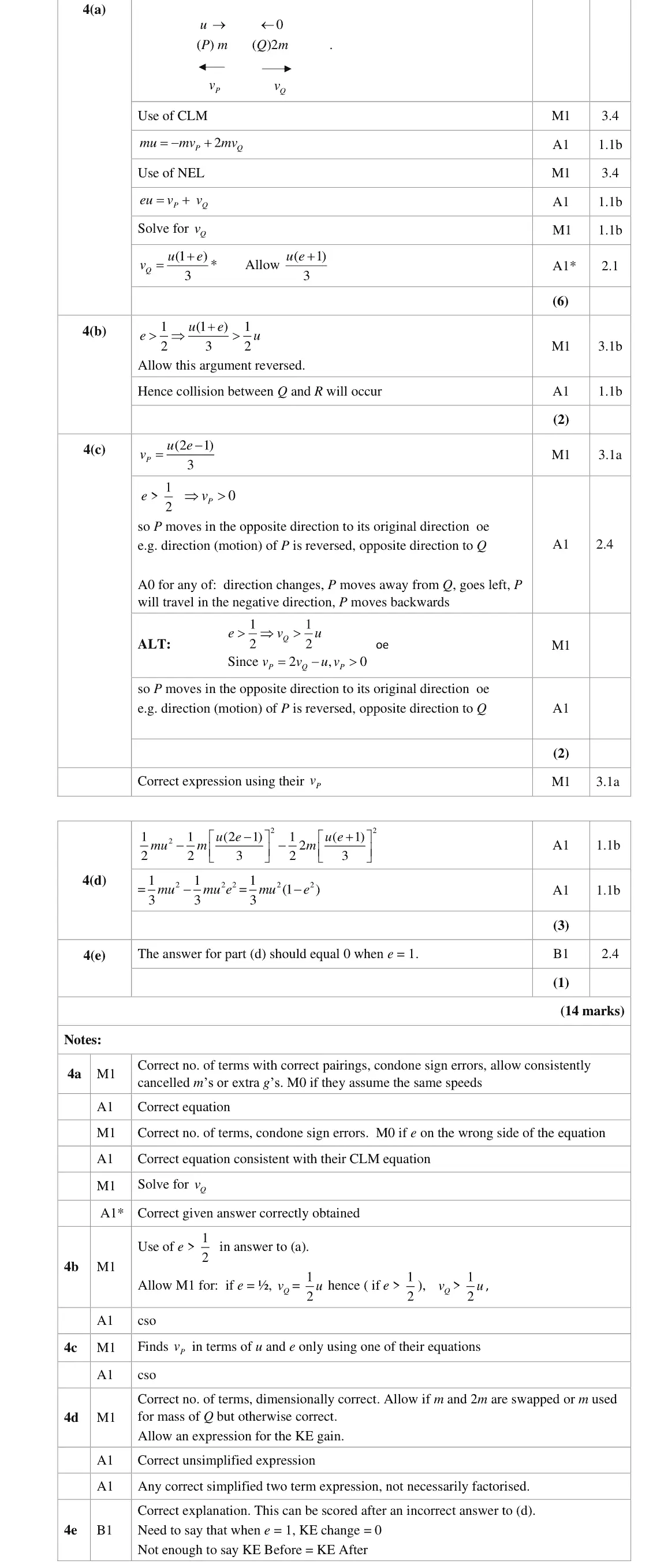
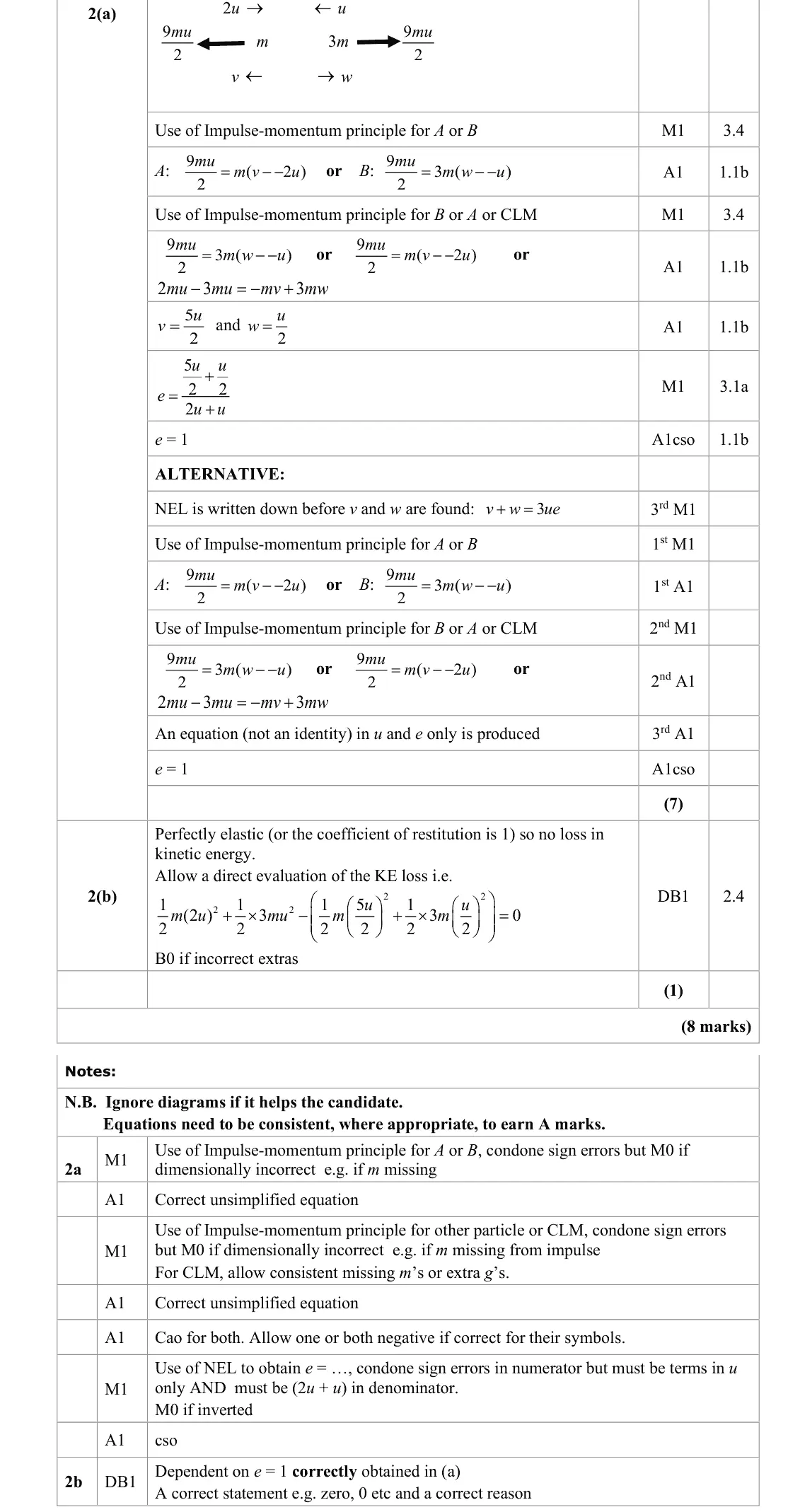
Mark scheme (whole question; this part is marked with the orange bar)
Examiner's comment
There were many fully correct responses in part (a), particularly from those who took onboard from the start the fact that the direction of motion of P was reversed by the collision. Those who didn’t just made life difficult for themselves, not only in part (a) but also in the later parts. Most, however, were able to write down a CLM and an NEL equation, do the necessary elimination and obtain the given answer, sometimes with some adjusting of the signs.
Key points from the mark scheme and examiner's report
CLM −mv + 3mw = mu and NLR v + w = eu with P's velocity reversed
solve for v = u(3e − 1)/4
if v is taken in the original direction a clear explanation of the sign change is needed
June 2025 · AS Paper 2 (Further Mechanics 1) · Q2(c)3 marks
Mark scheme (whole question; this part is marked with the orange bar)
Examiner's comment
Part (c) was often correctly done. The most common error was finding the velocity of Q but using m rather than 3m when calculating the magnitude of the impulse, closely followed by using P but making a sign error when dealing with the rebound velocity.
Key points from the mark scheme and examiner's report
e = 1/2: v = u/8, w = 3u/8
impulse = m(v + u) or 3mw = 9mu/8
common errors: mass m used with Q's velocity, sign error with P's rebound
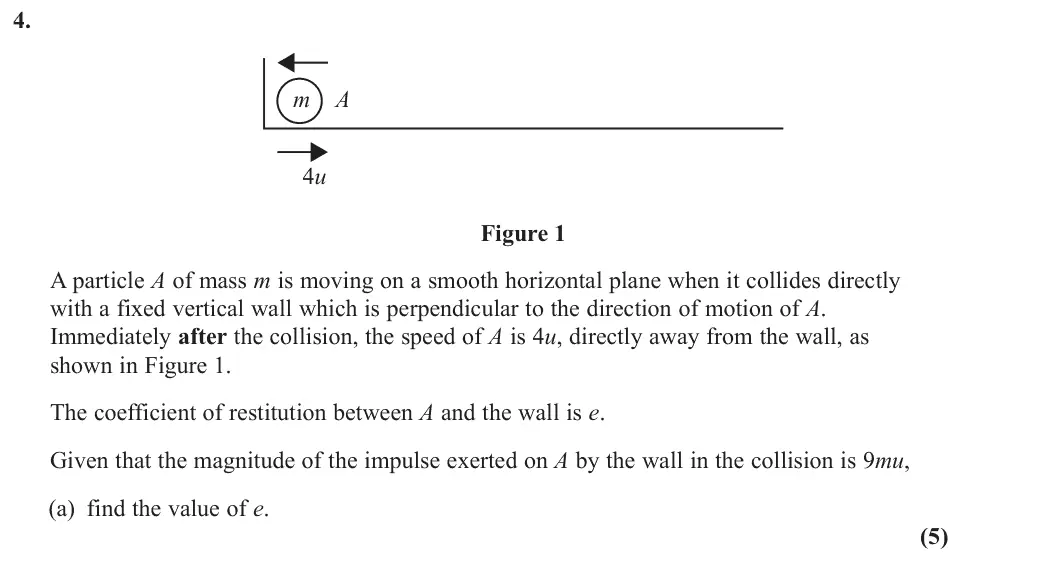
June 2025 · AS Paper 2 (Further Mechanics 1) · Q4(a)5 marks
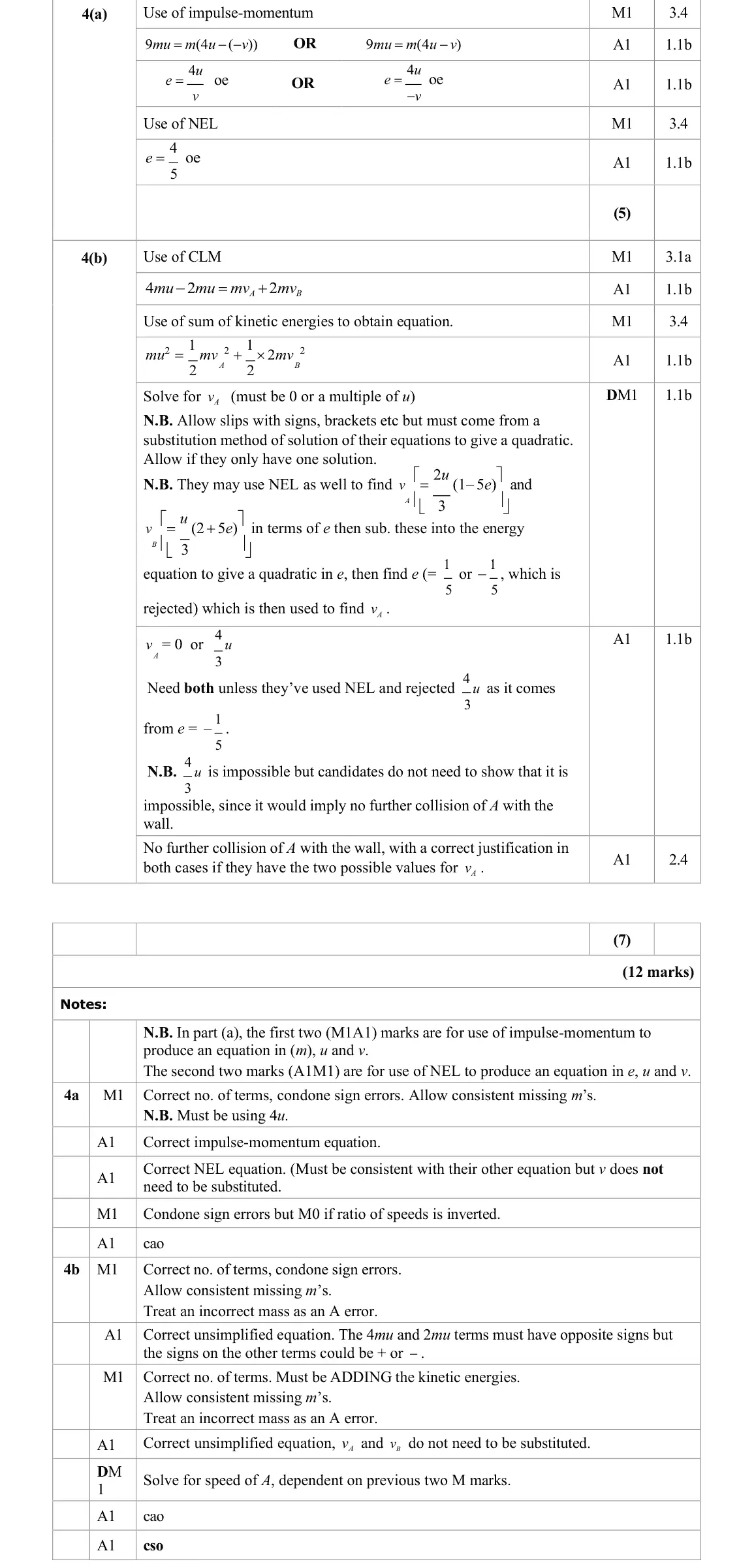
Mark scheme (whole question; this part is marked with the orange bar)
Examiner's comment
Part (a) caused some problems, although there many correct answers. The most common error occurred when dealing with the change in direction and there were sign errors in the impulse- momentum equation often leading to an answer of 4/13 instead of 4/5. The second part proved to be challenging for all but the very best students and there were very
Key points from the mark scheme and examiner's report
9mu = m(4u − (−v)) gives approach speed v = 5u
NLR e = 4u/5u = 4/5
sign errors from the change of direction gave 4/13
June 2025 · AS Paper 2 (Further Mechanics 1) · Q4(b)7 marks
Mark scheme (whole question; this part is marked with the orange bar)
Examiner's comment
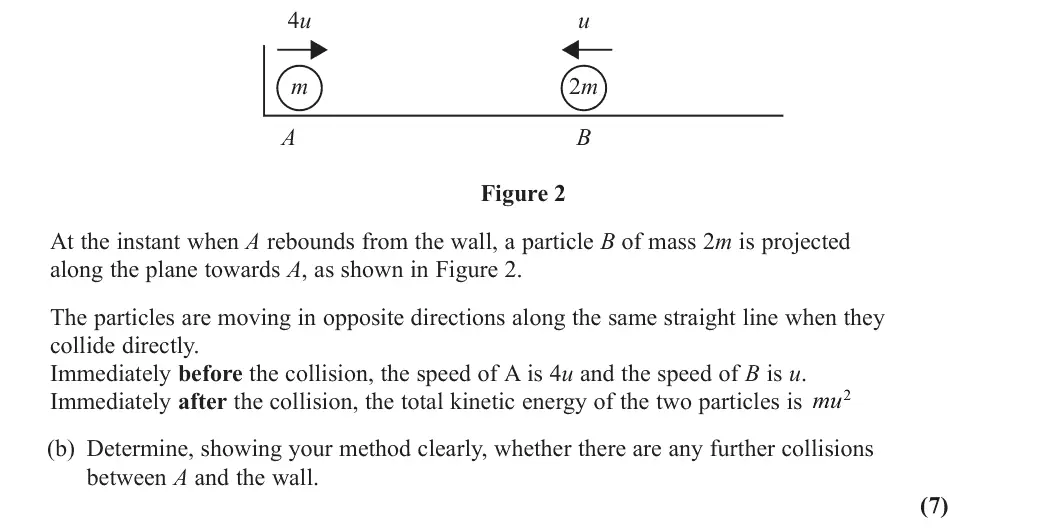
The second part proved to be challenging for all but the very best students and there were very few completely correct solutions. The first 4 marks were very straightforward but a surprisingly large number omitted the 2 in one or other of the CLM and KE equations. This often then led to pages of incorrect algebra. Learners would be well advised to check their equations carefully 2 before using them. Another common error was to treat mu as the KE loss rather than the final KE which again resulted in lots of unnecessary algebra. This often wasn’t helped by some very 2 2 basic fundamental mistakes being made – a common one being . A few chose u v u v + = + to include NEL, despite not being given the coefficient of restitution between the particles and made life a lot more difficult for themselves. However, some of these did struggle through, found the correct values for e, and went on to produce fully correct solutions. Some learners, who were close to producing a fully correct answer, fell at the final hurdle by cancelling the variable from their quadratic (forgetting that it could be zero). This left only one solution which unfortunately was the wrong one.
Key points from the mark scheme and examiner's report
CLM 4mu − 2mu = mv_A + 2mv_B with total KE ½mv_A² + ½(2m)v_B² = mu²
quadratic gives v_A = 0 (or 4u/3, impossible): A is at rest so no further collision with the wall
mu² is the final KE, not the loss
the 2 often dropped from a mass
June 2025 · Paper 3C (Further Mechanics 1) · Q1(a)3 marks
Mark scheme (whole question; this part is marked with the orange bar)
Examiner's comment
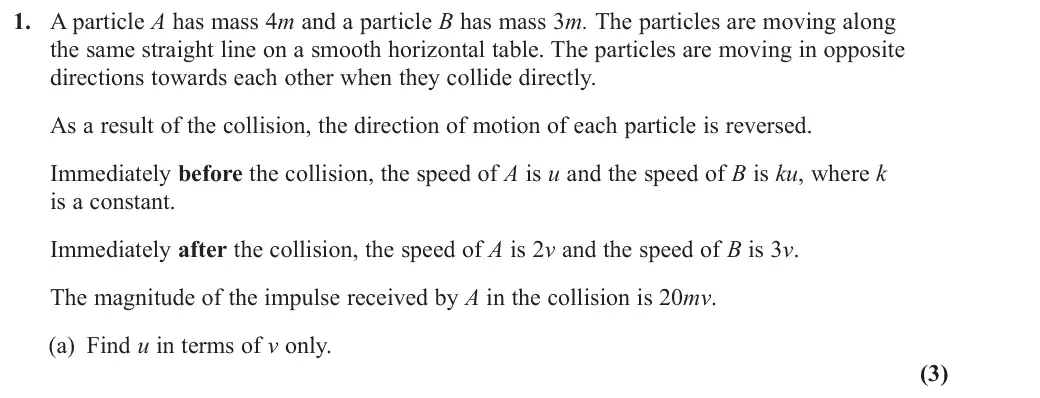
they could make no further progress in part (a) without knowing k and so formed a suitable Impulse equation and answered parts (a) and (b) simultaneously. Unfortunately, the false start caused confusion for some learners who proceeded to make errors in their working or made v the subject instead of u. It is important for learners at all levels to process each question carefully before embarking on an approach.
Key points from the mark scheme and examiner's report
both reverse direction
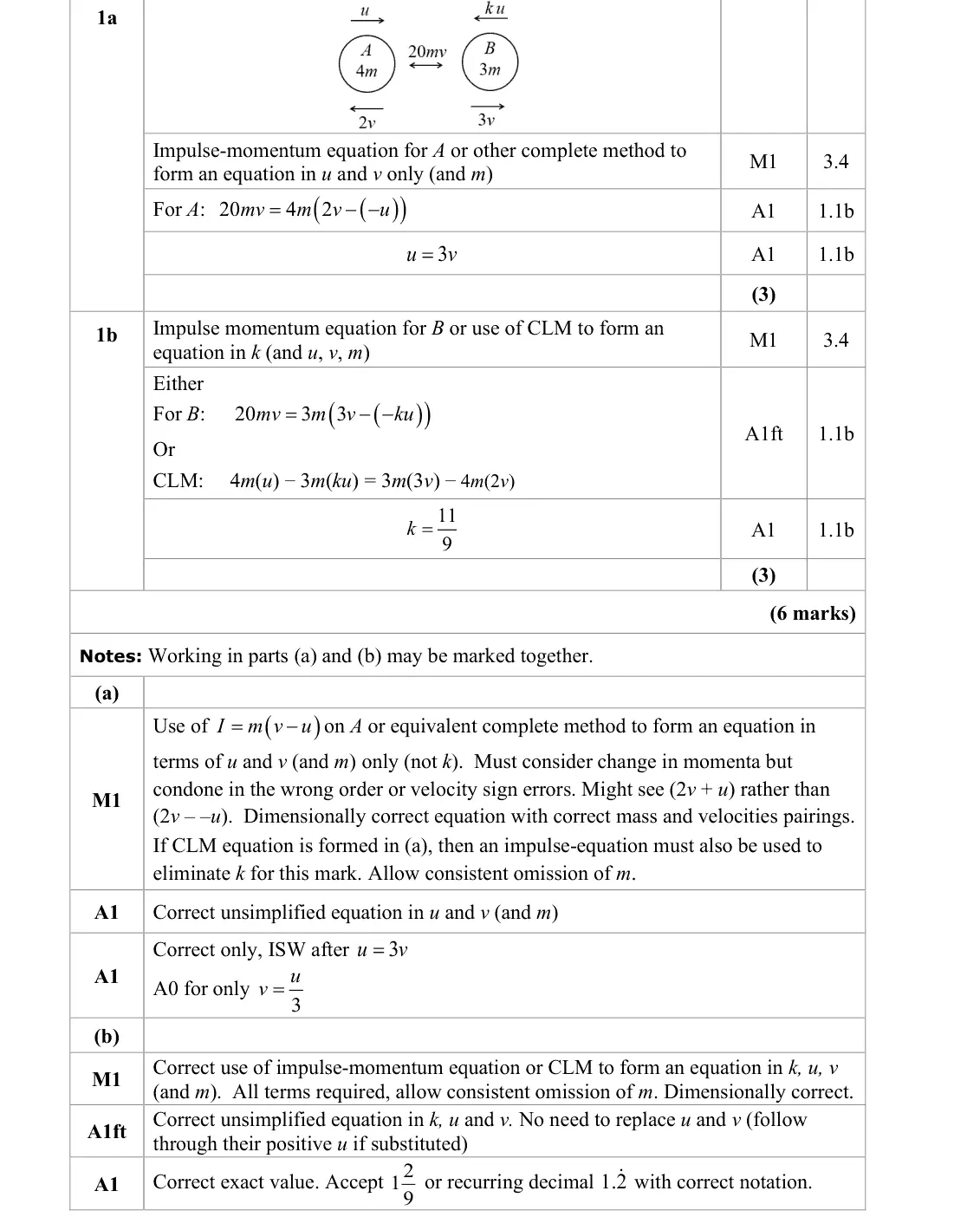
impulse on A: 20mv = 4m(2v − (−u)) gives u = 3v
some started with CLM (needs k) and got confused, or made v the subject
June 2025 · Paper 3C (Further Mechanics 1) · Q1(b)3 marks
Mark scheme (whole question; this part is marked with the orange bar)
Examiner's comment
Impulse equation and answered parts (a) and (b) simultaneously. Unfortunately, the false start caused confusion for some learners who proceeded to make errors in their working or made v the subject instead of u. It is important for learners at all levels to process each question carefully before embarking on an approach.
Key points from the mark scheme and examiner's report
impulse on B 20mv = 3m(3v + ku) or CLM: k = 11/9 (exact)
June 2025 · Paper 3C (Further Mechanics 1) · Q36 marks
Mark scheme (whole question; this part is marked with the orange bar)
Examiner's comment
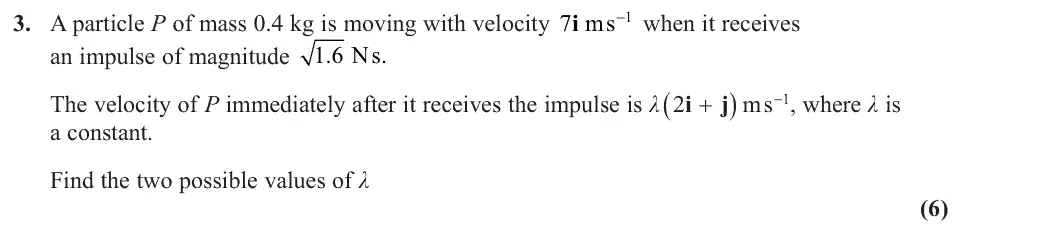
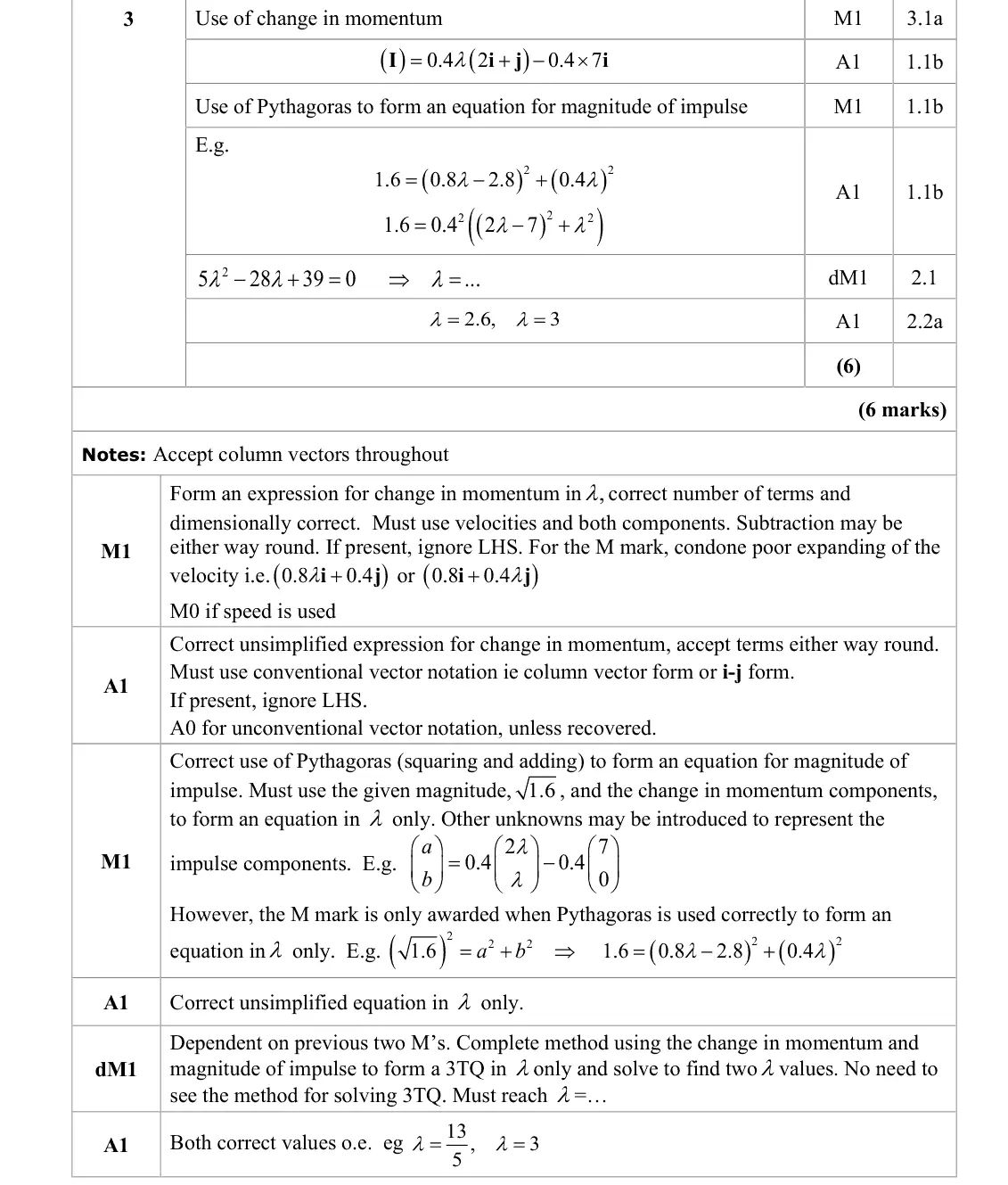
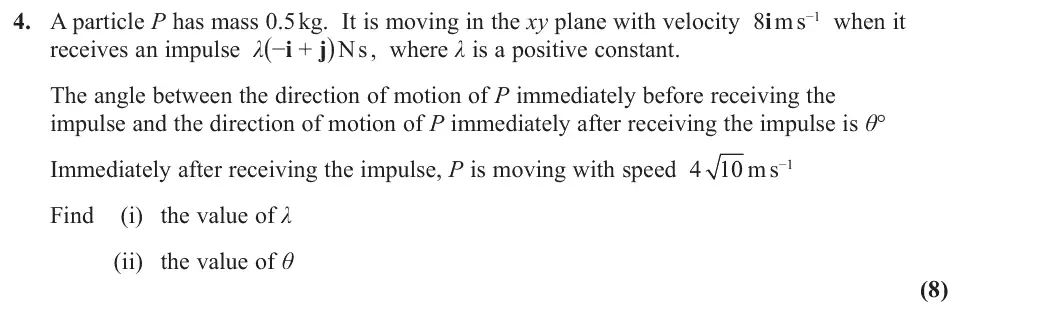
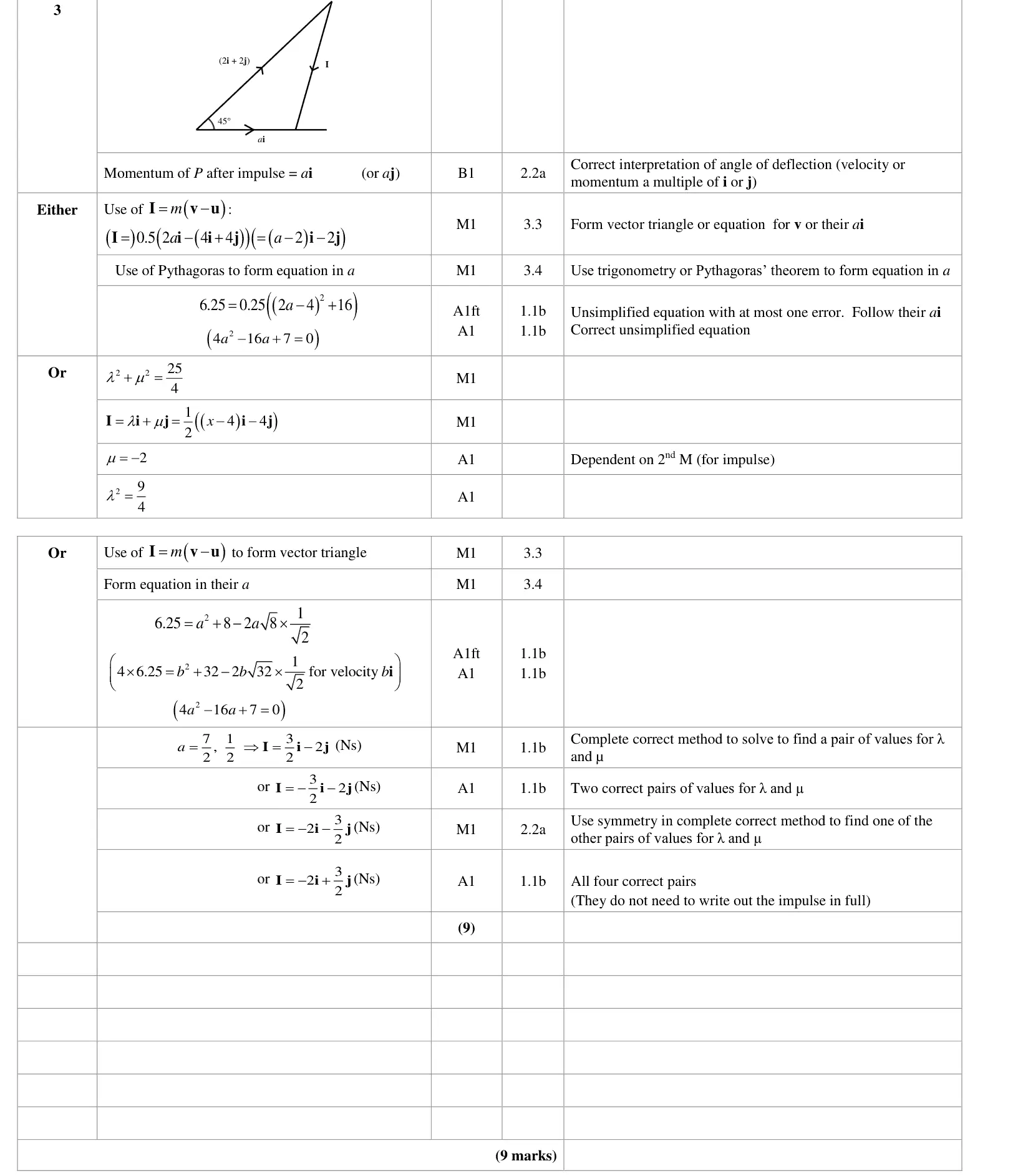
In this question, it was common for learners to work with column vectors to first find an expression for the change in momentum and then apply Pythagoras to the components to form a quadratic equation in λ . Most chose to use their calculator to solve the quadratic equation, efficiently finding two values for λ . There were many solutions with poor vector work and unconventional notation. Learners confused scalars and vectors, forming structurally incorrect equations such as m m = - I v u or . m m = - I v u Due to the format of this question, many were able to make a full recovery but learners should take greater care when solving problems with impulse expressed as a vector. It was rare for learners to use a vector triangle and the cosine rule to answer this question, but when seen it was usually correct. Sign errors or not using the mass in one or both of the terms caused marks to not be awarded. Those who tried to convert velocity vectors into a speed and direction made very little progress at all.
Key points from the mark scheme and examiner's report
mixing scalars and vectors (I = mv − mu with magnitudes) common
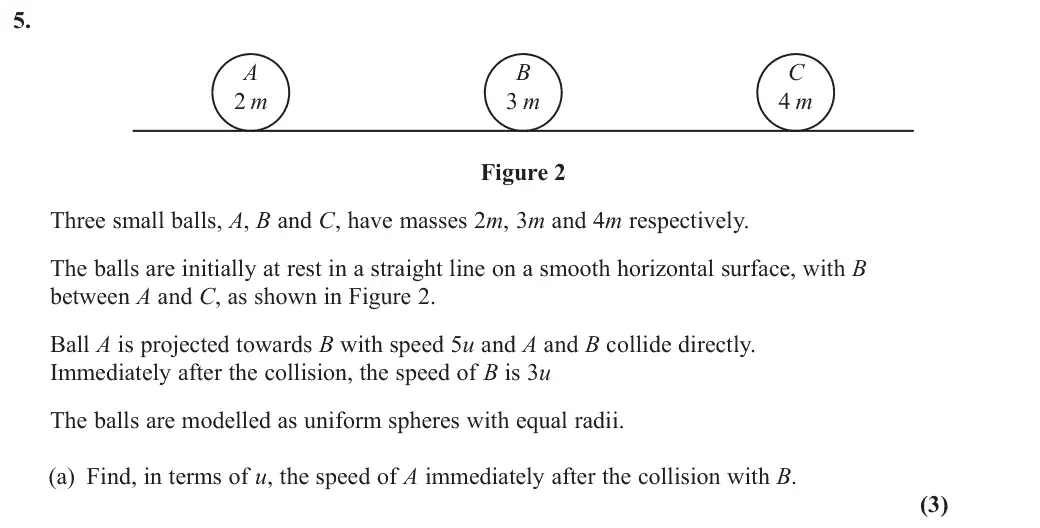
June 2025 · Paper 3C (Further Mechanics 1) · Q5(a)3 marks
Mark scheme (whole question; this part is marked with the orange bar)
Examiner's comment
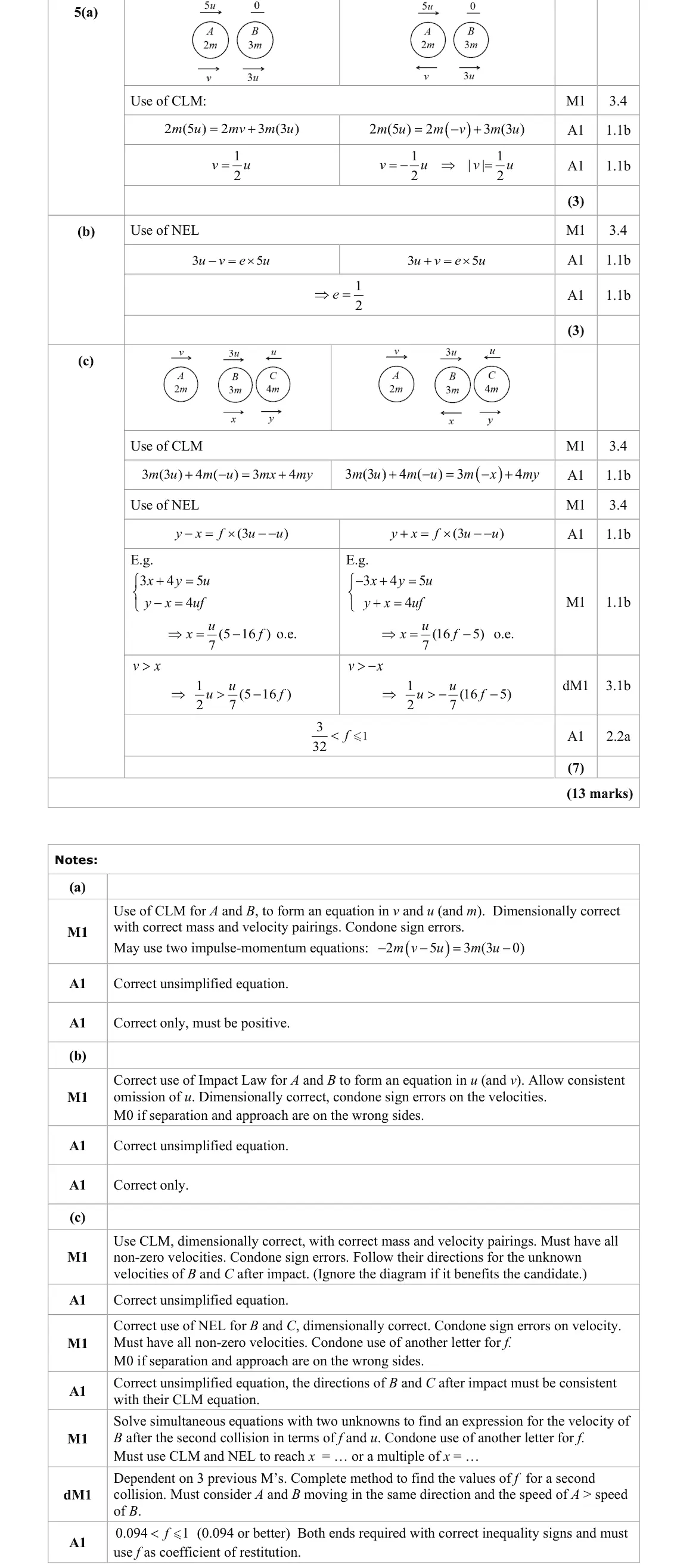
Candidates across the grades made a confident start to this question on successive direct collisions with most gaining the first 6 marks in a few lines of neat working. Forming a CLM equation in part (a) was very straightforward with few sign errors seen and the modulus taken, if necessary, to give the speed of A after the first collision. Using the impact law in part (b) brought almost the same level of success with any errors deriving from incorrect
Key points from the mark scheme and examiner's report
CLM 2m(5u) = 2mv + 3m(3u): speed of A is u/2
June 2024 · AS Paper 2 (Further Mechanics 1) · Q1(a)3 marks
Mark scheme (whole question; this part is marked with the orange bar)
Examiner's comment
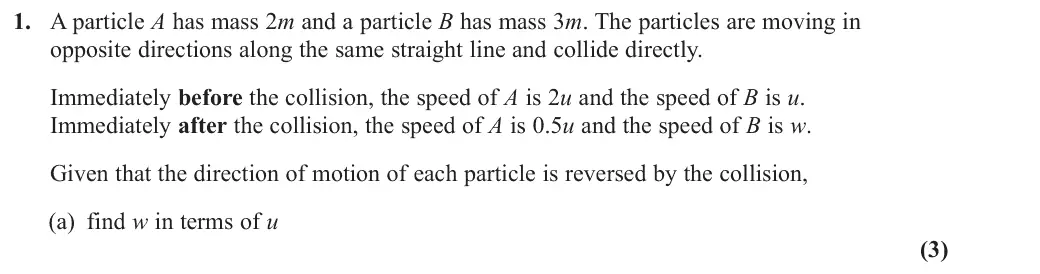
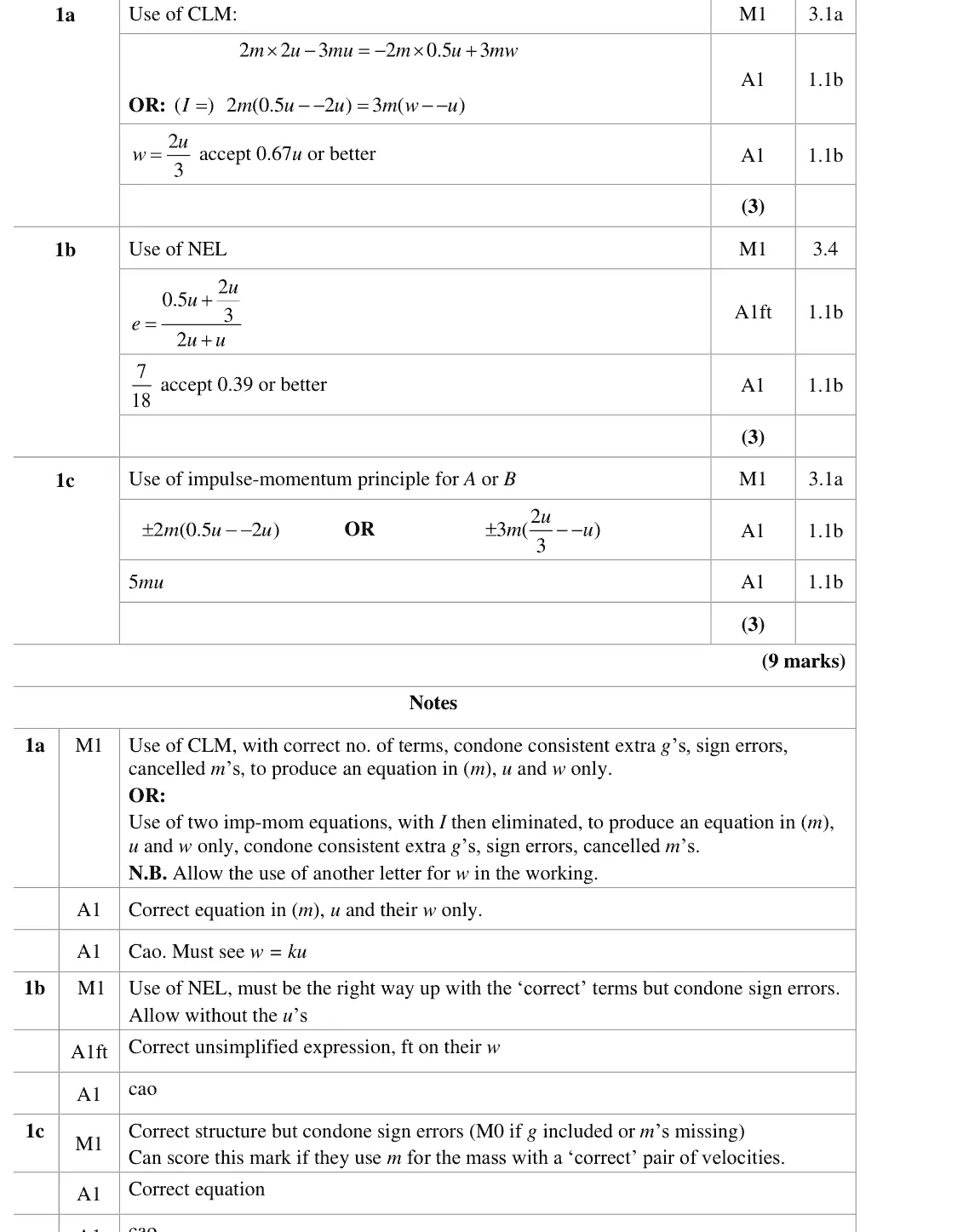
There were many fully correct responses and in part (a), almost all applied the conservation of momentum principle with the occasional use of impulse-momentum twice followed by elimination of the impulse. Errors were rare but when they did appear it was due to ignoring the different directions of motion.
Key points from the mark scheme and examiner's report
CLM 2m(2u) − 3mu = −2m(0.5u) + 3mw (or two impulse-momentum equations eliminating I): w = 2u/3
errors from ignoring the reversed directions
June 2024 · AS Paper 2 (Further Mechanics 1) · Q1(c)3 marks
Mark scheme (whole question; this part is marked with the orange bar)
Examiner's comment
Part (c) was often correctly done even if the first two parts were wrong. A minority left their answer as -5mu and lost the final mark and a few used a generic m instead of the actual mass in their impulse-momentum equation.
Key points from the mark scheme and examiner's report
impulse on A = 2m(0.5u − (−2u)) or on B = 3m(2u/3 + u): magnitude 5mu
leaving −5mu, or using a generic mass m
June 2024 · AS Paper 2 (Further Mechanics 1) · Q4(a)3 marks
Mark scheme (whole question; this part is marked with the orange bar)
Examiner's comment
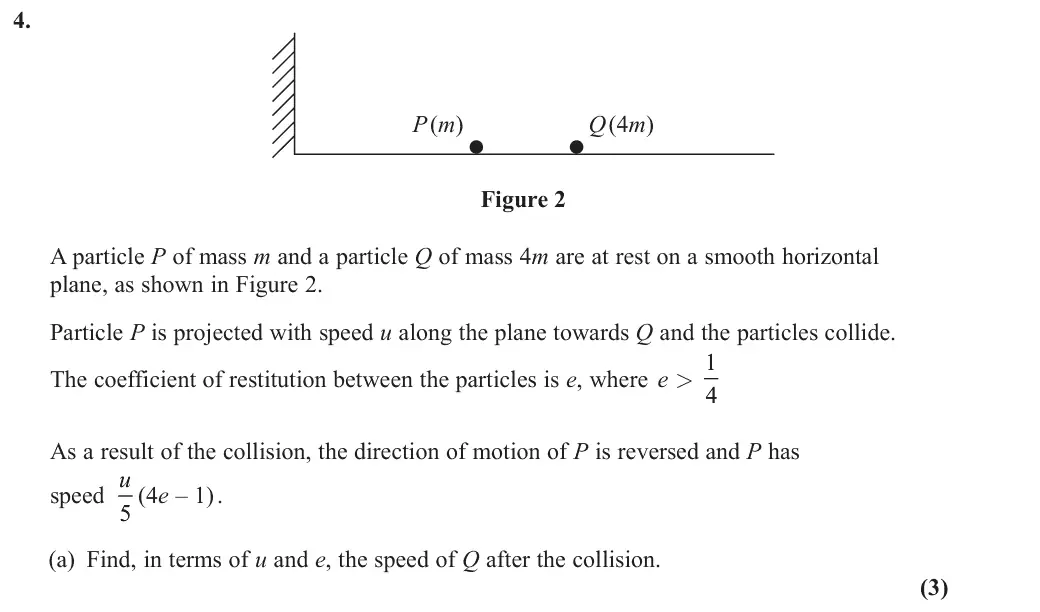
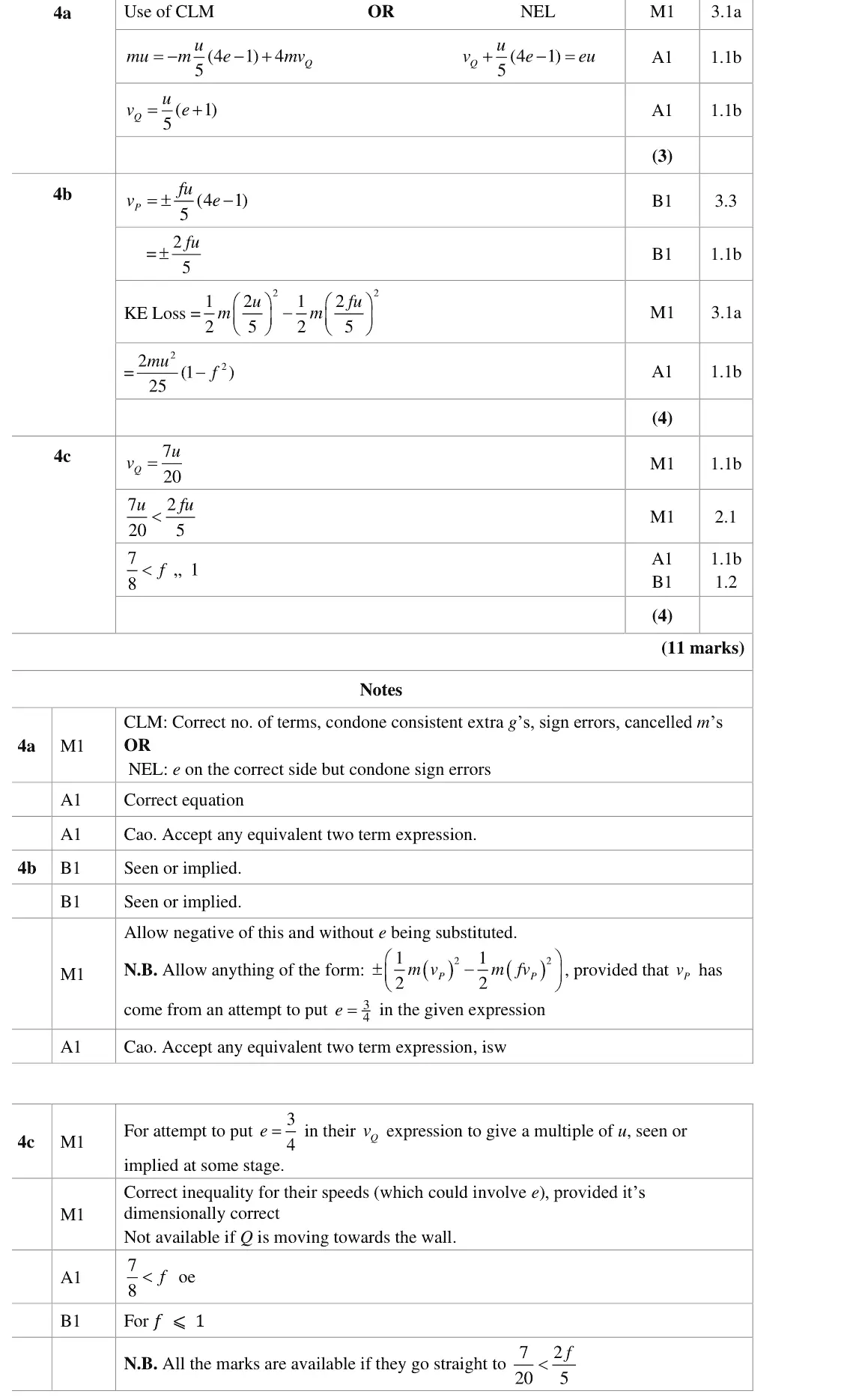
Part (a) was well answered with those candidates who used NEL making fewer sign errors than those who used CLM where the algebra was more difficult. Some candidates seemed unable to simplify their answer by collecting like terms.
Key points from the mark scheme and examiner's report
June 2024 · Paper 3C (Further Mechanics 1) · Q1(b)3 marks
Mark scheme (whole question; this part is marked with the orange bar)
Examiner's comment
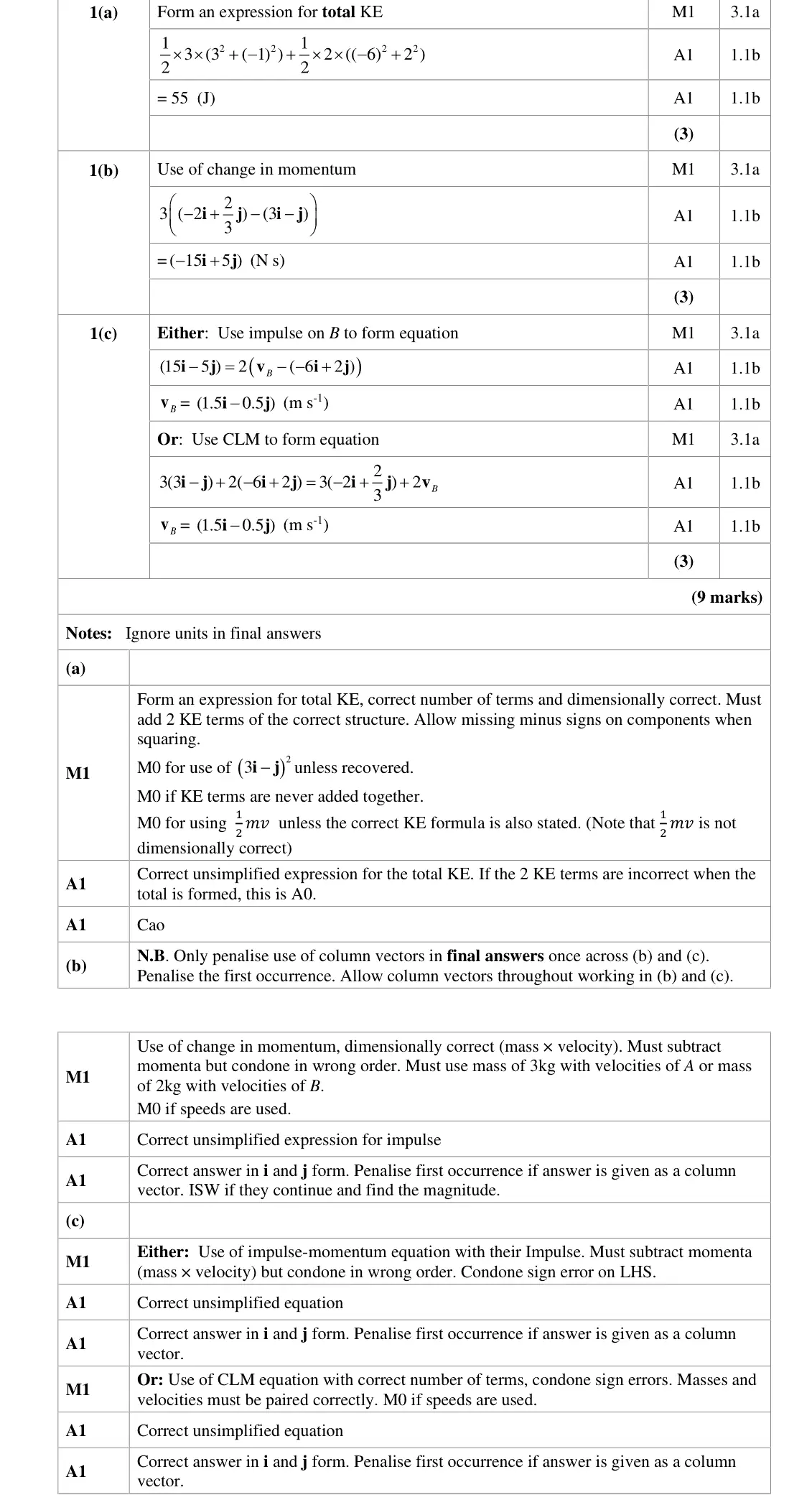
The vast majority chose to use column vectors in parts (b) and (c) with great success. Column vectors are always acceptable throughout working but candidates are advised to double check the required format of the final answer. In this question, candidates were asked to give their final answers to parts (b) and (c) in terms of i and j and those who forgot or ignored the instruction, lost one mark.
Key points from the mark scheme and examiner's report
impulse on A = 3((−2i + (2/3)j) − (3i − j)) = −15i + 5j N s
answer must be in i, j form
June 2024 · Paper 3C (Further Mechanics 1) · Q1(c)3 marks
Mark scheme (whole question; this part is marked with the orange bar)
Examiner's comment
The vast majority chose to use column vectors in parts (b) and (c) with great success. Column vectors are always acceptable throughout working but candidates are advised to double check the required format of the final answer. In this question, candidates were asked to give their final answers to parts (b) and (c) in terms of i and j and those who forgot or ignored the instruction, lost one mark.
Key points from the mark scheme and examiner's report
impulse on B is +15i − 5j (or CLM): v_B = 1.5i − 0.5j m s⁻¹
give answer in terms of i and j
June 2024 · Paper 3C (Further Mechanics 1) · Q4(c)3 marks
Mark scheme (whole question; this part is marked with the orange bar)
Examiner's comment
This was a very popular question with candidates at all levels achieving most of the marks available. successfully in part (b) to find the magnitude of the impulse, and in part (c) to find the loss in KE. The most common error in part (b) was a sign error in the rebound velocity which led to an incorrect impulse. Those who subtracted terms the wrong way round in parts (b) and (c) were more likely to recognise and correct the error.
Key points from the mark scheme and examiner's report
B rebounds at u(1 + e)
impulse m(u(1 + e) + 2u(1 + e)) = 3mu(1 + e)
sign of the rebound velocity the commonest error
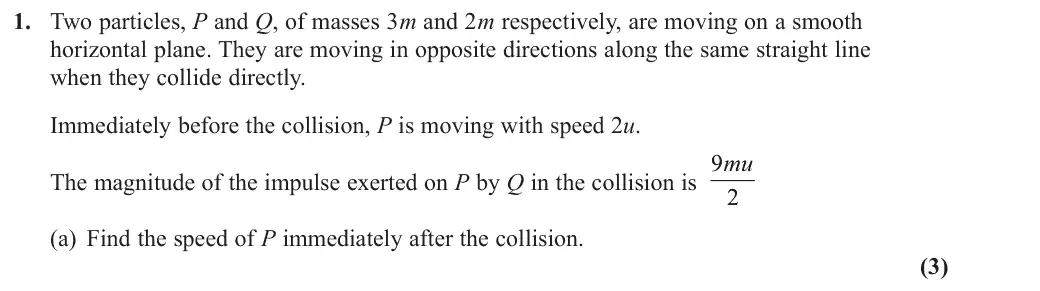
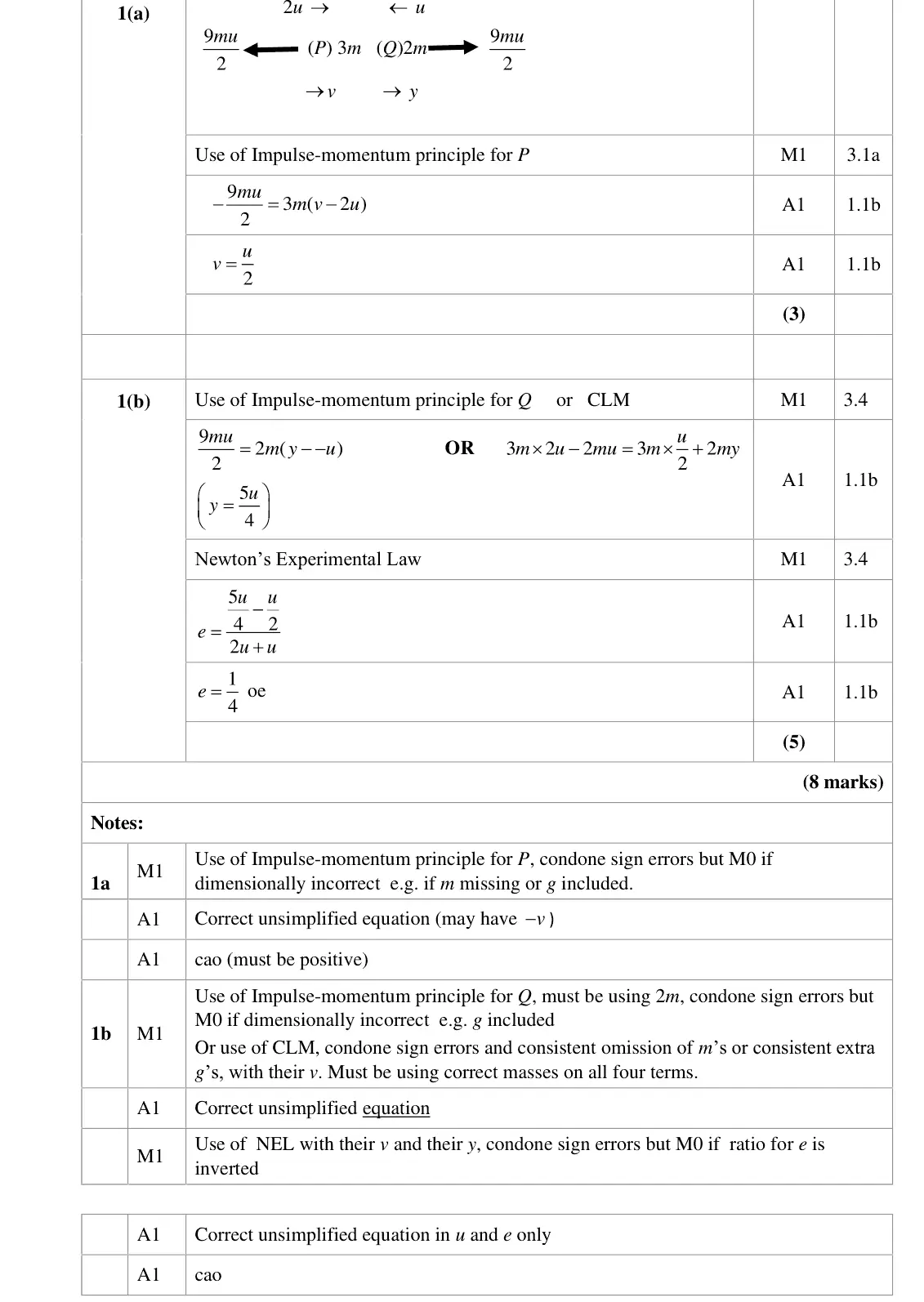
June 2023 · AS Paper 2 (Further Mechanics 1) · Q1(a)3 marks
Mark scheme (whole question; this part is marked with the orange bar)
Examiner's comment
There were many fully correct responses and in part (a), almost all applied the impulse- momentum principle to P. However, it was common to see a sign error which then often also cost the A marks in (b). Most knew that the answer needed to be positive but some gave a negative
Key points from the mark scheme and examiner's report
impulse-momentum for P: −9mu/2 = 3m(v − 2u) gives v = u/2 (speed must be positive)
sign errors here cost marks in (b) too
June 2023 · AS Paper 2 (Further Mechanics 1) · Q1(b)5 marks
Mark scheme (whole question; this part is marked with the orange bar)
Examiner's comment
the A marks in (b). Most knew that the answer needed to be positive but some gave a negative value for the speed and lost a mark. In part (b), most opted to first use CLM to find the speed of Q after the collision but the down side of this was that it involved using their answer to (a) which if wrong, led to the loss of all the A marks in the second part. Those who used the impulse-momentum principle on Q could get (a) wrong but (b) fully correct. Most then applied NEL correctly, with a correct approach speed of 3u but many got the wrong answer due to an earlier error. A minority of candidates tried to solve (b) by substituting an expression for vQ obtained using NEL into their CLM equation (or vice versa) and then substituting the value of vP from (a). Some did this successfully to obtain a correct value for e. However, some never actually substituted their vP so were unable to obtain an answer.
Key points from the mark scheme and examiner's report
impulse on Q 9mu/2 = 2m(y + u) or CLM gives y = 5u/4
NLR e = (5u/4 − u/2)/(2u + u) = 1/4
using the impulse on Q avoids follow-on from an error in (a)
approach speed is 3u
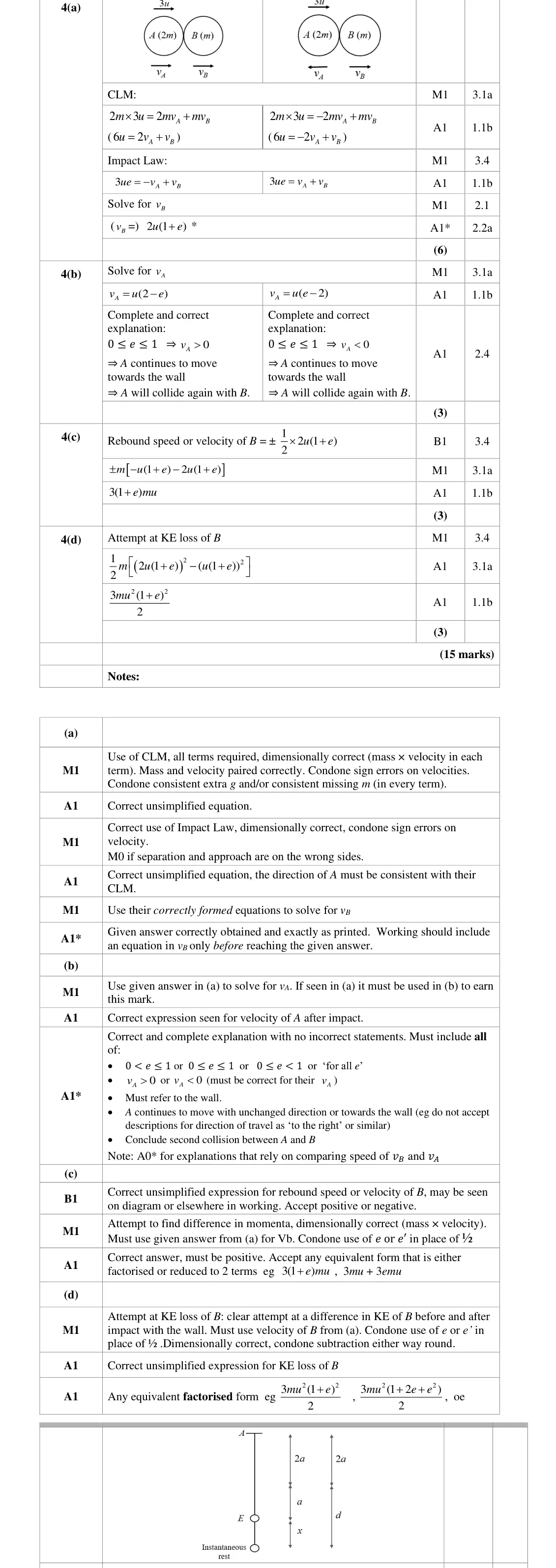
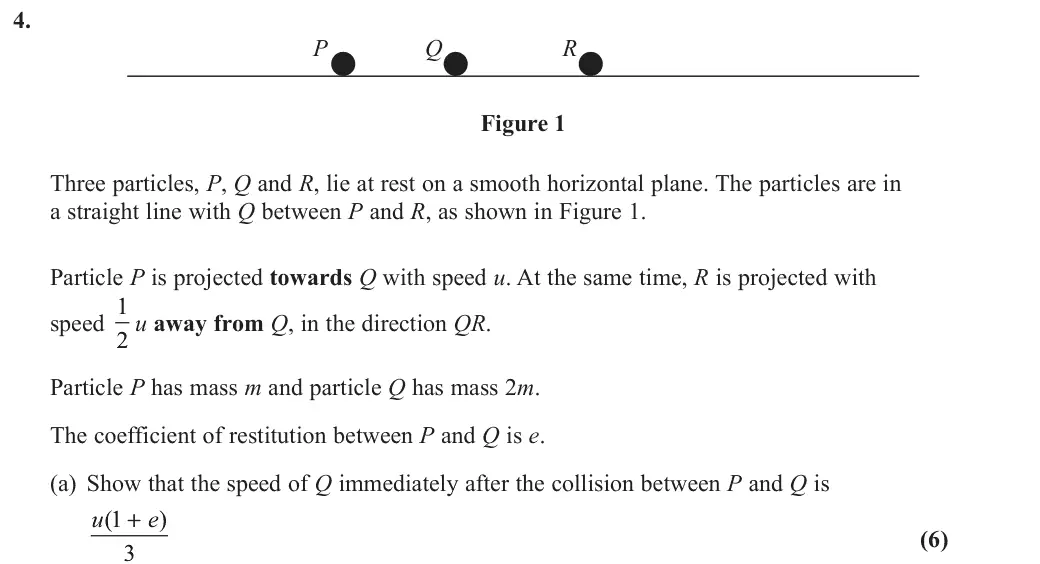
June 2023 · AS Paper 2 (Further Mechanics 1) · Q4(a)6 marks
Mark scheme (whole question; this part is marked with the orange bar)
Examiner's comment
Part (a) was well answered with most candidates producing and solving the two simultaneous equations using CLM and NEL. The method of solution of the equations varied, and some found vP before vQ , but most ensured they achieved the required expression correctly. used for P in part (a) and so incorrectly interpreted their expression. Many candidates are still unable to specify a direction correctly and there was a variety of incorrect vague answers: moving left, west, backwards, away from Q, in the negative direction etc with even strong candidates, who achieved full marks in the rest of the question, unable to give a precise answer.
Key points from the mark scheme and examiner's report
CLM mu = −mv_P + 2mv_Q and NLR eu = v_P + v_Q
solve for v_Q = u(1 + e)/3
June 2023 · Paper 3C (Further Mechanics 1) · Q1(a)4 marks
Mark scheme (whole question; this part is marked with the orange bar)
Examiner's comment
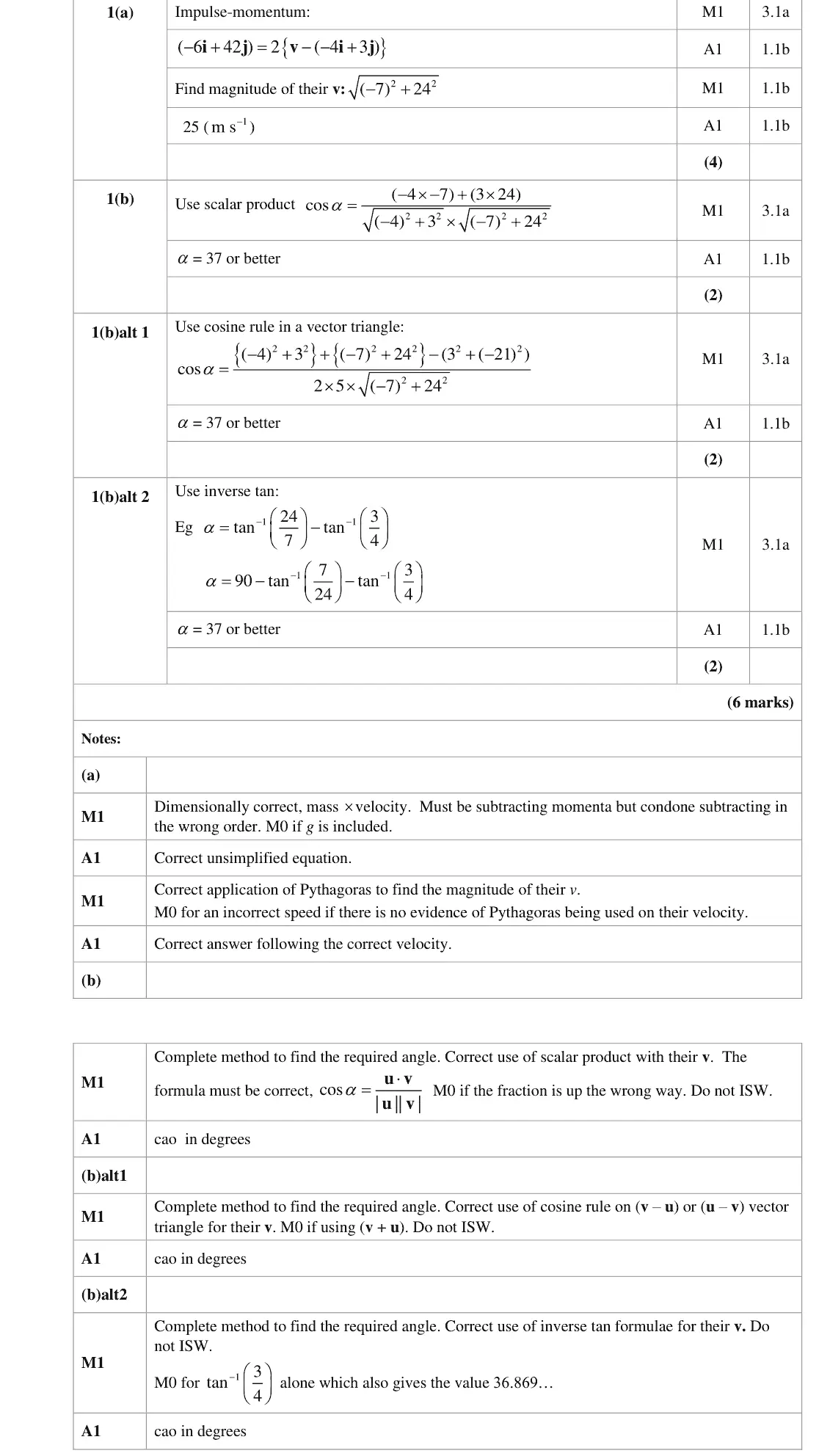
all grades gaining full marks. In part (a), almost all candidates achieved the first 2 marks for a correct impulse-momentum equation. Although most continued to find the speed, a significant proportion of candidates at all levels failed to calculate the magnitude of their velocity, instead moving directly onto part (b). The vast majority of candidates scored both marks in part (b)
Key points from the mark scheme and examiner's report
June 2023 · Paper 3C (Further Mechanics 1) · Q1(b)2 marks
Mark scheme (whole question; this part is marked with the orange bar)
Examiner's comment
moving directly onto part (b). The vast majority of candidates scored both marks in part (b) with the most common approach using the scalar product. The inverse tan alternative was also popular and well-executed. Where there were errors in part (b), they generally arose from a poor choice of vectors, incorrectly using the impulse vector instead of both velocity vectors.
Key points from the mark scheme and examiner's report
scalar product of −4i + 3j and −7i + 24j: α = 36.9 (37)
using the impulse vector instead of the two velocities was the usual error
tan⁻¹(3/4) alone scores 0
June 2023 · Paper 3C (Further Mechanics 1) · Q6(a)5 marks
Mark scheme (whole question; this part is marked with the orange bar)
Examiner's comment
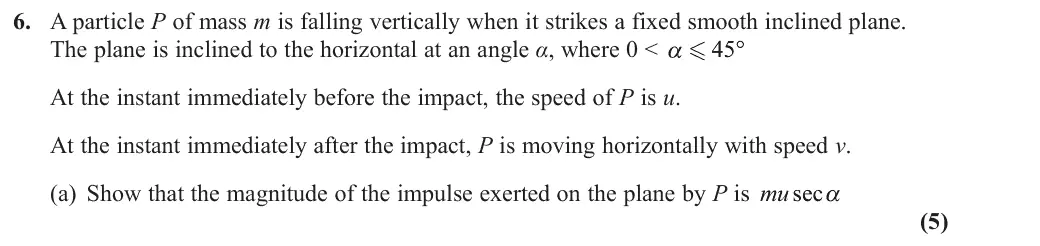
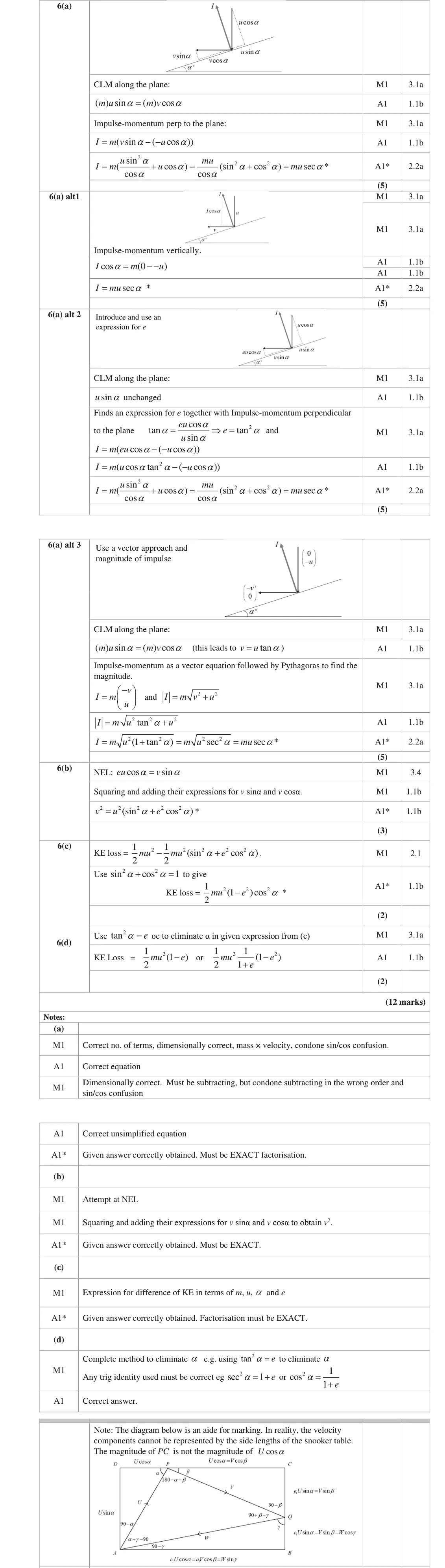
There were four parts to this question with parts (a), (b) and (c) all having given answers. Unfortunately, many candidates abandoned attempts at (d) or left it completely blank. Part (a) had at least four possible approaches and the presentation from candidates as they attempted to combine different pathways to reach the given answer was often poor. To make any progress, candidates needed to recognise that the angle between the final velocity and the slope was also alpha . Those who introduced a new angle rarely progressed to the given answer. The most common correct response was the main scheme followed by the vector alternative 3 approach. Some candidates took longer to reach the answer by introducing e but the intermediary result, 2 tan e = , gave them an advantage in part (d).
Key points from the mark scheme and examiner's report
final velocity also makes angle α with the plane
component along the plane conserved: u sin α = v cos α
impulse perpendicular to plane m(v sin α + u cos α) = mu sec α
a new angle rarely led anywhere
June 2022 · AS Paper 2 (Further Mechanics 1) · Q2(a)7 marks
Mark scheme (whole question; this part is marked with the orange bar)
Examiner's comment
In part (a), the most efficient method for finding e was to use the impulse-momentum principle for each particle to find the speeds after the collision and then substitute these values, with the correct signs into NEL. This was the most common and successful method. Those candidates who obtained expressions for either or both speeds in terms of e often lost their way in the algebra involved, usually due to incorrect multiplying out of brackets. Most candidates wrote down a correct CLM equation, but errors occurred most often in the Impulse-momentum equations, usually in assigning the correct direction to the impulse on the particle. Other errors occurred through a lack of consistency in the use of signs assigned to velocities. A few wrote the NEL equation with 3u in the numerator or had (2u – u) in the denominator. In the second part, almost all who obtained e = 1 by a
Key points from the mark scheme and examiner's report
impulse-momentum for each particle: 9mu/2 = m(v + 2u) and 9mu/2 = 3m(w + u) give v = 5u/2, w = u/2
NLR e = (5u/2 + u/2)/(2u + u) = 1
errors in the direction of the impulse and inconsistent signs
denominator must be 3u
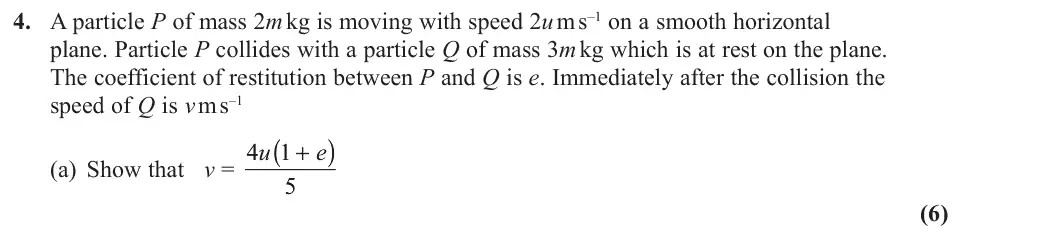
June 2022 · AS Paper 2 (Further Mechanics 1) · Q4(a)6 marks
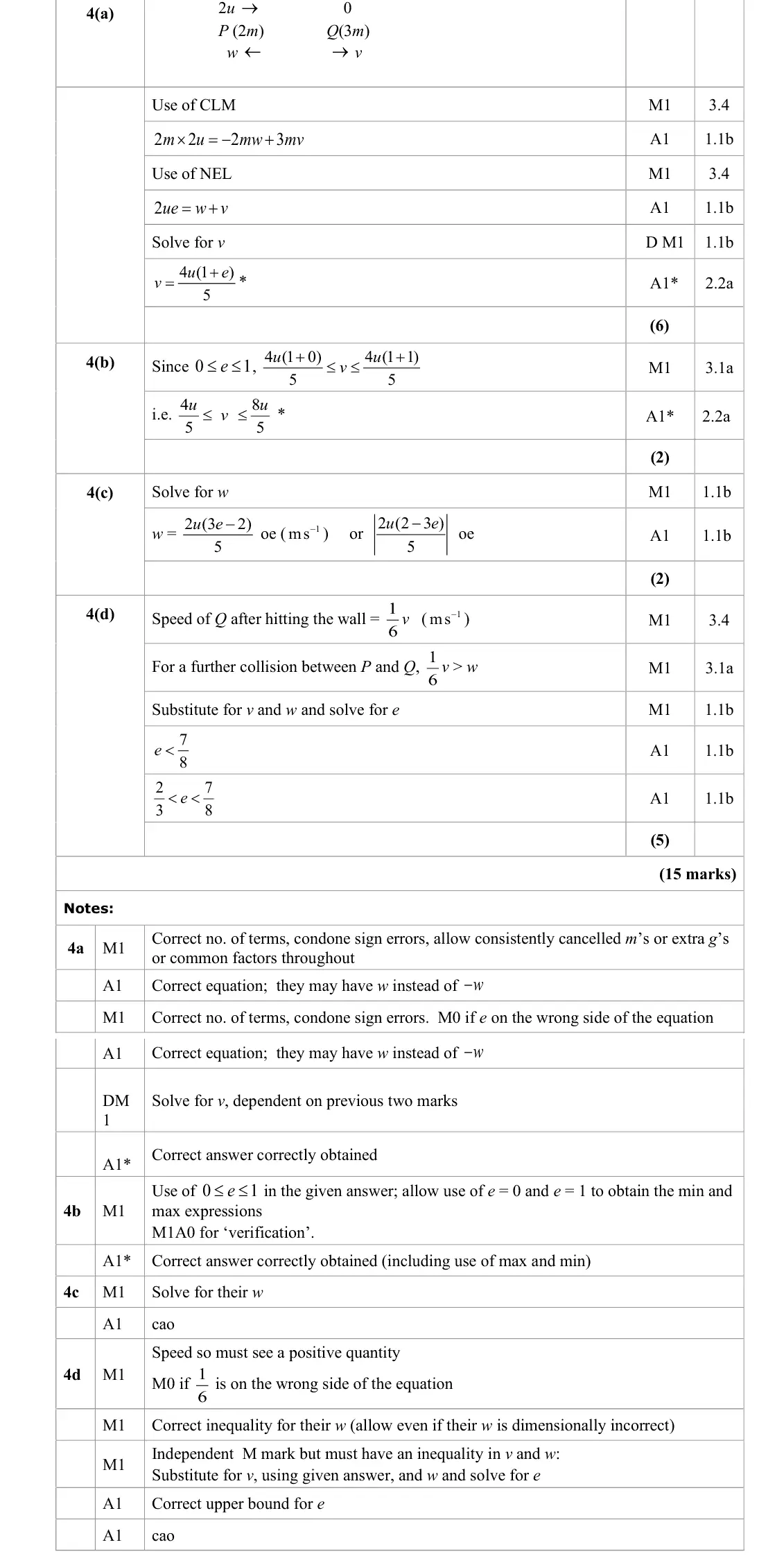
Mark scheme (whole question; this part is marked with the orange bar)
Examiner's comment
In part (a), the given result was successfully proven by almost all of the many candidates who attempted this question. Those who stumbled with initial inconsistent directions in their CLM and NEL equations usually recovered well. The algebra required was not a problem with various substitutions or eliminations handled competently. Most gave a correct verification in part (b) by substituting e = 0 and e = 1 into the expression for v to
Key points from the mark scheme and examiner's report
CLM 4mu = −2mw + 3mv and NLR 2ue = w + v
eliminate w: v = 4u(1 + e)/5
keep directions consistent
June 2022 · Paper 3C (Further Mechanics 1) · Q1(a)3 marks
Mark scheme (whole question; this part is marked with the orange bar)
Examiner's comment
Those candidates who drew a clear diagram did well on this question, especially in part (b) when considering the two situations and the change of direction for particle A. (a) There were many fully correct solutions to this question. The most common errors were due to incorrect pairing of masses and velocities in the impulse equation, and using the incorrect initial direction for particle B. Some candidates attempted to use CLM in part (a). A few paired this with the impulse- momentum principle for A and solved simultaneous equations to find v.
Key points from the mark scheme and examiner's report
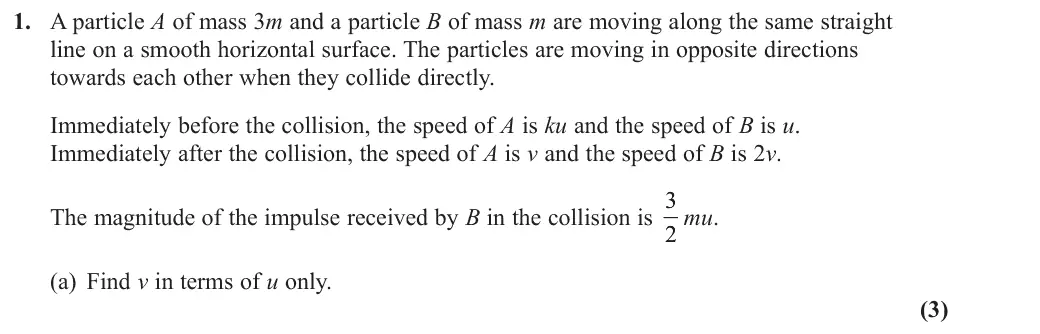
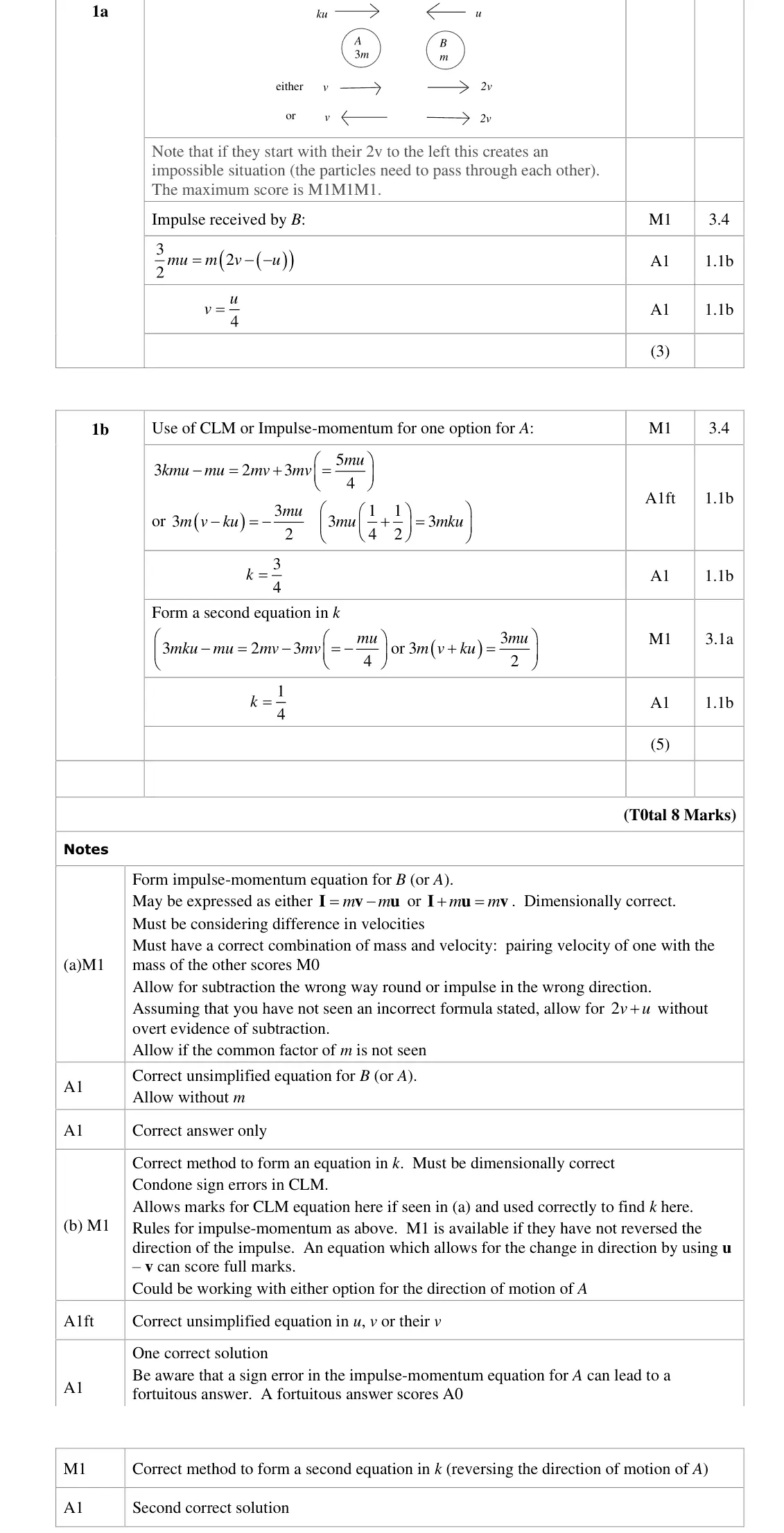
impulse on B: (3/2)mu = m(2v − (−u)) gives v = u/4
B must move away from A (2v to the left is impossible)
pairing the wrong mass and velocity was the commonest error
June 2022 · Paper 3C (Further Mechanics 1) · Q1(b)5 marks
Mark scheme (whole question; this part is marked with the orange bar)
Examiner's comment
Those candidates who drew a clear diagram did well on this question, especially in part (b) when considering the two situations and the change of direction for particle A. (b) Those candidates with a clear diagram often scored full marks. Candidates without a clear sense of how the two possible values of k arose usually had a correct method for finding one value but struggled to find a second. A significant minority of candidates worked on the impossible situation with particle B passing through particle A.
Key points from the mark scheme and examiner's report
A may continue or reverse: CLM or impulse on A for each case: k = 3/4 and k = 1/4
a clear diagram was key
some worked on B passing through A
June 2022 · Paper 3C (Further Mechanics 1) · Q35 marks
Mark scheme (whole question; this part is marked with the orange bar)
Examiner's comment
This question was accessible to most candidates and many fully correct solutions were seen. The candidates understood that the problem was two-dimensional and made an attempt to resolve either the velocity or the impulse with the former being the most popular and successful method seen. It was common for candidates to work in vector form throughout and this provided a very concise approach. There was occasional confusion between sine and cosine in the components. The cosine rule method was rarely used and candidates who attempted this tended to be less successful, often starting with an incorrect triangle, either dimensionally incorrect or with the vectors combined incorrectly.
Key points from the mark scheme and examiner's report
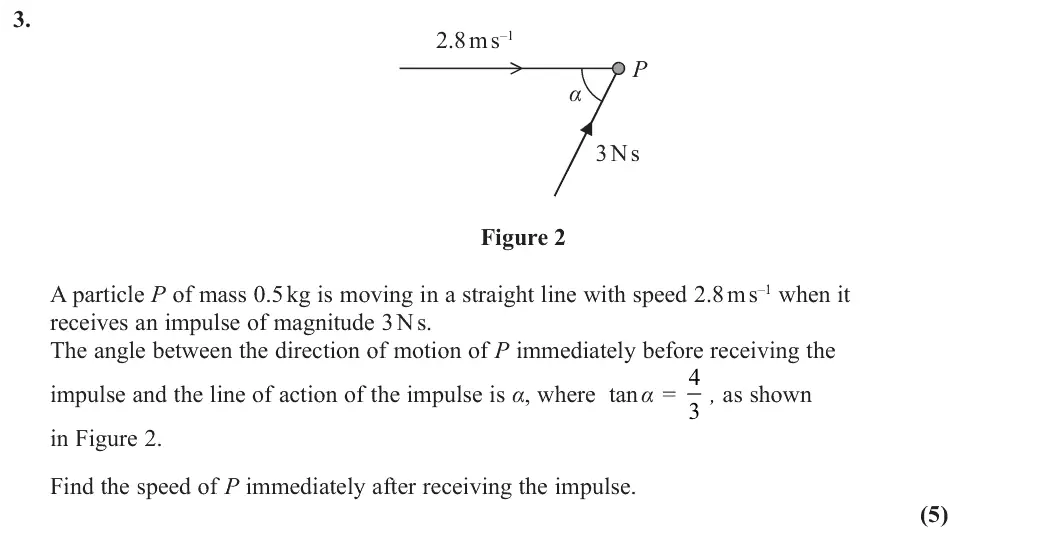
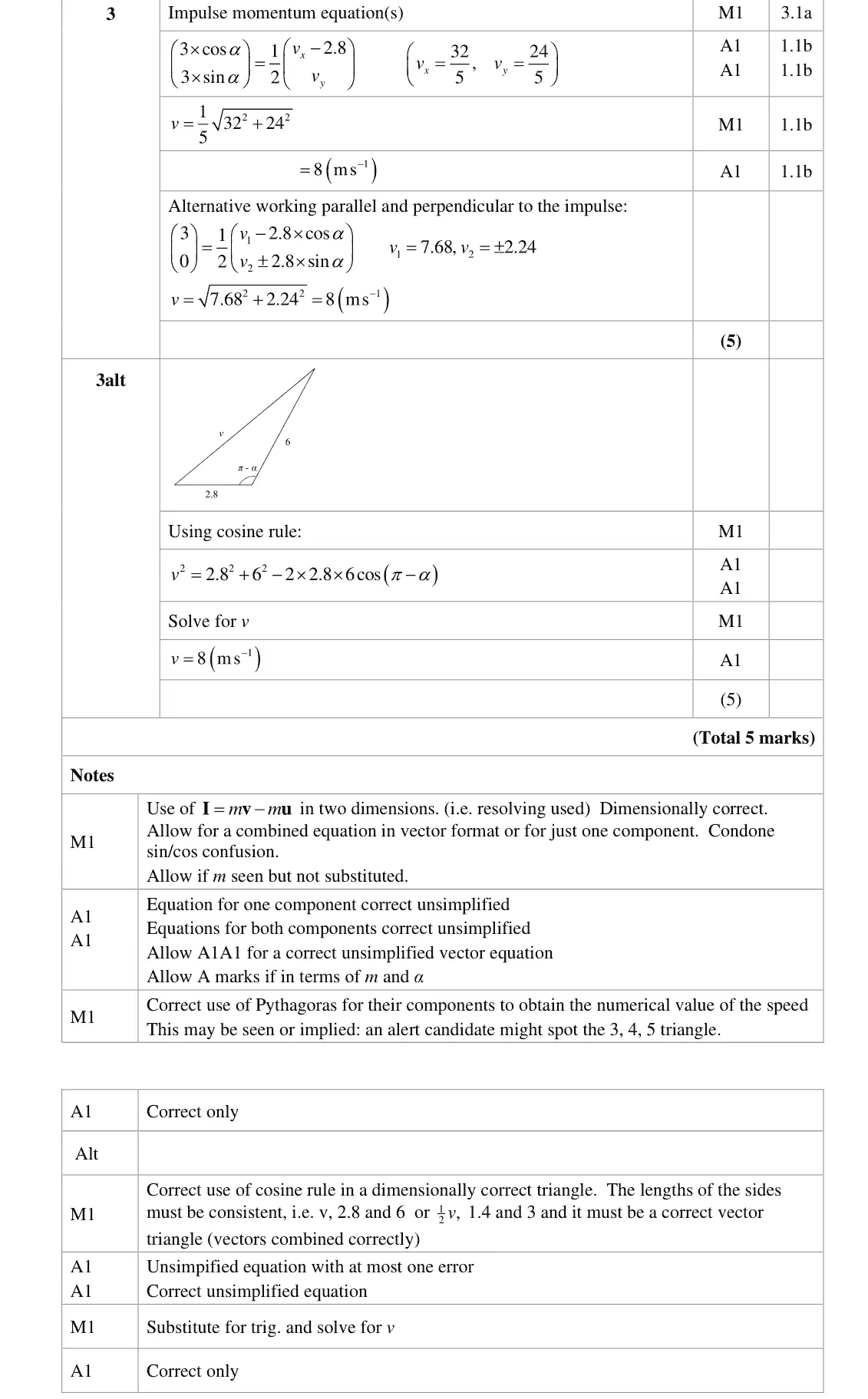
resolve: 3cos α = ½(vx − 2.8), 3sin α = ½vy: v = (32/5, 24/5), speed 8 m s⁻¹
vector form concise
cosine-rule triangles often set up wrongly
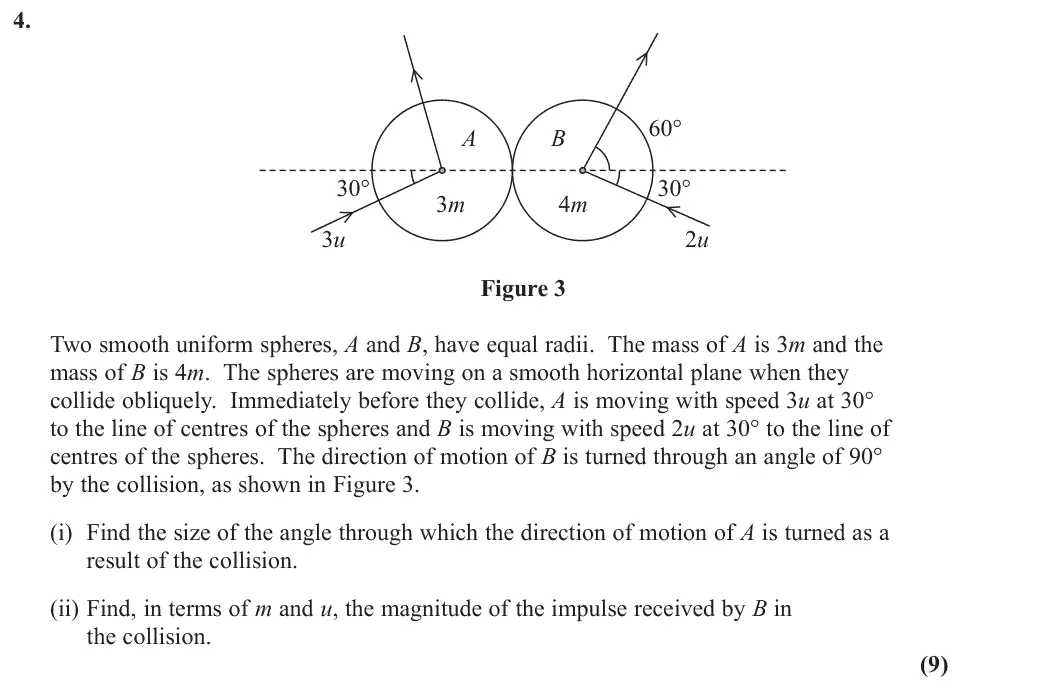
June 2022 · Paper 3C (Further Mechanics 1) · Q49 marks
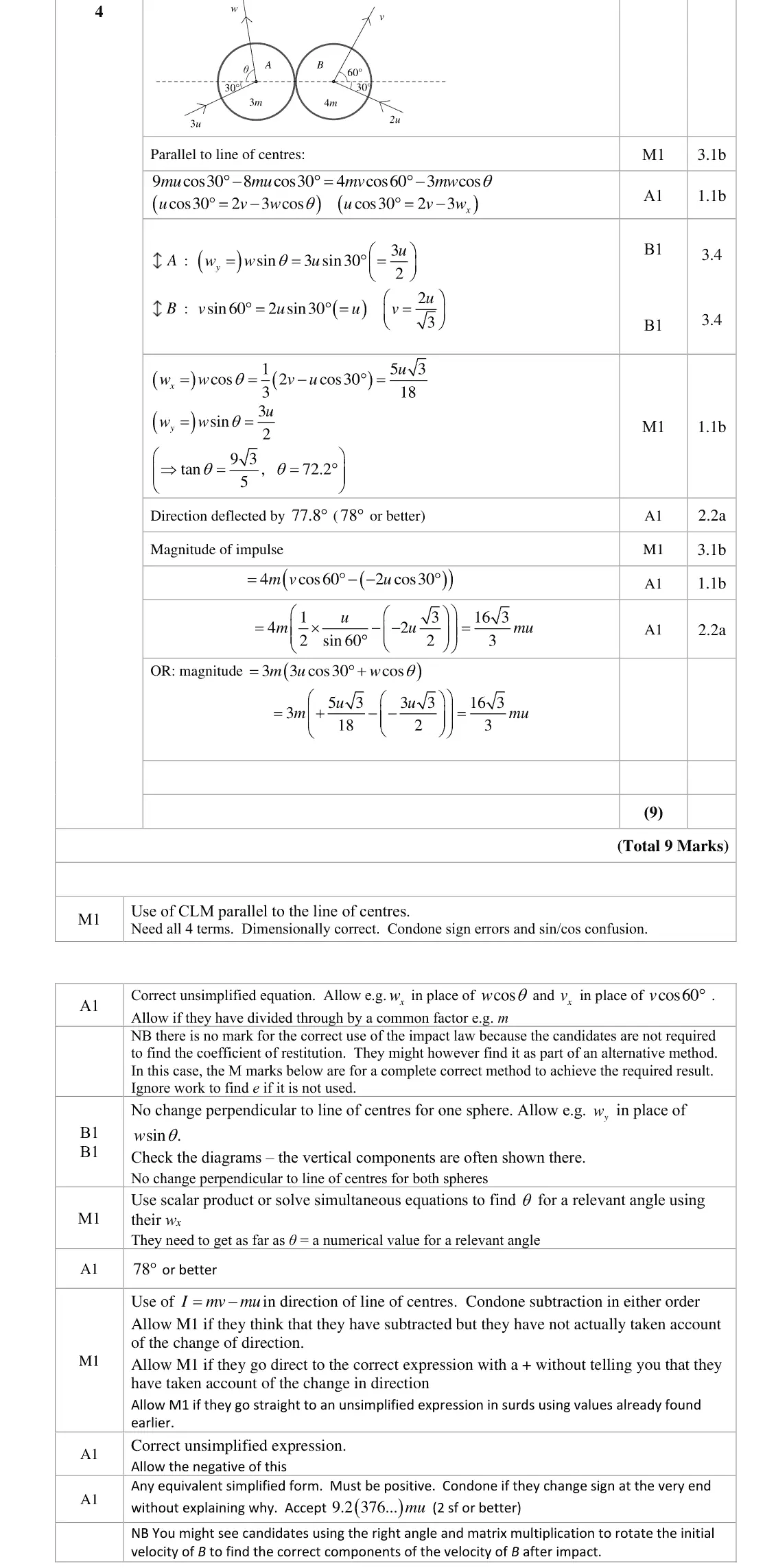
Mark scheme (whole question; this part is marked with the orange bar)
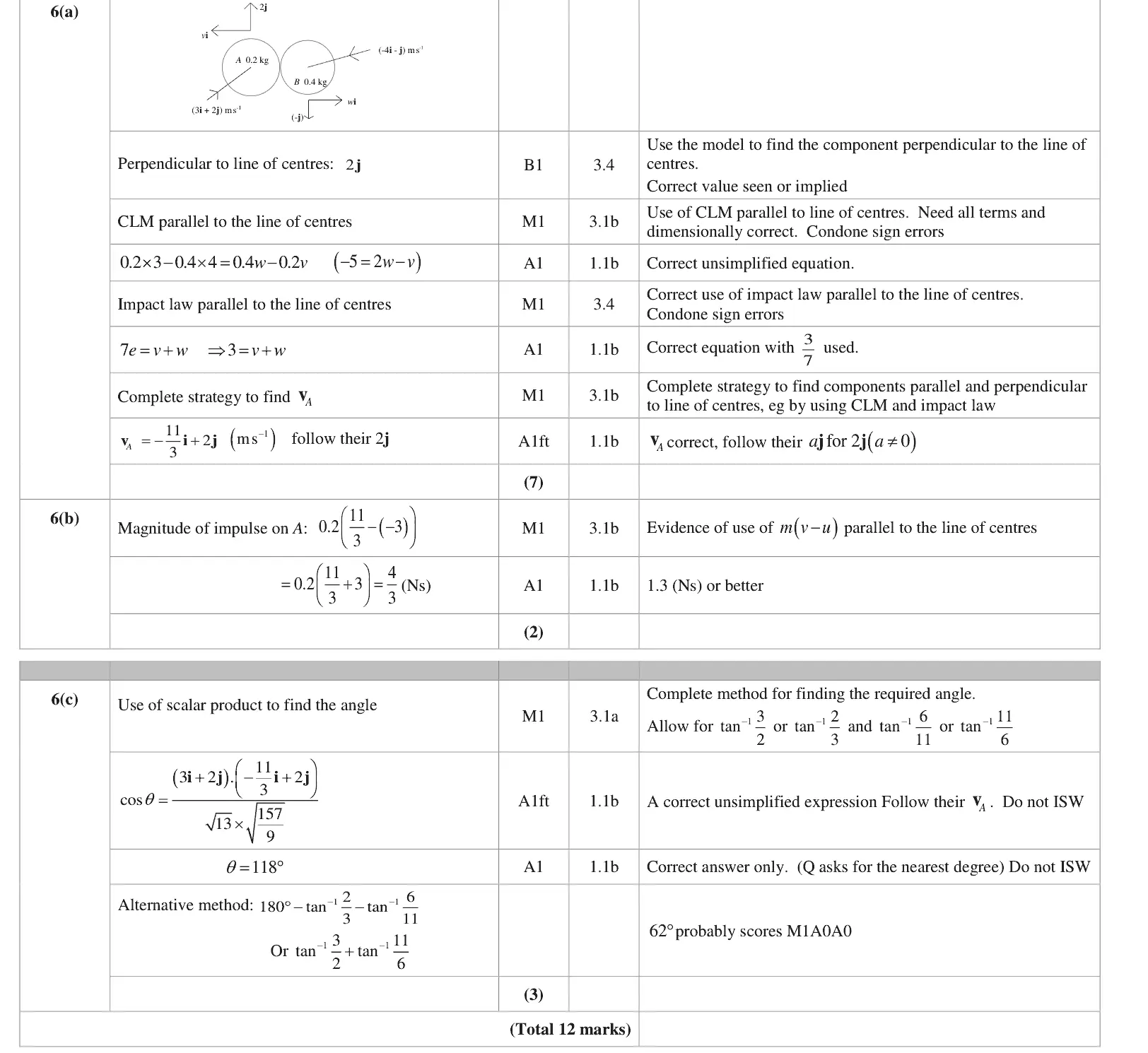
Examiner's comment
This question was accessible to all candidates, with virtually no blank responses. The candidates who were most successful started with a clearly labelled diagram. marking angles appropriately, and in particular assigning directions to velocities. Those who assigned a negative component to the velocity of A parallel to the line of centres after impact were more successful. Realising that the component of velocity perpendicular to the line of centres was unchanged for each mass was key to reaching a successful solution. Many marked this on their diagram. Most candidates understood that Conservation of Momentum parallel to line of centres should be used. There were few sign errors. A few candidates attempted to use the impact law, but that was not needed in this case. Those candidates who used vectors to represent the velocities and used the scalar product usually obtained the correct angle. Candidates who considered the components of the velocity often found a relevant angle, but they did not always use that correctly to find the required angle: the incorrect answer 102.2 was very common. Despite a large number of sign errors, many candidates did obtain the correct exact value for the magnitude of the impulse.
Key points from the mark scheme and examiner's report
perpendicular components unchanged
B turned 90° gives v = 2u/√3
CLM along the line of centres (no impact law needed)
A deflected 77.8°
impulse on B 16√3mu/3 = 9.24mu (positive)
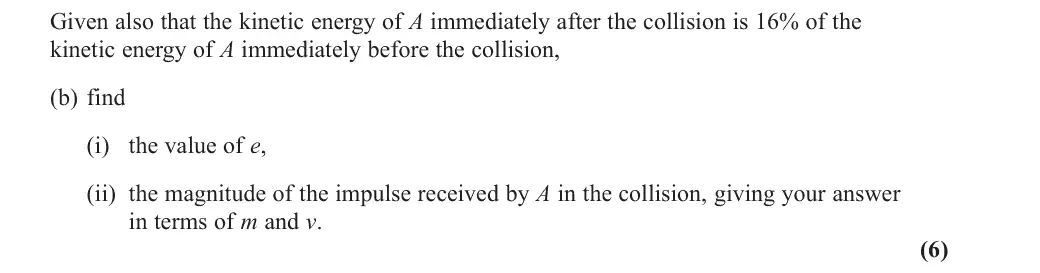
Nov 2021 · Paper 3C (Further Mechanics 1) · Q2(b)6 marks
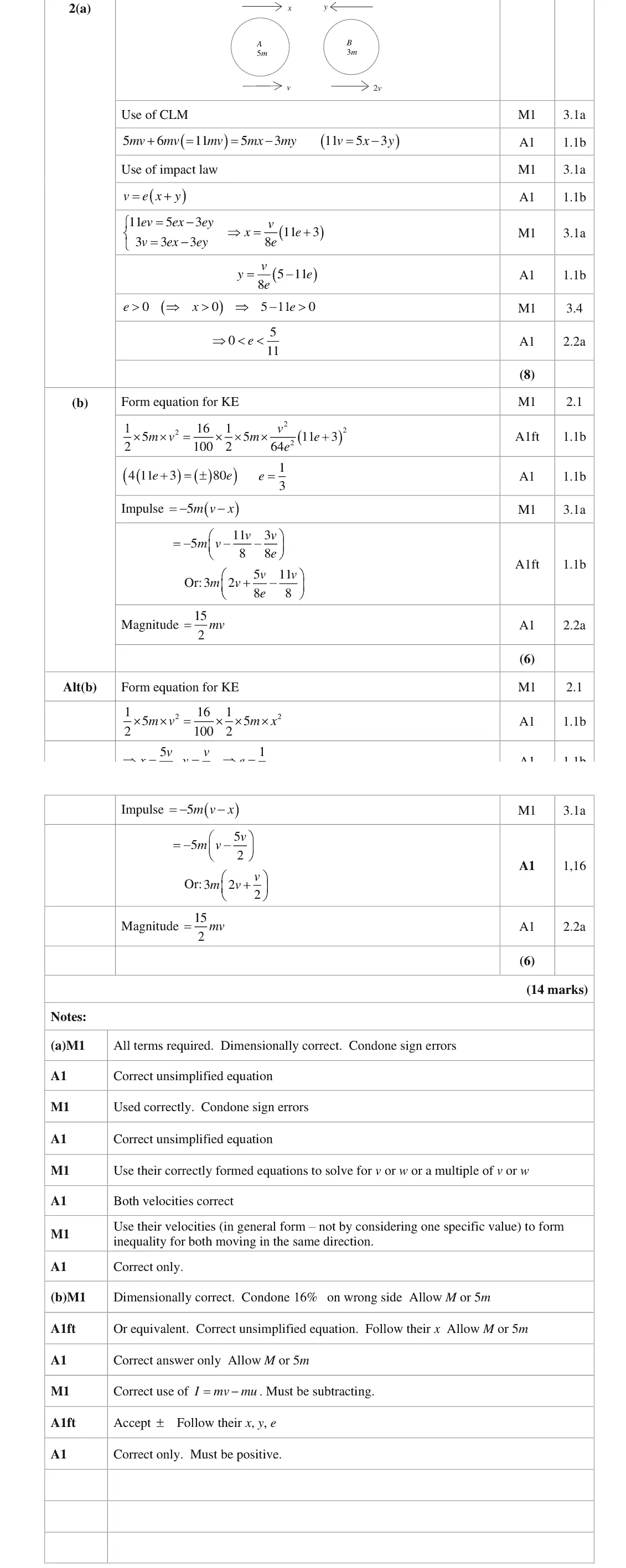
Mark scheme (whole question; this part is marked with the orange bar)
Examiner's comment
(b) Several candidates understood the methods required here and were able to score marks for finding the value of e and the magnitude of impulse.
Key points from the mark scheme and examiner's report
KE of A after = 16% of before, so x = 5v/2 and e = 1/3
impulse = 5m(v − x), magnitude 15mv/2 (must be positive)
Nov 2021 · Paper 3C (Further Mechanics 1) · Q48 marks
Mark scheme (whole question; this part is marked with the orange bar)
Examiner's comment
The candidates approached this question with confidence and several gained full marks. The method was generally well understood and most errors in finding the value of λ were due to slips in the arithmetic or algebra. Some candidates used the impulse and a velocity rather than the two velocities in their attempt to find the value of . theta
Key points from the mark scheme and examiner's report
some used the impulse rather than the two velocities for θ
Nov 2021 · Paper 3C (Further Mechanics 1) · Q7(b)3 marks
Mark scheme (whole question; this part is marked with the orange bar)
Examiner's comment
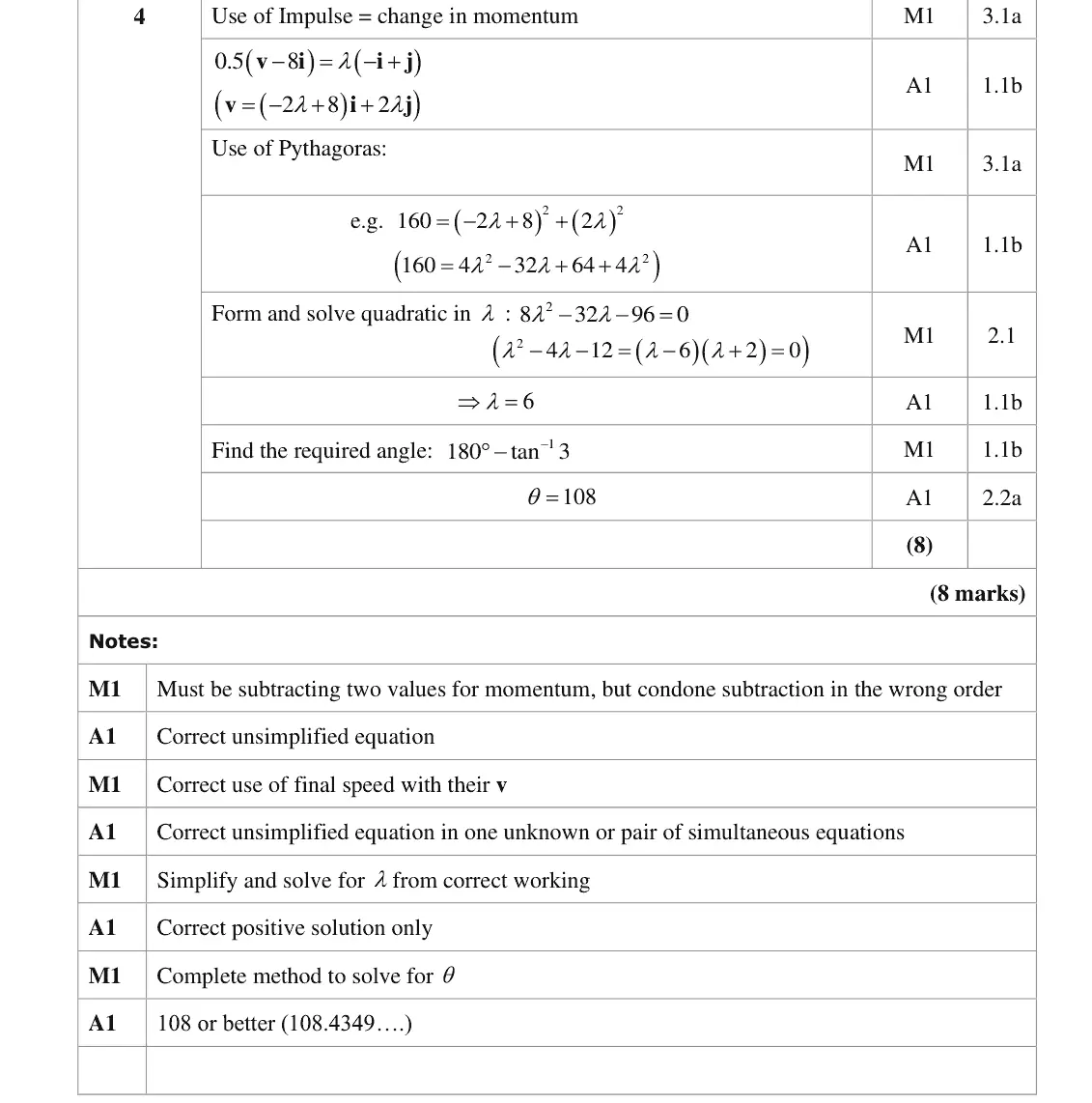
(b) Many candidates used the given result from part (a) to score full marks for finding the magnitude of the impulse.
Key points from the mark scheme and examiner's report
I = 0.25((4i + 6j) − (8i + 2j)) = −i + j
magnitude √2 = 1.41 N s
Oct 2020 · AS Paper 2 (Further Mechanics 1) · Q1(a)2 marks
Mark scheme (whole question; this part is marked with the orange bar)
Examiner's comment
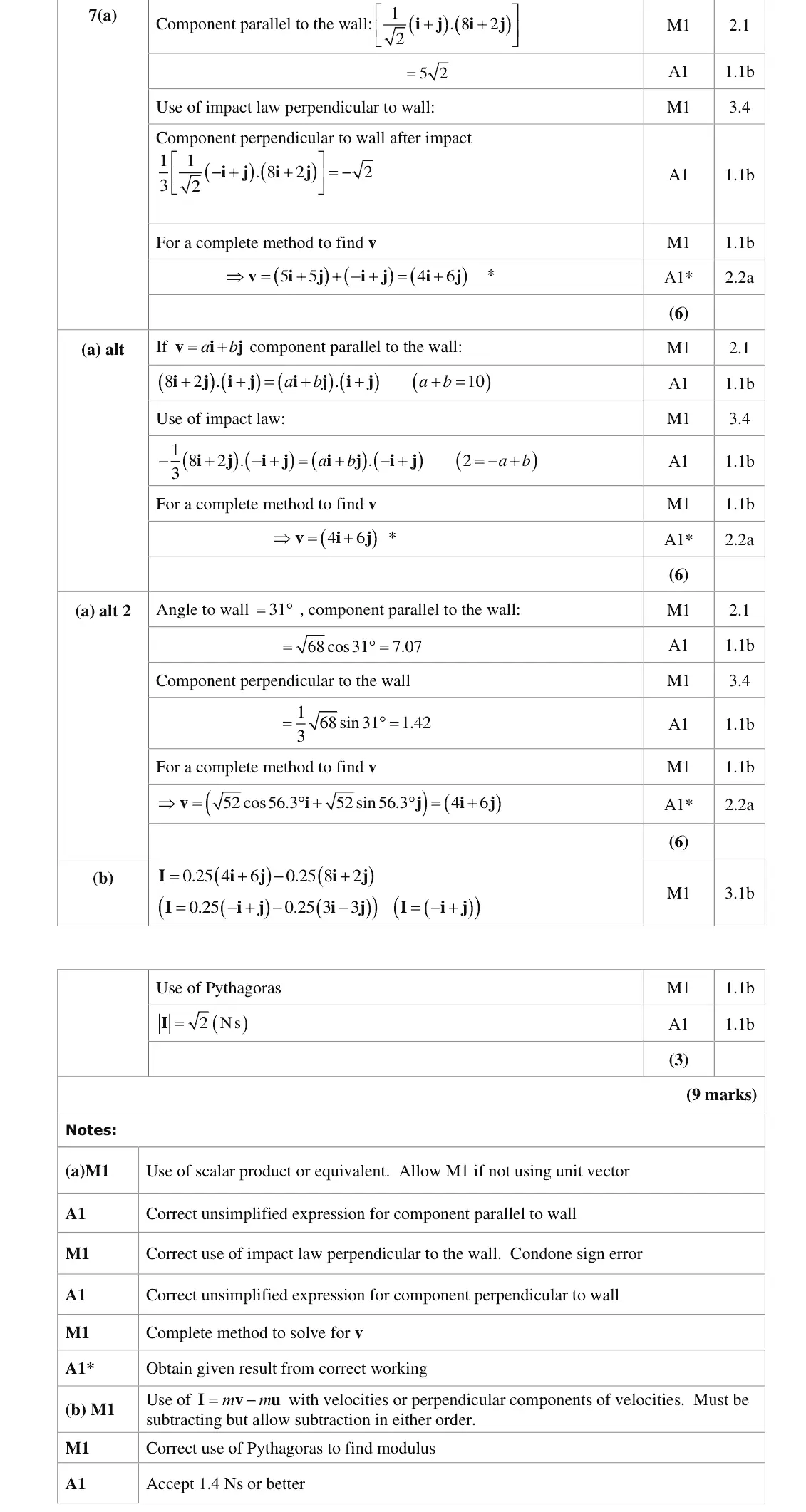
(a) Several candidates did not distinguish between the initial impulse given to the particle P and the impulse in the collision between P and Q. Some diagrams showed evidence of correct thinking, but this was not always translated into dimensionally correct statements. In some solutions it appeared that the candidate thought that the initial impulse had been applied to Q.
Key points from the mark scheme and examiner's report
the impulse gives P speed I/m
CLM in the collision m(I/m) = 4mw so I = 4mw
do not confuse the initial impulse on P with the impulse in the collision, or apply it to Q
Oct 2020 · AS Paper 2 (Further Mechanics 1) · Q3(b)4 marks
Mark scheme (whole question; this part is marked with the orange bar)
Examiner's comment
(b) Those candidates who wrote down an equation for the impulse on B were more likely to make a sign error than those candidates who considered the impulse on C. Here again candidates who started with a correct equation often made arithmetical and algebraic errors in reaching their final answers.
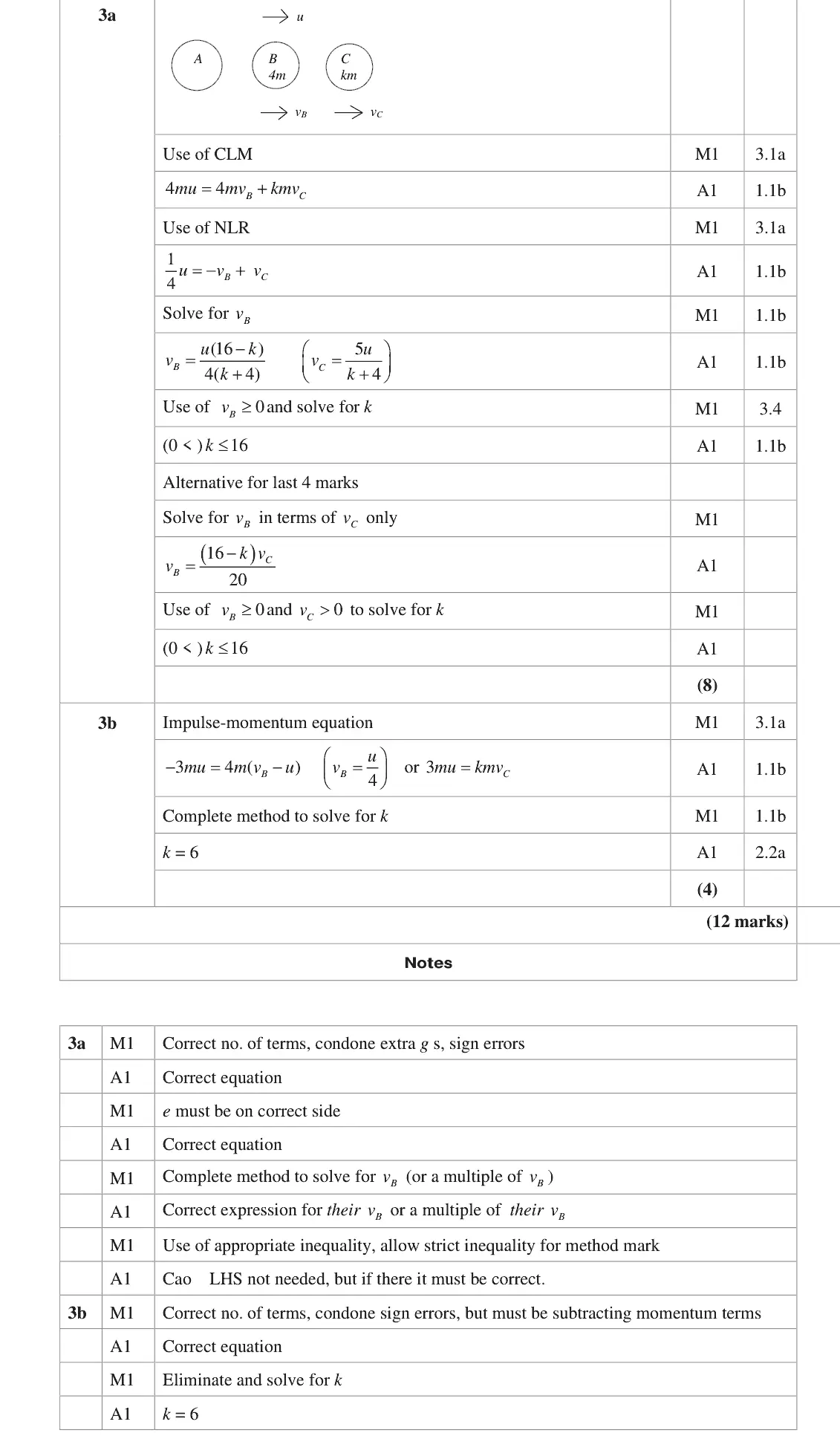
Key points from the mark scheme and examiner's report
impulse on C: 3mu = kmv_C, or on B: −3mu = 4m(v_B − u) giving v_B = u/4
then k = 6
sign errors more common when using the impulse on B
Oct 2020 · Paper 3C (Further Mechanics 1) · Q1(a)4 marks
Mark scheme (whole question; this part is marked with the orange bar)
Examiner's comment
(a) The majority of candidates recognised the need to form an impulse-momentum equation, and many did succeed in finding the magnitude of the impulse correctly. Some candidates found a correct expression for the impulse but did not go on to find the magnitude. There were some slips in the arithmetic and a significant minority of candidates used speeds rather than velocities in their attempt to find the impulse.
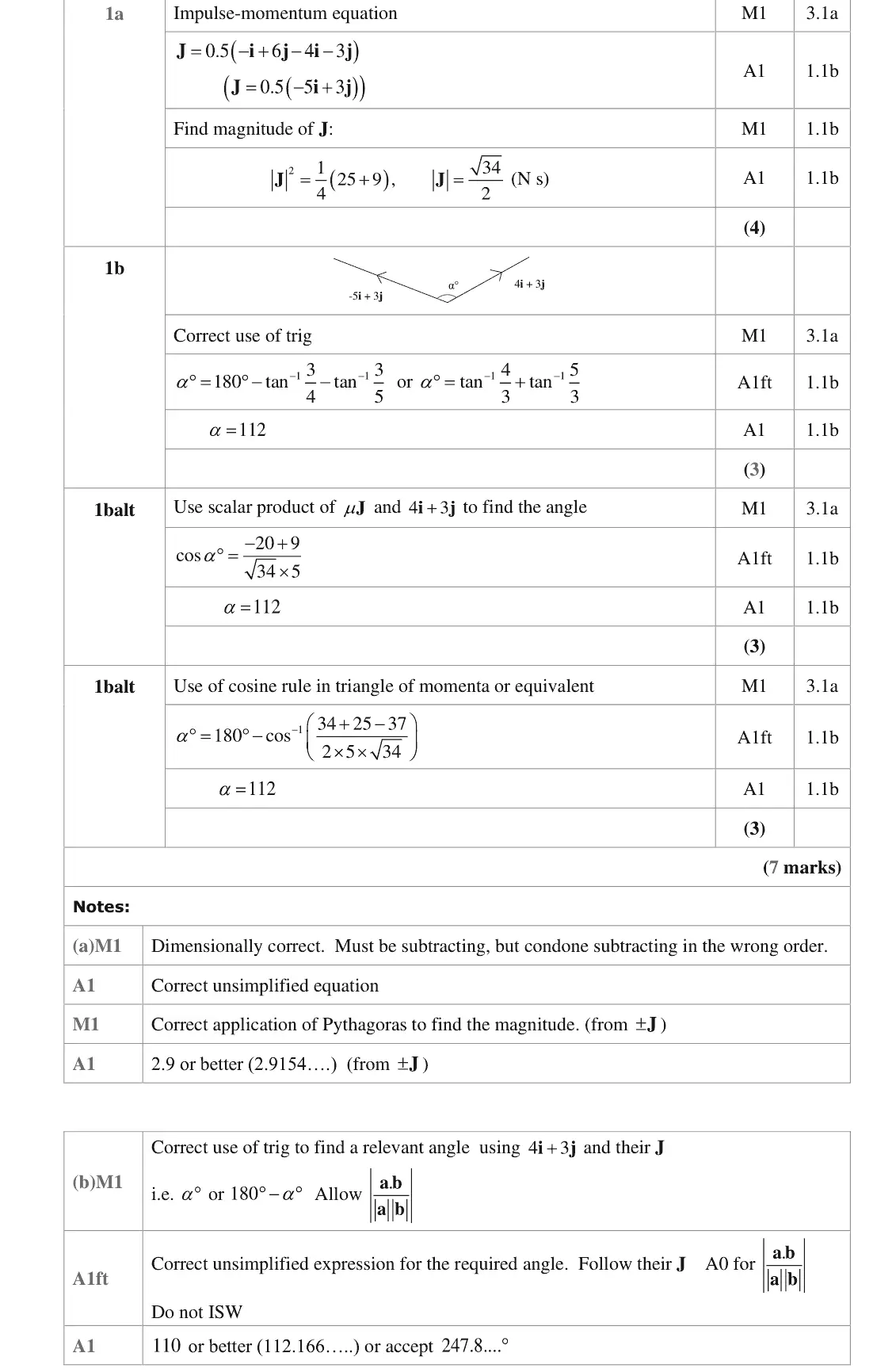
Key points from the mark scheme and examiner's report
J = 0.5((−i + 6j) − (4i + 3j)) = 0.5(−5i + 3j)
magnitude √34/2 = 2.92 N s
some stopped at the vector or used speeds instead of velocities
Oct 2020 · Paper 3C (Further Mechanics 1) · Q1(b)3 marks
Mark scheme (whole question; this part is marked with the orange bar)
Examiner's comment
(b) The simplest way to find the required angle was to use the scalar product, but several candidates had success using alternative methods. Most errors were due to finding the angle between the wrong pair of vectors.
Key points from the mark scheme and examiner's report
scalar product of J (or −5i + 3j) with 4i + 3j: α = 112
most errors used the wrong pair of vectors
June 2019 · AS Paper 2 (Further Mechanics 1) · Q2(a)9 marks
Mark scheme (whole question; this part is marked with the orange bar)
Examiner's comment
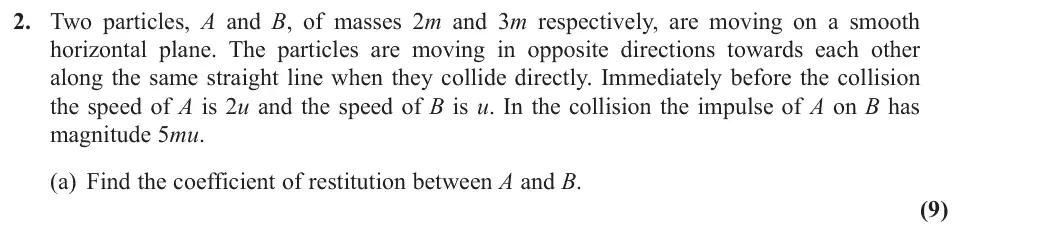
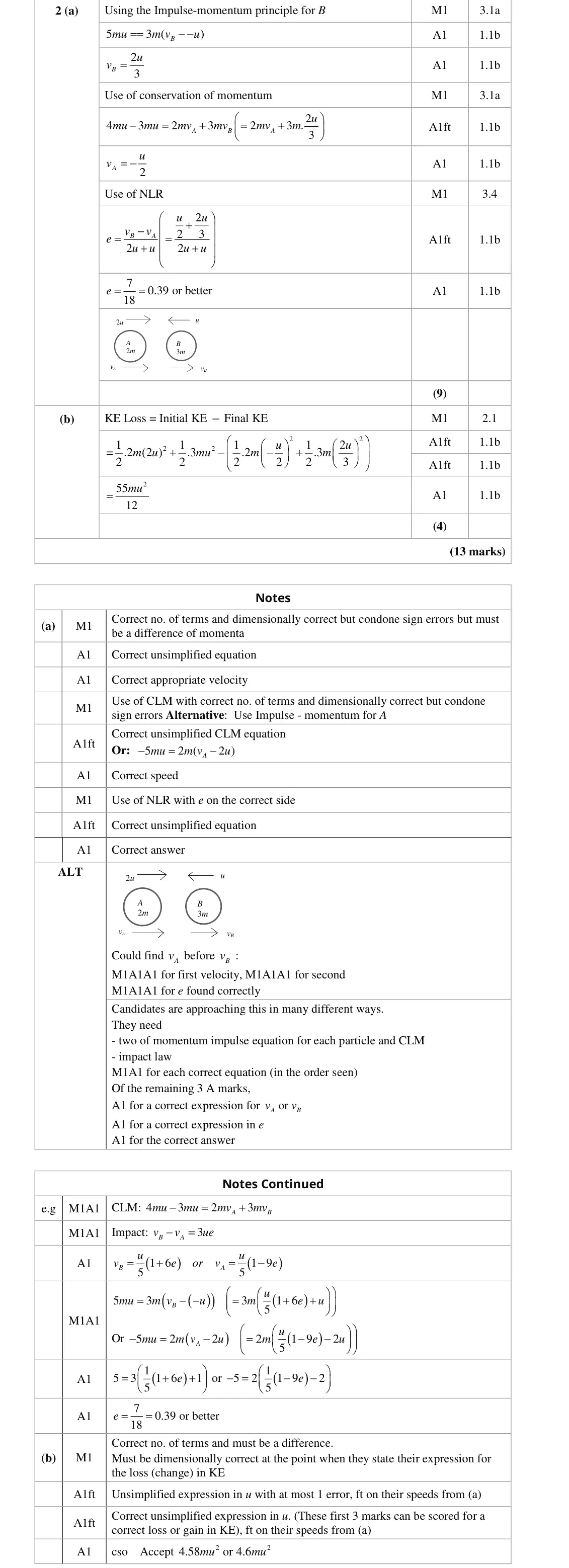
(a) Most candidates demonstrated some knowledge of the methods required here, but there were many sign errors. Candidates using the impulse-momentum principle usually recognised that they should be subtracting the initial momentum from the final momentum, but for particle B, candidates often did not take account of the change in direction, and for particle A they did not use an impulse of . The impact law was usually used with e on the correct side, but here again there were sign errors through confusion over directions. Candidates should be encouraged to draw a diagram in a question like this to help to confirm the directions of motion. Candidates need to take care with basic arithmetic and algebra – several solutions were spoiled through errors in manipulating equations. Some candidates created opportunities for error by using the same letter for both of the unknown velocities. the correct use of their values from part (a). A few candidates scored no marks because, although they found correct expressions for the initial kinetic energy and the final kinetic energy, they never combined the two to form an expression for the change in kinetic energy. Some candidates found the initial kinetic energy and the final kinetic energy and then “cancelled” the before subtracting, so they never had a dimensionally correct expression for the change in kinetic energy and scored no marks. The question asked candidates to find the loss in kinetic energy, so the final answer should be positive.
Key points from the mark scheme and examiner's report
draw a diagram and use different letters for the two velocities
June 2019 · Paper 3C (Further Mechanics 1) · Q39 marks
Mark scheme (whole question; this part is marked with the orange bar)
Examiner's comment
The unstructured nature of this question proved quite challenging for many candidates. Most could make a start and get some credit by forming an impulse-momentum equation, but this equation was often a mixture of scalars and vectors and led nowhere. Some candidates wrote equations in which they confused impulses and velocities. A significant number of candidates did make the key step of realising that if the path of P had been deflected through an angle of 45 then the velocity must be parallel to i or parallel to j. Without this, some candidates did succeed in using a scalar product approach, although this sometimes resulted in complicated algebra with no conclusion. Of those candidates who successfully found a set of values for and , many only got two pairs - either by symmetry or by considering the positive and negative square root - and a few of those who found all four erroneously excluded those with two negative components as not valid. A small number of successful candidates used quite creative approaches including short intuitive insights to derive the four pairs from simple initial equations.
Key points from the mark scheme and examiner's report
key step: after a 45° deflection the velocity is parallel to i or j
I = m(v − u) as a vector then Pythagoras: 4a² − 16a + 7 = 0
four pairs (±3/2, −2) and (−2, ±3/2)
mixing scalars and vectors common
June 2019 · Paper 3C (Further Mechanics 1) · Q6(b)2 marks
Mark scheme (whole question; this part is marked with the orange bar)
Examiner's comment
(b) Those candidates who worked with the velocities in vector form usually obtained the correct value for the magnitude of the impulse. The most common errors were due to working with speeds, or not giving the final answer as a positive number.
Key points from the mark scheme and examiner's report
impulse along the line of centres only: 0.2(11/3 + 3) = 4/3 N s
errors from working with speeds or giving a negative magnitude
June 2018 · AS Paper 2 (Further Mechanics 1) · Q1(a)5 marks
Mark scheme (whole question; this part is marked with the orange bar)
Examiner's comment
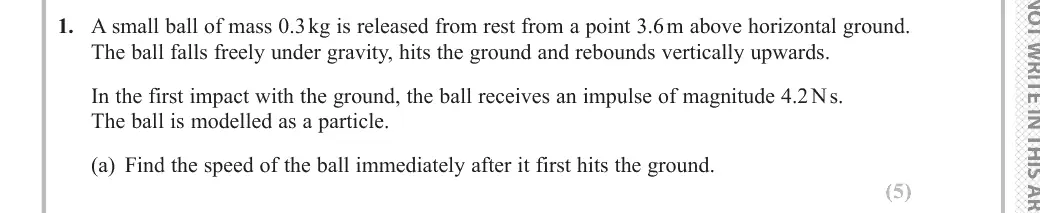
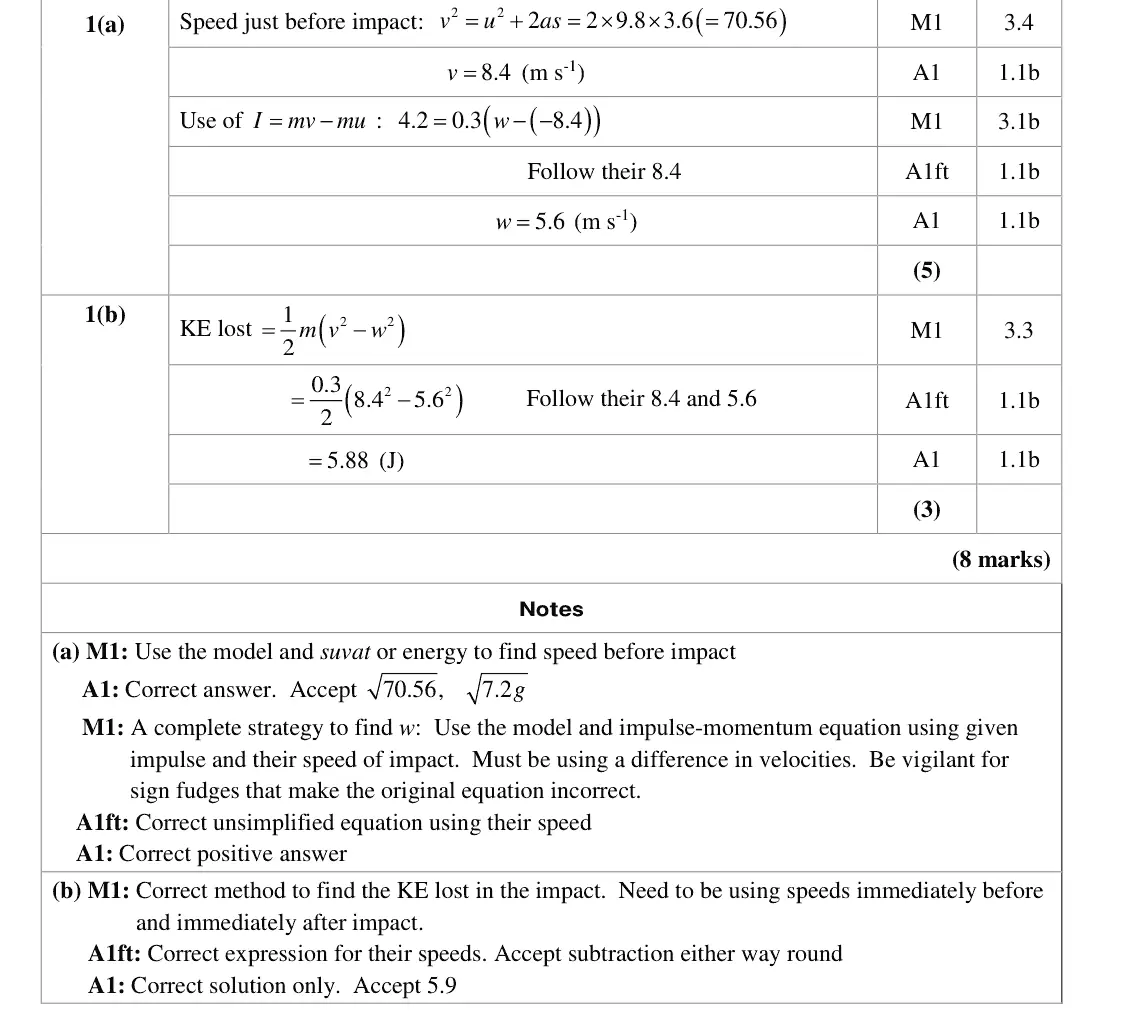
(a) The first step required students to use suvat to find the speed of the ball on impact with the ground, and many completed this successfully. The majority of students were clearly aware of the relationship between impulse and momentum, but there were many sign errors in applying the equation because a significant number of students took no account of the change in the direction of motion of the ball. Some students fudged the signs in their equation in order to get a positive answer for the speed. Students who obtained a speed of rebound greater than the speed of impact did not appear to be troubled by this. Some of the weaker students used a value of zero for the speed of impact, taking no account of the fact that the ball had been dropped from a height of 3.6 m.
Key points from the mark scheme and examiner's report
speed of impact √(2 × 9.8 × 3.6) = 8.4 by suvat or energy
I = m(w − (−8.4)) gives w = 5.6 m s⁻¹
sign errors from ignoring the change of direction, and some used impact speed 0
June 2018 · AS Paper 2 (Further Mechanics 1) · Q4(a)6 marks
Mark scheme (whole question; this part is marked with the orange bar)
Examiner's comment
(a) Students who had used papers from the old specification for practice had encountered many questions like this. The majority of solutions were completed correctly, but some would have benefitted from a diagram to help keep track of which particle was moving in which direction. A small minority of students showed insufficient working to confirm that they had reached the given answer correctly.
Key points from the mark scheme and examiner's report
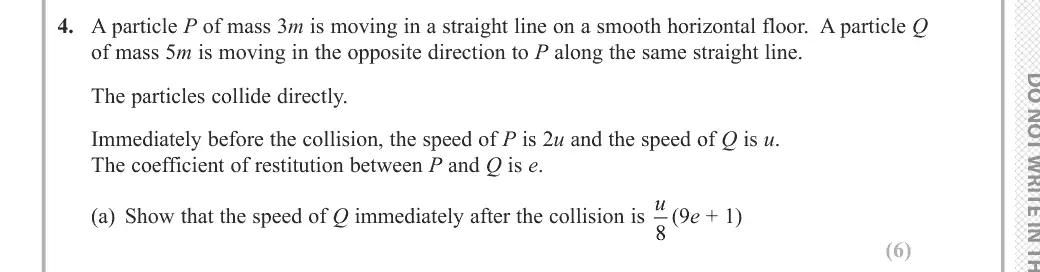
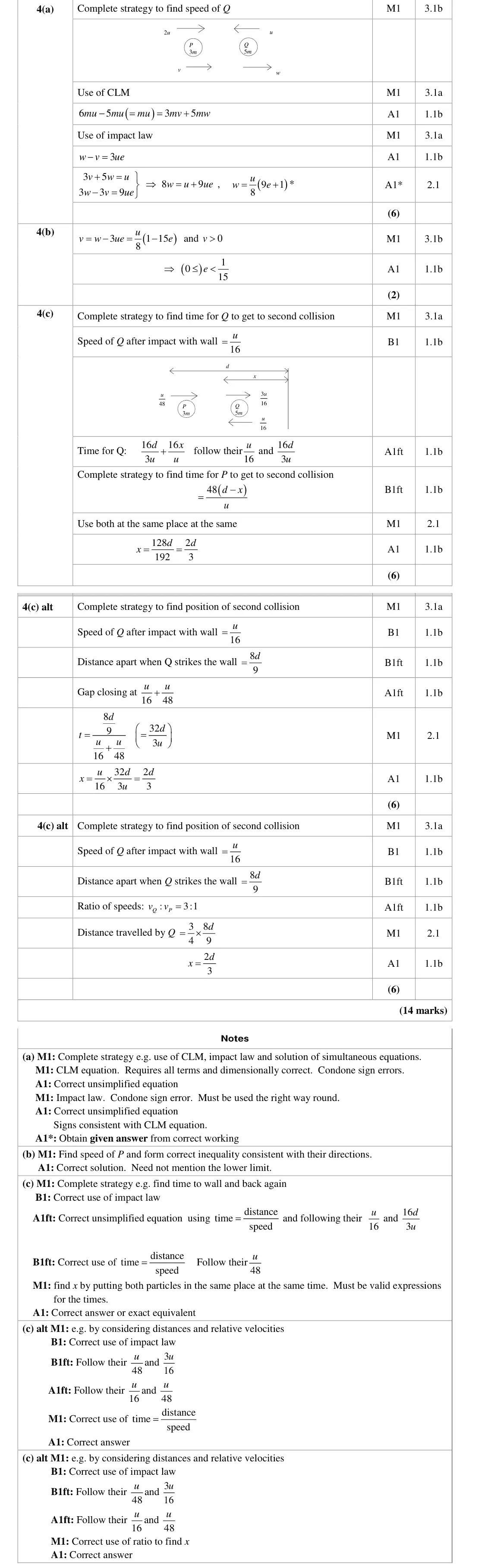
CLM 6mu − 5mu = 3mv + 5mw with impact law w − v = 3ue
solve simultaneously for w = u(9e + 1)/8
draw a diagram to keep directions consistent
Find an Edexcel Further Maths tutor
Stuck on this? Book a trial lesson with our Further Maths tutor.