Oct 2020: AS Paper 25: Further Mechanics 1

40 marks · 11 question parts · Question paper, mark scheme and examiner's report on Pearson's site

Question by question

QTopicMarksDifficulty
1(a) Momentum and impulse 2 —
1(b) Elastic collisions in one dimension 1 —
1(c) Elastic collisions in one dimension 2 —
2(a) Work, energy and power 1 —
2(b) Work, energy and power 7 —
2(c) Work, energy and power 4 —
3(a) Elastic collisions in one dimension 8 —
3(b) Momentum and impulse 4 —
4(a) Work, energy and power 5 —
4(b) Elastic collisions in one dimension, Work, energy and power 5 —
4(c) Elastic collisions in one dimension 1 —

The questions

1(a)1(b)1(c)2(a)2(b)2(c)3(a)3(b)4(a)4(b)4(c)
Oct 2020 · AS Paper 2 (Further Mechanics 1) · Q1(a) 2 marks momentum and impulse
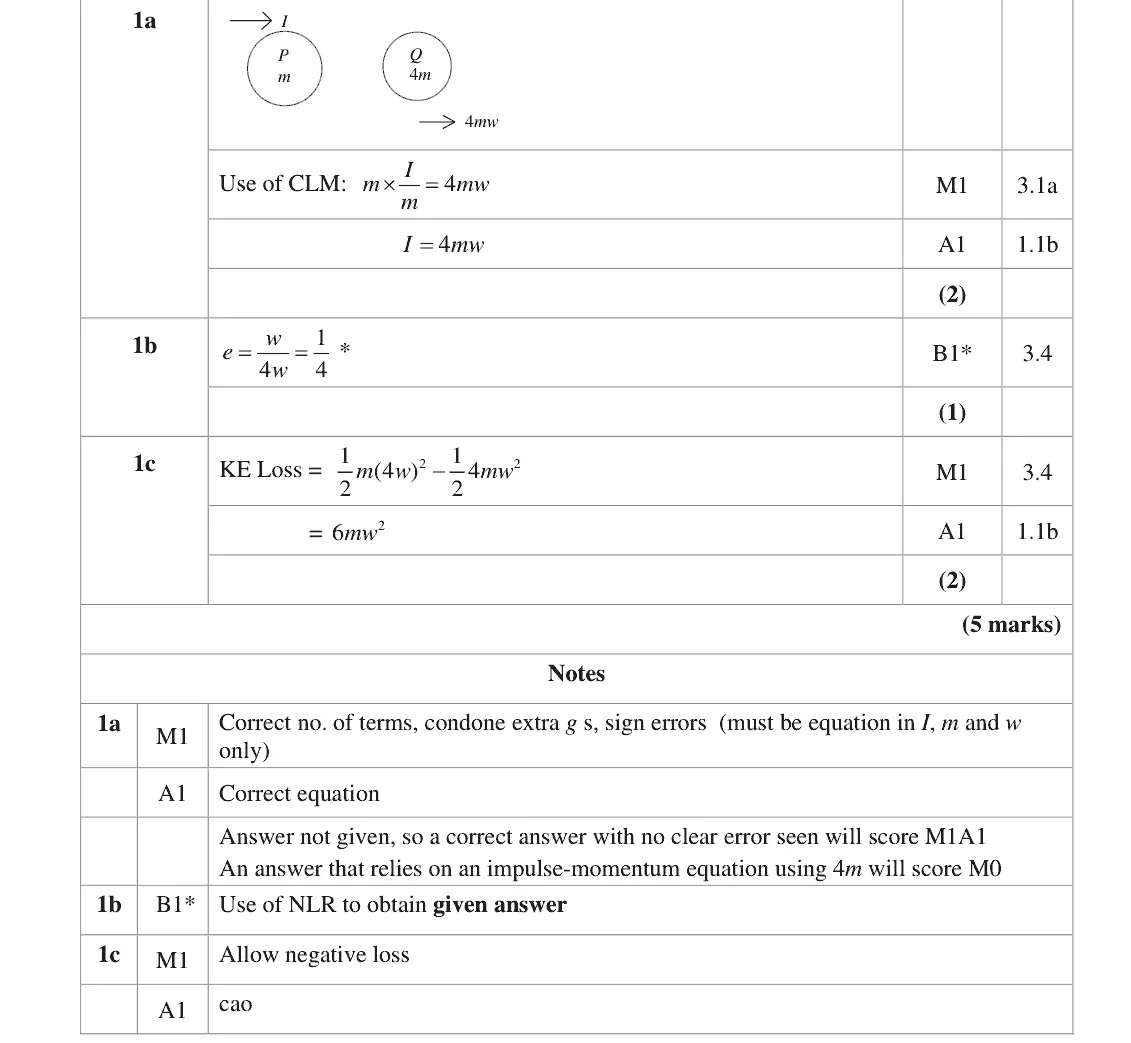
1. Two particles P and Q have masses m and 4m respectively. The particles are at rest on a smooth horizontal plane. Particle P is given a horizontal impulse, of magnitude I, in the direction PQ. Particle P then collides directly with Q. Immediately after this collision, P is at rest and Q has speed w. The coefficient of restitution between the particles is e. (a) Find I in terms of m and w. (2)
Oct 2020 · AS Paper 2 (Further Mechanics 1) · Q1(b) 1 mark collisions in one dimension
(b) Show that e = 1 (1)
Oct 2020 · AS Paper 2 (Further Mechanics 1) · Q1(c) 2 marks collisions in one dimension
(c) Find, in terms of m and w, the total kinetic energy lost in the collision between P and Q. (2)
Oct 2020 · AS Paper 2 (Further Mechanics 1) · Q2(a) 1 mark work energy and power
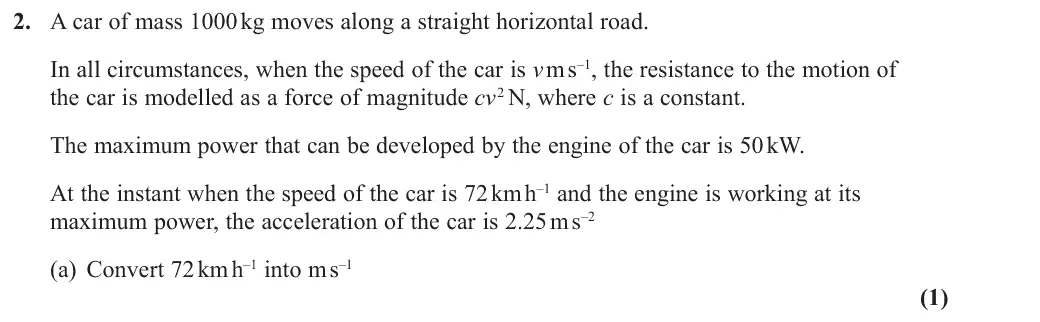
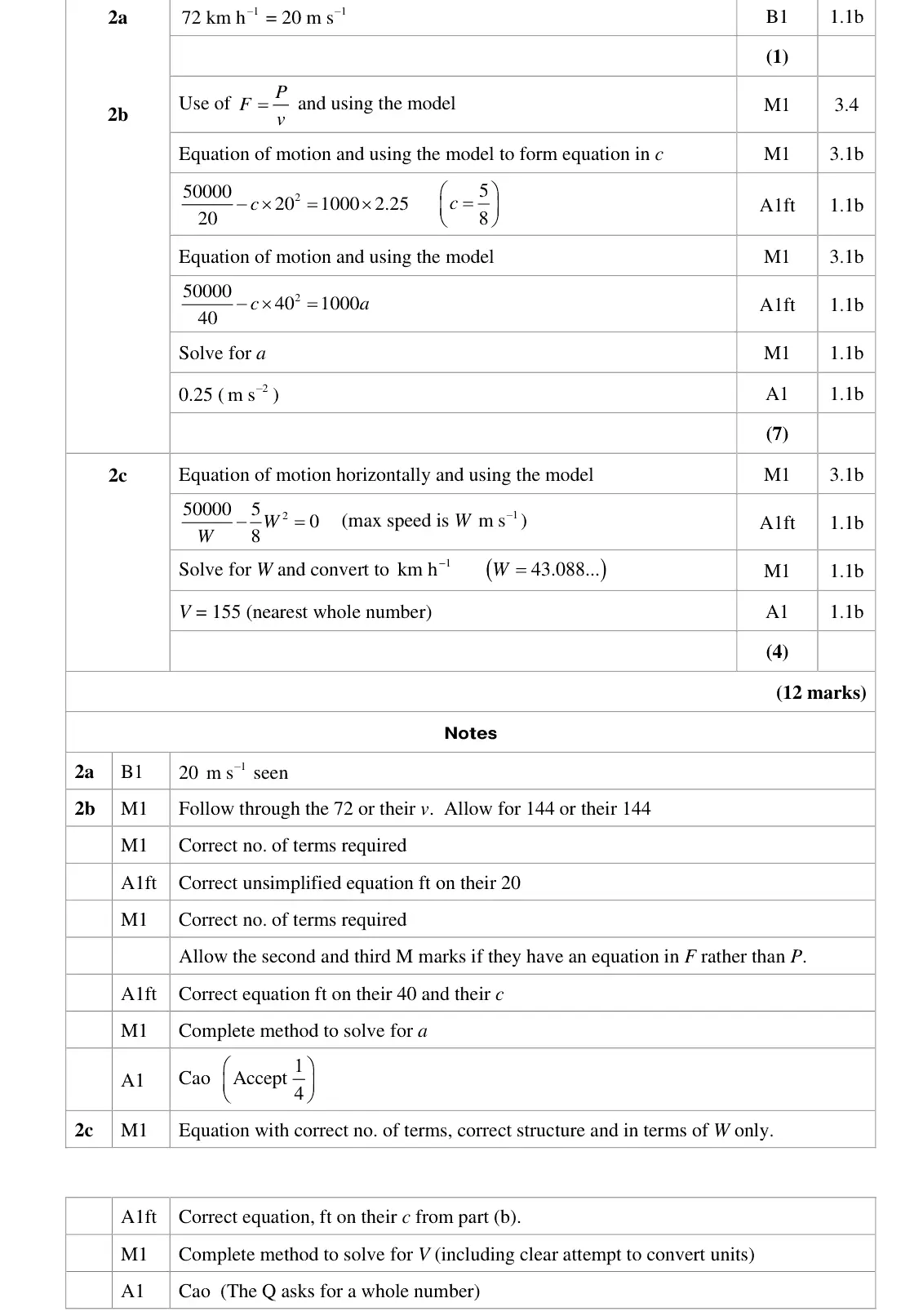
2. A car of mass 1000 kg moves along a straight horizontal road. In all circumstances, when the speed of the car is v m s–1, the resistance to the motion of the car is modelled as a force of magnitude cv2 N, where c is a constant. The maximum power that can be developed by the engine of the car is 50 kW. At the instant when the speed of the car is 72 km h–1 and the engine is working at its maximum power, the acceleration of the car is 2.25 m s–2 (a) Convert 72 km h–1 into m s–1 (1)
Oct 2020 · AS Paper 2 (Further Mechanics 1) · Q2(b) 7 marks work energy and power
(b) Find the acceleration of the car at the instant when the speed of the car is 144 km h–1 and the engine is working at its maximum power. (7)
Oct 2020 · AS Paper 2 (Further Mechanics 1) · Q2(c) 4 marks work energy and power
The maximum speed of the car when the engine is working at its maximum power is V km h–1. (c) Find, to the nearest whole number, the value of V. (4)
Oct 2020 · AS Paper 2 (Further Mechanics 1) · Q3(a) 8 marks collisions in one dimension
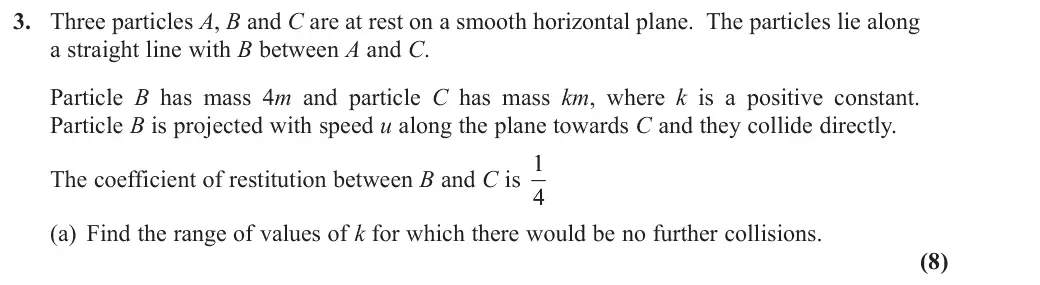
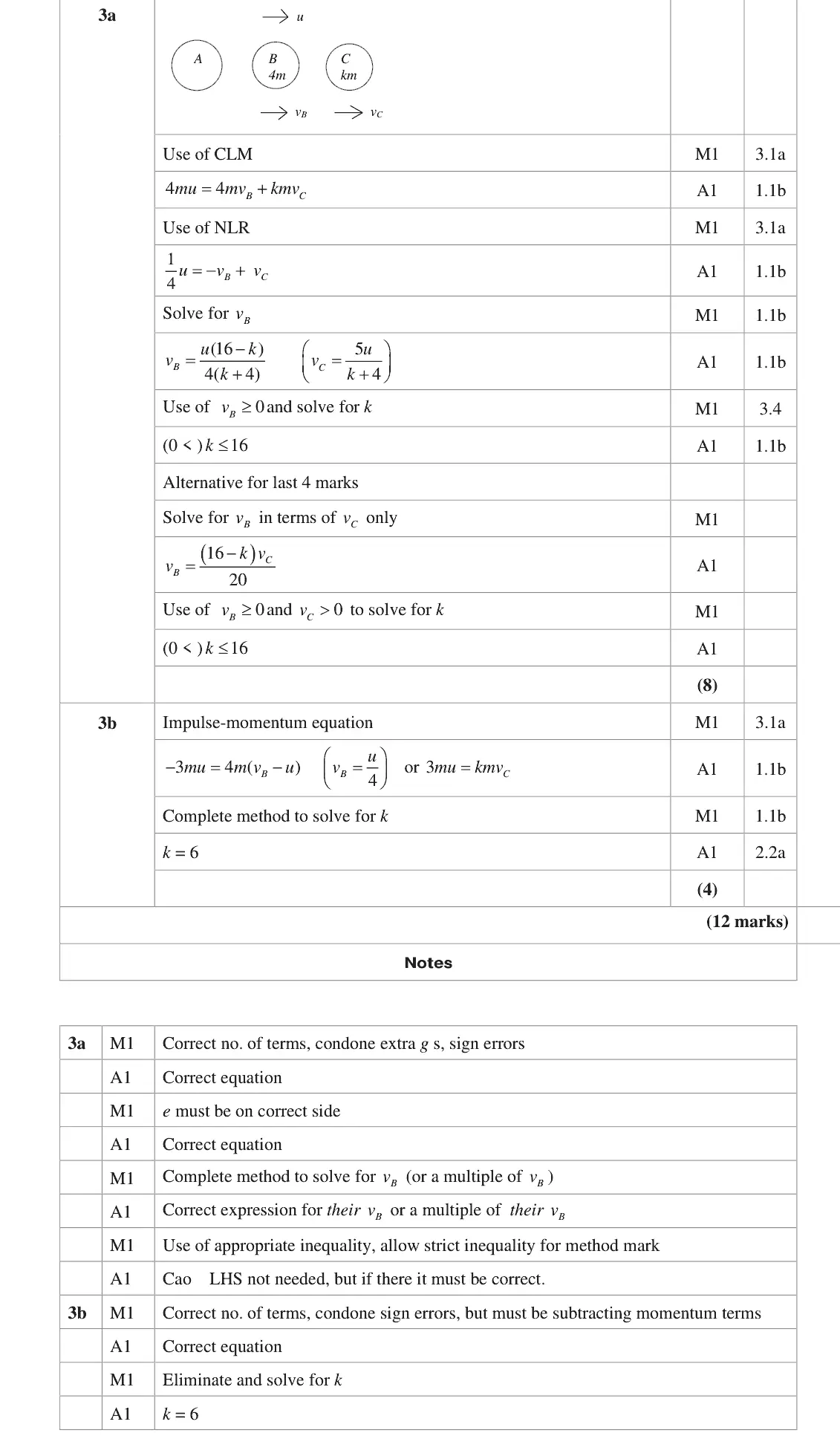
3. Three particles A, B and C are at rest on a smooth horizontal plane. The particles lie along a straight line with B between A and C. Particle B has mass 4m and particle C has mass km, where k is a positive constant. Particle B is projected with speed u along the plane towards C and they collide directly. The coefficient of restitution between B and C is 1 (a) Find the range of values of k for which there would be no further collisions. (8)
Oct 2020 · AS Paper 2 (Further Mechanics 1) · Q3(b) 4 marks momentum and impulse
The magnitude of the impulse on B in the collision between B and C is 3mu (b) Find the value of k. (4)
Oct 2020 · AS Paper 2 (Further Mechanics 1) · Q4(a) 5 marks work energy and power
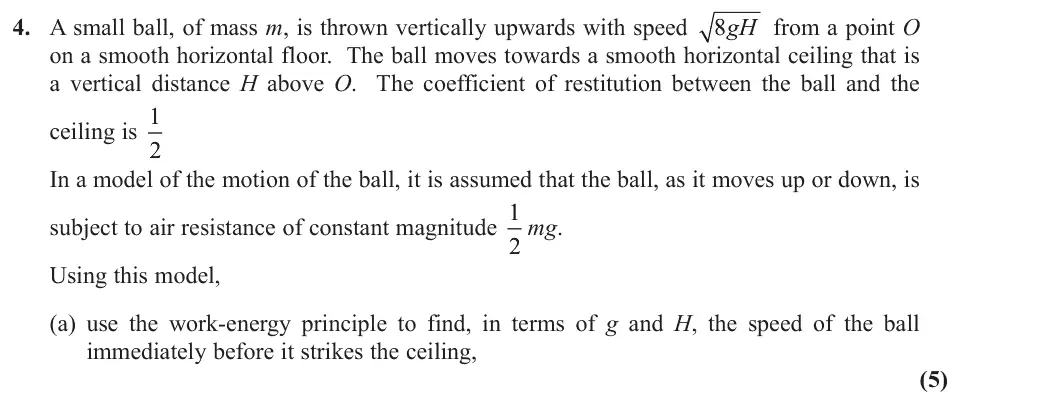
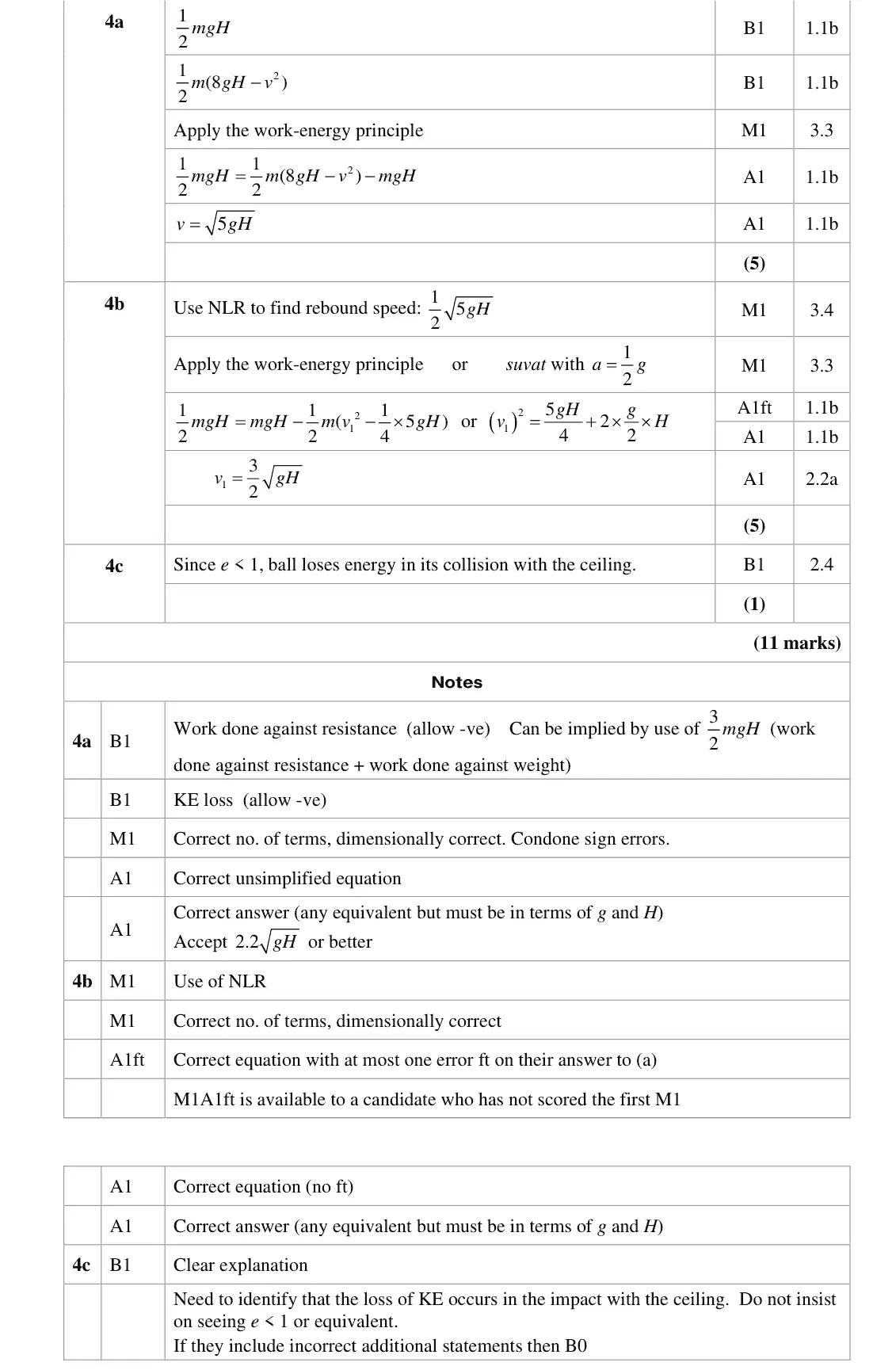
4. A small ball, of mass m, is thrown vertically upwards with speed 8gH from a point O on a smooth horizontal floor. The ball moves towards a smooth horizontal ceiling that is a vertical distance H above O. The coefficient of restitution between the ball and the ceiling is 1 In a model of the motion of the ball, it is assumed that the ball, as it moves up or down, is subject to air resistance of constant magnitude 1 2 mg. Using this model, (a) use the work-energy principle to find, in terms of g and H, the speed of the ball immediately before it strikes the ceiling, (5)
Oct 2020 · AS Paper 2 (Further Mechanics 1) · Q4(b) 5 marks collisions in one dimensionwork energy and power
(b) find, in terms of g and H, the speed of the ball immediately before it strikes the floor at O for the first time. (5)
Oct 2020 · AS Paper 2 (Further Mechanics 1) · Q4(c) 1 mark collisions in one dimension
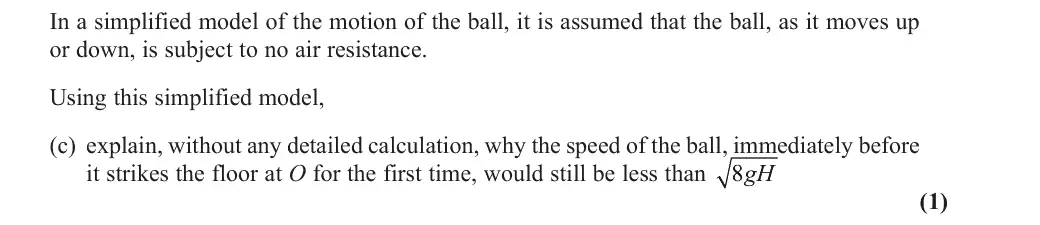
In a simplified model of the motion of the ball, it is assumed that the ball, as it moves up or down, is subject to no air resistance. Using this simplified model, (c) explain, without any detailed calculation, why the speed of the ball, immediately before it strikes the floor at O for the first time, would still be less than 8gH (1)

Find an Edexcel Further Maths tutor

Want this paper marked and gone through with a Further Maths tutor? Message us.

Prefer email? Send an enquiry

If you are under 18, please include a parent's contact details. Enquiries go to enquiries@alevelfurthermathstutor.com and are deleted once handled.