The table for the ellipse, parabola, hyperbola and rectangular hyperbola (standard and parametric forms, eccentricity, foci, directrices, asymptotes) is given.
Since 2018
46 question parts, 173 marks, 5 with a difficulty rating from the examiner's report
Notes, worked examples and practice for this topic are being written by our tutors. The past-paper questions below are ready now: work each one on paper, then open the mark scheme and the examiner's comment.
Tap a question to zoom it. Mark scheme and examiner's comment open under each question.
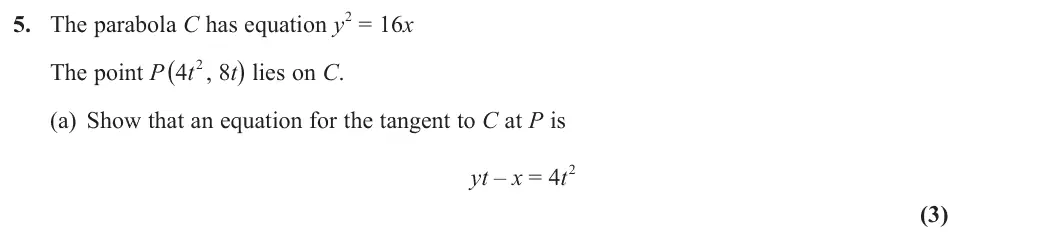
June 2025 · AS Paper 2 (Further Pure 1) · Q5(a)3 marks
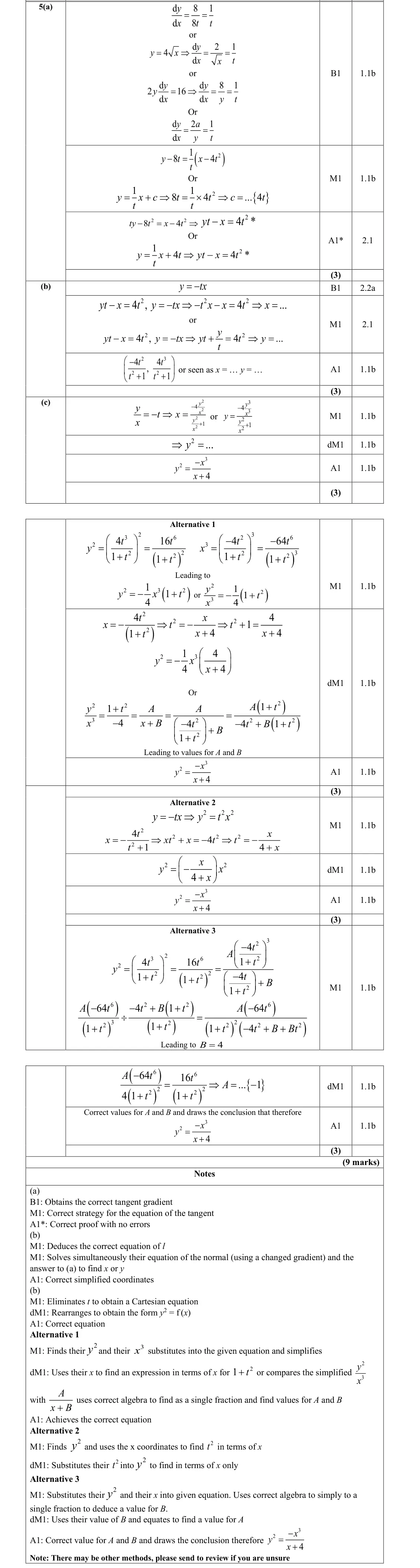
Mark scheme (whole question; this part is marked with the orange bar)
Examiner's comment
Nearly all candidates could show the equation of the tangent in part (a) successfully
Key points from the mark scheme and examiner's report
dy/dx = 8/y = 1/t at P
y − 8t = (1/t)(x − 4t²) gives yt − x = 4t²
nearly all correct
June 2025 · AS Paper 2 (Further Pure 1) · Q5(b)3 marks
Mark scheme (whole question; this part is marked with the orange bar)
Examiner's comment
Part (b) many had the correct approach but there were frequent sign or other algebraic errors; y 2 2 2 for example y tx 4 4 = - yt t yt y t - = ⇒ + = then others could not make x the t - subject. Most candidates had difficulty with part (c). Several made no attempt; it was difficult to
Key points from the mark scheme and examiner's report
l: y = −tx
solve with the tangent: Q(−4t²/(t² + 1), 4t³/(t² + 1))
sign and rearrangement errors
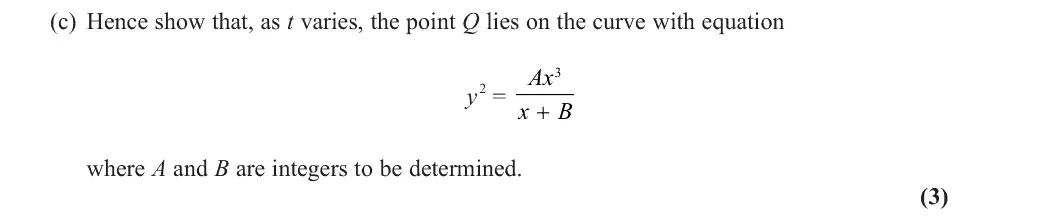
June 2025 · AS Paper 2 (Further Pure 1) · Q5(c)3 marks
Mark scheme (whole question; this part is marked with the orange bar)
Examiner's comment
Most candidates had difficulty with part (c). Several made no attempt; it was difficult to know whether they had run out of time or just didn’t know how to tackle it. Of those who attempted this part, the most common misconception was the implicit assumption that Q was on the parabola, as they tried to fit the parametric coords of Q to the form of the original parabola. Some found an efficient way to eliminate t and form the required equation, but many tried to solve it by substituting the coordinates of Q into the given form of the equation. This could lead to a reasonably simple solution if they simplified their equation as much as possible, but many multiplied out every bracket in sight and formed an expression which was too complicated to deal with. Another common error seen in this method was when they formed a fractional expression in t, A and B, then equated the numerators and the denominators separately.
Key points from the mark scheme and examiner's report
t = −y/x eliminates t: y² = −x³/(x + 4), so A = −1, B = 4
common misconception that Q lies on the parabola
equating numerators and denominators separately
over-expanded algebra
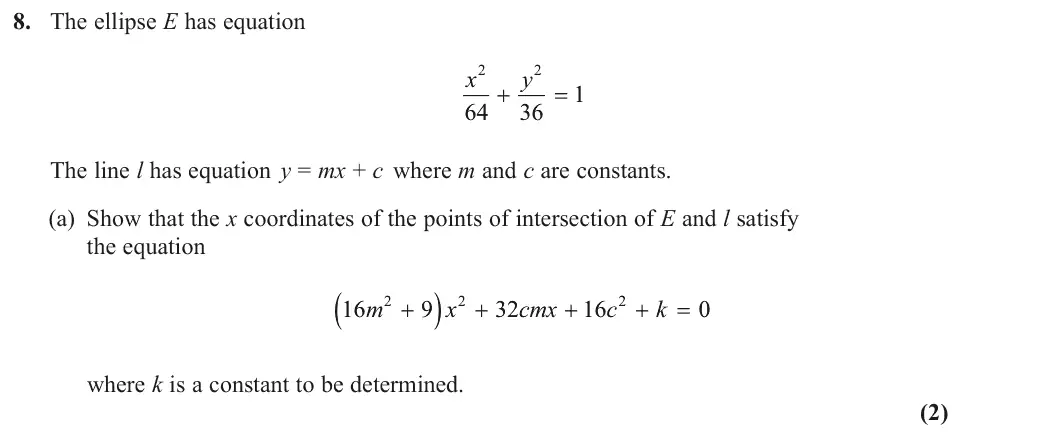
June 2025 · Paper 3A (Further Pure 1) · Q8(a)2 marks
Mark scheme (whole question; this part is marked with the orange bar)
Examiner's comment
Part (a) was accessible to almost all learners. Weaker responses displayed an inability to expand (mx + c)2 correctly or the understanding that correct placement of “=” is important.
Key points from the mark scheme and examiner's report
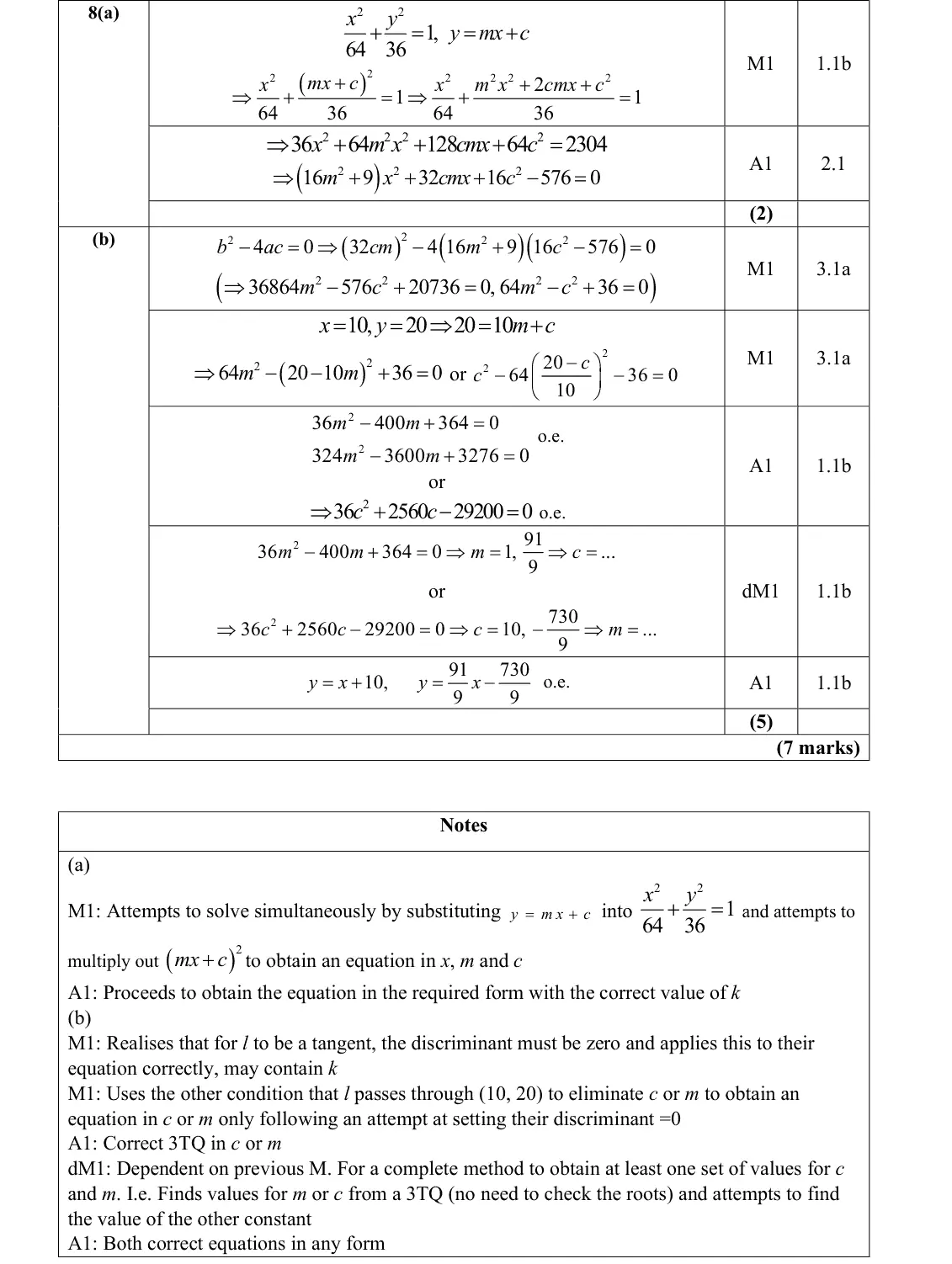
substitute y = mx + c and expand (mx + c)² correctly
k = −576
June 2025 · Paper 3A (Further Pure 1) · Q8(b)5 marks
Mark scheme (whole question; this part is marked with the orange bar)
Examiner's comment
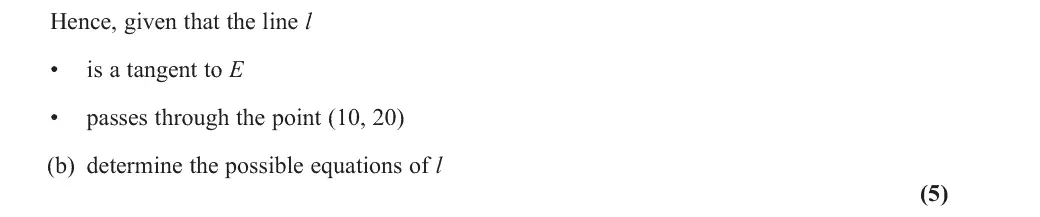
(b) Some learners struggled to identify the need to use the discriminant. Other learners used the discriminant correctly but could not cope with the algebraic manipulation that followed. This part confused learners who were expecting to use some conic section skills. Many assumed, incorrectly, that the given point was also on the ellipse. Some learners tried to use parametric equations together with differentiation
Key points from the mark scheme and examiner's report
tangent: discriminant 0 gives 64m² − c² + 36 = 0 with c = 20 − 10m
36m² − 400m + 364 = 0: m = 1 or 91/9
y = x + 10 and y = (91/9)x − 730/9
many did not use the discriminant or assumed (10, 20) is on E
June 2024 · AS Paper 2 (Further Pure 1) · Q5(a)2 marks
Mark scheme (whole question; this part is marked with the orange bar)
Examiner's comment
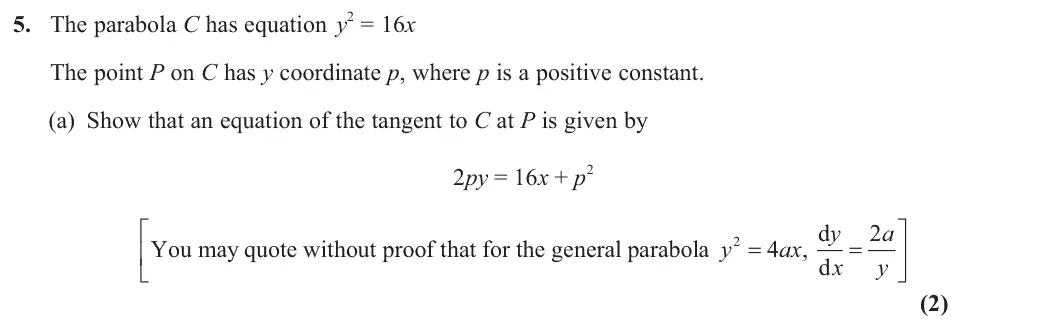
Part (a) was usually answered well. The main difficulty which arose in this part was that some candidates who were used to using the parametric equations of a parabola found it confusing to use p as the given y-coordinate. There were also a number who used 8 y as the gradient in their equation and were often unable to recover.
Key points from the mark scheme and examiner's report
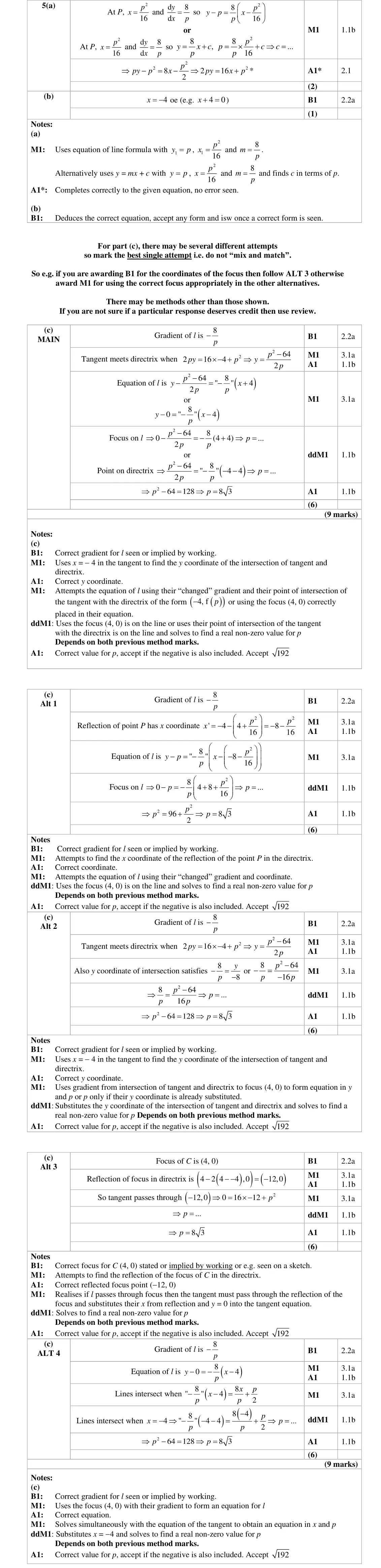
P(p²/16, p), gradient 8/p
y − p = (8/p)(x − p²/16) leads to 2py = 16x + p²
confusing p with a parameter, or using 8/y as the gradient
June 2024 · AS Paper 2 (Further Pure 1) · Q5(b)1 mark
Mark scheme (whole question; this part is marked with the orange bar)
Examiner's comment
The mark in part (b) was often scored with a few giving just the point (-4, 0) or the equation y = -4 or the equation x = 4.
Key points from the mark scheme and examiner's report
x = −4
giving the point (−4, 0), y = −4 or x = 4 is wrong
June 2024 · AS Paper 2 (Further Pure 1) · Q5(c)6 marks
Mark scheme (whole question; this part is marked with the orange bar)
Examiner's comment
Part (c) proved to be a very demanding part of the paper and success was varied. There were only a minority of fully correct solutions. The unstructured nature of the problem meant that candidates often didn’t know where to start. By far, the most significant error, was to assume that the gradient of l was the negative reciprocal of the gradient in part (a). Without this misconception, many attempts would have been more successful. There were several attempts using circular arguments. Some tried to use distance from focus = distance from directrix, resulting in 2 2. p p = Others used the intersection of l with the directrix and l passing through the focus to obtain the gradient of l, but then tried to use again the fact that it passed through the focus. There were some very neat and efficient solutions for this part such as alternative 3 on the mark scheme.
Key points from the mark scheme and examiner's report
reflection in x = −4 reverses the gradient: l has gradient −8/p
tangent meets the directrix at y = (p² − 64)/(2p)
l through focus (4, 0) gives p² = 192, p = 8√3 (neat route: reflect the focus to (−12, 0), which must lie on the tangent)
commonest error took the negative reciprocal gradient
circular arguments
June 2024 · Paper 3A (Further Pure 1) · Q66 marks
Mark scheme (whole question; this part is marked with the orange bar)
Examiner's comment
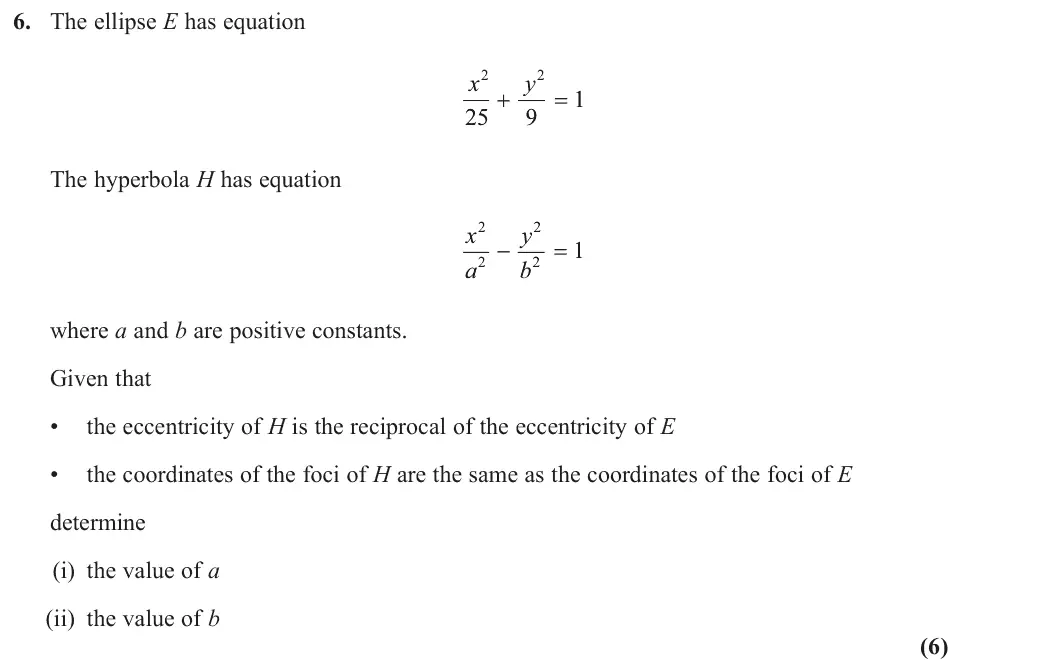
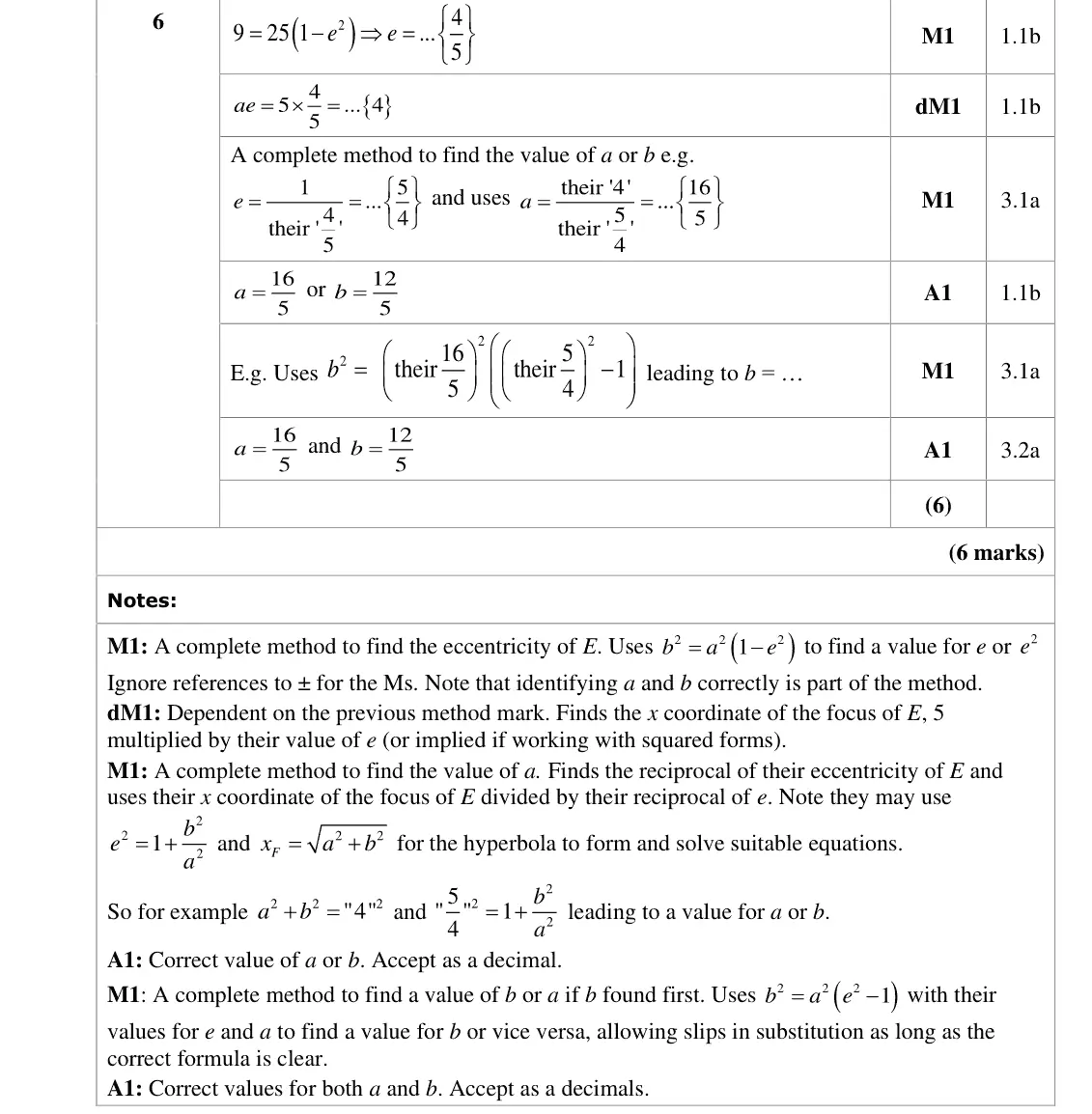
For those who knew what to do and could find the most efficient way through, this question was again swiftly answered and proved little problem. However, it was more discriminating than the earlier questions and caused problems for many who did not immediately see what to do. Candidates would be well advised to first of all write out what the given information is saying, as the reason for strife for many was the failure to use the second bullet point from the outset, but to try to use the first bullet point in the eccentricity equation for both curves first, and hence go through a process of setting up more complicated simultaneous equations when eventually bringing the second fact to bear. This was often done via using the x coordinate of the focus being 2 2 a b + , rather than finding the coordinate itself. At the outset most candidates were able to use the equation for eccentricity and obtain the correct eccentricity of the ellipse, and the first mark was therefore generally gained even if no further progress was made. They were then able to find the eccentricity of the hyperbola, but this did not necessarily gain further marks. Those who proceeded to find the coordinate of the focus as a next step usually then made light work of attempting the value of a, usually finding it correctly. Those who did not proceed via this route, but instead set up equations in a and b using the eccentricity and focus equations of the hyperbola (as noted above) had much more difficulty in reaching a value for a, with errors often made along the way, though many did reach the correct answer from this approach. If a value for a was found, most candidates then were able to attempt b from the relevant equation, although there were sometimes errors with the powers involved to gain the method mark, and this was score even in some cases where an incorrect process to attempt a had been made. But a correct value for a almost invariably led to a correct value for b and full marks ensued.
Key points from the mark scheme and examiner's report
ellipse: e = 4/5, foci (±4, 0)
hyperbola e = 5/4 and ae = 4 give a = 16/5
b² = a²(e² − 1) gives b = 12/5
use the foci condition from the start, otherwise messy simultaneous equations
June 2024 · Paper 3A (Further Pure 1) · Q8(a)3 marks
Mark scheme (whole question; this part is marked with the orange bar)
Examiner's comment
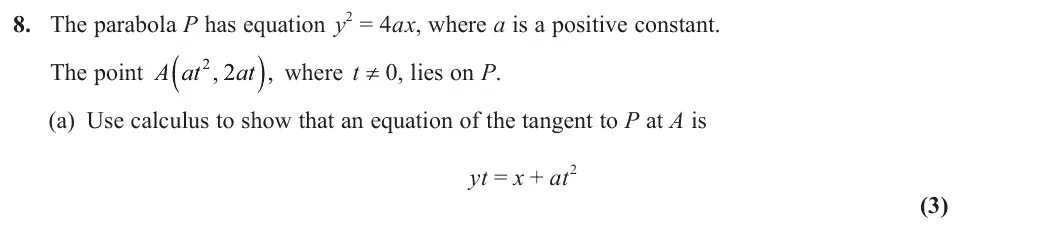
This second coordinate geometry question on the paper again provided some degree of discrimination in part (b), where many candidates failed to identify the values of a and t at the given points. This led to more complicated equations that needed, and often ground to a halt. Part (a), though, was accessible to nearly all candidates and full marks was the most common score in it. Candidates differentiated the equation of the parabola successfully, with implicit differentiation the most common approach, followed by parametric differentiation and only a few made y the subject first. Substitution of the parametric coordinates followed, with correct rearrangement to the given equation completed in most cases. The few who made little, or no, progress here were generally making little or no progress throughout the paper.
Key points from the mark scheme and examiner's report
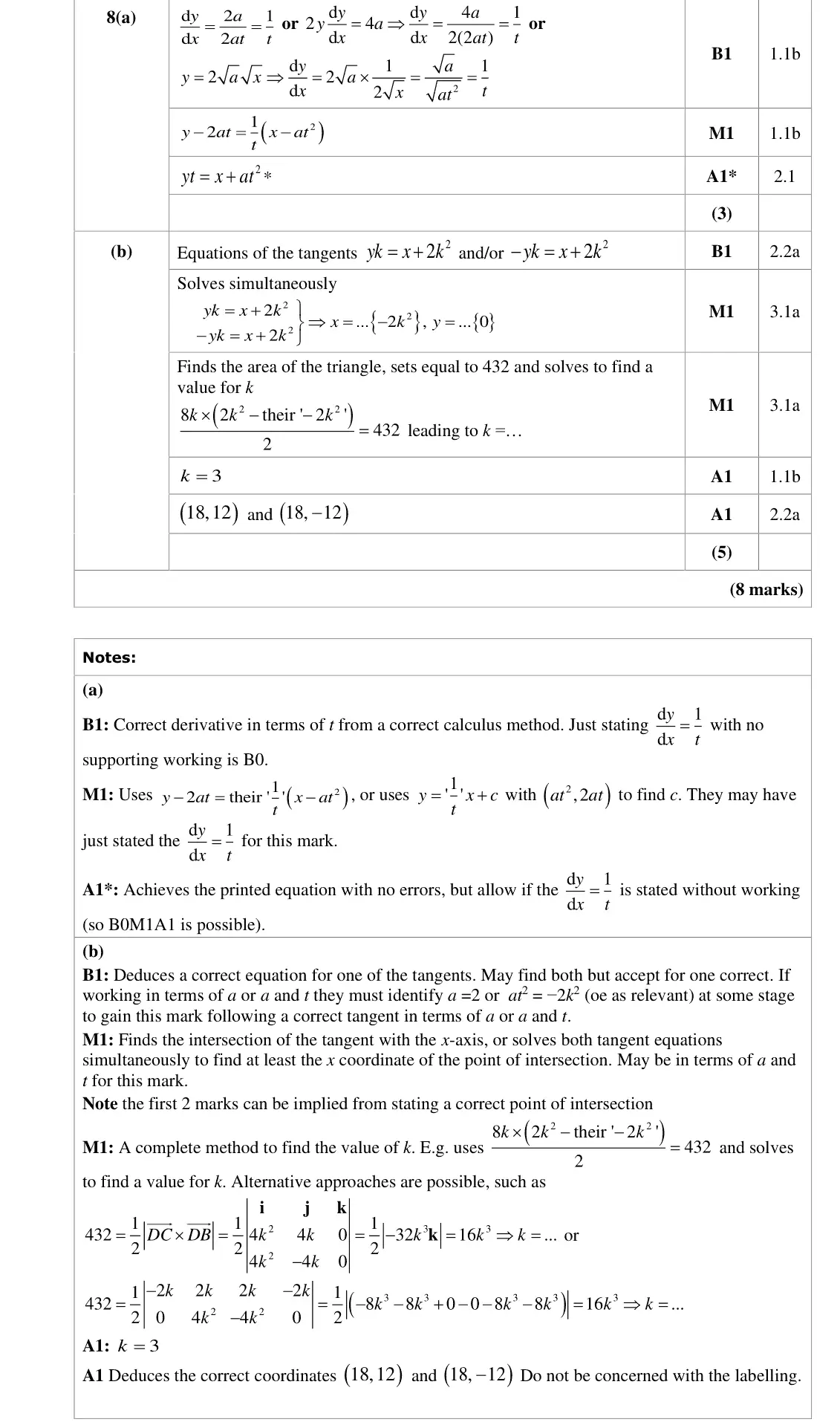
dy/dx = 1/t (implicit or parametric)
y − 2at = (1/t)(x − at²) to yt = x + at²
June 2024 · Paper 3A (Further Pure 1) · Q8(b)5 marks
Mark scheme (whole question; this part is marked with the orange bar)
Examiner's comment
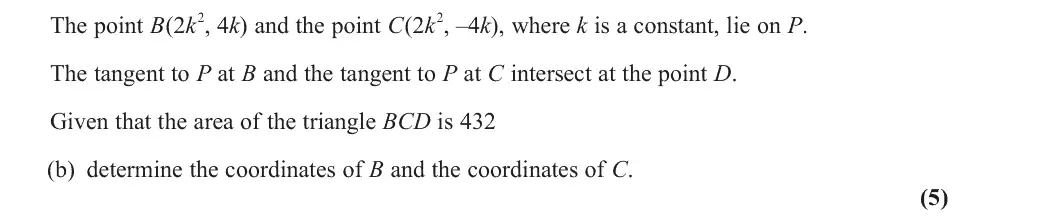
This second coordinate geometry question on the paper again provided some degree of discrimination in part (b), where many candidates failed to identify the values of a and t at the given points. This led to more complicated equations that needed, and often ground to a halt. In Part (b), most candidates realised the need to find the point of intersection of the two tangents at B and C, and tried to do so, but most did not immediately or at all realise that a = 2 and t = k^2 at the points B and C, and attempting to solve for equations of tangents in terms of a and t. This often led to them making little progress in the question with a score profile B0M1M0A0A0 being very common. It was also remarkable how many candidates failed to use the answer to (a) to deduce the tangents but instead resorted to recalculating the gradients for each point and setting up the tangents again from scratch. Usually this was done correctly but overlooks the point of having asked part (a). Having found the point of intersection, whether in terms of just k or in terms of k, a and t, there was usually an attempt to consider the area of the triangle, but due to the complicated or incorrect coordinates of the point of intersection, many candidates failed to find a value for k meaning the second method was inaccessible. Sometimes candidates did manage to work out a = 2 at this late stage (with copious amounts of work preceding it) to recover the situation, but mostly it was those who realise a = 2 from the outset who managed to access beyond the second mark. The method for the area of the triangle did vary, and although most used the direct approach, attempts at the cross-product formula, or shoelace method, were seen, while some attempted an incorrect dot product formula. Again, these were applied with a mix of k, a and t in the equations, though some erroneous methods managed to eliminate the a and t conveniently, but no further marks were available in any case. For the candidates who realised at some point in the solution the values of a and t, most were successful in eventually finding the value of k and correct coordinates, though slips with the triangle area formulae were sometimes made. The correct value of k, or correct coordinates, did occasionally arise from incorrect, or suspect working, such as erroneously arriving at k = ±3 from cube rooting and using the two values to attempt the two coordinates instead of symmetry. Candidates who drew a clear diagram had a higher successful rate of solving this part of the question, the diagram helped them to visualize the equations, and the most efficient solutions were those who identified the values from the outset and were easily able to identify the equations of the tangents, and quickly deduce the coordinates of D.
Key points from the mark scheme and examiner's report
a = 2 and t = ±k: tangents ky = x + 2k², −ky = x + 2k² meet at D(−2k², 0)
area ½ × 8k × 4k² = 16k³ = 432, k = 3: B(18, 12), C(18, −12)
many did not identify a = 2, t = k or re-derived the tangents
June 2023 · AS Paper 2 (Further Pure 1) · Q3(a)3 marks
Mark scheme (whole question; this part is marked with the orange bar)
Examiner's comment
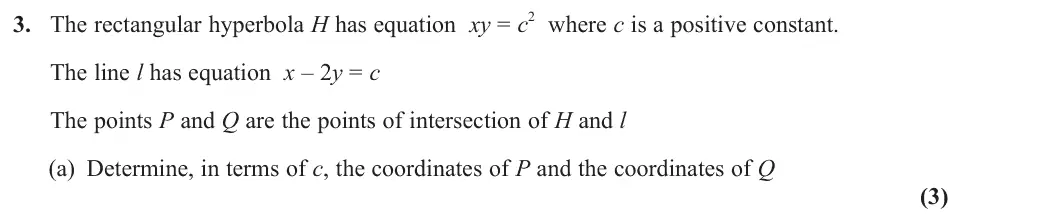
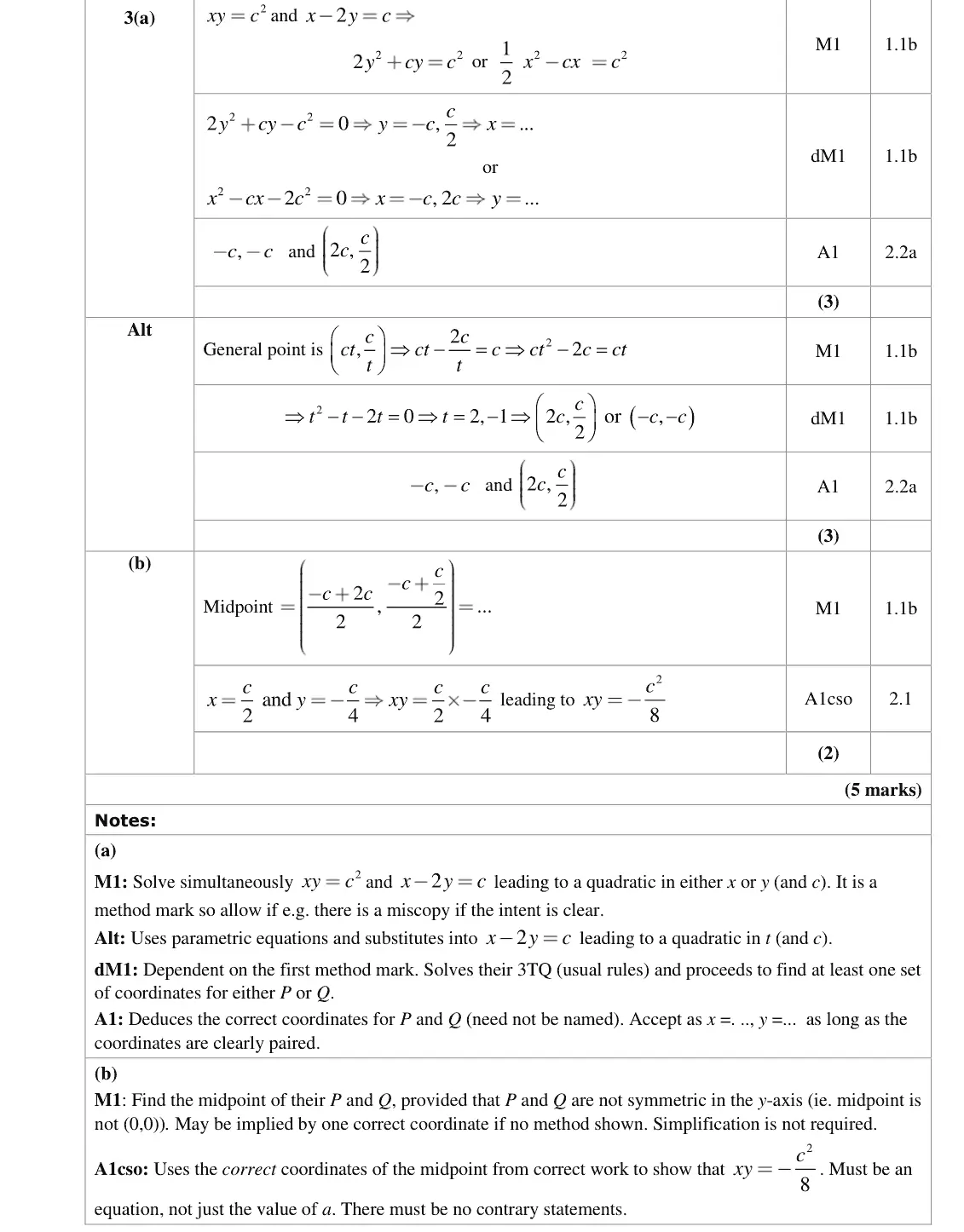
The first of the two coordinate geometry questions on the paper, both of which provided a good challenge for students. This question did prove to be a good discriminator for the paper, with on the whole only the higher levels of candidates able to produce fully correct solutions. For part (a) many students recognised that they needed to eliminate a variable, mostly commonly eliminating x to get a quadratic in y. Though they often obtained a suitable quadratic but then did not always see what to do with it. It was quite common to see 2 or 3 quadratics in different combinations of variables before they (sometimes) proceeded to solve one of them. Several students eliminated c to obtain a 3 term quadratic in x and y, and some successfully combined their solution with one of the original equations, but others gave up at that point and made no further progress with the question. A few students had mostly correct work but gave the x and y coordinates the wrong way round, while various errors in manipulation or slips in algebra prevented many from achieving the coordinates successfully.
Key points from the mark scheme and examiner's report
eliminate x: 2y² + cy − c² = 0 so y = −c or c/2
P and Q are (−c, −c) and (2c, c/2)
many formed quadratics but did not solve
coordinates swapped
June 2023 · AS Paper 2 (Further Pure 1) · Q3(b)2 marks
Mark scheme (whole question; this part is marked with the orange bar)
Examiner's comment
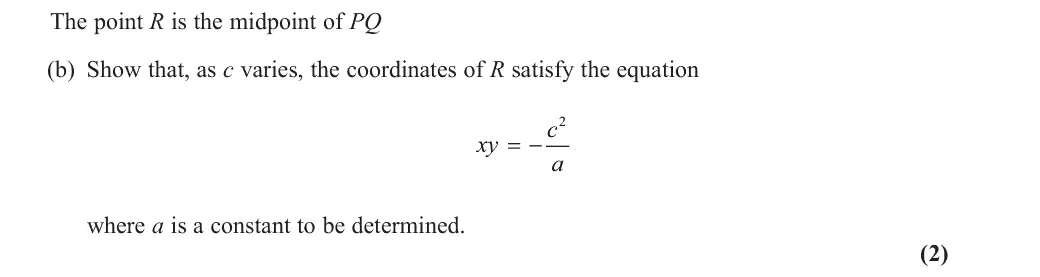
The first of the two coordinate geometry questions on the paper, both of which provided a good challenge for students. This question did prove to be a good discriminator for the paper, with on the whole only the higher levels of candidates able to produce fully correct solutions. Part (b) was often omitted, even when a correct answer to part (a) had been obtained. The method for finding the midpoint was less well attempted than might have been expected, with a number halving the difference rather than the sum of the coordinates. This may have been due to the negative coordinates in ( ) ,c c - - , but with no formula stated for the most cases, an incorrect method was assumed. Stating formulae before using them is advisable. When successfully showing the result, many students made their substitution into xy explicit and clear, earning the final mark, but there were also many attempts that made no reference to the xy at all, and so lost the final A mark. Some confused their answer with the original equation, equating their xy to c2 with some erroneous statement such as 2 2 8 c c = - being given, again losing the final accuracy. It was possible to get the correct midpoint and locus from incorrect work, since common errors in solving their quadratics did not affect the “sum of roots” hence the midpoint could be fortuitously correct. They also got a correct locus from incorrect work if they had written the coordinates the wrong way round. Such attempts were not permitted recovery, the correct midpoint was required to have been found for the final accuracy to be awarded.
Key points from the mark scheme and examiner's report
midpoint R(c/2, −c/4) (halve the SUM not the difference) so xy = −c²/8, a = 8
must show the product xy explicitly
correct locus from incorrect coordinates not credited
June 2023 · AS Paper 2 (Further Pure 1) · Q6(a)3 marks
Mark scheme (whole question; this part is marked with the orange bar)
Examiner's comment
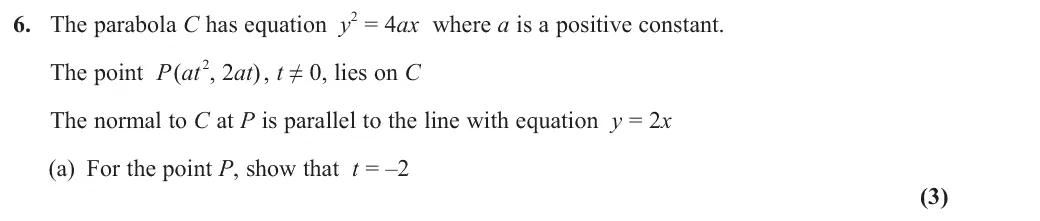
This proved a good challenge to end the paper, befitting the final question on the paper. Timing did not seem to be the issue with the question and the majority made some attempt at it, but it was clear that lower grade students were not able to work out the geometry of the situation to identify a suitable strategy. In part (a) the result for the derivative d 2 d y a x y = was not given on the paper this year, with students expected to be able to work out an approach to the derivative themselves, and this did actually prove to be the first difficulty of the question. Though higher grade students were able to do this, usually via 1 2 2 y ax = , lower grade students struggle to find any traction in the question, instead attempting various equations for the tangent using the gradient 2, but never showing any calculus to establish the result. These would usually then make no further progress with the question, even though the given value for t gave access to part (b). Students who had knowledge of either parametric or implicit approaches to the derivative were much better equipped to get started on the problem, and those who formed a correct derivative statement from any of the approaches were generally successful in showing the result in part (a). However, some were quite inefficient about it, finding the equation of the normal in parametric form before picking out the gradient and a number of such students ended up going awry in such approaches.
Key points from the mark scheme and examiner's report
dy/dx = 2a/y = 1/t at P (must be derived: not given)
normal gradient −t = 2 so t = −2
lower grade students found no calculus route
June 2023 · AS Paper 2 (Further Pure 1) · Q6(b)5 marks
Mark scheme (whole question; this part is marked with the orange bar)
Examiner's comment
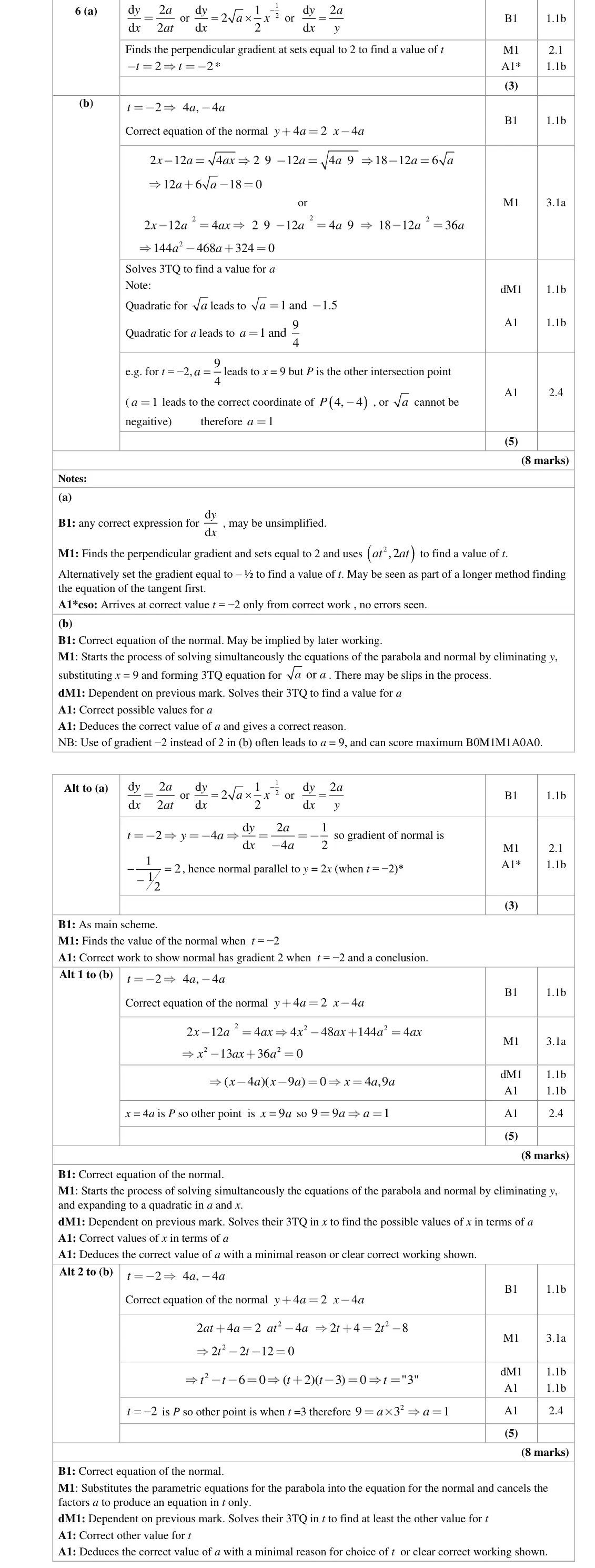
This proved a good challenge to end the paper, befitting the final question on the paper. Timing did not seem to be the issue with the question and the majority made some attempt at it, but it was clear that lower grade students were not able to work out the geometry of the situation to identify a suitable strategy. Part (b) did prove to be quite discriminating, with many students unable to unravel the information given in the question to produce a correct approach. A common error was to use y = 2x as the normal, rather than a parallel line, many seeing the -2 from part (a) and thinking this was the gradient needed for (b). Use of 1 2 - as the gradients was also noted in a few cases. There were a few different approaches possible for (b), though the most prevalent was the main scheme approach. All of the approaches were considerably simpler by early substitution of values of t to find P in terms of a, and of x = 9 for the second point, but many worked in more general terms and often got stuck in complicated polynomials involving a, t and x with errors in expansion of brackets and/or signs. Few of these succeeded in reaching a correct value for a. Of those who did take the direct approach, substituting the values, a considerable number obtained the equation of the normal correctly in the form y + 4a = 2(x – 4a), but did not simplify this correctly so got the wrong quadratic. The method of solving equations simultaneously was demonstrated by most (albeit with an incorrect equation for the normal in many cases) and so the two method marks were often gained, and where a correct normal had been achieved correct values for a usually followed. Justifying which solution of their quadratic to use was often unclear, though, meaning the final mark was difficult to attain. In particular for those who found a , they often argued that a ≠ -1.5 “because you cannot square root a negative number”, as opposed to the square root function not giving negative results, getting the argument back to front. Various other unclear attempts at explaining which root was needed were offered, with mixed success in actually choosing the correct one out of 1 and 9 4 . Some sketched the parabola, which proved helpful as they were able to deduce the required value based on the location of the intersection, although some of the sketches were actually of a hyperbola, not a parabola.
Key points from the mark scheme and examiner's report
P(4a, −4a)
normal y + 4a = 2(x − 4a)
with x = 9 gives a = 1 or 9/4 (or √a = 1, −1.5)
a = 9/4 makes x = 9 the point P itself, so a = 1
using y = 2x as the normal or gradient −2 (giving a = 9) were common
reasons for the choice often wrong or back to front
June 2023 · Paper 3A (Further Pure 1) · Q4(a)2 marks
Mark scheme (whole question; this part is marked with the orange bar)
Examiner's comment
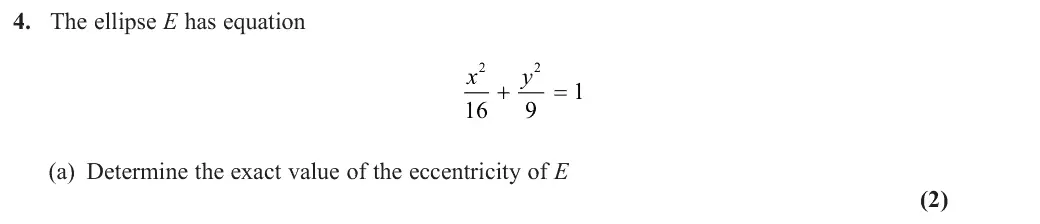
Once again an accessible question at all levels, and one which proved a good discriminator across grades. Part (a) required students to find the eccentricity of the given ellipse. The formula required was well known, and in the formula booklet, and most used it successfully to give the correct answer. A common error seen here was to give ± sqrt 7/4 as an answer rather than the required positive value, while a few also failed to simplify sqrt 16 to 4, and likewise only a small number used a and b in place of a2 and b2 in the formula.
Key points from the mark scheme and examiner's report
b² = a²(1 − e²): e = √7/4 (positive only)
June 2023 · Paper 3A (Further Pure 1) · Q4(b)4 marks
Mark scheme (whole question; this part is marked with the orange bar)
Examiner's comment
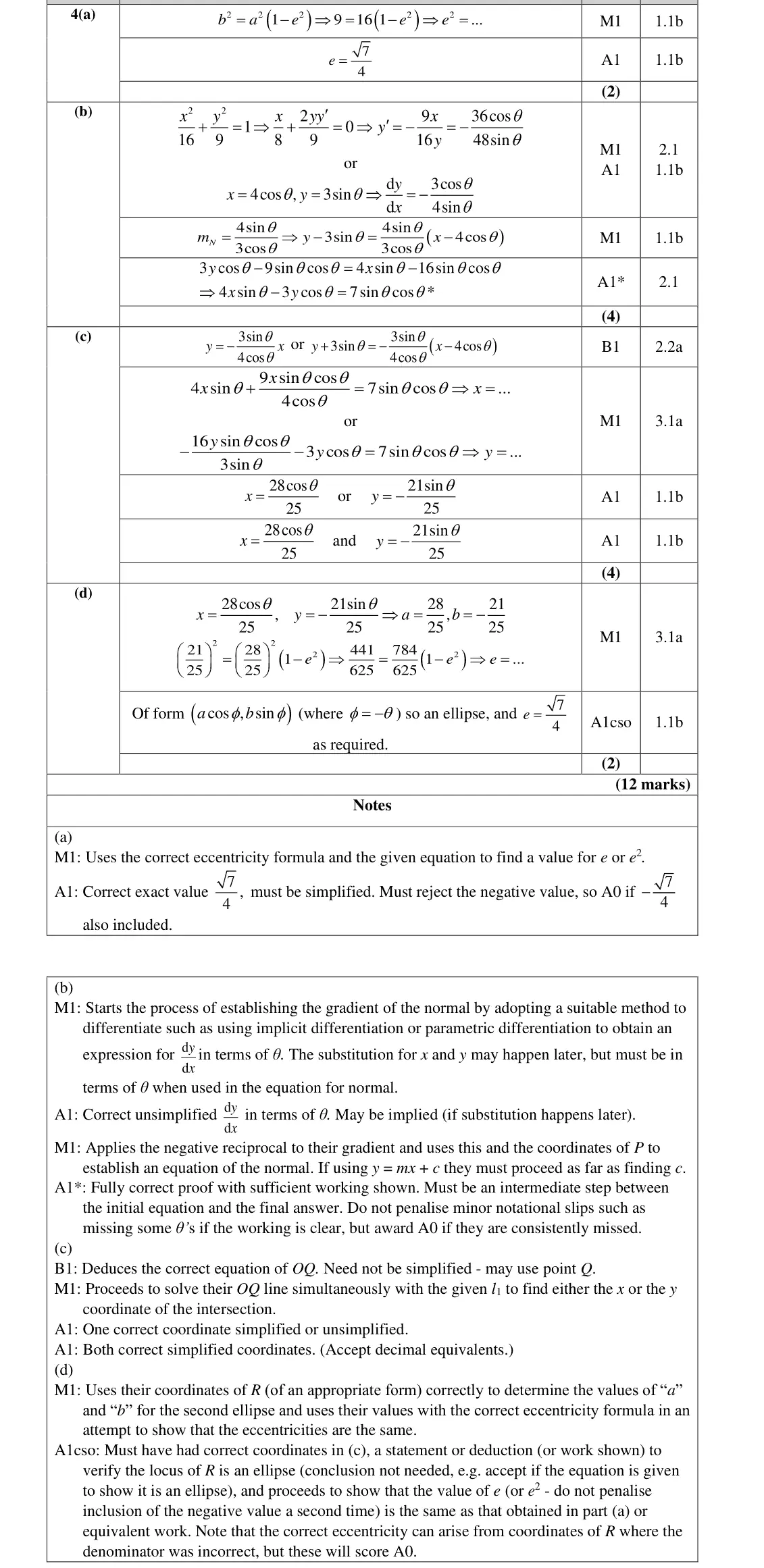
Once again an accessible question at all levels, and one which proved a good discriminator across grades. Part (b) was also well done with most students able to find the gradient correctly, usually either by parametric or by implicit differentiation, and then find the normal gradient to substitute in to get the correct equation. Occasional slips did occur, but in many cases students were able to identify the error and backtrack to correct when their answer did not match the given one - a useful checking point for students.
Key points from the mark scheme and examiner's report
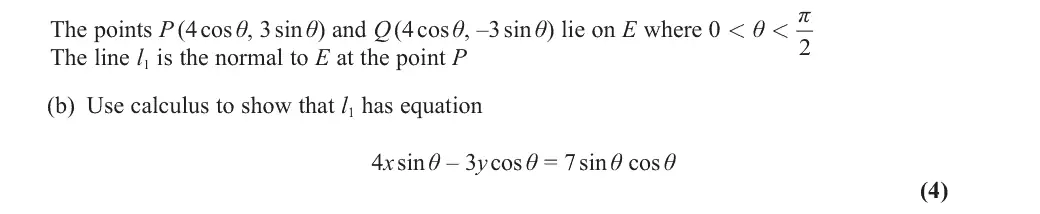
dy/dx = −3cos θ/(4sin θ) (implicit or parametric)
normal gradient 4sin θ/(3cos θ)
simplify to the printed equation
June 2023 · Paper 3A (Further Pure 1) · Q4(c)4 marks
Mark scheme (whole question; this part is marked with the orange bar)
Examiner's comment
Once again an accessible question at all levels, and one which proved a good discriminator across grades. It was in part (c) that difficulties began to arise, though most students found the equation for OQ correctly. Many made this more complicated than necessary, by adopting the form ( ) o 4 3sin 3s co in s 4c s x y = - - + rather than appreciating the line went through the origin, so has intercept zero. Unfortunately, a number of such candidates made errors in simplifying, or when substituting into the equation of the normal, such as losing one of the 4’s, to end up with incorrect coefficients in the coordinates, but of the correct form. These would lose both accuracy marks in (c) and the accuracy mark in (d), which required correct coordinates to have been found. It was rare, but not unknown, for only one coordinate to be correct. Another common error was to lose the ‘x’ when substituting for the line OQ into the given equation of the normal equation to find the intersection points, resulting in incorrect coordinates. These students did not appear to realise that the values they were getting were too complicated to be correct as they would not give the ellipse required for part (d). Such students could not gain the method mark in part (d) from forms of the coordinates which were not for an ellipse.
Key points from the mark scheme and examiner's report
OQ: y = −(3sin θ/(4cos θ))x through the origin
substitute into l₁: R(28cos θ/25, −21sin θ/25)
slips such as losing x or a factor 4
June 2023 · Paper 3A (Further Pure 1) · Q4(d)2 marks
Mark scheme (whole question; this part is marked with the orange bar)
Examiner's comment
Once again an accessible question at all levels, and one which proved a good discriminator across grades. Success in part (d) was dependent on whether they had successfully found intersection points in part (c) correctly, or at least of the correct form. As such many did not make much progress in this part, though those with correct form for the coordinates usually scored the method mark. Many students did not appreciate the necessity to give evidence that their point from part (c) did in fact lie on an ellipse rather than just finding the eccentricity, though many did first attempt to find the equation in Cartesian form using trigonometric identities, and so tacitly evidenced it was an ellipse, and could score the A. Familiarity with the standard parametric form from the formula booklet was not in evidence, and some thought they needed to show a is bigger than b before they could proceed. Finding the eccentricity from coordinates of the correct form was usually completed successfully, and in fact often did give the same value for e from incorrect coordinates due to “double errors” cancelling, meaning students were unaware of their error. However, the final mark was only permitted for a fully correct solution with at least some evidence of having an ellipse for the new locus, and so was not a difficult and discriminating, mark to achieve.
Key points from the mark scheme and examiner's report
R is (a cos φ, b sin φ) with a = 28/25, b = 21/25 so an ellipse
e² = 1 − (21/28)² = 7/16, e = √7/4
must state why it is an ellipse, not just compute e
June 2022 · AS Paper 2 (Further Pure 1) · Q4(a)1 mark
Mark scheme (whole question; this part is marked with the orange bar)
Examiner's comment
Almost all candidates were able to state the coordinates of the focus in part (a). In (b), some 2 q x = candidates worked with the generic form of the parabola and failed to include y q or = 10 in their attempt to reach the equation. In some cases, this was recovered later on in the working, but made the algebra more difficult to work with. Most who found the gradient as 5 were able q to complete the question.
Key points from the mark scheme and examiner's report
4a = 10 so F(5/2, 0)
June 2022 · AS Paper 2 (Further Pure 1) · Q4(b)3 marks
Mark scheme (whole question; this part is marked with the orange bar)
Examiner's comment
Almost all candidates were able to state the coordinates of the focus in part (a). In (b), some 2 q x = candidates worked with the generic form of the parabola and failed to include y q or = 10 in their attempt to reach the equation. In some cases, this was recovered later on in the working, but made the algebra more difficult to work with. Most who found the gradient as 5 were able q to complete the question. rather than using the tangent given in (b), which resulted in a large amount of complex and unnecessary working which was not creditworthy. Some attempted to prove the result by using the midpoint of BF, but this produced a circular argument which, again, did not earn full marks. Some candidates tried to find a specific value for q, usually 5, which missed the point of the general result. Those who found an equation for BF often went on to either substitute into the equation for AP or to use the y intercepts. The latter approach was more likely to earn full marks if the conclusion was stated clearly. In the former, whilst most successfully eliminated y, not all reached an equation of the form ( ) 2 50 2 0 x q + = or equivalent, in order to draw the required conclusion. Those that did often did not reject the possibility that the expression in terms of q could be equal to zero, meaning that the final conclusion was incomplete.
Key points from the mark scheme and examiner's report
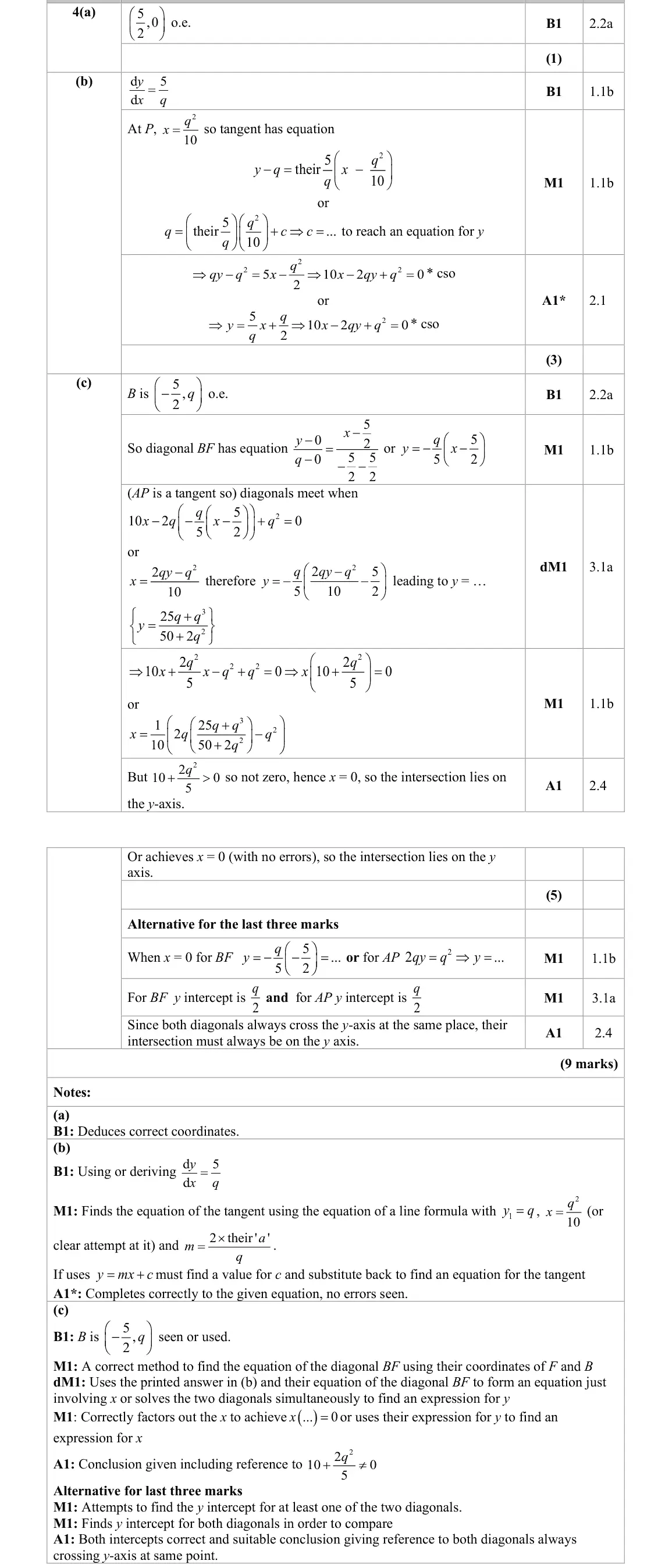
dy/dx = 5/q at P(q²/10, q)
y − q = (5/q)(x − q²/10) to the printed equation
some never used x = q²/10
June 2022 · AS Paper 2 (Further Pure 1) · Q4(c)5 marks
Mark scheme (whole question; this part is marked with the orange bar)
Examiner's comment
In part (c), a surprising number of candidates tried to derive the equation of the line AP again, rather than using the tangent given in (b), which resulted in a large amount of complex and
Key points from the mark scheme and examiner's report
B(−5/2, q) on directrix x = −5/2
diagonal BF meets the given tangent AP where x(10 + 2q²/5) = 0, and 10 + 2q²/5 ≠ 0 so x = 0 (or both diagonals have y-intercept q/2)
many re-derived AP, used circular midpoint arguments or a specific q
June 2022 · Paper 3A (Further Pure 1) · Q1(a)4 marksEasy
Mark scheme (whole question; this part is marked with the orange bar)
Examiner's comment
With 70% scoring full marks and a mean score of over 6/7, this was the easily the most accessible question of the paper, so well placed at question 1. A good start for high and low grade candidates alike to ease in to the paper on a familiar and expected topic. In part (a) the vast majority of candidates were able to use the correct formula to find a value for e1 or e12, however it was not unknown to see a and b substituted the wrong way round in instances where errors were made, and occasionally candidates forgot to square either a or b. One the equation was set up they usually successfully proceeded using e1 x e2 =1 to set up an equation in a and b, although not always in the most efficient manner. Common errors included using b2 = a2 (1 – e2) for both the ellipse and hyperbola and simple slips with fractions and roots. Despite being in the Formula Booklet a few candidates used incorrect equations.
Key points from the mark scheme and examiner's report
errors: a and b swapped, using the ellipse formula for the hyperbola
June 2022 · Paper 3A (Further Pure 1) · Q1(b)3 marksEasy
Mark scheme (whole question; this part is marked with the orange bar)
Examiner's comment
With 70% scoring full marks and a mean score of over 6/7, this was the easily the most accessible question of the paper, so well placed at question 1. A good start for high and low grade candidates alike to ease in to the paper on a familiar and expected topic. Again in part (b) most all candidates started well by successfully finding the focus of the ellipse, but after this success rates varied with maybe a mark or two dropped. A common error was to assume a was the same value for the hyperbola as the ellipse. Others did not see how to proceed and made little progress. Candidates who clearly wrote out what they were doing (thereby demonstrated clear thinking) most usually arrived at the equation of the hyperbola with ease. Many found b before a by solving simultaneous equations, failing to spot the much easier method of using the foci coordinates with their eccentricity from (a).
Key points from the mark scheme and examiner's report
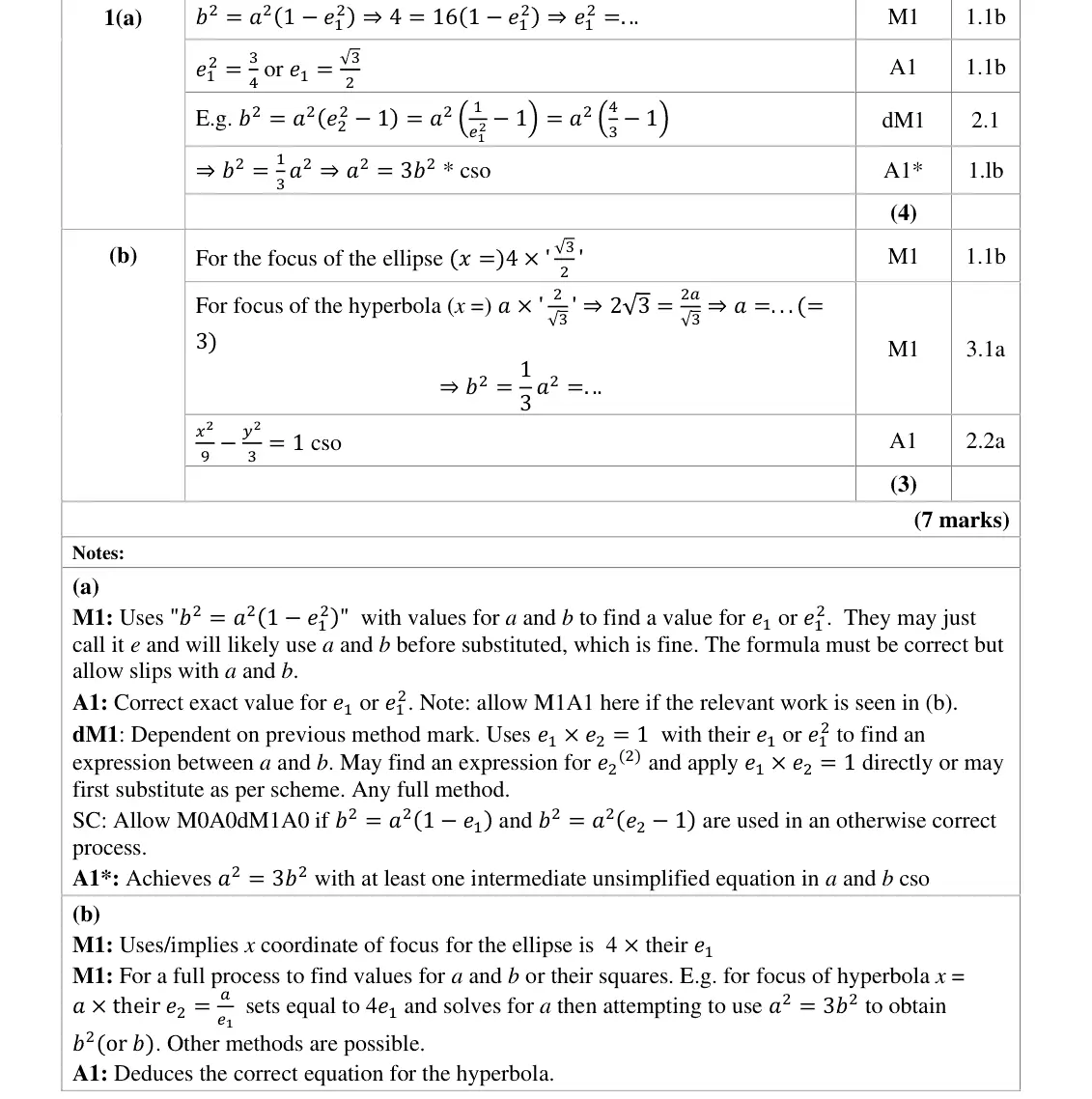
ellipse focus x = 4 × √3/2 = 2√3
hyperbola focus ae₂ = 2a/√3 = 2√3 so a = 3, b² = 3: x²/9 − y²/3 = 1
common error: assuming the same a as the ellipse
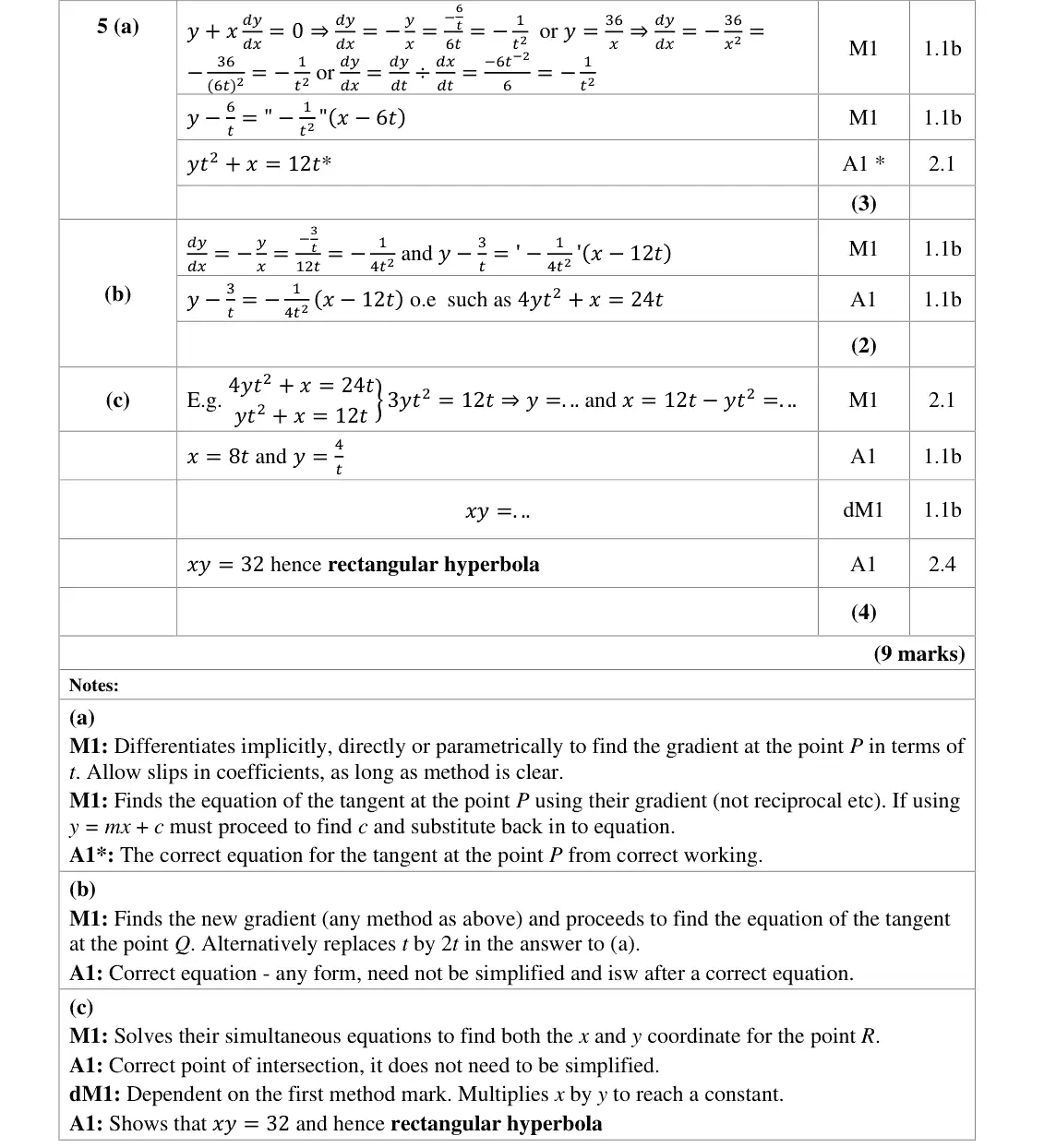
June 2022 · Paper 3A (Further Pure 1) · Q5(a)3 marksEasy
Mark scheme (whole question; this part is marked with the orange bar)
Examiner's comment
There was a much more mixed response to this question than the other questions on the paper, with 40% scoring the modal full marks, but scores of 3, 5 7 and 8 also very common. The 5% scoring no marks was also higher than all except the 7% in question 4. It was clear in part (a) that candidates were very well versed in this kind of ‘bookwork’ question, with this part being mostly very well answered. A variety of successful approaches were taken to finding the gradient, either using implicit or parametric differentiation. The most common approach was parametric differentiation followed by use of 1 1) ( y y m x x - = - . Using y mx c = + to find the equation often led to more problems with simplification.
Key points from the mark scheme and examiner's report
dy/dx = −1/t² at P by implicit or parametric differentiation
y − 6/t = −(1/t²)(x − 6t) to yt² + x = 12t
June 2022 · Paper 3A (Further Pure 1) · Q5(b)2 marksEasy
Mark scheme (whole question; this part is marked with the orange bar)
Examiner's comment
There was a much more mixed response to this question than the other questions on the paper, with 40% scoring the modal full marks, but scores of 3, 5 7 and 8 also very common. The 5% scoring no marks was also higher than all except the 7% in question 4. In part (b) candidates usually scored either both marks or neither. Many employed the same approach as in part (a) and they tended to be successful, while some very astute candidates noticed they could substitute t for 2t in their answer for part (a) and again were successful.
Key points from the mark scheme and examiner's report
gradient −1/(4t²): 4yt² + x = 24t (or replace t by 2t in (a))
June 2022 · Paper 3A (Further Pure 1) · Q5(c)4 marksEasy
Mark scheme (whole question; this part is marked with the orange bar)
Examiner's comment
There was a much more mixed response to this question than the other questions on the paper, with 40% scoring the modal full marks, but scores of 3, 5 7 and 8 also very common. The 5% scoring no marks was also higher than all except the 7% in question 4. The incorrect approaches usually assumed the gradient was the same as in part (a) leading to no marks in (b). In general, students who had an incorrect answer for (b) usually made little progress with part (c) if any. Part (c) proved to be a test of competence in basic algebra. There were a significant number of candidates who found solving this pair of simultaneous equations a challenge. However, many students correctly solved their simultaneous equations from (a) and (b) to find 𝑥 and 𝑦 in terms of 𝑡 but not all then went on to show that this represented a rectangular hyperbola by multiplying the 𝑥 and 𝑦 together to reach a constant. Some argued that the parametric form was enough to show that the locus was a rectangular hyperbola, but this did not achieve full marks. Some also lost marks for referring to the resulting Cartesian equation as a ‘hyperbola’ rather than ‘rectangular hyperbola’. Solutions which earned full marks were able to briefly state the point of their mathematical working into appropriate words such as “hence the form of a rectangular hyperbola”.
Key points from the mark scheme and examiner's report
solve simultaneously: x = 8t, y = 4/t, so xy = 32, a rectangular hyperbola
must form xy = constant and say "rectangular hyperbola"
parametric form alone not enough
algebra weak
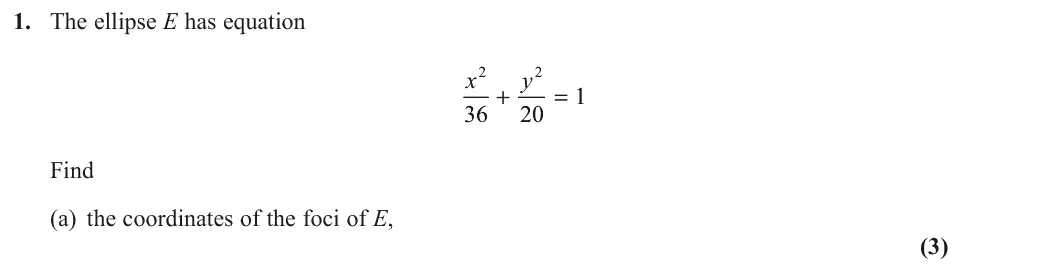
Nov 2021 · Paper 3A (Further Pure 1) · Q1(a)3 marks
Mark scheme (whole question; this part is marked with the orange bar)
Examiner's comment
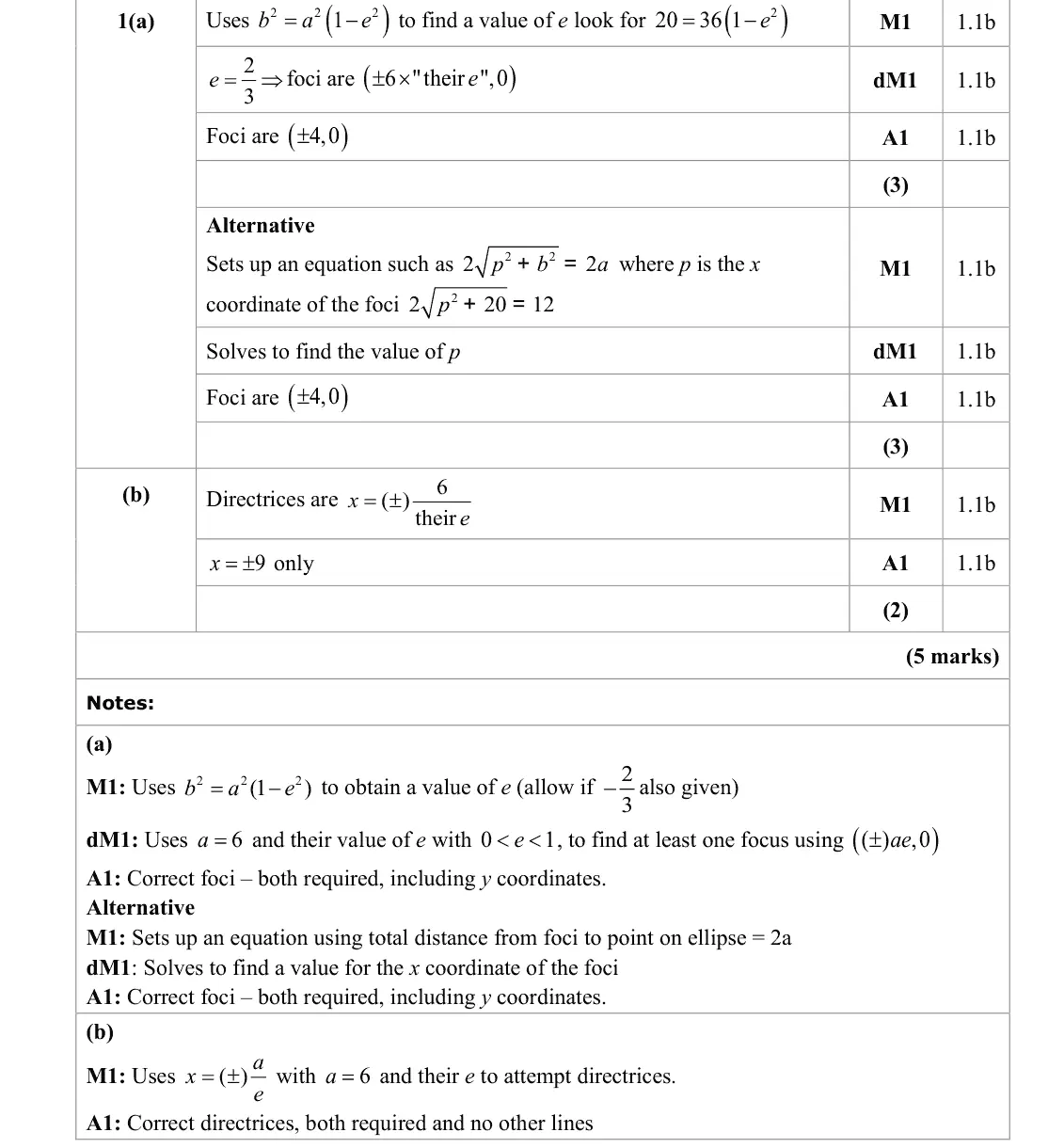
A good question 1, with virtually all the candidate scored full marks on this question, which given all the formulae are in the formula book. The only
Key points from the mark scheme and examiner's report
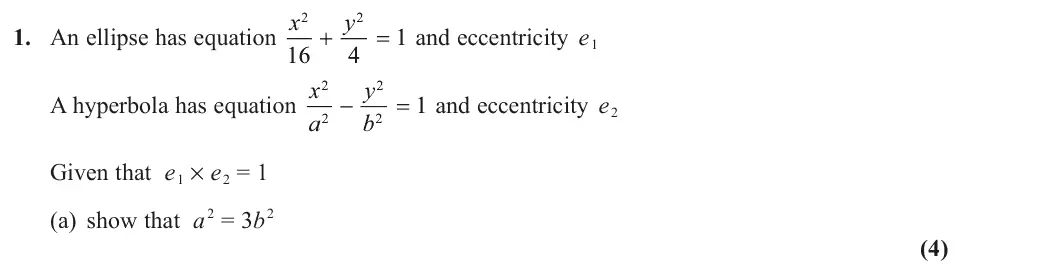
b² = a²(1 − e²) gives e = 2/3
foci (±ae, 0) = (±4, 0)
Nov 2021 · Paper 3A (Further Pure 1) · Q1(b)2 marks
Mark scheme (whole question; this part is marked with the orange bar)
Examiner's comment
A good question 1, with virtually all the candidate scored full marks on this question, which given all the formulae are in the formula book. The only = ± when slips were in part (b) were having extra equations or just writing 9 x = ± . the equations of the directrices are 9
Key points from the mark scheme and examiner's report
x = ±a/e = ±9, both and no other lines
slips were extra equations
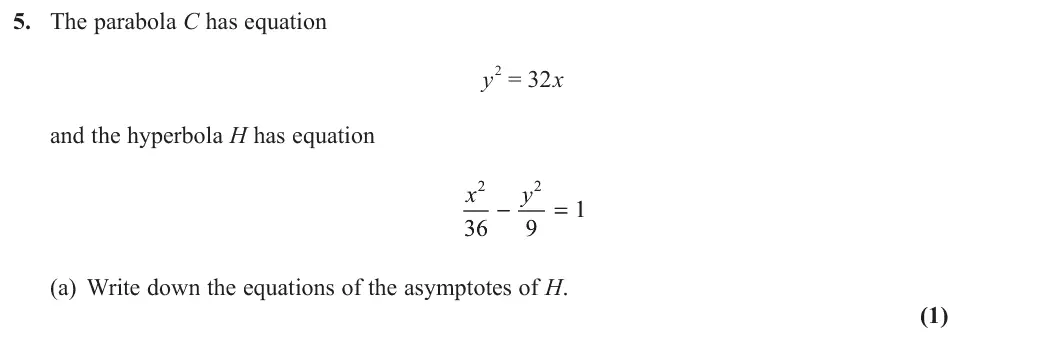
Nov 2021 · Paper 3A (Further Pure 1) · Q5(a)1 mark
Mark scheme (whole question; this part is marked with the orange bar)
Examiner's comment
Part (a) The majority of candidates were able to write down the equations of the asymptotes of the hyperbola, the formula can be found in the formula book.
Key points from the mark scheme and examiner's report
y = ±x/2
Nov 2021 · Paper 3A (Further Pure 1) · Q5(b)4 marks
Mark scheme (whole question; this part is marked with the orange bar)
Examiner's comment
Part (b) Candidates recognised that they needed to differentiate the parabola and sets equal to the perpendicular gradient of asymptotes in part (a). Most candidates differentiated using implicit differentiation and found the values of y. Once the values of y were found candidates correctly found the corresponding x coordinate and equation of the normal. The common errors were not reading that the normal to C was required, some candidates set the gradient of the parabola equal to the gradient in part (a) leading to the equation of the tangent to C which are parallel to the asymptotes of H.
Key points from the mark scheme and examiner's report
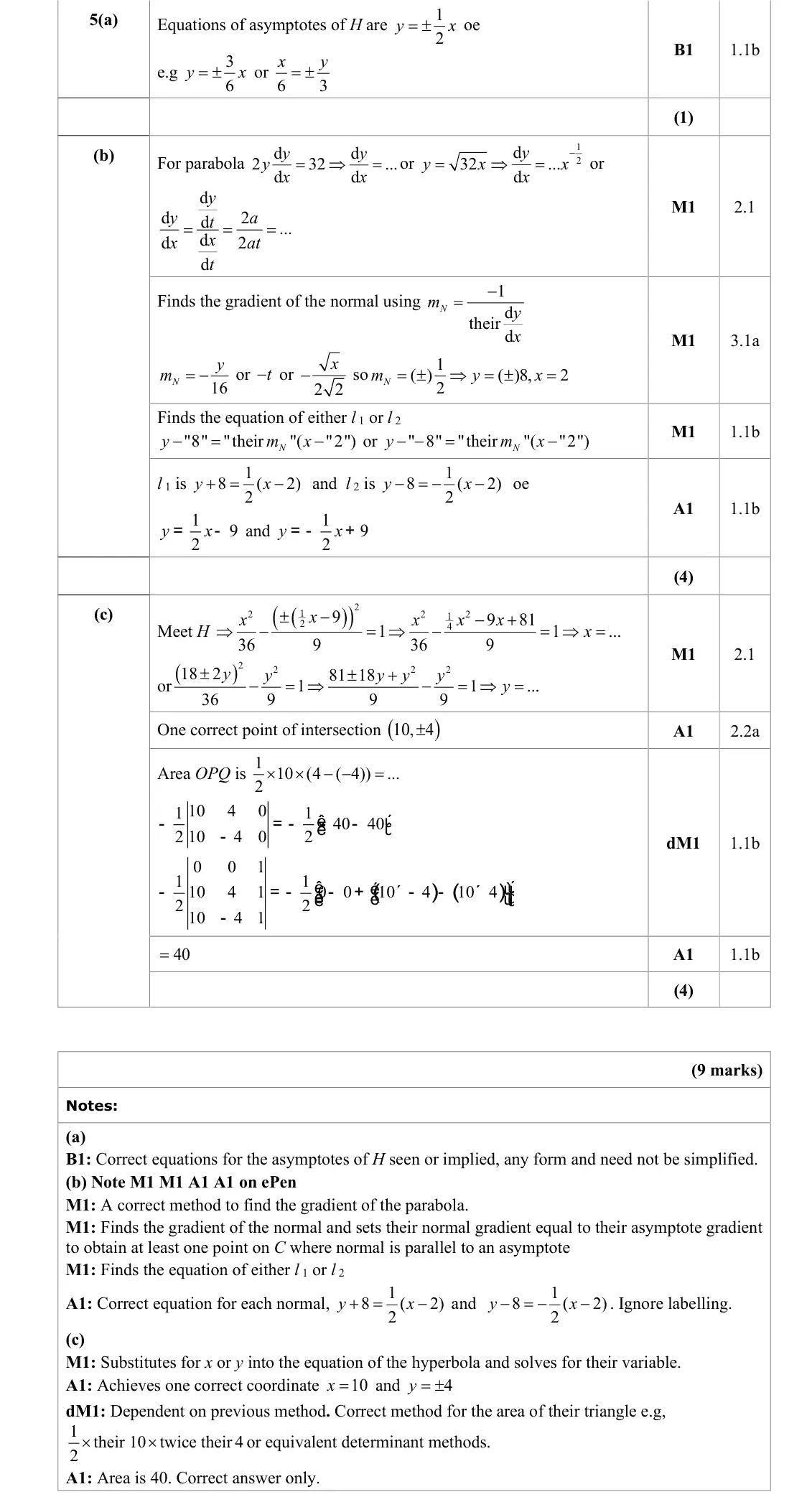
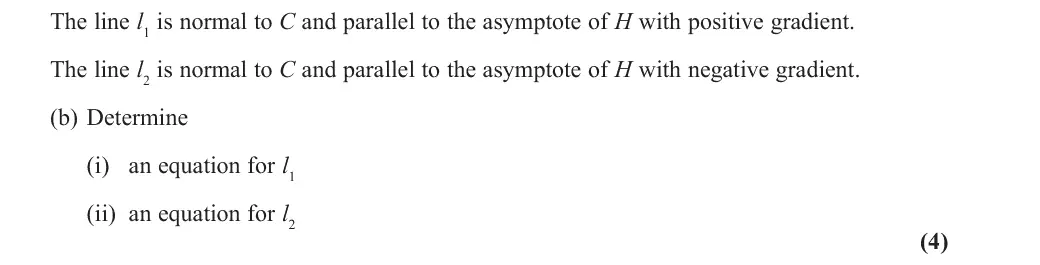
normal gradient −y/16 = ±1/2 gives (2, ∓8)
l₁: y = x/2 − 9, l₂: y = −x/2 + 9
common error: using tangents parallel to the asymptotes instead of normals
Nov 2021 · Paper 3A (Further Pure 1) · Q5(c)4 marks
Mark scheme (whole question; this part is marked with the orange bar)
Examiner's comment
Part (c) Candidates who were able to finding equations in part (a) knew that they need to find the points of intersection between their answers to part (b) and the hyperbola. On occasion candidates found the point of intersection between their two answers in part (b) for found the point of intersection with the parabola. Once the coordinates of P and Q were found candidates were able to find the area of the triangle OPQ. The determinate method was often seen.
Key points from the mark scheme and examiner's report
substitute each line into H: P(10, −4), Q(10, 4)
area OPQ = 40 (determinant or ½ × 8 × 10)
errors: intersecting l₁ with l₂ or with C
Oct 2020 · AS Paper 2 (Further Pure 1) · Q4(a)1 mark
Mark scheme (whole question; this part is marked with the orange bar)
Examiner's comment
There were no candidates who made any significant progress with this question. In part (a), only 9 candidates could identify the coordinates of the focus despite the fact that this is given in the formula book. In part (b), many
Key points from the mark scheme and examiner's report
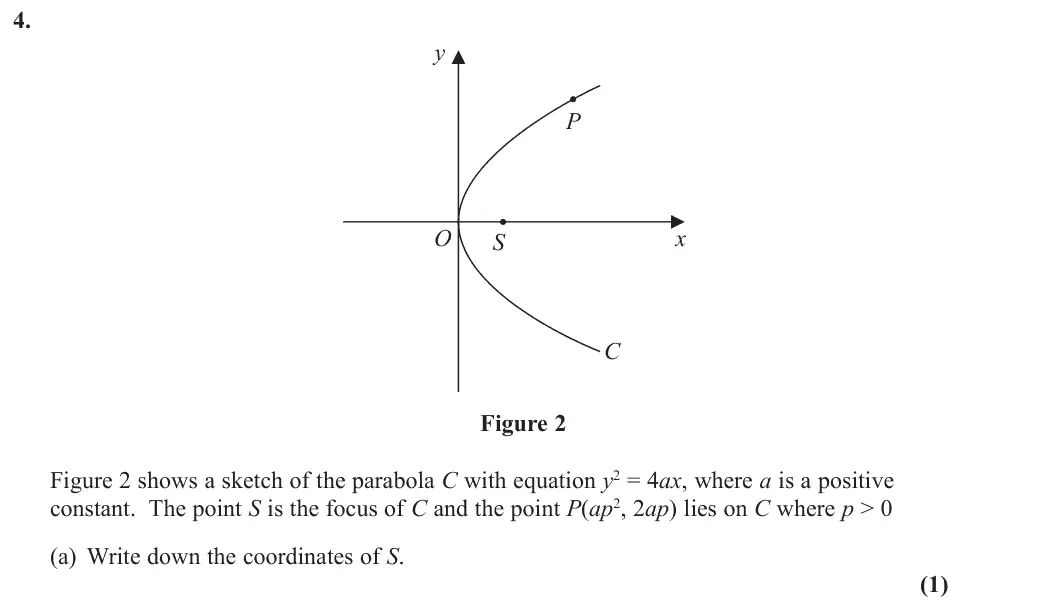
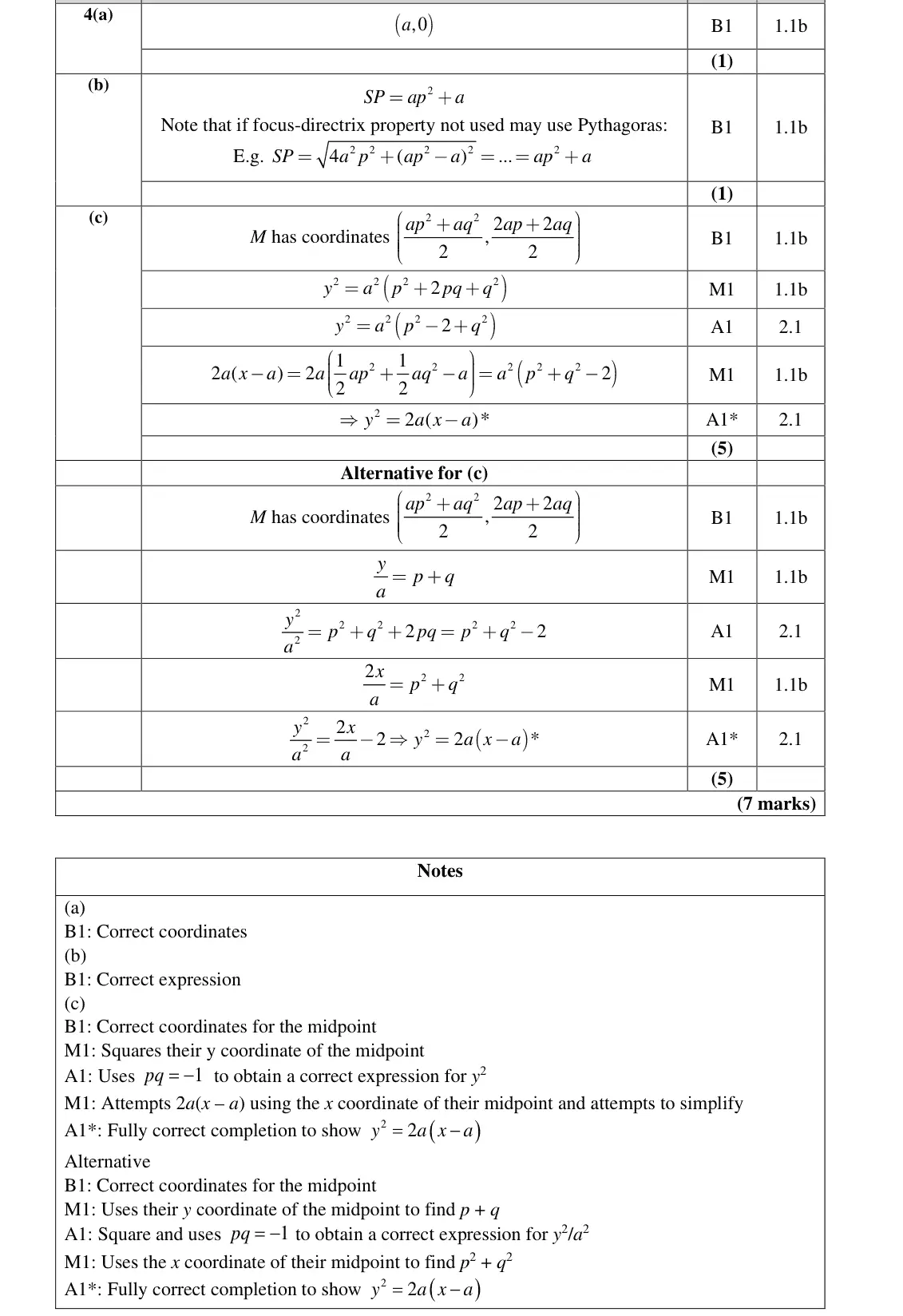
S(a, 0)
given in the formula book yet few correct
Oct 2020 · AS Paper 2 (Further Pure 1) · Q4(b)1 mark
Mark scheme (whole question; this part is marked with the orange bar)
Examiner's comment
There were no candidates who made any significant progress with this focus despite the fact that this is given in the formula book. In part (b), many candidates made poor attempts using Pythagoras’ theorem to prove the result, with many algebraic errors evident. There were no candidates who appeared to be aware of the focus-directrix property of the parabola. Part (c)
Key points from the mark scheme and examiner's report
SP = ap² + a by the focus-directrix property (distance to x = −a)
laboured Pythagoras attempts full of errors
Oct 2020 · AS Paper 2 (Further Pure 1) · Q4(c)5 marks
Mark scheme (whole question; this part is marked with the orange bar)
Examiner's comment
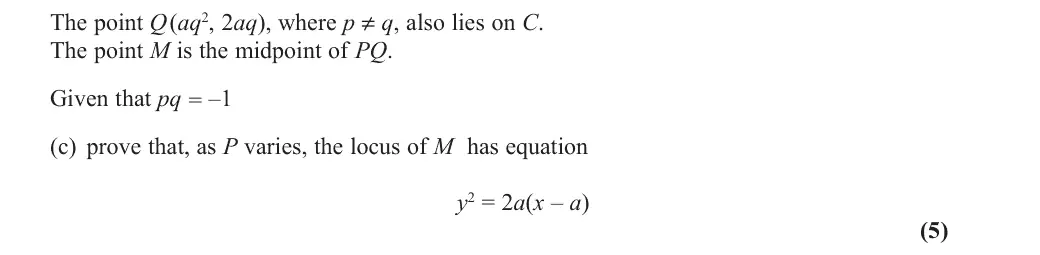
There were no candidates who made any significant progress with this appeared to be aware of the focus-directrix property of the parabola. Part (c) was met with little success and the only mark scored was that for the coordinates for the mid-point.
Key points from the mark scheme and examiner's report
M(a(p² + q²)/2, a(p + q))
y² = a²(p² + q² + 2pq) = a²(p² + q² − 2) using pq = −1, and 2a(x − a) gives the same
almost all scored only the midpoint mark
Oct 2020 · Paper 3A (Further Pure 1) · Q5(a)3 marks
Mark scheme (whole question; this part is marked with the orange bar)
Examiner's comment
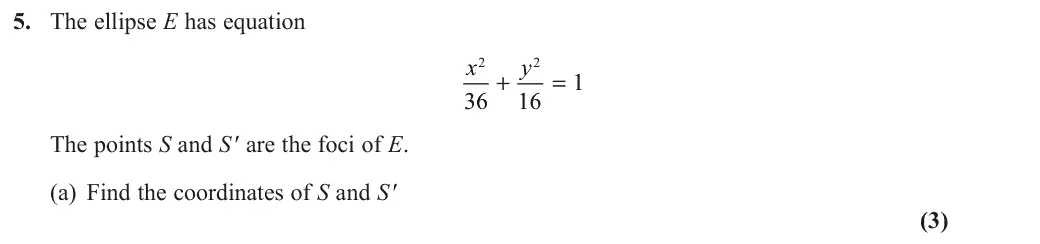
Most candidates achieved full marks in part a. There were a good number of candidates who did not attempt part b. Of those that did, choosing a general point in parametric form was the most common approach though these candidates generally then found it difficult to manipulate the trigonometry to find correct expressions for PS and PS’. There were students who chose to use either (0, 4) or (6, 0) as their point P without any justification that the length of PS + PS’ would be the same for a general point P. Very few candidates, even those that had found the perimeter correctly, concluded that the perimeter was constant for any P on E.
Key points from the mark scheme and examiner's report
b² = a²(1 − e²) with a = 6, b = 4: e = √5/3
foci (±2√5, 0)
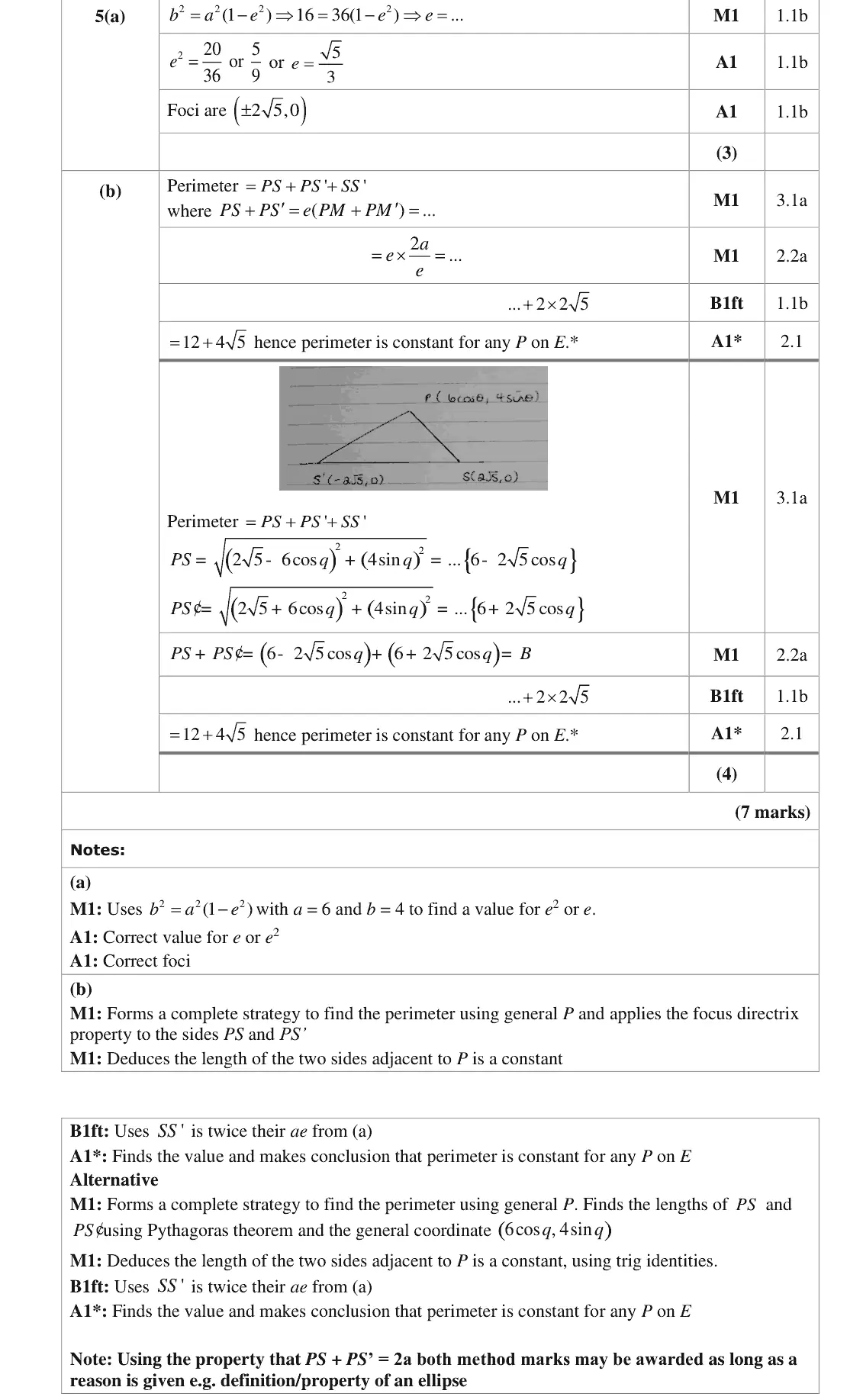
Oct 2020 · Paper 3A (Further Pure 1) · Q5(b)4 marks
Mark scheme (whole question; this part is marked with the orange bar)
Examiner's comment
Most candidates achieved full marks in part a. There were a good number of candidates who did not attempt part b. Of those that did, choosing a general point in parametric form was the most common approach though these candidates generally then found it difficult to manipulate the trigonometry to find correct expressions for PS and PS’. There were students who chose to use either (0, 4) or (6, 0) as their point P without any justification that the length of PS + PS’ would be the same for a general point P. Very few candidates, even those that had found the perimeter correctly, concluded that the perimeter was constant for any P on E.
Key points from the mark scheme and examiner's report
special points like (0, 4) without justification score little
conclusion "constant for any P" often missing
many did not attempt
Oct 2020 · Paper 3A (Further Pure 1) · Q7(a)3 marks
Mark scheme (whole question; this part is marked with the orange bar)
Examiner's comment
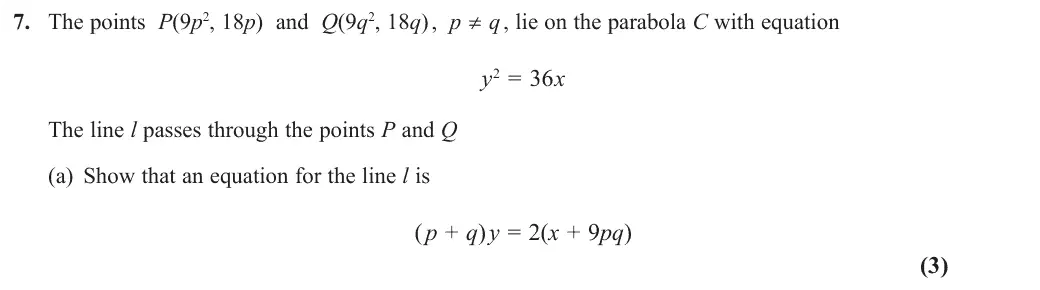
Part a was easily accessible to most candidates. The main reason that some candidates ran into difficulties was that they did not simplify their expression for the gradient before substituting it into an equation for the line and then either made algebraic errors or could not see how to simplify their significantly more complicated expressions to obtain the given answer. Most candidates had a good appreciation of the process required in part b, attempting to find the gradient of the normal at P and then the equation of the normal at P, writing down the equation of the normal at Q and then solving the two equations simultaneously. There were algebraic errors but the most common source of loss of marks was in not showing sufficient working to ( ) 3 3 9 9 18 18 p q p q x p q - + - = - obtain the given answer. Many candidates went from or similar directly to the given expression for x without justification. Candidates struggled with part c, there were many responses where part c was not attempted at all and many more where the candidate had put their x coordinate from part b equal to 12 and their y coordinate equal to 0 and struggled to make any progress. Only a very small proportion of candidates reached the correct relationship between x and y.
Key points from the mark scheme and examiner's report
gradient PQ = 2/(p + q) (simplify before substituting)
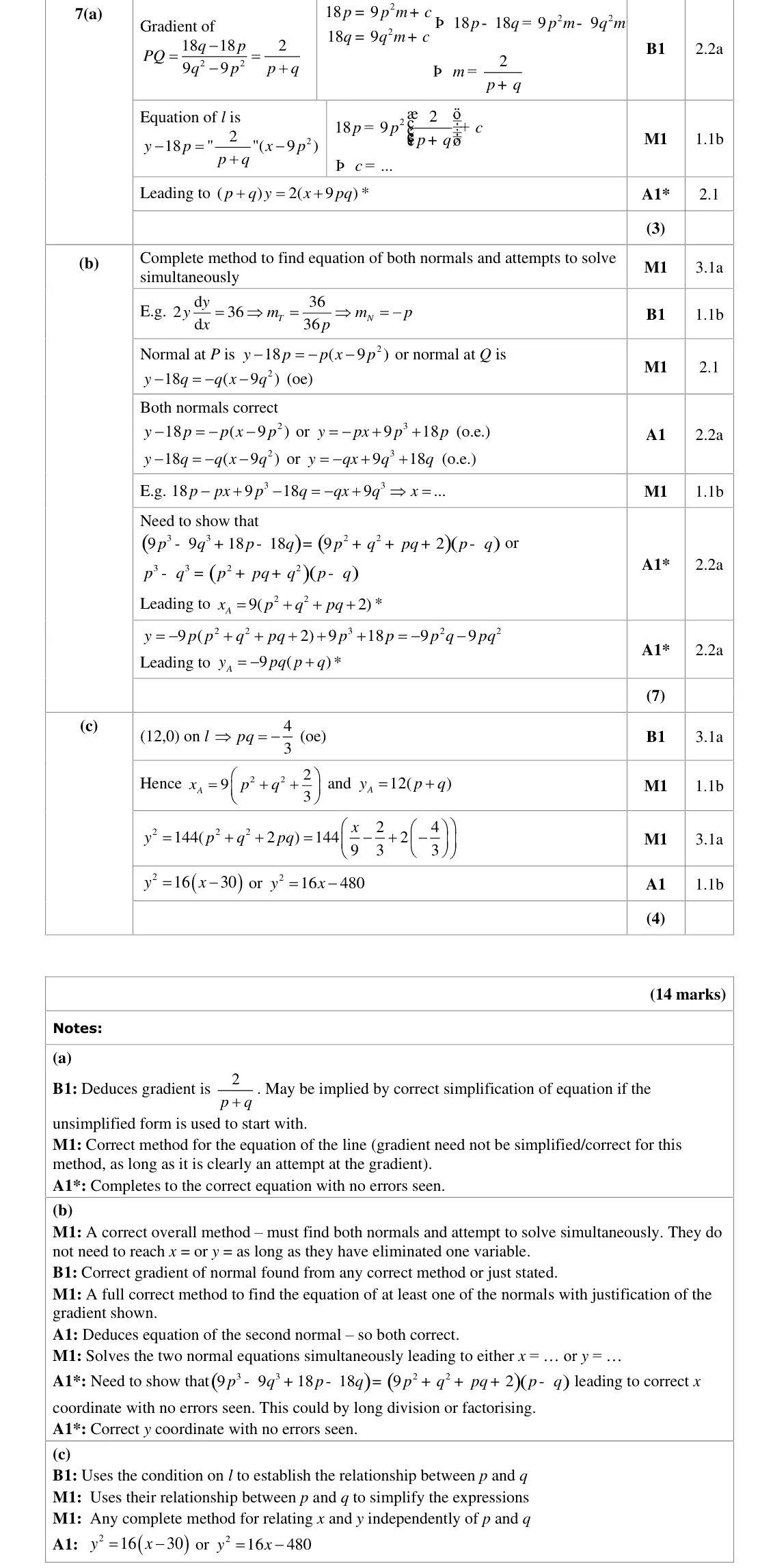
then straight-line equation to the printed (p + q)y = 2(x + 9pq)
Oct 2020 · Paper 3A (Further Pure 1) · Q7(b)7 marks
Mark scheme (whole question; this part is marked with the orange bar)
Examiner's comment
Part a was easily accessible to most candidates. The main reason that some candidates ran into difficulties was that they did not simplify their expression for the gradient before substituting it into an equation for the line and then either made algebraic errors or could not see how to simplify their significantly more complicated expressions to obtain the given answer. Most candidates had a good appreciation of the process required in part b, attempting to find the gradient of the normal at P and then the equation of the normal at P, writing down the equation of the normal at Q and then solving the two equations simultaneously. There were algebraic errors but the most common source of loss of marks was in not showing sufficient working to ( ) 3 3 9 9 18 18 p q p q x p q - + - = - obtain the given answer. Many candidates went from or similar directly to the given expression for x without justification. Candidates struggled with part c, there were many responses where part c was not attempted at all and many more where the candidate had put their x coordinate from part b equal to 12 and their y coordinate equal to 0 and struggled to make any progress. Only a very small proportion of candidates reached the correct relationship between x and y.
Key points from the mark scheme and examiner's report
normal at P: y + px = 18p + 9p³, similarly at Q
solve simultaneously
must show the factorisation p³ − q³ = (p − q)(p² + pq + q²) to reach the given x
jumping to the given answer was the main loss
Oct 2020 · Paper 3A (Further Pure 1) · Q7(c)4 marks
Mark scheme (whole question; this part is marked with the orange bar)
Examiner's comment
Part a was easily accessible to most candidates. The main reason that some candidates ran into difficulties was that they did not simplify their expression for the gradient before substituting it into an equation for the line and then either made algebraic errors or could not see how to simplify their significantly more complicated expressions to obtain the given answer. Most candidates had a good appreciation of the process required in part b, attempting to find the gradient of the normal at P and then the equation of the normal at P, writing down the equation of the normal at Q and then solving the two equations simultaneously. There were algebraic errors but the most common source of loss of marks was in not showing sufficient working to ( ) 3 3 9 9 18 18 p q p q x p q - + - = - obtain the given answer. Many candidates went from or similar directly to the given expression for x without justification. Candidates struggled with part c, there were many responses where part c was not attempted at all and many more where the candidate had put their x coordinate from part b equal to 12 and their y coordinate equal to 0 and struggled to make any progress. Only a very small proportion of candidates reached the correct relationship between x and y.
Key points from the mark scheme and examiner's report
(12, 0) on l gives pq = −4/3
x = 9((p + q)² − pq + 2), y = 12(p + q)
eliminate: y² = 16x − 480
many set A's coordinates to (12, 0) or did not attempt
June 2019 · AS Paper 2 (Further Pure 1) · Q510 marks
Mark scheme (whole question; this part is marked with the orange bar)
Examiner's comment
Q5 required an extended response and its unstructured nature proved too demanding for those who did not formulate a clear strategy. This meant that Q5 discriminated well across higher ability candidates and there was a significant minority who made no attempt or no creditable attempt at this question. A huge range of methods were viable, most of which were seen, although Way 1, as described in the mark scheme, was the most popular and successful route to a correct answer. A significant number of candidates progressed as far as finding an equation for l (the tangent to H at P) and finding the points where l cut through the x-axis and the y-axis. Errors seen for those who made further progress included using 2 OA OB rather than 2 OB OA ; using : 1:3; OA OB applying (base)(height) when finding the area of triangle OAB; believing 2 1 1 ; 2 4 t t or simplifying 1 ( )(2 ) 2 x x to give either 2 1 , 2 x 2 2x or 2 .x On the whole, it was pleasing to see a significant number of well-presented correct solutions.
Key points from the mark scheme and examiner's report
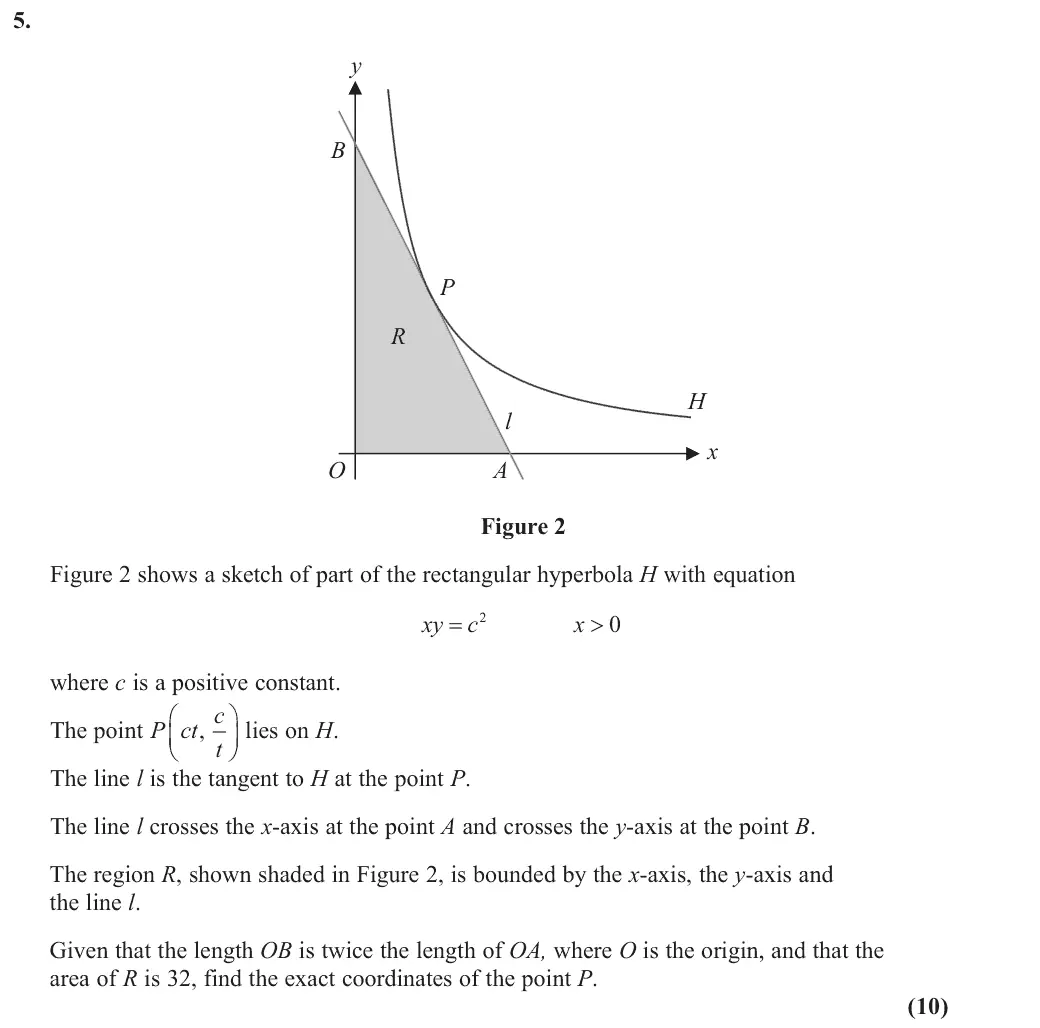
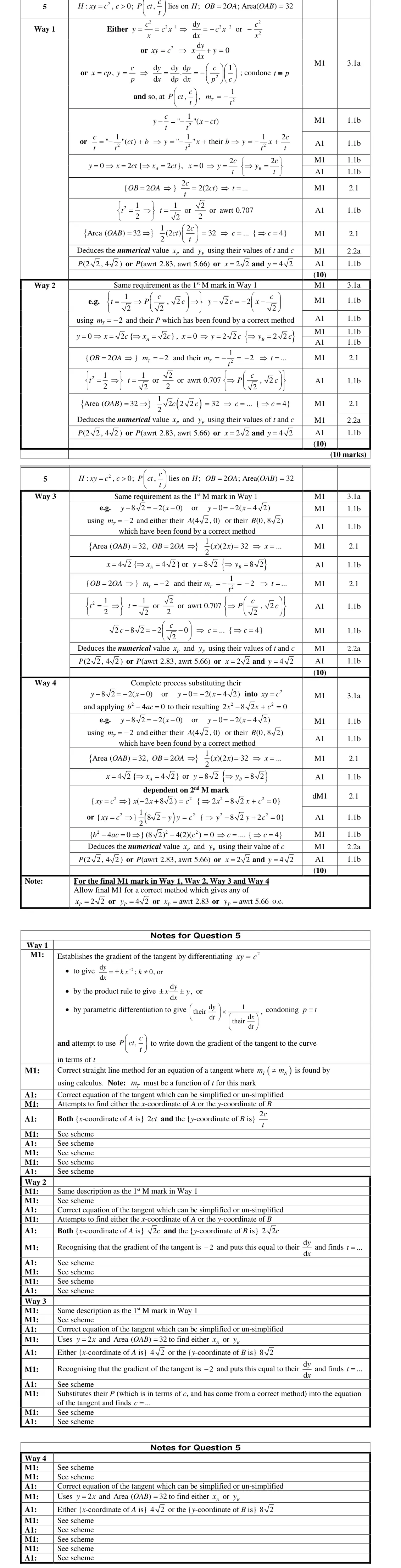
tangent x + t²y = 2ct gives A(2ct, 0), B(0, 2c/t)
OB = 2OA gives t = 1/√2
½(2ct)(2c/t) = 2c² = 32 so c = 4
P(2√2, 4√2)
errors: OA = 2OB, area without ½, poor simplification
June 2019 · Paper 3A (Further Pure 1) · Q48 marks
Mark scheme (whole question; this part is marked with the orange bar)
Examiner's comment
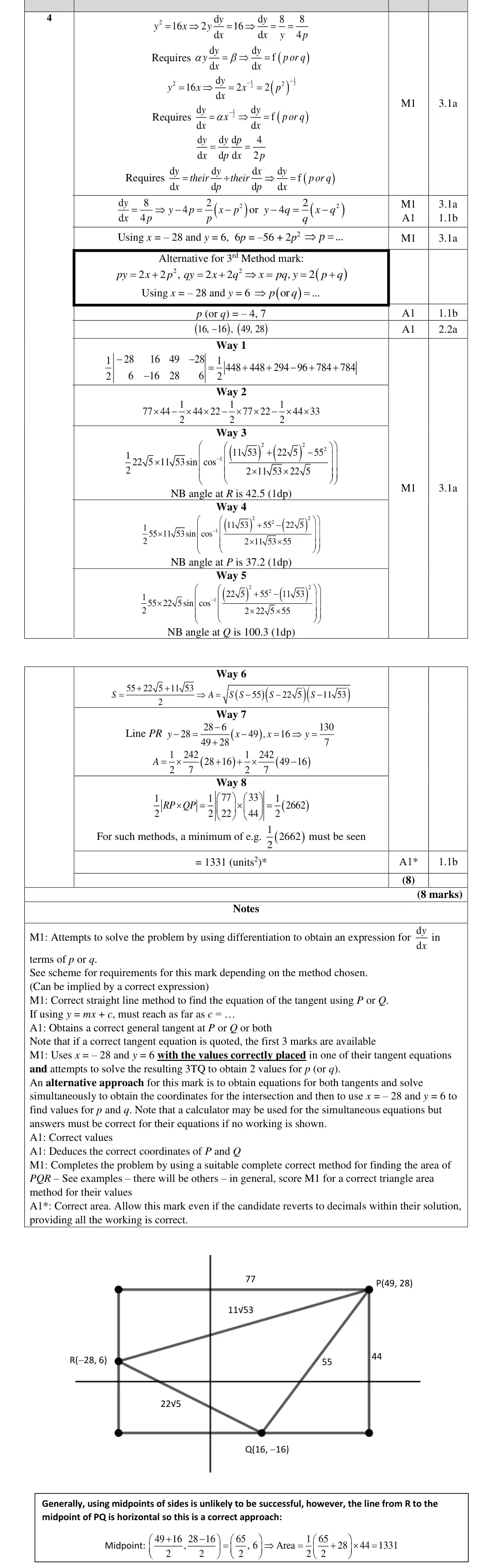
The first part of this question required candidates to produce the equation of a tangent to a parabola and then use the given point to find the coordinates of the two points where the two tangent touched the parabola. The most successful approach was to differentiate using the chain rule and then substitute in the given general P or Q coordinates to find an equation of the tangent at either P or Q. Candidates who drew a diagram realised that substituting in the given intersection point 𝑅(-28, 6) would yield the 𝑝 and 𝑞 needed in order to obtain the specific coordinates of the points P and Q. Such attempts usually yielded the correct coordinates of those points. For others it was a case of resorting to simultaneous equations using their general tangent equations and then substituting in the coordinates of the point of intersection. However, candidates needed to work much harder in order to obtain the correct quadratic equations which yielded the values of 𝑝 and 𝑞. The complexity of this algebra proved too much for some candidates. It was rare to see the resulting quadratic solved incorrectly. The second part of the question involved finding the area of the triangle formed by the given point and the two points found in the first part. It was disappointing to see many candidates setting off to find this area without first doing a quick sketch to help them. Longer solutions involved using the cosine rule and then a triangle area formula. Concise, and simpler, solutions used the determinant method of finding the area of a triangle, enclosing the triangle in a rectangle and finding the area of the rectangle and subtracting the area of three right angled triangles and using one half of the modulus of the cross product of the vectors forming two of the sides of the triangle. It should be noted that the use of these more efficient ways of finding the area of a triangle were relatively rare.
Key points from the mark scheme and examiner's report
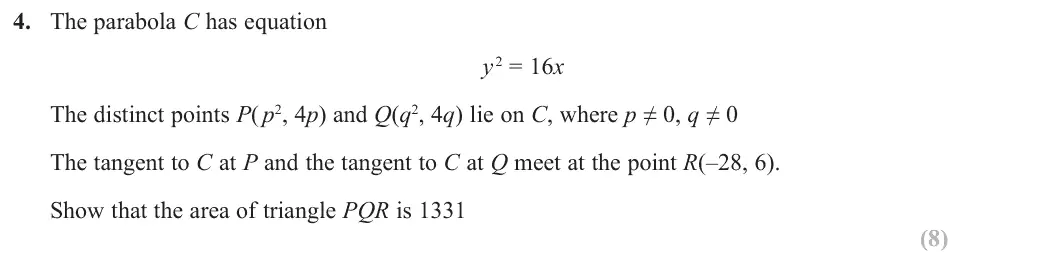
tangent py = 2x + 2p²
substituting R gives p² − 3p − 28 = 0 so p, q = −4, 7: P(16, −16), Q(49, 28)
a sketch helps, then enclosing rectangle, shoelace or ½ modulus of RP × QP = 1331
many did not sketch and used long cosine-rule routes
June 2019 · Paper 3A (Further Pure 1) · Q8(a)11 marks
Mark scheme (whole question; this part is marked with the orange bar)
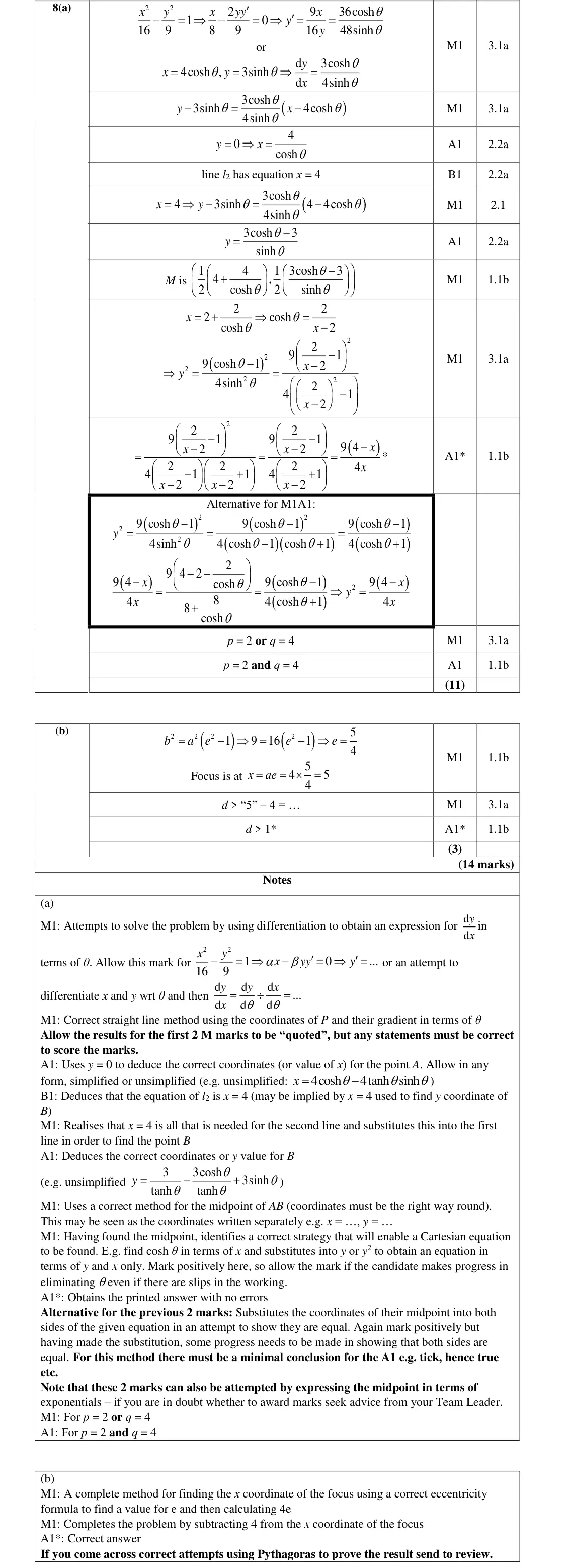
Examiner's comment
There were few candidates who did not attempt this question which would suggest that the paper was of an appropriate length. Candidates appreciated the strategy involved in finding the x coordinate of the point of intersection with the x-axis although some attempts were unnecessarily complex resulting from rearrangements of the tangent equation before setting y = 0. Many could then proceed to find the equation of the required line and the midpoint. It was disappointing to see slips in finding the mid-point where the x and y co- ordinates were subtracted rather than added. Establishing the form of the equation of the locus caused difficulty for many and solutions were seen with much unhelpful algebraic manipulation. The strategy of finding cosh theta in terms of x and then substituting into the expression for y2 from the mid-point was the most successful route; working on both sides of the required expression to achieve a common expression was also used. Generally, neither was completed with a great deal of success, many getting bogged down in the algebra. Even amongst those who were successful in this manipulation, it was common to see no reference to the values of p and q required. This was probably because many were pre-occupied with trying to obtain the equation of the locus of M. Of those who did attempt this part, q = 4 was seen but usually p = 0 was seen rather than p = 2.
Key points from the mark scheme and examiner's report
A(4/cosh θ, 0), l₂ is x = 4, B(4, (3cosh θ − 3)/sinh θ)
midpoint then cosh θ = 2/(x − 2) substituted into y²
p = 2, q = 4 (p = 0 a common error, values often omitted)
midpoint slips and heavy algebra
June 2019 · Paper 3A (Further Pure 1) · Q8(b)3 marks
Mark scheme (whole question; this part is marked with the orange bar)
Examiner's comment
Fully correct solutions to part (b) were extremely rare. Most candidates could not progress beyond finding the coordinates of the focus. It was rare to see any use of a diagram to help to understand what was required.
Key points from the mark scheme and examiner's report
b² = a²(e² − 1) gives e = 5/4, focus (5, 0)
x of M is less than 4 so distance > 5 − 4 = 1
fully correct answers extremely rare, few drew a diagram
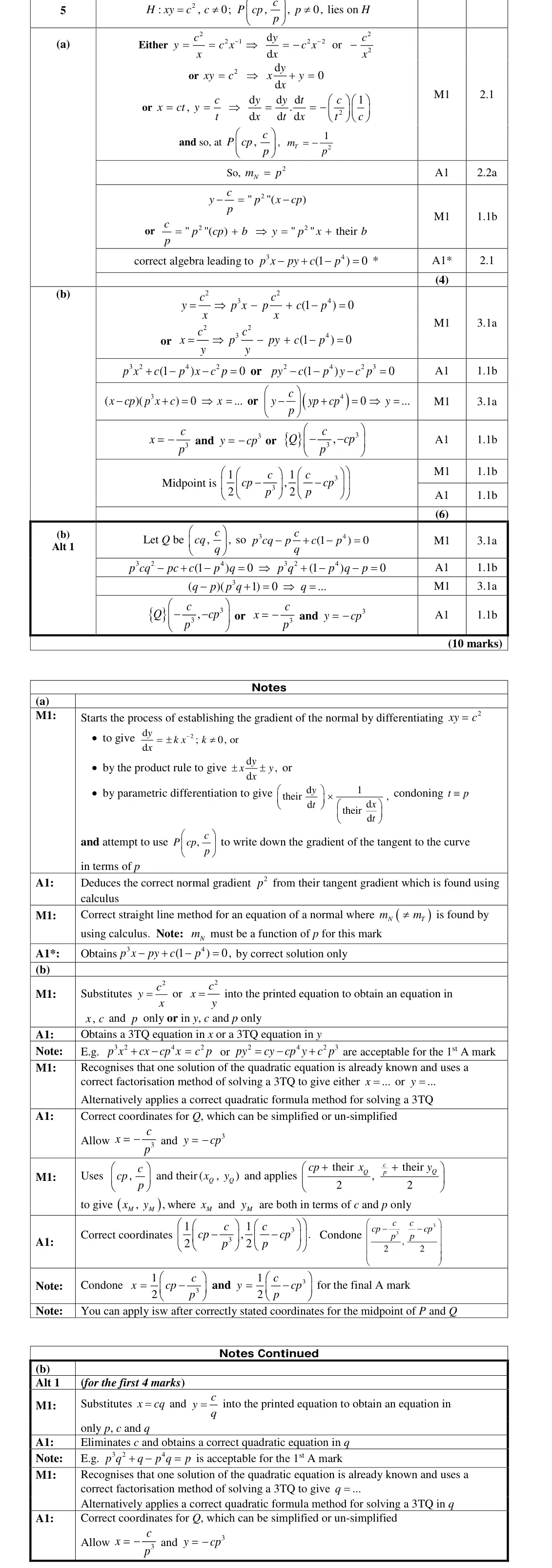
June 2018 · AS Paper 2 (Further Pure 1) · Q5(a)4 marks
Mark scheme (whole question; this part is marked with the orange bar)
Examiner's comment
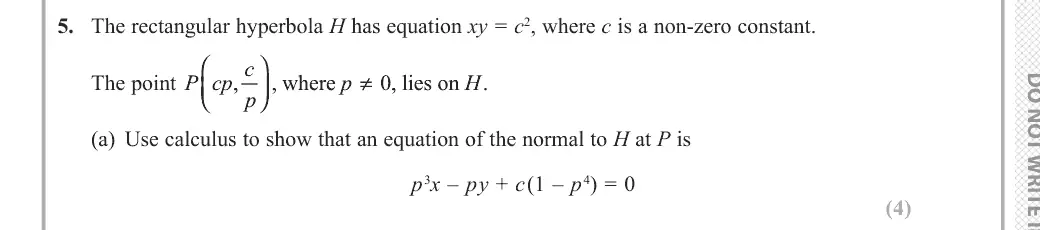
This question discriminated well across higher ability students with part (a) more successfully answered than part (b). There were a significant minority of students who made no attempt or no creditable attempt at this question. It was clear that some of these students had not revised this area of the specification. Some students were familiar with what was required in part (a). Students used a variety of methods to find d d y x with the most common being to make y the subject in order to find 2 2 d . d y c x x Other students used implicit differentiation or the chain rule with parametric equations. Some students used the coordinates of P to obtain an expression for d d y x in terms of p, which was followed by a correct method for finding the gradient of the normal in terms of p. Many students who progressed this far usually applied a correct straight-line method and achieved the given equation 3 4 (1 ) 0. p x py c p A few students who did not use a calculus method to find 2 d 1 d y x p lost marks in part (a).
Key points from the mark scheme and examiner's report
must use calculus: dy/dx = −c²/x² = −1/p² at P, normal gradient p²
then straight-line equation to the printed answer
June 2018 · AS Paper 2 (Further Pure 1) · Q5(b)6 marks
Mark scheme (whole question; this part is marked with the orange bar)
Examiner's comment
This question discriminated well across higher ability students with part (a) more successfully answered than part (b). There were a significant minority of students who made no attempt or no creditable attempt at this question. It was clear that some of these students had not revised this area of the specification. Part (b) proved to be more challenging for many students, although a few students produced fully correct and sometimes elegant solutions. A significant number of students made some progress by correctly substituting 2c y x or 2c x y into the given normal equation. Many students proceeded to form a 3-term quadratic equation, with some students at this stage unable to make any further progress. Of those who attempted to solve the quadratic equation, most used the quadratic formula. In many cases the algebra became cumbersome and many made algebraic errors which resulted in their being unable to find either the x or y coordinate of Q. Those who found the coordinates for Q usually produced a correct method for finding the coordinates of the midpoint of PQ.
Key points from the mark scheme and examiner's report
substitute y = c²/x into the normal, quadratic p³x² + c(1 − p⁴)x − c²p = 0 has known root x = cp
Q(−c/p³, −cp³)
midpoint (½(cp − c/p³), ½(c/p − cp³))
algebra often became unmanageable
Find an Edexcel Further Maths tutor
Stuck on this? Book a trial lesson with our Further Maths tutor.