De Moivre's theorem is given. e^(iθ) = cos θ + i sin θ is not.
Since 2018
16 question parts, 58 marks, 2 with a difficulty rating from the examiner's report
Notes, worked examples and practice for this topic are being written by our tutors. The past-paper questions below are ready now: work each one on paper, then open the mark scheme and the examiner's comment.
Tap a question to zoom it. Mark scheme and examiner's comment open under each question.
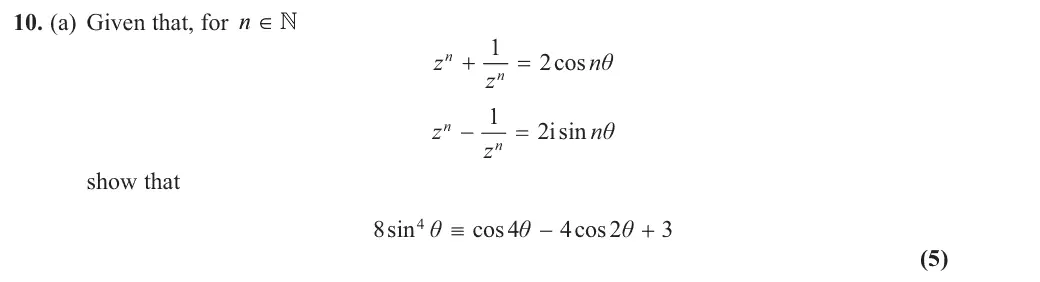
June 2025 · Paper 1 (Core Pure 1) · Q10(a)5 marks
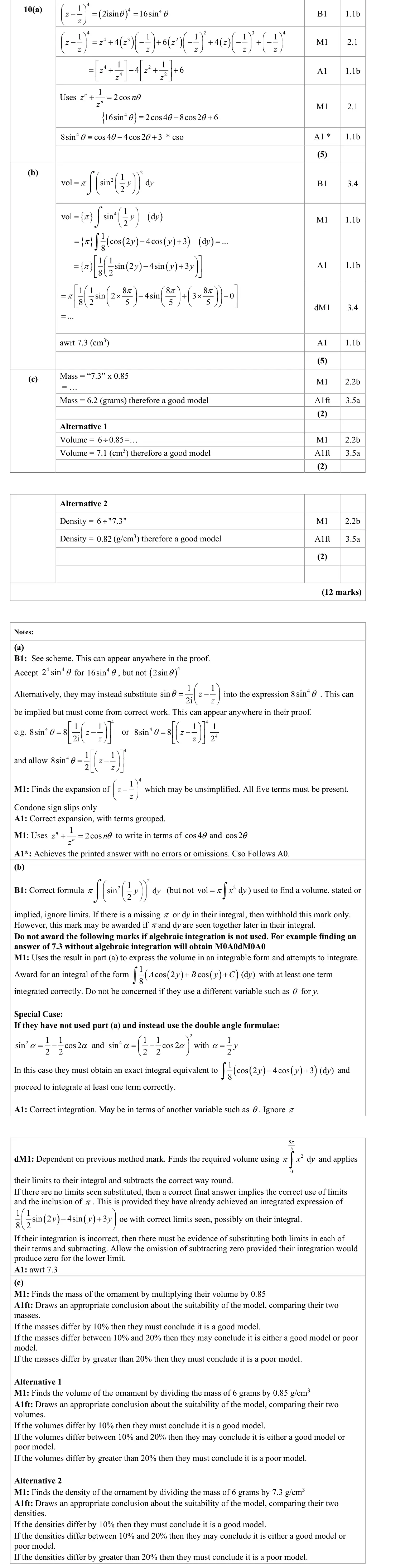
Mark scheme (whole question; this part is marked with the orange bar)
Examiner's comment
This question assessed candidates’ understanding of complex number identities, algebraic integration techniques, and modelling using volumes of revolution and density. The question had multiple points of entry for candidates, with many of them being able to gain marks in each part of the question. This question was accessible to most candidates and was a good discriminator of candidates’ ability to prove trigonometric identities, manage trigonometric substitutions carefully, and interpret a mathematical model in context. Those who showed methodical working and attention to algebraic detail were well rewarded. (a) This was generally well answered. Most candidates were able to follow a structured approach to proving their identity, with the majority achieving all marks. Being a proof question, the most common issues related to the accuracy of algebraic manipulation. Sign errors in the expansion of brackets were the most frequent source of lost marks. Other errors included misapplication of powers within the expansion, incorrect use of formulae involving powers of n rather than 1, and occasional omissions of key steps in the proof such as an explicit algebraic expression with grouped terms such as 4 4 1 z z + , which were necessary to reach the required identity.
Key points from the mark scheme and examiner's report
(z − 1/z)⁴ = (2i sin θ)⁴ = 16sin⁴θ
expand binomially, group into z⁴ + z⁻⁴ etc. = 2cos 4θ − 8cos 2θ + 6
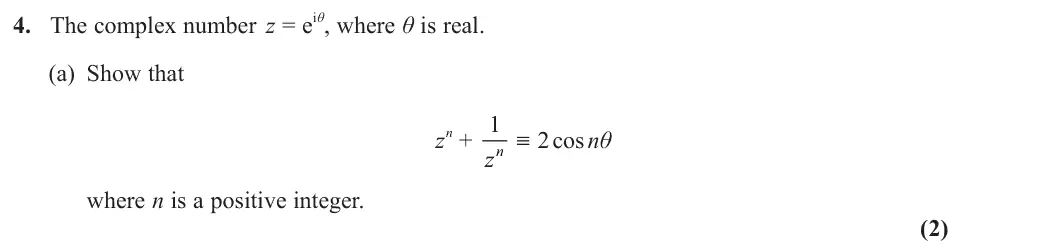
June 2024 · Paper 1 (Core Pure 1) · Q4(a)2 marks
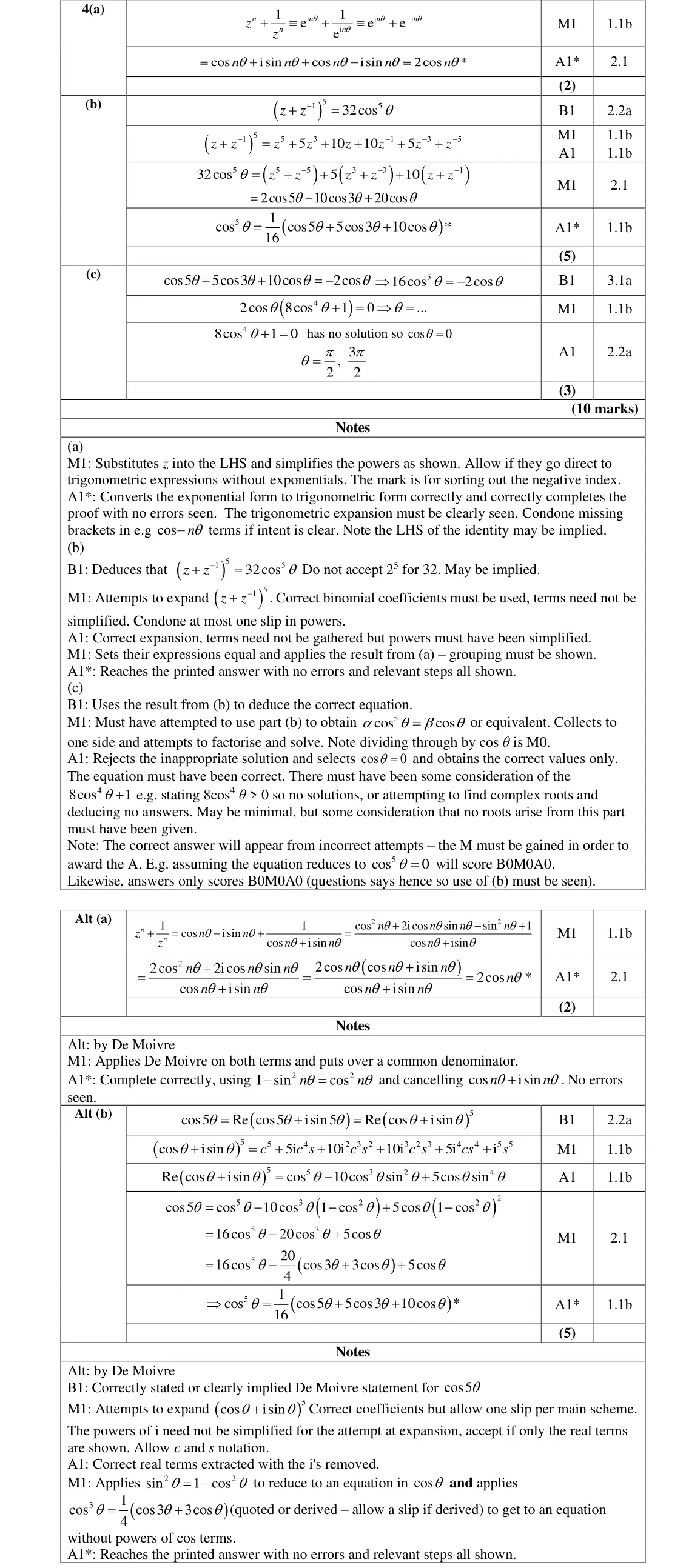
Mark scheme (whole question; this part is marked with the orange bar)
Examiner's comment
Almost all candidates were able to make a meaningful attempt at parts or all of this question, Part (a) was generally well approach, giving some easy access in the first mark for sorting out the negative power, so most candidates made some progress with this part. There was a variety of approaches, although most substituted directly into trigonometric terms, either from the stated z and Euler’s identity or proceeding via De Moivre’s theorem. Most who used these methods achieved a correct proof for both marks, though some missed out an n in their working and/or their answer, or other similar slip, losing the accuracy. However, a few circular arguments were seen, which could score only the first mark for 1 ( ) - + = i i n n dealing with the negative index. These went on to use , essentially c os ( n e ) e 2 assuming the result to be proved, to get to the result. There were a few attempts via the alternative at combining fractions rather than applying the negative index, which were more prone to error, but often led to a successful proof.
Key points from the mark scheme and examiner's report
write z⁻ⁿ = cos nθ − i sin nθ (de Moivre or Euler)
avoid circular arguments
keep the n throughout
June 2024 · Paper 1 (Core Pure 1) · Q4(b)5 marks
Mark scheme (whole question; this part is marked with the orange bar)
Examiner's comment
Almost all candidates were able to make a meaningful attempt at parts or all of this question, with part (b) being the most successful overall, as a standard type proof on this topic. Notation was sometimes questionable, but the methodology was generally sound. In part (b) the vast majority of candidates scored full marks for a well-practised proof. Most 5 - + i i e e started with an attempt to expand ( ) 5 z- + 1 , whilst a few used with equal z 2 success. Usually, the binomial coefficients were correct, and a satisfactory solution followed. On a rare occasion the terms were not grouped and the final two marks were lost. Sometimes cos with cos 5 theta and the solution went array. 5 a candidate confused Those who used the alternative method, by De Moivre, were largely unsuccessful, falling cos was need. A correct De Moivre statement for cos5 theta was 3 down when an identity for not always stated or implied and the solutions usually progressed no further than obtaining a sin . 2 set of real terms, with or without the substitution for
Key points from the mark scheme and examiner's report
expand (z + 1/z)⁵ = 32cos⁵θ and group the terms into z⁵ + z⁻⁵ etc.
June 2024 · Paper 1 (Core Pure 1) · Q4(c)3 marks
Mark scheme (whole question; this part is marked with the orange bar)
Examiner's comment
Almost all candidates were able to make a meaningful attempt at parts or all of this question, 16cos = 5 In part (c) the most common error was to reduce the equation incorrectly to 0 scoring no marks, despite that the correct answers fortuitously followed from this. But the majority of candidates did get to the correct equation, or one of the correct form, and then most also proceeded correctly to the two solutions, to obtain the first two marks. There was the occasional division by cos that lost the method mark, but generally the method of solution was sound. Of those who factorised correctly most went on to give a suitable reason why there were no further solution and scored full marks, but there were several who did not manage to do so. Errors that did occur at this stage included: not , correctly but omitting the 3 8cos = - has no solutions, finding 2 4 indicating that 1 2 ( ) 2cos + = 4 incorrect factorisation such as and finding incorrect solutions to 4cos 1 0 + = = or generating other spurious solutions). 4 4 (e.g. by solving 0 8cos 1 8cos 1
Key points from the mark scheme and examiner's report
reduces to 16cos⁵θ + 2cos θ = 0, i.e. cos θ(8cos⁴θ + 1) = 0
do not divide by cos θ
must explain why 8cos⁴θ + 1 = 0 has no solutions
θ = π/2 and 3π/2 (3π/2 often missed)
June 2024 · Paper 2 (Core Pure 2) · Q7(c)2 marks
Mark scheme (whole question; this part is marked with the orange bar)
Examiner's comment
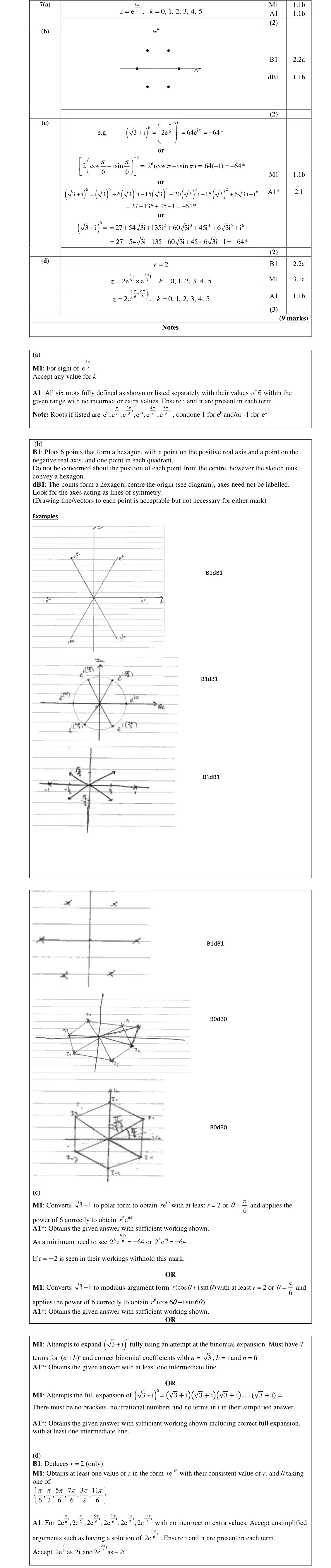
(c) There were various allowable approaches. Writing the complex number in polar and/or exponential form was the most straight forward and most successful, and many candidates gave clear concise solutions. Another approach was to expand the brackets which was time consuming and sometimes resulted in algebraic errors. Those who used a binomial expansion were slightly quicker and made less errors. However, many fully correct solutions were provided using both of these methods.
Key points from the mark scheme and examiner's report
√3 + i = 2e^(iπ/6), so 2⁶e^(iπ) = −64 (de Moivre)
binomial expansion also accepted
June 2023 · Paper 1 (Core Pure 1) · Q3(b)(ii)2 marks
Mark scheme (whole question; this part is marked with the orange bar)
Examiner's comment
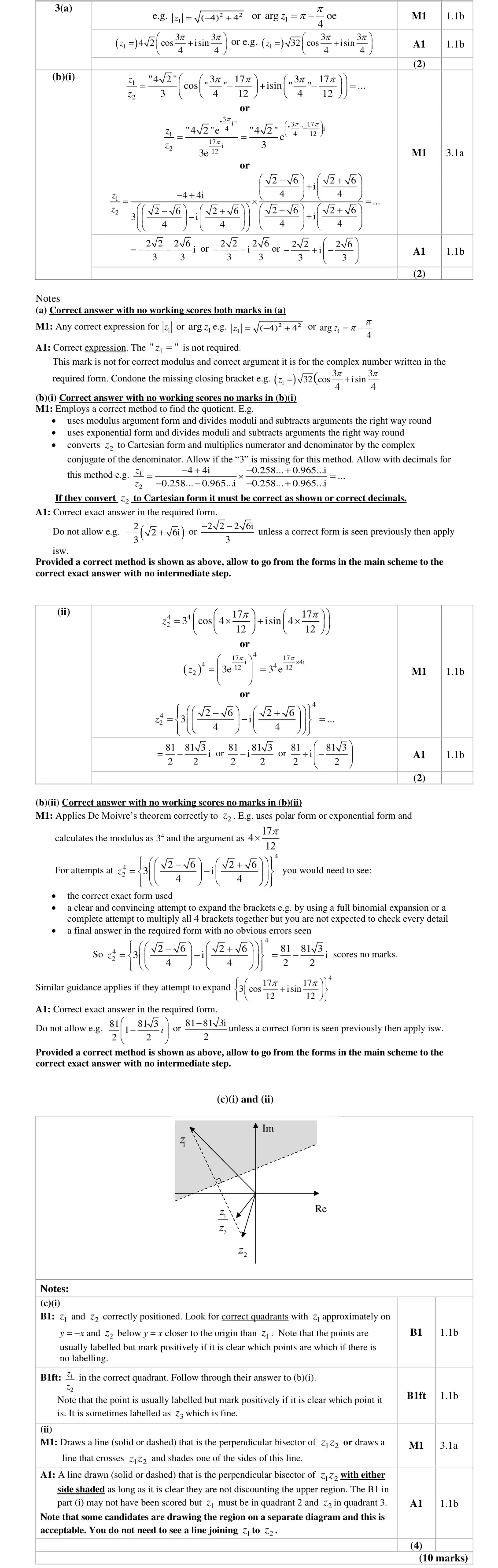
Part (a) was mainly answered correctly with most candidates writing the modulus as 4 sqrt 2 and the However, some gave an argument in an incorrect quadrant such as argument as 3 . or 7 - . 4 4 4 In part (b), correct answers only with no working scored no marks because the candidates were required to show all stages of their working and not rely on calculator technology. A few candidates did not heed these warnings but generally sufficient working was shown. In part (i), most candidates 𝑧1 found 𝑧2 by dividing the modulii and subtracting the arguments. Those that tried to divide the two complex numbers in Cartesian form, often failed to show sufficient working and resorted to using a calculator or could not negotiate the processing required to achieve an answer in the required exact form. In part (ii) most candidates attempted to apply de Moivre’s Theorem correctly. Candidates knew to raise the power of the modulus and multiply the argument by 4. There were some failed attempts to write their answer in the required form. Candidates who were most successful in part (b) often resorted to writing the complex numbers in exponential form. In part (c), around one third of candidates scored full marks. Axes were sometimes poorly drawn and in some cases z1 and z2 appeared to be equidistant from O or z2 was wrongly positioned within the 𝑧1 quadrant. Of those who did not give the required forms in part (b), some also positioned 𝑧2 in an incorrect quadrant. In part (ii) quite a number of candidates did not draw a line or have any shading to indicate the region required. A few realised that a perpendicular bisector was required but failed to do any shading. Others drew a line across z1z2 but it was not a perpendicular bisector. For those who did identify the perpendicular bisector, very few specified which side they believed to be the required area. Only a small number of responses were seen where the wrong side was clearly stated. Incorrect areas included areas between arcs from z1 and z2 and wedge-shaped areas between the lines from the origin to the points in their diagram.
Key points from the mark scheme and examiner's report
de Moivre: 3⁴ and 4 × 17π/12: 81/2 − (81√3/2)i
answer with no working scores 0
June 2022 · Paper 1 (Core Pure 1) · Q8(a)5 marksMedium
Mark scheme (whole question; this part is marked with the orange bar)
Examiner's comment
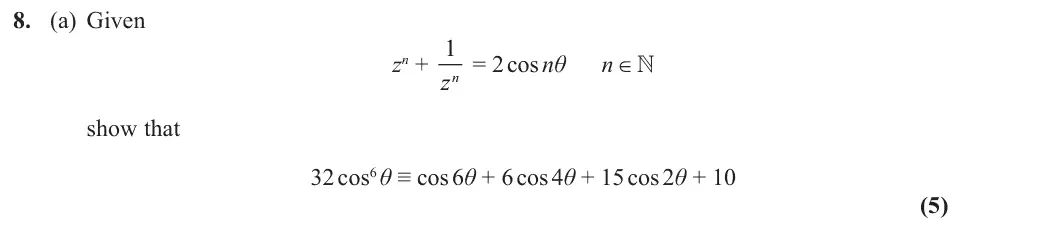
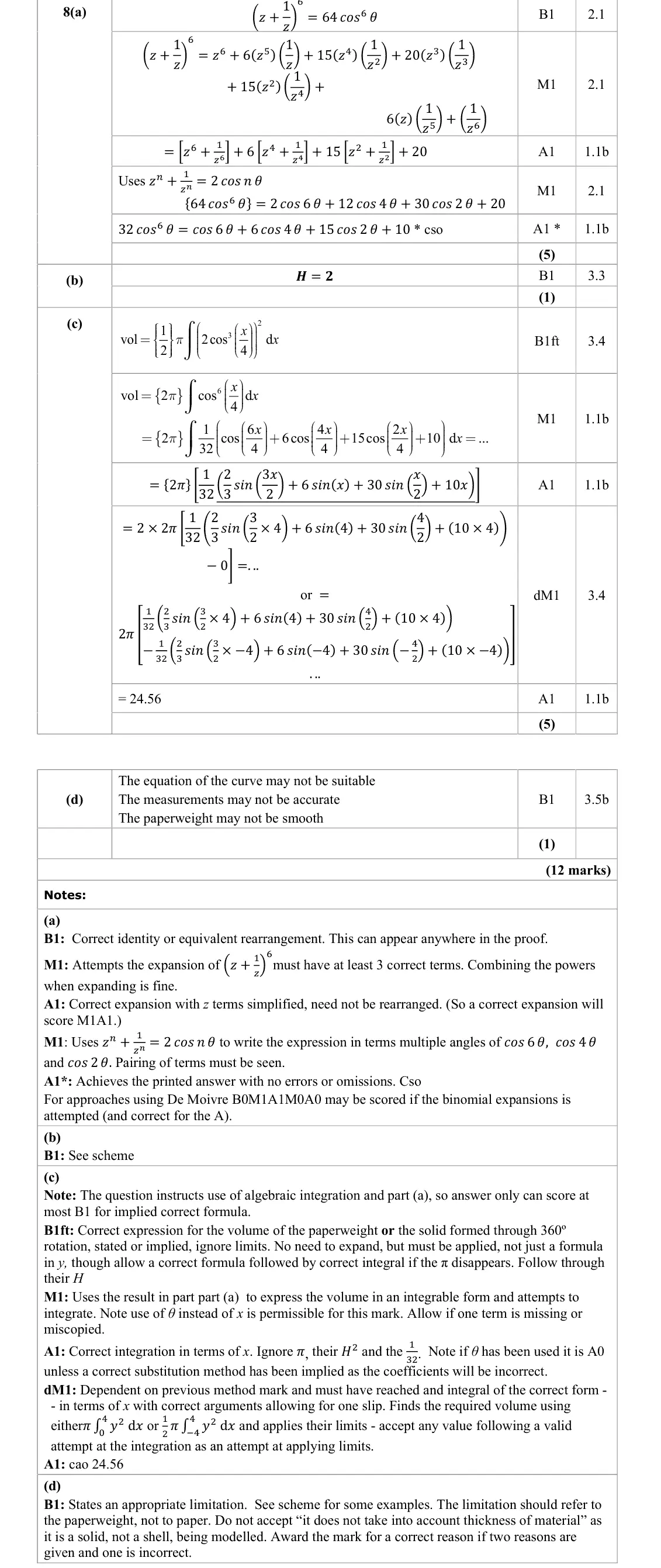
The difficult of the paper did increase over the last few questions with less than a quarter of candidates able to score full marks for this question, though 85% were able to score at least 7 out of 12 in a tapering distribution of scores from the mode of full marks all the way down to zero marks. Part (a) tested the candidates ability to write out a proof, something that many are not good at, though the general approach was known by most. Success depended on candidates showing a complete logical sequence of steps leading to the required answer. While the majority of the candidates managed to find a correct expansion and grouped terms correctly, a significant minority did not state 6 6 1 64cos z z + = , leading to loss of accuracy. Some confused 6 6 1 z z + with 6 1 z z + and did not make much progress. Other less common errors involved failing to show how the terms in the expansion could be grouped to achieve an expression where cosine had multiples of theta as arguments. Some candidates omitted 64cos6 theta and some the 32cos6 theta . Losing the first or final mark.
Key points from the mark scheme and examiner's report
(z + 1/z)⁶ = 64cos⁶θ (often not stated)
binomial expansion, pair terms into z⁶ + z⁻⁶ etc.
confusing z⁶ + 1/z⁶ with (z + 1/z)⁶
June 2022 · Paper 1 (Core Pure 1) · Q8(c)5 marksMedium
Mark scheme (whole question; this part is marked with the orange bar)
Examiner's comment
The difficult of the paper did increase over the last few questions with less than a quarter of candidates able to score full marks for this question, though 85% were able to score at least 7 out of 12 in a tapering distribution of scores from the mode of full marks all the way down to zero marks. In part (c), the majority of candidates succeeded in forming a suitable expression leading to a volume of revolution and went on to attempt to integrate and apply the correct upper and lower limits. However, obtaining the correct expression for the volume, and carrying out the integration, were not always done well. The most common mistakes were not spotting the argument had changed to 4 x leading to an incorrect integral, using the full volume of revolution through 360º, or incorrect use of limits. Some used theta and appropriate substitution which scored the M mark but changing to x caused some problems. There were some very good solutions and fully correct answers but also many incorrect answers. Common incorrect answers included 12.28 (half) and 49.12 (double).
Key points from the mark scheme and examiner's report
V = ½π∫ from −4 to 4 of 4cos⁶(x/4)dx (180° rotation, so half the usual volume)
use (a) with θ = x/4 (arguments 6x/4, x, x/2)
24.56 cm³
full 360° volume or wrong arguments are common errors
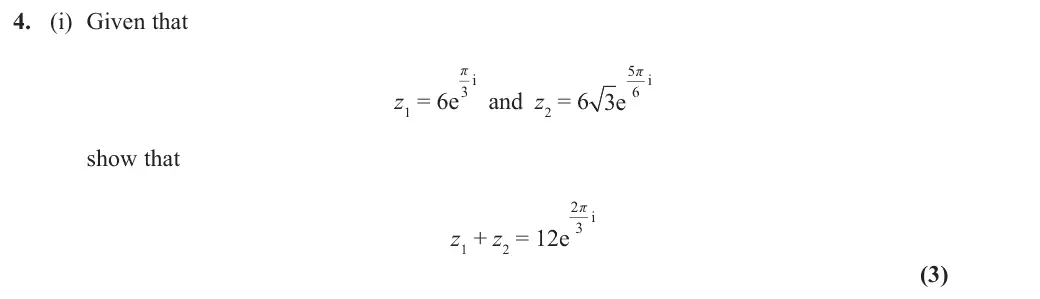
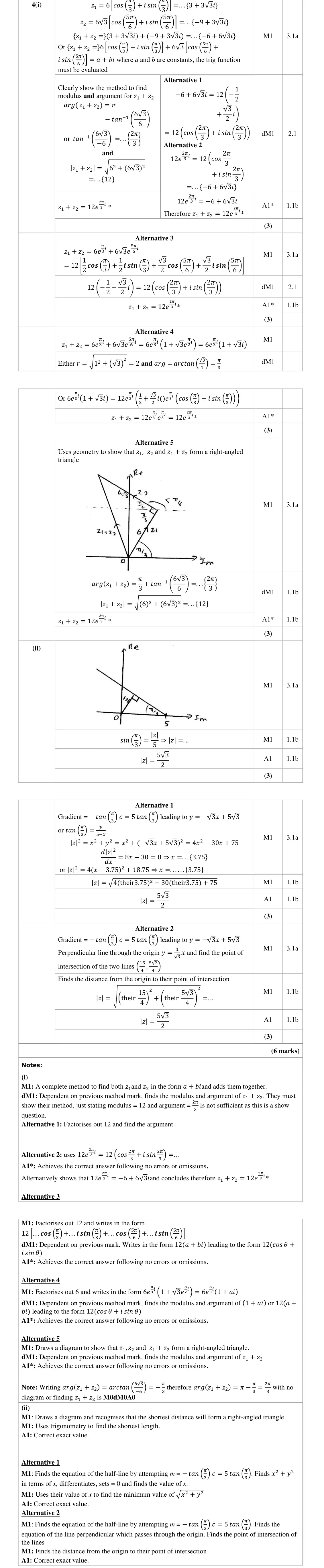
June 2022 · Paper 2 (Core Pure 2) · Q4(i)3 marks
Mark scheme (whole question; this part is marked with the orange bar)
Examiner's comment
This complex number question saw a mixed response with part (b) proving fairly discriminating in particular. Most knew the sensible way forward in part (a) with the wide variety of viable alternatives rarely seen. However, having converted to a + ib form and adding, many students did not show their method to obtain the modulus and/or the argument, this is a show question. In part (b), students who produced a reasonable sketch usually went on to score all the marks. Most sketches seen were realistic with the half-line in the correct place. It was anticipated that simple right-angled trigonometry or Pythagoras would be the most likely ways forward from here. Most who opted for this were successful. Algebraic approaches were more mixed in quality. Those who chose to find the distance of the point of intersection of the two relevant lines to the origin were often correct but those embarking on a circuitous route requiring minimisation tended to fall short.
Key points from the mark scheme and examiner's report
convert both to a + bi and add: −6 + 6√3i
must show the modulus 12 and the argument 2π/3 (π − tan⁻¹ etc.), not just state them, as this is a show that
Nov 2021 · Paper 2 (Core Pure 2) · Q9(a)1 mark
Mark scheme (whole question; this part is marked with the orange bar)
Examiner's comment
1 Part (a) Although most candidates did obtain a minority did not seem 1 z to remember geometric progressions. 1 cos 1 e ( ) or into the answer to part (a) and then attempted i isin theta z z = theta theta = + 2 2 to rationalise the denominator. Candidates then simplified and selected the imaginary part. However, the question required candidates to prove that for the series 1 1 1 2sin theta and to complete the proof sin sin 2 sin3 ... theta theta theta + + + = 2 4 8 5 4cos theta - 1 cos ( ) candidates needed show that when you substitute into isin z theta theta = + 2 the series that that the imaginary part was 1 1 1 . They sin sin 2 sin3 ... theta theta theta + + + 2 4 8 then needed to equate the imaginary parts to proof the required statement. A few candidates did the consider the first term of the series and so they could not achieve full marks since the first term is part of the series. (ii) Probably the least successful part of any question on the paper. Most candidates just said that there would be real parts without attempting to show that the real part cannot be zero. Candidates needed to set the real part of the series form part (i) equal to 0 and show that this was not possible. Overall candidates were able to have a good attempt at all the questions with the exception of question 2.
Key points from the mark scheme and examiner's report
sum to infinity of a geometric series: 1/(1 − z)
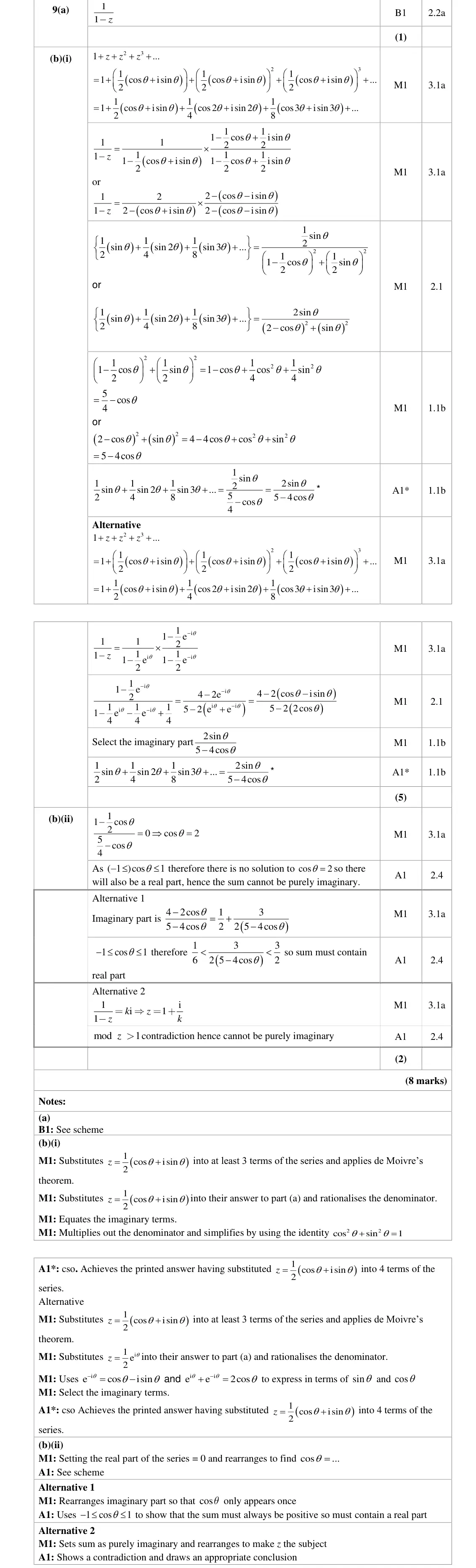
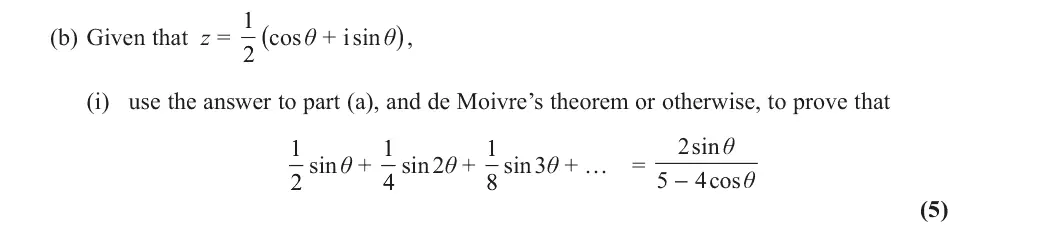
Nov 2021 · Paper 2 (Core Pure 2) · Q9(b)(i)5 marks
Mark scheme (whole question; this part is marked with the orange bar)
Examiner's comment
Part (b) (i) Candidates who made good progress with this art substituted 1 cos 1 e ( ) or into the answer to part (a) and then attempted i isin theta z z = theta theta = + 2 2
Key points from the mark scheme and examiner's report
de Moivre: zⁿ = (1/2ⁿ)(cos nθ + i sin nθ)
substitute into 1/(1 − z) and multiply by the conjugate
denominator (2 − cos θ)² + sin²θ = 5 − 4cos θ
equate imaginary parts
must show the series side, not only the sum
Nov 2021 · Paper 2 (Core Pure 2) · Q9(b)(ii)2 marks
Mark scheme (whole question; this part is marked with the orange bar)
Examiner's comment
1 Part (a) Although most candidates did obtain a minority did not seem 1 z to remember geometric progressions. Part (b) (i) Candidates who made good progress with this art substituted 1 cos 1 e ( ) or into the answer to part (a) and then attempted i isin theta z z = theta theta = + 2 2 to rationalise the denominator. Candidates then simplified and selected the imaginary part. However, the question required candidates to prove that for the series 1 1 1 2sin theta and to complete the proof sin sin 2 sin3 ... theta theta theta + + + = 2 4 8 5 4cos theta - 1 cos ( ) candidates needed show that when you substitute into isin z theta theta = + 2 the series that that the imaginary part was 1 1 1 . They sin sin 2 sin3 ... theta theta theta + + + 2 4 8 then needed to equate the imaginary parts to proof the required statement. A few candidates did the consider the first term of the series and so they could not achieve full marks since the first term is part of the series. (ii) Probably the least successful part of any question on the paper. Most candidates just said that there would be real parts without attempting to show that the real part cannot be zero. Candidates needed to set the real part of the series form part (i) equal to 0 and show that this was not possible. Overall candidates were able to have a good attempt at all the questions with the exception of question 2.
Key points from the mark scheme and examiner's report
real part (1 − ½cos θ)/(5/4 − cos θ) = 0 needs cos θ = 2, impossible since cos θ ≤ 1, so there is always a real part
Oct 2020 · Paper 2 (Core Pure 2) · Q4(a)5 marks
Mark scheme (whole question; this part is marked with the orange bar)
Examiner's comment
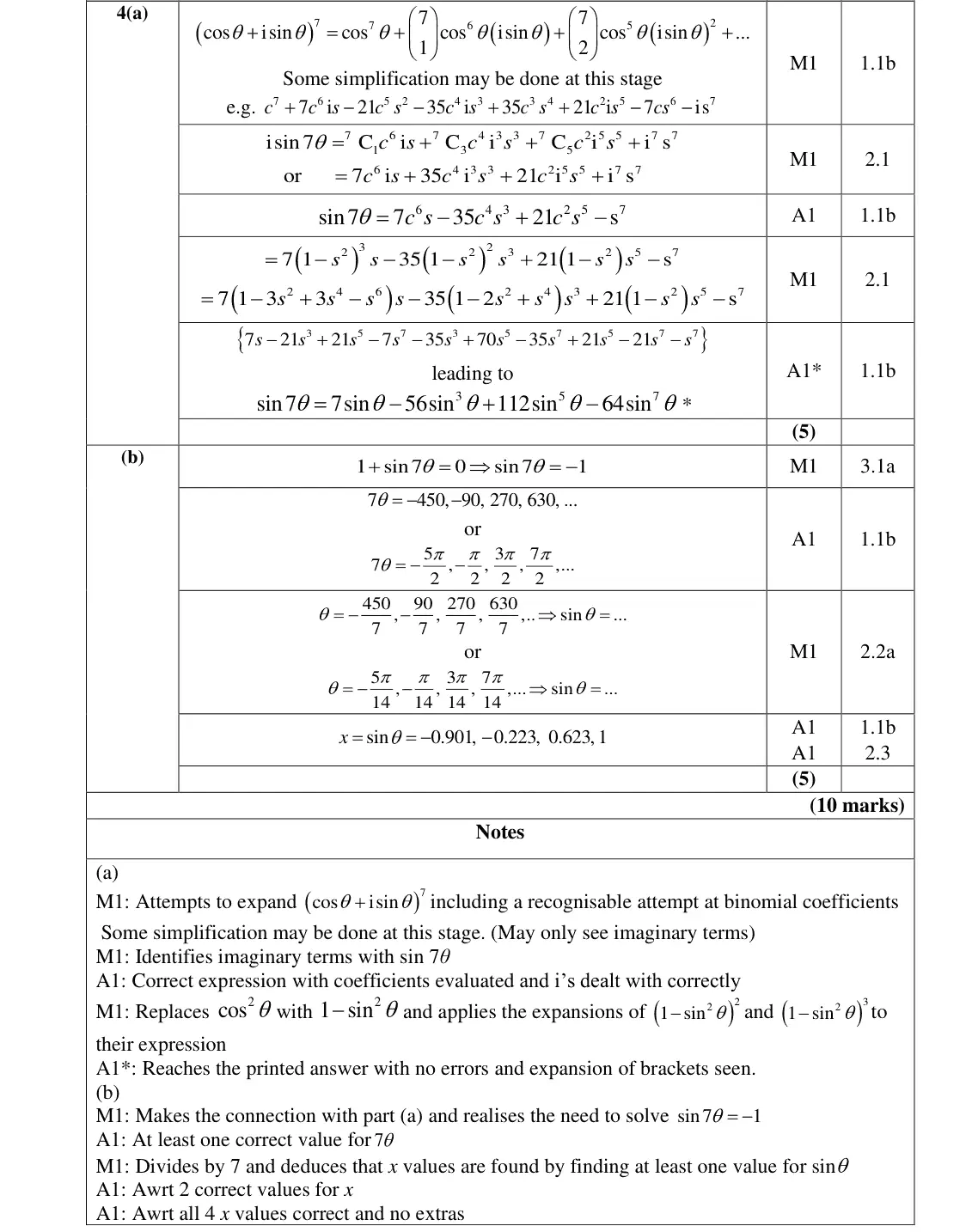
Part (a) this part was done well by the majority of candidate with many scoring full marks. Some candidates did not score the final mark as they went from ( ) ( ) ( ) 3 2 2 2 3 2 5 7 7 1 sin sin 35 1 sin sin 21 1 sin sin sin - - - + - - to the printed answer, not showing the expansion of the brackets, which was required.
Key points from the mark scheme and examiner's report
expand (cos θ + i sin θ)⁷ by the binomial theorem and equate imaginary parts: sin 7θ = 7c⁶s − 35c⁴s³ + 21c²s⁵ − s⁷
replace cos²θ by 1 − sin²θ and show the expansion of the brackets (needed for the final mark)
Oct 2020 · Paper 2 (Core Pure 2) · Q4(b)5 marks
Mark scheme (whole question; this part is marked with the orange bar)
Examiner's comment
Part (b) the majority of candidate attempted to use the answer to Part (a) many successfully. They find at least one value for q with many progressing to find values for sin x q = but a few stopped at values for q . Candidates who reached values for x often achieved the correct 4 values. A few incorrectly used sin 7 0 q = .
Key points from the mark scheme and examiner's report
with x = sin θ the equation is 1 + sin 7θ = 0, sin 7θ = −1
θ = −5π/14, −π/14, 3π/14, 7π/14 …
distinct roots x = −0.901, −0.223, 0.623, 1
using sin 7θ = 0
stopping at θ values
June 2019 · Paper 2 (Core Pure 2) · Q4(a)4 marks
Mark scheme (whole question; this part is marked with the orange bar)
Examiner's comment
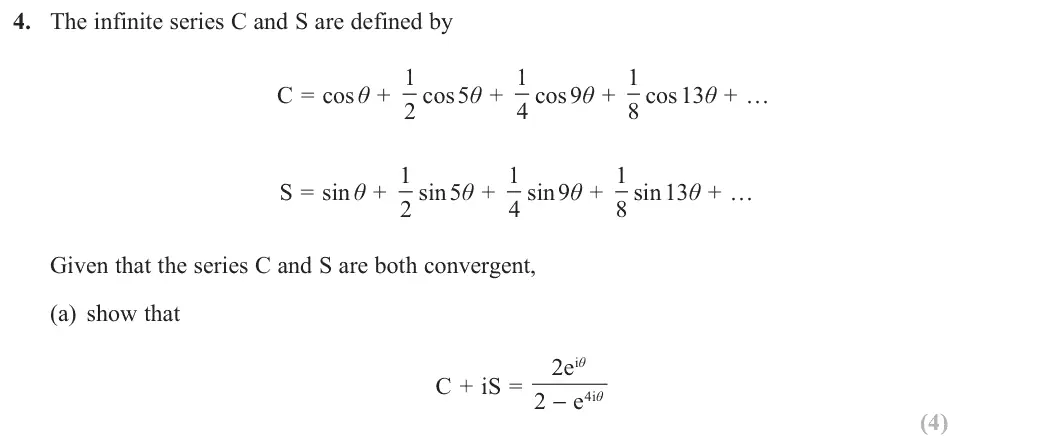
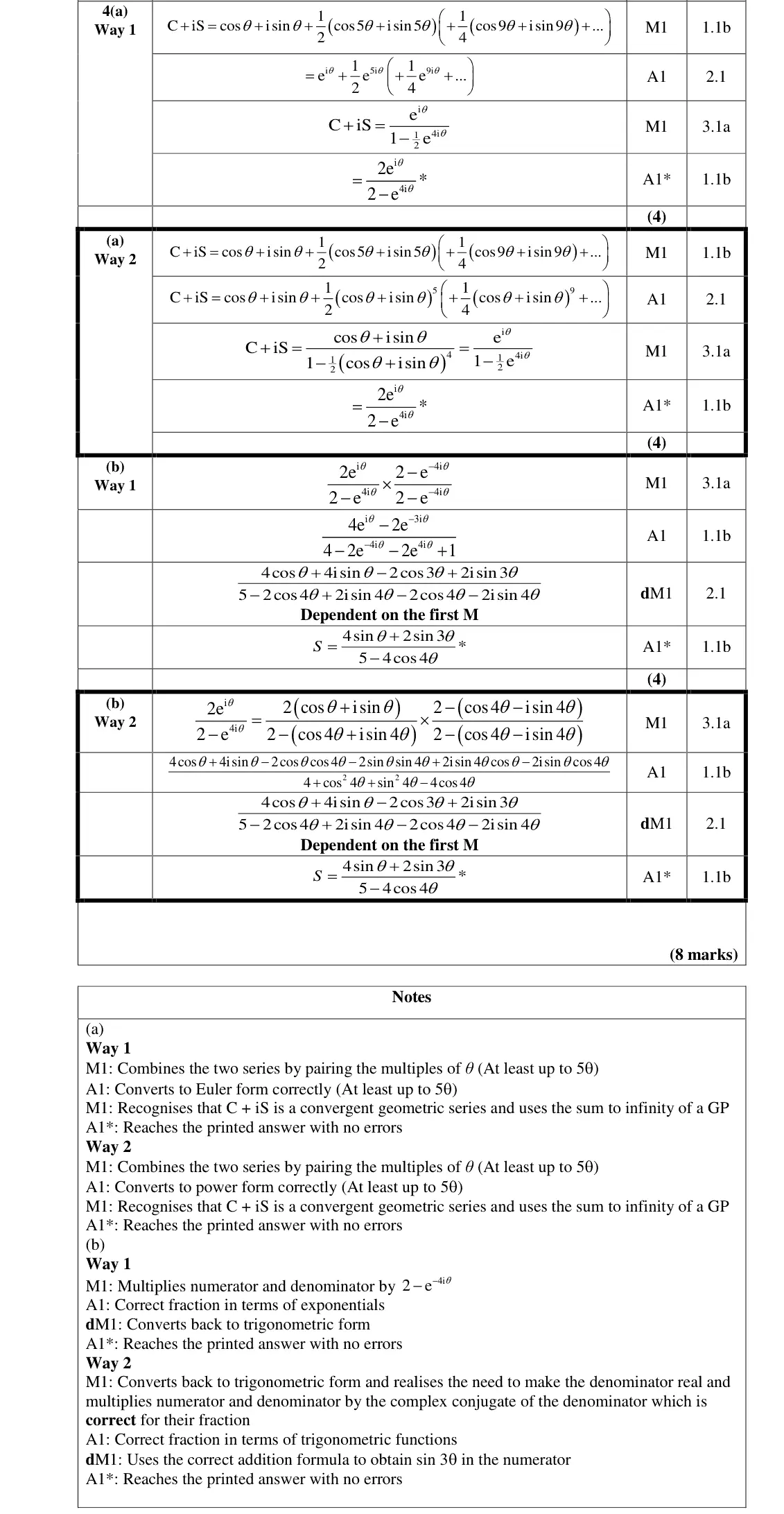
In part (a), obtaining C + iS as an exponential series was widely achieved. The majority were also able to use the sum to infinity formula to obtain the given answer. A few attempted to use the ordinary sum formula for a geometric series.
Key points from the mark scheme and examiner's report
C + iS = e^(iθ) + ½e^(5iθ) + ¼e^(9iθ) + …, an infinite geometric series with ratio ½e^(4iθ)
sum to infinity, not the finite-sum formula
June 2019 · Paper 2 (Core Pure 2) · Q4(b)4 marks
Mark scheme (whole question; this part is marked with the orange bar)
Examiner's comment
Part (b) proved tough for all but the most confident candidates. Incorrect attempts included multiplying numerator and denominator by e±4i theta , 2 + e-4i theta or 2 – e4i theta rather than the required 2 – e-4i theta . Those who knew the correct strategy usually obtained a correct expression and invariably went on to revert to trigonometric form and reach the given answer. The alternative of converting to trigonometric form and then rationalising was successful for some but there were often slips in the multiplications and some were unable to use the correct addition formula to reach the printed answer.
Key points from the mark scheme and examiner's report
multiply numerator and denominator by 2 − e^(−4iθ) (not e^(±4iθ) or 2 − e^(4iθ))
denominator 5 − 4cos 4θ
take the imaginary part
Find an Edexcel Further Maths tutor
Stuck on this? Book a trial lesson with our Further Maths tutor.