CP2.8 Understand de Moivre’s theorem and use it to find multiple angle…

Section
CP2 Complex numbers
Level
A level only
Statement
Understand de Moivre’s theorem and use it to find multiple angle formulae and sums of series.
Guidance
To include using the results z + 1/z = 2 cos θ and z − 1/z = 2i sin θ to find cos pθ, sin qθ and tan rθ in terms of powers of sin θ, cos θ and tan θ, and powers of sin θ, cos θ and tan θ in terms of multiple angles. For sums of series, students should be able to show that, for example, 1 + z + z² + … + zⁿ⁻¹ = 1 + i cot(π/2n) where z = cos(π/n) + i sin(π/n) and n is a positive integer.
Since 2018
17 parts, 63 marks · topic pages: De Moivre's theorem and exponential form, Volumes of revolution, Modulus-argument form, Complex numbers: arithmetic, conjugates, roots of polynomials and Argand diagrams

Back to the checklist

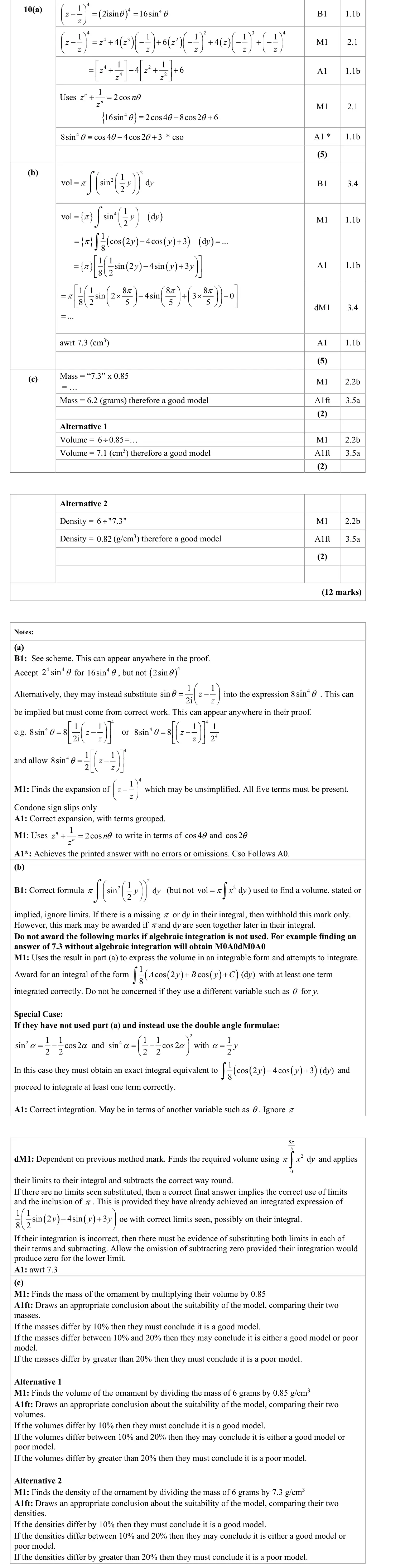
June 2025 · Paper 1 (Core Pure 1) · Q10(a) 5 marks
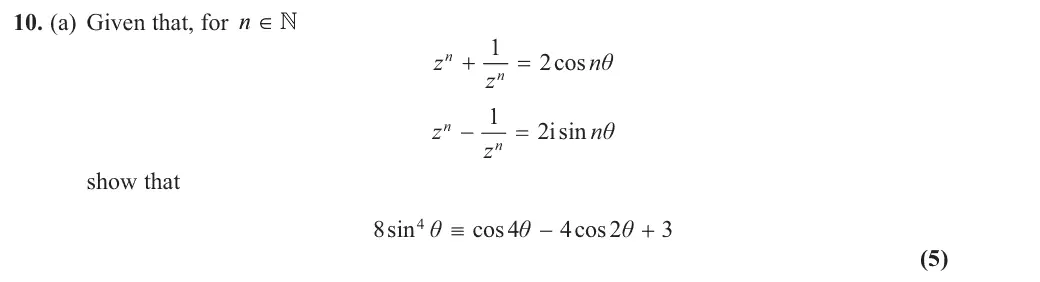
10. (a) Given that, for n ∈ z n 2cos theta n z n z 2isin theta n n z n show that theta theta theta sin cos cos (5)
June 2025 · Paper 1 (Core Pure 1) · Q10(b) 5 marks
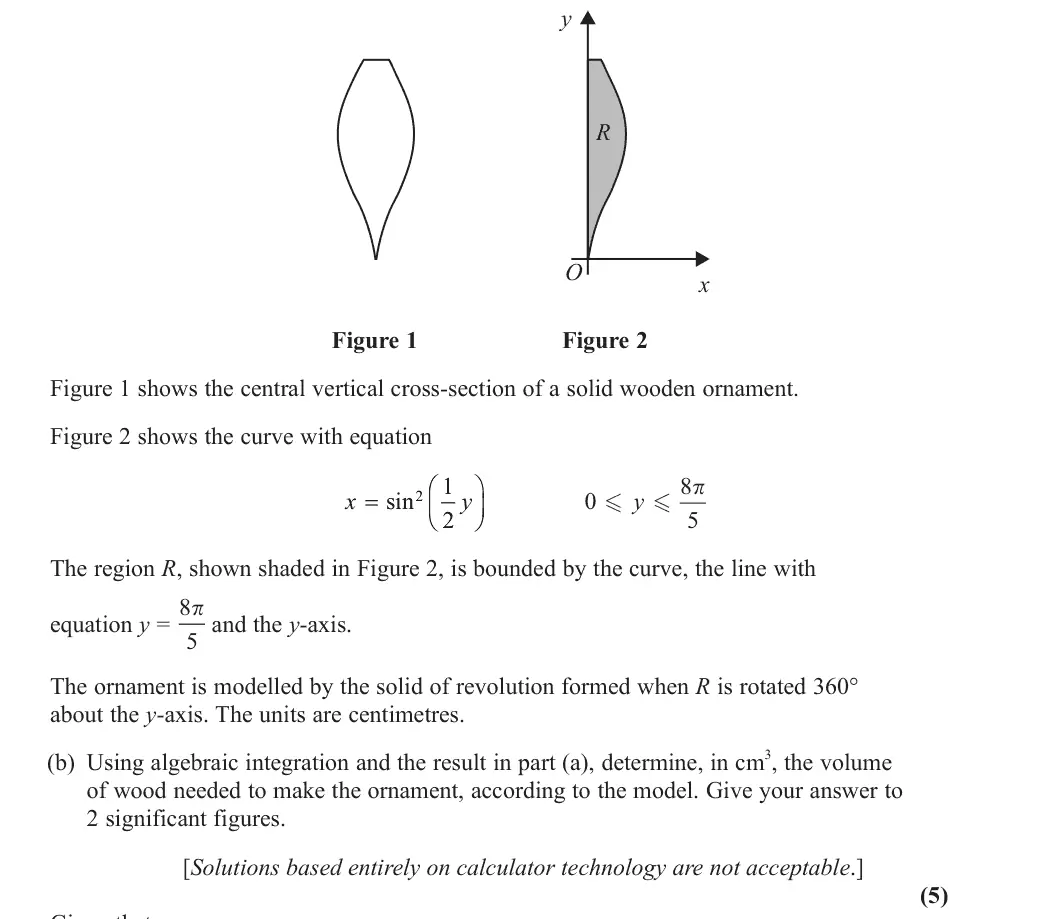
y R x Figure 1 Figure 2 Figure 1 shows the central vertical cross-section of a solid wooden ornament. Figure 2 shows the curve with equation sin2 1 ϖ ; x y < y < :9 The region R, shown shaded in Figure 2, is bounded by the curve, the line with equation y = 8 ϖ and the y-axis. The ornament is modelled by the solid of revolution formed when R is rotated 360° about the y-axis. The units are centimetres. (b) Using algebraic integration and the result in part (a), determine, in cm3, the volume of wood needed to make the ornament, according to the model. Give your answer to 2 significant figures. [Solutions based entirely on calculator technology are not acceptable.] (5)
June 2024 · Paper 1 (Core Pure 1) · Q4(a) 2 marks
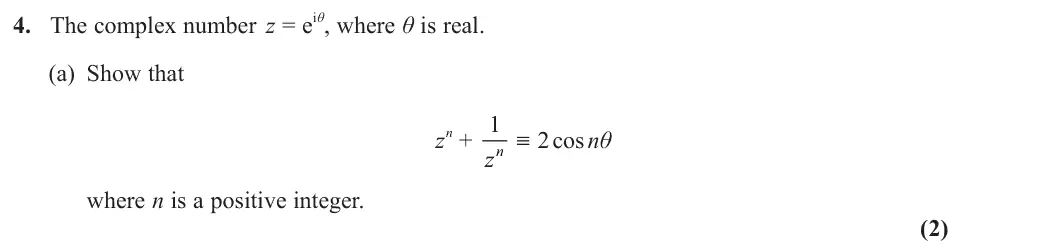
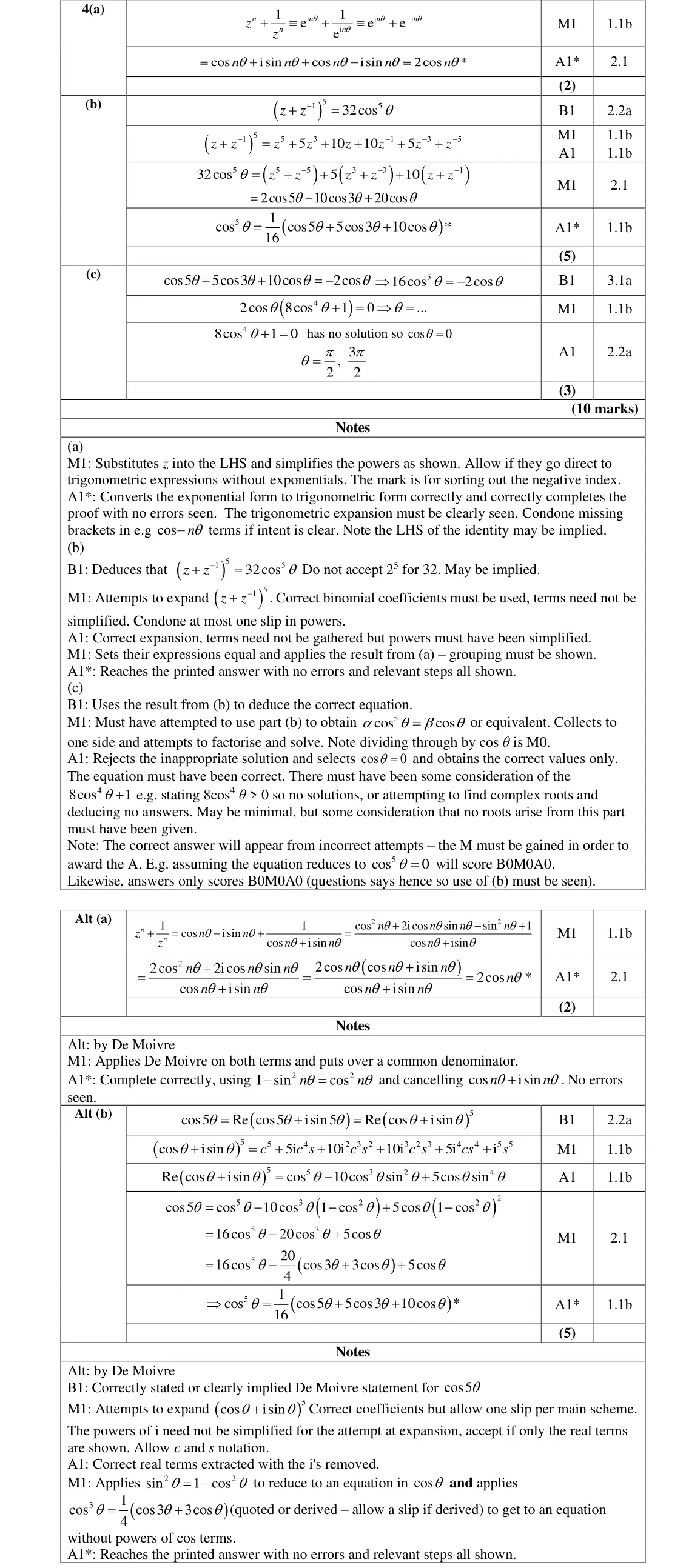
4. The complex number z = e i theta , where theta is real. (a) Show that n + 1 zn ≡2 cos n theta z where n is a positive integer. (2)
June 2024 · Paper 1 (Core Pure 1) · Q4(b) 5 marks
(b) Show that 5 theta = 1 cos 16 (cos 5 theta + 5 cos 3 theta + 10 cos theta ) (5)
June 2024 · Paper 1 (Core Pure 1) · Q4(c) 3 marks
(c) Hence, making your reasoning clear, determine all the solutions of cos 5 theta + 5 cos 3 theta + 12 cos theta = 0 in the interval 0 theta < 2 pi (3)
June 2024 · Paper 2 (Core Pure 2) · Q7(c) 2 marks
(c) Show that / O 3 i (2)
June 2023 · Paper 1 (Core Pure 1) · Q3(b)(ii) 2 marks
(ii) (z2) (2)
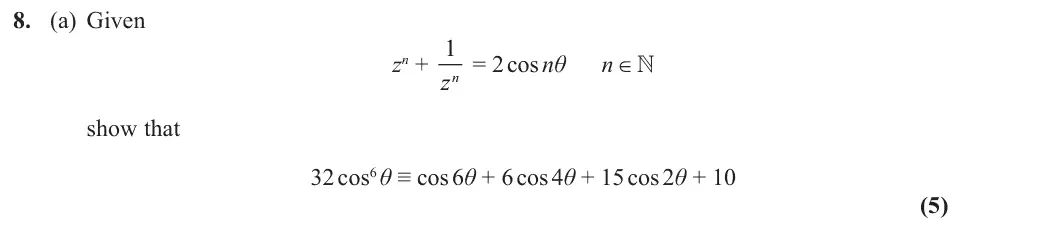
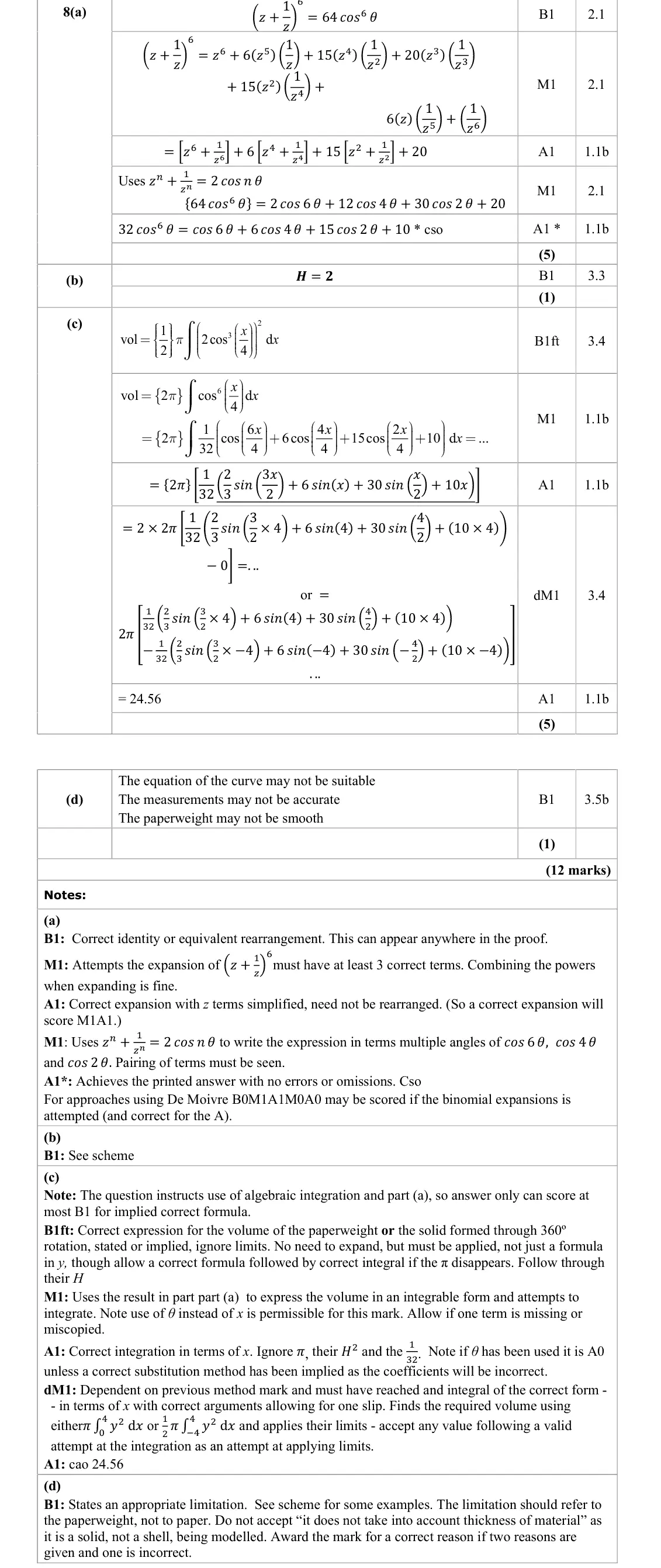
June 2022 · Paper 1 (Core Pure 1) · Q8(a) 5 marks Medium
8. (a) Given zn + 1 zn = 2 cos n theta n ∈ show that 32 cos6 theta ≡ cos 6 theta + 6 cos 4 theta + 15 cos 2 theta + 10 (5)
June 2022 · Paper 1 (Core Pure 1) · Q8(c) 5 marks Medium
(c) Using algebraic integration and the result in part (a), determine, in cm3 , the volume of the paperweight, according to the model. Give your answer to 2 decimal places. [Solutions based entirely on calculator technology are not acceptable.] (5)
Nov 2021 · Paper 2 (Core Pure 2) · Q1(b) 3 marks
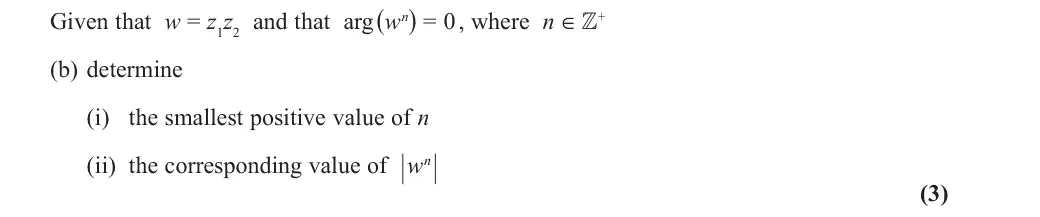
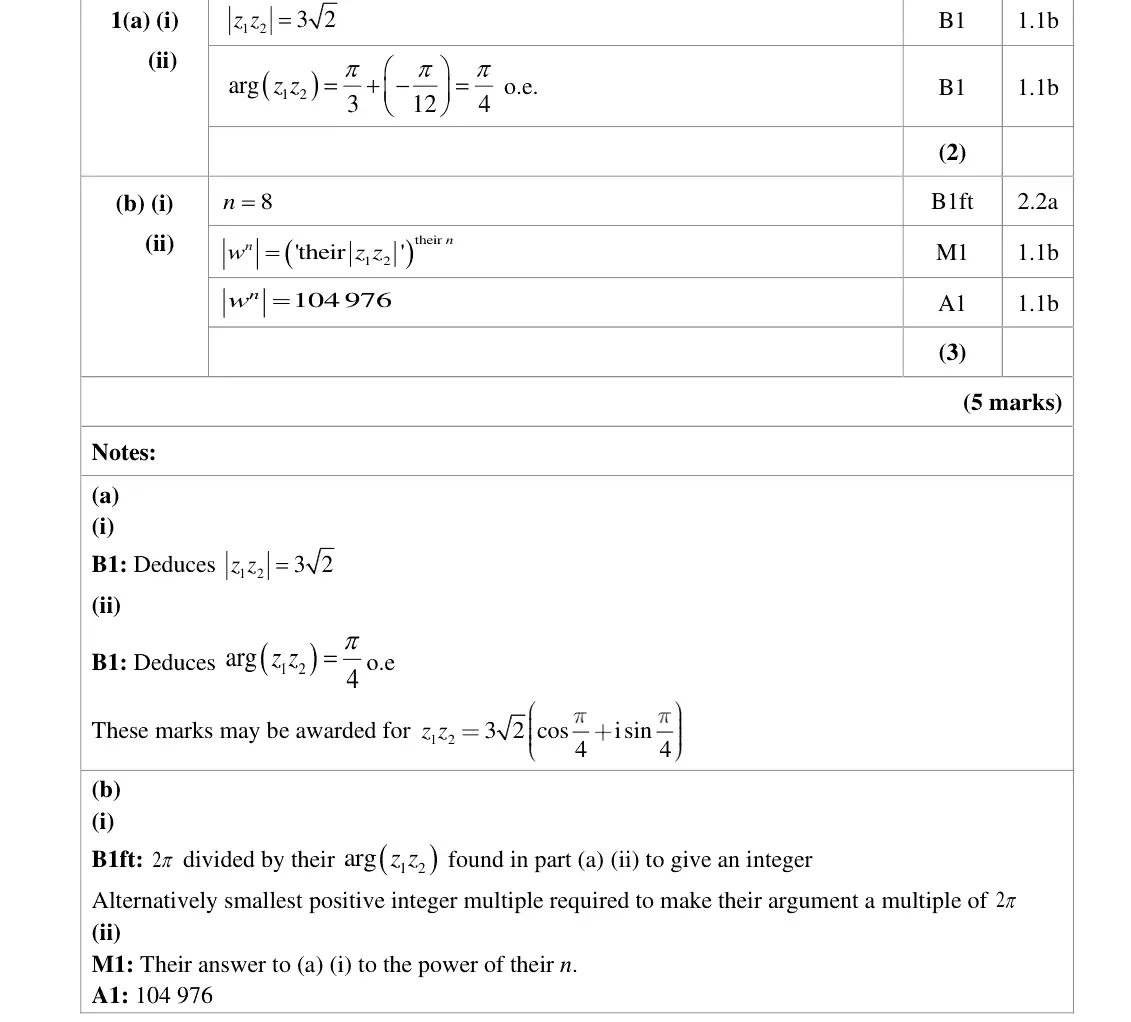
Given that w = z1z2 and that arg (wn) = 0 , where n + (b) determine (i) the smallest positive value of n (ii) the corresponding value of | wn | (3)
Nov 2021 · Paper 2 (Core Pure 2) · Q9(a) 1 mark
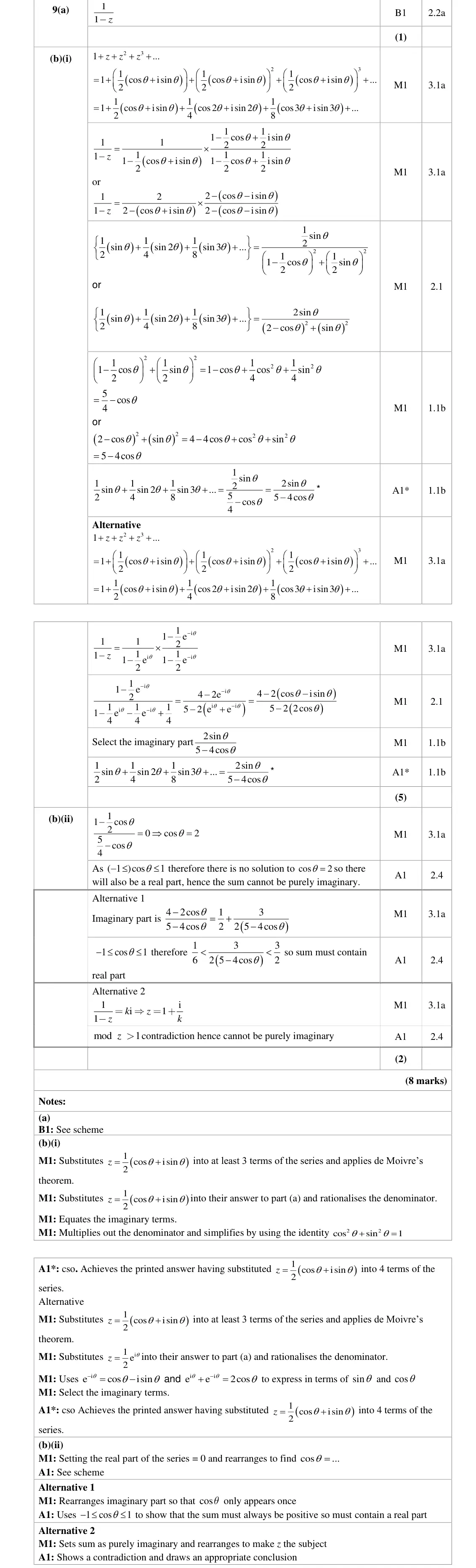
9. (a) Given that | z | < 1 , write down the sum of the infinite series 1 + z + z2 + z3 + … (1)
Nov 2021 · Paper 2 (Core Pure 2) · Q9(b)(i) 5 marks
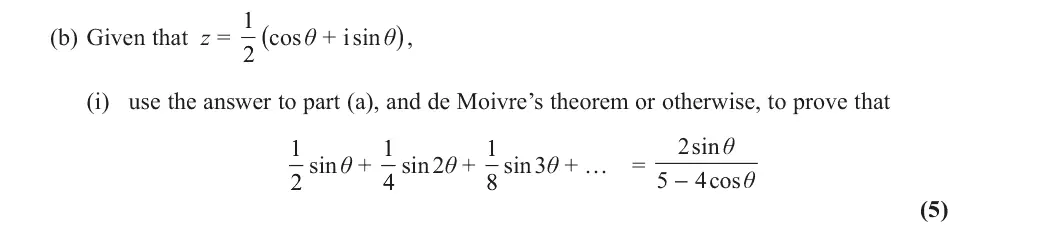
(b) Given that z = 1 2 (cos theta + i sin theta ) , (i) use the answer to part (a), and de Moivre’s theorem or otherwise, to prove that 2sin theta 2 sin theta + 1 4 sin 2 theta + 1 8 sin 3 theta + … = - theta 4cos (5)
Nov 2021 · Paper 2 (Core Pure 2) · Q9(b)(ii) 2 marks
(ii) show that the sum of the infinite series 1 + z + z2 + z3 + … cannot be purely imaginary, giving a reason for your answer. (2)
Oct 2020 · Paper 2 (Core Pure 2) · Q4(a) 5 marks
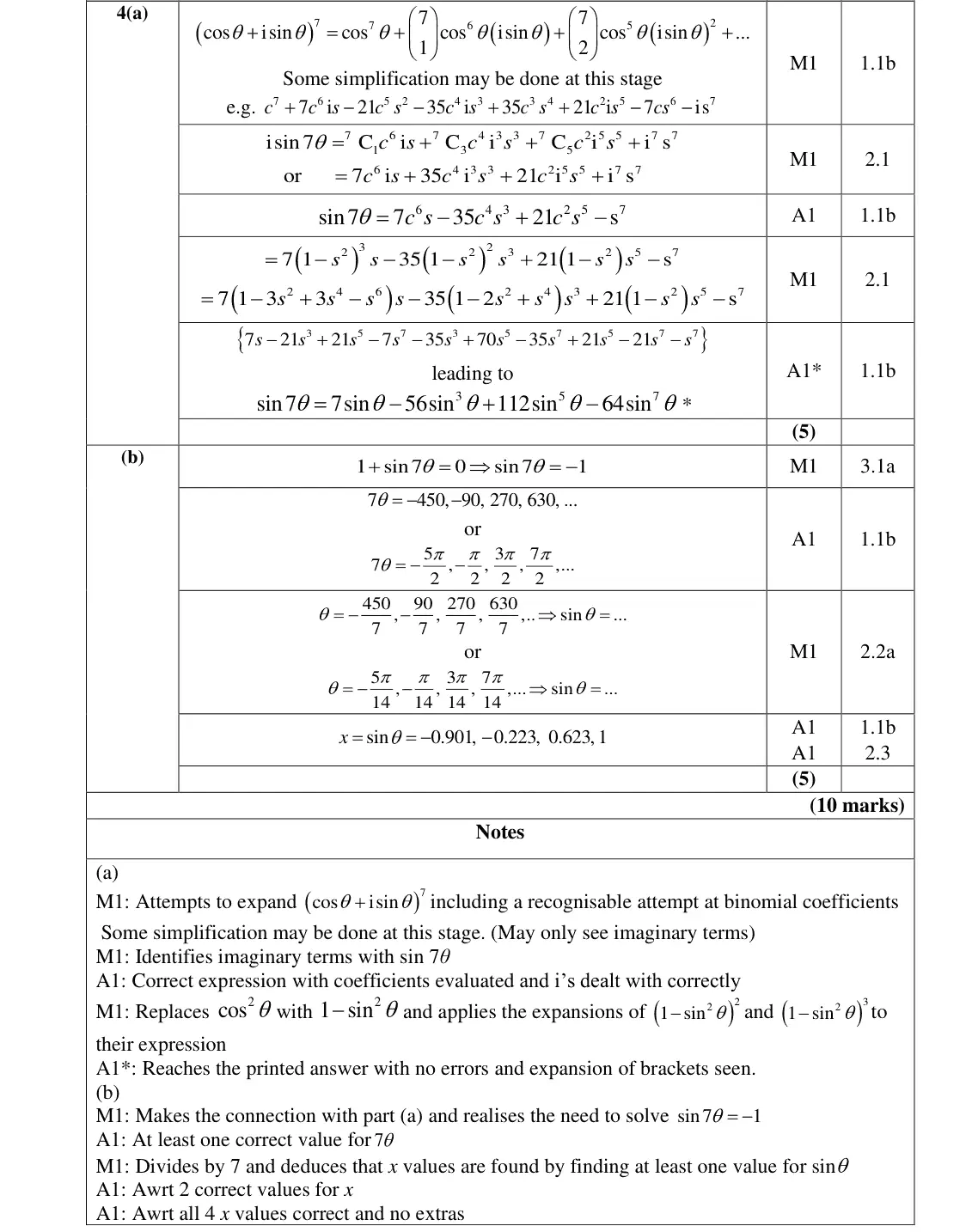
4. (a) Use de Moivre’s theorem to prove that sin 7 theta = 7 sin theta - 56 sin3 theta + 112 sin5 theta - 64 sin7 theta (5)
Oct 2020 · Paper 2 (Core Pure 2) · Q4(b) 5 marks
(b) Hence find the distinct roots of the equation 1 + 7x - 56x3 + 112x5 - 64x7 = 0 (5)
June 2019 · Paper 2 (Core Pure 2) · Q4(a) 4 marks
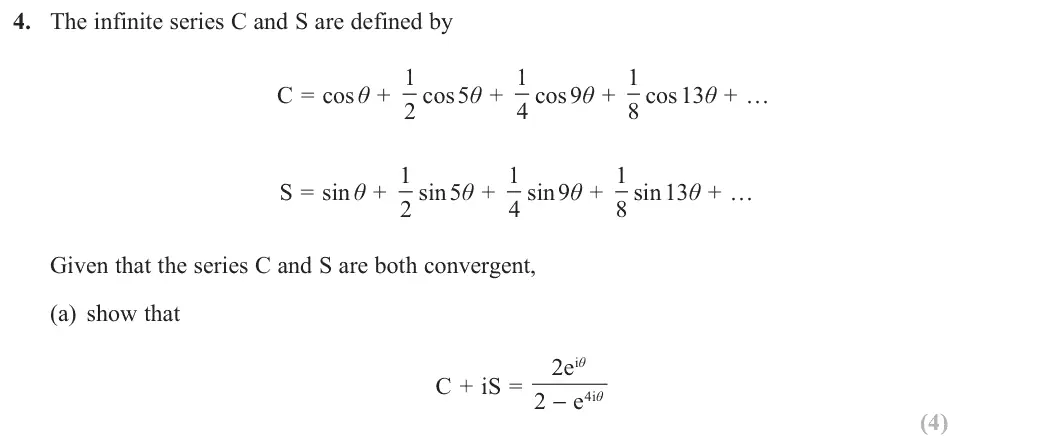
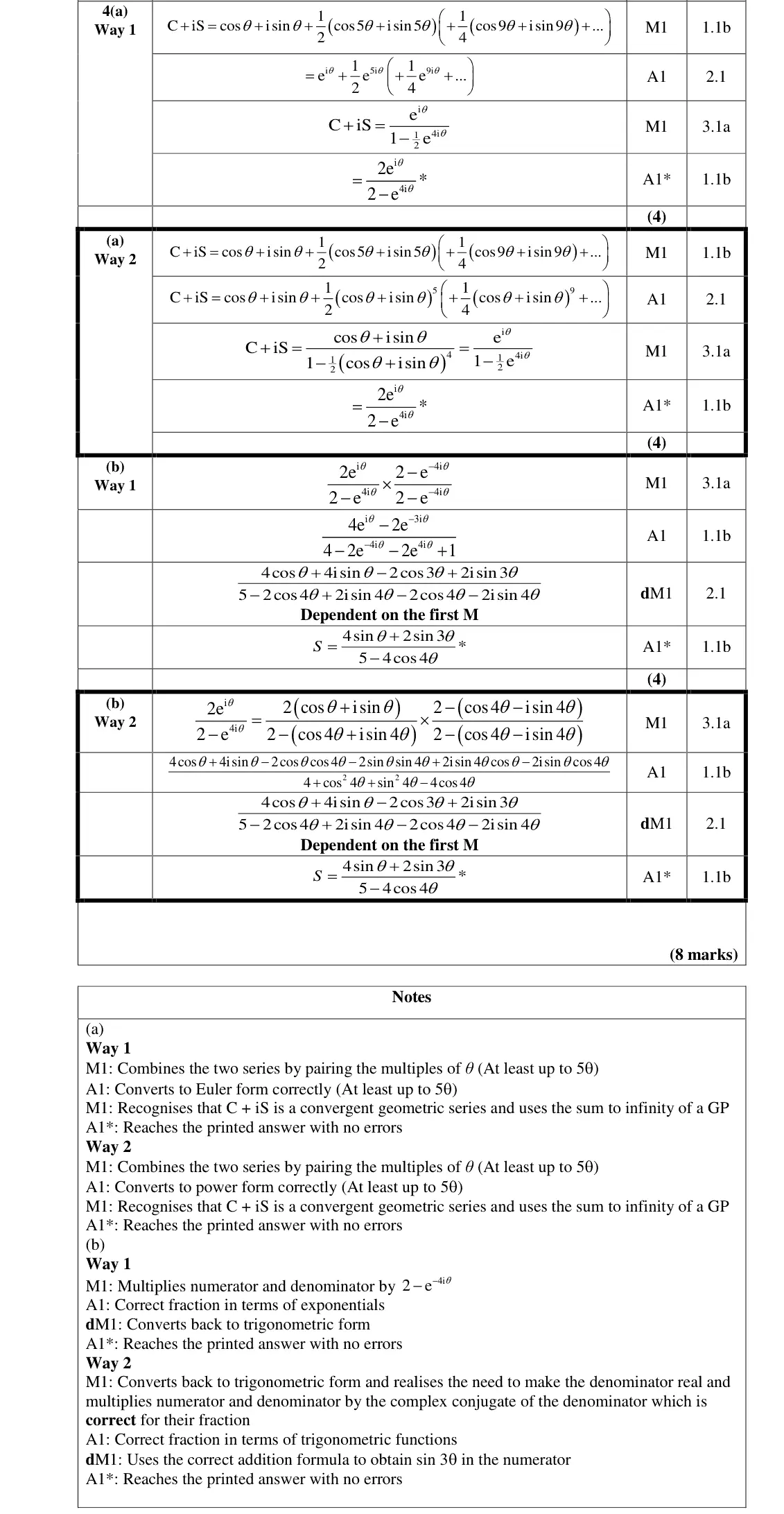
4. The infinite series C and S are defined by C = cos ș + 1 2 cos 5ș + 1 4 cos 9ș + 1 8 cos 13ș + … S = sin ș + 1 2 sin 5ș + 1 4 sin 9ș + 1 8 sin 13ș + … Given that the series C and S are both convergent, (a) show that 2e i theta C + iS = e 4i - theta (4)
June 2019 · Paper 2 (Core Pure 2) · Q4(b) 4 marks
(b) Hence show that S = 4sin 2sin3 theta + theta 4cos4 - theta (4)

Find an Edexcel Further Maths tutor

Stuck on this? Book a trial lesson with our Further Maths tutor.

Prefer email? Send an enquiry

If you are under 18, please include a parent's contact details. Enquiries go to enquiries@alevelfurthermathstutor.com and are deleted once handled.