Notes, worked examples and practice for this topic are being written by our tutors. The past-paper questions below are ready now: work each one on paper, then open the mark scheme and the examiner's comment.
Tap a question to zoom it. Mark scheme and examiner's comment open under each question.
June 2025 · Paper 4D (Decision 2) · Q13 marks
Mark scheme (whole question; this part is marked with the orange bar)
Examiner's comment
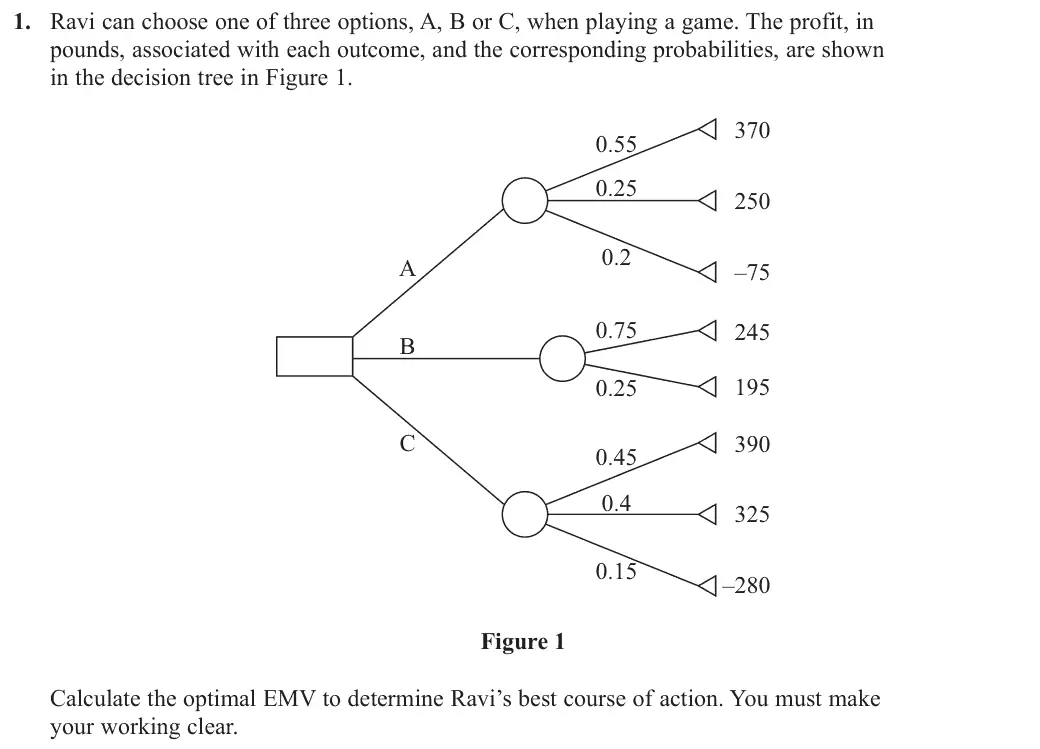
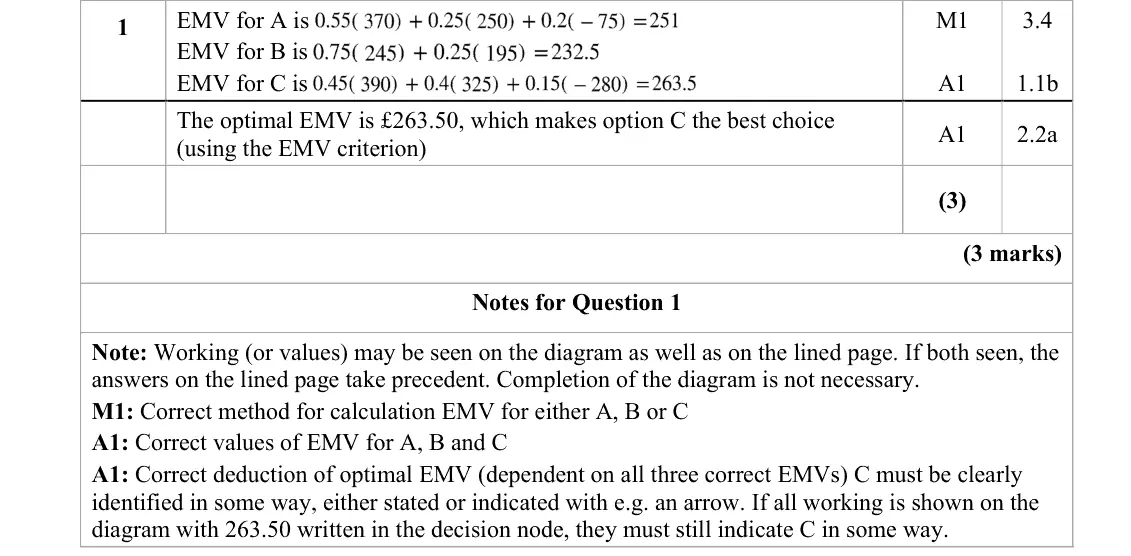
This question was answered well by almost all candidates, although a small number made errors when calculating the EMVs. Some candidates lost the final mark by failing to clearly state which of the three options (A, B or C) was the best choice. It was pleasing to see that a good number of candidates completely the decision tree diagram by filling in the chance nodes and the decision node and crossing the inferior options.
Key points from the mark scheme and examiner's report
EMVs A 251, B 232.5, C 263.5
optimal EMV £263.50 so choose C
option C must be clearly identified
June 2024 · Paper 4D (Decision 2) · Q5(a)6 marks
Mark scheme (whole question; this part is marked with the orange bar)
Examiner's comment
incorrectly, just took the cube root of the EMVs calculated in (a).
Key points from the mark scheme and examiner's report
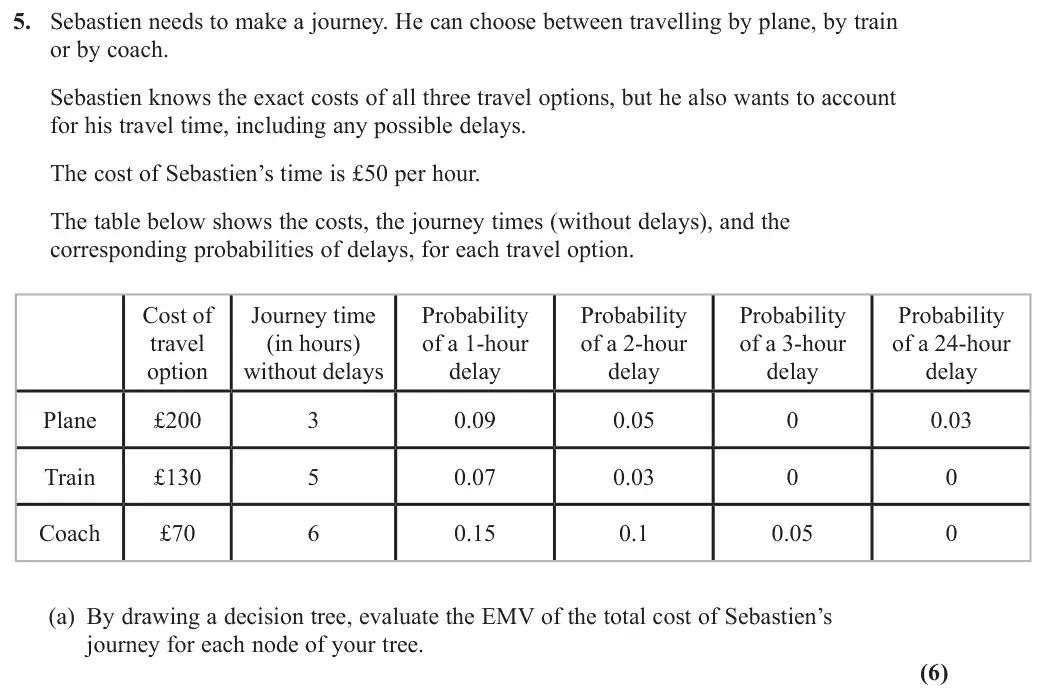
total cost = fare + £50 per hour of travel and delay
Mark scheme (whole question; this part is marked with the orange bar)
Examiner's comment
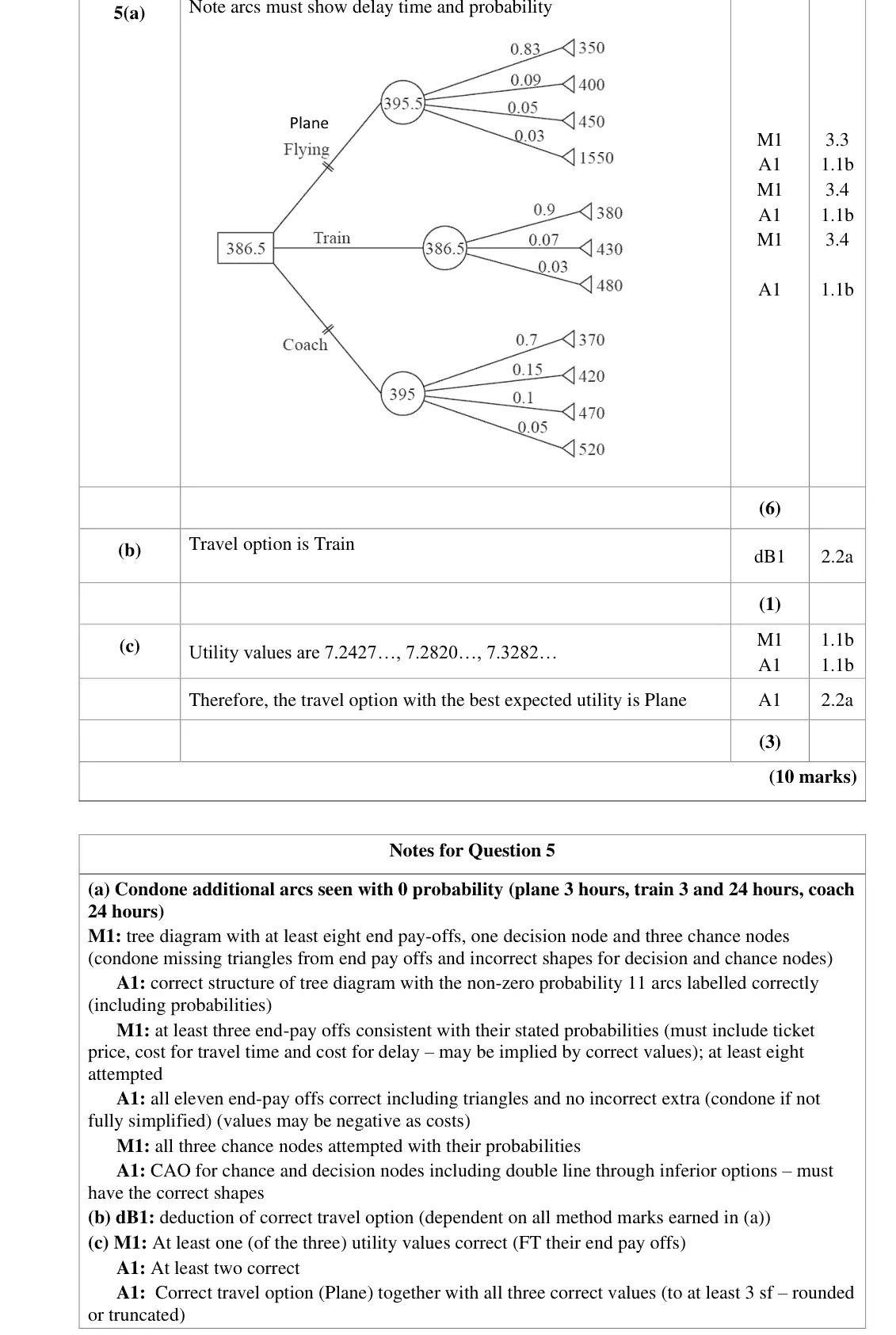
A significant number of candidates were able to make a reasonable attempt at drawing the decision tree, although there were several common errors seen. A small number of candidates did not draw the triangles for the end pay offs, other failed to label the branches correctly with both the delay and the probability of that delay. Some made errors with one or more ends pay off value. Some candidates did not fill in the values at either their chance nodes or the decision node and some failed to cross through the inferior options. A small number of candidates including additional, unnecessary arcs, for the possible delays which had 0 probability, but were not penalised for this. Most candidates, who had made a reasonable attempt at the decision
Key points from the mark scheme and examiner's report
train (least EMV of cost, 386.5)
June 2024 · Paper 4D (Decision 2) · Q5(c)3 marks
Mark scheme (whole question; this part is marked with the orange bar)
Examiner's comment
tree, stated the correct best option. In (c) a good number of candidates were able to apply the utility function correctly and obtained the new best option. However, a small number, incorrectly, just took the cube root of the EMVs calculated in (a).
Key points from the mark scheme and examiner's report
expected value of the cube root of each total cost: 7.2427 (plane), 7.2820 (train), 7.3282 (coach)
best is plane (lowest)
taking the cube root of the EMVs is wrong
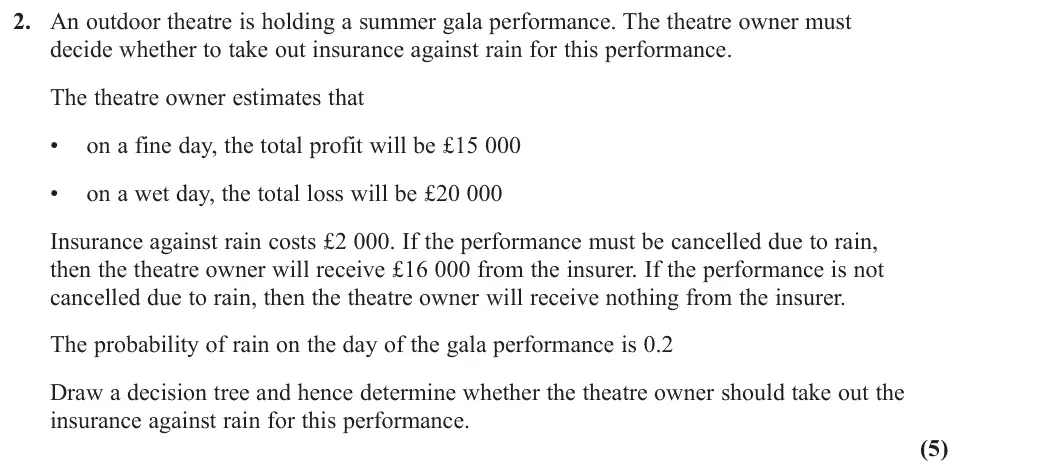
June 2023 · Paper 4D (Decision 2) · Q25 marks
Mark scheme (whole question; this part is marked with the orange bar)
Examiner's comment
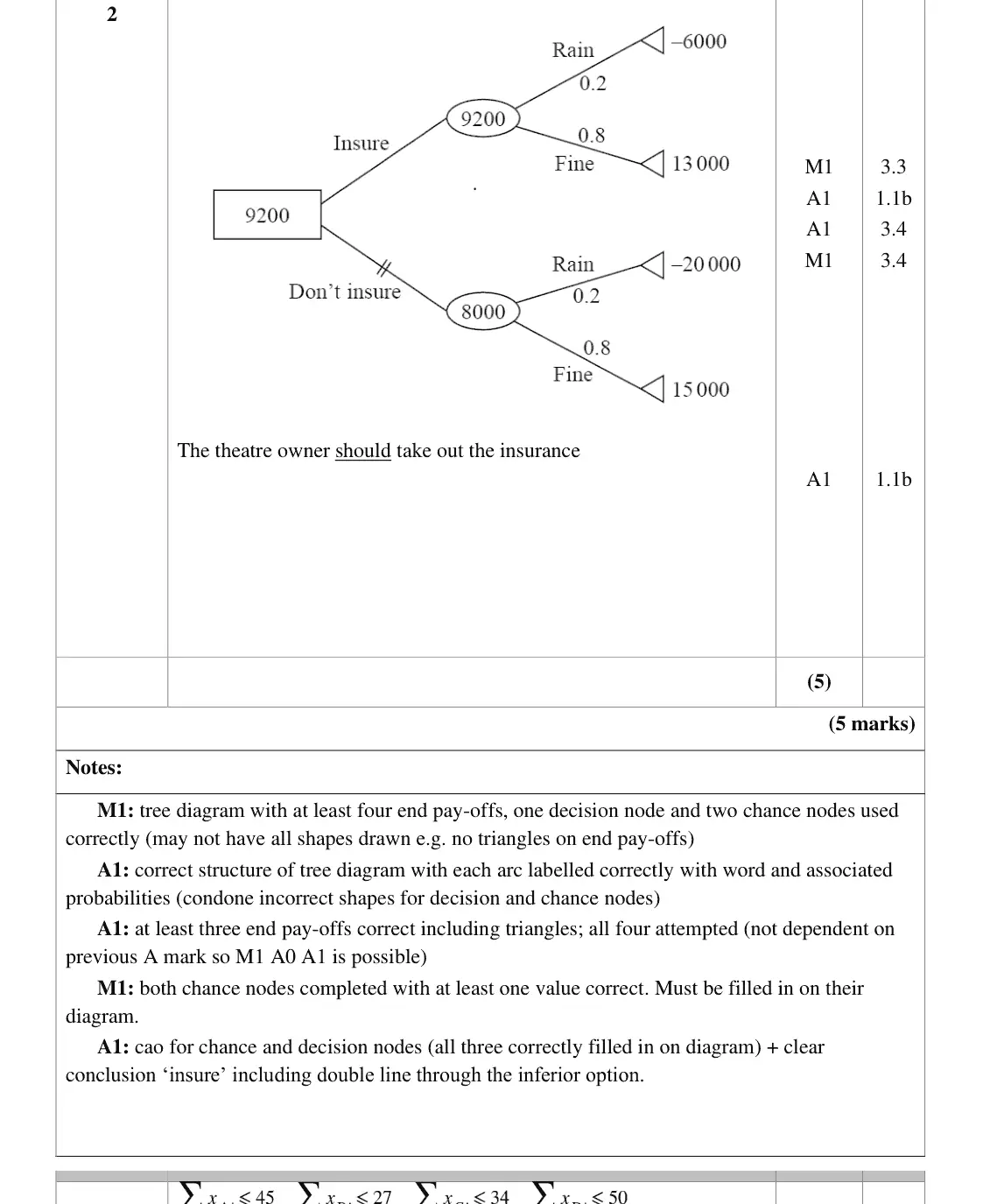
This question also proved to be accessible. As a relatively new topic, it is pleasing to see that candidates are able to produce good solutions. Most candidates drew a decision tree with the correct structure and used the correct shapes for the decision node, chance nodes and end pay offs, although a small number omitted either the decision node or end pay-offs, which was resulted in the loss of accuracy marks. Candidates need to ensure that the decision node and chance nodes are drawn sufficiently large to allow the calculated values to be written inside them. Some candidates failed to label the branches of the decision tree correctly, omitting either the option and/or the associated probabilities. Most candidates obtained at least 3 of the end pay-offs correctly, although a small number attempted to incorrectly combine the values and probabilities in their end pay-offs. Many candidates failed to obtain the final mark, either because they had not written the final EMV in the decision node or because they had failed to cross through (with a double line) the inferior option.
Key points from the mark scheme and examiner's report
pay-offs insure −6000 (rain) and 13000 (fine), don't insure −20000 and 15000
EMV insure 9200, don't insure 8000
take out the insurance
values must be written in the nodes and the inferior option double-lined
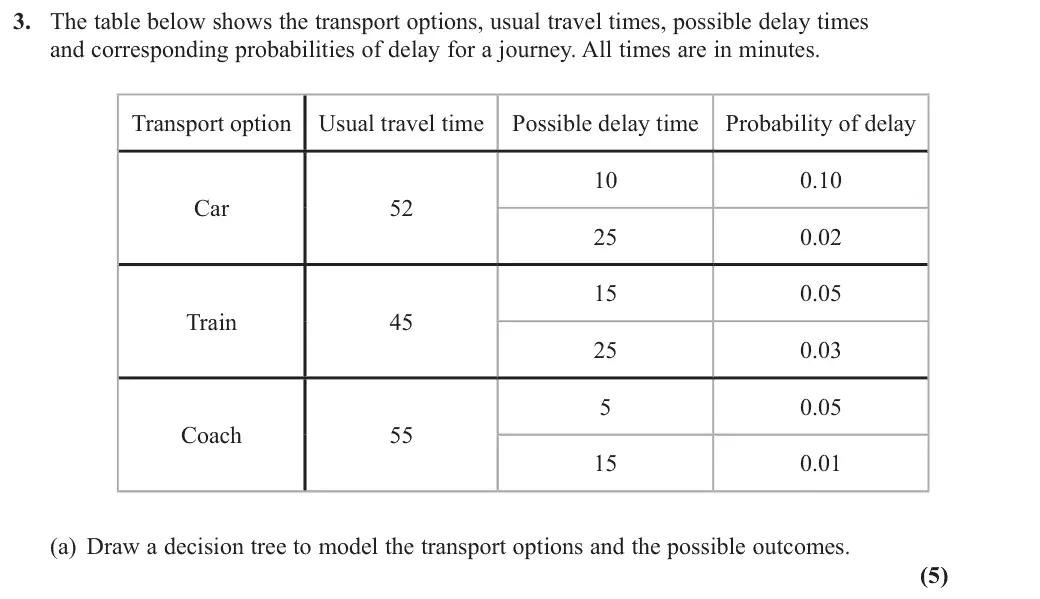
June 2022 · Paper 4D (Decision 2) · Q3(a)5 marks
Mark scheme (whole question; this part is marked with the orange bar)
Examiner's comment
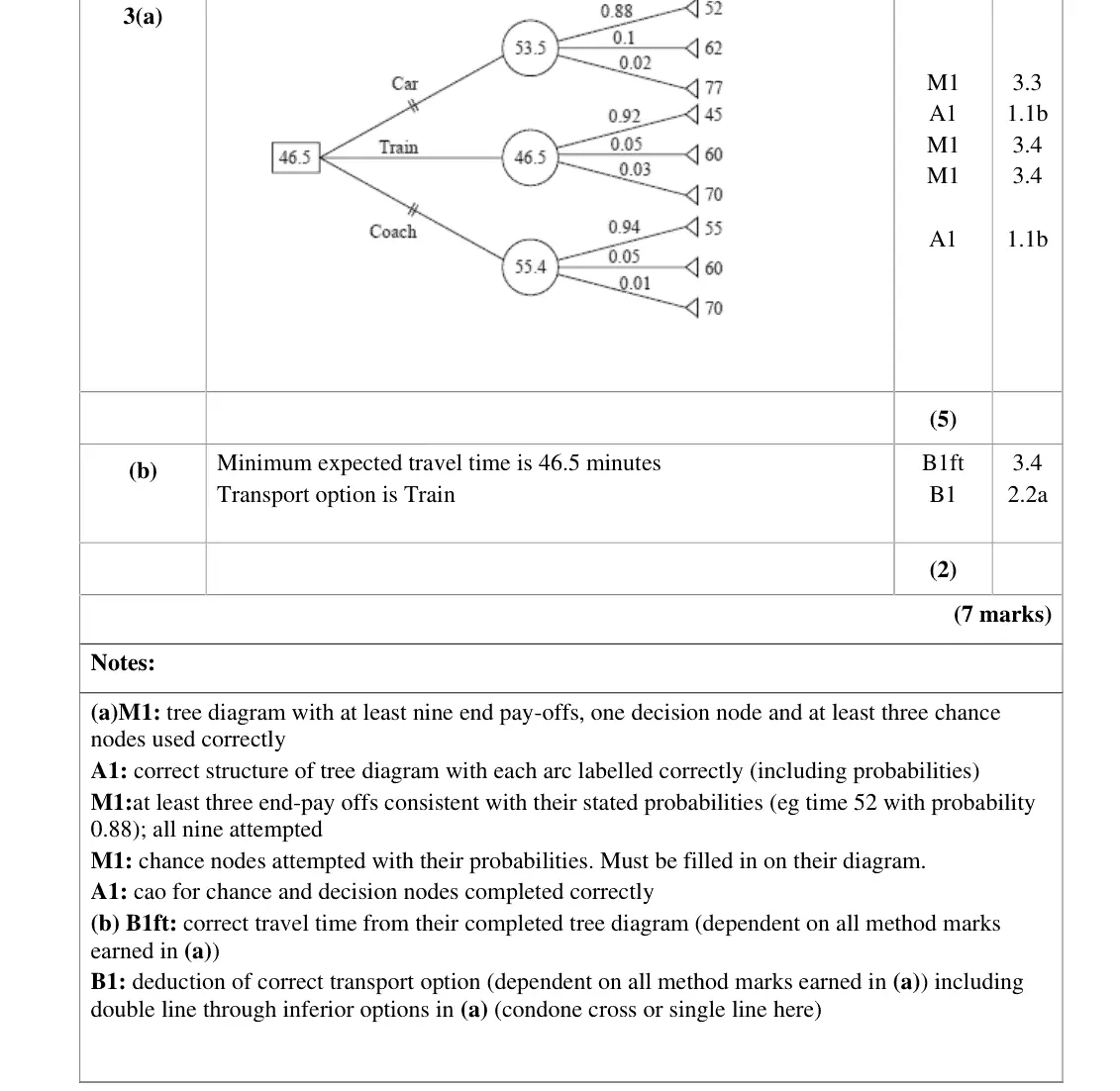
Decision analysis is a relatively new topic in the specification, so it was pleasing to see a good number of excellent solutions. Whilst many candidates interpreted the question correctly a substantial minority were unable to draw a correct decision tree. Candidates are advised to learn the style for the three types of node: boxes for decision nodes, circles for chance nodes and triangles for end pay-off nodes, with the former two drawn sufficiently large to allow figures to be entered inside them. For this problem the optimum structure consists of nine end pay-off nodes, three chance nodes and one decision nodes. A few candidates used an alternative correct structure, with six chance nodes, which overcomplicated the solution, necessitating the recalculation of several probabilities, and completion of additional intermediate chance nodes. Of those that constructed a correct tree diagram, many were then unable to annotate it correctly, in spite of showing the correct travel time calculations elsewhere in their solution. Both chance and decision nodes must have their calculated values entered inside them. All arcs must be appropriately labelled. Two short double lines through arcs should be used to indicate inferior options, though just on this occasion single lines or crosses were not penalised. A few candidates used negative values to indicate delays, and were not penalised this time, but again this would not be condoned in future.
Key points from the mark scheme and examiner's report
one decision node, three chance nodes, nine end nodes (times 52, 62, 77 for car with probabilities 0.88, 0.1, 0.02, etc.)
expected times car 53.5, train 46.5, coach 55.4 written in the nodes
squares for decisions, circles for chance, triangles for pay-offs
June 2022 · Paper 4D (Decision 2) · Q3(b)2 marks
Mark scheme (whole question; this part is marked with the orange bar)
Examiner's comment
Decision analysis is a relatively new topic in the specification, so it was pleasing to see a good number of excellent solutions. Whilst many candidates interpreted the question correctly a substantial minority were unable to draw a correct decision tree. Candidates are advised to learn the style for the three types of node: boxes for decision nodes, circles for chance nodes and triangles for end pay-off nodes, with the former two drawn sufficiently large to allow figures to be entered inside them. For this problem the optimum structure consists of nine end pay-off nodes, three chance nodes and one decision nodes. A few candidates used an alternative correct structure, with six chance nodes, which overcomplicated the solution, necessitating the recalculation of several probabilities, and completion of additional intermediate chance nodes. Of those that constructed a correct tree diagram, many were then unable to annotate it correctly, in spite of showing the correct travel time calculations elsewhere in their solution. Both chance and decision nodes must have their calculated values entered inside them. All arcs must be appropriately labelled. Two short double lines through arcs should be used to indicate inferior options, though just on this occasion single lines or crosses were not penalised. A few candidates used negative values to indicate delays, and were not penalised this time, but again this would not be condoned in future.
Key points from the mark scheme and examiner's report
minimum expected travel time 46.5 minutes, by train
double line through the inferior options
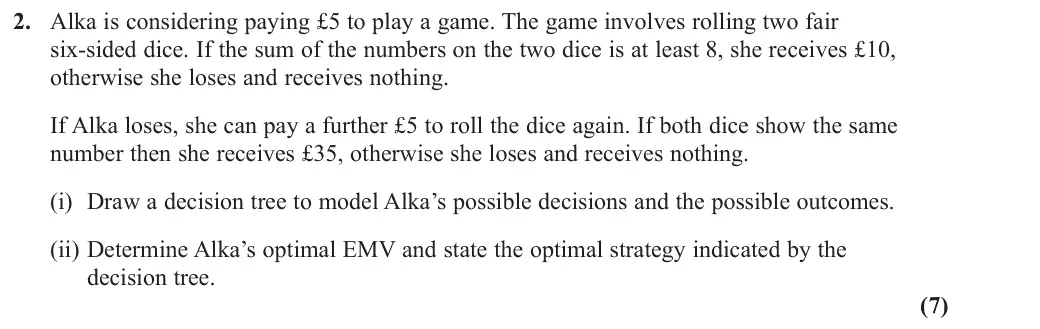
Nov 2021 · Paper 4D (Decision 2) · Q27 marks
Mark scheme (whole question; this part is marked with the orange bar)
Key points from the mark scheme and examiner's report
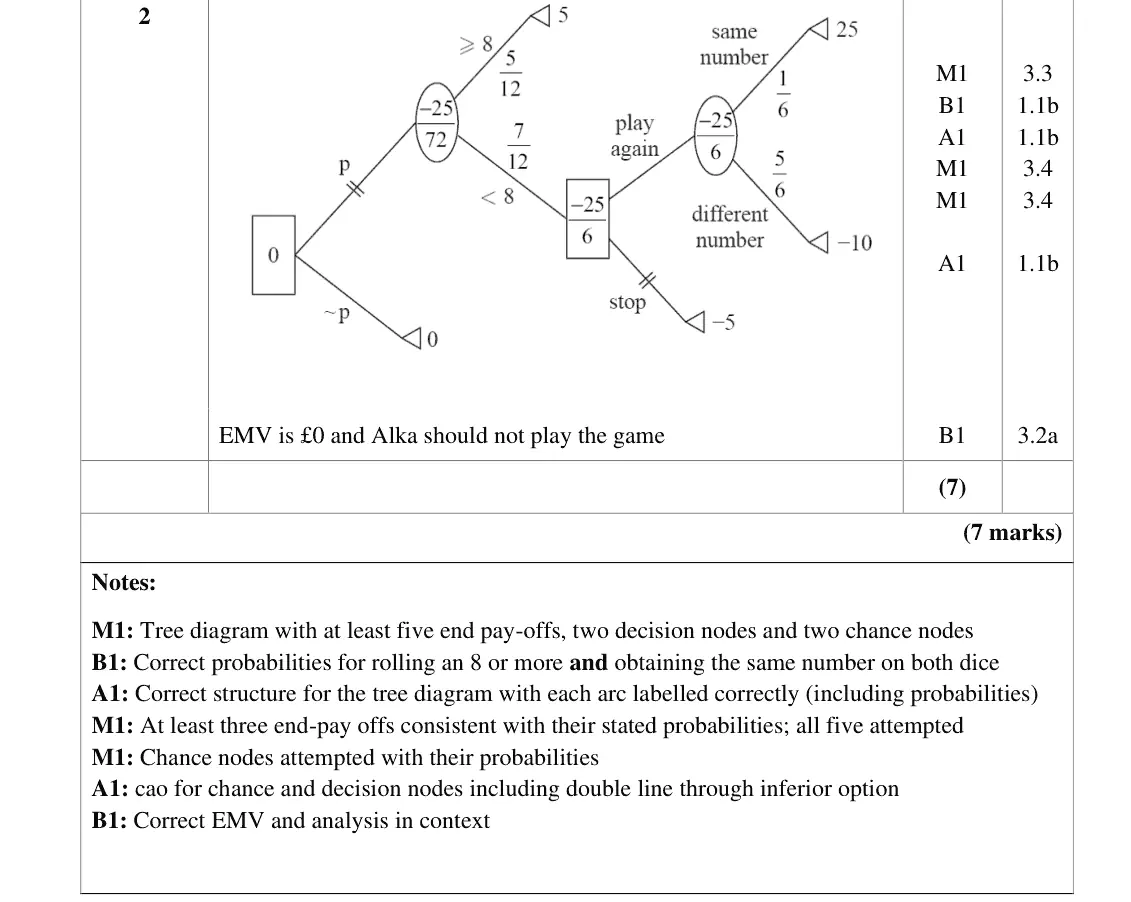
two decision nodes, two chance nodes, five pay-offs net of the £5 stakes (5, 25, −10, −5, 0)
P(sum at least 8) = 5/12, P(double) = 1/6
play again EMV −25/6 beats stop −5, play EMV −25/72
optimal EMV £0 so do not play
double line through inferior options
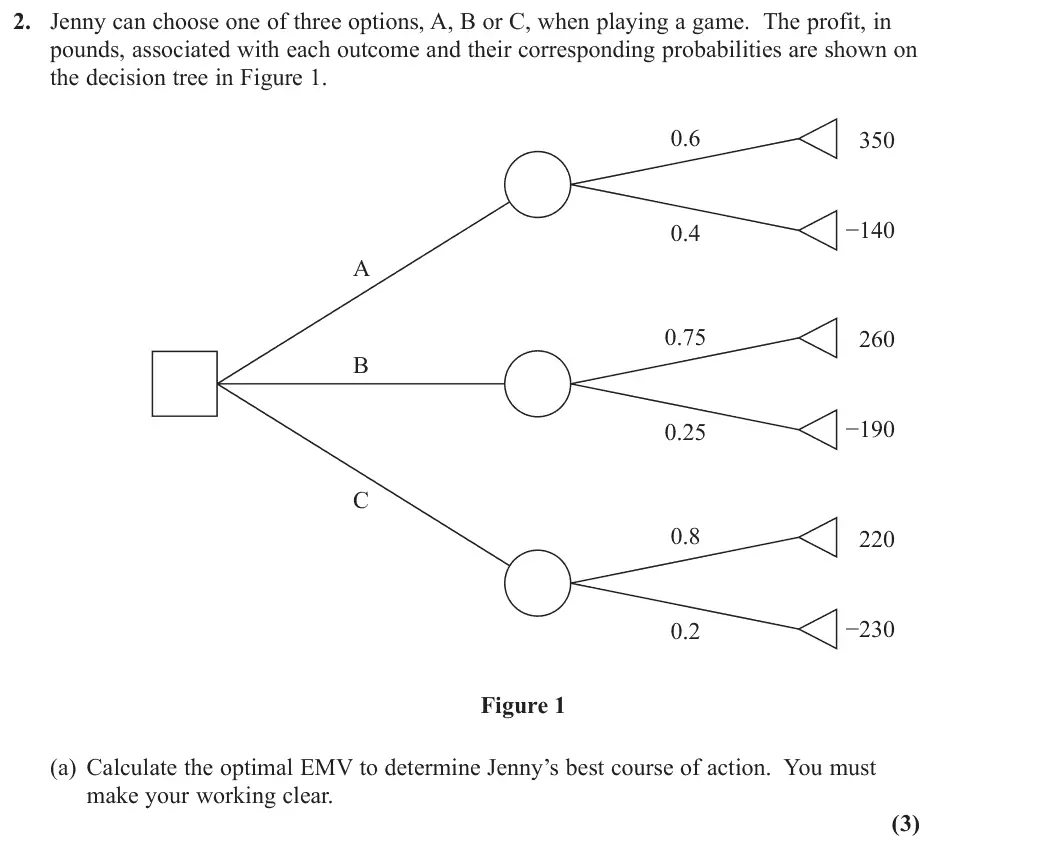
Oct 2020 · Paper 4D (Decision 2) · Q2(a)3 marks
Mark scheme (whole question; this part is marked with the orange bar)
Key points from the mark scheme and examiner's report
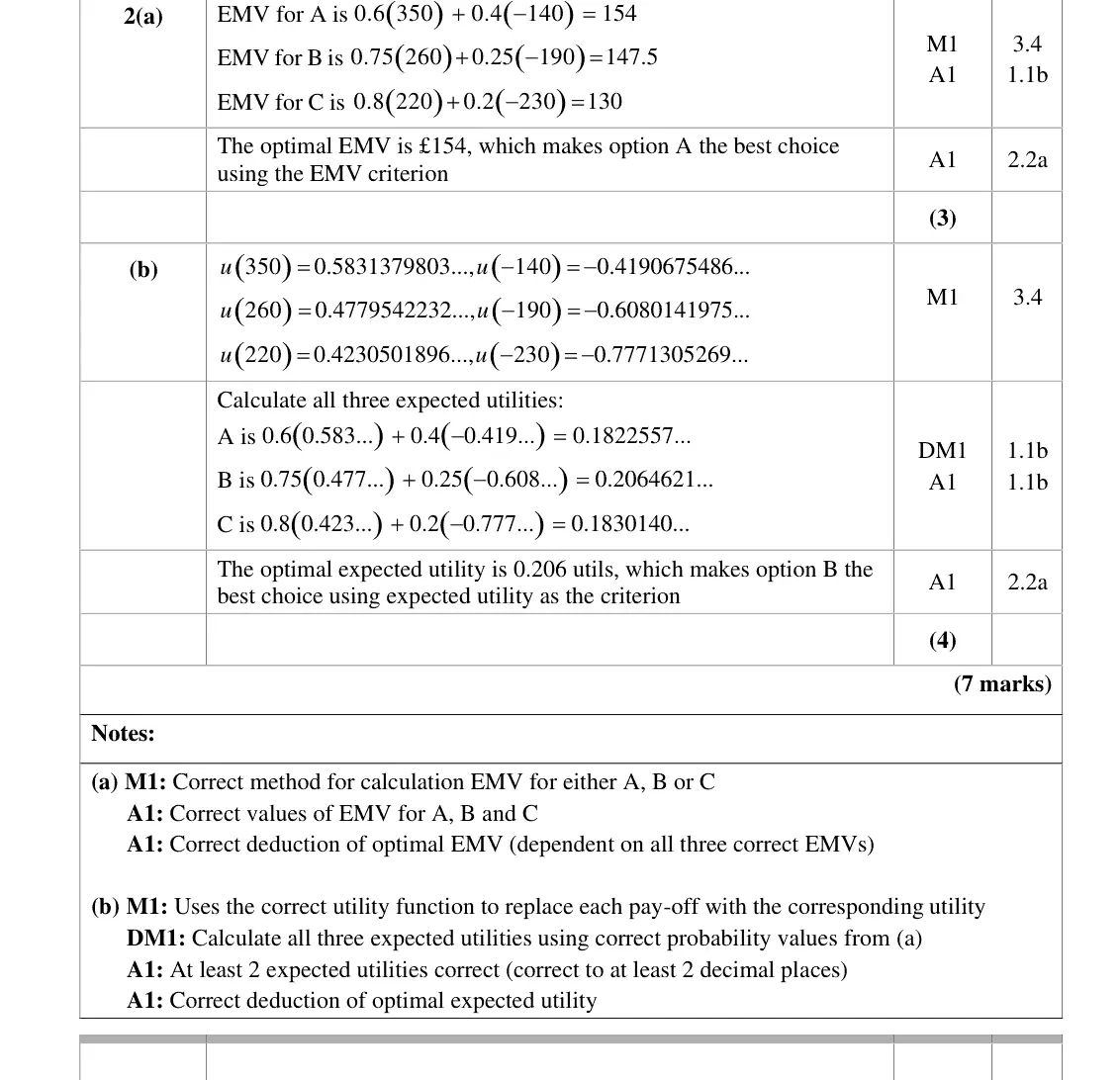
EMVs A 154, B 147.5, C 130
optimal EMV £154 so choose A
Oct 2020 · Paper 4D (Decision 2) · Q2(b)4 marks
Mark scheme (whole question; this part is marked with the orange bar)
Key points from the mark scheme and examiner's report
replace each pay-off by its utility 1 − e^(−x/400) (negative for losses), then expected utilities A 0.182, B 0.206, C 0.183
choose B
at least 2 expected utilities correct to 2 dp
June 2019 · Paper 4D (Decision 2) · Q7(a)6 marks
Mark scheme (whole question; this part is marked with the orange bar)
Examiner's comment
inferior option or ‘0’ in the decision node. In (a)(i), candidates were asked to determine the optimal EMV and state the optimal strategy. However, often candidates lost this straightforward mark for stating only the EMV of playing the game rather than the optimal EMV of 0. Some candidates only stated the EMVs and did not conclude that the optimal strategy was ‘Not Play’. Candidates should be encouraged to check that they are answering the question that has been asked.
Key points from the mark scheme and examiner's report
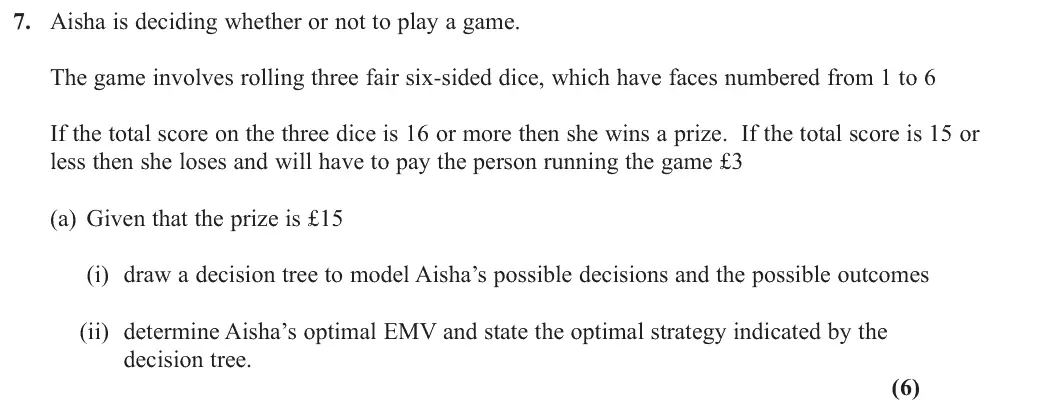
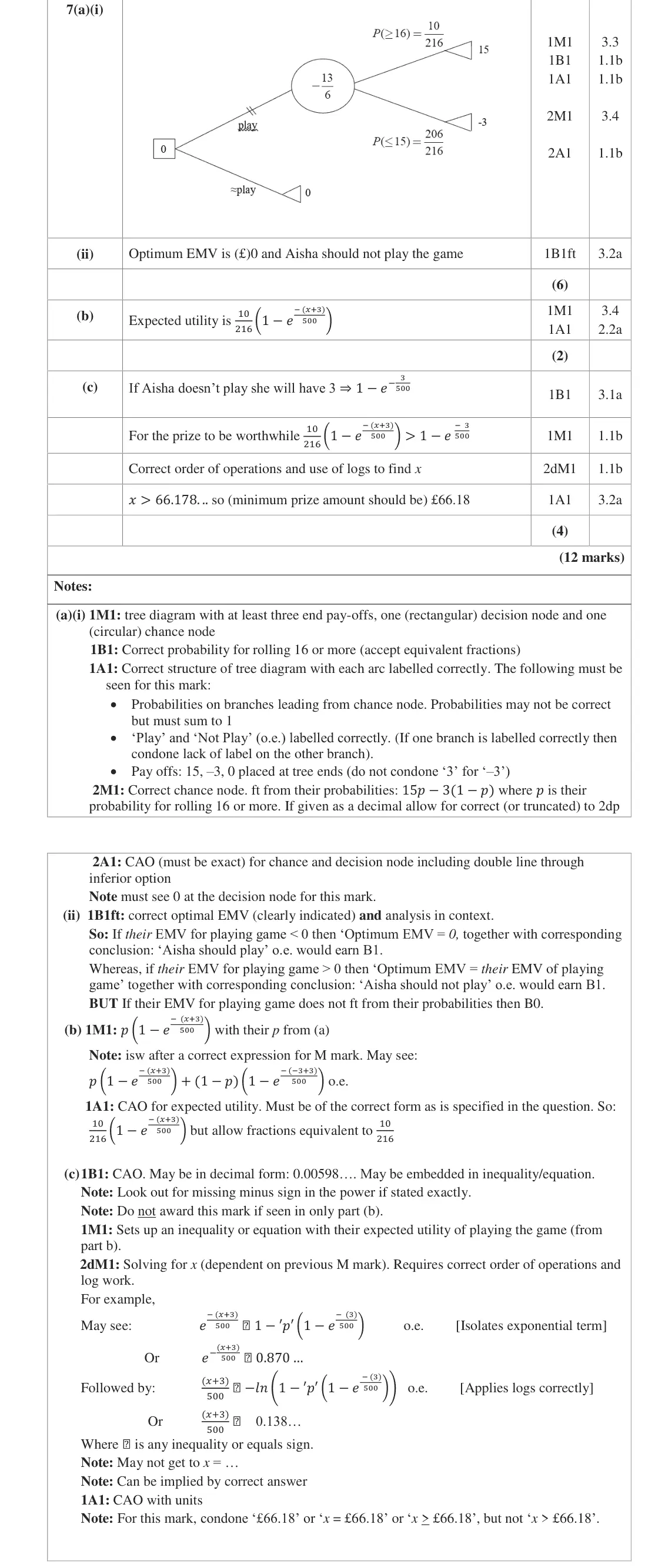
P(16 or more) = 10/216
EMV of play = 15(10/216) − 3(206/216) = −13/6 < 0
optimal EMV is £0 so do not play
stating only the EMV of playing, or no conclusion, lost the mark
pay-off −3 not 3
June 2019 · Paper 4D (Decision 2) · Q7(b)2 marks
Mark scheme (whole question; this part is marked with the orange bar)
Examiner's comment
Parts (b) and (c) provided a challenge to the majority of candidates and many did not make much progress here. Of those candidates that did make some headway, some spread of marks was observed. It seems that candidates are unfamiliar with the application of the utility function and most problems arose from an incorrect substitution of 𝑚 = 3 into the function rather than the correct 𝑚 = 𝑥 + 3; demonstrating a lack of understanding that the utility function is defined in terms of the total money Aisha has, rather than her winnings or losses. Furthermore, some candidates attempted to evaluate the utility function alone rather than calculating the expected utility as requested: thus, omitting the probability multiple(s). In (c), only a minority of candidates were able to make progress. Most seemed
Key points from the mark scheme and examiner's report
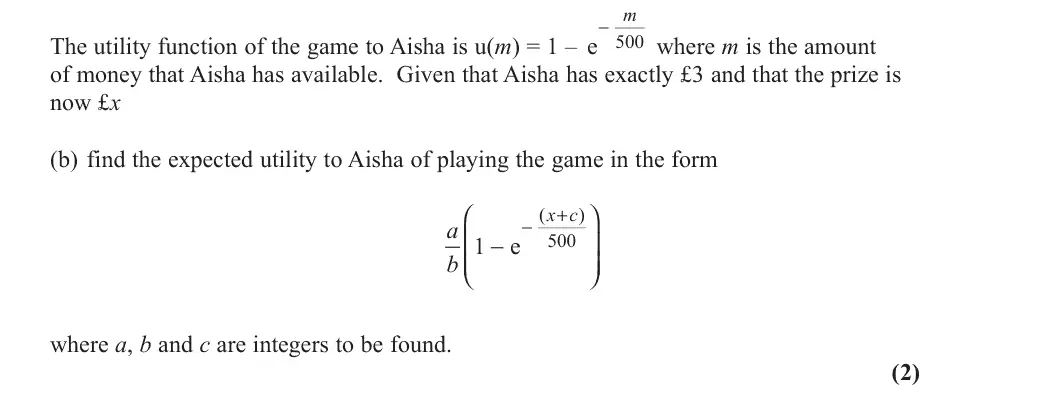
utility uses total money m = x + 3, not 3
losing leaves 0 money, utility 0
expected utility (10/216)(1 − e^(−(x+3)/500))
omitting the probability lost marks
June 2019 · Paper 4D (Decision 2) · Q7(c)4 marks
Mark scheme (whole question; this part is marked with the orange bar)
Examiner's comment
Parts (b) and (c) provided a challenge to the majority of candidates and many did not make much progress here. Of those candidates that did make some headway, some spread of marks was observed. It seems that candidates are unfamiliar with the application of the utility function and most problems arose from an incorrect substitution of 𝑚 = 3 into the function rather than the correct 𝑚 = 𝑥 + 3; demonstrating a lack of understanding that the utility function is defined in terms of the total money Aisha has, rather than her winnings or losses. Furthermore, some candidates attempted to evaluate the utility function alone rather than calculating the expected utility as requested: thus, omitting the probability multiple(s). In (c), only a minority of candidates were able to make progress. Most seemed unclear that they should be comparing the expected utility of playing with the expected utility of not playing. Instead some candidates simply set the expected utility of playing greater than zero. Others wrote down a correct inequality but seemed unable to make progress in solving the inequality for 𝑥 which is, perhaps, surprising at this level. Unfortunately, a handful of candidates who were able to navigate the algebra here slipped at the final hurdle by interpreting their solution for the minimum prize by incorrectly stating 𝑥 > £66.18 rather than 𝑥 = £66.18 or x > £66.18 (which was condoned).
Key points from the mark scheme and examiner's report
compare with utility of not playing 1 − e^(−3/500)
solve with logs: x > 66.178…, minimum prize £66.18
many did not compare the two expected utilities
Find an Edexcel Further Maths tutor
Stuck on this? Book a trial lesson with our Further Maths tutor.