Nothing is given; Hooke's law and elastic energy must be learned.
Since 2018
17 question parts, 78 marks
Notes, worked examples and practice for this topic are being written by our tutors. The past-paper questions below are ready now: work each one on paper, then open the mark scheme and the examiner's comment.
Tap a question to zoom it. Mark scheme and examiner's comment open under each question.
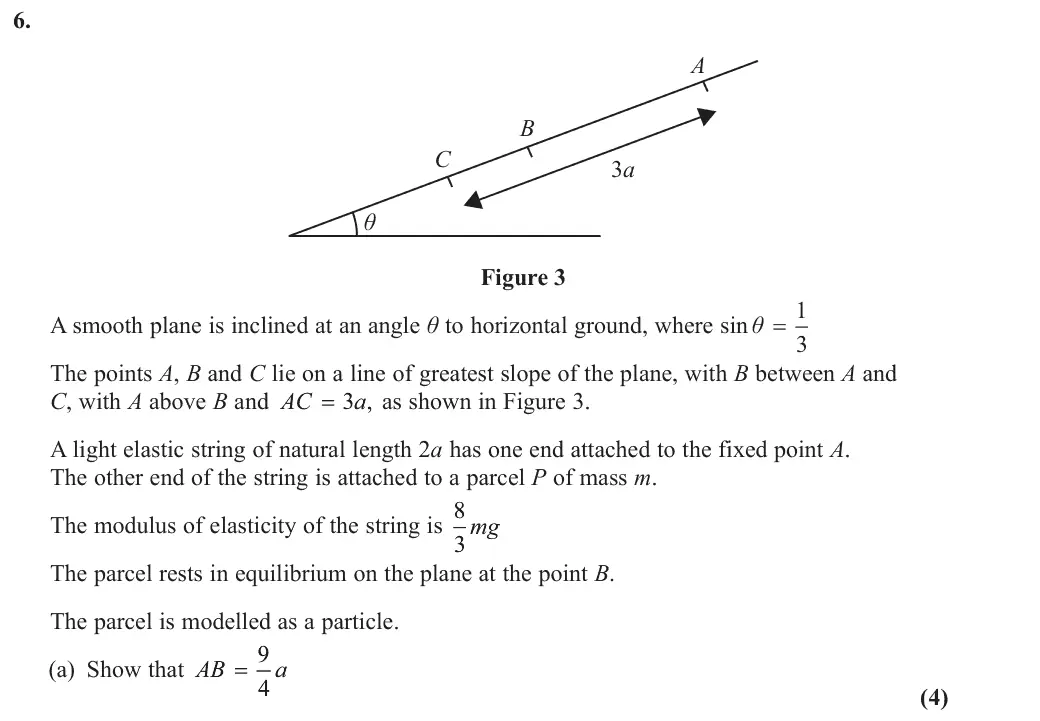
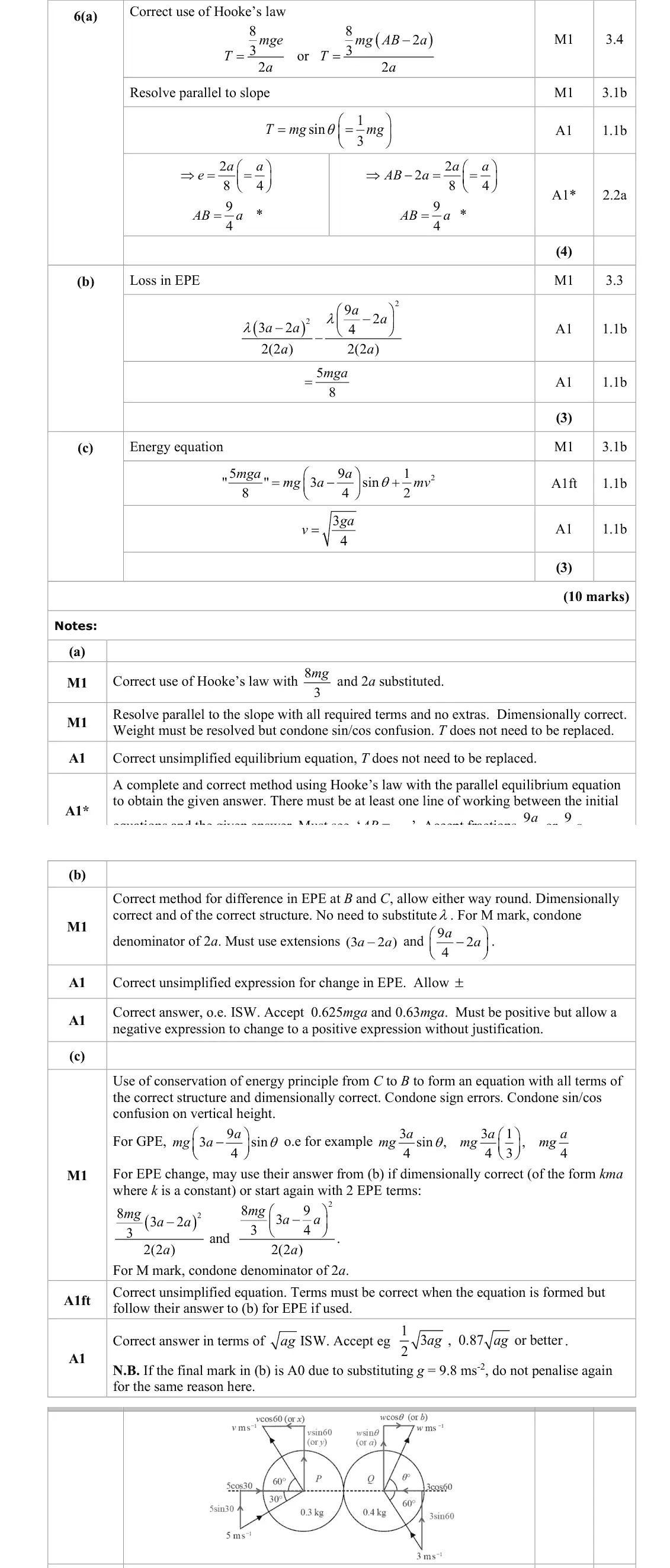
June 2025 · Paper 3C (Further Mechanics 1) · Q6(a)4 marks
Mark scheme (whole question; this part is marked with the orange bar)
Examiner's comment
The ‘show that’ part (a) provided a very accessible opening to this question on elastic potential energy and the work-energy principle. Learners at all levels demonstrated their confidence and accuracy in part (a) using Hooke’s Law with success to obtain the given answer. Some learners produced an incomplete solution and were not awarded the final mark for not giving an expression for AB as required in the question. The scaffolding provided by part (a) supported a strong entry into part (b) with many fully correct solutions. When using the EPE formula, it was more common to see errors in the extension than the denominator, using the distance from A instead of the extension. The final part of the question required use of the principle of conservation of mechanical energy
Key points from the mark scheme and examiner's report
T = (8mg/3)e/(2a) = mg sin θ = mg/3, e = a/4, AB = 9a/4
must end with an expression for AB
June 2025 · Paper 3C (Further Mechanics 1) · Q6(b)3 marks
Mark scheme (whole question; this part is marked with the orange bar)
Examiner's comment
The scaffolding provided by part (a) supported a strong entry into part (b) with many fully correct solutions. When using the EPE formula, it was more common to see errors in the extension than the denominator, using the distance from A instead of the extension. The final part of the question required use of the principle of conservation of mechanical energy ease, using their answer to part (b) and “Energy Loss = Energy Gain” to find an expression for EPE in just a few lines. Others chose to start again with separate energy terms and were just as successful using “Initial Energy = Final Energy”. Given that a and m both contain units, it was not appropriate to replace g with 9.8 in parts (b) or (c).
Key points from the mark scheme and examiner's report
EPE at C (extension a) minus at B (extension a/4) = 5mga/8
using the distance from A instead of the extension
keep g, do not use 9.8
June 2025 · Paper 3C (Further Mechanics 1) · Q6(c)3 marks
Mark scheme (whole question; this part is marked with the orange bar)
Examiner's comment
The final part of the question required use of the principle of conservation of mechanical energy and no marks were available for use of suvat. Well-rehearsed learners completed part (c) with ease, using their answer to part (b) and “Energy Loss = Energy Gain” to find an expression for or (c).
Key points from the mark scheme and examiner's report
5mga/8 = mg(3a/4)sin θ + ½mv²: v = √(3ga/4)
suvat scores 0
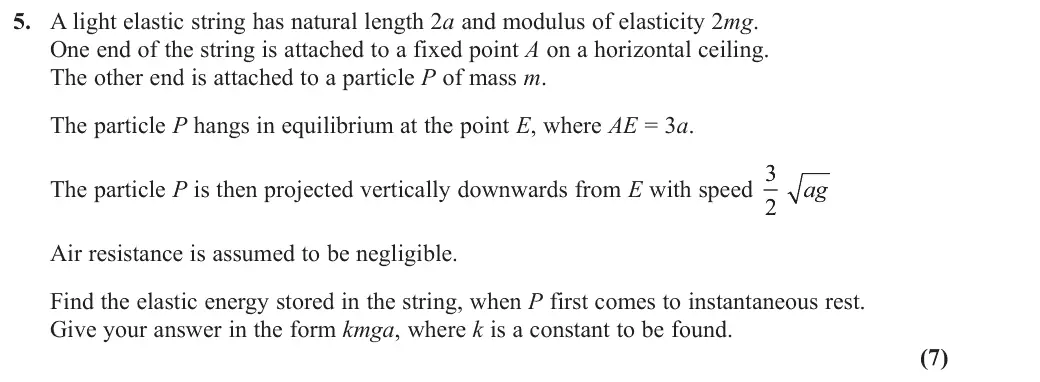
June 2024 · Paper 3C (Further Mechanics 1) · Q57 marks
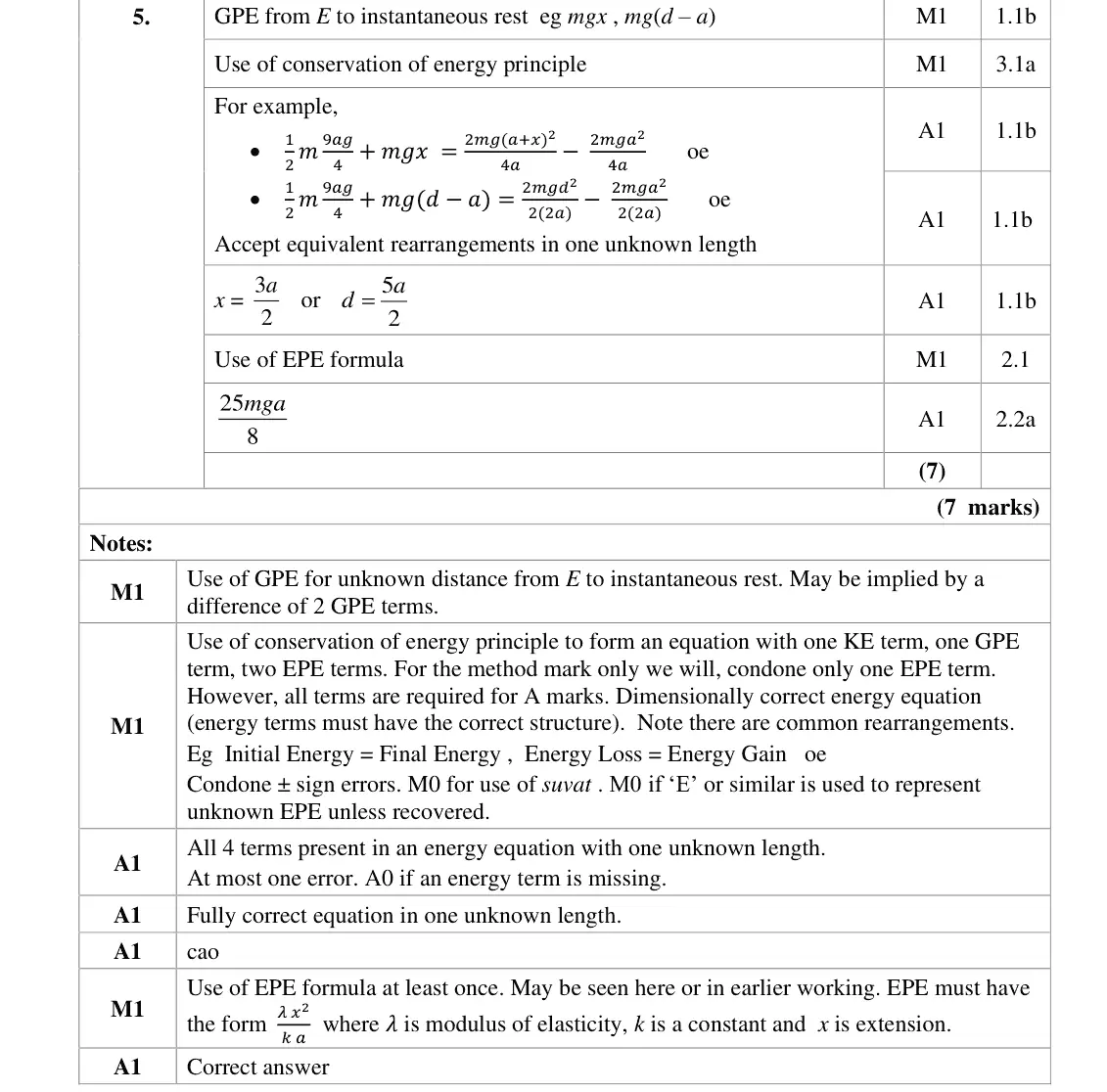
Mark scheme (whole question; this part is marked with the orange bar)
Examiner's comment
This question presented candidates with the first major challenge of the paper and whilst there were many excellent solutions, scores of 0 and 1 were not unusual. The unstructured format of this elasticity problem, and lack of a given answer, discriminated between the grades. Well-prepared candidates successfully produced a clear diagram and presented energy terms in a table. This approach would usually avoid mistakes with lengths and prompted the need for two EPE terms. The conservation of energy could lead quickly to a quadratic equation in an unknown length and the required EPE could follow in just a few lines of working. When solving problems involving EPE, it is recommended to state the EPE formula and show the full substitution. When candidates form an energy equation with simplified expressions, it can be very difficult for examiners to determine a valid method if mistakes are made. Errors in energy terms were frequent amongst weaker candidates; the initial EPE was often forgotten, the GPE term was not in terms of an unknown distance and the final EPE was written as ‘E’ rather than in terms of an unknown length. Despite the difficulties, candidates were reluctant to leave this question, instead producing pages of incorrect and crossed out working. Many appeared determined to complete the problem showing a confidence in the topic despite being unable to identify their error. This 7-mark question gave two pages for working and some re-attempts were made elsewhere in the script rather than on additional sheets. A surprising number did so without any direction to the examiner. Examiners must be alerted to working elsewhere in the script otherwise candidates are at risk of losing marks.
Key points from the mark scheme and examiner's report
a diagram and a table of energy terms avoided length errors
many scored 0 or 1
June 2023 · Paper 3C (Further Mechanics 1) · Q4(a)4 marks
Mark scheme (whole question; this part is marked with the orange bar)
Examiner's comment
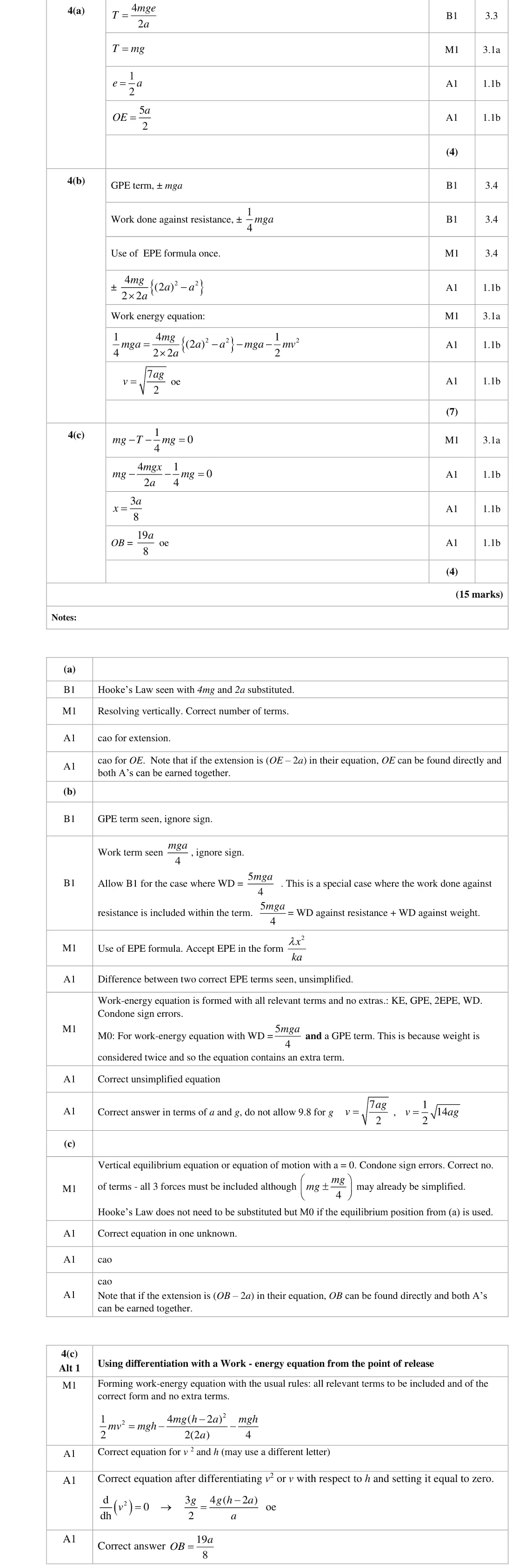
Although many candidates achieved full marks on this question, the later parts proved to be discriminatory. Part (a) was accessible to most candidates with high achievers generally earning all available marks. Hooke’s Law was used correctly and combined with a vertical equilibrium equation to find the extension and then the required length. Many candidates appeared to be well-rehearsed applying the work-energy principle and made good progress in (b). It was pleasing to see that solutions were well-organised with terms often
Key points from the mark scheme and examiner's report
June 2023 · Paper 3C (Further Mechanics 1) · Q4(b)7 marks
Mark scheme (whole question; this part is marked with the orange bar)
Examiner's comment
Although many candidates achieved full marks on this question, the later parts proved to be discriminatory. good progress in (b). It was pleasing to see that solutions were well-organised with terms often listed in a table which made awarding interim marks much easier when a correct answer was not reached. Candidates using a table rarely made sign errors which was a common cause of lost marks. Another common error was using 2a in the EPE denominator, which was the natural length, rather than 2(2a). Although less frequent, some candidates missed an EPE term or the work term. This mistake was almost exclusively amongst candidates who formed an energy equation straight away rather than listing in a table.
Key points from the mark scheme and examiner's report
work-energy from extension 2a to a: EPE lost (4mg/4a)((2a)² − a²) = mga + ¼mga + ½mv²: v = √(7ag/2)
using 2a not 2(2a) in the EPE denominator
tabulating terms avoided sign errors
June 2023 · Paper 3C (Further Mechanics 1) · Q4(c)4 marks
Mark scheme (whole question; this part is marked with the orange bar)
Examiner's comment
Although many candidates achieved full marks on this question, the later parts proved to be discriminatory. In part (c), many knew that the maximum speed occurred at the equilibrium point. However, only the high achievers realised that there was a new equilibrium point and understood how to use this successfully. Out of those who did set up a new equilibrium equation, a sign error was often made on the resistance term. There were a very small number of attempts using a work- energy equation with differentiation to find the maximum speed. Although it is a longer method, it was impressive to see the application of calculus almost always used fluently and accurately.
Key points from the mark scheme and examiner's report
max speed where acceleration is zero, a NEW equilibrium with resistance: mg − 4mgx/2a − ¼mg = 0, x = 3a/8, OB = 19a/8
most used the old equilibrium point
sign error on resistance
June 2022 · Paper 3C (Further Mechanics 1) · Q7(a)5 marks
Mark scheme (whole question; this part is marked with the orange bar)
Examiner's comment
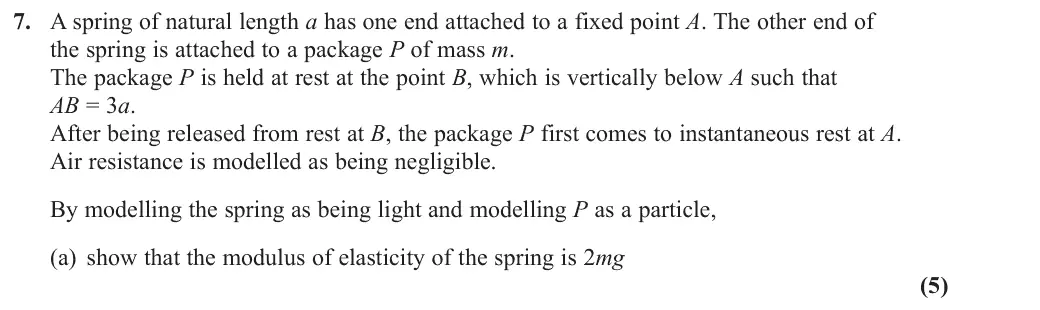
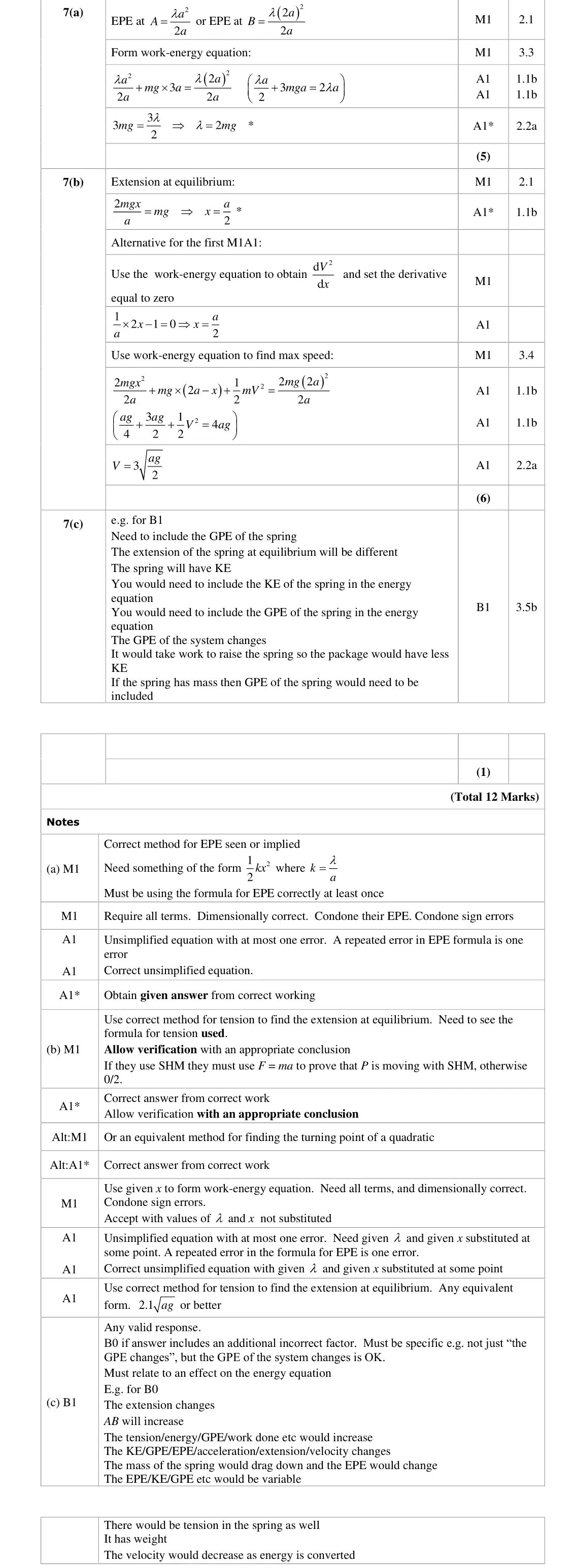
(a) Most candidates scored the first mark for a correct expression for the EPE at A or B. Combining the relevant terms for a correct energy equation was more challenging. Some candidates possibly did not appreciate that they were dealing with a spring and not a string and so two EPE terms were required. Those candidates who did set up the correct equation were able to deduce the given result.
Key points from the mark scheme and examiner's report
two EPE terms (it is a spring): λa²/2a + 3mga = λ(2a)²/2a, λ = 2mg
treating it as a string (one EPE term) was the common error
June 2022 · Paper 3C (Further Mechanics 1) · Q7(b)6 marks
Mark scheme (whole question; this part is marked with the orange bar)
Examiner's comment
(b) Almost all candidates gained the first two marks by recognising that the package is at its maximum speed when in equilibrium. Several responses then omitted a term when forming their equation for conservation of mechanical energy, or made slips in substituting and simplifying their equations.
Key points from the mark scheme and examiner's report
(i) max speed at equilibrium: 2mgx/a = mg, x = a/2
(ii) energy equation from release to x = a/2: V = 3√(ag/2)
terms missed or slips in simplifying
June 2022 · Paper 3C (Further Mechanics 1) · Q7(c)1 mark
Mark scheme (whole question; this part is marked with the orange bar)
Examiner's comment
(c) Valid responses were rare. The question asks candidates to say how the weight of the spring would affect their energy equation. Only a few responses mentioned the GPE or KE of the spring and how it would affect the energy equation. It was more common to read vague statements about there being more energy, the extension changing or the speed changing. These candidates were not referencing the equation or considering how the equation would change.
Key points from the mark scheme and examiner's report
must say how the energy equation changes, e.g. include the spring's KE or GPE
vague "more energy" or "extension changes" answers scored 0
valid responses rare
Nov 2021 · Paper 3C (Further Mechanics 1) · Q6(a)5 marks
Mark scheme (whole question; this part is marked with the orange bar)
Examiner's comment
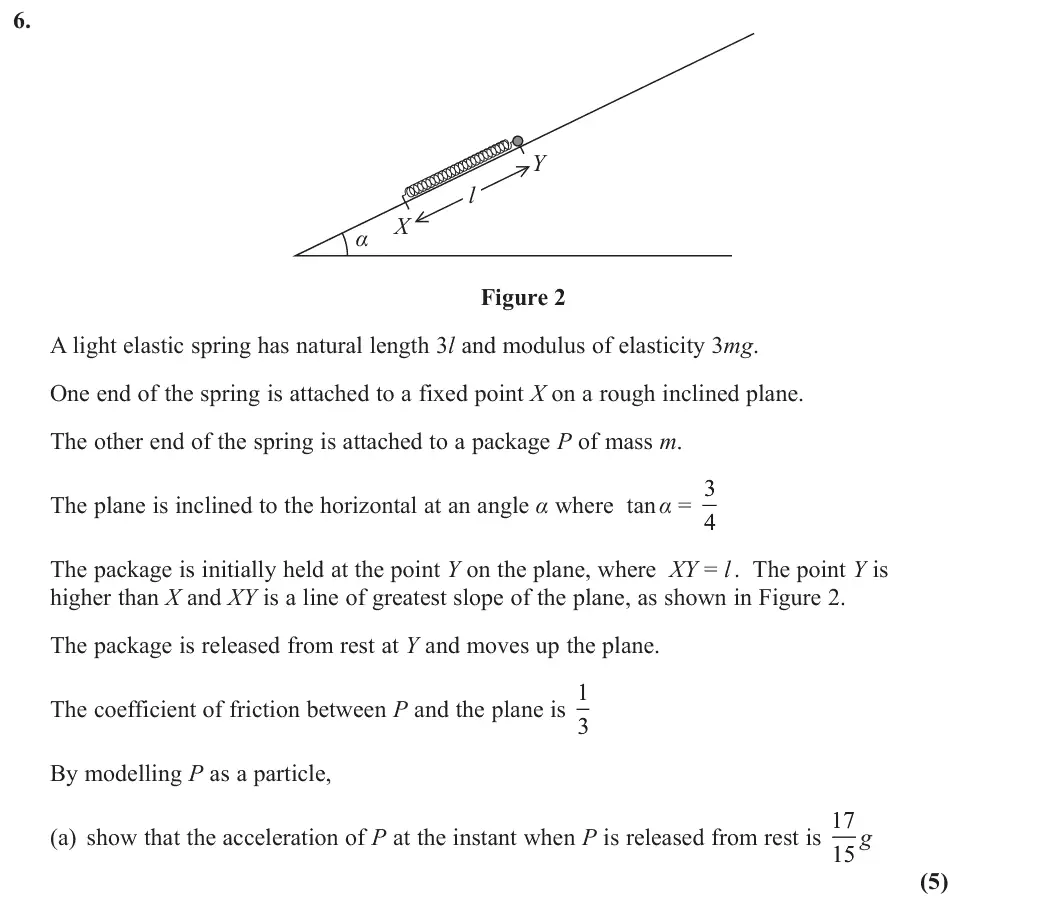
(a) The given answer enabled most students to complete this successfully. The candidates were confident using Hooke’s Law together with an equation of motion and the given answer helped them to find their errors.
Key points from the mark scheme and examiner's report
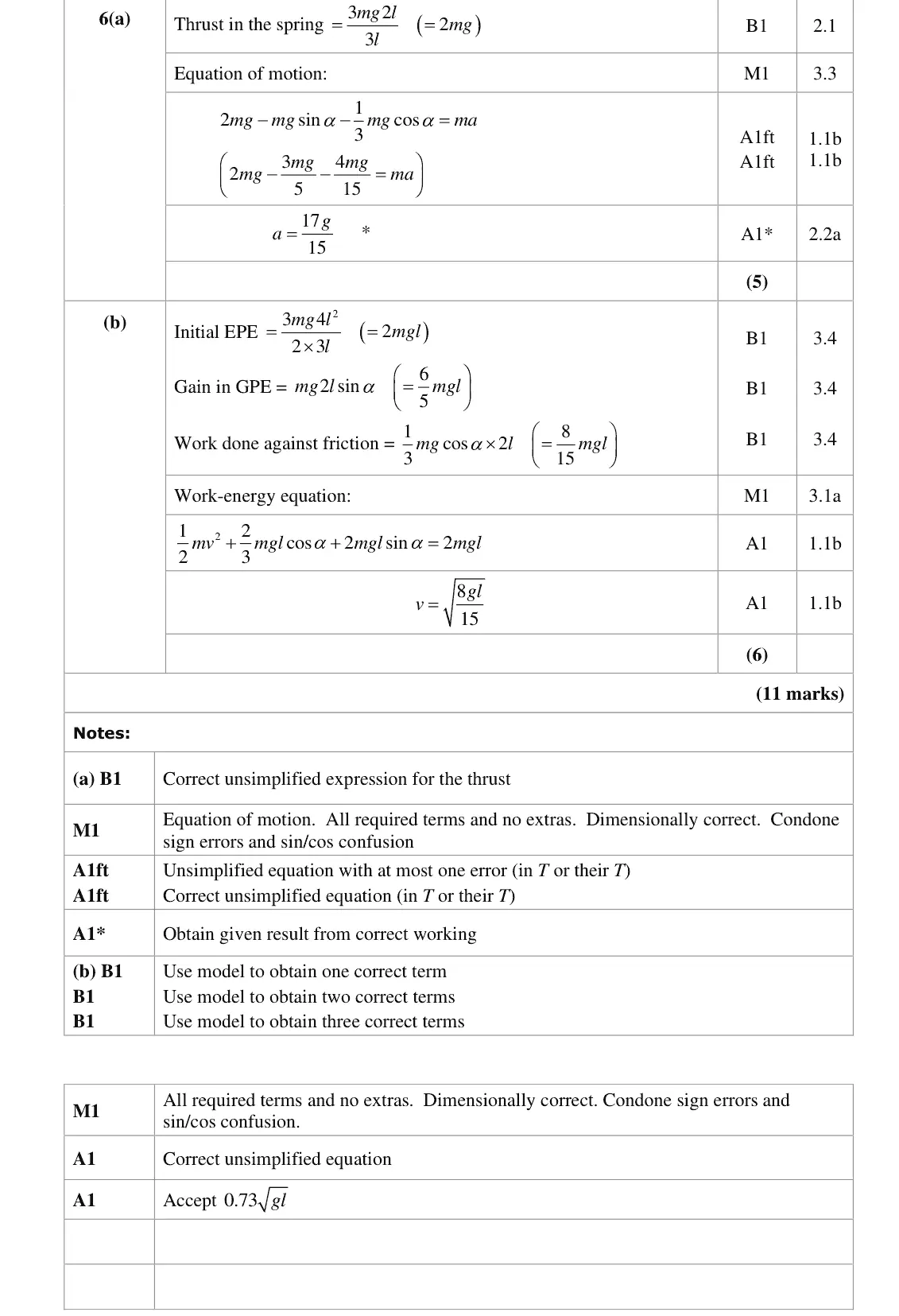
compression 2l so thrust 3mg(2l)/(3l) = 2mg
2mg − mg sin α − (1/3)mg cos α = ma gives 17g/15
given answer helped candidates find errors
Nov 2021 · Paper 3C (Further Mechanics 1) · Q6(b)6 marks
Mark scheme (whole question; this part is marked with the orange bar)
Examiner's comment
(b) The better candidates recognised the need to form a work-energy equation. The mark scheme helped those candidates who found some, but not all, of the required terms. The most common error was to omit the work done against friction.
Key points from the mark scheme and examiner's report
EPE 2mgl = KE + GPE (6/5)mgl + WD against friction (8/15)mgl over 2l
v = √(8gl/15)
omitting friction was the commonest error
Oct 2020 · Paper 3C (Further Mechanics 1) · Q6(a)6 marks
Mark scheme (whole question; this part is marked with the orange bar)
Examiner's comment
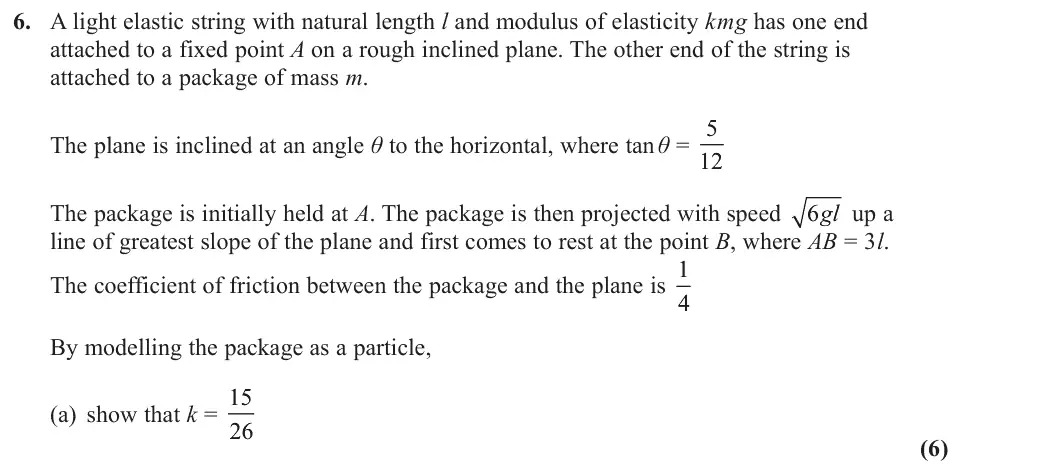
(a) Most candidates recognised the need to use conservation of energy. The work done against friction and the gain in gravitational potential energy were usually found correctly. Some candidates used 3l for the extension of the string, rather than 2l, to calculate the elastic potential energy in the string when the package is at B. There were many fully correct work-energy equations. The most common errors were sign errors, incorrect elastic potential energy and double counting the work done against the weight and the gain in gravitational potential energy. There were some attempts to solve the problem using suvat formulae, which are not appropriate here because the acceleration is not constant.
Key points from the mark scheme and examiner's report
Oct 2020 · Paper 3C (Further Mechanics 1) · Q6(b)5 marks
Mark scheme (whole question; this part is marked with the orange bar)
Examiner's comment
(b) Most candidates were able to use the given value for k to find an expression for the tension in the spring when the package is at B. Most errors were due to using an incorrect value for the extension in the string, terms missing from the equation of motion or sign errors in the equation.
Key points from the mark scheme and examiner's report
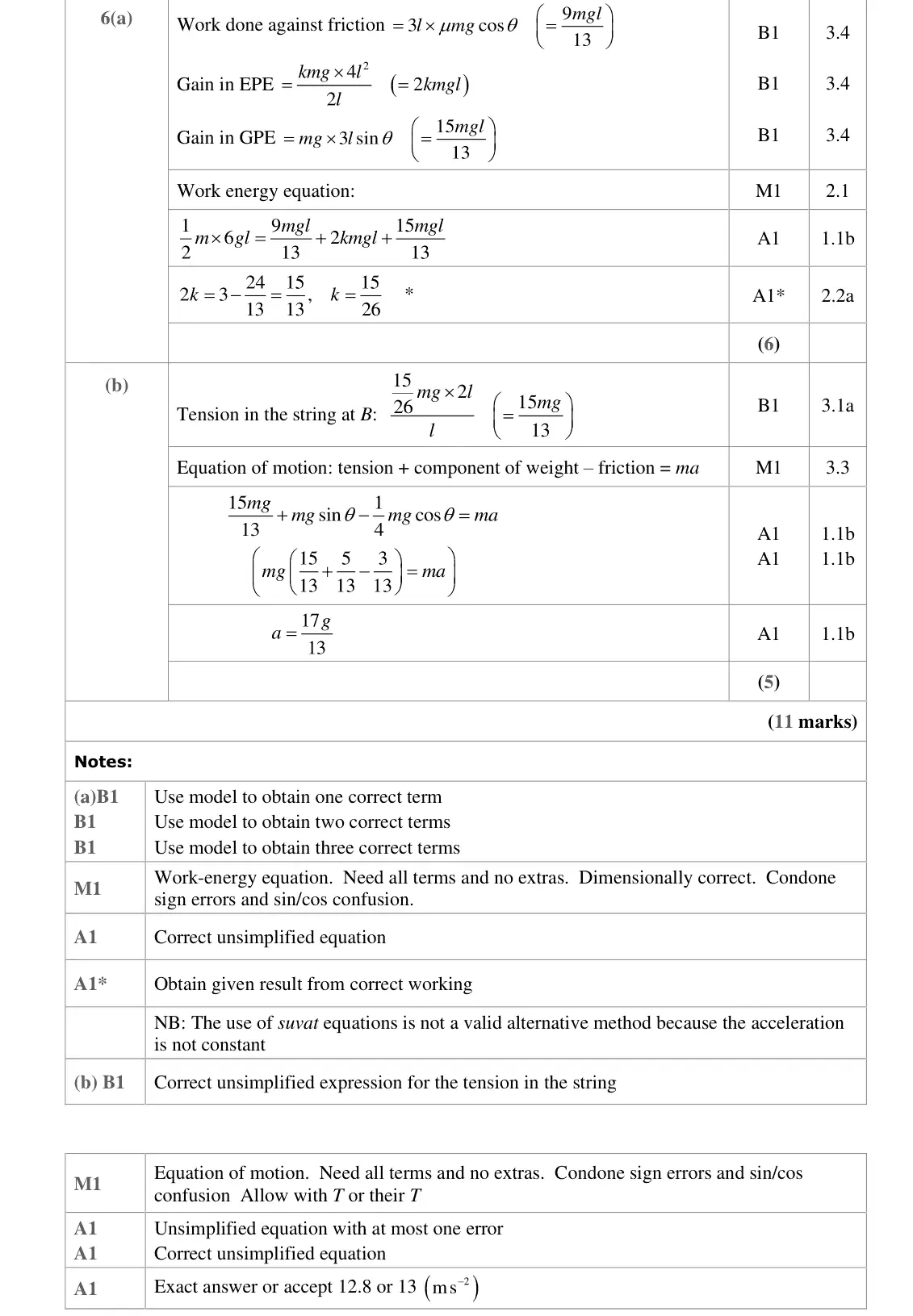
T = 15mg/13 at B
T + mg sin θ − ¼mg cos θ = ma (friction now acts up the plane): a = 17g/13
wrong extension or missing terms
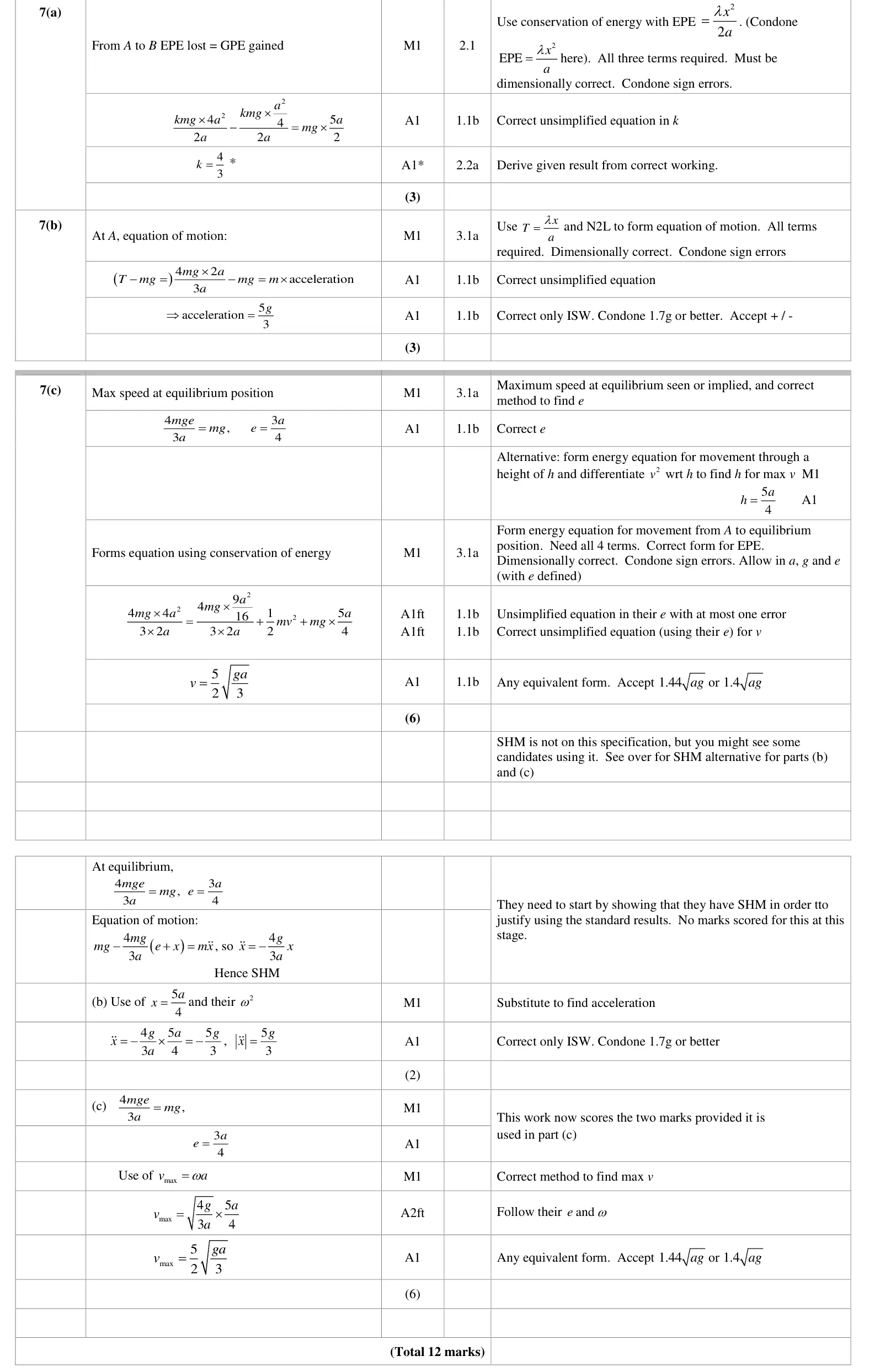
June 2019 · Paper 3C (Further Mechanics 1) · Q7(a)3 marks
Mark scheme (whole question; this part is marked with the orange bar)
Examiner's comment
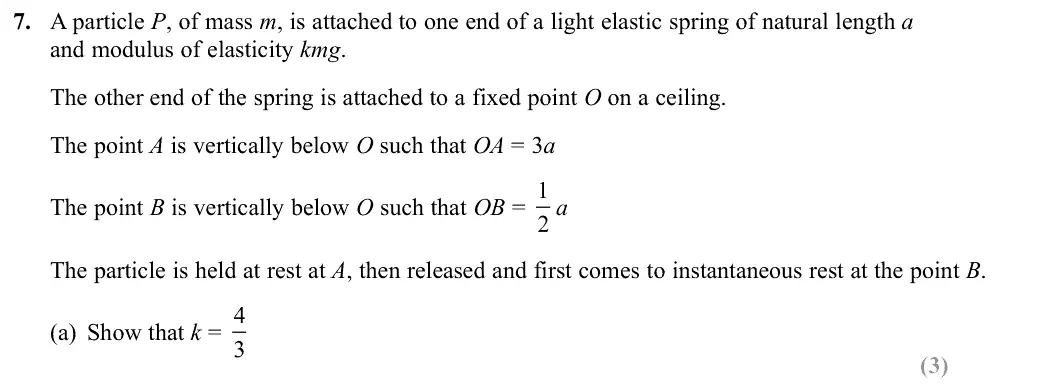
(a) The majority of candidates recognised that they needed to use energy. Many candidates initially treated the spring as a string and omitted the second term for elastic potential energy, but the given answer helped then to realise their error and correct their working. A significant minority of candidates showed completely correct working but in terms of λ and never used kmg, so they did not reach the given conclusion
Key points from the mark scheme and examiner's report
EPE lost = GPE gained with EPE = λx²/2a at both A (x = 2a) and B (compression a/2)
treating the spring as a string omits the second EPE term
leaving λ and never using kmg
June 2019 · Paper 3C (Further Mechanics 1) · Q7(b)3 marks
Mark scheme (whole question; this part is marked with the orange bar)
Examiner's comment
(b) Many candidates formed the equation of motion correctly and obtained the correct answer. The question makes it clear that an answer in terms of g is required, but some candidates combined this with a decimal rather than working in fractions. The most common error was to forget to include the weight in the equation of motion – an answer of 8 7 g was quite common.
Key points from the mark scheme and examiner's report
T = λx/a with λ = 4mg/3, x = 2a: T − mg = ma, acceleration 5g/3
forgetting the weight gives 8g/3
answer in terms of g, not decimals
June 2019 · Paper 3C (Further Mechanics 1) · Q7(c)6 marks
Mark scheme (whole question; this part is marked with the orange bar)
Examiner's comment
(c) This question proved to be quite challenging. A significant number of candidates did not realise that the greatest speed would be at the equilibrium position, with many assuming that it was when the spring was at its natural length, or with an extension of . 2 a For those candidates who were looking in the right place, it was common for one of the EPE terms to be missing in the energy equation. Some candidates had sign errors in their equations, and for some the algebra and fractions proved too much. A significant number of candidates did reach the correct final answer, many giving the answer in an exact form. A few candidates started by forming the energy equation at a general point and proceeded to rearrange this to give an equation for 2v in terms of x and then differentiate this and solve to find the value of x to minimise v; this was sometimes successful.
Key points from the mark scheme and examiner's report
max speed at equilibrium, extension 3a/4
energy equation from A to there: v = (5/2)√(ga/3)
many assumed max speed at natural length
missing an EPE term common
Find an Edexcel Further Maths tutor
Stuck on this? Book a trial lesson with our Further Maths tutor.