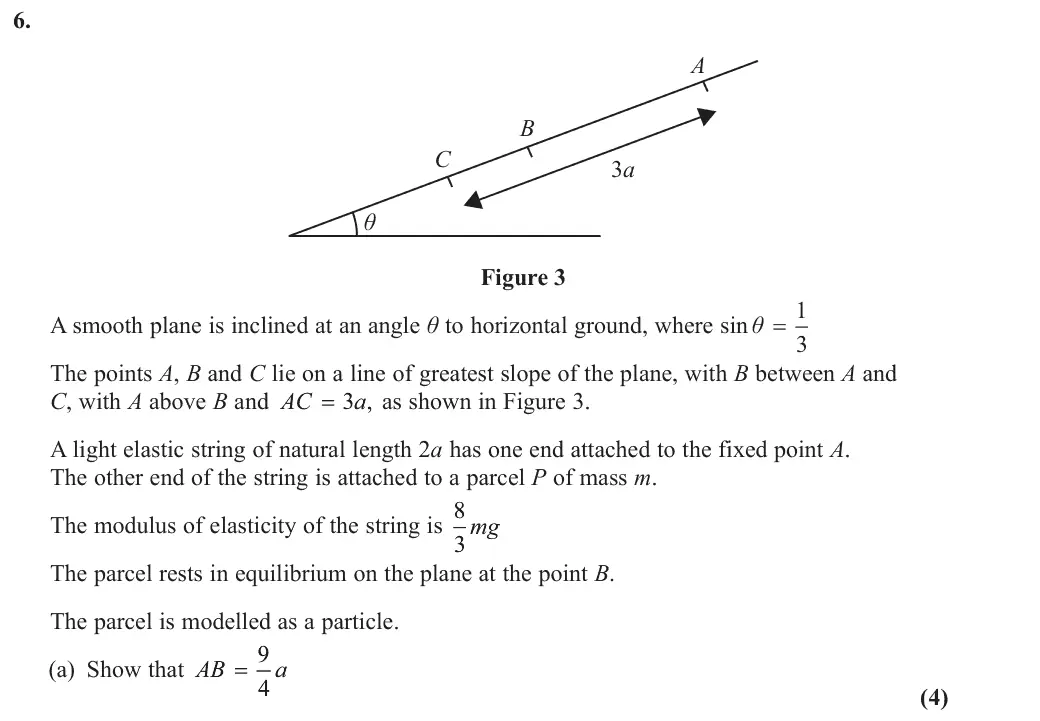
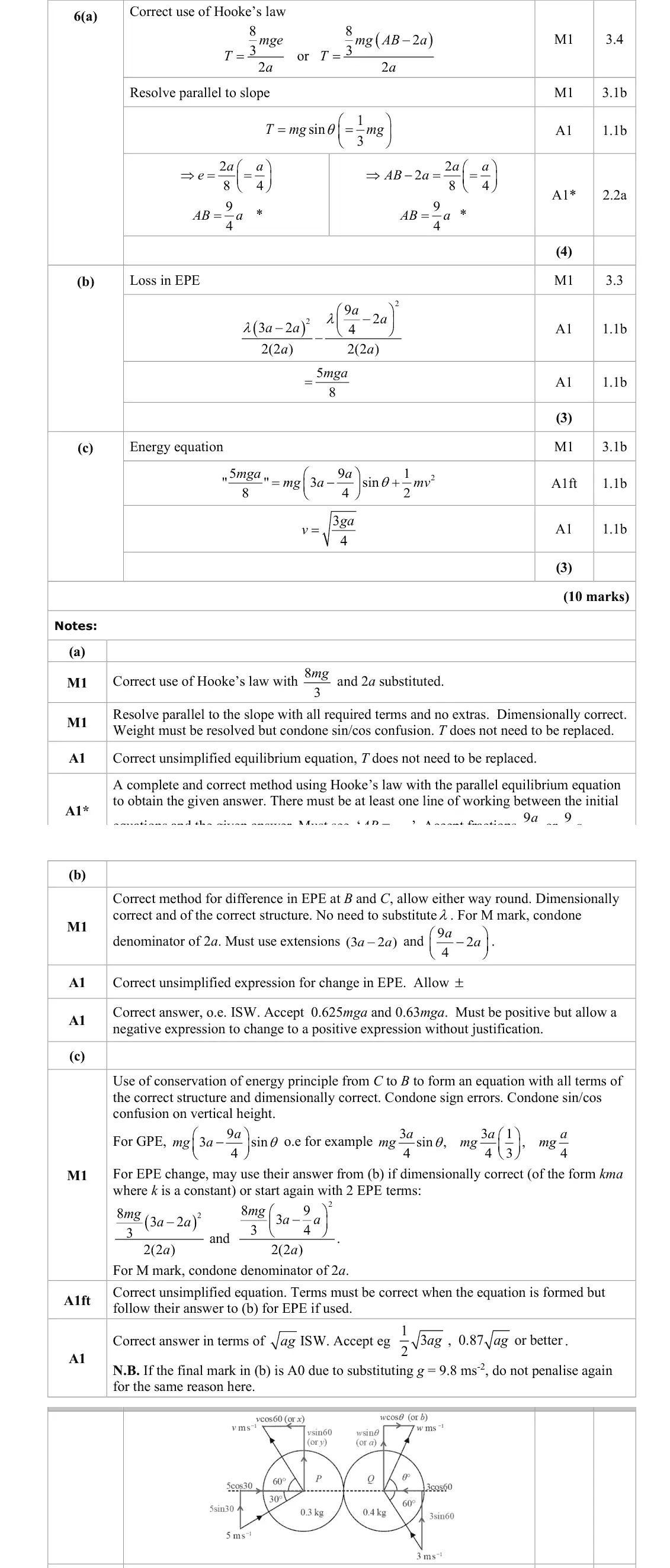
June 2025 · Paper 3C (Further Mechanics 1) · Q6(a)4 marks
Mark scheme (whole question; this part is marked with the orange bar)
Examiner's comment
The ‘show that’ part (a) provided a very accessible opening to this question on elastic potential energy and the work-energy principle. Learners at all levels demonstrated their confidence and accuracy in part (a) using Hooke’s Law with success to obtain the given answer. Some learners produced an incomplete solution and were not awarded the final mark for not giving an expression for AB as required in the question. The scaffolding provided by part (a) supported a strong entry into part (b) with many fully correct solutions. When using the EPE formula, it was more common to see errors in the extension than the denominator, using the distance from A instead of the extension. The final part of the question required use of the principle of conservation of mechanical energy
Key points from the mark scheme and examiner's report
T = (8mg/3)e/(2a) = mg sin θ = mg/3, e = a/4, AB = 9a/4
must end with an expression for AB
June 2023 · Paper 3C (Further Mechanics 1) · Q4(a)4 marks
Mark scheme (whole question; this part is marked with the orange bar)
Examiner's comment
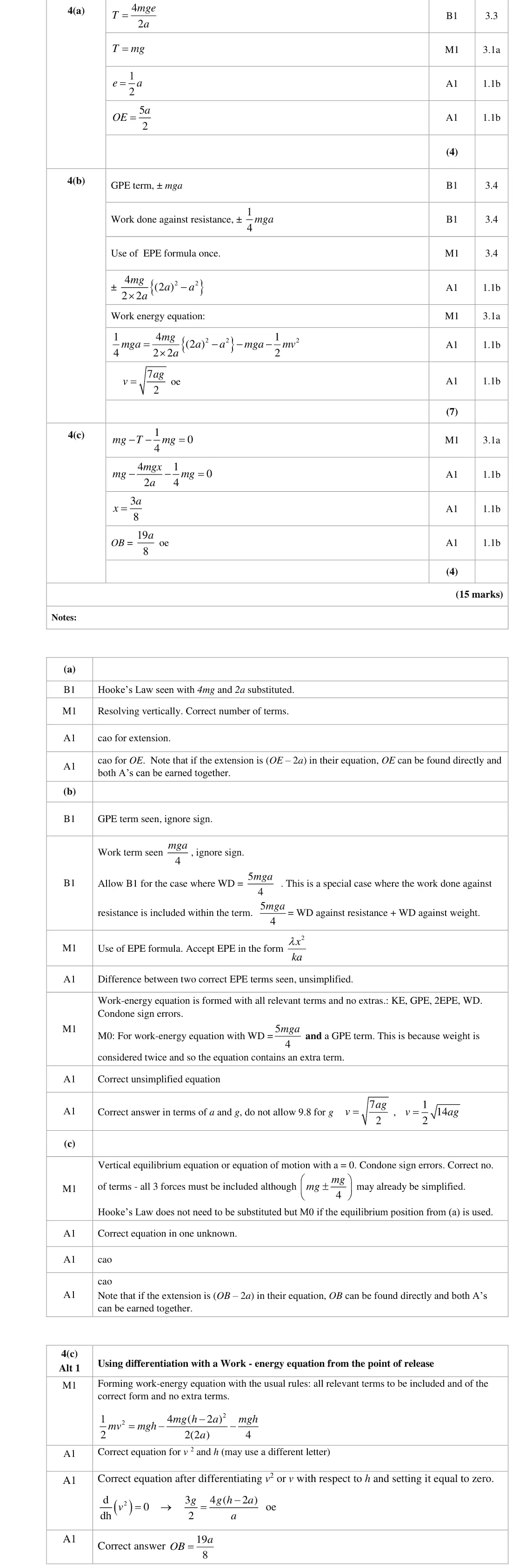
Although many candidates achieved full marks on this question, the later parts proved to be discriminatory. Part (a) was accessible to most candidates with high achievers generally earning all available marks. Hooke’s Law was used correctly and combined with a vertical equilibrium equation to find the extension and then the required length. Many candidates appeared to be well-rehearsed applying the work-energy principle and made good progress in (b). It was pleasing to see that solutions were well-organised with terms often
Key points from the mark scheme and examiner's report
June 2023 · Paper 3C (Further Mechanics 1) · Q4(c)4 marks
Mark scheme (whole question; this part is marked with the orange bar)
Examiner's comment
Although many candidates achieved full marks on this question, the later parts proved to be discriminatory. In part (c), many knew that the maximum speed occurred at the equilibrium point. However, only the high achievers realised that there was a new equilibrium point and understood how to use this successfully. Out of those who did set up a new equilibrium equation, a sign error was often made on the resistance term. There were a very small number of attempts using a work- energy equation with differentiation to find the maximum speed. Although it is a longer method, it was impressive to see the application of calculus almost always used fluently and accurately.
Key points from the mark scheme and examiner's report
max speed where acceleration is zero, a NEW equilibrium with resistance: mg − 4mgx/2a − ¼mg = 0, x = 3a/8, OB = 19a/8
most used the old equilibrium point
sign error on resistance
June 2023 · Paper 4C (Further Mechanics 2) · Q8(a)3 marks
Mark scheme (whole question; this part is marked with the orange bar)
Examiner's comment
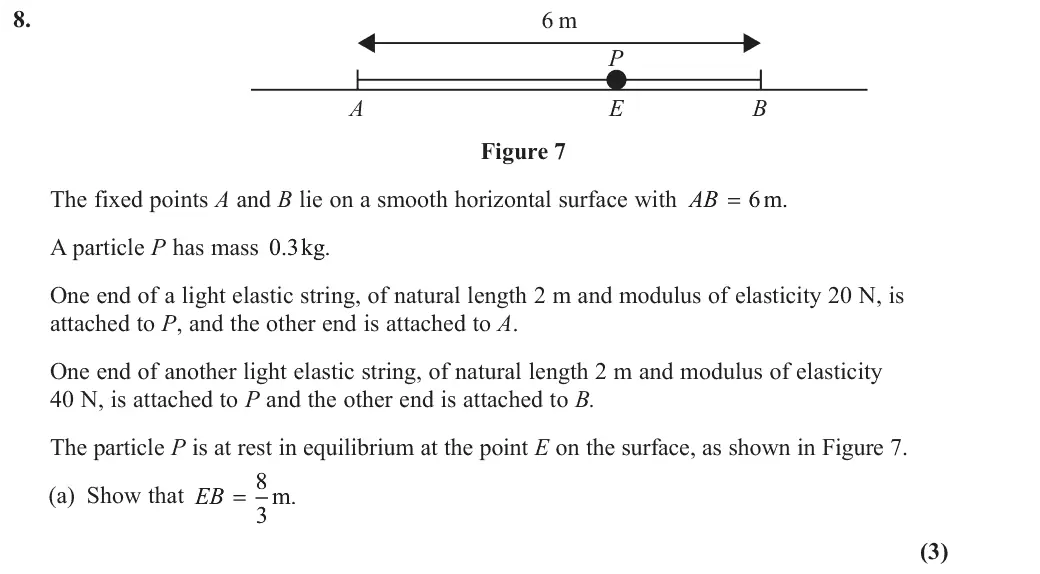
(a) The majority of candidates succeeded in using Hooke’s Law to form an equation in one unknown and went on to obtain the given answer correctly. Those who used “e” for an extension in (a) (rather than “x”) and subsequently used this in (b) were more likely to succeed, as were those who drew clear diagrams.
Key points from the mark scheme and examiner's report
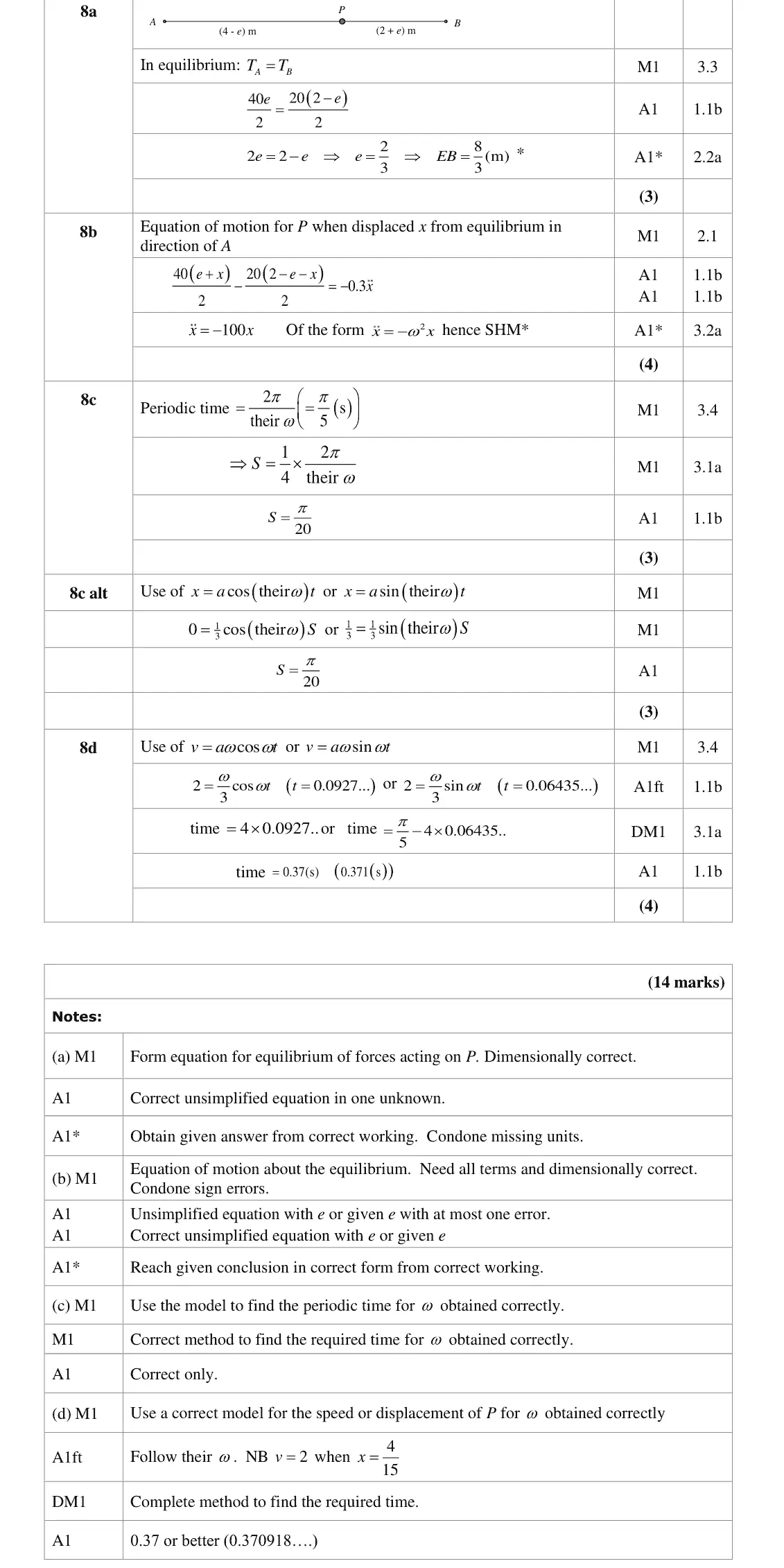
equilibrium: equal tensions 40e/2 = 20(2 − e)/2 with e the extension of string PB, e = 2/3, EB = 8/3 m
a clear diagram helps
June 2023 · Paper 4C (Further Mechanics 2) · Q8(b)4 marks
Mark scheme (whole question; this part is marked with the orange bar)
Examiner's comment
(b) For many candidates, this was a straightforward application of a standard and familiar method. A minority did not appear to be working about the equilibrium position, their extensions did not add up to 2, and only a few defined the x that they used in their equation. Some candidates did not confirm that their equation was indeed for SHM and some claimed SHM for an equation that clearly did not fit the pattern.
Key points from the mark scheme and examiner's report
displace x from E towards A: 40(e + x)/2 − 20(2 − e − x)/2 = −0.3ẍ, ẍ = −100x
define x, work about E, and state SHM
June 2022 · Paper 3C (Further Mechanics 1) · Q7(b)6 marks
Mark scheme (whole question; this part is marked with the orange bar)
Examiner's comment
(b) Almost all candidates gained the first two marks by recognising that the package is at its maximum speed when in equilibrium. Several responses then omitted a term when forming their equation for conservation of mechanical energy, or made slips in substituting and simplifying their equations.
Key points from the mark scheme and examiner's report
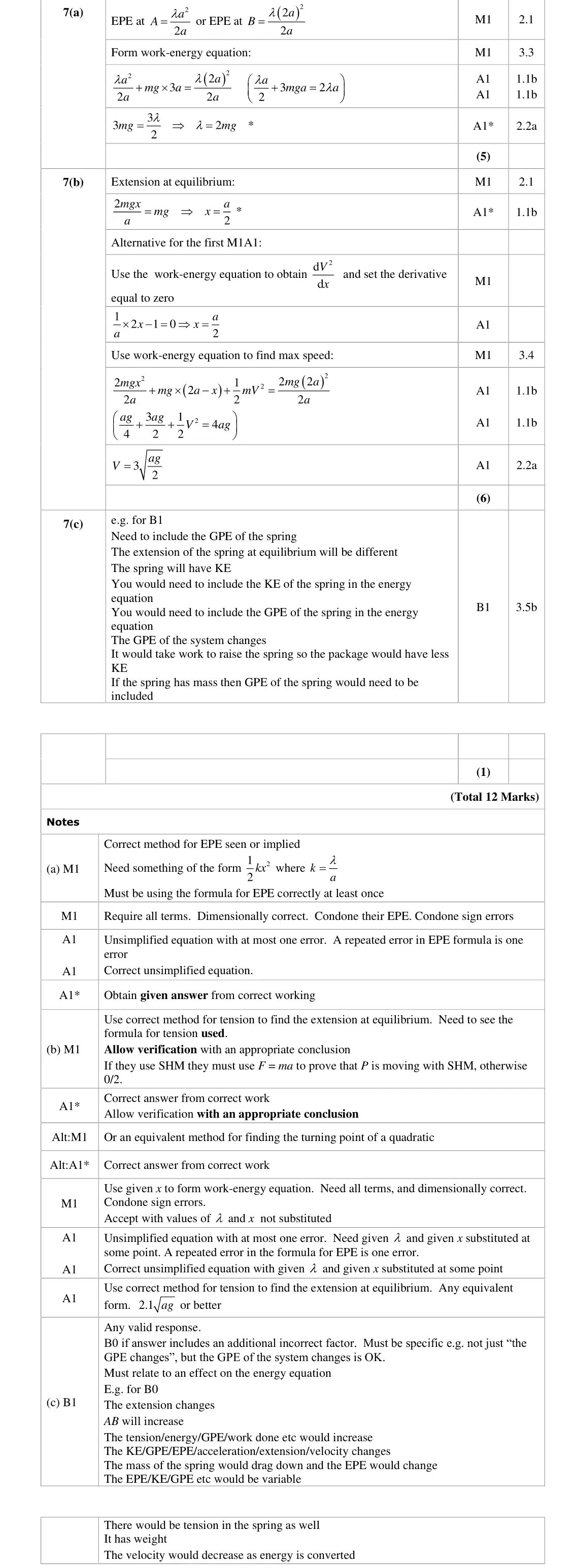
(i) max speed at equilibrium: 2mgx/a = mg, x = a/2
(ii) energy equation from release to x = a/2: V = 3√(ag/2)
terms missed or slips in simplifying
June 2022 · Paper 4C (Further Mechanics 2) · Q8(a)6 marks
Mark scheme (whole question; this part is marked with the orange bar)
Examiner's comment
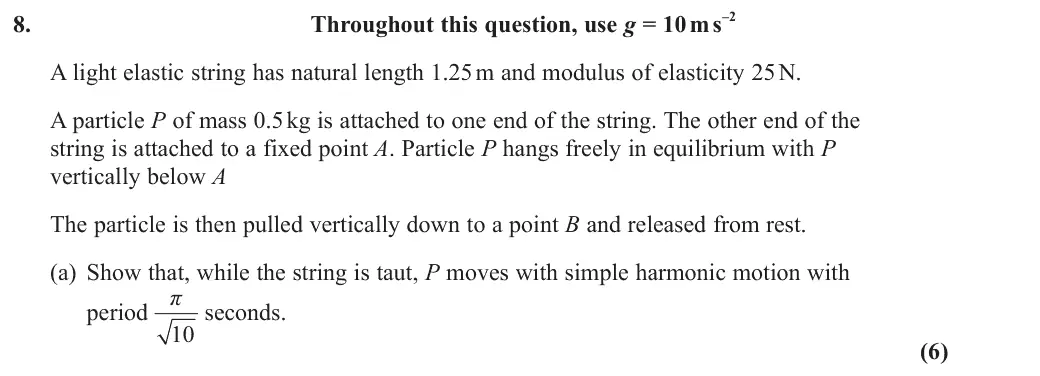
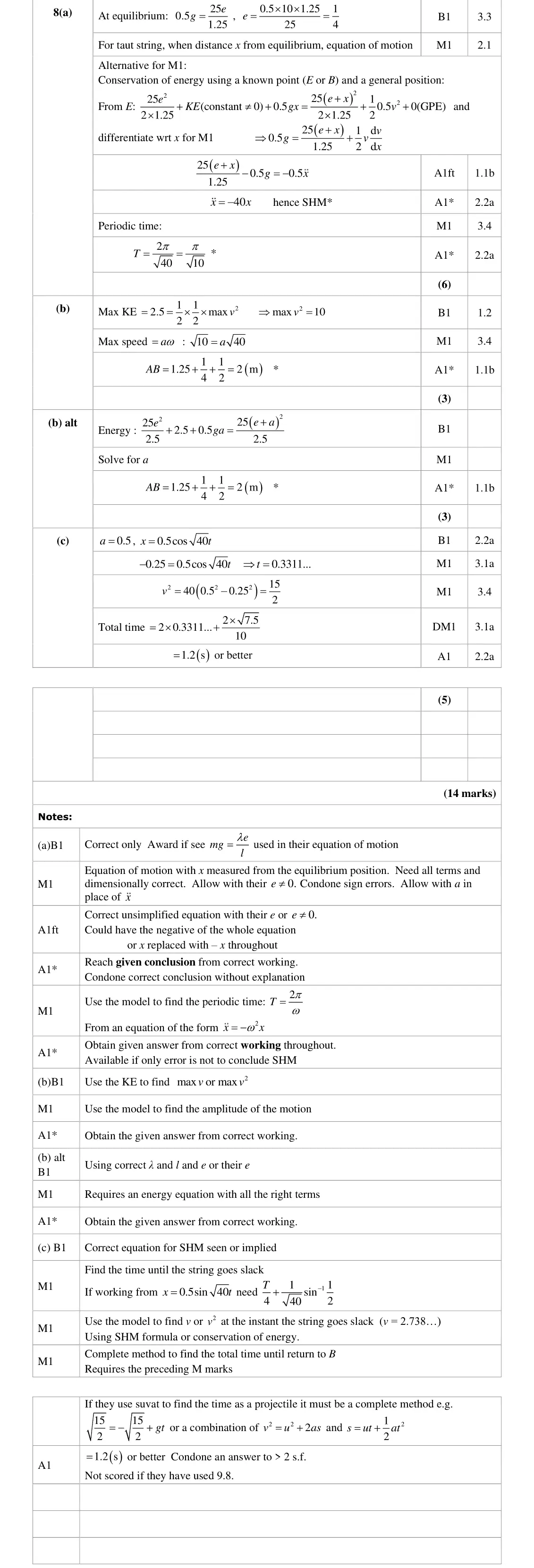
(a) Many candidates adopted a systematic approach by finding the equilibrium position and setting up an equation of motion for the particle when displaced from this position. Although it is a fairly common scenario, some candidates made little real progress and, although most knew an equation of motion was required, they failed either to find the equilibrium extension or to define an appropriate x. Sometimes an equation was left in terms of a (rather than 𝑥̈ ) with the direction of a not defined. Those who reached an equation of the form for SHM did not always state an appropriate conclusion. Virtually all candidates knew and applied the formula for the period.
Key points from the mark scheme and examiner's report
Nov 2021 · Paper 3C (Further Mechanics 1) · Q6(a)5 marks
Mark scheme (whole question; this part is marked with the orange bar)
Examiner's comment
(a) The given answer enabled most students to complete this successfully. The candidates were confident using Hooke’s Law together with an equation of motion and the given answer helped them to find their errors.
Key points from the mark scheme and examiner's report
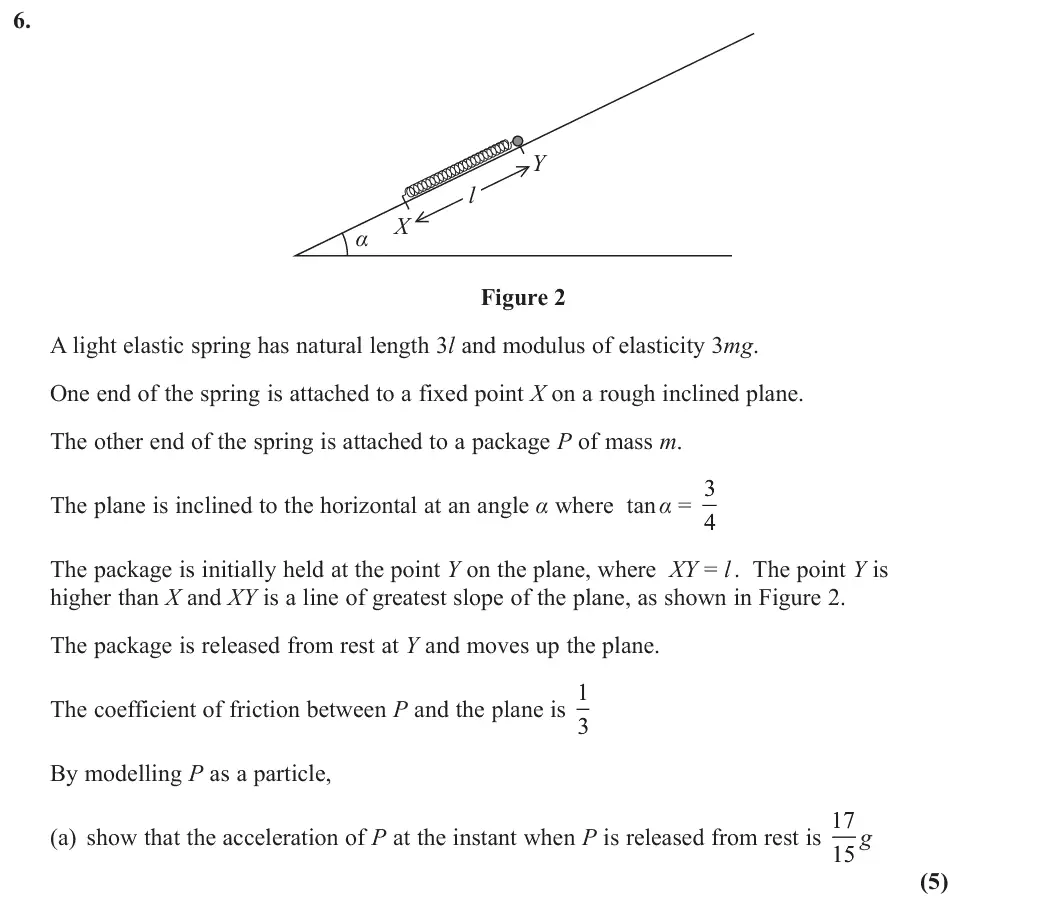
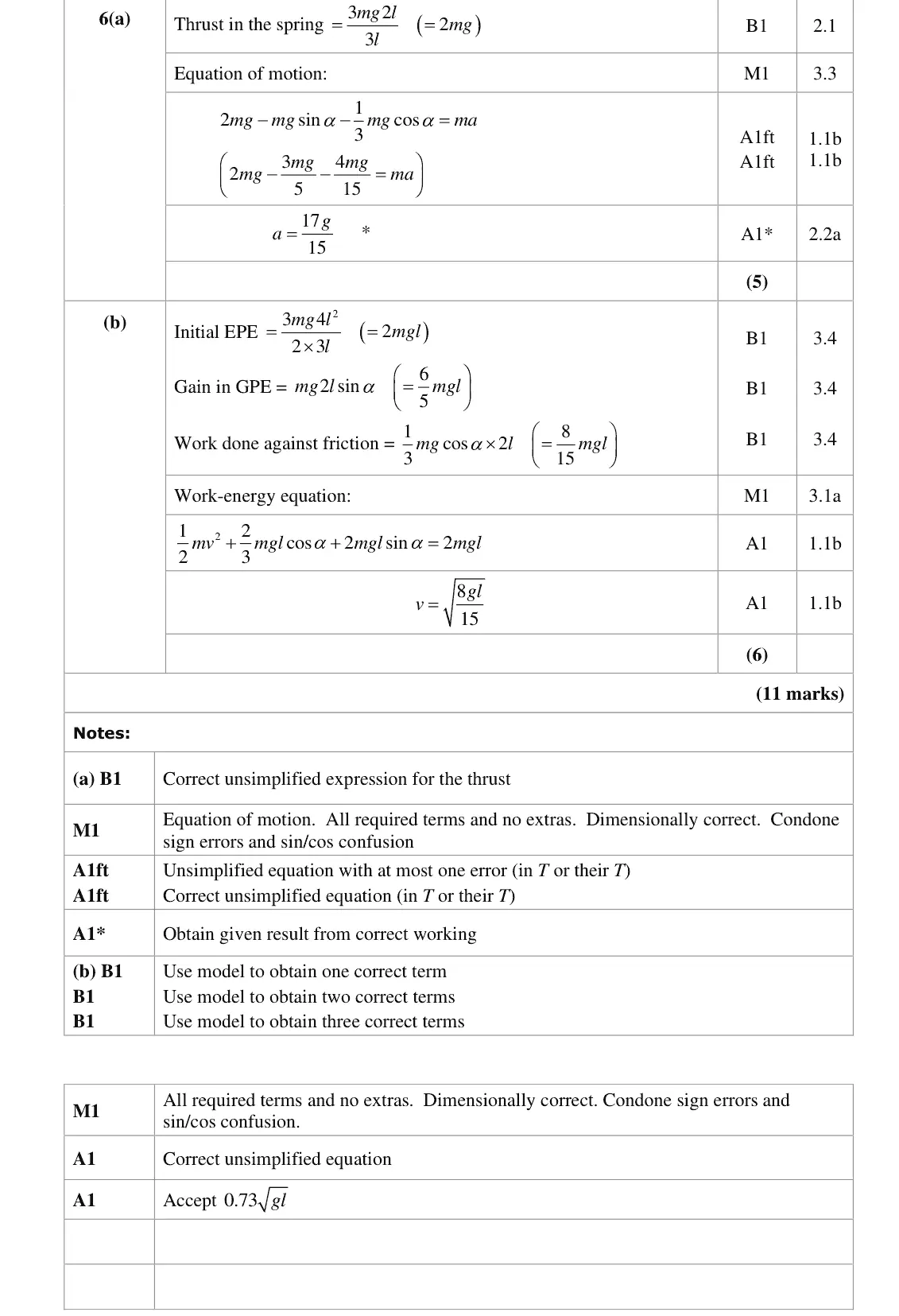
compression 2l so thrust 3mg(2l)/(3l) = 2mg
2mg − mg sin α − (1/3)mg cos α = ma gives 17g/15
given answer helped candidates find errors
Nov 2021 · Paper 4C (Further Mechanics 2) · Q6(a)2 marks
Mark scheme (whole question; this part is marked with the orange bar)
Key points from the mark scheme and examiner's report
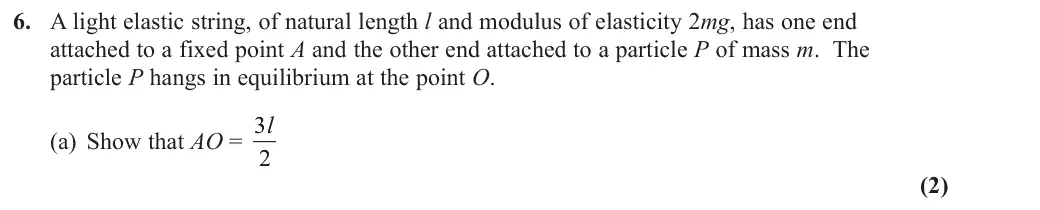
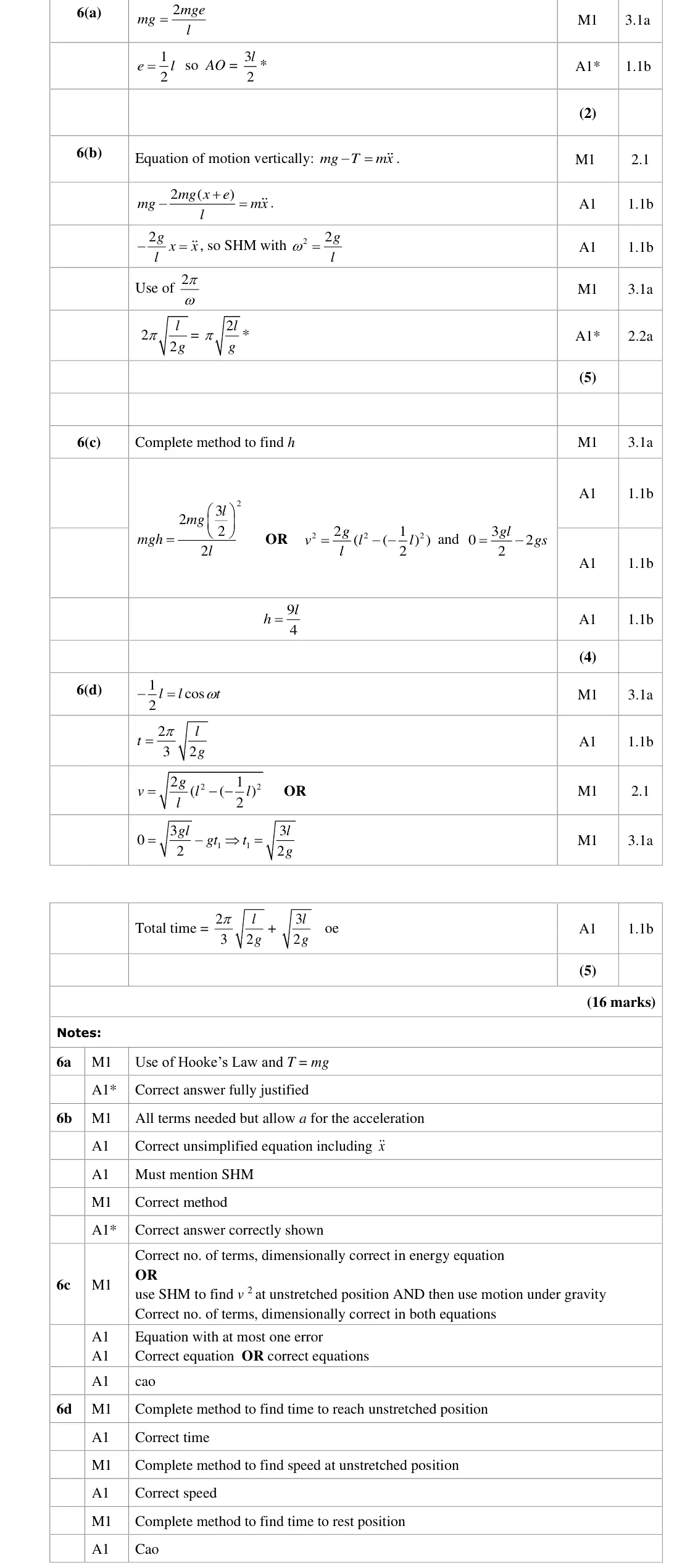
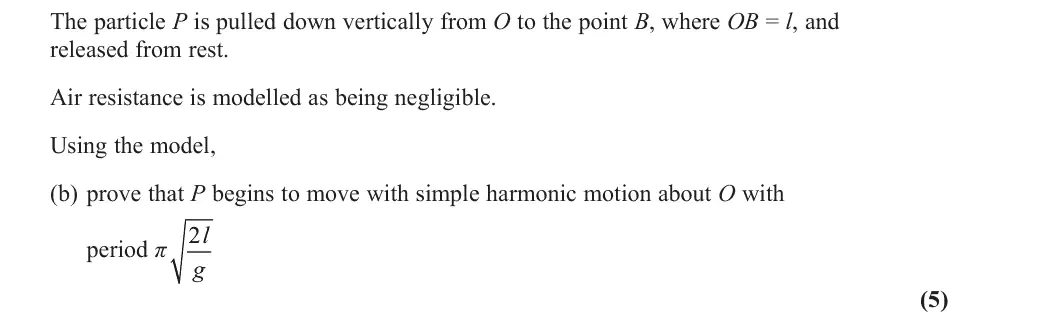
Hooke: mg = 2mge/l, e = l/2, AO = 3l/2
Nov 2021 · Paper 4C (Further Mechanics 2) · Q6(b)5 marks
Mark scheme (whole question; this part is marked with the orange bar)
Key points from the mark scheme and examiner's report
mg − 2mg(x + e)/l = mẍ gives ẍ = −(2g/l)x
must state SHM
period 2π√(l/2g) = π√(2l/g)
Oct 2020 · Paper 3C (Further Mechanics 1) · Q6(b)5 marks
Mark scheme (whole question; this part is marked with the orange bar)
Examiner's comment
(b) Most candidates were able to use the given value for k to find an expression for the tension in the spring when the package is at B. Most errors were due to using an incorrect value for the extension in the string, terms missing from the equation of motion or sign errors in the equation.
Key points from the mark scheme and examiner's report
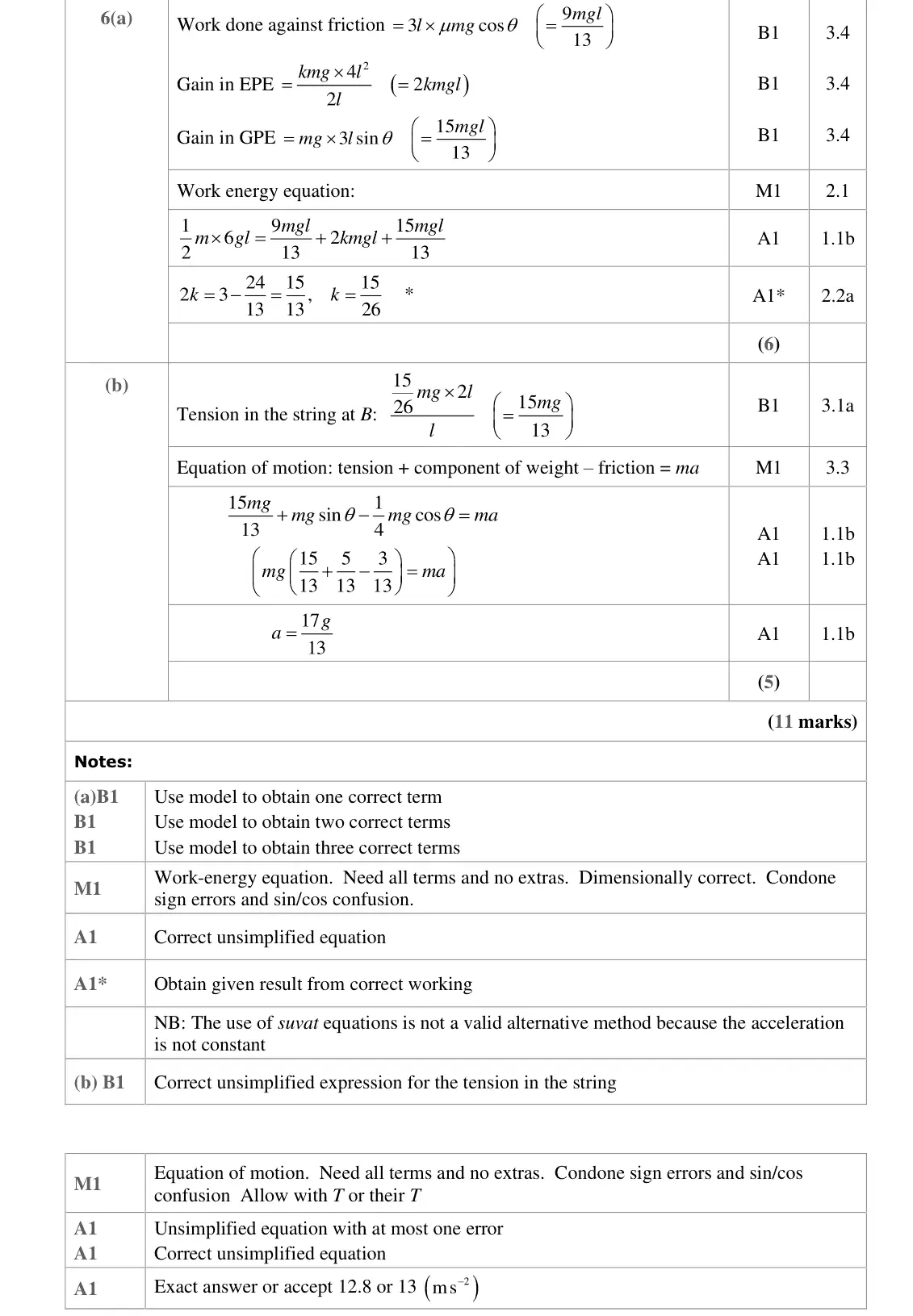
T = 15mg/13 at B
T + mg sin θ − ¼mg cos θ = ma (friction now acts up the plane): a = 17g/13
wrong extension or missing terms
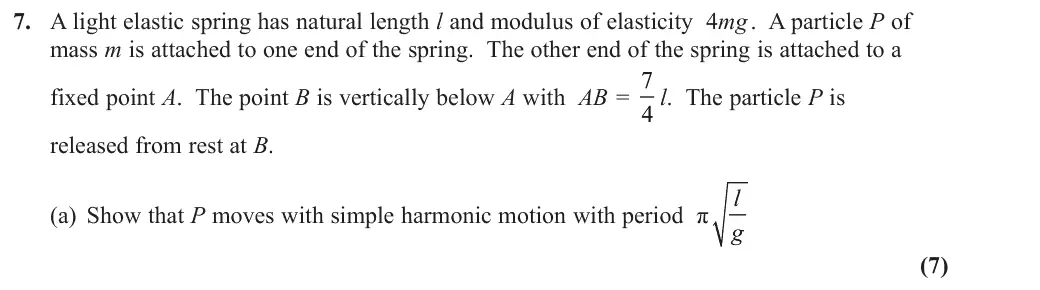
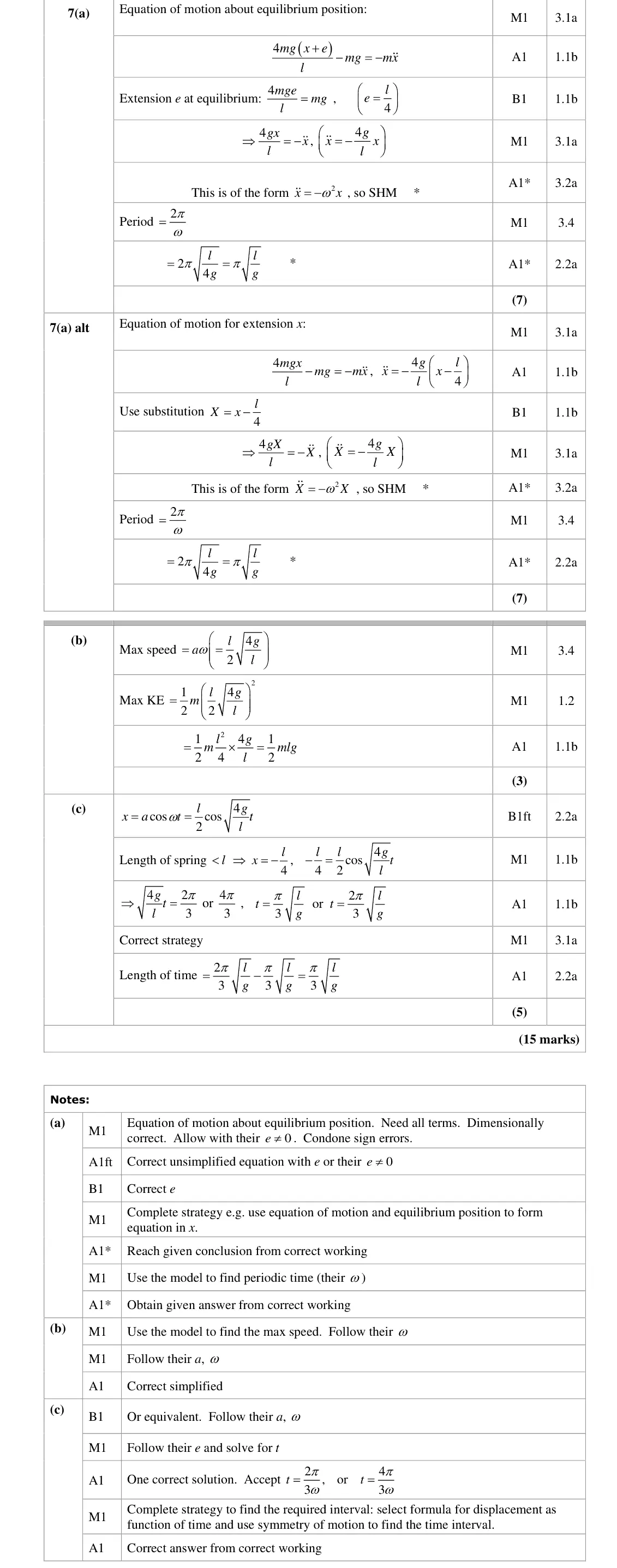
Oct 2020 · Paper 4C (Further Mechanics 2) · Q7(a)7 marks
Mark scheme (whole question; this part is marked with the orange bar)
Key points from the mark scheme and examiner's report
June 2019 · Paper 3C (Further Mechanics 1) · Q7(b)3 marks
Mark scheme (whole question; this part is marked with the orange bar)
Examiner's comment
(b) Many candidates formed the equation of motion correctly and obtained the correct answer. The question makes it clear that an answer in terms of g is required, but some candidates combined this with a decimal rather than working in fractions. The most common error was to forget to include the weight in the equation of motion – an answer of 8 7 g was quite common.
Key points from the mark scheme and examiner's report
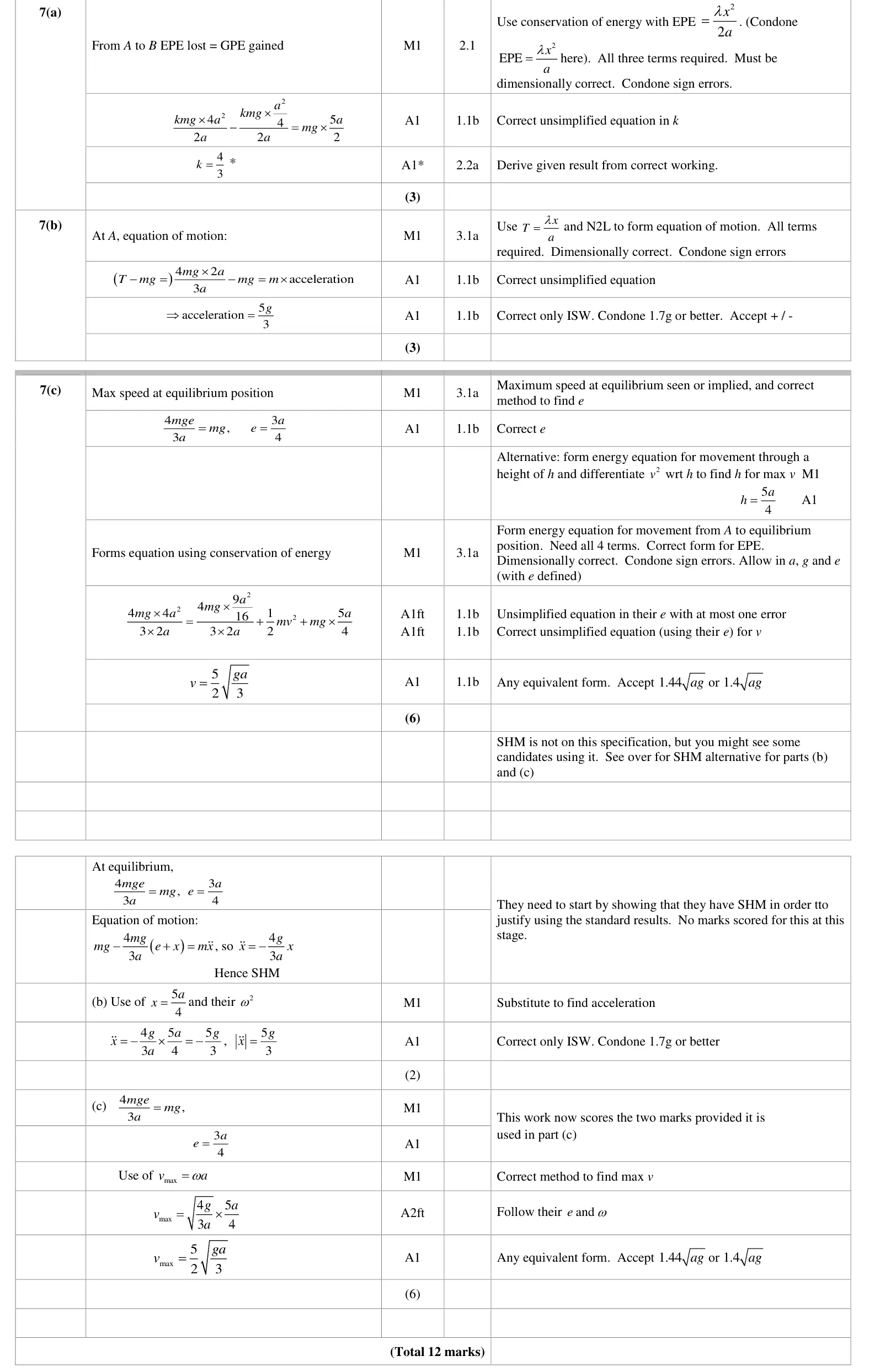
T = λx/a with λ = 4mg/3, x = 2a: T − mg = ma, acceleration 5g/3
forgetting the weight gives 8g/3
answer in terms of g, not decimals
June 2019 · Paper 3C (Further Mechanics 1) · Q7(c)6 marks
Mark scheme (whole question; this part is marked with the orange bar)
Examiner's comment
(c) This question proved to be quite challenging. A significant number of candidates did not realise that the greatest speed would be at the equilibrium position, with many assuming that it was when the spring was at its natural length, or with an extension of . 2 a For those candidates who were looking in the right place, it was common for one of the EPE terms to be missing in the energy equation. Some candidates had sign errors in their equations, and for some the algebra and fractions proved too much. A significant number of candidates did reach the correct final answer, many giving the answer in an exact form. A few candidates started by forming the energy equation at a general point and proceeded to rearrange this to give an equation for 2v in terms of x and then differentiate this and solve to find the value of x to minimise v; this was sometimes successful.
Key points from the mark scheme and examiner's report
max speed at equilibrium, extension 3a/4
energy equation from A to there: v = (5/2)√(ga/3)
many assumed max speed at natural length
missing an EPE term common
June 2019 · Paper 4C (Further Mechanics 2) · Q6(a)5 marks
Mark scheme (whole question; this part is marked with the orange bar)
Examiner's comment
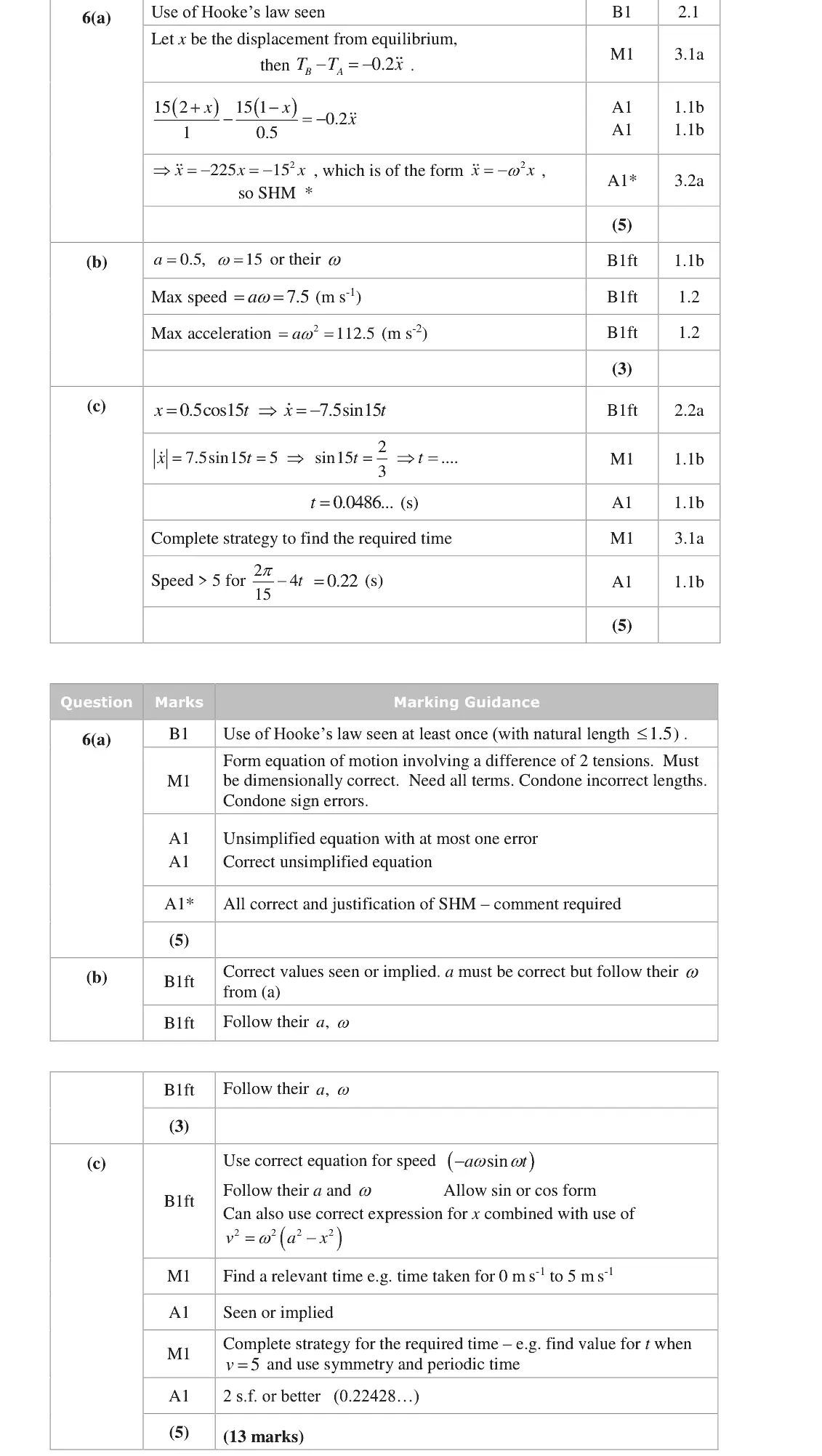
(a) The response to this question was very weak. Most candidates did demonstrate an understanding of Hooke’s law, and they did write down an equation of motion involving the difference between two tensions. However, the majority of candidates had either not understood the information given or they had not read it with sufficient care. Most candidates had the particle attached to the midpoint of the unstretched string, so they were using incorrect lengths throughout their working. Several of those candidates who did reach the correct equation of motion did not explain how they knew that this represented simple harmonic motion.
Key points from the mark scheme and examiner's report
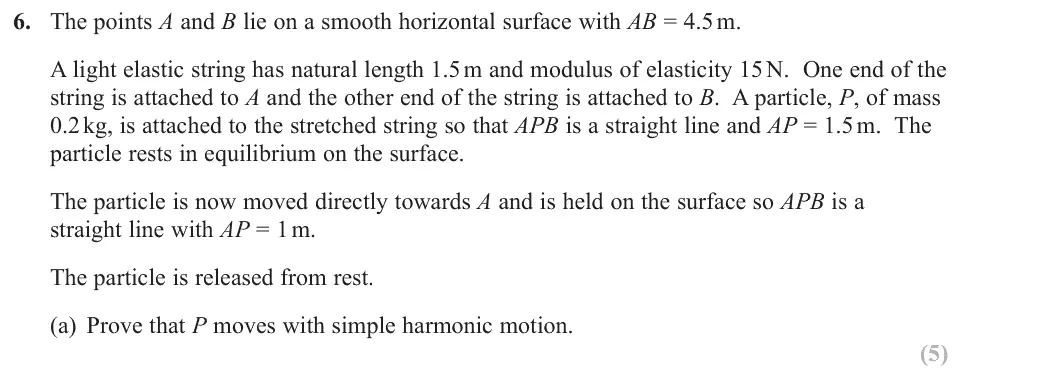
natural lengths of the two sections are 1 m and 0.5 m (not the midpoint)