Nothing is given; the SHM formulae must be learned.
Since 2018
34 question parts, 143 marks
Notes, worked examples and practice for this topic are being written by our tutors. The past-paper questions below are ready now: work each one on paper, then open the mark scheme and the examiner's comment.
Tap a question to zoom it. Mark scheme and examiner's comment open under each question.
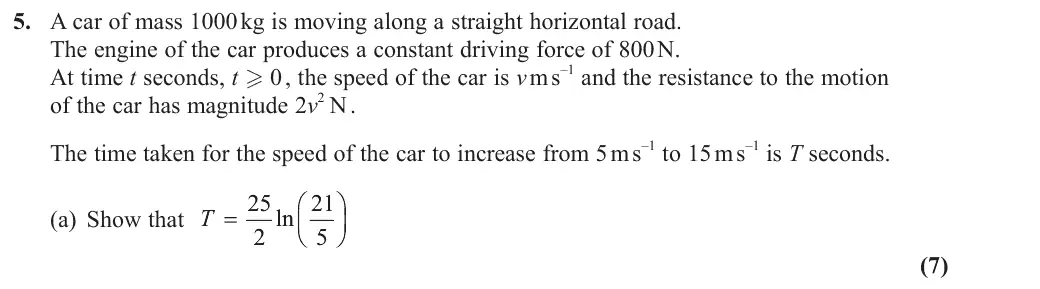
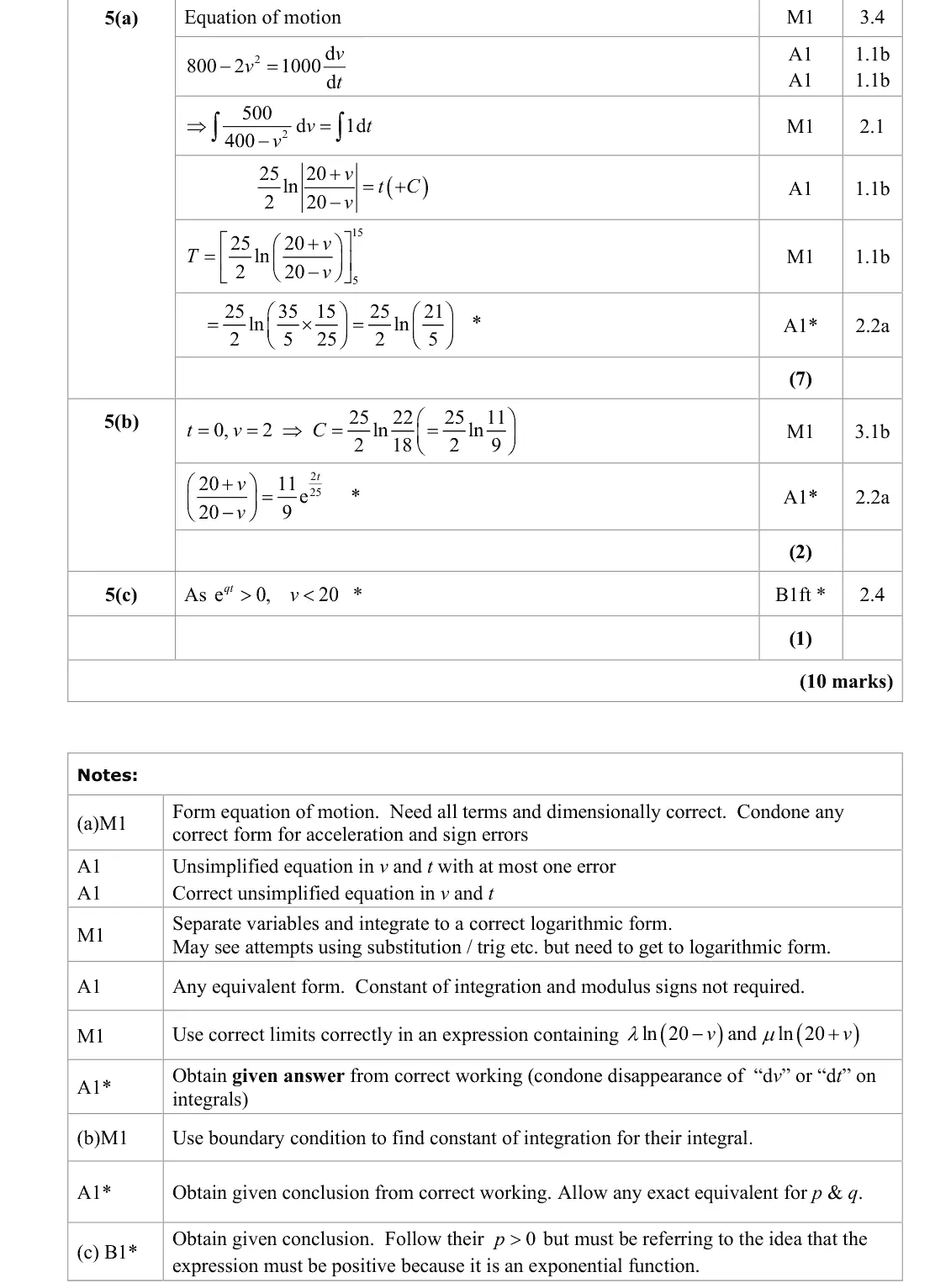
June 2025 · Paper 4C (Further Mechanics 2) · Q5(a)7 marks
Mark scheme (whole question; this part is marked with the orange bar)
Examiner's comment
(a) Most candidates began with an equation of motion. The variation came in the integration: weaker responses struggled to separate or identify the variable to integrate. A significant proportion of candidates used substitution and/or partial fractions rather than quote a standard result, and this was often a successful if longer approach. Some otherwise strong responses made errors with fractions or when manipulating logarithms.
Key points from the mark scheme and examiner's report
1000 dv/dt = 800 − 2v²
separate ∫500/(400 − v²) dv = (25/2)ln((20 + v)/(20 − v))
limits 5 to 15 give T = (25/2)ln(21/5)
partial fractions also fine
log manipulation slips
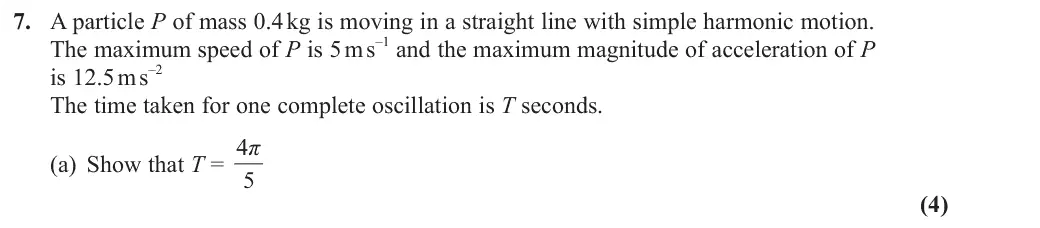
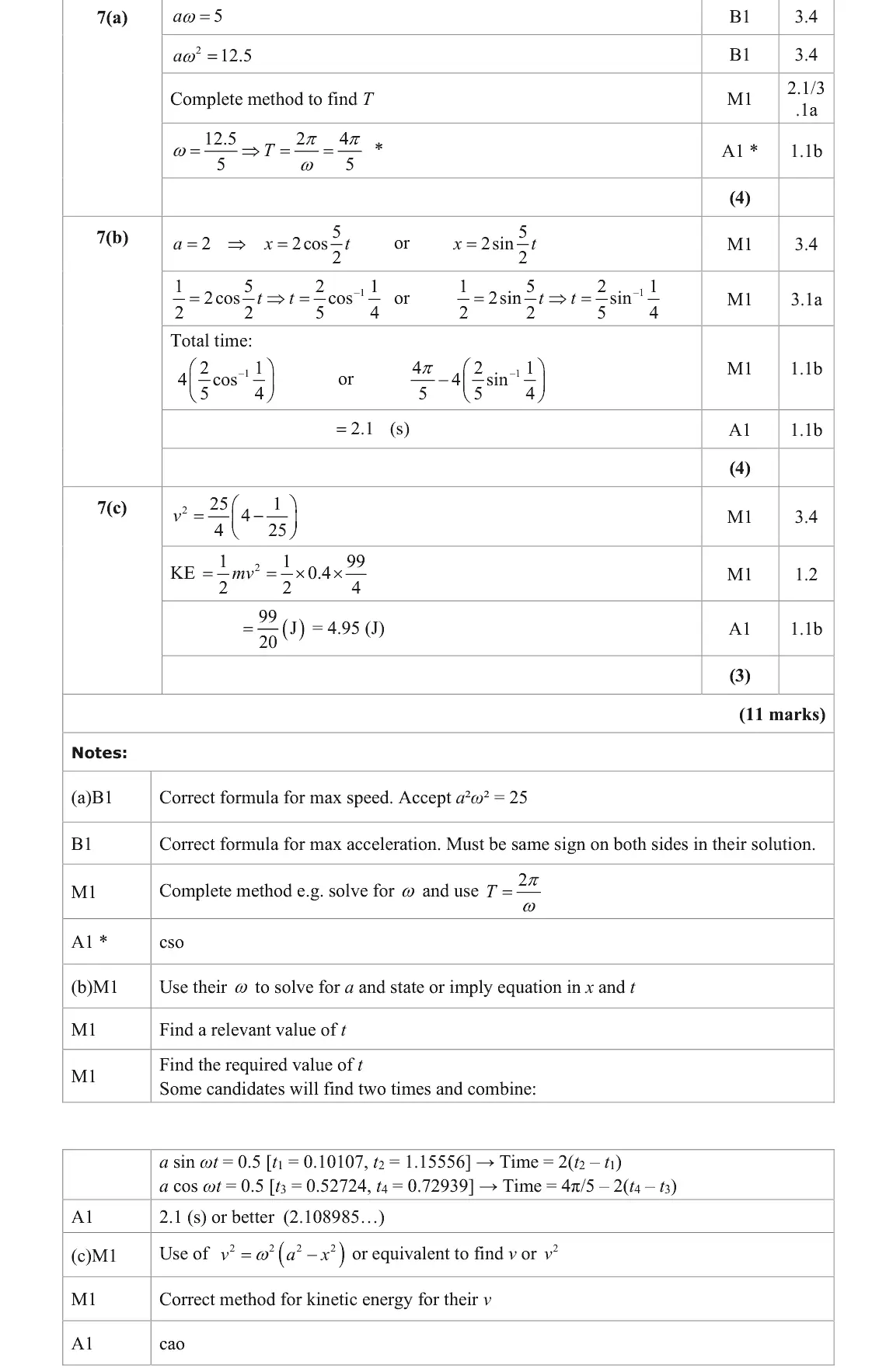
June 2025 · Paper 4C (Further Mechanics 2) · Q7(a)4 marks
Mark scheme (whole question; this part is marked with the orange bar)
Examiner's comment
(a) Those candidates who were familiar with the standard formulae for simple harmonic motion made good progress. Weaker responses either used incorrect formulae or tried to backwards engineer the value of ω from the given period. Several responses did not achieve full credit as they used –aω^2 = 12.5, usually achieving a = –2, without ever justifying the removal of the negative from their solution.
Key points from the mark scheme and examiner's report
aω = 5 and aω² = 12.5 give ω = 2.5, T = 2π/ω = 4π/5
−aω² = 12.5 needs the sign justified
June 2025 · Paper 4C (Further Mechanics 2) · Q7(b)4 marks
Mark scheme (whole question; this part is marked with the orange bar)
Examiner's comment
(b) The Least accurate responses here quoted incorrect formulae and achieved no credit. Better responses were able to achieve at least one of the relevant times, but a good proportion then did nothing with it or combined the times in an inappropriate manner. A small number of responses were given in degrees rather than radians. A good proportion of correct responses illustrated their working with graphs of sinusoidal waves to show their thinking.
Key points from the mark scheme and examiner's report
a = 2
x = 2cos 2.5t = 0.5 gives t = (2/5)arccos(¼)
total time 4t = 2.1 s
radians
a sketch of the curve helps combine times
June 2025 · Paper 4C (Further Mechanics 2) · Q7(c)3 marks
Mark scheme (whole question; this part is marked with the orange bar)
Examiner's comment
(c) A great number of candidates were able to respond to this part, including those who had not successfully completed previous parts. Weaker responses usually involved incorrect substitution or forgetting to square either ω or the velocity. A number of otherwise correct responses made errors in the final calculation step.
Key points from the mark scheme and examiner's report
v² = ω²(a² − x²) = (25/4)(4 − 0.04)
KE = ½(0.4)v² = 99/20 = 4.95 J
remember to square ω
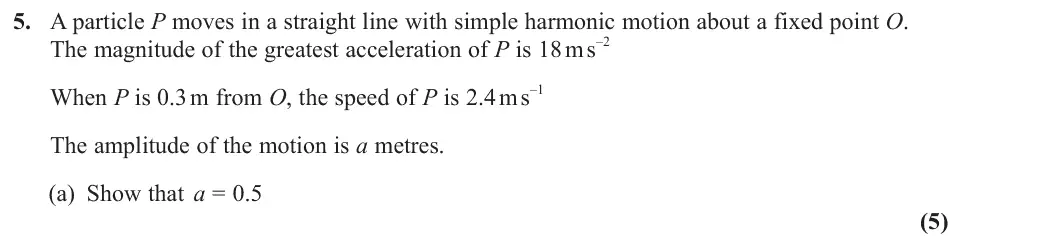
June 2024 · Paper 4C (Further Mechanics 2) · Q5(a)5 marks
Mark scheme (whole question; this part is marked with the orange bar)
Examiner's comment
(a) The majority of candidates made good progress and quickly setup equations using the standard SHM results. However, a number confused their equations and had negative values for ω^2 which resulted in an incorrect quadratic and subsequent negative value for a; this was penalised accordingly. A minority of candidates struggled as they had not learnt the standard formulae and it was only a small number who proceeded correctly from first principles.
Key points from the mark scheme and examiner's report
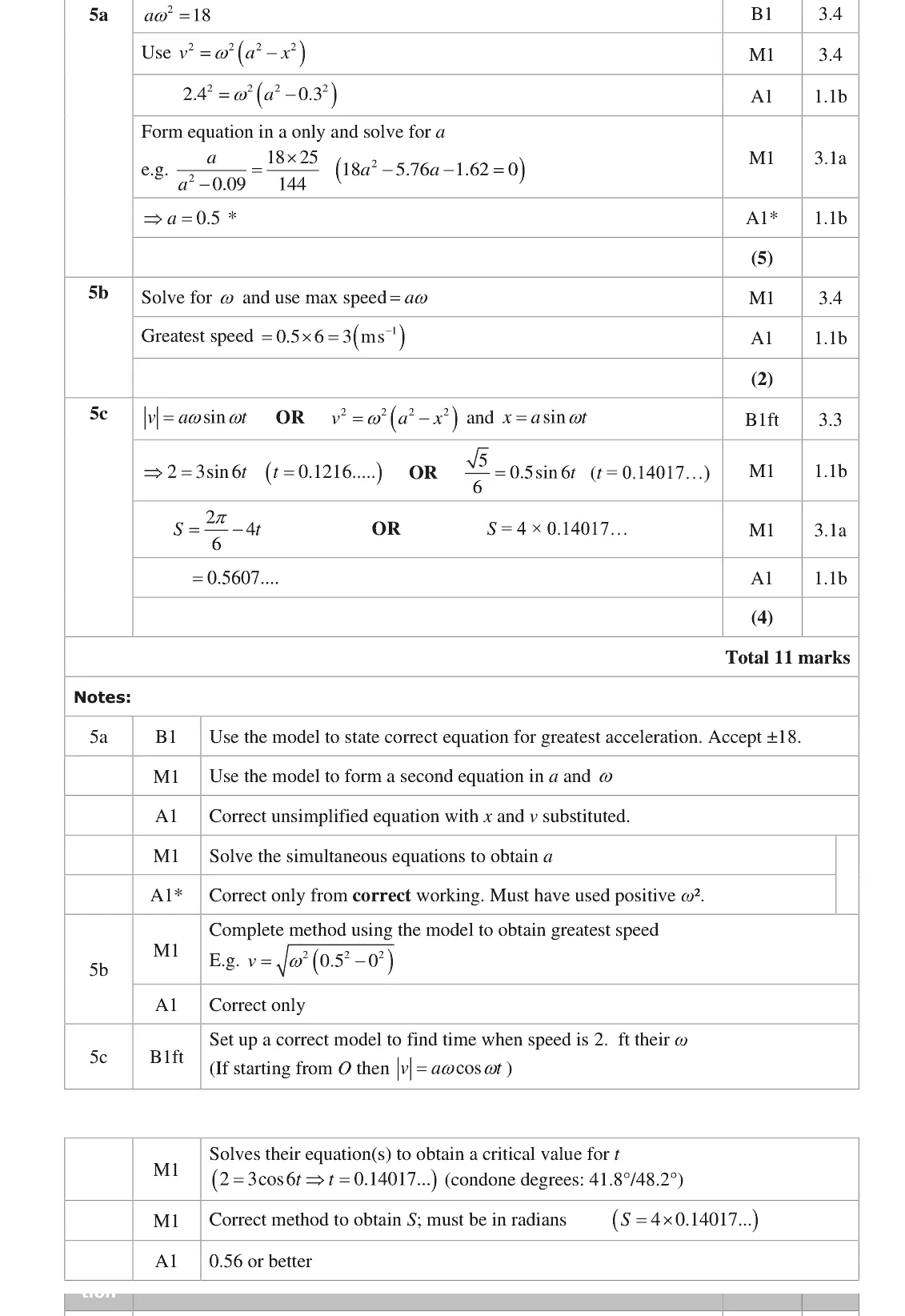
aω² = 18 and v² = ω²(a² − x²) with x = 0.3, v = 2.4
eliminate ω to get 18a² − 5.76a − 1.62 = 0, a = 0.5
ω² must be positive
June 2024 · Paper 4C (Further Mechanics 2) · Q5(b)2 marks
Mark scheme (whole question; this part is marked with the orange bar)
Examiner's comment
(b) Most were successful here but a surprising number made arithmetic mistakes (doubling instead of halving when multiplying by 0.5) or forgot to root their ω^2
Key points from the mark scheme and examiner's report
ω = 6, greatest speed aω = 3 m s⁻¹
slips in halving or forgetting to square-root ω²
June 2024 · Paper 4C (Further Mechanics 2) · Q5(c)4 marks
Mark scheme (whole question; this part is marked with the orange bar)
Examiner's comment
(c) Many candidates did this efficiently. From those who struggled, a fair number did not provide a complete method and focused only on finding possible times at which the speed was 2 – sometimes by confusingly using both the sine and cosine approach. A surprising number found the critical values 0.12… and 0.14… then subtracted, showing little understanding of the overall motion.
Key points from the mark scheme and examiner's report
speed 3cos 6t = 2 (timing from O) gives t = 0.140
S = 4t = 0.56 s
radians needed
subtracting critical times shows no grasp of the motion
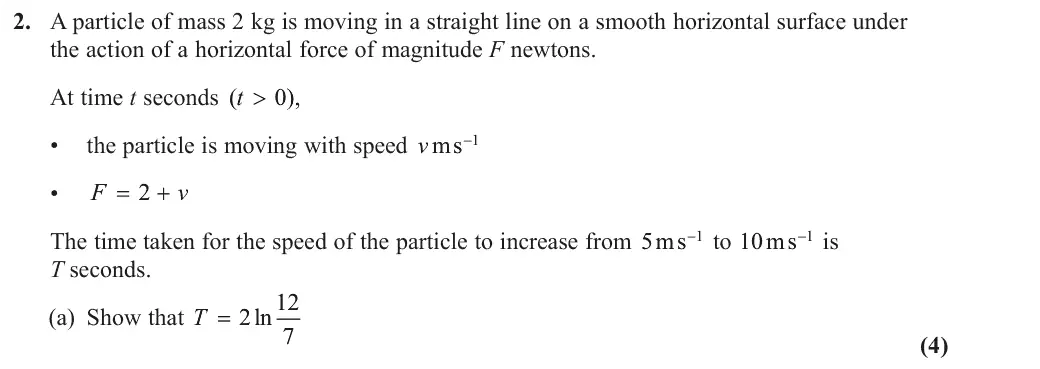
June 2023 · Paper 4C (Further Mechanics 2) · Q2(a)4 marks
Mark scheme (whole question; this part is marked with the orange bar)
Examiner's comment
(a) Almost all of the candidates started with a correct differential equation in v and t, although a small minority omitted the mass of the particle. The majority of candidates went on to separate the variables correctly, integrate and use limits to achieve the given answer. A small number used alternative methods such as the use of an integrating factor to solve the differential equation.
Key points from the mark scheme and examiner's report
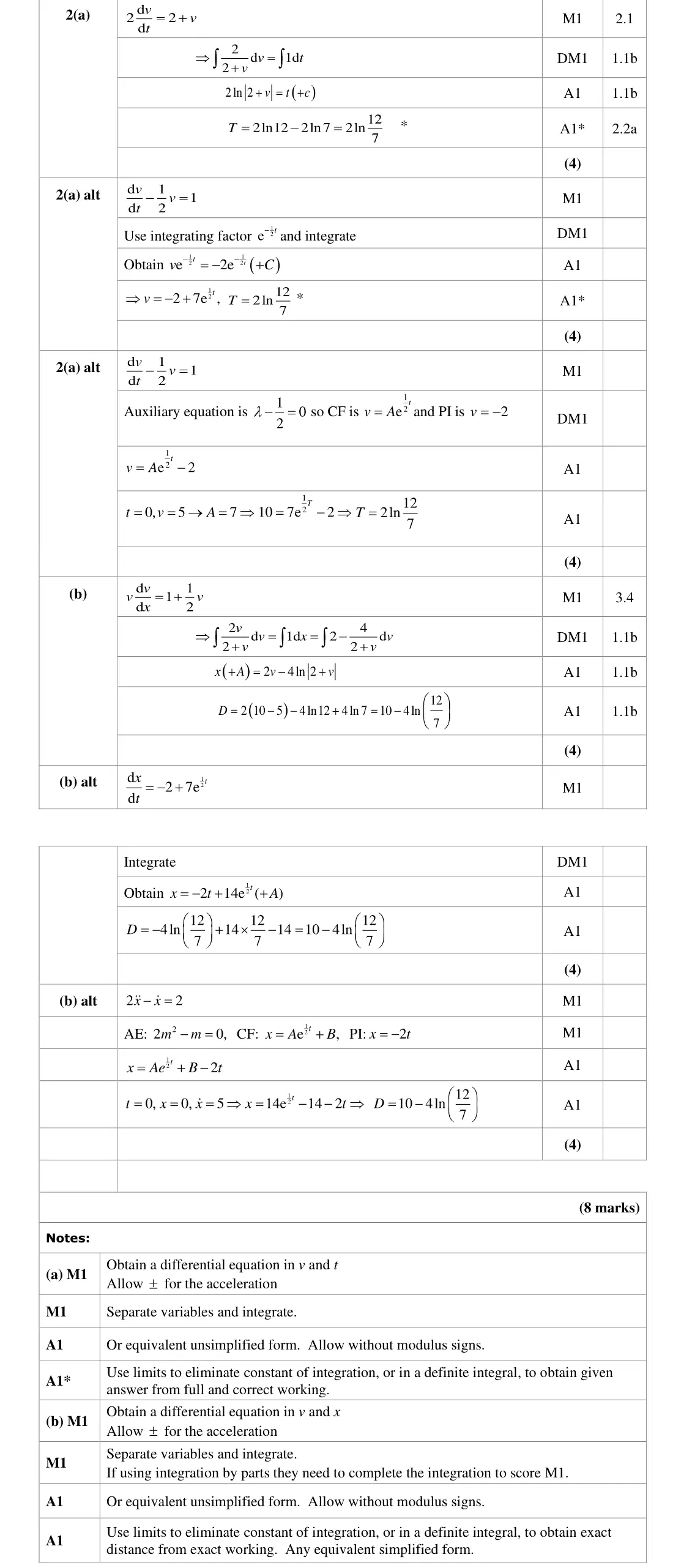
2 dv/dt = 2 + v (mass must be included)
separate: 2ln(2 + v) = t + c
limits v = 5 to 10 give T = 2ln(12/7)
integrating factor or auxiliary-equation methods also accepted
June 2023 · Paper 4C (Further Mechanics 2) · Q2(b)4 marks
Mark scheme (whole question; this part is marked with the orange bar)
Examiner's comment
(b) Most candidates started by writing acceleration as d d v v x to achieve a correct differential equation in v and x. They went on to separate the variables, but 2 d 2 v v v + proved challenging for a significant number of candidates. Those who rewrote the fraction as 4 2 4 2 v v + - + or who used the substitution 2 u v = + usually went on to obtain the correct value of D. Those candidates who attempted to use integration by parts were often unable to complete the integration correctly – those who remembered how to complete ( ) ln 2 d v v + usually obtained the correct solution. A small number integrated the formula for the velocity from part(a), which worked well. A small minority of candidates tried to make inappropriate use of suvat equations to answer this question.
Key points from the mark scheme and examiner's report
June 2023 · Paper 4C (Further Mechanics 2) · Q8(a)3 marks
Mark scheme (whole question; this part is marked with the orange bar)
Examiner's comment
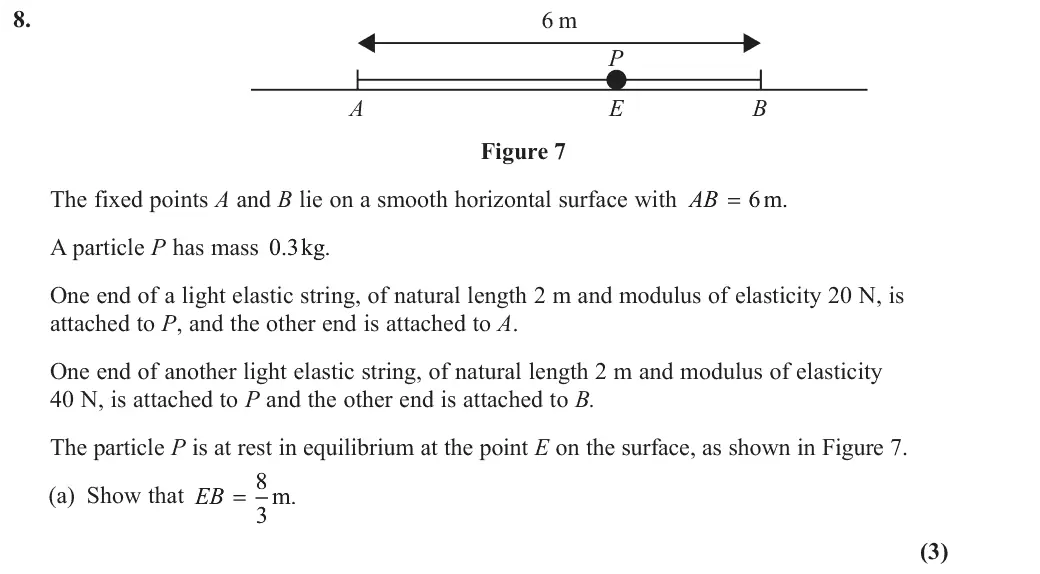
(a) The majority of candidates succeeded in using Hooke’s Law to form an equation in one unknown and went on to obtain the given answer correctly. Those who used “e” for an extension in (a) (rather than “x”) and subsequently used this in (b) were more likely to succeed, as were those who drew clear diagrams.
Key points from the mark scheme and examiner's report
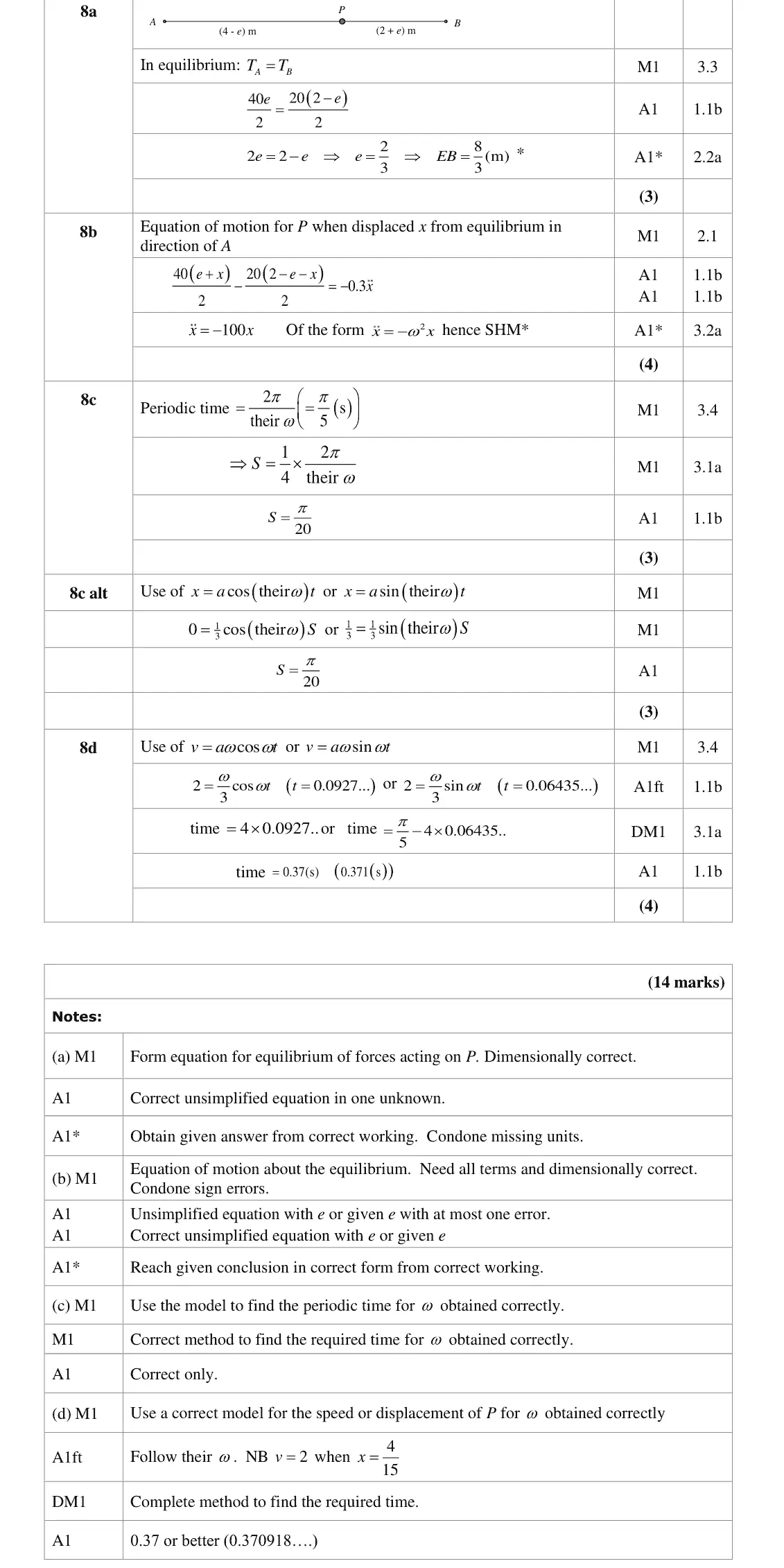
equilibrium: equal tensions 40e/2 = 20(2 − e)/2 with e the extension of string PB, e = 2/3, EB = 8/3 m
a clear diagram helps
June 2023 · Paper 4C (Further Mechanics 2) · Q8(b)4 marks
Mark scheme (whole question; this part is marked with the orange bar)
Examiner's comment
(b) For many candidates, this was a straightforward application of a standard and familiar method. A minority did not appear to be working about the equilibrium position, their extensions did not add up to 2, and only a few defined the x that they used in their equation. Some candidates did not confirm that their equation was indeed for SHM and some claimed SHM for an equation that clearly did not fit the pattern.
Key points from the mark scheme and examiner's report
displace x from E towards A: 40(e + x)/2 − 20(2 − e − x)/2 = −0.3ẍ, ẍ = −100x
define x, work about E, and state SHM
June 2023 · Paper 4C (Further Mechanics 2) · Q8(c)3 marks
Mark scheme (whole question; this part is marked with the orange bar)
Examiner's comment
(c) The candidates who attempted this part of the question understood what was required. The use of a model using sine or cosine was more popular than dealing with periodic time, although many did not link the correct initial distance with their model.
Key points from the mark scheme and examiner's report
amplitude 1/3 m (midpoint is 1/3 from E)
quarter period: S = ¼ × 2π/10 = π/20
June 2023 · Paper 4C (Further Mechanics 2) · Q8(d)4 marks
Mark scheme (whole question; this part is marked with the orange bar)
Examiner's comment
(d) Solutions based on a sketch of a trigonometric curve were often successful. The most straightforward method was to use cos v a t = and then multiply the value of t by 4, but this was not very common. Of those candidates who used 4 2 and , 15 v x = = not many were successful in combining the times that they found into the correct final answer.
Key points from the mark scheme and examiner's report
v = aω cos ωt = (10/3)cos 10t = 2 gives t = 0.0927, total 4t = 0.37 s
or v = 2 at x = 4/15
combining times was the common failure
June 2022 · Paper 4C (Further Mechanics 2) · Q2(a)4 marks
Mark scheme (whole question; this part is marked with the orange bar)
Examiner's comment
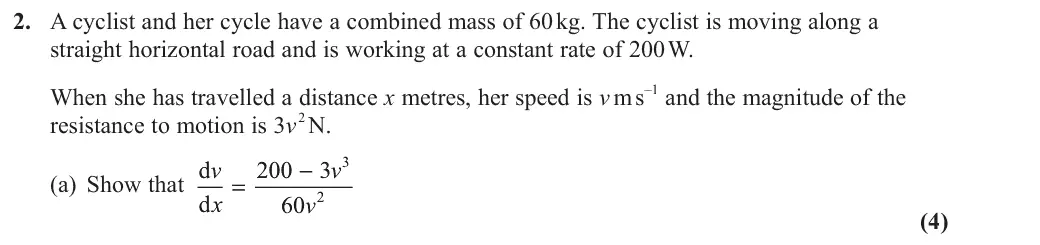
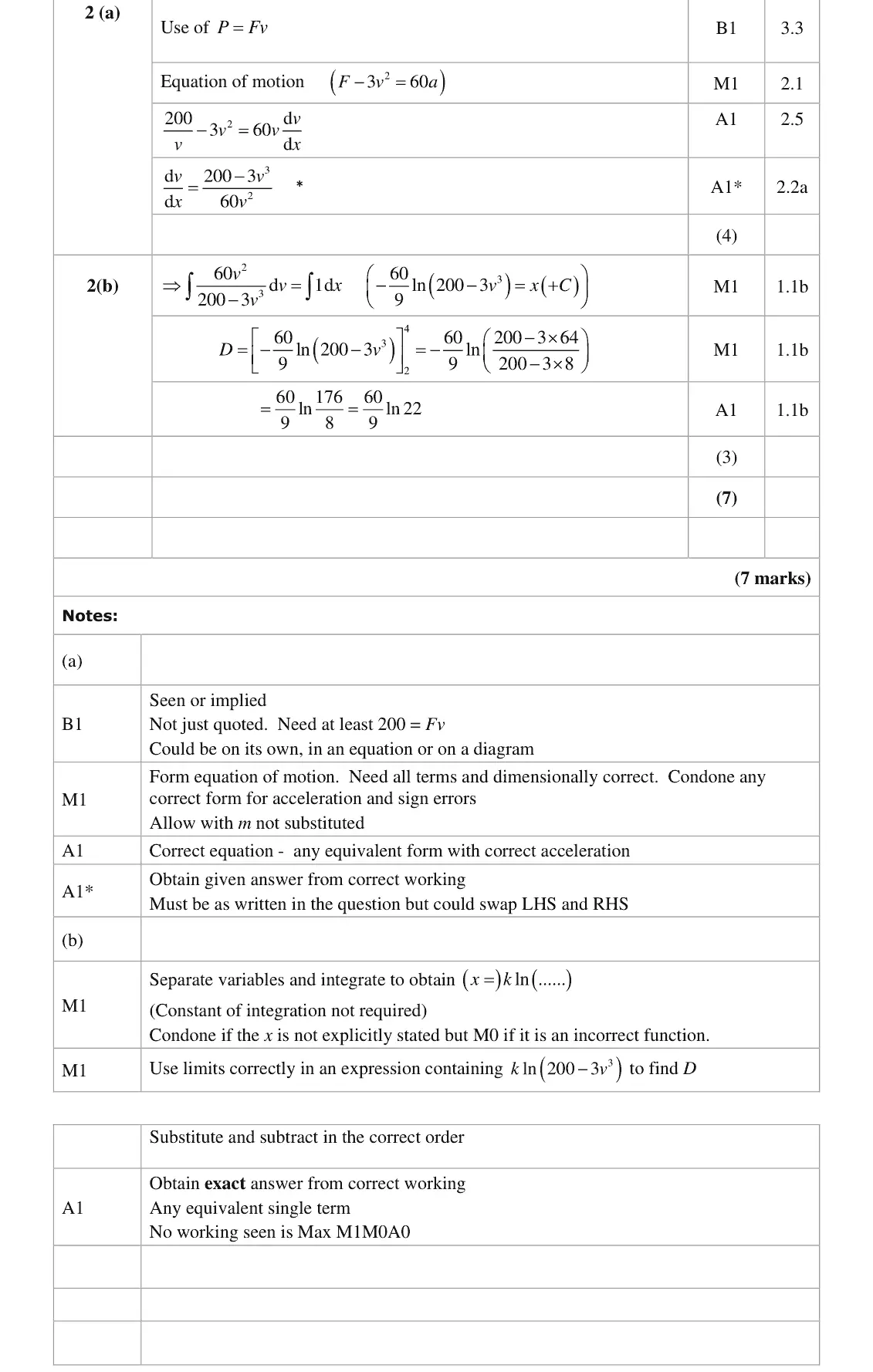
(a) This was another question that most candidates approached with confidence. They combined an expression for the driving force (obtained from the given rate of working) with a correct equation of motion to obtain the given differential equation. The most common route was to form the equation of motion in terms of a or d d v t and then substitute d d v v x , with many showing use of the chain rule to justify this step. The most common error was to use 200 as a force in the equation of motion.
Key points from the mark scheme and examiner's report
driving force 200/v from P = Fv
200/v − 3v² = 60v dv/dx
commonest error using 200 as a force
show a = v dv/dx
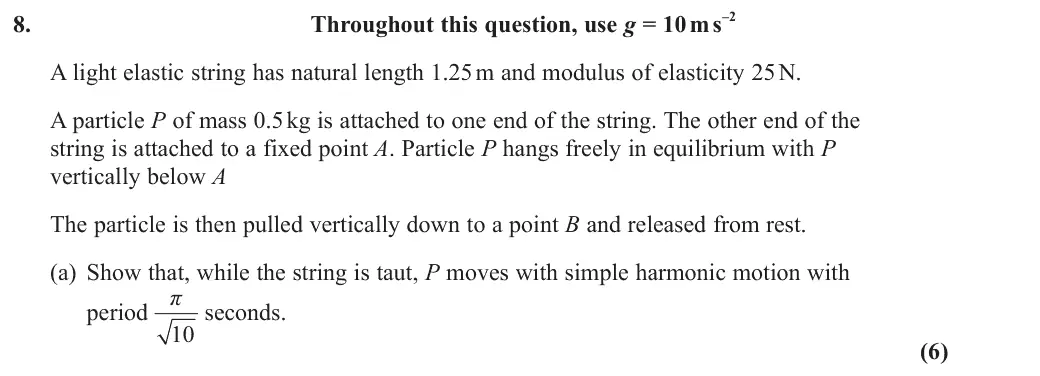
June 2022 · Paper 4C (Further Mechanics 2) · Q8(a)6 marks
Mark scheme (whole question; this part is marked with the orange bar)
Examiner's comment
(a) Many candidates adopted a systematic approach by finding the equilibrium position and setting up an equation of motion for the particle when displaced from this position. Although it is a fairly common scenario, some candidates made little real progress and, although most knew an equation of motion was required, they failed either to find the equilibrium extension or to define an appropriate x. Sometimes an equation was left in terms of a (rather than 𝑥̈ ) with the direction of a not defined. Those who reached an equation of the form for SHM did not always state an appropriate conclusion. Virtually all candidates knew and applied the formula for the period.
Key points from the mark scheme and examiner's report
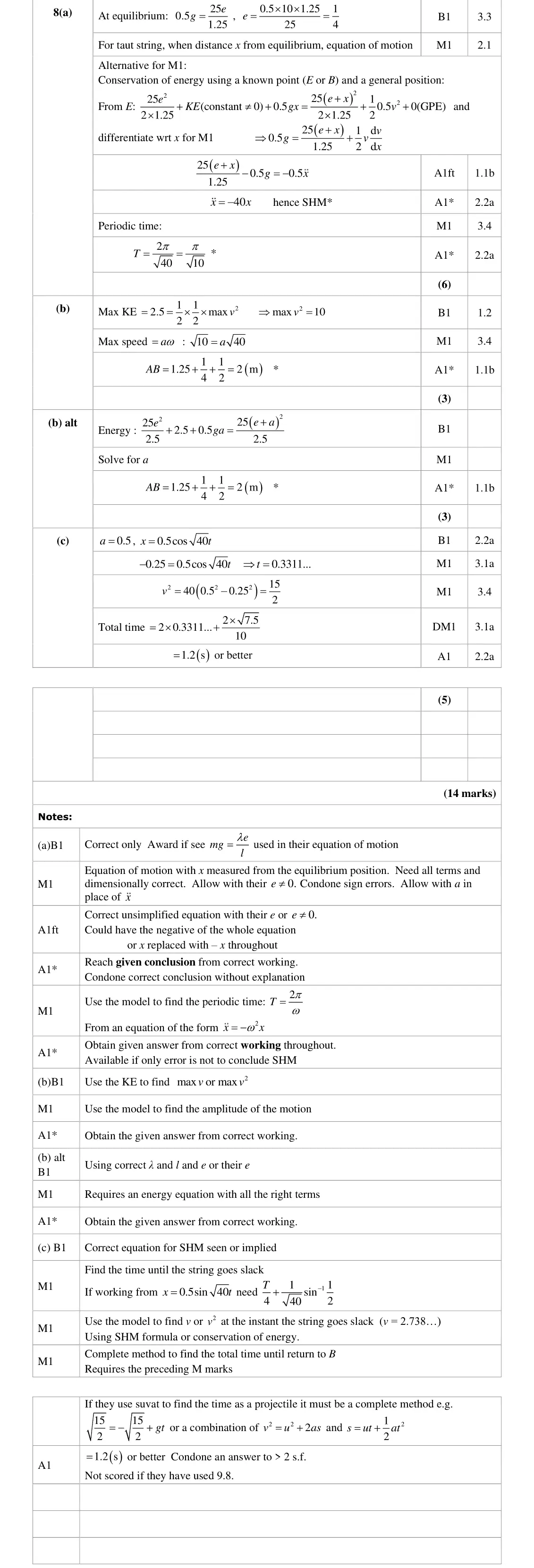
June 2022 · Paper 4C (Further Mechanics 2) · Q8(b)3 marks
Mark scheme (whole question; this part is marked with the orange bar)
Examiner's comment
(b) The most common approach to this task was to find the maximum speed from the given maximum kinetic energy and then use v = aω to find the amplitude. Hence the distance AB could readily be deduced. Some candidates attempted the alternative approach of using an energy equation. This approach was more complicated and less successful. The most common errors were in omitting the EPE at the equilibrium position and/or the GPE. Those who had used g = 9.8 ms-2 rather than 10 ms-2 as directed by the question did not achieve the exact answer of AB = 2 m and lost the final accuracy mark.
Key points from the mark scheme and examiner's report
max KE 2.5 J gives max v² = 10
aω = √10 so a = 0.5
AB = 1.25 + 0.25 + 0.5 = 2 m
energy route often omitted EPE or GPE
using 9.8 loses the exact answer
June 2022 · Paper 4C (Further Mechanics 2) · Q8(c)5 marks
Mark scheme (whole question; this part is marked with the orange bar)
Examiner's comment
(c) A small number of entirely correct solutions were seen, with clear and systematic working. Candidates needed to recognise that the motion was in two parts, some under SHM and some moving freely under gravity. There was confusion about distances and speeds at the relevant stages of the motion. Some wrote down an SHM equation for the first distance in the form cos x a t = but then equated it to 0.25rather than to 0.25. - Occasionally the speed when the string went slack was confused with the speed at the equilibrium position, found in (b). Those who had assumed g = 9.8 ms-2 but otherwise showed correct working throughout were penalised in the final mark only.
Key points from the mark scheme and examiner's report
string slack at x = −0.25 (not +0.25): 0.5cos √40t = −0.25, t = 0.331
speed there √7.5, then free motion under gravity for 2√7.5/10
T = 1.2 s
do not confuse with the speed at equilibrium
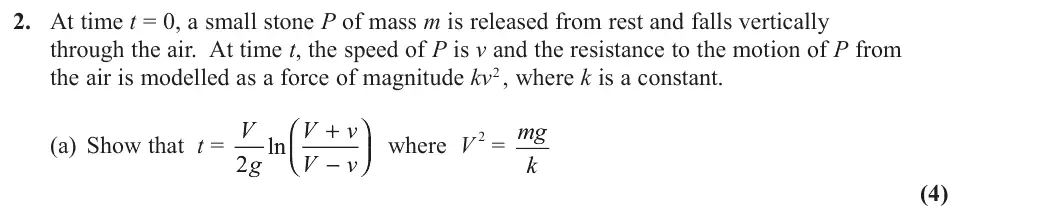
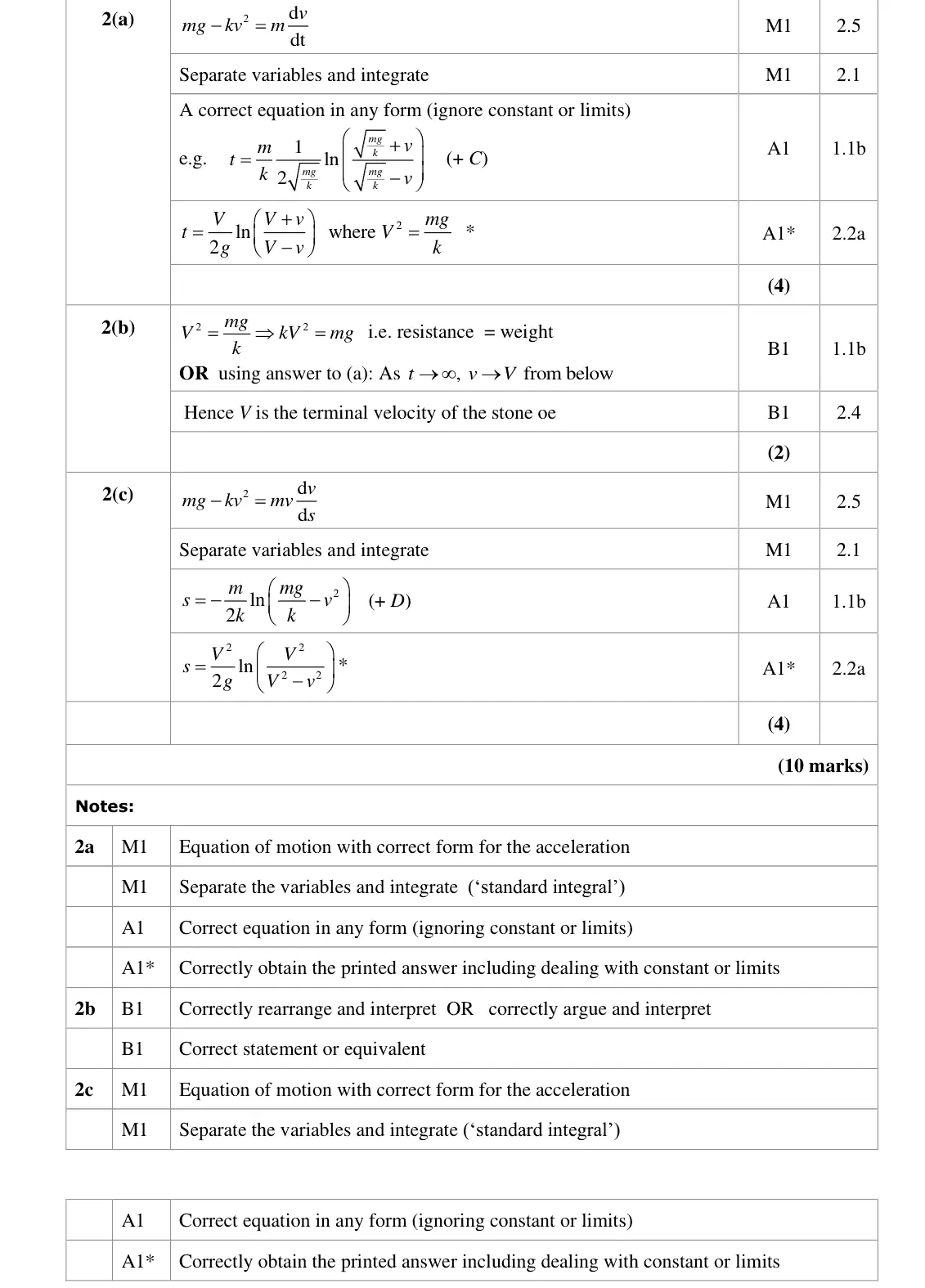
Nov 2021 · Paper 4C (Further Mechanics 2) · Q2(a)4 marks
Mark scheme (whole question; this part is marked with the orange bar)
Key points from the mark scheme and examiner's report
m dv/dt = mg − kv²
separate and use the standard integral for 1/(V² − v²)
deal with the constant using v = 0 at t = 0 for the printed answer
Nov 2021 · Paper 4C (Further Mechanics 2) · Q2(b)2 marks
Mark scheme (whole question; this part is marked with the orange bar)
Key points from the mark scheme and examiner's report
kV² = mg so resistance equals weight, or v → V as t → ∞
V is the terminal speed of the stone
Nov 2021 · Paper 4C (Further Mechanics 2) · Q2(c)4 marks
Mark scheme (whole question; this part is marked with the orange bar)
Key points from the mark scheme and examiner's report
mv dv/ds = mg − kv²
integrate to s = −(m/2k)ln(mg/k − v²) + D
use s = 0 when v = 0
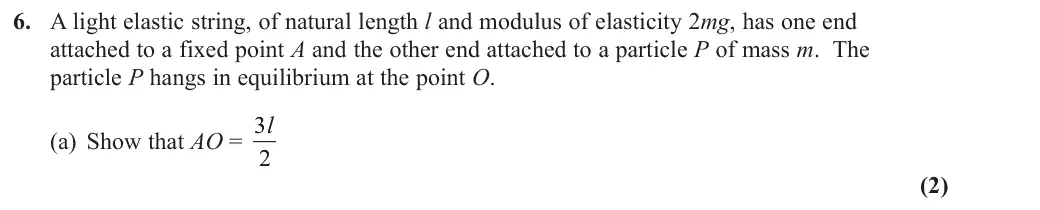
Nov 2021 · Paper 4C (Further Mechanics 2) · Q6(a)2 marks
Mark scheme (whole question; this part is marked with the orange bar)
Key points from the mark scheme and examiner's report
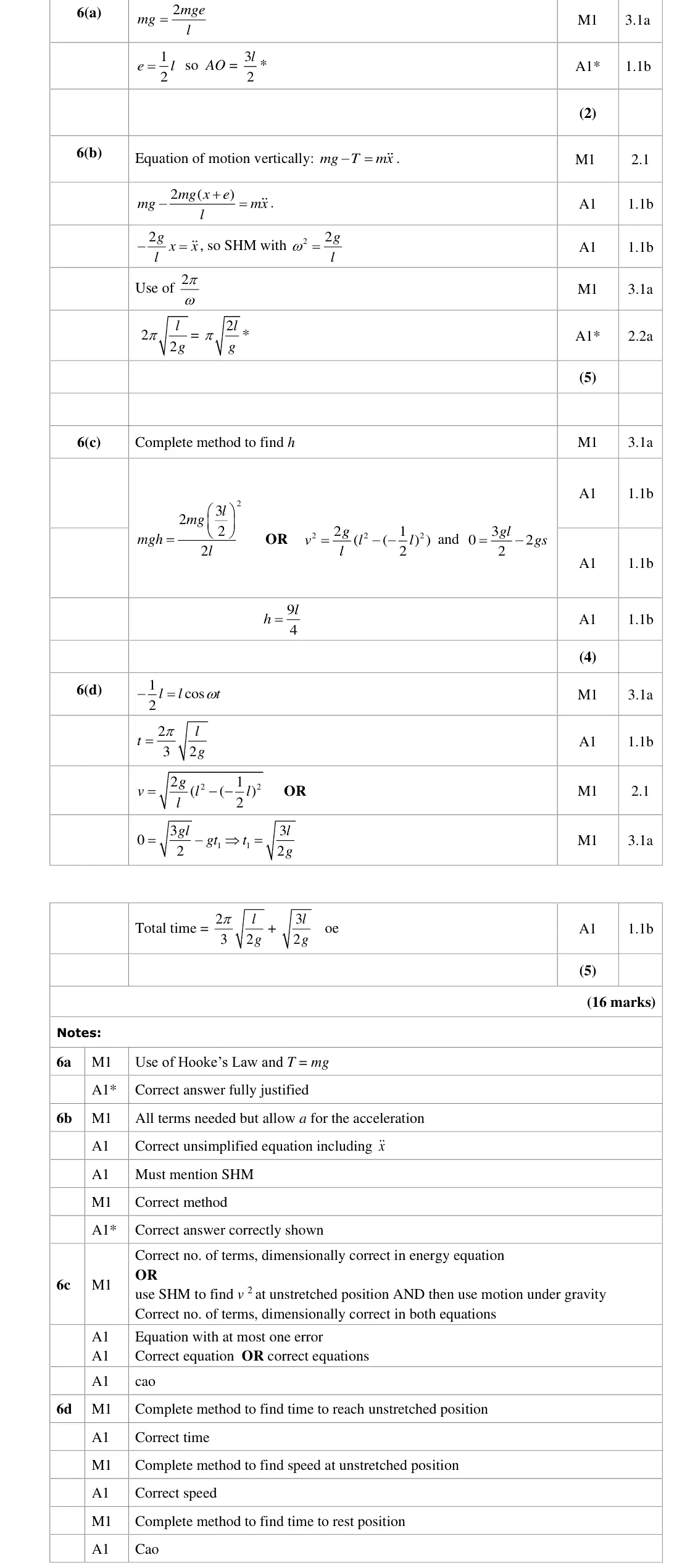
Hooke: mg = 2mge/l, e = l/2, AO = 3l/2
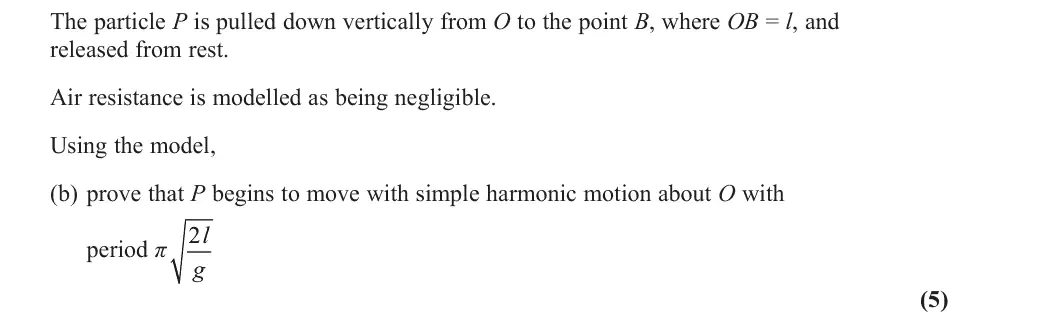
Nov 2021 · Paper 4C (Further Mechanics 2) · Q6(b)5 marks
Mark scheme (whole question; this part is marked with the orange bar)
Key points from the mark scheme and examiner's report
mg − 2mg(x + e)/l = mẍ gives ẍ = −(2g/l)x
must state SHM
period 2π√(l/2g) = π√(2l/g)
Nov 2021 · Paper 4C (Further Mechanics 2) · Q6(c)4 marks
Mark scheme (whole question; this part is marked with the orange bar)
Key points from the mark scheme and examiner's report
amplitude l takes P above the natural-length point, so the string goes slack and SHM stops
energy mgh = 2mg(3l/2)²/(2l), or SHM speed at natural length then free fall
BC = 9l/4
Nov 2021 · Paper 4C (Further Mechanics 2) · Q6(d)5 marks
Mark scheme (whole question; this part is marked with the orange bar)
Key points from the mark scheme and examiner's report
SHM from B to natural length: −l/2 = l cos ωt, t = (2π/3)√(l/2g)
speed there √(3gl/2), then motion under gravity for √(3l/2g)
total (2π/3)√(l/2g) + √(3l/2g)
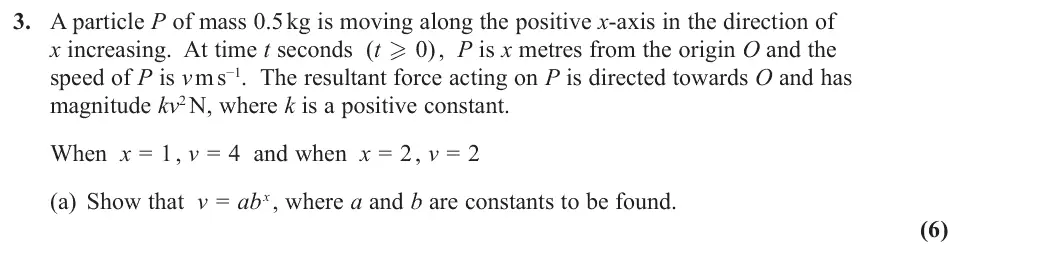
Oct 2020 · Paper 4C (Further Mechanics 2) · Q3(a)6 marks
Mark scheme (whole question; this part is marked with the orange bar)
Key points from the mark scheme and examiner's report
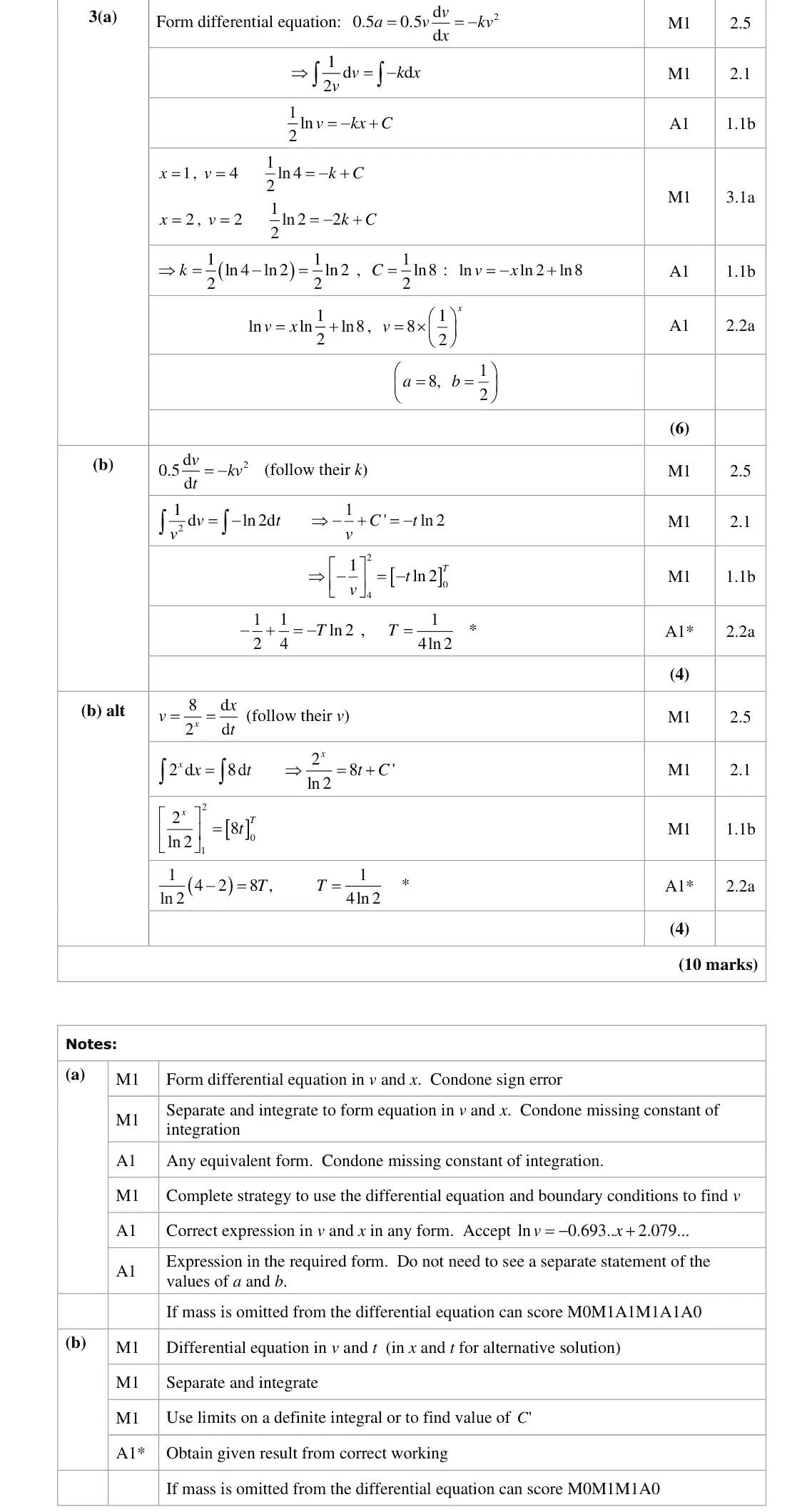
0.5v dv/dx = −kv² (mass must be included, force towards O so negative)
½ln v = −kx + C, k = ½ln 2
v = 8(½)^x so a = 8, b = ½
Oct 2020 · Paper 4C (Further Mechanics 2) · Q3(b)4 marks
Mark scheme (whole question; this part is marked with the orange bar)
Key points from the mark scheme and examiner's report
0.5 dv/dt = −kv² with their k, integrate 1/v² and use limits v = 4 to 2
alternative dx/dt = 8/2^x from 1 to 2
T = 1/(4ln 2)
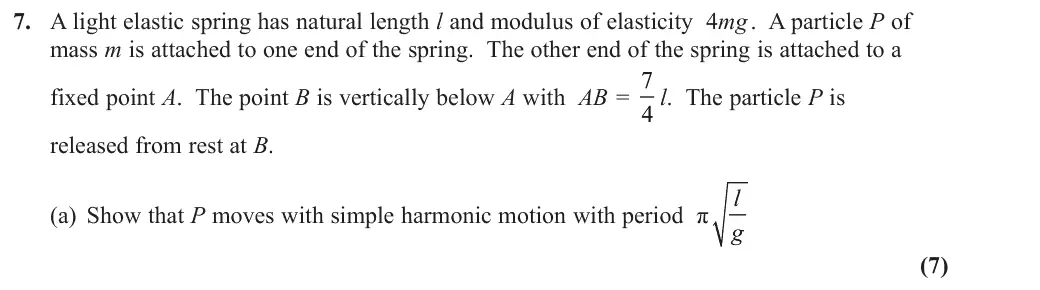
Oct 2020 · Paper 4C (Further Mechanics 2) · Q7(a)7 marks
Mark scheme (whole question; this part is marked with the orange bar)
Key points from the mark scheme and examiner's report
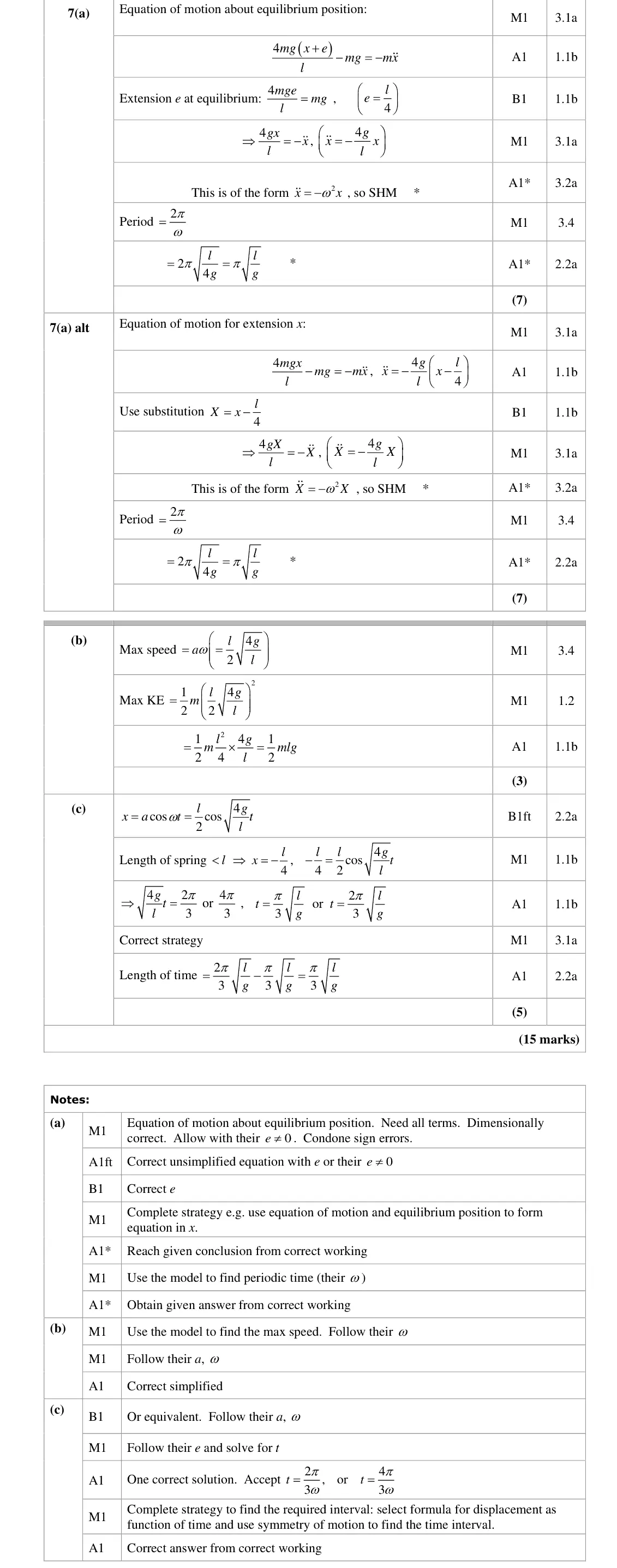
Oct 2020 · Paper 4C (Further Mechanics 2) · Q7(b)3 marks
Mark scheme (whole question; this part is marked with the orange bar)
Key points from the mark scheme and examiner's report
equilibrium length 5l/4 so amplitude l/2
max speed aω = (l/2)√(4g/l)
max KE ½mlg
Oct 2020 · Paper 4C (Further Mechanics 2) · Q7(c)5 marks
Mark scheme (whole question; this part is marked with the orange bar)
Key points from the mark scheme and examiner's report
x = (l/2)cos ωt
length less than l means x = −l/4 (above equilibrium), cos ωt = −½ gives t = π/3√(l/g) and 2π/3√(l/g)
time = (π/3)√(l/g) by symmetry
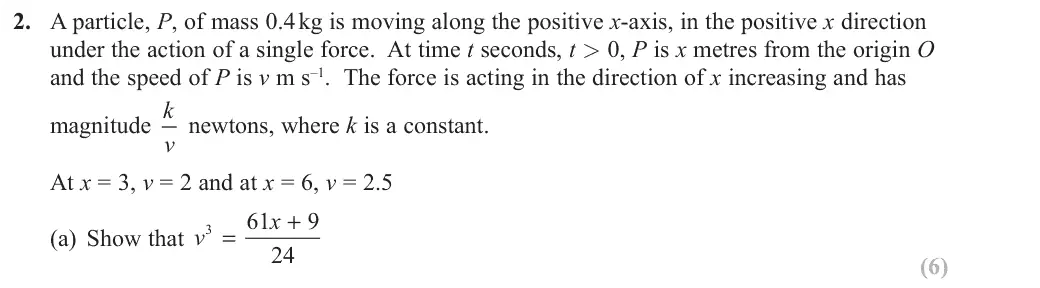
June 2019 · Paper 4C (Further Mechanics 2) · Q2(a)6 marks
Mark scheme (whole question; this part is marked with the orange bar)
Examiner's comment
(a) Most candidates set up a correct differential equation in v and x, separated the variables and integrated correctly. This was a “show that…” question, so we needed to see the use of the boundary conditions to find the value of k and of the constant if integration. Many candidates did reach the given result correctly. Several candidates claimed to have reached the given result despite arithmetic slips in their working. from part (a) to form a differential equation in x and t. The latter group of candidates made several errors with the indices and with the coefficients in the integral.
Key points from the mark scheme and examiner's report
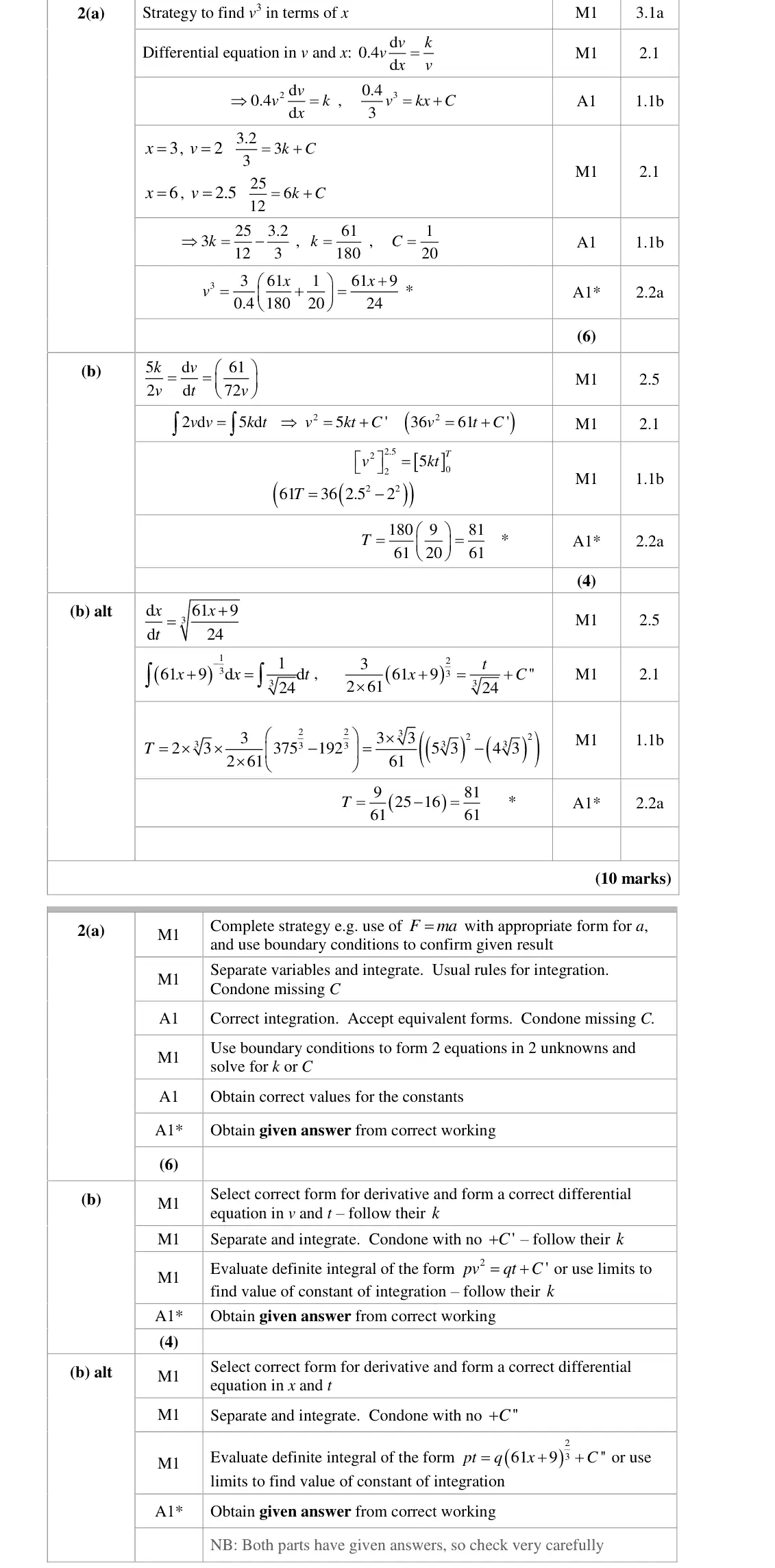
0.4v dv/dx = k/v, separate to 0.4v³/3 = kx + C
use both boundary conditions to find k = 61/180 and C = 1/20
given answer so arithmetic must be shown, slips claimed through
June 2019 · Paper 4C (Further Mechanics 2) · Q2(b)4 marks
Mark scheme (whole question; this part is marked with the orange bar)
Examiner's comment
(b) Most candidates did follow the instruction to use algebraic integration, but there were some who simply wrote down an integral followed by the given answer. There were two possible approaches: those candidates who went back to the initial information and formed a differential equation in v and t had an easier integral to complete than those candidates who used the result from part (a) to form a differential equation in x and t. The latter group of candidates made
Key points from the mark scheme and examiner's report
must use algebraic integration
easier route 0.4 dv/dt = k/v giving v² = 5kt + C
via dx/dt = cube root of (61x + 9)/24 is harder and caused index/coefficient errors
writing an integral then the answer scores little
June 2019 · Paper 4C (Further Mechanics 2) · Q6(a)5 marks
Mark scheme (whole question; this part is marked with the orange bar)
Examiner's comment
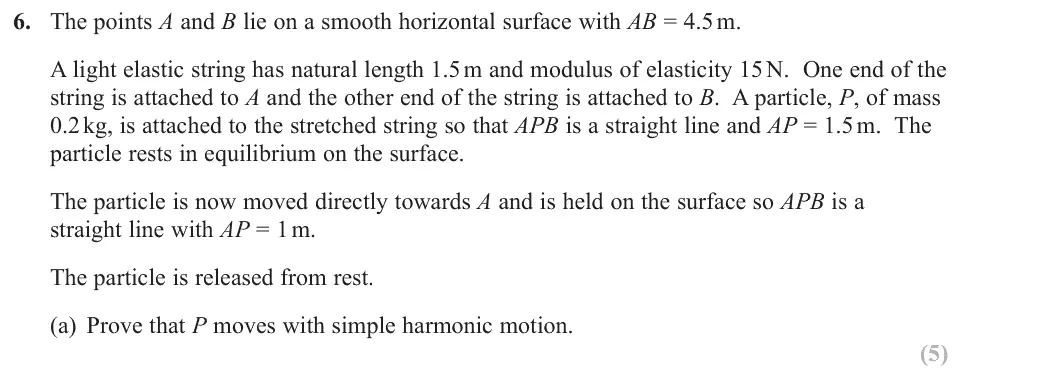
(a) The response to this question was very weak. Most candidates did demonstrate an understanding of Hooke’s law, and they did write down an equation of motion involving the difference between two tensions. However, the majority of candidates had either not understood the information given or they had not read it with sufficient care. Most candidates had the particle attached to the midpoint of the unstretched string, so they were using incorrect lengths throughout their working. Several of those candidates who did reach the correct equation of motion did not explain how they knew that this represented simple harmonic motion.
Key points from the mark scheme and examiner's report
natural lengths of the two sections are 1 m and 0.5 m (not the midpoint)
June 2019 · Paper 4C (Further Mechanics 2) · Q6(b)3 marks
Mark scheme (whole question; this part is marked with the orange bar)
Examiner's comment
(b) Many candidates demonstrated knowledge of the basic properties of simple harmonic motion and they were able to use their figures to find the values of the maximum speed and the maximum acceleration of P.
Key points from the mark scheme and examiner's report
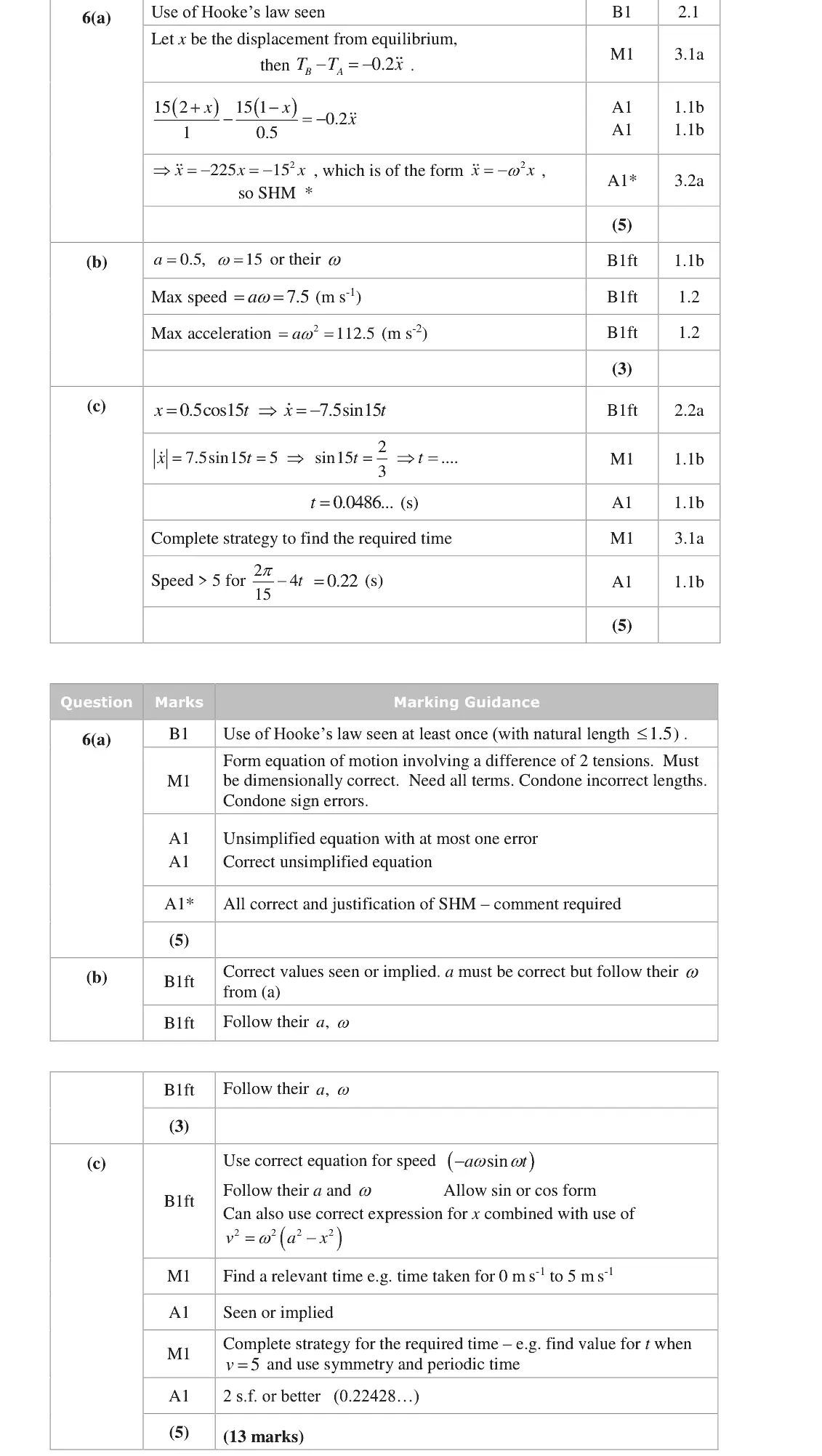
a = 0.5, ω = 15: max speed aω = 7.5 m s⁻¹, max acceleration aω² = 112.5 m s⁻²
June 2019 · Paper 4C (Further Mechanics 2) · Q6(c)5 marks
Mark scheme (whole question; this part is marked with the orange bar)
Examiner's comment
(c) Although the question is set up so that P is released from a position of maximum amplitude sin . x a t in the motion, many candidates worked from On this occasion that did not prevent them from reaching the correct conclusion. Several candidates succeeded in finding a relevant time for their model, but only a minority used that value correctly to find the total time required.
Key points from the mark scheme and examiner's report
x = 0.5cos 15t, speed 7.5sin 15t = 5 gives t = 0.0486
speed > 5 for 2π/15 − 4t = 0.22 s per oscillation
few used symmetry and the period correctly
Find an Edexcel Further Maths tutor
Stuck on this? Book a trial lesson with our Further Maths tutor.