FM2.4.1 Newton’s laws of motion, for a particle moving in one dimension,…
Section
FM2.4 Further dynamics
Level
A level only
Statement
Newton’s laws of motion, for a particle moving in one dimension, when the applied force is variable.
Guidance
The solution of the resulting equations will be consistent with the level of calculus required in A level Mathematics and Further Mathematics. Problems may involve the law of gravitation, i.e. the inverse square law.
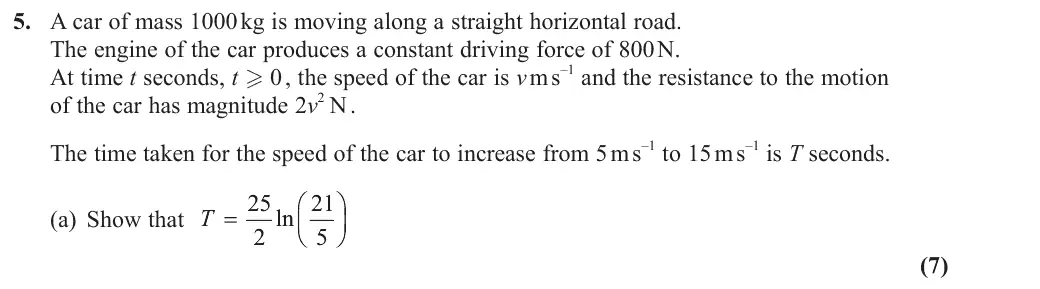
June 2025 · Paper 4C (Further Mechanics 2) · Q5(a)7 marks
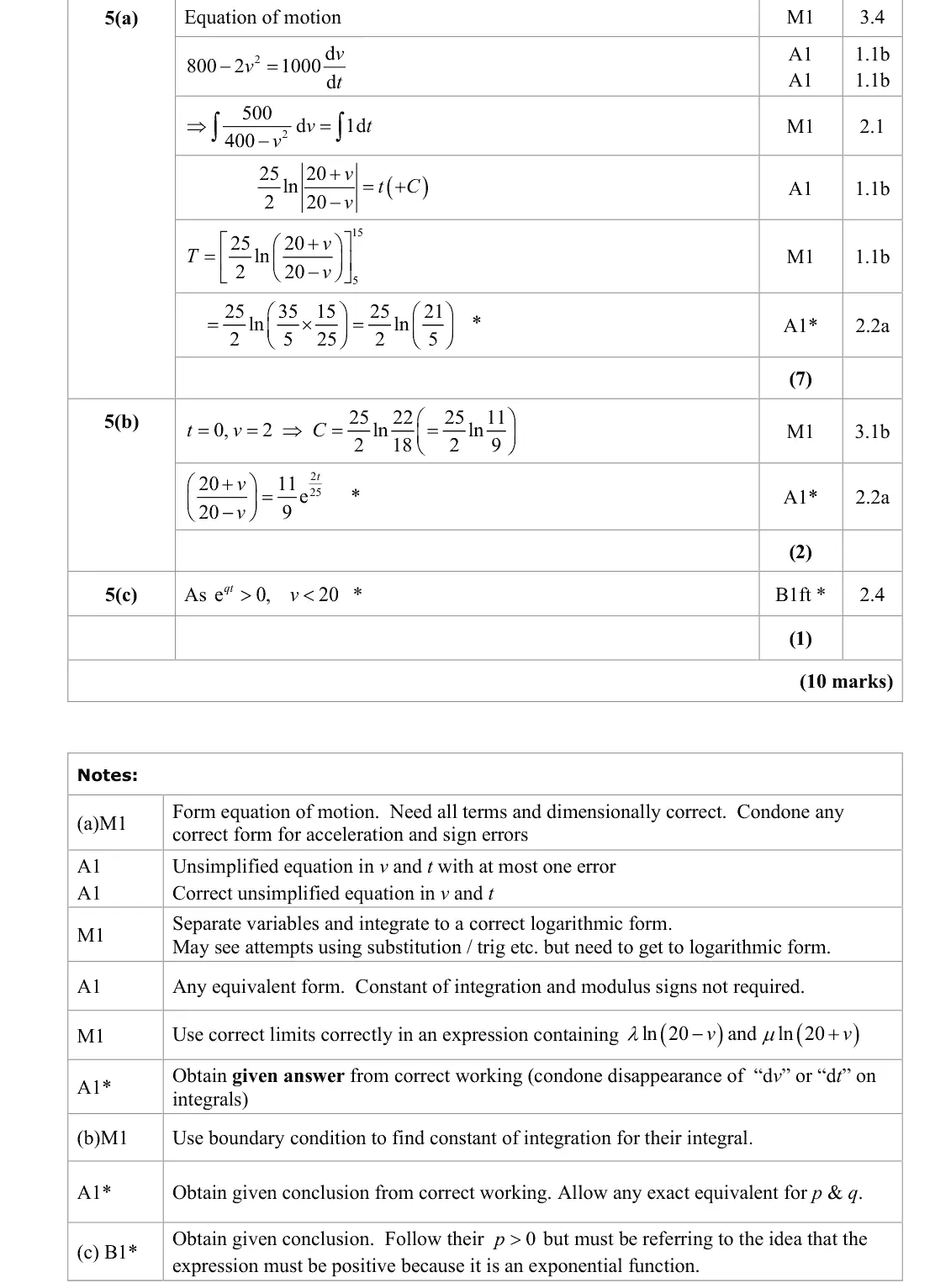
Mark scheme (whole question; this part is marked with the orange bar)
Examiner's comment
(a) Most candidates began with an equation of motion. The variation came in the integration: weaker responses struggled to separate or identify the variable to integrate. A significant proportion of candidates used substitution and/or partial fractions rather than quote a standard result, and this was often a successful if longer approach. Some otherwise strong responses made errors with fractions or when manipulating logarithms.
Key points from the mark scheme and examiner's report
1000 dv/dt = 800 − 2v²
separate ∫500/(400 − v²) dv = (25/2)ln((20 + v)/(20 − v))
limits 5 to 15 give T = (25/2)ln(21/5)
partial fractions also fine
log manipulation slips
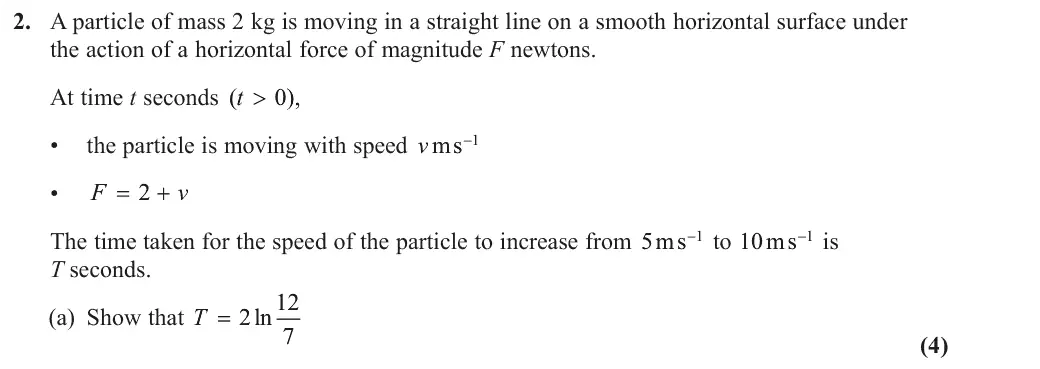
June 2023 · Paper 4C (Further Mechanics 2) · Q2(a)4 marks
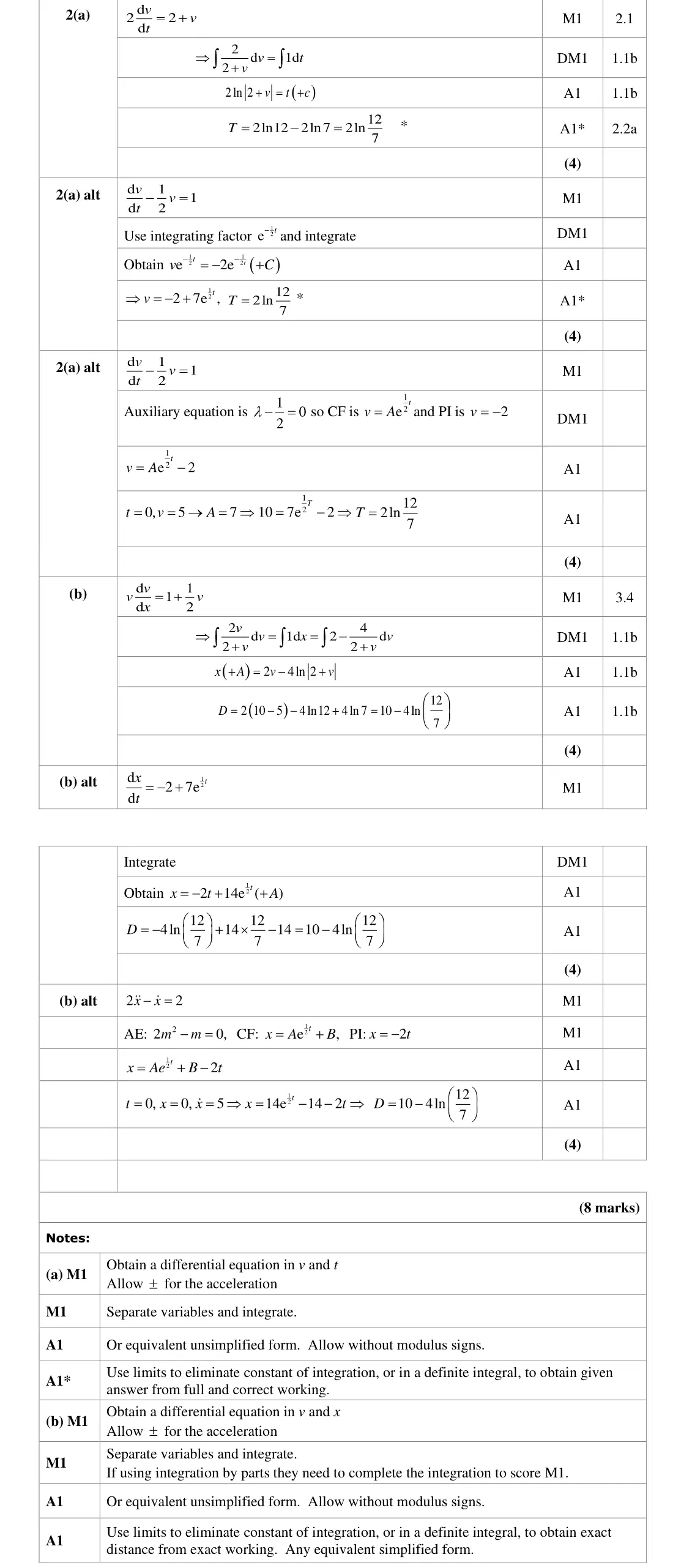
Mark scheme (whole question; this part is marked with the orange bar)
Examiner's comment
(a) Almost all of the candidates started with a correct differential equation in v and t, although a small minority omitted the mass of the particle. The majority of candidates went on to separate the variables correctly, integrate and use limits to achieve the given answer. A small number used alternative methods such as the use of an integrating factor to solve the differential equation.
Key points from the mark scheme and examiner's report
2 dv/dt = 2 + v (mass must be included)
separate: 2ln(2 + v) = t + c
limits v = 5 to 10 give T = 2ln(12/7)
integrating factor or auxiliary-equation methods also accepted
June 2023 · Paper 4C (Further Mechanics 2) · Q2(b)4 marks
Mark scheme (whole question; this part is marked with the orange bar)
Examiner's comment
(b) Most candidates started by writing acceleration as d d v v x to achieve a correct differential equation in v and x. They went on to separate the variables, but 2 d 2 v v v + proved challenging for a significant number of candidates. Those who rewrote the fraction as 4 2 4 2 v v + - + or who used the substitution 2 u v = + usually went on to obtain the correct value of D. Those candidates who attempted to use integration by parts were often unable to complete the integration correctly – those who remembered how to complete ( ) ln 2 d v v + usually obtained the correct solution. A small number integrated the formula for the velocity from part(a), which worked well. A small minority of candidates tried to make inappropriate use of suvat equations to answer this question.
Key points from the mark scheme and examiner's report
June 2022 · Paper 4C (Further Mechanics 2) · Q2(a)4 marks
Mark scheme (whole question; this part is marked with the orange bar)
Examiner's comment
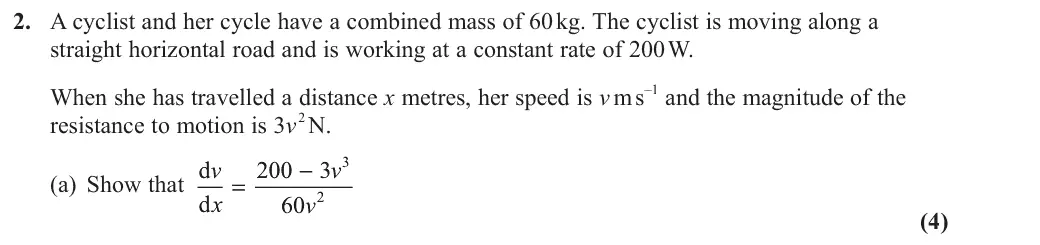
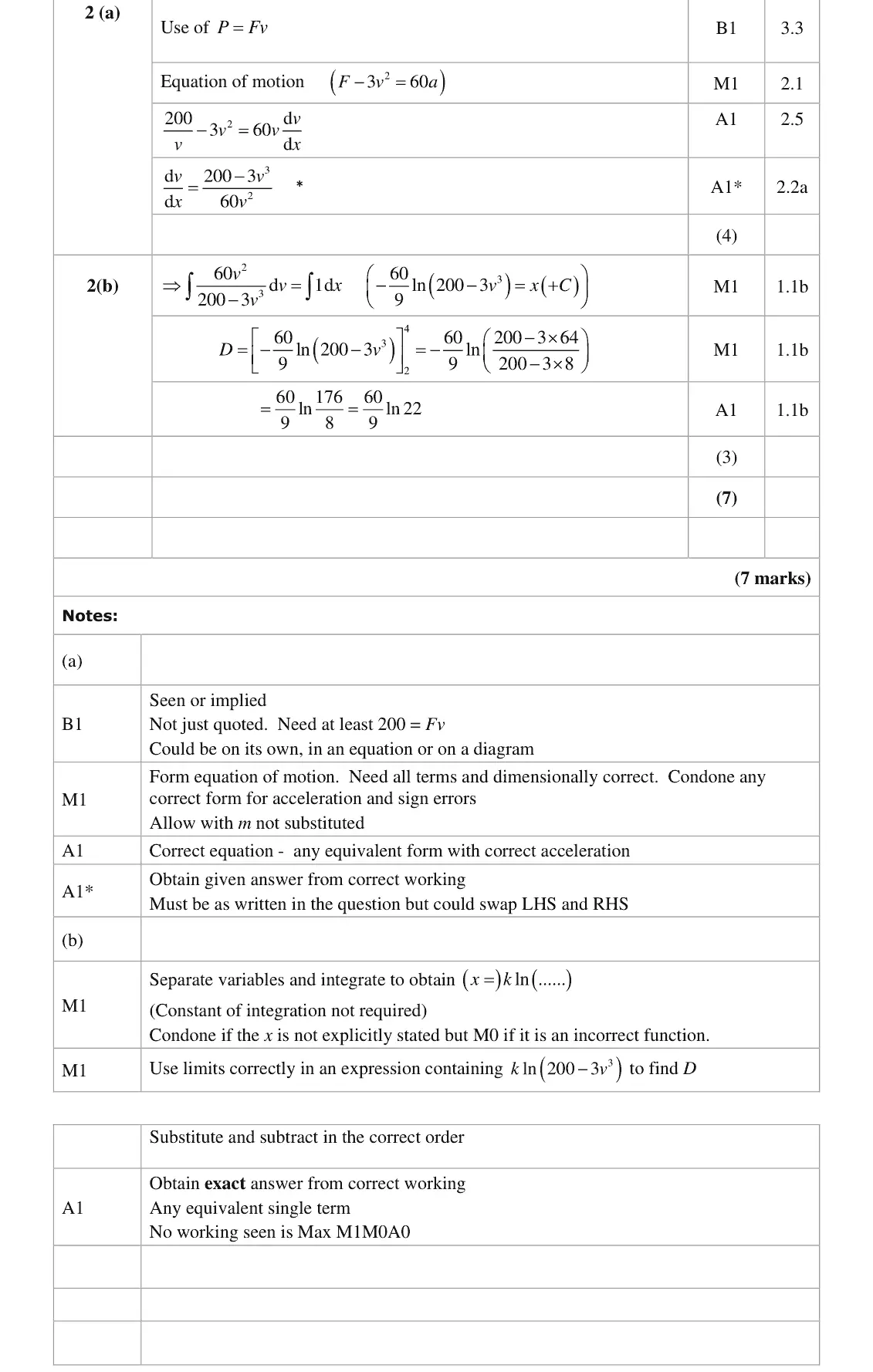
(a) This was another question that most candidates approached with confidence. They combined an expression for the driving force (obtained from the given rate of working) with a correct equation of motion to obtain the given differential equation. The most common route was to form the equation of motion in terms of a or d d v t and then substitute d d v v x , with many showing use of the chain rule to justify this step. The most common error was to use 200 as a force in the equation of motion.
Key points from the mark scheme and examiner's report
driving force 200/v from P = Fv
200/v − 3v² = 60v dv/dx
commonest error using 200 as a force
show a = v dv/dx
Nov 2021 · Paper 4C (Further Mechanics 2) · Q2(a)4 marks
Mark scheme (whole question; this part is marked with the orange bar)
Key points from the mark scheme and examiner's report
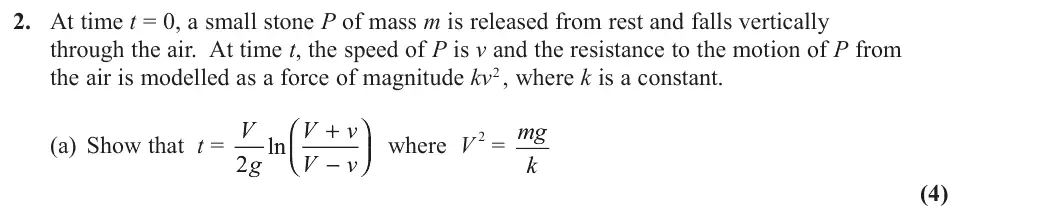
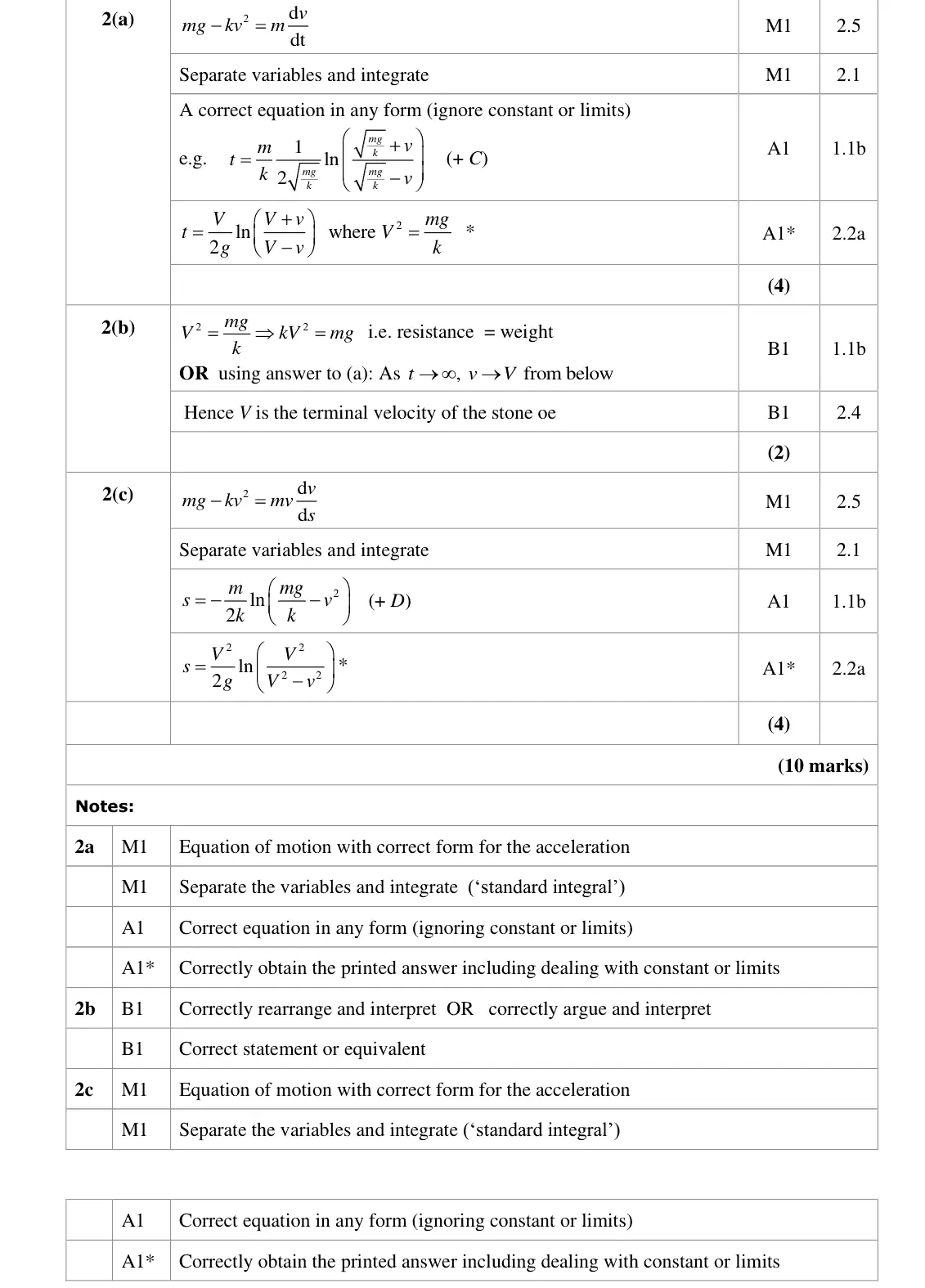
m dv/dt = mg − kv²
separate and use the standard integral for 1/(V² − v²)
deal with the constant using v = 0 at t = 0 for the printed answer
Nov 2021 · Paper 4C (Further Mechanics 2) · Q2(b)2 marks
Mark scheme (whole question; this part is marked with the orange bar)
Key points from the mark scheme and examiner's report
kV² = mg so resistance equals weight, or v → V as t → ∞
V is the terminal speed of the stone
Nov 2021 · Paper 4C (Further Mechanics 2) · Q2(c)4 marks
Mark scheme (whole question; this part is marked with the orange bar)
Key points from the mark scheme and examiner's report
mv dv/ds = mg − kv²
integrate to s = −(m/2k)ln(mg/k − v²) + D
use s = 0 when v = 0
Oct 2020 · Paper 4C (Further Mechanics 2) · Q3(a)6 marks
Mark scheme (whole question; this part is marked with the orange bar)
Key points from the mark scheme and examiner's report
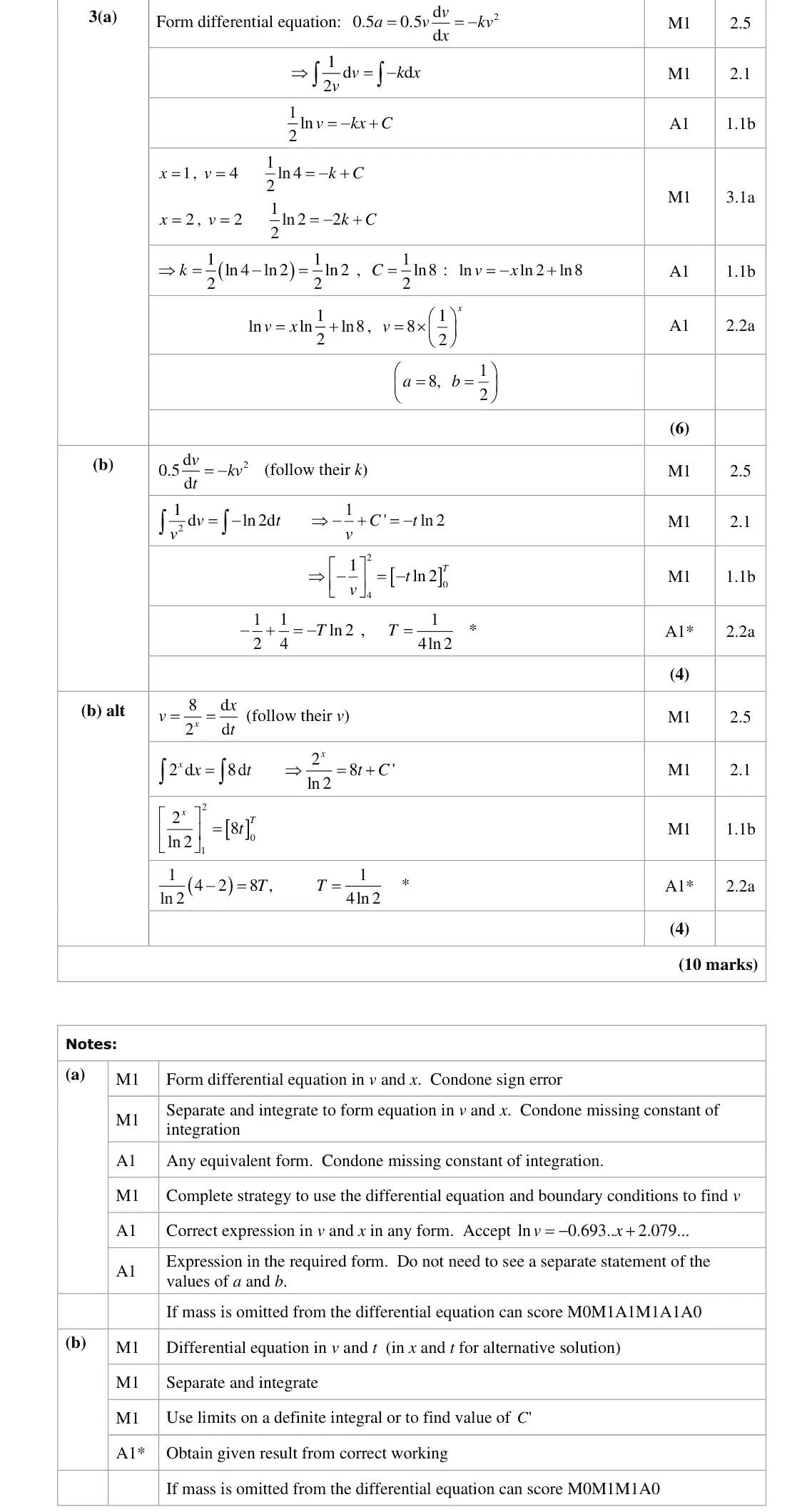
0.5v dv/dx = −kv² (mass must be included, force towards O so negative)
½ln v = −kx + C, k = ½ln 2
v = 8(½)^x so a = 8, b = ½
Oct 2020 · Paper 4C (Further Mechanics 2) · Q3(b)4 marks
Mark scheme (whole question; this part is marked with the orange bar)
Key points from the mark scheme and examiner's report
0.5 dv/dt = −kv² with their k, integrate 1/v² and use limits v = 4 to 2
alternative dx/dt = 8/2^x from 1 to 2
T = 1/(4ln 2)
June 2019 · Paper 4C (Further Mechanics 2) · Q2(a)6 marks
Mark scheme (whole question; this part is marked with the orange bar)
Examiner's comment
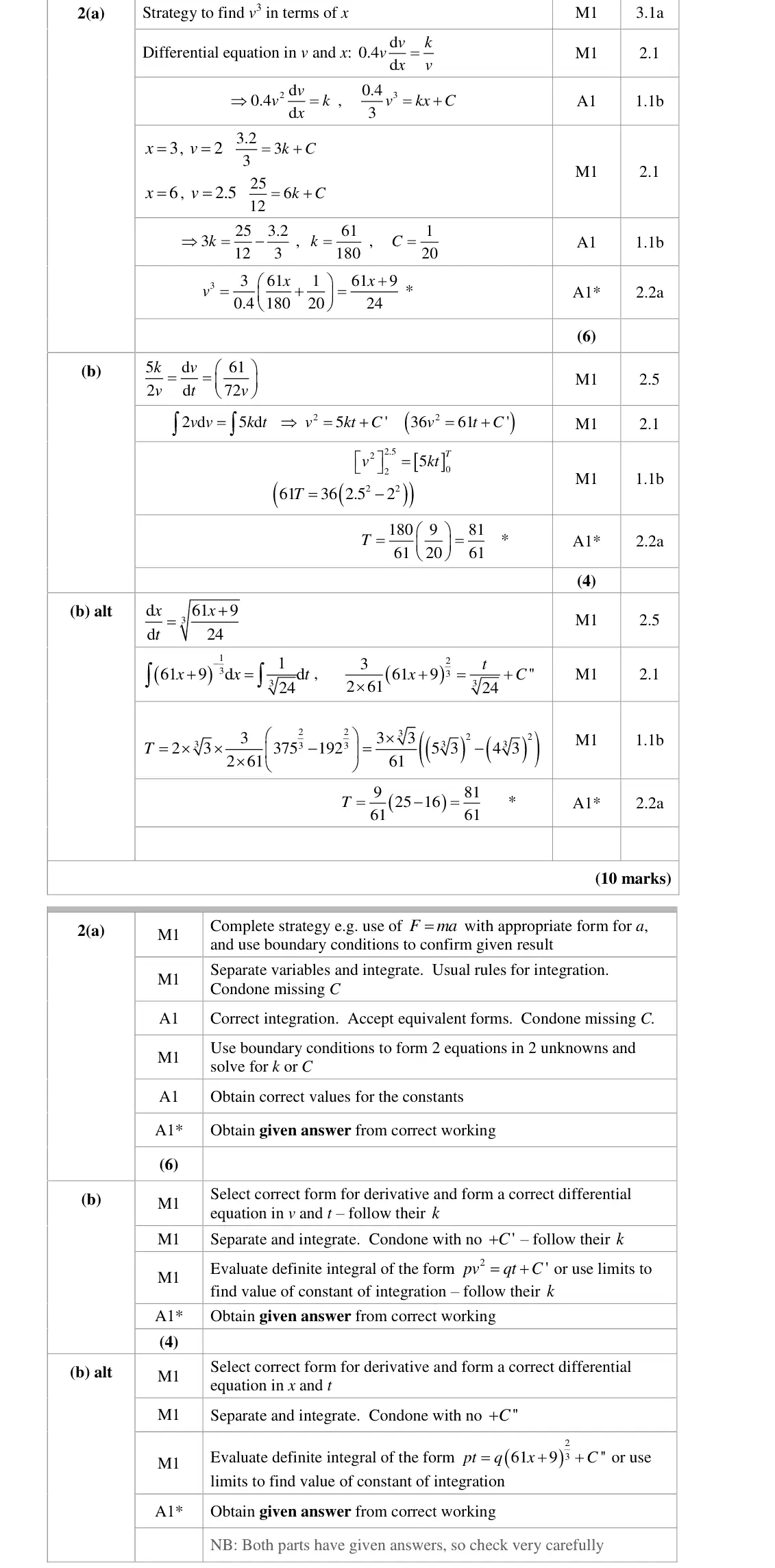
(a) Most candidates set up a correct differential equation in v and x, separated the variables and integrated correctly. This was a “show that…” question, so we needed to see the use of the boundary conditions to find the value of k and of the constant if integration. Many candidates did reach the given result correctly. Several candidates claimed to have reached the given result despite arithmetic slips in their working. from part (a) to form a differential equation in x and t. The latter group of candidates made several errors with the indices and with the coefficients in the integral.
Key points from the mark scheme and examiner's report
0.4v dv/dx = k/v, separate to 0.4v³/3 = kx + C
use both boundary conditions to find k = 61/180 and C = 1/20
given answer so arithmetic must be shown, slips claimed through
June 2019 · Paper 4C (Further Mechanics 2) · Q2(b)4 marks
Mark scheme (whole question; this part is marked with the orange bar)
Examiner's comment
(b) Most candidates did follow the instruction to use algebraic integration, but there were some who simply wrote down an integral followed by the given answer. There were two possible approaches: those candidates who went back to the initial information and formed a differential equation in v and t had an easier integral to complete than those candidates who used the result from part (a) to form a differential equation in x and t. The latter group of candidates made
Key points from the mark scheme and examiner's report
must use algebraic integration
easier route 0.4 dv/dt = k/v giving v² = 5kt + C
via dx/dt = cube root of (61x + 9)/24 is harder and caused index/coefficient errors
writing an integral then the answer scores little
Find an Edexcel Further Maths tutor
Stuck on this? Book a trial lesson with our Further Maths tutor.