19 question parts, 85 marks, 3 with a difficulty rating from the examiner's report
Notes, worked examples and practice for this topic are being written by our tutors. The past-paper questions below are ready now: work each one on paper, then open the mark scheme and the examiner's comment.
Tap a question to zoom it. Mark scheme and examiner's comment open under each question.
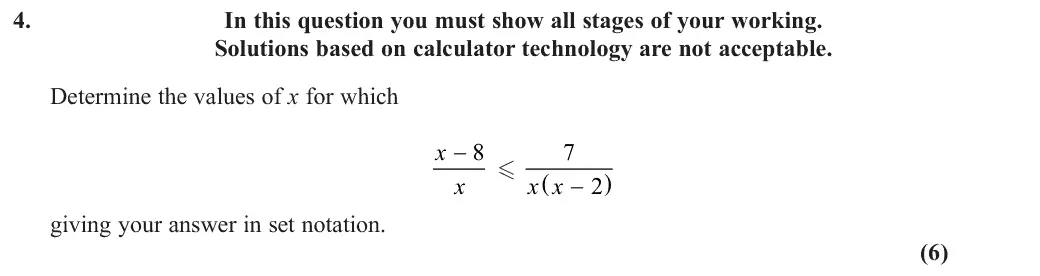
June 2025 · AS Paper 2 (Further Pure 1) · Q46 marks
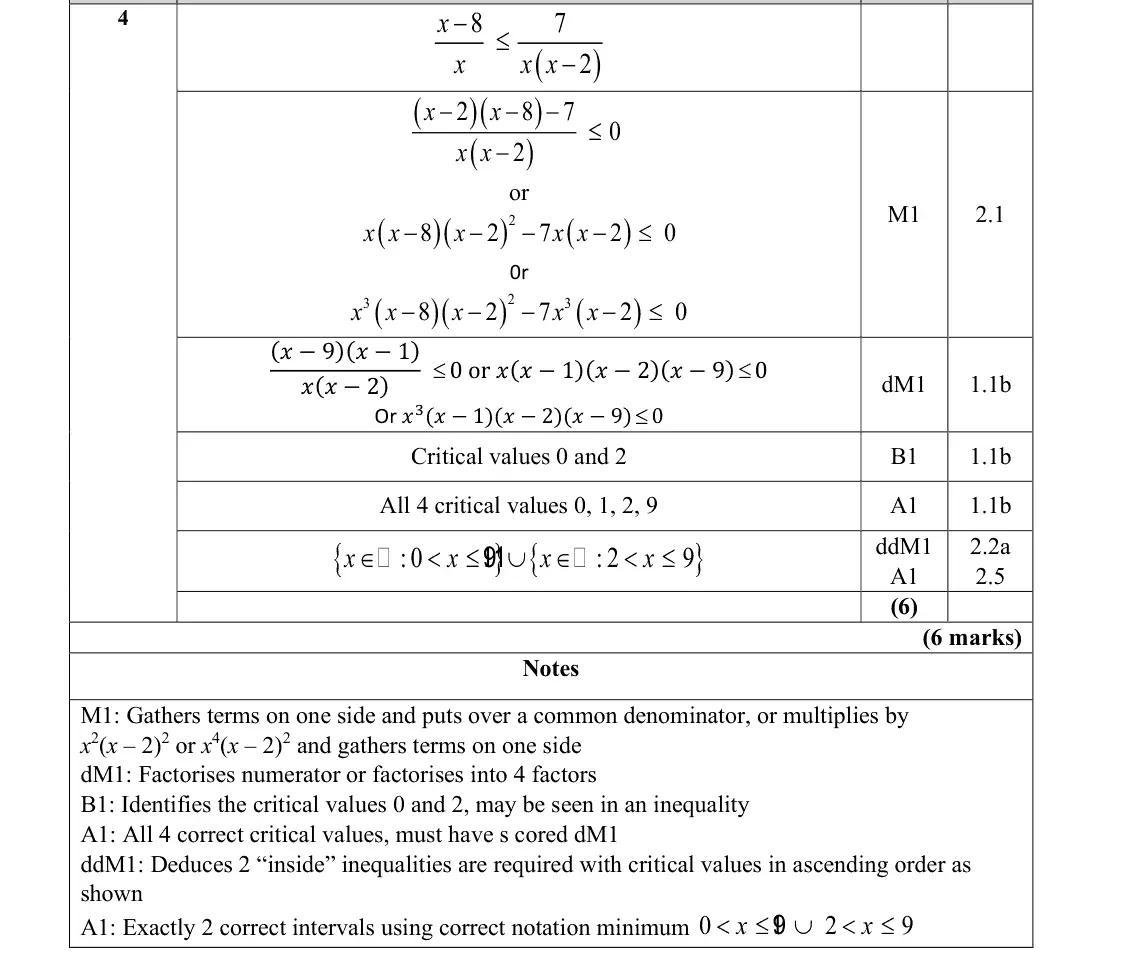
Mark scheme (whole question; this part is marked with the orange bar)
Examiner's comment
The majority of candidates attempted to solve by multiplying up, although many algebraic errors arose, particularly in ensuring that they multiplied by squared terms throughout. Those who succeeded in forming a correct inequality this way sometimes proceeded to multiply out all their brackets, forming a polynomial in x4 or x6 . Some candidates multiplied out the brackets and then used their calculator to solve and only gained two mark. Those who followed the instruction that calculator technology was not acceptable, and kept their terms as fully factorised as possible, were able to factorise the resulting expression correctly. Candidates who moved onto one side and then used a common denominator where able to factorise their numerator correctly. Some candidates ignored the 0 x = as one of their critical values. In the final answer, some candidates realised that 0 x = and 2 x = were not included in the range, but many made errors in the > or >= signs. A few candidates did not use set notation correctly, most often by using the intersection rather than union sign.
Key points from the mark scheme and examiner's report
common denominator: (x − 1)(x − 9)/(x(x − 2)) ≤ 0, or multiply by x²(x − 2)²
critical values 0, 1, 2, 9
answer {x : 0 < x ≤ 1} ∪ {x : 2 < x ≤ 9}
0 and 2 must be strict
expanding to a polynomial and using a calculator scores little
intersection instead of union
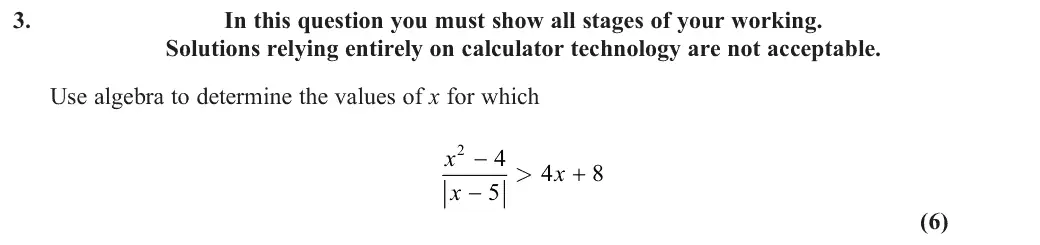
June 2025 · Paper 3A (Further Pure 1) · Q36 marks
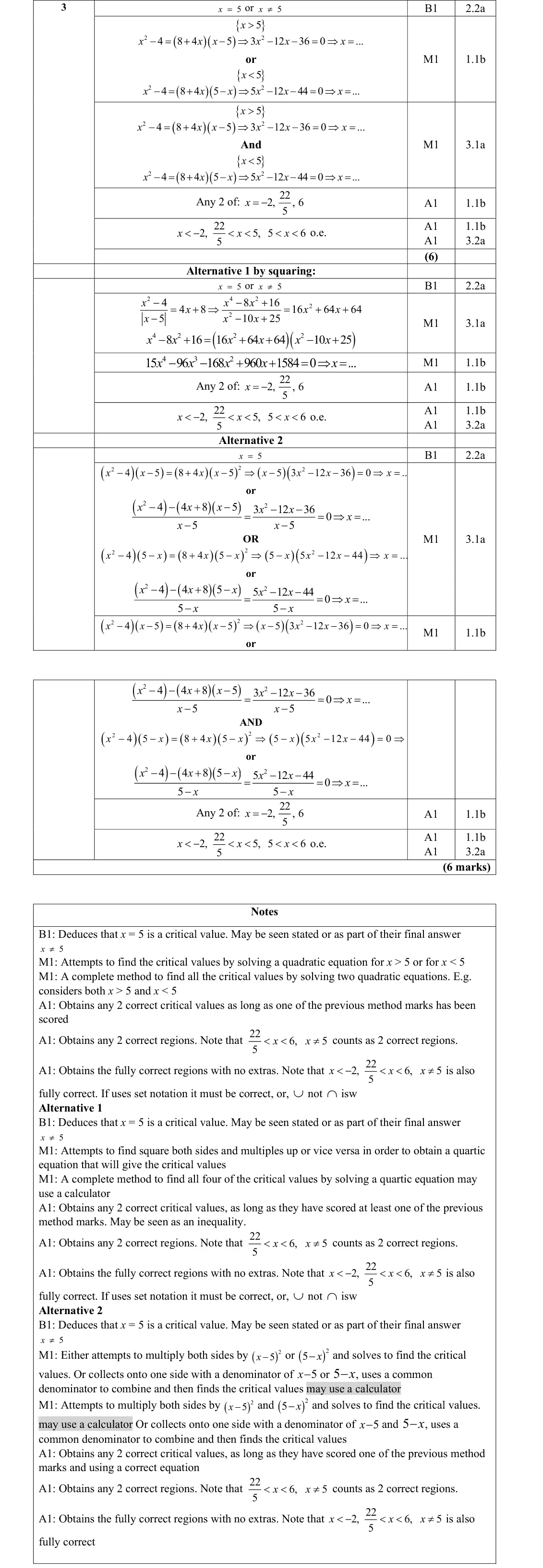
Mark scheme (whole question; this part is marked with the orange bar)
Examiner's comment
This question required the learners to first find the critical values of the given expression and then to express the sets of solutions as inequalities. Using graphical calculators was not allowed due to the wording of the question. No evidence was seen of their use and the requirement to show all stages of working was well understood. The identification of x = 5 as an asymptote, or the equivalent x ≠ 5, was often omitted throughout the solution or did not appear until the final answer. A variety of correct approaches were seen. The most common was to consider the cases x > 5 and x < 5 separately to reach two quadratics which, when solved yielded three critical values. Another common approach was to multiply through by (𝑥𝑥-5)2and (5 -𝑥𝑥)2 to proceed in the same way. A less common approach was to square both sides of the given expression which led to a quartic in x. It was permissible to use a calculator to solve this although factorisation was also seen. A very common error was only considering (𝑥𝑥-5)2 to find three of the four critical values but did not consider (5 -𝑥𝑥)2 to find the final critical value. Having found all of the critical values, learners who ignored x = 5 being an asymptote lost both marks for the inequalities and only achieved half marks for the whole question. It was very common to see sketches used to help learners identify relevant regions, but unless the asymptote at 5 was identified it did not help them gain full marks.
Key points from the mark scheme and examiner's report
x = 5 is excluded (asymptote)
cases x > 5 and x < 5 give 3x² − 12x − 36 = 0 and 5x² − 12x − 44 = 0: critical values −2, 22/5, 6
answer x < −2 or 22/5 < x < 6, x ≠ 5
x ≠ 5 often omitted
June 2024 · AS Paper 2 (Further Pure 1) · Q1(a)2 marks
Mark scheme (whole question; this part is marked with the orange bar)
Examiner's comment
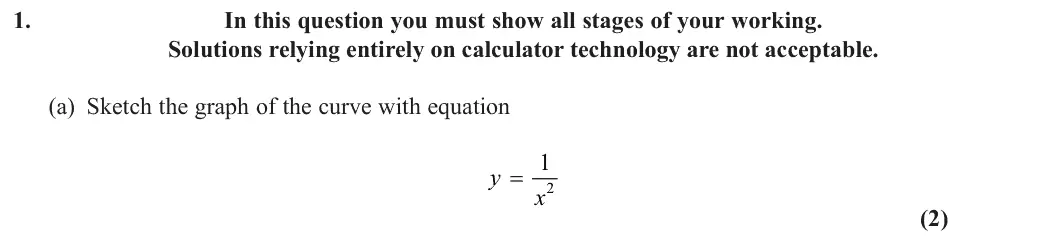
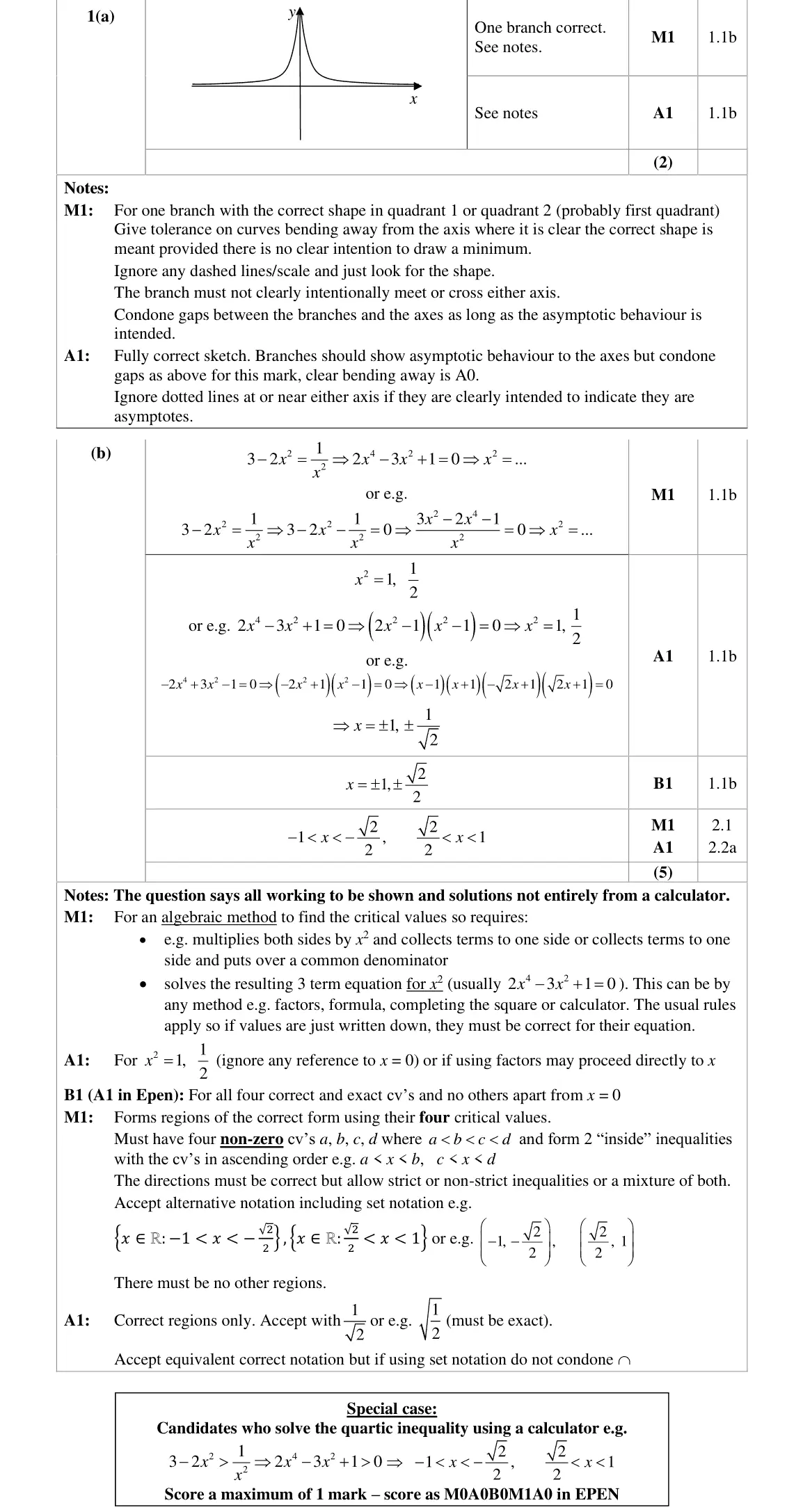
In part (a), the quality and accuracy of the sketches was very varied. Many candidates could at least score the first mark for a recognisable branch in quadrant 1 or 2 although there were many cases where the branch clearly curved away from one axis or both axes or clearly stopped at an axis rather than being asymptotic to it. There were a significant number of cases where candidates sketched 1 y x = rather than 2 1 . y x =
Key points from the mark scheme and examiner's report
two branches in quadrants 1 and 2, symmetric in the y-axis, asymptotic to both axes
branches bending away from or touching an axis lose the A mark
some sketched y = 1/x instead
June 2024 · AS Paper 2 (Further Pure 1) · Q1(b)5 marks
Mark scheme (whole question; this part is marked with the orange bar)
Examiner's comment
In part (b), the majority of candidates knew how to start and multiplied both sides by 2x or sometimes 4. x A small minority multiplied one side by 2x and the other by 4x and made little progress. Of those who started correctly, most obtained a 3 term quadratic equation in 2. x At this point many candidates just used a calculator to quote roots and then, realising all working needed to be shown, tried to show the factorisation, which more often than not, did not match their equation. Some candidates only obtained a 2-term equation which often resulted by evaluating 2 2 x x- x as 0 rather than 1. Some who solved their equation for x2 forgot about the negative values of x. The majority of those who obtained the correct critical values selected the correct regions although some had extra regions or incorporated x = 0 as a critical value. Many candidates used set notation even though this was not required.
Key points from the mark scheme and examiner's report
calculator roots without algebra and forgetting negative roots were common
June 2024 · Paper 3A (Further Pure 1) · Q24 marks
Mark scheme (whole question; this part is marked with the orange bar)
Examiner's comment
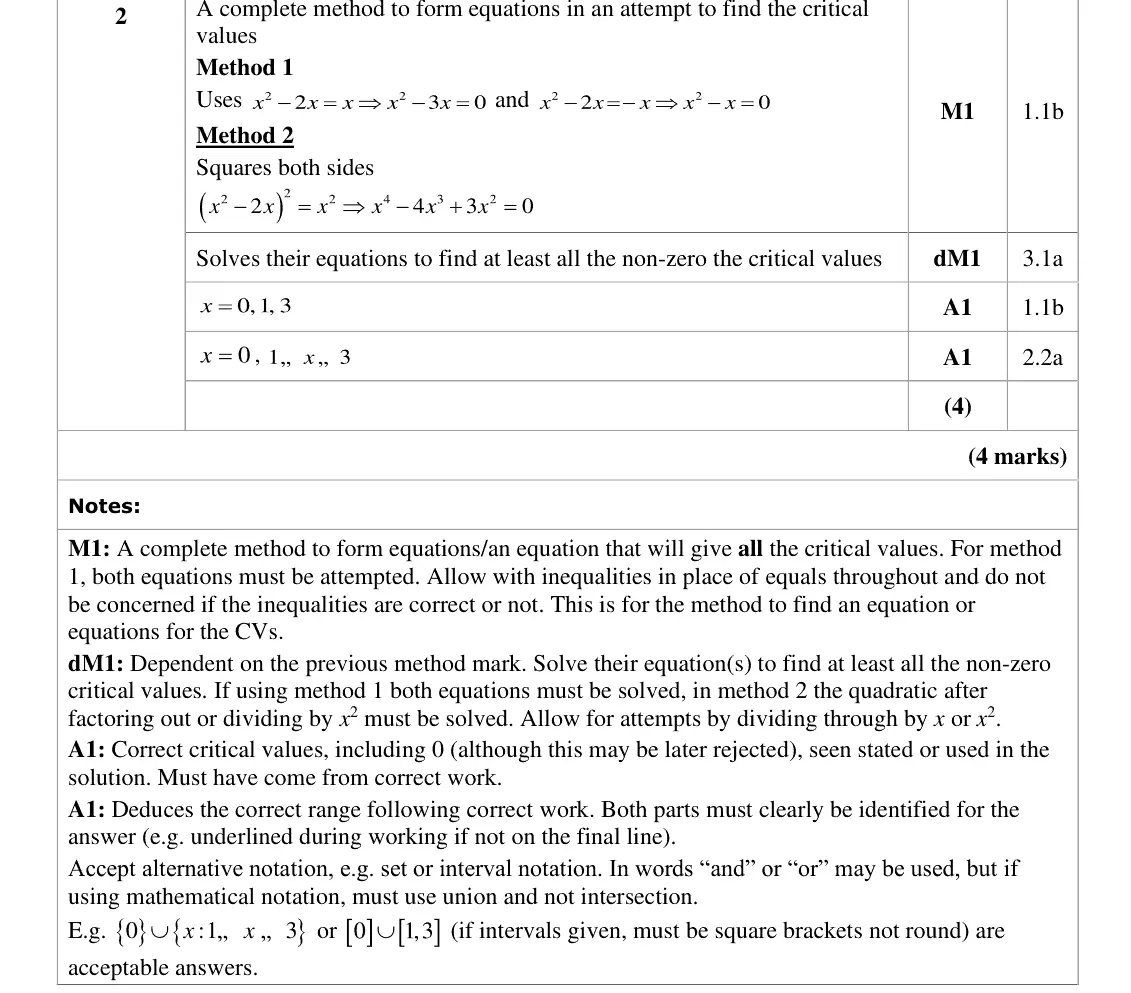
The majority of candidates seemed able to make a good attempt at this question to gain at least 2 or 3 marks. By far the most common approach was forming and solving two separate equations/inequalities for the different cases of the modulus function. Fewer candidates took the approach of squaring both sides to form and then solve a quartic equation and occasionally mistakes were made when interpreting the modulus function which resulted in the incorrect equation x2 + 2x = x occasionally appearing. Once the correct equations were formed, all three critical values were usually determined correctly with the division by x resulting in the loss of x = 0 as a critical value being only occasionally seen. The final mark proved more elusive as quite a few candidates were not able to piece together their previous values/solutions to give an overall correct range. The most common error here was the omission of x = 0. Although the mark scheme was quite generous in condoning incorrect inequalities for the method marks, the question revealed some confusion with regards to inequalities. It was very common for candidates to use the wrong symbols and give incorrect ranges during the intermediate stages of work, even if their final answer was ultimately correct. It was pleasing to see that many candidates drew accurate sketches of the graphs of both y = | x2 – 2x| and of y = x and when this was done it very often helped them to include x = 0 and to reach the correct final solution set. Different notations for the final answer were seen, but stating the inequalities was the most common, with set notation and interval notation only used in a small number of cases.
Key points from the mark scheme and examiner's report
solve x² − 2x = ±x (or square to a quartic): critical values 0, 1, 3
answer x = 0 or 1 ≤ x ≤ 3
dividing by x loses x = 0, and x = 0 was often omitted from the final set
June 2023 · AS Paper 2 (Further Pure 1) · Q1(a)4 marks
Mark scheme (whole question; this part is marked with the orange bar)
Examiner's comment
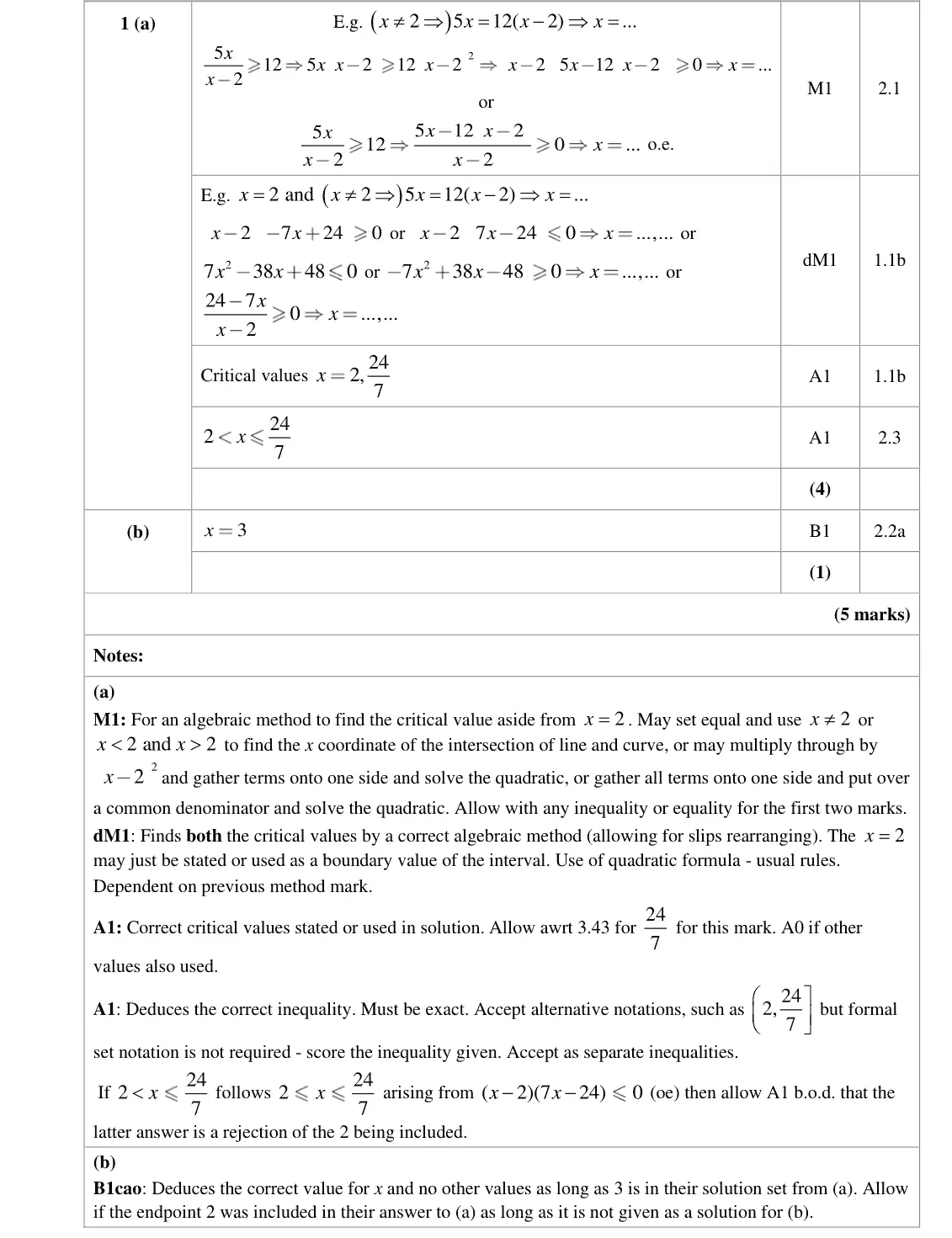
With full marks achieved by well over one third of students, this question provided a reassuring start to the paper for many. However, part (b) was not well understood, and so full marks was relatively uncommon. Part (a) was well answered by the vast majority, with mainly slips in the inclusion or not of boundary values in the solution preventing full marks from this part for many. Most were able to achieve the correct critical values, though there were occasional slips or miscopies, e.g. from omitting the x to obtain 5(x – 2) when multiplying by (x – 2)2, or incorrect multiplying out to give 5x2 – 10. Multiplication through by (x – 2)2 was the most common of the methods to find the critical values, though the other approaches were also seen frequently. Most students solved the quadratic (if one was found) correctly, but a few who factorised gave the value as 7 24 rather than 24 7 . There were also some sign errors at this stage. A few assumed that the critical values needed to be integers so tried rounding. As noted, the biggest problem in this part was the inequality at the end, with many students failing to give a strict inequality at the lower end of the range – even if they had said x ≠ 2 in their response. Only a small number of students made the error of selecting the outside ranges as their solution.
Key points from the mark scheme and examiner's report
multiply by (x − 2)² (or common denominator): (x − 2)(7x − 24) ≤ 0
critical values 2 and 24/7
answer 2 < x ≤ 24/7
the commonest loss was a non-strict inequality at x = 2
slips such as 5(x − 2) for 5x(x − 2)
June 2023 · AS Paper 2 (Further Pure 1) · Q1(b)1 mark
Mark scheme (whole question; this part is marked with the orange bar)
Examiner's comment
With full marks achieved by well over one third of students, this question provided a reassuring start to the paper for many. However, part (b) was not well understood, and so full marks was relatively uncommon. For part (b) there seemed to be some difficulty in picking out an integer value within the range; a large number of students seemed to think they needed a critical value in part (b), so there were responses like x ≠ 2 so x = 24 7 , or x = 2 because 24 7 is not an integer. What should have been a routine task seem instead to confuse many, who did not realise, for one reason or another, what was being asked.
Key points from the mark scheme and examiner's report
the only integer in 2 < x ≤ 24/7 is x = 3
many thought a critical value was required (x = 2 or 24/7)
June 2023 · Paper 3A (Further Pure 1) · Q37 marks
Mark scheme (whole question; this part is marked with the orange bar)
Examiner's comment
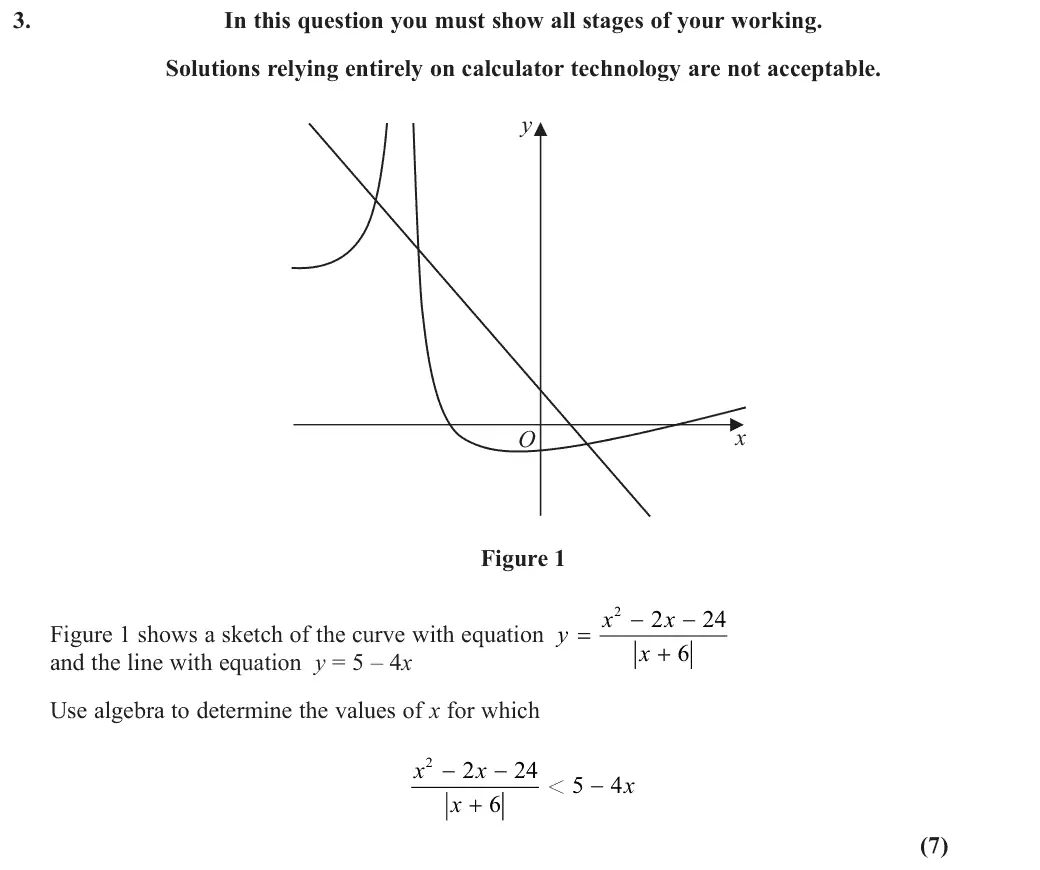
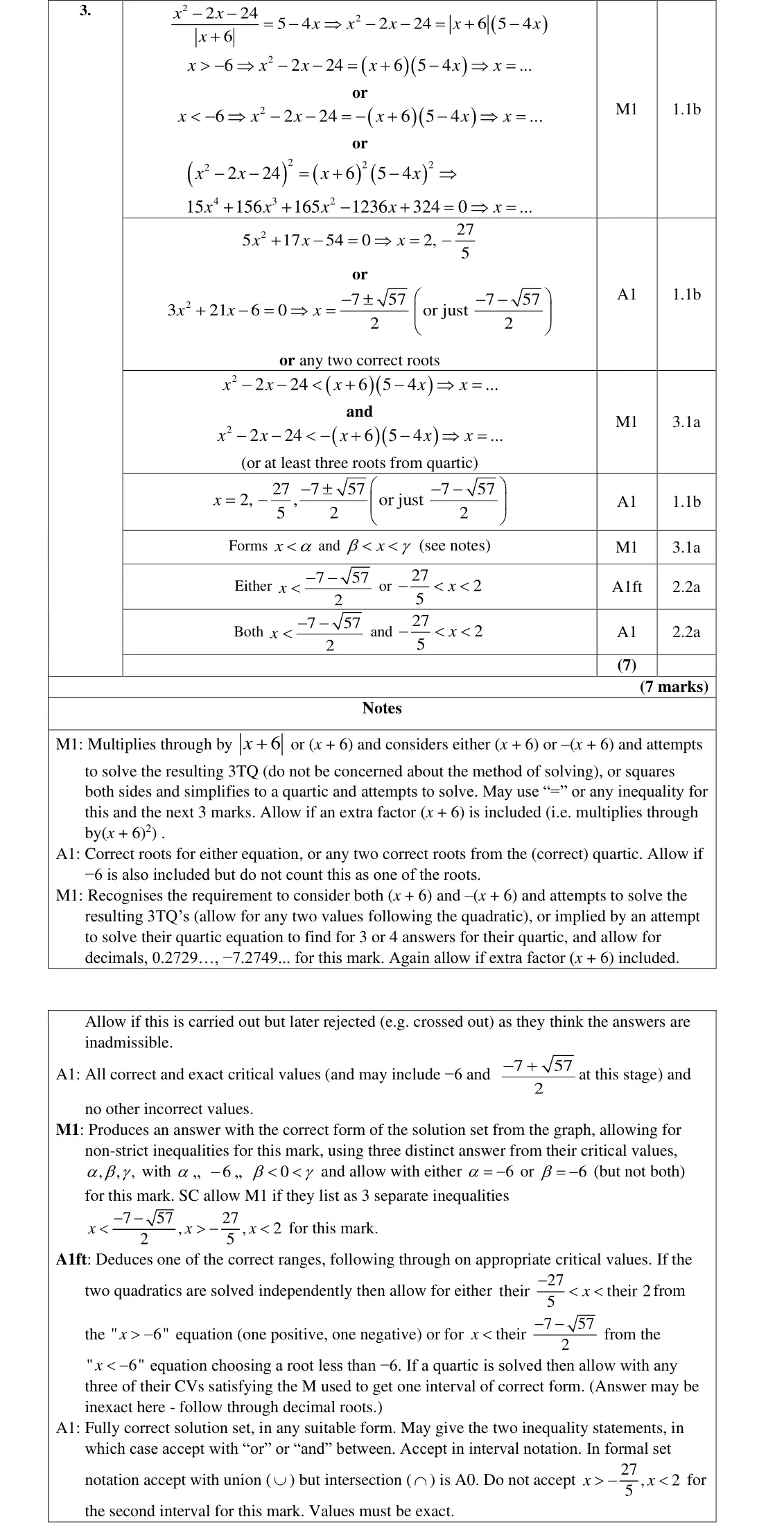
Another very well answered question with many scoring full marks. A score of 4/7 also proved a common scoring profile, which could arise in a couple of ways - either all four critical values correct, but incorrect form of solution set, or just two of the critical values from one equation, with -6, as another and a correct form for the solution set using this. Most students recognized the need to multiply by (x + 6), or its square, and solve the resulting equation, with the majority successfully finding the two values for x from this branch. Those who multiplied by (x + 6)2 were sometimes then confused by the solution x = -6, not recognizing that that was the equation of the asymptote, but treating it as one of the critical values, and some would go on to use this as part of the solution set, while neglecting the other branch (see paragraph 1). Often an inequality would be given immediately following the solution, though usually it was also reiterated in a final solution. Most students then identified the need to multiply by –(x + 6) and those that used the quadratic formula successfully gained the correct values of x, though some only gave the decimal values. Attempts at multiplying by (x - 6) and even (6 – x), and sometimes all four cases, were also seen among some students, who tried desperately to come out with a solution, and often result in multiple answers making it difficult to decide what the students final answer was. Students should bring the working together at the end of such piecemeal attempts to make their final answer clear. A few students attempted to square both sides and were less successful. Those that did manage to gain the correct quartic were usually unable to progress to the exact values required to gain full credit, though 5 marks were available for decimal solutions for the exact values. Students found the creation of the solution set more problematic and were not always able to relate the four values of x to the diagram to identify form of the solution set and the value to reject. Those that did refer to the diagram or had drawn a number line to aid them were more successful in gaining full marks. Where all four critical values and -6 were all found, and the correct form of the solution set deduced, there was still some difficulty in selecting the correct values to use. Though the -6 was often rejected, so was the 27 5 - , with a common incorrect answer being 7 , 6 2 2 57 x x -- - .
Key points from the mark scheme and examiner's report
multiply by (x + 6) for x > −6 and by −(x + 6) for x < −6
critical values −27/5, 2 and (−7 − √57)/2
answer x < (−7 − √57)/2 or −27/5 < x < 2
−6 is the asymptote, not a critical value to include
exact values needed
June 2022 · AS Paper 2 (Further Pure 1) · Q16 marks
Mark scheme (whole question; this part is marked with the orange bar)
Examiner's comment
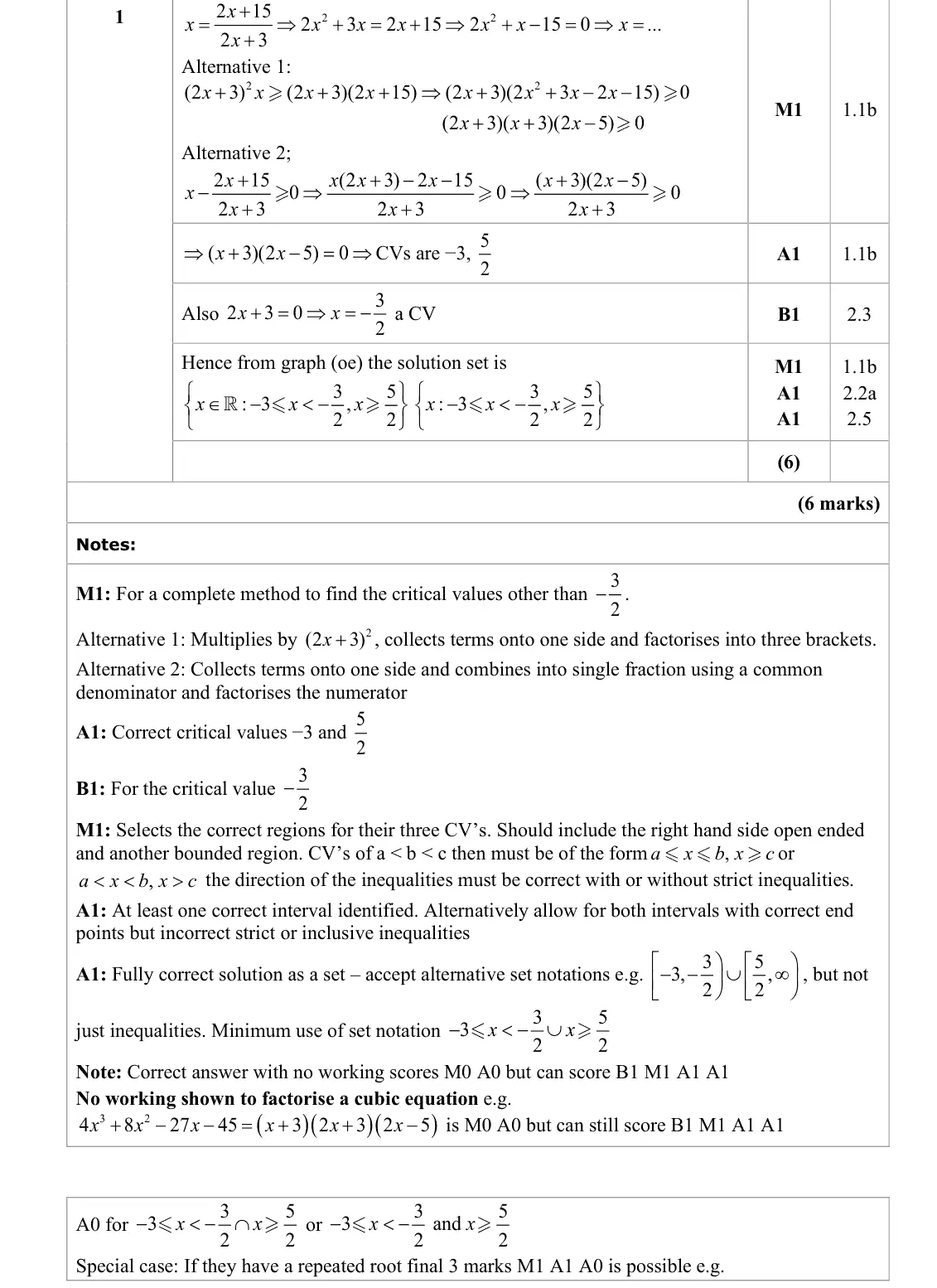
The vast majority of candidates understood how to approach this question, with the most common approach to be multiplying both sides by ( ) 2 2 3 x + , rearranging, simplifying and factorising. In most cases this was successful, although there were some arithmetic errors. Amongst candidates who expanded to a cubic only a very few showed an algebraic method to locate the critical values, and lost marks as a result. Almost all candidates located 3 2 - as a critical value but only a minority recognised that the function was not defined at this value. Most candidates with 3 critical values went on to correctly identify the inequalities needed to solve the inequality, however most used weak inequalities throughout, rather than the strict inequality needed for 3 2 - . A significant number of responses did not use set notation in their final answer and lost the last A1 as a result.
Key points from the mark scheme and examiner's report
multiply by (2x + 3)² or combine into one fraction: (x + 3)(2x − 5)/(2x + 3) ≥ 0
critical values −3, −3/2, 5/2
answer −3 ≤ x < −3/2 or x ≥ 5/2 in set notation
−3/2 must be strict (function undefined)
missing set notation loses the last mark
an unfactorised cubic with no working loses the method marks
June 2022 · Paper 3A (Further Pure 1) · Q7(a)2 marksMedium
Mark scheme (whole question; this part is marked with the orange bar)
Examiner's comment
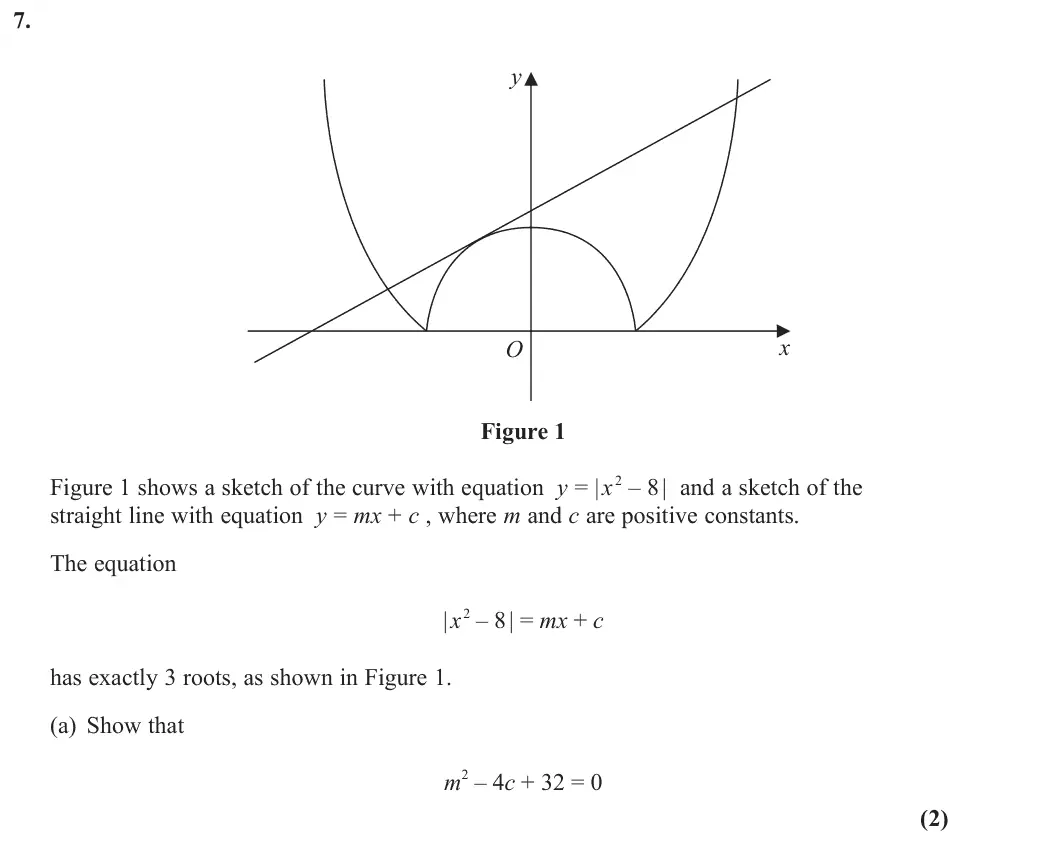
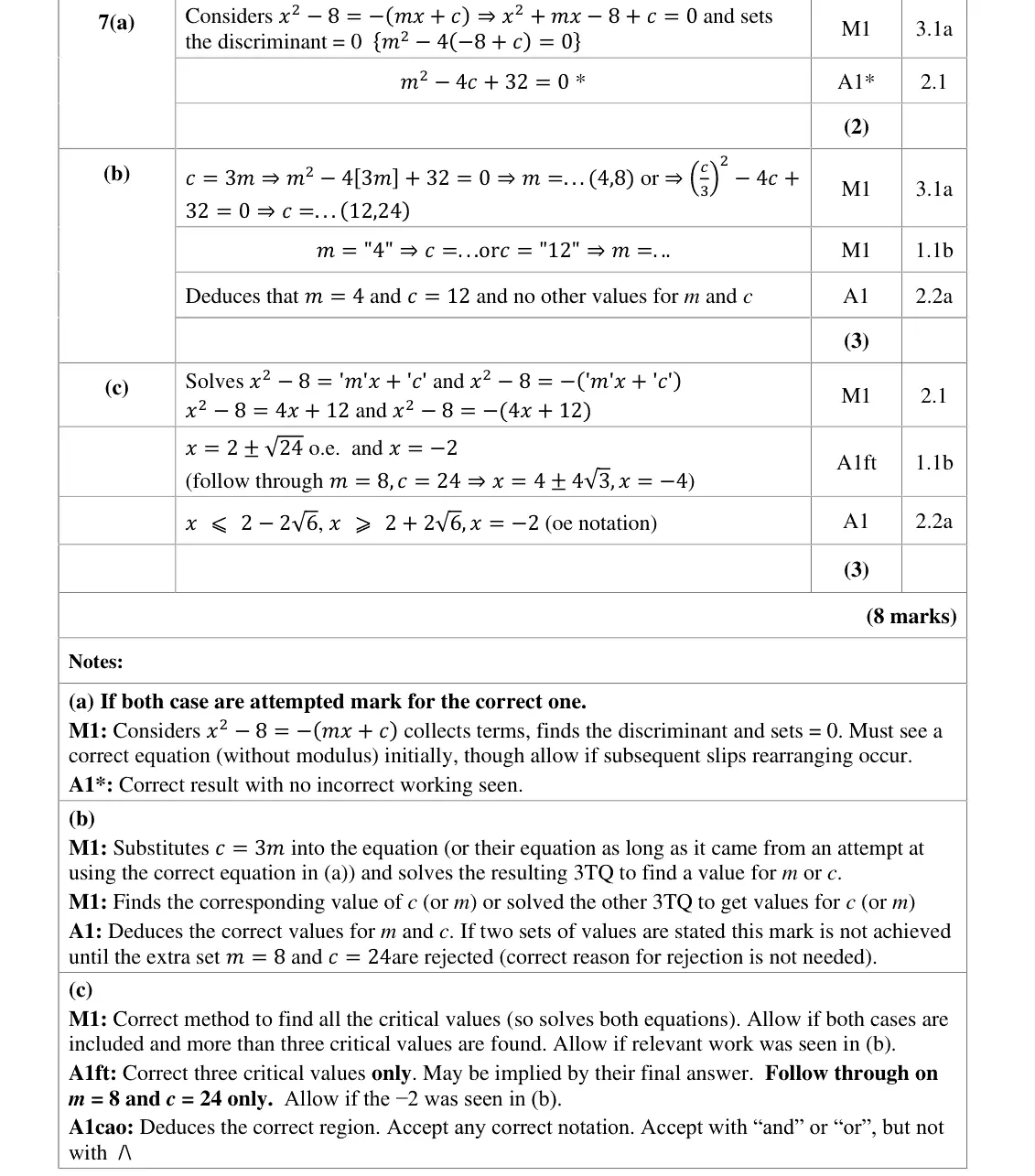
This proved to be the most challenging question on the paper with less than 30% obtaining full marks, though this was still the modal score. The mean 5.85 out of 8 was proportionally the lowest for all questions, though most did score at least 2 marks, for work in part (b). There was a good spread of marks from 2 to 8 making it a good discriminating question. In part (a) the majority of candidates did considered the discriminant of the relevant equation 2 8 mx c x - = + , albeit in many cases through trying both cases, though some tried to force the result from an incorrect equation, either using 2 2 8 8 or x mx c mx c x - = + + = + . Both those who started with the correct equation and those considering both cases were very usually successful and in the latter case were permitted the marks.
Key points from the mark scheme and examiner's report
line is tangent to the reflected part: x² − 8 = −(mx + c) has discriminant 0: m² − 4c + 32 = 0
forcing the result from x² − 8 = mx + c
June 2022 · Paper 3A (Further Pure 1) · Q7(b)3 marksMedium
Mark scheme (whole question; this part is marked with the orange bar)
Examiner's comment
This proved to be the most challenging question on the paper with less than 30% obtaining full marks, though this was still the modal score. The mean 5.85 out of 8 was proportionally the lowest for all questions, though most did score at least 2 marks, for work in part (b). There was a good spread of marks from 2 to 8 making it a good discriminating question. Part (b) proved to be accessible as equations needed were given in the question, so it was a case of solving the given equation with c = 3m. The values of m and c were usually easily found, but many candidates left their answer with 2 possible values for each of them, not realising the relevance of the second pair of values. A minority selected the wrong values, but many selected the correct values, some with very long demonstrations as to why. The visualisation of the problem was not good.
Key points from the mark scheme and examiner's report
c = 3m gives m² − 12m + 32 = 0: m = 4 or 8
the figure (line touches the arch left of O) gives m = 4, c = 12 only
many left both pairs
June 2022 · Paper 3A (Further Pure 1) · Q7(c)3 marksMedium
Mark scheme (whole question; this part is marked with the orange bar)
Examiner's comment
This proved to be the most challenging question on the paper with less than 30% obtaining full marks, though this was still the modal score. The mean 5.85 out of 8 was proportionally the lowest for all questions, though most did score at least 2 marks, for work in part (b). There was a good spread of marks from 2 to 8 making it a good discriminating question. Part (c) of the question caused the most problem to candidates, either because they were working with 2 possible values for both m and c or because they forgot to solve both equations. Many candidates who correctly found the critical values then missed out on the final A1, either because they did not include x = -2 in their answer or because they did not include the boundaries in their inequalities. Those who ended up solving four equations and finding 6 critical values could only access the first mark. On the other hand, there were many candidates who only solved one equation and consequently missed the third critical value, who scored no marks for this part.
Key points from the mark scheme and examiner's report
solve x² − 8 = 4x + 12 (x = 2 ± 2√6) and touching point x = −2
answer x ≤ 2 − 2√6, x ≥ 2 + 2√6, x = −2
x = −2 and non-strict inequalities often missed
Nov 2021 · Paper 3A (Further Pure 1) · Q38 marks
Mark scheme (whole question; this part is marked with the orange bar)
Examiner's comment
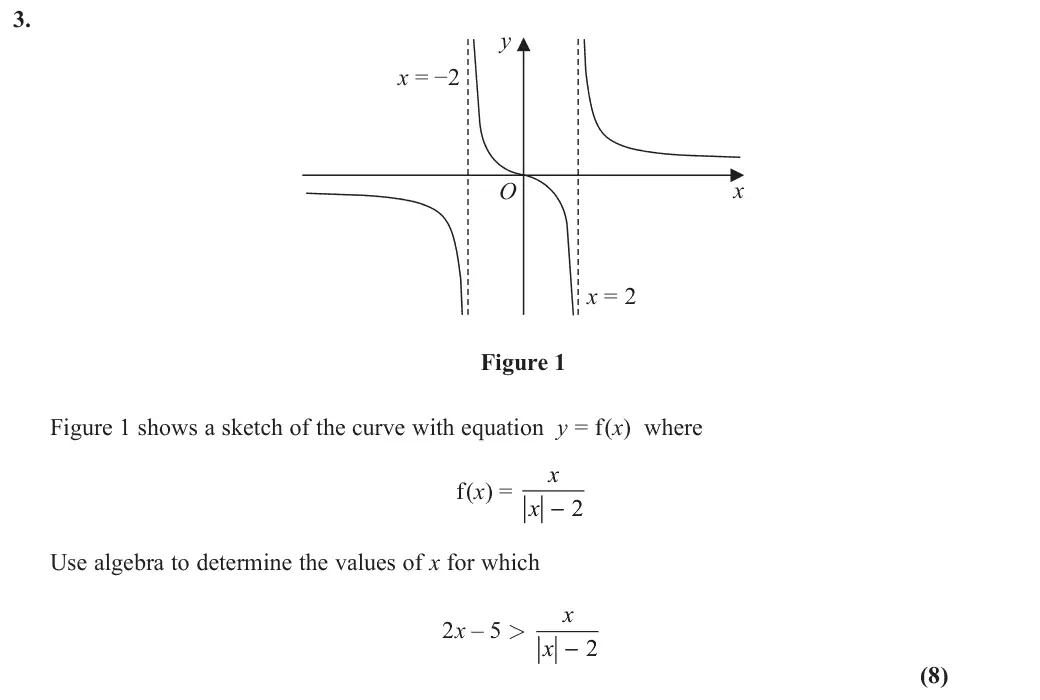
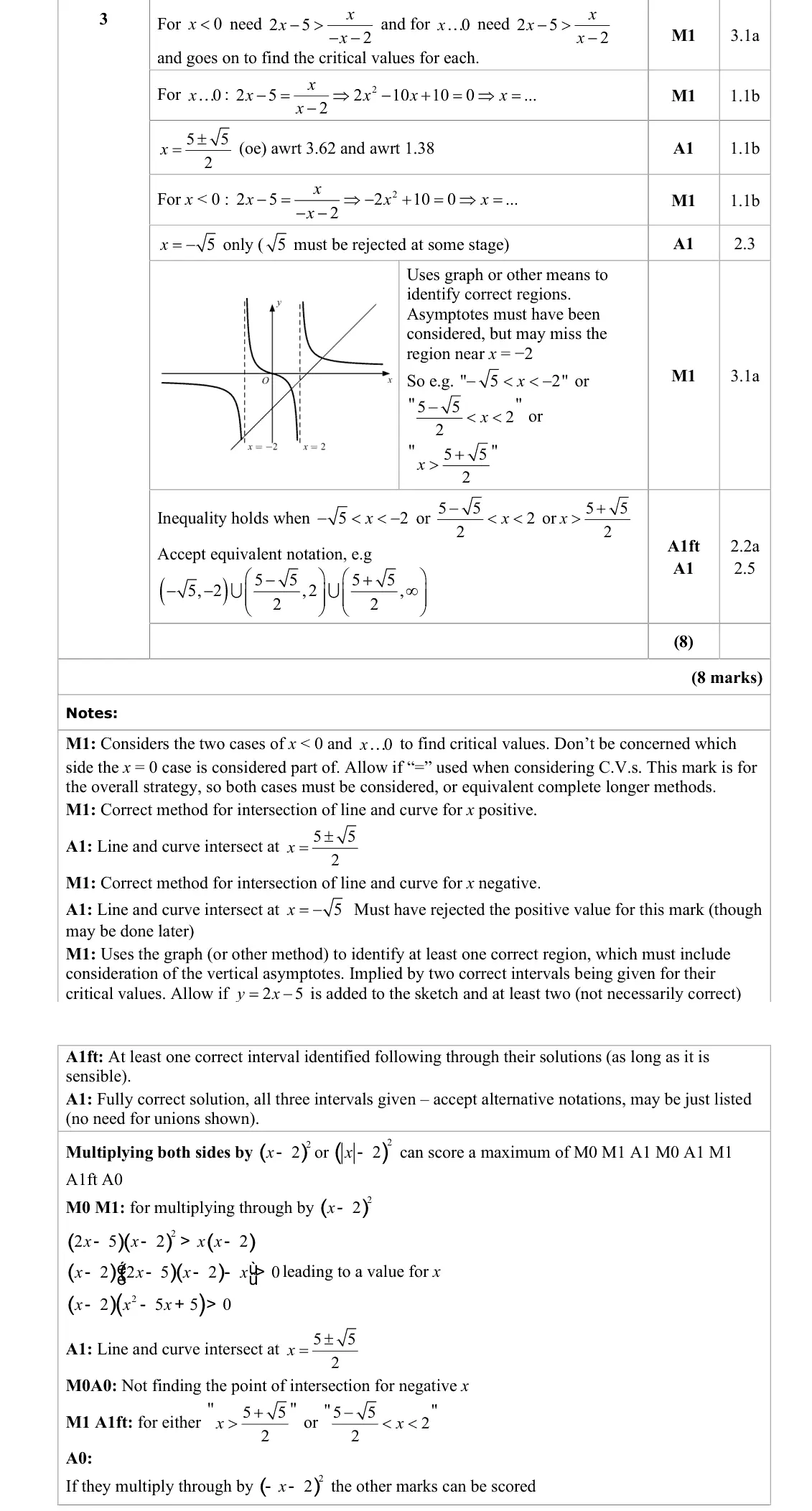
Candidates needed to consider the two situations when • 0 x solving 2 5 2 x x x - > - • 0 x < solving 2 5 2 x x x - > -- Many candidates multiplying both sides by 2 2 x considering the first situation, when just multiplying by 2 x would have sufficed. Candidates found the critical values and then found a required region. Quite a few candidates did not consider the second situation but managed to score 4 out of the 8 marks. Candidates who did consider the second situation again multiplying both sides by 2 2 x when just multiplying by 2 x would have sufficed. The critical value 5 needed to be rejected. Candidates who found the correct critical values were able to successfully determine the correct regions.
Key points from the mark scheme and examiner's report
treat x ≥ 0 and x < 0 separately
critical values (5 ± √5)/2 and −√5 (reject √5)
answer −√5 < x < −2, (5 − √5)/2 < x < 2, x > (5 + √5)/2
many ignored x < 0 (max 4/8) or multiplied by (x − 2)² unnecessarily
Oct 2020 · AS Paper 2 (Further Pure 1) · Q25 marks
Mark scheme (whole question; this part is marked with the orange bar)
Examiner's comment
All candidates apart from one made an attempt at this question. Success was variable and 5 candidates failed to score any marks as they simply multiplied up to eliminate the fractions with no consideration of sign. Others knew to multiply through by positive expressions but chose to expand to obtain a large number of terms rather than factorise where possible. This inevitably led to long complicated expressions that were difficult to make any headway with, to obtain the required critical values. 3 candidates scored full marks on this question.
Key points from the mark scheme and examiner's report
expanding instead of factorising led to unmanageable expressions
Oct 2020 · Paper 3A (Further Pure 1) · Q6(a)8 marks
Mark scheme (whole question; this part is marked with the orange bar)
Examiner's comment
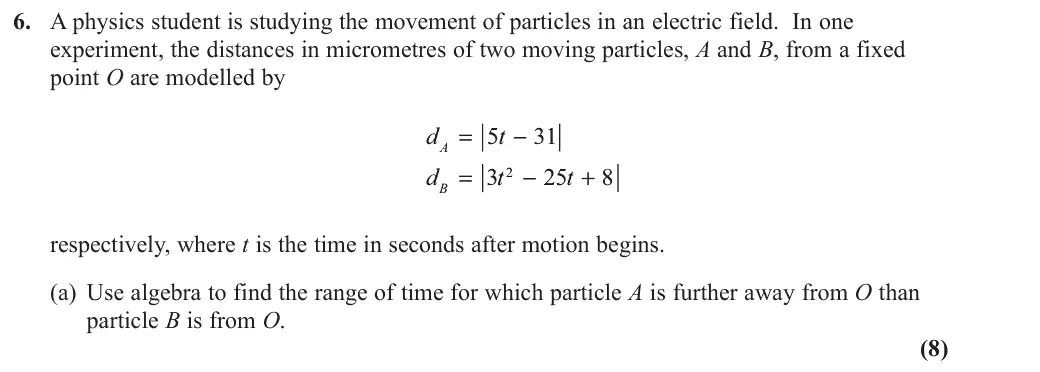
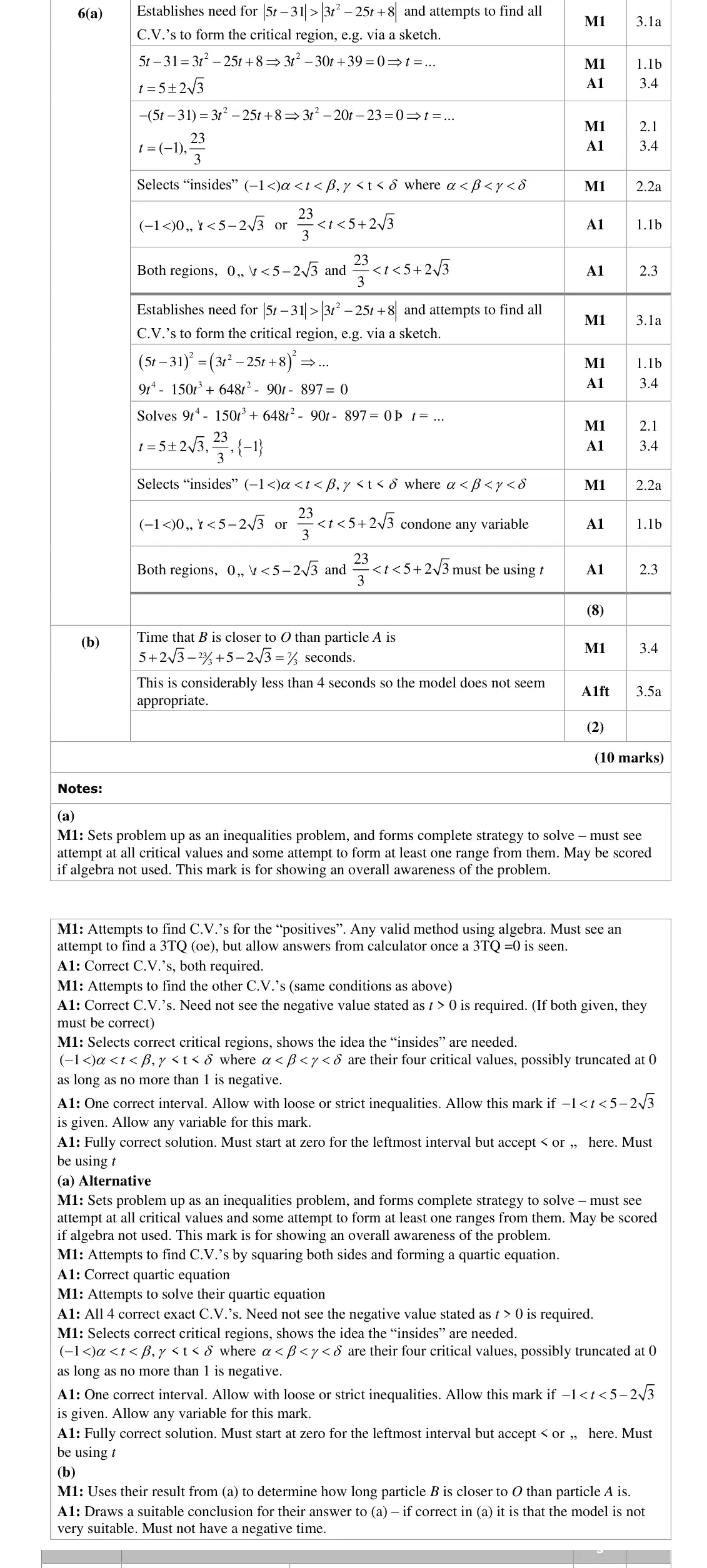
This was a good context for the use of inequalities and nearly all the candidates interpreted the question well, setting up an inequality and attempting to solve it. Most candidates found critical values by considering regions and solving two quadratic equations, a smaller number of candidates squared both sides to obtain a quartic equation which they then solved using their calculator. Accuracy marks were lost using the second approach as exact values were not obtained. There were many correct time intervals formed using the four critical values but some candidates struggled with the context here, giving various combinations of incorrect time intervals or not appreciating the need for 0 rather than – 1 as the minimum value of t. There were a large number of accuracy errors in part a; arithmetic errors leading to incorrect quadratic equations and incorrect critical values and miscopying 5t + 31 to 5t + 3. A large number of candidates did not attempt part b. Of those that did make an attempt, many struggled to interpret their solution to part a within the context of the question, considering whether t = 4 was within their intervals rather than calculating a total time from their intervals.
Key points from the mark scheme and examiner's report
critical values from 5t − 31 = ±(3t² − 25t + 8): t = 5 ± 2√3, 23/3, −1
answer 0 ≤ t < 5 − 2√3 and 23/3 < t < 5 + 2√3
start at t = 0 not −1
squaring to a quartic loses exactness
arithmetic slips (5t + 3)
Oct 2020 · Paper 3A (Further Pure 1) · Q6(b)2 marks
Mark scheme (whole question; this part is marked with the orange bar)
Examiner's comment
This was a good context for the use of inequalities and nearly all the candidates interpreted the question well, setting up an inequality and attempting to solve it. Most candidates found critical values by considering regions and solving two quadratic equations, a smaller number of candidates squared both sides to obtain a quartic equation which they then solved using their calculator. Accuracy marks were lost using the second approach as exact values were not obtained. There were many correct time intervals formed using the four critical values but some candidates struggled with the context here, giving various combinations of incorrect time intervals or not appreciating the need for 0 rather than – 1 as the minimum value of t. There were a large number of accuracy errors in part a; arithmetic errors leading to incorrect quadratic equations and incorrect critical values and miscopying 5t + 31 to 5t + 3. A large number of candidates did not attempt part b. Of those that did make an attempt, many struggled to interpret their solution to part a within the context of the question, considering whether t = 4 was within their intervals rather than calculating a total time from their intervals.
Key points from the mark scheme and examiner's report
total time B is closer = (5 − 2√3) + (5 + 2√3 − 23/3) = 7/3 s, well below 4 s, so the model is not appropriate
many did not attempt or just checked whether t = 4 lay in their interval
June 2019 · AS Paper 2 (Further Pure 1) · Q2(a)2 marks
Mark scheme (whole question; this part is marked with the orange bar)
Examiner's comment
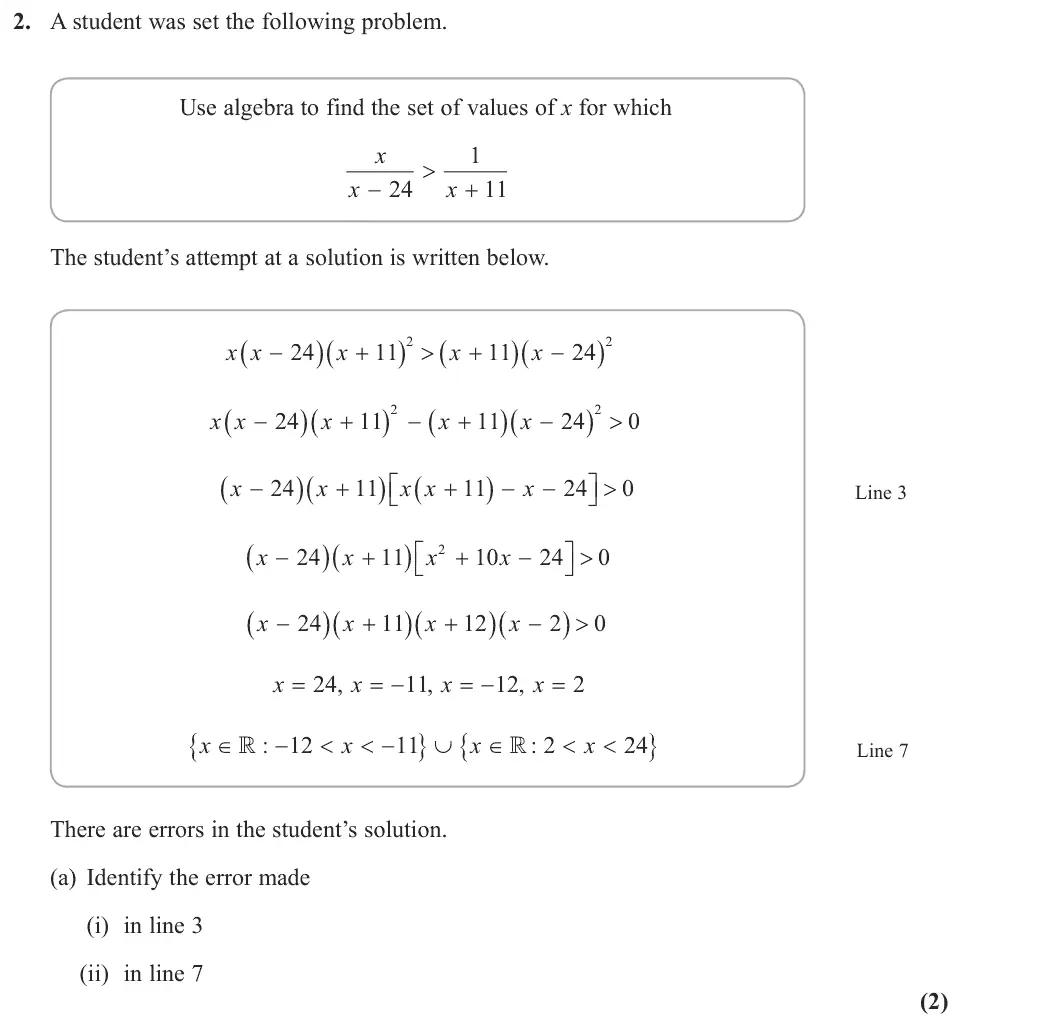
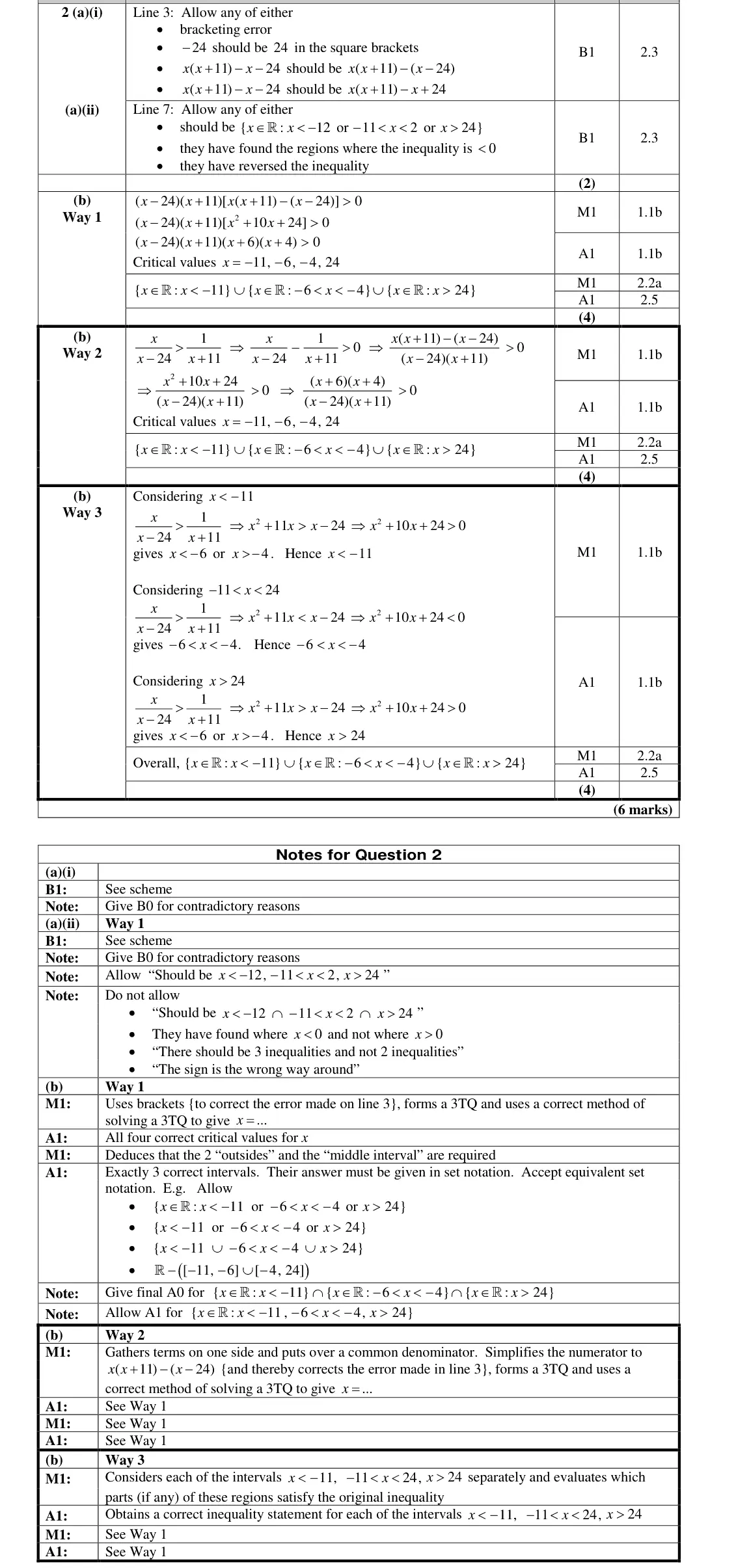
Q2 was well-answered, although some candidates struggled to give clear explanations in Q2(a). In Q2(a)(i), most candidates were aware of the sign error in line 3 and many explained that ( 11) 24 x x x should have been written as ( 11) ( 24) x x x or ( 11) 24. x x x In Q2(a)(ii), most candidates realised that the student of the question had found the regions 0, where the inequality is but this was inadequately explained in some candidates’ work, e.g. x 0 ‘solved for ’. Some candidates said that the set notation was wrong, e.g. ‘it should be and not ’. Many good solutions were seen in Q2(b) and only a few weak attempts were seen, such as invalid cross-multiplication or expansion to a quartic. Most candidates achieved the correct critical values and then went on to choose the appropriate regions. A small number failed to use set notation. A few candidates made the same sign error as the student in Q2(a) or thought that all they had to do in Q2(b) was to correct the student’s line 7 error.
Key points from the mark scheme and examiner's report
line 3: x(x + 11) − x − 24 should be x(x + 11) − (x − 24) (sign/bracketing error)
line 7: the student has found where the expression is less than 0, should take the outside regions
vague explanations lost marks
June 2019 · AS Paper 2 (Further Pure 1) · Q2(b)4 marks
Mark scheme (whole question; this part is marked with the orange bar)
Examiner's comment
Q2 was well-answered, although some candidates struggled to give clear explanations in Q2(a). In Q2(a)(i), most candidates were aware of the sign error in line 3 and many explained that ( 11) 24 x x x should have been written as ( 11) ( 24) x x x or ( 11) 24. x x x In Q2(a)(ii), most candidates realised that the student of the question had found the regions 0, where the inequality is but this was inadequately explained in some candidates’ work, e.g. x 0 ‘solved for ’. Some candidates said that the set notation was wrong, e.g. ‘it should be and not ’. Many good solutions were seen in Q2(b) and only a few weak attempts were seen, such as invalid cross-multiplication or expansion to a quartic. Most candidates achieved the correct critical values and then went on to choose the appropriate regions. A small number failed to use set notation. A few candidates made the same sign error as the student in Q2(a) or thought that all they had to do in Q2(b) was to correct the student’s line 7 error.
Key points from the mark scheme and examiner's report
(x − 24)(x + 11)(x + 6)(x + 4) > 0
critical values −11, −6, −4, 24
answer x < −11, −6 < x < −4, x > 24 in set notation
repeating the student's sign error was seen
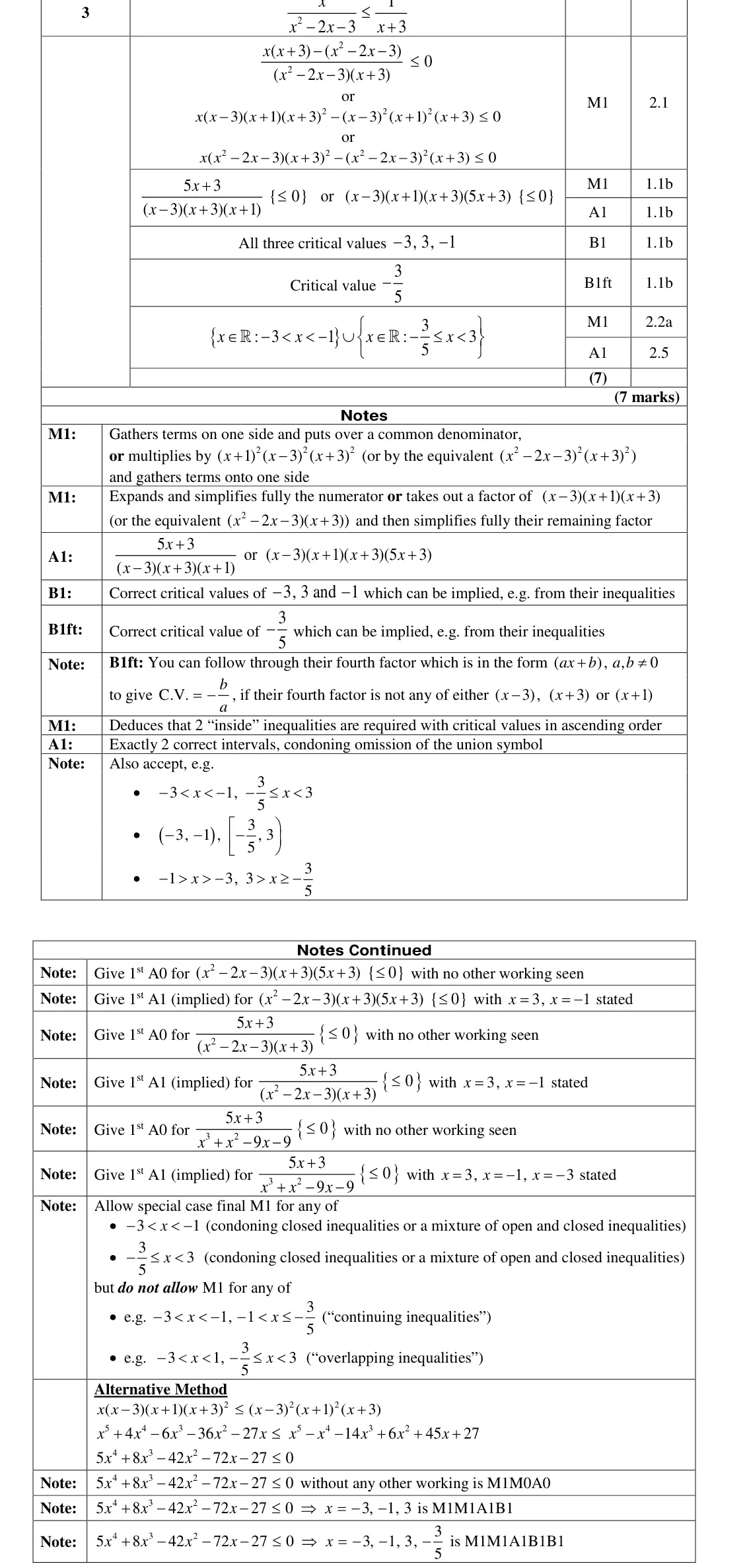
June 2018 · AS Paper 2 (Further Pure 1) · Q37 marks
Mark scheme (whole question; this part is marked with the orange bar)
Examiner's comment
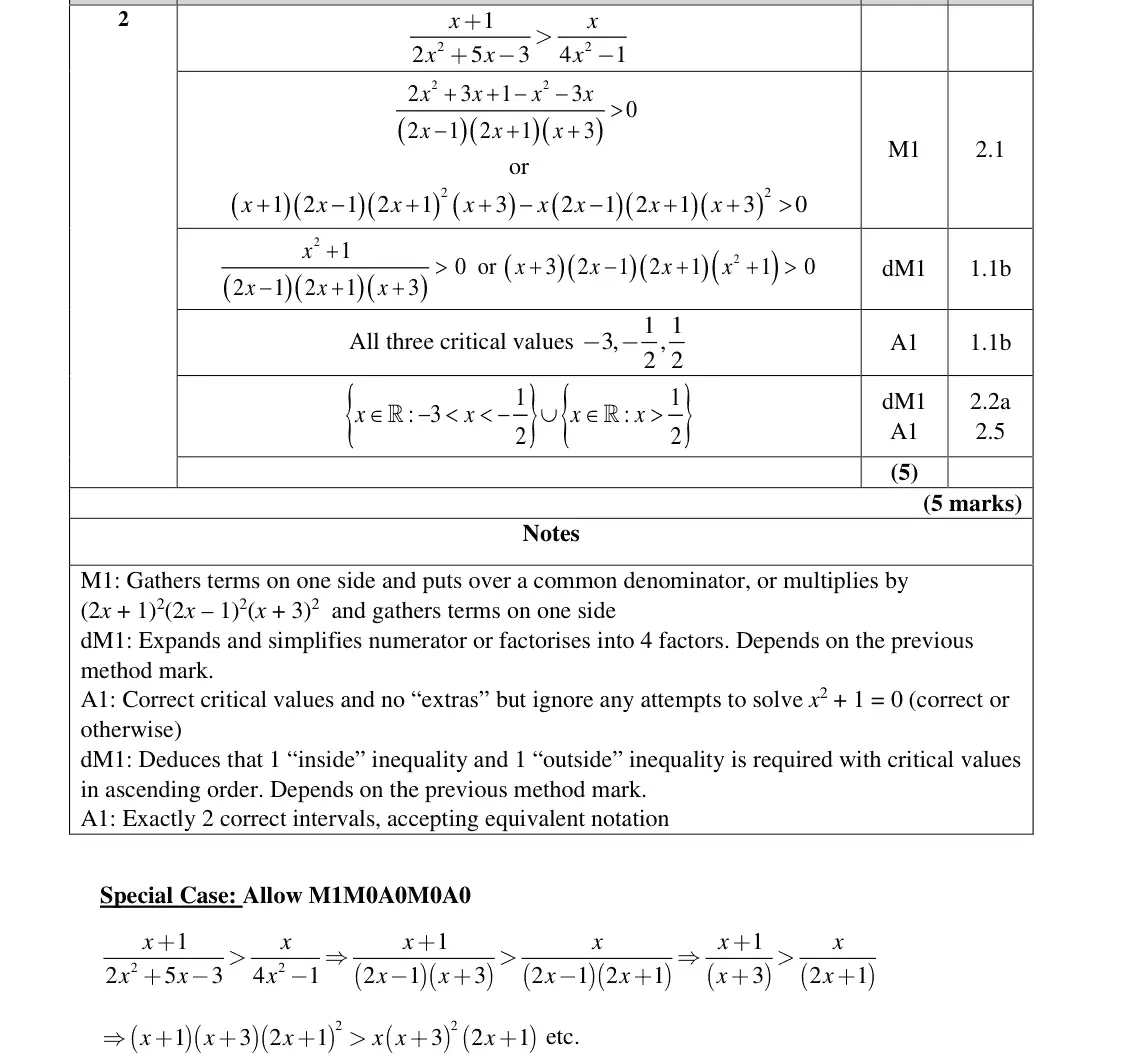
This question discriminated well between students of all abilities. There were a variety of methods which were used to find the correct critical values 3, 3, 1, 3. 5 Most students, who were generally more successful, rearranged the printed inequality 2 1 2 3 3 x x x x to give 2 1 0 2 3 3 x x x x and combined their algebraic fractions to achieve 5 3 0. ( 3)( 1)( 3) x x x x Other students, who multiplied both sides of the printed inequality by 2 2 2 ( 3) ( 1) ( 3) x x x usually made a number of algebraic and manipulation errors, although some manipulated the result to give a correct ( 3)( 1)( 3)(5 3) 0. x x x x In both of these methods, a significant number of students made a bracketing error by manipulating a correct factor ( ( 3) ( 3)( 1)) x x x x to give an incorrect ( 3) x or an incorrect ( 3). x A few students, obtained a correct quartic inequality 4 3 2 5 8 42 72 27 0 x x x x followed by a correct ( 3)( 1)( 3)(5 3) 0. x x x x Most students understood the method of finding critical values and usually identified the correct regions. Many students, who did not consider the validity of their answer at 3, 1, 3, x wrote down an incorrect answer 3 3 1 3. 5 x x Only a minority of students completed the problem by writing down a correct 3 3 1 3. 5 x x
Key points from the mark scheme and examiner's report
gather terms over a common denominator (or multiply by squared denominators): (5x + 3)/((x − 3)(x + 1)(x + 3)) ≤ 0
critical values −3, −1, −3/5, 3
answer −3 < x < −1 or −3/5 ≤ x < 3 (excluded points must be strict)
bracketing errors with −(x − 3) common
Find an Edexcel Further Maths tutor
Stuck on this? Book a trial lesson with our Further Maths tutor.