P(X = x), mean, variance and PGF for the geometric and negative binomial are given.
Since 2018
37 question parts, 106 marks, 6 with a difficulty rating from the examiner's report
Notes, worked examples and practice for this topic are being written by our tutors. The past-paper questions below are ready now: work each one on paper, then open the mark scheme and the examiner's comment.
Tap a question to zoom it. Mark scheme and examiner's comment open under each question.
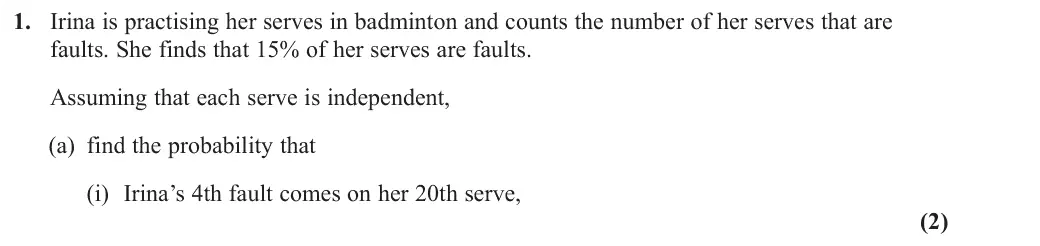
June 2025 · Paper 3B (Further Statistics 1) · Q1(a)(i)2 marks
Mark scheme (whole question; this part is marked with the orange bar)
Examiner's comment
This was a nice opening question with little text to read and demands which were very familiar to the candidates. As such, most candidates scored full marks on Question 1. Those who lost marks tended to be insufficiently familiar with the negative binomial distribution to apply it
Key points from the mark scheme and examiner's report
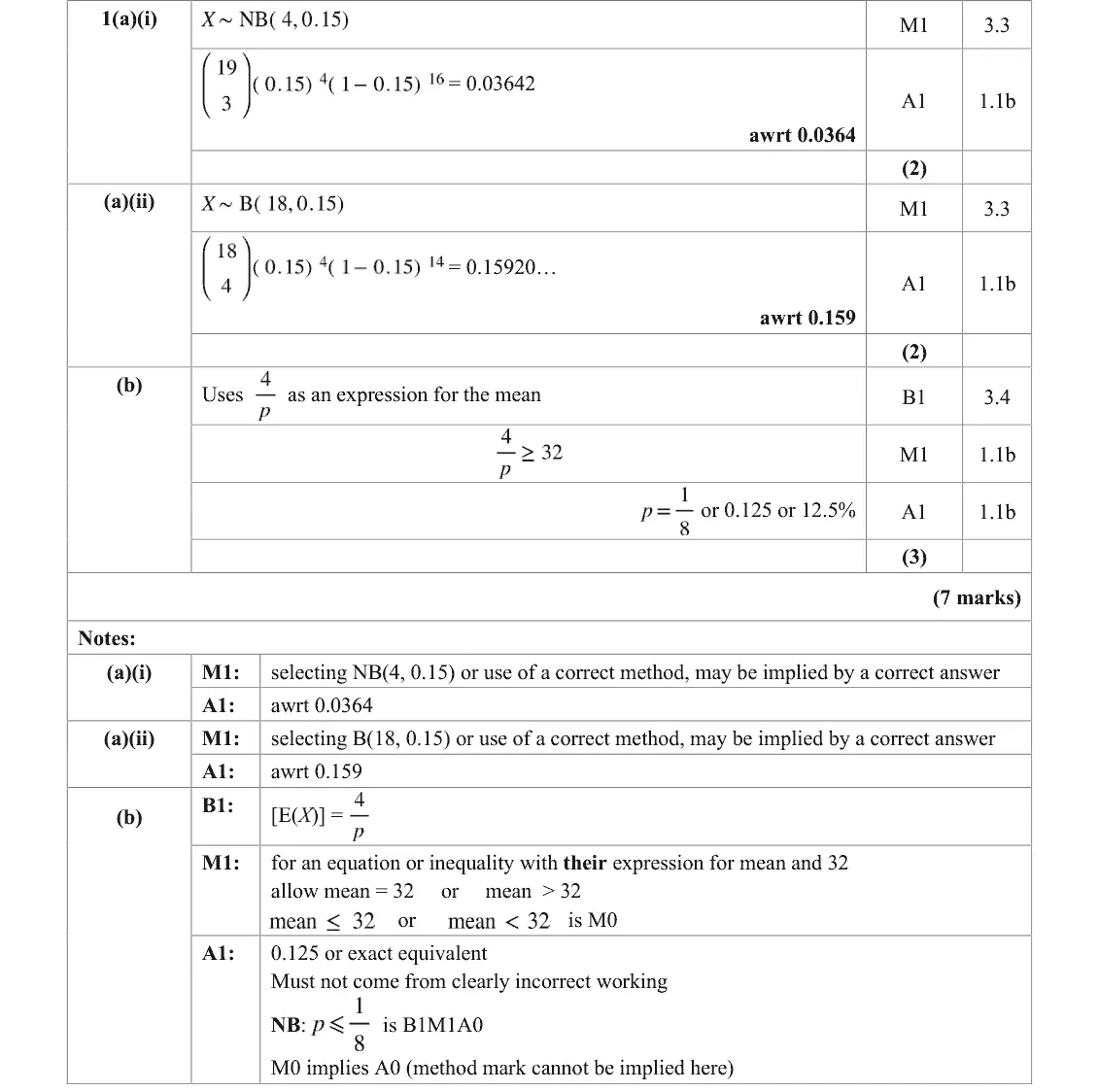
NB(4, 0.15): C(19, 3)0.15⁴ × 0.85¹⁶ = 0.0364
unfamiliarity with the negative binomial cost marks
June 2025 · Paper 3B (Further Statistics 1) · Q1(b)3 marks
Mark scheme (whole question; this part is marked with the orange bar)
Examiner's comment
correctly to (a)(i) and (b). The importance of candidates being familiar with all the distributions within the specification is a theme throughout the paper and first manifested here.
Key points from the mark scheme and examiner's report
mean r/p = 4/p ≥ 32 so p ≤ 1/8: maximum p = 0.125
mean ≤ 32 or < 32 is M0
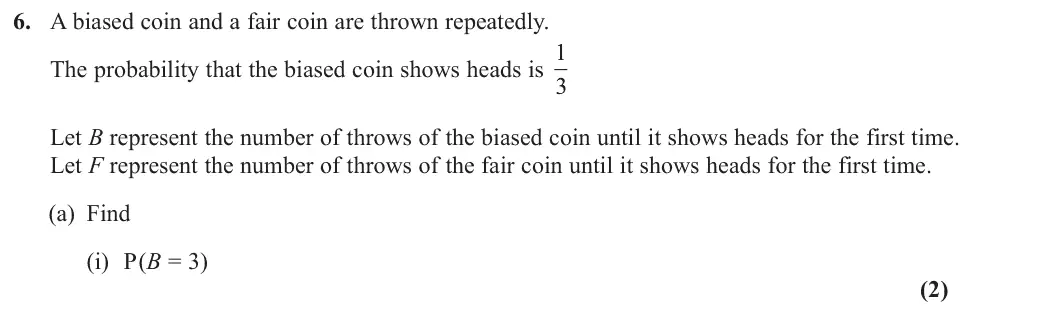
June 2025 · Paper 3B (Further Statistics 1) · Q6(a)(i)2 marks
Mark scheme (whole question; this part is marked with the orange bar)
Examiner's comment
This question was accessible to the candidates, helped by the first parts being routine. The final part of the question did require some problem-solving, but most candidates were still able to score a good number of marks. Part (a)(i) was answered correctly in most cases.
Key points from the mark scheme and examiner's report
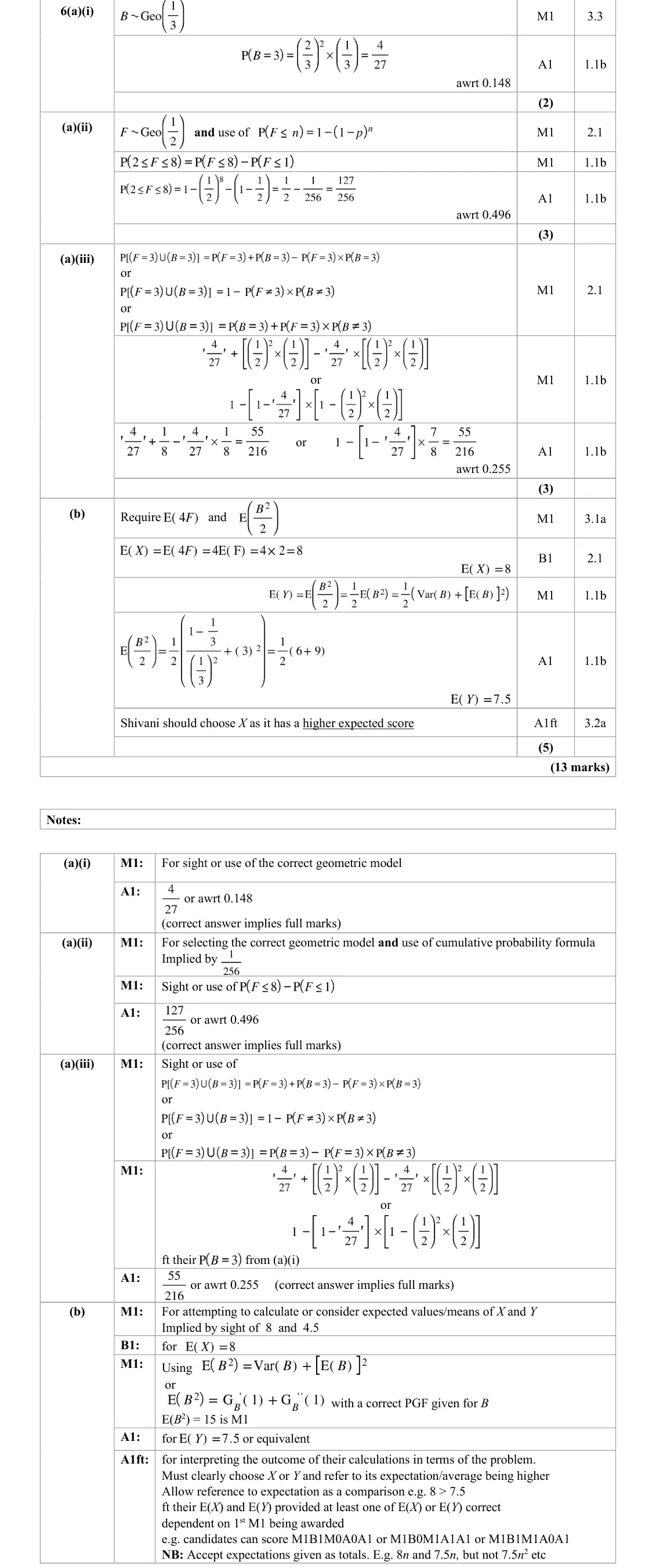
B ~ Geo(1/3): (2/3)²(1/3) = 4/27
June 2025 · Paper 3B (Further Statistics 1) · Q6(a)(ii)3 marks
Mark scheme (whole question; this part is marked with the orange bar)
Examiner's comment
This question was accessible to the candidates, helped by the first parts being routine. The final part of the question did require some problem-solving, but most candidates were still able to score a good number of marks. Most candidates scored full marks in part (a)(ii), but a decent number did have trouble with the probability statement or used the wrong probability. Candidates who showed clear working were able to lock in method marks here, firstly for stating/using the correct distribution, and secondly for deconstructing the probability statement in the question into the difference between two cumulative probability statements. This made such candidates robust to getting the final answer incorrect. Candidates should be advised to include such working in their solutions for questions like this.
Key points from the mark scheme and examiner's report
June 2025 · Paper 3B (Further Statistics 1) · Q6(a)(iii)3 marks
Mark scheme (whole question; this part is marked with the orange bar)
Examiner's comment
This question was accessible to the candidates, helped by the first parts being routine. The final part of the question did require some problem-solving, but most candidates were still able to score a good number of marks. Candidates found part (a)(iii) very challenging, with the majority scoring no marks. Most candidates did not spot, or did not understand, the use of union rather than intersection in the probability statement. Knowledge of the addition formula is standard in the Statistics element of A level Maths, so I imagine candidates perhaps did not read the question carefully enough to note the use of union. Those that did, tended to get full marks.
Key points from the mark scheme and examiner's report
union not intersection: P(B = 3) + P(F = 3) − product = 4/27 + 1/8 − 1/54 = 55/216
most scored 0
June 2025 · Paper 3B (Further Statistics 1) · Q6(b)5 marks
Mark scheme (whole question; this part is marked with the orange bar)
Examiner's comment
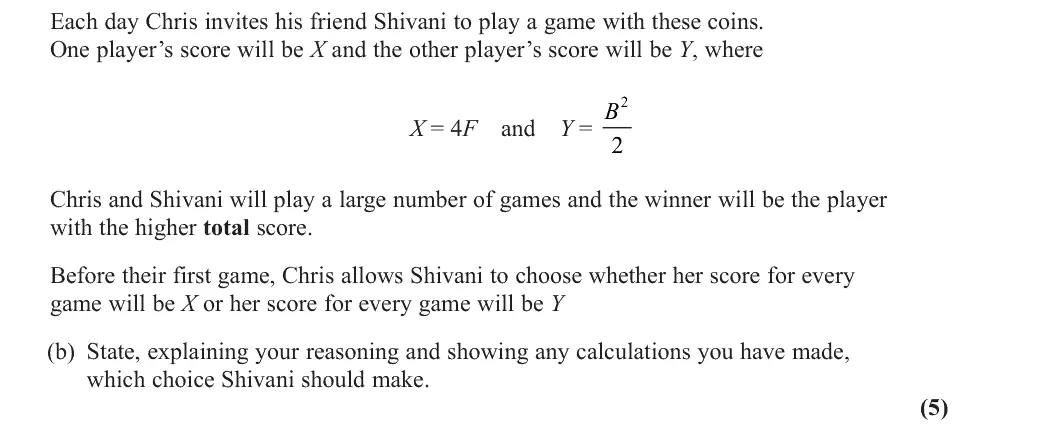
This question was accessible to the candidates, helped by the first parts being routine. The final part of the question did require some problem-solving, but most candidates were still able to score a good number of marks. Part (b) took the question in a new direction, and most candidates were able to make inroads into this part. Almost all realised that they needed to consider expectations, and the majority of these went on to find E(X) correctly. This was vital, as it gave them access to the final method mark. Candidates struggled to find E(B2) correctly, with a large number simply squaring E(B). This meant that, many candidates scored 3 of the 5 marks, as they usually went on to compare their two expectations correctly and choose X. However, a decent number of candidates were able to navigate part (b) and gain full marks. The question allowed for good discrimination between candidates of varying ability levels with almost all gaining 2 or 3 marks, and a many going further to score full marks. Some candidates used E(X)n, which was accepted. However, these candidates often included the n as part of the variable, while this did not make a difference for E(X), they ended up with E(Y) being multiplied by n2, which is incorrect. A few candidates who struggled tried to find the expectations using summations but did not do so correctly. Whenever candidates had their expressions for E(X) and E(Y) they almost always made a correct conclusion and scored the final mark. Candidates should be advised to take care to label their working clearly and correctly. Some candidates did not label their expressions and never referred to what they had as means or expectations, and hence did not score any marks.
Key points from the mark scheme and examiner's report
E(4F) = 8
E(B²/2) = ½(Var(B) + [E(B)]²) = ½(6 + 9) = 7.5
choose X
squaring E(B) is the common error
June 2025 · Paper 3B (Further Statistics 1) · Q7(c)1 mark
Mark scheme (whole question; this part is marked with the orange bar)
Examiner's comment
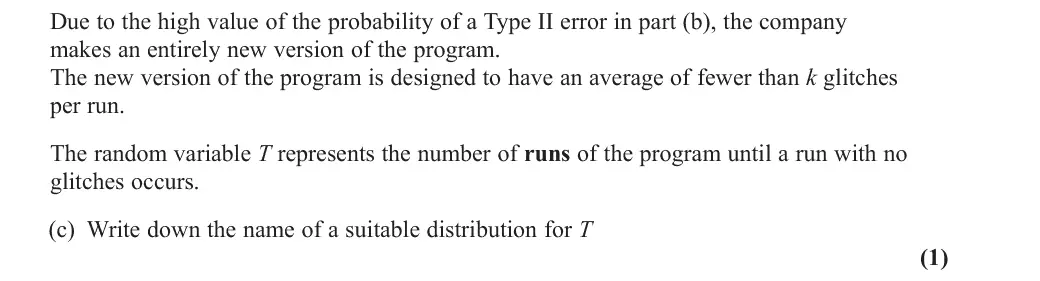
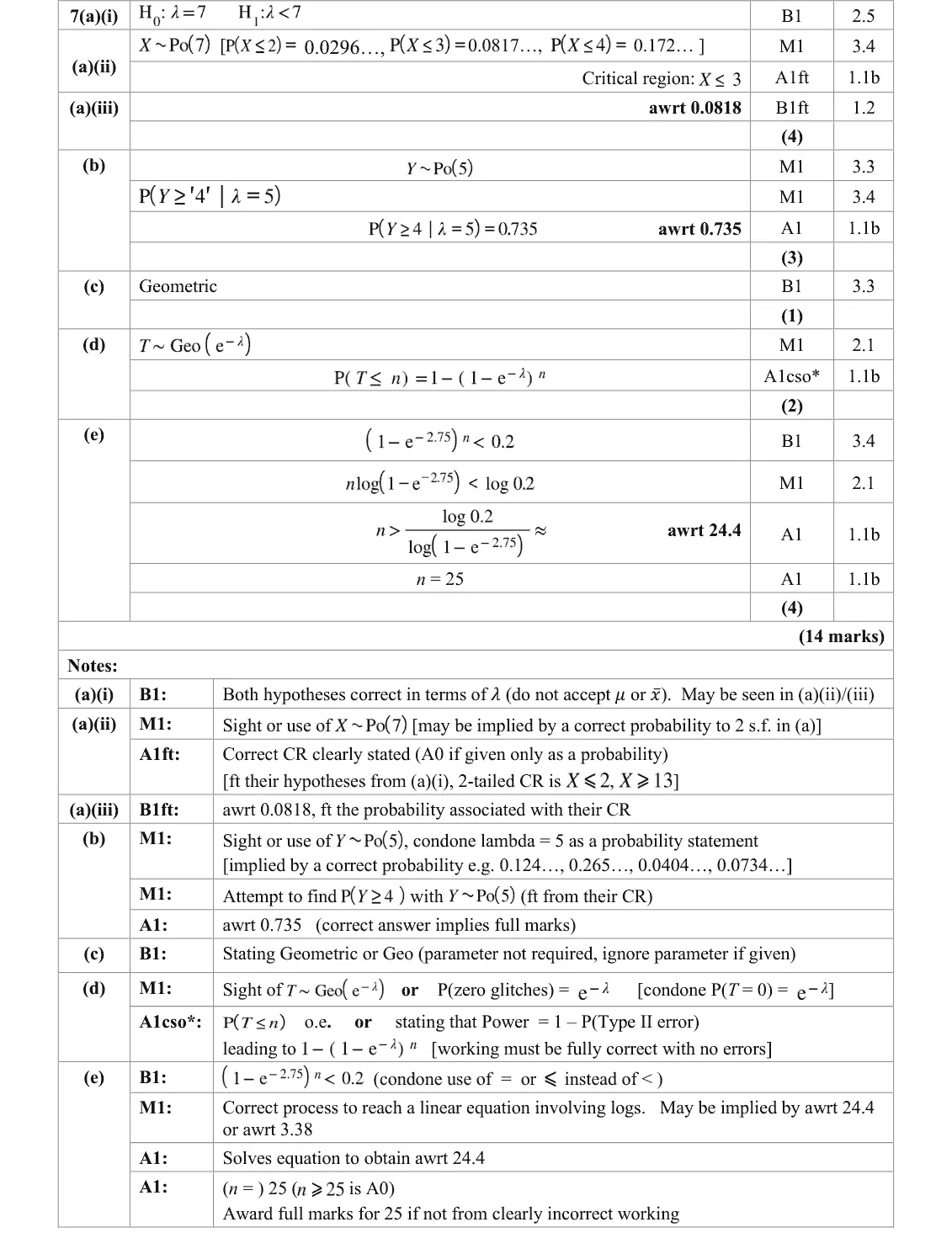
In general, candidates scored well in this question, with the exception of part (d), which was very challenging. Almost all candidates stated the correct distribution for part (c), though a few chose Poisson or Negative Binomial.
Key points from the mark scheme and examiner's report
geometric (parameter not needed)
June 2025 · Paper 3B (Further Statistics 1) · Q7(d)2 marks
Mark scheme (whole question; this part is marked with the orange bar)
Examiner's comment
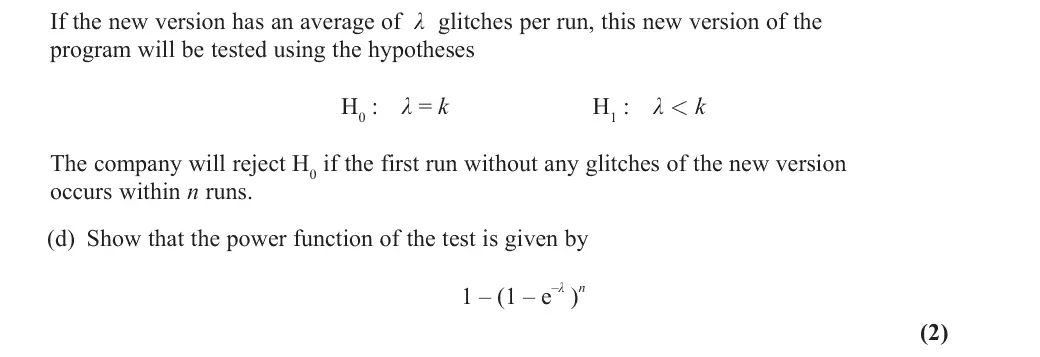
In general, candidates scored well in this question, with the exception of part (d), which was very challenging. Part (d) was understandably challenging for the candidates as these were high demand marks. The question was complex in terms of the context as well as the statistical knowledge required. Many candidates chose to concentrate on the given answer and work backwards from it, instead of working from first principles. This approach did not seem to be helpful to candidates and often resulted in seemingly random probability statements being written down with no coherent pattern to force the answer. Candidates who approached the question without working backwards often latched on to the crucial first step of realising that the previous part suggested that a Geometric distribution is the appropriate model to use, and, given that, to determine its parameter, p. Leading them to the next step of establishing that the parameter, p, the probability of number glitches in a run, as e-λ . Therefore, a good number of candidates did gain the first mark in part (d). A reasonably number did indeed go on to give a correct probability statement leading to the given answer and gain the final mark. A minority of candidates gained both marks by stating that Power = 1 – P(Type II error).
Key points from the mark scheme and examiner's report
P(run has no glitches) = e^(−λ) so T ~ Geo(e^(−λ))
power = P(T ≤ n) = 1 − (1 − e^(−λ))ⁿ
working backwards from the answer failed
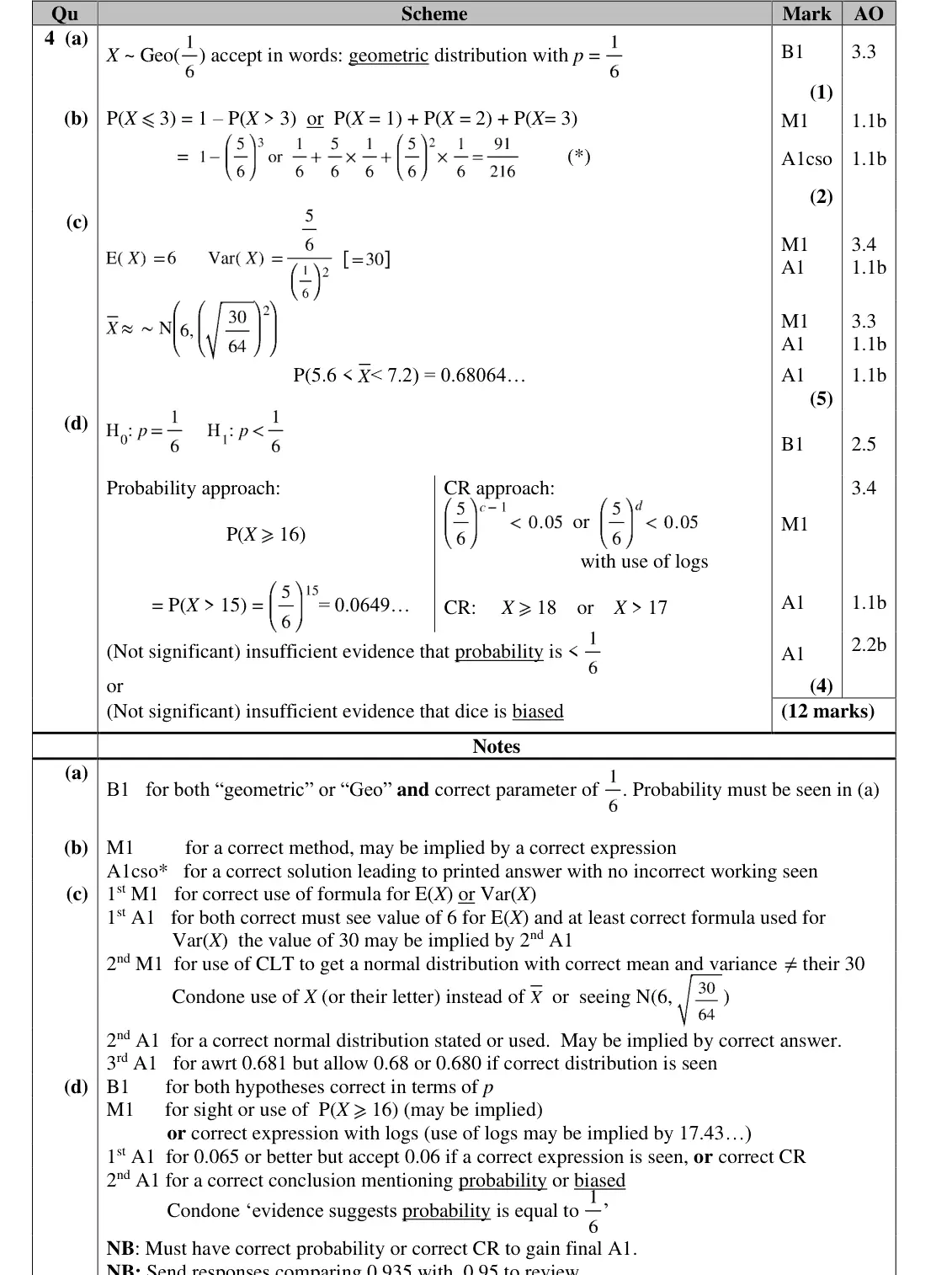
June 2024 · Paper 3B (Further Statistics 1) · Q4(a)1 mark
Mark scheme (whole question; this part is marked with the orange bar)
Examiner's comment
Part (a) was almost always answered correctly, though a small number of candidates did not realise a parameter was required. Part (b) was almost always answered correctly as well.
Key points from the mark scheme and examiner's report
Geo(1/6)
the parameter is required
June 2024 · Paper 3B (Further Statistics 1) · Q4(b)2 marks
Mark scheme (whole question; this part is marked with the orange bar)
Examiner's comment
realise a parameter was required. Part (b) was almost always answered correctly as well. Many candidates used the formulae for the Geometric distribution, but a good number reached the answer by summing P(X = 1), P(X = 2), and P(X = 3). The high level of success the candidates had with part (c) was most encouraging. Again, most
Key points from the mark scheme and examiner's report
1 − (5/6)³ = 91/216, or sum P(X = 1) + P(X = 2) + P(X = 3)
June 2024 · Paper 3B (Further Statistics 1) · Q4(c)5 marks
Mark scheme (whole question; this part is marked with the orange bar)
Examiner's comment
The high level of success the candidates had with part (c) was most encouraging. Again, most candidates realised that the central limit theorem was required and were able to correctly reach the required answer. On the whole the candidates’ working was clear, showed good notation, and was concise.
Key points from the mark scheme and examiner's report
E(X) = 6, Var(X) = (5/6)/(1/6)² = 30
CLT X̄ ≈ N(6, 30/64)
P(5.6 < X̄ < 7.2) = 0.681
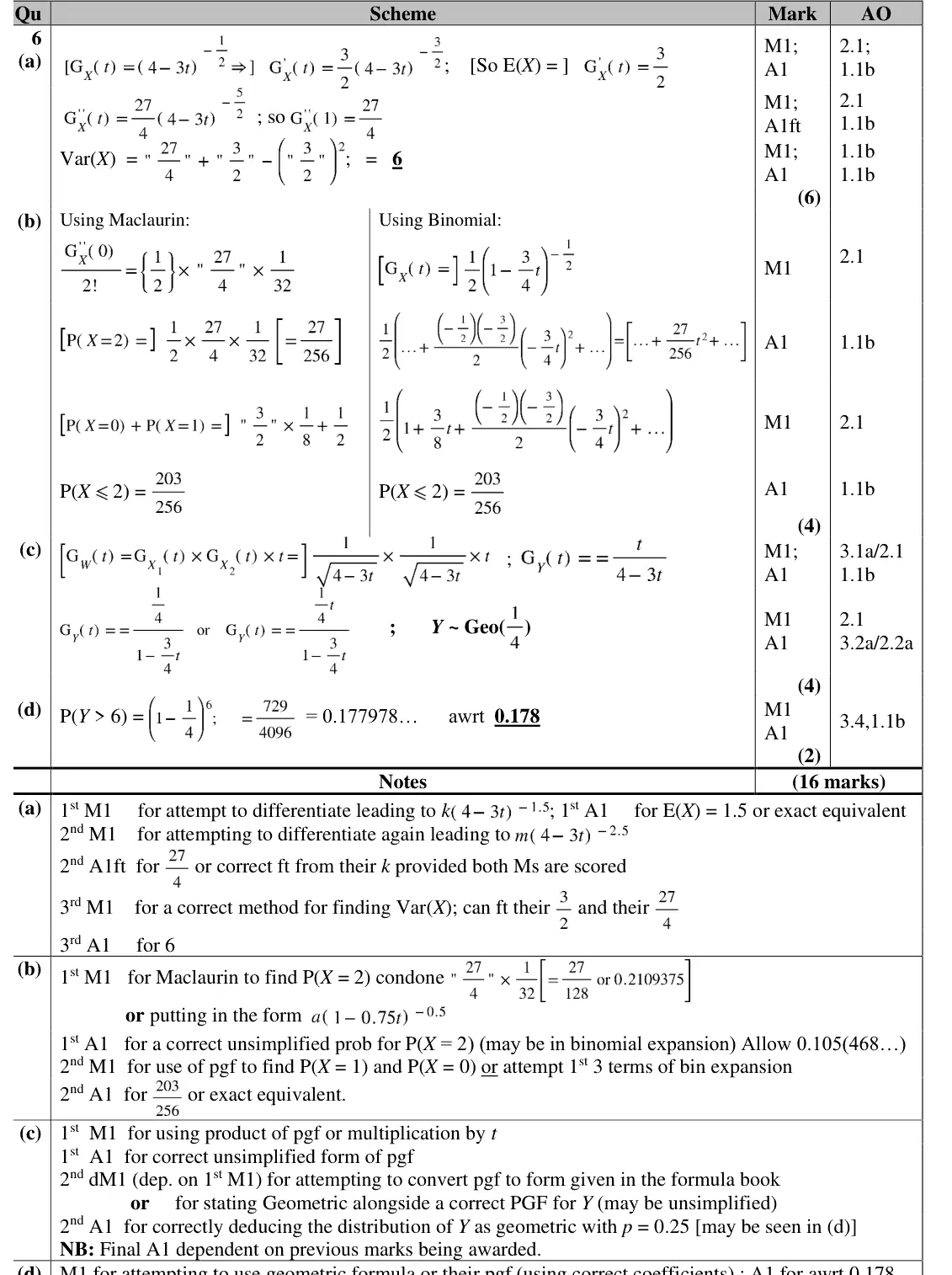
June 2024 · Paper 3B (Further Statistics 1) · Q6(d)2 marks
Mark scheme (whole question; this part is marked with the orange bar)
Examiner's comment
Most candidates were able to access most of the question and gain a good number of marks, with some parts challenging the more able candidates. scored full marks. Many did not realise a parameter was required in (c) but gave it in (d) instead – which was condoned. Overall, a good proportion of candidates scored 4/4 on (c), but scoring 1-3 marks was more common. A surprisingly large number of candidates who had successfully negotiated part (c) were
Key points from the mark scheme and examiner's report
X1 + X2 > 5 means Y > 6: (3/4)⁶ = 729/4096 = 0.178
many missed the link to Y
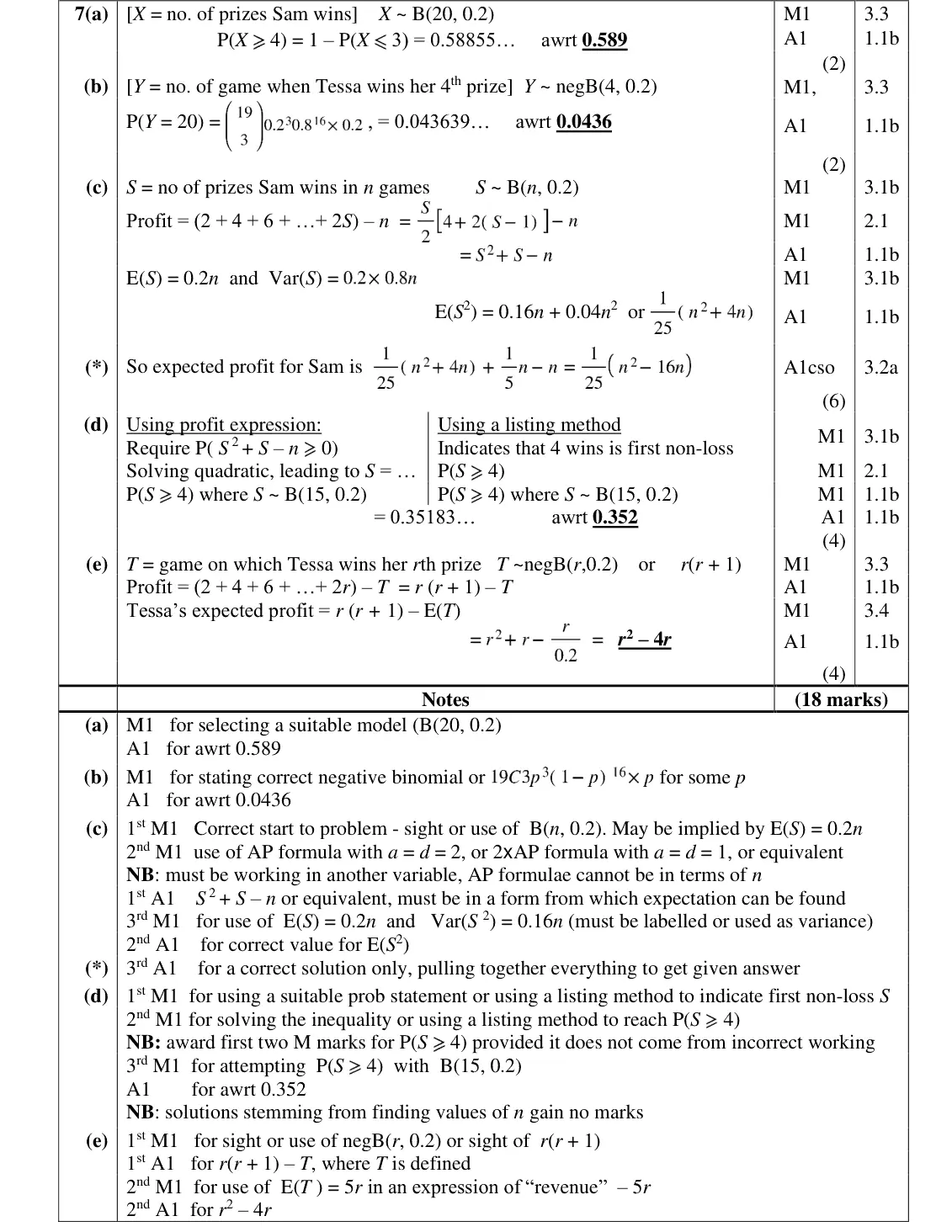
June 2024 · Paper 3B (Further Statistics 1) · Q7(b)2 marks
Mark scheme (whole question; this part is marked with the orange bar)
Examiner's comment
Candidates understandably found this question very challenging. It started off very easily in parts (a) and (b) but stepped up in difficulty considerably in part (c). The demand and nuance of (c) was beyond almost all candidates. Parts (a) and (b) were very routine, and the vast majority of candidates scored full marks on both parts. Candidates showed they are adept at modelling contextual situations with appropriate distributions – as they did throughout the paper.
Key points from the mark scheme and examiner's report
NB(4, 0.2): C(19, 3)0.2³ × 0.8¹⁶ × 0.2 = 0.0436
June 2024 · Paper 3B (Further Statistics 1) · Q7(e)4 marks
Mark scheme (whole question; this part is marked with the orange bar)
Examiner's comment
Candidates understandably found this question very challenging. It started off very easily in parts (a) and (b) but stepped up in difficulty considerably in part (c). The demand and nuance of (c) was beyond almost all candidates. Part (e) required a similar approach to (c). Very few candidates answered (c) correctly, but a cohort were able to form an expression for the revenue in (e) by using an arithmetic sum. Those that did often went on to gain full marks. However, in general candidates gained no marks for (e), or only the initial mark for stating the distribution correctly. Question 7 was certainly a very challenging question. To prepare to answer questions such as these successfully, candidates should be encouraged to: define the variable they are working with, state the distribution of that variable, and consider taking the expectation of a random variable or an expression in terms of a random variable properly when directed to by the word ’expected’ in the question.
Key points from the mark scheme and examiner's report
T ~ NB(r, 0.2)
profit = r(r + 1) − T
E(T) = r/0.2 = 5r
expected profit r² − 4r
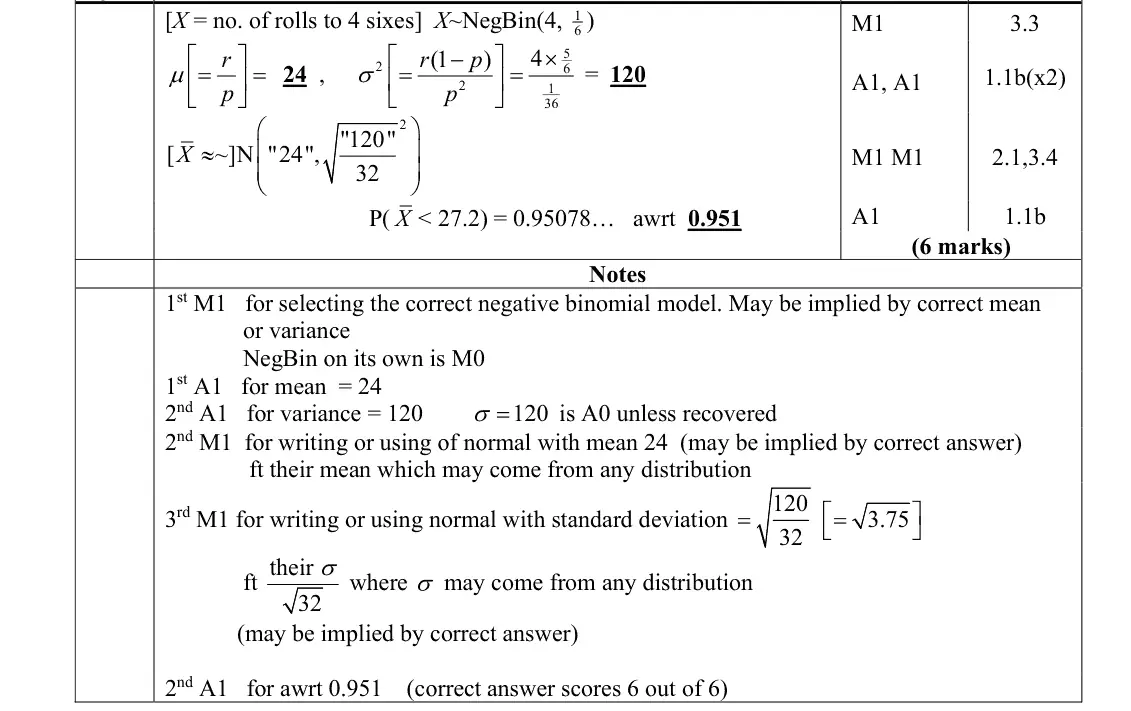
June 2023 · Paper 3B (Further Statistics 1) · Q46 marks
Mark scheme (whole question; this part is marked with the orange bar)
Examiner's comment
This proved to be the most accessible question on the paper and it was quite common to see students earning full marks. Most correctly identified the Negative Binomial distribution and correctly calculated its mean and variance. The vast majority went on to identify the correct normal distribution for the mean and obtain the required probability.
Key points from the mark scheme and examiner's report
rolls to 4 sixes ~ NB(4, 1/6): μ = 24, σ² = 120
CLT X̄ ≈ N(24, 120/32)
P(X̄ < 27.2) = 0.951
June 2023 · Paper 3B (Further Statistics 1) · Q6(a)2 marks
Mark scheme (whole question; this part is marked with the orange bar)
Examiner's comment
This question worked well at this stage of the paper and parts (a), (b) and (d) were more discriminating. In part (a) many students were able to use the formula sheet to identify this as a negative binomial PGF and having done so to recognise that r = 2 and p = 1/3. Some students did not include any parameters in their response. A handful of students opted for a Geometric distribution.
Key points from the mark scheme and examiner's report
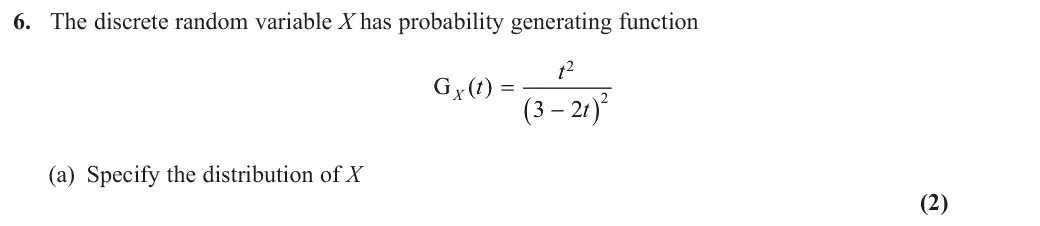
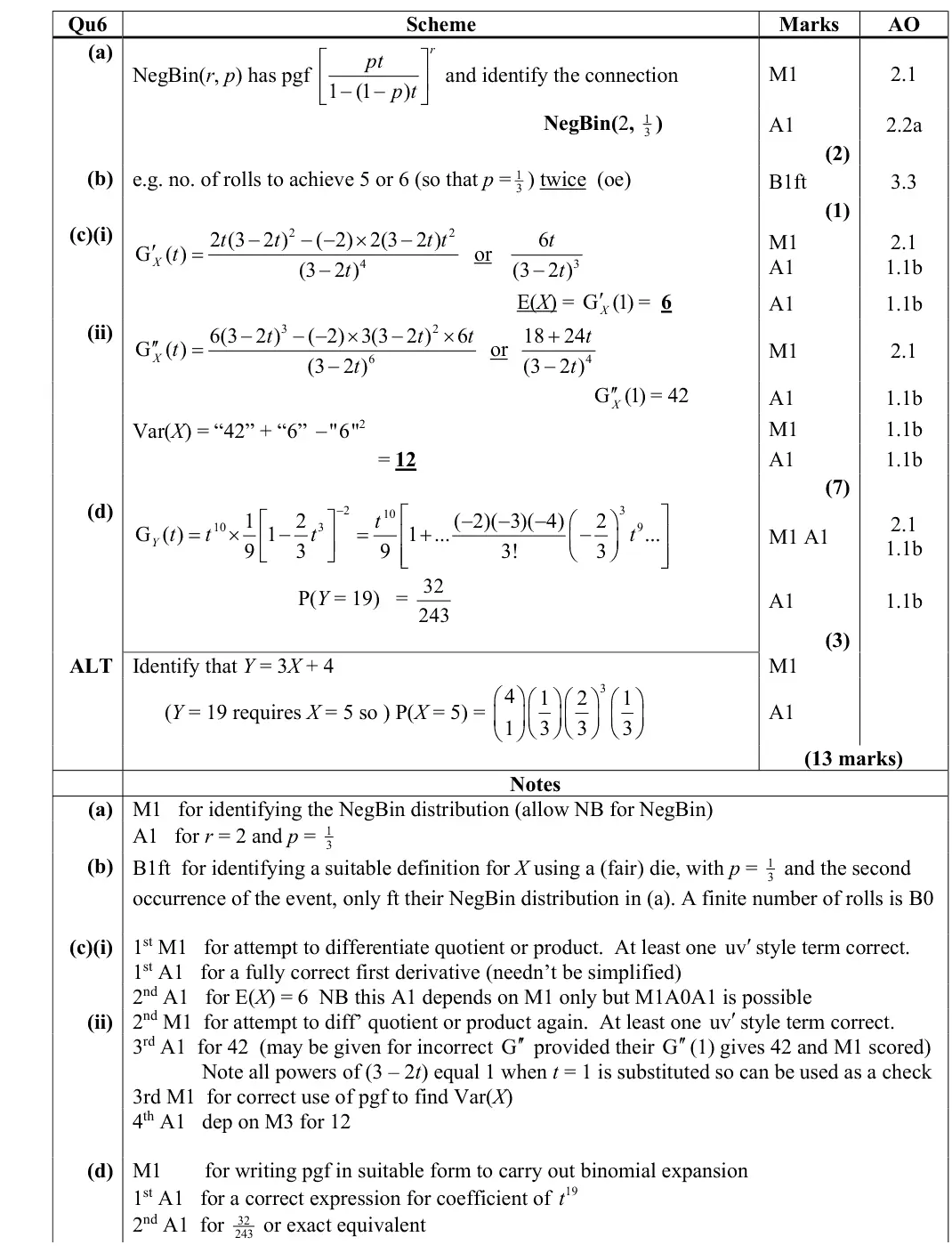
match with the NB(r, p) pgf [pt/(1 − (1 − p)t)]^r: X ~ NegBin(2, 1/3)
parameters required
geometric wrong
June 2023 · Paper 3B (Further Statistics 1) · Q6(b)1 mark
Mark scheme (whole question; this part is marked with the orange bar)
Examiner's comment
This question worked well at this stage of the paper and parts (a), (b) and (d) were more discriminating. Part (b) was less well answered and was occasionally not answered at all. Although contextual answers were usually given, a minority of students gave a scenario with a probability of a sixth instead of a third. Some by this stage had resorted to a fixed number of trials rather than successes despite recognising it as a negative binomial distribution.
Key points from the mark scheme and examiner's report
e.g. number of rolls needed to obtain a 5 or 6 twice (p = 1/3)
a fixed number of rolls scores 0
probability 1/6 events wrong
June 2023 · Paper 3B (Further Statistics 1) · Q7(a)(i)2 marks
Mark scheme (whole question; this part is marked with the orange bar)
Examiner's comment
There was a strong finish to the paper with many students achieving full marks on this question. In part (a)(i), virtually all candidates successfully used a Geo(0.2) distribution accurately. Part (ii) was nearly as well answered using a NB(3,0.2) distribution, although a few students only gave 2 significant figure accuracy or miscopied the answer from their calculator as 0.551. As expected, an excellent response was seen in part (iii) using a B(10, 0.2) distribution; occasionally, similar errors in accuracy to those in part (ii) were seen. The calculation of P(R) was generally performed accurately using a Geo(0.2) distribution, although a relatively small number of candidates chose to use a B(4,0.2) or Geo(0.4) distribution instead. However, the calculation of P(Y) posed more problems, and numerous different errors were made. The most common was to use NB(3,0.2) rather than NB(3,0.4). In both cases, the nCr factors were sometimes omitted when listing the required terms. Fewer used a B(7,0.4) distribution, but these usually resulted in an accurate answer. For those who obtained correct probabilities, virtually all concluded that R had the greater probability.
Key points from the mark scheme and examiner's report
Geo(0.2): 0.8³ × 0.2 = 0.1024
June 2023 · Paper 3B (Further Statistics 1) · Q7(a)(ii)2 marks
Mark scheme (whole question; this part is marked with the orange bar)
Examiner's comment
There was a strong finish to the paper with many students achieving full marks on this question.
Key points from the mark scheme and examiner's report
NB(3, 0.2): C(7, 2)0.2² × 0.8⁵ × 0.2 = 0.0551
3 s.f. needed
June 2023 · Paper 3B (Further Statistics 1) · Q7(b)7 marks
Mark scheme (whole question; this part is marked with the orange bar)
Examiner's comment
There was a strong finish to the paper with many students achieving full marks on this question.
Key points from the mark scheme and examiner's report
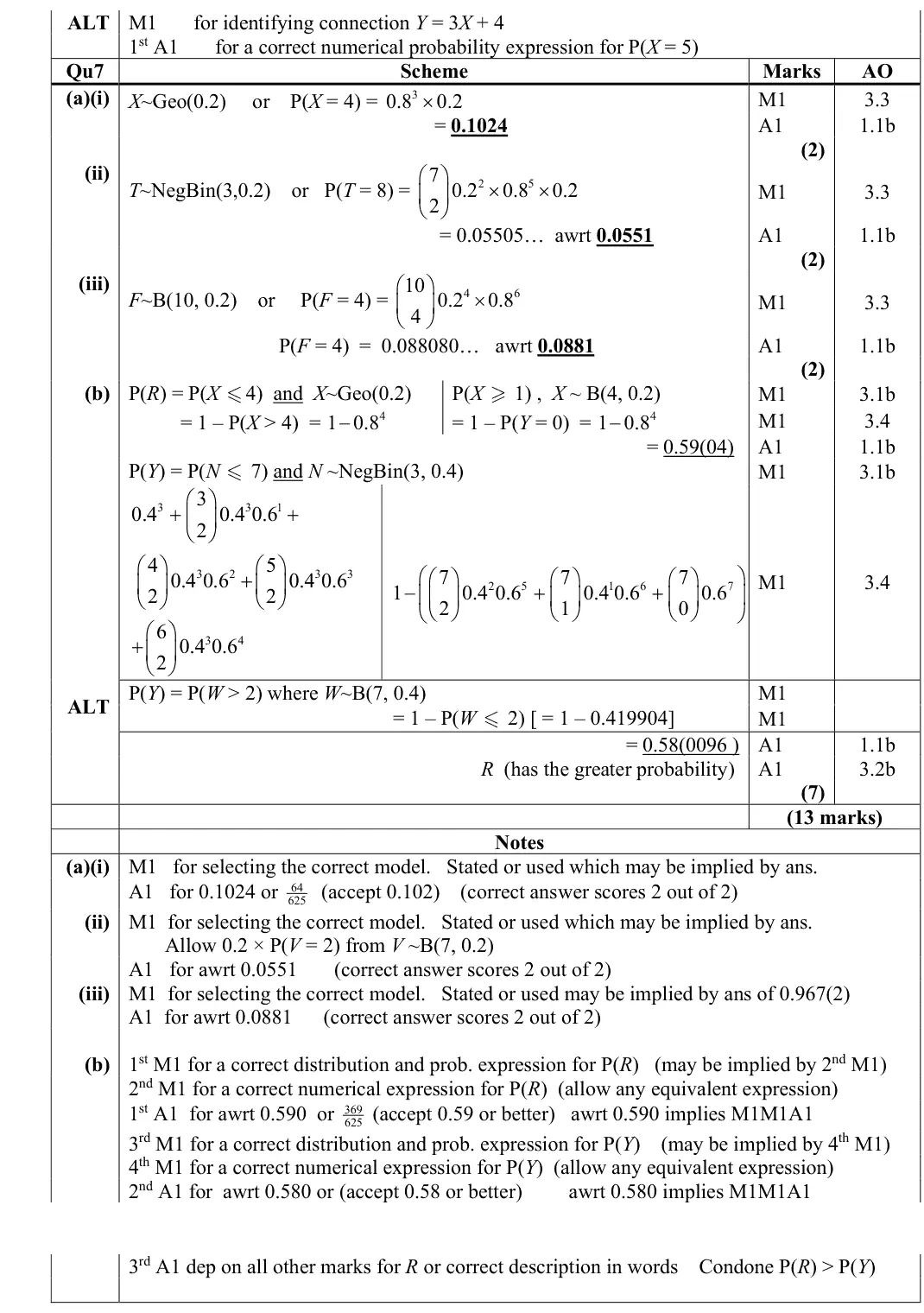
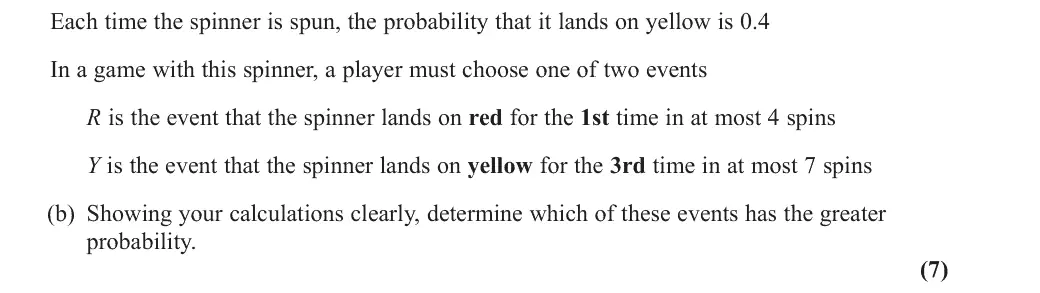
P(R) = 1 − 0.8⁴ = 0.590
P(Y) = P(N ≤ 7) for N ~ NB(3, 0.4) = P(W ≥ 3) for W ~ B(7, 0.4) = 0.580
so R is more likely
common errors NB(3, 0.2) and missing nCr factors
June 2022 · Paper 3B (Further Statistics 1) · Q4(a)(i)2 marksEasy
Mark scheme (whole question; this part is marked with the orange bar)
Examiner's comment
This was a very accessible question with 99% scoring at least 2 marks and nearly 25% full marks. Part (a)(i) was answered very well with most clearly stating the correct geometric distribution and giving the answer to an appropriate degree of accuracy. In (a) (ii) many interpreted the question (a)(i) and then, with a lovely explanation, simply took the mean of G(1) and G(– 1).
Key points from the mark scheme and examiner's report
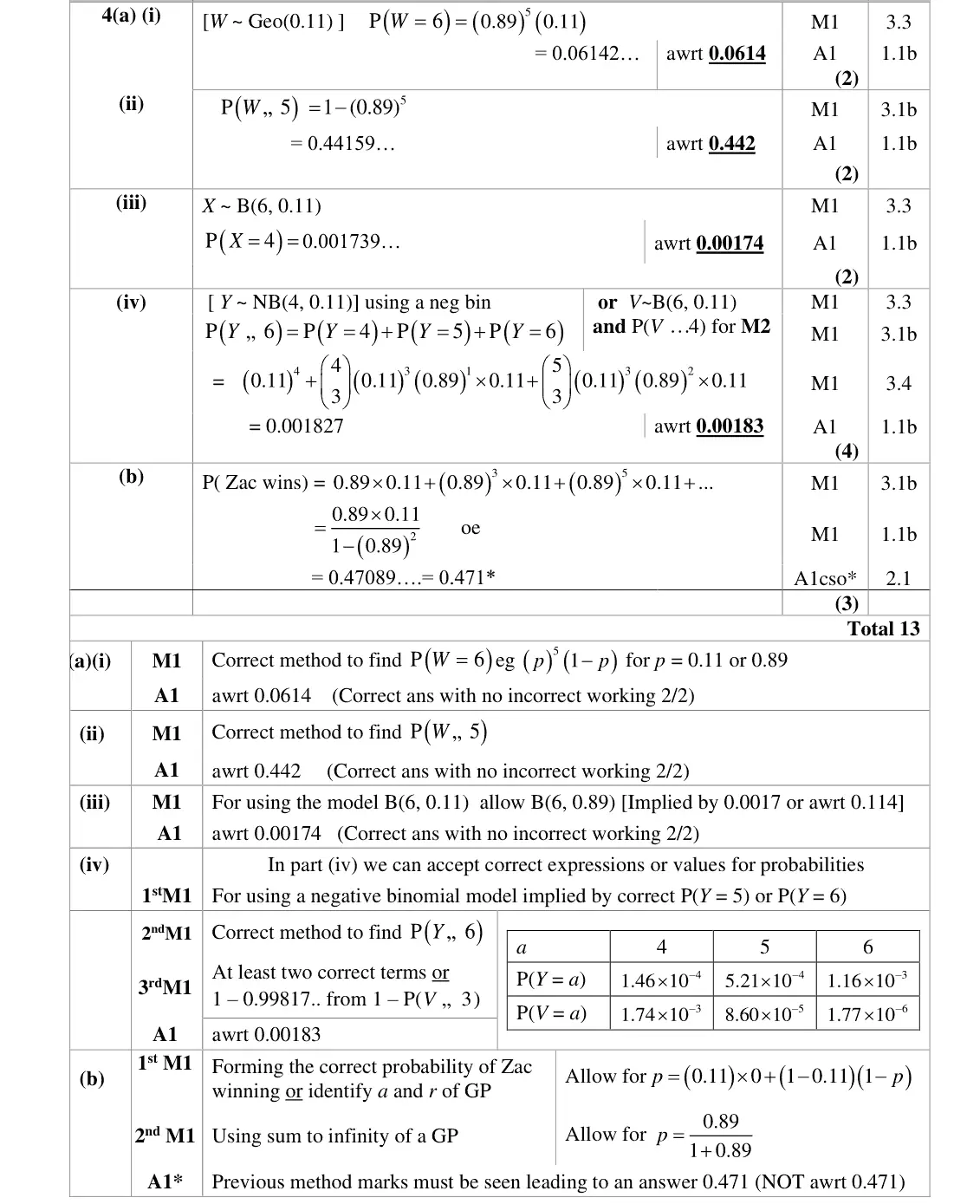
Geo(0.11): 0.89⁵ × 0.11 = 0.0614
June 2022 · Paper 3B (Further Statistics 1) · Q4(a)(ii)2 marksEasy
Mark scheme (whole question; this part is marked with the orange bar)
Examiner's comment
This was a very accessible question with 99% scoring at least 2 marks and nearly 25% full marks. giving the answer to an appropriate degree of accuracy. In (a) (ii) many interpreted the question - - 5 6 correctly but some had instead of . In part (a)(iii) many did not identify that a 1 0.89 1 0.89
Key points from the mark scheme and examiner's report
P(W ≤ 5) = 1 − 0.89⁵ = 0.442
1 − 0.89⁶ is the common error
June 2022 · Paper 3B (Further Statistics 1) · Q4(a)(iv)4 marksEasy
Mark scheme (whole question; this part is marked with the orange bar)
Examiner's comment
This was a very accessible question with 99% scoring at least 2 marks and nearly 25% full marks.
Key points from the mark scheme and examiner's report
June 2022 · Paper 3B (Further Statistics 1) · Q4(b)3 marksEasy
Mark scheme (whole question; this part is marked with the orange bar)
Examiner's comment
This was a very accessible question with 99% scoring at least 2 marks and nearly 25% full marks. correct answer very easily. Part (b) was answered very well with many students identifying that an infinite geometric series of probabilities was required. This was a “show that” question and so we needed to see the correct series clearly used and a correct formula used to find the sum and a statement that their answer did indeed round to the required value. A particularly impressive solution here used the probability generating function G(t) of the geometric distribution used in part
Key points from the mark scheme and examiner's report
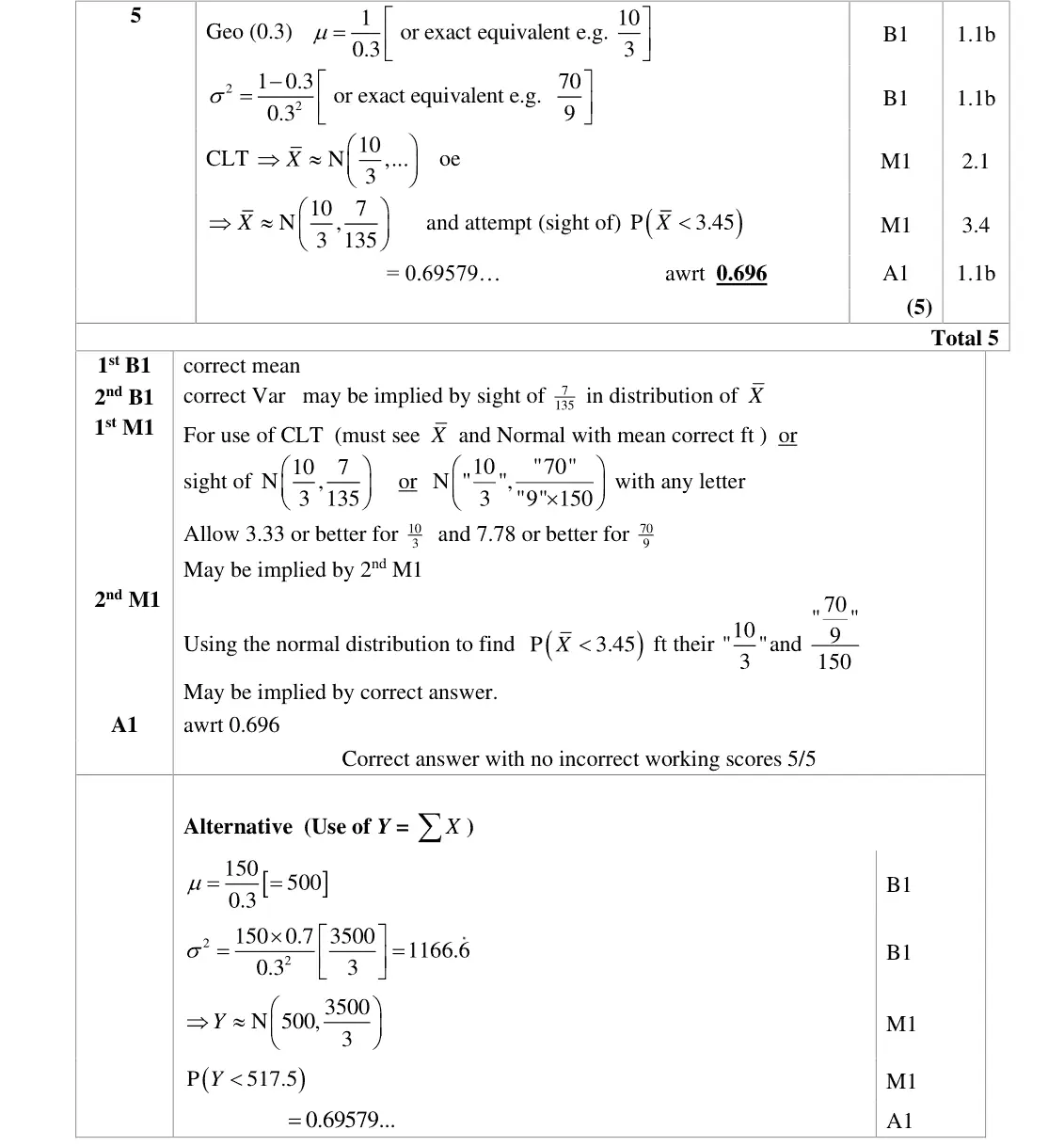
June 2022 · Paper 3B (Further Statistics 1) · Q55 marksEasy
Mark scheme (whole question; this part is marked with the orange bar)
Examiner's comment
The Advanced Information may well have helped students as they should have been expecting a question involving the Central Limit Theorem and over 75% scored full marks here. The correct mean and variance of the given geometric distribution were nearly always found but a few failed to divide the variance by 150 when forming the distribution for the mean. There was some confusion over the correct notation: we expected to see X and 10 7 N , 3 135 but often X was used for both Geo(0.3) and this normal distribution and occasionally the normal distribution was stated as 10 7 N , 3 135 but if this was used correctly we condoned the incorrect notation.
Key points from the mark scheme and examiner's report
Geo(0.3): μ = 10/3, σ² = 70/9
CLT X̄ ≈ N(10/3, 7/135)
P(X̄ < 3.45) = 0.696
failing to divide the variance by 150
same letter for X and X̄
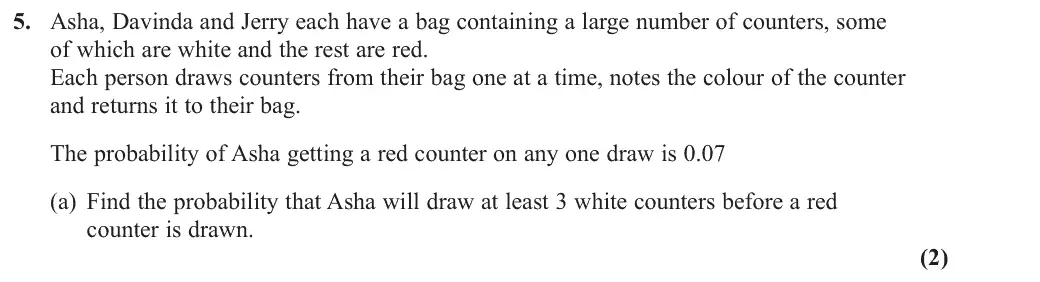
Nov 2021 · Paper 3B (Further Statistics 1) · Q5(a)2 marks
Mark scheme (whole question; this part is marked with the orange bar)
Examiner's comment
In part (a) the main error was to calculate the probability that exactly 3 counters are drawn before a red is drawn.
Key points from the mark scheme and examiner's report
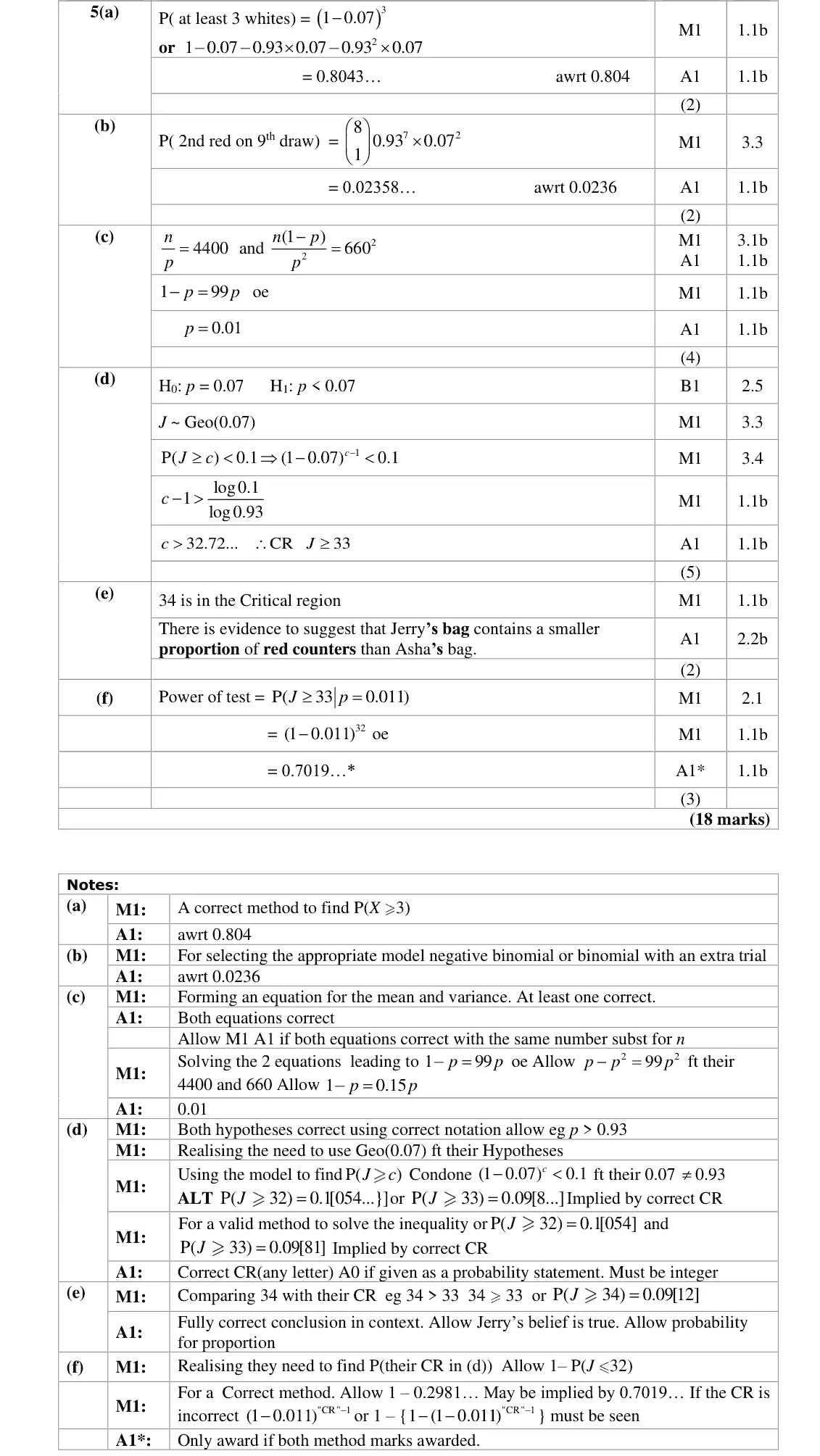
P(at least 3 whites first) = 0.93³ = 0.804
P(exactly 3 whites) a common error
Nov 2021 · Paper 3B (Further Statistics 1) · Q5(b)2 marks
Mark scheme (whole question; this part is marked with the orange bar)
Examiner's comment
Part (b) was usually well answered but a few candidates forgot the 8 1
Key points from the mark scheme and examiner's report
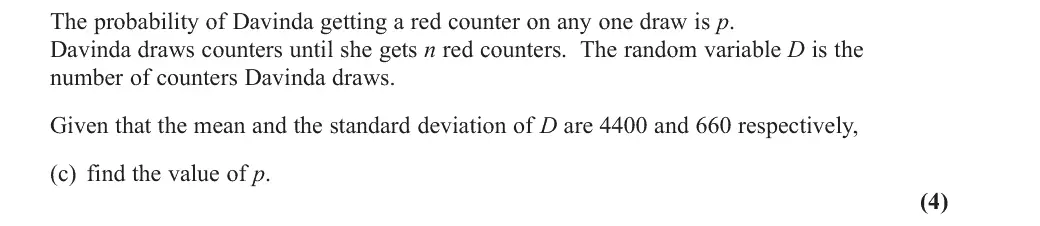
Nov 2021 · Paper 3B (Further Statistics 1) · Q5(c)4 marks
Mark scheme (whole question; this part is marked with the orange bar)
Examiner's comment
Part (c) was well answered with most candidates being able to set up the two equations (although some used 660 rather than 6602) Most candidates knew how to solve the equations to find a value for p
Key points from the mark scheme and examiner's report
n/p = 4400 and n(1 − p)/p² = 660²
dividing gives 1 − p = 99p, p = 0.01
using 660 not 660²
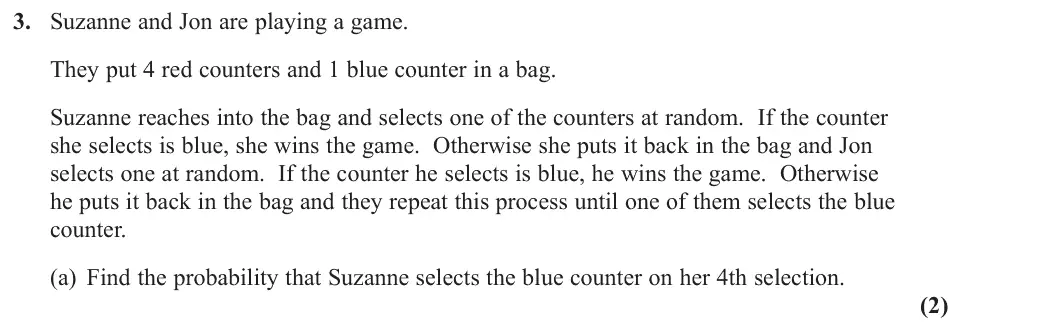
Oct 2020 · Paper 3B (Further Statistics 1) · Q3(a)2 marks
Mark scheme (whole question; this part is marked with the orange bar)
Examiner's comment
with the context and found P(X=4) instead of P(X=7) in part (a). A very small minority failed to recognise that p was 0.2 In part (b) some made the same error misunderstanding the context as in (a), but also common was finding 1–p5 instead of (1–p)5. The simplest way to think of this problem is that it is asking for the probability of the first 5 outcomes being ‘failure’, hence 0.85. Nearly all were successful in part (c) here although some stopped once they found
Key points from the mark scheme and examiner's report
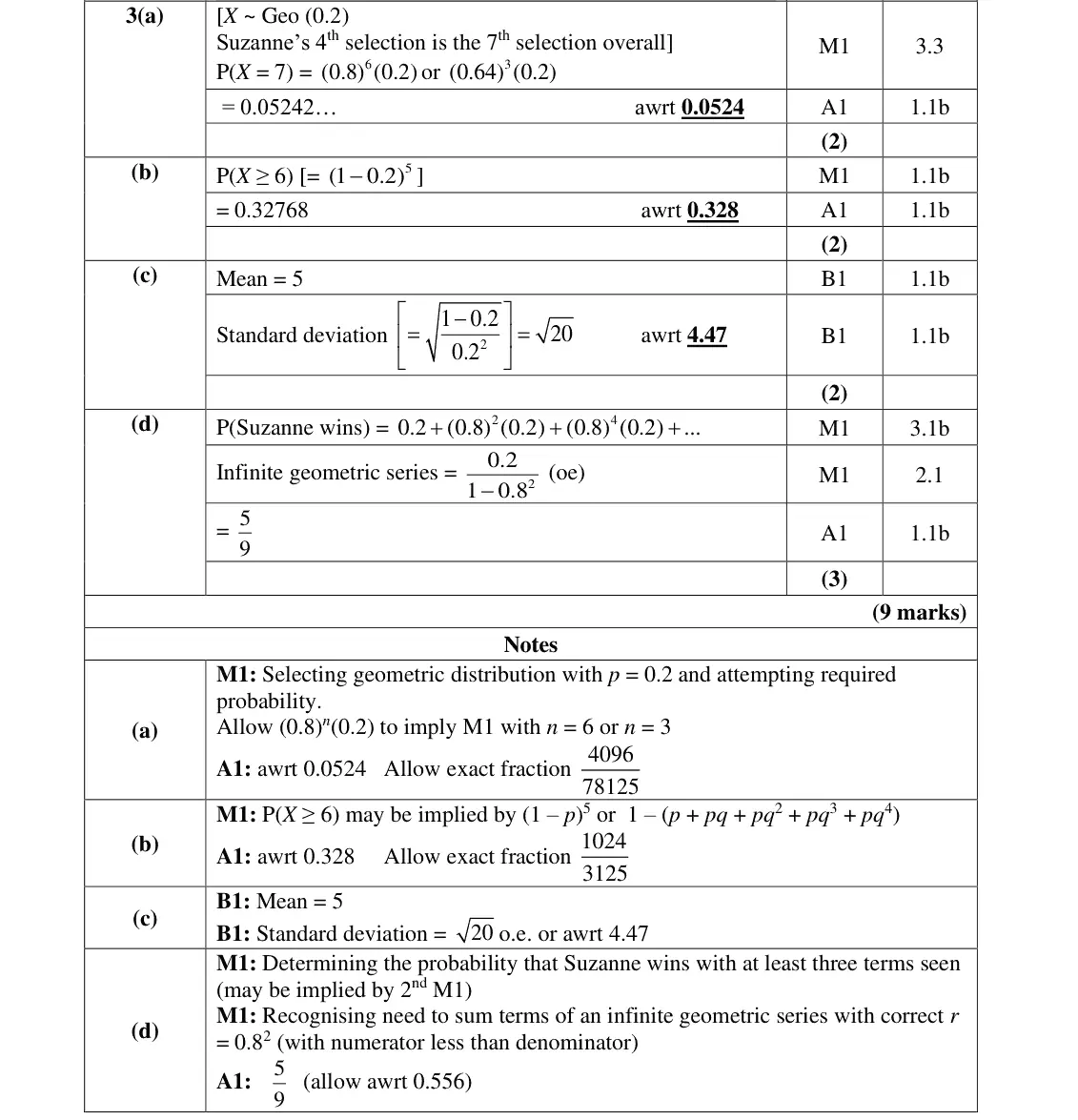
X ~ Geo(0.2)
Suzanne's 4th pick is the 7th overall: 0.8⁶ × 0.2 = 0.0524
P(X = 4) a common misreading
Oct 2020 · Paper 3B (Further Statistics 1) · Q3(b)2 marks
Mark scheme (whole question; this part is marked with the orange bar)
Examiner's comment
In part (b) some made the same error misunderstanding the context as in (a), but also common was finding 1–p5 instead of (1–p)5. The simplest way to think of this problem is that it is asking for the probability of the first 5 outcomes being ‘failure’, hence 0.85. Nearly all were successful in part (c) here although some stopped once they found
Key points from the mark scheme and examiner's report
Jon's 3rd pick is the 6th overall: P(X ≥ 6) = 0.8⁵ = 0.328
1 − 0.2⁵ is a common error
Oct 2020 · Paper 3B (Further Statistics 1) · Q3(c)2 marks
Mark scheme (whole question; this part is marked with the orange bar)
Examiner's comment
Nearly all were successful in part (c) here although some stopped once they found variance and failed to square root. The successful candidates in part (d) listed out the first few ways Suzanne could win the
Key points from the mark scheme and examiner's report
mean 1/p = 5, sd = √(0.8/0.04) = √20 = 4.47
some stopped at the variance
Oct 2020 · Paper 3B (Further Statistics 1) · Q3(d)3 marks
Mark scheme (whole question; this part is marked with the orange bar)
Examiner's comment
The successful candidates in part (d) listed out the first few ways Suzanne could win the game, leading to recognition that the required probability was the sum of an infinite geometric series.
Key points from the mark scheme and examiner's report
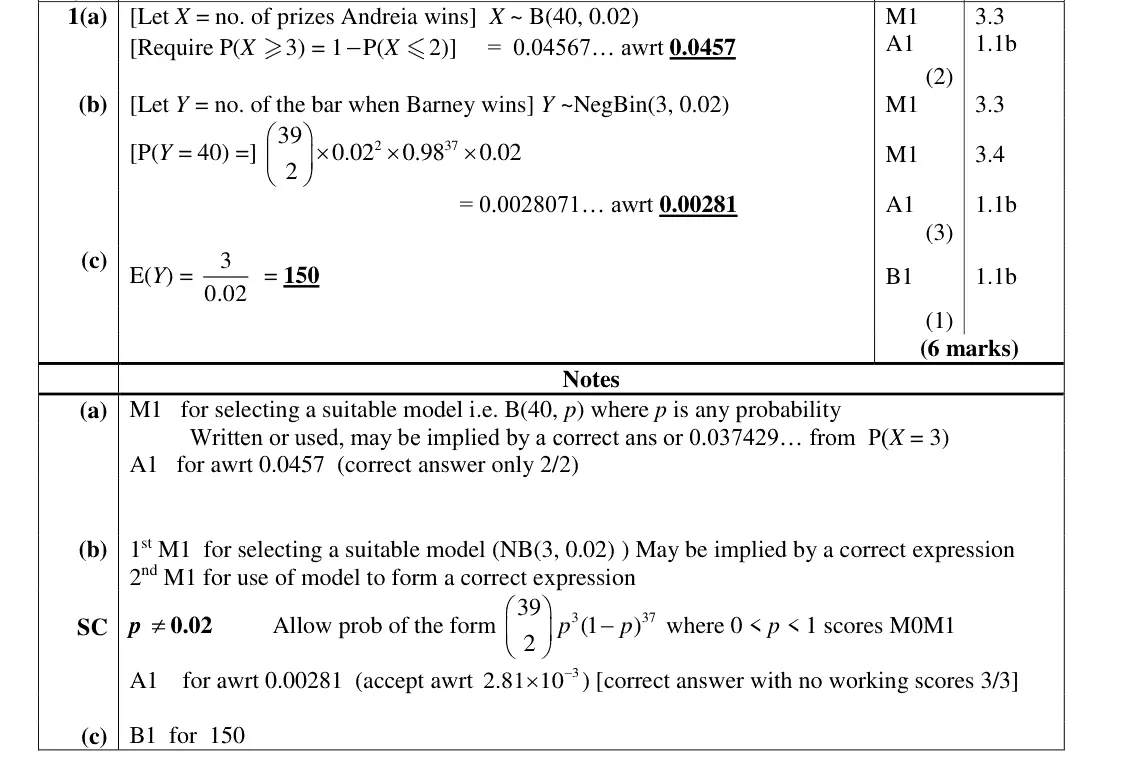
June 2019 · Paper 3B (Further Statistics 1) · Q1(b)3 marks
Mark scheme (whole question; this part is marked with the orange bar)
Examiner's comment
Part (a) was a straightforward opener and most candidates answered this correctly. In part (b) many recognised that a negative binomial model was required and this was often correct although some lost an accuracy mark for failing to give their answer correct to 3 significant figures. The other common error here, and in part (c), was to try and use a geometric model. In the final part most could use the
Key points from the mark scheme and examiner's report
June 2019 · Paper 3B (Further Statistics 1) · Q1(c)1 mark
Mark scheme (whole question; this part is marked with the orange bar)
Examiner's comment
error here, and in part (c), was to try and use a geometric model. In the final part most could use the formula given in the formula booklet correctly but some weren’t totally sure about the notation and therefore which values to use.
Key points from the mark scheme and examiner's report
E(Y) = r/p = 3/0.02 = 150
some confused r and p in the formula
geometric 1/p wrong
June 2019 · Paper 3B (Further Statistics 1) · Q7(a)4 marks
Mark scheme (whole question; this part is marked with the orange bar)
Examiner's comment
Part (a) was answered very well with most using the correct geometric distribution but some used 1 – P(B 4) rather than 1 – P(B > 5). Part (b) was usually answered very well too with the most common
Key points from the mark scheme and examiner's report
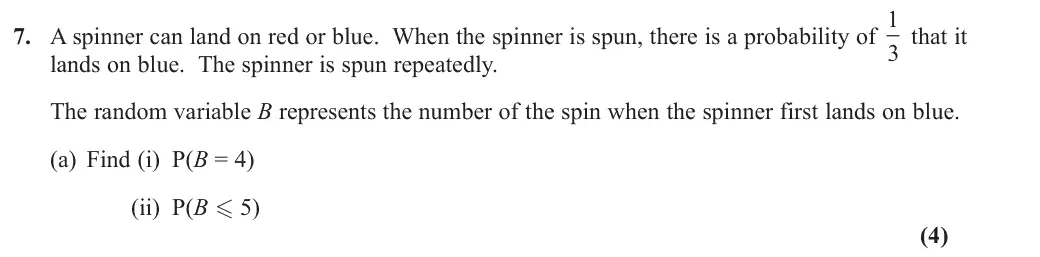
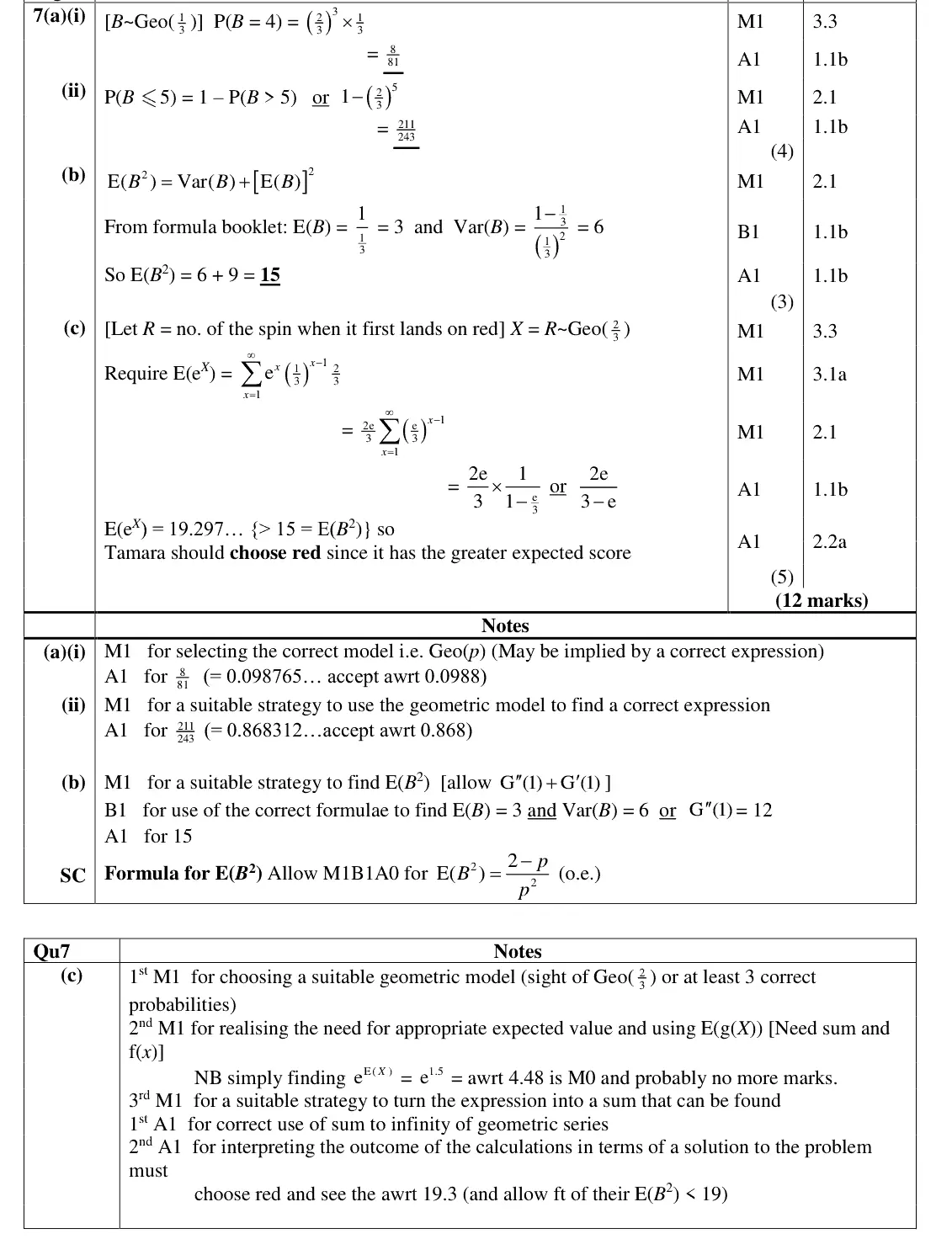
Geo(1/3): (i) (2/3)³(1/3) = 8/81
(ii) 1 − (2/3)⁵ = 211/243
1 − P(B ≤ 4) misuse
June 2019 · Paper 3B (Further Statistics 1) · Q7(b)3 marks
Mark scheme (whole question; this part is marked with the orange bar)
Examiner's comment
P(B 4) rather than 1 – P(B > 5). Part (b) was usually answered very well too with the most common error being to use E(B2) = [E(B)]2 . Part (c) was the most challenging question on the paper. Many
Key points from the mark scheme and examiner's report
E(B²) = Var(B) + [E(B)]² = 6 + 9 = 15
E(B²) = [E(B)]² was the common error
June 2019 · Paper 3B (Further Statistics 1) · Q7(c)5 marksMedium
Mark scheme (whole question; this part is marked with the orange bar)
Examiner's comment
error being to use E(B2) = [E(B)]2 . Part (c) was the most challenging question on the paper. Many obtained the first mark for identifying the correct distribution for the number of the spin when it first lands on red. The main problem was that candidates didn’t know how to find E(eX) with eE(X) being the most common incorrect approach. Some tried to argue from comparing the graphs of y = ex and y = x2 but there was no consideration of appropriate probabilities and some numerical approaches floundered in the same way. A small number found the correct probability generating function G(t) and then gave the very succinct solution G(e) but this was rare! Over 5% though did find the correct value of E(eX) and after comparing this with E(B2) were able to secure all the marks for this question.
Key points from the mark scheme and examiner's report
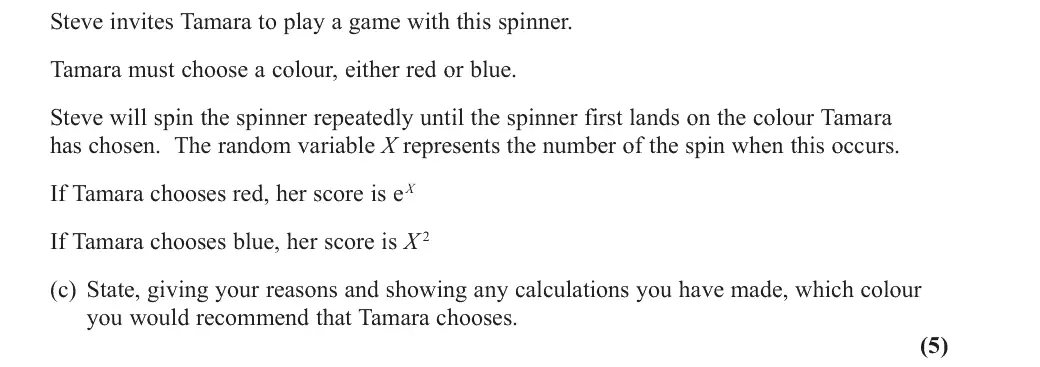
red: X ~ Geo(2/3)
E(eˣ) = Σ eˣ(1/3)^(x−1)(2/3) = 2e/(3 − e) = 19.3 > 15 so choose red (or G(e) from the pgf)
e^E(X) is the common wrong method
hardest part on the paper
Find an Edexcel Further Maths tutor
Stuck on this? Book a trial lesson with our Further Maths tutor.