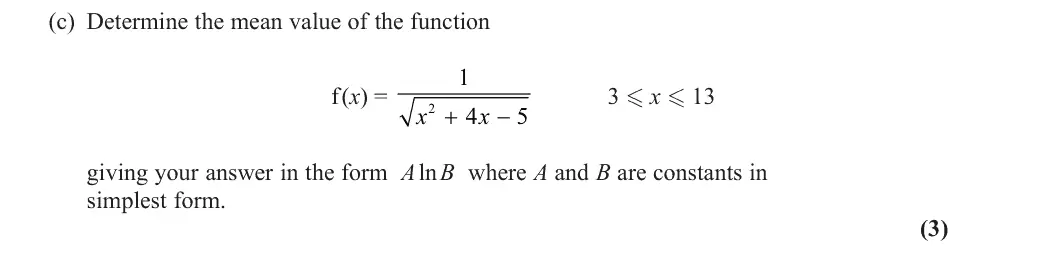
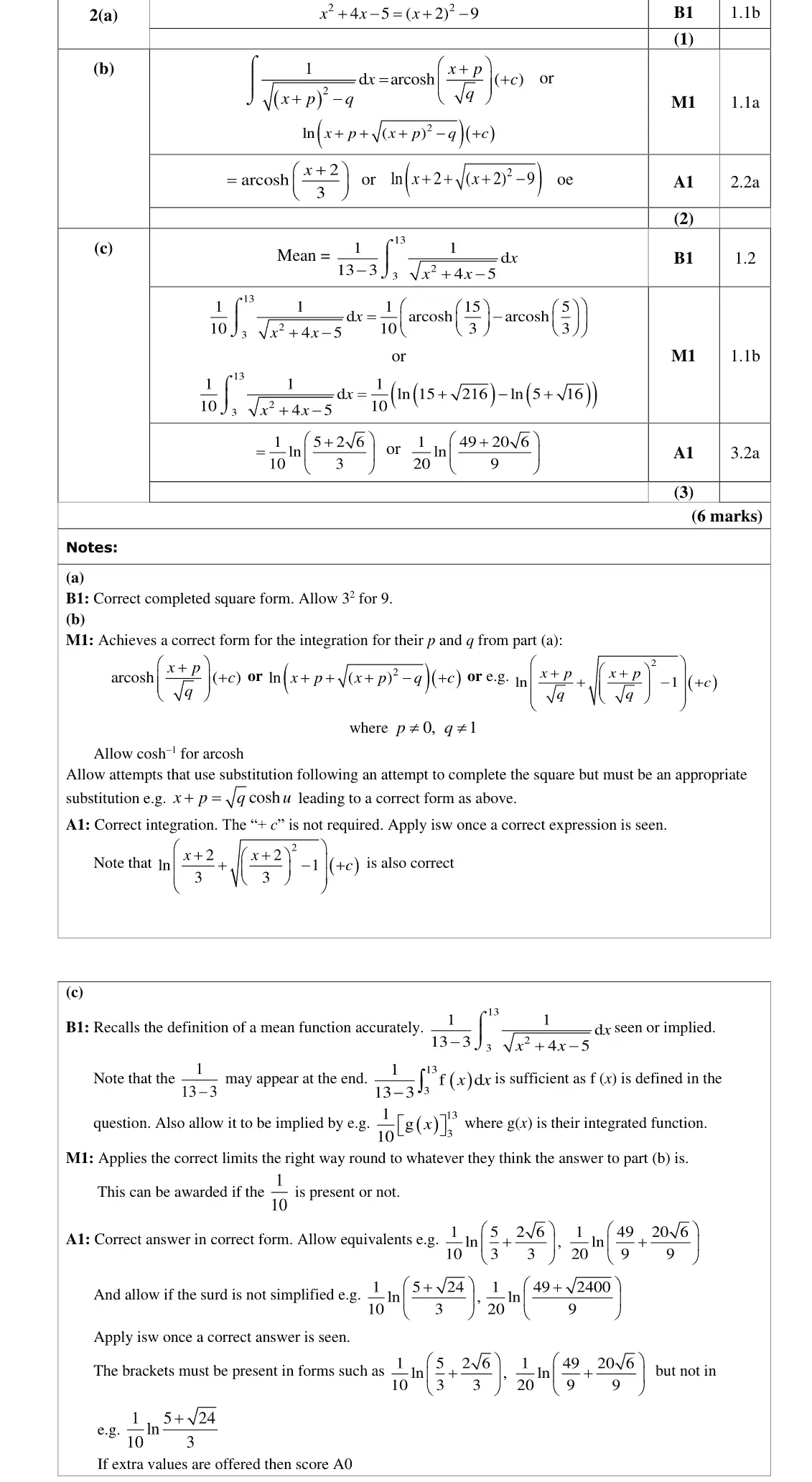
Nothing is given; the mean value formula must be known.
Since 2018
14 question parts, 41 marks, 5 with a difficulty rating from the examiner's report
Notes, worked examples and practice for this topic are being written by our tutors. The past-paper questions below are ready now: work each one on paper, then open the mark scheme and the examiner's comment.
Tap a question to zoom it. Mark scheme and examiner's comment open under each question.
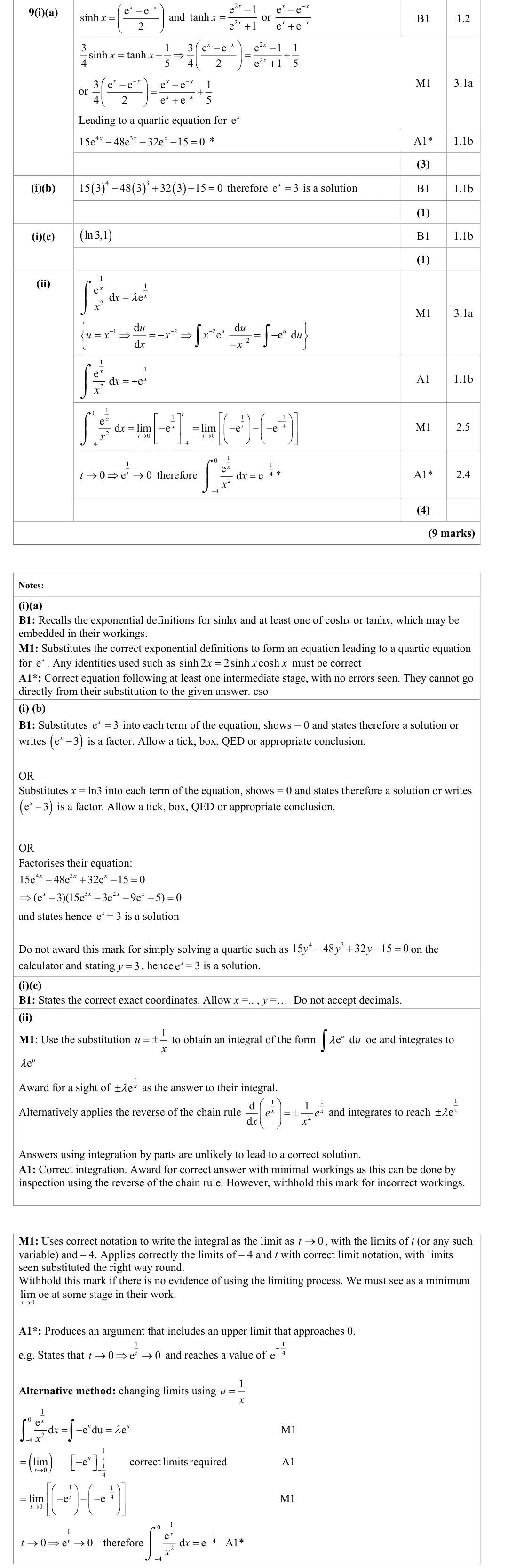
June 2025 · Paper 1 (Core Pure 1) · Q9(ii)4 marks
Mark scheme (whole question; this part is marked with the orange bar)
Examiner's comment
(i)(a) Many candidates successfully approached this part by correctly substituting the exponential definitions for sinh x and tanh x to form an equation. An equally successful alternative involved multiplying the equation by sinh x before applying the exponential definitions for sinh x and cosh x Most candidates then successfully progressed to derive the correct quartic equation for ex . Common errors observed included: ● Missing brackets during multiplication, leading to unmultiplied terms. ● Careless copying from previous lines. ● Incorrect treatment of signs. A significant number of unsuccessful attempts stemmed from candidates trying to use hyperbolic identities instead of converting to exponential form. There was no discernible difference in outcome based on whether candidates removed fractions early or gradually. x = or (i)(b) Most candidates confidently substituted e 3 into each term of the ln3 x = equation. However, a significant majority failed to provide an appropriate concluding statement, which was a prerequisite for earning this mark. A few candidates resorted to using a calculator to solve the quartic, which would also have resulted in the loss of this mark as they never showed evidence of their work. (i)(c) Most candidates were successful in achieving this mark. The primary reasons for not attaining it included: ● Obtaining an incorrect y-coordinate. and stopping without calculating the y-coordinate. ● Stating ln3 x = (ii) This part of the question was significantly more challenging for candidates, with very few scoring any marks. Many candidates unsuccessfully attempted integration by parts, often using several pages without making progress and consequently scoring zero marks. Candidates who employed substitution in their integration were generally more successful in achieving the correct integral. However, those who changed the limits frequently made errors, such as using an upper limit of “t” and expressing the integral as the limit as “t” approaches infinity, which often led to the loss of subsequent marks. Of those who integrated correctly, candidates who did not use a substitution were more successful in handling the limits and often secured the second method mark. Nevertheless, several candidates simply substituted 0 1 into their integral. Only a minority of candidates appreciated that 0 e 0 t → ⇒ → to reach a t 1 -. Very few candidates achieved full marks on this question. e value of 4
Key points from the mark scheme and examiner's report
integrand is undefined at x = 0 (the upper limit)
by reverse chain rule or u = 1/x the integral is −e^(1/x)
use lim t → 0⁻ so e^(1/t) → 0, giving e^(−1/4)
integration by parts went nowhere
very few gained full marks
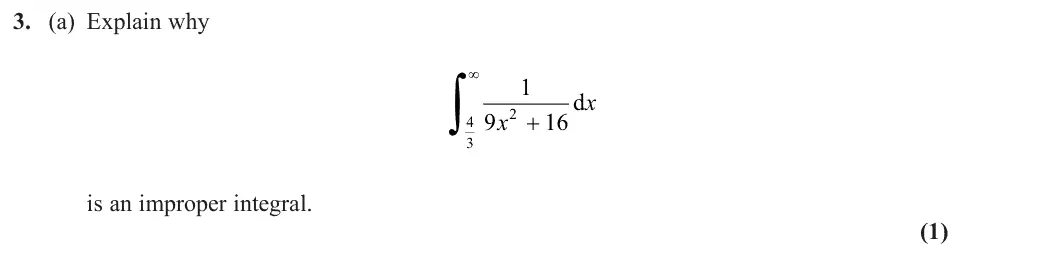
June 2024 · Paper 2 (Core Pure 2) · Q3(a)1 mark
Mark scheme (whole question; this part is marked with the orange bar)
Examiner's comment
(a) Overall, this was answered well, although some candidates lost marks by stating that the integral was undefined, without referring to the infinite limit, A few candidates incorrectly referred to the function rather than the limit with others stating that the function was not defined at 4 3 , also losing the mark.
Key points from the mark scheme and examiner's report
the upper limit is infinite
saying 'undefined' or referring to the function or to 4/3 scored 0
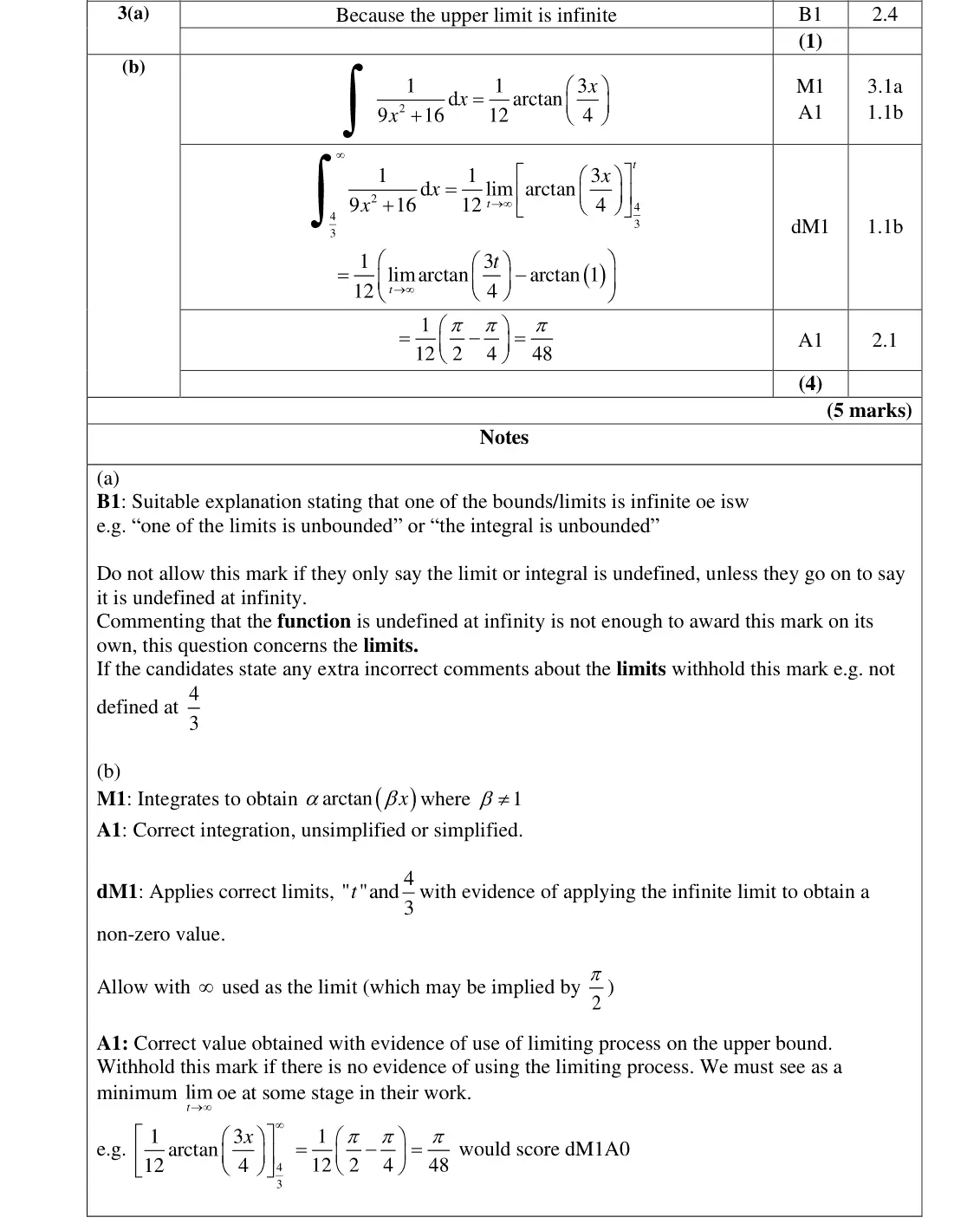
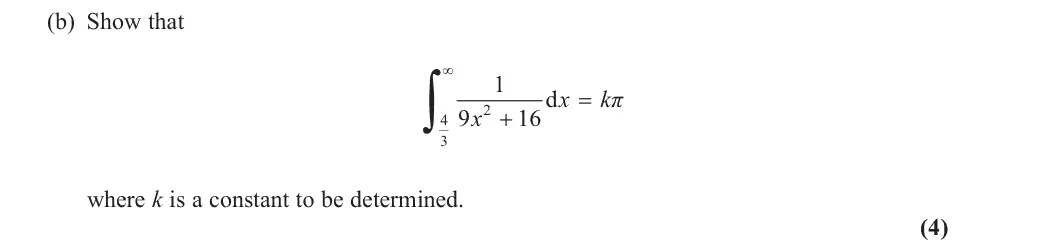
June 2024 · Paper 2 (Core Pure 2) · Q3(b)4 marks
Mark scheme (whole question; this part is marked with the orange bar)
Examiner's comment
(b) Most candidates identified the correct form for the integral, 𝛼arctan(𝛽𝑥) The most common error was to have 𝛼= 1 4 . The most successful candidates took out a factor of 1 9 before integrating. A few candidates made a substitution, in general, successfully. Very few candidates lost marks because they did not refer to lim t→ and a pleasing number realised that this was 𝜋 2 . The most common incorrect values were 0 and ∞.
Key points from the mark scheme and examiner's report
(1/12)arctan(3x/4)
must show the limit t → ∞ explicitly: (1/12)(π/2 − π/4) = π/48
1/4 instead of 1/12 was the common error
taking out a factor 1/9 first helps
June 2023 · Paper 1 (Core Pure 1) · Q2(c)3 marks
Mark scheme (whole question; this part is marked with the orange bar)
Examiner's comment
This question proved accessible to most candidates, with many scoring full marks. In part (c), most candidates knew how to find the mean value of a function. Those who failed to do that could often obtain B0M1A0 with the correct use of limits with their integral. There were some incorrect substitutions and collection and/or simplification of answers with some failing to divide both parts of their final fraction by 3 where appropriate.
Key points from the mark scheme and examiner's report
some failed to divide by 13 − 3 or simplify the log
June 2022 · Paper 1 (Core Pure 1) · Q9(i)(a)1 markEasy
Mark scheme (whole question; this part is marked with the orange bar)
Examiner's comment
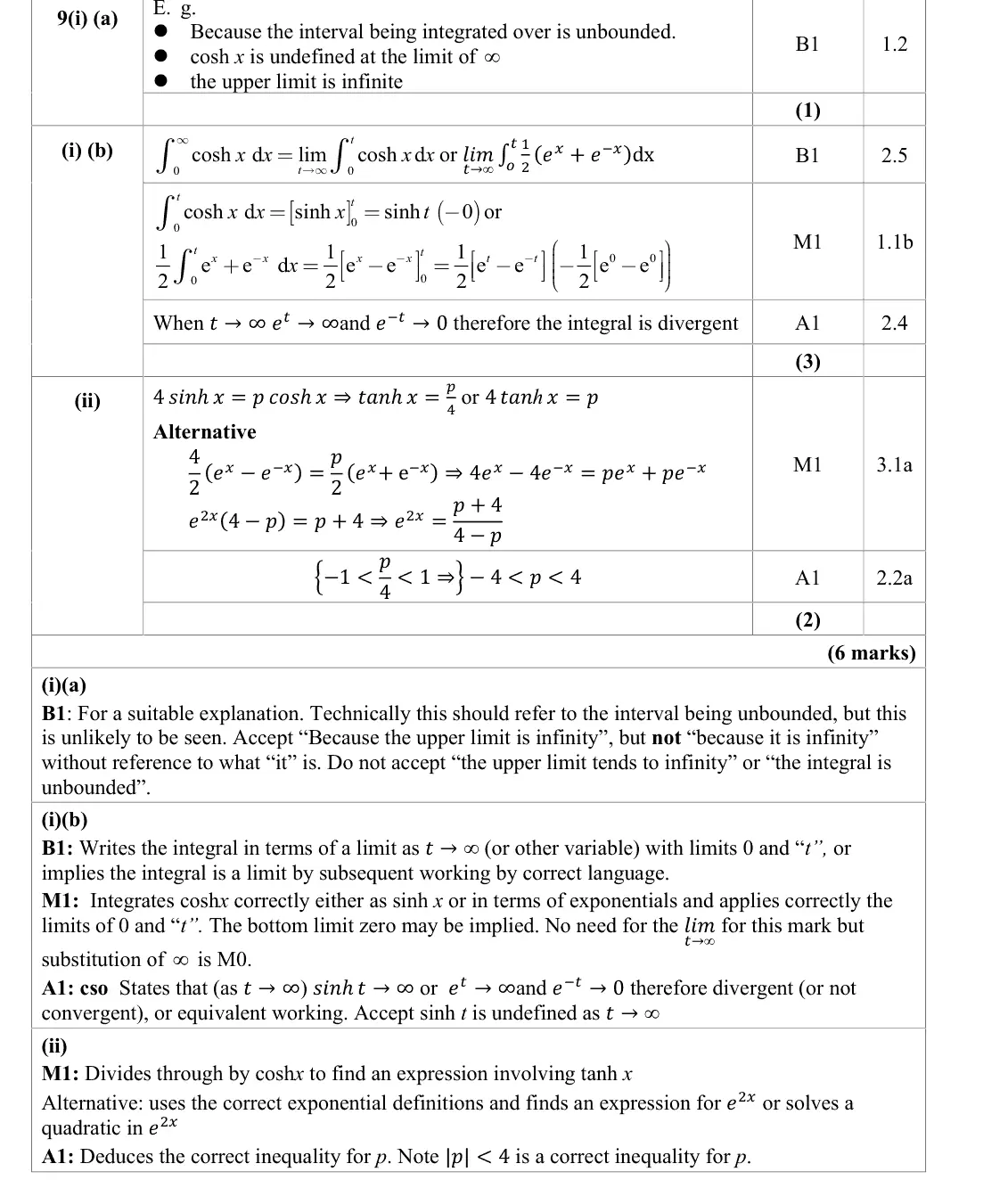
The first question for which the modal mark was not full marks, but was in this case 5 out of 6, with 6 and 4 marks being the next most common scores (about equally likely). Over 80% scored at least 3 marks, but there were many who made little progress in either part. Part (i) (a) proved difficult for candidates to explain, despite being a deceptively simple question expecting the answer that one of the limits is infinite. The intention was often clear but incorrect phrasing or vocabulary made it difficult for marks to be awarded. While most candidates had some idea the interval being integrated over is unbounded they found it difficult to express this clearly, with the most common comment being that one of the limits is infinity. It was not always clear whether they were referring to one of the limits or the integral as a whole. A huge variety of wording used by candidates demonstrated a lack of depth in their understanding of the definition of an improper integral. Part (i)(b) was much more successful but again, students did not always appreciate the importance of the correct language. Most candidates attempted to write down the integral, but a significant number did not replace ∞ with a parameter. They then went on to integrate, but some substituted ∞ instead of using a parameter. Candidates either integrated cosh x directly to give sinh x, or expressed cosh x in terms of exponentials and then integrated, with incorrect processing of limits being the most common reason for dropped marks. Those who did use a parameter and correctly applied the limits 0 and t (or a) usually attempted to find the limit as their t tended to infinity. If they got this far they often made the correct statement and drew the conclusion that it is divergent, but some omitted this. Incomplete statements were more common in those who used exponentials, so the last A mark was often not awarded. Those who opted to integrate to ( ) 1 - - x x 2 e e sometimes did not consider what happens as t tends to infinity for both et and e-t. Part (ii) was mostly answered well with both approached shown in the scheme being seen p = frequently. Those who went straight to tanh x were able to achieve and answer swiftly, 4 however some made lots of work for themselves by working in exponentials and this increased the chances of making an error somewhere along the way. The most efficient x responses used the range of tanh x to state the range for tanh 4 . A few of those who used the exponential form struggled to reach an expression in 𝑒2𝑥. There were some algebraic errors in their working but the most common error was to use the inclusive inequality, the inequality the wrong way round, or a single inequality, usually p < 4. Among those that took the exponential approach some tried to form an equation in terms of ex and use the discriminant to form an inequality in p – it rarely led to the correct final answer, being often abandoned. For those who continued to reach an inequality for p from an exponential definition, most managed to identify 4 as a boundary value but then left this as a single inequality, often p > 4.
Key points from the mark scheme and examiner's report
the upper limit is infinite (interval unbounded)
'because it is infinity' or 'the integral is unbounded' not accepted
June 2022 · Paper 1 (Core Pure 1) · Q9(i)(b)3 marksEasy
Mark scheme (whole question; this part is marked with the orange bar)
Examiner's comment
The first question for which the modal mark was not full marks, but was in this case 5 out of 6, with 6 and 4 marks being the next most common scores (about equally likely). Over 80% scored at least 3 marks, but there were many who made little progress in either part. Part (i) (a) proved difficult for candidates to explain, despite being a deceptively simple question expecting the answer that one of the limits is infinite. The intention was often clear but incorrect phrasing or vocabulary made it difficult for marks to be awarded. While most candidates had some idea the interval being integrated over is unbounded they found it difficult to express this clearly, with the most common comment being that one of the limits is infinity. It was not always clear whether they were referring to one of the limits or the integral as a whole. A huge variety of wording used by candidates demonstrated a lack of depth in their understanding of the definition of an improper integral. Part (i)(b) was much more successful but again, students did not always appreciate the importance of the correct language. Most candidates attempted to write down the integral, but a significant number did not replace ∞ with a parameter. They then went on to integrate, but some substituted ∞ instead of using a parameter. Candidates either integrated cosh x directly to give sinh x, or expressed cosh x in terms of exponentials and then integrated, with incorrect processing of limits being the most common reason for dropped marks. Those who did use a parameter and correctly applied the limits 0 and t (or a) usually attempted to find the limit as their t tended to infinity. If they got this far they often made the correct statement and drew the conclusion that it is divergent, but some omitted this. Incomplete statements were more common in those who used exponentials, so the last A mark was often not awarded. Those who opted to integrate to ( ) 1 - - x x 2 e e sometimes did not consider what happens as t tends to infinity for both et and e-t. Part (ii) was mostly answered well with both approached shown in the scheme being seen p = frequently. Those who went straight to tanh x were able to achieve and answer swiftly, 4 however some made lots of work for themselves by working in exponentials and this increased the chances of making an error somewhere along the way. The most efficient x responses used the range of tanh x to state the range for tanh 4 . A few of those who used the exponential form struggled to reach an expression in 𝑒2𝑥. There were some algebraic errors in their working but the most common error was to use the inclusive inequality, the inequality the wrong way round, or a single inequality, usually p < 4. Among those that took the exponential approach some tried to form an equation in terms of ex and use the discriminant to form an inequality in p – it rarely led to the correct final answer, being often abandoned. For those who continued to reach an inequality for p from an exponential definition, most managed to identify 4 as a boundary value but then left this as a single inequality, often p > 4.
Key points from the mark scheme and examiner's report
write as lim t → ∞ of ∫ from 0 to t
= sinh t, which tends to infinity, so divergent
substituting ∞ directly scores M0
Nov 2021 · Paper 1 (Core Pure 1) · Q5(i)3 marksHard
Mark scheme (whole question; this part is marked with the orange bar)
Examiner's comment
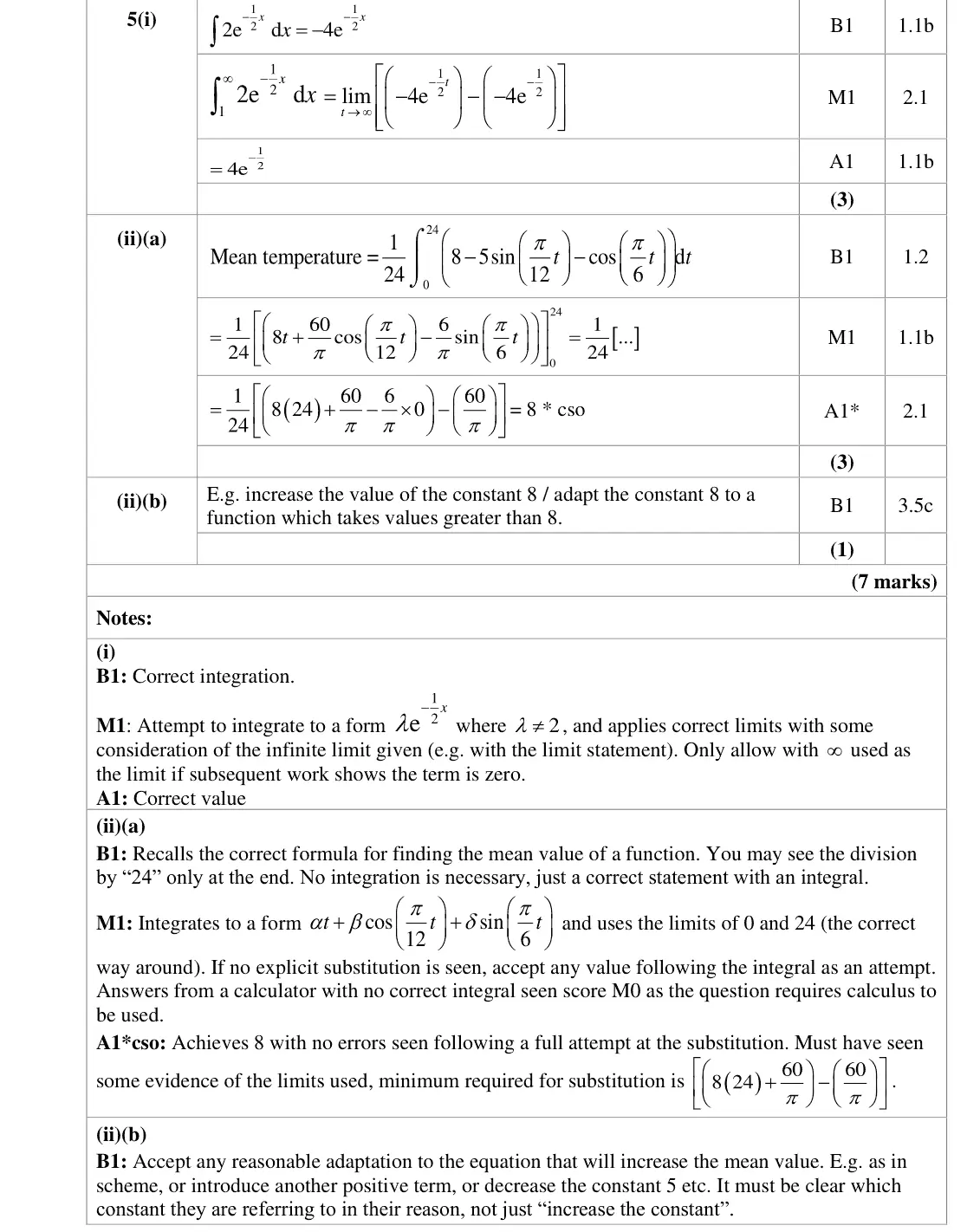
(i) Fully correct integration was required for the first mark and was often 1 given. Some had a coefficient of , suggesting they may have - 2 differentiated but a generous scheme allowed the M mark for any changed function in the required form, provided correct limits were used and a consideration of the infinite limit. Notation used tended to be good, which was pleasing, and many scored well, with over 60% scoring the first 2, and over 45% gaining the full three marks on this part. (ii) (a) About half of candidates quoted or implied the correct formula for finding the mean value for the B mark. Integration was usually successful although there was an issue with the coefficients in many cases and some did not substitute limits explicitly. Just under 45% score the M mark, usually it was a lack of evidence that lost the mark, as calculus was required to be seen. Some forgot to integrate the 8 to give 8t, also losing two marks. Many did not get the last A mark as they did not show a full attempt at substitution, with just under a quarter gaining the A1 mark. (b) Many candidates made no attempt at this part and less than 15% scored this mark.
Key points from the mark scheme and examiner's report
∫2e^(−x/2)dx = −4e^(−x/2)
show the limit as the upper limit → ∞
answer 4e^(−1/2)
Nov 2021 · Paper 1 (Core Pure 1) · Q5(ii)(a)3 marksHard
Mark scheme (whole question; this part is marked with the orange bar)
Examiner's comment
(i) Fully correct integration was required for the first mark and was often 1 given. Some had a coefficient of , suggesting they may have - 2 differentiated but a generous scheme allowed the M mark for any changed function in the required form, provided correct limits were used and a consideration of the infinite limit. Notation used tended to be good, which was pleasing, and many scored well, with over 60% scoring the first 2, and over 45% gaining the full three marks on this part. (ii) (a) About half of candidates quoted or implied the correct formula for finding the mean value for the B mark. Integration was usually successful although there was an issue with the coefficients in many cases and some did not substitute limits explicitly. Just under 45% score the M mark, usually it was a lack of evidence that lost the mark, as calculus was required to be seen. Some forgot to integrate the 8 to give 8t, also losing two marks. Many did not get the last A mark as they did not show a full attempt at substitution, with just under a quarter gaining the A1 mark. (b) Many candidates made no attempt at this part and less than 15% scored this mark.
Key points from the mark scheme and examiner's report
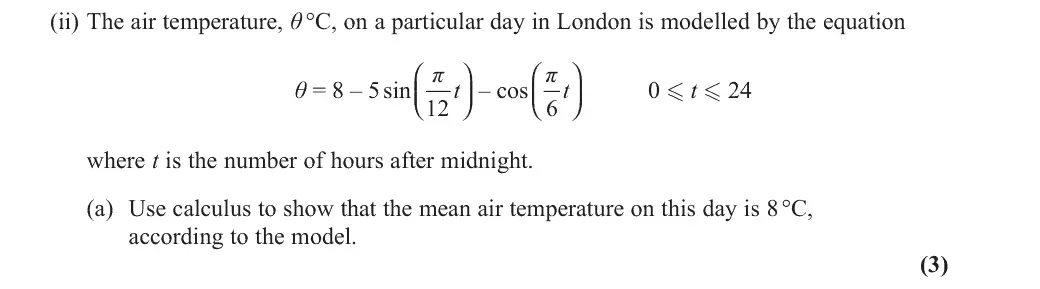
mean = (1/24)∫ from 0 to 24 of θ dt
integrate to 8t + (60/π)cos(πt/12) − (6/π)sin(πt/6), substitute limits to get 8
calculator-only scores 0
Nov 2021 · Paper 1 (Core Pure 1) · Q5(ii)(b)1 markMedium
Mark scheme (whole question; this part is marked with the orange bar)
Examiner's comment
(i) Fully correct integration was required for the first mark and was often 1 given. Some had a coefficient of , suggesting they may have - 2 differentiated but a generous scheme allowed the M mark for any changed function in the required form, provided correct limits were used and a consideration of the infinite limit. Notation used tended to be good, which was pleasing, and many scored well, with over 60% scoring the first 2, and over 45% gaining the full three marks on this part. (ii) (a) About half of candidates quoted or implied the correct formula for finding the mean value for the B mark. Integration was usually successful although there was an issue with the coefficients in many cases and some did not substitute limits explicitly. Just under 45% score the M mark, usually it was a lack of evidence that lost the mark, as calculus was required to be seen. Some forgot to integrate the 8 to give 8t, also losing two marks. Many did not get the last A mark as they did not show a full attempt at substitution, with just under a quarter gaining the A1 mark. (b) Many candidates made no attempt at this part and less than 15% scored this mark.
Key points from the mark scheme and examiner's report
increase the constant 8 (or decrease the 5, or add a positive term)
must say which constant, not just "increase the constant"
Oct 2020 · Paper 1 (Core Pure 1) · Q2(a)1 mark
Mark scheme (whole question; this part is marked with the orange bar)
Examiner's comment
(a) Most candidates realised that the integral was improper due to the infinite upper limit. Many however missed this part out or gave explanations with contrary reasoning. A common misconception was to state that the integrand was not valid when x = 0. Some said it was undefined when x = ∞, and these did not get the mark.
Key points from the mark scheme and examiner's report
the upper limit is infinity (interval unbounded)
saying the integrand is undefined at x = 0 or 'undefined when x = ∞' scores 0
Oct 2020 · Paper 1 (Core Pure 1) · Q2(b)6 marks
Mark scheme (whole question; this part is marked with the orange bar)
Examiner's comment
The straightforward integral in part (b) was done well by the majority although there were also some very disappointing attempts. Most used partial fractions and integrated successfully, gaining the first three marks. Many however made little progress from there as they did not realise that they needed to combine the logs in order to consider the limiting value. Many of those who did combine the logs did not complete the strategy to find the required area as they did not correctly find the limit of the improper term. The most common error was to assume the upper limit tended to 0. Most candidates gained 3 or 4 marks in (b) and a minority dealt with the upper limit correctly and gained full marks. There was a wide spread of marks on this question making quite discriminating. A very few chose to use Way 2 on the mark scheme, expanding the denominator and completing the square. These then used the formula to integrate. Sign errors when using the formula meant they could only gain the first two marks in (b).
Key points from the mark scheme and examiner's report
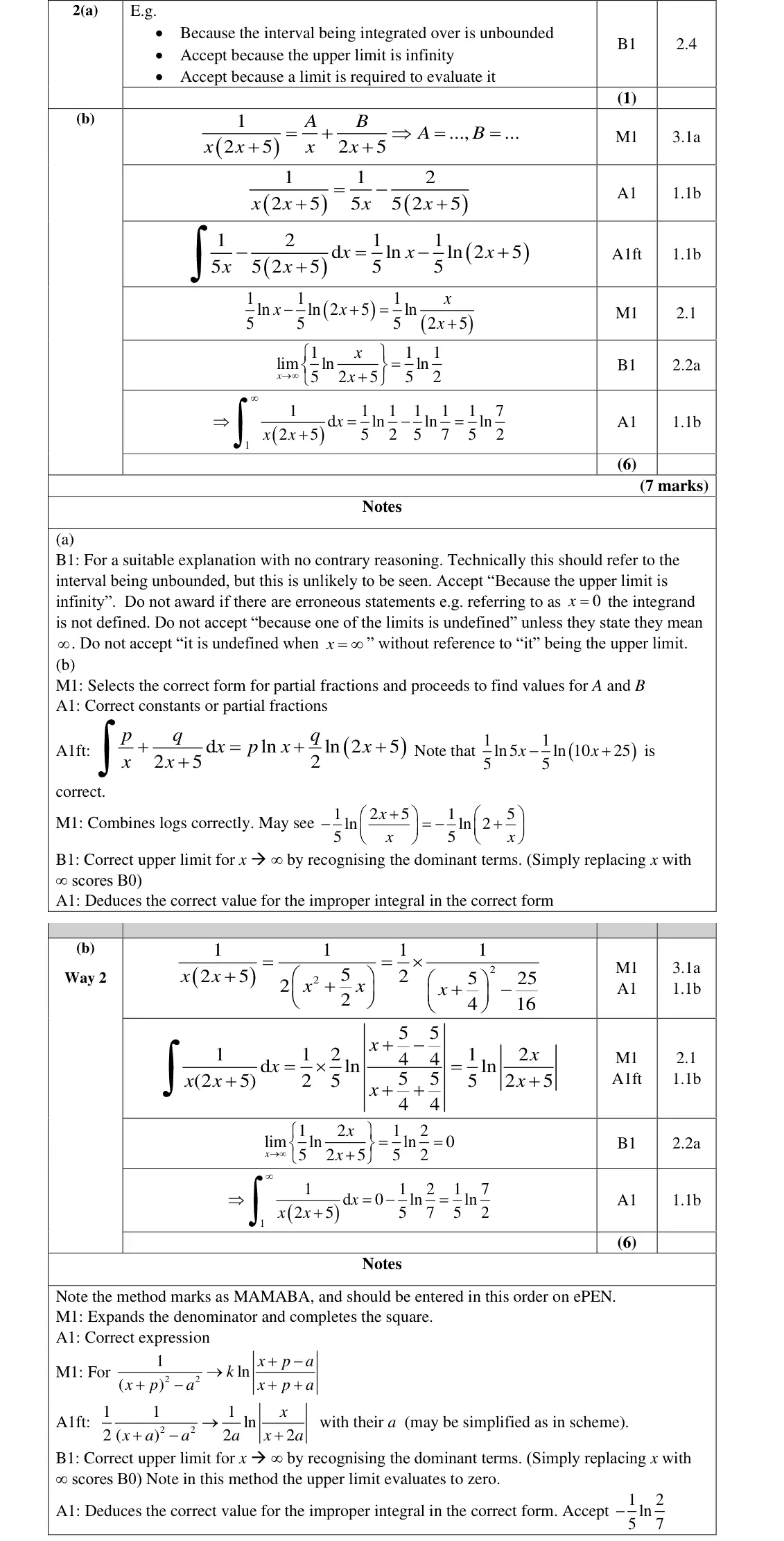
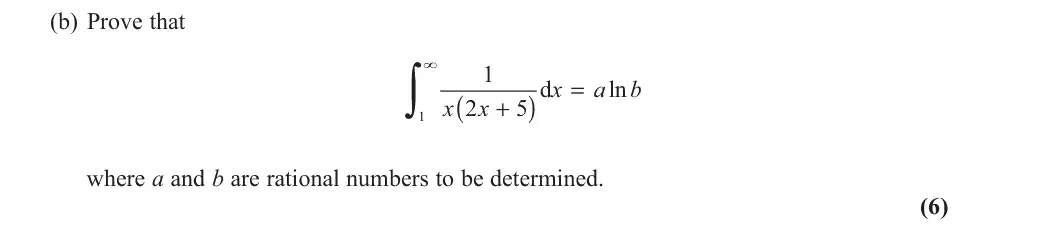
partial fractions 1/(5x) − 2/(5(2x + 5))
combine the logs before letting x → ∞ (limit (1/5)ln ½, not 0)
answer (1/5)ln(7/2)
simply replacing x with ∞ scores B0
Oct 2020 · Paper 2 (Core Pure 2) · Q5(c)2 marks
Mark scheme (whole question; this part is marked with the orange bar)
Examiner's comment
(c) Clearly most knew what they needed to do but were thwarted by failure to complete part b. There were a few fully correct solutions but not many sometimes due to careless slips in tidying up their expressions for the mean value.
Key points from the mark scheme and examiner's report
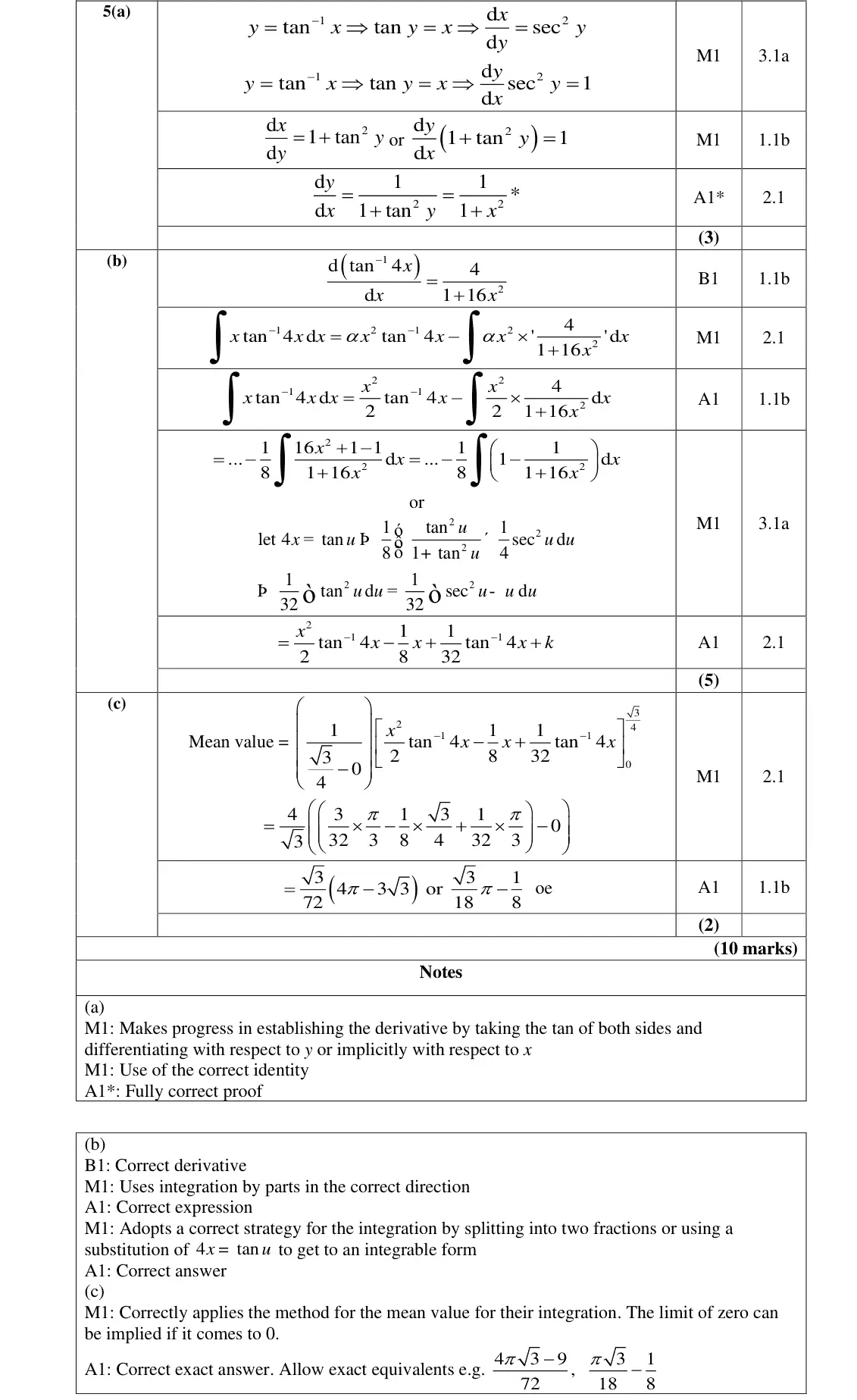
mean value = (4/√3) × [ … ] from 0 to √3/4 = (√3/72)(4π − 3√3) or (√3/18)π − 1/8
June 2019 · Paper 1 (Core Pure 1) · Q27 marks
Mark scheme (whole question; this part is marked with the orange bar)
Examiner's comment
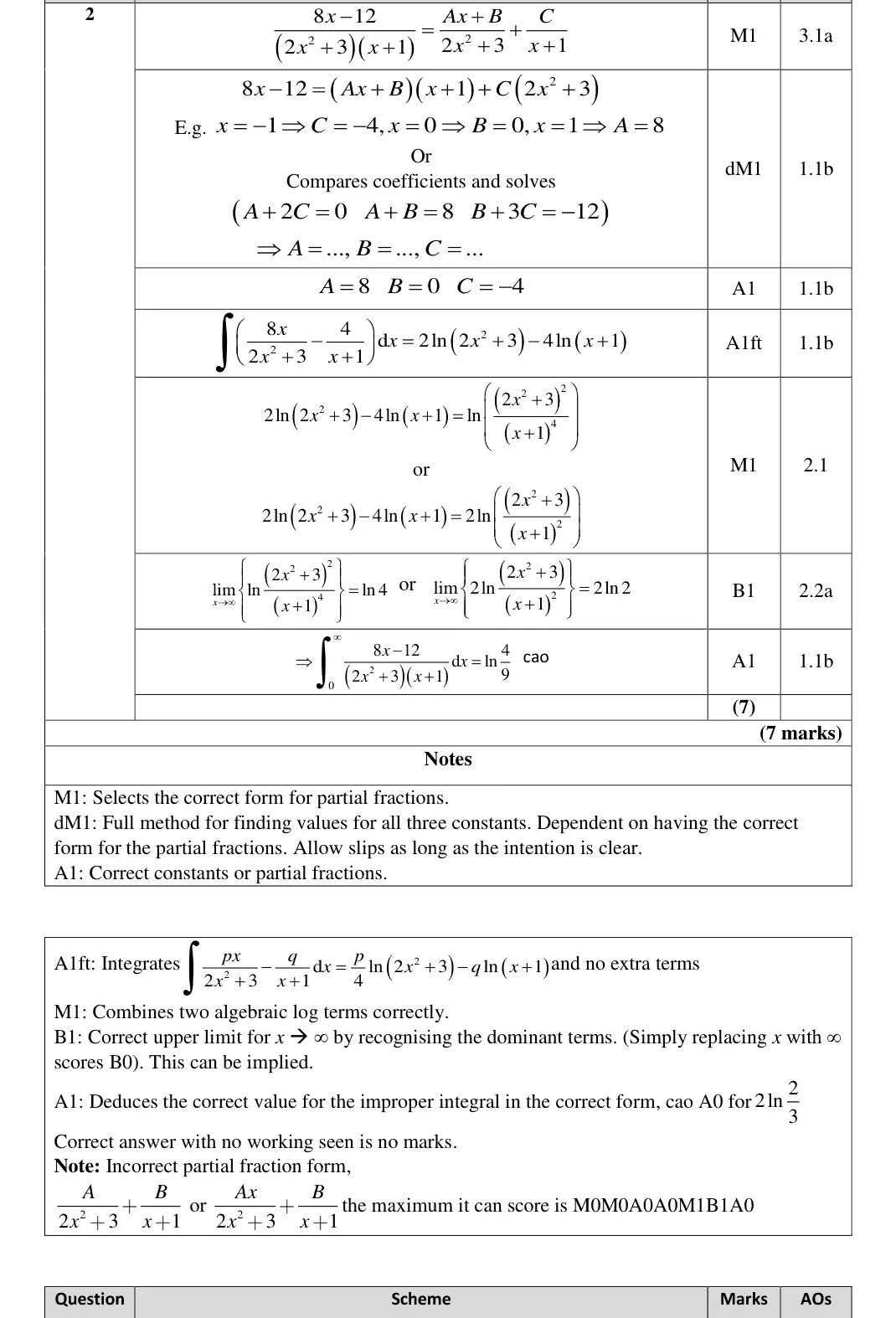
This question was attempted by the majority of the candidates but caused difficulties for a significant number of candidates Most candidates realised that they needed to use partial fractions to attempt this question. Those that did not usually scored 0/7. The question was answered quite well by candidates who chose the correct form of the partial fractions 2 2 3 1 Ax B C x x usually scored the first three marks. Most were then able to integrate correctly, though some had the wrong coefficient for the ln(2x2 + 3) term Many candidates chose the incorrect partial fraction either 2 2 3 1 A B x x or 2 2 3 1 Ax B x x and consequently lost the first four marks. Candidates who chose 2 2 3 1 Ax B x x sometimes managed to continue to score the M1B1. Incorrect partial fractions often led to an incorrect arctan integral. Many candidates missed the next key stage of working for applying the log rules- either before substituting or by substituting the variable 't' then collecting their log functions in terms of 't' before an attempt to simplify. Some of those candidates who did manage to combine their log terms then failed to deal with the limit correctly, believing that this simplified to ln(1). A small number of candidates who had successfully dealt with the limit left their final answer as 2ln(2/3) rather than putting this in the required form. Many candidates failed to obtain the B1 mark (and hence the final A1 mark) by not recognising the dominant terms. A very common incorrect answer was ln(1/9) There were some, concise, completely correct attempts at this question.
Key points from the mark scheme and examiner's report
partial fractions (Ax + B)/(2x² + 3) + C/(x + 1): A = 8, B = 0, C = −4
combine the logs before taking the limit as x → ∞ (dominant terms) to get ln(4/9)
wrong partial-fraction form or 'replacing x with ∞' lose most marks
June 2019 · Paper 2 (Core Pure 2) · Q3(b)2 marks
Mark scheme (whole question; this part is marked with the orange bar)
Examiner's comment
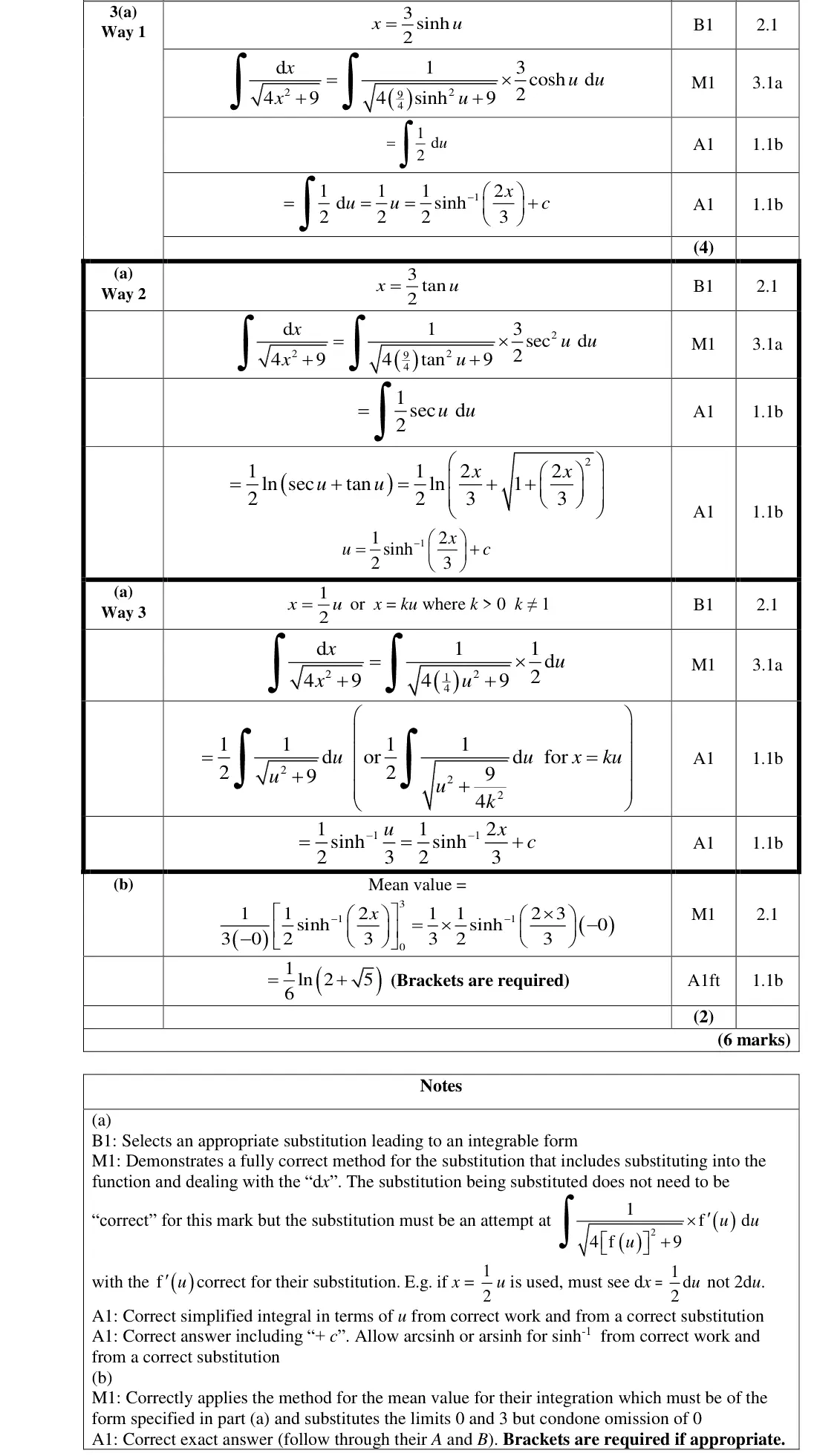
Part (a) required an integration by substitution. Unfortunately, some candidates merely used 1 3 the formula book. Those who chose an appropriate substitution, usually x = 2 u or x = 2 sinh u, tended to proceed correctly. The method mark was still available to those who chose a substitution that did not lead to an easily integratable form. There were very few cases where du dx dx was replaced with dx du rather than du du. In part (ii) the concept of mean value was widely known. A few errors were seen in the use of the logarithmic form of sinh-1(x) but generally the two marks here were widely scored.
Key points from the mark scheme and examiner's report
mean value = (1/3)∫ from 0 to 3 = (1/6)ln(2 + √5)
brackets required
slips in the log form of sinh⁻¹
Find an Edexcel Further Maths tutor
Stuck on this? Book a trial lesson with our Further Maths tutor.