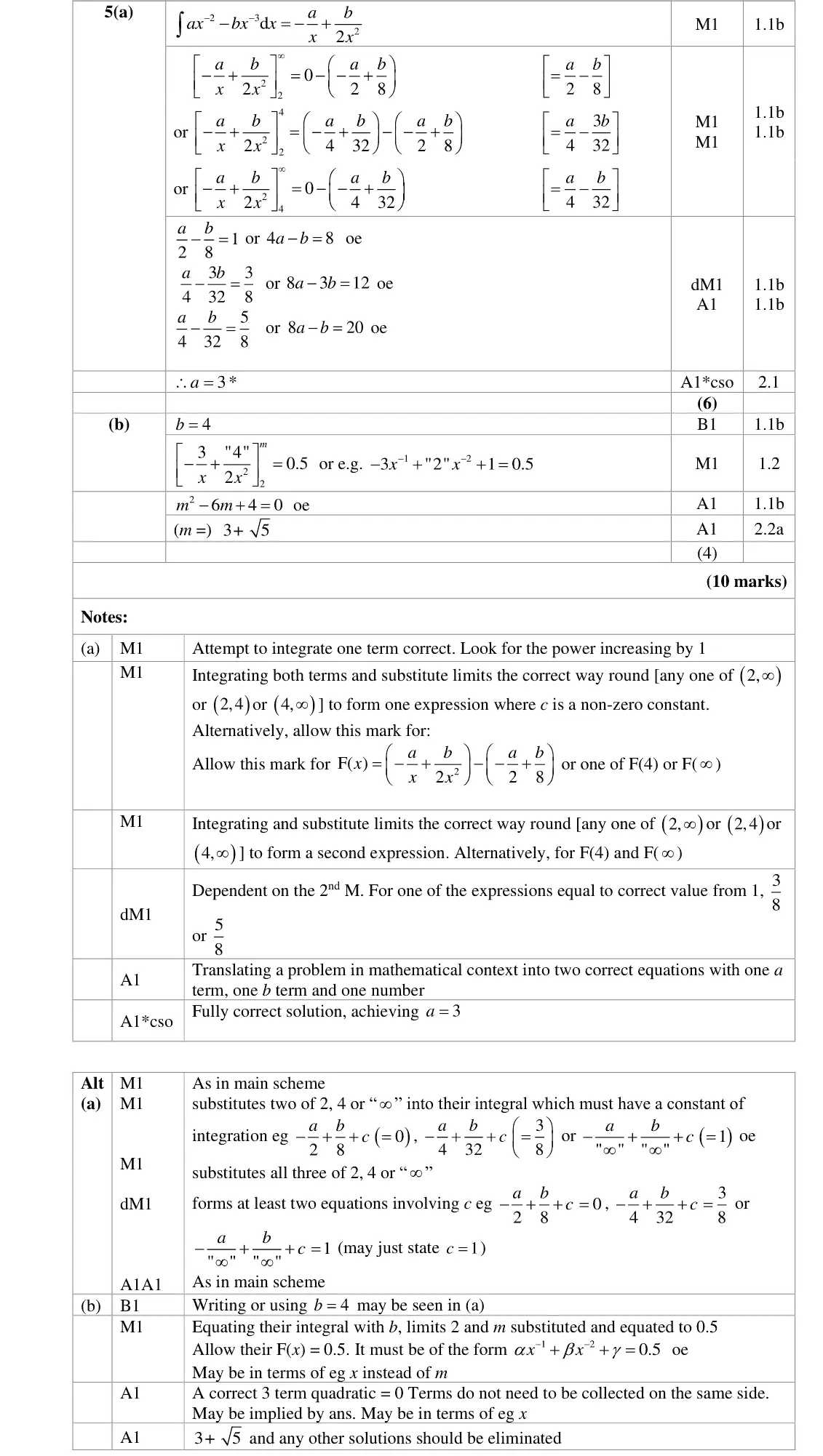
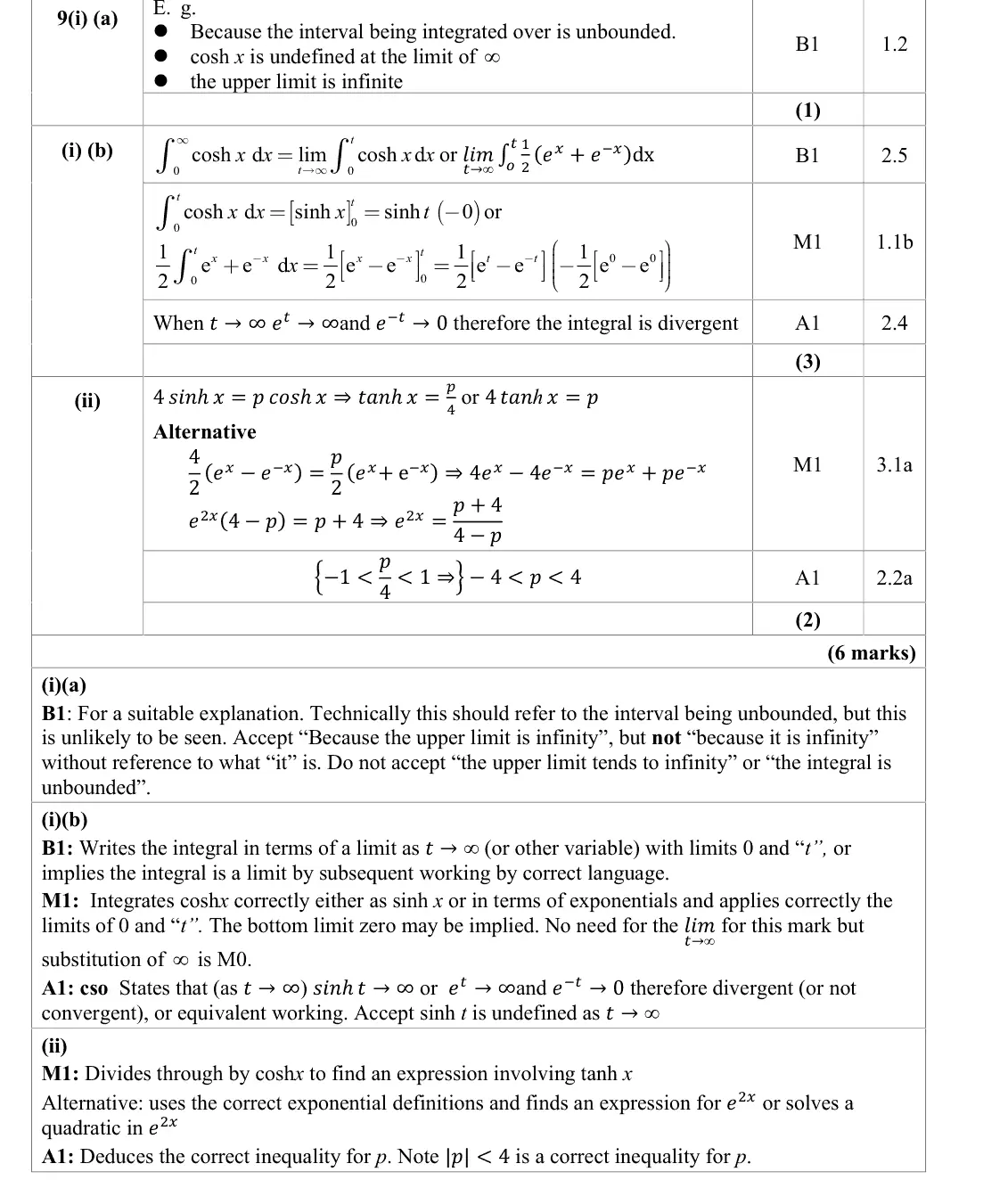
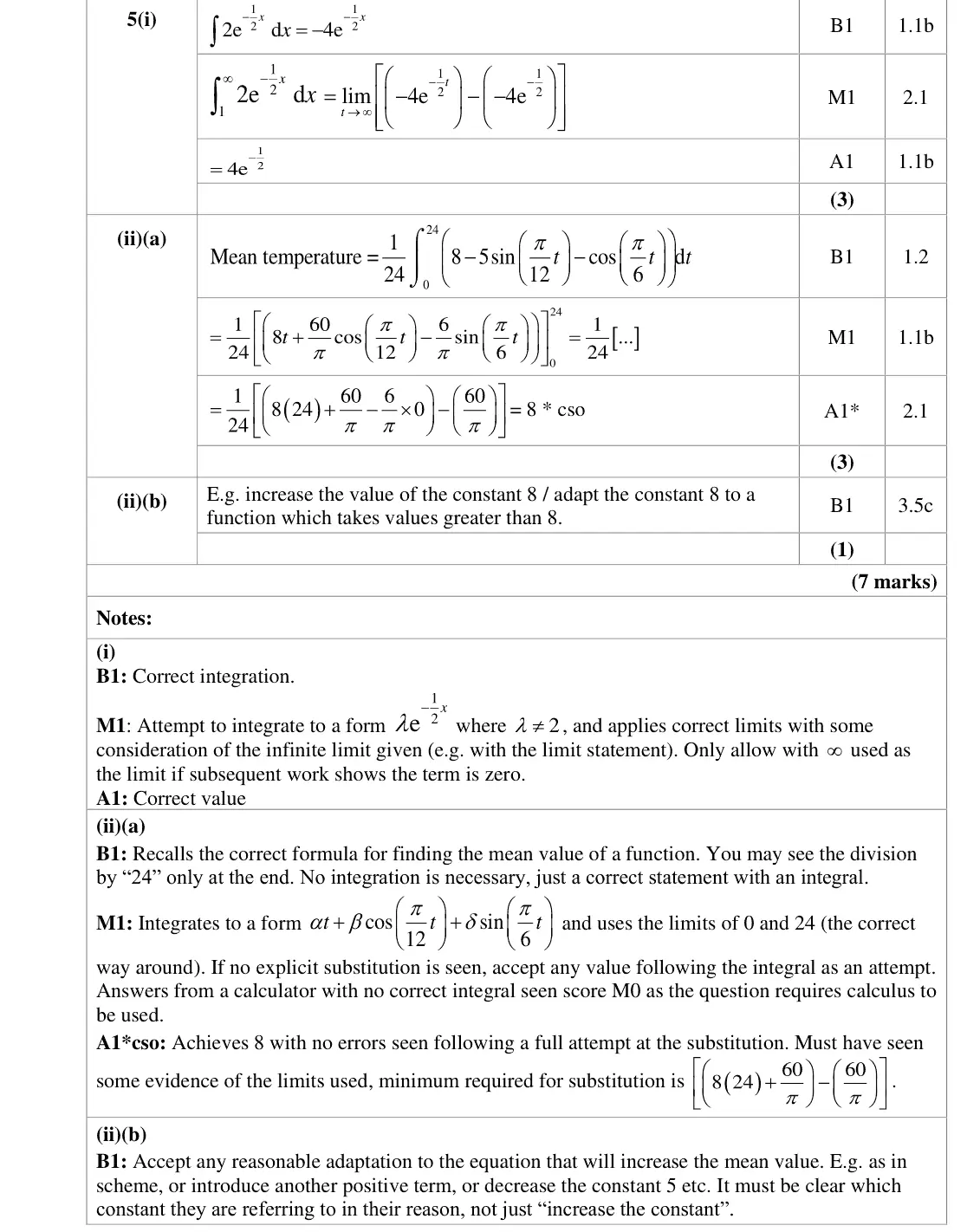
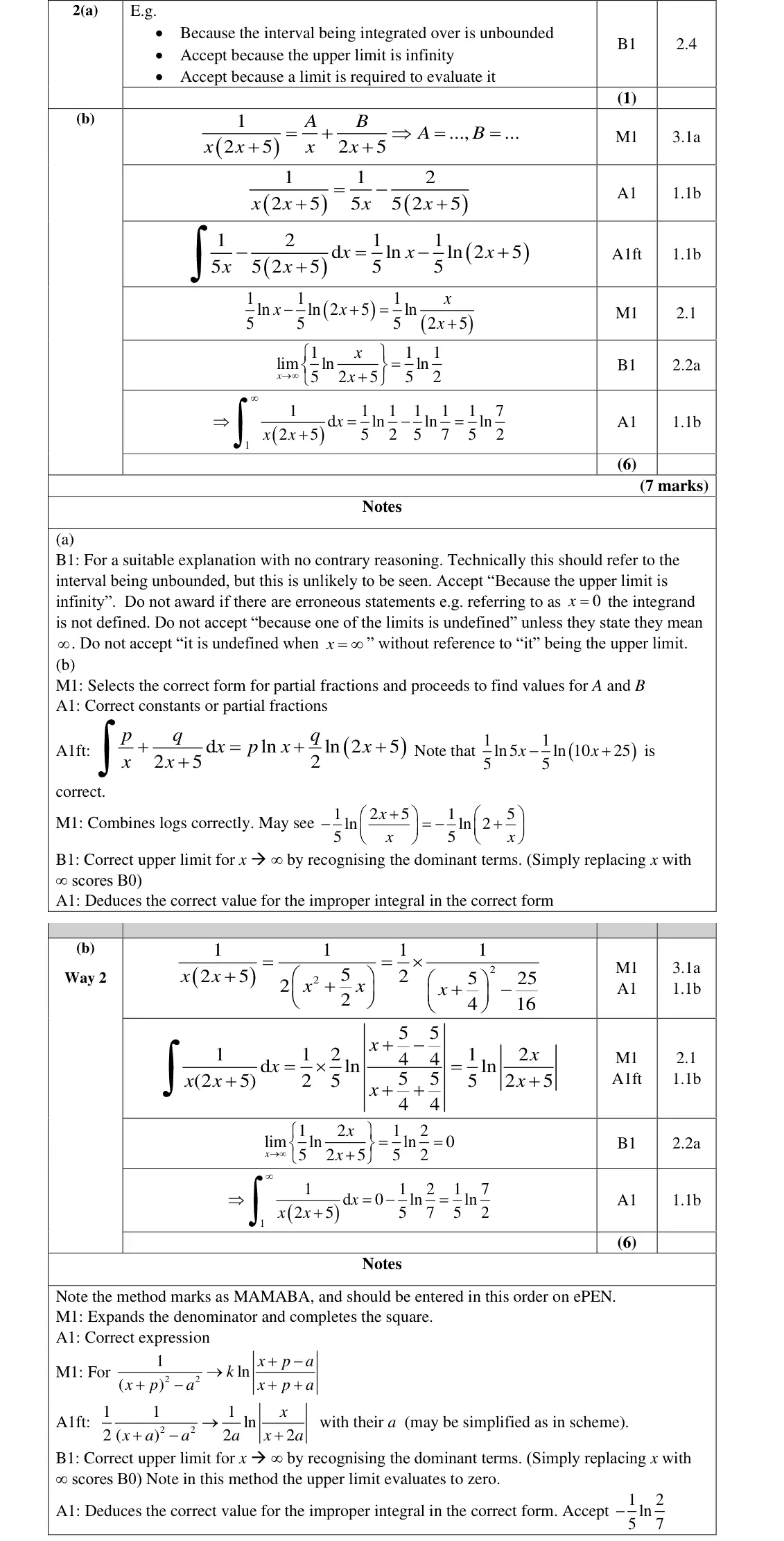
Mark scheme (whole question; this part is marked with the orange bar)
Examiner's comment
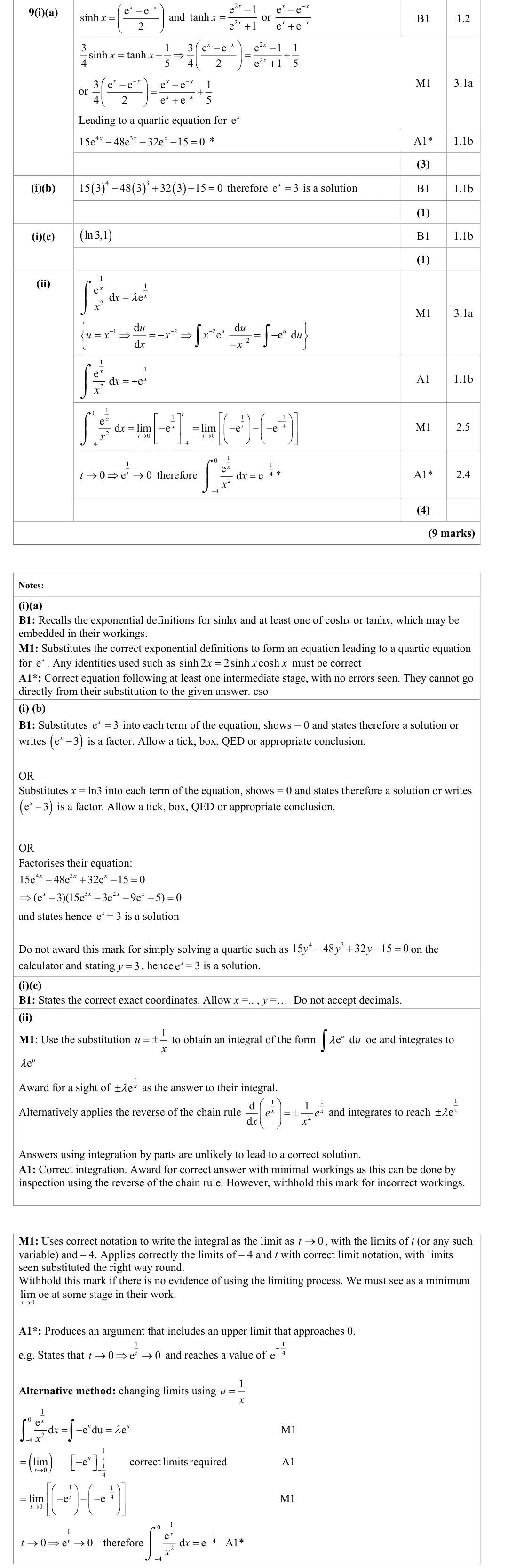
(i)(a) Many candidates successfully approached this part by correctly substituting the exponential definitions for sinh x and tanh x to form an equation. An equally successful alternative involved multiplying the equation by sinh x before applying the exponential definitions for sinh x and cosh x Most candidates then successfully progressed to derive the correct quartic equation for ex . Common errors observed included: ● Missing brackets during multiplication, leading to unmultiplied terms. ● Careless copying from previous lines. ● Incorrect treatment of signs. A significant number of unsuccessful attempts stemmed from candidates trying to use hyperbolic identities instead of converting to exponential form. There was no discernible difference in outcome based on whether candidates removed fractions early or gradually. x = or (i)(b) Most candidates confidently substituted e 3 into each term of the ln3 x = equation. However, a significant majority failed to provide an appropriate concluding statement, which was a prerequisite for earning this mark. A few candidates resorted to using a calculator to solve the quartic, which would also have resulted in the loss of this mark as they never showed evidence of their work. (i)(c) Most candidates were successful in achieving this mark. The primary reasons for not attaining it included: ● Obtaining an incorrect y-coordinate. and stopping without calculating the y-coordinate. ● Stating ln3 x = (ii) This part of the question was significantly more challenging for candidates, with very few scoring any marks. Many candidates unsuccessfully attempted integration by parts, often using several pages without making progress and consequently scoring zero marks. Candidates who employed substitution in their integration were generally more successful in achieving the correct integral. However, those who changed the limits frequently made errors, such as using an upper limit of “t” and expressing the integral as the limit as “t” approaches infinity, which often led to the loss of subsequent marks. Of those who integrated correctly, candidates who did not use a substitution were more successful in handling the limits and often secured the second method mark. Nevertheless, several candidates simply substituted 0 1 into their integral. Only a minority of candidates appreciated that 0 e 0 t → ⇒ → to reach a t 1 -. Very few candidates achieved full marks on this question. e value of 4
Key points from the mark scheme and examiner's report
- integrand is undefined at x = 0 (the upper limit)
- by reverse chain rule or u = 1/x the integral is −e^(1/x)
- use lim t → 0⁻ so e^(1/t) → 0, giving e^(−1/4)
- integration by parts went nowhere
- very few gained full marks