Derivatives of arcsin, arccos and arctan, and the integrals of 1/√(a² − x²) and 1/(a² + x²), are given.
Since 2018
13 question parts, 43 marks, 1 with a difficulty rating from the examiner's report
Notes, worked examples and practice for this topic are being written by our tutors. The past-paper questions below are ready now: work each one on paper, then open the mark scheme and the examiner's comment.
Tap a question to zoom it. Mark scheme and examiner's comment open under each question.
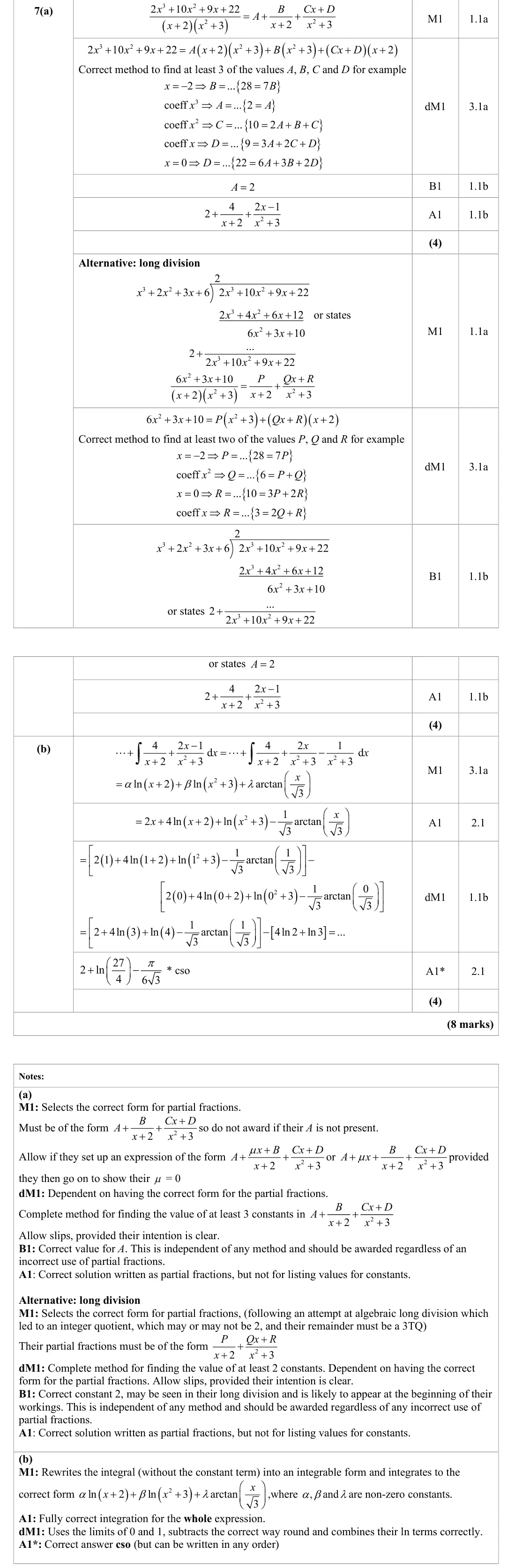
June 2025 · Paper 1 (Core Pure 1) · Q7(b)4 marks
Mark scheme (whole question; this part is marked with the orange bar)
Examiner's comment
(b) Those candidates who failed to recognise that there was a constant term in part (a) were able to gain some marks in part (b). If they integrated their fractions correctly to achieve x ( ) ( ) 2 ln 2 ln 3 arctan x x + + + + alpha beta λ then they could achieve the first mark. They could 3 then go on to earn the dM for substituting the limits 0 and 1 and collecting the ln terms correctly. A significant proportion of candidates scored full marks on the whole question although many candidates struggled to collect their ln terms together correctly.
Key points from the mark scheme and examiner's report
combining the log terms correctly was the main difficulty
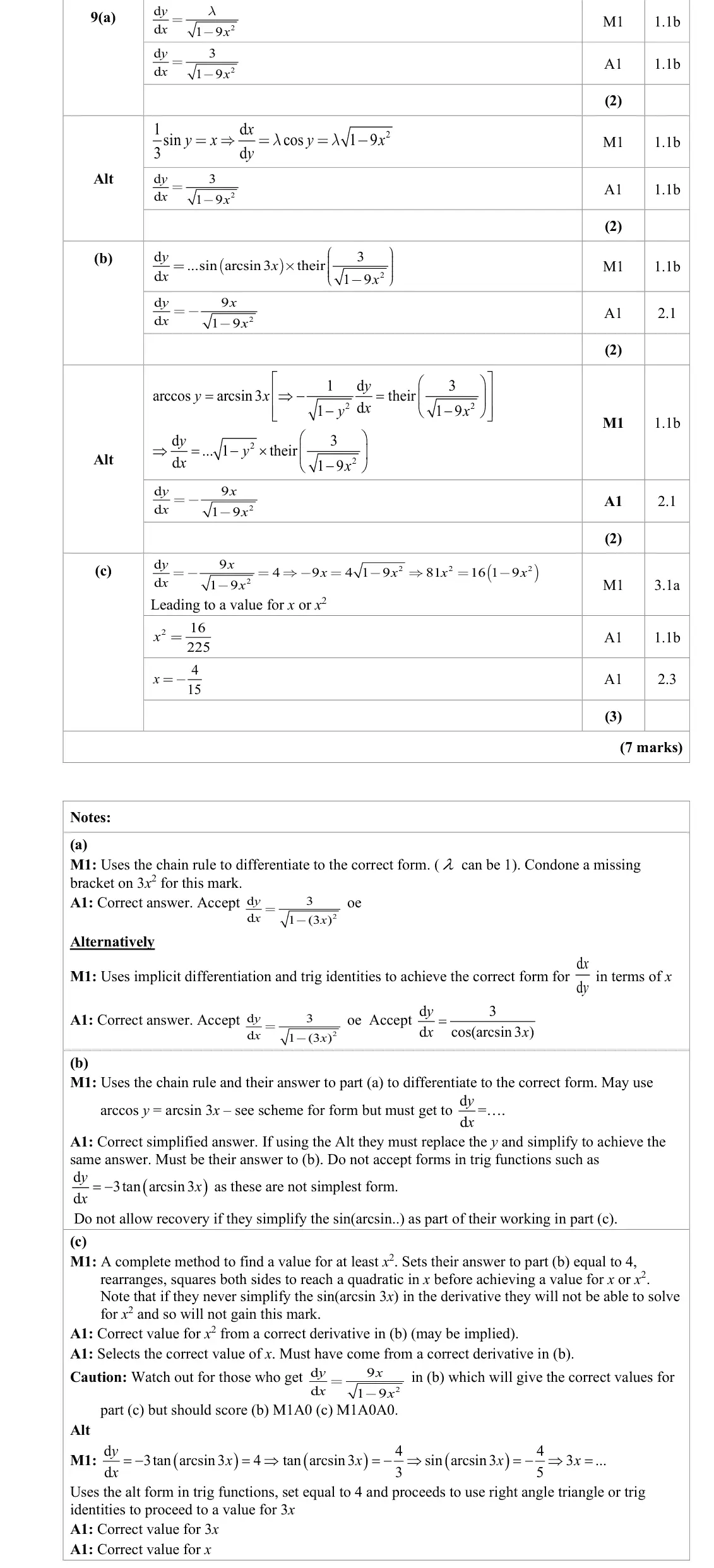
June 2025 · Paper 2 (Core Pure 2) · Q9(a)2 marks
Mark scheme (whole question; this part is marked with the orange bar)
Examiner's comment
This proved a relatively straightforward closing question compared to some final questions, and many were able to score full marks. Giving a fully simplified form for (b) proved to be the main stumbling block, though not selecting the correct root for (c) was also relatively common. Part (a) was well-answered by most candidates, though not all used the standard formula, but many used implicit differentiation to approach the problem to prove the result. The most common mistake was simply to have a 1 in the numerator rather than 3, which occurred in both methods. When using the formula another error that occurred, albeit infrequently, was to omit the 3 in the square root, giving 2 1 k x - , which scored no marks. Those using implicit or reciprocal differentiation by rearranging the initial question, were generally successful, but again occasionally made slips, losing the 3, or sometime failed find the correct expression for y in terms of x, either leaving in terms of y or giving an incorrect expression. Some gave ( ) d 3 d cos arcsin3 y x x = which was reluctantly accepted for the answer, but learners should aim in such questions to eliminate the trigonometric terms.
Key points from the mark scheme and examiner's report
dy/dx = 3/√(1 − 9x²)
a 1 instead of 3 in the numerator was the common error
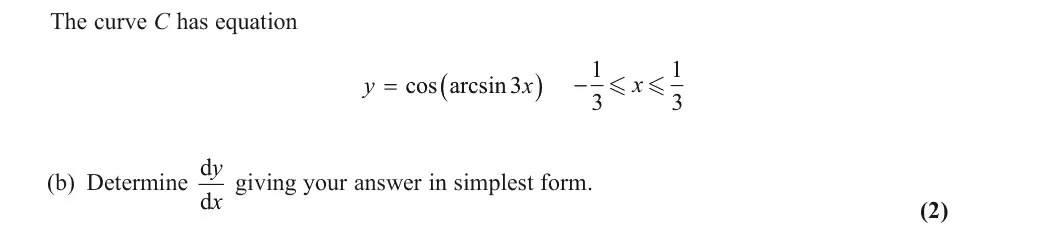
June 2025 · Paper 2 (Core Pure 2) · Q9(b)2 marks
Mark scheme (whole question; this part is marked with the orange bar)
Examiner's comment
This proved a relatively straightforward closing question compared to some final questions, and many were able to score full marks. Giving a fully simplified form for (b) proved to be the main stumbling block, though not selecting the correct root for (c) was also relatively common. Again in part (b) there was a mix of responses, with many favouring an approach via implicit differentiation by taking the arccosine of both sides first, rather than just applying the result to (a) in the chain rule. Whichever method was used, again the differentiation itself was usually correct, but the issue arose in the simplification, and losing the minus was seen fairly often. Many using the main scheme could not simplify ( ) arcsin sin3 x to 3x so lost the A mark for not reaching simplest form. Although some later simplified it in part (c) during working, they could not recover the mark for part (b) from it. Those using the alternative approach usually got to 2 2 d 3 1 d 1 9 y y x x = - x - but often did not proceed to an answer involving just x . Answers in terms of y or involving trigonometric functions, such as ( ) d 3tan arcsin3 d y x x = - , were not accepted for the accuracy mark as they were not deemed in simplest form (as not a simplified function in x) but progress could be made in part (c) from such forms. Those who left the answer to part (b) in an unsimplified form had less success. Though they could set up the equation needed, if they could not see how to simplify, they usually just stopped and did not reach an answer. However, some were able to make the simplification during the working in part (c) and so were still able to achieve the correct result, with the same proviso about selection of the correct root as above. Routes to the answer via alternative forms for the derivative in part (b) were also seen, for example, the ( ) d 3tan arcsin3 d y x x = - form of the solution in (b) was used by a fair proportion to reach ( ) 5 sin arcsin3 4 x = - via right angle triangles, from which the correct value could be deduced. Though uncommon, such approaches, if attempted, were usually successful in reaching the correct answer.
Key points from the mark scheme and examiner's report
Mark scheme (whole question; this part is marked with the orange bar)
Examiner's comment
This proved a relatively straightforward closing question compared to some final questions, and many were able to score full marks. Giving a fully simplified form for (b) proved to be the main stumbling block, though not selecting the correct root for (c) was also relatively common. Success in part (c) often depended on the final form of part (b). Those who had simplified fully to the expected answer usually made good progress in setting up the equation and reaching a value for x2. These would go on to find values for x but many did not appreciate that a single x coordinate was mentioned in the question, indicating only one of their solutions was valid, and so giving both. Those who did pick up on this cue would often evaluate the derivative at both values to determine which was correct, though some just selecting the positive value (possibly not even remembering the negative possibility) and so lost the accuracy at the end. Only a minority were able to get the single correct answer at the end. It should be noted that a sign error in part (b) would lead to the same equation in part (c) but would not score either accuracy mark.
Key points from the mark scheme and examiner's report
−9x/√(1 − 9x²) = 4, square: x² = 16/225
only x = −4/15 is valid (gradient positive needs x < 0)
many gave both roots
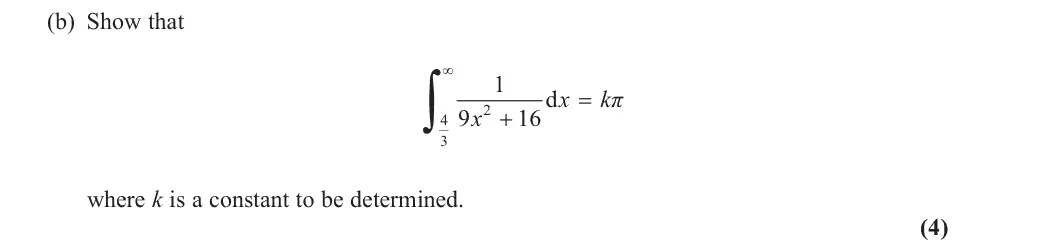
June 2024 · Paper 2 (Core Pure 2) · Q3(b)4 marks
Mark scheme (whole question; this part is marked with the orange bar)
Examiner's comment
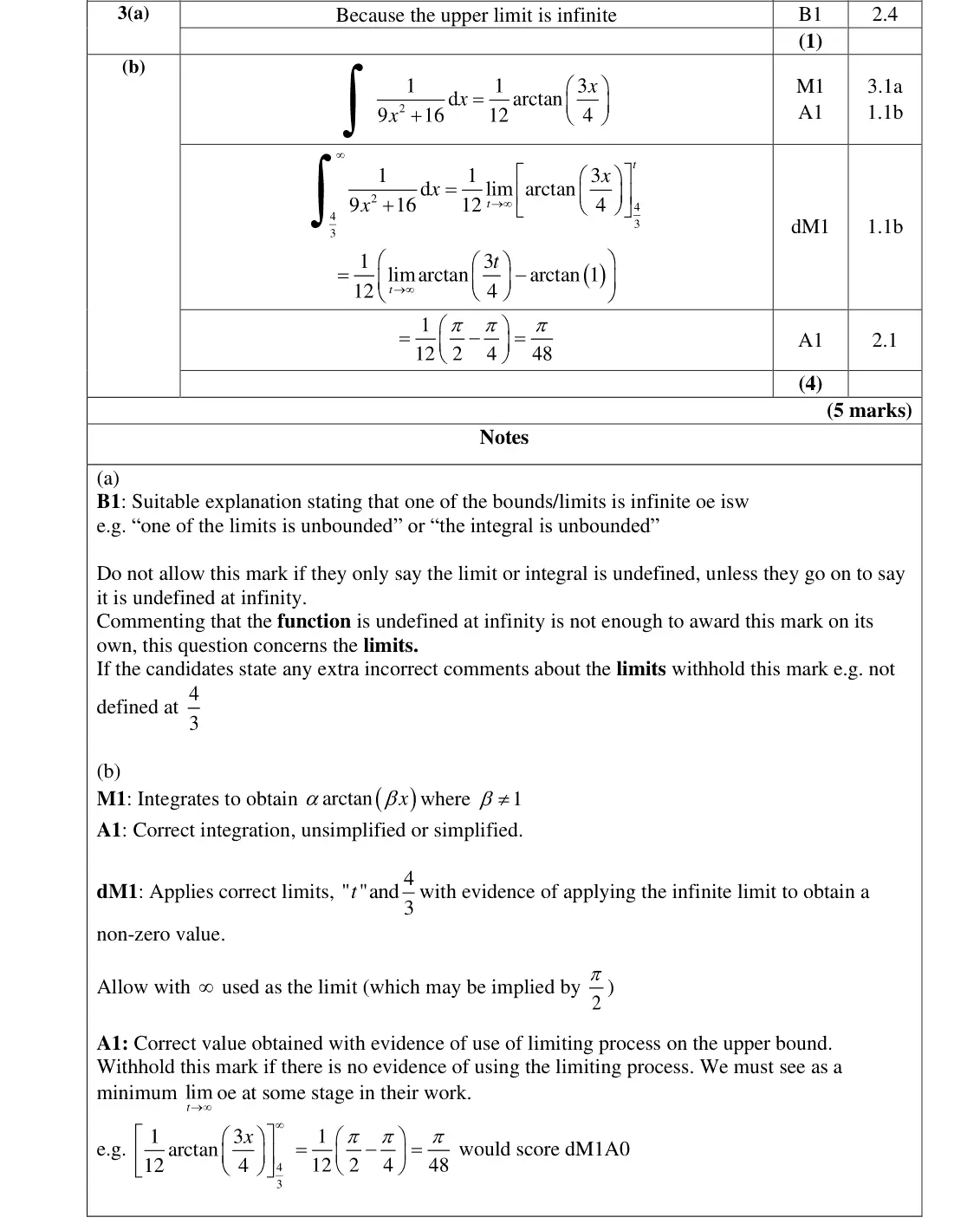
(b) Most candidates identified the correct form for the integral, 𝛼arctan(𝛽𝑥) The most common error was to have 𝛼= 1 4 . The most successful candidates took out a factor of 1 9 before integrating. A few candidates made a substitution, in general, successfully. Very few candidates lost marks because they did not refer to lim t→ and a pleasing number realised that this was 𝜋 2 . The most common incorrect values were 0 and ∞.
Key points from the mark scheme and examiner's report
(1/12)arctan(3x/4)
must show the limit t → ∞ explicitly: (1/12)(π/2 − π/4) = π/48
1/4 instead of 1/12 was the common error
taking out a factor 1/9 first helps
June 2023 · Paper 1 (Core Pure 1) · Q6(b)2 marks
Mark scheme (whole question; this part is marked with the orange bar)
Examiner's comment
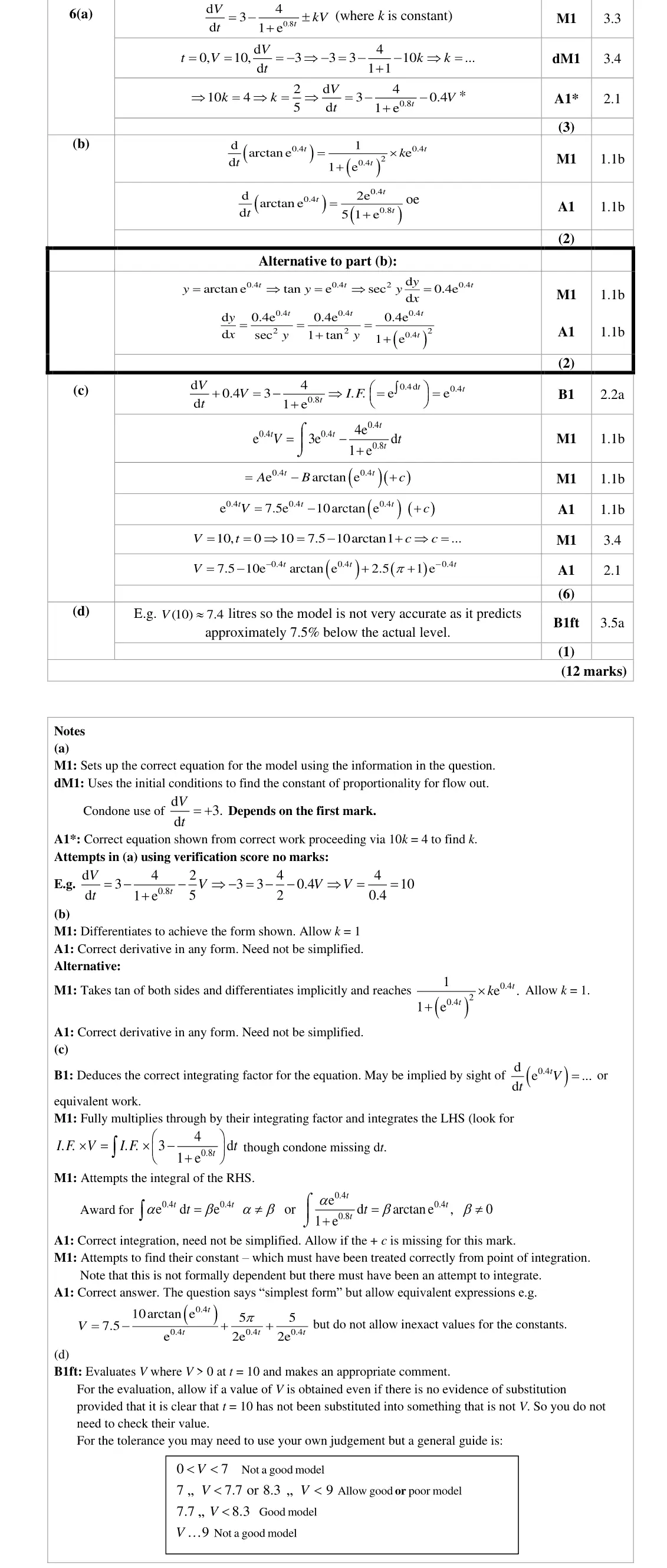
Part (b) saw more success although some candidates did not attempt this part. The majority of attempts were a success, but a minority failed to use the chain rule to obtain e0.4t in the numerator. In general, the coefficient was correct. Incorrect squaring of e0.4t to give 2 0.8 e t was seen occasionally.
Key points from the mark scheme and examiner's report
missing the e⁰·⁴ᵗ in the numerator was the main error
June 2022 · Paper 1 (Core Pure 1) · Q6(b)4 marksEasy
Mark scheme (whole question; this part is marked with the orange bar)
Examiner's comment
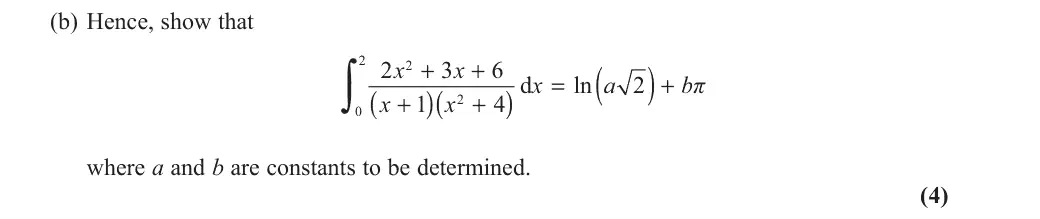
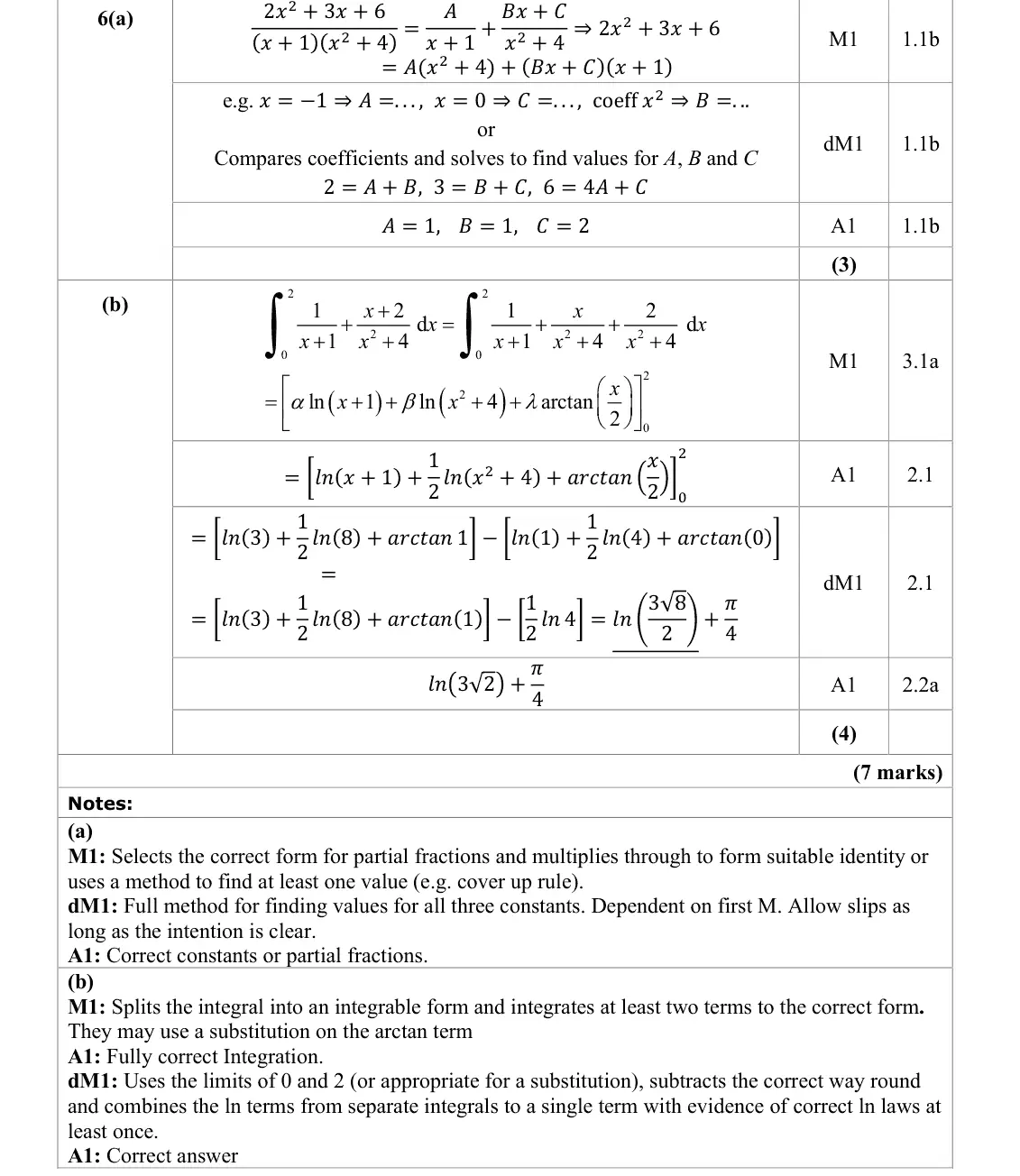
Still at this stage of the paper well over 50% of candidates were able to score full marks for the question, with the processes required being well demonstrated. For responses that were not fully correct the performance was much more mixed, with a fairly uniform distribution across all the other possible scores. Most students who had the correct form for the partial fractions from part (a) realised that for part (b) they needed to split their integral into three parts and achieved the M mark for at least two integrated terms. Generally, good integration skills were shown in this part of the question. The integration using logs was usually successful but there were more errors in the integration of the arctan term. Many candidates continued to use the correct limits and the correct log rules to achieve a single ln term to achieve the final method. A common error when integrating 2 2 4 x x + + was not to split the terms and instead have some unpleasant muddle involving logs or arctan. Amongst those that integrated sensibly common slips were missing the half from ( ) 2 ln 4 x + or integrating to 1 arctan 2 2 x .
Key points from the mark scheme and examiner's report
split into 1/(x + 1) + x/(x² + 4) + 2/(x² + 4): ln(x + 1) + ½ln(x² + 4) + arctan(x/2) from 0 to 2
ln(3√2) + π/4, a = 3, b = ¼
slips with the arctan term
June 2022 · Paper 2 (Core Pure 2) · Q5(a)3 marks
Mark scheme (whole question; this part is marked with the orange bar)
Examiner's comment
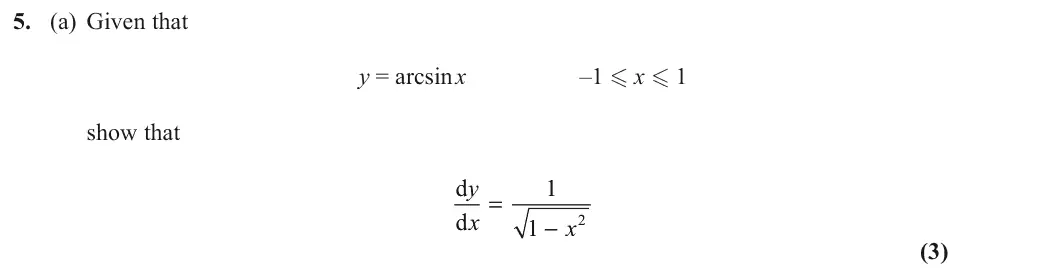
Generally, well answered and part (a) was done well with and students appearing confident with this. After writing as sin x y = methodology was split between implicit differentiation and working out d d x y but both were equally successful. Candidates used the identity 2 2 sin cos 1 y y + = to replace 2 cos 1 sin y y = - and then show the required derivative.
Key points from the mark scheme and examiner's report
sin y = x then differentiate (implicitly or dx/dy = cos y)
use cos y = √(1 − sin²y) = √(1 − x²)
June 2022 · Paper 2 (Core Pure 2) · Q5(b)3 marks
Mark scheme (whole question; this part is marked with the orange bar)
Examiner's comment
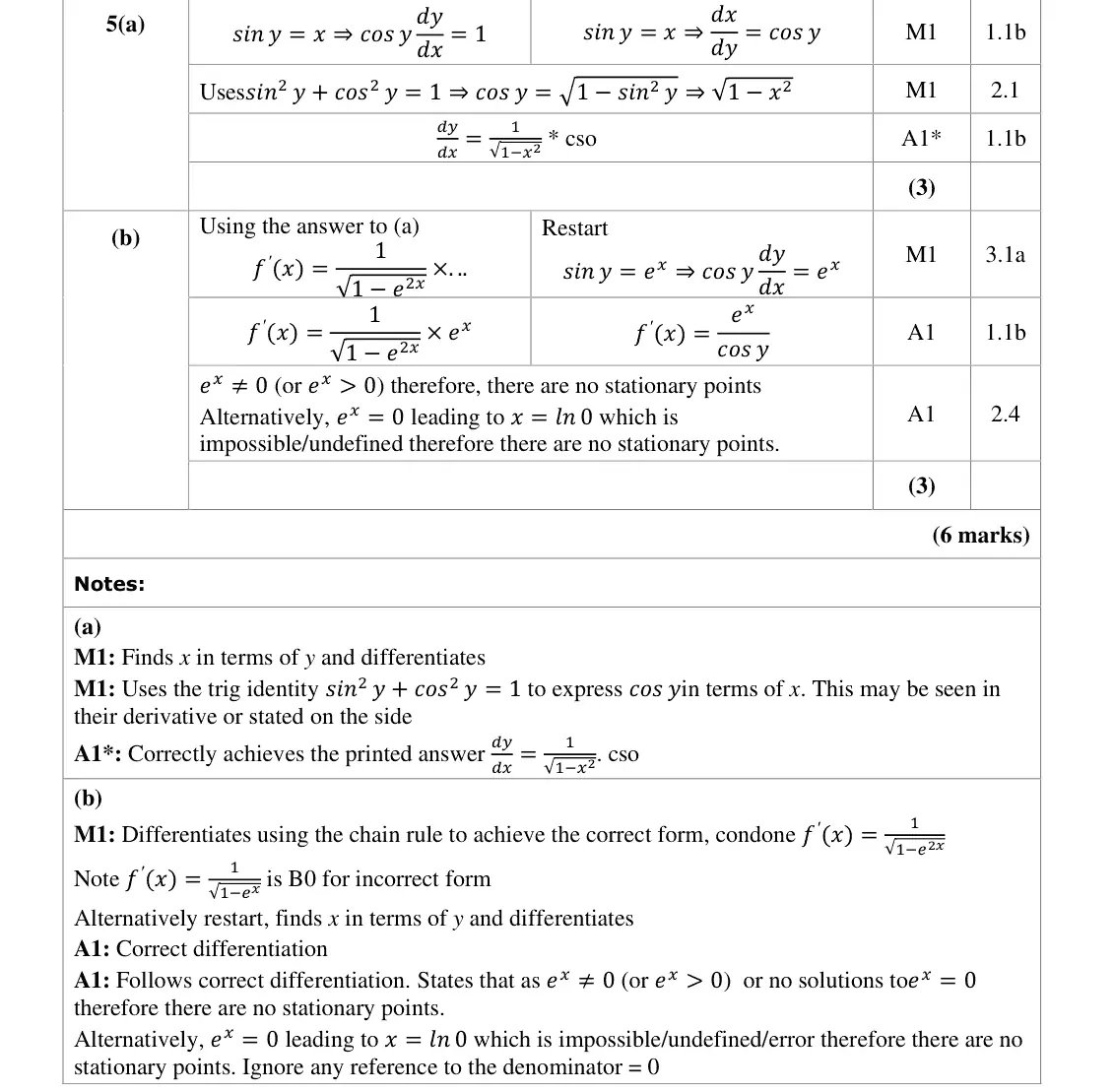
Part (b) was less well answered. A big minority substituted ex directly for x and only scored 1 out of 3 for this part, and many forgot to multiply by the derivative of the denominator because they did not use the chain rule. There were the occasional answers of 2 e 1 x x + which showed they had thought of the chain rule but were sloppy in their execution. Some had not got e2x on the denominator while those that did had not multiplied by ex. Although only a brief statement that ex could never equal zero, was required, some missed out on the final mark by neglecting the conclusion, i.e. therefore there were "no stationary points".
Key points from the mark scheme and examiner's report
chain rule: f′(x) = eˣ/√(1 − e²ˣ)
substituting eˣ for x without the chain rule scored 1/3
conclude eˣ ≠ 0 so no stationary points (conclusion often missing)
Nov 2021 · Paper 2 (Core Pure 2) · Q5(a)3 marks
Mark scheme (whole question; this part is marked with the orange bar)
Examiner's comment
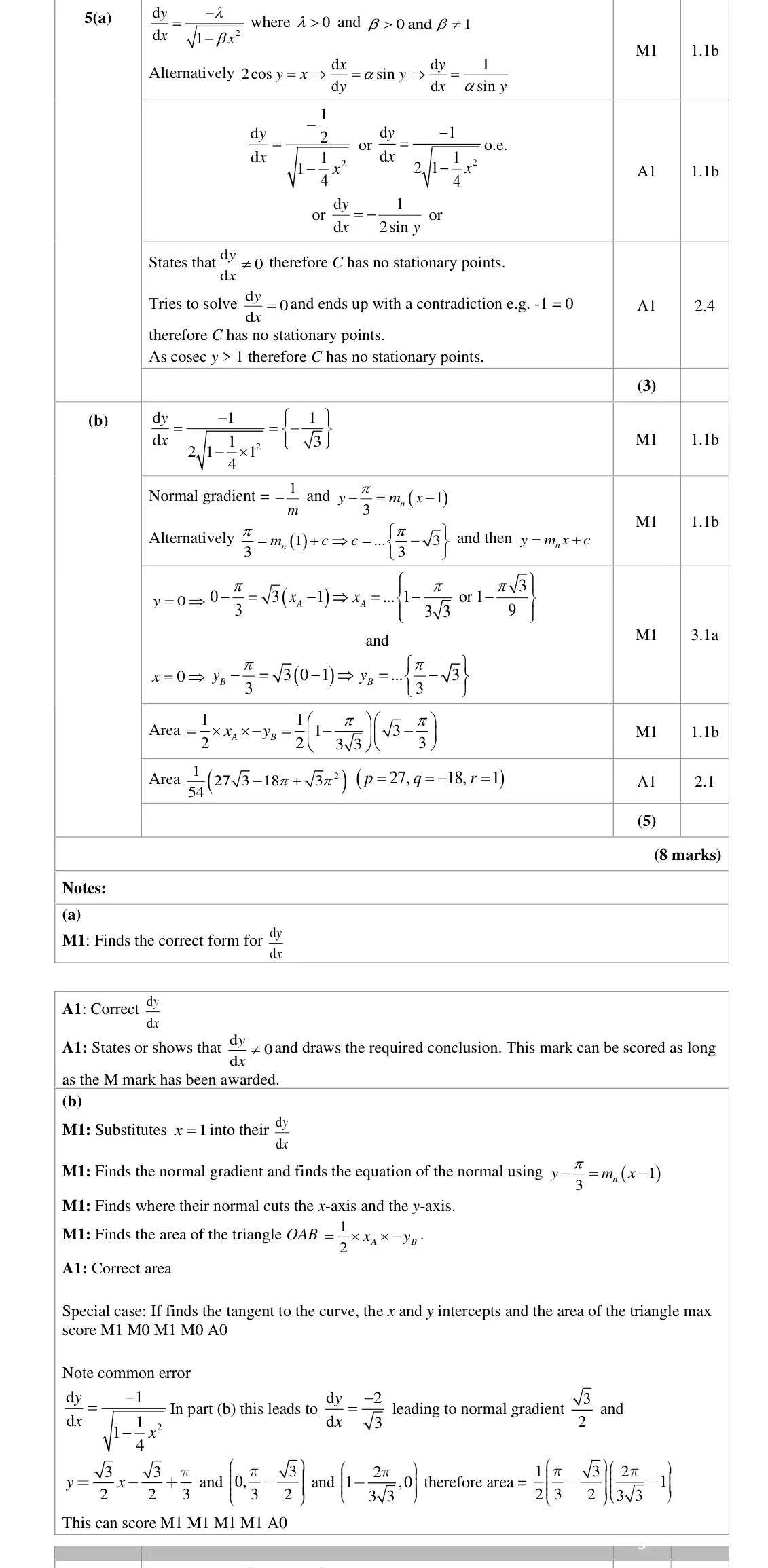
Part (a) A majority were able to differentiate to find d d y x in the correct form, although a very significant number omitted the ½ in the numerator. Candidates are reminded that if they apply a substitution, here 1 2 u x , find d d u x and complete the full substitution. Having achieved this there were problems for many in attempting a comprehensive argument for C having no stationary points although they clearly knew why.
Key points from the mark scheme and examiner's report
dy/dx = −½ ÷ √(1 − x²/4) (the ½ often omitted)
never zero, so no stationary points
a clear conclusion needed
Nov 2021 · Paper 2 (Core Pure 2) · Q5(b)5 marks
Mark scheme (whole question; this part is marked with the orange bar)
Examiner's comment
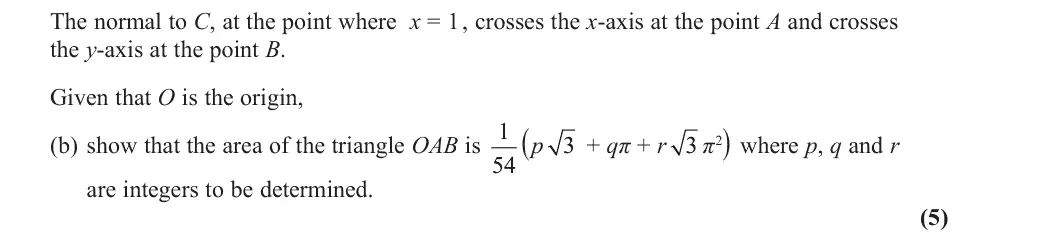
Part (b) Most candidates used their result for the differential in part (a) to find the gradient of the tangent when x = 1 and used this to find the gradient and equation of the normal at the point 1, 3 . A few actually went completely wrong at this point, finding the equation of the tangent. Candidates then went on to find where their normal crossed the coordinate axes and applied the area of a triangle. This did cause a problem for the majority who did not realise that one of their y coordinate was negative and that they should have used area of the triangle OAB 1 2 A B x y = x x - .
Key points from the mark scheme and examiner's report
at x = 1, y = π/3, gradient −1/√3 so normal gradient √3
area = ½ × x_A × (−y_B) = (1/54)(27√3 − 18π + √3π²)
finding the tangent instead
Oct 2020 · Paper 2 (Core Pure 2) · Q5(a)3 marks
Mark scheme (whole question; this part is marked with the orange bar)
Examiner's comment
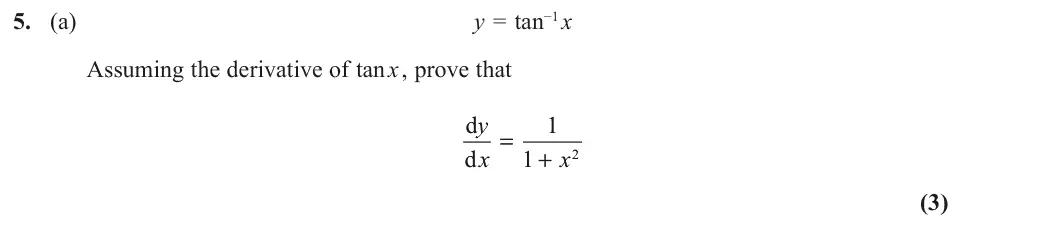
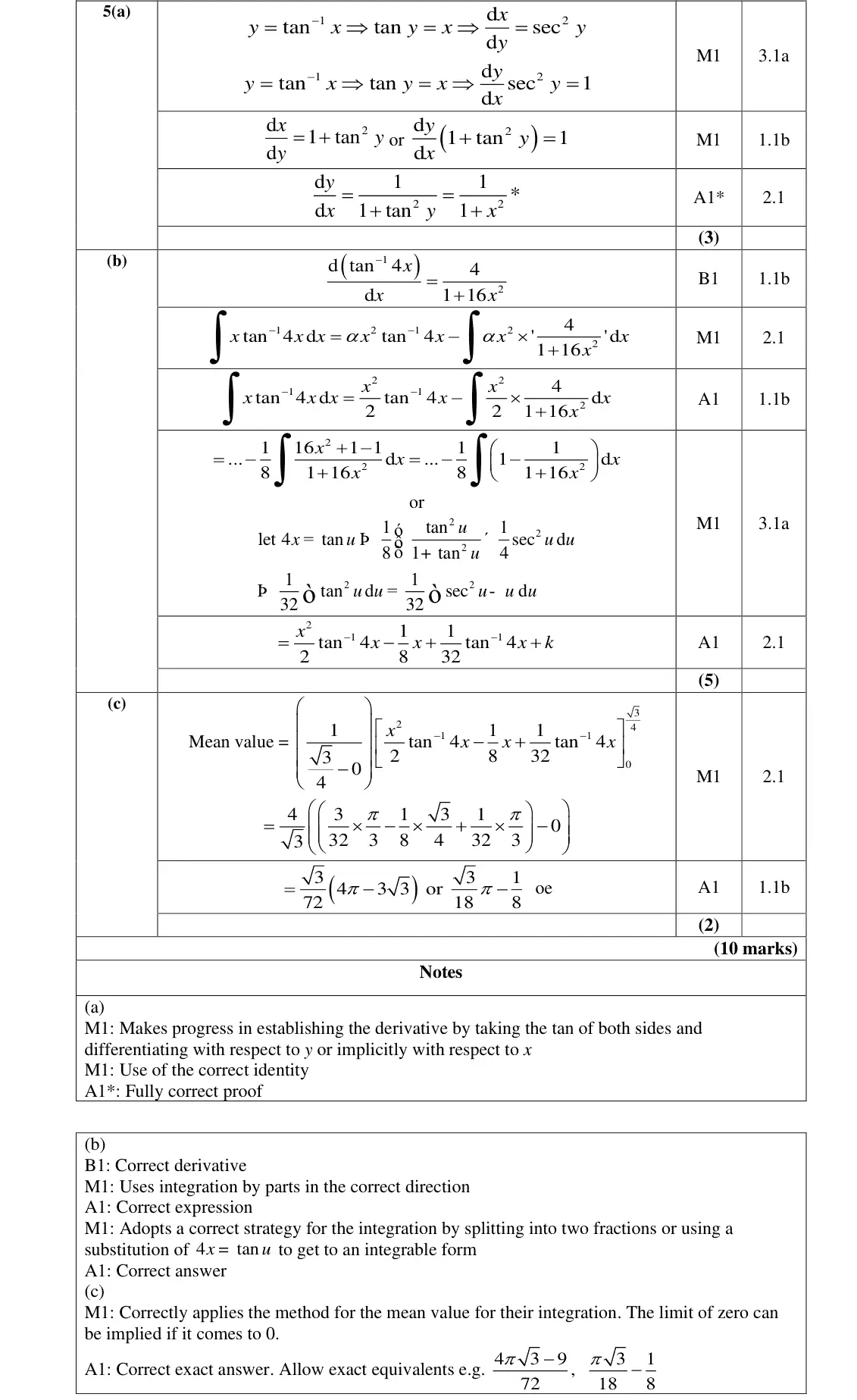
(a) A small minority had absolutely no idea of what to do. Most did, however, know that the differential of tan x is sec2 x and a majority knew the relationship between tan2 x and sec2 x – there were a few who had to divert via sine and cosine in order to establish the result.
Key points from the mark scheme and examiner's report
tan y = x, differentiate: sec²y dy/dx = 1
sec²y = 1 + tan²y = 1 + x²
Oct 2020 · Paper 2 (Core Pure 2) · Q5(b)5 marks
Mark scheme (whole question; this part is marked with the orange bar)
Examiner's comment
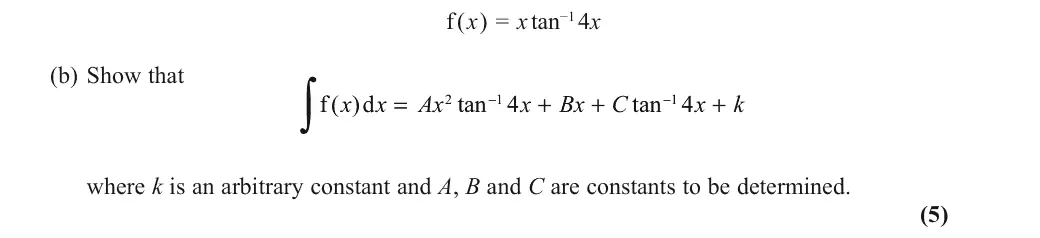
(b) Fewer than half of the candidates were able to correctly differentiate tan-1 4x which lead to a loss of accuracy throughout. The majority did make a reasonable attempt at integrating by parts. The resultant integral caused problems and only a small minority were able to adopt a sound strategy which, only occasionally, lead to the correct final expression. A few candidates did replace 4x with tan u at the start of this process but, again, success was limited.
Key points from the mark scheme and examiner's report
d/dx tan⁻¹4x = 4/(1 + 16x²) (often wrong)
integrate by parts
split 4x²/(1 + 16x²) = ¼(1 − 1/(1 + 16x²))
A = ½, B = −1/8, C = 1/32
Find an Edexcel Further Maths tutor
Stuck on this? Book a trial lesson with our Further Maths tutor.