Notes, worked examples and practice for this topic are being written by our tutors. The past-paper questions below are ready now: work each one on paper, then open the mark scheme and the examiner's comment.
Tap a question to zoom it. Mark scheme and examiner's comment open under each question.
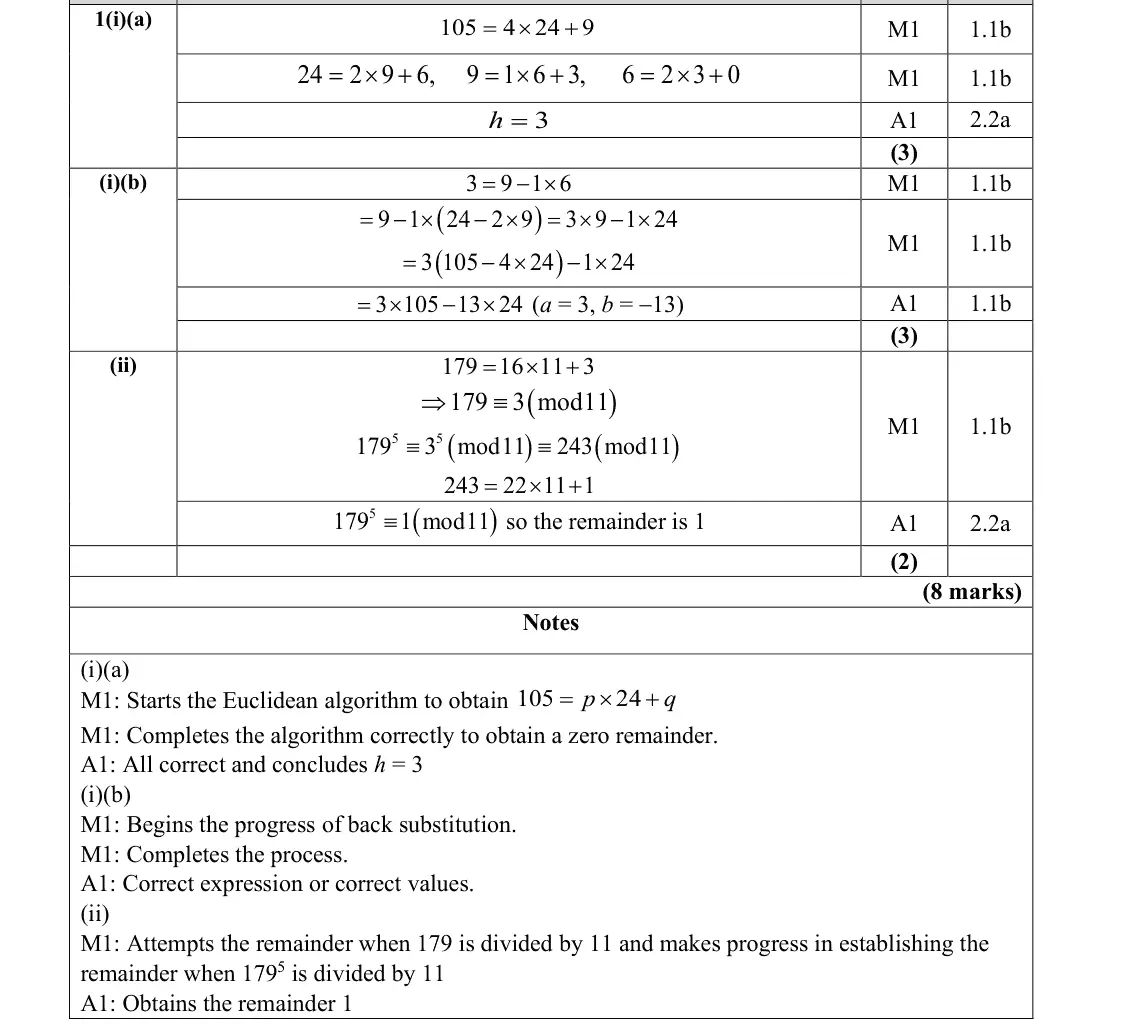
June 2025 · AS Paper 2 (Further Pure 2) · Q1(i)(a)3 marks
Mark scheme (whole question; this part is marked with the orange bar)
Examiner's comment
The use of the Euclidean algorithm to find the highest common factor and of back substitution to find the Bezout’s identity was well carried out by all the prepared students and nearly all gained full marks in part (i) of this question. The only ones who did not were clearly unprepared for the paper and did not make much progress in any question, often leaving questions unanswered. Part (ii) was less successfully completed, though the majority of students did gain full marks for the whole question. However, a few did not know how to proceed for this part who had completed part (i) successfully, while a couple had the correct method but made a slip during the processing and obtained an incorrect remainder. The replacement of 179 by its congruence modulo 11 was done correctly in such instances, with the errors coming from attempts to find the 5th power of the reduced equation.
Key points from the mark scheme and examiner's report
June 2025 · AS Paper 2 (Further Pure 2) · Q1(i)(b)3 marks
Mark scheme (whole question; this part is marked with the orange bar)
Examiner's comment
The use of the Euclidean algorithm to find the highest common factor and of back substitution to find the Bezout’s identity was well carried out by all the prepared students and nearly all gained full marks in part (i) of this question. The only ones who did not were clearly unprepared for the paper and did not make much progress in any question, often leaving questions unanswered. Part (ii) was less successfully completed, though the majority of students did gain full marks for the whole question. However, a few did not know how to proceed for this part who had completed part (i) successfully, while a couple had the correct method but made a slip during the processing and obtained an incorrect remainder. The replacement of 179 by its congruence modulo 11 was done correctly in such instances, with the errors coming from attempts to find the 5th power of the reduced equation.
Key points from the mark scheme and examiner's report
back substitution: 3 = 9 − 6 = 3 × 9 − 24 = 3 × 10⁵ − 13 × 24, so a = 3, b = −13
June 2025 · AS Paper 2 (Further Pure 2) · Q1(ii)2 marks
Mark scheme (whole question; this part is marked with the orange bar)
Examiner's comment
The use of the Euclidean algorithm to find the highest common factor and of back substitution to find the Bezout’s identity was well carried out by all the prepared students and nearly all gained full marks in part (i) of this question. The only ones who did not were clearly unprepared for the paper and did not make much progress in any question, often leaving questions unanswered. Part (ii) was less successfully completed, though the majority of students did gain full marks for the whole question. However, a few did not know how to proceed for this part who had completed part (i) successfully, while a couple had the correct method but made a slip during the processing and obtained an incorrect remainder. The replacement of 179 by its congruence modulo 11 was done correctly in such instances, with the errors coming from attempts to find the 5th power of the reduced equation.
Key points from the mark scheme and examiner's report
179 ≡ 3 (mod 11), so 179⁵ ≡ 3⁵ = 243 ≡ 1
remainder 1
slips came when finding the fifth power after reducing
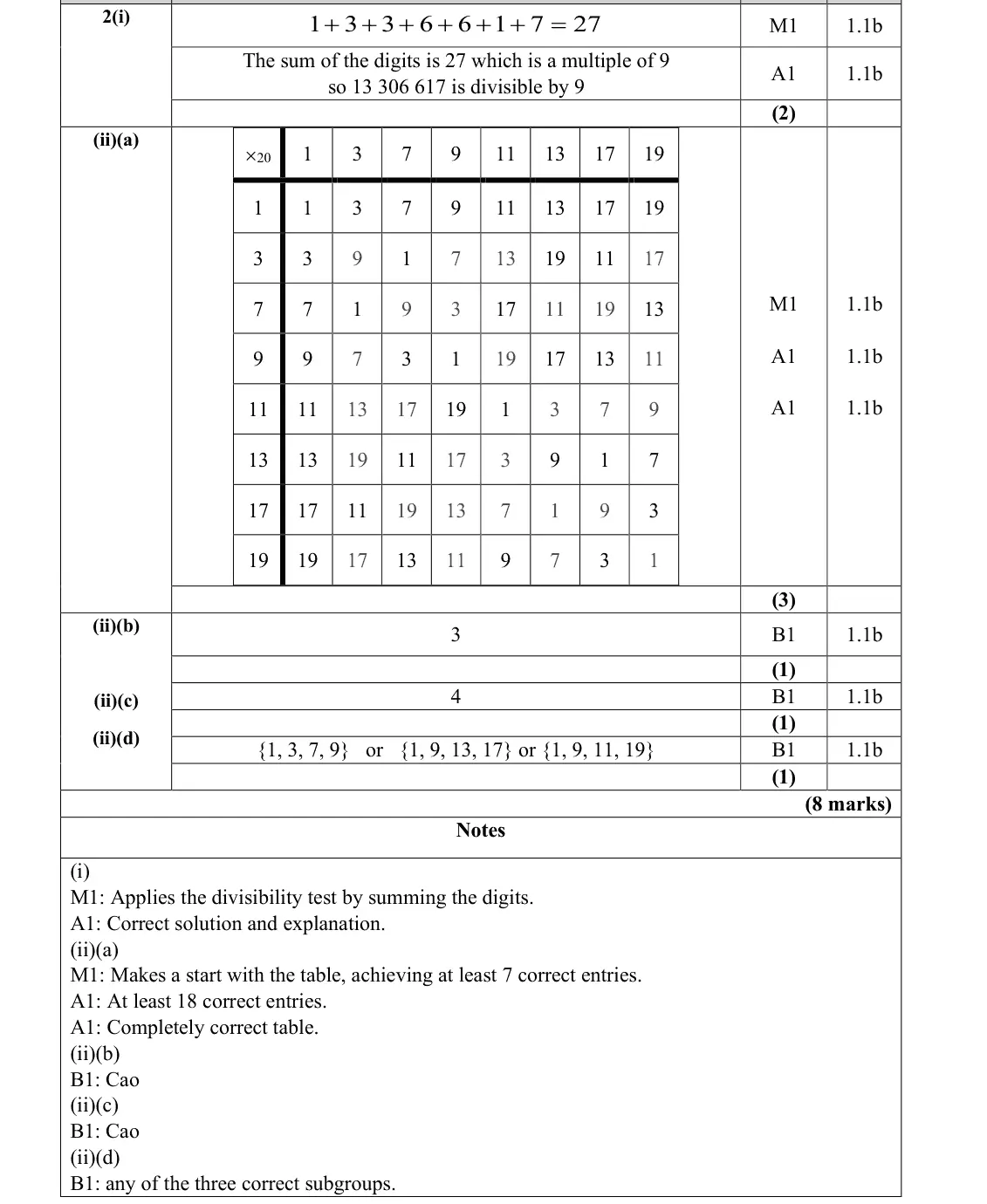
June 2025 · AS Paper 2 (Further Pure 2) · Q2(i)2 marks
Mark scheme (whole question; this part is marked with the orange bar)
Examiner's comment
This question also proved very accessible with most scoring at least 6 of the 8 marks. A couple made slips to score fewer, while some attempted only the filling in of the table (even those who made little progress elsewhere had some success in the group table for (ii)(a)). Part (i) was generally completed successfully even though sometimes a little unclear on the explanation. The divisibility test was well understood by most, with students showing appreciation that a number is divisible by 9 provided the digit sum is divisible by 9, and the sum was always correct when attempted. Conclusions were often sparse but did enough to convey the idea that since the sum was divisible by 9, so the original number is also. E.g. “1+3+3+0+6+6+1+7=27 9 | 27 ⸫ 9| 13306617” was a minimalist answer. One student did seem to misread and use the divisibility test for 11 instead, while a couple did not answer this part at all, possibly missing it was there if their eye was drawn to the group table. For part (ii), most made some attempt at the group table with the majority completing it all correctly, only one made a single slip, though a couple made only partial attempts (discounting those who did not offer any answer at all). Identifying the inverse of 7 was also done well by most who proceed further than the group table but stating the order and then writing down a subgroup were incrementally less well attempted. The final mark was only scored by a minority. Overall it was pleasing to see engagement and reasonable success with the group theory question on the paper.
Key points from the mark scheme and examiner's report
digit sum 1 + 3 + 3 + 0 + 6 + 6 + 1 + 7 = 27, a multiple of 9, so divisible by 9
conclusions were often sparse
one used the test for 11
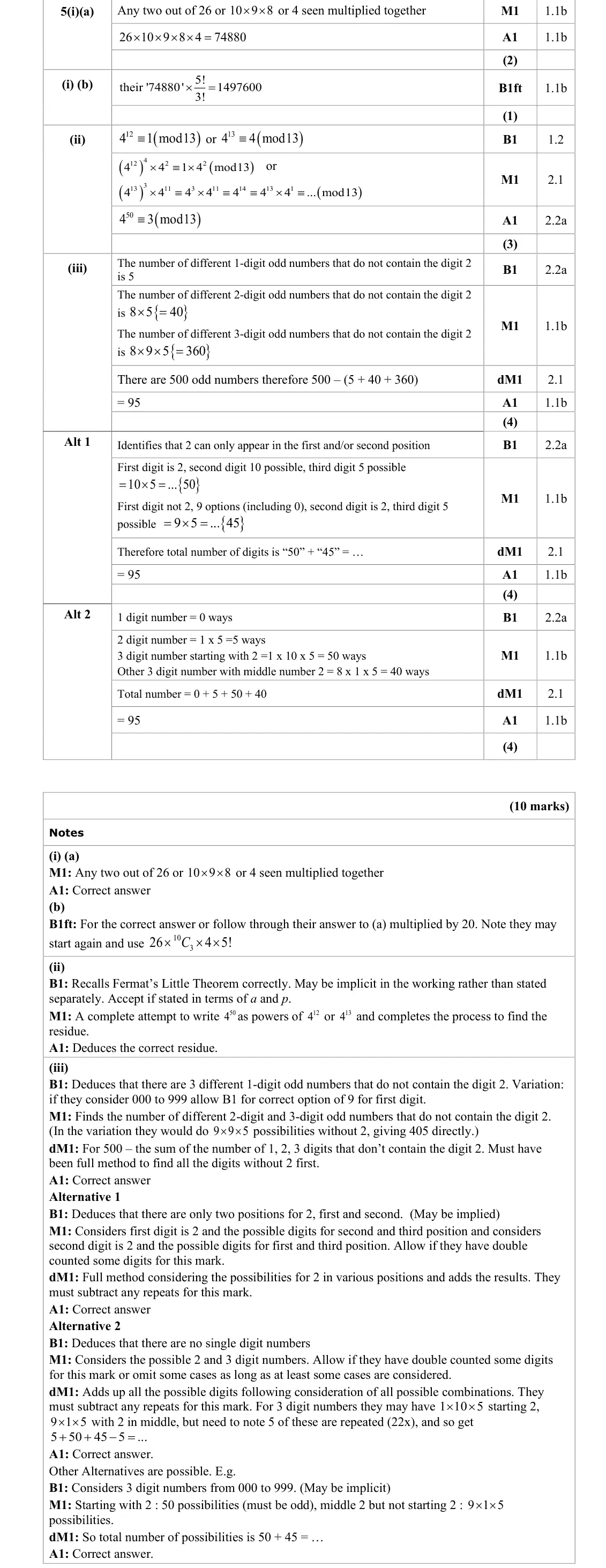
June 2025 · Paper 4A (Further Pure 2) · Q5(ii)3 marks
Mark scheme (whole question; this part is marked with the orange bar)
Examiner's comment
This was an inconsistently answered question, with (i) proving most challenging, (ii) proving very straightforward and (iii) producing a very mixed set of response. It is clear that the ideas of “counting” within number theory are still not well understood, but routine procedures such as applying Fermat’s Little Theorem are carried out very well. The leap between performing an algorithm and thinking through a problem can be big and this question therefore was a good discriminator for the paper. Part (i) was itself a bit mixed in performance, with most able to get started, fewer able to obtain a correct answer for part (a) and only a very small minority achieving a correct answer for (b). Many candidates were not confident working with combinatorics, but most could identify the 26 and the 4 that needed to be multiplied together to get the number of codes for part (a), although a few did have 24 letters in the alphabet rather than 26. The “10 x 9 x 8” or 10P3 for the 3 distinct digits was less commonly attained, with 9 x 8 x 7 often being given, presumably 0 being discounted at a valid digit. A few tried adding rather than multiplying the values for the three cases and so scored no marks. For (i)(b) very few were able to attain the correct answer. The most common thing to do was to multiply the answer to (a) by 5! Thinking that they needed to permute all the possibilities from part (a), not appreciating that the 3 ordered digits were originally chosen from 10, so there were repeats in these permutations from where the same three were chosen in a different order. Only a very few saw that the correct process from (a) to (b) was to multiply by 5! 20 3! = to discount the repeats. More often where correct answers occurred, they arose from working Many left this part out completely. out from scratch that it was 10 4 5! 26 C x x x 3 Part (ii) was answered very well, with even less able candidates able to score full marks in this part. Most stated Fermat’s Little Theorem initially, a good practice, before applying it to the problem, though a few candidates relied on the result being identified by implication within very brief work. Students should have it stressed that they should make the working clear, as answers only will not necessarily score the marks. After identifying the theorem most correctly adapted the powers and proceeded to simplify to the required residue with mistakes in simplifying being rare. A few did try approaches by modular arithmetic approaches without using Fermat’s Little Theorem, but these were unable to score marks as they did not follow the demand of the question Part (iii) was often approached haphazardly, but many were able to find their way to the correct solution, or at least partially correct. Following students work was often a difficult task, with very unclear layout and values appearing all over the place. Very few, after experimenting and finding their answer, went back to present the argument clearly. Again, the importance of making working clear, so that partial credit for incorrect answers may be able to be better awarded, should be stressed to students. In terms of how students approached the problem there were many approaches seen – all those on the mark scheme and variations of them. More students tried direct counting than counting the numbers without 2’s first, though the latter were arguably more successful overall. The most common method was considering the numbers in groups of 100, often listing options. E.g. 000’s =5, 100’s =5, 200’s=50, etc and summing the result. Such methods were effective, though less elegant than ones that considered forms of numbers, considering whether the first digit was 2, the second digit was 2 or the first and second digits were 2 and so on. However, these latter approaches were more prone to inclusion of repeats, or exclusion of some valid cases. Such method often scored the B mark on implication as few made it directly clear about the 1-digit numbers, as this was often subsumed in other cases, but it was clear that the majority realised 2 could not be the final digit (in fact there were only 5 choices for the final digit. Failing to consider multiple 2’s in the number was probably the most common error, with the 22x numbers often counted twice in solutions. Omitting possibilities such as the 2-digit numbers (often when counting x2x but excluding the first digit as 0 without considering 2 digit numbers separately) was also fairly common, while a few using the approach of counting no 2’s first did not correctly work out the 500 odd numbers to subtract from. Various other mistakes were made as well as these few examples. There were also several cases of students considering four-digit numbers seen, misreading or misinterpreting the “less than 1000”. For a deceptively simple question, this was a good demonstration of the level of complexity involved in counting problems and gave students ample opportunity to flex their problem- solving skills.
Key points from the mark scheme and examiner's report
4¹² ≡ 1 (mod 13)
4⁵⁰ = (4¹²)⁴ × 4² ≡ 16 ≡ 3 (mod 13)
FLT must be used
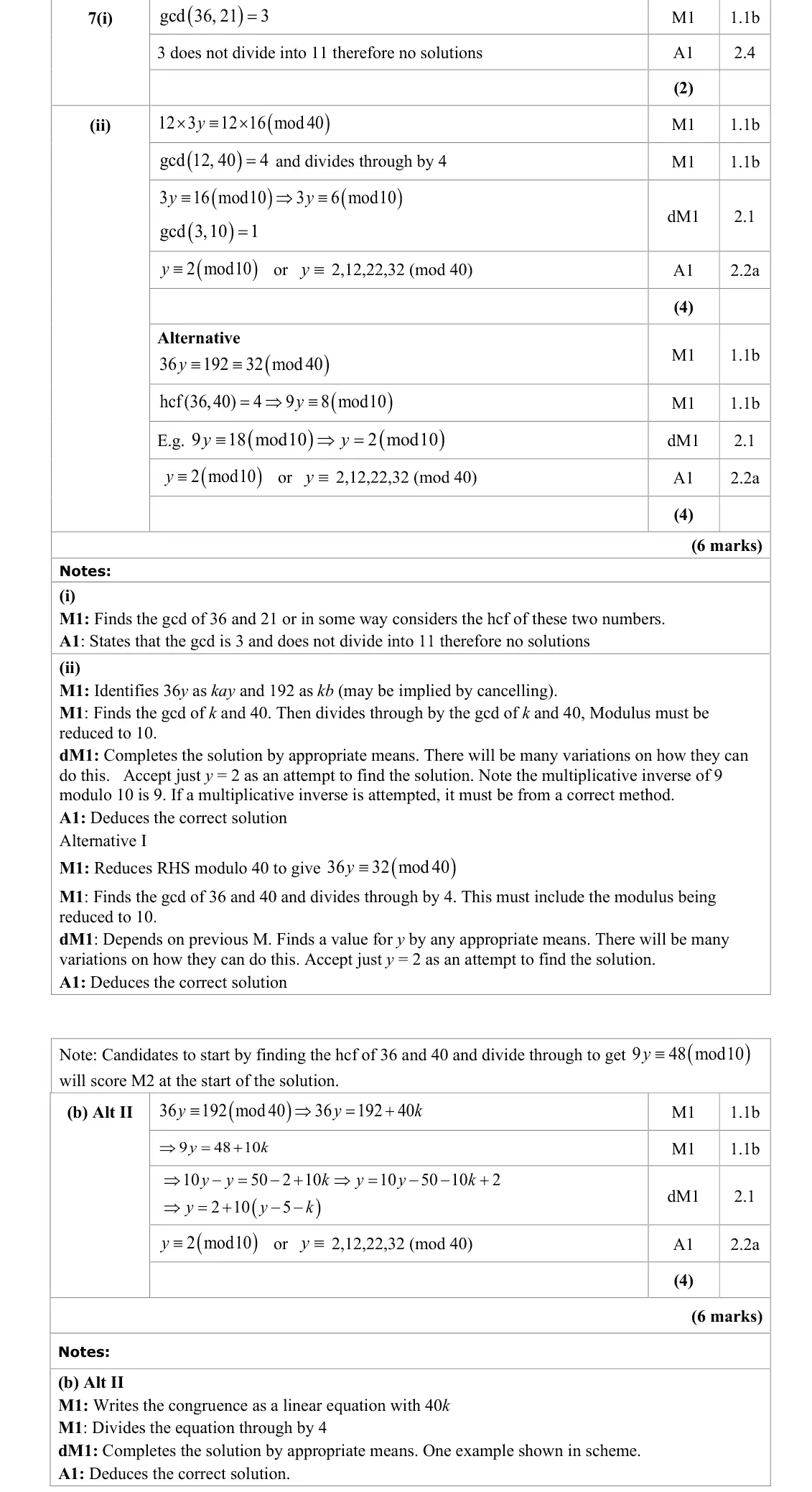
June 2025 · Paper 4A (Further Pure 2) · Q7(i)2 marks
Mark scheme (whole question; this part is marked with the orange bar)
Examiner's comment
Another number theory question, this again provided some good discrimination and showed students understanding of the methods for solving congruence equations and knowing when solutions do not exist. Part (i) was the better answered of the two parts, with most realising it was to do with common factors of the 21 and 36. A few only considered the 21 and 11, and so did not score any marks, while some candidates attempted to try to solve it to show the lack of solutions, which was generally less reliable – some found solutions. Those who identified the correct common factor were usually able to relate the reason for no solutions to the 11 not being divisible by 3, but some did not seem certain at this stage and a few unclear answers, often trying to talk about multiplicative inverse, belied this lack of understanding. Part (ii) was less well done, though often was a case of either fully correct or else little more than the first mark. The most common successful approach was to simplify the given equation to 9y = 48 (mod 10) directly and the solving from here to get y = 2 (mod 10). Most , but most students did not spot this efficiently this was done by spotting 1(mod 10) 9 ≡- directly but derived it using the Bezout’s identity to find the multiplicative inverse first, while others tried doubling successively until getting to the solution or similar methods. Other successful approaches first saw students reduce the equation partially by cancelling some common factors or reducing the right hand side modulo 10 before reducing the modulus to a modulo 10 equation, but these are essentially variations on a theme, and as long as candidates succeeded in reducing the modulus of the equation successfully most went on to the correct final answer, with only a small number making errors in solving the resulting congruence. However, many did not see that the modulus had a factor 4 in common with both other terms and so never reduced below modulus 40. Though many of these score the first mark for a partial reduction of the equation (both methods in the main scheme were seen frequently to reach this first stage of reduction), no further progress could be made. Indeed, many candidates seemed uncomfortable with congruence equations in general and lacked a clear approach, and there were also a number who were comfortable, but did not seem that confident in presenting their final answer clearly. The Alternative II in the mark scheme, forming the general equation, was rarely scene in this series, though was successful when used.
Key points from the mark scheme and examiner's report
gcd(21, 36) = 3 does not divide 11, so no solutions
June 2025 · Paper 4A (Further Pure 2) · Q7(ii)4 marks
Mark scheme (whole question; this part is marked with the orange bar)
Examiner's comment
Another number theory question, this again provided some good discrimination and showed students understanding of the methods for solving congruence equations and knowing when solutions do not exist. Part (i) was the better answered of the two parts, with most realising it was to do with common factors of the 21 and 36. A few only considered the 21 and 11, and so did not score any marks, while some candidates attempted to try to solve it to show the lack of solutions, which was generally less reliable – some found solutions. Those who identified the correct common factor were usually able to relate the reason for no solutions to the 11 not being divisible by 3, but some did not seem certain at this stage and a few unclear answers, often trying to talk about multiplicative inverse, belied this lack of understanding. Part (ii) was less well done, though often was a case of either fully correct or else little more than the first mark. The most common successful approach was to simplify the given equation to 9y = 48 (mod 10) directly and the solving from here to get y = 2 (mod 10). Most , but most students did not spot this efficiently this was done by spotting 1(mod 10) 9 ≡- directly but derived it using the Bezout’s identity to find the multiplicative inverse first, while others tried doubling successively until getting to the solution or similar methods. Other successful approaches first saw students reduce the equation partially by cancelling some common factors or reducing the right hand side modulo 10 before reducing the modulus to a modulo 10 equation, but these are essentially variations on a theme, and as long as candidates succeeded in reducing the modulus of the equation successfully most went on to the correct final answer, with only a small number making errors in solving the resulting congruence. However, many did not see that the modulus had a factor 4 in common with both other terms and so never reduced below modulus 40. Though many of these score the first mark for a partial reduction of the equation (both methods in the main scheme were seen frequently to reach this first stage of reduction), no further progress could be made. Indeed, many candidates seemed uncomfortable with congruence equations in general and lacked a clear approach, and there were also a number who were comfortable, but did not seem that confident in presenting their final answer clearly. The Alternative II in the mark scheme, forming the general equation, was rarely scene in this series, though was successful when used.
Key points from the mark scheme and examiner's report
reduce: 36y ≡ 32 (mod 40)
gcd 4 so 9y ≡ 8 (mod 10)
9 is self-inverse mod 10: y ≡ 2 (mod 10), i.e. 2, 12, 22, 32 (mod 40)
many never reduced the modulus
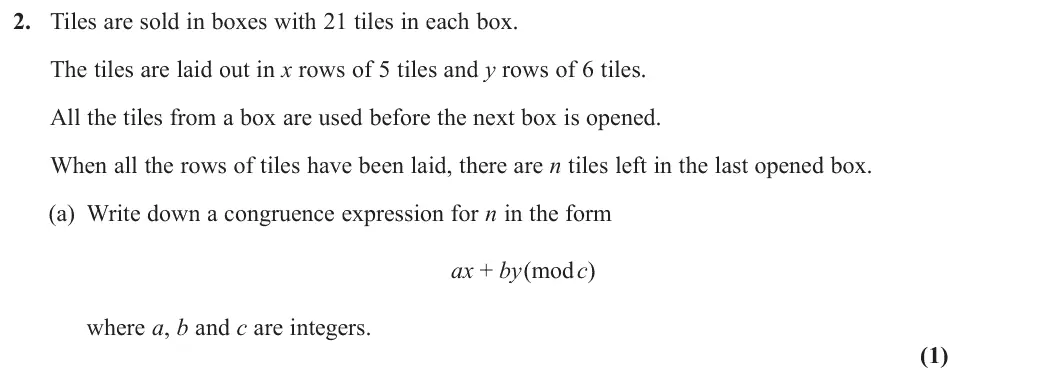
June 2024 · AS Paper 2 (Further Pure 2) · Q2(a)1 mark
Mark scheme (whole question; this part is marked with the orange bar)
Examiner's comment
Candidates found this question demanding with many scoring no marks, again many did not attempt this question. Part (a) candidates who did attempt this question managed to correctly write ( ) 5 6 mod 21 x y +
Key points from the mark scheme and examiner's report
n ≡ 5x + 6y (mod 21)
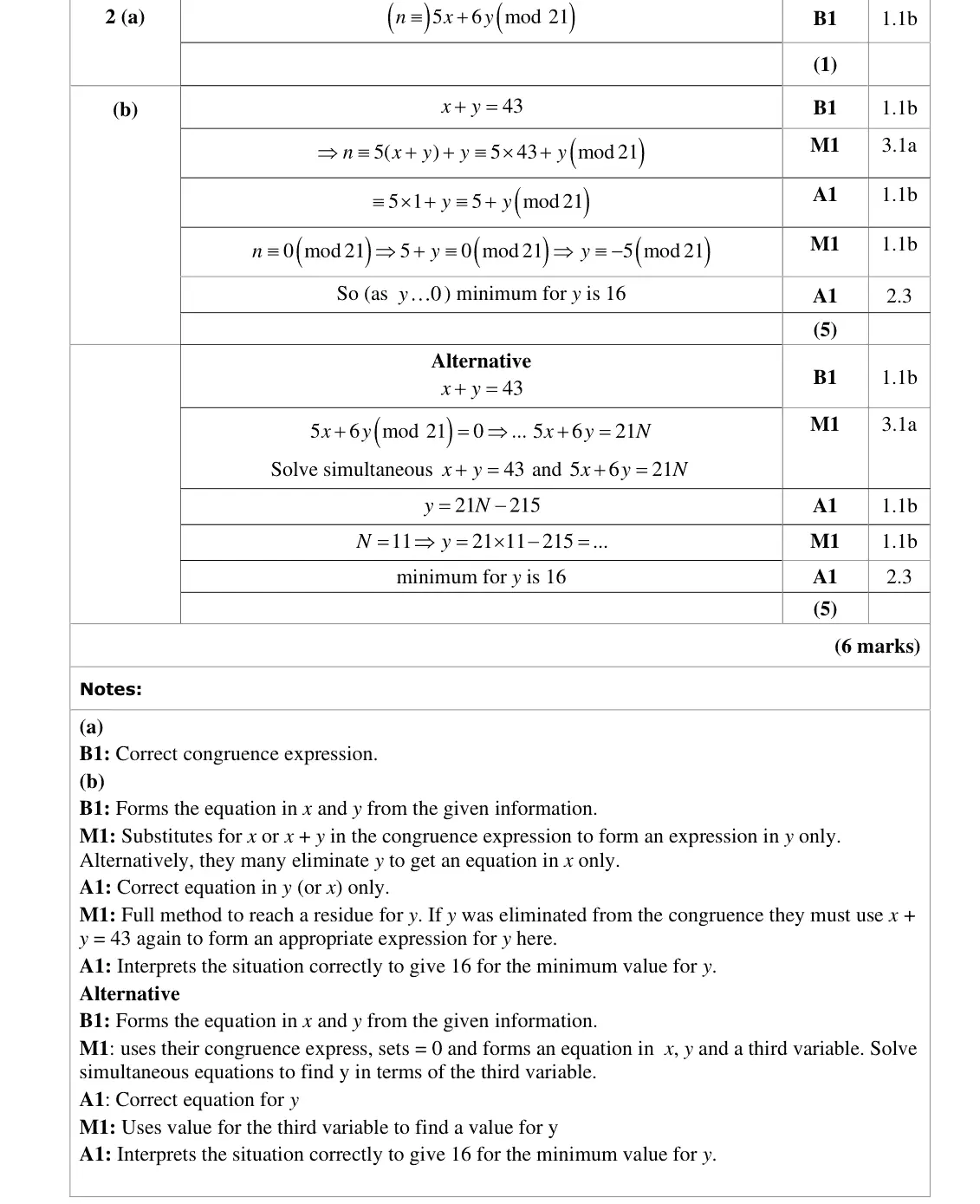
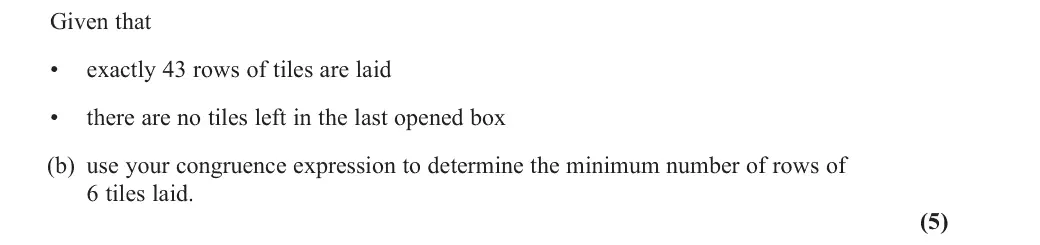
June 2024 · AS Paper 2 (Further Pure 2) · Q2(b)5 marks
Mark scheme (whole question; this part is marked with the orange bar)
Examiner's comment
Candidates found this question demanding with many scoring no marks, again many did not attempt this question. Part (b) candidates needed to use the fact that 43 x y + = and the answer to (a) to form and solve simultaneous equations. Some candidates incorrectly thought that 5 6 43 x y + = . Soe candidates stopped there but those who used 5 6 21 x y N + = went on to successfully find the values of x and y.
Key points from the mark scheme and examiner's report
x + y = 43 so n ≡ 5 × 43 + y ≡ 5 + y ≡ 0 (mod 21), y ≡ −5 ≡ 16
minimum 16 rows of 6
some wrongly wrote 5x + 6y = 43
many did not attempt
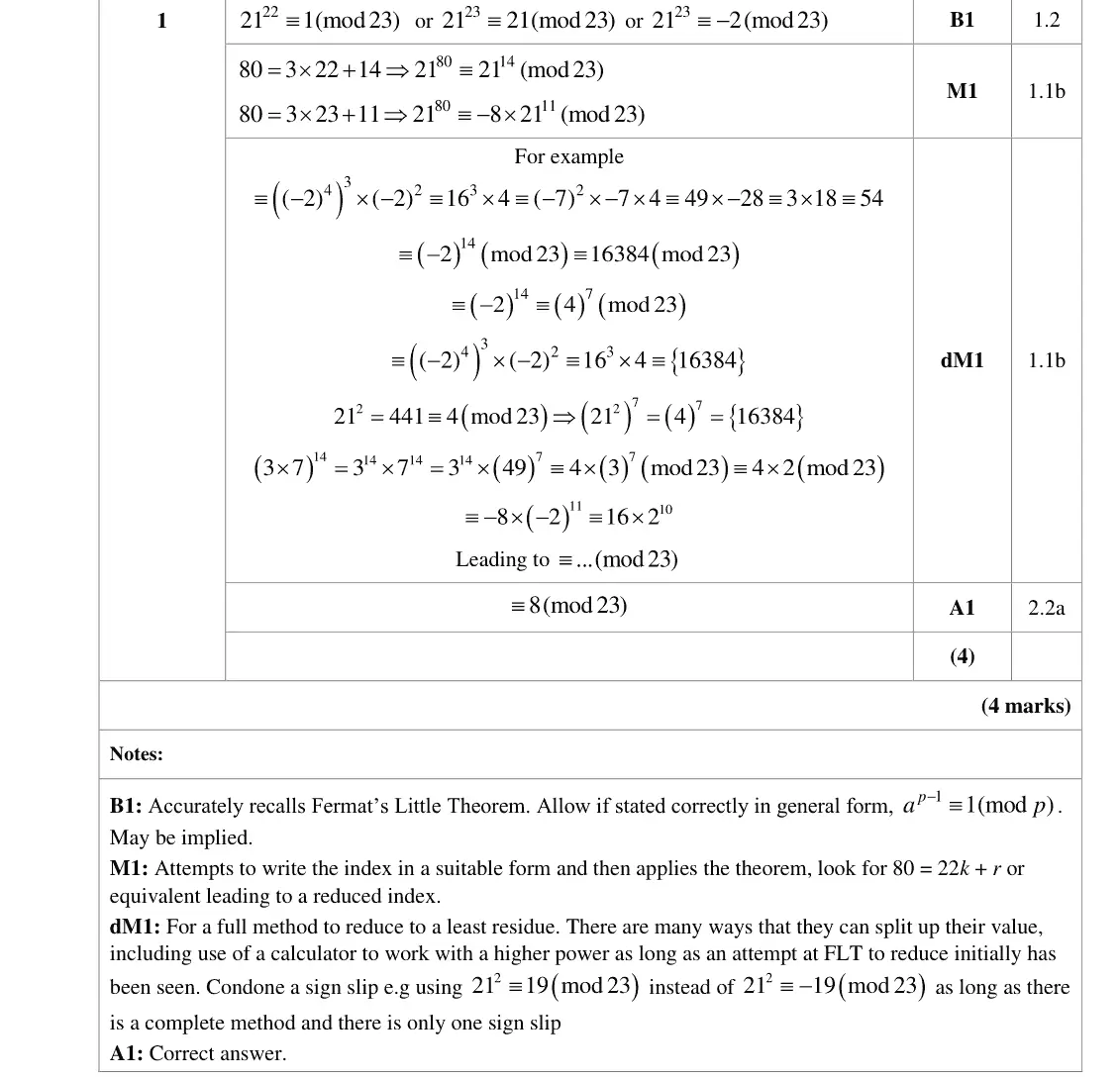
June 2024 · Paper 4A (Further Pure 2) · Q14 marks
Mark scheme (whole question; this part is marked with the orange bar)
Examiner's comment
The first mark was for using Fermat’s little theorem, writing 22 21 1(mod23) or 23 21 21(mod23) or 23 21 2(mod23) - . A few candidates did not use this, they went straight into modulo arithmetic, scoring no marks. Candidate are reminded that if the question asks for a particular method, then must use it to score any marks. The majority of candidates used 22 21 1(mod23) and wrote 22 14 80 3 = + leading to 80 14 21 (mod23) 21 scoring the next mark. Candidates who 23 21 21(mod23) generally went on to write 23 11 80 3 = + and then incorrectly 80 11 21 (mod23) 21 instead of 80 11 8 21 (mod23) 21 - . The majority of candidates did score the first two marks. Candidates could them use their candidates and modulus arithmetic to solve their modulus equation and most did so successfully.
Key points from the mark scheme and examiner's report
June 2024 · Paper 4A (Further Pure 2) · Q3(a)3 marks
Mark scheme (whole question; this part is marked with the orange bar)
Examiner's comment
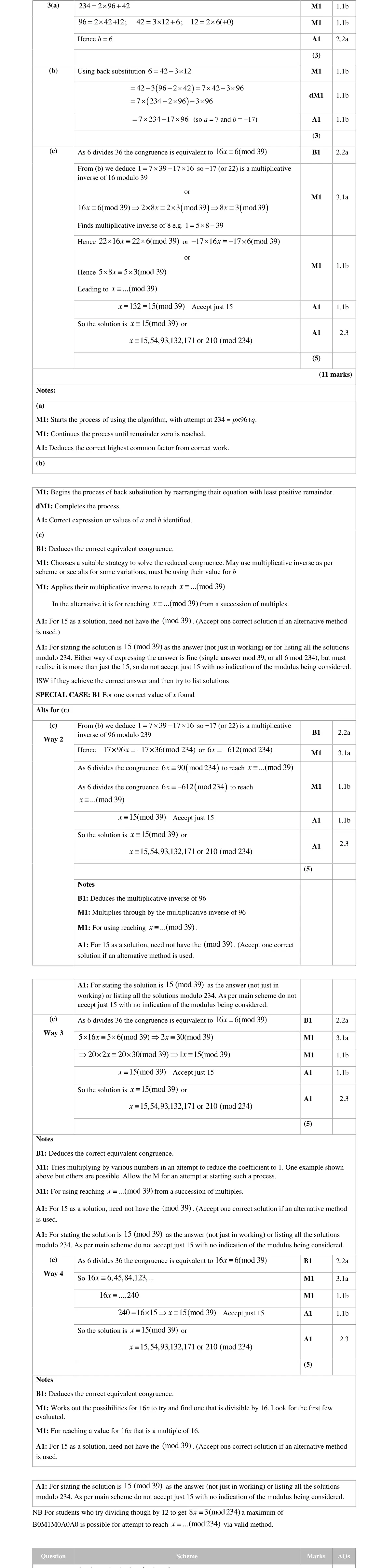
Candidate found parts (a) and (b) accessible as standard questions on Euclidean Algorithm to find the gcd and then use back substitution to find the Bezout’s identity. Part (c) candidate found more demanding and with many not realising the connection with part (b) and using the multiplicative inverse of 96 or 16. Part (a) Almost all the candidates score full arks on this question, writing 234 = p x 96+q and then completing the algorithm to find the gcd is 6. It was pleasing that candidates stated gcd = 6 of h = 6.
Key points from the mark scheme and examiner's report
June 2024 · Paper 4A (Further Pure 2) · Q3(b)3 marks
Mark scheme (whole question; this part is marked with the orange bar)
Examiner's comment
Candidate found parts (a) and (b) accessible as standard questions on Euclidean Algorithm to find the gcd and then use back substitution to find the Bezout’s identity. Part (c) candidate found more demanding and with many not realising the connection with part (b) and using the multiplicative inverse of 96 or 16. Part (b) The majority of candidates knew to start 6 42 = 3 12 + and rearrange to get 6 = … and then compered the process to express 6 in terms of 96 and 234. A few candidates incorrect started with the line 12 2 6( 0) = + and then rearranged 6 42 = 3 12 + to replace 6, this scored no marks.
Key points from the mark scheme and examiner's report
back-substitute from 6 = 42 − 3 × 12 (not from 12 = 2 × 6): 6 = 7 × 234 − 17 × 96, a = 7, b = −17
June 2024 · Paper 4A (Further Pure 2) · Q3(c)5 marks
Mark scheme (whole question; this part is marked with the orange bar)
Examiner's comment
Part (c) There were quite a few approaches to answer this question. The most common approach was to use the answer to part (b) and use the fact that the multiplicative inverse of 96 or 16 is -17. Approach 1: divide through by 6 to achieve 16 6(mod 39) x and multiply both sides by – 17 to reach 102(mod 39) x - (a few candidates incorrectly multiplied by 17). Most candidates then went on to successfully achieve the correct answer 15(mod 39) x . With this approach some candidates did not use part (b) and repeated parts (a) and (b) with 16 and 39 to find the multiplicative inverse. Approach 2: initially multiplied through by – 17 first but then needed to realise that this would give them 6 612(mod 234) x - , quite a few then incorrectly wrote 612(mod 234) x - . To score the next method mark they needed to divide by 6 to achieve 102(mod 39) x - and then solved correctly. There was a special case for candidate who managed to find one correct value, scoring a mark.
Key points from the mark scheme and examiner's report
divide by 6: 16x ≡ 6 (mod 39)
−17 is the inverse of 16 mod 39 (from (b)), so x ≡ −102 ≡ 15 (mod 39), i.e. 15, 54, 93, 132, 171, 210 (mod 234)
multiplying by −17 first needs care with the modulus
June 2023 · AS Paper 2 (Further Pure 2) · Q5(i)3 marks
Mark scheme (whole question; this part is marked with the orange bar)
Examiner's comment
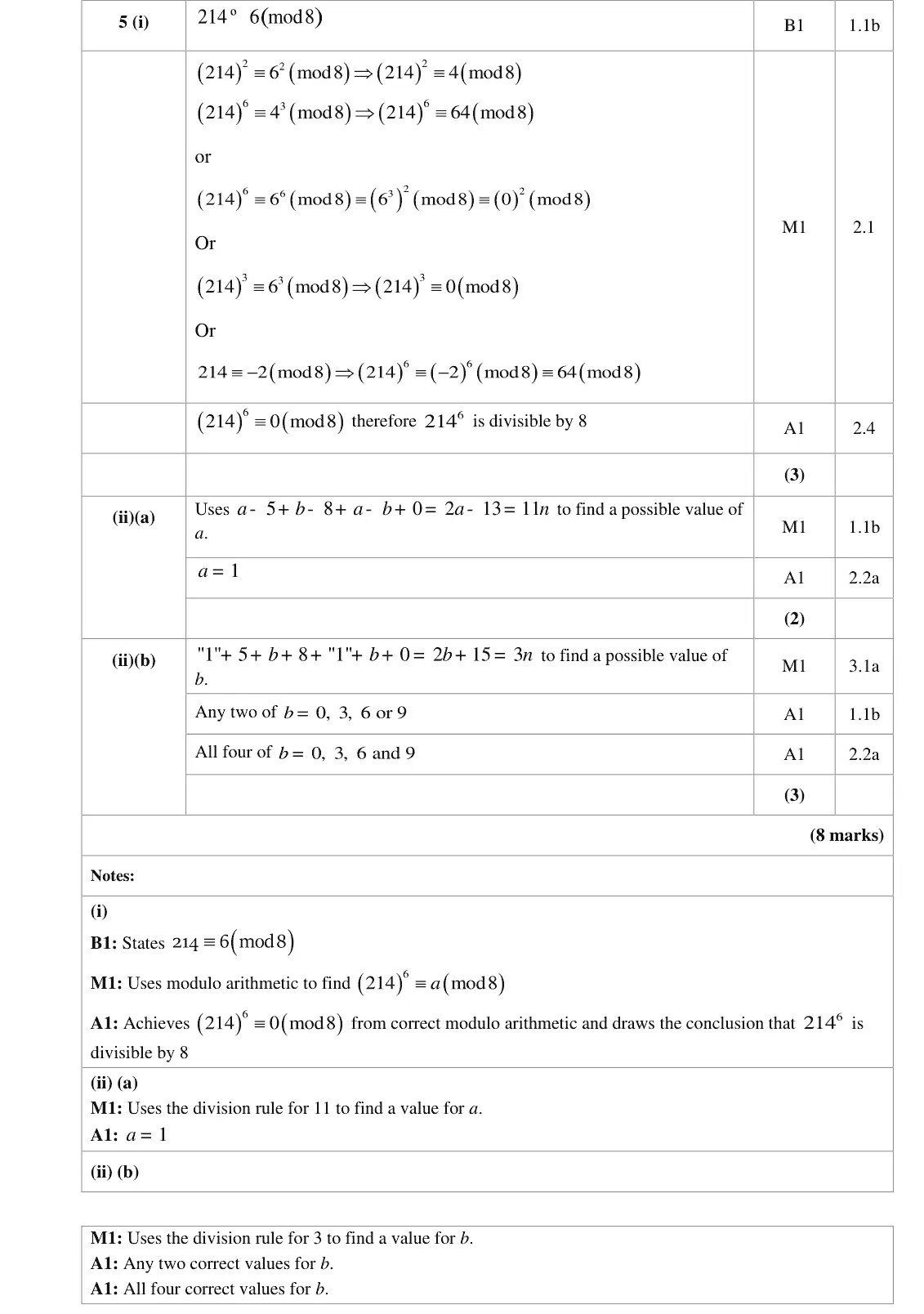
(i) About half the candidates were successful with this part, recognising the need to find ( ) 214 6 mod8 then use this to show that 2146 is divisible by 8 (ii) (a) Some candidates who were unsuccessful in (i) managed to score marks in this part. -+ -+ - + = 5 8 0 11 a b a b n Using the divisibility of 11 rule to find the value of a. (ii) (b) Most candidates were able to use the sum of the digits is divisible by 3 to find at least 2 correct possible values of b. The common error was to miss out b = 0 as a possible value.
Key points from the mark scheme and examiner's report
214 ≡ 6 (mod 8)
6³ = 216 ≡ 0 (or 214 ≡ −2 so (−2)⁶ = 64 ≡ 0)
so 214⁶ ≡ 0 (mod 8) and divisible by 8, with conclusion
about half succeeded
June 2023 · AS Paper 2 (Further Pure 2) · Q5(ii)(a)2 marks
Mark scheme (whole question; this part is marked with the orange bar)
Examiner's comment
(i) About half the candidates were successful with this part, recognising the need to find ( ) 214 6 mod8 then use this to show that 2146 is divisible by 8 (ii) (a) Some candidates who were unsuccessful in (i) managed to score marks in this part. -+ -+ - + = 5 8 0 11 a b a b n Using the divisibility of 11 rule to find the value of a. (ii) (b) Most candidates were able to use the sum of the digits is divisible by 3 to find at least 2 correct possible values of b. The common error was to miss out b = 0 as a possible value.
Key points from the mark scheme and examiner's report
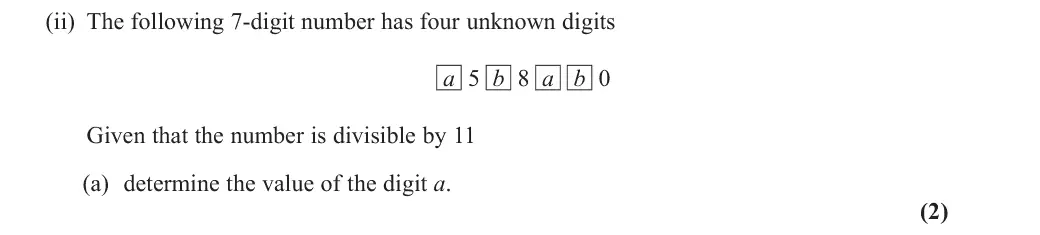
divisibility by 11: a − 5 + b − 8 + a − b + 0 = 2a − 13 must be a multiple of 11, so a = 1
June 2023 · AS Paper 2 (Further Pure 2) · Q5(ii)(b)3 marks
Mark scheme (whole question; this part is marked with the orange bar)
Examiner's comment
(i) About half the candidates were successful with this part, recognising the need to find ( ) 214 6 mod8 then use this to show that 2146 is divisible by 8 (ii) (a) Some candidates who were unsuccessful in (i) managed to score marks in this part. -+ -+ - + = 5 8 0 11 a b a b n Using the divisibility of 11 rule to find the value of a. (ii) (b) Most candidates were able to use the sum of the digits is divisible by 3 to find at least 2 correct possible values of b. The common error was to miss out b = 0 as a possible value.
Key points from the mark scheme and examiner's report
digit sum 2b + 15 must be a multiple of 3, so b = 0, 3, 6 or 9
b = 0 commonly missed
June 2023 · Paper 4A (Further Pure 2) · Q4(a)2 marks
Mark scheme (whole question; this part is marked with the orange bar)
Examiner's comment
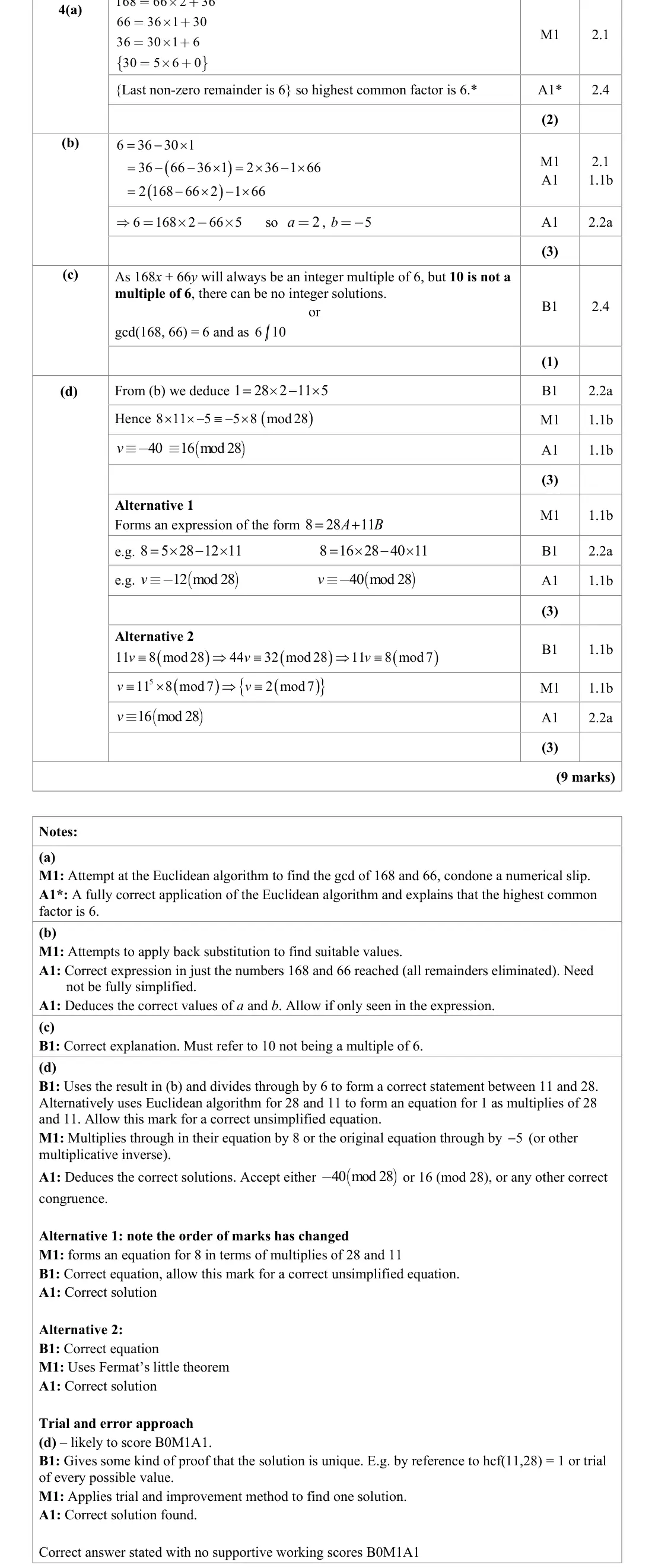
(a) This was done well by virtually all candidates; the only error was not stating the conclusion that ( ) gcd 168,66 6 = .
Key points from the mark scheme and examiner's report
June 2023 · Paper 4A (Further Pure 2) · Q4(b)3 marks
Mark scheme (whole question; this part is marked with the orange bar)
Examiner's comment
(b) Again, this was done very well, using their answer to part (a) to find 6 as multiplies of 66 and 168. Many gained full marks.
Key points from the mark scheme and examiner's report
6 = 168 × 2 − 66 × 5: a = 2, b = −5
June 2023 · Paper 4A (Further Pure 2) · Q4(c)1 mark
Mark scheme (whole question; this part is marked with the orange bar)
Examiner's comment
(c) This part was less well done. Candidates needed to state/show that 10 is not a multiple of 6. A common error was that candidates misread as 6 is not a multiple of 10.
Key points from the mark scheme and examiner's report
168x + 66y is always a multiple of 6 but 10 is not
many reversed this (6 not a multiple of 10)
June 2023 · Paper 4A (Further Pure 2) · Q4(d)3 marks
Mark scheme (whole question; this part is marked with the orange bar)
Examiner's comment
(d) This part was again done well with many candidates starting again and repeating parts (a) and (b) with 28 and 11. Very few realised that they could divide the answer to (b) by 6. They then divided by the multiplicative inverse of 11 and achieved the correct modulus solution. Another approach was to find 8 as a multiple of 11 and 28 and multiply through by the multiplicative invers of 11. A few candidates found that v = 16 was a solution but did not write as a modulus solution.
Key points from the mark scheme and examiner's report
divide (b) by 6: 1 = 28 × 2 − 11 × 5, so 11⁻¹ ≡ −5
v ≡ −40 ≡ 16 (mod 28)
v = 16 alone is not a congruence solution
most redid the algorithm instead
June 2023 · Paper 4A (Further Pure 2) · Q5(ii)4 marks
Mark scheme (whole question; this part is marked with the orange bar)
Examiner's comment
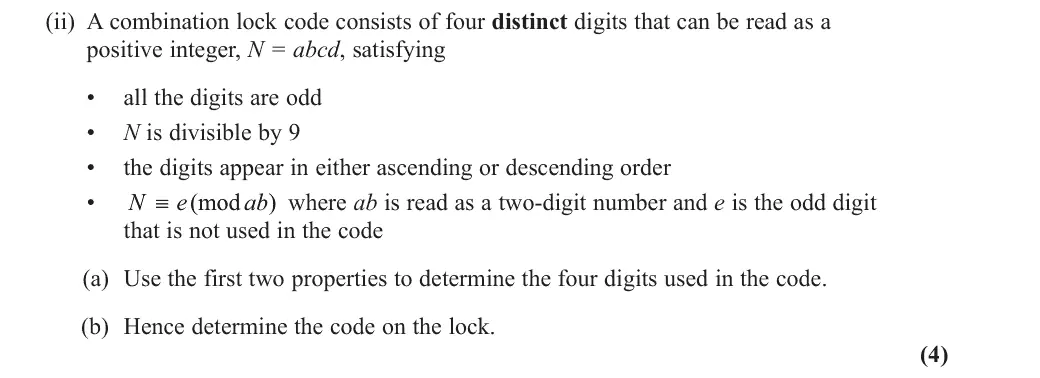
(i) (a) This part was not done well by many candidates; some common errors + or were . 45 4 3 4 3 2 5 4 (i) (b) Candidates struggled with this question and many left it blank. Candidates need to recognise that there were 5 possible positions for the letters and only 3 selected so ( ) and then subtract (a). 5 a C 3 (ii) This part was done very well by the candidates. In (a) they were able to select the correct odd digits 1, 3, 5 and 7 using the sum of the digits is a multiple of 9. In (b) again candidates were able to deduce that the correct code was 1357. A few candidates misread mod ab as multiplying the values of a and b.
Key points from the mark scheme and examiner's report
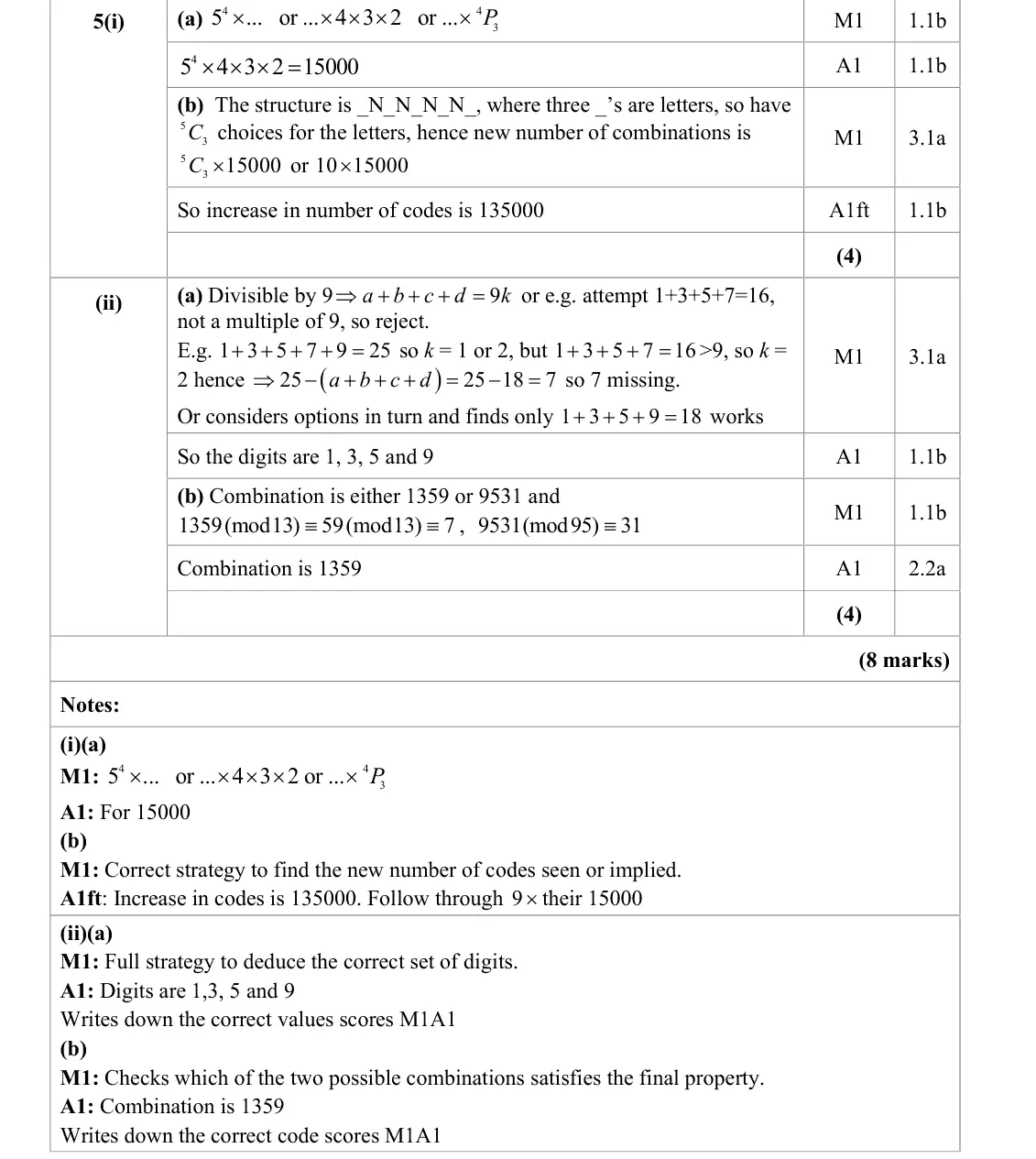
digit sum a multiple of 9: only 1 + 3 + 5 + 9 = 18 works, so e = 7
test 1359 mod 13 and 9531 mod 95: code 1359
mod ab is not a × b
June 2022 · AS Paper 2 (Further Pure 2) · Q3(i)3 marks
Mark scheme (whole question; this part is marked with the orange bar)
Examiner's comment
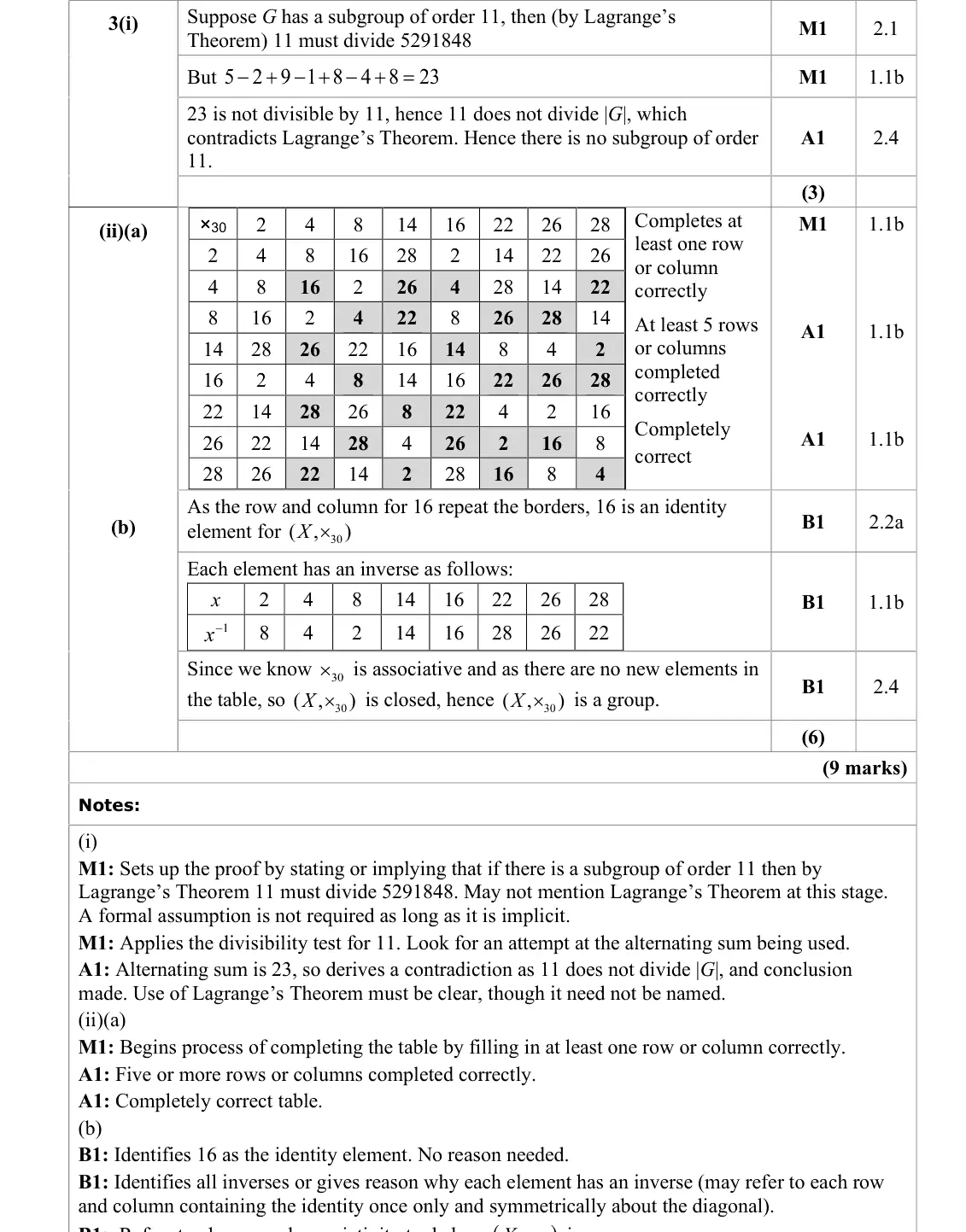
The question overall worked well as far as can be ascertained from the small candidature. However, it is clear group theory is still an unfamiliar topic which has yet to settle in candidates minds. Over time, with more past papers to practice, no doubt the topic will become more familiar, but still early in the new specification there are still some new ideas being assessed. It was the only question in which maximum marks was not achieved by any of the small candidature, though each individual mark was awarded to some. Part (i) was left out entirely by most, but those who did attempt it were generally successful. The idea of a proof perhaps put off some people, but the need for the divisibility test was shown by all those attempting. Not all identified Lagrange’s theorem explicitly, though most at least alluded to the result. Setting up a formal assumption for contradiction was not well done, but the scheme allowed flexibility with the approach. Two or three marks were common for those attempting this part. In part (ii) many did just the table and nothing more, picking up a few easy marks without attempting the rest. Only a couple left out the question entirely, but the modal score for the question was 3 marks, usually for the table and nothing more, though a couple made an error in the table but picked up one mark elsewhere. Spotting 16 as the identity proved the most difficult challenge to the group axioms, with some assuming it should be 1, and concluding there is no identity so not a group (for which a special case was allowed for one of the last three marks). Those who were able to spot the identity generally went on to score full marks for part (ii).
Key points from the mark scheme and examiner's report
assume a subgroup of order 11 exists, so by Lagrange 11 divides 5 291 848
alternating digit sum 23 is not divisible by 11: contradiction
most omitted this part
the formal assumption was often weak
June 2022 · AS Paper 2 (Further Pure 2) · Q4(i)(a)3 marks
Mark scheme (whole question; this part is marked with the orange bar)
Examiner's comment
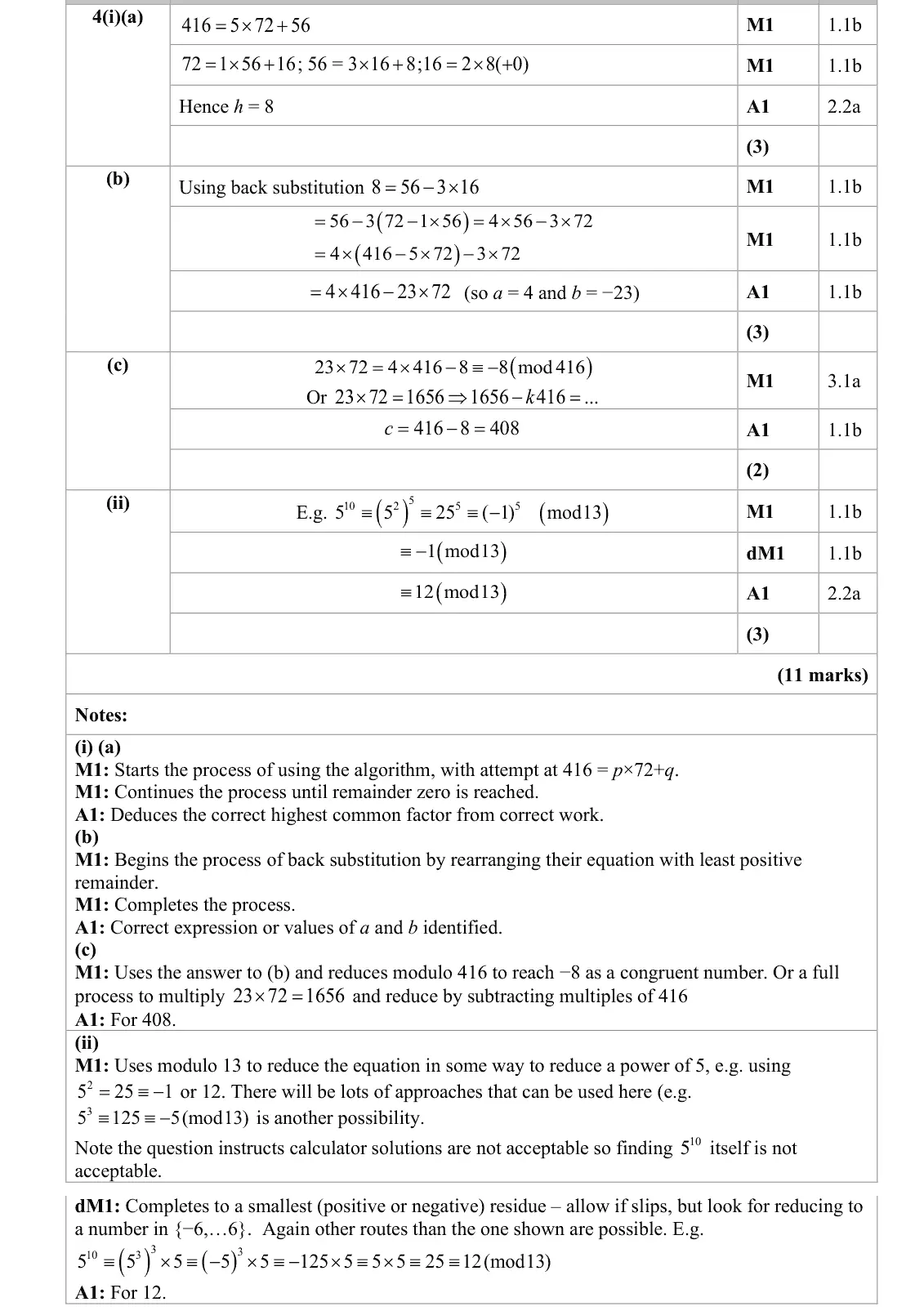
There was a good spread of marks for this question, with good access for part (i) and a mode 8 closely followed by 11 out of 11 (scored by about a third of candidates). Of the students who attempted the question, all scored at least 5 marks. Part (ii) proved to be a good discriminator for the paper. The required process for parts (i)(a) and (b) were shown by most, and usually carried out well with nearly all able to obtain the correct highest common factor. Occasional slips in back substitution did occur, but the method itself was demonstrated well. Most, however, did not spot the connection between (i)(b) and (c), but used direct calculation instead, which was an allowable method so the marks could be scored. It would be useful for candidates to look for connections within parts such at this, though, as it can speed up the work. Part (ii) did prove to be a more challenging part, as it was expected to be, with many 25 12(mod13) making no progress. Some did identify but we unable to see how to ≡ use this to suitable simplify the equation, while others made no progress at all. For those who could find a method to find a solution, they generally did so successfully.
Key points from the mark scheme and examiner's report
June 2022 · AS Paper 2 (Further Pure 2) · Q4(i)(b)3 marks
Mark scheme (whole question; this part is marked with the orange bar)
Examiner's comment
There was a good spread of marks for this question, with good access for part (i) and a mode 8 closely followed by 11 out of 11 (scored by about a third of candidates). Of the students who attempted the question, all scored at least 5 marks. Part (ii) proved to be a good discriminator for the paper. The required process for parts (i)(a) and (b) were shown by most, and usually carried out well with nearly all able to obtain the correct highest common factor. Occasional slips in back substitution did occur, but the method itself was demonstrated well. Most, however, did not spot the connection between (i)(b) and (c), but used direct calculation instead, which was an allowable method so the marks could be scored. It would be useful for candidates to look for connections within parts such at this, though, as it can speed up the work. Part (ii) did prove to be a more challenging part, as it was expected to be, with many 25 12(mod13) making no progress. Some did identify but we unable to see how to ≡ use this to suitable simplify the equation, while others made no progress at all. For those who could find a method to find a solution, they generally did so successfully.
Key points from the mark scheme and examiner's report
back substitution: 8 = 4 × 416 − 23 × 72 so a = 4, b = −23
occasional back-substitution slips
June 2022 · AS Paper 2 (Further Pure 2) · Q4(i)(c)2 marks
Mark scheme (whole question; this part is marked with the orange bar)
Examiner's comment
There was a good spread of marks for this question, with good access for part (i) and a mode 8 closely followed by 11 out of 11 (scored by about a third of candidates). Of the students who attempted the question, all scored at least 5 marks. Part (ii) proved to be a good discriminator for the paper. The required process for parts (i)(a) and (b) were shown by most, and usually carried out well with nearly all able to obtain the correct highest common factor. Occasional slips in back substitution did occur, but the method itself was demonstrated well. Most, however, did not spot the connection between (i)(b) and (c), but used direct calculation instead, which was an allowable method so the marks could be scored. It would be useful for candidates to look for connections within parts such at this, though, as it can speed up the work. Part (ii) did prove to be a more challenging part, as it was expected to be, with many 25 12(mod13) making no progress. Some did identify but we unable to see how to ≡ use this to suitable simplify the equation, while others made no progress at all. For those who could find a method to find a solution, they generally did so successfully.
Key points from the mark scheme and examiner's report
use (b): 23 × 72 = 4 × 416 − 8 ≡ −8, so c = 408
most missed the link and multiplied out directly (allowed)
June 2022 · AS Paper 2 (Further Pure 2) · Q4(ii)3 marks
Mark scheme (whole question; this part is marked with the orange bar)
Examiner's comment
There was a good spread of marks for this question, with good access for part (i) and a mode 8 closely followed by 11 out of 11 (scored by about a third of candidates). Of the students who attempted the question, all scored at least 5 marks. Part (ii) proved to be a good discriminator for the paper. The required process for parts (i)(a) and (b) were shown by most, and usually carried out well with nearly all able to obtain the correct highest common factor. Occasional slips in back substitution did occur, but the method itself was demonstrated well. Most, however, did not spot the connection between (i)(b) and (c), but used direct calculation instead, which was an allowable method so the marks could be scored. It would be useful for candidates to look for connections within parts such at this, though, as it can speed up the work. Part (ii) did prove to be a more challenging part, as it was expected to be, with many 25 12(mod13) making no progress. Some did identify but we unable to see how to ≡ use this to suitable simplify the equation, while others made no progress at all. For those who could find a method to find a solution, they generally did so successfully.
Key points from the mark scheme and examiner's report
5² = 25 ≡ −1 (mod 13) so 5¹⁰ ≡ (−1)⁵ ≡ −1 ≡ 12
evaluating 5¹⁰ on a calculator is not acceptable
many made no progress
June 2022 · Paper 4A (Further Pure 2) · Q4(a)2 marks
Mark scheme (whole question; this part is marked with the orange bar)
Examiner's comment
Part (a) This was mostly done well but quite a high proportion did not give a complete conclusion, thereby losing the 2nd mark by failing to conclude their proof properly. Very able candidates spotted that they could use the first line from part (a) 124 17 7 5 = ´ + to find 10 as a multiply of 124 and 17
Key points from the mark scheme and examiner's report
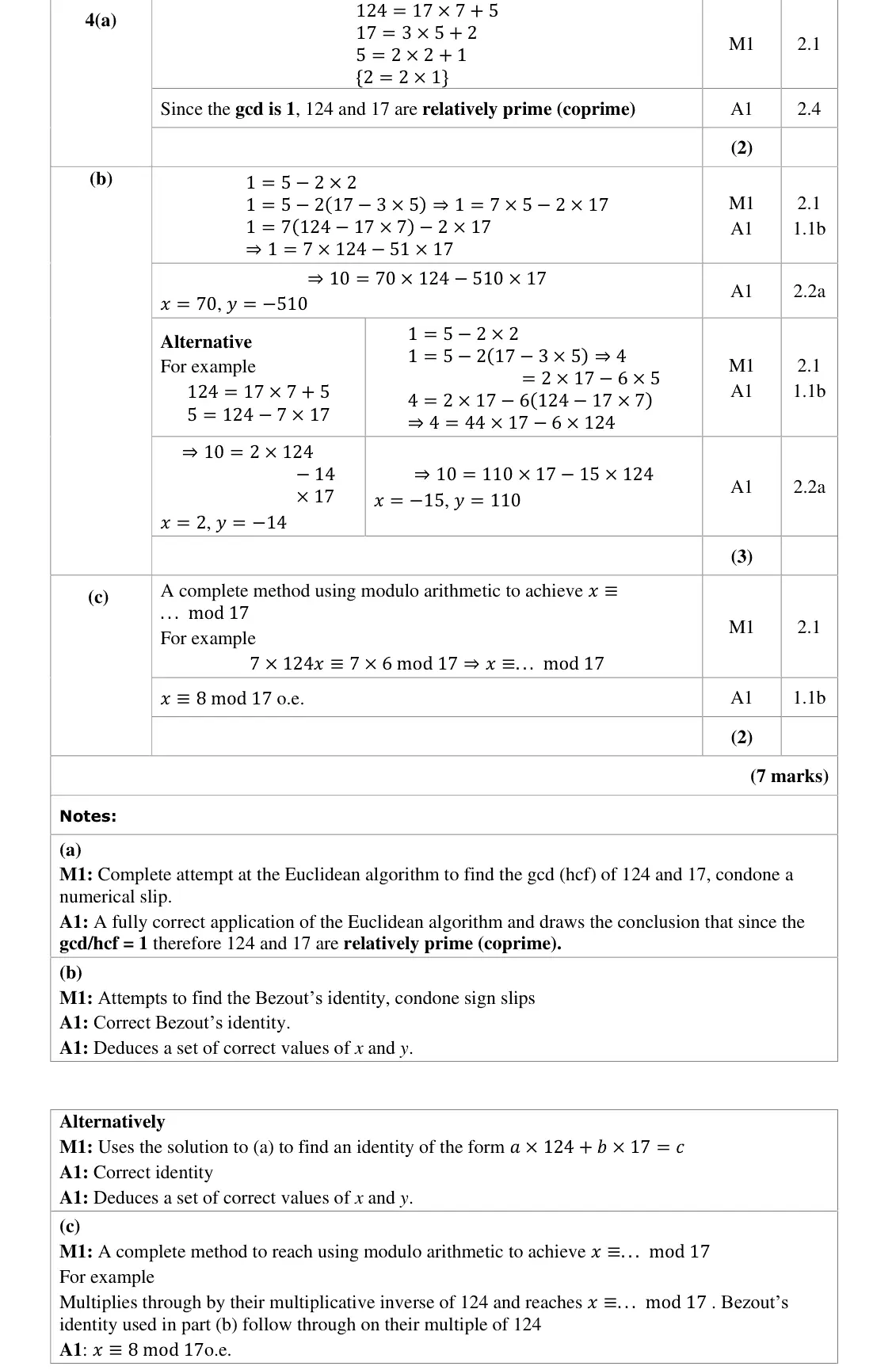
124 = 17 × 7 + 5, 17 = 3 × 5 + 2, 5 = 2 × 2 + 1
must conclude gcd = 1 so coprime
June 2022 · Paper 4A (Further Pure 2) · Q4(b)3 marks
Mark scheme (whole question; this part is marked with the orange bar)
Examiner's comment
Part (b) The majority of candidates solved this part correctly with many using Bezout’s identity. A few lost the third mark because they did not multiply their earlier result by 10. Very able candidates spotted that they could use the first line from part (a) 124 17 7 5 = ´ +
Key points from the mark scheme and examiner's report
back-substitute: 1 = 7 × 124 − 51 × 17, × 10: x = 70, y = −510 (other pairs e.g. x = 2, y = −14)
forgetting to multiply by 10
June 2022 · Paper 4A (Further Pure 2) · Q4(c)2 marks
Mark scheme (whole question; this part is marked with the orange bar)
Examiner's comment
(c) Many candidates score both marks by correct use of modular arithmetic. A few left their answer as 42, for example.
Key points from the mark scheme and examiner's report
7 is the inverse of 124 mod 17: x ≡ 42 ≡ 8 (mod 17)
leaving 42 lost the A
June 2022 · Paper 4A (Further Pure 2) · Q7(ii)(a)2 marks
Mark scheme (whole question; this part is marked with the orange bar)
Examiner's comment
Candidates were very successful at (i) (a) however for (i) (b) a large number wrote the answer 360, not realising that they had to remove the cases where the leading coefficient was 0, which does not lead to a quartic equation Part (ii) (a) received a wide variety of responses, with some very well argued, clear and concise arguments, but a much larger number that lost marks due to their reasoning not being clear. It was very important that the candidates explained exactly what the conditions given in the question implied for the values of the digits, and this was not always done well for the condition that the sum of the digits is even. Part (ii) (b) was often more successful, even with candidates who had made errors in part (a). Candidates successfully used the result from part (a) to find that b = 4 and therefore a + c = 4 leading to the four correct possible value for N.
Key points from the mark scheme and examiner's report
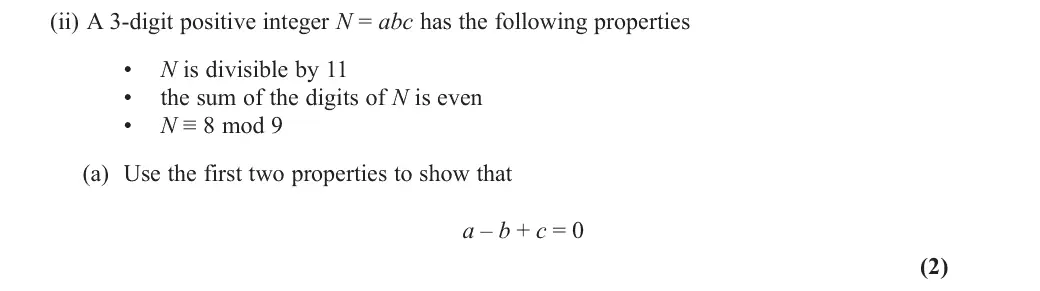
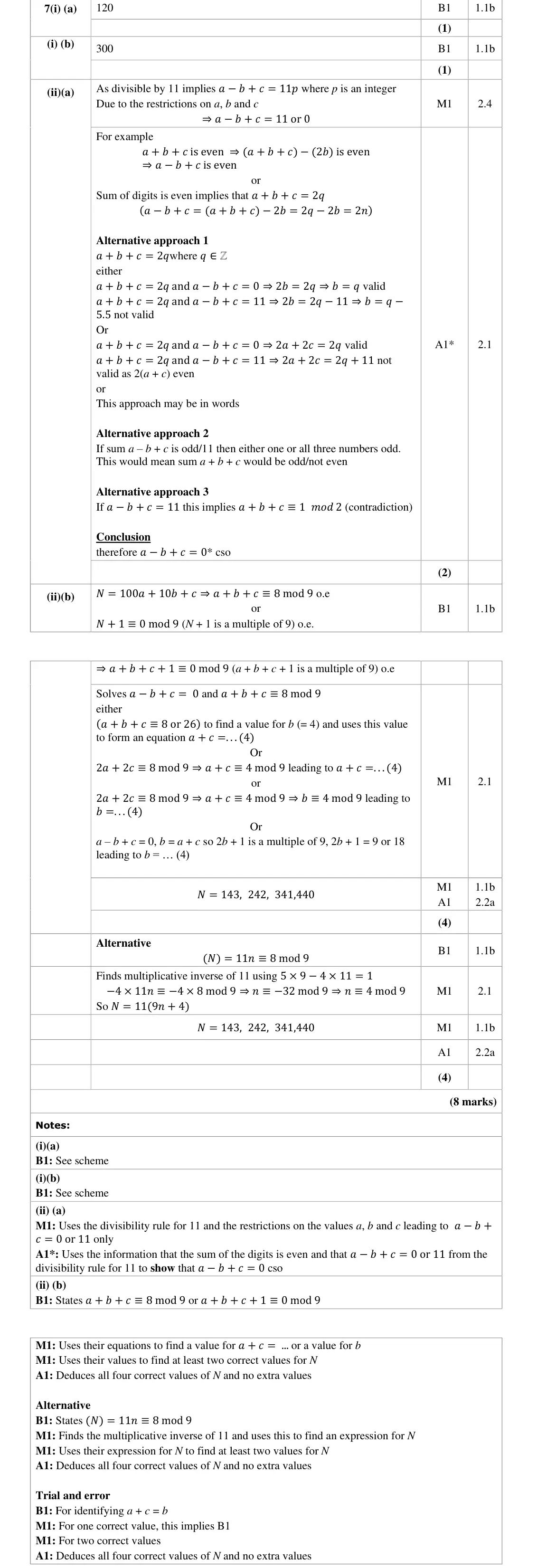
divisibility by 11 gives a − b + c = 0 or 11
a − b + c has the same parity as a + b + c, which is even, so it is 0
the parity step was often poorly explained
June 2022 · Paper 4A (Further Pure 2) · Q7(ii)(b)4 marks
Mark scheme (whole question; this part is marked with the orange bar)
Examiner's comment
Candidates were very successful at (i) (a) however for (i) (b) a large number wrote the answer 360, not realising that they had to remove the cases where the leading coefficient was 0, which does not lead to a quartic equation Part (ii) (a) received a wide variety of responses, with some very well argued, clear and concise arguments, but a much larger number that lost marks due to their reasoning not being clear. It was very important that the candidates explained exactly what the conditions given in the question implied for the values of the digits, and this was not always done well for the condition that the sum of the digits is even. Part (ii) (b) was often more successful, even with candidates who had made errors in part (a). Candidates successfully used the result from part (a) to find that b = 4 and therefore a + c = 4 leading to the four correct possible value for N.
Key points from the mark scheme and examiner's report
N ≡ digit sum (mod 9) so a + b + c ≡ 8
with b = a + c gives b = 4, a + c = 4: N = 143, 242, 341, 440 and no others
Nov 2021 · Paper 4A (Further Pure 2) · Q14 marks
Mark scheme (whole question; this part is marked with the orange bar)
Key points from the mark scheme and examiner's report
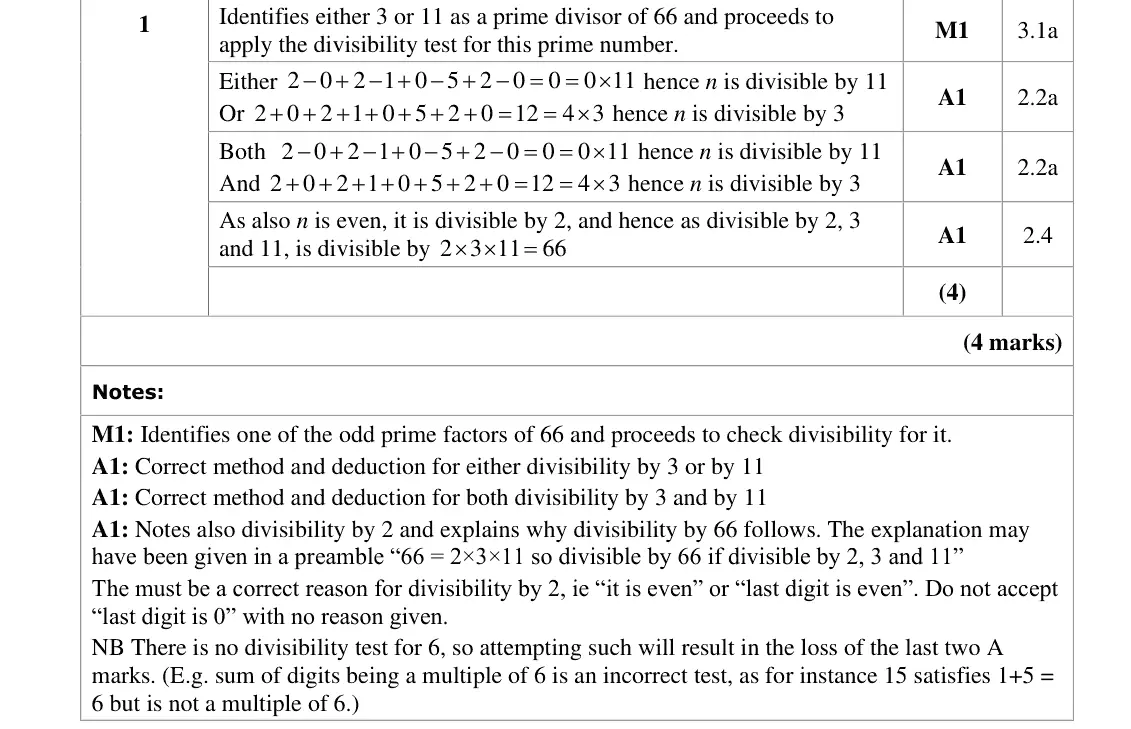
66 = 2 × 3 × 11: even
digit sum 12 is a multiple of 3
alternating digit sum 0 is a multiple of 11
there is no digit-sum test for 6
'last digit 0' alone is not a reason for 2
Nov 2021 · Paper 4A (Further Pure 2) · Q3(a)5 marks
Mark scheme (whole question; this part is marked with the orange bar)
Key points from the mark scheme and examiner's report
Oct 2020 · AS Paper 2 (Further Pure 2) · Q2(b)3 marks
Mark scheme (whole question; this part is marked with the orange bar)
Key points from the mark scheme and examiner's report
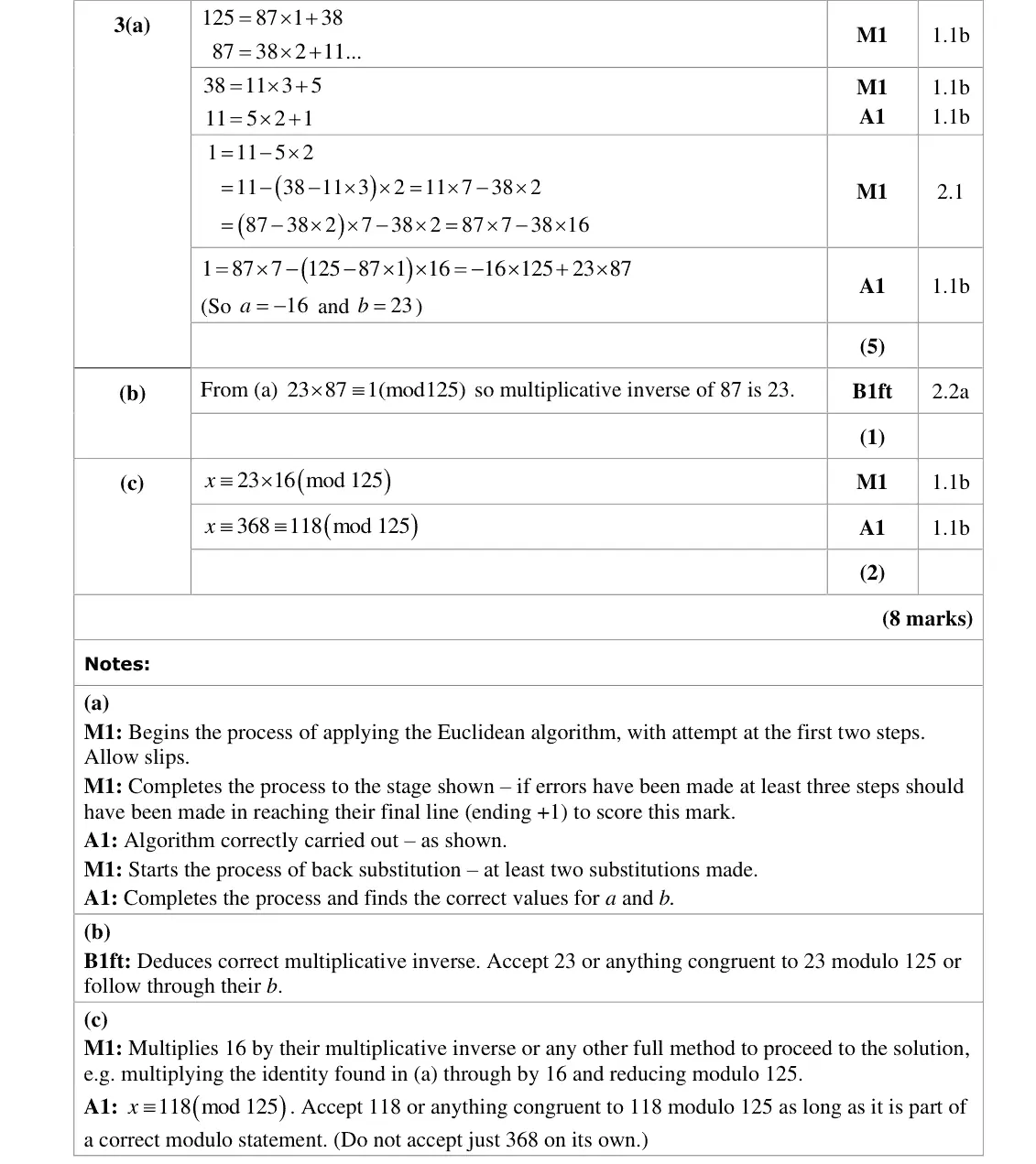
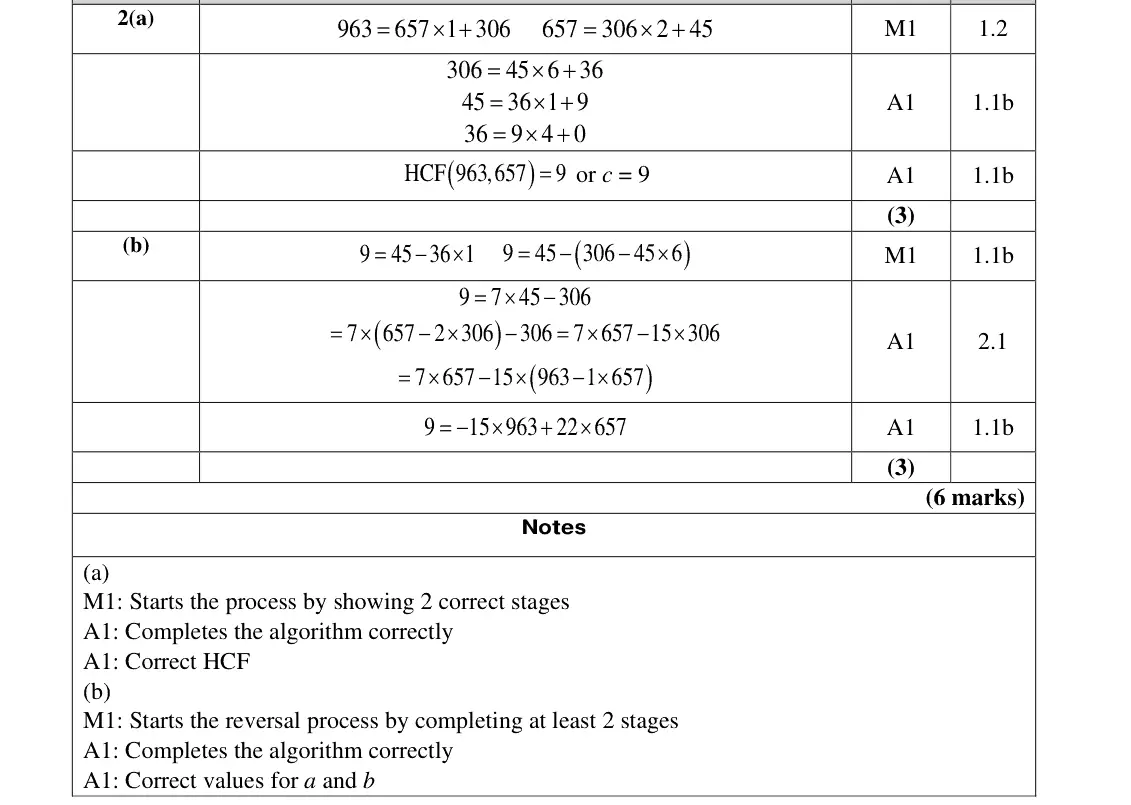
back-substitute through the algorithm: 9 = 7 × 45 − 306 = 7 × 657 − 15 × 306
a = −15, b = 22
Oct 2020 · Paper 4A (Further Pure 2) · Q8(a)2 marks
Mark scheme (whole question; this part is marked with the orange bar)
Key points from the mark scheme and examiner's report
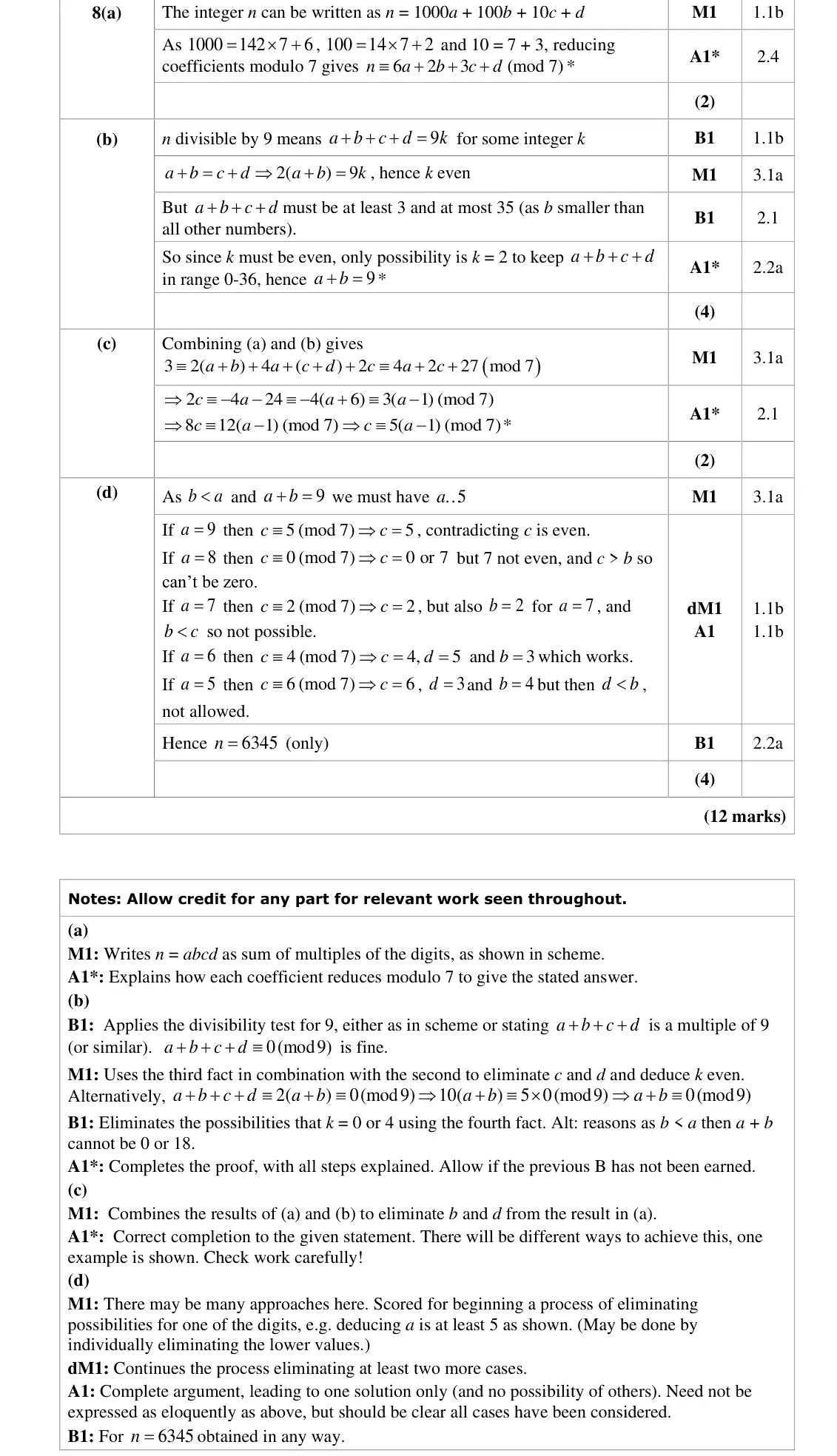
n = 1000a + 100b + 10c + d and reduce each coefficient mod 7 (1000 ≡ 6, 100 ≡ 2, 10 ≡ 3)
Oct 2020 · Paper 4A (Further Pure 2) · Q8(b)4 marks
Mark scheme (whole question; this part is marked with the orange bar)
Key points from the mark scheme and examiner's report
divisibility by 9: digit sum 9k
a + b = c + d gives 2(a + b) = 9k so k even
b smallest rules out 0 and 36, so a + b = 9
Oct 2020 · Paper 4A (Further Pure 2) · Q8(c)2 marks
Mark scheme (whole question; this part is marked with the orange bar)
Key points from the mark scheme and examiner's report
substitute b = 9 − a, d = 9 − c into 6a + 2b + 3c + d ≡ 3 and simplify (multiply by inverse of 2) to c ≡ 5(a − 1) mod 7
Oct 2020 · Paper 4A (Further Pure 2) · Q8(d)4 marks
Mark scheme (whole question; this part is marked with the orange bar)
Key points from the mark scheme and examiner's report
b < a and a + b = 9 so a ≥ 5
test a = 5 to 9 and eliminate each with the five properties
n = 6345 only
all cases must be shown
June 2019 · AS Paper 2 (Further Pure 2) · Q2(i)2 marks
Mark scheme (whole question; this part is marked with the orange bar)
Examiner's comment
Most candidates were able to attempt parts (a) and (b) however no candidates scored full marks for part (c) Part (a) The majority of candidates were able to find at least one correct value for a and with a few gave all three correct values. Part (b) The majority of candidates scored no marks in this part; many did not know how to start the question of square rooted both sides. A handful of candidates scored the first mark 2 1 x for realising that is divisible by p. The crux of the proof is that p is prime so that either is divisible by p or is divisible by p. This is the rigours element of the 1 x 1 x proof which was missed. Part (c) the majority of candidates where able to apply a divisibility test for 11. For the final mark candidates where expected to refer back to the context of the question when giving their conclusion, £13 940 220 is not divisible by 11 therefore, it is not is it possible to share this money equally between the 11 charities
Key points from the mark scheme and examiner's report
15 − 3 = 12 must be divisible by a
a = 4, 6, 12 with no extras
June 2019 · AS Paper 2 (Further Pure 2) · Q2(ii)3 marks
Mark scheme (whole question; this part is marked with the orange bar)
Examiner's comment
Most candidates were able to attempt parts (a) and (b) however no candidates scored full marks for part (c) Part (a) The majority of candidates were able to find at least one correct value for a and with a few gave all three correct values. Part (b) The majority of candidates scored no marks in this part; many did not know how to start the question of square rooted both sides. A handful of candidates scored the first mark 2 1 x for realising that is divisible by p. The crux of the proof is that p is prime so that either is divisible by p or is divisible by p. This is the rigours element of the 1 x 1 x proof which was missed. Part (c) the majority of candidates where able to apply a divisibility test for 11. For the final mark candidates where expected to refer back to the context of the question when giving their conclusion, £13 940 220 is not divisible by 11 therefore, it is not is it possible to share this money equally between the 11 charities
Key points from the mark scheme and examiner's report
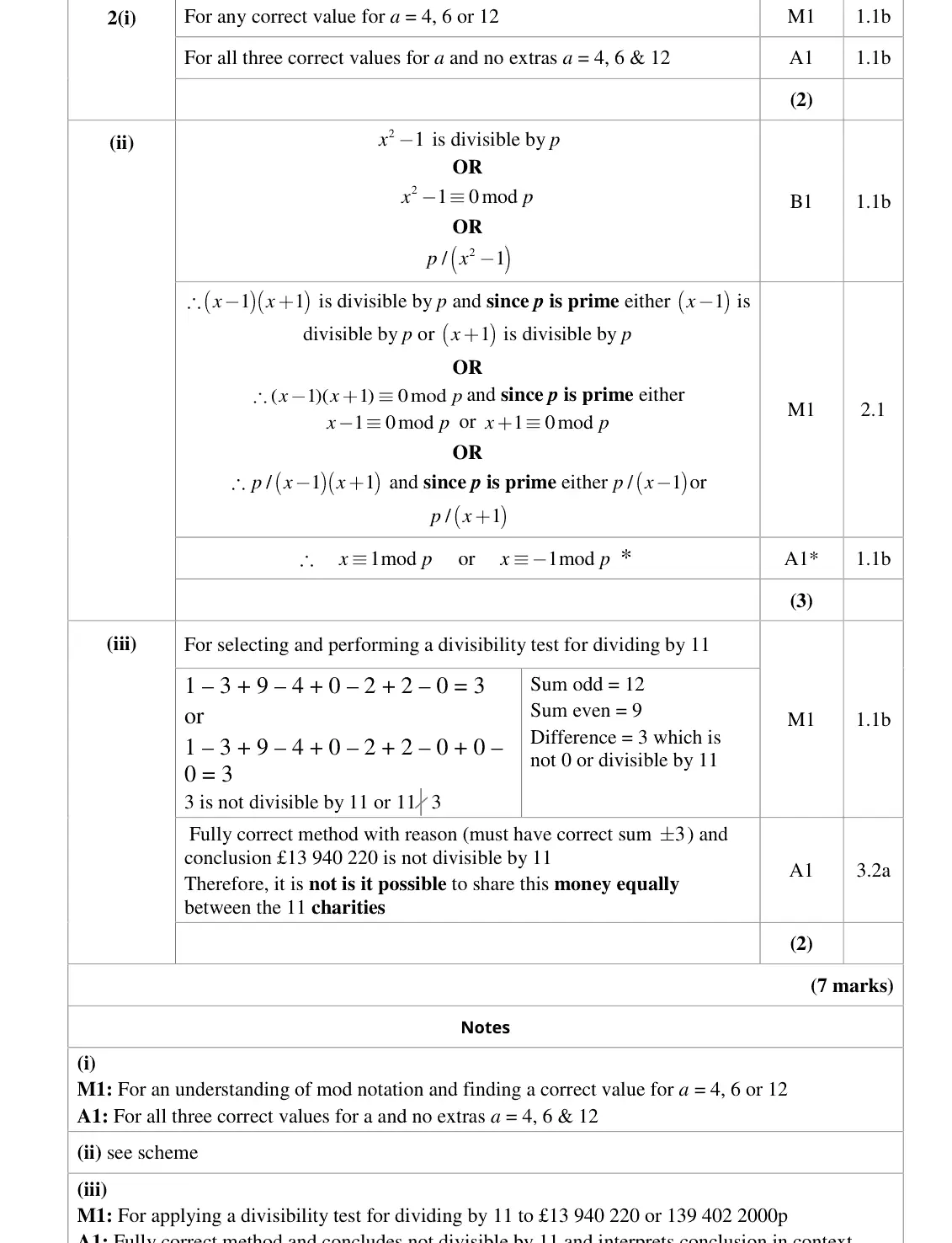
x² − 1 ≡ 0 mod p so p divides (x − 1)(x + 1)
since p is PRIME it divides one factor
the prime step was usually missed
square-rooting both sides scores 0
June 2019 · AS Paper 2 (Further Pure 2) · Q2(iii)2 marks
Mark scheme (whole question; this part is marked with the orange bar)
Examiner's comment
Most candidates were able to attempt parts (a) and (b) however no candidates scored full marks for part (c) Part (a) The majority of candidates were able to find at least one correct value for a and with a few gave all three correct values. Part (b) The majority of candidates scored no marks in this part; many did not know how to start the question of square rooted both sides. A handful of candidates scored the first mark 2 1 x for realising that is divisible by p. The crux of the proof is that p is prime so that either is divisible by p or is divisible by p. This is the rigours element of the 1 x 1 x proof which was missed. Part (c) the majority of candidates where able to apply a divisibility test for 11. For the final mark candidates where expected to refer back to the context of the question when giving their conclusion, £13 940 220 is not divisible by 11 therefore, it is not is it possible to share this money equally between the 11 charities
Key points from the mark scheme and examiner's report
alternating digit sum 1 − 3 + 9 − 4 + 0 − 2 + 2 − 0 = 3, not divisible by 11
conclusion must be in context: the money cannot be shared equally (no candidate scored both marks)
June 2019 · Paper 4A (Further Pure 2) · Q4(i)5 marks
Mark scheme (whole question; this part is marked with the orange bar)
Examiner's comment
Another of the new topics to the specification and again candidates found this question accessible, with most able to make a start on both parts. For part (i) the candidates who used Fermat's Little Theorem in the form 612 ≡ 1 (mod 13) usually obtained full marks had more success than those who used the form 613 ≡ 6 (mod 13). Confusing the two versions and forming 613 ≡ 1 (mod 13), or other incorrect indices, were seen in a small number of cases, but it was pleasing to see that most were able to recall the correct formula. The process of reducing the the power using its remainder modulo 12 or 13 (as appropriate) was usually carried out well, and most were able to reach a least positive residue, though some left the answer as 36. Attempts via 613 ≡ 6 (mod 13) tended to be cumbersome, with many more steps required, and thus were more prone to error. For part (ii) the vast majority of candidates answers (a) correctly, and part (c) was also correct more often than not, with at least the method mark gained by most. Parts (b) and (d) proved the most challenging parts of this question. For (b) most candidates recognised 4! had some part to play, but many left it at that, treating the friends as a block but not considering the order in the block. Only a minority successfully completed this part. Part (d) was also found to be difficult by many candidates, though many did gain the method for attempting to subtract something from 5040, but the attempts at what to subtract were usually incorrect. It was good to see some candidates attempting to explain their reasoning through diagrams - candidates who did this generally obtained good marks in this question and were able to think through some interesting other approaches to the question yielding the correct answer.
Key points from the mark scheme and examiner's report
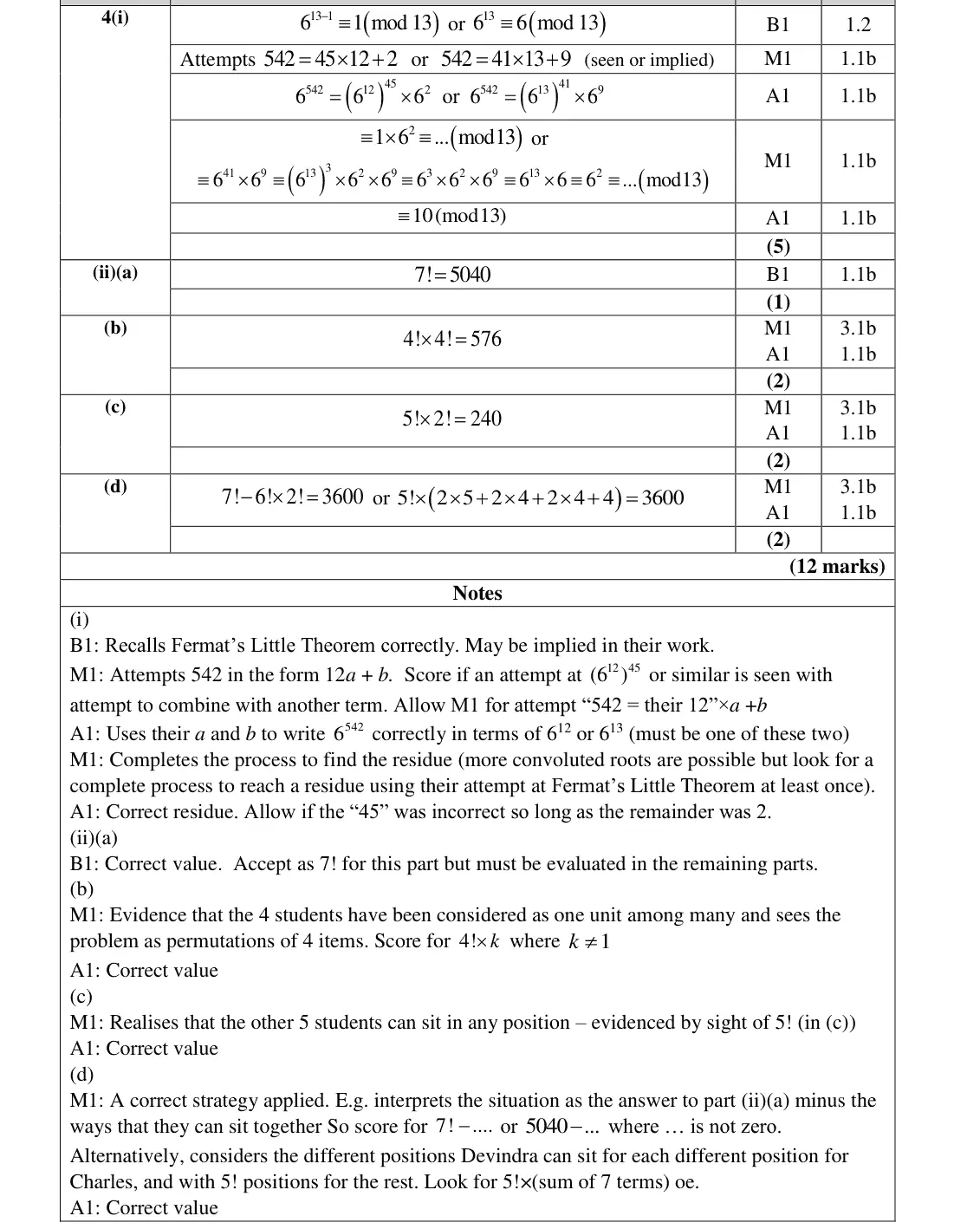
6¹² ≡ 1 (mod 13)
542 = 45 × 12 + 2 so 6⁵⁴² ≡ 6² ≡ 10 (mod 13)
some left 36
the 6¹³ ≡ 6 route was more error prone
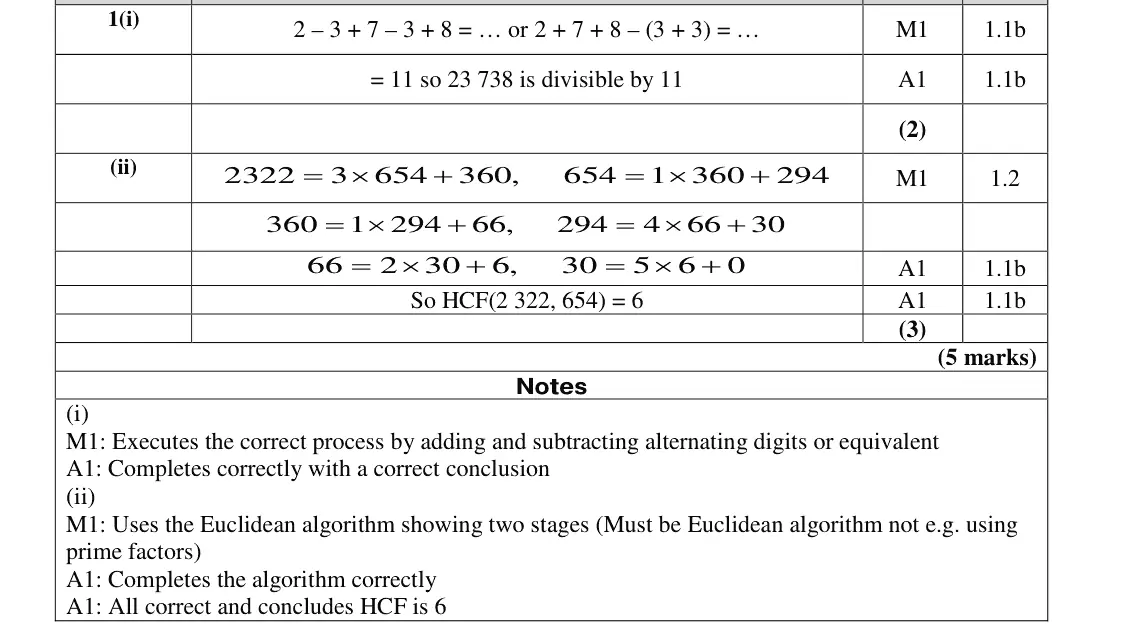
June 2018 · AS Paper 2 (Further Pure 2) · Q1(i)2 marks
Mark scheme (whole question; this part is marked with the orange bar)
Examiner's comment
This question was generally well done by those students who knew the appropriate algorithms. For the divisibility test in part (i), by far the simplest algorithm was to add and subtract alternate digits although some students were clearly aware of other valid methods. Some chose to ignore the instruction not to perform any division and effectively performed a long division calculation. In part (ii), it was expected that students demonstrate explicitly all steps of the algorithm which many students did. Some left this blank and others made a half- hearted attempt which suggested that they had some idea of how the algorithm works but became lost along the way. Again, as in part (i), some students ignored the instruction and attempted to the HCF using prime factors.
Key points from the mark scheme and examiner's report
alternating sum of digits 2 − 3 + 7 − 3 + 8 = 11 so divisible by 11
performing a division ignores the instruction and scores nothing
June 2018 · AS Paper 2 (Further Pure 2) · Q1(ii)3 marks
Mark scheme (whole question; this part is marked with the orange bar)
Examiner's comment
This question was generally well done by those students who knew the appropriate algorithms. For the divisibility test in part (i), by far the simplest algorithm was to add and subtract alternate digits although some students were clearly aware of other valid methods. Some chose to ignore the instruction not to perform any division and effectively performed a long division calculation. In part (ii), it was expected that students demonstrate explicitly all steps of the algorithm which many students did. Some left this blank and others made a half- hearted attempt which suggested that they had some idea of how the algorithm works but became lost along the way. Again, as in part (i), some students ignored the instruction and attempted to the HCF using prime factors.
Key points from the mark scheme and examiner's report
every step of the Euclidean algorithm shown: 2322 = 3 × 654 + 360 down to 30 = 5 × 6
HCF = 6
prime factorisation scores 0
many lost track part-way
Find an Edexcel Further Maths tutor
Stuck on this? Book a trial lesson with our Further Maths tutor.