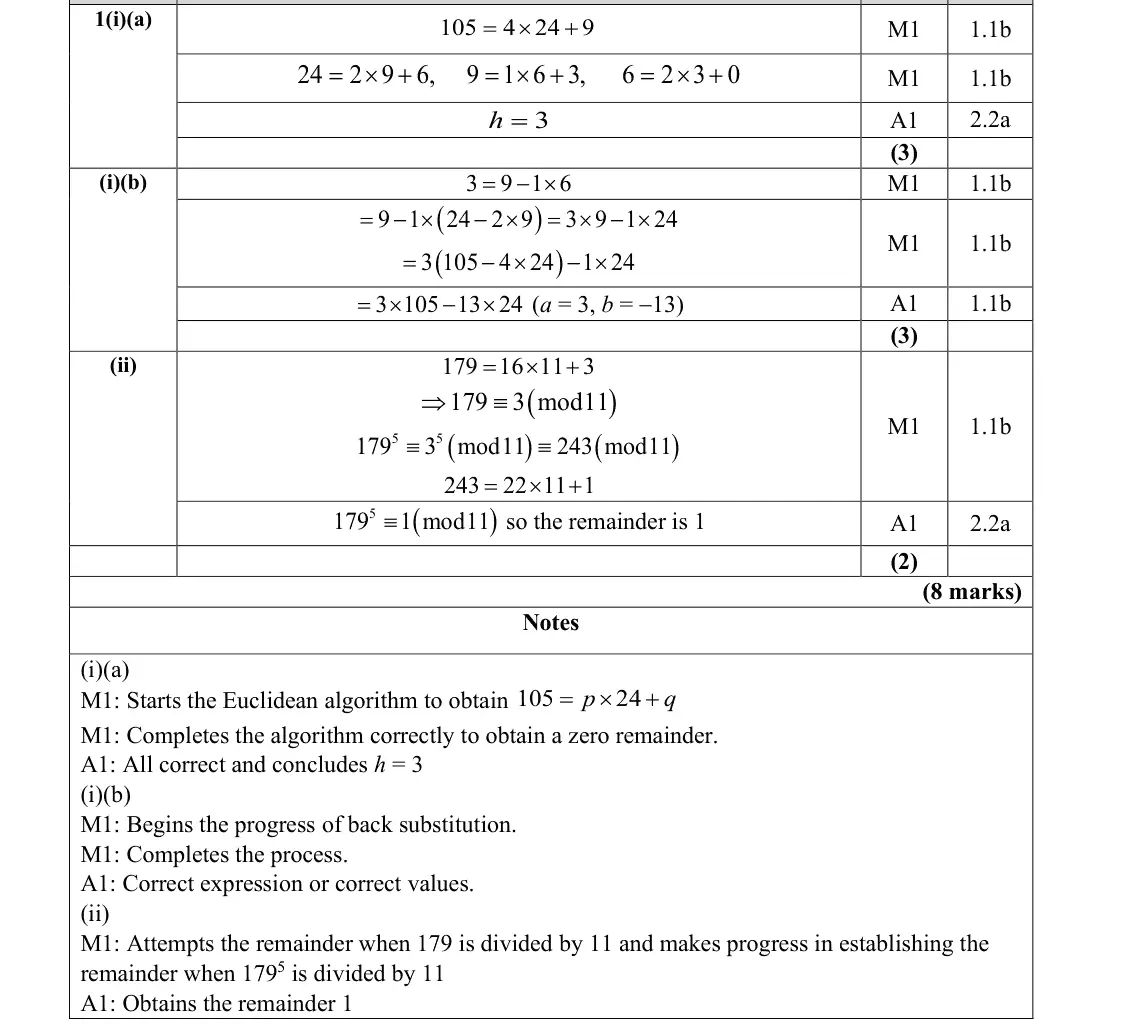
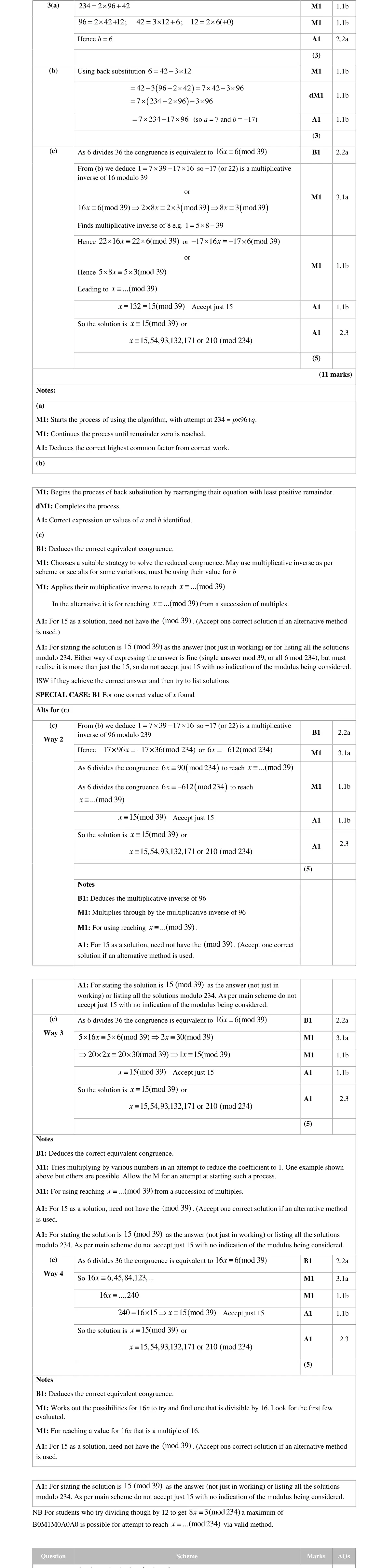
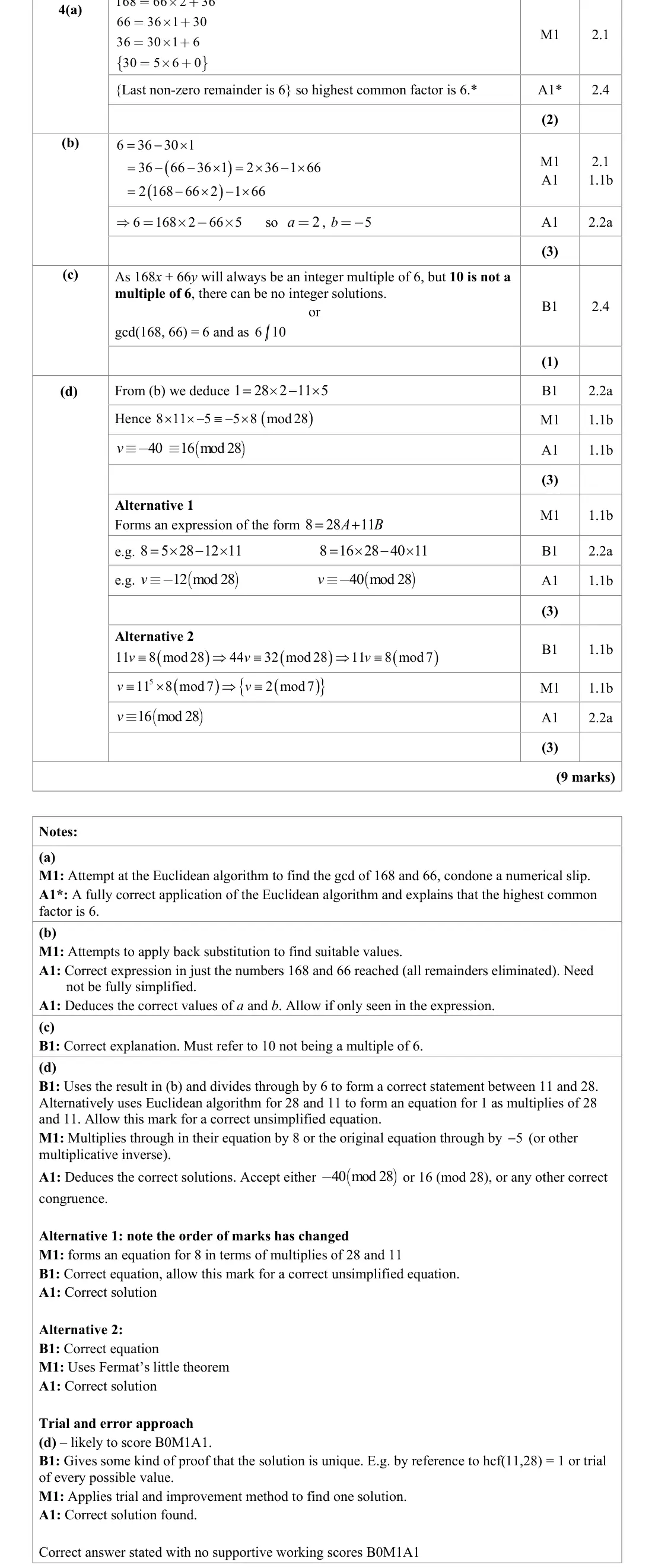
Examiner's comment
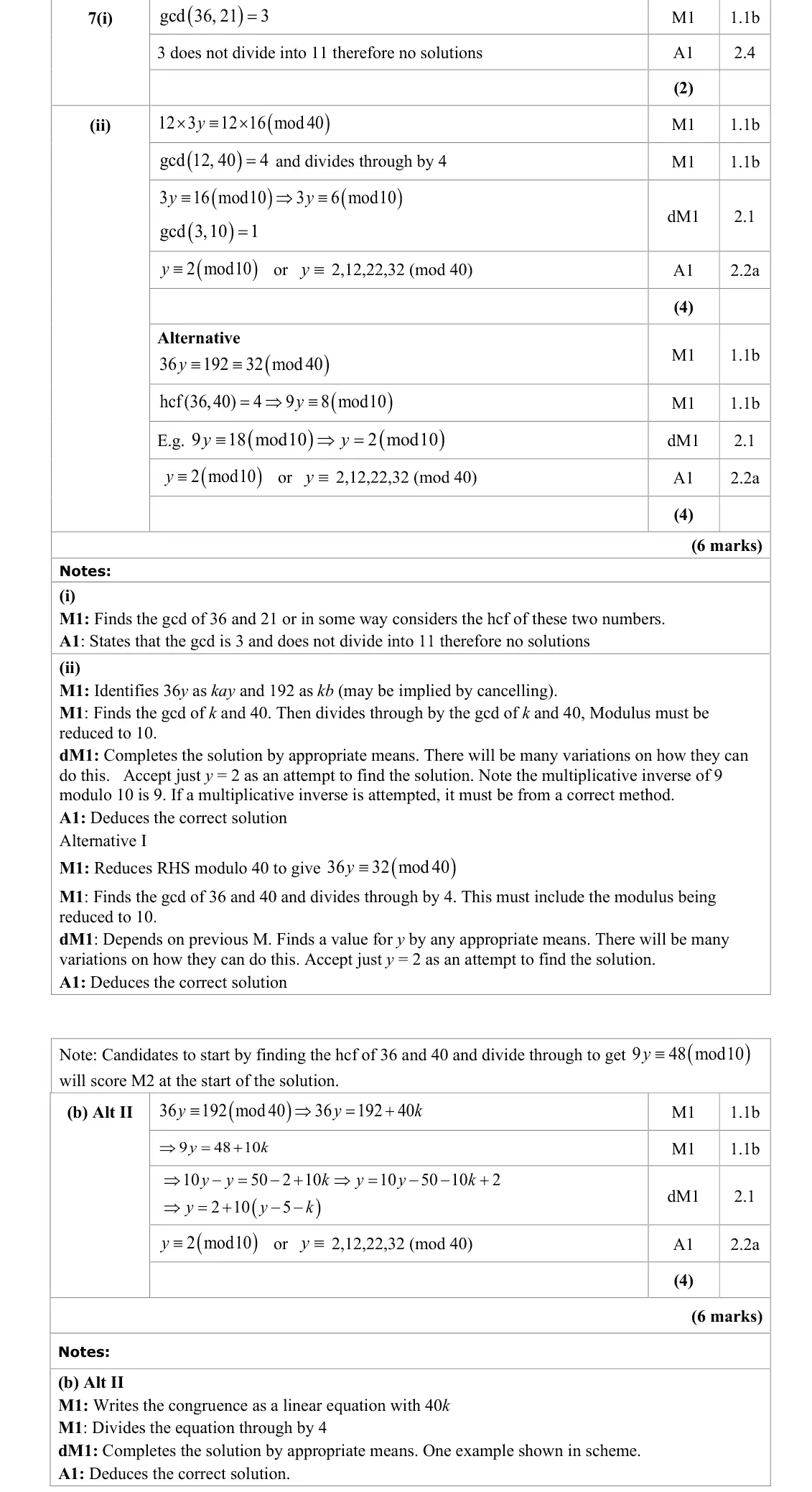
Another number theory question, this again provided some good discrimination and showed students understanding of the methods for solving congruence equations and knowing when solutions do not exist. Part (i) was the better answered of the two parts, with most realising it was to do with common factors of the 21 and 36. A few only considered the 21 and 11, and so did not score any marks, while some candidates attempted to try to solve it to show the lack of solutions, which was generally less reliable – some found solutions. Those who identified the correct common factor were usually able to relate the reason for no solutions to the 11 not being divisible by 3, but some did not seem certain at this stage and a few unclear answers, often trying to talk about multiplicative inverse, belied this lack of understanding. Part (ii) was less well done, though often was a case of either fully correct or else little more than the first mark. The most common successful approach was to simplify the given equation to 9y = 48 (mod 10) directly and the solving from here to get y = 2 (mod 10). Most , but most students did not spot this efficiently this was done by spotting 1(mod 10) 9 ≡- directly but derived it using the Bezout’s identity to find the multiplicative inverse first, while others tried doubling successively until getting to the solution or similar methods. Other successful approaches first saw students reduce the equation partially by cancelling some common factors or reducing the right hand side modulo 10 before reducing the modulus to a modulo 10 equation, but these are essentially variations on a theme, and as long as candidates succeeded in reducing the modulus of the equation successfully most went on to the correct final answer, with only a small number making errors in solving the resulting congruence. However, many did not see that the modulus had a factor 4 in common with both other terms and so never reduced below modulus 40. Though many of these score the first mark for a partial reduction of the equation (both methods in the main scheme were seen frequently to reach this first stage of reduction), no further progress could be made. Indeed, many candidates seemed uncomfortable with congruence equations in general and lacked a clear approach, and there were also a number who were comfortable, but did not seem that confident in presenting their final answer clearly. The Alternative II in the mark scheme, forming the general equation, was rarely scene in this series, though was successful when used.