5 question parts, 22 marks, 2 with a difficulty rating from the examiner's report
Notes, worked examples and practice for this topic are being written by our tutors. The past-paper questions below are ready now: work each one on paper, then open the mark scheme and the examiner's comment.
Tap a question to zoom it. Mark scheme and examiner's comment open under each question.
June 2025 · Paper 1 (Core Pure 1) · Q7(a)4 marks
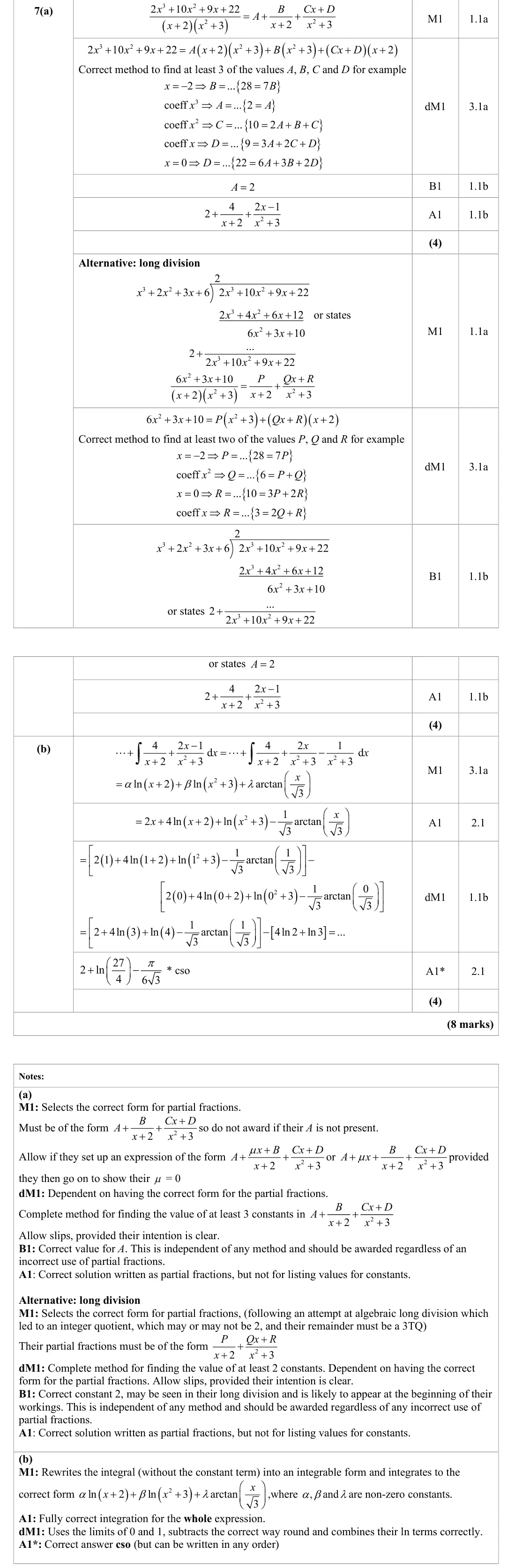
Mark scheme (whole question; this part is marked with the orange bar)
Examiner's comment
(a) This question differentiated between those who recognised the correct form of the improper fraction and those who did not. Some recognised that there was a constant term but failed to have the correct numerator for their quadratic denominator. Those that had the correct form usually proceeded to find the constants by either equating coefficients, substituting values or a combination of both. A few failed to write out the partial fractions found as required by the question and lost the final mark. A minority had fractions where one 2 8 2 1 x x + - which is not in the required form and needs was an improper fraction such as + 2 2 3 x x + + one more step to separate the improper fraction. (b) Those candidates who failed to recognise that there was a constant term in part (a) were able to gain some marks in part (b). If they integrated their fractions correctly to achieve
Key points from the mark scheme and examiner's report
improper fraction so a constant term is needed: 2 + 4/(x + 2) + (2x − 1)/(x² + 3)
missing the constant or leaving an improper part
final answer must be written as partial fractions
June 2025 · Paper 1 (Core Pure 1) · Q7(b)4 marks
Mark scheme (whole question; this part is marked with the orange bar)
Examiner's comment
(b) Those candidates who failed to recognise that there was a constant term in part (a) were able to gain some marks in part (b). If they integrated their fractions correctly to achieve x ( ) ( ) 2 ln 2 ln 3 arctan x x + + + + alpha beta λ then they could achieve the first mark. They could 3 then go on to earn the dM for substituting the limits 0 and 1 and collecting the ln terms correctly. A significant proportion of candidates scored full marks on the whole question although many candidates struggled to collect their ln terms together correctly.
Key points from the mark scheme and examiner's report
combining the log terms correctly was the main difficulty
June 2022 · Paper 1 (Core Pure 1) · Q6(a)3 marksEasy
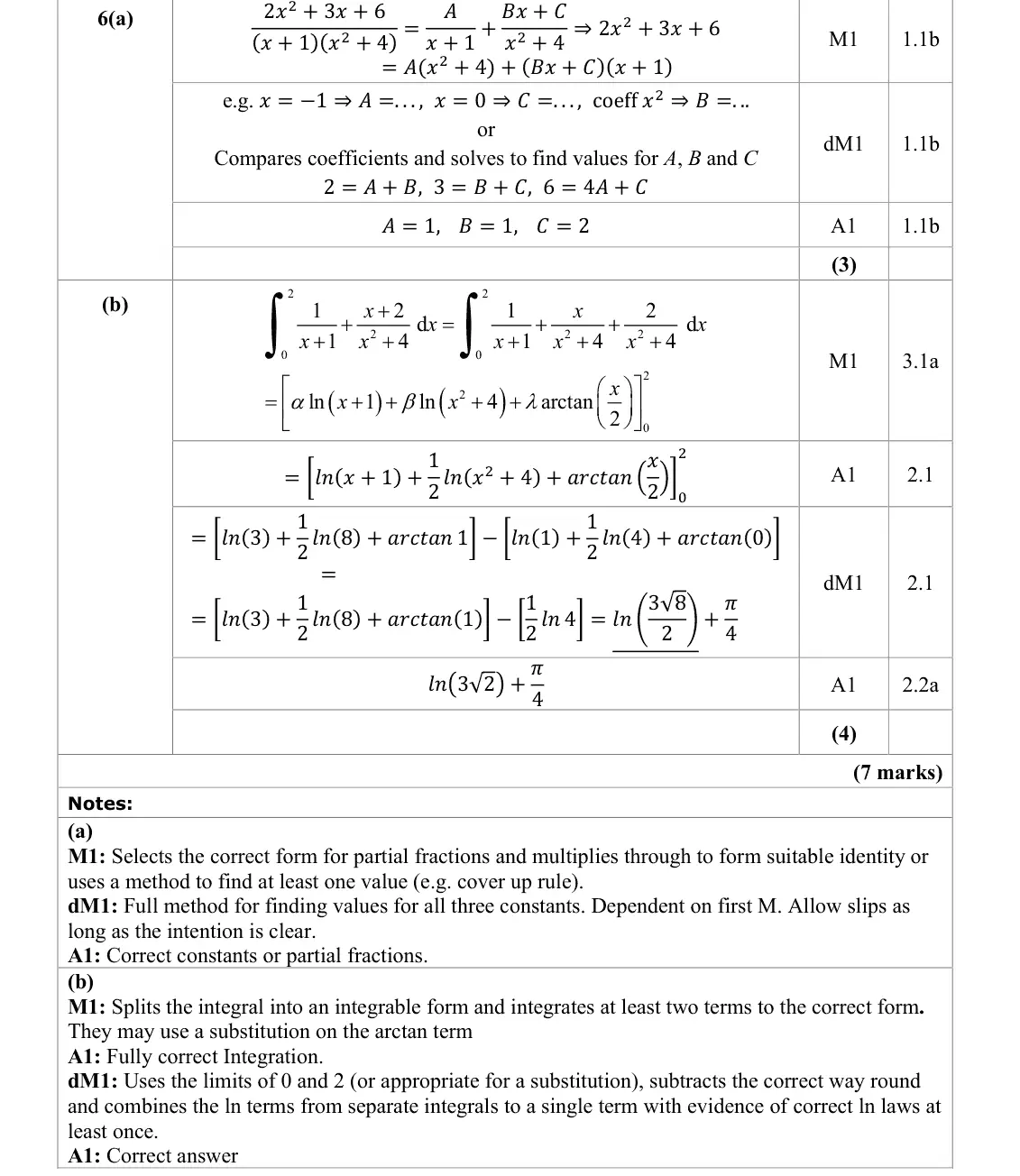
Mark scheme (whole question; this part is marked with the orange bar)
Examiner's comment
Still at this stage of the paper well over 50% of candidates were able to score full marks for the question, with the processes required being well demonstrated. For responses that were not fully correct the performance was much more mixed, with a fairly uniform distribution across all the other possible scores. In part (a) a surprising number of students did not set up partial fractions in the correct form, which left them unable to make any real progress. The incorrect form was usually 2 1 4 A B x x + + + but 2 1 4 A Bx x x + + + was also seen. The majority however did have the correct form for the partial fractions and made a valid attempt to find values for their constants. Most multiplied through to form a suitable identity and substituted for x to find the values, with only relatively few equating coefficients, mostly successfully.
Key points from the mark scheme and examiner's report
form A/(x + 1) + (Bx + C)/(x² + 4) (wrong forms common)
A = 1, B = 1, C = 2
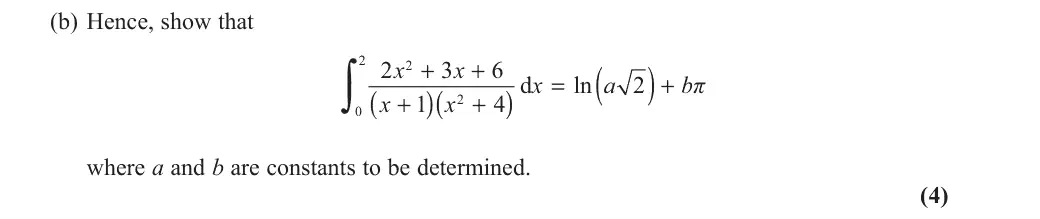
June 2022 · Paper 1 (Core Pure 1) · Q6(b)4 marksEasy
Mark scheme (whole question; this part is marked with the orange bar)
Examiner's comment
Still at this stage of the paper well over 50% of candidates were able to score full marks for the question, with the processes required being well demonstrated. For responses that were not fully correct the performance was much more mixed, with a fairly uniform distribution across all the other possible scores. Most students who had the correct form for the partial fractions from part (a) realised that for part (b) they needed to split their integral into three parts and achieved the M mark for at least two integrated terms. Generally, good integration skills were shown in this part of the question. The integration using logs was usually successful but there were more errors in the integration of the arctan term. Many candidates continued to use the correct limits and the correct log rules to achieve a single ln term to achieve the final method. A common error when integrating 2 2 4 x x + + was not to split the terms and instead have some unpleasant muddle involving logs or arctan. Amongst those that integrated sensibly common slips were missing the half from ( ) 2 ln 4 x + or integrating to 1 arctan 2 2 x .
Key points from the mark scheme and examiner's report
split into 1/(x + 1) + x/(x² + 4) + 2/(x² + 4): ln(x + 1) + ½ln(x² + 4) + arctan(x/2) from 0 to 2
ln(3√2) + π/4, a = 3, b = ¼
slips with the arctan term
June 2019 · Paper 1 (Core Pure 1) · Q27 marks
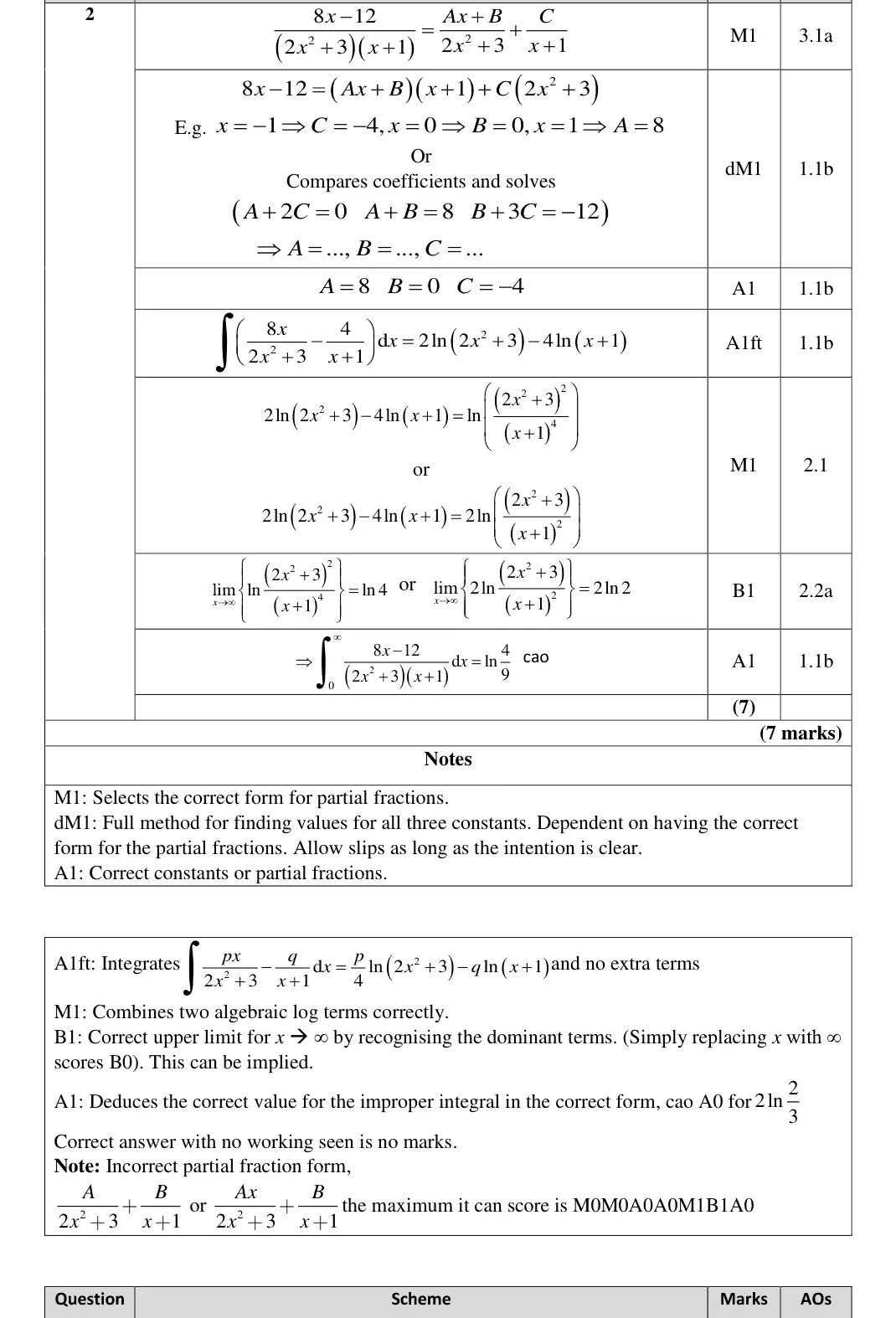
Mark scheme (whole question; this part is marked with the orange bar)
Examiner's comment
This question was attempted by the majority of the candidates but caused difficulties for a significant number of candidates Most candidates realised that they needed to use partial fractions to attempt this question. Those that did not usually scored 0/7. The question was answered quite well by candidates who chose the correct form of the partial fractions 2 2 3 1 Ax B C x x usually scored the first three marks. Most were then able to integrate correctly, though some had the wrong coefficient for the ln(2x2 + 3) term Many candidates chose the incorrect partial fraction either 2 2 3 1 A B x x or 2 2 3 1 Ax B x x and consequently lost the first four marks. Candidates who chose 2 2 3 1 Ax B x x sometimes managed to continue to score the M1B1. Incorrect partial fractions often led to an incorrect arctan integral. Many candidates missed the next key stage of working for applying the log rules- either before substituting or by substituting the variable 't' then collecting their log functions in terms of 't' before an attempt to simplify. Some of those candidates who did manage to combine their log terms then failed to deal with the limit correctly, believing that this simplified to ln(1). A small number of candidates who had successfully dealt with the limit left their final answer as 2ln(2/3) rather than putting this in the required form. Many candidates failed to obtain the B1 mark (and hence the final A1 mark) by not recognising the dominant terms. A very common incorrect answer was ln(1/9) There were some, concise, completely correct attempts at this question.
Key points from the mark scheme and examiner's report
partial fractions (Ax + B)/(2x² + 3) + C/(x + 1): A = 8, B = 0, C = −4
combine the logs before taking the limit as x → ∞ (dominant terms) to get ln(4/9)
wrong partial-fraction form or 'replacing x with ∞' lose most marks
Find an Edexcel Further Maths tutor
Stuck on this? Book a trial lesson with our Further Maths tutor.