The PGF definition, E(X) = G′(1), Var(X), the PGF of a sum, and the PGF of each standard distribution are given.
Since 2018
28 question parts, 89 marks, 6 with a difficulty rating from the examiner's report
Notes, worked examples and practice for this topic are being written by our tutors. The past-paper questions below are ready now: work each one on paper, then open the mark scheme and the examiner's comment.
Tap a question to zoom it. Mark scheme and examiner's comment open under each question.
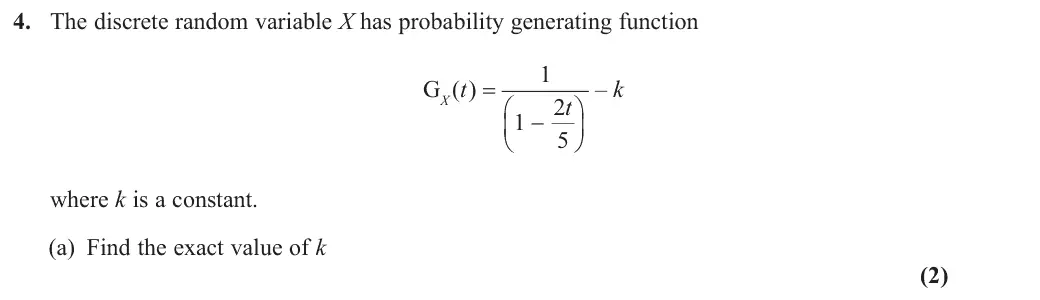
June 2025 · Paper 3B (Further Statistics 1) · Q4(a)2 marks
Mark scheme (whole question; this part is marked with the orange bar)
Examiner's comment
This was a question that I suspect most candidates were very happy with. Almost all were familiar with the concepts and methods required, and overall, the question was answered very well. In part (a), most candidates scored full marks. A few candidates substituted t = 0 leading to an incorrect k, but this was very rare.
Key points from the mark scheme and examiner's report
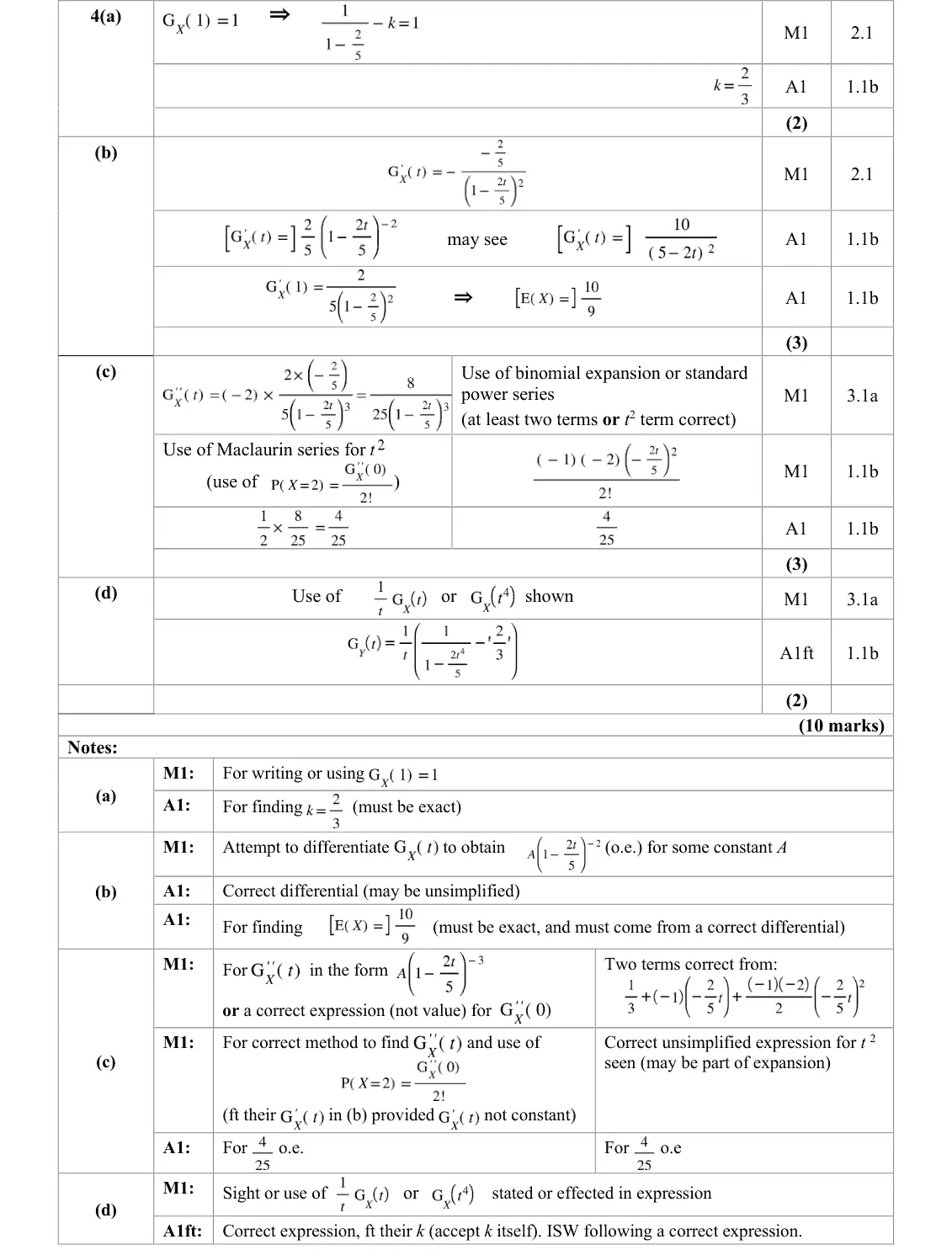
G(1) = 1: 1/(1 − 2/5) − k = 1, k = 2/3
substituting t = 0 is wrong
June 2025 · Paper 3B (Further Statistics 1) · Q4(b)3 marks
Mark scheme (whole question; this part is marked with the orange bar)
Examiner's comment
This was a question that I suspect most candidates were very happy with. Almost all were familiar with the concepts and methods required, and overall, the question was answered very well. In part (b), candidates generally knew to differentiate the function and did so accurately, going on to gain full marks. Generally, the only candidates losing marks here did so through errors in their differentiation.
Key points from the mark scheme and examiner's report
G′(t) = (2/5)(1 − 2t/5)^(−2)
E(X) = G′(1) = 10/9, exact
June 2025 · Paper 3B (Further Statistics 1) · Q4(c)3 marks
Mark scheme (whole question; this part is marked with the orange bar)
Examiner's comment
This was a question that I suspect most candidates were very happy with. Almost all were familiar with the concepts and methods required, and overall, the question was answered very well. Part (c) continued to be well done by candidates. Most used a binomial expansion approach, and while many gave the constant term incorrectly as 1, this was not required, and they gained full marks. Some did choose to find the second differential and use the Maclaurin series to find P(X = 2), with most navigating this successfully, though a few gave a correct answer by not dividing by 2! or by substituting 1 instead of 0 For part (d), most students knew how to work with linear functions of the random variable and gained at
Key points from the mark scheme and examiner's report
binomial series: coefficient of t² = (2/5)² = 4/25, or G″(0)/2!
forgetting 2! or using t = 1
June 2025 · Paper 3B (Further Statistics 1) · Q4(d)2 marks
Mark scheme (whole question; this part is marked with the orange bar)
Examiner's comment
This was a question that I suspect most candidates were very happy with. Almost all were familiar with the concepts and methods required, and overall, the question was answered very well. For part (d), most students knew how to work with linear functions of the random variable and gained at least one mark. The most common error was not applying the division by t to the whole function. Some candidates were fortunate that a correct simplified function was not required, as many started with a correct function but then went on to make algebraic errors. On this question we condoned incorrect subsequent working, but another time a more precise solution may be required.
Key points from the mark scheme and examiner's report
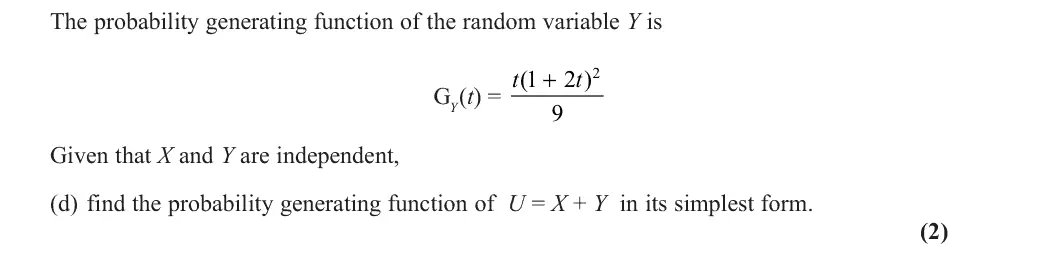
G_Y(t) = t⁻¹G_X(t⁴) = (1/t)[1/(1 − 2t⁴/5) − 2/3]
divide the whole function by t
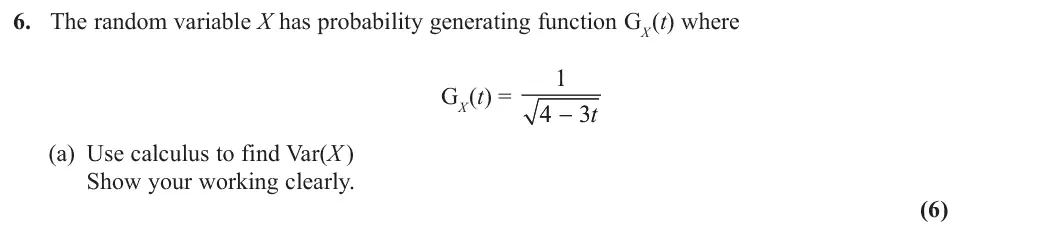
June 2024 · Paper 3B (Further Statistics 1) · Q6(a)6 marks
Mark scheme (whole question; this part is marked with the orange bar)
Examiner's comment
Most candidates were able to access most of the question and gain a good number of marks, with some parts challenging the more able candidates. Part (a) tested the core skills relating to PGFs, and the vast majority of candidates were able to gain full marks in (a). Candidates had no difficulty in recognising the approach needed and almost invariably found an acceptable form for G′ 𝑋(𝑡) and the correct value for E(X) to follow. A small minority of candidates appeared unable to recognise the use of the chain rule to be the most appropriate method for their differentiation, and while some successfully applied the quotient rule most errors in forming G′′ 𝑋(𝑡) came from those candidates who could not efficiently differentiate. Candidates were clearly aware of the fact that the formula for the variance was given and had no difficulty in applying this. The question ascended nicely in difficulty, with part (b) being more challenging than part (a). Almost all candidates understood what was required to obtain probabilities from a PGF, however, there was a reasonable variation in how well candidates were able to execute their chosen method. The majority of candidates chose to use a binomial expansion, with a good degree of success in most cases, though some, despite having written it, forgot to multiply by 1 2. The same error was made by candidates using a Maclaurin approach, also forgetting to divide by 2 despite having written it in their formula. Most candidates successfully got their values for P(X = 0) and P(X = 1). Those candidates following the binomial approach this time remembering the factor of 1 2 but the odd error was made by those using the Maclaurin approach when substituting 0 into their expressions for G𝑋(𝑡) and G′ 𝑋(𝑡). Some candidates needlessly put their final fractional answer into their calculator to give a rounded decimal, showing that they misunderstand the meaning of an ‘exact’ answer. Some lost the final mark by only giving a decimal answer.
Key points from the mark scheme and examiner's report
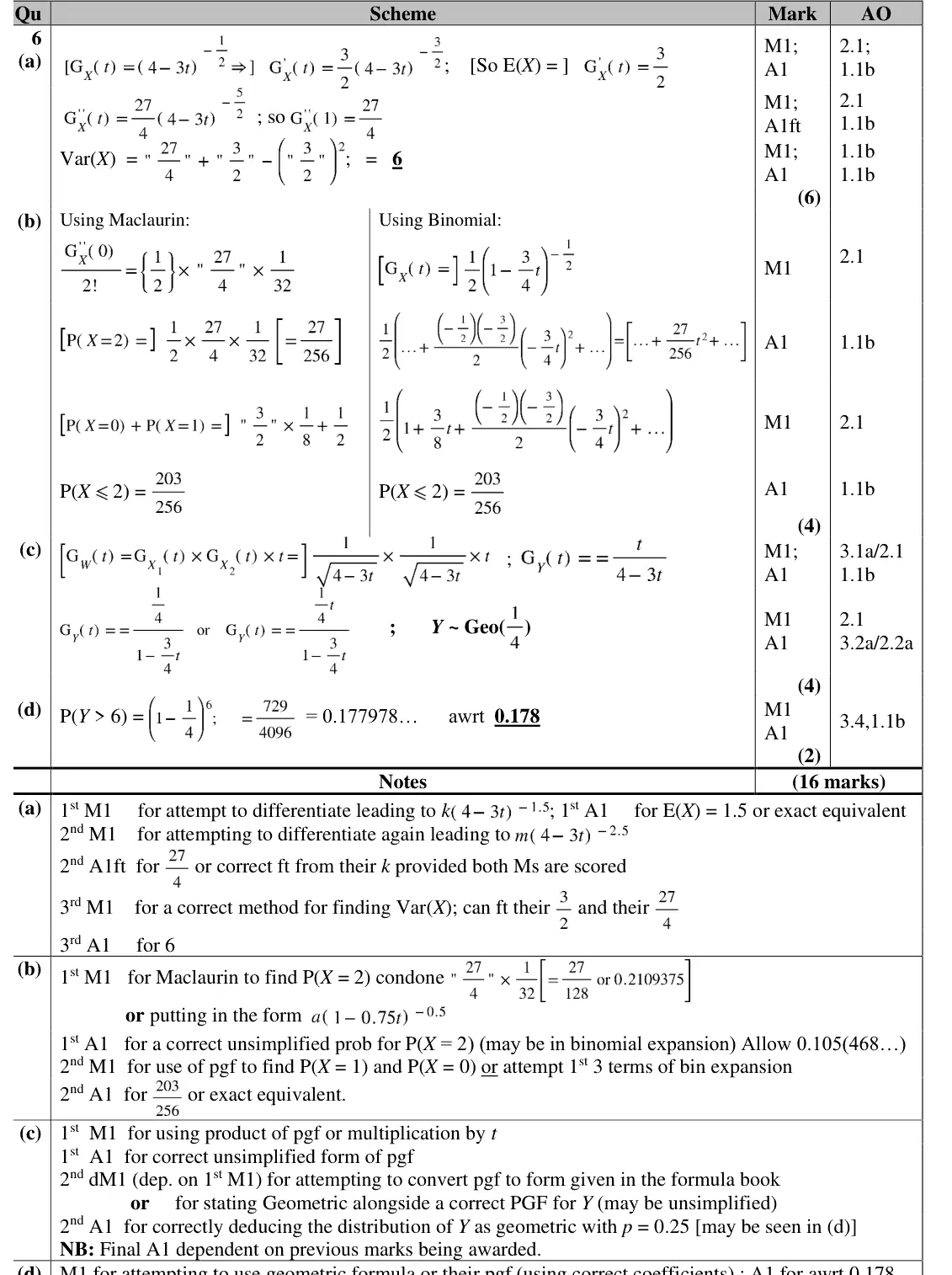
chain rule: G′(1) = 3/2, G″(1) = 27/4
Var(X) = 27/4 + 3/2 − 9/4 = 6
June 2024 · Paper 3B (Further Statistics 1) · Q6(b)4 marks
Mark scheme (whole question; this part is marked with the orange bar)
Examiner's comment
Most candidates were able to access most of the question and gain a good number of marks, with some parts challenging the more able candidates. The question ascended nicely in difficulty, with part (b) being more challenging than part (a). Almost all candidates understood what was required to obtain probabilities from a PGF, however, there was a reasonable variation in how well candidates were able to execute their chosen method. The majority of candidates chose to use a binomial expansion, with a good degree of success in most cases, though some, despite having written it, forgot to multiply by 1 2. The same error was made by candidates using a Maclaurin approach, also forgetting to divide by 2 despite having written it in their formula. Most candidates successfully got their values for P(X = 0) and P(X = 1). Those candidates following the binomial approach this time remembering the factor of 1 2 but the odd error was made by those using the Maclaurin approach when substituting 0 into their expressions for G𝑋(𝑡) and G′ 𝑋(𝑡). Some candidates needlessly put their final fractional answer into their calculator to give a rounded decimal, showing that they misunderstand the meaning of an ‘exact’ answer. Some lost the final mark by only giving a decimal answer.
Key points from the mark scheme and examiner's report
binomial expansion of ½(1 − 3t/4)^(−1/2) or Maclaurin: P(0) = 1/2, P(1) = 3/16, P(2) = 27/256
P(X ≤ 2) = 203/256
forgetting the factor ½ or the 2!
June 2024 · Paper 3B (Further Statistics 1) · Q6(c)4 marks
Mark scheme (whole question; this part is marked with the orange bar)
Examiner's comment
Most candidates were able to access most of the question and gain a good number of marks, with some parts challenging the more able candidates. Part (c) showed that a good many candidates were not clear how to form the PGF of 𝑋1 + 𝑋2 + 1. Many realised the need to multiply the PGF of X by itself, and many realised the ‘+1’ required multiplying the PGF by t. However, not many candidates realised the need for both of these things. Those that did reach a correct PGF for Y tended to realise their PGF was Geometric(0.25) without converting to the formula book style, which still scored full marks. Many did not realise a parameter was required in (c) but gave it in (d) instead – which was condoned. Overall, a good proportion of candidates scored 4/4 on (c), but scoring 1-3 marks was more common. A surprisingly large number of candidates who had successfully negotiated part (c) were unable to spot the link between Y and the required probability statement. A lot of candidates made quite basic errors, such as rearranging P(𝑋1 + 𝑋2 > 5) to P(𝑋1 + 𝑋2 + 1 > 4) rather than P(𝑋1 + 𝑋2 + 1 > 6), or setting P(Y > 6) equal to 1- P(𝑌 <= 5). A reasonable number of candidates tried to form a new PGF for 𝑋1 + 𝑋2 and use that. However, very few who tried this did so successfully as it required a lot of work, and usually an error was made. Candidates who spotted the link to Y and used a Geo(0.25) were able to reach the correct answer successfully on the whole. Overall, this question worked very well. Most candidates scored over half the marks, but then petering out a little towards the end of the question – allowing the most able students to distinguish themselves.
Key points from the mark scheme and examiner's report
G_Y(t) = t × G_X(t)² = t/(4 − 3t) = (t/4)/(1 − 3t/4): Y ~ Geo(1/4)
many squared but did not multiply by t, or vice versa
June 2023 · Paper 3B (Further Statistics 1) · Q6(a)2 marks
Mark scheme (whole question; this part is marked with the orange bar)
Examiner's comment
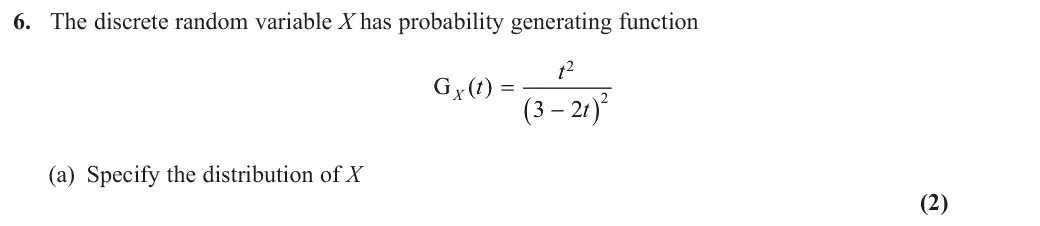
This question worked well at this stage of the paper and parts (a), (b) and (d) were more discriminating. In part (a) many students were able to use the formula sheet to identify this as a negative binomial PGF and having done so to recognise that r = 2 and p = 1/3. Some students did not include any parameters in their response. A handful of students opted for a Geometric distribution.
Key points from the mark scheme and examiner's report
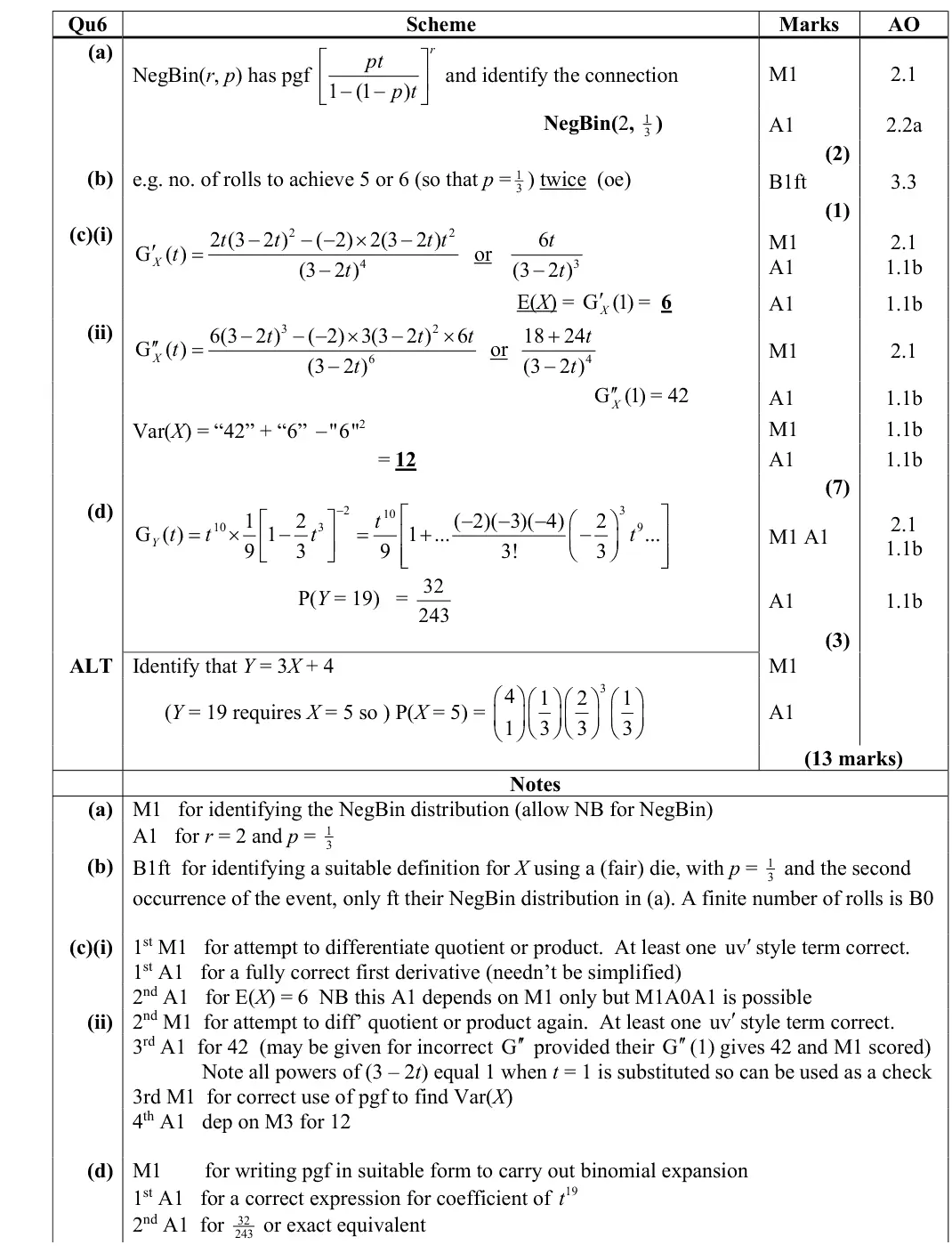
match with the NB(r, p) pgf [pt/(1 − (1 − p)t)]^r: X ~ NegBin(2, 1/3)
parameters required
geometric wrong
June 2023 · Paper 3B (Further Statistics 1) · Q6(c)7 marks
Mark scheme (whole question; this part is marked with the orange bar)
Examiner's comment
This question worked well at this stage of the paper and parts (a), (b) and (d) were more discriminating. Students were very comfortable with what was required in part (c) and were almost, without fail, aware of where to find the formulae for the mean and variance. The vast majority had a suitable method to deal with the differentiation. Students opted as equally for the product rule as the quotient rule with both having a high success rate. On rare occasions, no calculus was seen and no marks were therefore awarded to these students.
Key points from the mark scheme and examiner's report
June 2023 · Paper 3B (Further Statistics 1) · Q6(d)3 marks
Mark scheme (whole question; this part is marked with the orange bar)
Examiner's comment
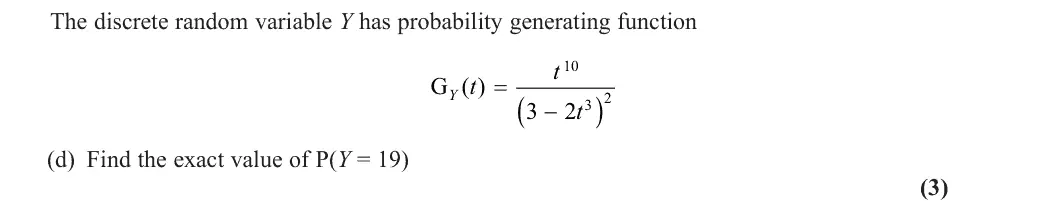
This question worked well at this stage of the paper and parts (a), (b) and (d) were more discriminating. Part (d) presented more of a challenge and while almost all students seemed aware of the need to find the coefficient of the t19 term many were not anticipating the need for the binomial expansion. Those who did rearrange their PGF in order to apply the binomial expansion were almost always able to achieve the required probability. A smaller number of students recognised a linear relationship between Y and X to find Y = 3X + 4. Not all of these students managed to calculate the resulting P(X = 5) successfully. A few students wrongly identified the relationship as Y = 4X + 3. The most typical wrong answer was to conclude P(X=19) = 0.
Key points from the mark scheme and examiner's report
write G_Y = (t¹⁰/9)(1 − 2t³/3)^(−2) and expand: coefficient of t¹⁹ = 32/243
or Y = 3X + 4 so P(X = 5)
many concluded P(Y = 19) = 0
June 2022 · Paper 3B (Further Statistics 1) · Q6(a)2 marksEasy
Mark scheme (whole question; this part is marked with the orange bar)
Examiner's comment
This proved to be a very accessible test of the probability generating function topic with nearly 95% of students gaining 5 or more marks and over 30% full marks. 2 3 + 2 Part (a) was usually answered very well but careless factorisation meant some wrote or t t 5 5 2 2 3 + 2 2 as part of their simplification. In part (b) most knew how to find E(W) and Var(W) but t t 5 5
Key points from the mark scheme and examiner's report
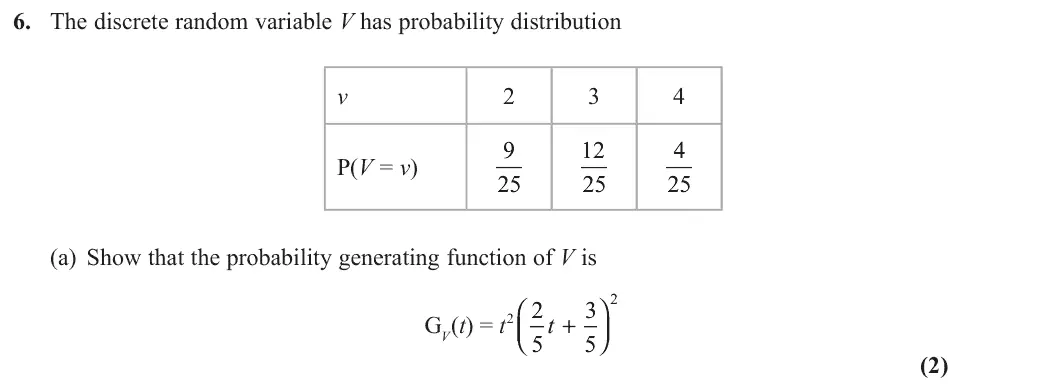
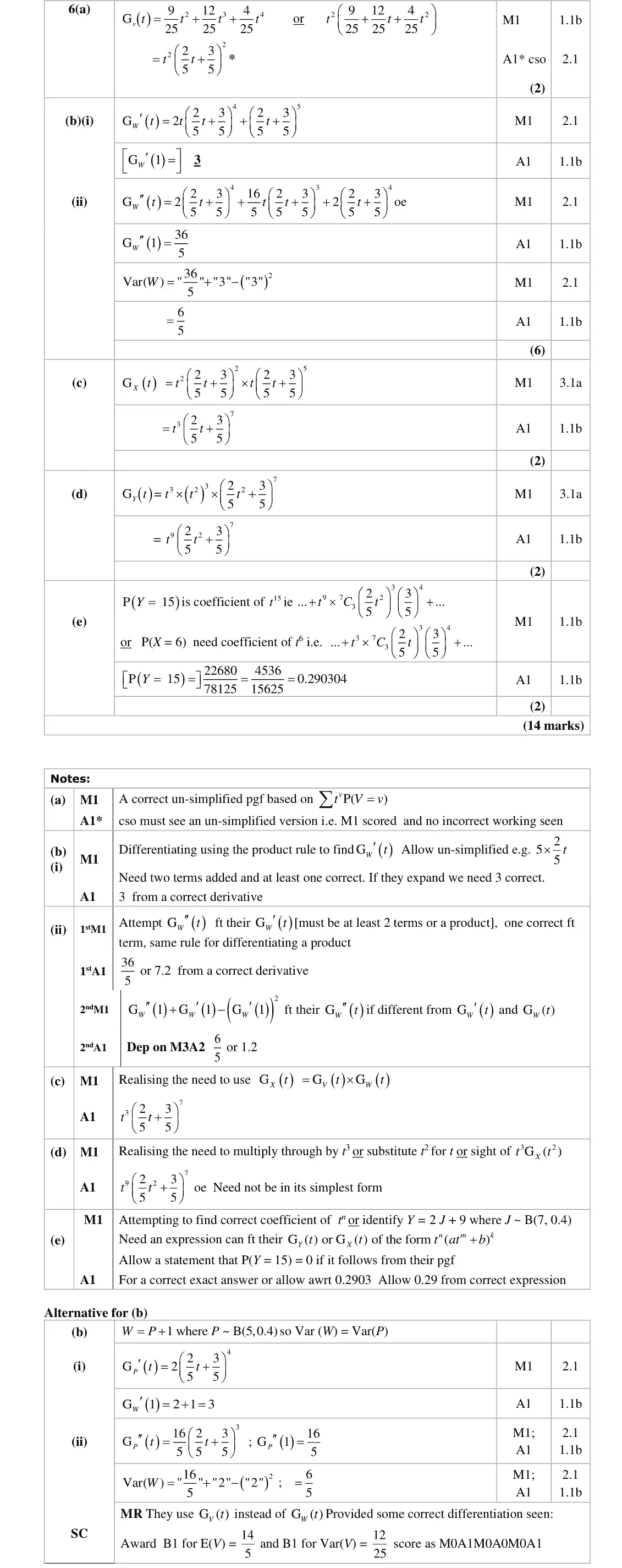
G_V(t) = (9t² + 12t³ + 4t⁴)/25 then factorise to t²(2t/5 + 3/5)²
careless factorising
June 2022 · Paper 3B (Further Statistics 1) · Q6(b)(i)2 marksEasy
Mark scheme (whole question; this part is marked with the orange bar)
Examiner's comment
This proved to be a very accessible test of the probability generating function topic with nearly 95% of students gaining 5 or more marks and over 30% full marks. 2 2 3 + 2 2 as part of their simplification. In part (b) most knew how to find E(W) and Var(W) but t t 5 5 poor differentiation, usually a failure to use the product rule correctly, meant that many failed to score full marks here. There was a specific demand to “use calculus to find” and some simply wrote down the answers without showing any working and so gained very few marks for this part. Part (c)
Key points from the mark scheme and examiner's report
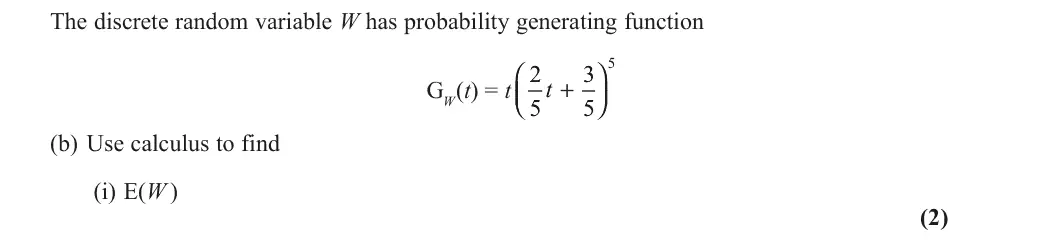
product rule: G′_W(1) = 3
working required by "use calculus"
June 2022 · Paper 3B (Further Statistics 1) · Q6(b)(ii)4 marksEasy
Mark scheme (whole question; this part is marked with the orange bar)
Examiner's comment
This proved to be a very accessible test of the probability generating function topic with nearly 95% of students gaining 5 or more marks and over 30% full marks.
Key points from the mark scheme and examiner's report
G″_W(1) = 36/5
Var(W) = 36/5 + 3 − 9 = 6/5
product-rule errors were common
June 2022 · Paper 3B (Further Statistics 1) · Q6(c)2 marksEasy
Mark scheme (whole question; this part is marked with the orange bar)
Examiner's comment
This proved to be a very accessible test of the probability generating function topic with nearly 95% of students gaining 5 or more marks and over 30% full marks. down the answers without showing any working and so gained very few marks for this part. Part (c) was answered very well with most knowing they needed to multiply the two probability generating functions and only a small minority failing to simplify their answer correctly. Part (d) was more
Key points from the mark scheme and examiner's report
G_X = G_V × G_W = t³(2t/5 + 3/5)⁷
June 2022 · Paper 3B (Further Statistics 1) · Q6(d)2 marksEasy
Mark scheme (whole question; this part is marked with the orange bar)
Examiner's comment
This proved to be a very accessible test of the probability generating function topic with nearly 95% of students gaining 5 or more marks and over 30% full marks. functions and only a small minority failing to simplify their answer correctly. Part (d) was more challenging, most realised they had to multiply by t3 but often they only substituted t2 for t inside the bracket. Most students who had answered part (d) usually used their G ( ) Y t correctly to find 7 2 3 = + 6 2 P(Y = 15) and even those with an incorrect could obtain a mark for stating that G ( ) Y t t t 5 5 P(Y = 15) = 0. Some found P(X = 6) instead which was, of course, fine.
Key points from the mark scheme and examiner's report
G_Y(t) = t³G_X(t²) = t⁹(2t²/5 + 3/5)⁷
some only replaced t inside the bracket
June 2022 · Paper 3B (Further Statistics 1) · Q6(e)2 marksEasy
Mark scheme (whole question; this part is marked with the orange bar)
Examiner's comment
This proved to be a very accessible test of the probability generating function topic with nearly 95% of students gaining 5 or more marks and over 30% full marks.
Key points from the mark scheme and examiner's report
coefficient of t¹⁵ (or of t⁶ in G_X): C(7, 3)(2/5)³(3/5)⁴ = 4536/15625 = 0.290
Nov 2021 · Paper 3B (Further Statistics 1) · Q6(a)2 marks
Mark scheme (whole question; this part is marked with the orange bar)
Examiner's comment
This question was answered well by candidates who were well prepared on this topic. In part (a) most candidates managed to clearly show that GX(1) = 1 was required although it was not always clearly stated on its own.
Key points from the mark scheme and examiner's report
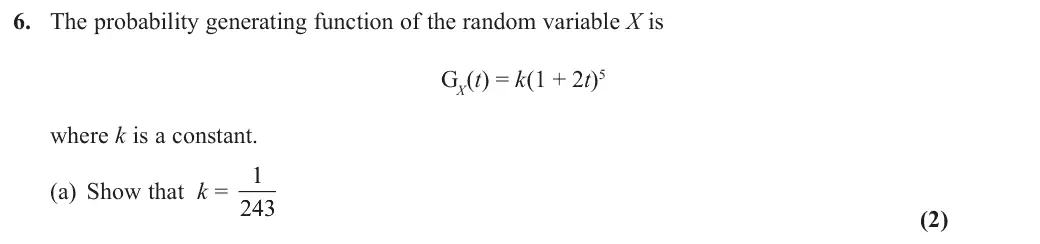
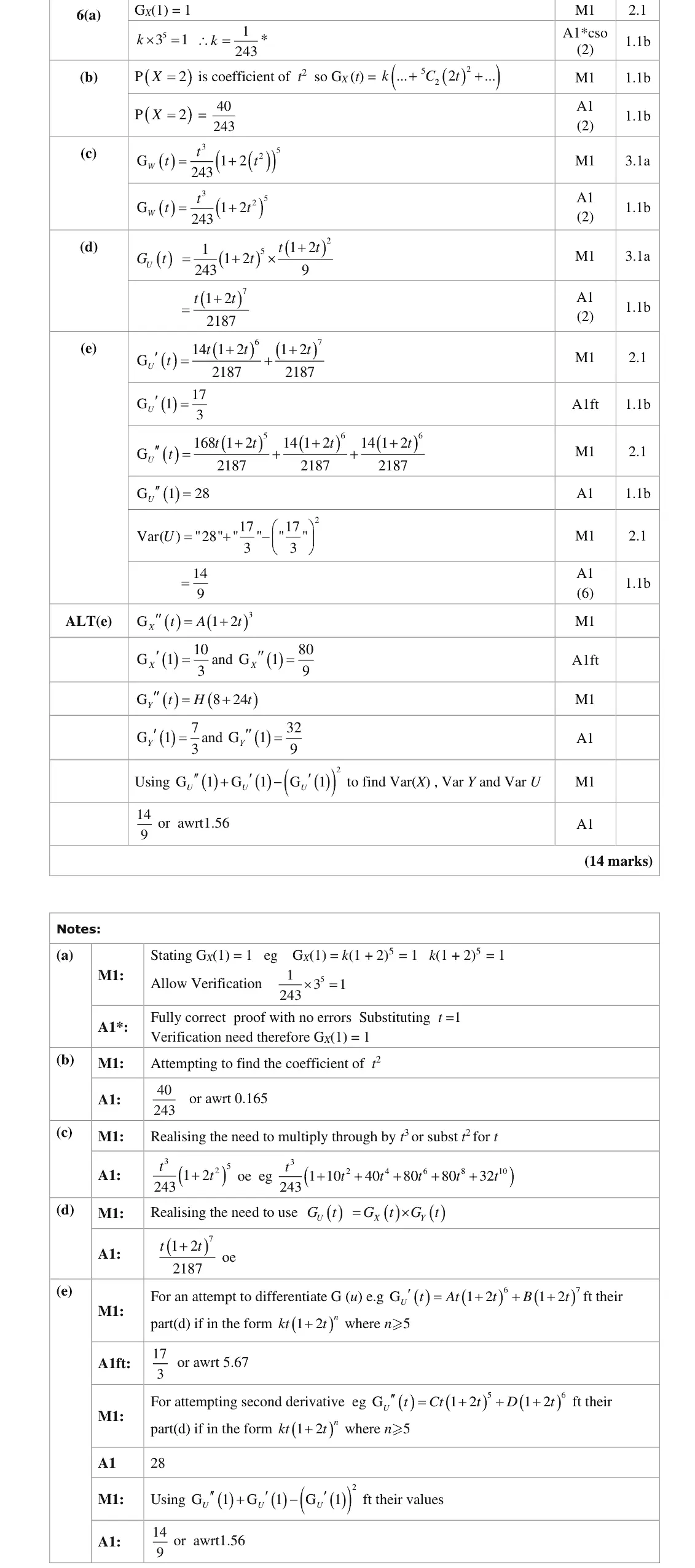
G(1) = 1: k × 3⁵ = 1, k = 1/243
state G(1) = 1 explicitly
Nov 2021 · Paper 3B (Further Statistics 1) · Q6(b)2 marks
Mark scheme (whole question; this part is marked with the orange bar)
Examiner's comment
This question was answered well by candidates who were well prepared on this topic. In part (b) whilst candidates realised they needed to find the coefficient of t2 time (which could have been used elsewhere) was spent on calculating all the terms of the expansion rather than just the one needed. The majority of candidates who attempted parts (c) and (d) knew what was required and
Key points from the mark scheme and examiner's report
coefficient of t²: C(5, 2) × 2² / 243 = 40/243
only that term is needed
Nov 2021 · Paper 3B (Further Statistics 1) · Q6(c)2 marks
Mark scheme (whole question; this part is marked with the orange bar)
Examiner's comment
This question was answered well by candidates who were well prepared on this topic. The majority of candidates who attempted parts (c) and (d) knew what was required and gained full marks. It was clear in part (e) that most candidates knew how to use the probability generating
Key points from the mark scheme and examiner's report
G_W(t) = t³G_X(t²) = (t³/243)(1 + 2t²)⁵
Nov 2021 · Paper 3B (Further Statistics 1) · Q6(d)2 marks
Mark scheme (whole question; this part is marked with the orange bar)
Examiner's comment
This question was answered well by candidates who were well prepared on this topic. The majority of candidates who attempted parts (c) and (d) knew what was required and gained full marks. It was clear in part (e) that most candidates knew how to use the probability generating
Key points from the mark scheme and examiner's report
G_U = G_X × G_Y = t(1 + 2t)⁷/2187
Nov 2021 · Paper 3B (Further Statistics 1) · Q6(e)6 marks
Mark scheme (whole question; this part is marked with the orange bar)
Examiner's comment
This question was answered well by candidates who were well prepared on this topic. It was clear in part (e) that most candidates knew how to use the probability generating function to find the variance but there were a few who struggled to differentiate the given function correctly. Those who did differentiate correctly and simplified their answer invariably were able to complete this part of the question.
Key points from the mark scheme and examiner's report
Oct 2020 · Paper 3B (Further Statistics 1) · Q6(a)1 mark
Mark scheme (whole question; this part is marked with the orange bar)
Examiner's comment
Candidates on the whole seem well-prepared for this question on probability generating functions – though a significant minority did lack familiarity and made little or no attempt. Some were substituting given x values for t in part (a). Many missed that they simply needed to consider the absence of a t3 term in the expansion to give an answer of zero. For part (b)(i), candidates were usually successful to consider the t4 coefficient to find
Key points from the mark scheme and examiner's report
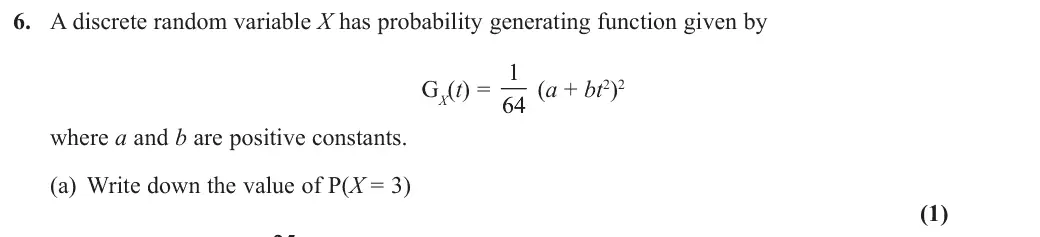
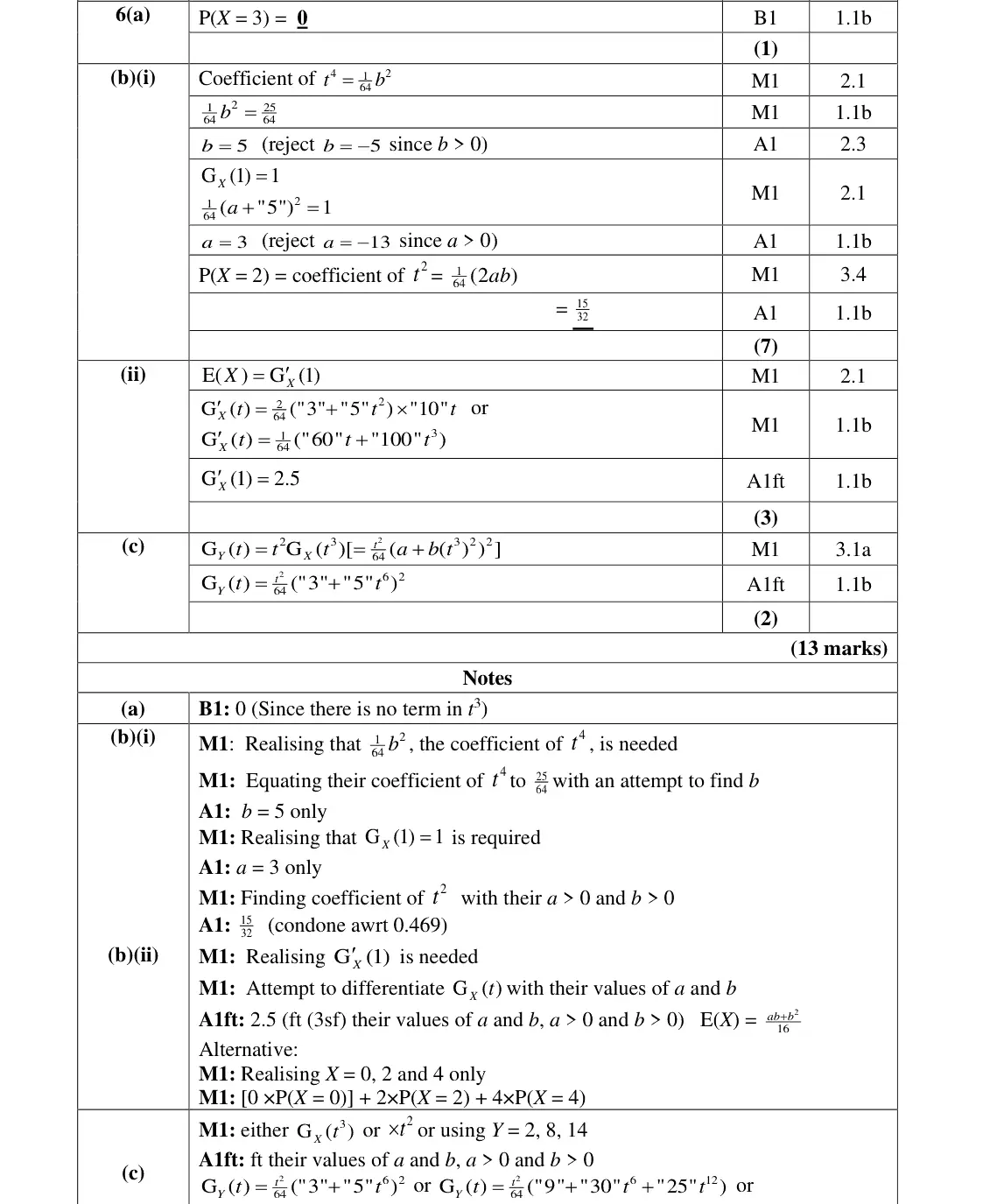
no t³ term in the expansion so P(X = 3) = 0
substituting values for t was a common error
Oct 2020 · Paper 3B (Further Statistics 1) · Q6(b)(i)7 marks
Mark scheme (whole question; this part is marked with the orange bar)
Examiner's comment
Candidates on the whole seem well-prepared for this question on probability generating functions – though a significant minority did lack familiarity and made little or no For part (b)(i), candidates were usually successful to consider the t4 coefficient to find the value of b. Unfortunately some omitted the 1/64 in the coefficient. More common was recognising the need to consider Gx(1) = 1 to find the relationship between a and b. Most who took the right approach correctly dismissed negative values for a and b. Success finding P(X=2) again then rested with familiarity with the significance of the coefficients. Those successful with (i) were usually also correct in (ii) and follow through marks were available here. Some earned a mark for knowing Gx'(1) was needed for E(X).
Key points from the mark scheme and examiner's report
coefficient of t⁴: b²/64 = 25/64, b = 5
G(1) = 1 gives a = 3 (reject negatives)
P(X = 2) = 2ab/64 = 15/32
omitting the 1/64
Oct 2020 · Paper 3B (Further Statistics 1) · Q6(b)(ii)3 marks
Mark scheme (whole question; this part is marked with the orange bar)
Examiner's comment
Candidates on the whole seem well-prepared for this question on probability generating functions – though a significant minority did lack familiarity and made little or no
Key points from the mark scheme and examiner's report
E(X) = G′(1) = 2.5 (or 2P(X = 2) + 4P(X = 4))
Oct 2020 · Paper 3B (Further Statistics 1) · Q6(c)2 marks
Mark scheme (whole question; this part is marked with the orange bar)
Examiner's comment
Candidates on the whole seem well-prepared for this question on probability generating functions – though a significant minority did lack familiarity and made little or no In part (c), a number of blank responses were seen. Some left their answer in terms of a and b rather than substituting their values. Often the mark was gained for knowing to multiply by t2. A worryingly not uncommon error was those who incorrectly simplified (t3)2 to t5. A small number mixed up where to put the t2 and t3.
Key points from the mark scheme and examiner's report
G_Y(t) = t²G_X(t³) = (t²/64)(3 + 5t⁶)²
(t³)² simplified to t⁵ was a common error
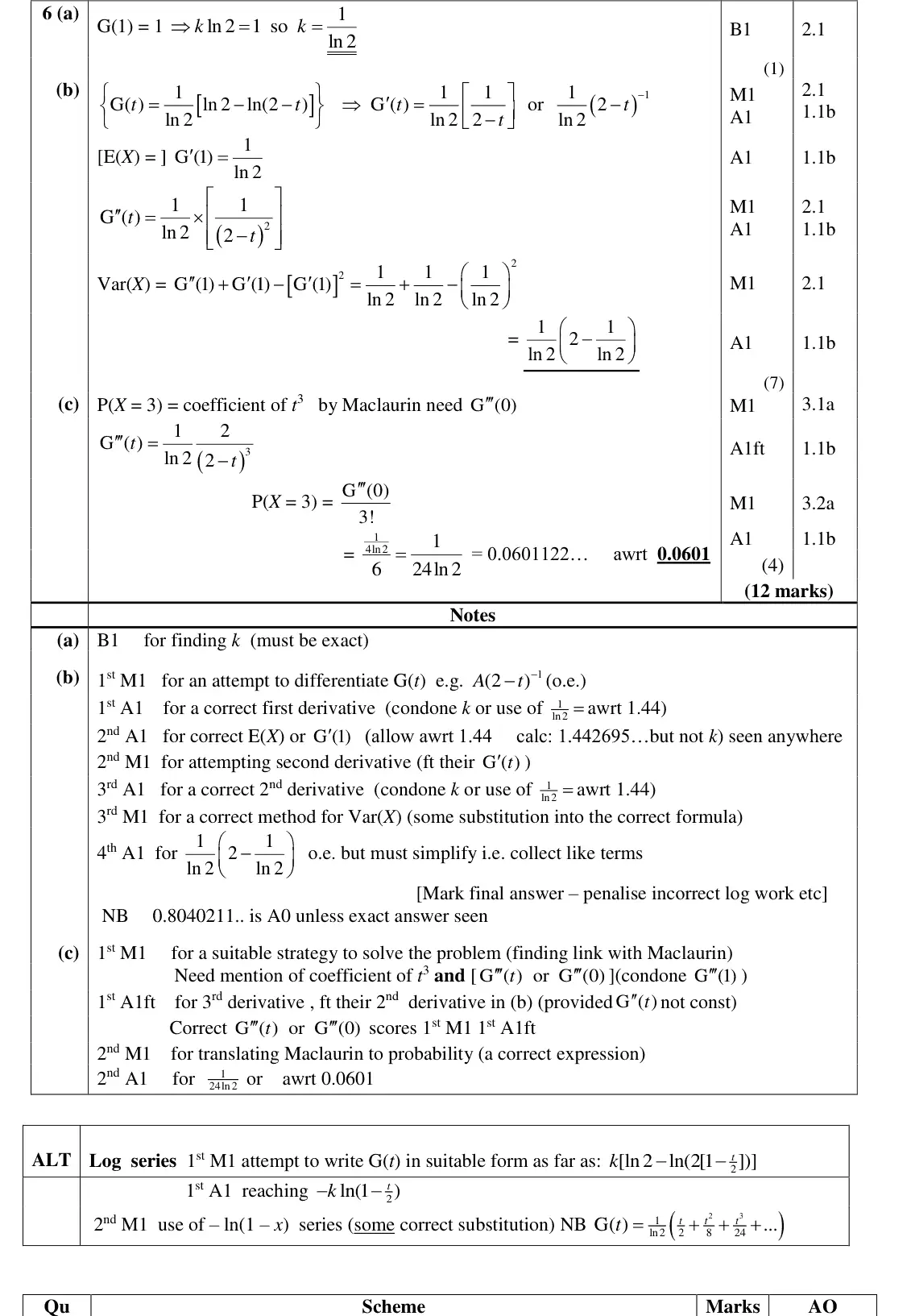
June 2019 · Paper 3B (Further Statistics 1) · Q6(a)1 mark
Mark scheme (whole question; this part is marked with the orange bar)
Examiner's comment
Part (a) was answered very well and most obtained the correct value for k though sometimes this was incorrectly expressed as – ln2. In part (b) it was clear that most candidates knew how to use the
Key points from the mark scheme and examiner's report
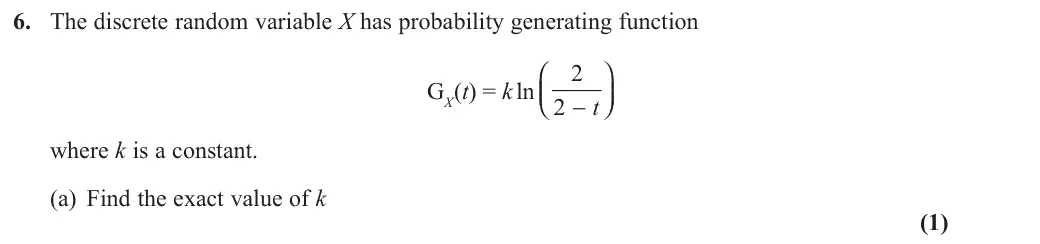
G(1) = 1 so k = 1/ln 2
−ln 2 seen
June 2019 · Paper 3B (Further Statistics 1) · Q6(b)7 marks
Mark scheme (whole question; this part is marked with the orange bar)
Examiner's comment
incorrectly expressed as – ln2. In part (b) it was clear that most candidates knew how to use the probability generating function to find the variance but there were a number who struggled to differentiate the given function correctly. A significant minority wrote G(t) as k[ ln2 – ln (2 – t)] and they fared better although some did not realise that ln2 was a constant and a spurious ½ appeared. Those who did differentiate correctly and simplified their answer invariably were able to complete this part of the question. Part (c) was more of a challenge but a good number attempted this. Many realised
Key points from the mark scheme and examiner's report
write G as k[ln 2 − ln(2 − t)]
G′(1) = 1/ln 2, G″(1) = 1/ln 2
Var = G″(1) + G′(1) − [G′(1)]² = (1/ln 2)(2 − 1/ln 2), exact and simplified
differentiation errors common
June 2019 · Paper 3B (Further Statistics 1) · Q6(c)4 marks
Mark scheme (whole question; this part is marked with the orange bar)
Examiner's comment
part of the question. Part (c) was more of a challenge but a good number attempted this. Many realised that a Maclaurin expansion was required and finding the third derivative was the most common approach. Unfortunately some forgot to divide by 3! but nearly a quarter of the candidates secured full marks on this question.
Key points from the mark scheme and examiner's report
P(X = 3) = coefficient of t³ = G‴(0)/3! = 1/(24 ln 2) = 0.0601 (or log series of −ln(1 − t/2))
forgetting to divide by 3!
Find an Edexcel Further Maths tutor
Stuck on this? Book a trial lesson with our Further Maths tutor.