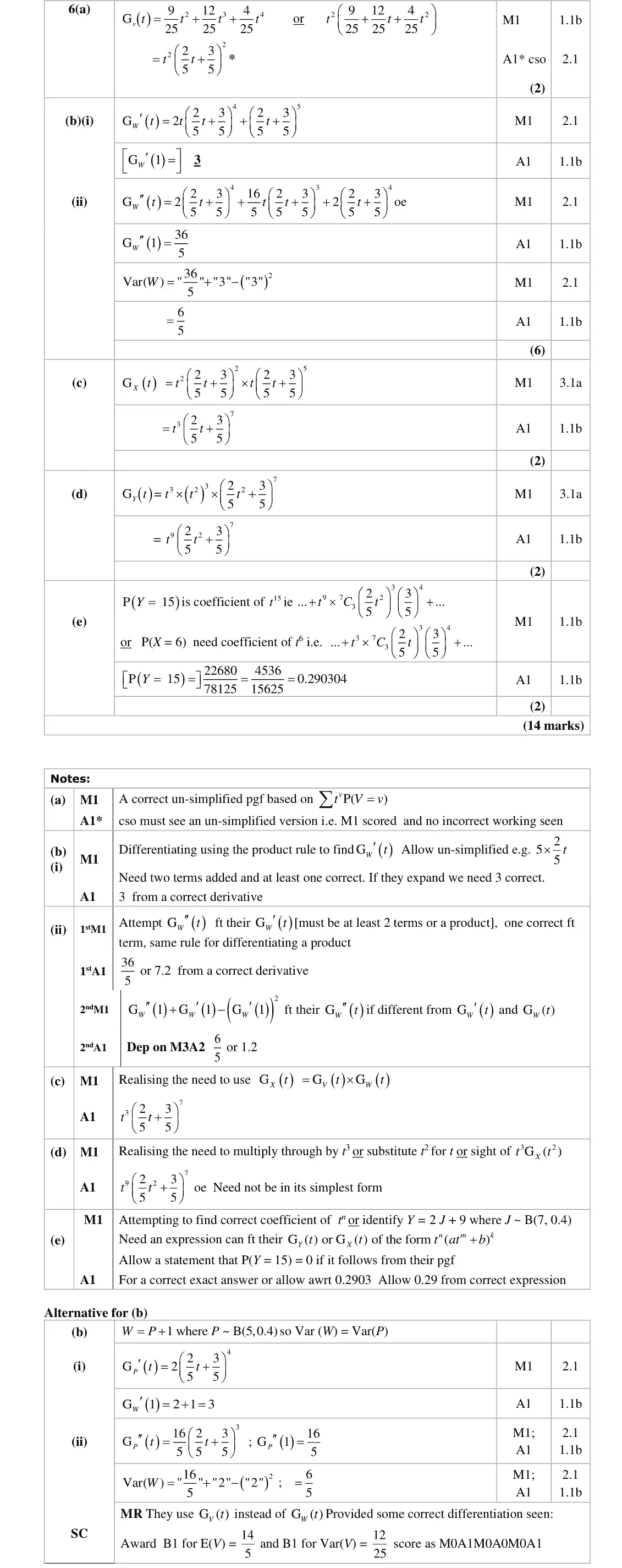
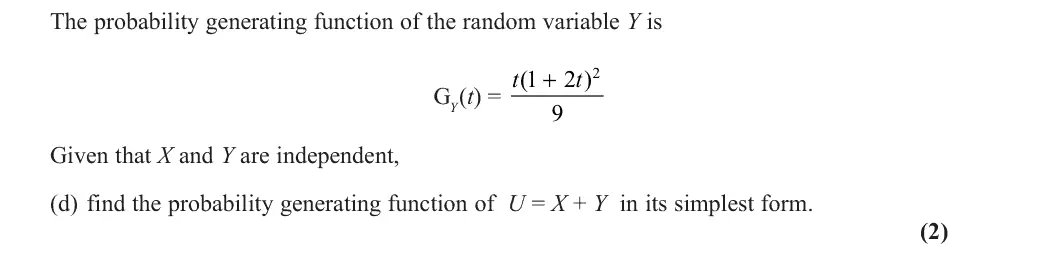
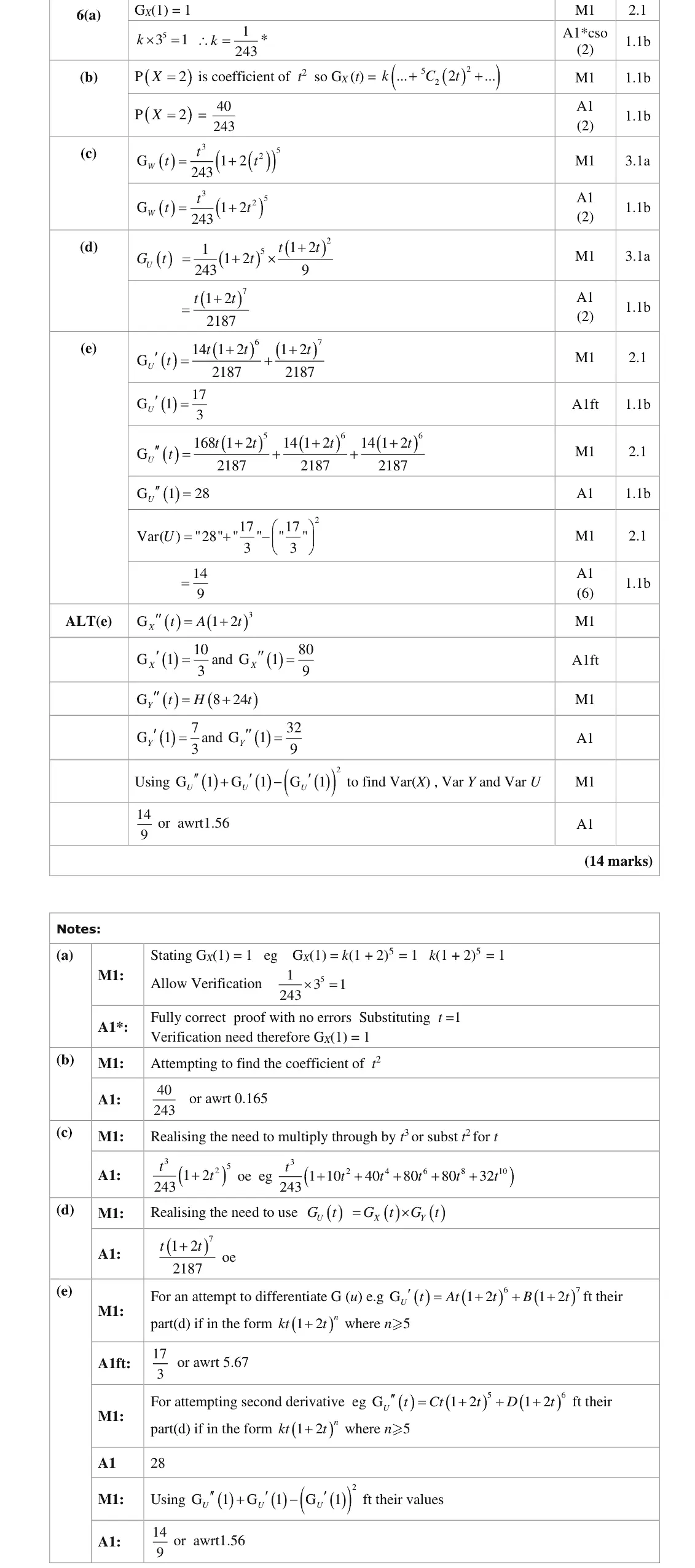
Mark scheme (whole question; this part is marked with the orange bar)
Examiner's comment
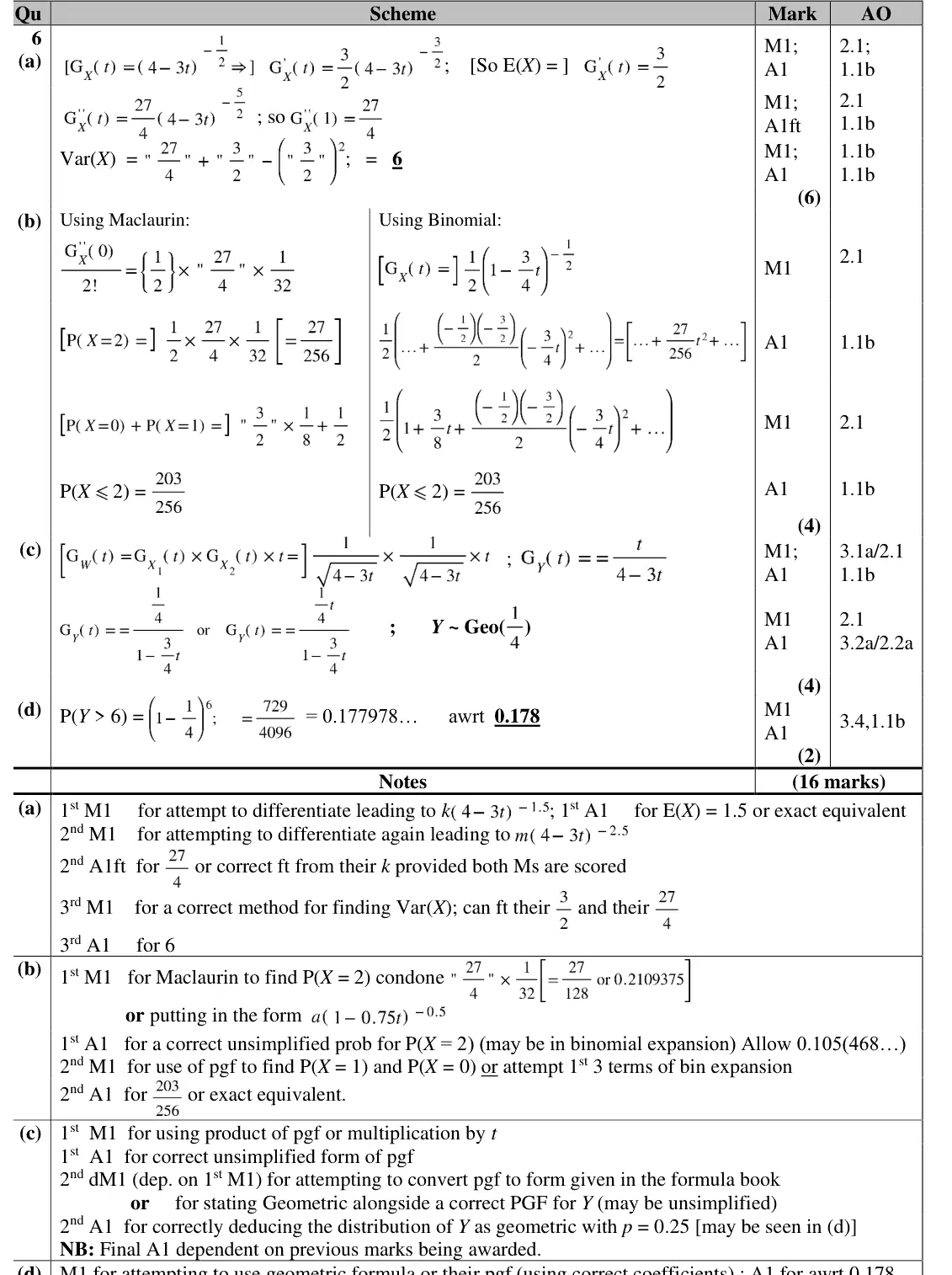
Most candidates were able to access most of the question and gain a good number of marks, with some parts challenging the more able candidates. Part (c) showed that a good many candidates were not clear how to form the PGF of 𝑋1 + 𝑋2 + 1. Many realised the need to multiply the PGF of X by itself, and many realised the ‘+1’ required multiplying the PGF by t. However, not many candidates realised the need for both of these things. Those that did reach a correct PGF for Y tended to realise their PGF was Geometric(0.25) without converting to the formula book style, which still scored full marks. Many did not realise a parameter was required in (c) but gave it in (d) instead – which was condoned. Overall, a good proportion of candidates scored 4/4 on (c), but scoring 1-3 marks was more common. A surprisingly large number of candidates who had successfully negotiated part (c) were unable to spot the link between Y and the required probability statement. A lot of candidates made quite basic errors, such as rearranging P(𝑋1 + 𝑋2 > 5) to P(𝑋1 + 𝑋2 + 1 > 4) rather than P(𝑋1 + 𝑋2 + 1 > 6), or setting P(Y > 6) equal to 1- P(𝑌 <= 5). A reasonable number of candidates tried to form a new PGF for 𝑋1 + 𝑋2 and use that. However, very few who tried this did so successfully as it required a lot of work, and usually an error was made. Candidates who spotted the link to Y and used a Geo(0.25) were able to reach the correct answer successfully on the whole. Overall, this question worked very well. Most candidates scored over half the marks, but then petering out a little towards the end of the question – allowing the most able students to distinguish themselves.
Key points from the mark scheme and examiner's report
- G_Y(t) = t × G_X(t)² = t/(4 − 3t) = (t/4)/(1 − 3t/4): Y ~ Geo(1/4)
- many squared but did not multiply by t, or vice versa