Notes, worked examples and practice for this topic are being written by our tutors. The past-paper questions below are ready now: work each one on paper, then open the mark scheme and the examiner's comment.
Tap a question to zoom it. Mark scheme and examiner's comment open under each question.
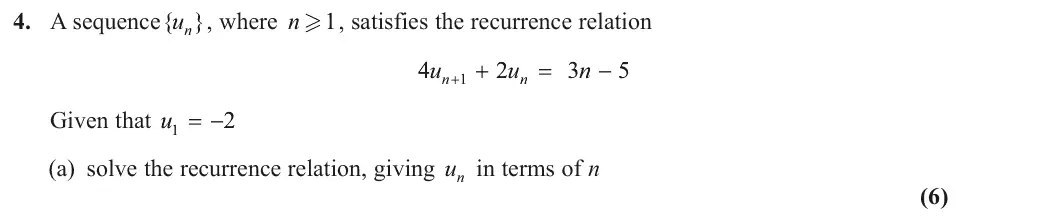
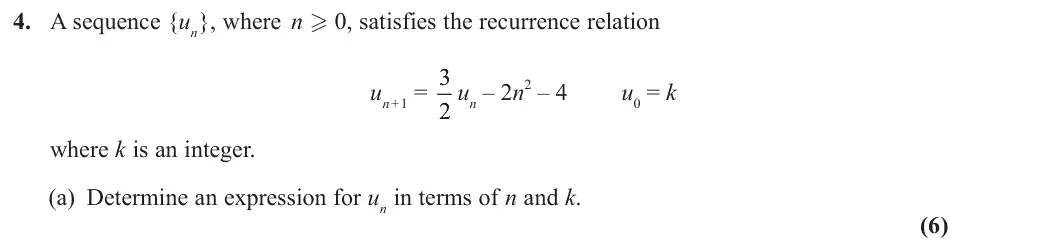
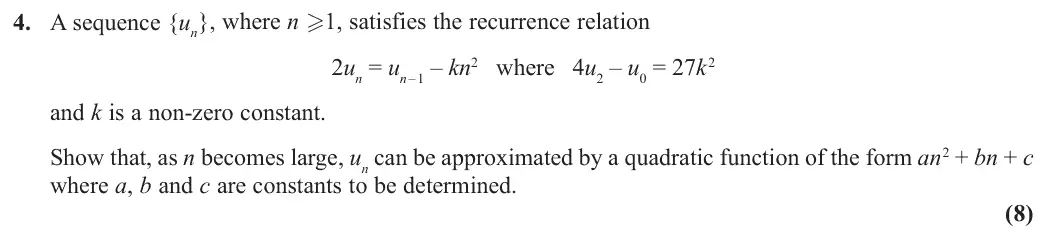
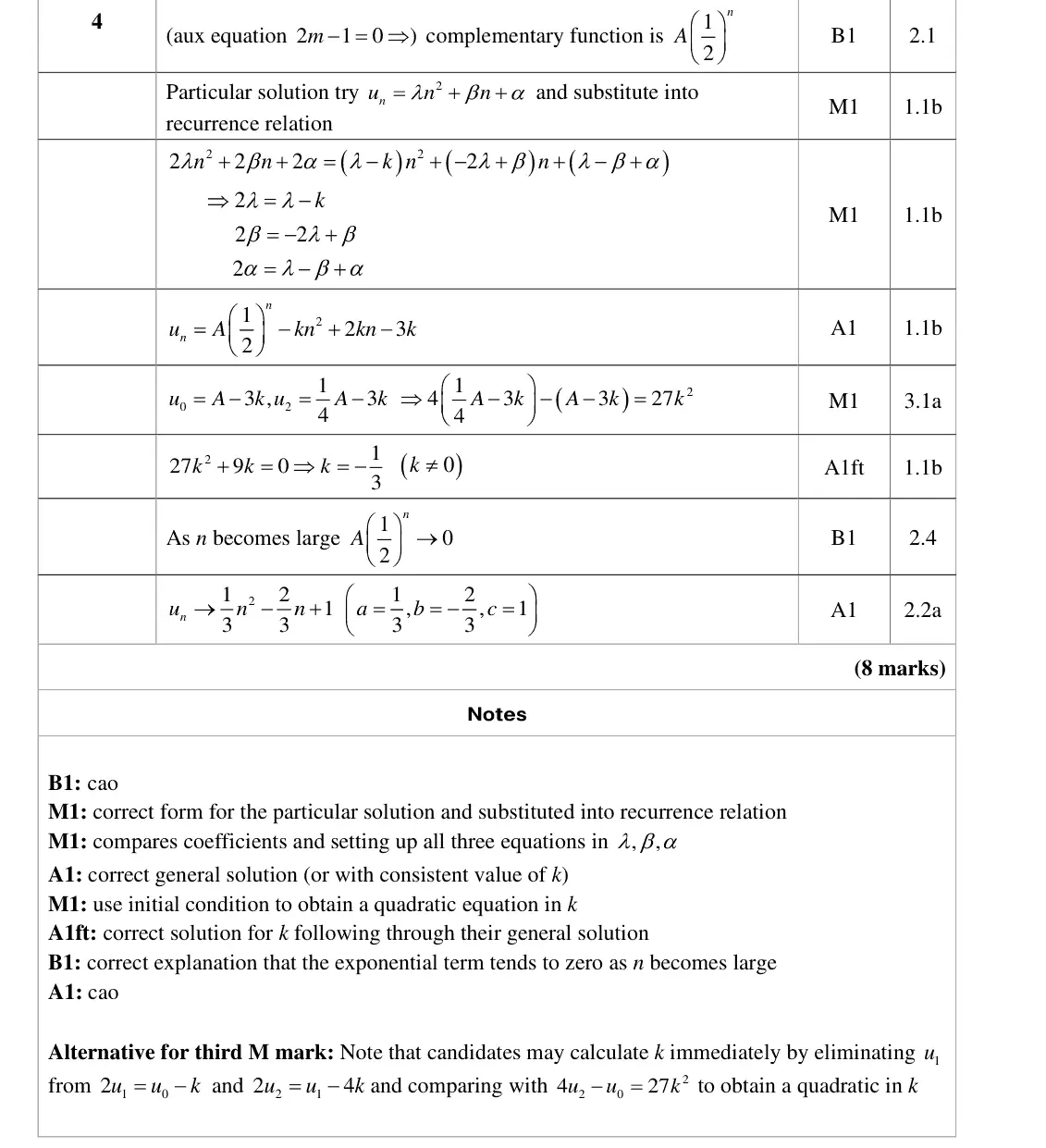
June 2025 · AS Paper 2 (Decision 2) · Q4(a)6 marks
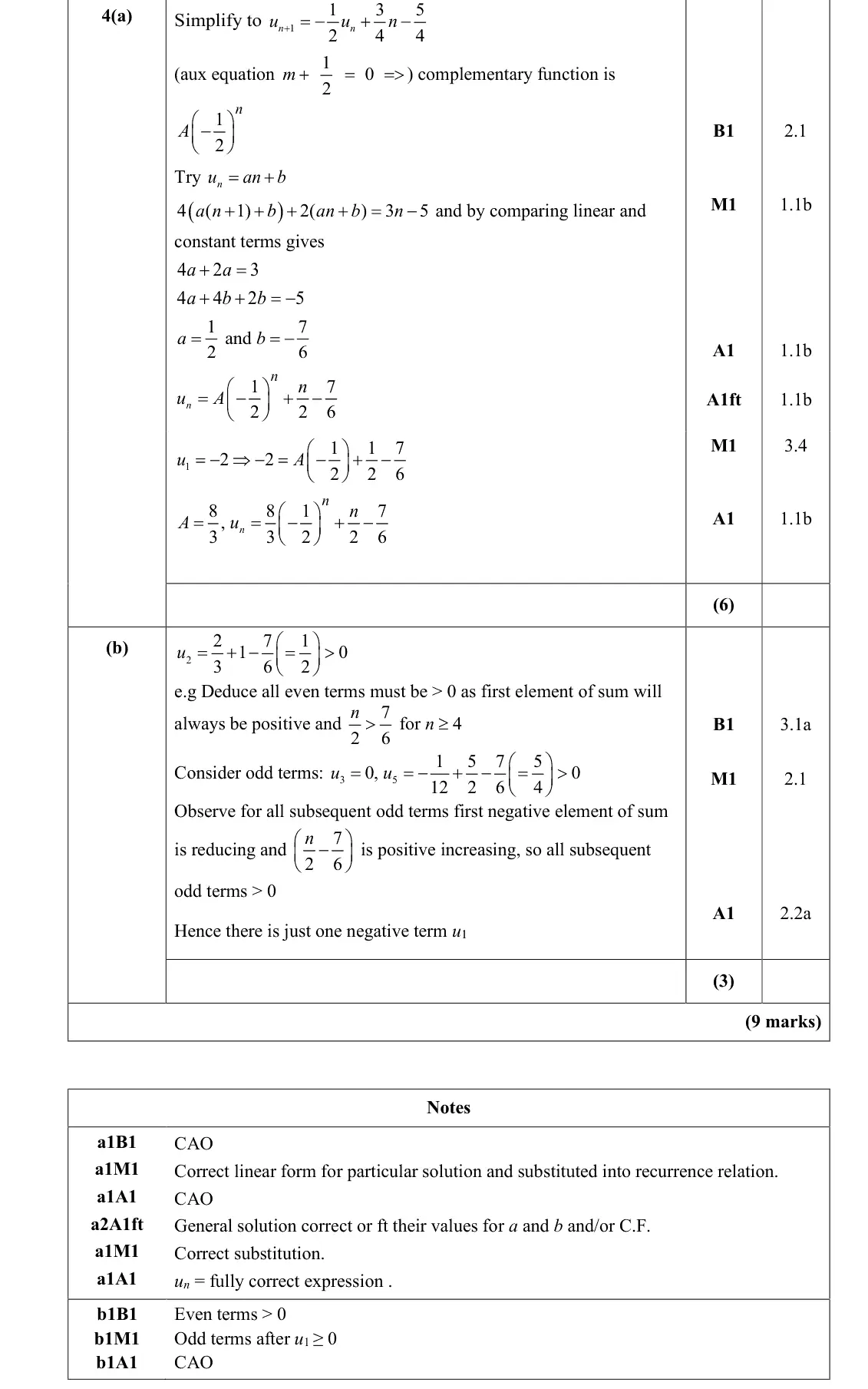
Mark scheme (whole question; this part is marked with the orange bar)
Examiner's comment
λ and mu . Relatively few learners obtained a fully correct solution to part (a). Part (b) was very poorly done, with very few learners scoring more than 1 mark. Those learners who had the correct solution to part (a) and then attempted this, generally calculated values for u2 u3 and u4 and then stated that there was just one negative term. Very few learners considered the odd and even terms separately and, while some stated that (-1/2)n would tend to 0 as n increased, very few attempted to calculate when n/2 > 7/6, which was required to fully explain their solution. A few learners who did not have the correct solution to part (a) attempted this, but, again, failed to build a complete justification for their answer.
Key points from the mark scheme and examiner's report
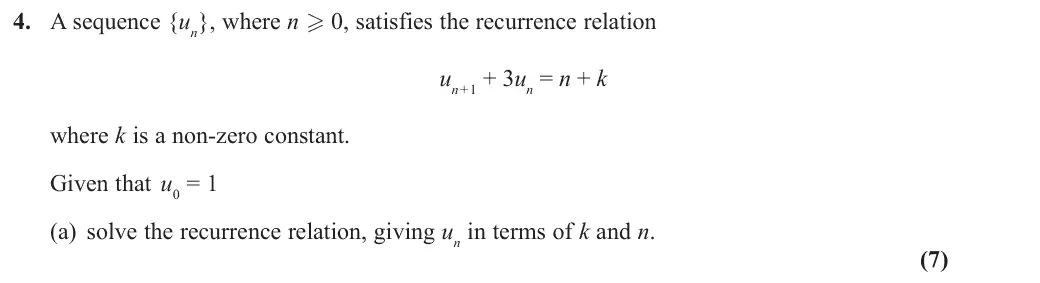
divide by 4 first
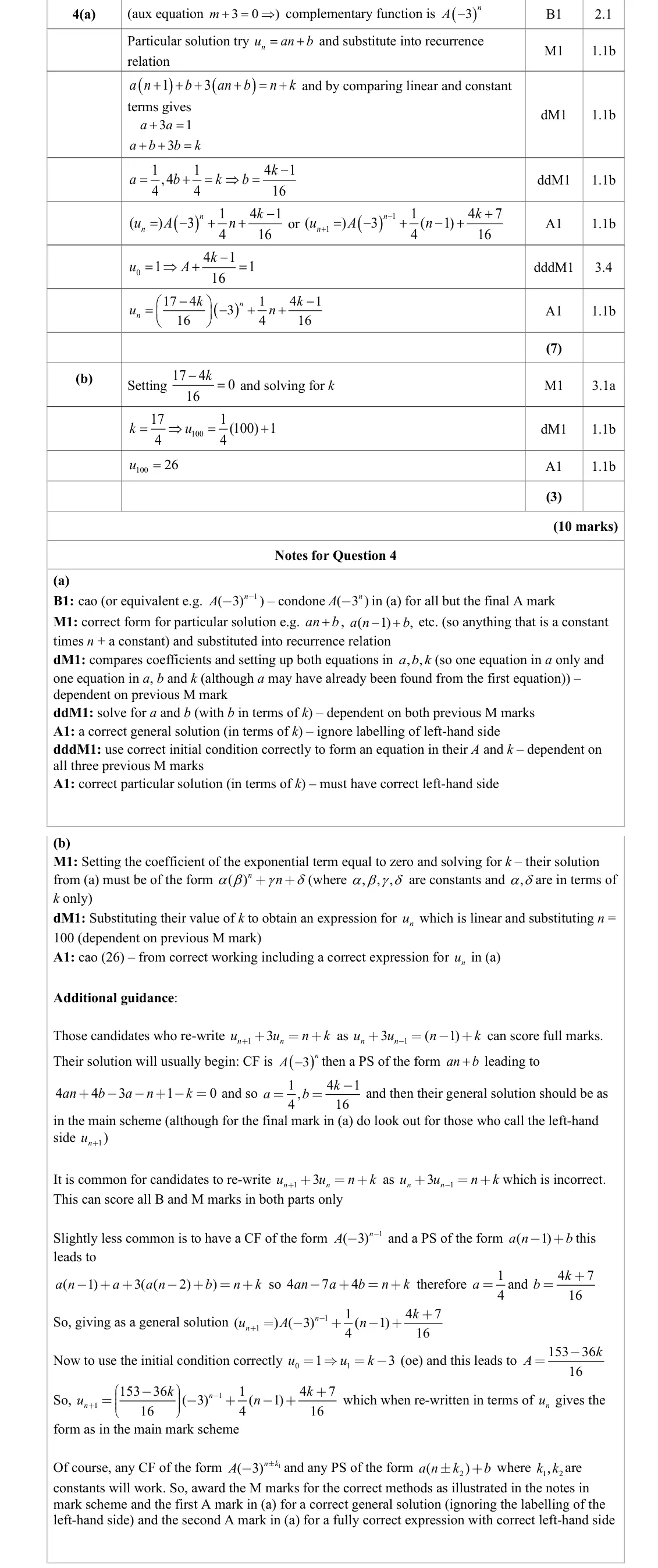
CF A(−1/2)ⁿ
try an + b: a = 1/2, b = −7/6
u₁ = −2 gives A = 8/3 so uₙ = (8/3)(−1/2)ⁿ + n/2 − 7/6
few fully correct
June 2025 · AS Paper 2 (Decision 2) · Q4(b)3 marks
Mark scheme (whole question; this part is marked with the orange bar)
Examiner's comment
λ and mu . Relatively few learners obtained a fully correct solution to part (a). Part (b) was very poorly done, with very few learners scoring more than 1 mark. Those learners who had the correct solution to part (a) and then attempted this, generally calculated values for u2 u3 and u4
Key points from the mark scheme and examiner's report
even terms are positive (n/2 > 7/6 for n ≥ 4, u₂ > 0)
odd terms: u₃ = 0, then n/2 − 7/6 grows while the negative part shrinks
so only u₁ is negative
listing a few terms is not a justification
very poorly answered
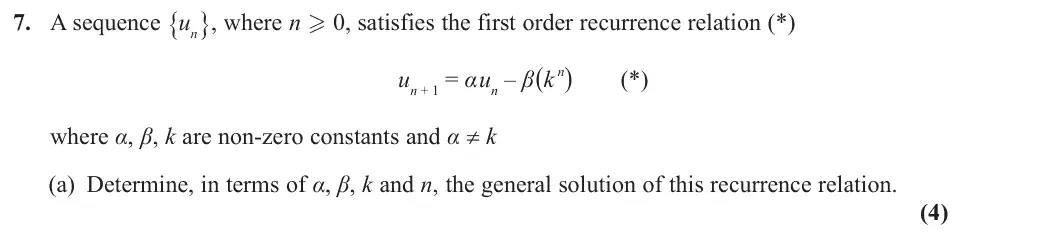
June 2025 · Paper 4D (Decision 2) · Q7(a)4 marks
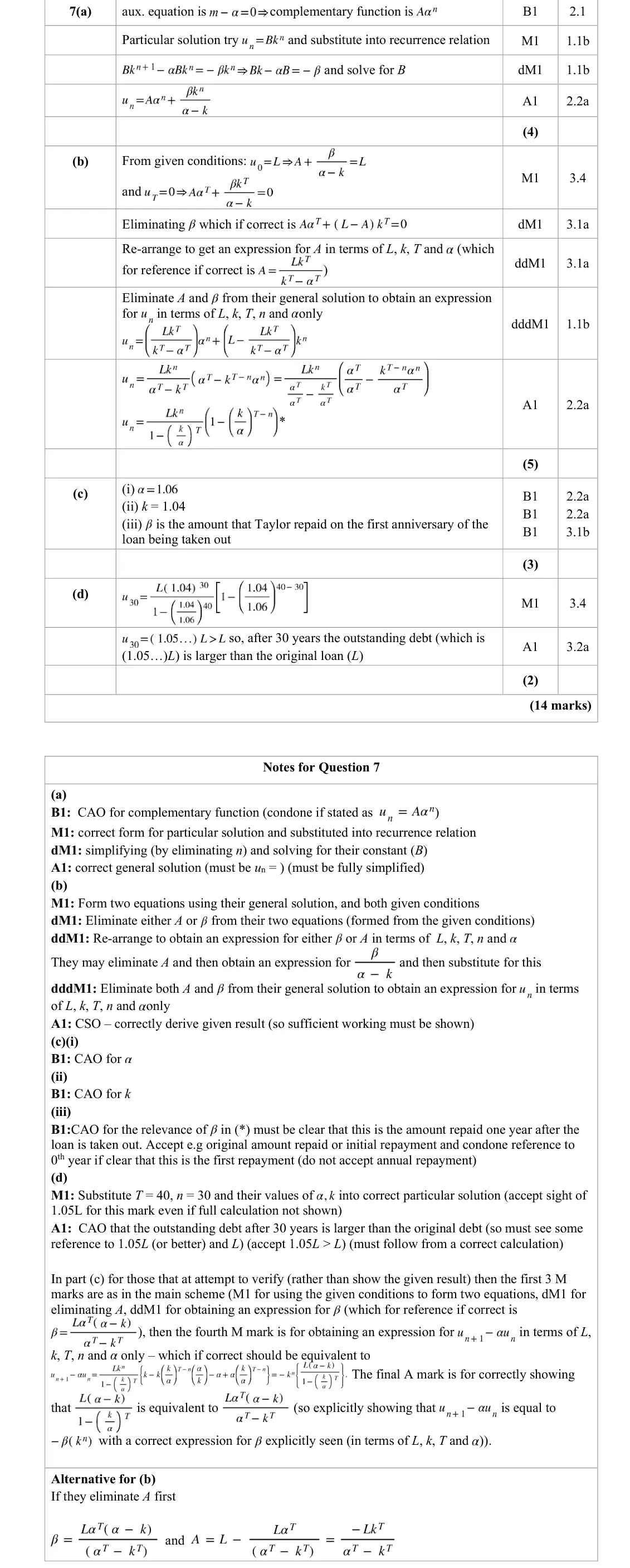
Mark scheme (whole question; this part is marked with the orange bar)
Examiner's comment
This was a challenging question, which a significant number of candidates did not attempt. In part (a), some candidates were able to write down the complimentary function and chose the correct form of the solution. Those that did so, were then generally able to substitute this into the recurrence relation and solve this to obtain the general solution, although some made errors rearranging their algebra. In part (b), most candidates who had obtained the general solution in (a) used the given values to write down two equations, but many stopped at this stage. Some attempted to eliminate their constants and it was pleasing to see several candidates doing so successfully and going on to obtain the correct given result.
Key points from the mark scheme and examiner's report
CF Aαⁿ
PS Bkⁿ: Bk − αB = −β so B = β/(α − k)
u_n = Aαⁿ + βkⁿ/(α − k)
June 2025 · Paper 4D (Decision 2) · Q7(b)5 marks
Mark scheme (whole question; this part is marked with the orange bar)
Examiner's comment
This was a challenging question, which a significant number of candidates did not attempt. In In part (b), most candidates who had obtained the general solution in (a) used the given values to write down two equations, but many stopped at this stage. Some attempted to eliminate their constants and it was pleasing to see several candidates doing so successfully and going on to obtain the correct given result.
Key points from the mark scheme and examiner's report
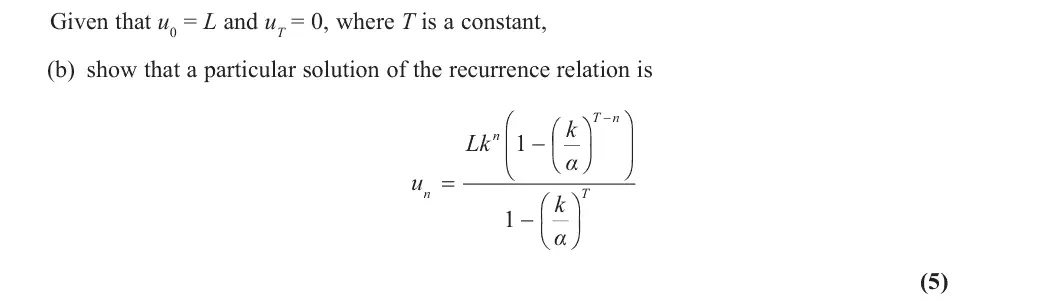
use u0 = L and u_T = 0 to form two equations, eliminate A and β, then substitute
printed answer so every step needed
many stopped after forming the two equations
June 2025 · Paper 4D (Decision 2) · Q7(c)3 marks
Mark scheme (whole question; this part is marked with the orange bar)
Examiner's comment
This was a challenging question, which a significant number of candidates did not attempt. In In part (c) many candidates confused the values of alpha and k and relatively few realised that beta represented the initial repayment. Only a small number of candidates attempted part (d), but most of those who did so obtained
Key points from the mark scheme and examiner's report
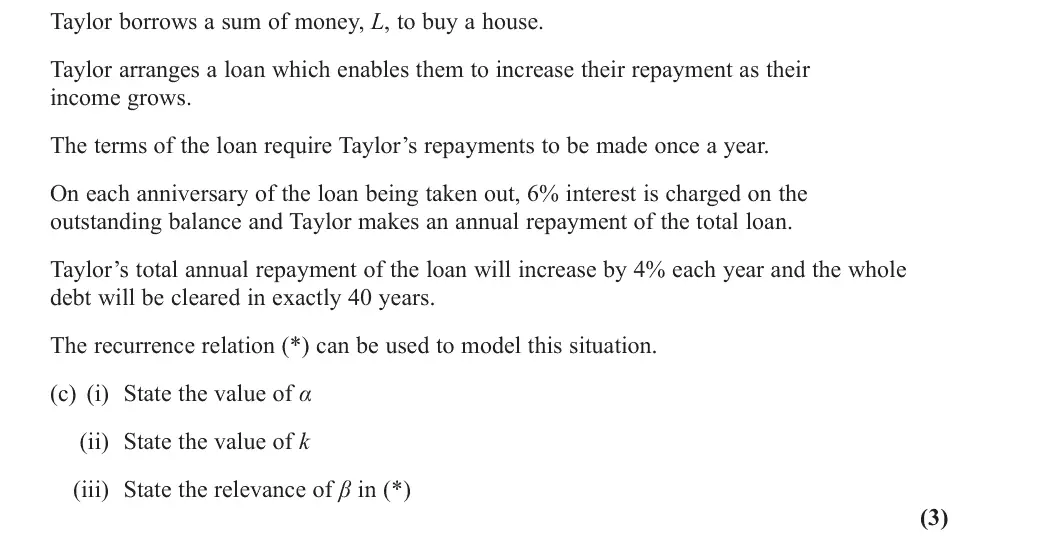
α = 1.06 (interest), k = 1.04 (repayment growth)
β is the first repayment, made one year after the loan is taken out
α and k often confused
June 2025 · Paper 4D (Decision 2) · Q7(d)2 marks
Mark scheme (whole question; this part is marked with the orange bar)
Examiner's comment
This was a challenging question, which a significant number of candidates did not attempt. In Only a small number of candidates attempted part (d), but most of those who did so obtained the correct value.
Key points from the mark scheme and examiner's report
substitute T = 40, n = 30, α = 1.06, k = 1.04: u30 = 1.05…L > L
rarely attempted
June 2024 · AS Paper 2 (Decision 2) · Q4(a)1 mark
Mark scheme (whole question; this part is marked with the orange bar)
Examiner's comment
Many candidates were able to make a good attempt at this question, with relatively few blank scripts seen. A significant number of candidates failed to realise that the model used a monthly payment and did not divide 1800 by 12. Most candidates stated a complimentary function of the correct form and many also used a trial solution of λ, although some incorrectly used λn + mu as their trial solution. A small number of candidates made errors in their working, but a good number of candidates obtained the fully correct solution. A small number of candidates were penalised as they gave a solution of the form un+1 = instead of un = Most candidates calculated the correct value of £5000 for D and, those who had a solution of the
Key points from the mark scheme and examiner's report
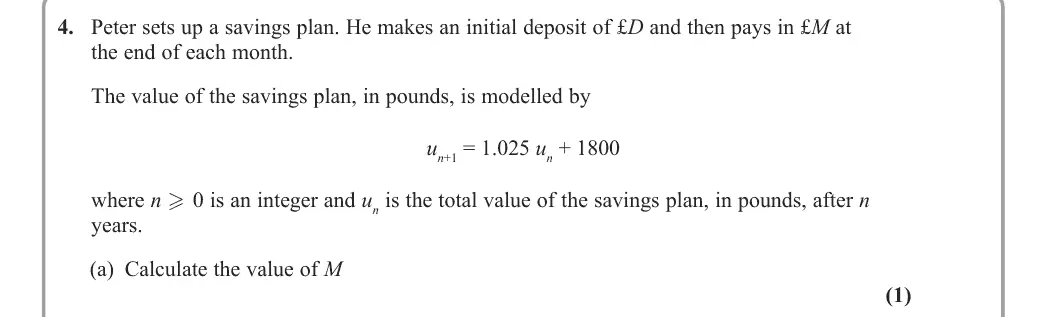
annual payment 1800 is 12 monthly payments: M = 150
many did not divide by 12
June 2024 · AS Paper 2 (Decision 2) · Q4(b)5 marks
Mark scheme (whole question; this part is marked with the orange bar)
Examiner's comment
Many candidates were able to make a good attempt at this question, with relatively few blank scripts seen. A significant number of candidates failed to realise that the model used a monthly payment and did not divide 1800 by 12. Most candidates stated a complimentary function of the correct form and many also used a trial solution of λ, although some incorrectly used λn + mu as their trial solution. A small number of candidates made errors in their working, but a good number of candidates obtained the fully correct solution. A small number of candidates were penalised as they gave a solution of the form un+1 = instead of un = Most candidates calculated the correct value of £5000 for D and, those who had a solution of the
Key points from the mark scheme and examiner's report
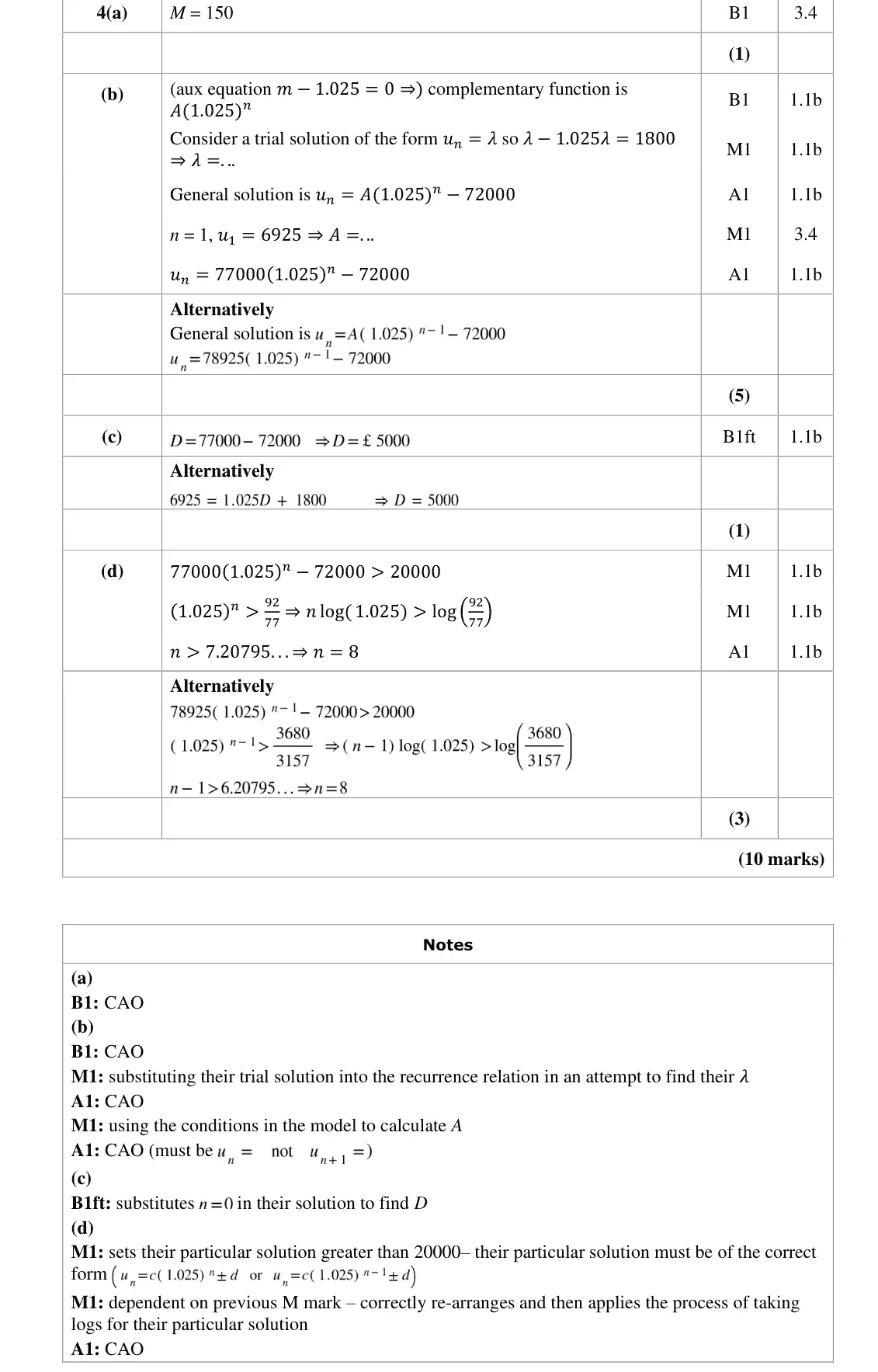
CF A(1.025)ⁿ
constant trial solution λ = −72000 (not λn + μ)
u₁ = 6925 gives uₙ = 77000(1.025)ⁿ − 72000
must be uₙ =, not uₙ₊₁ =
June 2024 · AS Paper 2 (Decision 2) · Q4(c)1 mark
Mark scheme (whole question; this part is marked with the orange bar)
Examiner's comment
Many candidates were able to make a good attempt at this question, with relatively few blank scripts seen. A significant number of candidates failed to realise that the model used a monthly payment and did not divide 1800 by 12. Most candidates stated a complimentary function of the correct form and many also used a trial solution of λ, although some incorrectly used λn + mu as their trial solution. A small number of candidates made errors in their working, but a good number of candidates obtained the fully correct solution. A small number of candidates were penalised as they gave a solution of the form un+1 = instead of un = Most candidates calculated the correct value of £5000 for D and, those who had a solution of the
Key points from the mark scheme and examiner's report
n = 0: D = 77000 − 72000 = £5000
June 2024 · AS Paper 2 (Decision 2) · Q4(d)3 marks
Mark scheme (whole question; this part is marked with the orange bar)
Examiner's comment
correct form, were able to use their solution to solve the final part of the question. A small number either made errors, either when taking logs or by not rounding their answer up. Some adopted a trial-and-error approach, which gained no credit.
Key points from the mark scheme and examiner's report
77000(1.025)ⁿ − 72000 > 20000 so (1.025)ⁿ > 92/77
logs give n > 7.21 so 8 years
failing to round up or using trial and error (no credit)
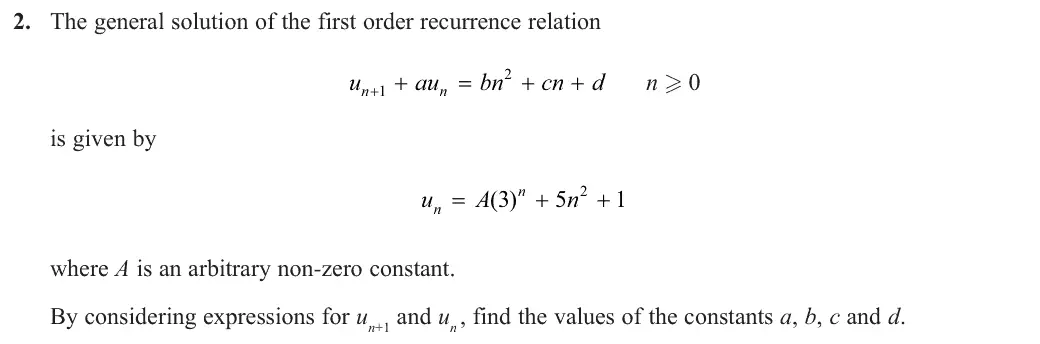
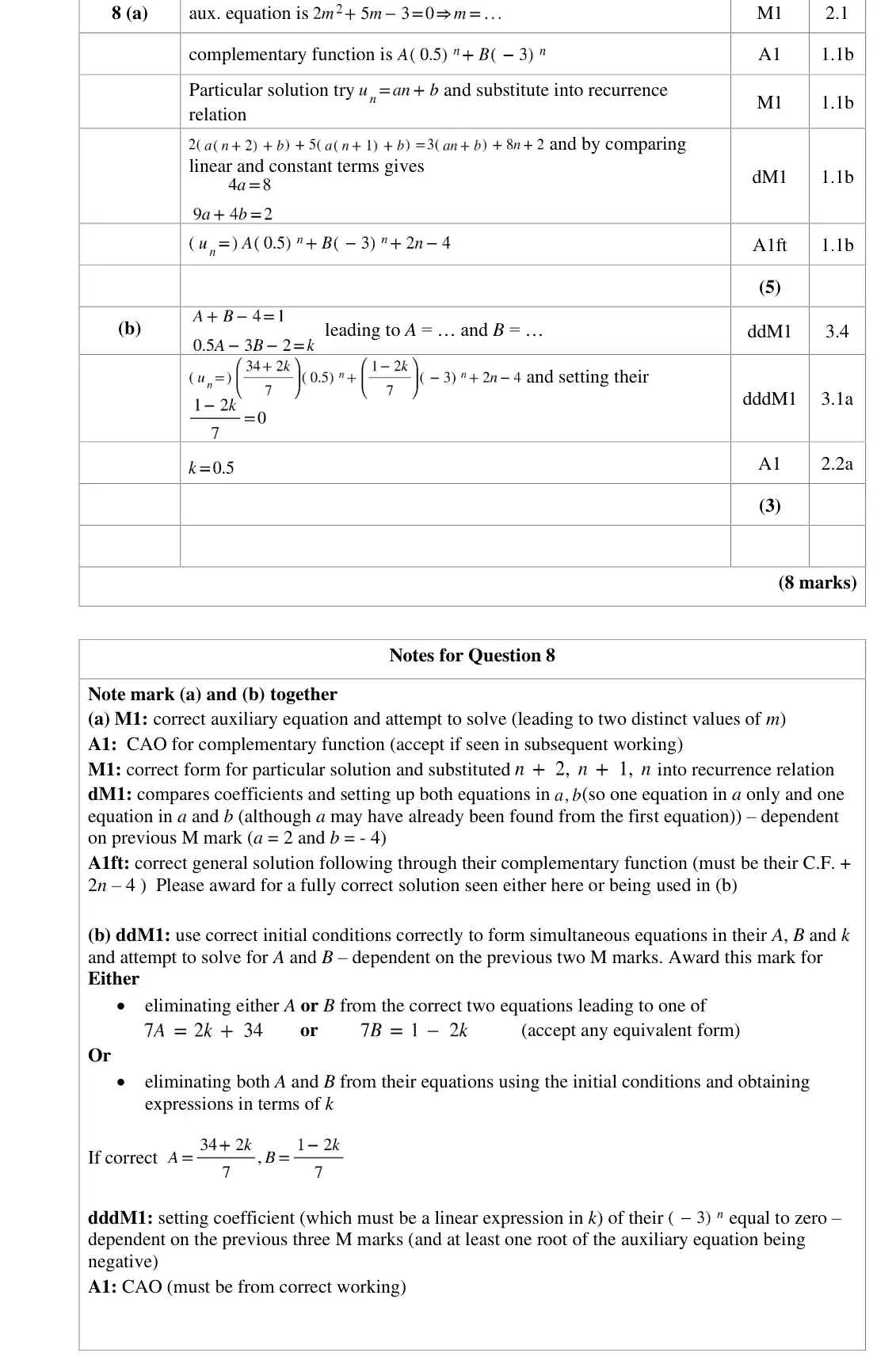
June 2024 · Paper 4D (Decision 2) · Q23 marks
Mark scheme (whole question; this part is marked with the orange bar)
Examiner's comment
This question proved to be challenging for many candidates and, despite being told in the question to consider un+1, a significant number just tried to solve the recurrence relation from first principles. While some were successful, this involved significant additional work. Those who did consider un+1 were generally able to make some progress, although there were numerical errors in some cases. A third alternative involved forming the correct equation for un+1 + aun and then comparing coefficients, which was more straightforward and led to success in the majority of cases.
Key points from the mark scheme and examiner's report
write u_{n+1} = 3A(3)ⁿ + 5(n + 1)² + 1 and eliminate A using u_n: u_{n+1} − 3u_n = −10n² + 10n + 3, so a = −3, b = −10, c = 10, d = 3
comparing coefficients in u_{n+1} + au_n also works
solving from first principles is long
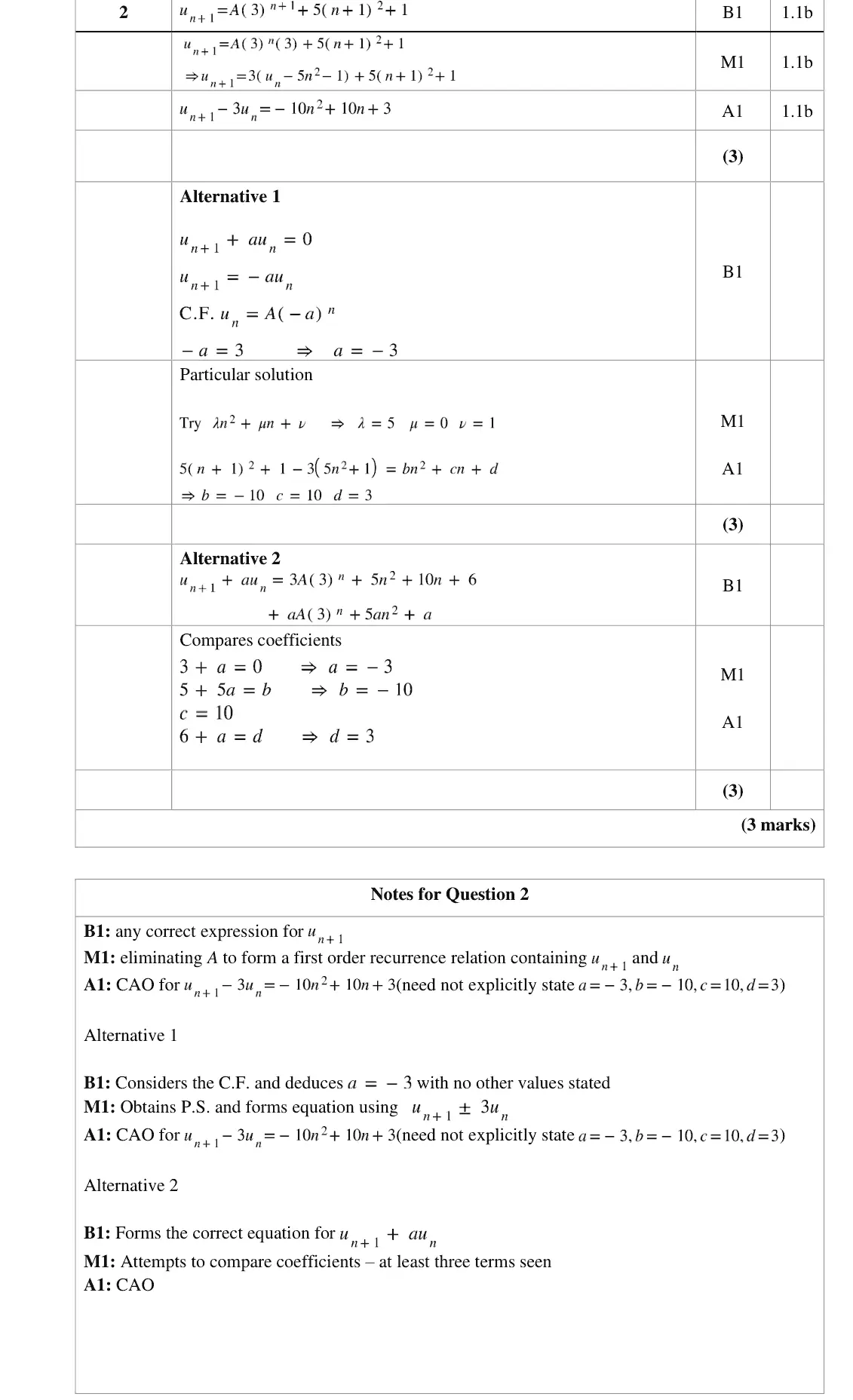
June 2024 · Paper 4D (Decision 2) · Q8(a)5 marks
Mark scheme (whole question; this part is marked with the orange bar)
Examiner's comment
The first part of this question was answered well by a significant number of candidates. Many formed and solved the correct auxiliary equation, leading to the complementary function. Many then went on to consider the correct form of the particular solution, substituting into the original recurrence relation and forming equations which enable them to calculate the correct coefficients. Some candidates failed to make any progress beyond this stage, any many that did attempt the final part of the question, struggled to make any real progress. Those candidates
Key points from the mark scheme and examiner's report
2m² + 5m − 3 = 0, m = 0.5 or −3
PS an + b gives a = 2, b = −4
u_n = A(0.5)ⁿ + B(−3)ⁿ + 2n − 4
June 2024 · Paper 4D (Decision 2) · Q8(b)3 marks
Mark scheme (whole question; this part is marked with the orange bar)
Examiner's comment
attempt the final part of the question, struggled to make any real progress. Those candidates who were successful here either used good algebra skills to obtain expressions for A and B just in terms of k or realised that the value of B must be 0 and used this with the initial conditions to obtain the correct value of k.
Key points from the mark scheme and examiner's report
A + B − 4 = 1 and 0.5A − 3B − 2 = k
all terms positive so the (−3)ⁿ coefficient B = (1 − 2k)/7 must be 0, giving k = 0.5
few made progress
June 2023 · AS Paper 2 (Decision 2) · Q4(a)6 marks
Mark scheme (whole question; this part is marked with the orange bar)
Examiner's comment
excellent solutions, particularly in part (a). The final mark was lost in part (a) for a few nu + = nu = ... ... candidates when they expressed their solution as (rather than implying ). 1 Relatively few candidates were able to complete part (b), but it was encouraging to see a good
Key points from the mark scheme and examiner's report
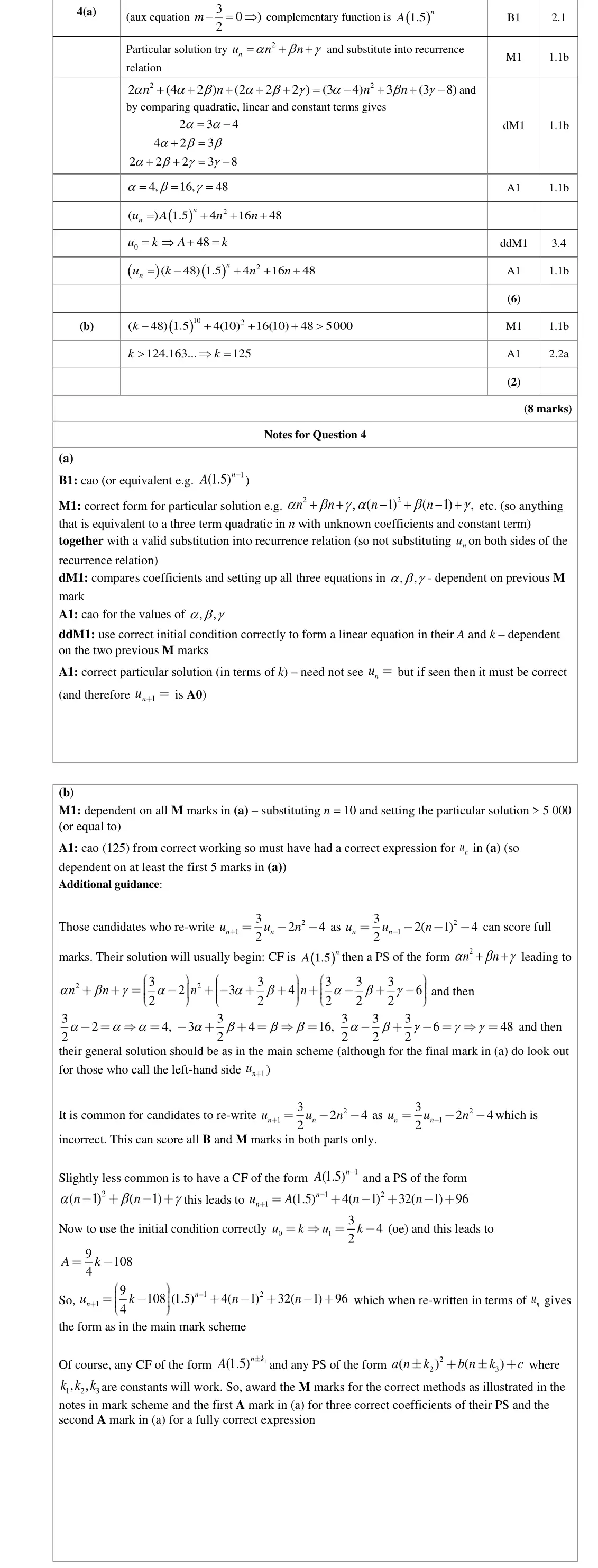
rewriting the relation wrongly in terms of uₙ₋₁ is common
June 2023 · AS Paper 2 (Decision 2) · Q4(b)2 marks
Mark scheme (whole question; this part is marked with the orange bar)
Examiner's comment
Relatively few candidates were able to complete part (b), but it was encouraging to see a good number setting their expression > 5000 and solving for k.
Key points from the mark scheme and examiner's report
(k − 48)(1.5)¹⁰ + 4(10)² + 16(10) + 48 > 5000 gives k > 124.16 so k = 125 (k is an integer)
few completed
June 2023 · Paper 4D (Decision 2) · Q5(a)7 marks
Mark scheme (whole question; this part is marked with the orange bar)
Examiner's comment
This question proved to be very challenging. The question was structured so that the correct use of the transformation reduced the problem to the easier homogenous relationship, however the majority of candidates failed to engage with this transformation, being penalised both with a loss of marks and a more complicated question. Those candidates who did use the transformation, were generally able to obtain the homogenous relationship, although a small number made an arithmetical error and did not do so. Many candidates (whether they had used the transformation or not) recognised that this was a second order relationship and wrote down the correct auxiliary equation. Most went on to solve this and wrote down the complimentary function. Those who had used the transformation generally wrote down the associated solution to the original problem. Many of those candidates who had not used the transformation, attempted to find a particular solution, but there were often errors seen at this stage. Those candidates who obtained a general solution to the original problem attempted to use the conditions given to calculate the values of the constants. Those candidates who obtained a final solution generally considered what happened to the relationship as n gets large, with some correctly recognising that it approximates to a linear relationship, while others incorrectly stated that it tended to infinity.
Key points from the mark scheme and examiner's report
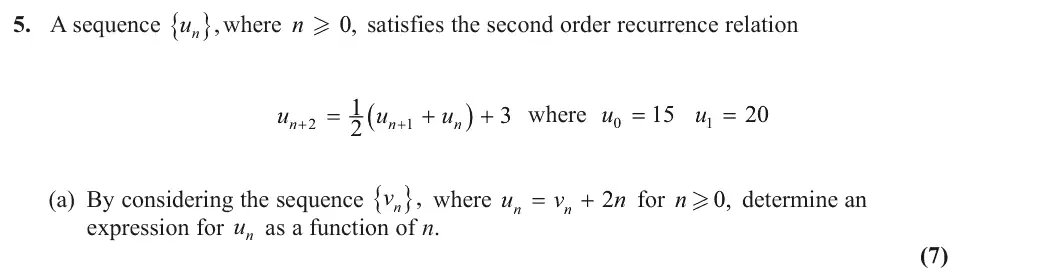
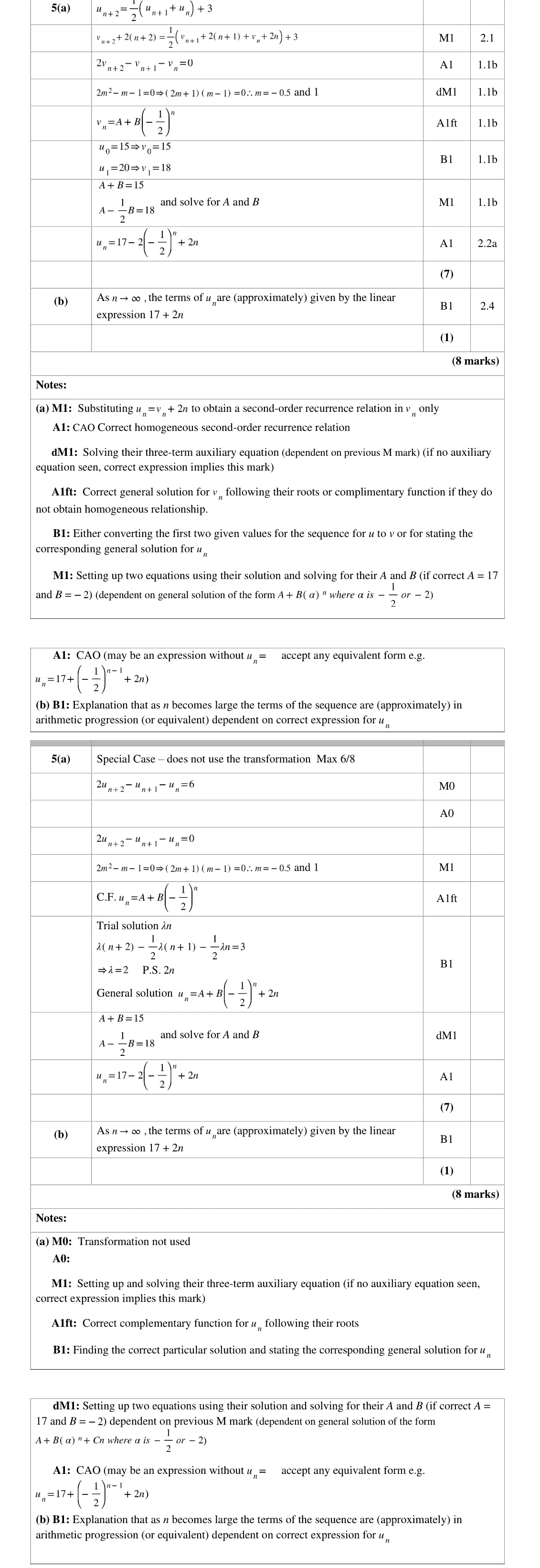
substitute u_n = v_n + 2n to get 2v_{n+2} − v_{n+1} − v_n = 0
roots 1 and −1/2
v0 = 15, v1 = 18 give A = 17, B = −2
u_n = 17 − 2(−1/2)ⁿ + 2n
ignoring the given transformation scores at most 6
June 2023 · Paper 4D (Decision 2) · Q5(b)1 mark
Mark scheme (whole question; this part is marked with the orange bar)
Examiner's comment
This question proved to be very challenging. The question was structured so that the correct use of the transformation reduced the problem to the easier homogenous relationship, however the majority of candidates failed to engage with this transformation, being penalised both with a loss of marks and a more complicated question. Those candidates who did use the transformation, were generally able to obtain the homogenous relationship, although a small number made an arithmetical error and did not do so. Many candidates (whether they had used the transformation or not) recognised that this was a second order relationship and wrote down the correct auxiliary equation. Most went on to solve this and wrote down the complimentary function. Those who had used the transformation generally wrote down the associated solution to the original problem. Many of those candidates who had not used the transformation, attempted to find a particular solution, but there were often errors seen at this stage. Those candidates who obtained a general solution to the original problem attempted to use the conditions given to calculate the values of the constants. Those candidates who obtained a final solution generally considered what happened to the relationship as n gets large, with some correctly recognising that it approximates to a linear relationship, while others incorrectly stated that it tended to infinity.
Key points from the mark scheme and examiner's report
(−1/2)ⁿ → 0 so u_n is approximately 17 + 2n, an arithmetic progression (linear growth)
June 2023 · Paper 4D (Decision 2) · Q7(a)6 marks
Mark scheme (whole question; this part is marked with the orange bar)
Examiner's comment
Many candidates struggled to engage with this question and were unable to set up the correct initial model for the problem and therefore failed to make progress with the question. Most of those candidates who did set up the initial model, then wrote down the complimentary function and attempted the trial solution. However, there were errors seen at this stage when rearranging the trial solution to calculate . Candidates obtaining a value for , generally attempted to use the initial condition to find the particular solution and stated an expression in terms of n. Most candidates who obtained a final expression then attempted to use it to calculate the minimum amount of money that needed to be credited. However, many made an error with their final answer by rounding the value down.
Key points from the mark scheme and examiner's report
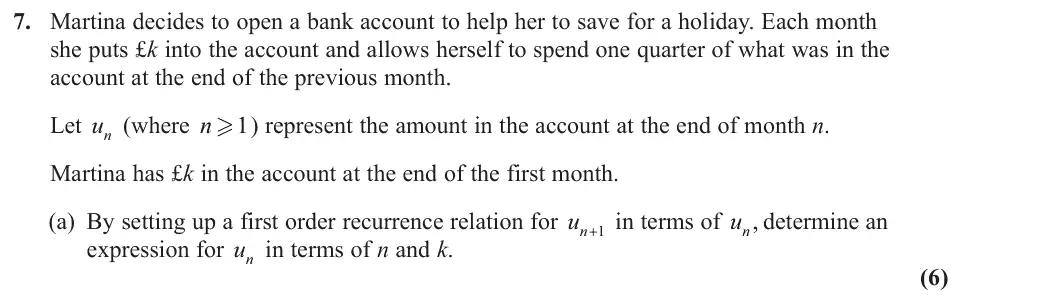
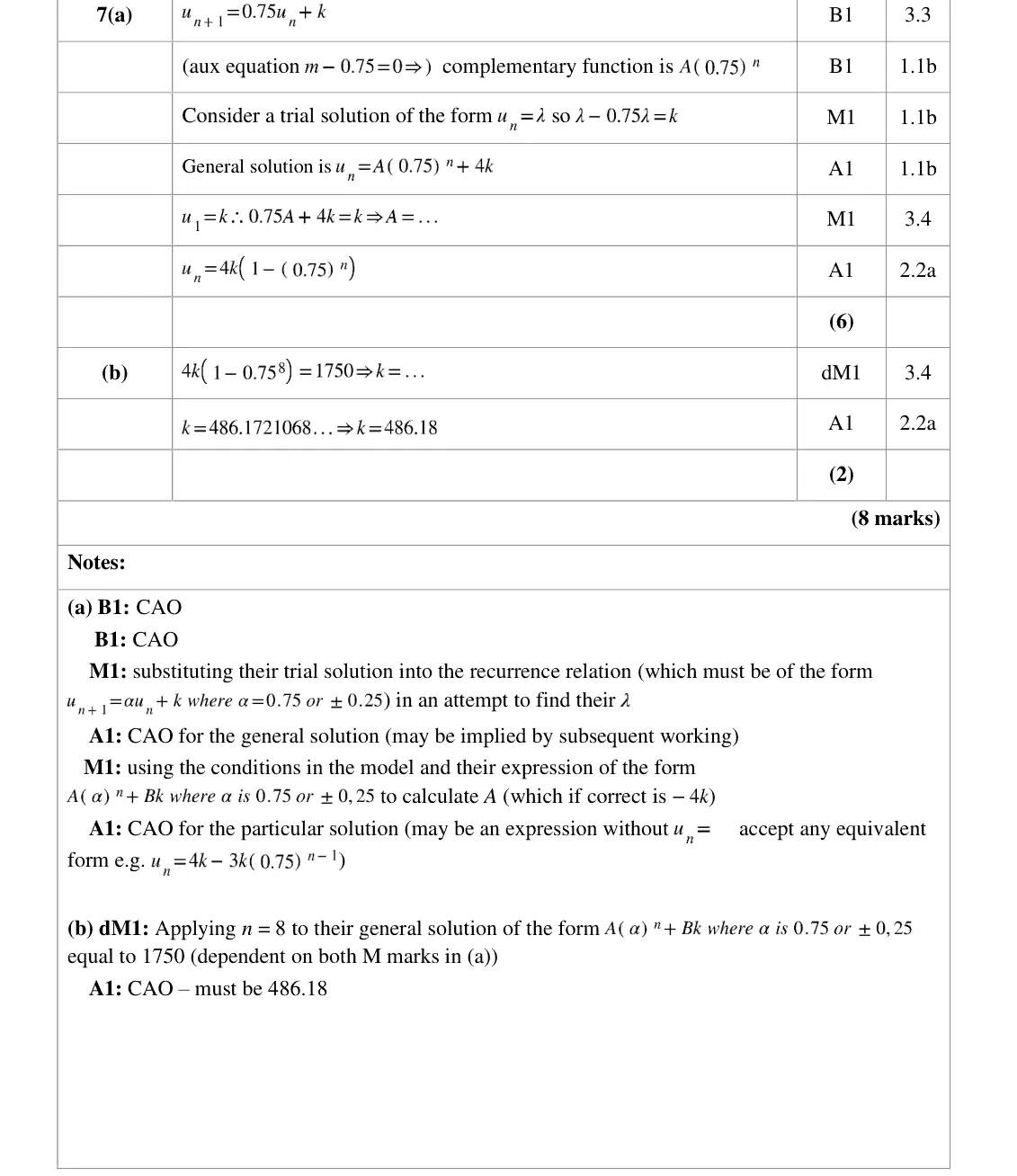
u_{n+1} = 0.75u_n + k
CF A(0.75)ⁿ, PS 4k
u1 = k gives u_n = 4k(1 − 0.75ⁿ)
many could not set up the model
June 2023 · Paper 4D (Decision 2) · Q7(b)2 marks
Mark scheme (whole question; this part is marked with the orange bar)
Examiner's comment
Many candidates struggled to engage with this question and were unable to set up the correct initial model for the problem and therefore failed to make progress with the question. Most of those candidates who did set up the initial model, then wrote down the complimentary function and attempted the trial solution. However, there were errors seen at this stage when rearranging the trial solution to calculate . Candidates obtaining a value for , generally attempted to use the initial condition to find the particular solution and stated an expression in terms of n. Most candidates who obtained a final expression then attempted to use it to calculate the minimum amount of money that needed to be credited. However, many made an error with their final answer by rounding the value down.
Key points from the mark scheme and examiner's report
4k(1 − 0.75⁸) = 1750 gives k = 486.17…, so £486.18 (rounding down was a common error)
June 2022 · AS Paper 2 (Decision 2) · Q4(a)7 marks
Mark scheme (whole question; this part is marked with the orange bar)
Examiner's comment
excellent solutions, particularly in (a). The final mark was lost in (a) for a number of candidates ... ... u u when they expressed their solution as rather than . Relatively few candidates 1 n n were able to complete (b), but it was encouraging to see a good number equating the coefficient n of 3 to zero and solving for k.
Key points from the mark scheme and examiner's report
June 2022 · AS Paper 2 (Decision 2) · Q4(b)3 marks
Mark scheme (whole question; this part is marked with the orange bar)
Examiner's comment
As expected, the final question on recurrence relations was the least well attempted on the paper and examiners noted that many candidates either left this question blank or made only minimal (unsuccessful) attempts. Some candidates did make a correct start though, writing down a correct complementary function plus a linear particular solution which they attempted to substitute into the recurrence relation, gaining the first two marks. Many attempts ended at this stage. However, a minority of candidates were well prepared for this topic and produced
Key points from the mark scheme and examiner's report
linear means the coefficient of (−3)ⁿ is zero: k = 17/4, so uₙ = n/4 + 1 and u₁₀₀ = 26
few completed this
June 2022 · Paper 4D (Decision 2) · Q2(a)2 marks
Mark scheme (whole question; this part is marked with the orange bar)
Examiner's comment
Again the majority of candidates gained full marks, though part (a) did cause difficulties for a minority. A few failed to recognise that the given solution implied an auxiliary equation with repeated roots, so were unable to make progress. Others wrote the incorrect equation (m-3)2 = 0, rather than (m+3)2 = 0. Those that found the correct values for k1 and k2 generally gained both marks provided their working was not incorrect. Some candidates’ working left a lot to be desired, with the use of x, or even n, rather than m, or just the expression (m+3)2 written rather than the equation, but these were not penalised. Almost all candidates went on to correctly answer (b).
Key points from the mark scheme and examiner's report
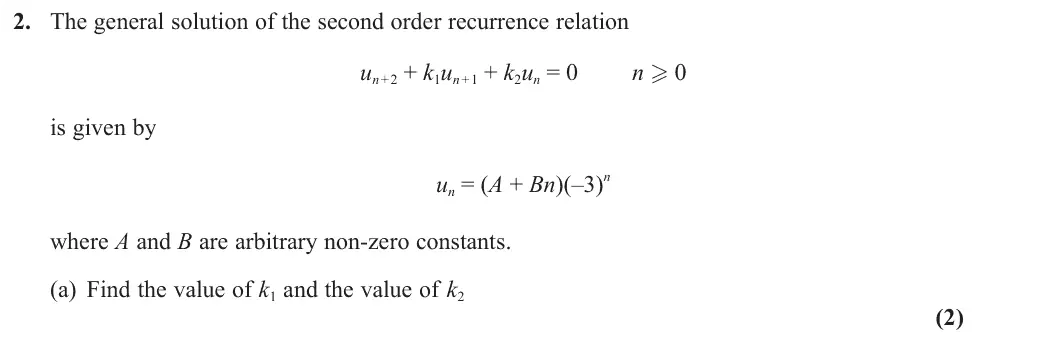
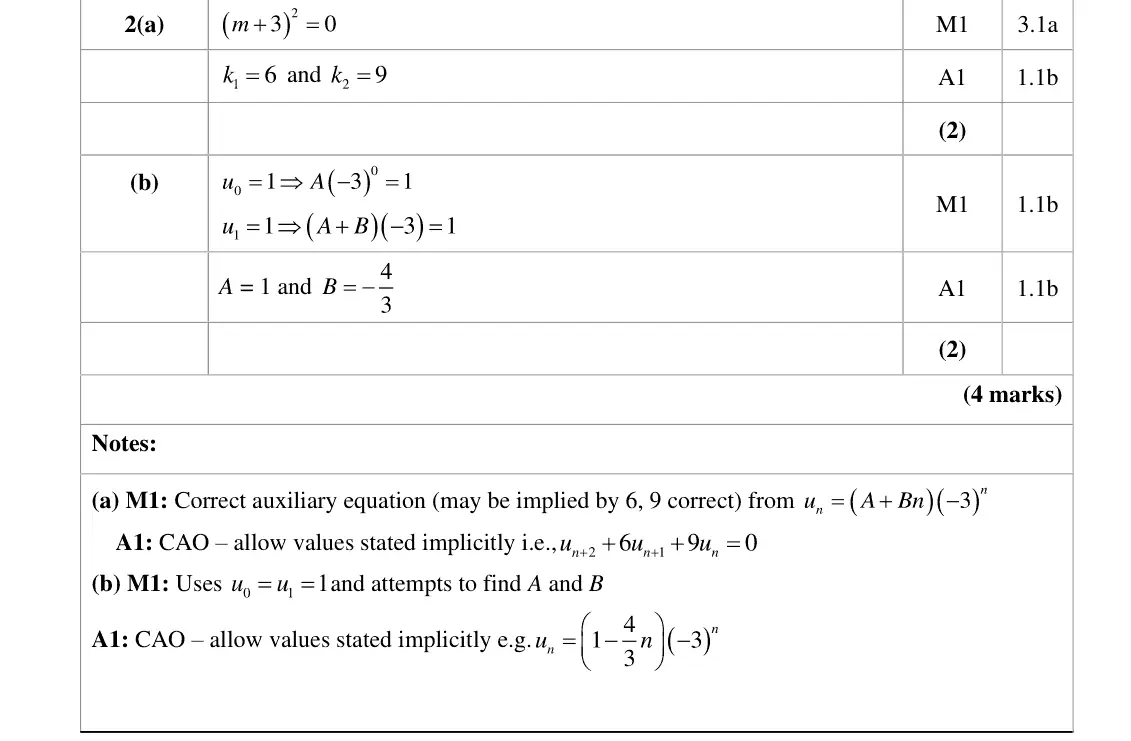
(A + Bn)(−3)ⁿ means a repeated root −3: (m + 3)² = 0 so k1 = 6, k2 = 9
(m − 3)² = 0 was a common error
some did not recognise the repeated root
June 2022 · Paper 4D (Decision 2) · Q2(b)2 marks
Mark scheme (whole question; this part is marked with the orange bar)
Examiner's comment
Again the majority of candidates gained full marks, though part (a) did cause difficulties for a minority. A few failed to recognise that the given solution implied an auxiliary equation with repeated roots, so were unable to make progress. Others wrote the incorrect equation (m-3)2 = 0, rather than (m+3)2 = 0. Those that found the correct values for k1 and k2 generally gained both marks provided their working was not incorrect. Some candidates’ working left a lot to be desired, with the use of x, or even n, rather than m, or just the expression (m+3)2 written rather than the equation, but these were not penalised. Almost all candidates went on to correctly answer (b).
Key points from the mark scheme and examiner's report
u0 = 1 gives A = 1
u1 = 1 gives (A + B)(−3) = 1 so B = −4/3
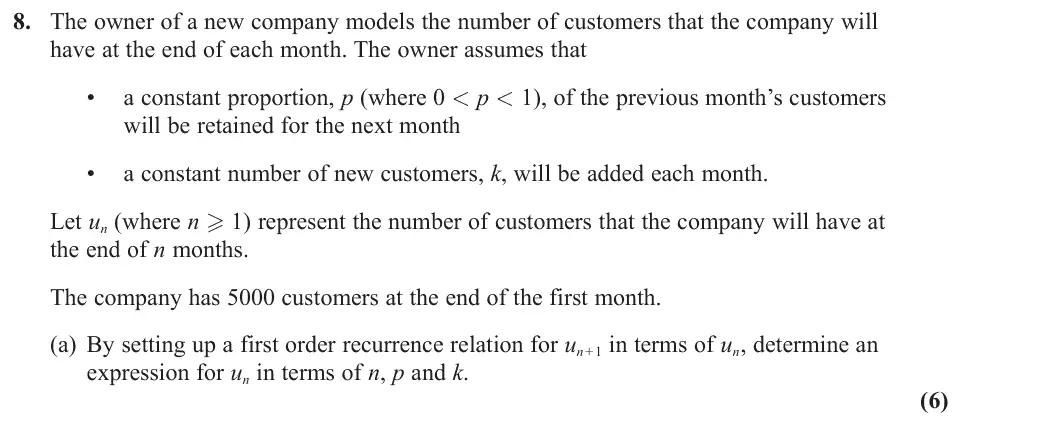
June 2022 · Paper 4D (Decision 2) · Q8(a)6 marks
Mark scheme (whole question; this part is marked with the orange bar)
Examiner's comment
Many candidates struggled to engage with this final question, with over half gaining either no marks or just one. There were many blank pages, which may have been due to candidates running out of time. Many candidates were unable to set up a correct initial model for the problem. Some used the incorrect subscript ‘n’ for their iterative formula, even though the correct one ‘n+1’ was given in the question, and some were then able to write down the correct complementary function. Of those earning the first two marks few were then able to write down the correct trial solution and rearrange this to find . Candidates also failed to write down the general solution in the correct form. Most candidates who had some form of general solution attempted to use the initial condition to calculate an expression for their constant in terms of k and p, substituting this into their general solution. A common error, seen at this stage, was to use 500 instead of 5000. Those candidates who obtained some form of general solution mostly went on to use the given information in an attempt to calculate the value of m, generally using logarithms as instructed, with some able to gain full marks.
Key points from the mark scheme and examiner's report
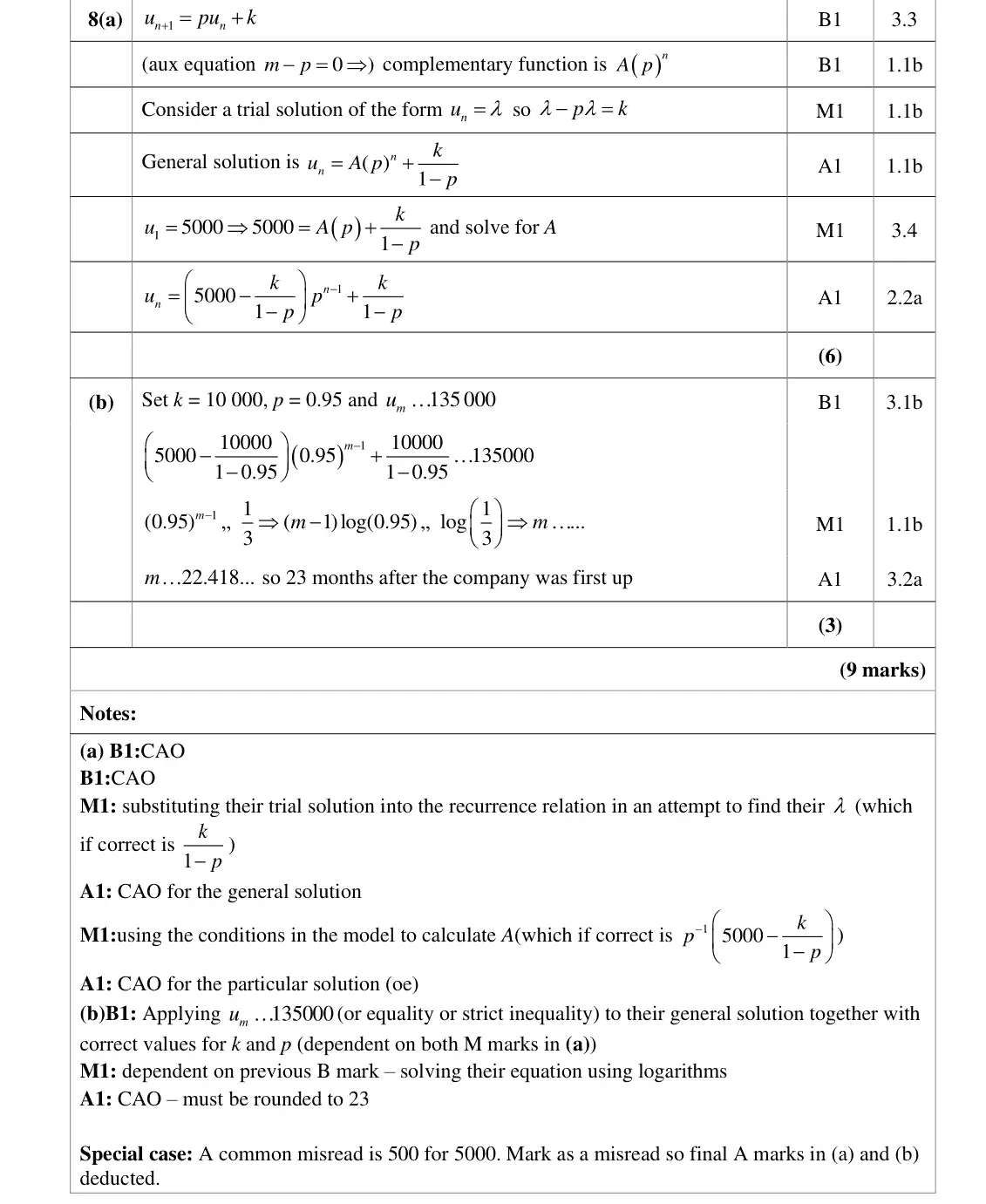
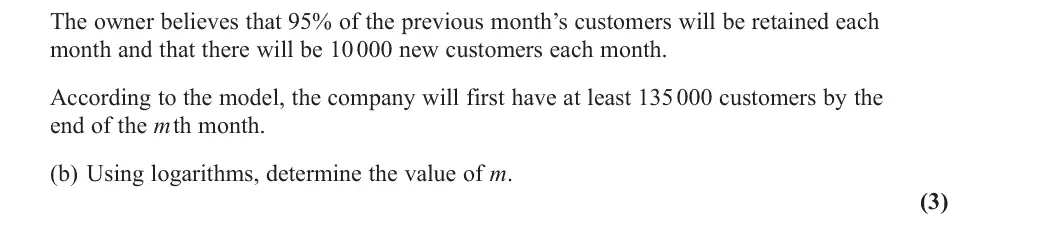
p = 0.95, k = 10000: 200000 − 195000(0.95)^(m−1) ≥ 135000 gives (0.95)^(m−1) ≤ 1/3
logs give m ≥ 22.4 so m = 23
Nov 2021 · Paper 4D (Decision 2) · Q4(a)1 mark
Mark scheme (whole question; this part is marked with the orange bar)
Key points from the mark scheme and examiner's report
Mark scheme (whole question; this part is marked with the orange bar)
Key points from the mark scheme and examiner's report
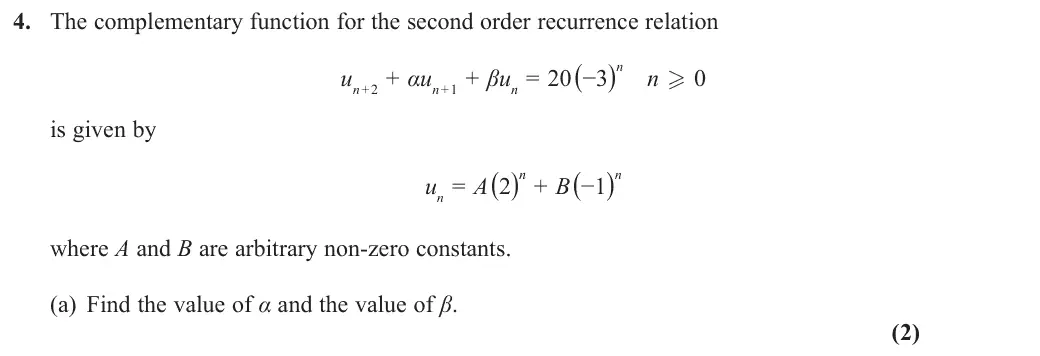
roots 2 and −1 give auxiliary equation (m − 2)(m + 1) = m² − m − 2 = 0, so α = −1, β = −2
Oct 2020 · Paper 4D (Decision 2) · Q4(b)6 marks
Mark scheme (whole question; this part is marked with the orange bar)
Key points from the mark scheme and examiner's report
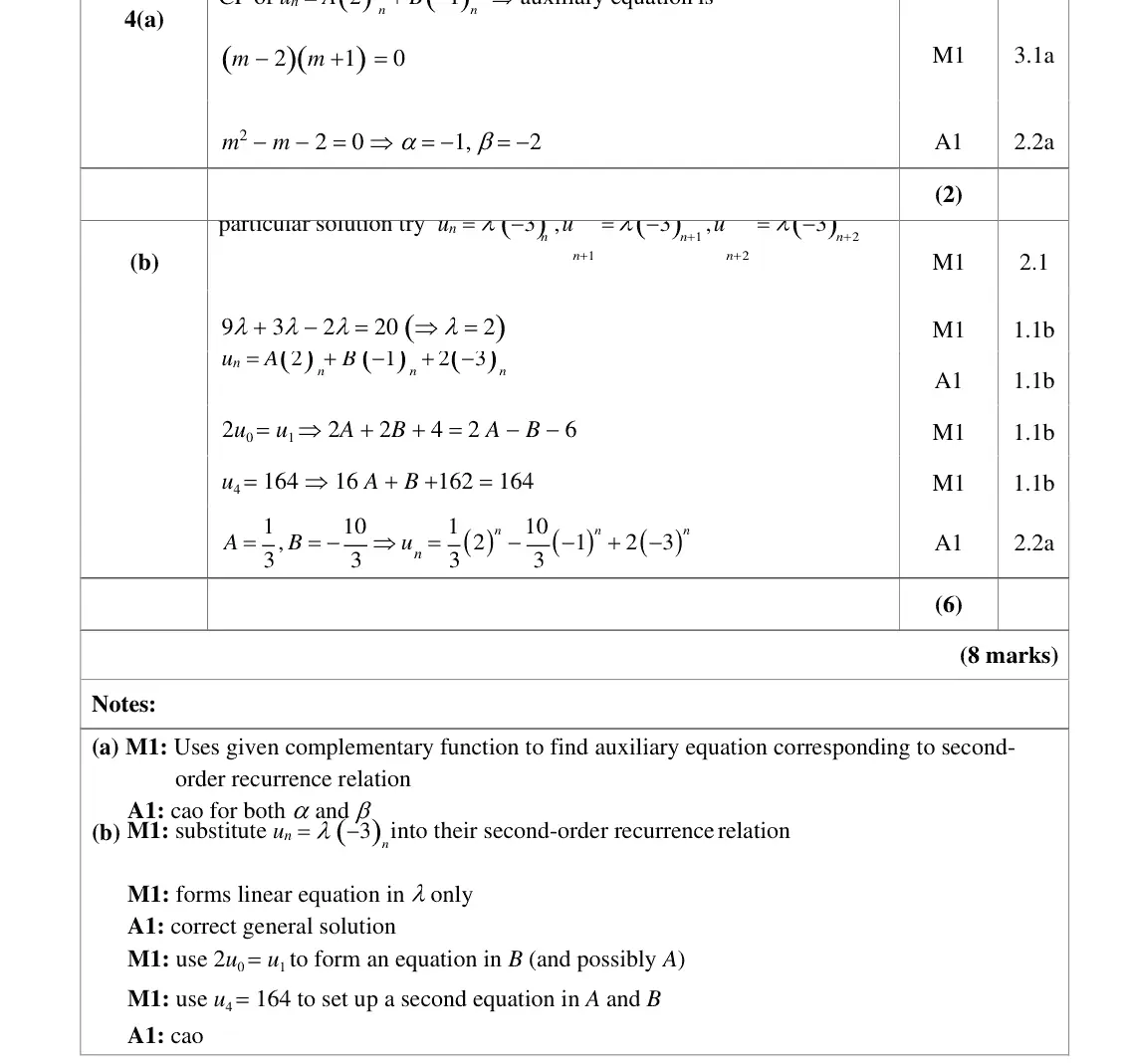
PS λ(−3)ⁿ: 9λ + 3λ − 2λ = 20, λ = 2
use 2u0 = u1 and u4 = 164 to form two equations
A = 1/3, B = −10/3: u_n = (1/3)2ⁿ − (10/3)(−1)ⁿ + 2(−3)ⁿ
June 2019 · AS Paper 2 (Decision 2) · Q2(a)4 marks
Mark scheme (whole question; this part is marked with the orange bar)
Examiner's comment
As stated in the introduction, the responses to this question on the relatively new topic of recurrence relations were mixed. While some candidates scored full marks, a significant number made very little progress after correctly stating the complementary function in part (a). Examiners noted that many nu instead of working with the candidates seemed to need to re-write the recurrent relation in terms of u (which seemed to display a lack of understanding of how these types of given form in terms of 1 n 2n 2n 3 u u 3 u u equations work) and many incorrectly re-wrote as so scoring nothing 1 n n 1 n n n 3 A but possibly the first mark in part (a). Those who correctly stated the complementary function as 2n u k and then used as a trial solution in the given recurrence relation usually went on to derive n n n 3 2 u A the correct general solution but some incorrectly stated this as instead of in terms of 1 n . nu
Key points from the mark scheme and examiner's report
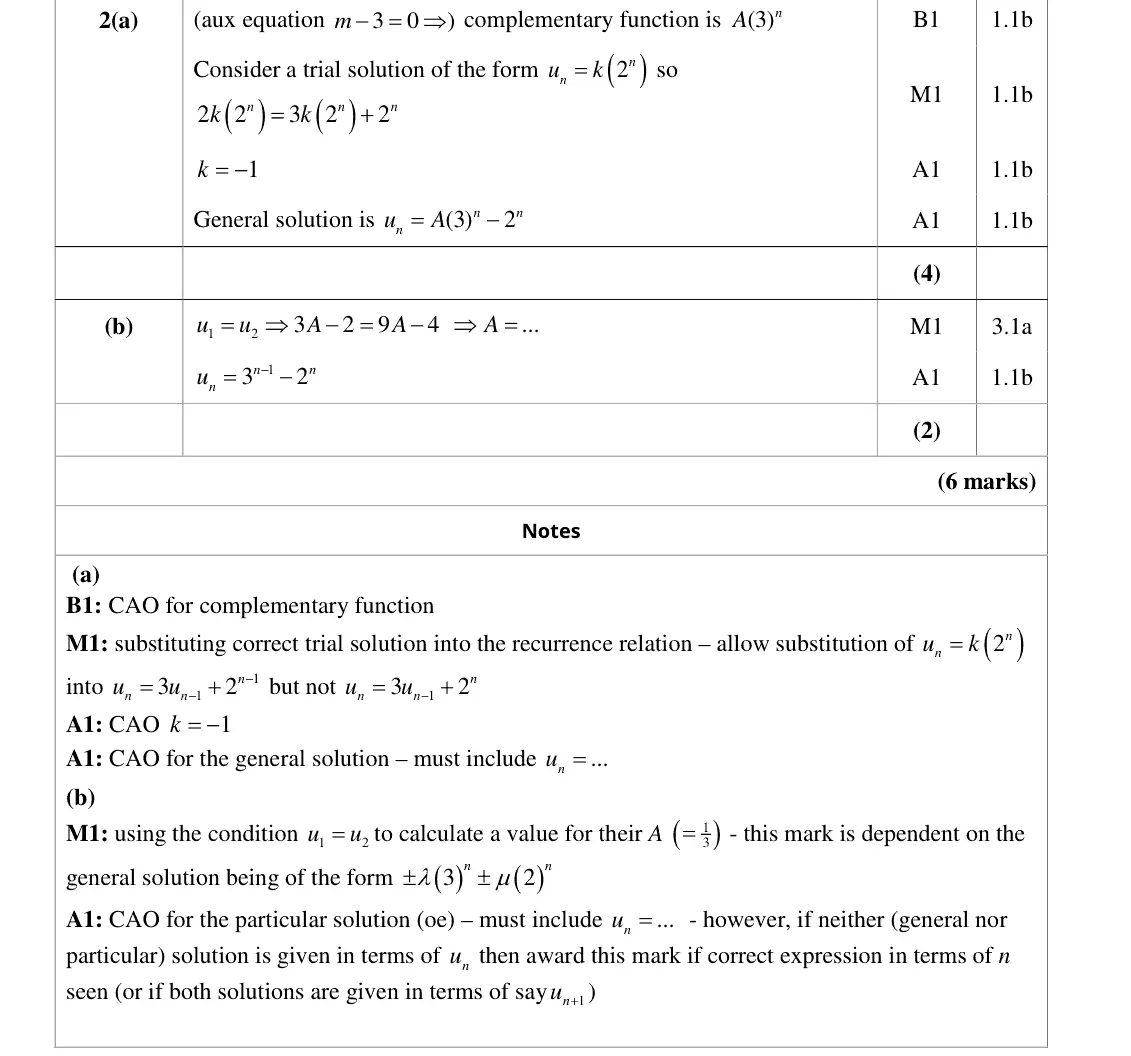
CF A(3)ⁿ
trial solution k(2ⁿ) gives k = −1 so uₙ = A(3)ⁿ − 2ⁿ
rewriting the relation wrongly as uₙ = 3uₙ₋₁ + 2ⁿ scores at most the CF mark
June 2019 · AS Paper 2 (Decision 2) · Q2(b)2 marks
Mark scheme (whole question; this part is marked with the orange bar)
Examiner's comment
As stated in the introduction, the responses to this question on the relatively new topic of recurrence relations were mixed. While some candidates scored full marks, a significant number made very little In part (b) those who had a general solution of the correct form could usually score the method mark 2. u u for finding a value for their constant based on the condition that However, a correct particular 1 solution was rarely seen in this part.
Key points from the mark scheme and examiner's report
u₁ = u₂ gives 3A − 2 = 9A − 4 so A = 1/3
uₙ = 3ⁿ⁻¹ − 2ⁿ
correct particular solution rarely seen
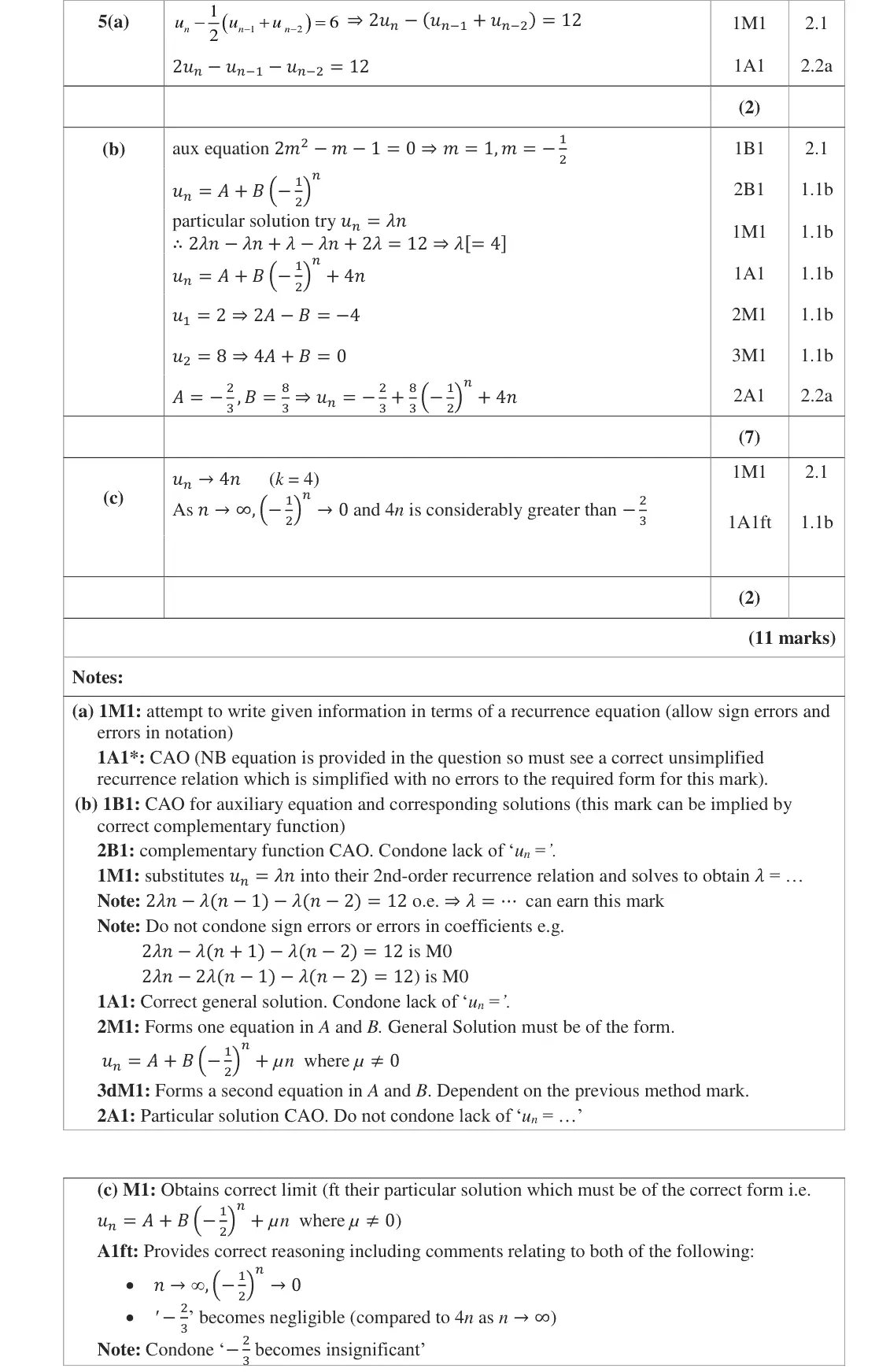
June 2019 · Paper 4D (Decision 2) · Q5(a)2 marks
Mark scheme (whole question; this part is marked with the orange bar)
Examiner's comment
Covering a new area of the specification, this question was meant to provide an accessible introduction to recurrence relations. It was extremely well answered by many candidates, but interestingly was also frequently not attempted by candidates. In part (a), a high proportion of candidates earned both marks. The most common loss of marks being due to sign errors when multiplying out brackets which is quite worrying at this level. Furthermore, a minority of candidates seemed unsure how to write down the mean of 𝑢𝑛-1 and 𝑢𝑛-2.
Key points from the mark scheme and examiner's report
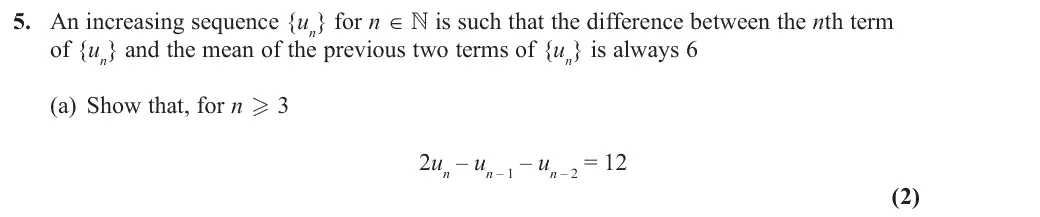
u_n − ½(u_{n−1} + u_{n−2}) = 6 then multiply by 2
sign errors expanding the bracket
printed answer so unsimplified form must be seen
June 2019 · Paper 4D (Decision 2) · Q5(b)7 marks
Mark scheme (whole question; this part is marked with the orange bar)
Examiner's comment
Covering a new area of the specification, this question was meant to provide an accessible introduction to recurrence relations. It was extremely well answered by many candidates, but interestingly was also frequently not attempted by candidates. Part (b) should have been quite standard and straightforward and for many candidates this was indeed the case. Worryingly though, some candidates set the right-hand side of their auxiliary equation equal to 12 and came unstuck almost immediately. However, the majority of candidates were able to form and solve the correct auxiliary equation although some misconceptions regarding the correct form of complementary function were apparent with some candidates writing, for example, 𝑢𝑛= 1 2 𝐴𝑛+ 𝐵𝑛. When determining the particular solution, most candidates correctly realised they needed to substitute 𝑢𝑛= 𝜆𝑛 into the recurrence relation and most were able to deduce that 𝜆= 4. Unfortunately, some candidates then made the costly error of deducing that the general solution was then 𝑢𝑛= 𝐴+ 𝐵(- 1 2)𝑛+ 4 rather than 𝑢𝑛= 𝑢𝑛= 𝐴+ 𝐵(- 1 2)𝑛+ 4𝑛. Solutions of an incorrect form such as these were then unable to earn later marks. Those candidates who obtained general solutions of the correct form were almost always able to write down two equations for ‘A’ and ‘B’ and solve them simultaneously, often using calculators, to determine the correct solution.
Key points from the mark scheme and examiner's report
auxiliary equation 2m² − m − 1 = 0 (RHS 0, not 12), m = 1, −½
CF A + B(−½)ⁿ
since 1 is a root try PS λn, λ = 4
u_n = −2/3 + (8/3)(−½)ⁿ + 4n
June 2019 · Paper 4D (Decision 2) · Q5(c)2 marks
Mark scheme (whole question; this part is marked with the orange bar)
Examiner's comment
Covering a new area of the specification, this question was meant to provide an accessible introduction to recurrence relations. It was extremely well answered by many candidates, but interestingly was also frequently not attempted by candidates. As mentioned above, part (c) was not accessible to candidates who made critical errors earlier in the question that give rise to general solutions of an incorrect form. Of those candidates who were eligible for marks here, a majority could state the value of k, but too frequently candidates only considered the behaviour of (- 1 2 )𝑛, and not the impact of the - 2 3.
Key points from the mark scheme and examiner's report
k = 4
must say (−½)ⁿ → 0 and the constant −2/3 is negligible compared with 4n
many only considered (−½)ⁿ
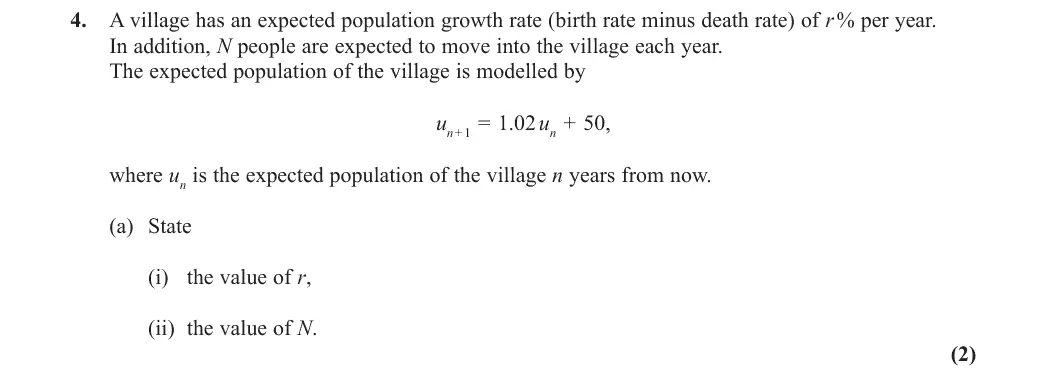
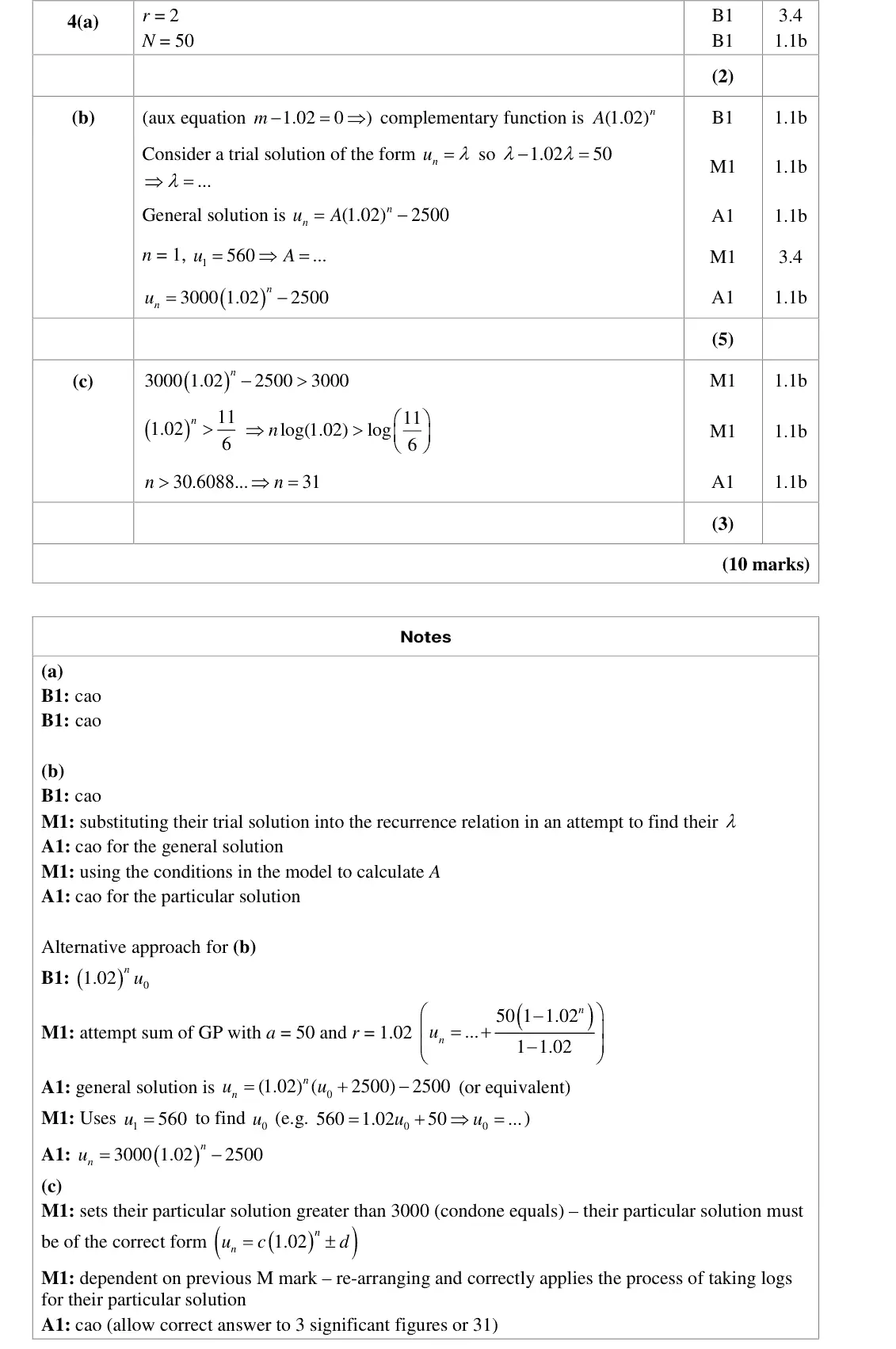
June 2018 · AS Paper 2 (Decision 2) · Q4(a)2 marks
Mark scheme (whole question; this part is marked with the orange bar)
Examiner's comment
As stated in the introduction, the responses to this question on the new topic of recurrence relations were mixed. While many students scored full marks a significant number made very little progress after (a). In part (a) many students correctly stated the value of N but many gave the value of r as either 1.02 or 0.02 (instead of the correct 2). nu was to first state the The most successful attempts in solving the recurrence relation for (1.02)n A complementary function as (where A is an arbitrary constant) and then to consider a trial nu solution of the form (so equal to a constant as the right-hand side of the recurrence relation once re-arranged was a constant too). This then should lead to a general solution of the form u n 560 (1.02) 2500 A and most students who got this far then correctly used the condition that 1 n u 3000 1.02 2500. to obtain the correct answer of The most common error was by those n u 560. students who believed that Of those students who attempted to use a geometric progression 0 with first term 50 and common ratio 1.02 many correctly arrived at the result that n u 560 1.02 2500 2500. u u However, these students then had to use and the original 1 0 n 0, u iterative formula to find and very few did so correctly. For those students who had correctly solved the recurrence relation in (b), many then determined
Key points from the mark scheme and examiner's report
r = 2 (not 1.02 or 0.02), N = 50
June 2018 · AS Paper 2 (Decision 2) · Q4(b)5 marks
Mark scheme (whole question; this part is marked with the orange bar)
Examiner's comment
As stated in the introduction, the responses to this question on the new topic of recurrence relations were mixed. While many students scored full marks a significant number made very little progress For those students who had correctly solved the recurrence relation in (b), many then determined n 11 correctly using logarithms (by solve the inequality 1.02 ) that it would be 31 years before the 6 model first predicting that the population would be in excess of 3000. A number of students used methods involving trial and improvement even though the question specifically demanded that an algebraic method be used.
Key points from the mark scheme and examiner's report
CF A(1.02)ⁿ
constant trial solution λ = −2500
u₁ = 560 gives A = 3000 so uₙ = 3000(1.02)ⁿ − 2500
GP sum route also accepted
June 2018 · AS Paper 2 (Decision 2) · Q4(c)3 marks
Mark scheme (whole question; this part is marked with the orange bar)
Examiner's comment
As stated in the introduction, the responses to this question on the new topic of recurrence relations were mixed. While many students scored full marks a significant number made very little progress
Key points from the mark scheme and examiner's report
3000(1.02)ⁿ − 2500 > 3000 so (1.02)ⁿ > 11/6
logs give n > 30.6 so 31 years
trial and improvement scores nothing as algebra was demanded
Find an Edexcel Further Maths tutor
Stuck on this? Book a trial lesson with our Further Maths tutor.