Arc length and surface area of revolution are given in cartesian, parametric and polar form.
Since 2018
30 question parts, 134 marks
Notes, worked examples and practice for this topic are being written by our tutors. The past-paper questions below are ready now: work each one on paper, then open the mark scheme and the examiner's comment.
Tap a question to zoom it. Mark scheme and examiner's comment open under each question.
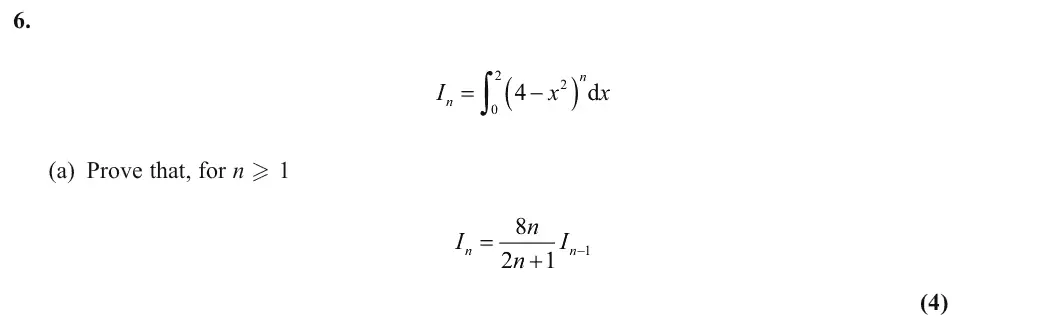
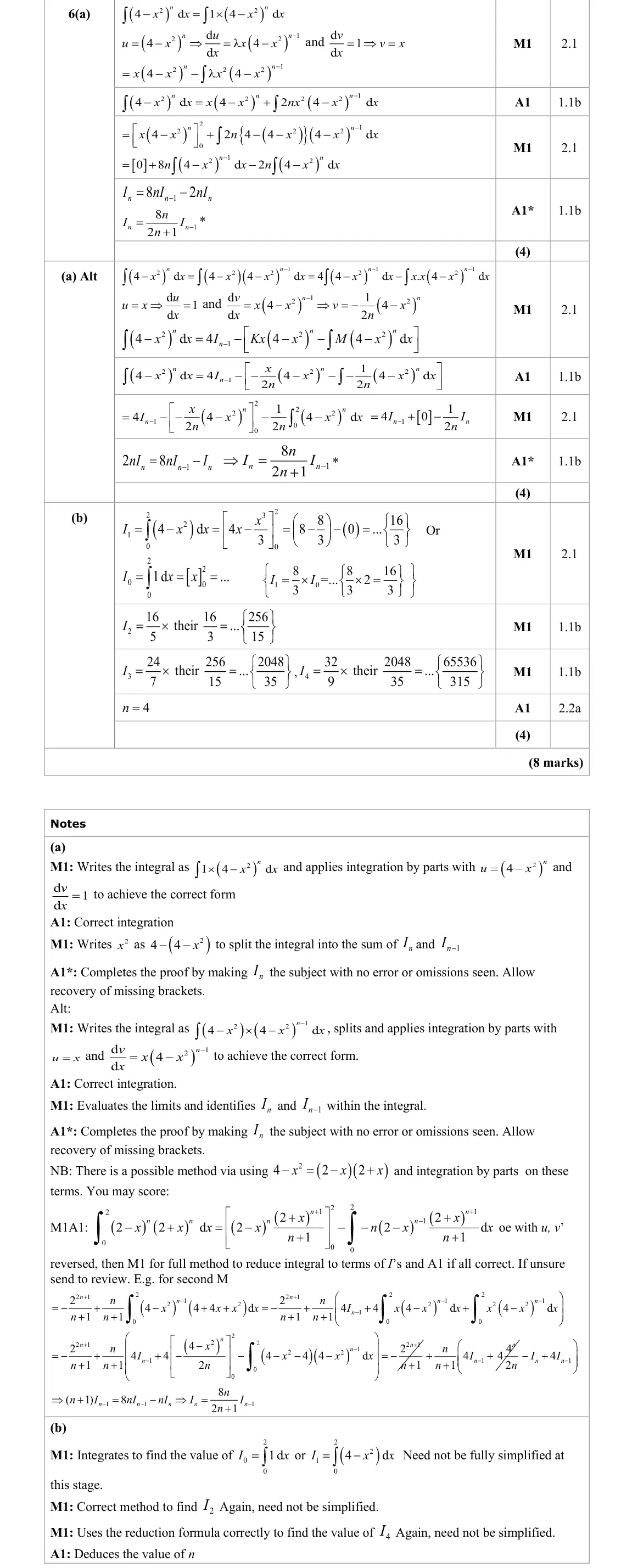
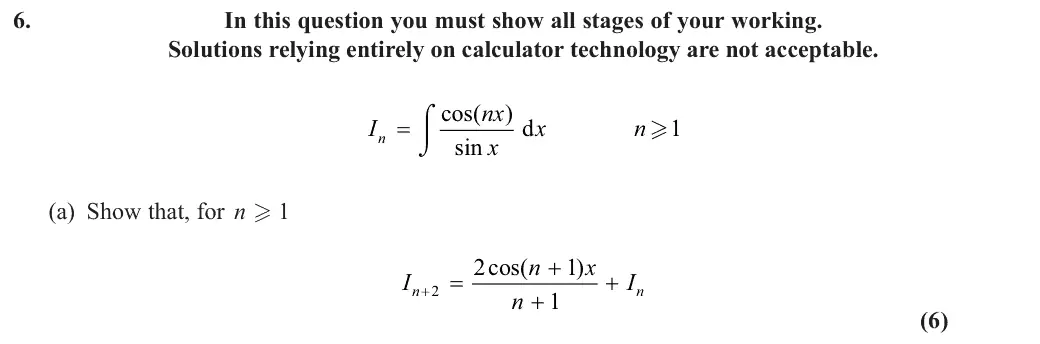
June 2025 · Paper 4A (Further Pure 2) · Q6(a)4 marks
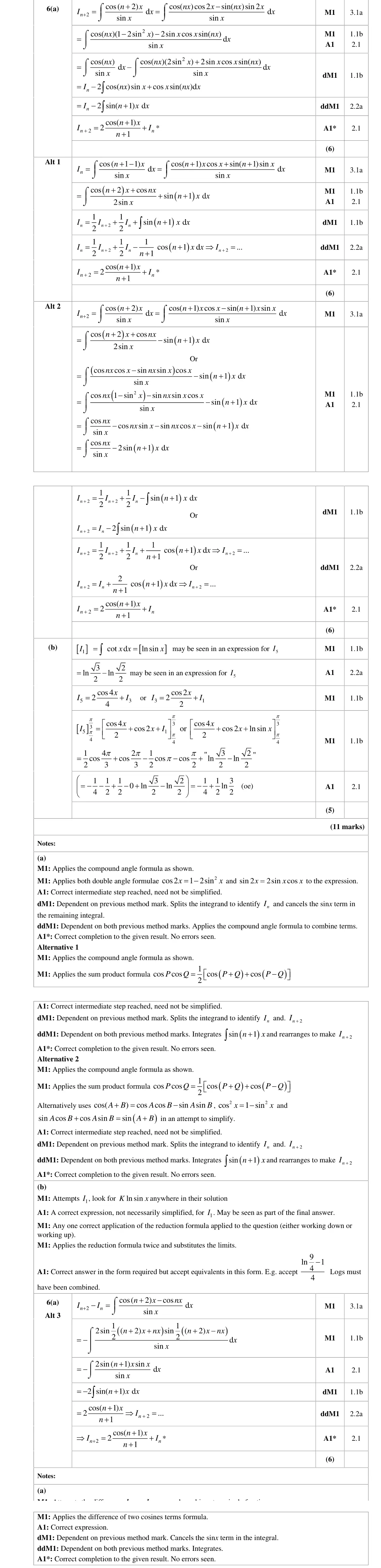
Mark scheme (whole question; this part is marked with the orange bar)
Examiner's comment
This was a topic which candidates seemed to feel quite comfortable with overall, being an expected topic for the paper, and many were fluent in the process required in part (a). Part (b) was, however, often over thought by students with much wild work trying to find closed forms that were not needed. Part (a) was done well overall, with success found using both main approaches, though the main method the more common. Though many were able to find a successful and succinct route at the first attempt, this question did produce a lot of multiple attempts with some only making suitable progress after several false starts. With the main method, most candidates got the first two marks without much fuss, though not all were able to spot the way to work with the 2x . Those that did generally completed without trouble to achieve the given result. There were a few who tried this approach but did not apply the chain rule when differentiating u, losing a factor x. These were then unable to make any further progress so score no marks. With the alternative method, there were more errors seen in the first stage of the process, often a sign error in one of the derivatives when applying parts, but if they succeeded in achieving the first A mark, most were able to finish the question correctly from there. The second M was more easily attainable in this approach as long as a suitable first stage of parts had been achieved. As well as these two methods the third possibility on the scheme was also seen on a few occasions, although with much more limited success. Often it would arise as an alternative method amongst many attempts when students could not get the main scheme approaches to work. As anticipated with this topic, less able candidates found this part challenging, with many struggling to make significant progress. This highlights an area where further targeted practice could be beneficial.
Key points from the mark scheme and examiner's report
parts on 1 × (4 − x²)ⁿ, chain rule factor −2x
write x² = 4 − (4 − x²) to give Iₙ = 8nIₙ₋₁ − 2nIₙ
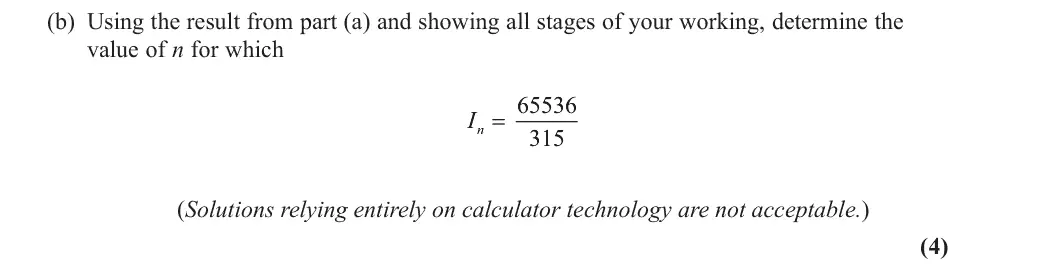
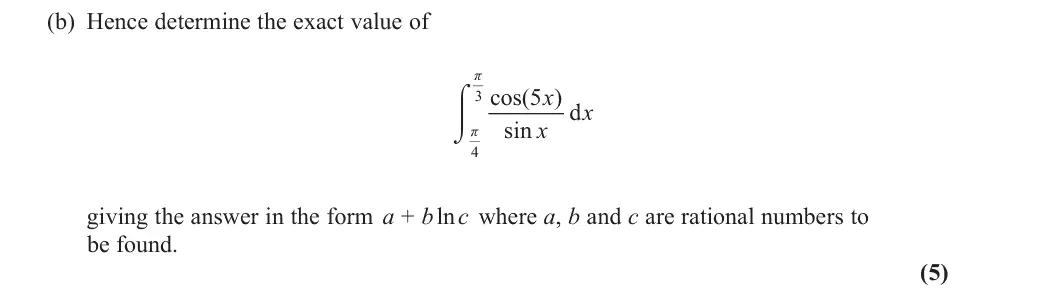
June 2025 · Paper 4A (Further Pure 2) · Q6(b)4 marks
Mark scheme (whole question; this part is marked with the orange bar)
Examiner's comment
This was a topic which candidates seemed to feel quite comfortable with overall, being an expected topic for the paper, and many were fluent in the process required in part (a). Part (b) was, however, often over thought by students with much wild work trying to find closed forms that were not needed. Part (b) tested the candidates' problem solving and often involved much wild working. Many persistently approached this from an algebraic approach, attempting to work from the top end of nI downward to reach a closed form and reason from there, but these usually ran into trouble. Sometimes they would realise and restart from the bottom end, other times grind to a halt, but it was no uncommon for n = 4 to suddenly appear from no clear working, presumably having tried a few cases on the calculator to work it out, despite the comment in the question that a non-calculator was required. However, a few did come up with some well- reasoned answers from the prime factorisation of the value given compared to the closed form– it just happened to be a long-winded unnecessary route in this case. Those who simply started with the first terms and worked upwards usually obtained the result with little fuss. This meant that some less able candidates performed well on this question by adopting a numerical approach, which they were more willing to attempt than some stronger candidates who focused on a more formal algebraic method. It was good to see candidates who did not do well in part (a) persist and do well in part (b). Both parts were discriminating in different ways, with part (a) highlighting stronger candidates’ ability to work through the algebra and proof and part (b) giving students an opportunity to show they can step back and think through the most strategic route to a problem.
Key points from the mark scheme and examiner's report
start from I₀ = 2 (or I₁ = 16/3) and work up: I₂ = 256/15, I₃ = 2048/35, I₄ = 65536/315 so n = 4
working down from Iₙ was a waste of time
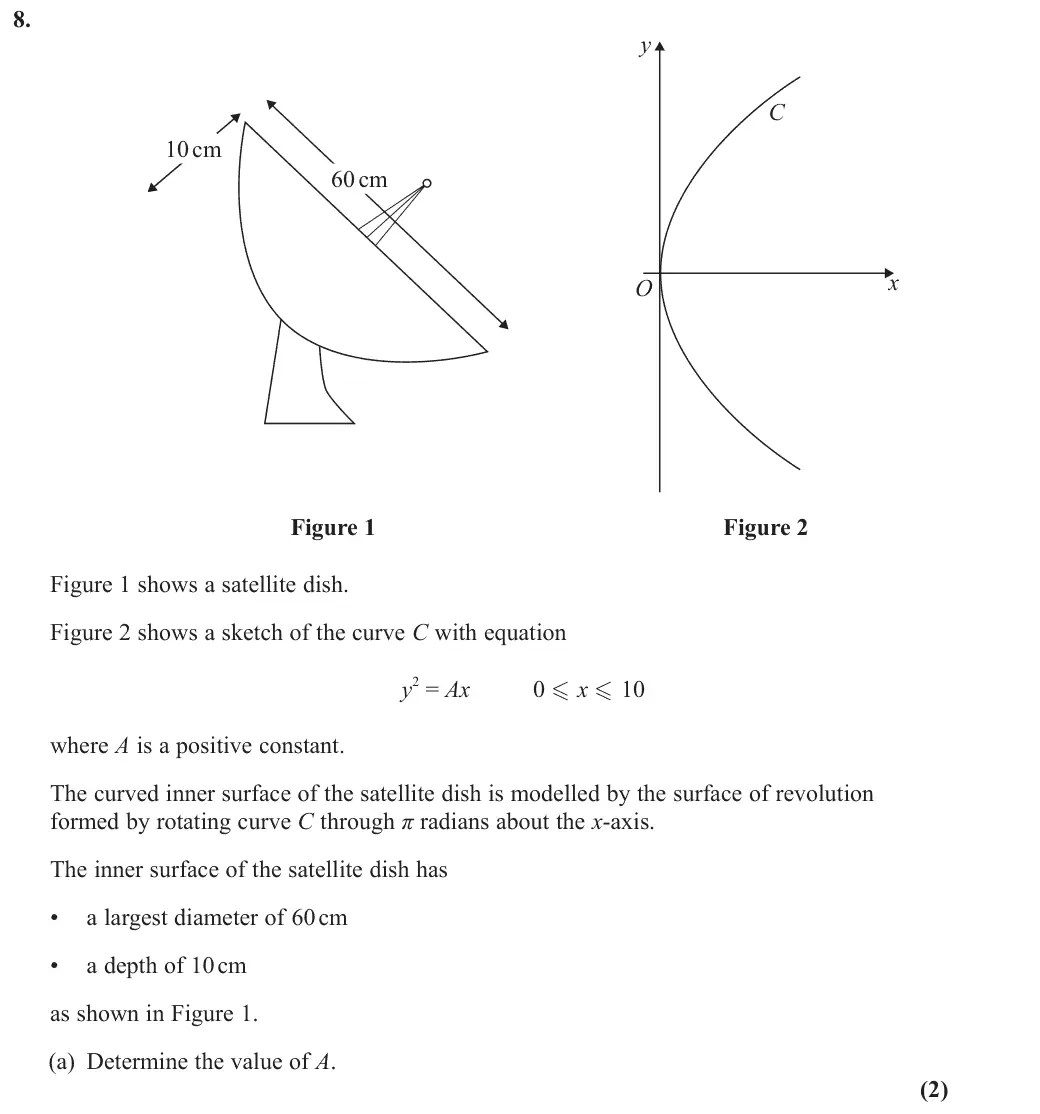
June 2025 · Paper 4A (Further Pure 2) · Q8(a)2 marks
Mark scheme (whole question; this part is marked with the orange bar)
Examiner's comment
This question in modelling a satellite was another in which some students hampered themselves part way through by trying to overthink the problem, with many trying far more complicated integration techniques than was necessary. But the general procedures required were shown to be understood, saving that many were confused about the constant needed in front of the integral – whether it need pi or 2 pi . Part (a) was answered very well, with very few making errors at this stage. Errors made included the mistake of using 60 instead of 30 (taking diameter instead of radius), while some others mixed up x and y, both cases scoring no marks, while some did score the first mark but made an error squaring 30 to given 90 instead of 900.
Key points from the mark scheme and examiner's report
radius 30 (not diameter 60) at x = 10: 900 = 10A, A = 90
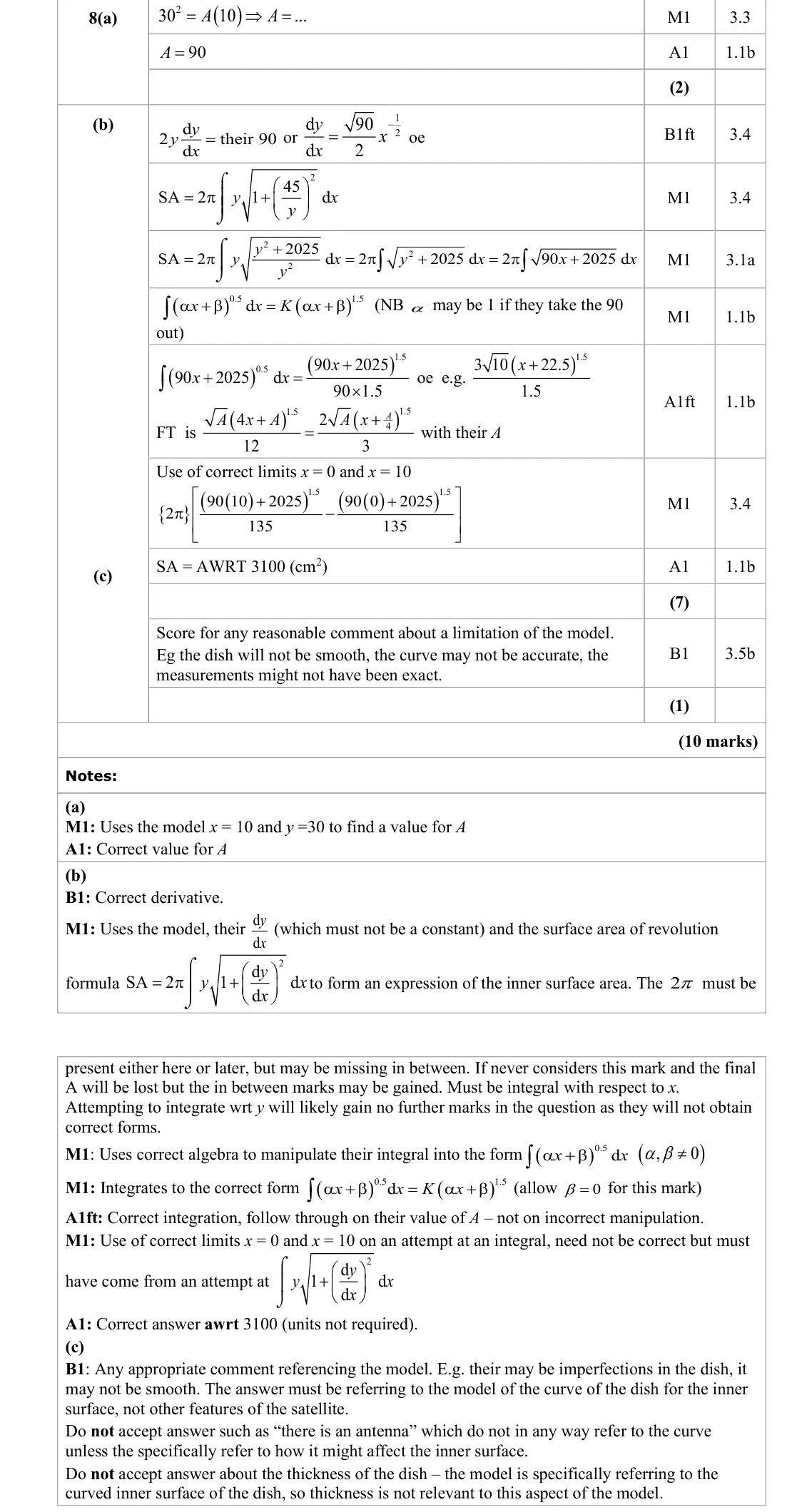
June 2025 · Paper 4A (Further Pure 2) · Q8(b)7 marks
Mark scheme (whole question; this part is marked with the orange bar)
Examiner's comment
This question in modelling a satellite was another in which some students hampered themselves part way through by trying to overthink the problem, with many trying far more complicated integration techniques than was necessary. But the general procedures required were shown to be understood, saving that many were confused about the constant needed in front of the integral – whether it need pi or 2 pi . There was a bit more of a mixed performance in part (b), most notably to do with whether the curve was to be rotated by pi or 2 pi . This was due to the curve in the sketch being above and below the axis, and students not realising the equation 90 y x = only represents the part above the axis, so needs rotating by 2 pi . Many instead rotated by pi and only calculated half of the surface area. Most candidates started well by finding d d y x correctly, following through their answer to (a) in some cases. Both versions in the scheme were seen equally frequently, but the implicit approach was less prone to slips being made. Again, most attempted the surface area formula, with the proviso about the multiple noted above costing some the first M, but some variations on the formula were seen, for instance 2 d d 1 d x y y y + ∫ was used on numerous occasions, which is a correct alternative and gave a suitable integrable function. However, some had versions with x instead of y in front of the square root, and so were incorrect, and these could generally not score any marks as the resulting integral was not of a suitable form. Examiner had to be diligent in checking the equations. Whichever form was used, substituting into the formula usually followed but not were able to manipulate the integral into a suitable form, and so some stopped at this stage, while others attempted integration by parts or a substitution, often going nowhere - though some and various valid substitutions were used, which again meant examiners needed to be careful to track through work to see if it was successful or not. Even among those who simplified the integral to the point shown in the mark scheme, not all spotted the inverse chain rule integration approach but instead attempted a trigonometric or hyperbolic substitution over thinking the problem. Some of these were correct and reached the correct answer (or half of it if the 2 was missing), but students ought to be watchful for the more direct route, expecting a substitution to be specified if needed. Those who spotted the simpler route were usually successful in attaining a correct follow through integral for their A, or at least a correct form for it – some square rooted the 90 incorrectly to lose the follow through accuracy mark at this stage. Substitution of limits at the end, providing that a suitable attempt at the surface area integral had been made, gave a bit of access to students even when the integration itself had gone wrong as long as they persisted in reaching that stage, which most did. Although there were various approaches to the integral taken many did manage to find a value for the surface area, but the most common error was the wrong coefficient at the start, reaching 1600 cm2 rather than 3100 cm2, with nearly half of students completing the problem giving this answer.
Key points from the mark scheme and examiner's report
S = 2π∫ y √(1 + y′²) dx = 2π∫√(90x + 2025) dx from 0 to 10 (2π, as y² = 90x gives only the upper half)
answer about 3100 cm²
1600 from using π was very common
no substitution needed
June 2025 · Paper 4A (Further Pure 2) · Q8(c)1 mark
Mark scheme (whole question; this part is marked with the orange bar)
Examiner's comment
This question in modelling a satellite was another in which some students hampered themselves part way through by trying to overthink the problem, with many trying far more complicated integration techniques than was necessary. But the general procedures required were shown to be understood, saving that many were confused about the constant needed in front of the integral – whether it need pi or 2 pi . For the limitation in part (c) most students focussed on the smoothness (or possible lack thereof) of the satellite, and so this part was generally done well. Variations such as stating that the dish may not fit the curve accurately or that the curve may not be exact were also acceptable. However, there were also a significant number who considered instead that the thickness of the dish would be an issue and did not gain the mark since the model is specifically noted as being a model for the inner surface of the dish and not the dish itself, therefore thickness was not relevant. A careful consideration of exactly what the model is for is required to identify a limitation.
Key points from the mark scheme and examiner's report
e.g. dish surface not smooth or not exactly this curve
thickness is not relevant as the model is of the inner surface
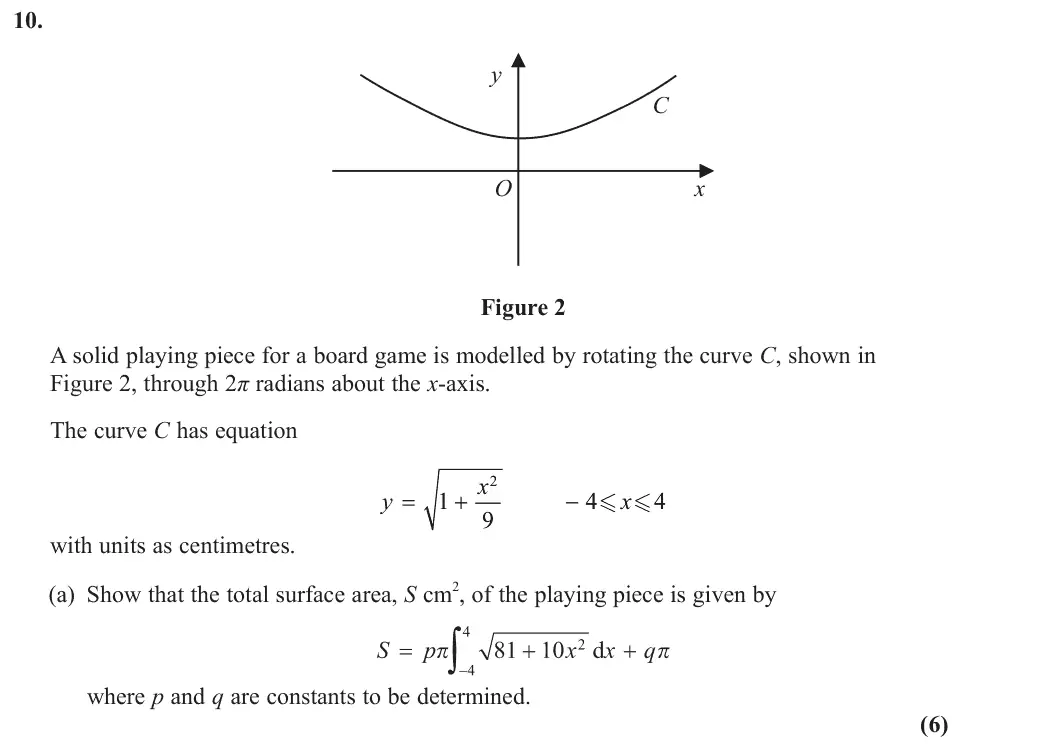
June 2024 · Paper 4A (Further Pure 2) · Q6(a)6 marks
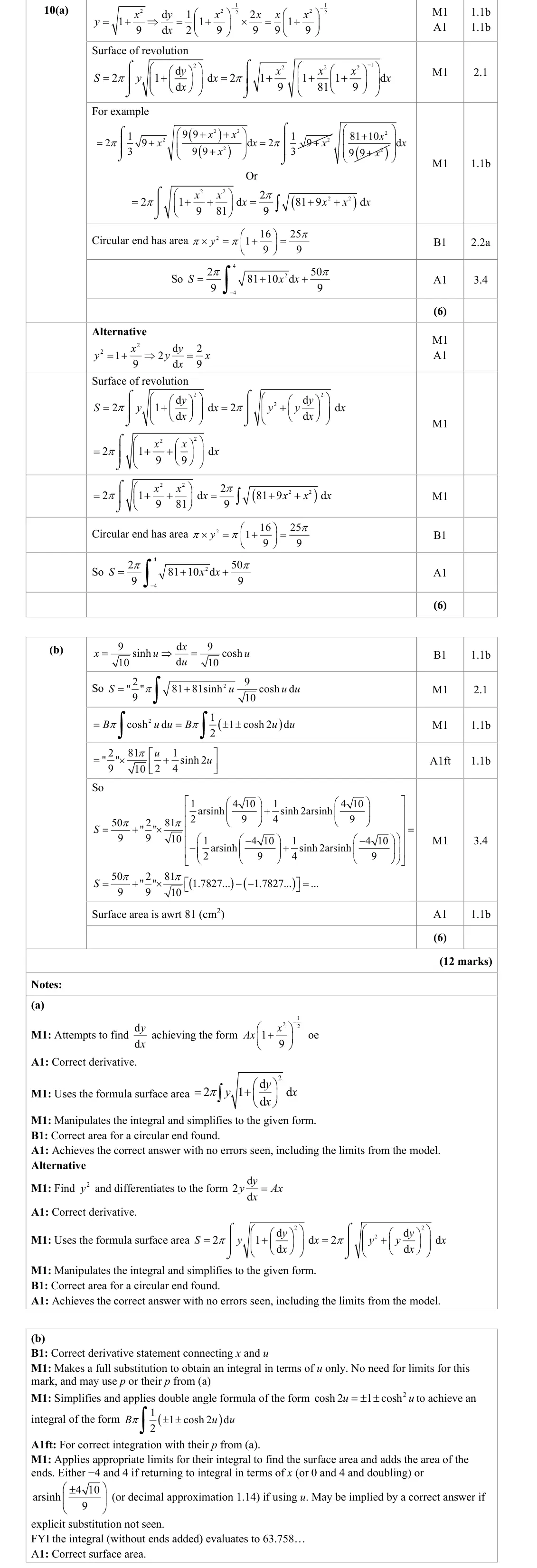
Mark scheme (whole question; this part is marked with the orange bar)
Examiner's comment
Part (a) was challenging to many candidates, but it was pleasing to see that candidates used the answer to part (a) to solve part (b) Part (a) there were many approaches to proving the result with the easiest approach using 2 cos( 2) cos sin d n n n x nx I I x x + + - - = and then applying the difference of two cosines terms formula, in the A level mathematics section of the formula book. Candidates who started with 2 cos( )cos2 sin( )sin 2 d cos( 2) n sin d si n n x I nx x nx x x x x x + - + = = scored the first method mark but then struggled to know where to go from there. Candidates needed to use 2 cos2 1 2sin x x = - and sin 2 2sin cos x x x = then simplify and compound angle formula to combine terms. Candidates who stared with cos( 1) cos sin( 1)sin d d sin cos( 1 1) sin n n x x I x n x n x x x x + - + + = + = scoring the first method mark but again then struggled to know where to go from there. Candidates needed to use ( ) ( ) 1 cos cos cos cos 2 P Q P Q P Q = + + - which is not explicitly in the formula book, however some candidates were aware of this formula and used it correctly. This approach was less successful that using 2 nI + . There were quite a few scripts where no marks were scored in this part.
Key points from the mark scheme and examiner's report
Iₙ₊₂ − Iₙ via difference of cosines: cos(n + 2)x − cos nx = −2 sin(n + 1)x sin x
integrate −2 sin(n + 1)x
compound/double angle routes harder
June 2024 · Paper 4A (Further Pure 2) · Q6(b)5 marks
Mark scheme (whole question; this part is marked with the orange bar)
Examiner's comment
Part (b) it was pleasing how many candidates who did not manage to successfully prove (a) was it to answer this part. Most candidates who attempted this part correctly found 1 cot d lnsin x x x I = = and used the correct limits to score two marks. The next mark was for using the recurrence relationship at least once. A common error was incorrectly using 3 5 cos6 2 6 x I I = + or 3 1 cos4 2 4 x I I = + , this then also lost them the method mark for use of limits to a correct reduction formula. A few candidates incorrectly found the answer to 7I scoring 3/5 marks.
Key points from the mark scheme and examiner's report
I₁ = ln sin x
I₃ = cos 2x + I₁, I₅ = ½cos 4x + I₃
limits π/4 to π/3: −1/4 + ½ ln(3/2)
wrong n in the formula (e.g. cos 6x/6) was common
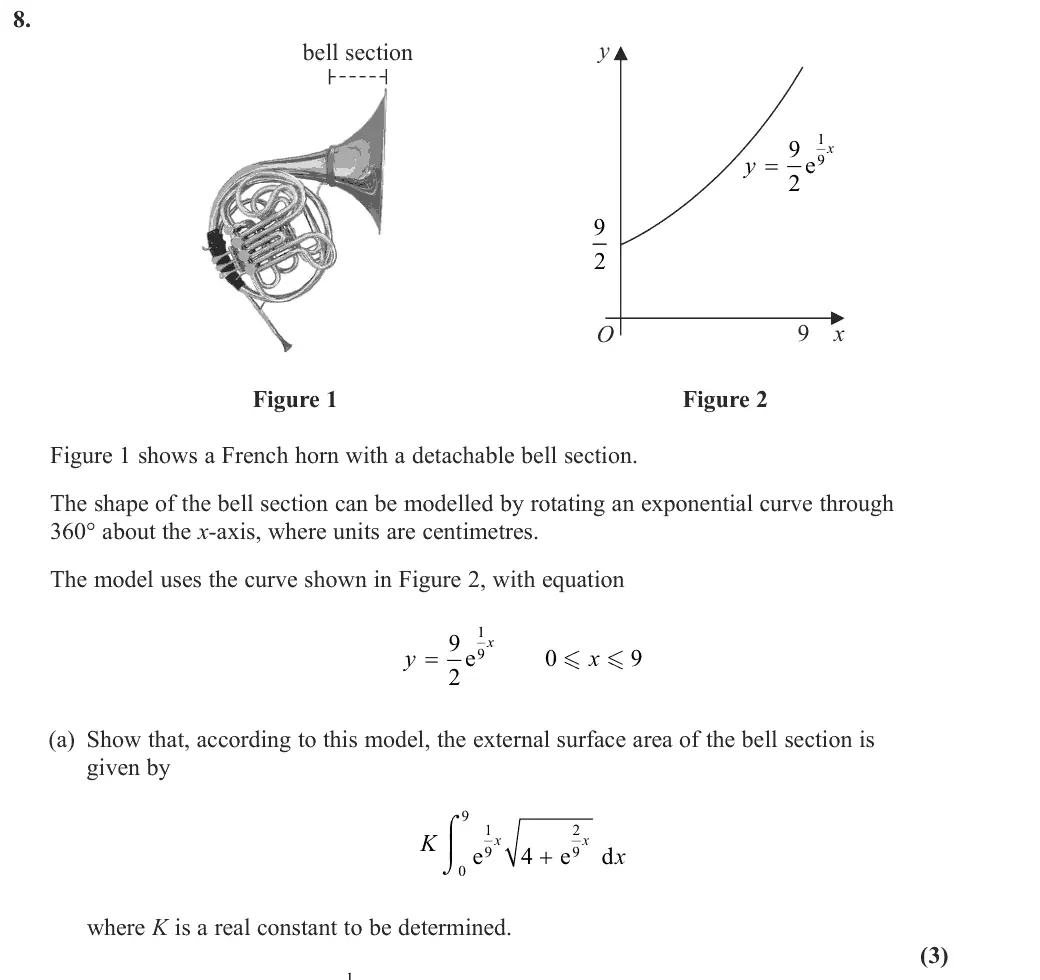
June 2024 · Paper 4A (Further Pure 2) · Q8(a)3 marks
Mark scheme (whole question; this part is marked with the orange bar)
Examiner's comment
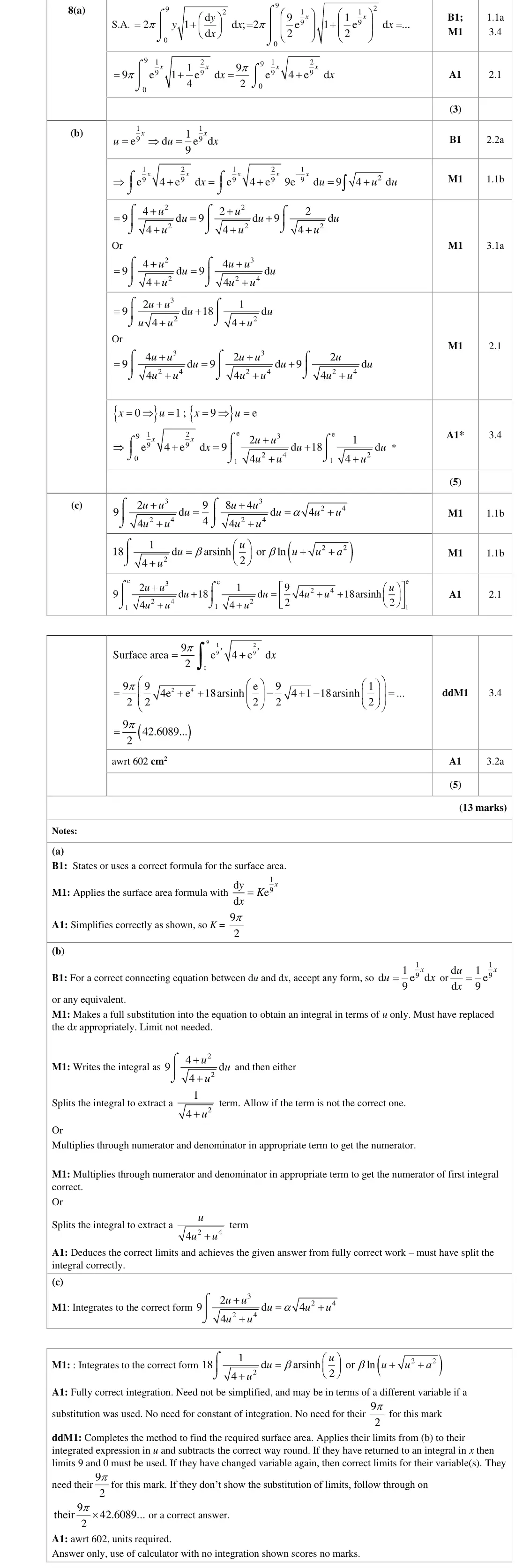
This question was split into parts which made all parts accessible to candidates, with proving the result in part (b) the most demanding. Part (a) Candidates were able to quote and correctly use the surface area formula. Many candidates managed to achieve the correct expression with correct value for K. A few candidates had an incorrect value for K when they factorised out 1 4 ended up multiplying by 2 instead of dividing.
Key points from the mark scheme and examiner's report
S = 2π∫ y √(1 + y′²) dx with y′ = ½e^(x/9)
K = 9π/2
factorising ¼ out wrongly gave a wrong K
June 2024 · Paper 4A (Further Pure 2) · Q8(b)5 marks
Mark scheme (whole question; this part is marked with the orange bar)
Examiner's comment
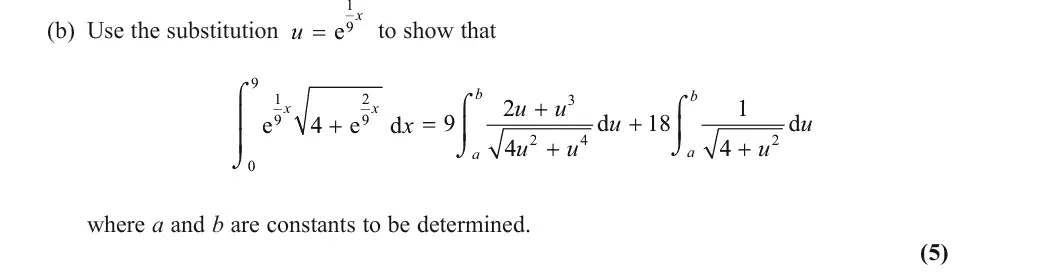
This question was split into parts which made all parts accessible to candidates, with proving the result in part (b) the most demanding. Part (b) this was the most demanding part of the question, using the given substitution to prove the result. The majority of candidates score the first 2 marks for differentiating the substitution and then a full substitution int the equation to obtain an integral in terms of u only. Many stopped at this point unsure how to process. Some candidates did recognise that they needed to write as 2 2 2 4 9 4 d 9 d 4 u u u u u + + = + , the key step and then split into two integrals 2 2 2 2 2 4 2 2 9 d 9 d 9 d 4 4 4 u u u u u u u u + + = + + + + . They then went onto to achieve the required results. All candidates who attempted this part were able to find the correct limits.
Key points from the mark scheme and examiner's report
du = (1/9)u dx so integral = 9∫√(4 + u²) du
write as 9∫(4 + u²)/√(4 + u²) du and split
limits a = 1, b = e
June 2024 · Paper 4A (Further Pure 2) · Q8(c)5 marks
Mark scheme (whole question; this part is marked with the orange bar)
Examiner's comment
This question was split into parts which made all parts accessible to candidates, with proving the result in part (b) the most demanding. Part (c) It was pleasing that even if candidates could not prove the result in (b) they used it to integrate the result in (a). The majority of candidate achieved the correct result for ( ) 2 2 2 1 18 d arsinh or ln 2 4 u u u u a u = + + + which is in the formula book. Candidates were less successful with 3 3 4 2 4 4 2 2 2 9 8 4 9 d d 4 4 4 4 u u u u u u u u u u u u + + = = + + + a common incorrect answer was ( ) 2 4 ln 4u u + . The third method mark was dependent on have the correct form of the integrals, using the correct limits and multiplying by their K. Quite a few candidates lost this mark as they forgot to multiply be their K. For the final mark units for the area were required and the majority of candidates who had a correct answer gave the correct units.
Key points from the mark scheme and examiner's report
first integral = (9/2)√(4u² + u⁴), second = 18 arsinh(u/2)
times K = 9π/2: ≈ 602 cm² (units needed)
forgetting K common
June 2023 · Paper 4A (Further Pure 2) · Q8(a)4 marks
Mark scheme (whole question; this part is marked with the orange bar)
Examiner's comment
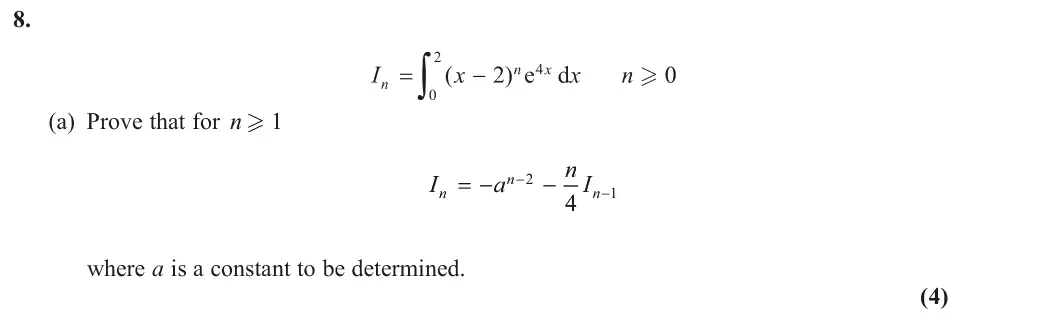
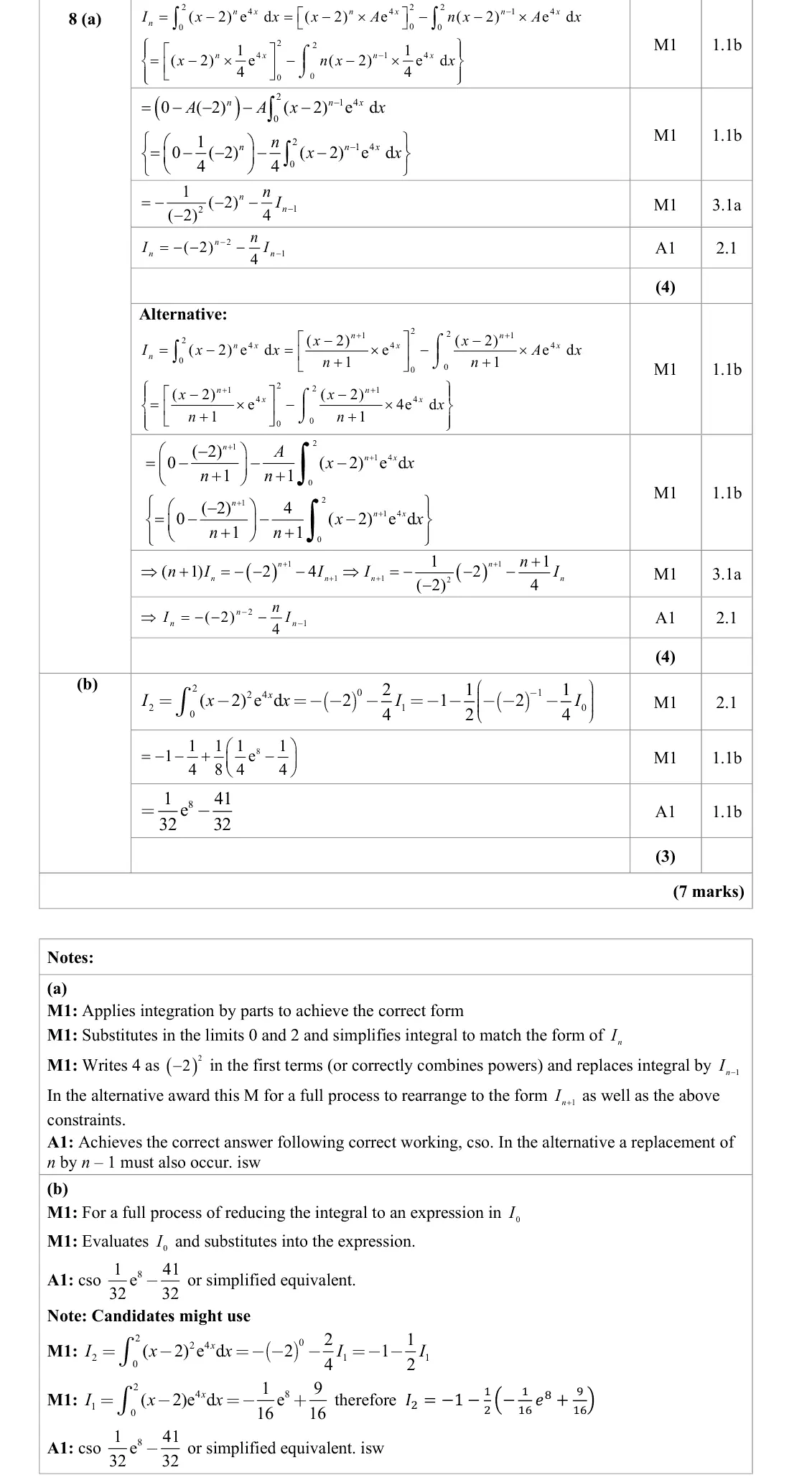
(a) The majority of candidates correctly used integration by parts to show the recurrence integration formula. The main error was seen with finding the value of a incorrectly thinking that ( ) ( ) 2 1 2 2 4 n n - - - = - instead of ( ) 2 2 n - -- . Candidates are reminded to look at the form that they are asked to show.
Key points from the mark scheme and examiner's report
parts with e⁴ˣ/4
uv term at 0 gives −(−2)ⁿ/4 = −(−2)ⁿ⁻²: a = −2 (not 2 or −4)
June 2023 · Paper 4A (Further Pure 2) · Q8(b)3 marks
Mark scheme (whole question; this part is marked with the orange bar)
Examiner's comment
(b) Candidates who were successful with achieving an answer to part (a) were able to use it to find 2I . Due to errors with the value of a many lost the accuracy mark but gained the method marks. Candidates who did not use the answer to part (a) and went straight for integrating did not gain any marks.
Key points from the mark scheme and examiner's report
June 2023 · Paper 4A (Further Pure 2) · Q10(a)6 marks
Mark scheme (whole question; this part is marked with the orange bar)
Examiner's comment
(a) Many candidates knew that they needed to find d d y x and substituted into the correct surface area formula. Candidates who incorrectly wrote 1 2 2 d 1 1 d 2 9 y x x - = + missing the derivate of 2 9 x were unable to score many marks as they would not be able to achieve the required form. Candidates with the correct d d y x did manage to achieve the correct form but there was an error in taking out 9 which appeared as the numerator instead of the denominator. The main error was not considering the area of the circles on the ends, some thought that q = 0 and many more just ignored it. Candidates are reminded to check the form of the answer so that they can see if they have missed anything.
Key points from the mark scheme and examiner's report
dy/dx = (x/9)(1 + x²/9)^(−½) (chain rule often missed)
June 2023 · Paper 4A (Further Pure 2) · Q10(b)6 marks
Mark scheme (whole question; this part is marked with the orange bar)
Examiner's comment
(b) This part was less well done with many candidates who did not achieve an answer to (a) not attempting this part, however a few did correctly find d d x u which was good. A few candidates after finding d d x u when substituting into the formula had it inverted, so they were unable to achieve the correct form of the integral. Candidates who were able to correct achieve 2 cosh d u u used the correct identity to integrate it. The correct limits were then generally used, a few incorrectly used x limits. Not many candidates achieved the correct overall surface area due to earlier errors.
Key points from the mark scheme and examiner's report
x = (9/√10) sinh u gives ∫cosh²u du = ½∫(1 + cosh 2u) du
limits arsinh(±4√10/9)
integral ≈ 63.76, total ≈ 81 cm²
inverted dx/du and x-limits were common errors
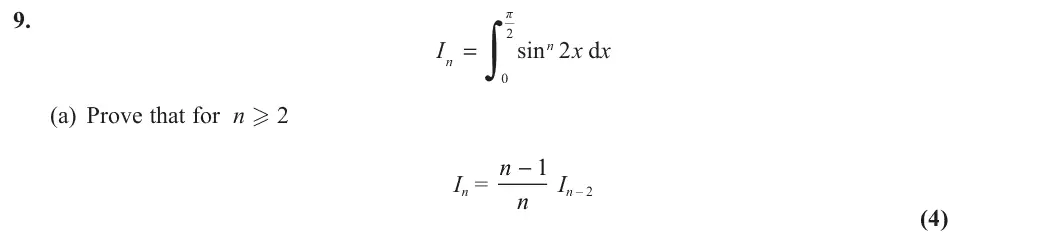
June 2022 · Paper 4A (Further Pure 2) · Q9(a)4 marks
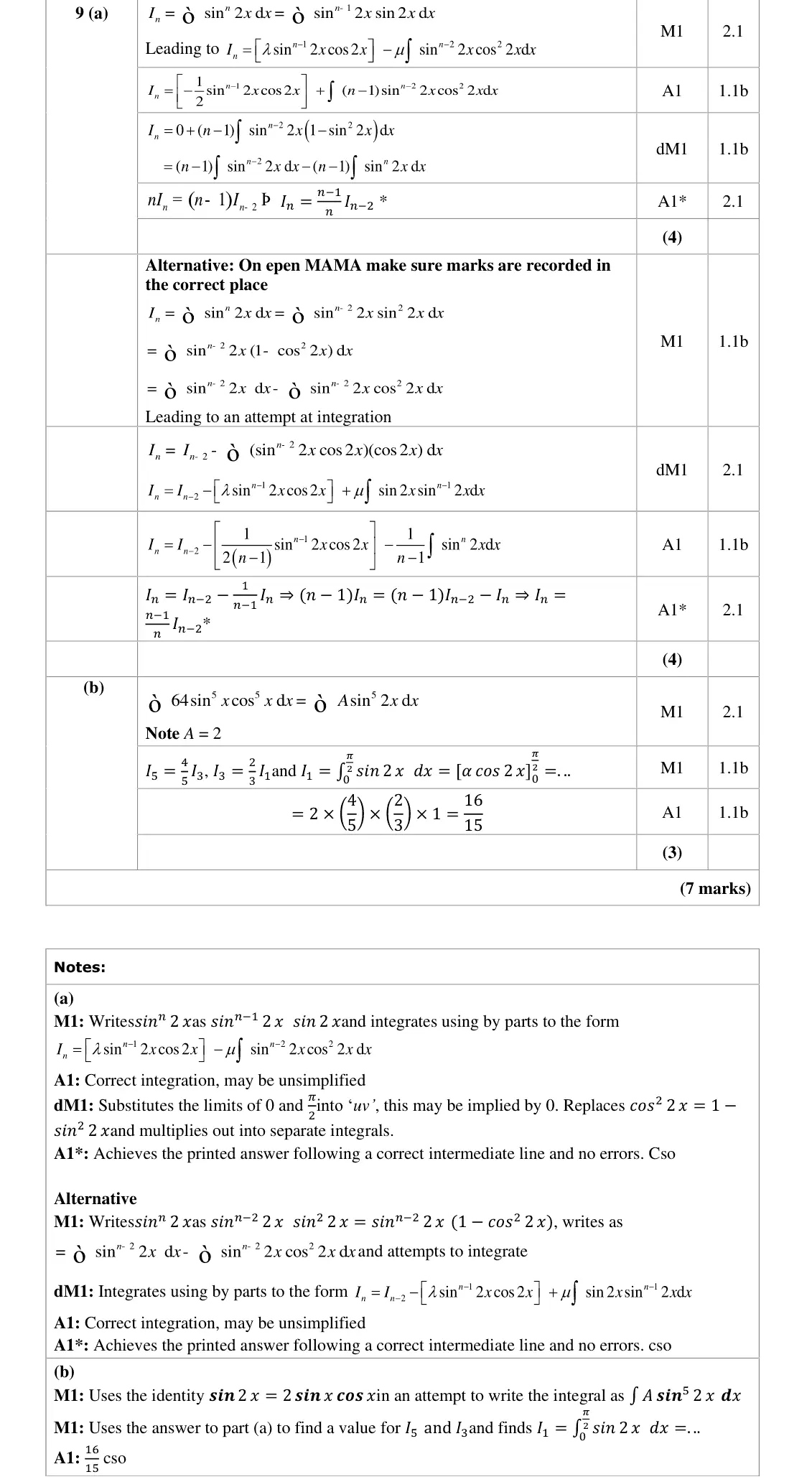
Mark scheme (whole question; this part is marked with the orange bar)
Examiner's comment
Part (a) the reduction formula proof gained a number of well written and completely correct responses, mostly among those candidates who used the main approach given in the mark scheme. Those who attempted the alternative approach found it much harder to make progress, often gaining no marks for this part of the question. Marks lost tended to be for algebraic slips, including those who struggled with part (a).
Key points from the mark scheme and examiner's report
parts on sinⁿ⁻¹2x · sin 2x
uv term vanishes at 0 and π/2
cos²2x = 1 − sin²2x gives nIₙ = (n − 1)Iₙ₋₂
June 2022 · Paper 4A (Further Pure 2) · Q9(b)3 marks
Mark scheme (whole question; this part is marked with the orange bar)
Examiner's comment
Part (b) Most candidates noticed the transformation needed in part (b), although a significant number found an incorrect coefficient of 32 rather than 2, leading to a loss of the final accuracy mark. Aside from that, candidates generally did well on this part of the question, including those who struggled with part (a).
Key points from the mark scheme and examiner's report
64 sin⁵x cos⁵x = 2 sin⁵2x (not 32)
I₅ = (4/5)(2/3)I₁, I₁ = 1: answer 16/15
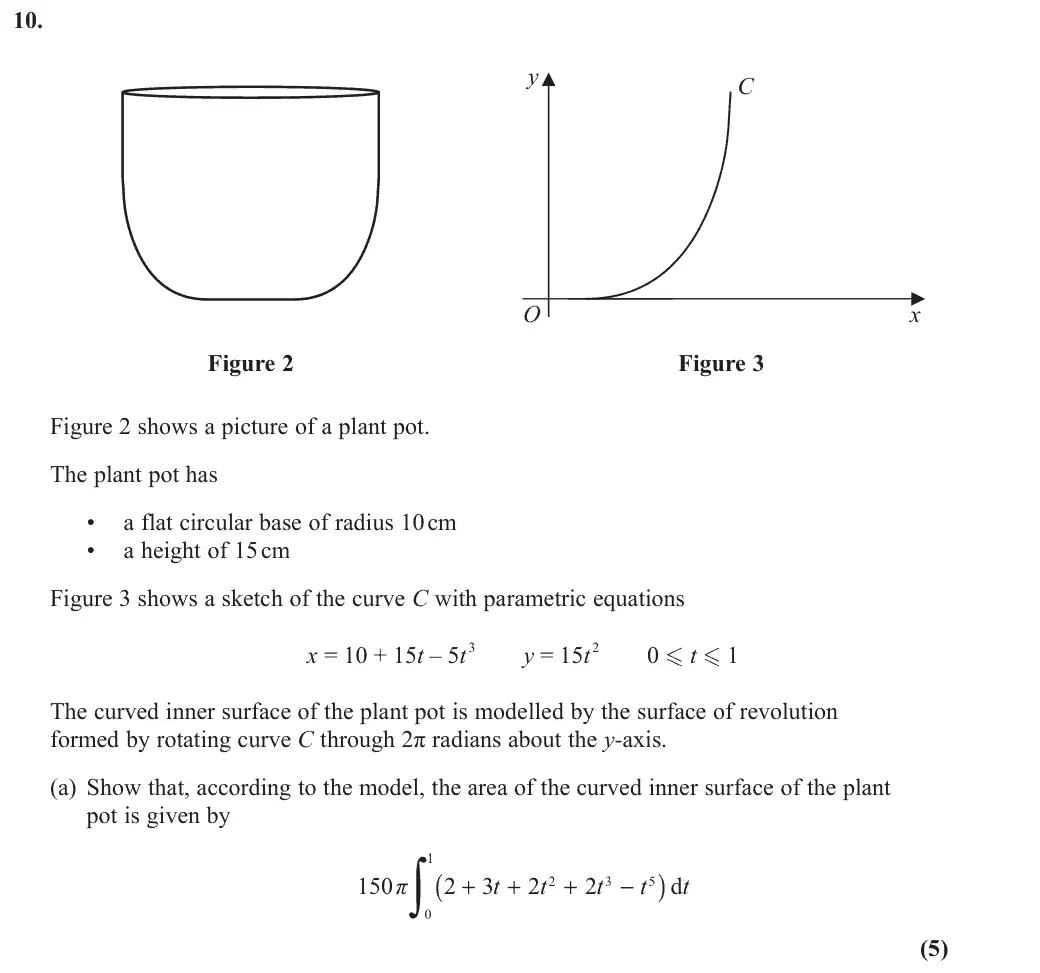
June 2022 · Paper 4A (Further Pure 2) · Q10(a)5 marks
Mark scheme (whole question; this part is marked with the orange bar)
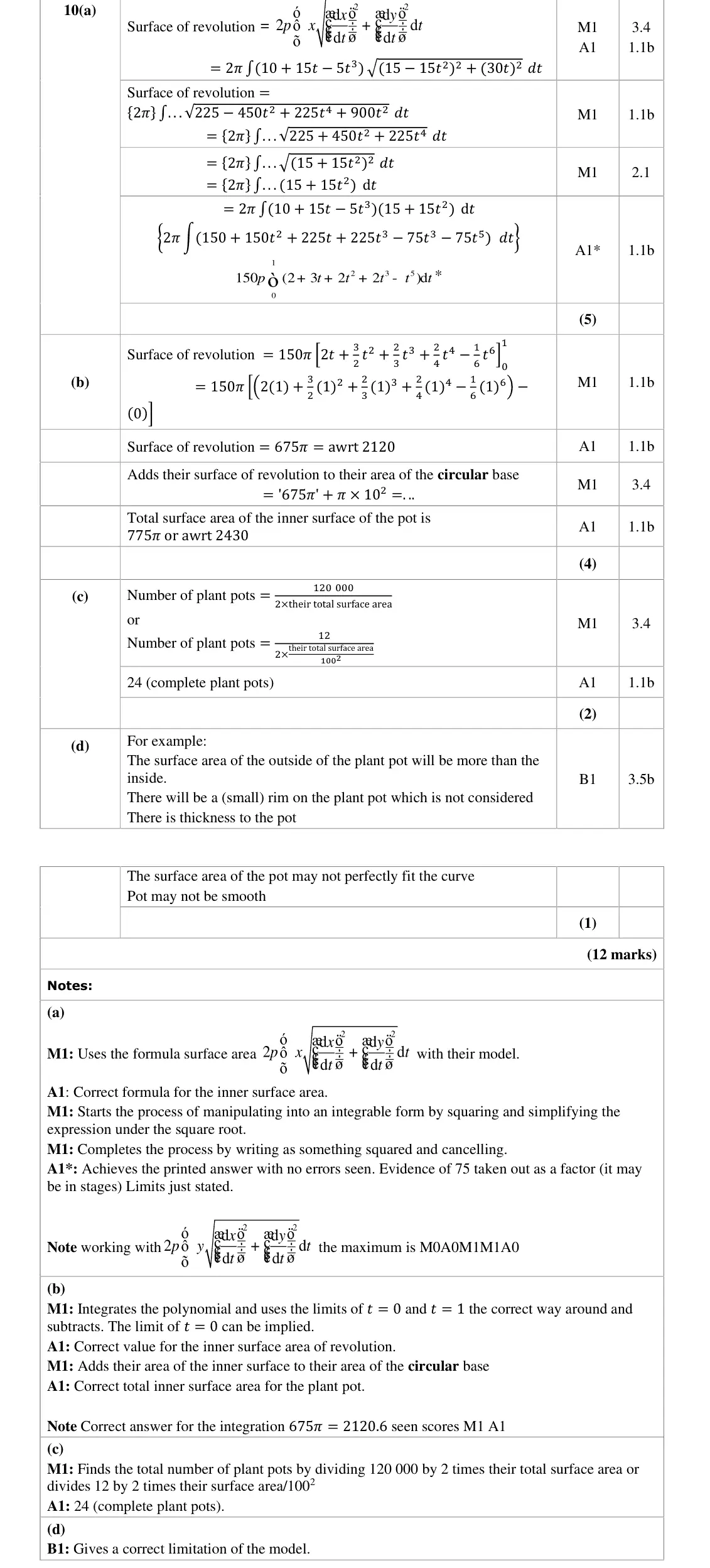
Examiner's comment
Part (b) Most candidates used the result form part (a) and integrated to achieve 675 pi . The majority of the candidates did not recognise that they needed to find the area of the circular base and add this on find the area of the inner surface of the plant pot.
Key points from the mark scheme and examiner's report
about the y-axis: S = 2π∫ x √(ẋ² + ẏ²) dt
(15 − 15t²)² + (30t)² = (15 + 15t²)²
expand to the printed integrand
June 2022 · Paper 4A (Further Pure 2) · Q10(b)4 marks
Mark scheme (whole question; this part is marked with the orange bar)
Examiner's comment
Part (b) Most candidates used the result form part (a) and integrated to achieve 675 pi . The majority of the candidates did not recognise that they needed to find the area of the circular base and add this on find the area of the inner surface of the plant pot.
Key points from the mark scheme and examiner's report
integral gives 675π
must add the circular base π × 10² = 100π: 775π ≈ 2430 cm²
most forgot the base
June 2022 · Paper 4A (Further Pure 2) · Q10(c)2 marks
Mark scheme (whole question; this part is marked with the orange bar)
Examiner's comment
Part (c) Although candidates mainly recognised the need to divide 120 000 by twice their area some used just 12 or made other slips with the units, while others coated only the inner surface of the pot
Key points from the mark scheme and examiner's report
120 000 cm² ÷ (2 × 775π) = 24 complete pots
unit slips and painting only the inside were common
June 2022 · Paper 4A (Further Pure 2) · Q10(d)1 mark
Mark scheme (whole question; this part is marked with the orange bar)
Examiner's comment
Part (d) Most candidates identified a limitation of the model, some recognising that the thickness had not been taken into account, others noting that there would be a rim. A few candidates suggested for example that some paint might be spilt or that more than one coat might be needed, but these comments did not relate to the model.
Key points from the mark scheme and examiner's report
pot has thickness so the outside area is larger, or a rim is ignored
spilt paint or extra coats do not relate to the model
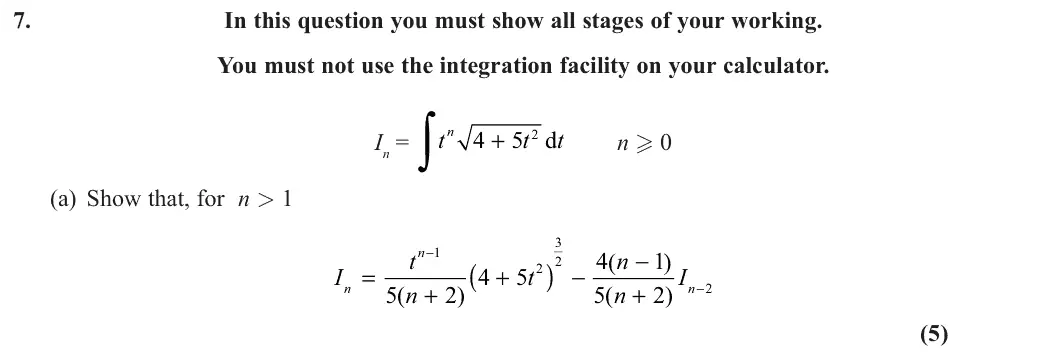
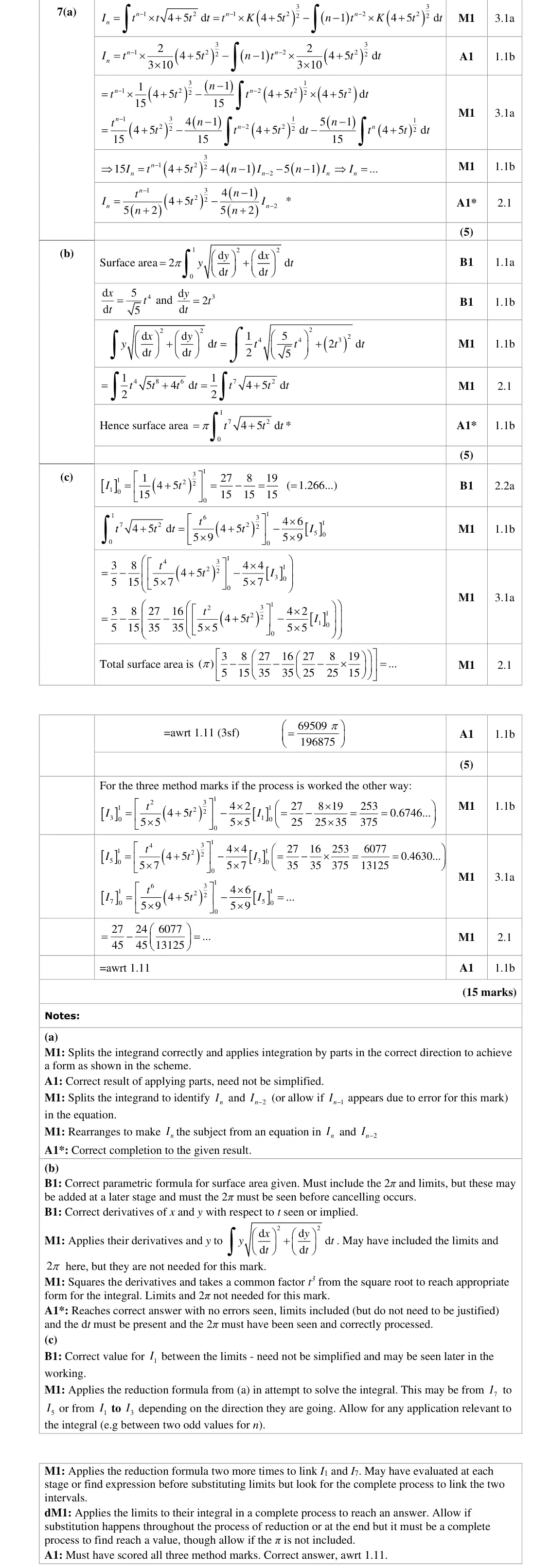
Nov 2021 · Paper 4A (Further Pure 2) · Q7(a)5 marks
Mark scheme (whole question; this part is marked with the orange bar)
Key points from the mark scheme and examiner's report
parts with tⁿ⁻¹ and t√(4 + 5t²)
write (4 + 5t²)^(3/2) as (4 + 5t²)√(4 + 5t²) to get Iₙ and Iₙ₋₂
make Iₙ the subject
Nov 2021 · Paper 4A (Further Pure 2) · Q7(b)5 marks
Mark scheme (whole question; this part is marked with the orange bar)
Key points from the mark scheme and examiner's report
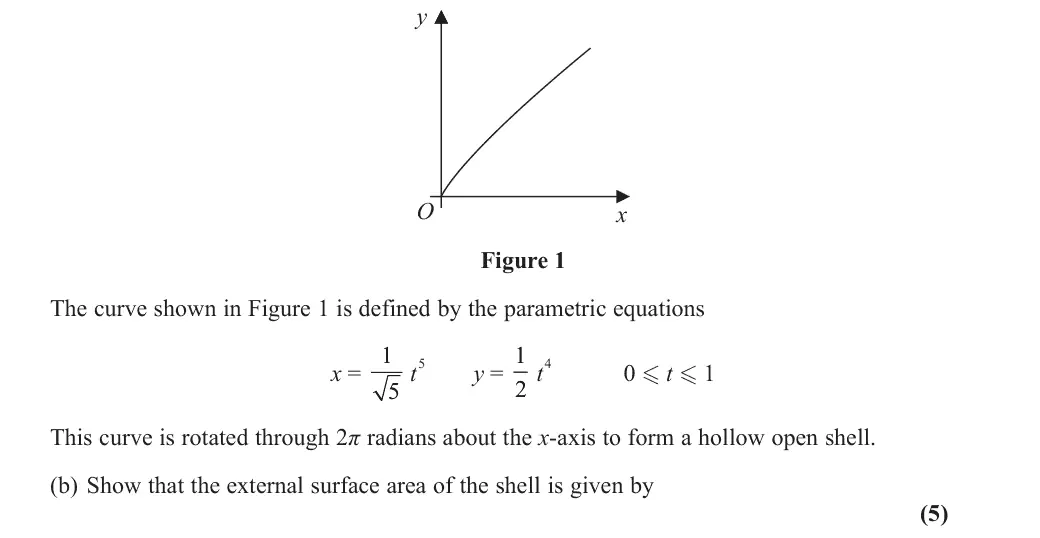
S = 2π∫ y √(ẋ² + ẏ²) dt with ẋ = 5t⁴/√5, ẏ = 2t³
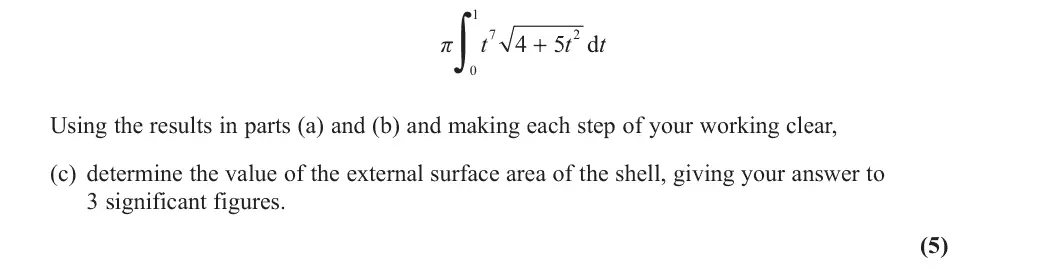
take out t³ to get π∫ t⁷√(4 + 5t²) dt from 0 to 1
Nov 2021 · Paper 4A (Further Pure 2) · Q7(c)5 marks
Mark scheme (whole question; this part is marked with the orange bar)
Key points from the mark scheme and examiner's report
I₁ = 19/15 directly, then apply the formula for I₃, I₅, I₇ with limits
S = 69509π/196875 ≈ 1.11
calculator integration not allowed
Oct 2020 · Paper 4A (Further Pure 2) · Q410 marks
Mark scheme (whole question; this part is marked with the orange bar)
Key points from the mark scheme and examiner's report
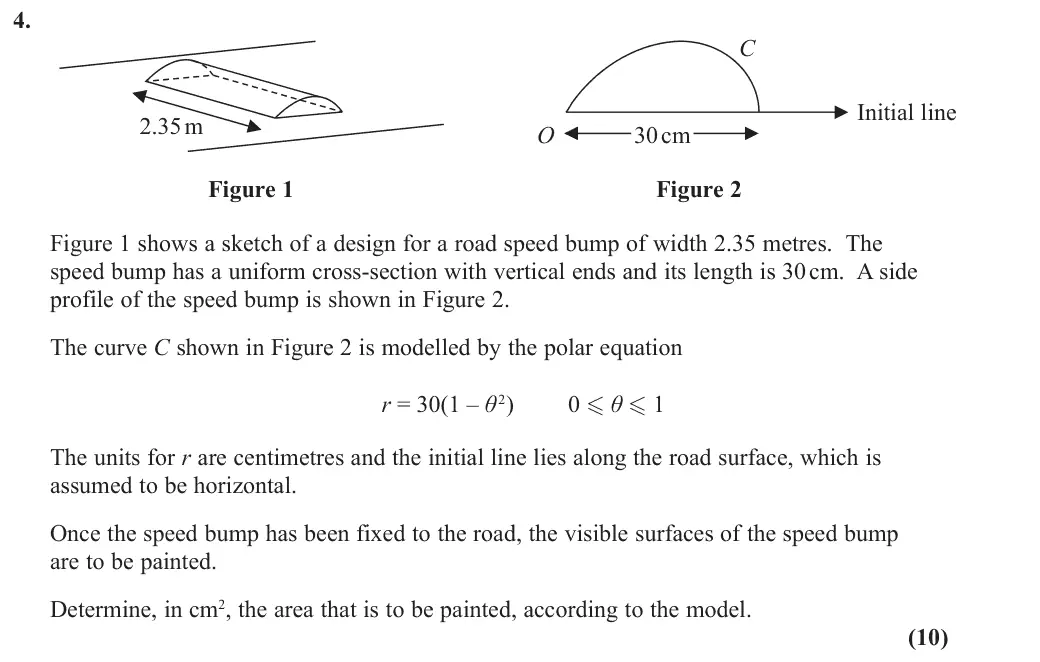
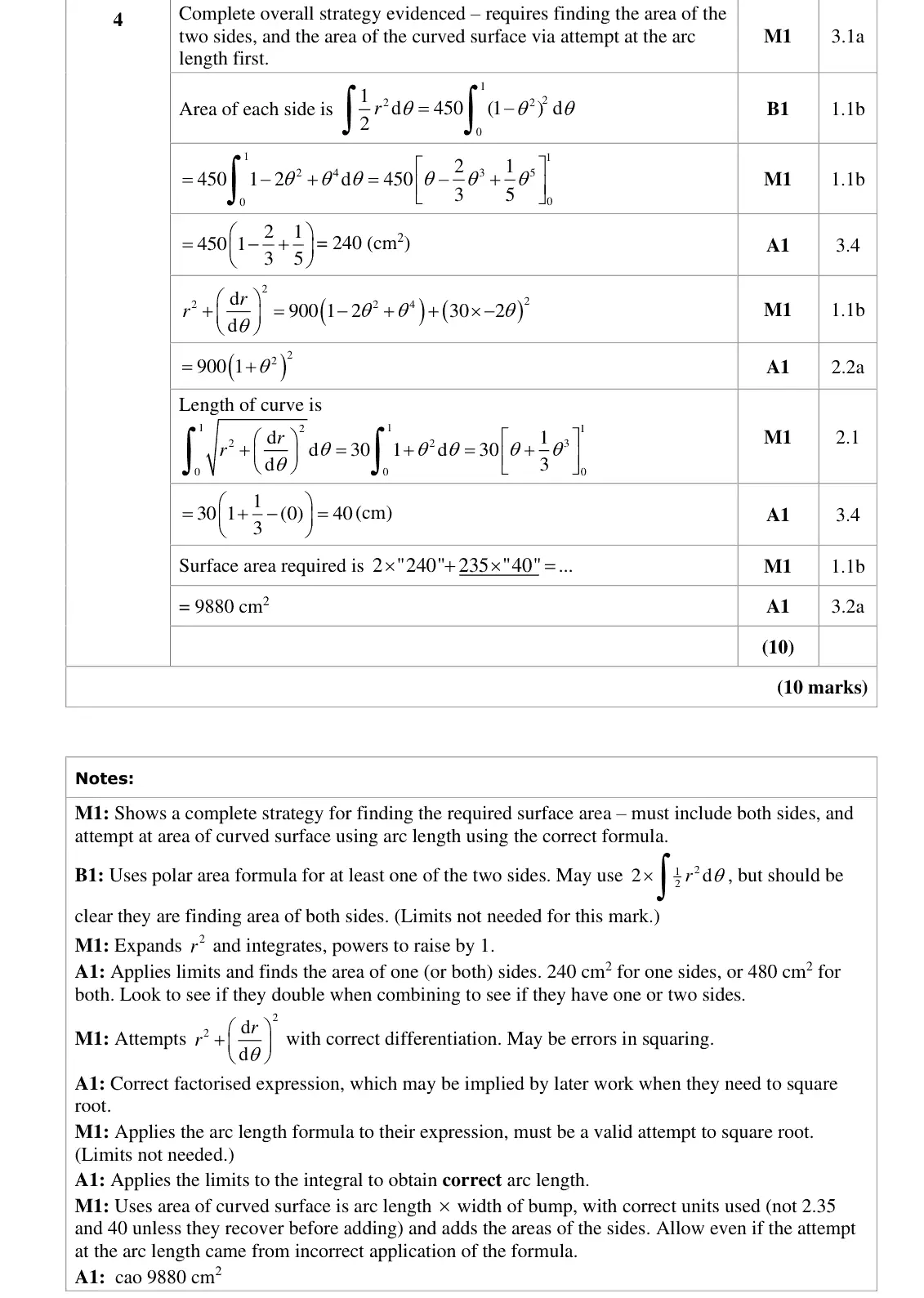
needs both end faces (polar area ½∫r²dθ = 240 each) plus curved surface = arc length × 235
r² + (dr/dθ)² = 900(1 + θ²)², arc length 40 cm
total 9880 cm²
keep units consistent (235 cm not 2.35 m)
Oct 2020 · Paper 4A (Further Pure 2) · Q7(a)5 marks
Mark scheme (whole question; this part is marked with the orange bar)
Key points from the mark scheme and examiner's report
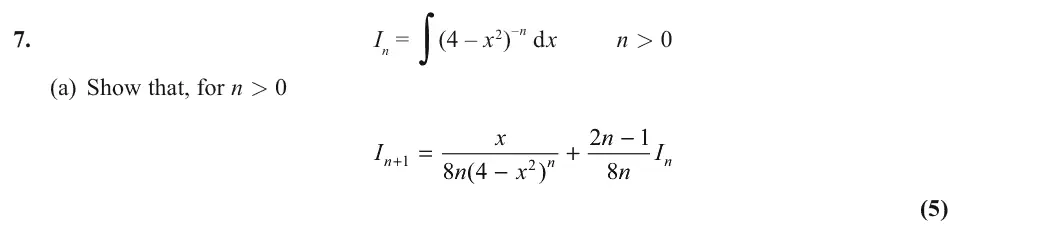
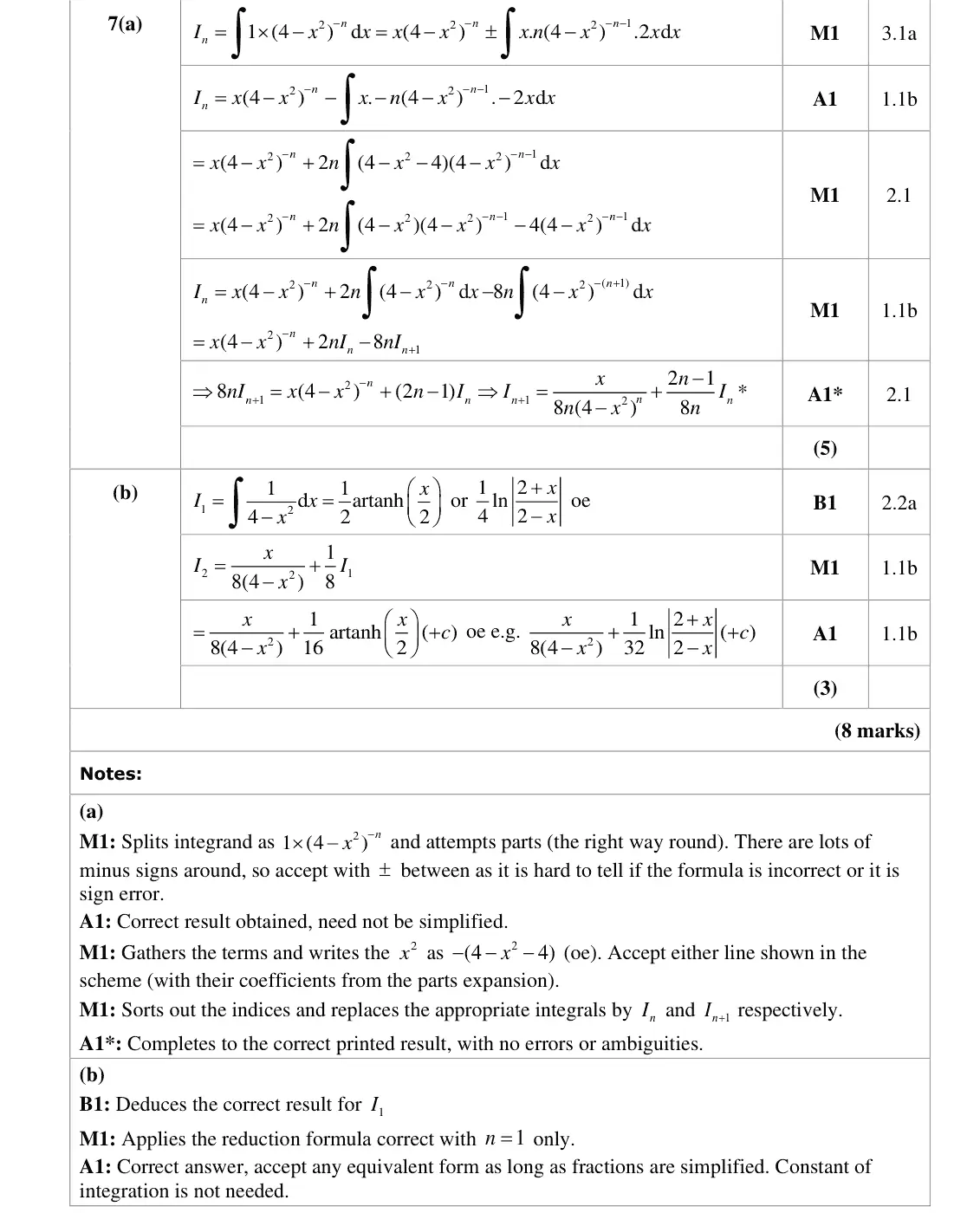
integrate 1 × (4 − x²)⁻ⁿ by parts
write x² = −((4 − x²) − 4) to get Iₙ and Iₙ₊₁
many sign hazards
printed result
Oct 2020 · Paper 4A (Further Pure 2) · Q7(b)3 marks
Mark scheme (whole question; this part is marked with the orange bar)
Key points from the mark scheme and examiner's report
I₁ = ½ artanh(x/2) or ¼ ln((2 + x)/(2 − x))
n = 1 in the formula: I₂ = x/(8(4 − x²)) + (1/16) artanh(x/2) + c
June 2019 · Paper 4A (Further Pure 2) · Q5(a)4 marks
Mark scheme (whole question; this part is marked with the orange bar)
Examiner's comment
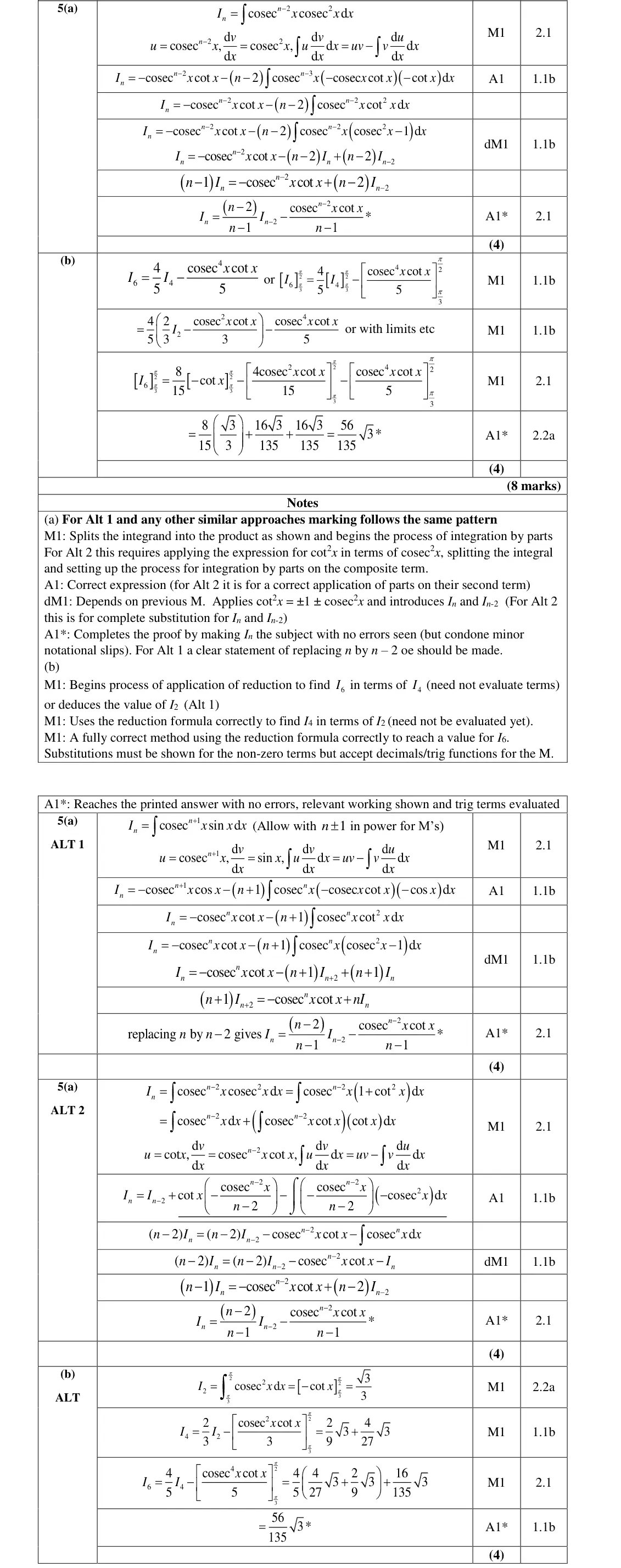
This was another familiar topic to candidates, having been on the previous specification, but the proof of a reduction formula such as this one is still a challenge for many. Those who had practised similar questions to know the split required did well, while others found it difficult to make much progress. Many candidates were able to answer part (a) using the main method shown on the mark scheme, splitting cosecn x into cosecn-2 x and cosec2 x, and correctly integrating with the appropriate choice of u and v. Those who attempted the alternative ways were fewer in number and mainly unsuccessful. Most of the algebra seen was correct, but some weaker candidates could not start this part or made errors at an early stage in their integration.
Key points from the mark scheme and examiner's report
split cosecⁿx = cosecⁿ⁻²x cosec²x and integrate by parts
replace cot²x by cosec²x − 1 to reintroduce Iₙ and Iₙ₋₂
printed answer so no slips
June 2019 · Paper 4A (Further Pure 2) · Q5(b)4 marks
Mark scheme (whole question; this part is marked with the orange bar)
Examiner's comment
This was another familiar topic to candidates, having been on the previous specification, but the proof of a reduction formula such as this one is still a challenge for many. Those who had practised similar questions to know the split required did well, while others found it difficult to make much progress. Good candidates made their final method in part (b) very clear, using a complete series of reduction formulae and substituting explicitly at the end to obtain 3 terms which summed to the given answer. A few candidates made arithmetic slips or misused the reduction formula, failing to substitute values for n correctly. Both parts had given answers (“prove that” and “show that”) and once again candidates need to remember to be clear in all steps of working to produce a convincing solution in such case. Many lost marks in part (b) in particular for arriving at the given answer without sufficient evidence of the substitution into their formula having been made.
Key points from the mark scheme and examiner's report
apply the formula for I₆ then I₄ with limits π/3 to π/2, I₂ = [−cot x] = √3/3
substitutions must be shown to reach 56√3/135
misusing n was the common slip
June 2019 · Paper 4A (Further Pure 2) · Q8(a)7 marks
Mark scheme (whole question; this part is marked with the orange bar)
Examiner's comment
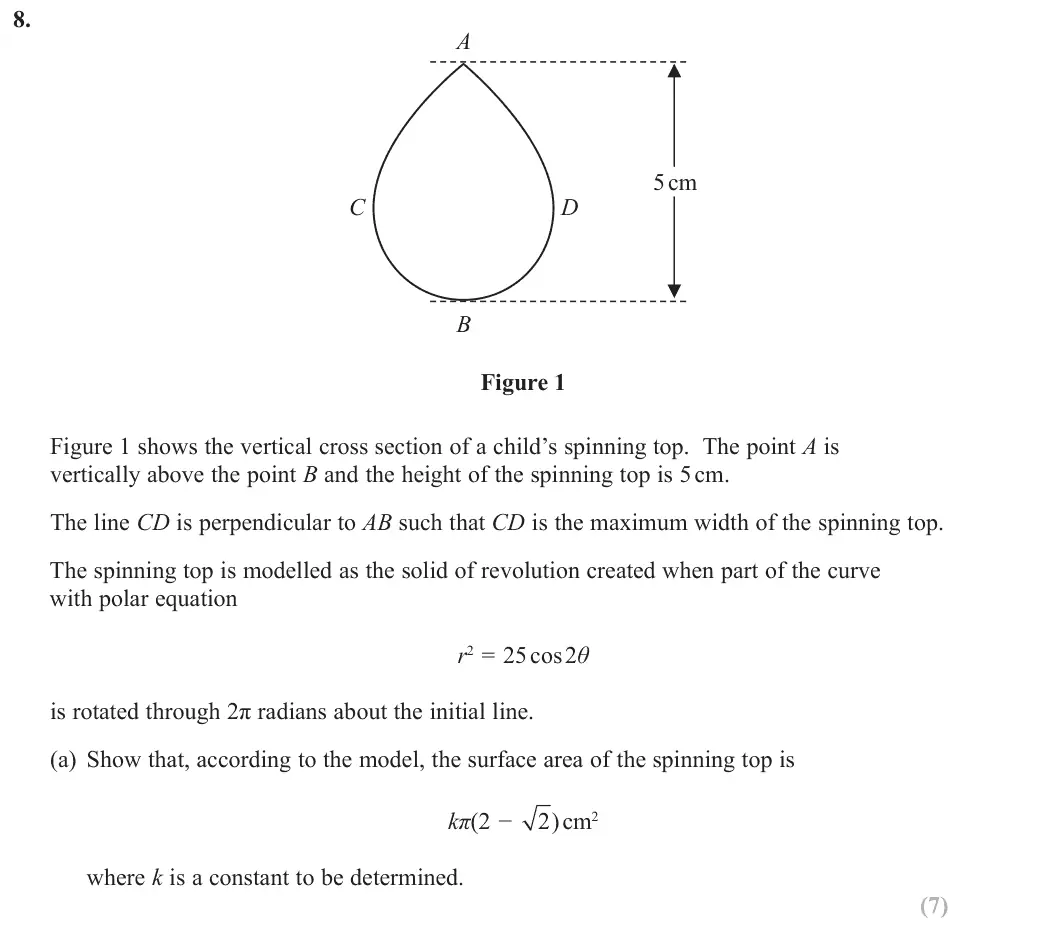
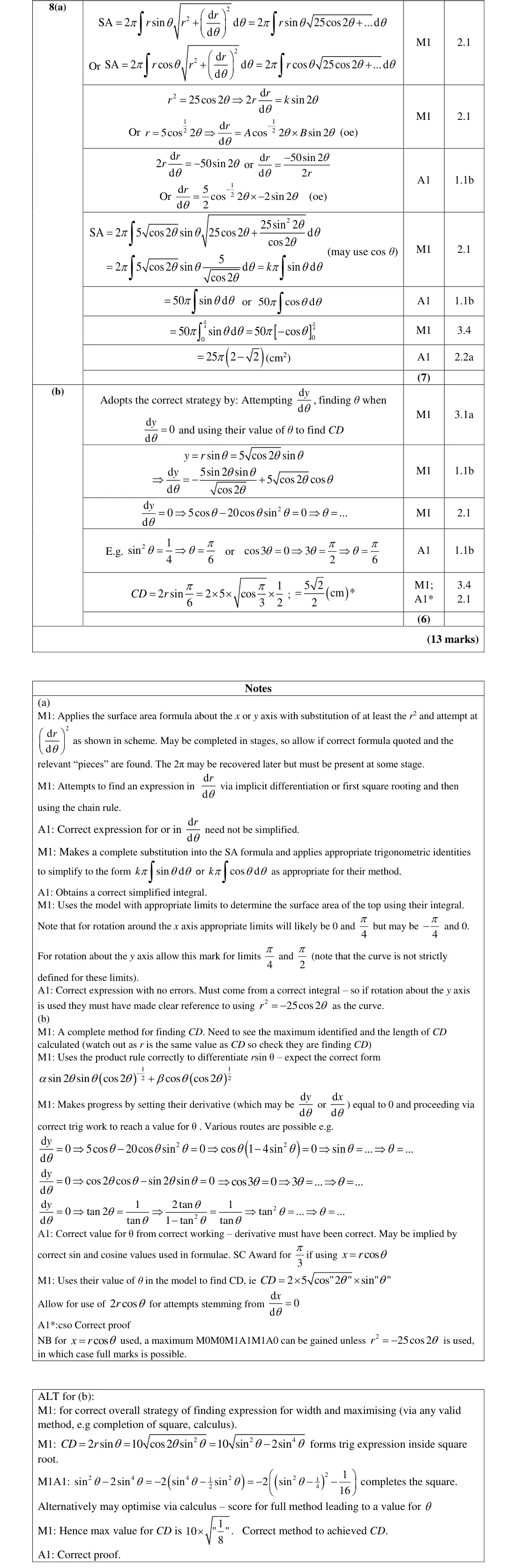
Candidates found this question very demanding, particularly part (b), but being the final question it was possible that timing was an issue for some candidates at this point. There were some good, complete answers seen, so well prepared candidates were able to complete the entire paper, but others may have spent more time than necessary on earlier questions leaving them short on time for this one. It was often difficult to follow the reasoning of candidates in their attempts at this question and generally those candidates who included a diagram of the correct curve obtained more marks than those responses with no explanation. This question did test the problem solving skills of candidates, with the orientation of the diagram not directly relating to the curve, and this did give difficulty to many, with a number of candidates assuming rotation around the y-axis was required, rather than about the x-axis. For part (a) most were able to correctly find dr/d𝜃 and then substitute this and r2 into a correct surface area formula (about either axis) and score the first three marks. However, achieving a correct simplified form proved much more of a challenge, with errors in algebra meaning attempts often ground to a halt. But there were also some very well executed solutions simplifying this form to a simple form to integrate. In such cases incorrect selection of limits prevented access to the final two marks. Those rotating about the y-axis in particular had trouble identifying correct limits, since the curve is not defined between the expected ones (though it is doubtful any candidates appreciated this).
Key points from the mark scheme and examiner's report
S = 2π∫ y √(r² + (dr/dθ)²) dθ about the initial line with y = r sin θ
simplifies to 50π∫ sin θ dθ from 0 to π/4 = 25π(2 − √2), k = 25
many rotated about the wrong axis or used wrong limits
June 2019 · Paper 4A (Further Pure 2) · Q8(b)6 marks
Mark scheme (whole question; this part is marked with the orange bar)
Examiner's comment
Candidates found this question very demanding, particularly part (b), but being the final question it was possible that timing was an issue for some candidates at this point. There were some good, complete answers seen, so well prepared candidates were able to complete the entire paper, but others may have spent more time than necessary on earlier questions leaving them short on time for this one. It was often difficult to follow the reasoning of candidates in their attempts at this question and generally those candidates who included a diagram of the correct curve obtained more marks than those responses with no explanation. This question did test the problem solving skills of candidates, with the orientation of the diagram not directly relating to the curve, and this did give difficulty to many, with a number of candidates assuming rotation around the y-axis was required, rather than about the x-axis. Successful attempts at part (b) were rare, though some excellent solutions were seen, showing the understanding of what was required and carrying the processes correctly. Few who identified the correct method made errors in algebra. Some candidates used a maximisation process on the length of CD via completing the square on the trigonometric function rather than differentiation. It was also important that the candidates demonstrated that they were finding the length CD, and not the value of r, since these had the same value, and some candidates proceed only as far as r. However, the majority of candidates did not realise what was required and either did not attempt this part or set off in a wrong direction. Many assumed the arc length was required and consequently attempted another integration. Many again mixed up directions and attempted to find dx/d theta , for which partial credit could be scored, but in most cases they did not proceed far enough to do so.
Key points from the mark scheme and examiner's report
maximise y = r sin θ: dy/dθ = 0 gives sin²θ = 1/4, θ = π/6
CD = 2r sin θ = 5√2/2
very demanding, a correct sketch of the curve helped
Find an Edexcel Further Maths tutor
Stuck on this? Book a trial lesson with our Further Maths tutor.










![5. ∫cosec I x x d n ] = n ∈ n (a) Prove that, for n . 2 n cosec x cot x - n - I I = - n n n - n - - (4)](/img/JUN19_9FM04A/JUN19_9FM04A_05(a).webp)