Examiner's comment
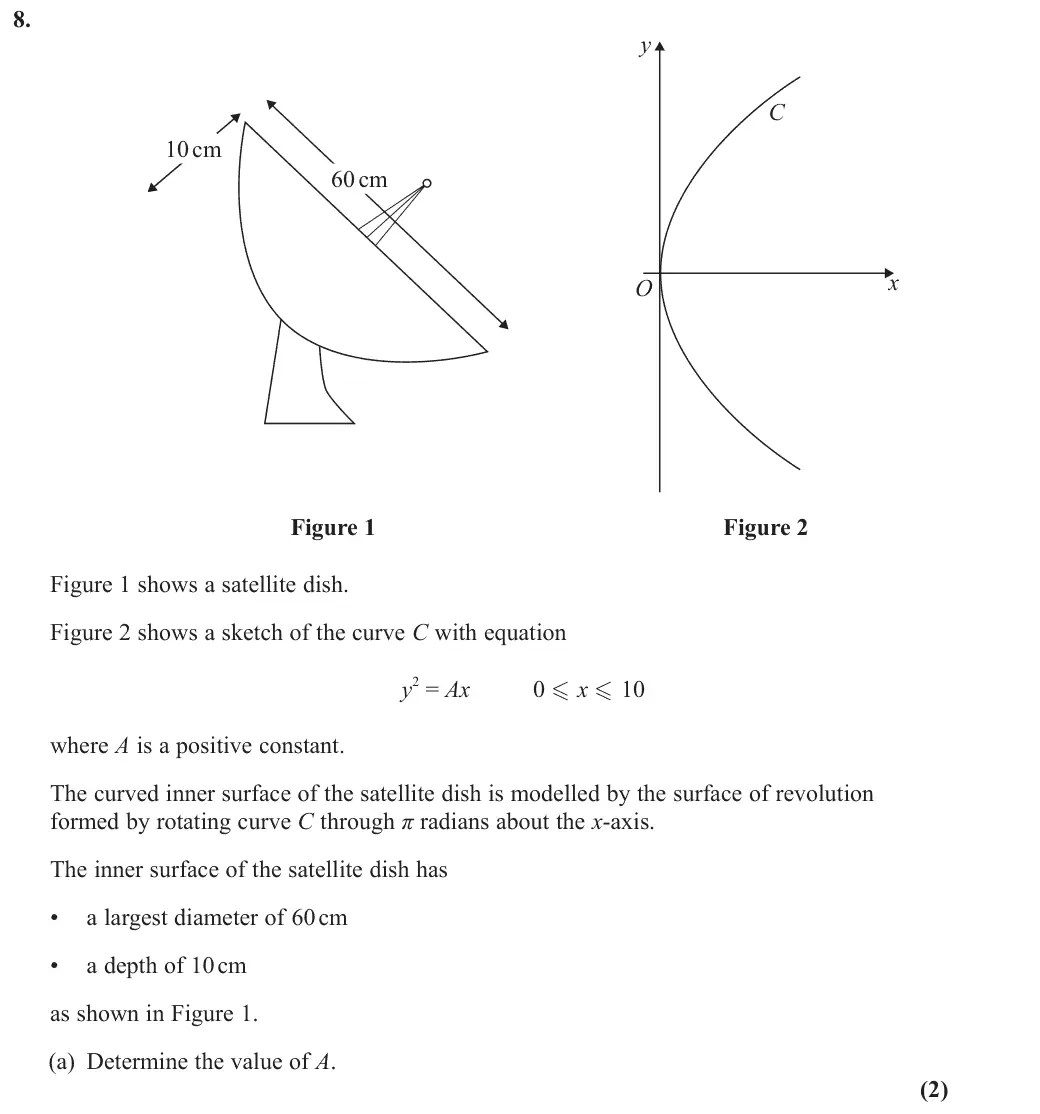
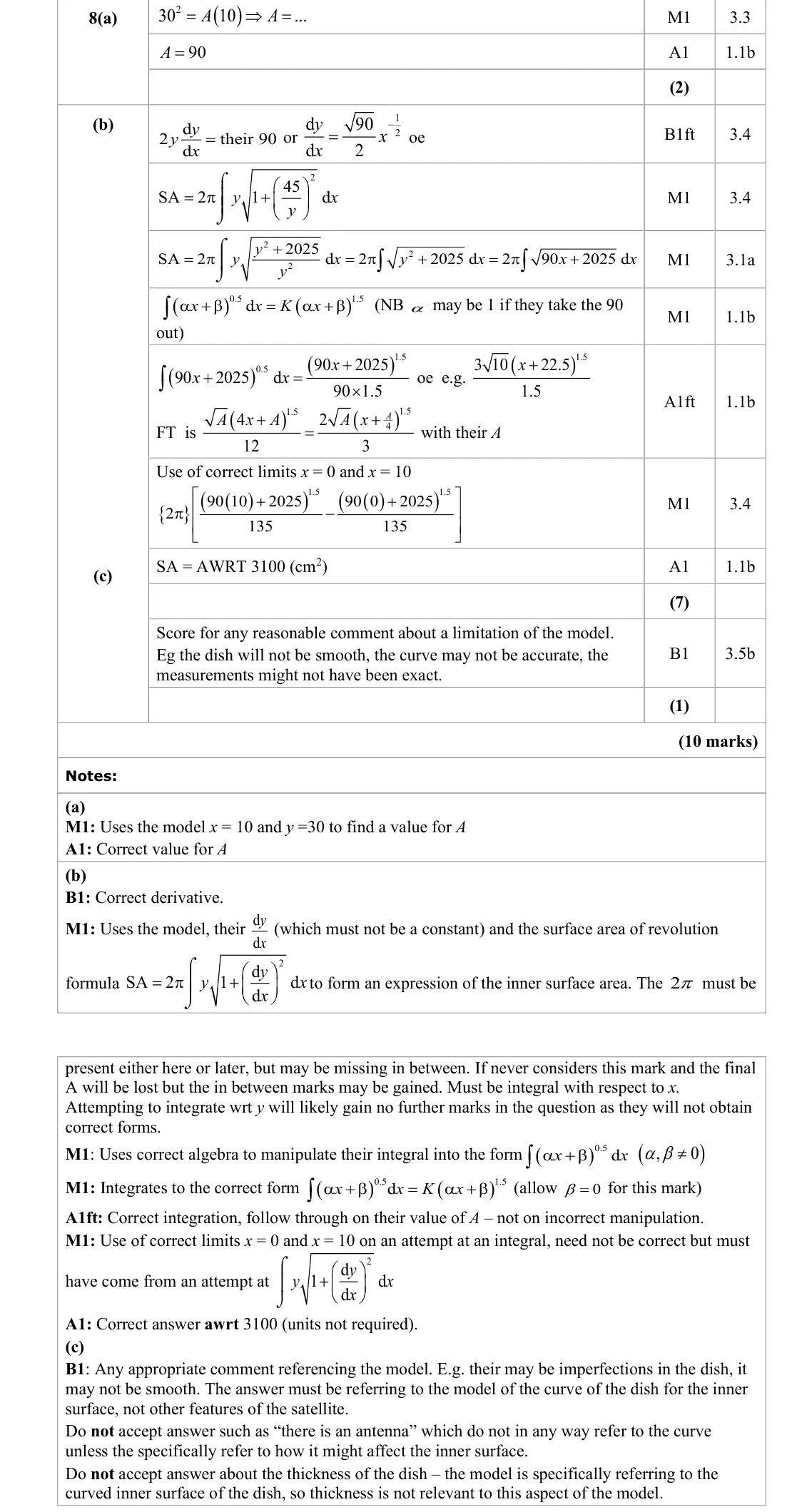
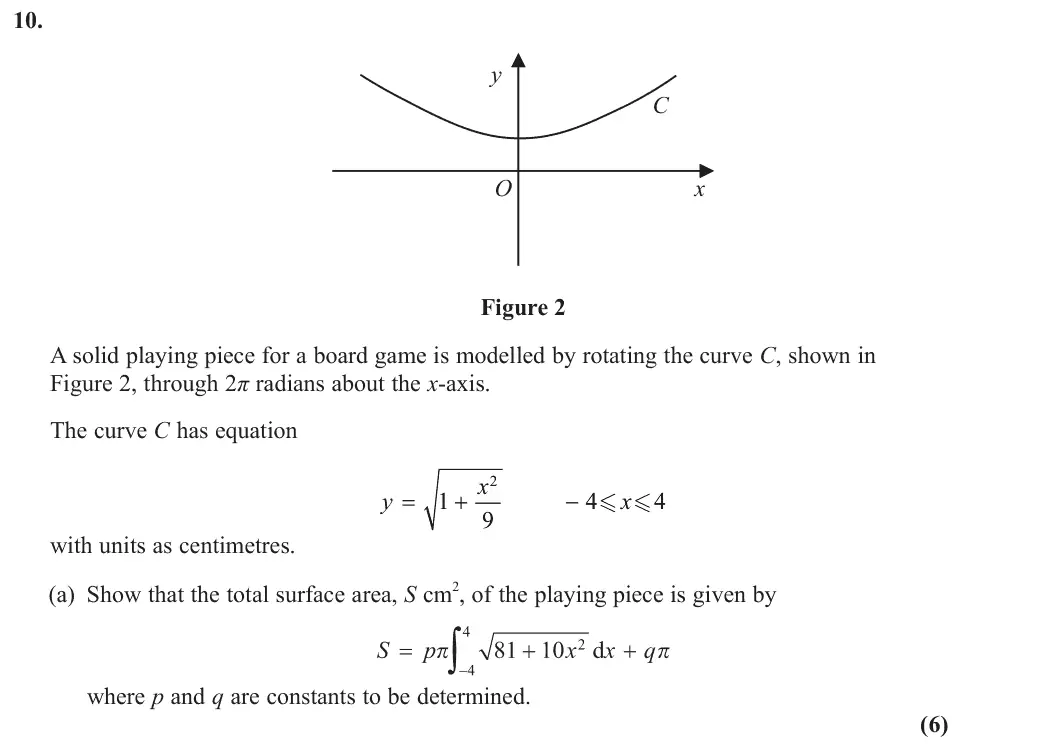
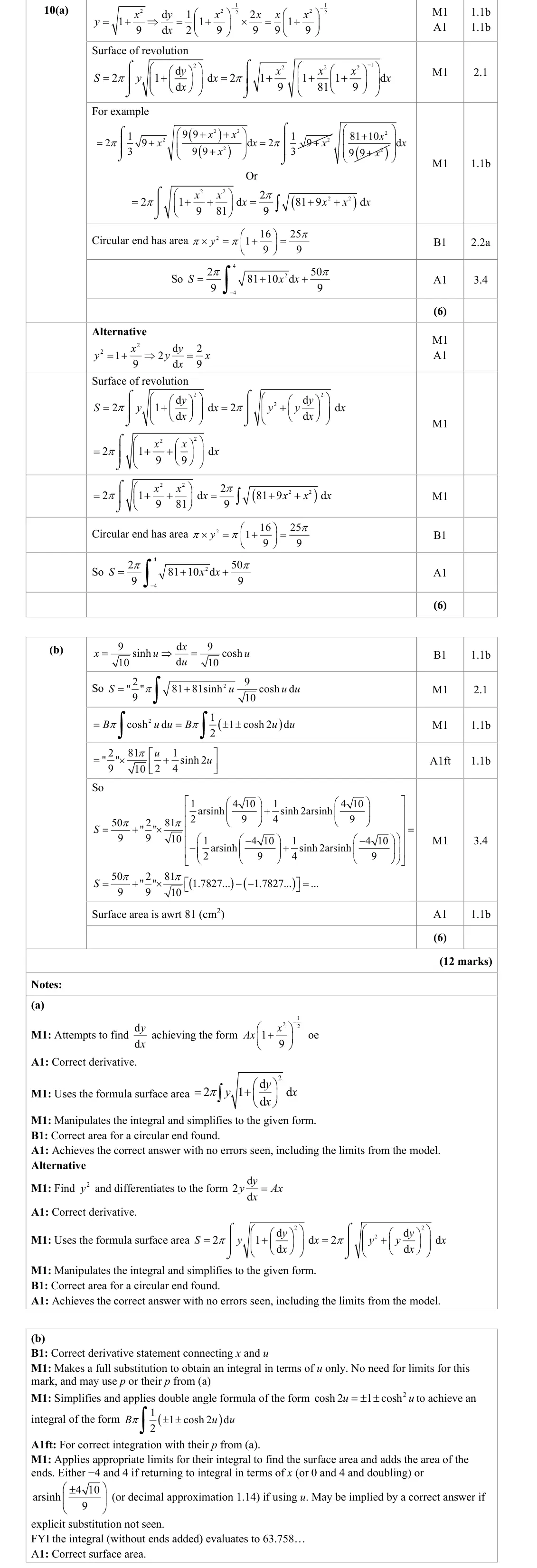
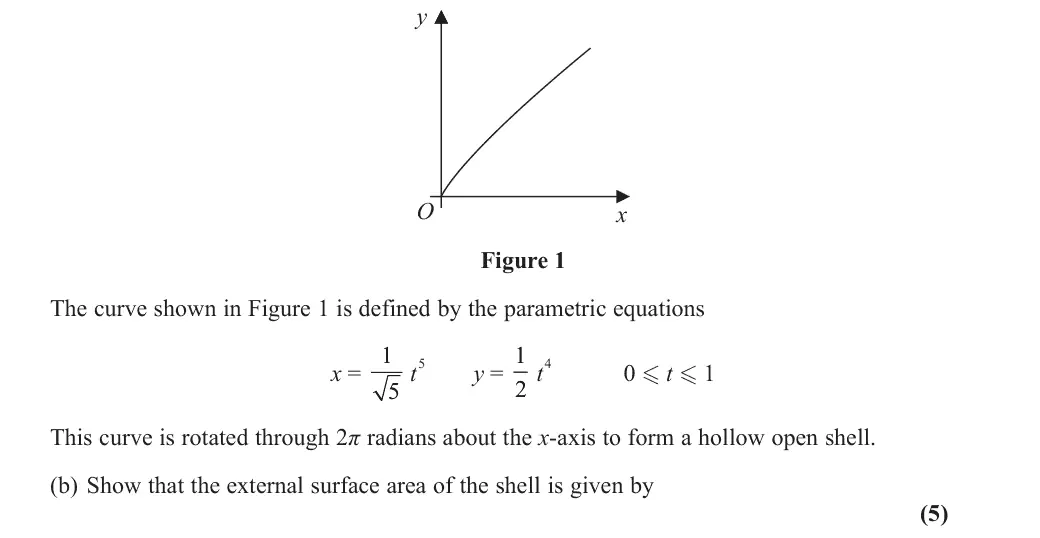
This question in modelling a satellite was another in which some students hampered themselves part way through by trying to overthink the problem, with many trying far more complicated integration techniques than was necessary. But the general procedures required were shown to be understood, saving that many were confused about the constant needed in front of the integral – whether it need pi or 2 pi . There was a bit more of a mixed performance in part (b), most notably to do with whether the curve was to be rotated by pi or 2 pi . This was due to the curve in the sketch being above and below the axis, and students not realising the equation 90 y x = only represents the part above the axis, so needs rotating by 2 pi . Many instead rotated by pi and only calculated half of the surface area. Most candidates started well by finding d d y x correctly, following through their answer to (a) in some cases. Both versions in the scheme were seen equally frequently, but the implicit approach was less prone to slips being made. Again, most attempted the surface area formula, with the proviso about the multiple noted above costing some the first M, but some variations on the formula were seen, for instance 2 d d 1 d x y y y + ∫ was used on numerous occasions, which is a correct alternative and gave a suitable integrable function. However, some had versions with x instead of y in front of the square root, and so were incorrect, and these could generally not score any marks as the resulting integral was not of a suitable form. Examiner had to be diligent in checking the equations. Whichever form was used, substituting into the formula usually followed but not were able to manipulate the integral into a suitable form, and so some stopped at this stage, while others attempted integration by parts or a substitution, often going nowhere - though some and various valid substitutions were used, which again meant examiners needed to be careful to track through work to see if it was successful or not. Even among those who simplified the integral to the point shown in the mark scheme, not all spotted the inverse chain rule integration approach but instead attempted a trigonometric or hyperbolic substitution over thinking the problem. Some of these were correct and reached the correct answer (or half of it if the 2 was missing), but students ought to be watchful for the more direct route, expecting a substitution to be specified if needed. Those who spotted the simpler route were usually successful in attaining a correct follow through integral for their A, or at least a correct form for it – some square rooted the 90 incorrectly to lose the follow through accuracy mark at this stage. Substitution of limits at the end, providing that a suitable attempt at the surface area integral had been made, gave a bit of access to students even when the integration itself had gone wrong as long as they persisted in reaching that stage, which most did. Although there were various approaches to the integral taken many did manage to find a value for the surface area, but the most common error was the wrong coefficient at the start, reaching 1600 cm2 rather than 3100 cm2, with nearly half of students completing the problem giving this answer.